PART2:“PAINT THAT UGLY PORCH OR I’LL HAVE YOU ARRESTED!” HOA Karen Sent the Sheriff to My Lake Cabin Five Times—She Had No Idea What I Found in the County Records
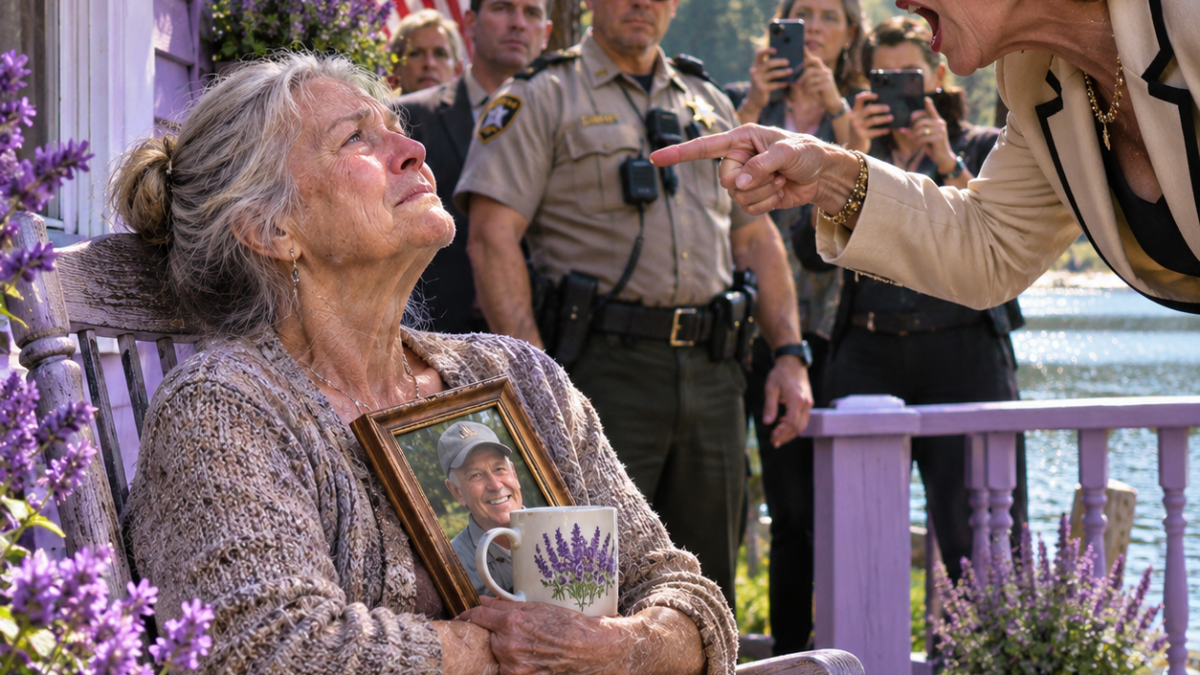
PART2
The first violation notice appeared three days after the paint dried.
I found it taped to my screen door when I returned from the grocery store.
The paper was white, the lettering black, and the language as cold as if someone were announcing a criminal sentence.
NOTICE OF NONCOMPLIANCE
Violation: Unauthorized exterior color modification.
Required correction: Repaint the porch using an approved neutral shade within seven days.
Failure to comply may result in escalating fines and legal proceedings.
I stood there holding a bag of groceries and read the notice twice.
Then I laughed.
I couldn’t help it.
The idea that a woman could simply declare authority over property she didn’t legally govern was absurd.
I took the paper inside, placed it on the kitchen table, and made myself a cup of tea.
For a few minutes, I considered throwing it away.
But thirty years of teaching had taught me something useful about people who abused authority.
They often depended on their targets being too intimidated, too disorganized, or too tired to challenge them.
And the first thing people like Jerry wanted was for you to believe their paperwork meant more than your rights.
So instead of throwing the notice away, I photographed it.
Then I placed it in a folder.
I didn’t know it then, but that folder would become one of the most important things I owned.
The second notice arrived two days later.
This one concerned my wind chimes.
Greg had bought them for me on our twenty-fifth wedding anniversary.
They were made of thin silver tubes and small pieces of blue glass.
When the breeze came off the lake, they produced the gentlest sound.
Greg used to say it reminded him of rain falling somewhere far away.
I’d hung them near the porch steps because I wanted to hear them while sitting outside.
Jerry apparently found them offensive.
Violation: Unapproved exterior sound-producing ornament.
I stared at the paper.
“Sound-producing ornament?”
I looked up at the wind chimes.
They moved softly in the breeze.
I almost expected them to apologize.
Three days later, another notice appeared.
My trash can was the wrong color.
The association supposedly required charcoal gray.
Mine was slate blue.
Then came a complaint about my lavender flowerpots.
They exceeded the permitted decorative height.
I measured them.
Twenty-four inches.
Apparently, my flowerpots had become a threat to neighborhood harmony.
Within two weeks, I’d collected enough notices to wallpaper part of my pantry.
At first, I found it funny.
Then the threats became more serious.
Jerry began adding administrative penalties.
Her letters warned about further enforcement.
One mentioned potential legal action.
And one afternoon, I noticed a man standing across the road photographing my porch.
I opened the screen door.
“Can I help you?”
He startled.
For a moment, he looked like a child caught stealing cookies.
Then he lowered his camera and hurried toward his car.
I watched him drive away.
The laughter I’d felt when the first notice arrived was gone.
I had moved to Timberpine Lake because I wanted quiet.
I wanted to sit beside the water and remember Greg without feeling as though the walls were closing in.
Instead, I found myself watching the road every time a vehicle slowed.
Waiting for the next letter.
Wondering whether someone was photographing my home.
It wasn’t the paint that frightened me.
It was the idea that a stranger had decided she could interfere with my life simply because I refused to obey her.
The first sheriff’s visit came on a Tuesday morning.
I was watering a row of potted herbs when a cruiser rolled into my driveway.
I set down the watering can.
A broad-shouldered man in his fifties stepped out.
His uniform looked slightly rumpled, and his face carried the permanent sunburn of someone who spent more time outdoors than behind a desk.
“Morning, ma’am.”
“Good morning, Officer.”
“Sheriff Clay Dobbins.”
He tipped his hat.
“I’m here concerning a complaint.”
I looked toward my porch.
“Let me guess.”
He sighed.
“Exterior modifications.”
“The lavender?”
His expression suggested he’d already guessed.
“Yes, ma’am.”
I folded my arms.
“Would you like to arrest the paint or the person who applied it?”
For a moment, he stared at me.
Then he gave a reluctant smile.
“Neither, hopefully.”
I invited him onto the porch.
I had my closing documents in a drawer beside the front door.
I retrieved the recorded survey and property description.
“Here.”
He examined them.
Then looked toward the road.
“Your cabin is outside the HOA boundary.”
“Exactly.”
He nodded.
“I don’t see anything here establishing that the association has authority over your property.”
I felt relief.
“Thank you.”
He handed the papers back.
“Sorry to bother you, Mrs. Rhodes.”
I smiled.
“No offense taken. Would you like some tea?”
He chuckled.
“Better get moving.”
As he walked toward his cruiser, I noticed Jerry standing beside her SUV across the road.
Her arms were crossed.
Her sunglasses reflected the sunlight.
She watched the sheriff approach.
Then began gesturing sharply.
Even from my porch, I could tell she was furious.
Sheriff Dobbins listened for a moment.
Then shook his head.
Jerry pointed toward my cabin.
He shook his head again.
Finally, he returned to his vehicle and drove away.
I stood on the lavender porch, feeling a small satisfaction.
Surely that would settle the matter.
A sheriff had reviewed the documents.
The property boundary was clear.
Jerry had no legal reason to keep harassing me.
I went inside and made another cup of tea.
I should have known better.
That evening, someone knocked on my door.
A woman stood outside wearing jeans and a faded green T-shirt with the words Plant Trees, Not Tyranny printed across the chest.
She had dark hair pulled into a messy ponytail and a smile that immediately put me at ease.
“You’re Evelyn?”
I nodded.
“Talia Jang. I live two cabins down.”
I smiled.
“Nice to meet you.”
She glanced at my porch.
“I love the color.”
I laughed.
“Don’t let Jerry hear you say that.”
Talia grinned.
“Oh, I’ve been saying worse things about Jerry for years.”
I invited her inside.
We sat at the kitchen table with iced tea.
She explained that Jerry had been the HOA president for fifteen years.
“Fifteen?”
Talia nodded.
“Long enough to start believing she owns the entire lake.”
I shook my head.
“She keeps sending violation notices, but my property isn’t part of the association.”
“I know.”
“Then why?”
Talia looked toward the window.
“Because she hates being told no.”
I leaned back.
“That’s hardly a legal basis for fines.”
Talia smiled.
“Legal basis doesn’t always stop her.”
She told me stories about homeowners receiving complaints over mailbox heights, flag placement, wind chimes, garden ornaments, and outdoor furniture.
Some were legitimate association matters.
Others sounded petty.
A few sounded deliberately punitive.
“People usually give in,” she said.
I looked down at my tea.
“Why?”
“Because Jerry makes resisting exhausting.”
That sentence stayed with me.
Talia continued.
“She sends notices. Threatens hearings. Brings in lawyers. Makes people think they’ll spend more money fighting than complying.”
I thought about the notices in my pantry.
The man taking photographs.
The sheriff’s visit.
“What happens to people who don’t comply?”
Talia’s smile disappeared.
“Sometimes they leave.”
I stared at her.
She looked toward the lake.
“And I think that’s exactly what she wants.”
A week later, a thick envelope arrived by certified mail.
The return address read:
ELKINS LAW GROUP
I opened it at the kitchen table.
The letter accused me of willful noncompliance with community standards, damage to neighborhood property values, and creating what the attorney described as a hostile aesthetic environment.
I read that phrase several times.
A hostile aesthetic environment.
I looked through the window at my little lavender porch.
A hummingbird hovered near the flowers.
The wind chimes rang softly.
The lake glittered in the afternoon sunlight.
If this was hostility, I couldn’t imagine what peace was supposed to look like.
Then I reached the final paragraph.
The attorney demanded that I repaint the porch, remove the disputed ornaments, and comply with the HOA’s regulations.
Otherwise, legal proceedings would follow.
The letter was signed:
Mark Elkins, Esq.
The name sounded familiar.
I called Talia.
“Do you know a lawyer named Mark Elkins?”
She groaned.
“Oh, you’ve met Jerry’s nephew.”
I closed my eyes.
“Her nephew?”
“Yes. He’s been helping her with legal threats for years.”
I stared at the letter.
“Wonderful.”
Talia sighed.
“She’s escalating.”
I ran a hand across my forehead.
“All because of a porch.”
“No, Evelyn.”
Her voice became serious.
“Because you’re refusing to let her control you.”
I looked at Greg’s photograph on the windowsill.
He was smiling at the camera, wearing his old gardening hat.
For a moment, I wanted to cry.
I hadn’t retired here to become an activist.
I’d already spent decades advocating for students whose voices were ignored.
I’d argued with school boards over arts funding.
I’d defended teenagers who were punished more harshly than wealthier classmates.
I’d stood beside families who needed someone to explain complicated procedures.
I was tired.
I wanted quiet mornings.
Books.
Lavender flowers.
A little peace after losing the man I loved.
Instead, a woman who didn’t even govern my property was threatening me with attorneys.
I picked up the letter.
Folded it carefully.
And placed it beside the others.
Then I called Talia again.
“There’s something I’d like to know.”
“What?”
“Who else has Jerry done this to?”
That question led me to Edwin and Marie Simmons.
They lived near the end of the lane in a cabin older than mine.
Their property had a broad wooden porch, stone steps, and flowerbeds Marie maintained with extraordinary care.
Greg and I had actually rented their cabin for a summer many years earlier.
I remembered sitting beside the lake with him, watching the sun disappear behind the trees.
When Marie opened the door, she recognized me.
“Evelyn?”
I smiled.
“Hello, Marie.”
She embraced me.
“Oh, honey. I heard about Greg.”
My throat tightened.
“Thank you.”
She held my hands.
“He was a wonderful man.”
I nodded.
“He was.”
Then she looked at the folder beneath my arm.
Her expression changed.
“Jerry?”
I laughed weakly.
“How did you guess?”
Marie sighed.
“Come inside.”
Edwin was sitting near the fireplace reading a newspaper.
He looked up when we entered.
“Well, now.”
He smiled.
“Evelyn Rhodes.”
I greeted him.
Then explained what was happening.
The paint.
The notices.
The sheriff.
The attorney.
As I spoke, Edwin’s expression grew darker.
When I finished, he stood and walked toward a bookshelf.
He returned carrying a thick manila folder.
He placed it on the table.
“You’re not the first.”
I stared at it.
He opened the folder.
Inside were copies of letters.
Photographs.
Notes.
HOA notices.
Records from previous disputes.
Marie pointed toward one section.
“The Clarks lived near here.”
I remembered the name vaguely.
“They moved?”
She nodded.
“After months of violations and threats.”
Edwin shook his head.
“Jerry made their lives miserable.”
I looked through the documents.
The complaints were relentless.
One after another.
Some seemed laughably minor.
Others involved fines large enough to frighten anyone living on a fixed income.
“Did they fight?”
Marie looked sad.
“For a while.”
Then she sighed.
“But eventually they sold.”
I stared at the papers.
“Did Jerry have authority over their property?”
“They were inside the HOA.”
I nodded slowly.
“Mine isn’t.”
Edwin leaned forward.
“Exactly.”
I looked at him.
He tapped the folder.
“That’s why your case matters.”
I felt a knot form in my stomach.
He continued.
“If she can force rules onto properties outside the association, what’s to stop her from claiming the entire shoreline?”
I looked through the window toward the lake.
The trees.
The old cabins.
The quiet water.
Then I remembered Jerry’s words.
Property boundaries can be complicated.
I had thought she was simply being arrogant.
Now I began wondering whether she’d been preparing something much more deliberate.
That night, I started organizing my own evidence binder.
I bought a thick three-ring binder, divider tabs, plastic sleeves, and a stack of labels.
Then I spread everything across the kitchen table.
Every violation notice.
Every photograph.
Every legal threat.
The property survey.
The sheriff’s visit.
The dates and times I’d seen someone photographing my porch.
Copies of emails.
Notes about conversations.
I recorded what I remembered as carefully as possible.
Not what I suspected.
Not what I hoped to prove.
Only what I knew.
I’d spent thirty years telling students that a strong argument required evidence.
Now I was following my own advice.
I labeled the first section:
PROPERTY OWNERSHIP AND HOA BOUNDARIES
The second:
UNAUTHORIZED ENFORCEMENT NOTICES
The third:
HARASSMENT AND LAW ENFORCEMENT CONTACTS
The fourth:
ATTORNEY CORRESPONDENCE
And the fifth:
OTHER PROPERTY OWNERS’ EXPERIENCES
I sat back when I finished.
The binder was already thick.
I looked at Greg’s photograph.
“Well, sweetheart,” I whispered, “your old schoolteacher has homework again.”
I almost heard him laugh.
Then I turned off the kitchen light.
For the first time since Jerry appeared, I slept without checking the driveway twice.
The following morning, I drove to the county clerk’s office in Millersfield.
It was about forty-five minutes away.
The road wound through forests and small towns.
I passed old barns, gas stations, and stretches of farmland where the autumn light made everything appear golden.
The clerk’s office occupied an ugly concrete building from the 1970s.
Inside, fluorescent lights buzzed overhead.
A man behind the counter looked up from his computer.
“Can I help you?”
“I’m hoping to examine the original recorded boundary plat for Timberpine Lake.”
He blinked.
“That one’s old.”
“I know.”
“What do you need it for?”
“A property dispute.”
He sighed.
“Of course.”
His name was Reggie.
He looked tired, but he was patient.
After checking the records, he disappeared into an archive room.
Several minutes later, he returned carrying a large roll of paper.
He spread it across a table.
“This is the original subdivision plat filed when the association was established in 1996.”
I leaned closer.
The lines were clear.
The HOA boundary wrapped around a section of the lakefront development.
Then stopped.
My cabin sat outside it.
I pointed.
“That’s my property.”
Reggie nodded.
“Looks like it.”
I exhaled.
“I knew it.”
He studied the map.
Then frowned.
“Hold on.”
I looked up.
“What?”
He returned to his computer.
Opened a digital mapping record.
Then turned the monitor toward me.
“That’s odd.”
I leaned forward.
The newer digital overlay showed a different boundary.
The shaded HOA area extended beyond the original line.
Right across my cabin.
I stared.
“That can’t be right.”
Reggie nodded slowly.
“Doesn’t match the recorded plat.”
I felt my heart begin pounding.
“Who changed it?”
He examined the record history.
Then looked at me.
“There’s a recent submission.”
“When?”
“Four months ago.”
“By whom?”
He read the name.
“Elkins Law Group.”
I went still.
Mark Elkins.
Jerry’s nephew.
The attorney who had threatened me.
I looked back at the screen.
The digital overlay had been modified to make my property appear as though it belonged inside the association’s boundaries.
The original recorded plat hadn’t changed.
But the newer digital map could easily mislead someone who didn’t know where to look.
I felt a cold sensation move through me.
“Can I get copies of both?”
Reggie nodded.
“Yes.”
“And the record history?”
“I can provide what the system shows.”
I took photographs.
Requested printed copies.
Saved the available metadata.
Then sat in my car outside the building, staring at the documents.
Jerry had insisted my property belonged under her authority.
Mark had sent threatening letters.
Now I had evidence that his firm had submitted a boundary revision inconsistent with the original filing.
This wasn’t proof of every motive I suspected.
But it was enough to make me believe something serious was happening.
I whispered, “What are you trying to do?”
And for the first time, I felt less like the target of a petty neighbor and more like someone who had stumbled onto a larger scheme.
I was leaving the county building when someone called my name.
“Evelyn!”
I turned.
Talia stood beside her hybrid SUV holding several folders.
I smiled.
“What are you doing here?”
She lifted the papers.
“Research.”
I held up my binder.
“Same.”
She laughed.
“Coffee?”
We walked to a small café across the street.
I spread the two maps on the table.
Talia leaned forward.
Her expression changed immediately.
“Oh, wow.”
I pointed toward the original boundary.
“My cabin is here.”
Then toward the newer version.
“And somehow, four months ago, it moved.”
Talia stared.
“Elkins?”
I nodded.
“His firm submitted the revision.”
She leaned back.
“That explains a lot.”
I frowned.
“What does?”
Talia opened one of her folders.
“There’s something else you should know about Timberpine Lake.”
She showed me a conservation document.
The lake and surrounding forest had been designated a protected ecological area decades earlier.
The designation limited certain kinds of development and environmental disturbance.
I examined the paperwork.
“Why does this matter to Jerry?”
Talia looked at me.
“Because there’s been talk about luxury development.”
I felt my stomach tighten.
“What kind?”
“A resort project. Bigger structures. More shoreline access. More construction.”
I stared at her.
“Here?”
She nodded.
“People with money have been looking at the lake for years.”
I looked down at the map.
The cabins outside the association were scattered along some of the quieter stretches of shoreline.
Talia continued.
“If Jerry could bring more properties under HOA influence, she might be able to pressure owners into standardized improvements, coordinated sales, or development agreements.”
I considered that.
It was a theory.
Not something we had fully proved.
But it provided a possible explanation for Jerry’s obsession with properties she didn’t legally govern.
I looked toward the documents.
“So this isn’t really about my porch.”
Talia shook her head.
“I don’t think it ever was.”
I felt anger rising.
My lavender porch.
Greg’s memory.
My peaceful cabin.
All of it had become part of someone else’s effort to control the shoreline.
I closed the folder.
“Then we’re going to need more than two maps.”
Talia smiled.
“I was hoping you’d say that.”
Over the next several days, I researched the laws and records surrounding the HOA.
I examined the recorded charter boundaries.
County filings.
The conservation designation.
And the legal authority claimed in Mark’s letters.
In the story that eventually became part of our court case, a provision cited as the Wisconsin Area Freedom Act of 1983 became one of the principal authorities supporting our argument that an association could not simply impose architectural rules on properties outside its legally established jurisdiction.
But the most important practical evidence remained the recorded property documents themselves.
My cabin was outside the original boundary.
No valid record I’d found established that I had joined the association or agreed to its covenants.
The newer digital overlay did not, by itself, create that authority.
I made copies of everything.
Then I called Edwin and Marie.
“We need a meeting.”
Marie didn’t hesitate.
“Come Sunday.”
We gathered on their screened porch beneath an enormous pine tree.
Edwin and Marie were there.
So was Talia.
I’d also invited two other property owners whose cabins stood outside the HOA’s original boundary.
Samir and Lena were a young couple who had inherited their grandfather’s cabin.
Dr. Howard Kaplan was a retired veterinarian who lived part-time on the far side of the lake.
I placed my binder on the table.
“Thank you for coming.”
Samir glanced at the papers.
“What’s all this about?”
I opened the first section.
“Jerry Monroe has been sending me HOA violations.”
Howard frowned.
“You’re not in the HOA.”
“Exactly.”
I spread the maps across the table.
Then explained the discrepancy.
The original 1996 plat.
The altered digital overlay.
The filing submitted by Elkins Law Group.
Lena stared at the documents.
“That’s our cabin too.”
I nodded.
“Yours is outside the original boundary.”
Samir leaned forward.
“Are you saying they’re trying to bring us into the association without our consent?”
“I’m saying the newer map shows us inside, and the original legal filing doesn’t.”
Howard shook his head.
“That’s outrageous.”
I looked around the table.
“Individually, we’re easy to intimidate.”
Marie nodded.
“That’s how Jerry operates.”
“But together,” I continued, “we can compare records, preserve evidence, and make sure nobody is misled.”
Samir looked at me.
“So what do we do?”
I took a breath.
“We stop hiding.”
Everyone became quiet.
“We stop assuming these threats are legitimate just because they arrive on official-looking paper.”
I pointed toward the binder.
“We document everything.”
Then I smiled.
“And I have a name for us.”
Talia laughed.
“Oh, this should be good.”
“The Timberpine Five.”
Edwin raised an eyebrow.
“Sounds like an old Western.”
“Good,” I said. “Because apparently we’ve got ourselves a sheriff, a villain, and a property dispute.”
For the first time in weeks, everyone laughed.
Even Howard.
But beneath the laughter was something important.
We were no longer isolated.
And Jerry was about to discover that the people she’d been pressuring had started talking to one another.
The storm arrived without warning.
I remember the sky turning almost black in the middle of the afternoon.
The wind began moving through the pines with a low, angry sound.
Then rain struck the lake.
Hard.
Within minutes, the peaceful shoreline disappeared behind sheets of water.
I secured the windows.
Brought in the flowerpots.
Checked the doors.
Then sat in the living room listening to thunder roll across the hills.
Greg had loved thunderstorms.
He’d stand beside the window and watch the lightning.
“Nature reminding us who’s really in charge,” he’d say.
I used to tell him he was being dramatic.
That night, I wished he were beside me.
The storm continued for hours.
Wind slammed against the cabin.
Branches scraped the roof.
At one point, something heavy struck above the living room.
The sound made me jump.
Then water began dripping from the ceiling.
I stared.
Another drop fell.
Then another.
Within minutes, part of the ceiling was wet.
I grabbed towels and buckets.
But there was little I could do while the storm continued.
By morning, the worst had passed.
The shoreline was covered with broken branches.
A kayak lay overturned near the dock.
Patio furniture had been blown into yards.
And a section of my roof had been damaged badly enough to allow water into the living room.
I stood beneath the exposed area, staring at the soaked floor.
For a moment, I felt exhausted.
I’d moved here to escape grief.
Then Jerry arrived.
Then the threats.
The lawyers.
The maps.
And now my roof was leaking.
I sat down on the edge of the sofa and began crying.
Not loudly.
Not dramatically.
Just the quiet, tired crying of someone who has carried too much for too long.
Then I looked toward Greg’s photograph.
I remembered the summer we’d repaired the roof of our old house.
He’d taught me how shingles overlapped.
How to identify damaged wood.
How to recognize the places water could enter.
He’d been patient.
I’d complained about the heat.
He’d laughed.
“You’re tougher than you think, Evie.”
I wiped my face.
Then stood.
“All right, Greg.”
I looked toward the ceiling.
“Let’s see what we can do.”
I arranged for emergency repairs and asked Edwin and Marie for help finding reliable assistance.
Their grandson came by to help with the initial work.
We secured a tarp, assessed the damaged area, and prepared for the replacement of affected materials.
I was careful about the roof because storm-damaged structures can be dangerous.
I knew enough from Greg’s lessons to recognize that damaged wood and slippery surfaces were not things to underestimate.
But I also knew I couldn’t leave the cabin open to more water.
By the third day, the repairs were progressing.
I was standing in the yard reviewing the work when a man appeared beside my driveway.
He wore a reflective vest and carried a clipboard.
“Mrs. Rhodes?”
“Yes?”
“I’m here concerning your unauthorized emergency repairs.”
I stared at him.
“My what?”
He gestured toward the roof.
“All post-storm exterior work must be approved through the Timberpine Lake HOA disaster recovery authority.”
I blinked.
“I’m not in the association.”
He handed me a packet.
“Temporary emergency oversight has been established for lake-adjacent properties.”
I looked at the document.
It claimed the association had been granted authority to coordinate and supervise repairs following the storm.
The language was broad.
Vague.
And deeply suspicious.
I looked at the man.
“Who authorized this?”
“The county emergency management office.”
“Under what legal authority?”
He hesitated.
“The document explains it.”
I skimmed the pages.
I found a stamp.
A signature.
References to community safety.
And language suggesting the HOA could supervise repairs on properties outside its normal boundaries.
My stomach tightened.
Jerry had found another way to claim control.
“Thank you,” I said.
The man blinked.
“So you’ll stop the work?”
“I’ll verify the paperwork.”
His expression hardened.
“Noncompliance can result in penalties.”
I looked at him.
“Then I suggest you make sure the penalties are legally supported.”
He stared at me.
Then walked away.
I watched him leave.
And immediately called the county.
The employee who answered sounded exhausted.
I explained the situation.
She searched the records.
Then sighed.
“Oh, yes. The Timberpine Lake emergency coordination request.”
I closed my eyes.
“So it exists?”
“A packet was submitted.”
“By the HOA?”
“Yes.”
“Did the county grant them authority over private properties outside their association?”
There was a pause.
“The request was processed during the emergency response.”
“That’s not what I asked.”
The employee hesitated.
“I’m not in a position to give you a legal interpretation.”
I took a breath.
“Then I need copies of the application, the approval, and the documents attached to it.”
She told me how to request them.
I wrote everything down.
Then called Talia.
“Jerry’s using the storm.”
“What?”
“She’s claiming temporary authority over everyone near the lake.”
Talia was quiet for a moment.
Then said, “Of course she is.”
I stared through the window at my damaged roof.
“I think she used the altered map.”
Talia exhaled.
“Then we need the emergency packet.”
I nodded.
“Exactly.”
The next day, a sheriff’s deputy arrived carrying an envelope.
I knew before he spoke.
Another legal action.
This time, the HOA had sued me.
The complaint alleged violations of emergency structural compliance procedures.
It sought an injunction requiring the repairs to stop or proceed under HOA supervision.
And it demanded a $2,500 penalty.
The attorney’s name was familiar.
Mark Elkins.
I stood on my porch reading the papers.
My hands trembled.
Not because I thought Jerry was right.
But because I understood the effort she was willing to make to punish me.
She had sent notices.
Called law enforcement.
Hired her nephew.
Submitted a disputed boundary map.
Then used a storm as an opportunity to extend her claimed authority.
All because I refused to repaint a porch on property she didn’t govern.
I looked toward the lake.
The water was calm again.
The storm clouds were gone.
But the feeling in my chest was worse than it had been during the thunderstorm.
I had wanted a peaceful retirement.
Now I was facing a lawsuit.
I went inside.
Placed the complaint in my binder.
And opened a new section.
EMERGENCY AUTHORITY AND DISPUTED DOCUMENTS
Then I called Edwin.
“We’re going to court.”
That evening, my phone rang from an unknown number.
I let it go to voicemail.
It rang again.
Then a third time.
On the fourth call, I answered.
“Hello?”
A woman’s voice whispered, “Mrs. Rhodes?”
“Yes?”
“I need to tell you something.”
I sat down.
“Who is this?”
“I can’t give you my name right now.”
I remained quiet.
“I’m on the HOA board.”
My stomach tightened.
She continued.
“I saw what Jerry and Mark did with the boundary map.”
I gripped the phone.
“What did they do?”
“They changed it before submitting the emergency application.”
I closed my eyes.
“Do you have proof?”
“There was an earlier draft.”
“Can you obtain it?”
She hesitated.
“I think so.”
I took a breath.
“Why are you telling me this?”
Silence.
Then her voice broke.
“Because this isn’t about safety.”
I stared at the wall.
“It’s about money.”
She continued.
“And control. Jerry wants authority over the whole shoreline. She’s been talking about development opportunities for months.”
I felt cold.
The woman whispered, “She’s willing to hurt anyone who gets in her way.”
Then the line went dead.
I sat motionless.
I had suspected the boundary change was deliberate.
Now someone inside the association was telling me the same thing.
But I still needed evidence that could be verified and used properly.
A frightened anonymous caller alone wasn’t enough.
I looked at the maps.
Then at Mark’s lawsuit.
And realized that the fight had become much more serious.
The following morning, I met with Talia, Edwin, and Marie.
I explained the call.
Talia listened carefully.
Then asked, “Did she identify herself?”
“No.”
“Did she offer documents?”
“She mentioned an earlier draft.”
Edwin frowned.
“Then we need that draft.”
I nodded.
“I know.”
Marie placed a hand over mine.
“Evelyn, are you all right?”
I looked at her.
For a moment, I wanted to say yes.
To pretend I was calm and confident.
But I was tired.
“I’m frightened,” I admitted.
Marie squeezed my hand.
“Of course you are.”
“I’ve spent months dealing with this woman. Now she’s suing me over storm repairs.”
Talia leaned forward.
“You’re not alone.”
I looked around the table.
Edwin.
Marie.
Talia.
Friends I hadn’t known well when I moved here.
People who were now helping me fight something none of us had wanted.
I thought of Greg.
How he’d always told me that good neighbors were one of life’s greatest blessings.
I smiled sadly.
“Thank you.”
Talia tapped the binder.
“Now let’s make sure the court sees what’s actually happened.”
The days before the hearing were exhausting.
I organized my documents again and again.
I reviewed the original property plat.
The digital overlay.
The filing metadata.
The emergency application.
The correspondence from Mark Elkins.
The violation notices.
The sheriff’s earlier determination.
The conservation documents.
And the notes from homeowners who had experienced similar pressure.
I prepared a clear timeline.
When I’d purchased the cabin.
When I’d painted the porch.
When Jerry first approached me.
When the notices began.
When the attorney threatened me.
When the digital map was submitted.
When the storm occurred.
And when the HOA claimed emergency authority.
I wanted the court to see that these were not isolated misunderstandings.
They formed a sequence.
And every step involved Jerry attempting to exercise control beyond the association’s original boundary.
I rehearsed what I would say.
Not in front of a mirror.
At the kitchen table.
With Greg’s photograph nearby.
Sometimes I would begin a sentence and stop.
My voice would tremble.
I’d feel frustrated.
Then I’d remember standing in a classroom full of teenagers who were afraid to speak.
I used to tell them:
“You don’t have to be the loudest person in the room. You have to know what you’re saying and why it matters.”
Now I repeated those words to myself.
Again.
And again.
The morning of the hearing, I opened my closet and reached for Greg’s old blazer.
It was brown corduroy.
A little too large across my shoulders.
The elbows were worn.
He’d kept it for years because he said it made him look like a college professor.
I’d teased him about it constantly.
Now I held it against my chest.
For a moment, I could almost smell his cologne.
I put it on.
Rolled the sleeves slightly.
And looked in the mirror.
I didn’t look like someone prepared to fight a powerful HOA.
I looked like a tired widow wearing her husband’s old jacket.
But then I lifted my chin.
And looked at myself again.
I’d spent thirty years helping young people understand their rights.
I’d survived the loss of the person I loved most.
I’d moved across the state and begun building a new life.
Jerry Monroe wasn’t going to decide whether I belonged in my own home.
I picked up the binder.
And left.
The courthouse in Millersfield was crowded.
Residents from Timberpine Lake filled the benches.
Some whispered when I entered.
Others smiled encouragingly.
I spotted Sheriff Dobbins near the back.
He was dressed in plain clothes.
He nodded.
I returned the gesture.
Talia sat beside Edwin and Marie.
Samir and Lena were nearby.
Howard Kaplan occupied the end of the row.
I felt a wave of gratitude.
Across the aisle, Jerry sat beside Mark Elkins.
She wore a tailored gray suit.
Pearl earrings.
A thin gold bracelet.
Her hair was perfectly styled.
Mark wore an expensive suit and carried a polished briefcase.
He glanced toward me.
Then smirked.
I set my binder on the table.
The sound was surprisingly loud.
Jerry’s eyes moved toward it.
For a moment, I saw uncertainty.
Then she looked away.
The bailiff called the court to order.
Judge Rowena Hullberg entered.
She was a sharp-eyed woman in her sixties with an expression that suggested she had little patience for theatrics.
Everyone stood.
Then sat.
The judge reviewed the matter.
Timberpine Lake HOA had requested emergency enforcement against my property.
I had challenged the association’s authority and alleged improper boundary manipulation.
Judge Hullberg looked toward Mark.
“Counsel, proceed.”
He stood confidently.
“Your Honor, the defendant has repeatedly refused to comply with reasonable community standards, including emergency construction requirements adopted to protect residents following a severe storm.”
He gestured toward me.
“Mrs. Rhodes has chosen confrontation over cooperation.”
I stared at him.
He continued.
“Her unauthorized repairs create safety concerns and undermine the coordinated recovery effort.”
I could feel my face warming.
My roof had been damaged.
I had arranged repairs to prevent further harm.
And this man was portraying me as a danger because I hadn’t asked his aunt for permission.
The judge listened.
Then turned toward me.
“Mrs. Rhodes, are you representing yourself?”
“Yes, Your Honor.”
She nodded.
“Do you wish to respond?”
I stood.
My knees felt unsteady.
“Yes.”
I picked up the original plat.
“Before we discuss my roof, I believe the court needs to determine whether the association has any authority over my property.”
The judge leaned forward.
“Explain.”
I approached the evidence table.
“This is the recorded subdivision plat from 1996.”
I pointed to the boundary.
“My cabin sits outside it.”
Then I produced the newer map.
“This is a digital overlay submitted to the county four months ago.”
I placed it beside the first.
“The boundary has been shifted.”
The judge studied the two maps.
Mark stood.
“Your Honor, mapping corrections are routine.”
I looked toward him.
“Then perhaps counsel can explain the legal basis for this correction.”
The judge raised a hand.
“Mr. Elkins, you’ll have an opportunity.”
He sat.
I continued.
“The newer map was submitted by Elkins Law Group.”
The judge examined the record.
“Your firm, Mr. Elkins?”
He nodded stiffly.
“Yes, Your Honor.”
I handed over the filing metadata.
“The original recorded boundary has not changed. I have found no valid instrument bringing my cabin into the association.”
The judge studied the documents carefully.
Then asked Mark, “What recorded covenant or other legally sufficient authority are you relying upon?”
He opened a folder.
“The HOA has longstanding jurisdiction over the lake community.”
“That wasn’t my question.”
His expression tightened.
The judge continued.
“What gives your client authority over this defendant’s property?”
For several seconds, Mark searched his papers.
Then he referred to the emergency coordination approval.
I took a breath.
And opened the next section of my binder.
“The emergency application relied on the disputed map,” I explained.
The judge examined the county documents.
I continued.
“The association presented the digital boundary as though it accurately reflected the properties under its authority.”
Mark stood.
“Objection. The defendant is speculating about our intentions.”
The judge looked at me.
“Mrs. Rhodes, focus on the documents and what you can establish.”
I nodded.
“Yes, Your Honor.”
I pointed toward the filing dates.
“The newer map was submitted before the storm. Then it was used in the emergency request after the storm.”
I looked toward Jerry.
“Mrs. Monroe had been sending me violation notices even before the emergency.”
I handed the judge copies.
Lavender porch.
Wind chimes.
Trash receptacle.
Flowerpots.
The judge examined them.
Then looked toward Mark.
“These were issued against a property outside the original association boundary?”
He hesitated.
“Under our interpretation of the broader community standards.”
The judge’s expression hardened.
“An interpretation is not a substitute for legal authority.”
I felt something loosen inside my chest.
For months, Jerry had spoken as though her opinion automatically became law.
Now someone was requiring her to explain the foundation of that authority.
And the foundation was beginning to crumble.
Talia testified about the lake’s conservation designation.
She described the environmental protections and concerns surrounding proposed shoreline development.
She explained why the expansion of coordinated control over lakefront properties could have consequences far beyond paint colors.
The judge listened.
Then Marie testified.
She brought copies of previous notices and records collected by the Simmons family.
She described the pattern of aggressive enforcement and intimidation that had caused some owners to give up fighting.
Edwin confirmed the history of the neighborhood and the original boundaries.
I presented the county metadata showing when the digital overlay had been submitted and by whom.
Then came the information from the HOA board member.
The earlier draft and supporting material had been preserved, and a statement describing the disputed map alteration had been provided for consideration.
The court examined the available evidence.
I watched Mark’s face.
His earlier confidence had disappeared.
He kept leaning toward Jerry.
Whispering.
Flipping through papers.
Looking for explanations.
Jerry sat rigidly.
Her fingers tightened around a pen.
I could see she was angry.
But I also saw something else.
Fear.
Then I asked to question Jerry.
Mark objected.
The judge considered the request and permitted questioning within the relevant issues.
Jerry approached the witness stand.
She looked at me with open contempt.
I held my binder against my chest for a moment.
Then set it down.
“Mrs. Monroe, do you remember coming to my cabin while I was painting the porch?”
She nodded stiffly.
“Yes.”
“You told me lavender wasn’t an approved color.”
“Correct.”
“I informed you that my property wasn’t part of the HOA.”
“You claimed that.”
I took a breath.
“Did you examine the original recorded plat before threatening me with violations?”
She hesitated.
“Our office relies on available records.”
“Did you examine the original plat?”
Silence.
Then:
“Not personally.”
I nodded.
“After I provided the sheriff with documentation showing my property was outside your jurisdiction, did you withdraw the notices?”
Her jaw tightened.
“No.”
“Why not?”
“Because community standards still matter.”
I stared at her.
“Even when the property owner isn’t a member?”
She leaned forward.
“Mrs. Rhodes, your lavender porch ruined the visual harmony of the neighborhood.”
For a moment, I thought I’d misheard.
I looked toward the judge.
Then back at Jerry.
“The color of my porch?”
“Yes.”
I spoke slowly.
“Mrs. Monroe, did you ever have legal authority to require me to repaint it?”
She opened her mouth.
Then closed it.
I continued.
“Did you have authority to fine me over wind chimes?”
She said nothing.
“My trash can?”
Silence.
“My flowerpots?”
Her face flushed.
I looked at her.
“Then why did you keep sending violations?”
Her hands gripped the edge of the witness stand.
“Because people around this lake need rules!”
I waited.
She continued.
“Someone has to maintain standards. Someone has to keep things from falling apart.”
I nodded slowly.
“But those rules don’t apply to everyone simply because you want them to.”
She glared.
“You don’t understand how much work I’ve put into this community.”
I stared at her.
“I understand you have served as HOA president for fifteen years.”
“I built that association!”
Her voice rose.
Mark shifted in his seat.
“Mrs. Monroe—”
She ignored him.
“I kept people in line. I made this neighborhood respectable. And then people like you move in and think they can do whatever they want!”
I felt my heart pounding.
I looked at the woman standing in front of me.
The expensive suit.
The perfect hair.
The anger trembling beneath her carefully controlled appearance.
And suddenly, I understood something.
She had confused leadership with ownership.
She thought that because she’d spent years controlling neighborhood decisions, she had earned the right to control the people who lived there.
I took a breath.
“Mrs. Monroe, I purchased a cabin.”
She stared at me.
“I didn’t purchase a membership in your association.”
Her lips tightened.
“And I didn’t surrender the right to paint my porch a color that reminds me of my dead husband.”
The room became quiet.
I felt tears gathering.
But I continued.
“You came onto my property and told me what I could do.”
I looked directly at her.
“You sent notices.”
She said nothing.
“You involved law enforcement.”
Her hands tightened.
“You hired your nephew to threaten me.”
Mark shifted.
“And when a storm damaged my roof, you tried to use emergency paperwork to take control of repairs on a property outside your authority.”
I paused.
“Why?”
Jerry stared at me.
Then her voice cracked.
“Because somebody has to be in control!”
The words echoed through the courtroom.
For a moment, nobody moved.
She blinked.
As though she had suddenly realized what she’d said.
Then she looked toward Mark.
But he was staring at the table.
I felt an unexpected sadness.
Not sympathy for what she’d done.
Not forgiveness.
But sadness that a woman could spend fifteen years building an identity around controlling other people’s lives.
I looked toward the judge.
“No further questions, Your Honor.”
Then I returned to my seat.
Judge Hullberg reviewed the record.
The courtroom remained silent.
I sat with my hands folded over Greg’s old blazer.
For the first time that morning, I noticed how badly they were trembling.
I pressed them together.
Talia sat behind me.
I could feel her presence.
Edwin and Marie were nearby.
I wasn’t alone.
The judge looked toward Mark.
“Counsel, the evidence before this court does not establish that the HOA has valid authority over Mrs. Rhodes’s property.”
Mark rose.
“Your Honor, the emergency ordinance—”
“The emergency approval cannot create private-association jurisdiction where the necessary legal basis is absent.”
He stopped.
The judge continued.
“The original recorded plat excludes the defendant’s property. The later digital overlay does not demonstrate a lawful expansion of that boundary.”
I felt my eyes fill.
She examined the documents again.
“The association has also failed to establish an adequate basis for its enforcement demands against Mrs. Rhodes.”
Jerry stared straight ahead.
The judge looked toward me.
“Mrs. Rhodes, your counterclaim raises serious concerns regarding the preparation and use of the disputed map.”
I nodded.
She continued.
“Those matters warrant additional investigation.”
My heart pounded.
Then Judge Hullberg delivered the ruling.
The HOA’s emergency enforcement claim against my property was rejected.
The asserted emergency jurisdiction over nonmember properties could not be sustained.
The association was barred from continuing the challenged enforcement against my cabin without lawful authority.
And the question of document manipulation would be referred for further investigation.
I sat motionless.
For a moment, I couldn’t believe it.
Then I heard Talia whisper behind me.
“Evelyn.”
I turned.
Her eyes were filled with tears.
“You did it.”
I shook my head.
“We did.”
Marie was crying.
Edwin smiled.
Howard nodded.
Samir and Lena held each other’s hands.
I looked toward Jerry.
She sat staring at the table.
Her face was pale.
Mark gathered his papers with shaking hands.
The woman who had threatened me with fines over a lavender porch no longer had the power to decide what color it should be.
I looked down at Greg’s old blazer.
And began crying.
Outside the courthouse, Talia hugged me so tightly I nearly dropped my binder.
“That was incredible!”
I laughed through tears.
“I thought I was going to faint.”
Marie embraced me.
“Oh, honey.”
Edwin shook my hand.
“Greg would be proud.”
That was what finally broke me.
I covered my face.
For months, I’d been fighting to protect the first home I’d chosen after losing him.
I’d tried to remain calm.
Organized.
Strong.
But the truth was that I missed him every day.
I missed being able to come home and tell him about the ridiculous things that happened.
I missed his laugh.
His advice.
The way he’d look at me when I got stubborn and say, “Here she goes again.”
Now Edwin had said Greg would be proud.
And I wanted so badly to believe it.
Talia placed a hand on my shoulder.
“He would, Evelyn.”
I looked at her.
She smiled.
“He really would.”
I held my binder against my chest.
And for the first time since moving to Timberpine Lake, I felt that perhaps I hadn’t made a mistake coming here.
Perhaps this place could still become the peaceful home I’d imagined.
The consequences for Jerry began almost immediately.
The county reviewed the boundary records and the emergency application.
Officials examined the conservation designation Talia had brought to our attention.
The lake’s protected status created serious obstacles to the proposed luxury development plans that had been discussed behind the scenes.
The vision of transforming the shoreline into a large resort-style development was no longer something that could quietly proceed through local influence and paperwork.
Any serious proposal would have to address the applicable environmental restrictions and oversight.
The old trees.
The shoreline.
The ecological character of the lake.
Those things couldn’t simply be ignored because someone saw an opportunity to make money.
I remember standing beside Talia when she explained the developments.
“So the resort idea is finished?”
She nodded.
“At least the plan they’ve been pursuing.”
I looked toward the water.
A pair of ducks moved across the surface.
The pine trees reflected in the lake.
I thought about Greg.
How much he would have loved this place.
How he’d always valued quiet natural spaces.
I smiled.
“Good.”
Jerry resigned as HOA president.
The announcement was brief.
It cited personal reasons.
But everyone understood that the association had been forced into a reckoning.
The district attorney’s office began investigating the document irregularities.
Mark Elkins’s role in the boundary submission and emergency application was examined.
Within weeks, his law firm closed.
Jerry disappeared from public HOA leadership.
The woman who once walked through Timberpine Lake with a binder like a badge of authority was no longer issuing orders.
I didn’t celebrate her downfall.
I didn’t throw a party.
I didn’t drive past her house to gloat.
I simply sat on my porch and watched the lake.
The absence of new violation notices felt almost strange.
For months, I’d grown accustomed to waiting for another envelope.
Another threat.
Another official-looking piece of paper telling me I didn’t have the right to enjoy my own home.
Now the mailbox held ordinary things.
Grocery advertisements.
Bills.
Letters from friends.
And once, a postcard from an old student who had heard about the case.
I sat holding that postcard for a long time.
She’d written:
You taught us that speaking up mattered, even when the person in charge didn’t want to listen. I’m glad you remembered your own advice.
I began crying.
Because that was the lesson I’d spent my career teaching.
And somewhere during my grief, I’d almost forgotten I was allowed to apply it to my own life.
The HOA elected a new board.
It was smaller.
More transparent.
And far less interested in controlling everyone’s personal choices.
Talia agreed to serve as vice president.
I laughed when she told me.
“You?”
She grinned.
“Apparently.”
“I thought you hated HOAs.”
“I hate bullies.”
She took a sip of coffee.
“An association can be useful if it remembers its purpose.”
I nodded.
“And what’s your first priority?”
She smiled.
“Making sure we act like neighbors instead of an empire.”
I laughed.
“That should be engraved above the meeting room door.”
The board reviewed previous enforcement practices.
Invalid notices were withdrawn.
Records were corrected.
Properties outside the association received written acknowledgment that the HOA’s rules did not govern them absent a lawful basis.
Meeting procedures were updated.
Financial records became more accessible to members.
And residents who had been afraid to question the board began attending meetings.
It wasn’t perfect.
People still argued about ordinary neighborhood matters.
Parking.
Maintenance.
Shared facilities.
Noise.
But disagreements no longer automatically became threats.
And that changed the feeling of the community.
The most surprising part of the experience came afterward.
I began receiving calls from homeowners outside Timberpine Lake.
Some had read about the case.
Others knew someone who lived nearby.
A retired couple wanted help understanding a threatening HOA letter.
A single mother described fines that seemed to grow every time she asked a question.
A veteran told me his association had challenged a flag display.
Another woman said she was afraid to make needed repairs because her HOA kept sending conflicting instructions.
I listened.
I couldn’t resolve everyone’s situation.
I wasn’t a lawyer.
I didn’t pretend to be.
But I knew something about organizing evidence.
And I understood how frightening official correspondence can feel when you’re isolated.
So I began writing.
At first, it was just a short guide for the people who contacted me.
I titled it:
Rights of the Independent Homeowner: How to Stand Your Ground Against HOA Overreach
I explained the practical lessons I’d learned.
Check the recorded property documents.
Understand whether the association actually governs your home.
Keep copies of notices and correspondence.
Document dates.
Ask for the legal basis of disputed demands.
Preserve official records.
Seek qualified legal advice when necessary.
And don’t assume a person has authority simply because they speak confidently or carry an impressive title.
The guide grew.
I added examples from my experience.
I described how I’d organized the binder.
How I’d obtained the county plat.
Why the digital map mattered.
And how the storm-related emergency application became part of the dispute.
I was careful to explain that laws differ by location and that homeowners should verify the rules that apply to them.
I wasn’t trying to turn every neighborhood disagreement into a lawsuit.
I was trying to help ordinary people recognize when they needed reliable information.
And I wanted them to understand that fear alone wasn’t a reason to surrender.
I made the guide available for free.
I didn’t want money.
I’d spent thirty years teaching.
Sharing what I’d learned felt natural.
One afternoon, I received a letter from a retired teacher in another lakeside community.
She explained that her HOA had repeatedly threatened her over a garden she’d maintained for years.
She’d felt intimidated.
So intimidated that she’d begun considering selling her home.
Then someone sent her my story.
She read it.
Started organizing her records.
And sought independent advice about her situation.
She thanked me for reminding her that asking questions wasn’t the same as being difficult.
I sat at the kitchen table holding the letter.
For a long time, I stared at the handwriting.
Then I looked at Greg’s photograph.
“Well, sweetheart.”
My voice broke.
“Seems I haven’t finished teaching after all.”
I laughed softly.
Then wiped my eyes.
For months after his death, I’d wondered what I was supposed to do with the rest of my life.
I’d retired from the classroom.
Sold our house.
Moved away from familiar places.
And tried to build something quieter.
Now I understood that retirement didn’t mean the skills I’d spent decades developing had disappeared.
I could still help.
Still teach.
Still make a difference.
Even if I did it from a lavender porch beside a lake.
One evening, Edwin and Marie invited me for dinner.
Talia came too.
We sat around their table eating roast chicken and vegetables from Marie’s garden.
The conversation moved from the weather to fishing to the HOA’s new meeting procedures.
Then Edwin raised his glass.
“To Evelyn.”
I laughed.
“Oh, no.”
Marie smiled.
“Oh, yes.”
Talia lifted her glass.
“To the woman who refused to repaint her porch.”
I shook my head.
“Honestly, it wasn’t supposed to become such a production.”
Edwin chuckled.
“That may be the understatement of the year.”
Everyone laughed.
Then Marie reached across the table and took my hand.
“You’re part of this community now, Evelyn.”
I looked at her.
My throat tightened.
She continued.
“Not because you fought Jerry.”
I swallowed.
“Because you cared enough to help the rest of us.”
For a moment, I couldn’t speak.
When I moved to Timberpine Lake, I had been trying to escape the emptiness left by Greg’s death.
I thought solitude would heal me.
Maybe some solitude was necessary.
But I hadn’t realized how much I still needed other people.
People who would sit beside me.
Bring tea.
Share documents.
Stand in a courtroom.
And remind me I wasn’t alone.
I smiled through tears.
“Thank you.”
Talia squeezed my shoulder.
“Besides, we need someone to make sure I don’t become the next Jerry.”
I laughed.
“Oh, honey, I’ll be watching.”
The first spring after the court ruling, I planted lavender beside the porch.
Not just a few pots.
A whole row.
I drove into town and purchased young plants.
Then spent the morning preparing the soil.
The air smelled of damp earth.
Birds called from the trees.
The lake was calm.
I knelt beside the first plant.
For a moment, I remembered Greg doing exactly the same thing in our old garden.
I could almost hear him.
“Not too deep, Evie.”
I smiled.
“I know.”
“Give the roots room.”
“I know, Greg.”
I pressed the soil gently around the plant.
Then sat back on my heels.
Tears ran down my cheeks.
But for once, they weren’t only tears of grief.
They were also gratitude.
I had carried a piece of our old life here.
At first, I’d painted the porch because I was desperate to keep him close.
I thought the lavender color might make the cabin feel less unfamiliar.
Now the flowers were growing beside it.
And the place no longer felt like a temporary refuge.
It felt like home.
My home.
A home I had defended.
A home surrounded by people who cared.
A place where I could remember Greg without feeling trapped inside the moment I lost him.
There were mornings when the old fear still returned.
I’d hear tires crunching over gravel and immediately glance toward the driveway.
I’d see an envelope in the mailbox and feel my stomach tighten.
Sometimes, when a sheriff’s vehicle passed on the road, I’d remember the humiliating visits.
The deputies.
Jerry standing across the street.
The board members filming.
The feeling of being watched in my own home.
I learned that winning a court case doesn’t erase every emotion attached to the experience.
It takes time to stop expecting another threat.
Time to feel safe.
Time to believe that peace might actually last.
But gradually, the fear weakened.
One day, I received a letter from the county confirming corrections to the relevant records.
I opened it.
Read it.
Filed it.
And returned to my tea.
No trembling.
No racing heart.
No need to call someone.
I simply placed the paper where it belonged.
Then stepped outside.
The wind chimes moved softly.
The lavender flowers stirred.
And I realized that I hadn’t thought about Jerry all morning.
That felt like a victory all its own.
I saw Sheriff Dobbins again one afternoon.
He stopped by while making rounds near the lake.
I was sitting on the porch with a book.
He stepped out of his cruiser.
“Mrs. Rhodes.”
I smiled.
“Sheriff.”
He looked toward the porch.
“Still lavender, I see.”
I laughed.
“Afraid so.”
He grinned.
“Looks nice.”
I raised an eyebrow.
“Careful. Someone might report you for approving an unauthorized color.”
He laughed.
Then grew serious.
“I’m glad things worked out.”
I nodded.
“Thank you.”
He looked toward the lake.
“Never should’ve gotten as far as it did.”
I studied him.
“No.”
He nodded slowly.
Then said, “You handled yourself well.”
I smiled faintly.
“I was frightened half the time.”
He looked at me.
“Most people are when they’re being threatened.”
I swallowed.
He continued.
“Doesn’t mean they can’t do the right thing.”
After he left, I sat thinking about those words.
I had spent so long measuring courage by whether I felt afraid.
But courage wasn’t the absence of fear.
It was acting carefully and honestly while fear remained.
I had been frightened of Jerry’s letters.
Frightened of the lawsuit.
Frightened of standing alone in court.
But I had gone anyway.
And perhaps that mattered more than appearing fearless.
Sometimes I wonder what Greg would have thought of the whole thing.
At first, he probably would have laughed.
He would have stood on the porch, hands on his hips, and said, “Imagine getting the sheriff involved over lavender paint.”
Then he’d have looked at the notices.
And stopped laughing.
Greg wasn’t an argumentative man.
He preferred compromise.
He liked getting along with neighbors.
But he didn’t tolerate bullying.
I remember once, years ago, when a landlord tried to intimidate one of my students’ families with threats the family didn’t understand.
Greg spent an entire Saturday helping them organize their paperwork and find appropriate assistance.
He never made a big speech about it.
He simply did what needed doing.
That was the kind of man he was.
So when I think about the fight with Jerry, I like to believe he would have stood beside me.
Perhaps he’d have brought me tea while I organized the binder.
Perhaps he’d have reminded me to eat dinner.
Perhaps he’d have told me to stop working at midnight.
And when the court ruled in my favor, I imagine he’d have taken my hand and whispered, “I knew you could do it.”
I miss him.
Every day.
But the memories no longer hurt quite the same way.
Now they remind me of the strength our life together gave me.
One evening, Talia stopped by carrying two cups of chamomile tea.
She found me sitting on the porch watching the sunset.
“Mind if I join you?”
I smiled.
“Never.”
She sat beside me.
For a while, we watched the light move across the lake.
Then she looked down at the lavender boards.
“You know, I think Jerry hated this color because she couldn’t control it.”
I laughed.
“That’s a philosophical interpretation of paint.”
Talia smiled.
“Maybe.”
She sipped her tea.
“But you have to admit, it’s funny.”
“What is?”
“She spent months trying to make you repaint it.”
I nodded.
“She did.”
“And now it’s probably the most famous porch on the lake.”
I shook my head.
“Poor porch. It never asked for that kind of attention.”
We laughed.
Then Talia grew quiet.
“Are you happy here, Evelyn?”
The question surprised me.
I looked toward the water.
The dock.
The trees.
The lavender flowers.
My little cabin.
I thought about the woman I’d been when I first arrived.
Exhausted.
Heartbroken.
Unable to spend another night surrounded by Greg’s belongings without feeling as though I were drowning.
I’d wanted a place where I could breathe.
Instead, I’d stumbled into a conflict that demanded every bit of energy I thought I’d lost.
And somehow, through that fight, I’d found friends.
Purpose.
Community.
And a kind of strength I hadn’t realized was still there.
I nodded.
“Yes.”
Talia smiled.
“Good.”
I looked at her.
“Not every day.”
She nodded.
“I understand.”
“Some days I still wake up missing Greg so badly that I don’t want to get out of bed.”
My voice trembled.
“But I do get up.”
I looked toward the garden.
“I make tea. I water the lavender. I sit outside.”
Talia listened.
“And most days,” I continued, “I remember that life still has things worth enjoying.”
She reached for my hand.
“That’s a good answer.”
I squeezed her fingers.
Then we sat quietly until the sky darkened.
The guide I wrote continued circulating.
People sent me messages.
Some wanted advice.
Others simply wanted to share their experiences.
A few thanked me for encouraging them to examine documents before surrendering to pressure.
I was careful about what I told them.
I reminded them that my experience wasn’t a substitute for legal advice.
But I could share the lessons I’d learned.
One of the most important was that confidence can be deceptive.
Jerry always sounded certain.
She had a binder.
A title.
A lawyer.
Board members.
Official-looking notices.
She spoke as though every word she said had the force of law.
And for a while, that made me question myself.
Perhaps I’d missed something.
Perhaps the HOA really could regulate properties outside its recorded boundary.
Perhaps I was being difficult.
Perhaps I should simply repaint the porch and enjoy my retirement.
That was what Jerry wanted.
She wanted my doubt to become compliance.
But when I examined the documents, her claims didn’t match the records.
The original plat showed my cabin outside the association.
The county records raised questions about the newer map.
The emergency application relied on a disputed boundary.
And the court ultimately rejected the association’s claimed authority over my property.
The lesson wasn’t that every homeowner is automatically right.
It wasn’t that all HOAs are corrupt.
It was that authority must have a legitimate foundation.
And when someone threatens to take away your choices, you’re allowed to ask them to prove they have the right.
One afternoon, I walked down to the dock carrying Greg’s old fishing hat.
He hadn’t been much of a fisherman.
He liked sitting beside the water more than actually catching anything.
He’d cast a line, lean back, and spend half an hour watching the clouds.
I’d tease him.
“Are you fishing or napping?”
He’d grin.
“Depends which one works first.”
I sat on the edge of the dock.
Placed his hat beside me.
And looked across the lake.
The water was smooth.
Pine trees reflected along the shore.
A light breeze stirred the surface.
I thought about the first day I’d seen the cabin listing.
How desperate I’d been to find somewhere I could breathe.
I’d imagined quiet mornings.
Birdsong.
Tea.
Books.
I hadn’t imagined lawsuits.
Sheriff visits.
Threatening letters.
Altered maps.
Or a courtroom full of neighbors.
But as I sat there, I realized something.
My retirement had not been ruined by the fight.
It had been changed.
And in some unexpected ways, the fight had helped me reclaim the part of myself grief had nearly silenced.
I was still a teacher.
Still a woman who believed in fairness.
Still someone who could organize records, ask difficult questions, and help people understand that their voices mattered.
Losing Greg hadn’t erased those things.
It had simply made it difficult for me to remember them.
I picked up his hat.
Held it against my chest.
And whispered, “I think I’m going to be okay.”
The words surprised me.
Because for months, I hadn’t dared say them.
Now I meant them.
The next summer, we held a neighborhood gathering near the lake.
Nothing elaborate.
Folding tables.
Homemade food.
Children running across the grass.
People laughing.
A few guitars.
And a long discussion about whether the annual picnic should include a pie contest.
Talia wanted one.
Edwin said it was a dangerous idea because Marie would win every year.
Marie told him to stop talking and cut another slice of cake.
I laughed so hard my stomach hurt.
For a moment, I looked around and felt something warm settle inside me.
This was what community was supposed to look like.
Not identical houses.
Not perfectly matched trash cans.
Not control disguised as harmony.
People.
Sharing food.
Helping one another.
Disagreeing without threatening lawsuits.
Welcoming newcomers.
Respecting boundaries.
I thought about Jerry.
The way she’d spoken about maintaining community standards.
How certain she’d been that harmony required obedience.
Now, without her controlling every decision, the neighborhood felt more welcoming than it had in years.
I smiled.
Then I heard a little girl ask her mother why the porch on my cabin was purple.
Her mother laughed.
“It’s lavender, sweetheart.”
The girl looked toward my house.
“Why?”
I walked over.
“Because my husband loved lavender flowers.”
She looked up at me.
“Where is he?”
My throat tightened.
“He passed away.”
Her expression softened.
“I’m sorry.”
I smiled.
“Thank you.”
She looked toward the porch again.
Then said, “I think he would like it.”
For a moment, I couldn’t speak.
Then I knelt carefully beside her.
“I think so too.”
That evening, after everyone went home, I returned to my porch.
There were a few empty cups to collect.
A plate of leftover cake on the table.
And the faint sound of laughter still lingering in my memory.
I sat in my favorite chair.
The same chair I’d occupied when the sheriff arrived that fifth time.
I remembered how the cruiser had rolled up the driveway.
How the deputies stepped out.
How Jerry stood across the road with her arms crossed.
How her board members recorded everything.
I remembered the humiliation.
The anger.
The feeling of being treated like a criminal because I’d painted my own porch in memory of the man I loved.
Then I looked around.
At the lavender boards.
The flowers.
The lake.
The cabin.
And the quiet road where no one was waiting to threaten me.
The contrast made my eyes fill with tears.
I had spent so much time preparing for another confrontation that I almost didn’t recognize peace when it returned.
Now there were no notices on my screen door.
No attorneys demanding compliance.
No strangers photographing my porch.
No board members waiting to watch the sheriff embarrass me.
Just the sound of wind moving through the trees.
And the soft music of Greg’s old wind chimes.
I closed my eyes.
For a moment, I imagined him sitting beside me.
His hand resting over mine.
His gardening hat tilted back.
That familiar smile.
“Well, Evie,” I imagined him saying, “you certainly made yourself at home.”
I laughed softly.
“Yes, sweetheart.”
I looked toward the water.
“I certainly did.”
People sometimes ask whether I regret refusing to repaint the porch.
I tell them no.
Not because lavender is the most important color in the world.
Not because a porch is worth endless stress.
But because the fight was never really about paint.
If I had repainted it, Jerry would have moved on to something else.
The wind chimes.
The flowerpots.
The trash can.
The roof.
The dock.
She had made it clear that she believed she possessed authority over my property.
And her threats were designed to make me accept that belief.
I couldn’t.
Not after spending a lifetime teaching young people that rules should be fair, transparent, and applied by people who actually have the authority to enforce them.
Not after watching families struggle when powerful institutions used complicated paperwork to frighten them.
And not after Greg spent decades reminding me that love sometimes requires us to stand firm.
The porch mattered because it was mine.
Because the color reminded me of him.
And because Jerry had no right to take that choice away from me.
I am still surprised by how much the binder changed my life.
When I started collecting documents, I thought I was simply preparing to defend myself against a few ridiculous fines.
I didn’t know the records would lead me to the original subdivision plat.
I didn’t know I’d discover a conflicting digital boundary.
I didn’t know Talia would uncover the conservation documents.
Or that a storm would allow Jerry to make an even more aggressive attempt to claim control.
I didn’t know a frightened board member would contact me.
And I certainly didn’t expect to stand in a courtroom questioning the woman who had spent fifteen years controlling the neighborhood.
But each document led to another question.
Each question led to another fact.
And the facts eventually gave us the means to challenge her.
I think about that whenever someone tells me they’re too old, too inexperienced, or too ordinary to stand up for themselves.
I was a grieving widow.
A retired teacher.
A woman who had moved to a lake cabin because she wanted silence.
I didn’t have a powerful title.
An expensive attorney in the family.
Or a board of loyal supporters.
I had a property survey.
A stack of notices.
A few neighbors who cared.
And the willingness to keep asking questions.
That turned out to be enough to begin.
The final change came quietly.
One morning, I stepped outside carrying my tea.
I looked toward the road.
For a moment, I remembered Jerry’s SUV parked across from my cabin.
The way she’d waited for the sheriff to arrive.
The smug satisfaction in her expression.
Then I looked down at my porch.
Sunlight warmed the lavender boards.
The paint had weathered slightly, but it was still beautiful.
The flowers beside the steps were beginning to bloom.
A butterfly moved between them.
I smiled.
Then something occurred to me.
I hadn’t looked toward the road because I was afraid.
I’d looked because the view was beautiful.
The habit of expecting trouble had finally begun to fade.
I sat down.
Placed my cup beside me.
And opened a book.
A simple morning.
The kind I had dreamed about when I first found the cabin listing.
And this time, I could enjoy it.
Sometimes I still speak to Greg when I’m alone.
I know that may sound strange.
But after thirty-eight years of marriage, the habit of talking to someone doesn’t simply disappear because they’re no longer sitting beside you.
I tell him about the weather.
About the garden.
About Edwin and Marie.
About Talia’s latest argument with someone at an HOA meeting.
Sometimes I tell him something funny and laugh before I remember he can’t answer.
And sometimes I tell him how much I miss him.
On those days, I sit on the porch and let myself cry.
Grief doesn’t have a deadline.
It doesn’t disappear because you win a lawsuit or make new friends.
But it changes.
In the beginning, remembering Greg felt like touching an open wound.
Now, many memories bring warmth.
I still miss him.
I always will.
But the lavender porch no longer represents only the life we lost.
It represents the life I’m continuing.
A life shaped by everything he taught me.
Patience.
Kindness.
Courage.
And the importance of standing beside people who need help.
Last night, I sat outside until the stars appeared.
The lake was almost perfectly still.
The sky was clear.
Crickets sang beyond the garden.
I held Greg’s old coffee mug between my hands.
The lavender paint glowed faintly beneath the porch light.
And I thought about the fifth time the sheriff came.
How Jerry stood across the road, certain that one final public humiliation would make me surrender.
She’d brought deputies.
Board members.
Phones.
And the confidence of someone who believed authority meant never having to explain herself.
I had sat on the porch.
Frightened.
Angry.
Grieving.
But unwilling to move.
I didn’t know then how everything would end.
I didn’t know the court would reject her claims.
I didn’t know the investigations would expose serious questions about the boundary filings and emergency paperwork.
I didn’t know the HOA would elect new leadership.
Or that the lake’s conservation protections would become central to stopping a proposed development scheme.
I didn’t even know whether I’d manage to stay in my cabin.
I only knew one thing.
My husband had loved lavender.
I’d painted the porch because I loved him.
And a woman who had no lawful authority over my home wasn’t going to frighten me into erasing that memory.
I looked toward the water.
Then whispered, “We did it, Greg.”
The breeze moved through the trees.
My wind chimes rang softly.
And for a moment, I could almost hear his laugh.
I smiled through tears.
Because I hadn’t come to Timberpine Lake looking for a battle.
I’d come looking for a place where my broken heart could begin to heal.
Jerry Monroe tried to take even that small peace away.
But in fighting to keep it, I found more than I ever expected.
Friends.
Community.
A renewed sense of purpose.
And the courage to keep living after the greatest loss of my life.
Jerry thought sending the sheriff five times would make a grieving widow surrender her lavender porch. Instead, she taught me that the strongest boundaries aren’t the ones drawn by an HOA president on a falsified map—they’re the ones we refuse to let anyone cross when our dignity, our memories, and the home we love are at stake.








