PART2:“PAINT THAT UGLY FENCE OR I’LL TAKE YOUR HOUSE!” HOA Karen Fined Me $5 Million Over My De@d Wife’s Color—She Had No Idea Her Clubhouse Was Sitting on My Land
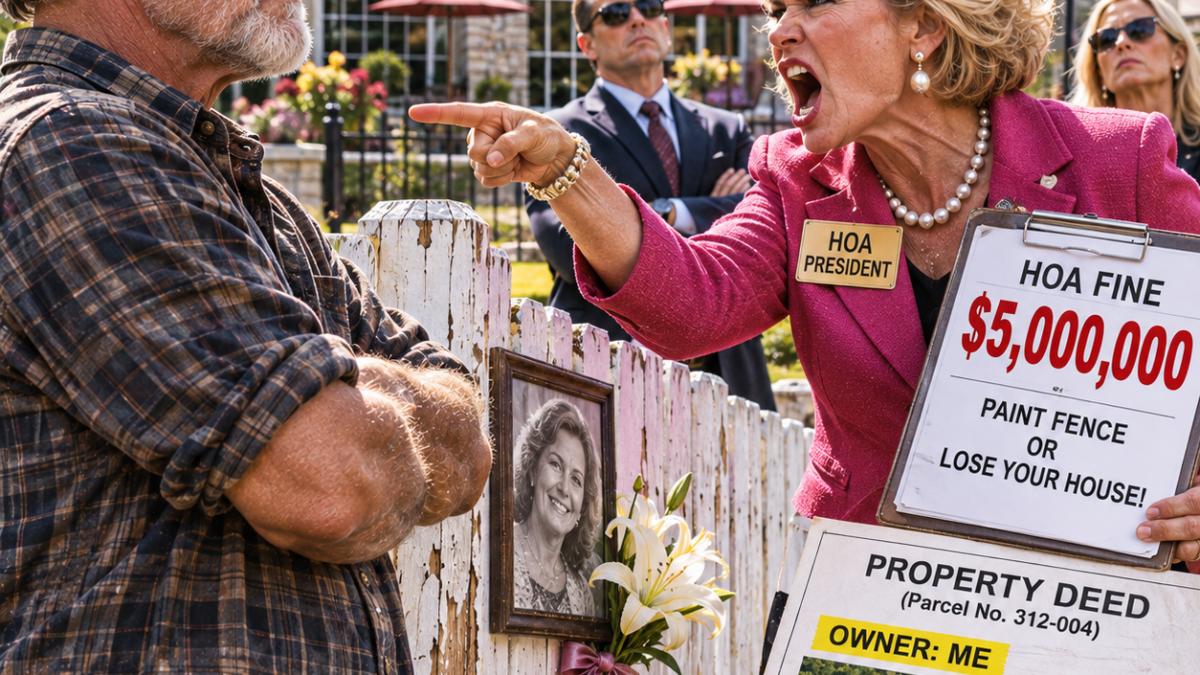
PART2
For a moment, I said nothing.
Not because I was intimidated.
Because I was deciding how much of the man standing inside me I was willing to let out.
Ellie was on the porch.
I knew she could hear.
So I kept my voice even.
“Get off my property.”
Brenda blinked.
“What did you say?”
“You heard me.”
She smiled again.
But it looked different now.
“Mr. Caldwell, you don’t get to dismiss the president of your homeowners association.”
“I just did.”
Her lips tightened.
“I’ll be back with paperwork.”
“I’m sure you will.”
She turned toward the Escalade.
Then glanced over her shoulder.
“Fourteen days.”
The door slammed.
Ellie waited until the vehicle disappeared.
Then walked down the steps.
“Dad?”
“Yeah?”
“Are we repainting?”
I looked at the fence.
Sage moss against cedar.
Her mother’s color.
“No.”
She nodded.
“It’s Mom’s color.”
“I know.”
“Don’t let her take it.”
I put my arm around her.
“I won’t.”
At the time, I thought I had made a promise about paint.
I had no idea how expensive that promise was about to become.
That evening I read the Ridgecrest Estates covenants again.
Forty-seven pages.
Architectural standards.
Landscaping.
Vehicle rules.
Trash containers.
Roof materials.
Fence height.
Exterior finishes.
There it was.
Approved colors had to fall within “earth-tone palettes established by the Architectural Review Committee.”
Sage moss was an earth tone.
But there was another requirement.
The Architectural Review Committee was supposed to publish written color criteria annually.
I searched the HOA website.
Nothing.
Old newsletters.
Nothing.
Meeting packets.
Nothing.
I emailed the management address.
“Please send the current written approved color standards.”
No response.
The next morning, I submitted an official application for sage moss anyway.
Brenda chaired the Architectural Review Committee.
Twenty-four hours later:
DENIED.
Reason:
NOT CONSISTENT WITH COMMUNITY AESTHETIC STANDARDS.
No standard cited.
No approved-color list.
No explanation.
Ellie found the letter on the kitchen counter.
Her face changed.
“She said no?”
“Yes.”
“Why?”
“Because she likes saying no.”
Ellie looked toward the backyard.
“Can she make us?”
“I don’t think so.”
That was the first time I lied to my daughter during the whole dispute.
Not because I believed Brenda was right.
Because I did not yet understand how far someone can push when everybody around her has spent years backing away.
The first fine was two hundred dollars.
Unauthorized exterior color.
Failure to comply with Architectural Review Committee directive.
I appealed.
Tuesday evening.
Clubhouse.
Six board members sat behind a folding table.
Brenda in the middle.
Reading glasses on a chain.
Clipboard in front of her.
Jan Mosley.
Doug Burrows.
Linda Pace.
Rick Hoff.
And Tom Pritchard.
Tom was seventy-two.
Retired Fort Worth police detective.
White mustache.
Flannel shirts.
Voice that sounded like gravel poured into a cement mixer.
I later learned Tom had spent years being the only person on the board who occasionally told Brenda no.
I laid out my case.
“The CC&Rs say earth tones.”
I held up the swatch.
“Sage moss is an earth tone.”
Brenda barely looked.
I continued.
“There are no published standards identifying prohibited shades.”
“The committee has reviewed the color.”
“Based on what published criterion?”
Brenda leaned toward the microphone.
“Based on our authority.”
“That isn’t a criterion.”
She smiled.
“You’re splitting hairs.”
“I’m reading the rules.”
Doug looked uncomfortable.
Brenda said:
“The committee has spoken.”
Tom leaned back.
“Garrett’s asking a fair question.”
Brenda turned toward him.
“No, Tom. Garrett is refusing to comply.”
Tom looked at my swatch.
“Looks green to me.”
“Exactly.”
“Green is an earth color.”
Brenda stared.
“This isn’t kindergarten.”
Tom folded his arms.
“Then maybe publish the list like the rules require.”
That was the first crack I saw.
Small.
But real.
The appeal failed.
Four to one.
Tom voted for me.
One board member abstained.
Thirty days later, Brenda increased the penalty.
Five hundred dollars per day.
Per day.
For fence paint.
Letters began arriving with bold words.
LIEN.
FORECLOSURE.
COLLECTION.
I read the CC&Rs a third time.
Article Twelve.
Section Four.
Written color criteria had to be published no less than annually.
Brenda had been ARC chair nine years.
No annual standards.
No archived lists.
Nothing.
I sent a certified letter to the board.
I requested:
All fines suspended.
Written standards produced.
My appeal reconsidered according to the HOA’s own procedure.
Brenda signed for the letter.
Ignored it.
Two weeks later, I came home early.
A van was parked near my backyard.
Two painters were inside my property.
One stood on a ladder.
The other opened a five-gallon bucket of desert tan.
Six feet of Linnea’s sage moss had already disappeared beneath beige paint.
Ellie stood inside the kitchen.
Crying.
Not angry.
Scared.
Like somebody was taking something from her mother all over again.
Brenda stood on the sidewalk.
Arms crossed.
Supervising.
I did not yell.
I took out my phone.
Pressed record.
Walked through my gate.
“Gentlemen.”
The painter on the ladder looked down.
“Who hired you?”
He pointed toward Brenda.
“The HOA.”
“Do you have written permission from me?”
His face changed.
“The lady said she had authority.”
“She doesn’t.”
I turned.
“Brenda.”
She lifted her chin.
“You ignored the violation.”
“That does not authorize trespass.”
“The HOA has the right to cure violations.”
“Show me where.”
She stared.
I called police.
When the responding officer arrived, he listened to both sides.
Then walked into my yard.
Looked at the fence.
Looked at the painters.
Looked at Brenda.
“Ma’am, did the homeowner give permission for these contractors to enter?”
“He is in violation.”
“That’s not what I asked.”
She folded her arms.
“The association has enforcement authority.”
“Does it include physically entering his property and altering it?”
Silence.
The officer looked at the painters.
“Pack up.”
Brenda’s face went pale.
“This is HOA business.”
The officer said:
“HOA business does not automatically mean permission to enter private property.”
I filed a trespass report.
The painters left.
Brenda stood beside the Escalade.
“Congratulations, Garrett.”
“For what?”
“You just made this much worse.”
“No.”
I looked at the tan strip across Linnea’s fence.
“You did.”
That night, under the garage floodlight, I repainted every inch they had covered.
Ellie sat on the back steps drinking lemonade.
Crickets screamed from the grass.
When I finished, she walked over.
Touched the cedar.
“It looks like Mom again.”
I swallowed.
“Yes.”
That was when the fight stopped being theoretical.
The next morning Brenda posted on the Ridgecrest Community Watch group.
Certain homeowners are intentionally destroying property values with unauthorized exterior modifications.
She attached a photo of my fence.
Forty-seven likes.
I screenshotted it.
Created a folder on my computer.
Named it:
EVIDENCE.
That folder became large.
Very large.
Brenda increased the daily penalty again.
One thousand dollars.
At that rate, she claimed I owed more each week than many people earned in a month.
The total passed fifteen thousand.
Then twenty.
Then thirty.
The letters became more aggressive.
The neighborhood changed around us.
People who used to wave stopped.
One couple across the street suddenly became fascinated by the ground whenever I walked outside.
Ellie came home from school one afternoon.
Dropped her backpack.
Sat at the kitchen table.
“Dad?”
“What?”
“A girl said you’re ruining the neighborhood.”
I froze.
“What did you say?”
“Nothing.”
She picked at a loose thread on her sleeve.
“Am I supposed to?”
I sat across from her.
“No.”
“But they’re saying stuff.”
“Then let them.”
“She said her mom says we’re going to make everybody’s house worth less.”
I looked toward the fence through the kitchen window.
“Some people think paint matters more than how you treat a neighbor.”
Ellie looked at me.
“They’re wrong.”
“Yes.”
She nodded.
But I could tell she didn’t feel better.
That was when I realized Brenda wasn’t only pressuring me.
She was using the entire neighborhood to isolate us.
Then she took my truck.
I came home on a Thursday afternoon.
Driveway empty.
My 2019 Ford F-250 had been parked there that morning.
Dark blue.
Tool chest.
Work scratches.
Oil stain still visible on the concrete.
Pete Solis, my older neighbor, walked over.
“Garrett.”
“Where’s my truck?”
“Tow truck.”
My stomach dropped.
“What?”
“Two o’clock.”
“Why didn’t you call?”
“I thought you knew.”
“Who ordered it?”
Pete looked toward Brenda’s block.
“That blond woman.”
Of course.
“She stood in the street pointing at your truck like she was directing an airplane.”
I called the tow company.
The man who answered sounded as though he had smoked through every decade since Nixon.
“HOA-authorized removal.”
“From my driveway?”
“Commercial vehicle violation.”
“It’s my personal work truck.”
“Sir, take it up with your HOA.”
“Give me your vehicle-storage-facility license number.”
Silence.
“Sir?”
“Your license number.”
He put me on hold.
Four minutes.
When he returned, his voice was less confident.
“My manager will call.”
Nobody called.
I checked the company’s credentials.
Then filed complaints and a police report over the unauthorized tow.
Six hours later, the truck returned.
No fee.
New scratch on the bumper.
They claimed it had already been there.
I photographed it.
Date.
Location.
Every angle.
That night Brenda posted again.
If certain residents simply complied with community standards, enforcement would not be necessary.
Fifty-three likes.
Screenshot.
Evidence folder.
But pressure has a strange effect.
Push people long enough and some become quieter.
Others start talking.
Mrs. Henderson came first.
Seventy.
Widow.
Garden beautiful enough to stop traffic.
She caught me near the mailbox.
“Garrett.”
“Yes?”
“Brenda fined me four hundred dollars last year.”
“For what?”
“Flower pot.”
I stared.
“Too tall.”
“How tall?”
“Three inches above approved height.”
She pointed toward her porch.
“The thing had been there six years.”
Then Mr. Torres approached me at a gas station.
Retired electrician.
Hands like catcher’s mitts.
“Brenda made me sell my RV.”
“Why?”
“Visual obstruction.”
“Was it visible?”
“Behind a privacy fence.”
His jaw tightened.
“My grandkids used to sleep in it.”
He looked away.
Then came the Palmers.
Young couple.
Two kids.
They had already moved to Denton after eighteen months of fines.
Trampoline.
Basketball hoop.
Christmas lights installed in what Brenda called a “non-symmetrical pattern.”
They didn’t fight.
They sold.
Every story shared the same shape.
Brenda found something.
Bent a rule around it.
Sent a letter.
Raised the cost until compliance became easier than resistance.
Nobody had ever made her prove the rule actually said what she claimed.
Until me.
The emergency board meeting about my fence was Wednesday night.
One agenda item:
SPECIAL AESTHETIC COMPLIANCE ASSESSMENT — 1247 RIDGECREST DRIVE.
My address.
Brenda had a twenty-three-slide PowerPoint.
Photos of my fence from fourteen angles.
Red circles.
Arrows.
Words:
NON-COMPLIANT.
She had a spreadsheet estimating “aggregate diminution in neighborhood property values.”
Three letters from realtors.
Later I learned all three had business connections with Cliff Whitfield’s development company.
Then Brenda reached the final slide.
Five million dollars.
For one second, I honestly thought I had misread it.
She spoke calmly.
“Based on the sustained nature of the violation, refusal to comply with repeated directives, and documented damage to neighborhood value, I move that the board impose a special assessment of five million dollars against 1247 Ridgecrest Drive, record a lien, and commence foreclosure if payment is not received within ninety days.”
Silence.
Even Doug looked sick.
Tom leaned back until his chair creaked.
“This is extortion with a clipboard.”
Brenda turned.
“It is compliance enforcement.”
“It’s paint.”
“It’s defiance.”
Tom pointed toward me.
“You’re proposing a five-million-dollar assessment against a widower because his fence is green.”
“I am protecting every homeowner’s investment.”
“You’re protecting your ego.”
Brenda’s eyes narrowed.
The vote passed.
Four to one.
Tom again.
I walked to my truck holding a piece of paper claiming I owed more money than the house, lot, fence and probably half the street combined.
Ellie waited in the passenger seat.
She looked at my face.
“How bad?”
“Five million.”
She stared.
“Dollars?”
“Yes.”
“That’s more than our house.”
“That’s more than most houses.”
“Can she really do that?”
I started the truck.
“She thinks she can.”
Ellie looked out the window.
“What do you think?”
I drove past the clubhouse.
“I think she made a mistake.”
I just didn’t know yet how large it was.
The next morning Brenda began knocking on doors.
Petition.
Support the assessment.
Authorize foreclosure.
She expected a victory lap.
Instead, the neighborhood had started remembering.
Mrs. Henderson opened her door.
“You fined me for a flower pot.”
“Mrs. Henderson—”
“I’m not signing.”
Mr. Torres spoke through his screen door.
“You made me sell my RV.”
“The RV violated—”
“Leave my porch.”
The Chens asked:
“Where do our special assessments go?”
Brenda’s smile faltered.
Out of one hundred forty-two homes, she collected thirty-one signatures.
Most from people on her block.
Friends.
Bridge partners.
Board allies.
That was it.
I did not campaign.
I didn’t knock on doors.
I listened.
Mailbox.
School pickup.
Gas station.
Hardware store.
Every conversation eventually reached the same question.
Where does the money go?
I didn’t have an answer.
But I knew how to find property answers.
And one night, sitting on my porch with a beer, staring at the sage-moss fence beneath the streetlight, I heard Linnea’s voice in my head.
Not literally.
Memory.
She had said it a hundred times whenever I got angry at work.
Don’t get mad, Garrett. Get the survey.
I smiled.
Then walked into the garage.
My old survey equipment had been untouched for five years.
Tripod.
Transit level.
Steel tape.
Rod.
Plumb bob.
Everything clean.
Oiled.
Stored properly.
Army habit.
I began with my own lot.
Measured the fence.
Every corner matched.
Then I expanded.
Original subdivision plat.
County records.
Physical monuments.
Common areas.
For two weeks, I worked after hours.
Mornings before Texas heat became brutal.
Evenings until the light disappeared.
Measure twice.
Record everything.
Trust the numbers.
That philosophy had kept me employed for twenty-two years.
The numbers led me toward the center of Ridgecrest Estates.
Lot 143.
Two-point-four acres.
Clubhouse.
Pool.
Parking lot.
Tennis court.
The heart of Brenda’s kingdom.
On the recorded subdivision plat, Lot 143 was labeled as common area intended for eventual conveyance to the Ridgecrest Estates Homeowners Association.
I read that line three times.
INTENDED FOR CONVEYANCE.
Not:
CONVEYED.
That difference bothered me.
So I drove to the Tarrant County Clerk’s office.
A woman named Dolores Fuentes had worked the counter for twenty-eight years.
She pulled the records.
Original grantor deed.
Earl Jessup to Whitfield Development.
Subdivision plat.
Individual conveyances.
Lot one.
Two.
Three.
All the way through 142.
Then she stopped.
“Lot 143.”
“Yes.”
She searched.
Again.
Grantor-grantee index.
Recorded instruments.
Older records.
Nothing.
“No deed.”
I leaned closer.
“Check Whitfield Development to Ridgecrest HOA.”
“Already did.”
“Maybe under another name?”
She checked.
Nothing.
The land had been planned as HOA property.
Built as HOA property.
Used as HOA property.
Taxed and maintained as HOA property.
But no deed had ever transferred it.
The legal title chain still traced through Earl Jessup’s remaining estate.
And I had bought everything in Earl Jessup’s estate that remained unsold.
Including Lot 143.
I sat in my truck outside the courthouse.
Hands on the wheel.
Brenda had just assessed me five million dollars for a fence color.
And the building where she made that decision appeared to be sitting on my land.
I laughed.
Then stopped.
Because before I enjoyed that thought, I needed proof.
Real proof.
I hired Walt Pemberton.
Licensed surveyor.
Thirty years experience.
Suspenders.
Polite enough to call his dog “sir.”
I gave him the deed chain.
Subdivision plat.
My measurements.
Then got out of the way.
Three days.
Crew of two.
Full boundary work.
He came to my house with stamped drawings.
“Garrett.”
“Yes?”
“You were right.”
I looked at the survey.
Lot 143.
2.4 acres.
Clubhouse.
Pool.
Parking lot.
Tennis court.
All within the tract still tied to the Jessup estate interest I had purchased.
Walt shook his head.
“I’ve never seen a developer leave a parcel this important unconveyed.”
“Accident?”
He looked toward the clubhouse.
“Either somebody forgot something very expensive or somebody intended to fix it later and never did.”
I thought about Cliff.
Brenda’s husband.
Original developer.
I had a theory.
But theories are not deeds.
I took Walt’s survey to Claudia Reeves.
Claudia specialized in real-estate disputes.
Second-floor office on Camp Bowie.
View of the Trinity River.
Walls covered with framed courtroom photographs.
I laid everything across her conference table.
She read silently.
Four minutes.
Exactly.
Then removed her glasses.
“Mr. Caldwell.”
“Yes?”
“You have a serious property issue here.”
“Good serious?”
“For you?”
She looked at the survey.
“Potentially.”
“What does the plat do?”
“Shows intended use.”
“And ownership?”
“Comes from the deed chain.”
“So if the conveyance never happened?”
“Then intending the HOA to own it and actually transferring title are not the same thing.”
I nodded.
She looked at me.
“You already knew that.”
“I wanted to hear you say it.”
She almost smiled.
Then she became cautious.
“We still need title verification, an independent appraisal, analysis of any easement or equitable arguments, and a litigation strategy.”
“Can they claim they’ve used it so long they own it?”
“They may claim several things.”
“Do they?”
“Claims aren’t outcomes.”
Good answer.
I liked her.
I asked:
“Could we calculate fair rental value?”
Claudia leaned back.
“Why?”
I showed her Brenda’s five-million-dollar assessment.
For the first time, Claudia laughed.
“Oh.”
“Yes.”
“You want a mirror.”
“Exactly.”
We had an appraiser estimate comparable commercial land value.
Fifteen years of use.
Clubhouse.
Parking.
Pool.
Tennis facilities.
The back-rent theory was more complicated than my first spreadsheet suggested, and Claudia warned me not to treat an invoice as a guaranteed court award.
Fine.
I didn’t need a guarantee.
I needed a negotiating position.
The calculated claim came to approximately:
$5,036,000.
I printed the number.
Looked at the sage fence outside.
Brenda’s demand:
$5,000,000.
Mine:
$5,036,000.
I laughed.
Linnea would have loved the absurdity.
Claudia prepared a formal package.
Notice of ownership claim.
Independent survey.
Demand to negotiate purchase or lease.
Claim for historic use.
Notice that we would seek judicial relief if necessary.
And a lis pendens notifying anyone dealing with Lot 143 that ownership was disputed.
I asked:
“Can we force them to remove the clubhouse?”
Claudia chose her words carefully.
“A landowner can seek remedies for unauthorized structures.”
“Meaning?”
“Meaning removal is one possible remedy depending on the facts and court.”
I nodded.
“Put it on the table.”
“Garrett.”
“I don’t want the clubhouse torn down.”
“I know.”
“I want Brenda to understand that property rights work in both directions.”
Claudia closed the folder.
“That is exactly why you do not threaten things you don’t intend to pursue.”
I smiled.
“You sound like Linnea.”
“I’ll take that as a compliment.”
Before sending the demand, I requested HOA financial records.
As a homeowner, I was entitled to inspect certain association documents.
The records were revealing.
Property taxes on Lot 143 had been paid through HOA funds.
Maintenance.
Insurance.
Pool service.
Landscaping.
That complicated the story.
They had behaved as though they owned it.
But paying expenses is not the same as receiving title.
Then there were special assessments.
Fees.
Administrative costs.
Enough unanswered questions that homeowners started demanding a deeper review.
I did not accuse Brenda of stealing.
Not without proof.
That mattered.
Her abuses were bad enough without inventing crimes.
Tom Pritchard came to my garage on Saturday evening.
Then Mrs. Henderson.
Mr. Torres.
The Chens.
Twelve homeowners.
Folding chairs between my workbench and Ellie’s bicycle.
Beer.
Coffee.
Fluorescent light humming.
I showed them the plat.
The deed history.
Walt’s stamped survey.
The proposed claim.
Mr. Torres stared at the five-million-dollar figure.
“So she’s been fining us to maintain a building on your land?”
“I’m saying the recorded title appears to put Lot 143 in my ownership.”
Tom tapped his knuckle against the workbench.
“Careful.”
I looked at him.
He nodded.
“Facts first.”
I smiled.
“Retired detective?”
“Always.”
Mrs. Henderson asked:
“What do you want?”
That question mattered more than anything.
I looked at the documents.
“I don’t want the clubhouse.”
“Then what?”
“I want the HOA to buy the land properly.”
“And Brenda?”
“I want the illegal fines gone.”
Mr. Torres crossed his arms.
“That’s it?”
“No.”
I looked toward Ellie’s bicycle.
“I want rules that make it harder for another president to do this to somebody else.”
Tom nodded.
“Now we have a plan.”
Brenda had already scheduled a town hall.
Her purpose:
Present the five-million-dollar assessment.
Begin foreclosure action.
Our purpose:
Let her finish.
Then show everyone what she had never checked.
Claudia mailed the demand letter Monday.
Certified.
Brenda signed.
Tuesday morning, the board began panicking.
Doug called Brenda.
“Is this real?”
She called it a bluff.
Rick Hoff hired his own attorney.
Two hours later, Rick’s lawyer told him:
“This is not a bluff. Get independent counsel.”
Linda Pace stopped answering calls.
Then Brenda called her husband.
Cliff Whitfield.
Developer.
The man whose company had built Ridgecrest.
Apparently Cliff said:
“I’ll fix it.”
That decision made everything worse.
Cliff went to the county clerk with a deed claiming Lot 143 had been transferred years earlier.
Dated 2009.
Signatures.
Notary.
Old-looking paper.
But the clerk flagged inconsistencies.
The document did not match available records.
The notarial information raised questions.
More importantly, litigation concerning the parcel had already been noticed.
Dolores called Claudia.
“Someone is attempting to file a deed against the property in dispute.”
The instrument was not simply accepted as unquestioned truth.
It was preserved for investigation.
Claudia called me.
“Garrett.”
“What?”
“Cliff tried to cure the title with a document that appears false.”
I sat down.
“How false?”
“Enough that we’re involving investigators.”
I stared at Linnea’s paint swatch on the refrigerator.
This had started with a fence.
Now a developer was apparently trying to manufacture history.
I asked:
“Why would he do that instead of negotiating?”
Claudia sighed.
“Because some people think admitting a fifteen-year mistake is more dangerous than making a fresh one.”
A criminal investigation began into the suspect filing.
That frightened the board more than my back-rent demand.
Doug confronted Brenda.
She called it an administrative misunderstanding.
Tom asked:
“How does a questionable deed become administrative?”
No answer.
Cliff hired counsel.
Brenda hired personal counsel.
Not the HOA attorney.
Her first lawyer reviewed the records.
Recommended settlement.
She fired him.
Second lawyer.
Same advice.
She stopped listening to lawyers.
Then the attacks turned personal.
A Child Protective Services investigator arrived at my house.
Wednesday evening.
Ellie doing homework.
Dinner on stove.
House clean.
Fridge full.
The investigator looked exhausted before she even sat down.
“Mr. Caldwell, we received a neglect allegation.”
I stared.
“Against me?”
“Yes.”
“For Ellie?”
“Yes.”
My daughter froze at the kitchen table.
The anger I felt in that moment scared me.
I kept my voice low.
“Come in.”
The investigator spoke with us.
Looked around.
Asked questions.
Ellie answered.
An hour later, the woman stood near the door.
“I’m not seeing evidence supporting the report.”
I nodded.
She gave me a case number.
“If this appears connected to ongoing harassment, document everything.”
After she left, Ellie sat at the table.
“Was that Brenda?”
“I don’t know.”
“She hates us.”
I sat beside her.
“No.”
Ellie looked at me.
“She hates losing control.”
“Same thing.”
“No, sweetheart.”
I took her hand.
“You are not the thing she gets to control.”
That was the closest I came to losing my composure during the entire dispute.
Not five million dollars.
Not the tow.
Not the fence.
My daughter.
Brenda had reached toward the one person I would burn everything down to protect.
But burning things down was exactly what she wanted me to do.
So I documented.
Case number.
Date.
Time.
No public accusation.
No angry post.
Just evidence.
Then she claimed online that I had a criminal record.
I didn’t.
She contacted a retired former commanding officer of mine.
Colonel Harris called me afterward laughing.
“Garrett.”
“Sir.”
“Some woman called asking whether you were ever disciplined.”
I closed my eyes.
“What did you say?”
“That your record was clean.”
“Thank you.”
“And then I asked whether she needed a surveyor.”
I laughed.
“Why?”
“Because whoever she’s using apparently can’t find a boundary.”
I almost felt human again.
Brenda’s final maneuver involved Lot 143.
Emergency board meeting.
Nine at night.
Agenda:
Sell all common-area property to Ridgecrest Holdings LLC.
Price:
One dollar.
Ridgecrest Holdings LLC was registered to Cliff Whitfield.
Address:
Brenda’s house.
They were trying to transfer the disputed property to Cliff’s entity before my claim could be adjudicated.
Tom called me from the meeting.
“They’re trying to vote right now.”
“How many present?”
“Brenda, Doug, Rick.”
“Quorum?”
“Barely.”
I called Claudia.
She was having dinner with her husband.
Apologized.
Then listened.
By the next morning she sought emergency relief.
The court entered a temporary restraining order preventing transfer or encumbrance of Lot 143 while the ownership dispute proceeded.
A process server delivered it to Brenda.
Tom later told me she called 911 complaining someone had threatened her with legal documents.
I wish I had been there for the dispatcher’s response.
I wasn’t.
But the image still makes me smile.
Meanwhile, Janet Avery from the Fort Worth Star-Telegram had become interested.
I had given her only publicly supportable facts.
No theatrics.
Ownership dispute.
Five-million-dollar HOA fine.
Lot 143.
Suspect deed filing.
Upcoming town hall.
She asked one question.
“When?”
“Thursday.”
“I’ll be there.”
Ellie helped me prepare the presentation.
Four easel boards.
Subdivision plat.
Deed history.
Independent survey.
Financial calculation.
She mounted copies on foam core.
Stepped back.
Tilting her head.
“Dad.”
“Yeah?”
“This looks like a science fair for adults who forgot who owns the land.”
I laughed.
“That is exactly what it is.”
She picked up the sage-moss swatch.
“Should we put this on one?”
“No.”
“Why?”
“This isn’t about proving Mom had good taste.”
“She did.”
“I know.”
“It’s about proving Brenda had no right to use that color to take our house.”
Ellie nodded.
Then quietly taped the swatch inside my folder anyway.
“Good luck.”
Thursday.
Seven p.m.
Ridgecrest clubhouse.
The building sitting on Lot 143.
My disputed land.
Tom leaned toward me.
“She chose the venue.”
“I appreciate the irony.”
One hundred eighteen homeowners attended.
Standing room only.
Texas evening heat.
Air conditioner losing badly.
Janet sat in back.
Photographer beside her.
A deputy near the exit because counsel had informed authorities that matters connected to an active investigation might be discussed.
Brenda entered.
White blazer.
Hair perfect.
Clipboard.
She looked exactly as she had the first day at my fence.
Only now everybody in the room had questions.
She opened with my violations.
Unauthorized color.
Refusal to comply.
Unpaid fines.
Graphs.
Property-value claims.
Realtor letters.
Then she said:
“I move that the board authorize a five-million-dollar lien against 1247 Ridgecrest Drive and begin foreclosure proceedings immediately.”
The room went silent.
I stood.
“Before you vote, I’d like to show the homeowners something about this building.”
Brenda smiled.
“This is not on the agenda.”
Tom spoke.
“I move that Garrett be allowed to present information relevant to association property.”
Mrs. Henderson:
“Second.”
A vote.
Overwhelmingly yes.
Brenda’s face changed.
I walked to the front.
Claudia beside me.
First easel.
Subdivision plat.
“This is Lot 143.”
People leaned forward.
“Two-point-four acres. Clubhouse, pool, parking lot, tennis court.”
Second easel.
Deed records.
“This is the recorded chain of title.”
I pointed.
“The plat contemplated transferring Lot 143 to the HOA.”
Pause.
“No recorded deed completing that transfer has been found.”
Murmurs.
Third easel.
Walt’s survey.
Stamped.
Signed.
“Independent survey confirms the facilities sit entirely on Lot 143.”
I took a breath.
“The remaining interest in the Jessup estate, including parcels never conveyed by the developer, was sold to me.”
Someone whispered:
“Oh my God.”
I looked toward Brenda.
She gripped the podium.
Fourth easel.
Five-million-dollar claim.
I said:
“Your president says my sage-green fence caused five million dollars in damage.”
A few people laughed.
Brenda glared.
I continued.
“My counsel calculated a historic-use claim concerning fifteen years of unauthorized occupation of Lot 143.”
I pointed to the number.
$5,036,000.
The room erupted.
I raised my hand.
“This is a legal claim, not a final judgment.”
That mattered.
“I am not here to evict anybody tonight.”
People quieted.
“I am not closing the clubhouse.”
Mrs. Henderson nodded.
“I am not filling the pool with dirt.”
Somebody laughed.
“I want this land issue resolved lawfully.”
Then I looked directly at Brenda.
“But if five million dollars is a reasonable number for a fence color, I thought you should understand what five million looks like when it comes with a deed, two surveys, and fifteen years of property use.”
Silence.
Tom smiled.
Barely.
Then Claudia stepped forward.
“The homeowners should also know that after Mr. Caldwell notified the association of this title defect, an attempt was made to file a document purporting to transfer Lot 143 retroactively.”
The room froze.
“The county raised concerns regarding that document, and the matter has been referred for investigation.”
Every head turned toward Brenda.
Her mouth opened.
“Cliff handled development paperwork.”
Tom stood.
His chair scraped hard against the tile.
“I move for a vote of no confidence in the current HOA president.”
Mr. Torres stood.
“Second.”
Brenda slammed one hand on the podium.
“You cannot do this based on his revenge fantasy!”
Mrs. Henderson shouted:
“He didn’t fine himself five million dollars!”
Applause.
Tom raised his voice.
“Order.”
The board followed the governing procedure for removal.
The result was overwhelming.
One hundred thirty-one to four when proxy and eligible votes were counted.
Nine years of Brenda’s rule ended in less than a minute.
She stared at the room.
At the neighbors.
At Tom.
At me.
Then picked up her purse.
Clipboard.
Walked down the aisle.
Nobody stopped her.
The photographer’s shutter clicked.
Once.
Twice.
Three times.
The door closed.
That was it.
No handcuffs.
No cheering mob.
Just a woman discovering that a title means nothing after the people who gave you authority decide to take it back.
Janet found me beside the refreshment table.
“Quote?”
I looked at the documents.
The surveys.
The years of letters.
Ellie’s sage swatch hidden inside my folder.
“Document everything.”
She smiled.
“That’s it?”
“That’s it.”
The story ran Sunday.
It spread farther than I expected.
People everywhere had HOA stories.
Mailbox colors.
Grass length.
Flags.
Trash cans.
Parking.
Fines.
Some legitimate.
Some absurd.
But I stopped reading comments after a while.
I had a bigger problem.
Lot 143 still needed a solution.
The new board hired independent counsel.
Not Claudia.
Good.
The HOA needed its own lawyer.
Negotiations began.
I never demanded the full five million.
I had never intended to.
That number was a mirror.
Brenda used a ridiculous figure to frighten me.
I used a supported claim to make the board understand what unresolved property rights could cost.
An independent appraisal valued Lot 143 at $850,000.
The HOA agreed to purchase it.
Payment structured through reserves and financing over time.
My legal fees reimbursed.
All fence-related fines vacated.
Every one.
The CC&Rs were amended.
No single committee chair could impose unlimited aesthetic penalties.
Large fines required independent board review.
Homeowners received formal appeal rights.
Written standards had to be published.
The entire enforcement structure changed.
And for the first time in fifteen years, Ridgecrest actually produced an approved-color list.
Sage moss was on it.
Ellie laughed when she saw that.
“They finally like Mom’s color?”
“No.”
I smiled.
“They finally wrote down the rules.”
“Same thing?”
“No.”
“Better?”
“Much.”
The criminal side took longer.
Cliff faced consequences over the suspect deed.
The matter ultimately resolved through a plea arrangement that included probation, a substantial fine, and professional consequences affecting his development work.
I did not attend every hearing.
I had spent enough time with the Whitfields.
Brenda was never charged for disliking my fence.
She didn’t belong in prison for being rude.
But the civil record and HOA proceedings made clear what she had done with enforcement power.
The CPS complaint.
The towing.
The contractors.
The false public statements.
They formed a pattern even where individual incidents had separate remedies.
Eventually, Brenda and Cliff sold their house.
Moved away.
I heard she applied for another HOA board position elsewhere.
Some people learn from cliffs.
Some look over the edge and think:
Next time I’ll lean farther.
Not my problem anymore.
Tom Pritchard became HOA president.
Unanimous vote.
His first meeting lasted fifty-three minutes.
His first action:
Strip the Architectural Review Committee of unilateral fine power.
Second:
Publish actual standards.
Third:
Review old fines.
Mrs. Henderson placed her oversized flower pot back on the porch.
Tom drove past.
Saw it.
Kept driving.
Mr. Torres bought another RV.
Thirty-two feet.
Cherry red.
His grandchildren decorated it for the Fourth of July.
He parked it legally.
Then hung a sign:
JUST BECAUSE I CAN.
I nearly fell over laughing.
The Palmer family did not move back.
Some damage does not reverse.
They pursued their own claims and built a life elsewhere.
That mattered too.
Justice is not a time machine.
I used part of the proceeds from the Lot 143 sale to establish a small legal-defense fund for homeowners in Tarrant County facing serious HOA disputes.
Not revenge disputes.
Not:
“My neighbor’s grass is ugly.”
Real cases.
Improper liens.
Unlawful enforcement.
Procedural abuse.
Retirees terrified by letters they didn’t understand.
Widows facing fines they couldn’t challenge alone.
Claudia agreed to sit on the advisory board.
Tom volunteered.
Ellie designed the logo.
She painted a little green fence beneath an oak tree.
I stared at it.
“Subtle.”
She smiled.
“I learned from Mom.”
That September, ninety-four families attended a community barbecue on the clubhouse lawn.
The same lawn that had once been part of my disputed title.
Now it actually belonged to the HOA.
Proper deed.
Recorded.
Paid for.
Clean.
Tom smoked brisket.
Mesquite filled the parking lot.
Mr. Torres parked the Winnebago in front of the clubhouse.
Mrs. Henderson brought flowers tall enough to violate three of Brenda’s old standards simultaneously.
Nobody measured them.
Ellie displayed a watercolor.
Sage-moss fence against a Fort Worth sunset.
She gave it to me for my birthday.
I hung it in the garage above the old survey equipment.
The paint swatch still lives on the refrigerator.
Lobster magnet.
Maine.
Linnea.
Some things stay.
People sometimes ask whether I felt guilty taking $850,000 from the HOA.
No.
And yes.
The homeowners had not created the title problem.
Cliff had.
The board had operated for years under the assumption it owned Lot 143.
But I also had purchased the remaining Jessup estate rights.
Ownership carried value.
The solution could not be:
“Garrett should donate it because everybody made a mistake.”
Nor could the solution be:
“Garrett should demand five million because Brenda angered him.”
Fair market value was fair.
That was why we used an independent appraisal.
The HOA got clean title.
I got compensation.
Homeowners got permanent certainty.
No clubhouse demolished.
No pool drained.
No innocent family punished.
That is what a good settlement looks like.
Everybody gives up the most dramatic outcome.
Everybody gets enough truth to move forward.
Ellie once asked:
“Would Mom have wanted you to sell the clubhouse land?”
I laughed.
“Your mother would have wanted me to sell everything and buy a place in Maine.”
“She loved Maine.”
“She hated Texas summers.”
Ellie looked at the fence.
“She would’ve liked that Brenda lost.”
I thought about it.
“Maybe.”
“Dad.”
“Okay.”
I smiled.
“She definitely would have enjoyed the five-million-dollar rent invoice.”
Ellie laughed.
And for one beautiful second, she sounded exactly like Linnea.
That hurt.
And healed.
Same time.
Grief is strange that way.
I never changed the fence.
Sage moss.
The cedar faded slightly over the years.
I touched up the worst spots.
Every time I opened the can, I remembered Ellie with green paint on her nose.
Linnea clipping the swatch from the catalog.
Brenda pointing.
That disgusting fence.
Funny how people can look at the same thing and see completely different worlds.
Brenda saw noncompliance.
Ellie saw her mother.
I saw a promise.
That was why no dollar figure could settle the paint dispute.
Some values do not appear on appraisal reports.
One morning Tom stopped by.
He leaned against my fence.
“Garrett.”
“Careful.”
“What?”
“You’re touching a five-million-dollar asset.”
He laughed.
“Still using that joke?”
“Until death.”
Tom looked toward the clubhouse.
“You know, none of this would’ve happened if Brenda had just approved the color.”
“No.”
“She probably would’ve stayed president.”
“Yes.”
“Cliff’s title mistake might never have surfaced.”
“Probably.”
Tom shook his head.
“She destroyed herself over paint.”
I looked at the sage boards.
“No.”
“What?”
“She destroyed herself because she couldn’t accept one person saying no.”
Tom nodded slowly.
“Fair.”
That became the lesson I carried from all of it.
Not:
Read your deeds.
Though you should.
Not:
HOAs are evil.
They aren’t automatically.
Not:
Never follow rules.
Good communities need rules.
The lesson was simpler.
Power becomes dangerous when a person interprets disagreement as disobedience and disobedience as something that must be punished.
Brenda didn’t want compliance.
She wanted submission.
There’s a difference.
When she first arrived, I could have repainted.
Six gallons.
Maybe two weekends.
Desert tan.
Problem gone.
Except it wouldn’t have ended.
Mrs. Henderson proved that.
Mr. Torres proved that.
The Palmers proved that.
If I repainted, Brenda would have learned that fear worked.
Next time it would be a truck.
A basketball hoop.
A tree.
A mailbox.
Control expands into whatever space people surrender.
That doesn’t mean fight everything.
Some rules are reasonable.
Some arguments aren’t worth having.
But when somebody threatens to take your home because they dislike a color their own documents do not prohibit, the problem has stopped being paint.
Years earlier, Linnea and I had argued about something stupid.
I can’t even remember what.
At the end she said:
“You know your problem?”
I said:
“I’m sure you’re about to tell me.”
“You think being calm means you aren’t stubborn.”
I laughed.
She didn’t.
“You’re the most stubborn calm person I know.”
After Brenda, I finally understood.
I never screamed louder than she did.
I didn’t need to.
I measured.
Filed.
Copied.
Recorded.
Appealed.
Asked.
Waited.
Then measured again.
Stubborn does not have to sound angry.
Sometimes stubborn looks like a man standing beside a green fence saying:
“Show me the rule.”
The legal-defense fund took on its first case six months after we created it.
A widow named Carol.
Different HOA.
Threatened lien over an accessibility ramp installed for her husband before he died.
The rule was complicated.
The facts weren’t identical to mine.
Claudia told me:
“Do not assume every case is Brenda.”
“I know.”
“Do you?”
“Yes.”
“Good.”
The fund paid for Carol to get independent legal advice.
The dispute settled.
Ramp stayed.
No viral showdown.
No newspaper.
No million-dollar twist.
Perfect.
I liked that outcome more than mine.
Nobody should need a war to get a reasonable answer.
The board eventually commissioned a complete title review of every common parcel.
Smart.
No more assumptions.
One small drainage strip had a minor easement issue.
Fixed before it became expensive.
Tom called me.
“Anything else you secretly own?”
“Your kitchen.”
He hung up.
I retired my old survey kit after the Ridgecrest case.
Not because it stopped working.
Because I wanted to.
I cleaned everything.
Oiled the metal.
Put it back in the case.
Ellie asked:
“You’re really done?”
“Mostly.”
“What if somebody puts another clubhouse on our land?”
“I’ll hire Walt.”
She smiled.
“Growth.”
“Exactly.”
The kit sits beneath her watercolor now.
Tools that helped me measure a boundary.
Painting that reminds me why I bothered.
A year after Brenda left, I received an envelope.
No return address I recognized.
Inside was a copy of the old fence violation.
Across it, someone had written:
YOU WERE RIGHT. I’M SORRY I VOTED AGAINST YOU.
No signature.
I kept it.
Not because I needed vindication.
Because fear makes ordinary people do strange things.
Some residents had supported Brenda because they believed her.
Others because they were afraid of becoming targets.
A few genuinely hated the fence.
I didn’t need to punish all of them forever.
Communities can’t heal if everybody demands perfect courage from people who were afraid.
What matters is what they do after they understand.
Mrs. Henderson became fearless.
Almost excessively.
At one meeting, Tom asked her to stop speaking because her time was up.
She stood.
“Are you silencing me?”
Tom sighed.
“Margaret, you have been speaking for eleven minutes.”
“Brenda used to—”
“I am not Brenda.”
“Good point.”
She sat.
Progress.
Mr. Torres’s RV became legendary.
His grandkids slept in it every summer.
The first July after Brenda left, he invited half the street.
I brought beer.
Tom brought brisket.
Ellie painted little flags with the kids.
At sunset, Torres came to stand beside me.
“Thank you.”
“For what?”
“My RV.”
“You bought it.”
“You helped make it possible.”
I shook my head.
“No.”
He looked toward his grandchildren.
“Maybe.”
Then he smiled.
“But I still mean it.”
I accepted.
Sometimes refusing gratitude is just another kind of pride.
Linnea taught me that too.
Ridgecrest changed.
Not magically.
People still complained.
Grass.
Noise.
Dogs.
Parking.
That is what neighborhoods do.
But complaints moved through procedure.
Written rules.
Evidence.
Appeals.
No president could invent five-million-dollar fines because she felt insulted.
There was still conflict.
There was less fear.
That was enough.
One afternoon Ellie came home from school with a painting.
Not the fence.
Linnea.
She had painted her mother from a photograph taken in Maine.
Wind in her hair.
Lobster shack behind her.
I stared too long.
Ellie became nervous.
“You don’t like it?”
“I love it.”
“Then why are you making that face?”
“What face?”
“The crying-but-not-crying face.”
I laughed.
Then cried.
She sat beside me.
After a while she said:
“Mom would’ve hated desert tan.”
I laughed through tears.
“Yes.”
“She would’ve fought Brenda.”
“Oh, absolutely.”
“Worse than you?”
“Much worse.”
Ellie smiled.
Then looked toward the backyard.
“I’m glad we kept the color.”
“So am I.”
That was the actual victory.
Not Lot 143.
Not $850,000.
Not Brenda losing the presidency.
A fourteen-year-old girl asked me not to let somebody erase something that connected her to her mother.
And I didn’t.
Everything else followed.
The five-million-dollar number still gets attention when people hear the story.
I understand why.
It’s absurd.
A five-million-dollar fence fine answered by a five-million-dollar land-use claim.
Perfect symmetry.
But numbers are the least interesting part.
The real turning point came months earlier.
The night Ellie said:
“It looks like Mom again.”
After I repainted the section Brenda’s contractors covered.
At that moment, I realized compliance was no longer cheaper.
Not emotionally.
I could pay money.
I could repaint.
I could sell.
But I would teach my daughter that somebody with enough confidence could rewrite a memory because challenging them was inconvenient.
I couldn’t do that.
People ask whether I hated Brenda.
For a while.
Yes.
I hated her voice.
Her Escalade.
That clipboard.
Her white blazers.
The way she said “community” when she meant “me.”
But hatred is exhausting.
Eventually, she left.
The fence remained.
My daughter grew older.
Life kept moving.
Hatred became unnecessary.
I don’t forgive what she did in some ceremonial sense.
I simply stopped giving her free space in my mind.
That may be better.
Cliff was different.
His mistake created the entire property problem.
The missing deed.
Maybe negligence.
Maybe something else.
Then the attempt to fix the record with a questionable document transformed an old title defect into a serious legal problem.
That was his choice.
A decent developer would have called.
“Garrett, we discovered a fifteen-year mistake.”
Then negotiated.
Instead, he tried to make history agree with what he wished had happened.
Same disease as Brenda.
Reality became inconvenient.
So they tried to replace it.
Documents are unforgiving when you do that badly.
Dolores Fuentes retired the following year.
I sent her flowers.
Card:
THANK YOU FOR READING THE FINE PRINT.
She called.
“You know, Mr. Caldwell, that was literally my job.”
“People keep forgetting to do their jobs in this story.”
She laughed.
“Fair.”
I asked what she planned to do in retirement.
“Never look at another deed again.”
I respected that.
Claudia remained involved with the legal-defense fund.
She became almost a family friend.
Almost.
Lawyers resist joy.
At least Claudia did.
Ellie once asked:
“Do you ever smile?”
Claudia replied:
“Hourly rate applies.”
Ellie loved her immediately.
At one fundraiser, somebody auctioned a framed gallon paint label.
SAGE MOSS.
Signed by Tom.
Mrs. Henderson.
Mr. Torres.
Claudia.
Me.
It raised three thousand dollars for the homeowner fund.
I wanted no part of it.
Ellie forced me.
“Mom’s color is paying legal bills now.”
That sentence would have delighted Linnea.
The old lobster magnet is still on the refrigerator.
Slightly chipped.
The original paint swatch beneath it has faded.
I bought a replacement swatch once.
Ellie stopped me.
“No.”
“What?”
“Keep Mom’s.”
“It’s faded.”
“So?”
I put the new one away.
She was right.
Authenticity beats perfection.
Same with the fence.
Same with grief.
Same with people.
Years later, I finally understood why Brenda’s insult about Linnea hit so hard.
“You think because your wife died, you get to ignore the rules?”
It wasn’t only cruel.
It twisted grief into evidence against me.
As though losing someone made me selfish.
Unstable.
Difficult.
That was what I could not forgive quickly.
But it also exposed her.
A leader who uses a resident’s De@d spouse as leverage has already abandoned the idea of community.
Everything after that was paperwork catching up.
The day the HOA sale of Lot 143 closed, I signed the transfer documents at Claudia’s office.
Clean deed.
Proper notarization.
Recorded.
Everything Cliff should have done fifteen years earlier.
Before signing, I looked at Claudia.
“You sure?”
She laughed.
“You’re asking me whether I’m sure the HOA should finally own its clubhouse?”
“Yes.”
“Yes.”
I signed.
When the county recorded it, Ridgecrest Estates legally owned Lot 143 for the first time.
That mattered to me.
I did not want my victory to depend on leaving another title problem for somebody else’s daughter to discover years later.
Fix it once.
Fix it correctly.
Then go home.
Tom called after recording.
“Congratulations.”
“For what?”
“You no longer own the clubhouse.”
“Best real-estate deal of my life.”
“You sold a building you didn’t build.”
“American dream.”
He laughed.
Then became serious.
“Thank you for not using the land to hurt everybody.”
I looked toward the backyard.
“Thank Grandpa Jessup’s estate attorney.”
“What?”
“If the paperwork had been cleaner, none of this happens.”
“That is not what I meant.”
“I know.”
I paused.
“Brenda wanted me angry enough to become unreasonable.”
“You almost did.”
“Yeah.”
“Five-million-dollar rent invoice?”
I smiled.
“I said almost.”
That invoice hangs nowhere.
People assume I framed it.
I didn’t.
It’s in the evidence folder.
Because it was a negotiating document.
Not a trophy.
The trophy is the fence.
I can see it from my kitchen.
That is enough.
On the third anniversary of the town hall, Ridgecrest held another barbecue.
No reporters.
No controversy.
Just neighbors.
I stood near the clubhouse entrance.
The building looked the same.
Stone facade.
Glass doors.
Pool behind it.
Only the ownership was different.
Tom joined me.
“Thinking?”
“Dangerous habit.”
He nodded toward the building.
“Still feel like yours?”
“No.”
“Good.”
“Feels like theirs.”
He smiled.
“Better.”
Yes.
Much better.
Property rights are not about collecting everything you can prove belongs to you.
They are about having the power to decide what happens next.
I chose to sell.
Freely.
That freedom was what Brenda had tried to take from me over a fence.
Ellie is older now.
She still paints.
When she leaves for college, I know the house will become too quiet.
I’m preparing badly.
She knows.
One evening she found me in the garage staring at Linnea’s watercolor.
“Dad.”
“What?”
“You’re doing the thing.”
“What thing?”
“Pre-grieving.”
“I’m not.”
“You absolutely are.”
She crossed her arms.
“Mom would tell you to stop.”
“Your mother told me lots of things.”
“She was usually right.”
“That is revisionist history.”
Ellie laughed.
Again, Linnea.
Every time.
She asked if I planned to stay in Ridgecrest after she left.
“Yes.”
“Even after everything?”
“Especially after everything.”
She looked toward the fence.
“Because of Mom?”
“Partly.”
“What else?”
I thought about Tom.
Mrs. Henderson.
Torres.
Claudia.
The families at the barbecue.
The legal fund.
The clubhouse.
“Because now it actually feels like a neighborhood.”
Ellie nodded.
“Good.”
Then she went inside.
I stayed.
Sunset caught the fence.
Sage moss turned almost gray in the evening light.
Exactly what Linnea had wanted.
People love clean endings.
Karen loses.
Garrett wins.
Fence stays.
Everyone cheers.
Real life is messier.
Some neighbors never apologized.
Some still think the fence is ugly.
The Palmers never returned.
I spent money I did not want to spend.
Ellie carried stress no kid deserved.
I lost sleep.
I became suspicious.
For months, every certified letter made my stomach tighten.
Even after Brenda left.
Victory does not erase cost.
It simply decides whether the cost bought anything worthwhile.
In my case, it did.
The legal-defense fund now keeps a simple checklist for homeowners:
Read the governing documents.
Ask for the exact rule.
Keep every notice.
Respond in writing.
Do not threaten.
Do not alter evidence.
Seek qualified legal advice early.
Separate bad behavior from bad law.
And never assume the loudest person in the room understands the deed.
That last one is mine.
Claudia hates it.
Says it’s too cute.
We kept it.
One case involved an HOA president who was completely right.
Homeowner had built a structure on common property.
No permission.
Clear rule.
We told the homeowner.
He was angry.
“So you side with HOAs now?”
“No.”
“We side with the documents.”
That was important.
If our fund became an anti-HOA revenge machine, we would become Brenda wearing a different shirt.
Rules matter.
Process matters.
Boundaries matter.
Even when they disappoint you.
Especially then.
That may be the greatest thing Linnea taught me.
Not about fences.
About fairness.
She hated winning ugly.
When we argued, she would stop if she realized I had a point.
I was worse at that.
Still am.
But I try.
Brenda never stopped.
Every correction felt like humiliation.
Every no became a challenge.
That made learning impossible.
Eventually, reality taught her with a sledgehammer.
I still drink coffee on the back porch every morning.
Fence in view.
Some mornings the sun hits it and the green looks warm.
Other days gray.
After rain it turns deep and dark.
Paint changes with light.
Maybe that was what Brenda hated.
She wanted one approved answer.
One approved shade.
One approved way.
Linnea loved colors that changed.
I smile whenever I think of that.
A new family moved into Ridgecrest last year.
The father knocked on my door.
“Are you Garrett?”
“Yes.”
He pointed toward the fence.
“That fence?”
I sighed.
“What about it?”
“Is that the famous fence?”
“I regret everything.”
He laughed.
“My wife wants that color.”
I stared.
“Seriously?”
“Can I get the paint name?”
I looked toward the sky.
“Linnea, this is your fault.”
He laughed harder.
I gave him the code.
Two weeks later, his backyard fence was sage moss.
Then another neighbor copied it.
Tom called.
“Garrett.”
“Yes?”
“You’ve started a plague.”
“How many?”
“Four green fences.”
I smiled.
“Property values collapsing?”
“Tragically.”
A month later, the approved-color list added three more green shades.
That would have finished Brenda.
There is no five-million-dollar lien on my house.
No foreclosure.
No painters in my yard.
No tow truck.
The CPS case was closed.
The false allegations faded.
The board changed.
Lot 143 belongs to the HOA legally.
The old financial questions were reviewed.
Better controls followed.
Life became boring again.
I recommend boring.
The most valuable document in my evidence folder is not the deed.
Not the survey.
Not the appraisal.
It is the first denial letter.
One page.
“Sage moss is not consistent with community aesthetic standards.”
No rule.
No explanation.
That page reminds me how abuse begins.
Usually small.
So small you feel ridiculous pushing back.
“It’s just paint.”
Exactly.
If it was just paint, why did Brenda need five million dollars to force me to change it?
That contradiction told the whole story before anybody knew it.
If I could go back to that first morning, Brenda standing beside the fence, I would not insult her.
Would not threaten.
Would not tell her what I eventually discovered.
I would say the same thing I said then.
“Show me the rule.”
Because people who depend on invented authority hate four words more than almost anything:
Show me the rule.
Not:
You’re wrong.
Not:
I hate you.
Not:
I’ll sue.
Just:
Show me.
Proof has a way of shrinking bullies.
The last time I saw Brenda was months after she moved.
Hardware store.
Different part of Fort Worth.
I turned an aisle.
There she was.
No clipboard.
No blazer.
Jeans.
Cart.
For a second, neither of us moved.
She looked older.
So did I.
She glanced at the paint display.
Of course.
I almost laughed.
She said:
“Garrett.”
“Brenda.”
Silence.
Then she looked away.
“I heard the legal fund is doing well.”
“Yes.”
Another pause.
“I never meant for it to become what it became.”
I thought about Ellie crying in the kitchen.
Painters in my yard.
Truck missing.
CPS investigator.
Five million dollars.
I could have said many things.
Instead:
“You should’ve accepted the first no.”
Her face changed.
Then she nodded.
Once.
That was it.
We walked in opposite directions.
No redemption scene.
No dramatic apology.
No need.
When I got home, Ellie asked:
“What did you buy?”
“Deck screws.”
“Anything else?”
“No.”
I looked at the refrigerator.
Lobster magnet.
Paint swatch.
“Actually, I ran into Brenda.”
Ellie froze.
“What happened?”
“Nothing.”
“She yelled?”
“No.”
“You yelled?”
“No.”
“What did you do?”
“Bought screws.”
Ellie stared.
“That is disappointingly mature.”
“I’m sorry.”
“Mom would be proud.”
I looked away.
“Yeah.”
Probably.
Today, that sage-moss fence is older.
Some boards have been replaced.
One post leans slightly.
I could fix it.
I will.
Eventually.
The color remains.
The house remains.
The neighborhood remains.
But what changed most is the meaning.
At first, the fence was Linnea’s idea.
Then Ellie’s connection to her mother.
Then Brenda’s target.
Then evidence.
Then a symbol everybody else made bigger than I ever intended.
Now?
It is just my fence again.
And that might be the best ending.
The things bullies turn into battlefields deserve to become ordinary again.
I stand outside sometimes with coffee.
Run my hand over the cedar.
Remember Linnea.
Not Brenda.
That took time.
For a while, every green board reminded me of the fight.
Now it reminds me of Maine.
Lobster magnet.
Ellie laughing with paint on her nose.
A woman who planned colors for houses she had not yet seen.
That is memory reclaiming territory.
No survey needed.
Brenda Whitfield thought the five-million-dollar assessment would frighten me into obedience.
Instead, it made me open old records.
Measure old lines.
Ask old questions.
Her punishment became the reason I discovered the title defect beneath her own clubhouse.
There is something satisfying about that symmetry.
But not because I destroyed her.
Because she finally had to live under the same principle she had tried to ignore:
Rules apply both directions.
If my fence must obey written standards, her clubhouse must obey written ownership.
If I need permission to alter community property, she needs permission to alter mine.
If she can demand proof from me, I can demand proof from her.
Authority without reciprocity is not governance.
It is control.
The five-million-dollar back-rent claim was never a lottery ticket.
I never collected it.
Never expected to.
The HOA paid fair market value for Lot 143.
That was enough.
Fairness mattered more than humiliation.
Had I demanded every impossible dollar because Brenda had angered me, I would have become the same kind of person.
Claudia reminded me of that.
So did Ellie.
So did Linnea, even after she was gone.
I think about the line Brenda shouted the first day.
“I decide what’s allowed here.”
That was the lie beneath every other lie.
No one person decides everything.
Not an HOA president.
Not a homeowner.
Not a developer.
Not a surveyor.
Documents.
Votes.
Contracts.
Laws.
Consent.
Boundaries.
They exist because people are unreliable when power becomes personal.
Brenda believed she was the rules.
Eventually the rules reminded her she wasn’t.
If somebody ever tells Ellie this story years from now, I hope they don’t say:
“Your father beat an HOA Karen.”
I hope they say:
“Your father kept the fence.”
That is enough.
Because the fence was never worth five million dollars.
It was worth more.
It was a promise to a girl who had already lost her mother that she did not have to watch another piece of that woman disappear just because somebody with a title told us to surrender it.
I kept that promise.
Everything else was paperwork.
This morning, Ellie left a new watercolor on my workbench.
The fence.
Sage moss.
Sunrise behind it.
Tiny figure standing beside the cedar.
A woman.
Linnea.
Not realistic.
Memory.
Underneath, Ellie wrote:
SOME BOUNDARIES ARE MEASURED IN INCHES. SOME ARE MEASURED BY WHAT YOU REFUSE TO LET PEOPLE TAKE.
I stood there a long time.
Then hung it beside the old survey kit.
Above the workbench.
Where I could see it every day.
The HOA still sends letters.
Pool closures.
Meeting notices.
Road repairs.
Normal letters.
Whenever one arrives, I open it carefully.
Part of me still expects:
VIOLATION.
Usually it says:
COMMUNITY BARBECUE SATURDAY.
Healing.
Tom says I should run for HOA president.
Absolutely not.
“You’re perfect.”
“No.”
“You know the rules.”
“That’s why I know I don’t want the job.”
“Smartest thing you’ve ever said.”
He stopped asking.
Mrs. Henderson’s flower pot has grown larger.
I don’t know how.
It may have developed its own ecosystem.
Mr. Torres bought another RV.
Mrs. Chen joined the board.
The Palmers visit occasionally.
Their kids still remember Ridgecrest.
The neighborhood is imperfect.
Good.
Perfect communities usually require somebody enforcing perfection.
I’ve had enough of that.
The clubhouse is still there.
Every time I walk inside, I remember the town hall.
Brenda behind the podium.
Five-million-dollar motion.
My maps.
The whispered “Oh my God.”
But now the building belongs to the HOA.
Properly.
That makes me strangely happy.
The title line is clean.
People swim.
Play tennis.
Hold birthday parties.
Nothing dramatic.
Land doing what land should do once humans finish arguing about it.
I sometimes wonder what Earl Jessup would think.
Original owner.
Kept one home.
Left behind the accidental parcel that eventually became my sledgehammer.
Maybe he’d laugh.
Maybe he’d be annoyed nobody caught it sooner.
Maybe he’d ask why an engineer had to spend two weeks proving what a title company should have checked.
Fair question.
I never knew Earl.
But his missing signature changed my life.
Paperwork is strange.
The absence of one document can matter as much as the presence of another.
That is why my final advice is boring.
Keep your papers.
Read before you sign.
Know what you own.
Know what your HOA owns.
Know what the rules actually say.
And when someone with a clipboard tells you they can take your home because your fence is the wrong shade of green, do not panic.
Ask them to show you the rule.
Then check the land beneath the building where they wrote it.
You never know what they forgot to measure.
Brenda believed she controlled Ridgecrest because people had obeyed her for nine years.
But obedience built on fear is temporary.
The moment the neighborhood saw the documents, her authority vanished.
Not because I was richer.
Not because I was stronger.
Not because I had secret political connections.
Because the lines on the ground did not move when she shouted.
The deeds did not change because she wore a blazer.
The survey did not care how many people liked her Facebook post.
And Linnea’s color did not stop being beautiful because Brenda said it violated standards that did not exist.
The fence stayed.
The house stayed.
Ellie stayed proud of her mother’s color.
The clubhouse stayed too.
Nobody had to destroy anything.
The only thing that disappeared was the belief that Brenda’s word was law.
That was enough.
More than enough.
Sometimes justice arrives with sirens.
Sometimes with a judge.
Sometimes with a board vote.
Mine began with a paint swatch beneath a lobster magnet and ended with a recorded deed finally matching the land beneath a clubhouse.
Everything between those two moments taught me the same lesson:
Never confuse somebody’s confidence with authority.
Brenda threatened to take my house over six gallons of sage-green paint.
She thought the five-million-dollar number would make me afraid.
Instead, it made me measure.
And once I measured, she discovered the most expensive thing in Ridgecrest Estates wasn’t my fence.
It was the land beneath the building where she had spent nine years telling everyone else what they were allowed to own.
She tried to use five million dollars to erase my wife’s color from one fence, and in the end, that same number forced an entire neighborhood to learn where her power actually stopped.








