PART2:“PACK YOUR THINGS—I’M LEAVING YOU FOR HER.” My Husband Threw Me Out the Morning After I Won $73 Million—Then He Learned What His Own Postnup Said
PART2
I knew her.
Not well.
Vanessa Cole.
Thirty-two.
Regional marketing manager at Mark’s company.
She had attended our Christmas party the previous year.
She had stood in my kitchen drinking sauvignon blanc while telling me Mark was “the only sales director who actually understands branding.”
I had laughed.
Said:
“Don’t tell him that. I already live with his ego.”
Vanessa had smiled.
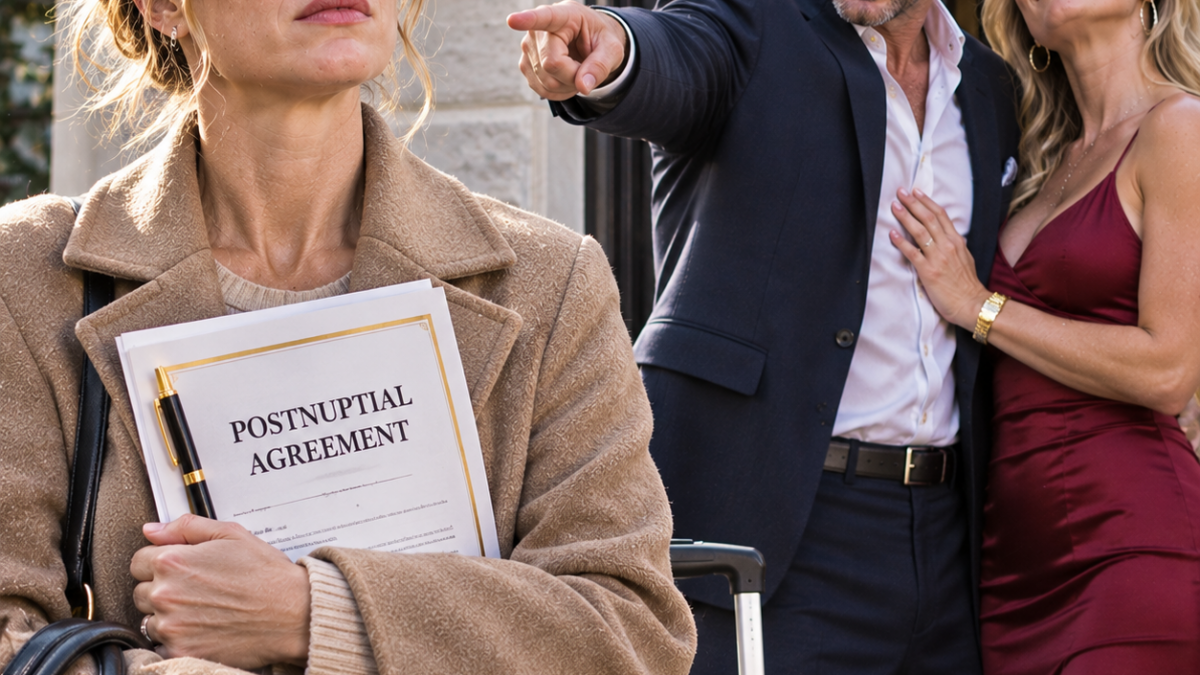
Now she stood in my foyer wearing yesterday’s makeup and Mark’s company fleece over a black dress.
Her overnight bag rolled across the hardwood floor.
Mark closed the door.
Looked at me.
No shock.
No shame.
Almost relief.
“Claire.”
My brain kept waiting for another explanation.
Flight canceled.
Coworker needed somewhere to stay.
Emergency.
Anything.
Then Vanessa placed her hand on his arm.
Not accidentally.
I looked down.
Mark followed my eyes.
Then sighed.
Not apologetically.
Annoyed.
As if I had forced him into an inconvenient conversation.
“This is Vanessa.”
“I know.”
Vanessa gave me a small smile.
Not cruel exactly.
Worse.
Confident.
Mark loosened his tie.
“I was going to wait until after the trip.”
I stared.
“Wait for what?”
He looked toward the stairs.
Then back.
“I’m done pretending this marriage works.”
The sentence was so ordinary that for a moment I did not understand it.
“What?”
“I’m leaving.”
He glanced at Vanessa.
“For her.”
Six years disappeared.
Courthouse wedding.
First apartment.
Broken furnace.
Student debt.
The year Mark was unemployed.
The year I took weekend freelance work while working full-time.
The night he cried because his second promotion disappeared after a merger.
The months I paid everything.
The vacations postponed.
My studio postponed.
Children postponed.
Everything compressed into:
For her.
I looked at Vanessa.
She shifted but did not remove her hand.
I looked back at Mark.
Then at my purse.
The winning ticket was maybe twelve feet away.
Seventy-three million dollars.
I could have told him.
The words were right there.
Mark, I won the lottery last night.
Maybe his face would have changed.
Maybe Vanessa’s hand would have dropped.
Maybe everything would suddenly become complicated.
Instead, I heard myself ask:
“Are you sure?”
Mark laughed.
That laugh saved me.
Not because it felt good.
Because it removed uncertainty.
“Claire.”
He shook his head.
“Don’t make this pathetic.”
Pathetic.
Something inside me became quiet.
Not broken.
Quiet.
He continued:
“This hasn’t worked in years.”
“That’s news to me.”
“Come on.”
He gestured around the foyer.
“We’re roommates.”
“You were telling me you loved me three months ago.”
“I care about you.”
Vanessa looked toward the living room.
Mark followed.
Then:
“But this is different.”
I almost asked:
How long?
Then realized I did not want the answer yet.
Mark pointed upstairs.
“You can stay until Sunday.”
I blinked.
“What?”
“Take whatever is yours.”
“Then I want the keys.”
Vanessa’s eyes flickered toward him.
He had rehearsed this.
I could hear it.
I said:
“The keys.”
“Yes.”
“This house.”
Mark exhaled.
“Claire.”
“What about it?”
“You know I’ve paid most of the mortgage for the last few years.”
That was technically true.
After his promotion, Mark’s income became significantly higher than mine.
What he did not mention was the $128,000 down payment.
My grandmother June had left me a small investment account when she died.
I sold part of it to buy this house.
The bank transfer still existed.
Every statement.
Every closing document.
Mark continued:
“I think we both know the house is mostly mine.”
Interesting.
Vanessa looked around.
I noticed then that she was studying the room.
Not me.
The room.
Fireplace.
Furniture.
Kitchen.
Like someone imagining where her things would go.
She said softly:
“Mark said we’d make the transition respectful.”
I looked at her.
“We?”
She flushed.
Mark stepped in.
“Don’t do this.”
I almost laughed.
“What exactly am I doing?”
“Turning it ugly.”
“You brought another woman into our house at six in the morning.”
“She’s here because I didn’t want to keep lying.”
“How noble.”
His face tightened.
Then:
“I’m trying to be honest.”
That sentence made me understand something.
People can tell the truth after months of lying and congratulate themselves for honesty.
I nodded.
“All right.”
Mark looked surprised.
“All right?”
“Yes.”
“You’ll go?”
“Yes.”
His shoulders relaxed.
Vanessa smiled.
Mark mistook calm for surrender.
He always had.
I walked upstairs.
Closed the bedroom door.
Locked it.
Then sat on the edge of our bed.
My hands started shaking.
Not because of the money.
Not yet.
Because the man downstairs had already begun discussing my removal from my own life.
I took the ticket from my purse.
Six numbers.
Still there.
My phone.
Call one:
The official lottery claims number listed on the state website.
I told them I believed I had a jackpot-winning ticket.
The representative gave me basic instructions.
Sign it.
Photograph it.
Secure it.
Do not hand it to anyone.
Do not post.
Consider legal and financial advice before presenting it.
I signed the back.
CLAIRE BENNETT DALTON.
Then photographed both sides.
Placed the ticket into a second sleeve.
Call two:
Janelle Ortiz.
Divorce attorney.
Recommended by a woman from work two years earlier when her own marriage collapsed.
I had saved the name.
I never expected to use it.
Her receptionist said earliest appointment was Monday.
I said:
“My husband brought his mistress home this morning and told me I have until Sunday to leave.”
Pause.
Then:
“Can you be here at ten?”
“Yes.”
Call three:
My accountant.
Peter Lang.
I said only:
“I may have a significant windfall.”
“How significant?”
“Lottery.”
Silence.
“Claire.”
“Yes?”
“How much?”
“Seventy-three million advertised jackpot.”
Another silence.
Then:
“Do not do anything.”
I almost laughed.
“That seems to be today’s theme.”
He continued:
“Do not promise anyone money.”
“Do not put anything online.”
“Do not claim it until you’ve spoken to a lawyer who handles lottery proceeds and estate planning.”
“And Claire?”
“Yes?”
“Do not hide it from a divorce attorney.”
That sentence mattered.
“I wasn’t planning to.”
“Good.”
“Because timing and marital-property rules can be complicated.”
My stomach tightened.
I looked at my wedding photograph.
“So Mark might get half.”
“I’m an accountant.”
“Not your divorce lawyer.”
“Do not assume anything.”
“Tell your attorney everything.”
“I will.”
That is exactly what I did.
Before leaving the house, I opened the small fireproof safe in my closet.
Mark did not know the combination.
I placed the ticket inside temporarily.
Then changed my mind.
Too dangerous.
This was now a house where the woman downstairs wanted my bedroom.
I placed the ticket inside my purse and kept the purse against my body.
I packed only enough for one night.
Laptop.
Medication.
Underwear.
Two sweaters.
Work clothes.
Passport.
Grandmother’s jewelry.
Financial files.
Mark was in the kitchen when I came downstairs.
Vanessa was making coffee.
My coffee.
In my kitchen.
Mark looked at the bag.
“Where are you going?”
“Work.”
“With luggage?”
“I’m staying at the Marriott tonight.”
His eyebrows lifted.
“You don’t have to leave immediately.”
I stared.
“Thank you for your generosity.”
Vanessa said:
“Claire, I know this is uncomfortable.”
I looked at her.
She stopped.
I said:
“Don’t.”
One word.
Enough.
She lowered her eyes.
Mark followed me toward the door.
“Can we talk tonight?”
“Not today.”
“You’re going to have to deal with this.”
I turned.
“Mark.”
“What?”
“Did you mean what you said?”
He frowned.
“Which part?”
“You’re leaving me for her.”
His eyes moved toward Vanessa.
Then back.
“Yes.”
“No doubt?”
He looked irritated.
“No doubt.”
I nodded.
“Good.”
Then left.
At 10:03, I sat in Janelle Ortiz’s office.
She was maybe forty-five.
Dark hair.
Gray suit.
No patience for euphemisms.
She listened without interruption.
Affair.
House.
Six-year marriage.
No children.
My grandmother’s inheritance used as down payment.
Mark’s recent salary increase.
Our retirement accounts.
My postponed studio.
Then:
“I won the lottery last night.”
Her pen stopped.
I placed the photocopy of the ticket on her desk.
She stared.
Then looked at me.
“Are you serious?”
“Yes.”
“How much?”
“Seventy-three million advertised jackpot.”
Janelle slowly put the pen down.
“Well.”
“That changes the morning.”
“I’ve had better.”
She almost smiled.
Then became serious.
“Have you claimed it?”
“No.”
“Told Mark?”
“No.”
“Anyone besides lottery office and accountant?”
“You.”
“Good.”
She folded her hands.
“First thing you need to understand.”
“I am not going to tell you this is automatically yours.”
My stomach dropped.
“The ticket was purchased during the marriage.”
“Yes.”
“Before separation.”
“Yes.”
“Depending on governing law, source of funds, agreements between spouses, and other facts, Mark may have a claim.”
I nodded.
“I figured.”
“Second.”
“You cannot conceal this from the legal process.”
“I won’t.”
“Good.”
“Trying to hide seventy-three million dollars is how people turn an advantageous divorce into a catastrophe.”
“I understand.”
“Third.”
“Do you have a prenup?”
“No.”
Her face fell slightly.
Then I remembered.
“Wait.”
“What?”
“Postnup.”
Janelle looked up.
“You have a postnuptial agreement?”
“Yes.”
“Where?”
“Home.”
“Copy?”
“Email maybe.”
I searched.
Two years earlier.
Mark had gotten a major promotion.
Significant equity compensation.
He had become anxious.
He said one of his coworkers had been “destroyed” in divorce.
He wanted to clarify ownership.
I had been offended.
Mark insisted it was not about us.
Just prudent planning.
His attorney drafted it.
I hired independent counsel because the agreement required it.
I had barely thought about it since.
I found the PDF.
Sent it to Janelle.
She opened.
Read.
Her expression changed at page eleven.
Then she went back.
Read again.
“What?”
I asked.
She did not answer immediately.
“Janelle.”
She looked at me.
“Who wanted this agreement?”
“Mark.”
“Strongly?”
“Yes.”
“Do you have emails?”
“Probably.”
She turned the monitor toward me.
Section 8.3.
Independent Windfalls and Chance-Based Proceeds.
I read.
Any lottery, sweepstakes, gambling, prize, contest, promotional award, or similar windfall acquired by either spouse individually and purchased or entered solely by that spouse would remain that spouse’s separate property, together with proceeds, growth, and reinvestment, unless expressly converted to marital property in a signed writing.
I stared.
Read again.
Then:
“Why is that in there?”
Janelle kept reading.
I remembered.
Mark played high-stakes fantasy sports with coworkers.
Occasionally poker.
He had once won almost $40,000 in a company pool.
When drafting the postnup, he wanted any future wins protected.
His attorney used broad language.
At the time, I had joked:
“If I win Powerball, you’re going to regret this.”
Mark had laughed.
“If you win Powerball, I’ll carry your bags.”
My hands started shaking.
Janelle raised one finger.
“Do not celebrate yet.”
I stopped.
“Agreement can still be challenged.”
“For coercion.”
“Unconscionability.”
“Disclosure.”
“Technical issues.”
“We need your independent counsel file.”
“Your financial disclosures.”
“Execution circumstances.”
“Everything.”
“But if this agreement is enforceable and this ticket fits the clause…”
She tapped the screen.
“Mark may have written himself out of your lottery prize.”
I sat back.
Could not speak.
Janelle continued.
“And Claire?”
“Yes?”
“This does not mean you lie to him.”
“I understand.”
“It means we disclose when legally appropriate and through controlled channels.”
“Do not text him a photograph.”
“I wasn’t planning to.”
“Good.”
“People do stupid things when shocked.”
I thought of Mark downstairs with Vanessa.
“I’m learning.”
Janelle’s team went to work.
I left her office at noon.
Checked into the Marriott.
Then went to my job.
Yes.
Work.
Because the world remained offensively normal.
I was a senior project manager for Bellweather Home & Hospitality, a design and furnishings firm.
Not glamorous.
Good job.
I managed commercial interiors.
Teams.
Vendors.
Budgets.
Clients.
It paid well.
But I had wanted my own studio for years.
Mark always said:
“After my next promotion.”
Why?
Because my health insurance was better.
Because startup income could be unstable.
Because his travel schedule meant we needed my predictable schedule.
Because we should pay down the mortgage.
Reasonable explanations.
Year after year.
Dream postponed through reasonable explanations.
That afternoon, my assistant Tessa asked:
“Are you okay?”
I said:
“My husband left me this morning.”
Her mouth fell open.
“For who?”
“Coworker.”
“Do you want me to kill him?”
“No.”
“Slash tires?”
“No.”
“You’re no fun.”
I laughed for the first time all day.
Then went into my office and cried.
Not about money.
That needs to be clear.
Seventy-three million dollars did not anesthetize betrayal.
It did not make six years meaningless.
It did not stop me from remembering Mark holding my hand when my grandmother died.
It did not erase the first apartment.
The courthouse vows.
The cheap Chinese food after.
Winning money does not turn heartbreak into a victory montage.
I wanted my husband.
At least the husband I thought I had.
That night, Mark texted.
We need to talk about logistics.
Logistics.
Our marriage reduced to moving boxes.
I replied:
My attorney will contact you tomorrow.
He called immediately.
I let it ring.
Again.
Again.
Then a text.
Attorney? Seriously?
I stared.
Then:
Yes.
His reply came fast.
Claire, don’t turn this into a war.
I laughed alone in the hotel room.
The man who brought his mistress home asked me not to make things hostile.
Janelle filed the divorce petition the next morning.
Mark was served at work.
By 10:40, he had hired his own attorney.
By 2:00, he texted:
You filed already?
I did not answer.
Then:
I thought we could handle this like adults.
Then:
Vanessa feels terrible.
That one almost impressed me.
I blocked him temporarily and routed communication through Janelle.
The first settlement proposal arrived four days later.
Mark wanted the house.
He valued it at $680,000.
Actual market estimate was closer to $940,000.
He claimed his mortgage contributions justified most equity.
He proposed giving me:
My car.
My retirement account.
My personal belongings.
$35,000 cash.
Mutual waiver of claims to separate assets.
Each spouse keeps future earnings and acquisitions.
And I vacate within thirty days.
Janelle read the proposal.
Then looked at me.
“He thinks you’re stupid.”
“I know.”
“He also thinks you’re broke.”
“I know.”
“He’s relying heavily on the postnup.”
“Of course.”
She tapped his lawyer’s letter.
“They specifically cite its separate-property sections.”
I smiled despite myself.
“What?”
“Nothing.”
“No.”
Janelle smiled too.
“Say it.”
“He really loves that postnup.”
“Oh, Claire.”
She leaned back.
“He is going to hate that postnup.”
But first we had to verify it.
My former independent attorney still had the file.
Signed disclosures.
Emails.
Certificate stating I had separate counsel.
No evidence of duress.
Both parties had disclosed assets.
Mark’s attorney had circulated draft language.
And there was the email.
The one Janelle had hoped existed.
From Mark.
To both attorneys.
Two years earlier.
I want the agreement broad. Any future bonus, stock appreciation, prize, investment gain, gambling win, inheritance, or other windfall associated with one spouse individually should stay with that spouse. I don’t want ambiguity later.
Janelle read it twice.
Then:
“Frame it.”
I laughed.
She was joking.
Mostly.
Another email:
Claire and I each have our own careers. If either of us hits it big, that shouldn’t automatically become the other person’s asset.
I remembered reading that.
At the time, it had hurt.
Mark had just received a large equity package.
I knew who he meant by hits it big.
Him.
I had signed anyway because my own attorney told me the agreement also protected Quinn Atelier if I ever opened it.
The irony was almost mathematically perfect.
The lottery attorney joined the team next.
Martin Hale.
Estate planning and high-value claims.
He inspected the ticket personally.
Verified the number sequence.
Security.
Claim deadline.
Options.
Privacy rules.
Tax planning.
Trust structure.
He did not react emotionally.
I appreciated that.
He said:
“You have not won seventy-three million dollars in spendable cash.”
“I know.”
“Headline jackpot and actual net proceeds are different.”
“I know.”
“We will model annuity and cash options.”
“Good.”
“And no Ferrari.”
“I drive a six-year-old Subaru.”
“That is not an answer.”
I laughed.
“I don’t want a Ferrari.”
“Everyone says that in week one.”
I liked him.
We stored the ticket in a secure bank location under documented control.
I stopped carrying seventy-three million dollars in my purse.
That helped me sleep.
Then came disclosure.
Janelle did it properly.
Not publicly.
Not through Mark.
His attorney received formal notice that I possessed a potential high-value lottery claim acquired immediately before separation and that I asserted separate-property treatment under Section 8.3 of the postnuptial agreement.
The letter did not hide the amount.
Advertised jackpot: $73,000,000.
Janelle called me before sending.
“Ready?”
“No.”
“Good.”
“People who say yes are lying.”
“Send it.”
She did.
Twenty-seven minutes later, Mark called from a number I had not blocked.
I answered before thinking.
“Claire.”
His voice sounded wrong.
Not angry.
Breathless.
“Is it true?”
I closed my eyes.
“You need to talk to your lawyer.”
“Seventy-three million dollars?”
“I’m not discussing legal matters directly.”
“You won the lottery?”
“Yes.”
Silence.
Then:
“When?”
“The night before you came home.”
Another silence.
Longer.
I could hear him breathing.
“You knew.”
“Yes.”
“When I came in with Vanessa.”
“Yes.”
“When I told you to leave.”
“Yes.”
“You knew you had seventy-three million dollars.”
“Yes.”
His voice cracked.
“Why didn’t you tell me?”
That question was so extraordinary that I almost laughed.
“Why would I?”
“Because I’m your husband.”
“You were standing beside the woman you said you were leaving me for.”
“Claire.”
“You told me to pack.”
“I was emotional.”
“No.”
“You were prepared.”
Silence.
“You brought her overnight bag.”
“That wasn’t—”
“You told me I had until Sunday.”
“Stop.”
“No.”
My voice stayed calm.
“Remember what I asked?”
He did not answer.
“I asked if you were sure.”
“Claire.”
“You laughed.”
Silence.
“You called me pathetic.”
His breathing changed.
“I didn’t know.”
There it was.
I whispered:
“Exactly.”
He stopped.
Neither of us spoke.
Then I asked:
“If I had told you?”
“What?”
“That morning.”
“If I had taken the ticket out of my purse and said I won seventy-three million dollars.”
“What would you have done?”
He answered too slowly.
“Nothing would have changed.”
I closed my eyes.
“Mark.”
“I mean it.”
“You’re lying.”
“You don’t know that.”
“I know you.”
“Apparently not.”
That hurt him.
Good.
Maybe cruel.
True.
He said:
“Can we meet?”
“No.”
“Please.”
“No.”
“This changes everything.”
And there it was.
I laughed softly.
He heard it.
“What?”
“You just said it.”
“What?”
“This changes everything.”
He realized.
“No.”
“That’s not what I meant.”
“Then explain.”
“I mean financially.”
“Exactly.”
“No, Claire.”
“I’m saying we need to—”
“You wanted a divorce when I was the woman you thought earned seventy-eight thousand dollars and owned half a house.”
“It was over before the money.”
“Good.”
I wiped tears from my face.
“Then let it stay over after the money.”
He went silent.
Then:
“Vanessa and I are having problems.”
I actually closed my eyes from secondhand embarrassment.
“We are not having this conversation.”
“She didn’t understand—”
“Mark.”
“What?”
“Do not tell me problems with your mistress like I’m still your wife.”
I hung up.
Then cried.
Again.
Not because I wanted him back.
Because part of me had spent six days secretly wondering whether he regretted leaving me.
Now I knew.
He regretted timing.
That is different.
Vanessa moved out of the house three days later.
I learned through Mark’s attorney because she had left personal property involved in a temporary inventory dispute.
Janelle told me.
I said:
“I don’t care.”
Then:
“Why?”
Janelle looked amused.
“You just said you don’t care.”
“I’m evolving slowly.”
Apparently Mark had not told Vanessa the full truth about his finances.
She believed he owned the house almost outright.
He did not.
Mortgage balance was substantial.
His car was leased.
His executive compensation looked impressive but a meaningful portion was unvested stock protected by the postnup.
He had also carried more credit-card debt than I knew.
Not catastrophic.
Enough that Vanessa’s imagined life looked different after the divorce filings.
Then the lottery disclosure arrived.
Vanessa reportedly asked Mark whether he planned to contest it.
He said yes.
She asked whether that meant reconciliation was impossible.
He did not answer well.
Their relationship collapsed inside a week.
I did not celebrate.
Okay.
I celebrated a little.
I am not applying for sainthood.
Then Vanessa called me.
I almost did not answer.
Unknown number.
Again.
“Claire?”
“Yes.”
“This is Vanessa.”
I nearly hung up.
She said quickly:
“I’m not calling about Mark.”
“Then why?”
“I owe you an apology.”
I said nothing.
“I knew he was married.”
Still nothing.
“He told me you were basically separated.”
“Were we?”
“No.”
At least honest.
“He said you slept in separate rooms.”
Lie.
“That you had already agreed to split after his trip.”
Lie.
“That the house was his.”
Lie.
“That you didn’t want children.”
Complicated.
Then Vanessa said:
“I should have known better.”
“Yes.”
She inhaled.
“I was awful to you that morning.”
“Yes.”
“I thought I was walking into a house where the marriage was already over.”
“You walked into my house carrying an overnight bag.”
“I know.”
“You looked around like you were choosing furniture.”
She started crying.
“I know.”
I felt no urge to comfort her.
That was healthy.
Then she said:
“Mark asked if I’d testify that you two had been separated before the lottery ticket was purchased.”
My entire body went still.
“What?”
“He said it would help him establish the money was acquired after the marriage effectively ended.”
“Were you there?”
“No.”
“Did you agree?”
“No.”
That mattered.
“Why are you telling me?”
“Because I did enough.”
I closed my eyes.
“Will you tell my attorney?”
“Yes.”
“Then do not discuss this with me again.”
“Okay.”
Before hanging up, Vanessa said:
“For what it’s worth, I didn’t leave him because you got rich.”
I almost laughed.
“Vanessa.”
“I know how it looks.”
“It doesn’t matter how it looks.”
She became quiet.
Then:
“You’re right.”
I gave her Janelle’s number.
Hung up.
Mark had crossed another line.
Not necessarily a criminal line.
A desperation line.
Trying to manufacture a separation date through Vanessa’s testimony.
His attorney apparently shut that down quickly once informed.
The facts were simple.
Mark and I had shared the same bedroom the week he left.
Joint household.
Texts.
Meals.
No formal separation.
No agreement.
And none of it mattered as much as Mark hoped because the postnup’s windfall clause did not depend entirely on marital status.
It defined individually acquired lottery prizes as separate.
Mark’s legal strategy changed.
He attacked the postnup.
The same agreement his first settlement proposal had demanded we enforce.
Janelle nearly smiled herself into another dimension.
His new position:
The agreement was unfair.
Too broad.
Possibly unconscionable.
Executed without sufficient understanding.
Janelle responded with:
His attorney.
His draft instructions.
His emails.
His financial disclosures.
My independent counsel.
His repeated reliance on the agreement.
And the settlement proposal his lawyer had sent only days earlier insisting it governed our property division.
At mediation, I saw Mark in person for the first time since he brought Vanessa home.
He looked tired.
Still handsome.
Still Mark.
I hated that my heart noticed.
We sat in separate rooms initially.
The mediator shuttled.
House.
Retirement.
Cars.
Accounts.
Attorney fees.
Lottery.
Mark wanted a percentage.
Started at fifty.
Then forty.
Then twenty-five.
Then ten.
Janelle kept saying:
“No.”
I asked:
“Could he win if we go to court?”
She never lied to me.
“Yes.”
My stomach tightened.
“Any agreement can be challenged.”
“No litigation is guaranteed.”
“But?”
“But I like our position.”
“Do you want to settle?”
“For how much?”
“That is your decision.”
I thought.
I could give Mark five million dollars and still be wealthier than I had ever imagined.
Would that buy peace?
Maybe.
Would it reward his strategy?
Also maybe.
Janelle said:
“Do not decide based on what you can afford.”
“Decide based on what you think is fair and what risk you can tolerate.”
I nodded.
“What would you do?”
“I charge you so you don’t ask me to live your life.”
Annoying woman.
Good attorney.
Eventually, Mark requested direct conversation.
I said yes.
Janelle stayed.
His attorney stayed.
Mark entered.
We sat across.
For a few seconds, neither of us spoke.
Then he said:
“You look good.”
I almost laughed.
“Don’t.”
“Sorry.”
He looked at his hands.
Then:
“I made a mistake.”
“Several.”
“Yes.”
That surprised me.
He continued.
“Vanessa is gone.”
“I know.”
“I ended it.”
“I don’t care who ended it.”
He nodded.
“I deserve that.”
Then:
“I don’t want the divorce.”
There it was.
Janelle looked at me.
Not interfering.
I asked:
“Would you be saying that if I had not won?”
Mark’s eyes filled.
“Yes.”
“Immediately?”
He hesitated.
Too long.
I smiled sadly.
“That’s the answer.”
“No.”
“Claire.”
“I was angry.”
“At what?”
“Our life.”
“Then you should have told me.”
“I tried.”
“When?”
He had no answer.
I continued.
“You slept with someone else.”
“Yes.”
“You brought her home.”
“Yes.”
“You told me the house was mostly yours.”
He closed his eyes.
“I was an asshole.”
“Yes.”
“I thought you’d leave quietly.”
“Yes.”
“I thought you needed me more than I needed you.”
That one hurt.
He said it himself.
At least.
I whispered:
“Why?”
“Because I earned more.”
“I paid the mortgage.”
“My career was going somewhere.”
“You kept talking about a design studio you never opened.”
His voice cracked.
“I started seeing you as someone who talked about a life instead of building one.”
That hurt worse than Vanessa.
Because there was truth tangled inside cruelty.
I had postponed.
Again.
Again.
Partly because of Mark.
Partly because I was afraid.
I had used his career as an excuse too.
I looked at him.
“And did sleeping with Vanessa make you feel like the person building a life?”
He looked down.
“No.”
Silence.
Then:
“Claire.”
“What?”
“I loved you.”
“I know.”
“I still do.”
I looked away.
Love was not the issue.
That took me weeks to understand.
People can love you and still treat you badly.
Love is not a behavioral exemption.
Mark continued:
“I’ll sign over the house.”
“I don’t want it.”
He looked shocked.
“What?”
“I don’t want the house.”
“But your grandmother’s money—”
“I want my documented contribution and lawful share of equity.”
“I don’t want the rooms.”
His face crumpled.
That house had been our dream.
Now I could not imagine sleeping there.
Mark asked:
“What do you want?”
I answered before thinking.
“My six years back.”
Silence.
Of course impossible.
I continued:
“So I’ll take what is possible.”
“My money.”
“My work.”
“My freedom.”
“And the chance to build the life I kept postponing.”
He cried.
I had never seen Mark cry during our marriage except at his father’s funeral.
I cried too.
The lawyers sat quietly.
Sometimes mediation becomes grief with billing rates.
Then Mark said:
“I’ll stop contesting the lottery.”
I stared.
His attorney turned toward him.
“Mark—”
“No.”
He looked at me.
“I wrote the postnup.”
“Yes.”
“I meant it when I thought I’d be the one who benefited.”
That was the truest sentence he had spoken.
I said nothing.
He continued:
“If I fight it now, I’m proving exactly what you think I am.”
My eyes filled.
“I don’t know what I think you are.”
He nodded.
“Fair.”
He agreed to withdraw his claim to the lottery proceeds in exchange for both sides honoring the remainder of the postnup as written and resolving the house through documented contributions and a negotiated equity split.
Janelle insisted every term be reviewed.
No handshake emotions.
Written.
Signed.
Proper disclosure.
The settlement did not leave Mark penniless.
I did not want that.
He kept his retirement.
His separate investment accounts.
His vested company equity according to the postnup.
His vehicle.
His personal property.
He received a fair portion of marital savings.
The house was listed.
My grandmother’s traceable down payment was credited as the agreement required.
Remaining marital equity was divided under the negotiated settlement.
No revenge.
No financial annihilation.
Just disentanglement.
Mark signed.
So did I.
Only after the settlement framework was fully documented and the lottery disclosure resolved did I move ahead with the claim process.
I chose the cash option after months of analysis.
Taxes.
Trusts.
Estate planning.
Investment policy.
Security.
Privacy.
I learned more about municipal bonds in six weeks than any sane human should.
The number that eventually entered controlled accounts was nowhere near the giant headline jackpot.
Still enormous.
Life-changing beyond imagination.
I did not buy a mansion.
Martin was disappointed.
“I had you pegged for one reckless purchase.”
“I bought a new mattress.”
He stared.
“That’s depressing.”
“It was $4,800.”
“Better.”
I paid my mother’s remaining mortgage.
Not immediately.
First I asked.
That sounds small.
It wasn’t.
Before the lottery, I imagined arriving with a check.
Surprise.
Hero moment.
After everything with Mark, I learned money does not erase consent.
I told Mom:
“I want to pay your mortgage if you’ll let me.”
She cried.
Said yes.
Then:
“Are you sure?”
I laughed.
“Very.”
Eddie at the gas station received the retailer bonus automatically associated with selling the winning ticket.
When I visited months later, he recognized me before I reached the counter.
His mouth fell open.
“You.”
“Me.”
“I told you.”
“You told me I needed luck.”
“You looked terrible.”
I laughed.
“I was tired.”
He poured coffee.
“Still bad.”
“Some things money can’t fix.”
I bought the coffee.
He refused payment.
I left five dollars anyway.
Not a million-dollar check.
Not a car.
He already had the official retailer bonus and did not need me turning one moment of kindness into a debt.
I did send the store staff lunch for a week.
That felt enough.
Then I did something that frightened me more than claiming the money.
I resigned.
Bellweather had been my stability for eleven years.
Good salary.
Benefits.
Respect.
I sat across from my boss, Adrian, expecting guilt.
Instead he smiled.
“Finally.”
I stared.
“What?”
“You’ve been talking about your own studio since before I hired you.”
“That’s rude.”
“It’s true.”
“You knew?”
“Claire.”
He laughed.
“Everyone knew.”
I started crying.
Adrian looked alarmed.
“Good crying?”
“I don’t know anymore.”
I opened June House Studio six months later.
Named after my grandmother.
Not because the lottery made me brave.
Because betrayal made delay feel expensive.
I leased a converted brick warehouse.
Not huge.
Great windows.
Hired Tessa.
Then three designers.
Then two architects.
Then an operations director who refused to let me buy antique chairs without budgets.
The lottery money funded security.
Not extravagance.
We built slowly.
Clients did not need to know I had millions behind the company.
I wanted the work to stand.
Our first project was a boutique hotel lobby in Madison.
Small.
Beautiful.
I stood there opening night with a glass of champagne and thought:
I delayed this for six years.
Then corrected myself.
No.
I prepared for six years.
Different story.
Mark heard about the studio.
He sent flowers.
No romantic message.
Card:
You should have done this years ago. I’m sorry I helped convince you not to. — M
I stared at it.
Then put the flowers in the lobby.
Not because I forgave everything.
Because the apology was accurate.
Vanessa contacted me once more.
Almost a year after the morning she entered my house.
Email.
I don’t expect an answer. I wanted to tell you I’m sorry without explaining myself this time. I hurt you knowingly. Mark’s lies do not erase what I chose to do.
That was it.
No request.
No story.
I did not answer.
Sometimes silence is an answer without being punishment.
Mark left his company eight months after our divorce.
I worried at first he had been fired because of Vanessa.
He had not.
He took a position with a smaller firm in Minneapolis.
Fresh start.
His mother told my mother, who told me.
Families remain efficient intelligence networks after divorce.
I said:
“Good for him.”
And meant it.
Mostly.
The divorce became final eleven months after that morning.
Janelle brought champagne to her office.
I said:
“Isn’t that inappropriate?”
“Extremely.”
We toasted.
Then she handed me the signed decree.
I stared at my name.
Claire Bennett Dalton.
Soon to become Claire Bennett again.
Six years represented by pages.
House.
Accounts.
Waivers.
Separate property.
Windfall clause.
A marriage translated into legal categories.
I expected triumph.
Instead I felt grief.
Janelle watched me.
“You okay?”
“No.”
“Good.”
I laughed through tears.
“You say that a lot.”
“Divorce clients who say they’re completely fine usually terrify me.”
I looked at the decree.
“I thought being rich would make this easier.”
“Money makes some parts easier.”
“Not the part where he stopped choosing you.”
That sentence hurt.
“Yes.”
She leaned back.
“Claire, your money gave you options.”
“It did not make your heart stupid for caring.”
I cried.
Good attorney.
Expensive therapist.
The house sold two months later.
I went back once.
Empty.
Staged furniture gone.
Our photographs gone.
Marks on the wall where pictures had hung.
I stood in the kitchen.
Same counter where I scratched—no, where I checked—the ticket.
Same foyer where Mark brought Vanessa.
Same stairs I climbed.
The house had no idea.
Buildings are rude like that.
They hold events without holding meaning.
Mark arrived to sign final documents with the realtor.
I had not expected him.
We stood in the kitchen.
He looked around.
“Remember when the dishwasher flooded?”
I laughed.
“Our first week.”
“You blamed me.”
“You installed it.”
“I connected one hose.”
“Incorrectly.”
He smiled.
Then became sad.
“I thought we’d get old here.”
“So did I.”
Silence.
Then:
“If I had known…”
I stopped him.
“No.”
He looked at me.
“Don’t.”
“What?”
“Finish that sentence.”
His eyes filled.
I continued:
“I need one thing from you.”
“Anything.”
“Don’t tell me what you would have done if you knew about the money.”
He swallowed.
“Why?”
“Because if the answer is that you would have stayed, it will hurt.”
“And if the answer is that you still would have left, that will hurt too.”
He nodded.
Fair.
Then he said:
“I can tell you something else.”
“What?”
“I wish I had left honestly six months earlier instead of cheating and turning you into the villain in my head.”
I stared.
That was mature.
Painful.
True.
“Why did you?”
“Cheat?”
“Yes.”
He looked toward the empty dining room.
“Because Vanessa made me feel admired.”
“You knew me.”
“That sounds stupid.”
“It isn’t.”
He continued.
“With you, I felt behind.”
“Why?”
“You carried me when I was unemployed.”
“You saw every failure.”
“You knew how scared I was.”
“When I started making more money, instead of being grateful, I wanted to erase the years I needed you.”
My chest hurt.
He said:
“Vanessa met the version of me who had already succeeded.”
“She thought I was impressive.”
“I liked not owing the person in front of me a history.”
I whispered:
“I never thought you owed me.”
“I did.”
That was the tragedy.
He had converted gratitude into humiliation without telling me.
I asked:
“Why the postnup?”
He laughed bitterly.
“Same reason.”
“I finally had money.”
“I was terrified you’d leave and take the proof I had made it.”
“So you protected it.”
“Yes.”
He looked at me.
“And then you won the lottery.”
Despite everything, I laughed.
He did too.
For maybe ten seconds, we were married again.
Not literally.
Just the old ease.
Then it passed.
Mark said:
“I really did write myself out of it.”
“Yes.”
“My lawyer still hates me.”
“Mine likes you.”
He smiled.
Then:
“Are you happy?”
I thought.
“Sometimes.”
He nodded.
“That’s probably real.”
I looked at him.
“You?”
“Sometimes.”
“Good.”
We locked the house.
Walked to separate cars.
That was the last time Mark and I were alone for several years.
Money changed my life.
Of course it did.
Anyone who tells you millions do not change life is either lying or has never worried about medical bills.
I stopped checking prices at grocery stores.
My mother stopped fearing a roof repair.
I traveled.
Not constantly.
Enough.
I built a retirement structure so conservative Peter accused me of having “the risk tolerance of a municipal library.”
I donated quietly.
A scholarship at the community college where I had studied design before transferring.
Emergency grants for women leaving financially dependent marriages.
Not because I believed every woman needed lottery money to leave.
The opposite.
I wanted small amounts to create options before desperation became a cage.
June House Studio grew.
Not because I poured unlimited money into it.
Because good people joined.
Tessa became creative director.
She once said:
“You know you could just retire.”
“I’d go insane.”
“You could buy an island.”
“I don’t like sand.”
“That is the saddest rich-person answer I’ve ever heard.”
We laughed.
Five years after the win, we had thirty-one employees.
Work across the Midwest.
Hotels.
Restaurants.
Residential.
Adaptive reuse.
I finally designed spaces instead of only coordinating other people’s designs.
Grandmother June would have loved it.
She had been the first person to give me graph paper as a child.
When other adults asked what I wanted to be, I said:
“Someone who makes rooms.”
June never corrected me.
She said:
“Then make good ones.”
The inheritance she left bought the first house.
The house ended.
The lesson did not.
I never bought another home with a romantic partner.
Not because I stopped believing in relationships.
Because financial clarity became peaceful to me.
For a while, I stopped dating completely.
Then I met Daniel Mercer.
Not a billionaire.
Not secretly powerful.
A high-school history teacher.
Divorced.
Two teenage daughters.
We met because June House redesigned his school library pro bono.
He argued with me about removing an ugly mural because students loved it.
I said:
“It is objectively terrible.”
He said:
“It was painted by a student who died.”
I immediately changed the design.
He smiled.
“Good.”
I disliked him.
Obviously, we started dating.
Our third date, I told him about the lottery.
Not the first.
I wanted him to know me before the number.
He stared.
Then:
“Seventy-three million?”
“Headline number.”
“Still.”
“Yes.”
He took a sip of beer.
“Do I have to pay for dinner?”
I laughed.
“Yes.”
“Terrible.”
He paid.
That mattered more than it should have.
Daniel never moved into my financial life.
We eventually shared a home, but every agreement was explicit.
Lawyers.
Ownership percentages.
Estate plans.
His daughters protected.
My assets protected.
Daniel joked:
“Romance is alive.”
I said:
“Nothing says love like Schedule B.”
He kissed me.
Healthy love can survive paperwork.
Mark remarried too.
Not Vanessa.
A woman named Lauren.
Physical therapist.
I learned from mutual friends.
I felt strange.
Then normal.
Then genuinely happy for him.
That surprised me.
Years earlier, I imagined wanting him to regret me forever.
That would have kept me connected forever.
Regret is still a relationship.
Indifference took longer.
Peace took longer still.
One day, maybe seven years after the divorce, Mark emailed.
Subject:
Odd Question
I opened.
Claire, Lauren and I are expecting a baby. I know this may be strange, but I wanted you to hear it from me rather than someone else. I hope you’re well.
I stared.
Then cried.
Not because I wanted his baby.
Because Mark and I had postponed children until they disappeared from our marriage.
Career first.
Money first.
House first.
One more year.
Then he had another life.
That grief was real.
I showed Daniel.
He read.
Then handed back the phone.
“Want me to say something useful?”
“No.”
“Great.”
He sat beside me.
Perfect answer.
Eventually I replied:
Congratulations. I hope everyone is healthy.
Mark answered:
Thank you.
That was all.
Boundaries.
Peace.
The winning ticket itself disappeared into lottery procedure years before.
Surrendered.
Validated.
Processed.
I kept the photocopy.
Not framed.
Janelle had joked about framing Mark’s postnup email.
I did not do that either.
For a while, both documents sat in a file drawer.
The ticket.
The postnup.
Two pieces of paper representing wildly different kinds of luck.
One random.
One accidental.
Mark wrote the agreement believing wealth would flow toward him.
Years later, Peter once asked:
“Do you think the best thing that ever happened to you was winning?”
I thought.
“No.”
He looked shocked.
“Claire.”
“Financially, yes.”
“Obviously.”
“But not best.”
“What was?”
I considered.
“The timing.”
He frowned.
“What do you mean?”
“If Mark had left me two days earlier, I would have thought I couldn’t afford to start over.”
“I might have fought harder for the house.”
“I might have stayed in a job I had outgrown.”
“If he had left me two days later…”
I stopped.
“What?”
“I would have told him.”
About the ticket.
Then everything would have been different.
Would he still have left?
Maybe.
Would I always wonder whether he stayed for money?
Almost certainly.
The timing gave me certainty.
Brutal certainty.
Mark chose Vanessa while believing I was ordinary Claire.
No jackpot.
No studio.
No wealth.
Just the wife who had carried him through the hard years.
And he chose to leave.
That knowledge hurt.
It also freed me.
Peter said:
“That’s dark.”
“Accountants are supposed to like certainty.”
“We like reconciled statements.”
“Same thing.”
He laughed.
The gas-station ticket became family legend eventually.
My mother told the story badly.
She always added:
“And then Claire smiled when he told her to leave.”
I would correct:
“I did not smile immediately.”
“You told me you did.”
“Mom.”
“Better story.”
She was right.
The truth?
I smiled later.
Not downstairs.
Upstairs.
After Janelle emailed:
Section 8.3 may be very important.
That was when I smiled.
Not because I wanted Mark poor.
Because suddenly a document he created to reduce my claim on his success protected me from his claim on mine.
There is poetry in contracts sometimes.
At June House’s tenth anniversary party, Tessa demanded I tell the staff the origin story.
Not everyone knew.
I refused.
She gave a speech anyway.
She said:
“Claire founded this company after realizing waiting for the perfect moment is a scam.”
That I liked.
No lottery.
No cheating husband.
No seventy-three million.
Just:
Stop waiting.
Later that evening, a young junior designer named Maya approached me.
Twenty-four.
Talented.
Terrified.
She said:
“I want to freelance eventually.”
“Good.”
“But I should probably wait.”
I smiled.
“For what?”
“More savings.”
“Experience.”
“Marriage.”
“I don’t know.”
“Life to settle down.”
I heard myself twenty years earlier.
I said:
“Prepare.”
“Don’t wait.”
She frowned.
“What’s the difference?”
“Preparation has a target.”
“Waiting can go forever.”
She nodded.
I continued:
“Save money.”
“Learn contracts.”
“Build clients.”
“Get insurance.”
“Then pick a date.”
“If you’re always waiting until nobody else needs anything from you, you may wait forever.”
Her eyes widened.
“Is that what you did?”
“Yes.”
“For six years.”
“What changed?”
I smiled.
“Bad morning.”
She laughed.
I did not explain.
By then, the lottery had become the least interesting thing about my life.
That sounds absurd.
Seventy-three million dollars.
Least interesting.
But money becomes infrastructure eventually.
It pays bills.
Generates statements.
Requires taxes.
Supports choices.
Then you still wake up human.
You still have arguments.
Your mother still complains you do not call.
Your partner still loads the dishwasher incorrectly.
You still worry about employees.
Still miss your grandmother.
Still occasionally dream about the house you sold.
One dream repeated.
Mark enters.
Vanessa beside him.
He says:
“Pack your things.”
I reach into my purse.
But instead of a lottery ticket, nothing is there.
I wake scared.
For years, I thought the dream meant I feared losing money.
Therapist disagreed.
She said:
“You’re dreaming about whether you would still leave without the safety net.”
I hated that.
Because I did not know the answer.
Would I?
At the time?
Maybe not.
Money created an escape route.
That made me grateful.
But eventually I needed to become the woman who could say:
I deserve better.
Even without millions.
That became why I funded those emergency grants.
Not charity for victims.
Choice funds.
Rent.
Deposit.
Attorney consultation.
Childcare.
Enough money to turn:
I can’t leave
into:
Maybe I can.
The amounts were small compared with the jackpot.
Often $2,000.
$4,000.
$7,500.
Those checks sometimes mattered more to me than investment statements.
One recipient later sent an anonymous note.
You didn’t save me. You gave me enough room to save myself.
I kept that.
Framed.
Not the lottery ticket.
That note.
Years later, Mark and I crossed paths at a charity event.
Lauren with him.
Baby now a five-year-old boy named Miles.
Daniel with me.
It could have been awkward.
It wasn’t.
Mark introduced us.
Daniel shook his hand.
Lauren was warm.
Miles spilled juice on an expensive tablecloth.
Everyone laughed.
At one point Mark and I ended up near the bar alone.
He nodded toward Daniel.
“He seems good.”
“He is.”
“You seem happy.”
“I am.”
He smiled.
“Good.”
Then:
“Do you ever think about that morning?”
I almost laughed.
“Yes.”
“Me too.”
He looked embarrassed.
“I was unbelievably cruel.”
“Yes.”
“I thought making you leave fast would make me feel less guilty.”
That was interesting.
“Did it?”
“No.”
He looked toward Lauren.
Then:
“I spent years blaming you for postponing your studio.”
“I realized later I was afraid you’d succeed at something that didn’t include me.”
I stared.
“Mark.”
“I know.”
He smiled sadly.
“Therapy.”
“Good investment.”
“Cheaper than divorce.”
“Not for you.”
He laughed.
Then became serious.
“I’m glad you won.”
I studied him.
“Really?”
“Yes.”
“Not because you needed money.”
“Because I don’t know if you would have believed me leaving was about me otherwise.”
I stopped.
He understood something I had spent years learning.
I nodded.
“Maybe.”
He said:
“Claire.”
“Yes?”
“If you had told me that morning…”
I raised a hand.
He stopped.
We both smiled.
Still no answer.
Some questions are better left untested.
He nodded.
“Right.”
Then returned to Lauren.
I returned to Daniel.
The evening continued.
No dramatic closure.
No revenge.
Just two people who had once promised forever and eventually learned how to occupy the same room without needing to rewrite the past.
When my mother turned seventy-five, I took her to Italy.
The trip I had once imagined taking with Mark after the jackpot.
Rome.
Florence.
Tuscany.
Mom complained about stairs.
Loved everything.
One evening we sat overlooking vineyards.
She asked:
“Do you think Grandma June had anything to do with the ticket?”
I laughed.
“She died twelve years before.”
“That wasn’t my question.”
“You think she manipulated lottery numbers from heaven?”
“She liked you best.”
“Mom.”
“I’m just saying.”
Then Mom became quiet.
“I worried about you when Mark left.”
“I know.”
“Not because of money.”
“I know.”
“I thought you’d think six years had been wasted.”
I looked over the hills.
“Sometimes I did.”
“And now?”
I thought.
“No.”
“Why?”
“Because wasted years don’t teach you anything.”
“That marriage taught me a lot.”
Mom smiled.
“Expensive education.”
“Technically it paid very well.”
She laughed so hard wine nearly came out her nose.
Grandmother June would have approved.
I eventually took the winning-ticket photocopy out of the file.
Not to frame it.
I brought it to June House.
Tessa asked:
“What are you doing?”
“Time capsule.”
We had renovated a second floor.
Inside one wall, before it was closed, staff members placed small items.
Sketches.
Business cards.
Opening-day menu.
Photographs.
I put a copy of the ticket inside an envelope.
On the back I wrote:
This did not build the company. It gave me time to try.
Then sealed it inside the wall.
That distinction mattered.
Money did not design a single room.
Did not manage a difficult client.
Did not train staff.
Did not negotiate contracts.
Did not create taste.
It removed fear.
That is powerful.
But it is not talent.
I needed years to stop feeling guilty for having luck.
People have strange reactions to lottery winners.
Some assume genius.
Some stupidity.
Some moral failure.
Some destiny.
I was a woman who bought a ticket because a cashier made a joke.
Randomness happened.
What mattered afterward was what I did with it.
I protected it.
Disclosed it.
Paid taxes.
Built safeguards.
Did not use it to destroy Mark.
Did not let Mark use marriage to take what his own agreement said was mine.
Did not confuse wealth with wisdom.
Made mistakes anyway.
Plenty.
One investment failed spectacularly.
Peter still brings it up.
I bought a vacation property I hated and sold eighteen months later.
Martin said:
“I told you.”
I banned him from saying that phrase for a quarter.
I gave a cousin money that immediately became a second request.
Learned.
Money magnifies boundaries.
People who respected no before sometimes respect it less once they know yes is affordable.
That was another lesson.
The first Christmas after the win was strange.
Mark and I were mid-divorce.
Mom came to my rental apartment.
Tiny tree.
Takeout.
I had money to rent a ballroom.
Did not want one.
Mom handed me a box.
Inside:
A two-dollar bill in a frame.
I stared.
She said:
“For the next ticket.”
I laughed.
“I’m never buying another lottery ticket.”
“Why?”
“I used all my luck.”
Mom shook her head.
“No.”
“What?”
“You used the ticket.”
“Luck was finally seeing who people were before you told them.”
I stared at her.
“That’s surprisingly profound.”
“I watch Oprah.”
I laughed.
That framed two-dollar bill sits in my office now.
Visitors assume it represents entrepreneurship.
I let them.
The truth is more ridiculous.
Some mornings I still look at it and remember 6:14.
Mark opening the door.
Vanessa behind him.
My purse on the table.
The question.
Are you sure?
Yes.
He was.
And strange as it sounds, I am grateful he was.
Not grateful for the affair.
Not the disrespect.
Not the cruelty.
Grateful he did not hesitate because of information he did not have.
His choice was clean.
So mine could become clean too.
If he had stumbled.
If he had said:
I don’t know.
If he had asked for time.
If he had cried.
Maybe I would have opened the purse.
Maybe money would have contaminated every answer afterward.
Instead, Mark laughed.
Called me pathetic.
Told me to leave.
I went upstairs.
Made three calls.
And from that moment forward, the life I had postponed started becoming mine again.
People love to end this story with the lottery.
They say:
“Imagine leaving a woman the day after she wins seventy-three million.”
Wrong lesson.
Because if the ticket had lost?
Mark would still have been wrong.
If every number had missed by one?
Still wrong.
If I had walked upstairs with forty-three dollars in my checking account instead of a jackpot claim?
I still deserved respect.
I might have needed more help.
More time.
A smaller apartment.
A second job.
A different lawyer.
But the value of my life was never printed on that ticket.
That took me longer to understand than the winning numbers.
Money changed my options.
It did not create my worth.
Mark’s greatest mistake was not walking away from seventy-three million dollars.
It was believing the woman standing in front of him was disposable before he knew she had it.
And my greatest victory was not keeping the prize.
It was eventually understanding that even without it, I never should have believed him.








