PART2:“PACK YOUR BAGS—SHE NEEDS THIS HOUSE MORE THAN YOU!” My In-Laws Brought My Husband’s Pregnant Mistress Into My Dead Mother’s Home—They Had No Idea I Owned Every Inch of It
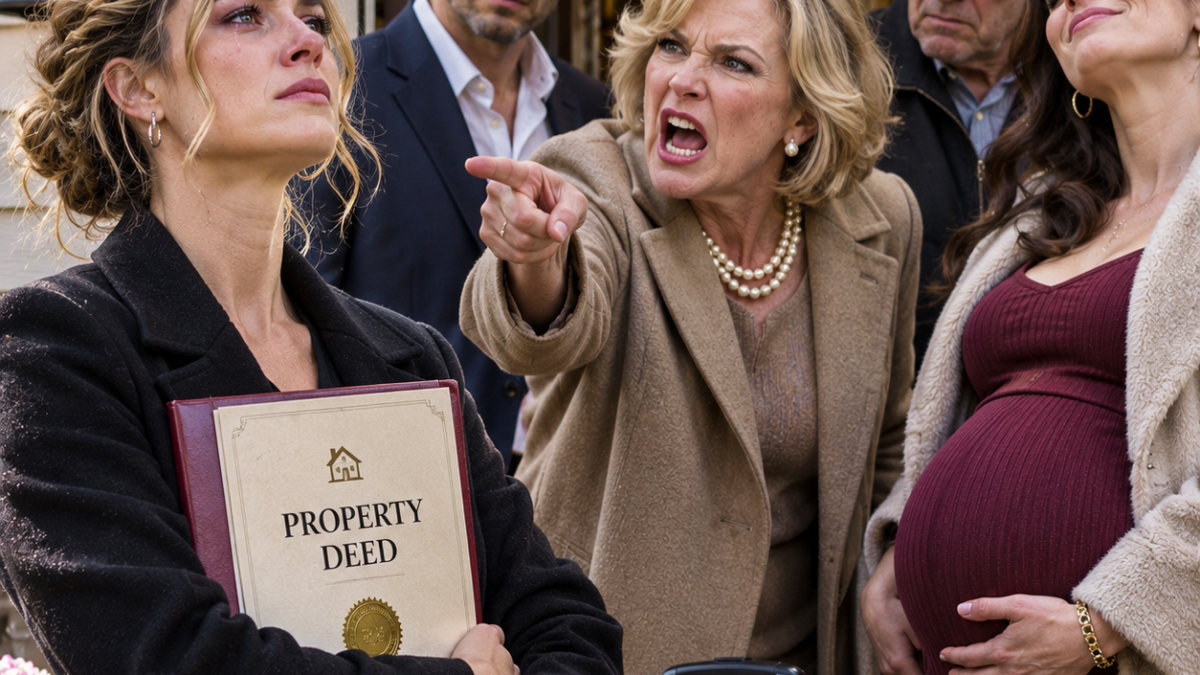
PART2
Lilibeth laughed.
Not nervously.
Confidently.
“What nonsense.”
I opened my briefcase.
Inside was the crimson leather folder Rosario had prepared that morning.
My attorney had a flair for presentation.
I once teased her about it.
She said:
“If people insist on behaving theatrically, there is no reason paperwork should arrive looking boring.”
I placed the folder on the console.
Lilibeth stared at it.
“What is that?”
“Reality.”
Adrien stood.
“Maria.”
“Sit down.”
He did.
That frightened him more than yelling would have.
During five years of marriage, I had almost never ordered him to do anything.
I had negotiated.
Explained.
Compromised.
Now I sounded like the senior financial auditor I became at work.
The woman executives called when somebody’s numbers stopped making sense.
I opened the folder.
First document.
Original deed.
My name.
Second.
Estate transfer.
My mother to me.
Third.
Prenuptial agreement.
Signed six weeks before our wedding.
Schedule A:
Residence located at 18 Hawthorne Crest, together with all improvements and designated inherited furnishings, retained as Maria Isabel Santos’s separate property.
I slid the copies across the coffee table.
Lilibeth did not touch them.
“This house belonged to my mother.”
“We know that.”
“No.”
“You knew she lived here.”
“That is different.”
“She purchased it twelve years before I married Adrien.”
Adrien finally said:
“Maria, nobody is denying that.”
I looked at him.
“Your mother just ordered me out.”
“She means temporarily.”
Lilibeth snapped:
“I do not.”
Adrien closed his eyes.
Ariana looked suddenly uncomfortable.
Good.
I continued.
“My mother left this property to me.”
“I owned it before marriage.”
“The deed was never transferred.”
“No marital funds were used to acquire it.”
“And our prenuptial agreement specifically confirms the property remains mine.”
Lilibeth waved a dismissive hand.
“You are married.”
“Yes.”
“What belongs to husband and wife belongs to the marriage.”
“That is not how deeds work.”
“Adrien has lived here five years.”
“So has my housekeeper.”
Gina made a choking noise that might have been a laugh.
Lilibeth glared at her.
Then at me.
“You cannot simply throw your husband out of his own home.”
“I can revoke permission for his relatives and his mistress to remain on my property.”
Ariana sat straighter.
“Excuse me?”
I looked at her for the first time directly.
“You heard me.”
She placed one hand over her belly.
“I’m pregnant.”
“That does not convert trespassing into tenancy.”
Adrien stood again.
“Stop.”
I turned.
“No.”
“This is getting ugly.”
I almost smiled.
“You brought your pregnant mistress into my mother’s chair and asked your family to remove me from my own house.”
I tilted my head.
“Ugly arrived before I did.”
Silence.
Then Lilibeth said:
“You are being vindictive because you cannot give Adrien what Ariana can.”
My hand nearly moved again toward my stomach.
I stopped it.
Rosario’s voice echoed in my head.
Do not tell them anything until you decide it serves you rather than your emotions.
So I smiled.
“You mean a baby?”
Lilibeth’s eyes gleamed.
“Yes.”
Ariana looked down modestly.
The perfect picture.
Pregnant.
Young.
Chosen.
I said:
“Interesting.”
Adrien’s face tightened.
“Maria.”
“What?”
“This doesn’t have to be cruel.”
I stared at him.
“Cruel?”
“You know what I mean.”
“No.”
“Explain.”
He rubbed his forehead.
“I made a terrible mistake.”
“One mistake?”
“It became a relationship.”
“Better.”
Ariana looked at him.
He continued:
“She got pregnant.”
“Yes.”
“We have to deal with reality.”
“There’s that word again.”
“Maria.”
He stepped closer.
“I don’t want you humiliated.”
For several seconds, I genuinely could not speak.
Then I laughed.
Quietly.
“You don’t want me humiliated.”
“No.”
“That is why you invited six people?”
“I didn’t invite—”
Lilibeth interrupted.
“We are his family.”
I looked at her.
“And I was what?”
“You were his wife.”
Past tense.
She said it deliberately.
Ariana smiled.
Small.
I saw it.
So did Gina.
Gina looked away.
I said:
“Ten minutes.”
Nobody understood.
Lilibeth frowned.
“What?”
“You have ten minutes to leave.”
Her mouth opened.
“Every one of you.”
Adrien stepped forward.
“Maria, stop this.”
“No.”
“This is my residence.”
“For the moment, your status will be handled by counsel.”
I pointed toward Ariana.
“But she leaves.”
Then Lilibeth.
“You leave.”
Ramon.
“Gina.”
“Roberto.”
“All of you.”
Lilibeth laughed again.
“Or what?”
I looked toward the bookshelf.
Tiny red indicator.
Recording.
The color drained slightly from Adrien’s face.
He knew our security system.
He also knew I had upgraded it three months earlier after several expensive pieces disappeared from the house.
He did not know why I had upgraded it.
I said:
“Or I call the police.”
Ariana stood.
“You’re threatening a pregnant woman?”
“No.”
“I am revoking permission for you to remain on property I own.”
“You cannot—”
“Yes.”
“I can.”
She turned toward Adrien.
“Tell her.”
Adrien stared at me.
“Maria, please don’t call police.”
That was the moment Ariana understood.
Not because of me.
Because the man who had promised her my home did not say:
She cannot.
He said:
Please don’t.
Her face changed.
“What do you mean?”
Adrien said:
“Ari—”
“You told me the house was marital property.”
I folded my arms.
Interesting.
Ariana looked at me.
Then him.
“You said you paid for half.”
I said:
“He did not.”
Adrien snapped:
“Maria.”
I continued.
“He paid utilities occasionally.”
“He paid for a pool repair two years ago.”
“With money I transferred into our household account.”
Ariana stared.
“You told me you owned this house.”
“I said it was our house.”
“That’s not the same thing.”
“No.”
“Apparently it isn’t.”
Lilibeth stood.
“This is ridiculous.”
“No.”
I looked at my watch.
“Nine minutes.”
“You think because your mother left you a house you can disrespect us?”
I stared at her.
“You came into that dead woman’s house without my permission.”
“You drank from her cups.”
“You put your son’s mistress in her chair.”
“And then you ordered her daughter to leave.”
I took one step toward Lilibeth.
“You should be grateful I’m only asking you to walk out.”
Ramon finally spoke.
“Lilibeth.”
She turned.
“What?”
“We should leave.”
Her face twisted.
“You’re taking her side?”
“I’m saying this is her property.”
“You don’t know that.”
He glanced at the deed.
“I can read.”
Gina stood too.
“Mom.”
Lilibeth looked betrayed.
Then Uncle Roberto cleared his throat.
“I’m leaving.”
He picked up his jacket.
Lilibeth snapped:
“Sit down.”
“No.”
“What?”
Roberto looked embarrassed.
“Adrien told us Maria had agreed to separate.”
My eyes moved to my husband.
Adrien’s face went pale.
Roberto continued.
“He said tonight was about discussing arrangements.”
Lilibeth stared.
“That’s what we are doing.”
“No.”
Roberto shook his head.
“You said we were coming to convince her to leave.”
“I thought she already knew about Ariana.”
I did.
But that was not the point.
I asked:
“Adrien told you I had agreed to separate?”
Roberto nodded.
“That’s what I understood.”
Gina whispered:
“Me too.”
Ariana looked at Adrien.
“What did you tell everyone?”
Adrien’s jaw tightened.
“This is getting twisted.”
There it was.
His favorite sentence whenever multiple versions of his own story collided.
I said:
“The camera will help.”
He looked toward the bookshelf again.
“What exactly did you record?”
“Everything since you entered.”
Lilibeth exploded.
“You recorded us without consent?”
“In my home.”
“That’s illegal.”
“Rosario disagrees.”
“Who?”
“My attorney.”
Now the room changed.
Not emotionally.
Structurally.
Before that word, they still believed this was a family conflict.
After it, they understood there was another room somewhere where somebody with no emotional investment had already seen documents.
Adrien whispered:
“You retained an attorney?”
“Yes.”
“When?”
“Before Tuesday.”
He went still.
“How did you know about Tuesday?”
I smiled.
Two days earlier.
Kitchen sink.
Window cracked.
Adrien pacing outside on the patio.
Phone call with Lilibeth.
Seven Tuesday.
Bring Uncle Roberto.
Bring Gina.
Ariana has to be there physically.
Maria needs to see the belly.
We need overwhelming numbers.
His exact words.
He had never realized the kitchen window was open.
I said:
“I heard you planning this ambush.”
Ariana slowly sat back down.
Lilibeth looked at Adrien.
“You said she couldn’t hear.”
He closed his eyes.
That sentence gave me another piece.
They had planned it together.
Not just Adrien.
Not just Lilibeth.
Ariana asked:
“How long have you known?”
I looked at her.
“About the affair?”
She nodded.
“Long enough.”
“How?”
“Financial records.”
Adrien’s eyes flew to mine.
“What financial records?”
I almost admired the panic.
Five years married.
He still forgot what I did for a living.
I audited money.
For a living.
Numbers had always spoken to me more clearly than people.
Three months earlier, Adrien’s spending changed.
Not dramatically.
That would have been easier.
Tiny things.
A restaurant charge at a hotel across town.
Parking near an apartment building.
Jewelry purchase labeled as client development.
Cash withdrawals before nights he said he had networking dinners.
Then one larger transfer.
$18,500.
From our joint investment account into his business.
Two days later, $17,900 moved from his business account somewhere I could not see.
I asked him.
Vendor advance.
Which vendor?
New logistics contractor.
Documentation?
Coming.
It never came.
That was when I began preserving records.
I did not initially suspect an affair.
I suspected another failing business.
Adrien had already lost money twice.
The first time, I covered debts because we were newly married.
The second, I refinanced an investment property from my inheritance—not the house—to prevent a lawsuit.
He cried.
Promised me he would never mix business and household finances again.
Then I discovered the $18,500 transfer.
So I audited.
Quietly.
Hotel.
Restaurant.
Jewelry.
Apartment utilities.
Prenatal pharmacy.
Then a recurring rent payment.
$2,850.
Every month.
Paid through a shell vendor description in his company books.
AR Consulting.
Ariana Reyes.
AR.
Not subtle once you knew where to look.
I had confronted Rosario first.
Not Adrien.
She told me:
“Do not accuse until you understand the money.”
So we understood the money.
The affair lasted at least eleven months.
The apartment lease began nine months earlier.
Adrien had used business funds partly capitalized by money I had loaned his company.
The distinction mattered.
My money had not purchased Ariana.
But Adrien had diverted funds away from obligations he had sworn were business expenses while telling me his company needed additional support.
That was betrayal layered over betrayal.
I asked:
“How much did you tell Ariana about our finances?”
Adrien said nothing.
Ariana looked at him.
“Adrien?”
I continued.
“Did he tell you his company is profitable?”
She hesitated.
“Yes.”
“It isn’t.”
His head snapped toward me.
“Maria.”
“It has negative operating cash flow.”
“That’s temporary.”
“For nineteen months?”
Ariana looked confused.
“He said the company was expanding.”
“It has $412,000 in liabilities.”
Adrien shouted:
“Stop discussing my private business.”
I laughed.
“You financed it with my money.”
“That does not make every detail yours.”
“No.”
“The loan agreement does.”
Ariana stood.
“You said you were selling your company next year.”
Adrien’s face tightened.
“I am exploring.”
“You said eight figures.”
I stared at him.
Then laughed.
Could not help it.
“Eight figures?”
He glared.
I said:
“Ariana, his company’s last independent valuation was below $900,000 before debt.”
She looked as though I had slapped her.
“You’re lying.”
“I have no reason to.”
Adrien stepped between us.
“That valuation is outdated.”
I nodded.
“True.”
“The company is worth less now.”
Gina whispered:
“Oh my God.”
Lilibeth snapped:
“Enough.”
I looked at my watch.
“Six minutes.”
“You aren’t calling police on your husband’s family.”
“I am if you refuse to leave.”
Lilibeth looked at Ariana.
“Stay seated.”
That was her mistake.
Not legally.
Strategically.
Ariana’s fear had started turning toward anger.
Not at me.
At Adrien.
She stood anyway.
“I’m leaving.”
Lilibeth grabbed her wrist.
“No.”
Ariana pulled away.
“Don’t touch me.”
“Sit down.”
“This is not what Adrien told me.”
“What did he tell you?”
Ariana looked at him.
I saw humiliation.
She said:
“That Maria would move into her condo.”
I did own a condo.
Inherited from my father.
Rented to a retired teacher.
“He told me this house was going to us.”
I looked at Adrien.
“Us.”
He stared at the floor.
Ariana continued.
“He said Maria didn’t want children.”
Something inside me went still.
I had not planned to reveal my pregnancy.
Not that night.
Not under pressure.
Not as a weapon.
But that sentence struck somewhere deeper than anger.
For three years, Adrien and I had tried.
Quietly.
Painfully.
One miscarriage at nine weeks.
Another at eleven.
A chemical pregnancy I barely had time to hope for.
Tests.
Medication.
Appointments.
Adrien held my hand through the first loss.
Cried.
Through the second, he became distant.
By the third year, he stopped wanting to discuss it.
He said:
“Maybe this is our sign.”
Maybe we were meant to be child-free.
I was not sure.
So I stopped pushing.
Then two days before the ambush, I went to my doctor because I had been nauseated for a week.
Five weeks pregnant.
Cardiac activity visible.
Tiny.
Precious.
Terrifying.
I had not told Adrien because Rosario told me to wait until after we understood the legal and medical situation.
Now Ariana was telling me he had rewritten my grief as preference.
I asked softly:
“He told you I didn’t want children?”
“Yes.”
Adrien said:
“Ariana, stop.”
She ignored him.
“He said you refused fertility treatment.”
I stared.
We had done treatment.
Not advanced treatment.
But enough.
“He said you cared more about your career.”
There it was.
My miscarriages converted into ambition.
My pain rewritten so his affair felt morally cleaner.
I looked at Adrien.
He finally met my eyes.
And saw something there.
Maybe the end.
“Maria.”
I reached into the crimson folder.
Not the pregnancy report.
Not yet.
Another document.
Loan summary.
Business transfers.
House deed.
Prenup.
Then I took out my phone.
5:52 remaining.
I called non-emergency police dispatch.
Adrien stepped forward.
“Don’t.”
I raised one finger.
He stopped.
“My name is Maria Santos.”
“I am the sole titled owner of the residence at 18 Hawthorne Crest.”
“I have multiple people inside my home whose permission to remain I have revoked.”
“Yes.”
“One is my husband’s guest.”
“Yes.”
“I have asked them to leave.”
“No, I am not alleging violence.”
“At this time I would like assistance removing trespassers if they refuse.”
Lilibeth’s face finally lost all color.
I gave dispatch the rest.
Hung up.
Then said:
“You have approximately five minutes before officers arrive.”
Ramon grabbed his coat.
“Lilibeth.”
She did not move.
“Fine.”
She stared at me.
“We will go.”
I nodded.
“Good.”
“But this isn’t finished.”
I looked toward Adrien.
“No.”
“It really isn’t.”
One by one, they collected their things.
Gina apologized first.
Quietly.
“I didn’t know.”
I said:
“You knew he had a pregnant mistress.”
She looked ashamed.
“Yes.”
“You came anyway.”
Her eyes filled.
“Yes.”
“Then you knew enough.”
She nodded.
That was all.
Roberto left without speaking.
Ramon paused near me.
“I’m sorry.”
I looked at him.
“For what?”
He opened his mouth.
Nothing came.
I said:
“Exactly.”
He left.
Lilibeth walked last among the family.
At the foyer, she turned.
“You think owning a house makes you powerful.”
“No.”
“Money makes people arrogant.”
“I agree.”
“You’ll regret humiliating Adrien.”
I stared.
“Your son brought his pregnant mistress into my dead mother’s home.”
“You humiliated yourselves before I arrived.”
She left.
Ariana remained.
Adrien noticed.
“Ari.”
She looked at him.
“You lied to me.”
His face changed.
“This is not the time.”
“When?”
“Ariana.”
“Is the company broke?”
“No.”
“Is the house hers?”
“Yes.”
“Did she fund your business?”
He said nothing.
Ariana laughed.
Then started crying.
“What about the lake house?”
I almost asked what lake house.
Adrien snapped:
“Enough.”
Ariana turned to me.
“He told me he owns a lake house.”
I shook my head.
“No.”
Adrien said:
“Maria.”
“The property belongs to a holding company established by my mother.”
Ariana covered her mouth.
“You told me that was yours.”
Adrien’s entire fantasy was collapsing one asset at a time.
House.
Company.
Lake property.
Inherited money.
Ariana had apparently been dating a man who existed mostly in representations.
I should have felt victorious.
I felt tired.
I said:
“You should leave.”
She nodded.
Then hesitated.
“I’m sorry.”
I looked at her.
Not cruelly.
Not kindly.
“You knew he was married.”
She looked down.
“Yes.”
“That apology belongs somewhere else.”
She cried harder.
“I believed he was leaving.”
“You still chose a married man.”
“Yes.”
“Then own that part.”
She nodded.
And left.
Adrien stood alone.
Police lights appeared outside thirty seconds later.
He looked toward the window.
“Are you really doing this?”
“Yes.”
“I live here.”
“You do.”
“So they can’t remove me.”
“I didn’t ask them to.”
He stared.
“What?”
“I asked them to remove the guests.”
He looked around.
Empty room.
Then at me.
“What do you want?”
I laughed.
“Now?”
“Maria.”
“What do I want now?”
“You ambushed me with your family.”
“Your mistress sat in my mother’s chair.”
“You told them to evict me.”
“And now you want my preferred resolution?”
He lowered his voice.
“I’m sorry.”
Too fast.
Too easy.
“What are you sorry for?”
“Everything.”
“Name one.”
He froze.
That told me all I needed.
The officers arrived.
Two.
Professional.
Calm.
I showed ID.
Deed.
Explained guests had departed.
No assistance required.
One officer asked:
“Are you safe remaining here with your husband?”
I looked at Adrien.
“Yes.”
Adrien flinched.
The officer asked him separately.
“Yes.”
They documented the call and left.
The moment the door closed, Adrien turned.
“You called the police for theater.”
“No.”
“I called because your mother told Ariana to remain after I revoked permission.”
“She would have left.”
“Eventually.”
“Maria.”
He ran both hands through his hair.
“You didn’t have to destroy everyone.”
I stared.
“There it is.”
“What?”
“The part where consequences become something I did.”
His face hardened.
“I know I was wrong.”
“Do you?”
“Yes.”
“Then why did you bring them?”
“I panicked.”
“You planned it.”
He stopped.
“You heard the call.”
“Yes.”
“All of it?”
“Yes.”
He sank onto the sofa.
The same sofa where three weeks earlier he had watched a movie with me and rested his head on my lap.
Marriage is strange like that.
The room can remember love while holding evidence of betrayal.
I remained standing.
“How long?”
Adrien looked down.
“Maria.”
“How long have you been sleeping with her?”
“About a year.”
“Eleven months or twelve?”
He looked up.
“How do you know?”
“AR Consulting.”
His face went white.
I almost felt sorry for him.
Almost.
“How much money did you spend?”
“I don’t know.”
“I do.”
“Maria—”
“$86,740 traceable.”
His mouth opened.
“That includes rent.”
“Yes.”
“Medical care.”
“Yes.”
“Business dinners.”
“No.”
“I removed legitimate business expenses.”
He stared.
“You audited me?”
“I audited money I loaned you.”
“That’s not the same.”
“It is when you represented withdrawals as vendor obligations.”
He stood.
“This is why I couldn’t talk to you.”
I blinked.
“What?”
“You turn everything into numbers.”
I laughed.
“You lied about numbers.”
“You were never emotionally available.”
There it was.
The retrospective justification.
Every affair apparently requires one.
“I worked sixty hours because your company kept losing money.”
“I never asked you to.”
“You asked me for $280,000 over five years.”
“That was business.”
“That was my inheritance.”
“I paid some back.”
“$41,000.”
He looked away.
I felt something inside me become almost peaceful.
Not because I had won.
Because for the first time, I stopped trying to understand him charitably.
He had choices.
Lots.
Talk to me.
Leave me.
Separate.
Ask for divorce.
Tell me he was unhappy.
Instead he took money.
Lied.
Built a second relationship.
Got another woman pregnant.
Then tried to use his family to remove me from my own home.
There was no complexity in the part that mattered.
He had chosen deception repeatedly.
I said:
“You need to pack.”
His head snapped up.
“What?”
“Tonight.”
“No.”
“Yes.”
“I live here.”
“I am asking you to leave voluntarily.”
“I’m not going anywhere.”
“That is your decision.”
He folded his arms.
“You can’t throw me onto the street.”
“I’m not.”
“I booked you a hotel for seven nights.”
He stared.
“You what?”
“Rosario expected this possibility.”
“You already planned everything.”
“No.”
“I prepared for the consequences of your plan.”
He looked suddenly afraid.
“What exactly have you done?”
“Retained counsel.”
“Preserved financial records.”
“Secured my separate accounts.”
“Changed authorizations on my inherited assets.”
“Notified my company’s internal security that you no longer have access to my office.”
His face hardened.
“You think I would steal from you?”
I looked at him.
He stopped speaking.
I said:
“I think you already moved money under false descriptions.”
“That is enough.”
He whispered:
“You’re going to divorce me.”
“Yes.”
No hesitation.
His face collapsed.
“Maria.”
“No.”
“Please.”
“No.”
“We can fix this.”
I laughed.
“You arrived home with your pregnant mistress and your mother’s eviction committee.”
“Do you hear yourself?”
“I was confused.”
“No.”
“Stop calling planned behavior confusion.”
He came toward me.
I stepped back.
“Do not touch me.”
He stopped.
Then he cried.
For five years I had seen Adrien cry only twice.
When his father nearly died.
When we lost our first pregnancy.
Now his face crumpled.
“I love you.”
I nearly broke.
That was the cruelest sentence.
Because I believed some part of him meant it.
People like to imagine betrayal requires absence of love.
It does not.
Sometimes people love you and still love themselves more.
They love comfort.
Attention.
Admiration.
Escape.
They compartmentalize until love becomes a word detached from behavior.
I said:
“Love that requires me not to know the truth is useless to me.”
He sat again.
I looked at the chair.
My mother’s chair.
Ariana had left a faint indentation in the cushion.
I hated that.
Ridiculous.
Fabric would recover.
Still.
I crossed the room and smoothed it.
Adrien watched.
Then asked:
“Why are you so calm?”
I looked at him.
“Because I cried before you knew I knew.”
His face changed.
That was true.
Three weeks earlier, in Rosario’s office, she had shown me the apartment lease.
Ariana Reyes.
Emergency contact:
Adrien Villanueva.
I went home.
Locked myself in the guest bathroom.
Turned on the shower so Adrien would not hear.
Then sat on the floor and cried until I could not breathe.
The marriage ended emotionally there.
Tuesday night was paperwork catching up.
Adrien packed one suitcase.
Then stopped at the doorway.
“Can I come back tomorrow for clothes?”
“Coordinate through Rosario.”
“You’re serious.”
“Yes.”
He looked around the foyer.
At the staircase.
The photographs.
Our wedding portrait.
He touched the frame.
I almost told him not to.
Then decided I did not care.
He whispered:
“I never wanted it to end like this.”
I answered:
“Then you should have behaved differently before the ending.”
He left.
The front door closed.
I locked it.
Then I walked to my mother’s chair.
Sat down.
For the first time that night, I cried.
Not beautifully.
Not silently.
I folded over my own stomach and sobbed until my throat hurt.
Five weeks pregnant.
My husband gone.
Another woman carrying his child.
My mother dead.
My marriage ending.
The house suddenly enormous.
I pressed one hand against my abdomen.
“I’m sorry.”
I do not know why I said it.
The baby had done nothing.
Neither had I.
Still, apology came first.
Maybe because mothers apologize even for storms they cannot stop.
My phone rang.
Rosario.
“How bad?”
I tried to answer.
Couldn’t.
Her voice softened.
“Maria.”
“They’re gone.”
“Good.”
“Adrien too.”
“Voluntarily?”
“Yes.”
“Any threats?”
“No.”
“Did he acknowledge Ariana?”
“Yes.”
“Money?”
“Some.”
“Recording preserved?”
“Yes.”
“Good.”
I started crying again.
Rosario stopped being my lawyer for a moment.
“You are allowed to be devastated.”
“I know.”
“No.”
“You’re doing that thing.”
“What thing?”
“Turning pain into tasks.”
I laughed through tears.
“You know me too well.”
“Tomorrow we do tasks.”
“Tonight you grieve.”
I sat in my mother’s chair.
Looked at the coffee ring.
Then finally allowed myself to miss everything I had lost.
Not Adrien alone.
The future.
The baby announcement I had imagined.
The look on his face.
A nursery.
Two parents.
My mother not being there to see any of it.
I had fantasized that pregnancy would repair some quiet distance between Adrien and me.
Now I hated myself for ever thinking a baby should repair adults.
At 11:14, my phone buzzed.
Adrien.
Please don’t tell anyone about the pregnancy until I talk to Ariana.
I stared.
Pregnancy.
For one irrational second, I thought:
How does he know?
Then realized.
He meant Ariana’s.
Of course.
My baby remained mine alone.
I did not respond.
Next message:
She is very upset.
I laughed so loudly in the empty living room it frightened me.
The pregnant mistress was upset because she had learned the house promised to her belonged to the wife.
My sympathy reserves were empty.
Then:
My mother is hysterical.
Again.
Not my problem.
At midnight:
Can we please talk tomorrow without lawyers?
No.
Morning came.
I had not slept.
At 7:30, Rosario arrived with coffee and bagels.
She looked around.
“Chair okay?”
I laughed.
That was why she was my friend before she became my attorney.
“Yes.”
“The famous chair survives.”
“Barely.”
We sat at the dining table.
She reviewed everything.
Recording.
Police call.
Documents.
Messages.
Then:
“Now tell me about the pregnancy.”
I touched my abdomen.
“I don’t know what to do.”
“You don’t have to decide everything today.”
“I’m keeping the baby.”
“I know.”
“I mean about Adrien.”
“That is different.”
“Does he have to know?”
Rosario’s face became careful.
“Eventually there may be legal and parental issues requiring disclosure.”
“But emotionally?”
“Emotionally, you owe him nothing this morning.”
I nodded.
“What changes legally?”
“Potentially many things.”
“Custody later.”
“Support.”
“Estate planning.”
“Financial disclosures.”
“But it does not magically transfer your inherited home to him.”
“Good.”
She smiled.
“That part seems important to you.”
I looked toward my mother’s chair.
“It’s all I have left of her.”
“No.”
Rosario said it firmly.
“You have yourself.”
“And now your child.”
I cried again.
Pregnancy hormones made dignity impossible.
We spent the morning separating accounts.
Not hiding marital money.
Preserving.
Documenting.
Protecting inherited assets.
Business loans.
Property records.
Rosario insisted everything be transparent and defensible.
“We do not become sloppy because he was dishonest.”
That line became our rule.
The divorce petition was filed that afternoon.
Adrien received notice two days later.
His first reaction was anger.
Second:
Negotiation.
Third:
Charm.
Fourth:
Family pressure.
Lilibeth called from three numbers after I blocked her first.
Voicemail one:
“You are overreacting.”
Two:
“Think about Adrien’s child.”
Three:
“Ariana is under terrible stress.”
Four:
“Marriage requires forgiveness.”
Five:
“My son invested five years in you.”
That one nearly impressed me.
Invested.
As if I were a failed stock.
Then Gina called.
I answered.
“Maria.”
“Yes.”
“I’m sorry.”
“For Tuesday?”
“For everything.”
I waited.
“I knew about Ariana.”
“How long?”
“Four months.”
I closed my eyes.
Four months.
Christmas.
My birthday.
The dinner where Gina gave me a necklace and said:
“To my favorite sister.”
She knew.
“Why didn’t you tell me?”
“Adrien said he was going to.”
“Did you believe that?”
“At first.”
“And later?”
She cried.
“I was afraid of losing my brother.”
“So you let me lose my husband without warning.”
Silence.
Then:
“Yes.”
At least she answered.
I said:
“Thank you for being honest now.”
“Do you hate me?”
“I don’t have energy for hate.”
“Can we still be family?”
“No.”
She started crying harder.
I did too.
“I’m sorry.”
“So am I.”
Then I ended the call.
Boundaries hurt even when correct.
That surprised me.
I thought saying no would feel empowering.
Sometimes it did.
Sometimes it felt like cutting off your own fingers because they had been trapped beneath something heavy.
Necessary.
Still painful.
Three days later, Ariana contacted Rosario.
Not me.
Smart.
She wanted her belongings from an apartment Adrien had leased.
Rosario said:
“That has nothing to do with you unless your money paid for the apartment.”
Some did.
Indirectly.
Tracing continued.
That was when the second financial betrayal emerged.
Adrien had not only diverted business funds.
He had taken a $150,000 loan from his company using receivables as collateral.
Then moved $60,000 into a separate account I had never seen.
From there:
Rent.
Jewelry.
Travel.
Ariana’s prenatal bills.
Furniture.
And a $12,000 deposit to a real estate broker.
For what?
A home.
He had been shopping.
Not my house.
Another one.
The listing printout was almost comical.
Four bedrooms.
New construction.
Lake view.
$1.2 million.
He had told Ariana they would move there after “Maria transferred Hawthorne Crest.”
The story kept changing depending on the audience.
To Lilibeth:
Ariana moves into my home.
To Ariana:
Maybe Hawthorne Crest, maybe lake house.
To me:
Nothing.
Adrien was not managing a plan.
He was managing expectations.
That was his real talent.
Tell each person enough to keep them invested.
I knew that kind of accounting.
Liabilities hidden until renewal.
Then one day everything becomes due.
Ariana came to Rosario’s office two weeks later.
She asked to speak with me.
I almost refused.
Then agreed.
Not alone.
Rosario present.
Ariana wore a beige maternity dress.
No makeup.
She looked younger without it.
Twenty-four.
I hated that noticing her youth made my anger more complicated.
She had still knowingly slept with my husband.
But she had also believed a long catalogue of lies.
She sat.
Hands on belly.
“Thank you for coming.”
I said nothing.
She took a breath.
“I owe you the truth.”
“I already have quite a bit.”
“I know.”
“Why now?”
Her eyes filled.
“Because he’s lying to me too.”
I almost smiled.
“Welcome.”
She flinched.
Fair.
Then she began.
Adrien told her our marriage had been emotionally over for two years.
False.
He said we slept separately.
False except during my miscarriages for brief periods.
He said I refused children.
False.
He said I had a long-term relationship with someone at my firm.
Completely false.
He said the divorce was delayed because I threatened to ruin him financially.
False.
He said Hawthorne Crest was marital property.
False.
He said I had agreed he could remain in the house after separation.
False.
He said my mother had given him part ownership as a wedding gift.
Absurd.
I asked:
“Did you ever ask to see anything?”
She looked ashamed.
“No.”
“Why?”
“I believed him.”
I understood that more than I wanted.
I had too.
She continued.
“He said you were cold.”
I laughed.
“He said you didn’t love him.”
“Of course.”
“He said you cared more about money.”
“There it is.”
She looked at me.
“I’m sorry.”
I said:
“You should be.”
Rosario glanced at me.
I continued.
“You knew he was married.”
“Yes.”
“You knew he lived with me.”
“Yes.”
“You attended a dinner where I sat beside him.”
“Yes.”
“You shook my hand.”
“Yes.”
“You still continued.”
Ariana cried.
“Yes.”
“I won’t pretend you were merely fooled.”
“I know.”
“But I also won’t pretend he told you the truth.”
She nodded.
Then:
“There’s something else.”
I braced.
“He asked me to sign something.”
“What?”
“An acknowledgment.”
Rosario leaned forward.
“Do you have it?”
Ariana opened her bag.
Pulled out papers.
Draft property occupancy agreement.
Prepared by Adrien.
Not a lawyer.
It claimed Ariana would become a “family occupant” of Hawthorne Crest after separation.
No signature from me.
No legal effect.
But the audacity was breathtaking.
Rosario read.
Then looked at me.
“Your husband is either very creative or very stupid.”
“Both can coexist.”
Ariana almost laughed through tears.
Then she said:
“He told me once I moved in, you wouldn’t fight because you wouldn’t want public scandal.”
There it was again.
Adrien understood my discretion as weakness.
He counted on shame.
He assumed I would protect appearances.
That became the central pattern of our marriage after I knew where to look.
Every time he failed, he relied on me not wanting outsiders to know.
Business debt?
Keep it private.
His mother’s demands?
Family issue.
Gina’s unpaid loan?
Don’t embarrass her.
His own spending?
Marriage problem.
Ariana?
He expected the same.
I had become his cleanup crew.
Not anymore.
Ariana asked:
“Are you pregnant?”
The room froze.
Rosario looked at me.
I stared at Ariana.
“How do you know?”
Her face went pale.
“Adrien.”
My entire body went cold.
“He knows?”
She nodded.
“How?”
“I don’t know.”
I looked at Rosario.
She stood.
“Maria.”
I could barely hear.
Ariana continued.
“He called me last night.”
“What did he say?”
“He said you were pregnant too.”
Too.
The word made me sick.
“How?”
“He said he saw a medical appointment notification on the insurance portal.”
I closed my eyes.
Of course.
Shared insurance.
Not results.
But obstetric billing.
Enough.
I had forgotten.
My secret had not been secret.
“How long has he known?”
“Two days.”
Two days.
He had not called.
Not texted.
Not asked.
Maybe his attorney told him not to.
Maybe shock.
Maybe shame.
Still.
Two days.
Ariana whispered:
“He said it might not be his.”
The room disappeared.
For a moment, all I could hear was blood.
Rosario said:
“Maria.”
I raised one hand.
No.
Let her finish.
“What exactly did he say?”
Ariana looked terrified.
“That because you had been emotionally distant, he couldn’t be certain.”
I laughed.
Not because anything was funny.
A sharp, broken sound.
Ariana continued:
“I told him he was disgusting.”
That surprised me.
“He said we needed to know which baby changed the divorce more.”
I put both hands flat on the table.
Which baby.
Not:
My wife is pregnant.
Not:
I might have another child.
Which baby changes the divorce more.
A financial variable.
Rosario spoke.
“We’re done for today.”
I stood.
Ariana reached for me.
Stopped before touching.
“Maria.”
I looked at her.
“I’m sorry.”
I believed she meant it.
It changed nothing.
But I believed it.
I left.
In the elevator, I collapsed against Rosario.
Not physically unconscious.
Just no bones.
She held me.
“I hate him.”
I whispered.
“No, you don’t.”
“I do.”
“You hate what he’s doing.”
I started sobbing.
“He thinks this baby isn’t his.”
Rosario rubbed my back.
“He knows he has no factual basis for that.”
“He said it anyway.”
“Yes.”
“Why?”
“Because people who have destroyed trust sometimes assume everyone else lives the way they do.”
That sentence stayed with me.
Adrien had cheated.
Therefore fidelity became negotiable in his imagination.
The paternity issue was resolved medically later.
No drama.
No question.
Adrien was the father.
But by then I had learned something important.
Biology did not repair betrayal.
Pregnancy did not save marriage.
A baby was not leverage.
My child would not enter the world carrying responsibility for fixing adults.
Adrien asked to meet.
Through lawyers.
I refused twice.
Agreed the third time.
Neutral conference room.
Rosario beside me.
His attorney beside him.
Adrien looked terrible.
Weight lost.
Beard.
No charm.
He stared at my stomach.
At ten weeks, almost nothing visible.
Still, he stared.
“Is the baby okay?”
First good question he had asked in weeks.
“Yes.”
He closed his eyes.
“Thank God.”
I wanted to hate him enough that this would mean nothing.
It meant something.
He asked:
“Why didn’t you tell me?”
I almost laughed.
“You were preparing to install another pregnant woman in my house.”
His face crumpled.
“I didn’t know.”
“No.”
“You didn’t.”
“That was the point.”
He looked at the table.
“I said awful things.”
“Yes.”
“To Ariana.”
“Yes.”
“I was angry.”
“No.”
I shook my head.
“You were afraid.”
He looked up.
“Of what?”
“Losing control of the story.”
Silence.
I continued.
“You told Ariana I did not want children.”
“I know.”
“You knew about the miscarriages.”
He cried.
“I know.”
“You held me when I lost our first baby.”
“I know.”
“And then you used that grief to make your affair look respectable.”
He covered his face.
“I’m sorry.”
This time, the apology had weight.
Not enough.
But weight.
I said:
“You don’t get to use my infertility history as your character reference.”
He nodded.
“You don’t get to tell people I refused children.”
“Yes.”
“You don’t get to question this baby because you were unfaithful.”
“Yes.”
“You don’t get to ask me to protect you from Ariana.”
He looked confused.
“I didn’t.”
“You will.”
His attorney shifted.
Adrien stared.
I said:
“When your lies to her collapse completely, you will want me to confirm the parts that make you look better.”
“I won’t.”
“Good.”
Then he whispered:
“Can we save anything?”
There it was.
I felt the old pull.
Five years.
Wedding.
Miscarriages.
Business failures.
Sunday mornings.
My mother’s funeral.
He carried my mother’s casket.
Held my hand at the cemetery.
How could the man who did that become the man who placed Ariana in her chair?
Both were real.
That was the tragedy.
I said:
“No.”
He cried silently.
I cried too.
“No?”
“No.”
“Even with the baby?”
“Especially because of the baby.”
His eyes widened.
“I will not teach my child that betrayal becomes acceptable when leaving feels complicated.”
His attorney looked down.
Rosario remained perfectly still.
Adrien whispered:
“I love you.”
“I believe you.”
That surprised him.
I continued.
“And that is why this hurts.”
“If you didn’t love me, this would be simple.”
“But your love did not stop you from lying.”
“Spending my money.”
“Sleeping with another woman.”
“Getting her pregnant.”
“Planning an ambush.”
“Trying to move her into my mother’s home.”
“Or rewriting our miscarriages as my refusal to have children.”
I wiped my face.
“So your love is not enough.”
That was the end.
Not legally.
Emotionally.
The divorce continued another year.
There was no instant courtroom victory.
No judge slamming a gavel and giving me everything because Adrien was a bad husband.
Property required documentation.
Debts required tracing.
Business interests required valuation.
Loans required accounting.
The house remained mine.
That had always been clear.
The prenup held.
My inherited properties remained mine.
Marital accounts were divided according to applicable law and agreement.
Adrien remained responsible for certain business liabilities tied to his company.
Some transfers using joint funds had to be addressed.
There were negotiations.
Mediation.
Invoices.
Ugly emails.
But not chaos.
Numbers did what numbers do.
They forced stories into columns.
Adrien’s family stopped contacting me after Rosario sent formal notice.
Except Gina.
She wrote letters.
Not demanding forgiveness.
Updates.
I ignored the first three.
Read the fourth.
I know I do not deserve a relationship with you. I want you to know I have started therapy because I realized Tuesday was not the first time our family closed ranks around Adrien. It was simply the first time I saw how ugly it looked from the outside.
I read that twice.
Then put it away.
Months later, I answered.
I hope therapy helps you. I am not ready for contact.
She replied:
Understood.
That was progress.
Lilibeth did not progress so quickly.
She told relatives I stole Adrien’s house.
That made me laugh.
Then furious.
Then indifferent.
The deed was public record.
Anyone sufficiently curious could read.
Ramon called once.
“Maria.”
“Yes?”
“I need to apologize.”
I waited.
“I should have stopped Tuesday.”
“Yes.”
“I knew the house was your mother’s.”
That surprised me.
“You knew?”
“Yes.”
“Then why did you come?”
He cried.
“Because Lilibeth said Adrien needed us.”
I closed my eyes.
The whole family had been trained around the same principle.
Adrien needs us.
Gina knows and stays quiet.
Roberto attends.
Ramon follows.
Lilibeth attacks.
Everyone protects the son.
Nobody asks what he did.
I said:
“Your son needed someone to tell him no years ago.”
Ramon whispered:
“I know.”
That was all.
Ariana gave birth first.
A boy.
Mateo.
I learned through legal disclosure because custody and financial obligations affected Adrien’s finances.
I felt strange seeing the name.
Not anger at the baby.
Never.
He had done nothing.
For months, people assumed I would resent him.
I did not.
Children do not commit adultery.
Children do not steal houses.
Children do not lie about property.
Adults create triangles.
Babies arrive innocent.
When my own pregnancy reached twenty weeks, I learned I was carrying a girl.
I cried in the ultrasound room.
My mother had wanted a granddaughter desperately.
She never got one.
Now I did.
I named her Isabel.
Not as a monument.
As a continuation.
Adrien attended some prenatal appointments after legal discussions and boundaries were established.
Not all.
At first, I hated seeing him.
Then something shifted.
He became less husband-shaped in my mind.
More:
Father of my child.
Separate role.
He asked questions.
Paid what he was supposed to.
Stopped asking to reconcile.
That mattered.
One afternoon after an appointment, he stood beside my car.
“Maria.”
“Yes?”
“I’m selling the company.”
I almost laughed.
“To whom?”
“A competitor.”
“Enough to cover debt?”
“Mostly.”
“Good.”
He nodded.
Then:
“I’m moving into a smaller apartment.”
I waited.
“I’m telling you because…”
He stopped.
“Actually, I don’t know why I’m telling you.”
I almost smiled.
“Habit.”
“Probably.”
He looked toward the clinic.
“Isabel.”
“Yes.”
“That’s what you’re naming her?”
“Yes.”
He cried.
“Your mother would’ve loved that.”
I looked at him.
“She would’ve loved her.”
Then I got in the car.
Boundaries did not require cruelty.
That took me longer to learn.
For a while, I thought strength meant never softening.
Then I realized that was another prison.
Adrien could be a flawed father trying to do better without becoming my husband again.
Those roles were not linked.
Isabel was born on a rainy Thursday morning.
Seven pounds, one ounce.
Dark hair.
My mother’s nose.
Or maybe I imagined that.
Adrien was at the hospital.
Not in the room during delivery.
My choice.
Rosario was.
Yes.
My attorney became my birth support.
Life is strange.
After Isabel was cleaned and wrapped, I held her.
She opened one eye.
Then closed it.
I whispered:
“You are not responsible for fixing anything.”
That was my first promise.
Not:
I will never let you hurt.
Impossible.
Not:
I will keep your family together.
Dangerous.
Just:
You are not responsible for adults.
Later, Adrien came in.
He stood near the door.
Did not approach.
“Can I?”
I nodded.
He washed his hands.
Sat.
I handed him Isabel.
His face broke.
The same way it had during our first pregnancy loss.
I watched him hold our daughter.
For one dangerous second, an alternate life appeared.
Adrien beside me.
Baby.
House.
Nursery.
Family.
Then I remembered Ariana in my mother’s chair.
Not as revenge.
As fact.
Some doors close because what happened on the other side cannot be made unhappen.
Adrien whispered:
“I’m sorry.”
I said:
“I know.”
No more.
He kissed Isabel’s forehead.
That was allowed.
We learned co-parenting slowly.
Schedules.
Medical decisions.
Holidays.
He had Mateo too.
Two babies born months apart.
Different mothers.
Different homes.
A consequence no one could hide.
Lilibeth initially demanded access to Isabel.
I said no.
Not forever.
Not yet.
She had called me childless as an insult while I was already pregnant.
She had treated Ariana’s pregnancy as proof of my disposability.
That mattered.
She wrote:
I was angry.
I replied:
You were deliberate.
Months passed.
Then a different letter.
I believed grandchildren were something my son gave our family, not something mothers gave the world. I understand now how dehumanizing that was.
That sentence surprised me.
Then:
I treated Ariana’s pregnancy like a weapon against you. I treated your infertility history like a defect. I was cruel.
No excuses.
I showed Rosario.
She said:
“Therapy.”
I laughed.
“Probably.”
Eventually Lilibeth met Isabel.
Supervised.
At my house?
Absolutely not.
Neutral café with a garden.
She arrived early.
No dramatic gifts.
That impressed me.
She looked at the baby.
Cried.
Then looked at me.
“May I hold her?”
I waited.
Then nodded.
She held Isabel carefully.
No speech about Villanueva blood.
No heir nonsense.
Just:
“Hello, sweetheart.”
Progress.
Not absolution.
Progress.
The house changed after everything.
For months, I could not use my mother’s porcelain.
I hated remembering Lilibeth’s tea.
So I packed the cups away.
Then one morning, when Isabel was six months old and sleeping badly, I woke at 4:30.
Made coffee.
Saw the china cabinet.
Opened it.
Took out my mother’s cup.
Used it.
Nothing terrible happened.
That mattered.
Trauma makes objects feel contaminated.
Healing gives them back.
The ivory chair took longer.
Ariana had sat there.
I hated myself for caring.
She had only sat.
Fabric did not betray me.
Still, I could not use the chair.
One night, Isabel had a fever.
I carried her downstairs.
Rocked her instinctively.
Sat in the chair without thinking.
Half an hour later, I noticed.
My daughter sleeping against my chest.
My mother’s coffee ring beneath my elbow.
And suddenly Ariana no longer mattered.
The chair belonged to my mother.
Then me.
Now this moment.
Not the worst person who had occupied it once.
I cried quietly.
Isabel slept.
I whispered:
“Grandma sat here.”
She did not care.
Babies are wonderfully uninterested in symbolism.
The divorce finalized when Isabel was eleven months old.
I wore navy.
No victory dress.
No champagne.
I signed papers.
Adrien signed.
The marriage ended legally at 10:42 on a Wednesday morning.
Outside the courthouse, he stopped me.
“Maria.”
“Yes?”
“Thank you.”
I stared.
“For what?”
“For not making Isabel hate me.”
I was surprised.
“I don’t discuss adult betrayal with a baby.”
“You know what I mean.”
“I do.”
He looked exhausted.
Then:
“You could have destroyed me.”
“No.”
“I could have been harsher.”
“Yes.”
He almost smiled.
“Very.”
I said:
“You did enough damage yourself.”
He nodded.
Fair.
Then he said:
“Ariana and I aren’t together.”
I had heard.
Still, hearing it from him felt strange.
“What happened?”
He laughed bitterly.
“She didn’t trust me.”
I almost laughed.
Then didn’t.
“That seems reasonable.”
He nodded.
“We’re figuring out Mateo.”
“Good.”
Silence.
Then:
“I hope you’re happy someday.”
I looked at him.
“I already am sometimes.”
That surprised both of us.
Happiness had returned without announcement.
Not constant.
Not cinematic.
Moments.
Isabel laughing.
Coffee.
Work.
A quiet house.
My mother’s chair.
Rosario bringing wine after bedtime.
I was not waiting for another man to certify recovery.
That became freedom.
Adrien left.
I watched him walk across the courthouse plaza.
For five years, I had thought losing him would mean losing my life.
Instead, I lost a role.
Wife.
The rest remained.
Daughter, though my mother was gone.
Mother now.
Auditor.
Friend.
Homeowner.
Woman.
Myself.
The house became quieter after the divorce.
Then louder as Isabel grew.
Blocks.
Toys.
Music.
Crayon marks.
At two, she drew on the hallway wall.
I stared at it.
Then laughed.
My mother would have scrubbed it immediately.
I left one tiny blue line behind after cleaning the rest.
Maybe I inherited her weakness for marks.
Evidence someone lived here.
The coffee ring.
Blue crayon.
A life does not remain pristine.
It accumulates proof.
I dated again when Isabel was three.
Slowly.
His name was Marcus.
Architect.
Divorced.
One teenage son.
The first time he entered my living room, he saw the chair.
“Beautiful upholstery.”
“My mother did it.”
“You should never replace that.”
I almost married him on the spot.
I did not.
Growth.
We dated two years.
He never asked to move into Hawthorne Crest.
Never assumed.
When marriage eventually came up, he said:
“This is Isabel’s home and your mother’s house.”
“If we ever live together, we decide what makes sense.”
Not:
ours automatically.
Not:
my right.
I cried after he left that night.
Healthy respect can feel overwhelming when you have lived through entitlement.
We married eventually.
Small ceremony in the garden.
The ivory chair sat beneath the hydrangeas.
Empty.
A place for my mother.
Isabel placed one white rose on it.
No one sat there.
Not because nobody was allowed.
Because we wanted her represented.
Adrien attended?
No.
That would have been strange.
But he sent Isabel with a card for me.
I hope he treats you the way I should have.
I kept it.
Not as proof he changed completely.
As proof people can eventually understand things too late.
Ariana contacted me one final time years after the ambush.
Mateo and Isabel were both school age.
Because they shared a father, their lives occasionally intersected.
She asked to meet.
I agreed.
Public café.
She looked different.
Older.
So did I.
She said:
“I’ve wanted to apologize again.”
I almost groaned.
She noticed.
“I know.”
“Apologies don’t create obligations.”
“Good.”
She smiled weakly.
Then:
“I used to tell myself Adrien lied to me.”
“He did.”
“I used that to avoid the part where I knew he was married.”
I said nothing.
“I saw your wedding ring.”
“I met you.”
“I sat at your table.”
“I knew.”
“Yes.”
She looked at her coffee.
“I’m sorry.”
This time, I accepted it.
Not because time erased anything.
Because she finally apologized for the right thing.
“I accept.”
She looked up.
Surprised.
“Really?”
“Yes.”
“That does not mean we become friends.”
She laughed.
“God, no.”
I smiled.
First time.
Then she said:
“I hated that chair.”
I blinked.
“What?”
“The ivory one.”
I stared.
“Why?”
“Because you looked at me when you came in.”
“I knew immediately I was sitting somewhere I shouldn’t be.”
That surprised me.
“Why didn’t you move?”
“Pride.”
She looked ashamed.
“Lilibeth told me to sit there because it was the best chair.”
Of course she had.
A deliberate insult I had never even known.
I felt anger flare.
Then fade.
Years.
Ariana continued.
“Afterward, I kept thinking about the coffee ring.”
“You noticed?”
“Adrien told me about your mother.”
That hurt strangely.
He had shared my mother’s story with his mistress.
But again:
Years.
I said:
“The ring is still there.”
“Good.”
We finished coffee.
When we left, Ariana hugged me?
No.
We were not that story.
She said:
“Take care of Isabel.”
I said:
“You take care of Mateo.”
That was enough.
My relationship with Lilibeth never became warm.
Respectful.
Limited.
She loved Isabel.
I made sure she did not turn that love into ownership.
No comments about bloodline.
No “our family’s child.”
No comparisons with Mateo.
When she slipped once and called Isabel “a true Villanueva girl,” I corrected her.
“She’s also a Santos.”
Lilibeth nodded.
“Of course.”
Old Lilibeth would have fought.
New Lilibeth adjusted.
That is what accountability looks like years later.
Not groveling forever.
Changing behavior.
Ramon became gentler.
Gina eventually rebuilt some relationship with me through Isabel.
We never returned to sisters.
That was okay.
Not every repaired bridge needs to carry the same traffic it once did.
Rosario remained family.
When Isabel turned five, she asked:
“Auntie Rosario, why does Mommy call you when she’s mad?”
Rosario said:
“Because your mother enjoys paying me by the hour.”
I threw a napkin at her.
Isabel laughed.
My mother would have loved Rosario.
Maybe that was why I did.
Strong women recognize each other.
One night, years later, Isabel found the crimson folder.
Locked cabinet had been left open.
She was eight.
“Mom?”
“Yes?”
“What’s this?”
I saw the folder.
My body remembered Tuesday.
Seven o’clock.
Ariana.
Chair.
Lilibeth.
Ten minutes.
I took the folder.
“Old paperwork.”
“About Dad?”
“Yes.”
“Can I read it?”
“When you’re older.”
“Why?”
“Because adult problems should not become children’s homework.”
She accepted that.
Then asked:
“Did Dad used to live here?”
“Yes.”
“Why doesn’t he?”
I had always answered age appropriately.
“Because we were not good married partners.”
At eight, she wanted more.
“Did he do something bad?”
I thought.
“Yes.”
“Did you?”
“Probably some things.”
“Same amount?”
I laughed.
“No.”
She smiled.
“Okay.”
Then:
“Did he hurt you?”
Not physically.
But children do not mean only physically.
“Yes.”
“He hurt me.”
“Did you hurt him?”
“Leaving probably hurt him.”
“Was leaving bad?”
“No.”
She frowned.
“How can something hurt and not be bad?”
There is philosophy from an eight-year-old.
“Sometimes telling the truth hurts.”
“Sometimes saying no hurts.”
“Sometimes ending something hurts.”
“That doesn’t make it wrong.”
She thought.
“Like shots.”
“Exactly.”
“Still hate shots.”
“Reasonable.”
Then she ran away.
Years later, she would learn more.
About Ariana.
Mateo.
The house.
My pregnancy.
Not all at once.
Truth has timing.
That became another lesson.
Adrien and I became functional co-parents.
Not friends.
Respectful.
He eventually rebuilt his career as an operations consultant.
Smaller.
More honest, I hope.
He paid support.
Showed up.
Missed one school concert in ten years because of weather.
Isabel loved him.
That used to make a tiny, ashamed part of me uncomfortable.
Then I realized something.
Her loving her father did not invalidate what he did to me.
Children are allowed their own relationships.
I did not need Isabel to avenge me emotionally.
That was not her job.
Mateo and Isabel became close.
Half-siblings.
Same laugh.
It startled everyone.
At thirteen, they made jokes about Adrien’s terrible financial decisions.
I shut that down.
Not because false.
Because children should not become jury.
Adrien once thanked me.
“I know you could tell her everything.”
“I will tell her truth when she needs it.”
“Thank you.”
“Don’t thank me.”
“I am doing it for her.”
He nodded.
Right.
The title of mother changed my understanding of what happened Tuesday.
Lilibeth had justified everything through pregnancy.
Ariana needs the house.
Ariana carries the heir.
A pregnant mother needs stability.
As if pregnancy granted title.
As if motherhood justified removing another woman’s dignity.
Then I became a mother.
And learned the opposite.
Motherhood does not entitle you to other people’s homes.
Money.
Marriages.
Silence.
Motherhood is responsibility.
Not privilege over other women.
Ariana learned too.
Lilibeth eventually did.
The woman sitting in my mother’s chair had not been my enemy because she was pregnant.
She was part of my husband’s betrayal.
Different.
That distinction saved me from becoming bitter toward her child.
Toward mine.
Toward motherhood itself.
The house remains in my name.
I never added Marcus.
Not because I distrusted him.
Because it is part of my mother’s estate plan and ultimately passes through my trust to Isabel.
Marcus understood.
He joked:
“So I married into a tenancy situation.”
“Correct.”
“What if you evict me?”
“Behave.”
He laughs.
Healthy love can laugh at the places old love wounded.
Not immediately.
Eventually.
My mother’s chair is still in the living room.
New cushion insert.
Same upholstery.
Coffee ring untouched.
I had a professional reinforce the frame when one leg loosened.
I watched like a hawk.
“Do not touch that stain.”
The upholsterer stared.
“I wasn’t going to.”
“People always want to clean it.”
He shrugged.
“Some marks belong.”
Exactly.
Some marks belong.
Not because pain deserves worship.
Because history deserves honesty.
The Tuesday ambush is one of those marks.
I do not think about it daily.
Years can pass between memories.
Then someone says:
Pack your bags.
Or I smell jasmine tea.
Or a pregnant woman touches the chair at a family gathering.
And for one second I am back in the foyer.
Briefcase.
Six faces.
Adrien staring at the floor.
Lilibeth declaring my home more useful to someone else.
And me realizing they had mistaken my silence for ignorance.
My generosity for weakness.
My marriage for surrender.
If I could speak to the woman I was before opening that door, I would tell her something different from what people expect.
Not:
Destroy them.
Not:
Take everything.
Not:
Make them regret it.
I would say:
Do not bargain with anyone who has already decided your dignity is negotiable.
Document.
Breathe.
Tell the truth.
Let adults carry consequences that belong to them.
And do not let anyone turn your kindness into evidence that you will accept anything.
That had been my problem.
I had rescued Adrien too many times.
First failed business.
Debt.
Family requests.
Unpaid taxes.
Bad contracts.
Every rescue looked like love.
To me.
To him, slowly, they became precedent.
Maria will fix it.
Maria will stay calm.
Maria hates scandal.
Maria loves marriage.
Maria will not embarrass me.
Maria has money.
Maria has a house.
Maria has no children.
Maria can move.
Each assumption grew from the one before.
Until Tuesday.
Then he learned the boundary.
Maria can say no.
That changed everything.
People later asked what happened to the family members who came that night.
Nothing dramatic.
No arrests.
No bankruptcies.
No public humiliation campaign.
Roberto stopped involving himself in family disputes.
Ramon apologized.
Gina changed.
Lilibeth learned boundaries the slow way.
Ariana rebuilt her life.
Adrien became two children’s father in two homes.
Everyone continued.
That is real consequence.
You live after the thing you thought would destroy you.
So do the people who hurt you.
Justice is not always watching them collapse.
Sometimes justice is simply making sure they can no longer make you collapse for them.
I kept the house.
But that was never the real victory.
The house had already been mine.
The victory was keeping myself.
Keeping the parts Adrien’s chaos had slowly consumed.
My confidence.
My judgment.
My money.
My grief.
My motherhood.
My mother’s memory.
My right to decide who sits in my living room.
Who enters my home.
Who stays.
Who leaves.
That right sounds small until someone takes it for granted.
The final apology from Lilibeth came on Isabel’s tenth birthday.
We were clearing plates after dinner.
Everyone else outside.
She stood beside my mother’s chair.
Did not sit.
She said:
“Maria.”
“Yes?”
“I have wanted to tell you something.”
I waited.
“I knew this house was your mother’s.”
My heart stopped.
Ramon had told me he knew.
But Lilibeth?
She continued.
“Adrien said the prenup was complicated.”
“I told myself marriage meant he had enough rights.”
“But I knew.”
I stared at her.
“Why?”
“Why did I come?”
“Yes.”
She looked toward the backyard where Isabel and Mateo were laughing.
“Because Ariana was pregnant.”
“I thought that made everything simpler.”
“For whom?”
“My son.”
Of course.
She sighed.
“I spent my whole life making things simpler for Adrien.”
“When he was little, I fixed his homework.”
“When he was a teenager, I called teachers.”
“When he lost money, Ramon and I defended him.”
“When he cheated on you…”
She swallowed.
“I tried to remove the obstacle instead of asking what was wrong with my son.”
The obstacle.
Me.
I appreciated the honesty even though it hurt.
She said:
“You were easier to confront.”
“Why?”
“Because I knew you would behave.”
That sentence landed hard.
I laughed sadly.
“There it is.”
“What?”
“The whole story.”
She looked confused.
I explained.
“You chose me because I was predictable.”
“You knew I wouldn’t scream.”
“You knew I wouldn’t create a scene.”
“You knew I had spent years fixing things.”
“So you all expected me to fix Adrien’s affair too.”
Her eyes filled.
“Yes.”
I looked at the chair.
Then back at her.
“I forgive you.”
She began crying.
I raised one hand.
“But forgiveness is not permission to forget what happened.”
“I know.”
“Good.”
She nodded.
Then asked:
“May I sit?”
She indicated the sofa.
Not the chair.
I smiled.
“Yes.”
That mattered.
Years earlier, she had entered my home assuming entitlement.
Now she asked.
Sometimes healing is nothing more dramatic than a question where there used to be an assumption.
May I?
Can I?
Would you like?
Is this okay?
Those are love words too.
The chair remained empty.
Until Isabel came inside.
She threw herself into it sideways.
Shoes hanging over one arm.
I almost corrected her.
Then stopped.
My mother would have.
Actually, no.
My mother would have pretended to be angry and then brought her cookies.
Isabel said:
“Mom?”
“Yes?”
“Why is Grandma Lilibeth crying?”
Lilibeth laughed through tears.
“I was remembering something stupid I did.”
Isabel nodded solemnly.
“You do that a lot.”
I choked.
Lilibeth laughed harder.
Fair.
Later that night, after everyone left, Marcus and I cleaned.
Isabel asleep.
House quiet.
I picked up a teacup.
Jasmine.
Lilibeth had used my mother’s porcelain again.
With permission.
This time, I had taken the cups down myself.
I looked at the cup.
Marcus asked:
“You okay?”
“Yes.”
“Sure?”
I nodded.
“Just thinking.”
“Dangerous.”
I smiled.
Then carried the cup to the sink.
No panic.
No flashback.
Just porcelain.
That is how I knew the house was mine again emotionally.
Not when police arrived.
Not when the deed proved it.
Not when divorce finalized.
When objects became objects again.
Chair.
Cup.
Door.
House.
Not evidence.
Not battlefield.
Home.
People love the sentence I said that night:
You have ten minutes to get off my property before the police drag all six of you out.
It sounds powerful.
Clean.
Viral.
People imagine that was the moment everything changed.
It wasn’t.
The real change had begun days earlier in a dark examination room when a doctor turned a monitor toward me and said:
“Five weeks.”
A tiny flicker.
A life.
I sat alone in my car afterward with one hand on my abdomen and understood something before I had words for it.
Whatever happened next, I could no longer build my life around managing Adrien’s instability.
Someone else would depend on me.
Not to preserve appearances.
To be safe.
That pregnancy did not make me stronger magically.
It made my excuses less convincing.
I had tolerated too much when the damage fell mainly on me.
A failed business.
A demanding mother-in-law.
Financial rescue.
Emotional distance.
I kept saying:
Marriage is complicated.
People struggle.
We recover.
All true.
Then betrayal forced a different question.
What kind of home would I bring a child into?
A home where her father lied?
Where Grandma treated women as replaceable based on fertility?
Where her mother owned the walls but had no voice?
No.
That became impossible.
My daughter never needed a perfect family.
She needed one adult willing to make reality safe even when reality was ugly.
That became me.
Not instantly.
Through paperwork.
Tears.
Boundaries.
Therapy.
Mistakes.
And time.
On Isabel’s twelfth birthday, she asked to see the crimson folder.
I said yes.
Not everything.
Enough.
Deed.
Prenup.
Police incident number.
A printed copy of the first divorce filing.
She read quietly.
Then:
“Dad tried to make you leave this house?”
I answered carefully.
“His family did.”
“Did he stop them?”
“No.”
“Was Ariana pregnant with Mateo?”
“Yes.”
“And you were pregnant with me?”
“Yes.”
She stared.
“He didn’t know?”
“No.”
“That’s insane.”
I laughed.
“Accurate.”
She looked toward the chair.
“Was that the chair?”
“Yes.”
“She sat there?”
“Yes.”
“Did that make you mad?”
“More than it should have.”
“No.”
Isabel shook her head.
“Grandma Isabel made it.”
I smiled.
“You understand.”
“Of course.”
Then she asked:
“Do you hate Ariana?”
“No.”
“Dad?”
“No.”
“Grandma?”
“No.”
She frowned.
“How?”
I thought.
“Because hate requires rent.”
“What?”
“In your head.”
“It takes up space.”
“I had other things I wanted to build there.”
She stared.
“That sounds like something Aunt Rosario told you.”
I laughed.
“She probably did.”
Then Isabel touched the folder.
“Are you glad it happened?”
“No.”
Immediate.
“I am glad what happened taught me things.”
“But I would never choose the pain just to get the lesson.”
That distinction matters.
People romanticize suffering after survival.
They say:
Everything happens for a reason.
I don’t.
Some things happen because people make selfish decisions.
Meaning comes later when survivors decide what to do next.
Adrien cheated because he chose to.
Lilibeth ambushed me because she chose to.
I protected myself because I chose to.
No cosmic script required.
That is more empowering to me than destiny.
Choices matter.
My mother chose to build an accounting practice when everyone told her a divorced woman with a daughter should find “something safer.”
She chose to buy Hawthorne Crest.
She chose ivory fabric for a chair that was impossible to keep clean.
She chose to leave the house to me.
Years later, when people attempted to push me out of it, her choices protected me.
Not magically.
Legally.
Financially.
Emotionally.
That is inheritance.
Not simply property.
A woman makes choices before she dies that give another woman options after she is gone.
I think about that often.
Especially now that Isabel is old enough to understand money.
I teach her.
Not because I expect betrayal.
Because independence should exist before crisis.
Know what you own.
Know what you owe.
Know where documents are.
Know what you sign.
Have your own credit.
Understand accounts.
Never outsource your entire financial reality to love.
Love is not an audit control.
She groans when I say that.
“Mom.”
“What?”
“Nobody says audit control except you.”
“Correct.”
“But you’re right.”
“I know.”
She rolls her eyes.
My mother would be proud.
Maybe that is the real ending.
Not Adrien’s apology.
Not the divorce.
Not Lilibeth crying.
Not Ariana admitting she knew.
Not even the ten-minute ultimatum.
It is my daughter growing up inside the same house where a group of people once told her pregnant mother she had no place.
She walks down the stairs.
Leaves shoes everywhere.
Studies at my mother’s dining table.
Sits in the ivory chair.
Knows exactly who owns the house.
Not because ownership is power over others.
Because security matters.
One day, if the trust works as designed, Hawthorne Crest becomes hers.
I told her:
“You do not have to keep it.”
She looked horrified.
“What?”
“You can sell.”
“No.”
“People change.”
“Mom.”
“What?”
“The chair stays.”
I laughed.
“Fine.”
“House too.”
“We’ll see.”
“No.”
She folded her arms.
“Grandma built history here.”
Technically Grandma bought history.
But I let it go.
Maybe another woman in another generation will sit in that chair.
Maybe leave another coffee ring.
Maybe think of us.
I hope she knows one thing.
A house is not what saved me.
A deed helped.
Money helped.
A lawyer helped.
Cameras helped.
But none of those mattered until I stopped asking whether I was allowed to use them.
That was the hardest part.
Women can possess resources and still feel forbidden from defending themselves.
Because good wives compromise.
Good daughters forgive.
Good daughters-in-law respect elders.
Good women do not make scenes.
Good women protect family reputation.
I had obeyed every one of those rules.
Adrien counted on it.
Lilibeth weaponized it.
Tuesday night, I broke one.
I made a scene.
A very quiet one.
Ten minutes.
Police.
Deed.
Door.
Sometimes a scene is simply a woman refusing to disappear politely.
And yes, apologies came.
Gina.
Ramon.
Ariana.
Adrien.
Eventually Lilibeth.
Every apology mattered differently.
None arrived in time to preserve what existed before.
That is another truth people hate.
Sorry does not restore a marriage automatically.
Sorry does not erase an ambush.
Sorry does not clean a sentence out of memory.
A pregnant mother needs this home more than a childless woman.
I was pregnant when she said it.
Sometimes I still think about that irony.
But the deeper cruelty would have been identical if I were not.
My value did not increase because I carried a baby.
My right to my home did not become stronger.
I did not deserve respect because a heartbeat existed inside me.
I deserved respect because I was a person.
Ariana did too.
That was why Adrien’s behavior toward both of us was wrong.
He treated women as roles.
Wife.
Mistress.
Mother of child.
Owner of house.
Provider of money.
He told each what kept her useful.
We eventually stopped cooperating.
That was his collapse.
Not financial ruin.
Not punishment.
Loss of control over the women whose perceptions he had been managing.
Ariana asked questions.
I checked records.
Lilibeth eventually stopped rescuing.
The system dissolved.
Years later, Adrien said something at Isabel’s school graduation.
We stood near the parking lot.
Mateo nearby.
Families everywhere.
He said:
“I used to think I was unlucky because everything fell apart at once.”
I looked at him.
“And?”
“I realize now it didn’t fall apart at once.”
“No.”
“I just found out all at once that I had been holding it together with lies.”
That was one of the wisest things he ever said.
I nodded.
“Yes.”
He looked at me.
“Thank you for not hating me forever.”
I said:
“That was never for you.”
He smiled sadly.
“I know.”
Then our daughter ran toward us.
Cap crooked.
Diploma in hand.
“Photo!”
Adrien stood one side.
I stood the other.
For one picture, we looked like a family.
Because we were.
Not husband and wife.
Not reconciled.
Not pretending.
Two parents.
One daughter.
A history.
That was enough.
Later, back at Hawthorne Crest, Isabel changed clothes and collapsed into my mother’s chair.
I walked past.
Stopped.
There was a new stain on the right armrest.
Chocolate.
I gasped.
“Isabel.”
“What?”
“Chocolate.”
She looked.
“Oh.”
“Oh?”
“Sorry.”
I reached for cleaner.
Then stopped.
Looked at the left armrest.
Coffee ring.
My mother.
Right armrest.
Chocolate.
My daughter.
I put the cleaner down.
Isabel stared.
“You’re leaving it?”
“Maybe.”
She grinned.
“Historic.”
“Don’t push your luck.”
She laughed.
I sat on the sofa.
Looked at the chair.
For so long, I had protected my mother’s mark because it was the last physical evidence of her living presence.
Now there was another mark.
Not loss.
Continuation.
Maybe that is what healing finally is.
Not restoring everything to the way it was before betrayal.
Not cleaning every stain.
Not pretending nothing happened.
It is allowing new life to leave marks beside the old ones until the object no longer belongs mainly to grief.
The house no longer belongs to Tuesday night.
The chair no longer belongs to Ariana’s trespass.
My marriage no longer defines my adulthood.
Adrien’s betrayal no longer occupies the central room of my memory.
The story does.
But I own the story now.
That is different.
If anyone asks what I remember most from that night, they expect me to say Lilibeth’s face when I showed her the deed.
Or Ariana learning Adrien did not own the house.
Or police lights.
Or the ten-minute warning.
Those were satisfying.
But the image I remember most happened hours later.
Everyone gone.
House silent.
I sat in my mother’s chair.
One hand pressed against the place where Isabel was still too small to feel.
My other hand rested over the coffee ring.
And I whispered into an empty room:
“I’m scared, Mom.”
No answer.
Of course.
Then I heard my mother’s voice anyway.
Not supernatural.
Memory.
The sentence she used whenever I panicked over exams.
Jobs.
Money.
Life.
You do not need to know how the whole story ends before you decide what the next right thing is.
So I decided.
Lock the door.
Call Rosario.
Protect the baby.
File the papers.
Tell the truth.
One right thing.
Then another.
Then another.
Years later, that is still how I live.
And if someone ever walks into my home again, sits in my mother’s chair, looks me in the face and tells me I should disappear because another person needs my life more than I do, I will not argue about worth.
I will not beg.
I will not compete.
I will not cry for permission.
I will simply point toward the door.
Because Hawthorne Crest taught me something no marriage ever had:
Love may invite people into your home.
But love does not give them the right to erase the person who opened the door.








