PART2:“PACK THAT SNOW MACHINE BACK UP OR I’LL FINE YOU EVERY NIGHT!” HOA Karen Threatened My Daughter’s Christmas Tradition—Then I Asked Her to Show Me the Vote
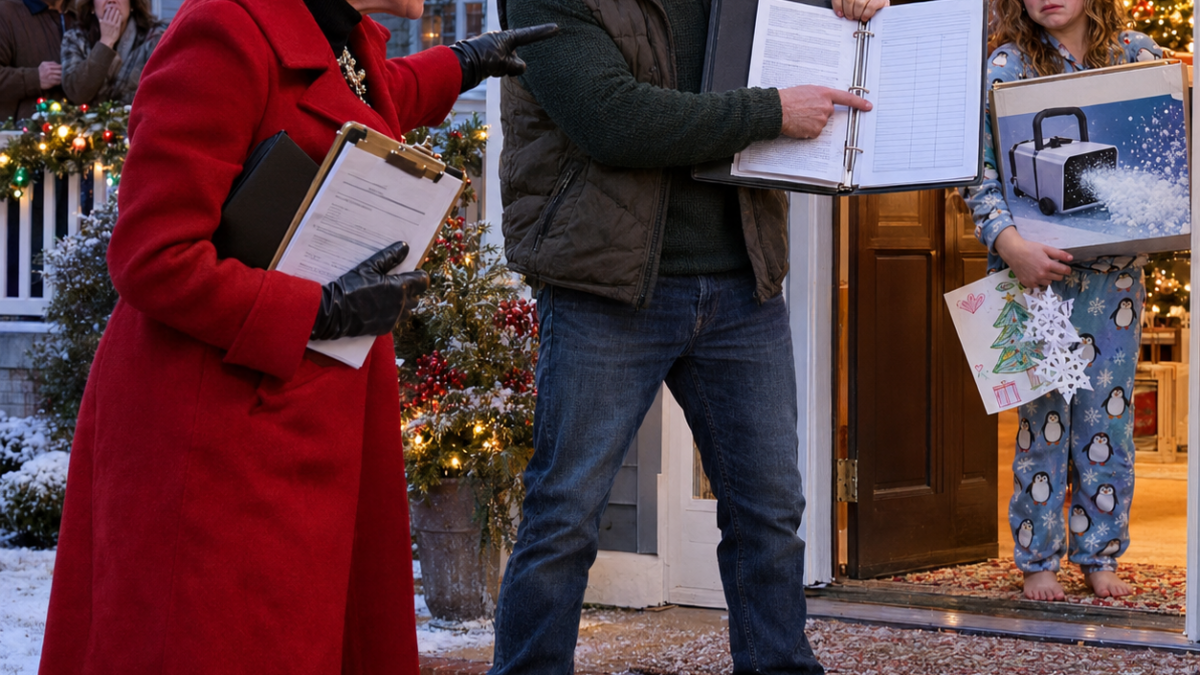
PART2
I stayed at the table until almost two in the morning.
People like to imagine that finding one favorable paragraph in a governing document feels like discovering a winning lottery ticket.
It doesn’t.
At least it didn’t to me.
My first thought was not, I beat Karen.
It was, What am I missing?
Working in IT does that to you.
When a system behaves incorrectly, the worst thing you can do is fall in love with the first explanation that makes you feel smart.
You check dependencies.
Exceptions.
Versions.
Permissions.
You see whether another section changes the meaning of the one you just found.
HOA documents were not software, but the habit transferred surprisingly well.
The declaration gave the board general authority to adopt reasonable operating rules.
That was real.
I could not simply wave Section 4.2 and pretend the board had no regulatory power.
But 4.2 appeared to impose a separate procedure when a new restriction materially affected how owners used their private lots.
The November holiday guidelines prohibited categories of equipment owners had previously been allowed to use.
That looked important.
I wrote on a legal pad:
QUESTION 1: DID SECTION 4.2 APPLY?
Below it:
QUESTION 2: IF YES, WHERE IS THE OWNER VOTE?
Then I kept going.
City noise regulations.
Outdoor electrical requirements.
Temporary-event rules.
Sidewalk clearance.
Fire-lane access.
I wanted to know whether Karen’s safety complaints were nonsense.
Some were not.
Crowds could create traffic problems.
Cords could create trip hazards.
Foam could become slippery if enough accumulated on a sidewalk.
Large speakers could make neighbors miserable.
I had no interest in becoming the guy who shouted “my property” while turning everybody else’s December into three hours of honking cars and bass-heavy Christmas music.
But my actual setup already addressed most of those concerns.
The show ended at nine.
My speakers faced the house and ran at a level where adults could hold normal conversations twenty feet away.
I kept decorations back from the public sidewalk.
My cousin Kevin, a licensed electrician, helped me with power distribution every year.
During busy nights, I used cones and signs to keep driveways and hydrants clear.
The new snow machine produced theatrical foam that evaporated quickly.
I could position it so the material stayed over my lawn.
None of that automatically invalidated the HOA rule.
It did mean there were practical solutions short of a blanket prohibition.
Then I remembered last year’s HOA Christmas party.
I opened the association’s social-media page.
There it was.
Winter Ridge Holiday Kickoff.
Official HOA event.
A giant inflatable arch partially over the sidewalk.
A rented DJ.
Large speakers.
Extension cords.
And a projector throwing animated snowflakes over the clubhouse wall.
One photograph showed Karen directly beneath those projected flakes, holding a microphone and smiling.
I stared at it.
Then saved it.
The photo did not prove I had a right to use my own projector.
I knew that.
A rule could legitimately change from one year to another.
But if Karen intended to argue that projectors were inherently incompatible with neighborhood safety or character, the association’s enthusiastic use of one a year earlier deserved an explanation.
I created a folder on my laptop.
WINTER RIDGE — CHRISTMAS
Inside went everything.
The new guidelines.
Governing documents.
Meeting records I already had.
City ordinances.
Photographs from the HOA event.
Old emails.
Donation receipts from the family shelter.
My electrical checklist from the previous year.
Traffic notes.
At 1:53 a.m., I finally closed the laptop.
The next morning, Grace found me making pancakes.
“Did you win?”
“I didn’t know we were playing a game.”
She climbed onto a stool.
“You know what I mean.”
“I found questions.”
“That’s not winning.”
“No.”
“Did you find something saying Karen is wrong?”
“I found something saying the HOA may have needed a homeowner vote.”
“Did they have one?”
“I don’t know.”
“Wouldn’t you remember?”
“I would.”
She considered that.
“Then they didn’t.”
“That is a very dangerous way to investigate things.”
She poured syrup over her pancake.
“What do we do?”
“Ask for the records.”
“And if there aren’t any?”
“Ask the board to fix the rule.”
“And if Karen says no?”
“Then we make her explain why in front of everybody.”
Grace stared at me.
“That sounds boring.”
“It is incredibly boring.”
“Can’t you just turn on Frosty Two?”
“That would be exciting for about five minutes.”
“Then what?”
“Then I could be fighting fines while we’re still arguing about whether the rule was adopted correctly.”
She took a bite.
“So your plan is paperwork.”
“My plan is better paperwork than Karen’s.”
That finally earned a smile.
Monday morning, I sent a formal records request to Maplestar Management.
I asked for the November fifteenth meeting notice.
Agenda.
Minutes.
Text of the adopted policy.
Vote tally.
Any owner-meeting notice connected to the policy.
Any membership vote.
Any written legal or management opinion addressing Section 4.2.
I copied the directors.
Karen answered twelve minutes later.
The board acted within its lawful authority. Repeated attempts to obstruct enforcement will not change the rules.
She had answered none of my questions.
I replied:
Thank you. Please provide the requested records.
Nothing else.
No accusation.
No insult.
No mention of Frosty Two.
That afternoon, Dan caught me at the cluster mailbox.
“So how illegal is Christmas?”
I laughed.
“Undetermined.”
“You’re actually reading all that stuff?”
“Somebody should.”
He shoved envelopes under his arm.
“My wife says the rule bans our projector.”
“You have a projector?”
“Little one. Candy canes on the garage.”
“Did you know they were considering banning it?”
“No.”
“Did you attend a membership vote?”
“No.”
“Did you receive notice of one?”
“No.”
He raised an eyebrow.
“You planning to sue?”
“No.”
“Seriously?”
“I don’t want a lawsuit.”
“Then what do you want?”
“I want the board to answer the same questions in a room full of homeowners.”
Dan smiled slowly.
“That I’d like to see.”
I hadn’t intended to organize anyone.
But conversation spreads.
Especially when the subject is Christmas.
At school pickup, Priya Shah asked whether the ban applied to her roof projector.
At the dog park, Mr. Benton asked why he had never heard about a membership vote.
The Martinez family worried that their animated display might violate the new rules too.
Megan, a single mother two houses down, told me her boys called our driveway “the North Pole.”
None of these people were interested in overthrowing the HOA.
Most rarely attended meetings.
They just had the same basic question.
When did this rule happen?
I started a small group text.
My first message said:
I’m not trying to start a war. I’m trying to find out whether the new rule was adopted using the procedure in our documents. If anyone has a meeting notice or remembers an owner vote, please send it.
Nobody did.
Then Priya sent a message that changed the direction of the entire dispute.
What if Snow Night became an official charity event? Harder to dismiss it as Alex just wanting a bigger toy.
I reopened the bylaws.
Section 7.3 encouraged community activities supporting neighborliness and charitable work, subject to reasonable regulation.
That did not force the HOA to sponsor my display.
But it gave me a constructive option.
Instead of saying:
You can’t stop me.
I could say:
Here is exactly what I want to do, exactly when I want to do it, exactly how I will manage safety, and exactly who benefits.
If the board still said no, at least we would be arguing about facts.
I drafted a proposal.
WINTER RIDGE SNOW NIGHT FOR SHELTER
Fridays and Saturdays in December.
6:00 p.m. to 9:00 p.m.
No admission charge.
Voluntary donations to the local family shelter.
Snow effect contained within my front lawn.
Projector aimed toward my house and trees.
Moderate speaker volume.
Traffic cones during peak periods.
Volunteer parking monitors.
No blocked hydrants.
No blocked driveways.
Licensed electrician reviewing outdoor circuits.
Cleanup immediately after each event.
I attached documentation showing that the prior year’s visitors had donated about eight hundred dollars to the shelter.
Then I addressed the rule.
Carefully.
I did not write:
The board illegally adopted the policy.
I didn’t know that.
Instead:
The November guidelines appear inconsistent with the approval procedure described in Section 4.2. Please clarify whether the required membership approval occurred and provide the applicable record.
I attached the HOA’s own photographs from the prior Christmas party.
Because the association has previously used projectors, amplified music, and large inflatables at its own holiday event, I also ask that safety and appearance standards be applied consistently.
Finally:
I am willing to meet with board representatives, management, my electrician, and appropriate city safety personnel to address any specific concern.
I reread it three times.
Then sent it.
I forwarded a copy to Lisa Moreno, director of the family shelter.
A shorter message.
We’re trying to make Snow Night official this year. Would the shelter still want to participate if the HOA approves it?
Her answer came within an hour.
Absolutely. Some of our children still talk about your snow from last year. Let me know what you need.
I sat looking at that sentence.
Some children still talked about it.
Grace had a house.
A warm bed.
Christmas presents.
Parents who had the luxury of arguing over a fake snow machine.
Some of the children Lisa served were spending December in temporary housing because their families had nowhere else to go.
A few minutes under fake snow might be silly to an adult.
Maybe to a child, it wasn’t.
The dispute suddenly felt less personal.
The management company replied the next afternoon.
A special meeting would be held December fifth.
My proposal and the holiday policy would be on the agenda.
Until then, I was asked not to operate the new equipment.
I accepted.
No snow.
No projector.
No attempt to provoke anybody.
Karen seemed surprised.
She came to my house Tuesday afternoon while I was wrapping garland around a porch column.
Alone this time.
“You received the meeting notice?”
“Yes.”
“And you understand the new equipment remains off?”
“Yes.”
She studied my face.
“Good.”
I kept wrapping garland.
She stayed.
“Anything else?”
“You’re creating unnecessary conflict.”
“I requested a meeting.”
“You’ve been discussing board business with half the neighborhood.”
“They’re homeowners.”
“You’re turning this political.”
“It’s literally an association governed by elected directors.”
“You know what I mean.”
I stepped down.
“No, Karen. I don’t.”
She moved closer.
“You are turning a safety decision into a referendum on my leadership.”
There it was.
Not the board.
Not the policy.
My leadership.
“If Section 4.2 requires a membership vote, then the members should vote.”
“They elected us to make decisions.”
“Some decisions.”
“The association cannot hold a neighborhood-wide vote every time somebody buys a new toy.”
“This stopped being about my toy as soon as you wrote a rule affecting everybody’s property.”
She rolled her eyes.
“You think reading a binder makes you a lawyer?”
“No.”
“Good.”
“I think reading a binder makes me someone who read the binder.”
For once, she had no immediate answer.
Then she glanced toward my garage.
“You could save everybody a great deal of time by returning the machine.”
I looked at her.
“This isn’t about saving time.”
“No?”
“No.”
I pointed toward Dan’s house.
“His projector is banned.”
Then toward the Martinezes.
“Their animated display may be affected.”
Another direction.
“Priya’s too.”
Then back at her.
“If the rule was adopted correctly, show us.”
Her jaw tightened.
“And if it wasn’t?”
“Then do it correctly.”
She walked away.
Grace had been watching from behind the living-room curtain.
When I came inside, she said:
“You didn’t yell.”
“No.”
“She looked really mad.”
“Yes.”
“Does that mean you won?”
“No.”
She frowned.
“What does winning look like?”
I almost answered immediately.
The machine.
Snow.
Karen losing a vote.
Then I stopped.
“Fair rules.”
Grace looked disappointed.
“That is the most dad answer ever.”
“Probably.”
“And snow?”
I smiled.
“And hopefully snow.”
December fifth arrived colder than usual.
Not Minnesota cold.
Texas cold.
Enough for jackets.
I walked into the Winter Ridge clubhouse expecting maybe twenty people.
There were more than forty.
People stood along the walls.
Parents.
Retirees.
Teenagers.
Lisa from the shelter.
Mrs. Martinez and her mother Elena, bundled into a wheelchair near the back.
Even Councilwoman Hannah Reed was there with her twelve-year-old son.
Hannah lived nearby and had visited our display before.
She made it clear she was attending as a resident and parent, not because city government was taking sides.
That distinction mattered.
Karen sat at the front table.
Martin beside her.
Three other directors.
Jenna Cole.
Robert Hayes.
Michael Trent.
Karen called the meeting to order.
Landscaping.
Pool maintenance.
Gate repairs.
Then item three.
Seasonal decorations.
She read a prepared statement.
Traffic congestion.
Slip hazards.
Noise.
Neighborhood character.
Insurance exposure.
Safety.
She spoke for six minutes.
Not once did she mention Section 4.2.
Then she said:
“Unless there are board questions, we will proceed to the next agenda item.”
I raised my hand.
“As an owner, I’d like to speak.”
Her expression barely changed.
But she looked toward the packed room.
“Two minutes.”
I stood.
My heart started hammering.
Computers are easier than people.
When software rejects your argument, it gives you an error.
Forty neighbors just stare.
“I’ve been running a Christmas display for years.”
My voice sounded steadier than I felt.
“It ends by nine. We have adjusted traffic when necessary. Outdoor electrical connections are checked by a licensed electrician. Last year visitors donated roughly eight hundred dollars to the family shelter.”
I held up the snow-machine manual.
“This year, I proposed a theatrical-snow effect contained within my own front lawn.”
A child near the back whispered loudly:
“Snow!”
Several people smiled.
“I understand the board can regulate real safety issues.”
I looked at Karen.
“I’m willing to follow operating hours, electrical requirements, traffic controls, and any reasonable requirement to keep foam off public sidewalks.”
Karen leaned toward her microphone.
“And the board has determined the equipment is inappropriate.”
“I understand that is your position.”
I set the governing documents on the table.
“My first question is about process.”
The room quieted.
“Section 4.2 appears to require membership approval for new restrictions materially affecting the use of private lots.”
Martin looked down.
Karen didn’t.
“I requested the record of the homeowner vote approving the November rule.”
I looked at Martin.
“I have not received one.”
Karen spoke immediately.
“The board has general rulemaking authority.”
“Yes.”
That seemed to surprise her.
“The declaration also contains Section 4.2.”
Jenna opened her copy.
I continued.
“My second question is about consistency.”
I put the HOA’s prior-year photographs on the screen.
Large projector.
DJ.
Inflatable arch.
One photograph of Karen smiling beneath projected snowflakes.
Several people chuckled.
I didn’t.
“If projectors and amplified music present unacceptable safety or appearance concerns, I’m asking why they were acceptable at an association-sponsored event.”
Martin leaned toward his microphone.
“That event occurred before the new rule.”
“Correct.”
I nodded.
“That’s why the adoption process matters.”
Karen crossed her arms.
I turned to the final slide.
“My proposal is already in your packet.”
Hours.
Safety plan.
Traffic plan.
Electrical review.
Shelter donations.
“If there is a specific safety problem, tell me what it is.”
I looked around the table.
“I will fix what can reasonably be fixed.”
Then I sat down.
For half a second, nobody moved.
Karen began.
“We have received multiple concerns from homeowners.”
Dan called from the side wall:
“How many?”
Karen looked at him.
“We do not disclose individual complainants.”
“I asked how many.”
She ignored him.
She described potential traffic backups.
Children slipping.
Foam residue.
Electrical hazards.
Speakers disturbing residents.
Those were legitimate categories of concern.
But each one already had a proposed solution.
Then Hannah Reed stood.
Karen’s shoulders tightened.
“Hannah?”
“I am not speaking for city council.”
Hannah smiled.
“I’m speaking as a resident whose son has enjoyed Alex’s lights.”
Her son looked mildly embarrassed.
A few people laughed.
“Because city regulations have been discussed, I can clarify one point.”
She turned toward the board.
“The city has no outstanding code-enforcement action involving the Dawson display.”
Karen leaned forward.
“That doesn’t mean a foam machine cannot create a hazard.”
“Absolutely.”
Hannah nodded.
“If foam accumulates on a public sidewalk, that can become an issue.”
Then she pointed to my proposal.
“That’s why containing it to the lawn and monitoring it is a practical approach.”
Karen started to respond.
Lisa Moreno stood.
“Our shelter isn’t here to tell Winter Ridge how to govern.”
Her voice was soft enough that the room became quieter to hear her.
“But I would like the board to understand the human side of this event.”
She looked toward Grace.
“Last year’s donations arrived during a week when our beds were full.”
Grace stopped fidgeting.
“Several children who stayed with us had never experienced snowfall.”
Lisa smiled.
“They still talk about this driveway.”
Nobody laughed.
She continued.
“I’m not asking anyone to ignore safety.”
Her eyes moved to Karen.
“I’m asking you not to use the word safety as a reason to stop asking whether a problem can be solved.”
I felt that line in my chest.
So did the room.
Mr. Benton raised his hand.
“Why don’t the owners vote?”
Karen frowned.
“Excuse me?”
“If the documents say we vote, let us vote.”
Murmurs spread.
Jenna leaned toward Martin.
“I need clarification from management.”
Martin looked uncomfortable.
“Does Section 4.2 require an owner process for restrictions like these?”
He paused.
Karen answered first.
“Our counsel recognizes broad board authority—”
Jenna held up a hand.
“I asked Martin.”
That was the first moment the balance of power shifted.
Not because anyone shouted.
Because another director stopped Karen from answering for everyone.
Martin opened the declaration.
“Our preliminary interpretation is that the board possesses general rulemaking authority, but a restriction materially affecting lot use may also trigger the membership procedure in Section 4.2.”
Karen turned toward him.
“That is not what you told me.”
“I said the board had general rule authority.”
“You approved the policy.”
“I processed the board action.”
“Same thing.”
“No.”
Martin’s voice remained quiet.
“It is not.”
Karen stared at him.
Jenna made a motion.
“I move that enforcement of the November fifteenth holiday guidelines be suspended pending formal review of the required adoption procedure.”
Karen immediately objected.
“This would leave the community without standards.”
“No.”
Jenna continued.
“Existing valid rules remain.”
Then:
“I further move that Alex Dawson’s Snow Night for Shelter be approved for this season, subject to the conditions in his written proposal: nine p.m. shutdown, foam contained to his lot, no blocked sidewalk, traffic volunteers, and electrical and fire-safety review.”
Robert seconded.
Karen looked around the table.
“This is how associations lose control.”
Jenna turned toward the audience.
“No.”
Then back to Karen.
“This is how members get a voice.”
The vote began.
Karen:
“No.”
Jenna:
“Yes.”
Robert:
“Yes.”
Michael:
“Yes.”
Three to one.
For half a second, nothing happened.
Then applause filled the room.
Not wild screaming.
Not some movie-style rebellion.
Just parents clapping.
Neighbors smiling.
Kids whispering.
Lisa hugged Grace.
Dan slapped my shoulder hard enough to move me sideways.
Karen struck the gavel.
“Order.”
Nobody was out of control.
She just needed the sound.
I looked at Grace.
Her eyes were shining.
“We saved Christmas.”
I crouched beside her.
“Our neighbors did.”
She threw her arms around my neck anyway.
The week before opening night was a blur.
Kevin inspected every electrical connection.
He found a weatherproof box he didn’t like.
“That needs replacement.”
“It worked last year.”
“Congratulations.”
“Is it dangerous?”
“It’s worn.”
“That wasn’t my question.”
“It’s getting replaced.”
He replaced it.
I moved two cords because he thought the approach angle created a trip hazard.
Those were exactly the kinds of things Karen claimed to care about.
The difference was that Kevin showed me specific problems.
Specific problem.
Specific fix.
No speeches about property values.
No vague accusation that joy was excessive.
Councilwoman Reed stopped by in daylight with a city fire marshal who agreed to inspect the setup because we expected a larger crowd.
He looked at the outlets.
Foam placement.
Street access.
Speaker direction.
“Keep the sidewalk clear.”
“Yes.”
“Nine means nine.”
“Yes.”
“If the foam starts accumulating where pedestrians walk, shut it down until it clears.”
“Understood.”
Then he pointed at Frosty Two.
“Can I see it run?”
Grace appeared from the garage as if summoned.
“I can do it!”
He laughed.
“Go ahead.”
She flipped the switch.
The machine hummed.
Soft white foam drifted across the lawn.
Grace ran beneath it.
The marshal watched.
Then crouched and touched the grass.
“Looks manageable.”
He stood.
“Honestly, the crowd is the bigger concern.”
“We have volunteers.”
“Good. Keep hydrants and driveways open.”
That was regulation I could respect.
The morning of opening night, Grace decorated the donation bucket.
She painted:
SNOW FOR SHELTER
Then covered half of Shelter with glitter.
Priya organized traffic volunteers.
Dan made directional signs.
Megan handled hot chocolate.
Lisa brought shelter information.
By five thirty Friday evening, cars began arriving.
Kids wore pajamas beneath coats.
Parents carried thermoses.
Grandma Elena arrived in her wheelchair.
Dan wore a Santa hat so tall the top kept falling across his face.
Karen’s house stood diagonally across the street.
Curtains open.
Porch light on.
At 5:58, Grace stood beside me.
“Two minutes.”
“I know.”
“One minute fifty-three.”
“Grace.”
“One minute forty-nine.”
“I own a watch.”
“Your watch could be wrong.”
At exactly six, she hit the first switch.
Roof lights glowed.
Then trees.
Warm music began.
The projector painted slow snowflakes across the brick front of the house.
People moved closer.
Grace looked at me.
I nodded.
She reached for Frosty Two.
The machine came alive.
White snow drifted into the Texas night.
The crowd made one sound.
Not cheering.
Not clapping.
A gasp.
The sound people make when something turns out slightly better than they expected.
Grace stepped underneath.
Foam collected in her dark hair.
On her shoulders.
She tilted her face upward.
For a second, she looked five again.
A little boy from the shelter held both hands out.
Another spun in circles.
A girl tried catching flakes on her tongue before Lisa explained why that was probably a terrible idea.
Grandma Elena laughed so hard her daughter had to wipe tears from her cheeks.
And then something strange happened.
I forgot Karen existed.
Completely.
For weeks, she had occupied far too much space in my head.
Rules.
Emails.
Meeting records.
Threats.
Votes.
But standing there watching Grace disappear under artificial snow, I didn’t care whether Karen was across the street.
That was probably the moment I started winning for real.
Around seven, a patrol car rolled slowly down the street.
My stomach tightened.
Old reflex.
The officer stopped near Dan.
Rolled down his window.
Looked at the volunteers.
The cones.
The snow.
Then toward me.
“You Alex?”
“Yes.”
“You wrapping by nine?”
“Yes, sir.”
He nodded.
“Looks organized.”
Then he pulled a twenty-dollar bill from his wallet.
Handed it to Dan.
“Shelter jar.”
The kids reacted as if he had personally arrested the Grinch.
At 8:45, Grace found me.
“One extra song.”
“No.”
“Why?”
“Nine means nine.”
“Final song at 8:58?”
“No.”
“8:57?”
“Final song starts at 8:54.”
She narrowed her eyes.
“You’re being Karen.”
I put my hand over my chest.
“That is deeply hurtful.”
She laughed.
At exactly nine, the animated sequence ended.
Music off.
Projector off.
Frosty Two off.
Cars left gradually.
Priya and Dan stayed near the street until the last cluster cleared.
No accidents.
No blocked hydrants.
No angry neighbors.
No foam on the sidewalk.
When we carried the donation bucket inside, it was heavy.
We counted.
$1,946.
Grace stared.
“Is that a lot?”
“For one night?”
I smiled.
“Yes.”
“Does it all go to the shelter?”
“Yes.”
She became serious.
Then:
“So next year we buy Frosty Three.”
“There will never be a Frosty Three.”
“Why?”
“Because I’m still paying for Frosty Two.”
Saturday night raised another $1,371.
The weekend total exceeded three thousand dollars.
I emailed the board a summary.
Operating hours.
Attendance estimate.
Donation total.
No reported injuries.
No known code complaints.
No blocked-driveway complaints reported to volunteers.
I thanked the directors.
Including Karen.
That was intentional.
I wanted the conflict to end.
Four days later, Maplestar Management emailed the entire community.
The November guidelines would remain suspended pending revision.
Any replacement restrictions affecting private-lot use would follow the governing-document procedure.
Mostly, that should have ended everything.
Instead, something more important began.
Homeowners started reading.
Not just Christmas rules.
Pool procedures.
Architectural approvals.
Fine schedules.
Meeting-notice requirements.
Voting rules.
People began showing up.
Winter Ridge had never been full of rebels.
It was full of ordinary homeowners who had stopped believing their participation mattered.
Karen had not created that alone.
Apathy helped.
Convenience helped.
People were busy.
Board meetings were boring.
If someone else handled the pool contract and landscaping, most residents were happy to ignore the details.
Until the details reached their own front door.
January’s meeting was half full.
Still more attendance than I had ever seen.
The holiday-policy rewrite came first.
Martin presented a draft.
Reasonable hours.
No equipment extending onto sidewalks.
Noise compliance.
Temporary traffic plans for large gatherings.
No blanket projector prohibition.
No blanket artificial-snow prohibition.
Clear language about foam or decorations creating public hazards.
Then he said:
“Because the restrictions affect private-lot use, management recommends completing the membership-approval process described in the governing documents.”
Owners discussed the draft.
Actually discussed it.
Mr. Benton wanted an earlier cutoff on weeknights.
Parents disagreed.
A compromise was reached.
One paragraph about projectors was rewritten because it was too vague.
Another provision about traffic was clarified.
Then the membership voted.
The policy passed.
I voted yes.
Afterward, Karen approached me.
“You realize you just voted to restrict your own display.”
“Reasonably.”
“You spent a month fighting restrictions.”
“No.”
I zipped my coat.
“I spent a month fighting a rule adopted without the process our documents required.”
She stared at me.
“You really think there’s a meaningful difference?”
“Yes.”
That was the entire argument.
I did not want Winter Ridge to become a place where every homeowner could do anything at any hour in the name of freedom.
Forty houses running speakers at midnight was not freedom.
Cars blocking driveways were not freedom.
Unsafe cords across sidewalks were not freedom.
Rules were necessary.
But legitimate rules and personal commands were not the same thing.
Process mattered.
Consistency mattered.
The ability to ask questions mattered.
Three months later came the annual board election.
Karen ran again.
So did Jenna.
Robert.
Two other homeowners.
Several people asked me to run.
I refused.
Dan cornered me near the clubhouse.
“You should do it.”
“No.”
“You’re exactly what we need.”
“I already have one job where people contact me only when something is broken.”
“You love rules.”
“I love not attending Tuesday-night budget meetings.”
Election night was surprisingly ordinary.
No dramatic speeches.
No secret files.
No police.
No public humiliation.
People voted.
Karen lost her seat.
Not by a landslide.
I thought that mattered.
Some residents still believed she had done good work.
They were right.
The pool had been maintained.
Vendors had been paid.
Reserves were healthy.
Entrance landscaping had improved.
Karen was not a cartoon villain.
She was a capable person who had gradually stopped distinguishing between responsibility and control.
She had done useful things.
She had also reached a point where disagreement felt like insubordination.
Both things could be true.
Jenna became president.
Her first announcement was painfully boring.
Quarterly homeowner forums.
Meeting materials posted earlier.
Review of enforcement procedures.
Dan leaned toward me.
“This is terrible entertainment.”
“Perfect.”
Spring arrived.
Then summer.
Grace forgot about fake snow and complained about Texas heat.
Frosty Two went into storage.
I saw Karen around the neighborhood occasionally.
Our conversations were short.
At first awkward.
Eventually polite.
She never apologized for what she said on my porch.
I never demanded one.
The policy had been fixed.
The board changed.
My daughter got her snow.
The shelter received money.
I didn’t need Karen to kneel in my driveway and admit I had been right.
The next December, Grace opened the garage before I did.
“Frosty Two!”
“Still a terrible name.”
“You’re wrong.”
We checked the new rules before setting up.
Not because I expected trouble.
Because that was the point.
Nine o’clock cutoff.
Fine.
Foam contained to private property.
Fine.
Projection contained to the house and yard.
Fine.
Traffic plan required for a large event.
We submitted one.
Approved.
No confrontation.
No threatening letter.
No emergency meeting.
Snow Night opened again.
Grace stood beside the donation table explaining the machine to younger kids as if she had personally engineered it.
“It uses special fluid.”
A boy asked:
“Is it real snow?”
“No.”
“Why does it look real?”
“Science.”
I nearly choked on my coffee.
Lisa brought several shelter families.
Grandma Elena came again.
Dan’s inflatable Santa remained structurally questionable.
The crowd was larger.
So were donations.
At 8:59, Grace looked at me.
I pointed at the clock.
She sighed.
“I know.”
At nine, everything shut down.
Later, we sat on the curb with hot chocolate.
The lawn smelled faintly sweet from snow fluid.
Grace leaned against me.
“Remember when Karen tried to cancel Christmas?”
“She didn’t cancel Christmas.”
“She tried.”
“She tried to enforce a rule.”
“She said my Christmas wish didn’t matter.”
I remembered her exact words.
“Yeah.”
“That was mean.”
“It was.”
Grace looked toward Karen’s former house.
She had sold it months earlier.
A new family lived there.
Two young children.
Small wreath.
Nothing dramatic.
Then Grace asked:
“Did we beat her?”
I thought about it.
The meeting.
Vote.
Policy.
Election.
Snow.
“No.”
Grace sat up.
“She lost.”
“She lost an election.”
“Exactly.”
“But Karen wasn’t the whole problem.”
“What was?”
I took a drink.
“The idea that having a title means you can stop listening.”
She stared at me.
“That sounds like something from your work.”
“It probably is.”
“So can we buy another snow machine?”
“No.”
“You ruin every emotional conversation.”
The following Saturday, something happened that mattered more to me than the board election ever had.
A woman I did not recognize arrived with two boys.
She waited until the crowd thinned.
Then approached.
“Are you Alex?”
“Yes.”
She nodded toward Lisa.
“We stayed at the shelter last winter.”
I didn’t know what to say.
“My boys came here.”
The older one, maybe eight, stood a few yards away watching the snow.
“He talked about it for months.”
The boy pretended not to hear us.
The woman smiled.
“We have an apartment now.”
“That’s wonderful.”
“Things are better.”
“I’m glad.”
She put ten dollars into the donation bucket.
Then five more.
“It isn’t much.”
I started to stop her.
She raised her hand.
“Last year somebody put money in here for us.”
I couldn’t answer.
Across the yard, Grace was helping a small girl catch foam flakes in a red mitten.
For weeks the previous year, I had obsessed over whether Karen could ban a machine.
Necessary question.
Necessary fight.
But Frosty Two had never been the important part.
Neither had the projector.
Neither had beating Karen.
Something small had become part of the neighborhood.
People came.
Talked.
Met one another.
Children laughed.
Money went into a jar.
That money helped families.
One year later, a mother who had needed help stood in my driveway putting fifteen dollars back into the same jar.
No HOA rule could manufacture that.
But bad leadership could have killed it before it happened.
That was why governance mattered.
That was why listening mattered.
That was why Karen’s first visit stayed with me.
Not because she threatened fines.
Because she arrived after deciding the answer.
Later, I understood more of her concerns.
Crowds really could create traffic.
Music could really bother people.
Foam could become slippery.
Large displays could become obnoxious.
If Karen had come to my door that first Saturday and said:
“Alex, this event is getting bigger. Before you add equipment, can we work through traffic, noise, and safety?”
I would have said yes.
We probably could have solved everything in twenty minutes.
Instead, she arrived with a finished prohibition.
Then threatened punishment.
That turned a manageable conversation into a fight about authority.
Most power struggles probably begin that way.
Not with enormous corruption.
With one person deciding discussion is inefficient.
My IT job had taught me the same lesson in less emotional circumstances.
Systems fail when nobody questions assumptions.
Bad software.
Bad policies.
Bad leadership.
You do not fix a system by smashing the computer.
You inspect it.
Find the failure.
Correct the process.
Test again.
Leave it better.
By the third annual Snow Night after the dispute, Grace was thirteen.
Too old, according to her, for penguin pajamas.
Not too old to control Frosty Two.
The glitter donation bucket now sat beside a digital payment sign because Grace refused to retire it.
Every year we submitted our traffic plan.
Every year Kevin inspected wiring.
Every year we checked the sidewalk.
I had started doing several things Karen originally complained about.
That was another lesson.
Someone can misuse authority while still identifying real issues.
The mature response is not to reject every concern because you dislike the person raising it.
It is to separate legitimate problems from illegitimate control.
Winter Ridge changed more than our display did.
People attended meetings now.
Not everyone.
Not always.
But enough.
Documents went online earlier.
Owners asked questions.
Jenna answered.
Sometimes the board said no.
Sometimes owners were unreasonable.
Sometimes directors were wrong.
Then they discussed it.
Voted.
Moved on.
It was messy.
Occasionally exhausting.
Sometimes boring enough that I almost missed Karen’s dramatic speeches.
But nobody confused silence with consent anymore.
One December evening, years after the original dispute, I found the old November guidelines inside my file cabinet.
No projectors.
No amplified music.
No artificial snowfall.
Attached to the page was the yellow sticky note I had written during that first late-night review:
THESE TWO DON’T MATCH.
I laughed.
Grace walked into the office.
“What?”
“Nothing.”
She saw the paper.
“Oh.”
“You remember this?”
“Obviously.”
“You were ten.”
“I have a memory.”
“Dangerous.”
She took the guideline.
“She really said she’d fine us every night?”
“Yes.”
Grace folded the paper.
“Can I keep it?”
“Why?”
“For later.”
“That explains nothing.”
She smiled.
“Someday somebody might wave a paper at me and tell me I can’t do something.”
I looked at her.
“And?”
She held up the old policy.
“I’ll read the paper.”
I smiled.
“Good.”
She walked toward the garage.
“Then I’ll buy two snow machines.”
“Not the lesson.”
That night Snow Night opened at six.
The projector painted slow flakes across the house.
Music played quietly.
Artificial snow drifted over the lawn.
Kids ran beneath it.
Parents held coffee.
Neighbors donated.
At 8:55, Grace came to the controls.
“One extra song?”
“You know the answer.”
Eye roll.
At nine, she shut everything down.
The street grew quiet.
No fines.
No threats.
No HOA president standing on my porch.
Just neighbors following rules they had participated in creating.
Grace watched the last foam flakes disappear.
“You know what I remember most?”
“The meeting?”
“No.”
“The vote?”
“No.”
“What?”
“The first night we turned it on.”
I remembered.
Her face raised toward the snow.
The shelter children.
Grandma Elena laughing.
The patrol officer dropping twenty dollars into the jar.
The moment I had forgotten Karen was watching.
Grace pointed toward the yard.
“That was when we won.”
She was right.
Not when the board voted three to one.
Not when the policy changed.
Not when Karen lost her board seat.
The real victory happened when the thing she had turned into a power struggle became what it had been meant to be again.
A father.
A daughter.
A front yard.
Some lights.
Fake snow in a Texas December.
And children being given a few minutes to believe magic could be visible.
I opened the garage.
Grace picked up the old donation bucket.
Beneath years of scratches and glitter, her ten-year-old handwriting was still visible.
SNOW FOR SHELTER
I had spent that first week believing I was protecting a machine.
I wasn’t.
I was protecting my right to ask questions before somebody claimed authority over my home.
I was protecting a tradition my daughter loved.
I was protecting my neighbors’ right to participate in rules affecting their own property.
And without understanding it at first, I was protecting the idea that “community standards” should actually come from a community.
Years passed.
Frosty Two eventually wore out.
Grace grew taller.
Projectors improved.
Children who once stood beneath the snow became teenagers.
Some stopped coming.
New children took their places.
One December, after Grace had started high school, I replaced the machine.
She stood in the garage staring at the new box.
“Frosty Three.”
“No.”
“Yes.”
“There was never a Frosty One.”
“History disagrees.”
“History is wrong.”
She wrote FROSTY THREE across the cardboard with a marker.
I gave up.
That year, she handled most of the event planning herself.
She emailed the board.
Attached the traffic plan.
Contacted Lisa.
Made volunteer schedules.
Checked the nine o’clock shutdown.
I watched her do all of it.
No drama.
Just competence.
One afternoon, she found me in the garage.
“Dad?”
“Yeah?”
“Why did you keep all those old HOA papers?”
I looked at the filing cabinet.
“For records.”
“You could scan them.”
“I did.”
“So why keep the paper?”
I thought about it.
“Because sometimes I like remembering how small the thing was that started everything.”
She leaned against the workbench.
“A snow machine?”
“A knock on the door.”
Karen had not shown up with bulldozers.
She had not threatened my house.
Nobody faced foreclosure.
No police dragged anyone away.
She came with a clipboard.
A rule.
A confident voice.
That was enough.
Abuse of authority does not always begin with something enormous.
Sometimes it starts when the person enforcing a rule becomes more interested in obedience than whether the rule was properly made.
The danger is not that every HOA president becomes a tyrant.
Most don’t.
The danger is ordinary.
People stop asking.
Boards stop explaining.
Residents stop attending.
The person willing to do all the work slowly becomes the person nobody challenges.
And eventually, that person forgets the difference between being responsible for a community and owning it.
That was Karen’s mistake.
She did not wake up one morning hating children or Christmas.
She convinced herself that uniformity made the neighborhood safer.
Then that her judgment was better than everyone else’s.
Then that disagreement threatened order.
By the time she reached my porch, she could look past a ten-year-old holding a Christmas box and genuinely believe threatening daily fines was simply good governance.
That realization changed how I remembered her.
It did not excuse what she did.
But it made the story more useful.
Because if Karen had been some unbelievable monster, there would be nothing to learn.
She was ordinary.
Capable.
Organized.
Often helpful.
And too comfortable with power.
That combination is much more dangerous.
Grace graduated high school years later.
The December before she left for college, she insisted on running one final Snow Night almost entirely herself.
I was demoted to electrical assistant and hot-chocolate quality control.
At 5:55, she stood beside Frosty Three.
Same driveway.
Same house.
Different girl.
She was taller than her mother now.
Lisa stood near the donation table.
Grandma Elena had passed away the previous spring.
The Martinez family placed a small photograph of her beside the hot-chocolate station.
Dan still lived across the street.
His inflatable Santa had been replaced twice.
It still leaned badly.
At six, Grace started the show.
Lights.
Music.
Projection.
Snow.
Children screamed.
A little girl in a purple coat ran beneath the foam with her arms open.
Grace looked toward me.
For just a second, I saw the ten-year-old in penguin pajamas again.
The child who had looked down at a cardboard box because an adult with a lanyard made her feel foolish for wanting Christmas snow.
I had forgotten how much that moment hurt.
At eight fifty-eight, Grace came beside me.
“Two minutes.”
“I own a watch.”
She smiled.
“You used to say that.”
“I still say that.”
At nine, she shut the machine down.
Exactly.
People left.
Volunteers packed signs.
Lisa carried the donation bucket inside.
Grace and I remained on the driveway.
“College next year.”
“Don’t remind me.”
“You’ll need somebody to run Snow Night.”
“I can push a button.”
“You’ll forget the traffic spreadsheet.”
“I invented the traffic spreadsheet.”
“You use the old version.”
“I hate you.”
She laughed.
Then became quiet.
“Do you think you would’ve fought Karen if I hadn’t been standing behind you?”
I thought about the question.
Maybe.
Probably.
But not the same way.
“I don’t know.”
“She made you mad because I heard her.”
“Yes.”
“Was that why?”
“Partly.”
I looked at the dark lawn.
“She made you feel like wanting something happy was a problem.”
Grace said nothing.
“That bothered me.”
She nudged my shoulder.
“I got over it.”
“I know.”
Then she picked up the donation bucket.
“Good thing you read boring papers.”
We walked toward the garage.
Across the front of the battered old bucket, barely visible beneath newer stickers and layers of glitter, were the words she had written at ten.
SNOW FOR SHELTER.
The machine had changed.
The HOA board had changed.
The neighborhood had changed.
Grace had grown up.
But those words remained.
And every time I saw them, I remembered exactly what the entire fight had really been about.
Karen believed authority flowed from the top down.
President.
Board.
Rule.
Homeowner.
Obey.
What Winter Ridge eventually learned was more complicated.
Authority had limits.
Rules required process.
Safety concerns deserved answers.
Homeowners had responsibilities too.
And a community worked best when nobody—president or resident—treated participation as surrender.
I never became HOA president.
Never wanted to.
But I started attending meetings regularly.
I read documents.
Sometimes I supported the board.
Sometimes I disagreed.
Sometimes I voted for restrictions that applied directly to me.
That surprised people who remembered the Christmas fight.
It shouldn’t have.
I had never fought for the right to ignore rules.
I fought for rules that deserved to be followed.
That distinction became something I wanted Grace to carry with her long after Frosty Three finally stopped working.
The night before she left for college, we sat on the front steps.
August.
Texas heat.
No snow machine in sight.
She looked toward the lawn.
“Dad?”
“Yeah?”
“When I buy a house someday, should I avoid HOAs?”
I laughed.
“That depends.”
“I thought you’d say yes.”
“I’d say read the documents before you buy.”
“Of course you would.”
“Attend meetings.”
“Boring.”
“Know what you’re agreeing to.”
“More boring.”
“And if somebody tells you there’s a rule?”
She smiled.
“Read the paper.”
“Exactly.”
She rested her head on my shoulder.
For a few minutes, neither of us spoke.
I thought about that first Saturday.
The ladder.
Dan’s Santa.
Karen’s sequined sweater.
Martin’s clipboard.
Grace holding a box.
Everything that followed began with something incredibly small.
One threat.
One child hearing it.
One question.
Show me the rule.
Sometimes that is all standing up for yourself begins with.
Not rage.
Not revenge.
Not some hidden legal weapon waiting to destroy your enemy.
A question.
Then the patience to keep asking until somebody answers.
Years after Karen left the board, I heard through neighbors that she was doing well.
She moved to another part of Texas.
Worked with a nonprofit.
I hoped she was happy.
I meant that.
Justice did not require her life to collapse.
She had lost authority she stopped using responsibly.
The rules were corrected.
The neighborhood learned.
My family kept our tradition.
That was enough.
The final Snow Night before Grace graduated college happened almost a decade after the original fight.
She came home for December break.
By then, Frosty Three had also started making an ugly grinding noise.
I told her it was dying.
She placed both hands on the machine.
“Don’t say that in front of him.”
“Him?”
“Frosty Three.”
“This family has become ridiculous.”
We turned it on anyway.
The machine coughed.
Then sent a perfect curtain of white foam into the air.
Kids ran underneath.
Parents took pictures.
Lisa, older now, stood beside the donation table.
Dan had become a grandfather.
His granddaughter was wearing a Santa hat bigger than her head.
At 8:59, Grace looked at me.
I looked at her.
Neither of us spoke.
At nine, she turned the machine off.
Silence settled over the lawn.
Then one final cluster of foam flakes drifted down from the tree branches.
Grace held out her hand.
One landed on her palm.
Disappeared.
“Still magic,” she said.
“Still soap.”
She punched my arm.
We stood there until the last family drove away.
I looked toward the place on the porch where Karen had once stood.
I could almost see her.
White pants.
Red sequined sweater.
Clipboard beside her.
Telling me my daughter’s Christmas wish did not override HOA authority.
She had been right about one thing.
A child’s wish did not override legitimate community rules.
Neither did my personal preference.
Neither did Christmas.
But legitimate rules did not come from one person deciding everyone else should obey.
And HOA authority did not override the documents that created it.
That was what Winter Ridge had finally remembered.
Grace picked up the donation bucket.
I carried the old snow machine toward the garage.
Behind us, the lawn was wet with disappearing white foam.
Nothing permanent.
Nothing valuable.
Nothing anyone would remember if they had not been there.
Yet for one evening, children had stood beneath fake snow in Texas and looked upward as if the sky had changed just for them.
That was enough.
I pulled the garage door down.
Grace stood beside me.
On the old bucket, beneath scratches, tape, glitter, and nearly a decade of use, three words remained visible.
SNOW FOR SHELTER.
For years, I had told people the story started because our HOA president tried to ban a snow machine.
That wasn’t quite true.
It started when my daughter heard an adult with authority tell her that something harmless and meaningful to her did not matter enough to deserve a conversation.
And it ended when an entire neighborhood remembered that a community is not something one person controls.
It is something everyone has a responsibility to protect.








