PART2:“OPEN THOSE BAGS OR I’LL PUT A LIEN ON YOUR HOUSE BY MONDAY!” HOA Karen Invented a Rule to Inspect Every Delivery—She Had No Idea the New Homeowner Sued HOAs for a Living
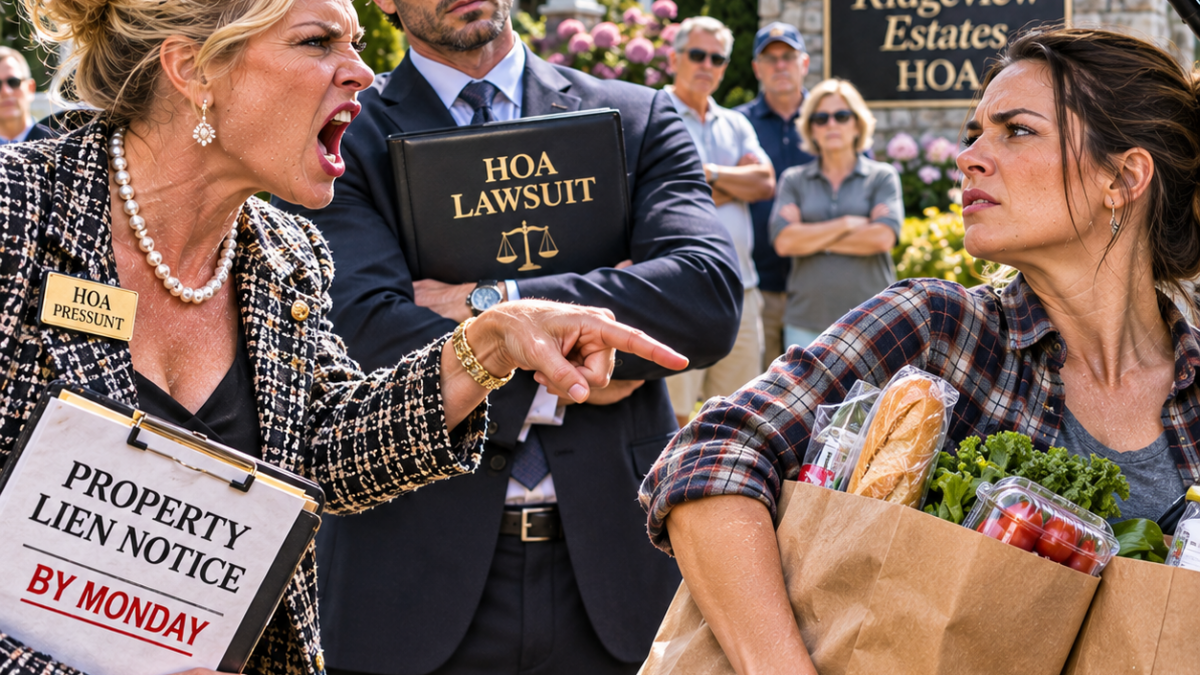
PART2
By the end of my second week in Meadowbrook Falls, Patricia had given me eight violation notices.
Eight.
For deliveries.
One for groceries.
Two Amazon packages.
A pharmacy drop-off.
A FedEx envelope containing client documents.
A pizza.
A pet-food delivery for Barnaby.
And one absurd citation because a floral arrangement sent by my law firm had entered the neighborhood without “prior security registration.”
The cumulative demand reached $1,200 because Patricia’s math changed depending on how angry she was that day.
I began keeping the doorbell camera running continuously.
Then added a second camera above the garage.
Not hidden.
Not provocative.
Just enough to capture the porch, walkway, and curb.
Every time a delivery truck arrived, Patricia seemed to appear within minutes.
Sometimes seconds.
That meant one of two things.
Either she had a remarkable understanding of courier schedules.
Or she was watching my house.
The first time she tried to physically intercept a package, I opened the door before her hand reached it.
“Patricia.”
She froze.
“Jessica.”
“You’re being recorded.”
“I’m aware.”
“Please leave my property.”
“I’m performing an HOA inspection.”
“No.”
“You cannot refuse.”
“I just did.”
Her face flushed.
“You are creating a compliance record that will become very expensive.”
“I’m comfortable with records.”
That line irritated her.
Good.
She left.
But not quietly.
“Your attitude is going to cost you this house.”
The camera captured every word.
I saved the clip.
The next incident occurred during a grocery delivery.
Patricia arrived while the driver was setting bags down.
She told him:
“Do not leave those.”
The poor nineteen-year-old kid froze.
“Ma’am?”
“I’m HOA president.”
He looked at me.
I stepped outside.
“You can leave the groceries.”
Patricia said:
“No.”
I looked at the driver.
“You have my permission.”
He unloaded.
Patricia’s face hardened.
“You are intentionally violating neighborhood safety procedures.”
“Send me the bylaw.”
“I already did.”
“No.”
“I sent it.”
“Then resend it.”
Her lips pressed together.
“Open the bags.”
“No.”
“Open them.”
“No.”
The driver backed toward his car.
He clearly wanted no part of suburban constitutional law.
Patricia pointed at one bag.
“I need to verify contents.”
I moved between her and the groceries.
“You do not have permission to touch my property.”
Her eyes narrowed.
“Do you understand I can put a lien on your home?”
“Send me the authority.”
“I am the authority.”
There it was.
The sentence I had been waiting for.
Not because it was legally meaningful.
Because it revealed how she thought.
I smiled.
“Have a good evening, Patricia.”
I closed the door.
Inside, Barnaby sat in the hallway watching me.
“I know.”
He meowed.
“Ridiculous.”
My law practice had taught me something ugly about intimidation.
It rarely begins with the worst act.
Nobody starts with:
Give me your house.
They start with:
Just sign this.
Just pay the small fine.
Just let me look inside the bag.
Just don’t make trouble.
If you comply, the next demand becomes easier.
Then the next.
Soon, the victim is no longer asking whether the authority exists.
They are calculating how expensive resistance will become.
Patricia had practiced that progression for years.
I did not know how many years until Susan Abernathy knocked on my door carrying a casserole.
Thursday evening.
Six-thirty.
Foil-covered dish.
Nervous expression.
She lived two houses down.
I had waved to her several times but never spoken beyond hello.
“Jessica?”
“Yes.”
“I’m Susan.”
“I know.”
She looked behind her.
Toward the street.
Then lowered her voice.
“Can I come inside?”
That changed everything.
We sat in the kitchen.
Barnaby immediately attempted to inspect the casserole with greater legal authority than Patricia possessed.
Susan laughed weakly.
Then her eyes filled.
“I saw the notices.”
I said nothing.
“She did this before.”
“How many times?”
Susan looked toward the window.
“Three that I know.”
“Tell me.”
The first was a young couple named Andrew and Melissa Park.
Moved in two years earlier.
Patricia created parking violations.
Delivery violations.
Landscaping violations.
Then began telling neighbors they were “running business activity” from the house because Andrew occasionally received computer equipment for work.
They paid thousands.
Eventually sold.
Moved to Concord.
Second:
Harold Myers.
Retired history teacher.
Widower.
He paid $4,200 in fines over several years because challenging them felt more expensive than writing checks.
Third:
Chloe Jenkins.
Single mother.
Two children.
Patricia had targeted her aggressively.
Trash cans.
Children’s bicycles.
Visitors.
Package deliveries.
Home maintenance.
Eventually lien threats.
Chloe moved away crying.
Susan still had her number.
“Why didn’t anyone do anything?”
Susan’s eyes filled.
“We were afraid.”
“Of what?”
“Her.”
“Patricia?”
“And the board.”
“Why?”
“She makes everything expensive.”
That sentence stayed with me.
Not illegal.
Not violent.
Expensive.
The perfect middle-class weapon.
Most people cannot afford lawyers over $300.
Or $600.
Or $1,200.
Patricia understood that.
I asked:
“Did you personally witness any of it?”
“Yes.”
“Would you write down what you saw?”
Susan recoiled.
“I don’t want my name involved.”
“Then don’t.”
She looked surprised.
“I mean it.”
“I will not pressure you.”
“But save everything.”
“What?”
“Emails.”
“Notices.”
“Meeting minutes.”
“If you ever decide you want to talk, preserve what you have.”
She nodded.
At the door, she stopped.
“Chloe might talk.”
“Would you ask her whether I may call?”
Susan nodded.
Twenty minutes later, my phone rang.
Unknown number.
“Jessica?”
“Yes.”
“This is Chloe Jenkins.”
Her voice shook.
Then she told me her story.
Patricia began visiting after Chloe’s husband left.
That timing mattered emotionally, though I did not yet know whether it mattered legally.
Chloe worked evenings twice a week.
Her mother watched the children.
Patricia called the visits “unauthorized occupancy.”
Then delivery fines.
Then trash.
Then landscaping.
Then an allegation that Chloe’s teenage nephew, who was Black, made neighbors “uncomfortable” when he visited.
My pen stopped.
“What exactly was written?”
“I still have the email.”
“Send it.”
She did.
Patricia had written:
Repeated unfamiliar male visitors create security concerns.
Then another email to a board member Chloe obtained later:
The Jenkins property is becoming the wrong kind of environment.
Wrong kind.
Vague enough to deny.
Clear enough to frighten.
Chloe paid nearly $6,000.
Then sold at a loss.
“Why did you pay?”
She started crying.
“Because every letter said lien.”
“I had kids.”
“I could not risk losing the house.”
“I didn’t have money for a lawyer.”
That sentence was the center of Patricia’s business model.
Not legitimate governance.
Cost asymmetry.
Issue a $300 fine.
Homeowner would need $3,000 in legal work to fight it.
So they paid.
I asked:
“Would you be willing to speak with another attorney at my firm?”
Long silence.
“Would it cost me?”
“No.”
“Then yes.”
Andrew and Melissa Park agreed too.
Harold Myers took longer.
He was seventy-two.
Embarrassed.
He believed paying the fines made him complicit.
I told him:
“Paying under pressure does not make the pressure legitimate.”
He finally agreed to review his documents.
By Monday morning, I had four separate timelines.
Mine.
Chloe’s.
The Parks’.
Harold’s.
Susan had not signed anything yet.
But her information connected us.
I did not tell Patricia.
Why would I?
Good evidence likes patience.
Patricia continued.
Anonymous late-night calls began.
Blocked number.
No voice at first.
Just breathing.
Then someone whispered:
“Sell.”
I logged the times.
Reported them to my carrier.
Did not accuse Patricia.
Suspicion is not proof.
Then she made the move I had been waiting for.
Saturday afternoon.
Grocery delivery.
Two board members behind her.
A man named Leonard Cross in a polo shirt.
A woman named Diane Willis wearing a navy blazer.
Both carried clipboards.
Patricia stood in the center.
I opened the door.
Did not invite them inside.
“Jessica.”
“Patricia.”
She pointed toward the bags.
“This has gone far enough.”
“I agree.”
“You’ve ignored eight violations.”
“I preserved eight notices.”
Her eyes narrowed.
“The board has voted to escalate.”
“To what?”
“Lien proceedings.”
Leonard shifted.
Diane looked at her clipboard.
“Based on which covenant?”
Patricia’s smile became icy.
“Your refusal to cooperate.”
“With a rule you have never produced.”
“We have explained it repeatedly.”
“You have described it.”
“That is not the same as producing authority.”
She stepped closer.
“You do not get to decide which rules apply.”
“No.”
“The governing documents do.”
That irritated her.
Then Patricia reached toward the grocery bag.
I did not slap her hand.
Did not yell.
I simply said:
“Stop.”
Her hand hovered.
For one second.
Then I asked:
“Do any of you know what I do for a living?”
Patricia scoffed.
“I don’t care.”
Leonard looked at Diane.
Diane looked at me.
I said:
“I’m a civil-rights attorney.”
Patricia’s face did not change immediately.
So I continued.
“I have spent fourteen years litigating housing discrimination, selective enforcement, fabricated rules, retaliation, and hostile housing cases.”
Leonard stepped backward.
Diane’s eyes dropped to her clipboard.
“I have handled disputes involving associations in New York, Pennsylvania, and Ohio.”
“That’s supposed to scare me?”
Patricia asked.
“No.”
I smiled.
“It is supposed to help you understand why I haven’t argued with you.”
That was when her face changed.
I reached inside.
Picked up my laptop from the entry table.
Opened it.
Turned the screen toward them.
The folder had grown.
Table of contents.
Mine:
Eight violation notices.
Twelve video clips.
Six still images.
Four voicemails.
Delivery logs.
Camera timestamps.
Carrier complaint.
Then:
CHLOE JENKINS.
ANDREW AND MELISSA PARK.
HAROLD MYERS.
SUSAN ABERNATHY — WITNESS SUMMARY.
Patricia stared.
Her face lost color.
I said:
“Every notice.”
“Every email.”
“Every voicemail.”
“Every time you attempted to touch delivered property.”
“Every statement threatening a lien.”
“Every previous resident willing to provide records.”
Diane looked at Patricia.
“You said she was just refusing registration.”
Patricia snapped:
“She is.”
I closed the laptop.
“No.”
“I am documenting a pattern.”
Then I looked at Leonard.
“Did you personally vote to authorize a lien?”
He hesitated.
Patricia answered:
“The board did.”
I looked at him again.
“Did you?”
His mouth opened.
No sound.
Diane’s eyes widened.
Interesting.
I said:
“Do not answer if you are uncomfortable.”
Patricia nearly shouted:
“They do not have to answer you.”
“Correct.”
I smiled.
“Discovery will be different.”
That word landed.
Discovery.
Lawyers understand it.
Regular people usually do not.
But Patricia understood enough.
Her mouth tightened.
“You are threatening us.”
“No.”
“I am informing you.”
“Big difference.”
I looked at all three.
“You’ll be hearing from my associate by Friday.”
Then closed the door.
My hands started shaking the second the lock clicked.
That part never makes it into stories.
Courage often looks calm from outside.
Inside, your body still knows confrontation happened.
I stood in the hallway breathing.
Barnaby rubbed against my ankle.
“Good work.”
He meowed.
Friday came.
So did the letter.
Marcus Thorn, one of my associates, sent a formal demand and litigation-preservation notice to Meadowbrook Falls, Patricia personally, and relevant board members.
Records were to be preserved.
Emails.
Texts.
Violation histories.
Meeting minutes.
Financial records.
Policies.
Communications regarding me and prior residents.
Then we filed.
The initial complaint included federal and state claims our team believed were supported by the evidence then available, including housing-related civil-rights theories, selective and discriminatory enforcement allegations where protected-class evidence existed, retaliation, and state-law claims regarding fabricated rules, harassment, and improper lien threats.
We did not claim facts we could not prove.
That mattered.
Chloe joined.
Andrew and Melissa joined.
Harold joined.
Susan eventually signed a declaration.
The lawsuit stopped being:
Jessica versus Patricia.
It became:
What exactly had this board been doing for nine years?
Patricia responded with a neighborhood email.
ATTORNEY HOMEOWNER ATTACKS VOLUNTEER BOARD.
She called me litigious.
Hostile.
Entitled.
Claimed I was attempting to avoid “reasonable security measures.”
She finally attached what she said was the delivery rule.
I read it.
Then laughed.
It was not in the bylaws.
Not in the declaration.
Not adopted through any board vote reflected in available minutes.
It was a one-page internal memo dated four months earlier.
Signed only by Patricia.
DELIVERY SAFETY GUIDELINES.
Guidelines.
Not authority.
And nothing in it authorized inspection of private package contents.
Marcus called me.
“She just gave us Exhibit A.”
“I know.”
“You sound happy.”
“I enjoy self-authenticating nonsense.”
Discovery started.
That was when Patricia’s world changed.
Before litigation, she controlled the information.
After discovery, she had obligations.
Produce.
Search.
Answer.
Preserve.
The court ordered HOA email production for the prior five years within the authorized scope.
Patricia fought.
Too broad.
Burdensome.
Private.
Confidential.
The judge narrowed certain categories and ordered production.
Then came the emails.
Thousands.
Most boring.
Landscaping.
Snow removal.
Pool chairs.
Budget questions.
Then the ugliness.
One email about Chloe:
She brings too many people who don’t fit the neighborhood profile.
Another:
If we keep pressure on, she’ll move.
Another regarding a Black family who had rented in the subdivision before I arrived:
We don’t want Meadowbrook turning into one of those places where nobody knows who belongs.
A board member replied:
What does that mean?
Patricia:
You know exactly what it means.
Another involving a Latino contractor:
Check documentation before allowing crew through gate.
No equivalent screening instructions appeared for white contractors in the same records we reviewed.
That was no longer vague intuition.
It was evidence.
Not necessarily enough alone to prove every legal element.
But enough to make the discrimination claims serious.
Then we found the delivery pattern.
Patricia had targeted new homeowners far more aggressively than long-term residents.
Why?
Fear.
New people did not know which rules were real.
Emails showed it.
New owners need to be trained early.
Another:
Once they pay the first fine, compliance improves.
I read that one three times.
Trained.
Not welcomed.
Trained.
Marcus said:
“She thought this was behavioral conditioning.”
“She wasn’t entirely wrong.”
Because it worked.
For years.
Then Diane Willis called our office.
The woman in the navy blazer.
She wanted to talk.
Her lawyer attended.
Diane looked exhausted.
“I did not know about the old cases.”
I said nothing.
“I knew Patricia was aggressive.”
“Then why stand on my porch?”
“Because she told us you were creating a security problem.”
“You believed that?”
Diane looked ashamed.
“Yes.”
“Why?”
“Patricia always had documents.”
There it was.
Paper as costume.
“Did you vote to lien my property?”
“No.”
“Was there a board vote?”
“No.”
“Did Leonard?”
“No.”
“So when she stood on my porch and said the board had voted…”
“She lied.”
Clean.
Direct.
“What else?”
Diane looked at her lawyer.
He nodded.
She slid a thumb drive across the table.
“Six months of internal correspondence.”
Marcus stared.
“Why wasn’t this produced?”
“Some was on my personal account.”
Diane swallowed.
“I’m producing it now.”
The drive changed the case.
Patricia directing board members to “back her authority.”
Patricia instructing them not to answer homeowner questions about the delivery protocol.
Patricia discussing fines as leverage.
Then financial messages.
I had not expected money.
I should have.
Control and money often meet eventually.
The HOA books showed irregular reimbursements.
Not necessarily criminal on their face.
But enough to demand explanation.
Consulting fees.
Credit-card charges.
“Community security expenses.”
Payments to a company connected to Patricia’s brother.
A decorating vendor owned by a close family friend.
No clear competitive bidding in several instances.
Expense descriptions vague.
Marcus brought in a forensic accountant.
We did not announce theft.
We asked questions.
Where was the contract?
Where was board approval?
What service was delivered?
Who approved reimbursement?
Patricia’s attorney grew less confident every month.
Then her insurance company entered the picture.
The association’s policy could potentially cover some claims against directors and officers depending on terms, exclusions, conduct, and capacity.
Initially, Patricia acted as though that meant unlimited protection.
Then discovery got uglier.
Intentional conduct.
Possible discriminatory acts.
Potentially personal financial benefits.
The insurer issued reservations.
Then declined to defend or indemnify Patricia personally for certain allegations and conduct outside covered capacity or falling within exclusions, while continuing to address the HOA’s own position as appropriate.
That was the day Patricia understood the difference between:
HOA money.
And Patricia money.
She called an emergency board meeting.
Residents packed the room.
I attended with Marcus.
No speech planned.
Patricia entered late.
No Mercedes visible outside.
Diane sat on the opposite side of the table.
Leonard stared at his hands.
The treasurer asked:
“Are we paying Patricia’s personal legal expenses?”
Silence.
Patricia said:
“This litigation arose from my service.”
Diane answered:
“Some of it.”
Patricia glared.
The treasurer continued:
“Did the board authorize the delivery inspection policy?”
“No.”
Silence.
Patricia turned.
“What?”
He repeated:
“I searched the minutes.”
“No adoption.”
“No vote.”
“Nothing.”
Patricia snapped:
“It was a safety guideline.”
“You fined people under it.”
“Because they refused reasonable cooperation.”
I stood.
Not because I needed to speak.
Because residents were looking toward me.
Patricia saw.
“Do not turn this into a courtroom.”
I said:
“I haven’t said anything.”
“Your presence is intimidation.”
I almost smiled.
“My house is here.”
“You do not control whether I attend.”
That sentence mattered more than it should have.
Because Patricia had spent nine years controlling rooms by deciding who belonged.
Not anymore.
Susan stood.
Her hands shook.
“I want to say something.”
Patricia rolled her eyes.
“Of course.”
Susan’s fear disappeared.
Not completely.
Enough.
“I watched you drive Chloe out.”
Patricia’s face hardened.
“No.”
“You threatened her.”
“She violated rules.”
“You humiliated her.”
“She was disruptive.”
Susan’s voice grew stronger.
“I said nothing.”
“I watched because I was afraid you’d come for me.”
Then Harold Myers stood.
“I paid you $4,200.”
Patricia looked irritated.
“Legitimate fines.”
“No.”
Harold held up a binder.
“Your own committee approved three of the things you fined me for.”
Murmurs.
Andrew Park stood.
“You told us we were operating an illegal business because I received work computers.”
Melissa stood beside him.
“You said if we fought, you’d make it expensive.”
Patricia’s attorney whispered something.
She ignored him.
“You all benefited from property values I protected.”
Someone laughed bitterly.
Then Chloe Jenkins entered from the back.
She no longer lived there.
But residents had invited her to speak.
Patricia went pale.
Chloe walked forward.
No shouting.
No theatrics.
“I sold my house because I was afraid of you.”
Silence.
“You told neighbors my nephew was suspicious.”
“You fined me after my husband left because you knew I was alone.”
“You threatened a lien every time I questioned anything.”
Patricia’s mouth opened.
Chloe continued.
“I lost almost forty thousand dollars selling when I did.”
“You told me I was lucky anyone would buy from someone with ‘my kind of household instability.’”
The room changed.
Patricia said:
“I never said that.”
Chloe reached into her folder.
“Email.”
Marcus smiled faintly beside me.
Receipts.
Always receipts.
Chloe read the line.
Patricia’s face lost color.
Diane stood.
“I move that Patricia Sterling be removed from the presidency pending formal vote and legal review.”
The room erupted.
Patricia shouted:
“You cannot!”
Another board member seconded.
The board attorney intervened.
Explained procedure.
Emergency suspension first.
Formal membership process afterward.
Not mob justice.
Process.
That mattered to me.
Within days, the formal emergency action removed Patricia from day-to-day presidential authority.
A properly noticed membership meeting followed.
The final vote was overwhelming.
Even people who had supported her abstained or voted against her.
The woman who ran Meadowbrook Falls for nearly a decade lost her position.
No screaming arrest.
No dramatic handcuffs.
Just a gavel passing to someone else.
Sometimes power ends quietly.
The lawsuit continued.
Losing the presidency did not erase nine years.
Depositions followed.
Patricia’s was the longest.
Marcus questioned her first.
“Did you inspect packages belonging to all homeowners?”
“No.”
“Why not?”
“Resources.”
“How many homes?”
“Approximately two hundred.”
“How many package inspections did you personally attempt?”
“I don’t know.”
“Our records show concentration among newer residents.”
“I dispute your records.”
“Your own emails say new owners need to be ‘trained early.’”
Patricia shifted.
“Figure of speech.”
“Trained to do what?”
“Follow rules.”
“Rules adopted where?”
Silence.
“Show me the board resolution authorizing package inspection.”
Her attorney objected.
She could not.
Then discrimination.
Emails.
Words.
Patterns.
She attempted to explain every sentence separately.
Security.
Context.
Tone.
Misunderstanding.
The problem with pattern evidence is that explanations which sound plausible alone become less persuasive together.
One email can be misunderstood.
Twenty begin to describe a habit.
Then financial questions.
Why was an HOA card used for certain meals?
Why were consulting payments approved without full-board documentation?
Why did a vendor connected to Patricia’s family receive repeated work?
Some explanations held.
Others did not.
That distinction was important.
We did not claim every suspicious payment was theft.
The financial review found irregular governance and questionable transactions, but not every ugly bookkeeping decision became criminal misconduct.
The lawsuit remained civil.
That made the ending less cinematic.
And more believable.
Mediation began after eleven months.
By then both sides knew enough.
The HOA’s insurer wanted certainty.
The new board wanted the litigation over.
Plaintiffs wanted compensation and reforms.
Patricia faced personal exposure for portions outside insurance protection.
The settlement conference lasted fourteen hours.
No one shouted.
Mostly coffee.
Numbers.
Language.
Confidentiality negotiations.
Policy changes.
Attorney fees.
I sat beside Marcus.
Patricia sat across the room with her lawyers.
At one point she looked at me.
“You destroyed me.”
I almost answered.
Then didn’t.
Marcus whispered:
“Good choice.”
Later, during a break, Patricia approached me near the hallway.
No lawyer immediately beside her.
She looked older.
Hair not perfect.
Eyes tired.
“You could have just paid the fine.”
I stared.
“That’s still what you think?”
“You had money.”
There it was.
The whole philosophy.
If the victim can afford the abuse, the abuse becomes acceptable.
I said:
“Chloe could not.”
Patricia’s mouth tightened.
“She made choices.”
“So did you.”
Then I walked away.
The final settlement was six figures across the combined claims and fees.
The exact allocation was governed by the settlement terms.
Patricia personally bore the largest share of the non-insured exposure attributed to her.
The HOA paid portions resolved through available coverage and association obligations.
Chloe received compensation.
The Parks.
Harold.
Others whose claims had matured and were included.
But money was not the central term I cared about.
Policy.
That was the win.
No invented rules enforceable without proper adoption.
No private package-inspection protocol.
No entry onto residential property without lawful authority or permission.
No lien action without documented underlying authority, notice, hearing, and review required by governing documents and applicable law.
Mandatory training for board members.
Independent review of financial controls.
Conflict-of-interest disclosure.
Documented complaint procedures.
Anti-retaliation requirements.
And the HOA had to revise how enforcement records were kept so one president could not privately manufacture a rule and then call it board policy.
The delivery memo disappeared.
Permanently.
I never received another package violation.
Neither did anyone else.
Patricia’s name appeared in the local paper.
Not because I called a reporter.
Court filings were public.
The story wrote itself.
LONGTIME HOA PRESIDENT OUSTED AFTER CIVIL RIGHTS AND HARASSMENT SETTLEMENT.
Middlesex County Journal.
Front local section.
Susan brought me three copies.
“Why three?”
“One for you.”
“One for Chloe.”
“One for my scrapbook.”
I laughed.
“You have a scrapbook?”
“I’m seventy.”
“I’m required.”
Patricia’s house went on the market two months later.
For-sale sign.
No celebration.
No party.
I did not drive past repeatedly.
Susan did.
She claimed coincidence.
It was not.
One Saturday morning, she knocked on my door holding another casserole.
Barnaby came running.
“Guess what.”
“What?”
“Sold.”
I knew exactly what she meant.
“Patricia?”
“Yes.”
“Where’s she going?”
Susan shrugged.
“Somewhere with no HOA, I hope.”
We both laughed.
Then I stopped.
Not because I felt sorry for Patricia exactly.
Because I realized something.
For nine years, she had treated neighbors as problems to be controlled.
If she moved somewhere without an HOA, maybe for the first time she would have to live beside people without a clipboard between them.
That seemed educational.
Leonard resigned from the board.
He sent me an email.
I should have asked more questions before standing on your porch.
I replied:
Yes.
Then:
Thank you for saying so.
Diane remained.
That surprised people.
She had cooperated early.
Some residents wanted her gone anyway.
She stood at a meeting.
“I participated.”
“I believed Patricia.”
“I failed to check.”
“I understand if you remove me.”
Residents voted to let her finish the term under monitoring and new controls.
Why?
Because accountability is not always exile.
Diane had admitted what she did.
Turned over records.
Testified.
Changed behavior.
That mattered.
She became one of the strongest advocates for financial transparency.
At one meeting, somebody suggested a private “safety committee.”
Diane almost shouted:
“No.”
Everyone laughed.
The new president, Michael Grant, was a retired accountant.
He hated drama.
Perfect.
His first monthly newsletter contained:
Snow-removal schedule.
Pool repair.
Budget spreadsheet.
Reminder to leash dogs.
That was it.
I read the whole thing twice.
No threats.
No invented protocols.
No photographs of residents.
Beautifully boring.
Meadowbrook Falls slowly changed.
Not because one lawsuit magically healed everything.
Fear leaves slower than power.
Susan still lowered her voice whenever mentioning Patricia for months.
Harold checked every envelope from the HOA with shaking hands.
Chloe did not move back.
Some injuries are not reversible.
Andrew and Melissa stayed in Concord.
They had built another life.
But they attended one community barbecue after the settlement.
Patricia no longer lived there.
Melissa stood on my porch.
“I hated this neighborhood.”
“I know.”
“Now it looks normal.”
“It mostly is.”
She laughed.
“That’s the problem.”
“What?”
“People think bad systems look obviously bad.”
“They don’t.”
No.
They look like clipboards.
Forms.
Friendly newsletters.
Fine schedules.
Official seals.
Words like safety.
Compliance.
Property values.
Reasonable people assume official-looking rules must come from somewhere.
Patricia built nine years of control on that assumption.
She did not need a legal right to inspect packages if people believed she had one.
Authority often survives because nobody asks:
Show me the sentence.
That became the phrase residents used afterward.
Whenever the board proposed anything new:
“Show me the sentence.”
Where is it authorized?
Where is it adopted?
Where is the vote?
Where is the budget?
Not hostility.
Governance.
The board learned to appreciate it.
Mostly.
I also learned something uncomfortable.
Lawyers sometimes become arrogant about evidence because we know how to demand it.
Most people do not.
That does not make them weak.
Before meeting Patricia, I would have wondered why Chloe paid.
Why Harold paid.
Why the Parks moved.
Surely they could have challenged.
Then I watched the mechanism firsthand.
A $300 notice.
Then $600.
Then $1,200.
Then lien language.
Anonymous calls.
Board members at your door.
Neighbors watching.
Legal consultation costs hundreds per hour.
You work.
Raise children.
Care for parents.
Do you really want to spend a year litigating a grocery-delivery rule?
Most people say no.
Patricia depended on rational people making rational cost decisions.
She could win without being legally right.
That is why my profession mattered.
Not because I was smarter.
Because my resistance cost less.
I knew procedure.
I had colleagues.
I understood preservation.
I was not afraid of discovery.
That gave me an advantage Chloe never had.
So part of the settlement funded legal-education sessions for Meadowbrook residents.
Not because every neighbor needed to become a lawyer.
Because everyone deserved to know:
A notice is not automatically lawful.
A fine is not automatically valid.
A board president is not the board.
A policy is not a bylaw merely because someone prints it.
And a lien threat should never be ignored—but neither should it automatically be obeyed without asking what supports it.
Marcus taught the first session.
The title:
READ BEFORE YOU PAY.
Seventy people attended.
Susan brought brownies.
Barnaby was not invited.
He attended anyway.
People asked practical questions.
Can an HOA regulate paint?
Sometimes.
Parking?
Depending on governing documents and law.
Packages?
Not like Patricia claimed.
Can they enter your house?
Generally not simply because the president wants to “inspect.”
Can they fine?
Potentially, but process and authority matter.
Can residents remove a board?
Follow governing documents and applicable law.
One man raised his hand.
“What if the president says the rules are confidential?”
Marcus smiled.
“Ask why the rules governing your home would be secret.”
The room laughed.
Education is not dramatic.
But neither is prevention.
Six months after settlement, Chloe invited me to dinner.
She lived in a rented townhouse in Framingham.
Smaller than her Meadowbrook house.
Two kids.
Warm kitchen.
She handed me a folder.
“What’s this?”
“All my old Patricia stuff.”
“You want me to store it?”
“No.”
“I’m throwing it away.”
I stared.
“You sure?”
“Yes.”
“Legal retention?”
“Marcus said copies are preserved.”
“Then yes.”
She carried the folder to the recycling bin.
Paused.
Then threw it in.
Started crying.
I hugged her.
“I hated that paper.”
“I know.”
“For years.”
“I know.”
“Every time I saw the folder, I felt stupid.”
“Why?”
“Because I paid.”
I pulled back.
“Chloe.”
“I know what you’re going to say.”
“Do you?”
“Yes.”
“I was scared.”
“You had children.”
“You made the decision you believed protected them.”
“That does not make you stupid.”
She wiped her face.
“I still wish I had fought.”
“So do I.”
She stared.
“You?”
“Yes.”
“Because if someone before you had stopped Patricia, you might never have needed to.”
That was the right way to think about systemic abuse.
Individual courage matters.
But systems should not require exceptional courage for ordinary fairness.
Harold Myers eventually spoke at a town meeting.
He brought the canceled checks for his old fines.
Four thousand two hundred dollars.
He placed copies on the table.
“I kept these because I was ashamed.”
Michael asked:
“Ashamed of what?”
“Paying.”
Harold looked around.
“Jessica told me something I want to repeat.”
He looked at me.
I nodded.
“Being pressured into payment does not make the pressure legitimate.”
Then he smiled.
“I’m done being embarrassed.”
People applauded.
Harold used part of his settlement to take his granddaughter to Italy.
He mailed me a postcard from Rome.
NO HOA INSPECTION AT THE COLOSSEUM. VERY DISAPPOINTED.
I framed it.
Susan became unofficial neighborhood intelligence.
Nothing changed there.
She still knew who had contractors.
Who was dating.
Which house had raccoons.
But she used her powers for good.
Mostly.
One afternoon, she called.
“Emergency.”
“What?”
“A package is coming to your house.”
I waited.
“And?”
“Do you want me to inspect it?”
I hung up.
She laughed for three days.
Barnaby became locally famous because newspaper photographers captured him sitting in the front window during an interview.
The caption:
Barnaby Vance, who continues to receive uninspected food deliveries.
I bought a copy.
The new HOA president mailed me a joke notice.
VIOLATION: CAT HAS FAILED TO REGISTER TUNA SHIPMENT. FINE: ONE HEAD SCRATCH.
I paid immediately.
Some humor returns only after fear leaves.
My law firm received dozens of calls after the story.
HOA problems.
Neighbor disputes.
Actual discrimination.
Ordinary rule disagreements.
I refused to turn every dispute into:
Patricia 2.0.
That would be irresponsible.
Some associations were right.
One homeowner called furious because the board fined him for storing construction equipment across a sidewalk.
He said:
“Civil rights!”
I asked:
“Are you blocking wheelchair access?”
Silence.
“Yes.”
“Move the equipment.”
He hung up.
Another claimed selective enforcement over a shed.
Turns out she never submitted plans required by clearly recorded covenants that every neighbor followed.
Not every no is abuse.
Not every fine is tyranny.
Evidence cuts both directions.
That was why Patricia’s case mattered.
Her conduct was not wrong because homeowners disliked rules.
It was wrong because she invented authority, applied it selectively, threatened property interests, pressured vulnerable residents, and left a documentary record of bias and manipulation.
Precision matters.
Especially when stories go viral.
One afternoon, a young lawyer at my firm asked:
“What was the exact moment you knew you had Patricia?”
I laughed.
“Never.”
“What?”
“You never know.”
“Not even when Diane gave you the emails?”
“No.”
“Insurance denial?”
“No.”
“Settlement conference?”
“No.”
She looked disappointed.
“Law isn’t a movie.”
“You build evidence.”
“You test it.”
“You lose some arguments.”
“Win others.”
“People settle for complicated reasons.”
She leaned against my doorway.
“But there must have been a moment.”
I thought.
Maybe there was.
The first day.
My porch.
Patricia saying:
I am the authority.
Not because that sentence won the case.
Because it told me she had stopped distinguishing between office and person.
Patricia believed:
I am president.
Therefore my preference is policy.
That mindset produces bad records.
Because when people stop believing they need permission, they stop hiding the fact they never got it.
She fined before votes.
Issued memos as rules.
Threatened liens without proper support.
Wrote what she thought in emails.
Dragged board members to porches without board authorization.
Arrogance is terrible legal strategy.
I tell young lawyers:
“Never interrupt a person who is documenting their own misconduct.”
But I also tell clients:
“Do not intentionally bait people.”
There is a difference.
My cameras did not create Patricia.
My silence did not trick her.
I simply stopped rescuing her from the consequences of speaking.
That lesson extends beyond HOAs.
Managers.
Landlords.
Supervisors.
Boards.
Anyone who relies on intimidation often depends on victims reacting emotionally rather than keeping records.
Dates matter.
Exact words matter.
Who was present.
What document.
Which rule.
Which vote.
Which payment.
The mundane details become structure.
My divorce had taught me something similar.
When my marriage ended, I wanted a grand explanation.
Why did love fail?
What moment broke it?
My therapist finally said:
“Sometimes the answer is a thousand ordinary moments.”
Patricia’s case was the same.
Not one monstrous event.
Nine years of ordinary coercion.
A notice.
A phone call.
A fee.
A threat.
A frightened widow.
A family deciding moving was cheaper.
One after another.
Until the file became hundreds of pages.
People assume injustice always announces itself dramatically.
Sometimes it arrives on HOA letterhead.
The first anniversary of Patricia leaving Meadowbrook Falls, Susan organized a block party.
She called it:
DELIVERY FREEDOM DAY.
I objected.
She ignored me.
Everyone ordered takeout.
Pizza.
Thai food.
Chinese.
Groceries.
Amazon packages.
One resident had a florist deliver six bouquets just because he could.
The poor delivery drivers had no idea why people applauded each van.
Michael, the HOA president, stood near my porch.
“Do I need to inspect anything?”
“Absolutely.”
I handed him a bag.
He looked inside.
“Garlic bread.”
“Contraband?”
“Potentially.”
We laughed.
Then Chloe arrived.
With her children.
First time back since moving.
She stood at the entrance to the subdivision for several seconds.
I saw her from the sidewalk.
Frozen.
I walked over.
“You okay?”
“I don’t know.”
“You don’t have to come in.”
She looked at Meadowbrook Falls.
“Patricia’s gone?”
“Yes.”
“Really gone?”
“Yes.”
She took a breath.
Then entered.
Susan hugged her.
Harold hugged her.
Andrew and Melissa had driven in too.
For one afternoon, the people Patricia had scattered stood on the same street.
That hit me harder than the settlement.
Chloe walked past her old house.
New family lived there.
Bikes in driveway.
Children playing.
She cried.
“I miss it.”
“I know.”
“I don’t want it back.”
“I know.”
“I just hate that I left because of her.”
I took her hand.
“You left because you protected your kids with the options you had.”
She nodded.
“Still sucks.”
“Yes.”
Justice does not always restore the exact thing taken.
Sometimes it only prevents the next loss.
That is enough to matter.
Later that evening, after people left, I sat on my porch.
Barnaby in the window.
Empty pizza boxes.
Susan’s folding chairs scattered across the lawn.
A delivery van stopped three houses down.
Driver carried a package.
No Mercedes appeared.
No clipboard.
No one watched.
The package reached the door.
The driver left.
That ordinary scene felt almost sacred.
My phone buzzed.
Unknown Massachusetts number.
I answered.
“Jessica Vance?”
“Yes.”
“My name is Rebecca.”
“I live in another HOA.”
“I heard about Meadowbrook.”
“Okay.”
“Our president keeps demanding residents provide copies of guest IDs.”
I sat straighter.
“What do your governing documents say?”
“I don’t know.”
“Start there.”
She began crying.
“I’m scared.”
I looked down the quiet street.
“I understand.”
“Do not argue tonight.”
“Save every written demand.”
“Write down dates.”
“Request the governing documents.”
“If you feel threatened or believe discrimination is involved, talk to qualified local counsel.”
“Do not assume your facts are identical to mine.”
She took a shaky breath.
“Okay.”
Then:
“How did you know when to fight?”
I thought about Chloe.
Harold.
The Parks.
Susan.
My own eight notices.
“I didn’t.”
“What?”
“I just started keeping records.”
That was the answer.
Not:
Be fearless.
Not:
Destroy the board.
Not:
Sue everyone.
Document.
Understand.
Then choose.
Rebecca thanked me.
We hung up.
For weeks after, people online celebrated Patricia’s downfall.
Comments:
JUSTICE SERVED.
KAREN PICKED THE WRONG HOUSE.
LAWYER DESTROYED HOA.
I understand why people like that version.
It is clean.
But I did not destroy Meadowbrook Falls.
The goal was never to.
The HOA still exists.
That matters.
It manages common property.
Snow.
Landscaping.
Insurance.
Pool maintenance.
Some rules are useful.
Some restrictions protect everyone.
The board needed reform, not annihilation.
Patricia had confused herself with the institution.
So when she fell, people assumed the institution had to fall too.
It didn’t.
Healthy systems outlive bad leaders.
That became the deepest justice.
Patricia said:
Without me, this community will collapse.
It didn’t.
Snow still got plowed.
Grass still got cut.
Property values did not evaporate.
Packages continued arriving.
Nothing burned.
The only thing that disappeared was fear.
That is the worst news a tyrant can receive.
You were never as necessary as you told everyone.
Years later, Diane Willis became HOA president.
Yes.
The woman who stood on my porch behind Patricia.
Some residents objected.
I did not.
Diane had spent years after the case doing the work.
Training.
Audits.
Open meetings.
Publishing minutes.
She never ran unopposed.
Refused special authority.
Her first act as president was to post a message:
IF I EVER TELL YOU “I AM THE AUTHORITY,” PLEASE REMOVE ME IMMEDIATELY.
Susan printed it on a T-shirt.
I bought one.
Diane and I became friends eventually.
One evening she told me:
“I hate thinking about that porch.”
“Why?”
“I looked ridiculous.”
“You did.”
“Thanks.”
“You were holding a clipboard.”
“I know.”
“I thought that made me official.”
We laughed.
Then she became serious.
“I believed Patricia because everybody believed Patricia.”
“That happens.”
“Not an excuse.”
“No.”
She nodded.
“I want people to understand that ordinary people help bad leaders because we think compliance is neutral.”
That was wise.
Diane had not invented the delivery policy.
But she lent Patricia her presence.
Her clipboard.
Her silence.
That made the threat look institutional.
Accountability required admitting that.
Patricia herself never contacted me again.
Not directly.
Once, years later, a lawyer representing her sent a routine question involving settlement records.
Nothing personal.
No apology.
No final confrontation.
I preferred it.
People often imagine closure requires the villain to say:
You were right.
I was wrong.
I underestimated you.
Life rarely provides that.
Closure came when I stopped needing Patricia to understand anything.
She could spend the rest of her life believing she protected Meadowbrook.
The records said otherwise.
I did not need her agreement.
That freedom surprised me.
Before the case, I believed justice meant convincing the wrongdoer.
Afterward, I understood:
Sometimes justice is establishing reality clearly enough that the wrongdoer’s belief no longer controls anybody else.
Patricia could believe her package inspections were reasonable.
She could no longer enforce them.
She could believe Chloe deserved fines.
The settlement said otherwise.
She could believe residents needed her.
They elected someone else.
She could believe I was just difficult.
I still lived at 5029 Oak Creek Way.
Barnaby still watched deliveries.
Life moved on without permission from Patricia Sterling.
My mother visited one Christmas.
She had followed the story from Florida.
After dinner, a UPS truck stopped.
Mom looked toward the window.
“Is that one of them?”
“One of what?”
“The packages.”
I laughed.
“Yes.”
She whispered dramatically:
“Should we call the president?”
I handed her wine.
“Get out.”
Barnaby died three years later.
Seventeen years old.
Kidney failure.
I buried him beneath the maple tree behind the sunroom.
Susan cried harder than I did.
She brought a casserole.
Of course.
A week later, a package arrived.
Cat food subscription I had forgotten to cancel.
I stood on the porch holding the box.
Started crying.
Not because of Patricia.
Because for years Barnaby’s ridiculous face in the window had become part of the story.
The first witness to every delivery battle.
I donated the food to a shelter.
Then sat on the porch.
Sometimes a home becomes yours through conflict.
Sometimes through grief.
Mostly through ordinary days.
That was what Patricia never understood.
A house is not an asset first.
It is where life happens.
When she threatened liens, she saw leverage.
When Chloe heard lien, she saw her children’s bedrooms.
When Harold heard fine, he saw retirement savings.
When Andrew and Melissa heard violation, they saw whether they could afford lawyers and a mortgage at the same time.
Patricia dealt in paper.
The residents lived inside what that paper threatened.
That is why good governance requires restraint.
Power may be legal and still need judgment.
The following year, Meadowbrook Falls held another community meeting.
Budget.
Nothing dramatic.
At the end, Diane asked if I wanted to say anything about the anniversary of the lawsuit.
“No.”
Susan shouted:
“She has a speech.”
“I do not.”
“Liar.”
Everyone laughed.
I stood anyway.
Looked around the clubhouse.
Same room where fear once operated quietly.
No cameras.
No reporters.
No lawyers.
Just neighbors.
“I have one thing.”
People waited.
“When Patricia first came to my porch, I thought the problem was a fake delivery rule.”
“It wasn’t.”
“The problem was that too many people had been taught asking for proof was disrespect.”
I looked at Diane.
“At ourselves too.”
“We should never be afraid to ask the board:
Where is that written?
Who voted?
What does it cost?
Who benefits?
Is it applied equally?
Those questions are not attacks.”
“They are how a community stays ours.”
That was it.
I sat.
Susan whispered:
“Pretty good.”
“Shut up.”
The lesson stayed with me professionally too.
I began teaching a short seminar for younger attorneys about evidence preservation in housing disputes.
Not titled:
How to Destroy an HOA Karen.
Unfortunately.
The marketing department rejected my suggestion.
It was called:
PATTERN, PROCESS, AND PROOF IN COMMUNITY-ASSOCIATION DISPUTES.
Painfully boring.
Exactly right.
First slide:
A photo of Patricia’s first $300 notice.
Then a question:
WHAT DOES THIS DOCUMENT PROVE?
Students always answered:
That the HOA fined Jessica.
Yes.
But not that the fine was valid.
Paper proves what happened.
Authority must still be established.
Second slide:
The supposed delivery guideline.
What does it prove?
That Patricia created a memo.
Not that residents were legally bound by it.
Third:
Emails.
Pattern.
Fourth:
Financial records.
Questions.
The goal was to teach restraint.
Lawyers love stories.
Evidence loves precision.
Never claim more than the document supports.
That principle protected us.
Patricia exaggerated.
We did not.
She said:
Jessica refuses all HOA authority.
False.
I paid legitimate dues.
Followed recorded rules.
Submitted exterior requests.
We said that.
Patricia said:
Every delivery required inspection.
We asked:
Show the rule.
She could not.
Patricia said:
The board voted for lien escalation.
Diane and Leonard said no.
Meeting records supported them.
Patricia said:
Prior residents were simply noncompliant.
Emails showed planned pressure.
The truth did not need decorating.
That became my favorite lesson.
When facts are strong, drama is often the enemy.
Which is funny, considering how dramatic Patricia was.
One of my law students later became an attorney representing homeowner associations.
She emailed me.
Don’t be mad.
I replied:
Someone has to teach them not to be Patricia.
She now advises boards to document votes, avoid selective enforcement, disclose conflicts, and never invent powers.
That is part of justice too.
Not merely helping homeowners fight.
Helping boards govern legally.
A functioning HOA protects both sides from chaos.
The world is less satisfying when you admit complexity.
But more useful.
Eight years after I moved into Meadowbrook Falls, Susan and I sat on my porch drinking iced tea.
She looked toward the house Patricia once owned.
New family.
Two young children.
Basketball hoop.
A delivery truck pulled up.
Boy ran outside.
Driver handed him a box.
Susan smiled.
“Remember?”
“Yes.”
“Patricia would have intercepted that.”
“Probably.”
“What do you think she would have found?”
“Legos.”
“Dangerous.”
“Extremely.”
We laughed.
Then Susan became quiet.
“I should’ve spoken earlier.”
“Susan.”
“No.”
“Let me say it.”
She stared toward the street.
“When Chloe was being targeted, I knew.”
“Not everything.”
“Enough.”
“I told myself it wasn’t my problem.”
“Then the Parks.”
“I still stayed quiet.”
“Harold.”
“Quiet.”
Her eyes filled.
“You moved in.”
“I saw the notice.”
“And I almost stayed quiet again.”
I took her hand.
“But you didn’t.”
“Eventually.”
“That counts.”
“Does it?”
“Yes.”
Not because late courage erases earlier silence.
Because systems change only when someone eventually breaks pattern.
Susan had.
She brought the casserole.
Such a small act.
It connected me to Chloe.
The Parks.
Harold.
Without Susan, maybe I still would have filed over my own case.
But the pattern would have been harder to prove.
One nervous neighbor holding baked pasta changed litigation.
History is strange.
I asked:
“What was in the casserole?”
She looked offended.
“Chicken tetrazzini.”
“I don’t remember.”
“Because you lawyers don’t appreciate culture.”
I laughed.
She slapped my arm.
The story of Meadowbrook Falls became less important over time.
That was healthy.
New residents moved in who had never met Patricia.
They heard pieces.
“The package lady.”
“Was that real?”
Yes.
Eventually the story sounded ridiculous.
Good.
Abuse should sound ridiculous once people stop accepting it as normal.
One teenager asked me:
“Why didn’t everybody just tell her no?”
I looked at him.
“That is exactly what people always ask afterward.”
He shrugged.
“She couldn’t inspect mail.”
“No.”
“So why did people listen?”
“Because she had title.”
“Paper.”
“Board members.”
“Fines.”
“Because adults are busy.”
“Because houses are expensive.”
“Because lawsuits are scary.”
“Because people are more willing to tolerate a small violation of freedom than risk a large financial loss.”
He thought.
“That’s messed up.”
“Yes.”
“Would I have told her no?”
I smiled.
“Everyone thinks they would.”
That answer annoyed him.
Good.
Confidence should be tested.
The greatest danger in hearing stories about bullies is imagining victims were weak and you would automatically be brave.
Maybe.
Maybe not.
Courage is easier in hindsight.
I had advantages.
Training.
Money.
Professional confidence.
I knew exactly what Patricia could and could not do once I saw the documents.
Chloe did not.
Harold did not.
The Parks did not.
Judging them would be another form of arrogance.
So when people tell me:
“She picked the wrong house.”
I say:
“She did.”
Then:
“But the right outcome should not depend on picking a lawyer’s house.”
That is why the reforms mattered.
Why Diane mattered.
Why education mattered.
Why financial transparency mattered.
The goal was never to create one homeowner too dangerous to bully.
The goal was to create a community where bullying failed regardless of who lived behind the door.
That is much harder.
And much more satisfying.
Patricia once said:
Nothing enters this neighborhood without my approval.
Today packages arrive every hour.
Food.
Medicine.
Flowers.
Books.
Cat toys for Susan’s new kitten.
Nobody approves them.
Nobody needs to.
The neighborhood did not become unsafe.
Property values did not collapse.
The sky did not fall.
Which revealed the truth about Patricia’s rule.
It was never really about packages.
It was about ritual.
Make a new homeowner open a bag for you.
They learn:
You can enter their private decisions.
Make them pay a fake $300 fine.
They learn:
Resistance costs money.
Threaten a lien.
They learn:
Your house is conditional on obedience.
That is why my refusal bothered her so much.
I was not protecting groceries.
I was interrupting the ritual.
Patricia sensed it before I fully did.
The most important sentence I said was not:
I’m a civil-rights attorney.
It was earlier.
Much simpler.
No.
No, you cannot inspect this.
No, you cannot touch that package.
No, a memo is not a bylaw.
No, being president does not make you the authority over everything.
No, I will not pay merely because fighting is inconvenient.
Every legal action after that grew from the word.
But no alone would not have been enough.
Documentation made no durable.
That distinction matters.
Boundaries without evidence can become memory disputes.
Evidence gives boundaries structure.
That is why I still keep a digital copy of Patricia’s file.
Not because I expect another lawsuit.
Because it reminds me how ordinary tyranny looks at the beginning.
A silver Mercedes.
A clipboard.
A polite smile.
A woman saying:
“I’m responsible for safety.”
Then one request you know is wrong.
Open the bag.
Most abuse does not arrive announcing:
I am abuse.
It arrives disguised as procedure.
I eventually repainted my front door.
Red.
The architectural committee approved it.
In writing.
Diane emailed:
APPROVED. PLEASE DO NOT FRAME THIS EMAIL.
I framed it.
Hung it in my office beneath the diploma.
Clients ask.
I tell them:
“Long story.”
Susan says:
“Tell the casserole part.”
I refuse.
My life became quieter again.
Which was what I had wanted when I moved.
Work.
Home.
Friends.
A porch.
No husband.
No Patricia.
Eventually another relationship.
His name was Ethan.
We met at a bar association dinner.
He was not a lawyer.
Architect.
I told him that was suspicious because architects always believe they understand contracts.
He told me lawyers always believe buildings obey arguments.
Fair.
The first time he ordered food to my house, the driver arrived.
Ethan looked toward the window.
“Do I need HOA clearance?”
I stared.
“Get out.”
He laughed.
Stayed.
Years later, he moved in.
No drama.
No board inspection.
Susan performed an unofficial background check anyway.
More dangerous than Patricia ever was.
I told her that.
She said:
“Correct.”
Meadowbrook Falls never became perfect.
Someone still complained about Halloween decorations.
Another resident tried to ban basketball hoops.
People argued over trees.
Budgets.
Dogs.
Human beings create conflict.
That is normal.
What changed was process.
Someone proposed a rule.
Board published it.
Residents commented.
Vote happened.
Counsel reviewed.
Records existed.
People disagreed.
Nobody threatened to search groceries.
Beautiful.
At one annual meeting, a resident yelled at Diane:
“You work for us!”
Diane replied:
“Yes.”
Then waited.
The resident looked confused.
He had expected combat.
That single answer showed how far the community had come.
Leadership without ego feels almost anticlimactic.
It should.
The last physical reminder of Patricia disappeared when the new owners removed the old landscaping from her property.
Tall hedges she used for privacy.
One morning, crews cut them down.
From my porch, I could suddenly see straight through to the house.
For years, Patricia had watched the neighborhood.
Now nothing hid the place she once ruled from.
I felt no triumph.
Just distance.
Someone else lived there.
Different family.
Different story.
Property moves on.
That helped me understand why Chloe eventually recovered too.
She bought another house years later.
Not HOA-controlled.
Smaller.
Happy.
Her children grew.
The youngest barely remembered Meadowbrook Falls.
At her housewarming, Chloe handed me a package.
“Open it.”
I laughed.
“Careful.”
Inside was a wooden plaque.
NOTHING ENTERS THIS HOUSE WITHOUT MY APPROVAL.
I stared.
She burst out laughing.
“You hate it?”
“I absolutely hate it.”
“Perfect.”
I hung it inside a closet.
She still checks every visit.
The case did not give Chloe back the years of fear.
But it let her laugh at the sentence.
That matters.
Harold died at seventy-eight.
His daughter called.
He had kept the framed Rome postcard.
At his memorial, she told me:
“Dad used to say the lawsuit was the first time he stopped feeling stupid for paying.”
I cried.
That is what institutions do when they abuse people.
They make the victim carry embarrassment for what the institution did.
Harold thought:
I should have known.
Chloe:
I should have fought.
Susan:
I should have spoken.
The Parks:
We should have stayed.
Everyone pointed inward.
Patricia rarely did.
Justice helped move shame toward the person whose choices created it.
Not perfectly.
Enough.
When law students ask what I learned, I give them five words.
Power hates a clean record.
Not because every powerful person is corrupt.
Because arbitrary power relies on ambiguity.
Who said what?
Which rule?
Did we vote?
Was notice sent?
Did the resident receive it?
Was the same rule applied elsewhere?
Clean records turn ambiguity into questions with answers.
Patricia thrived in:
I thought.
I was told.
We usually.
It’s understood.
Everybody knows.
Safety requires.
The lawsuit forced:
Show me.
Once she had to show us, the mythology collapsed.
That is why the file on my laptop became so important.
Eight notices.
Twelve videos.
Four voicemails.
Six photographs.
Names.
Dates.
Nothing glamorous.
No secret recording that magically solved everything.
No envelope hidden behind a wall.
Just disciplined accumulation.
Receipts always do the talking.
Susan still says that.
I blame her.
Years later, after I became partner at my firm, I had a young associate come into my office furious about a case.
“The defendant lied.”
“Yes.”
“Aren’t you angry?”
“Of course.”
“You don’t look angry.”
I pointed toward Patricia’s first notice framed beside the red-door approval.
“Anger is not evidence.”
She stared.
“What is?”
“Usually boring things.”
She laughed.
Then went back to discovery.
That may be Patricia Sterling’s accidental legacy.
She reminded a generation of lawyers at my firm that the person who talks loudest is not necessarily the person with the stronger case.
And sometimes the most dangerous response to an arrogant bully is a quiet woman who photographs the paper, names the folder, and goes back to work.
The day Patricia stood on my porch and said:
I inspect every single delivery on this street, and I don’t care who you think you are,
she believed the question was:
Who are you to tell me no?
It wasn’t.
The real question was:
Who are you to tell everyone yes is mandatory?
She never found a good answer.
The governing documents did not give her one.
The board records did not.
The discovery did not.
The insurer did not.
The residents eventually did not.
And once enough people stopped mistaking Patricia’s confidence for authority, there was almost nothing left holding her system together.
That is the ending I prefer.
Not her for-sale sign.
Not the settlement check.
Not the newspaper headline.
A delivery truck stopping at a house.
A driver walking to the porch.
A homeowner opening the door.
Taking the package.
Closing it again.
No clipboard.
No inspection.
No fear.
Just home.
That is what Meadowbrook Falls should have been all along.








