PART2:“OPEN THAT GATE, YOU SELFISH OLD MAN, OR I’LL MAKE YOU REGRET BUYING THIS RANCH!” HOA Karen Threatened My 60 Acres Over a Four-Minute Shortcut—She Never Expected Me to Question One Missing Document
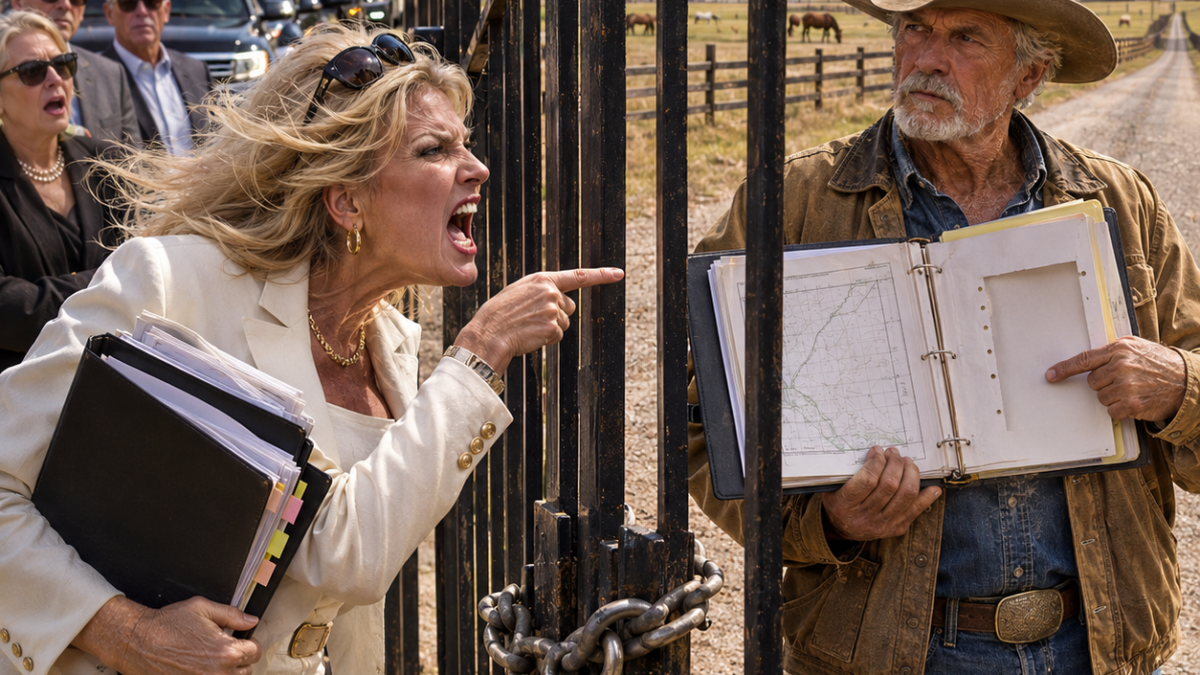
The steel gate went in that Saturday.
I installed it exactly where the survey showed my property began, leaving enough width for my pickup, a stock trailer, and eventually the construction vehicles that would need to reach the house site.
I didn’t block County Road 18.
I didn’t touch Red Cedar’s paved subdivision streets.
I didn’t put the gate across somebody else’s driveway.
I closed an opening in my own fence.
At least, that was what I understood the boundary documents to show.
I also knew that a deed wasn’t the only possible source of property rights. Longstanding use could raise questions about easements, historical permissions, and other legal claims.
That was precisely why I wanted Linda to show me what Red Cedar believed it owned.
If a legitimate right existed, we could discuss it.
But she seemed to think asking for evidence was an act of aggression.
By Monday afternoon, I had a certified letter from an attorney representing Red Cedar Estates.
It was written on expensive stationery and contained three pages of carefully polished indignation.
The association demanded that I restore what it called historic secondary access within seventy-two hours.
Its attorney asserted that residents had relied on the route for nearly two decades and that the HOA intended to pursue all available remedies to protect the community’s access rights.
The letter also warned me against interfering with what it described as established infrastructure serving the development.
That last word caught my attention.
Infrastructure.
I’d seen a dirt track.
Some tire marks.
A couple of shallow drainage cuts near the fence.
Nothing that seemed to justify the grand language in the letter.
I read the notice twice.
Then called my daughter.
Rachel Mercer was thirty-one and worked as a title examiner in Oklahoma City.
When she was little, she used to organize her school supplies by color and label her Christmas presents before anybody asked.
By high school, she was the kind of girl who could find a missing page in a hundred-page document simply because the numbering felt wrong.
She had inherited her mother’s patience and, unfortunately for anybody trying to bluff her, my stubbornness.
“Hey, Dad.”
“Morning, sweetheart.”
“You sound irritated.”
I looked at the letter.
“Is that what you call my voice now?”
“Only when you start a conversation without complaining about the weather.”
I laughed.
Then told her about Linda.
The Lexus.
The gate.
The four-minute shortcut.
The seventy-two-hour demand.
Rachel listened quietly.
When I finished, she asked one question.
“Did they attach an easement?”
“No.”
“A book and page reference?”
“No.”
“An instrument number?”
“Nothing.”
I could almost hear her thinking.
Then she said, “I’ll come Saturday.”
“You don’t need to drive all the way down here.”
“Dad.”
“What?”
“You bought sixty acres to get away from people, and somehow you’ve already found an HOA president.”
I smiled.
“Apparently.”
She sighed.
“I’m coming.”
Before hanging up, she added, “Don’t take down the gate, don’t start an argument, and don’t assume they’re wrong just because their president is obnoxious.”
I stared at the phone.
“You sound like your mother.”
“Good.”
Then she hung up.
I sat in the equipment shed smiling for the first time since Linda’s visit.
My wife would have loved that exchange.
She’d spent years telling me that Rachel was the only person in the family capable of winning an argument by refusing to have one.
I was about to discover just how useful that talent could be.
Rachel arrived Saturday morning carrying a laptop, two banker boxes, and enough coffee to keep both of us awake until Sunday.
She stepped out of her car and looked at the gate.
“Nice work.”
“Thank you.”
“Straight posts.”
“Of course.”
“Surprising.”
I gave her a look.
She grinned and hugged me.
For a moment, I held on longer than usual.
She’d been worried about me since her mother died.
I knew that.
She called almost every evening.
Asked whether I was eating properly.
Reminded me to make appointments.
Pretended she needed advice about things she already understood.
She was trying to make sure loneliness didn’t swallow me.
I appreciated it.
Even when she was annoying.
We carried her boxes into the equipment shed and spread the documents across a folding table.
My warranty deed.
The title commitment.
The recorded legal description.
The survey I’d reviewed before closing.
Tax maps.
Recorded exceptions.
Older aerial photographs.
Rachel also brought her own research into neighboring parcels and the development history of Red Cedar Estates.
She worked systematically.
First, the property I owned.
Then its predecessors.
Then the subdivision.
Then the documents connected with Red Cedar’s original development.
At noon, she pushed away her coffee.
“Nothing.”
I looked up.
“Nothing?”
“No recorded vehicle easement in what we’ve located so far.”
I folded my arms.
“So Linda’s bluffing.”
Rachel raised a finger.
“Not so fast.”
I sighed.
She continued, “Recorded documents are important, but a lawyer may need to evaluate other possible claims. We’re identifying what the records actually show.”
I nodded.
“Fair enough.”
She turned back to her screen.
“Now let’s find out where that road came from.”
An hour later, she found something.
A promotional development plan dated 2007.
It showed Red Cedar Estates as an attractive new community with paved streets, landscaped common areas, a clubhouse, and neatly arranged residential lots.
At the northwest edge of the promotional drawing, a dotted line extended toward the land that was now my ranch.
Rachel enlarged it.
Three words appeared beside the line.
FUTURE SECONDARY ACCESS.
I leaned closer.
“Future.”
She nodded.
“Not existing.”
“Does that give them anything?”
“Not by itself.”
She opened another file.
“The recorded subdivision plat doesn’t grant the access they’re claiming.”
I stared at the screen.
The developer had advertised an additional exit.
But the official records we’d found didn’t establish permanent vehicle access across my property.
Rachel studied the drawing.
“Dad, this could be more than Linda wanting to save four minutes.”
I looked at her.
“What do you mean?”
“Imagine buying a house because the developer showed you a convenient second entrance.”
I nodded.
“Then you move in, and everybody uses it for years.”
“Right.”
She leaned back.
“Now imagine discovering nobody ever secured the legal right to use it.”
I looked toward the gate outside.
“Somebody might have been selling a promise they couldn’t guarantee.”
Rachel nodded.
“And somebody else may have spent years pretending the problem didn’t exist.”
I didn’t answer.
For the first time, I began wondering whether Linda was angry because I was inconveniencing her residents—or because my gate was exposing something she’d rather keep hidden.
We drafted a short response to the HOA’s attorney.
No insults.
No threats.
No accusations.
I supplied the parcel identification and asked for the recording information for any easement authorizing permanent vehicle access across Mercer Ridge Ranch.
Rachel reviewed the wording.
Then nodded.
“Good.”
I looked at her.
“That’s it?”
“That’s it.”
I laughed.
“You drove all this way to help me write one paragraph?”
She smiled.
“Dad, sometimes one paragraph is all you need to find out whether the other side has a document.”
We sent it.
Then waited.
Two days passed.
No easement arrived.
On Thursday morning, Linda returned.
This time, she brought somebody with her.
I was unloading fence supplies when a dark pickup pulled up near the gate.
A magnetic sign on the door read:
DALTON PROPERTY SERVICES.
A man stepped out carrying a measuring wheel, survey flags, and a clipboard.
Linda’s white Lexus arrived behind him.
She got out with the expression of someone who’d already won an argument.
“Mr. Mercer.”
“Linda.”
She gestured toward the contractor.
“This is Eric Dalton. He’s documenting the established access corridor.”
Eric nodded politely.
“Morning.”
I looked at his measuring wheel.
“From which side of the boundary?”
Eric stopped.
Linda answered for him.
“The disputed area.”
I pointed toward the survey marker.
“This parcel belongs to me unless you can establish a legal right to be on it.”
Linda’s jaw tightened.
“You received our attorney’s notice.”
“Yes.”
“Then you understand there is a dispute.”
“I understand your attorney hasn’t supplied the document I requested.”
Eric glanced from her to me.
He looked uncomfortable.
“I was told to measure the secondary road,” he said.
I nodded.
“You can measure whatever you’re authorized to measure from the adjoining property.”
Linda stepped closer.
“Mr. Mercer, you are obstructing routine community maintenance.”
“Maintenance of what?”
“The access corridor.”
“Then show me the right to maintain it.”
Her eyes narrowed.
“You’re being deliberately difficult.”
I shrugged.
“I’m asking a straightforward question.”
She turned toward Eric.
“Take the measurements.”
I looked directly at him.
“Mr. Dalton, I haven’t given you permission to enter my property.”
Eric hesitated.
“Ma’am, maybe we should verify the line first.”
Linda’s face reddened.
She looked as though somebody had insulted her in church.
“You’re here to perform a contracted service.”
“Yes, ma’am.”
“Then do your job.”
Eric lowered the measuring wheel.
“But I don’t want to trespass.”
For a moment, I almost felt sorry for him.
He’d arrived expecting an ordinary measurement job.
Instead, he was being ordered into a property dispute by a woman who didn’t seem interested in producing proof of her authority.
Linda stared at him.
Then turned sharply toward me.
“You’re going to regret making this so complicated.”
I didn’t answer.
She ordered Eric back into the truck.
As she reached her Lexus, she looked over her shoulder.
“148 families are not going to accept being held hostage by one man’s selfishness.”
I watched her drive away.
Then looked toward Eric’s truck as it followed.
He gave me a brief, apologetic nod.
I nodded back.
At the time, I had no reason to think I’d be seeing Eric Dalton again before the week was over.
I was wrong.
Two mornings later, I drove toward the northeast gate just after sunrise.
The sky was pale orange.
Rain had passed through overnight, leaving the red soil dark and soft.
I had planned to inspect the fence before meeting a builder about the house foundation.
As I approached, something looked wrong.
The steel gate was open.
Not broken.
Not hanging off its hinges.
Just standing open.
The chain I’d wrapped through the latch was gone.
I stopped my pickup.
For a moment, I sat there staring.
Then I got out.
Fresh tire tracks crossed the entrance.
They came from County Road 18, passed through my gate, and continued along the dirt shortcut toward Red Cedar Estates.
Whoever had been there had driven across my property after I’d made clear that unauthorized access was not permitted.
I crouched beside the gatepost.
The metal latch showed signs of handling.
The chain was nowhere in sight.
Then I noticed something orange in the mud.
A survey flag.
Bright orange.
The same type Eric Dalton had been carrying.
I didn’t pick it up.
I took photographs.
The gate.
The missing chain.
The tire tracks.
The flag.
The position of the tracks relative to the boundary marker.
Then I called the sheriff’s office.
Sheriff Daniel Hayes arrived roughly forty minutes later.
He was a practical man with a weathered face and a habit of asking short questions.
He walked beside me toward the gate.
“Anybody have permission to use this route?”
“Not from me.”
“Anybody else have a key to the chain?”
“No.”
He looked at the mud.
“Do you know who did it?”
I pointed toward the flag.
“I know somebody was here. I don’t know who removed the chain.”
Daniel nodded.
“Good distinction.”
He photographed the scene.
Documented the tracks.
Took the information I’d gathered.
And prepared a report without pretending that my suspicions established guilt.
Before leaving, he looked at the gate.
“You might want cameras.”
I nodded.
“I was thinking the same thing.”
He studied the fence line.
“And Cole?”
“Yes?”
“Don’t confront anybody if you find them out here.”
I looked toward Red Cedar Estates.
“Wasn’t planning on it.”
“Good.”
He returned to his cruiser.
I watched him leave.
Then looked at the missing chain.
Linda had threatened me.
Her attorney had demanded access.
A contractor had appeared with survey flags.
Now somebody had entered my property and opened my gate without permission.
The dispute had moved beyond words.
But the evidence didn’t yet tell me who was responsible.
I intended to change that.
That afternoon, I installed three trail cameras.
One covered the gate.
One faced the fence from inside the cedar line.
The third watched the dirt track toward the subdivision.
I checked the timestamps, motion detection, and image storage.
Then I secured each camera where it could monitor my property without intruding into anybody’s private home.
I wasn’t interested in spying on residents.
I wanted to know who was entering my ranch.
The first two days were quiet.
A rabbit wandered past the gate.
Then a raccoon.
One camera captured a coyote moving along the edge of the cedar trees shortly before dawn.
I showed the footage to Rachel.
She laughed.
“Well, at least somebody respects your property.”
I smiled.
“Not sure the coyote read the deed.”
“Probably more carefully than Linda.”
I laughed harder than I expected.
Then, on the third morning, my phone showed a new motion alert.
5:18 A.M.
I opened the footage.
Headlights appeared.
An HOA maintenance truck rolled toward the gate.
It stopped.
A man stepped out wearing work gloves.
I leaned closer.
Eric Dalton.
He opened the gate.
Drove inside.
Then walked toward the fencepost beside the old shortcut.
The second camera captured him pulling the post from the ground.
The third recorded the truck sitting approximately twenty yards inside my property.
I watched the footage once.
Then again.
The timestamps matched.
The images were clear.
I felt anger rise so sharply that my face grew hot.
For one moment, I imagined driving straight to Linda’s house and demanding an explanation.
Then I remembered Daniel’s advice.
I put down the phone.
Took a breath.
And called the sheriff.
This time, I wasn’t reporting suspicions.
I had recorded conduct to document.
And that changed the entire conversation.
By eight that morning, Daniel was standing beside my gate again.
He watched the camera footage without speaking.
Eric’s truck entered the frame.
The gate opened.
The fencepost came out.
Daniel checked the time and location information, then looked toward the post.
“Anybody authorize that?”
“No.”
He nodded.
“I’ll contact him.”
Eric wasn’t difficult to locate.
His business information was on his truck, and he agreed to meet us at the property.
When he arrived, his face looked considerably less confident than it had during his previous visit with Linda.
He got out slowly.
“Sheriff.”
“Morning, Eric.”
Daniel pointed toward the post.
“Did you remove this?”
Eric looked at me.
Then at the camera mounted on the cedar tree.
For a moment, nobody spoke.
Finally, he nodded.
“Yes.”
“Why?”
“I had a work order.”
“From who?”
“Red Cedar Management.”
Daniel took out his notebook.
“Did the work order identify the property owner?”
Eric hesitated.
“It called it the HOA maintenance corridor.”
“That wasn’t my question.”
Eric looked down.
“No. It didn’t identify Mr. Mercer.”
I stepped forward.
“Did anybody tell you I’d given permission?”
Eric shook his head.
“Linda said the association had authority to maintain the access.”
“Did she show you an easement?”
“No.”
He swallowed.
“I thought it was an established road.”
I studied him.
He seemed genuinely uncomfortable.
Not outraged.
Not defiant.
More like a working man who had taken instructions from somebody he assumed understood the job better than he did.
Daniel continued asking questions.
Eric explained that he had been instructed to reopen the corridor and remove the post interfering with maintenance access.
The written work order would need to be reviewed.
Daniel documented the statement without trying to settle the underlying property dispute himself.
I was grateful for that.
I didn’t need a sheriff announcing that every legal issue had been decided beside a muddy gate.
I needed a reliable account of what had happened.
After Eric left, Daniel turned toward me.
“Are you going to repair the fence?”
“Yes.”
“Photograph everything first.”
“I have.”
He nodded.
“And keep those camera files.”
“I will.”
Then he looked toward the subdivision.
“Sounds like you need an attorney who handles land disputes.”
I let out a long breath.
“I think you’re right.”
Nathan Brooks called me back twenty minutes after receiving the documents.
Nathan had practiced property law for years.
He wasn’t the sort of attorney who became excited when a client announced somebody had behaved outrageously.
In fact, the angrier a client sounded, the quieter Nathan became.
I respected that.
“Cole.”
“Morning.”
“I’ve reviewed the deed, title search, demand letter, and your camera footage.”
I sat down.
“And?”
“First, stop communicating directly with Linda about the dispute.”
I nodded.
“Fine with me.”
“Second, preserve every original recording and document.”
“Already working on it.”
“Third, don’t assume that the absence of a recorded easement automatically resolves every possible claim. We need to examine the history of the road, any permissions, the subdivision documents, and the nature of its use.”
I sighed.
“Rachel said the same thing.”
“Your daughter sounds sensible.”
“She’s annoying that way.”
Nathan almost laughed.
Then his voice became serious.
“Cole, what concerns me immediately is that somebody was sent onto your property under an HOA work order after you’d expressly refused permission.”
I looked toward the gate.
“That’s what concerns me too.”
He continued:
“I’ll send a preservation demand to the association and its counsel.”
“What does that cover?”
“Communications, board minutes, contractor instructions, maintenance records, maps, and documents concerning access across your property.”
I nodded.
“And Linda?”
“She’ll receive notice through the HOA.”
Nathan paused.
“Don’t threaten her. Don’t post accusations. Don’t give her a reason to turn this into a personal feud.”
I stared at the phone.
“She’s already made it personal.”
“That doesn’t mean you have to.”
I thought about that.
Then looked toward the little sketch of our future house pinned inside the shed.
“No,” I said.
“I suppose it doesn’t.”
By the end of the day, Red Cedar Estates had formal notice to preserve its relevant records.
For the first time, the HOA wasn’t simply demanding paperwork from me.
It was being asked to account for its own.
Linda responded the following week.
Not with an easement.
Not with a satisfactory explanation for the contractor’s work order.
With complaints to the county.
She alleged that my gate interfered with emergency access, drainage maintenance, and neighborhood safety.
Some of those allegations required legitimate examination.
County officials couldn’t simply ignore a claimed drainage or emergency-access issue because the person making the complaint had behaved badly.
So the planning office placed a temporary administrative hold on the review of my ranch-house permit while it checked the concerns.
That letter hurt worse than anything Linda had shouted.
I was standing inside the equipment shed when I read it.
The plans for my house lay on the worktable.
I’d spent months choosing the location.
The kitchen window would face south.
The workshop would stand a short distance away.
And the porch would look east, just as my wife had wanted.
I had already spoken with a builder.
Discussed utility connections.
Reviewed the foundation design.
And measured the porch twice because I couldn’t stop picturing two rocking chairs beneath the morning sky.
Now the permit review was paused.
Contractor schedules were in danger of slipping.
Every delay cost money.
More importantly, every delay pushed the dream farther away.
I sat down.
For a moment, I couldn’t move.
Then I took the folded grocery receipt from my wallet.
The pencil marks were faint.
Three porch posts.
Two chairs.
A little sun.
I ran my thumb over the drawing.
My wife had made it during an ordinary Saturday breakfast.
She’d been sitting across from me with a cup of coffee, planning a future neither of us knew would be shortened.
I remembered her looking up.
“Cole, promise me something.”
“What?”
“If we ever build this place, don’t make it so fancy you’re afraid to get your boots dirty.”
I’d laughed.
“That’s never going to be a problem.”
She’d smiled.
“And I want to watch the sunrise from the porch.”
I folded the receipt carefully.
Then placed it back in my wallet.
Linda could delay a permit.
She could send letters.
She could call me selfish in front of her neighbors.
But she wasn’t going to turn the last dream my wife and I shared into something I abandoned because a four-minute shortcut mattered more to her than my property rights.
I picked up my phone.
My first impulse was to call Linda.
I imagined demanding to know how she could interfere with a widower trying to build a home.
Then I stopped.
She didn’t know my wife.
Didn’t know the drawing.
Didn’t know what those acres meant to me.
And I wasn’t going to make my grief another argument she could use against me.
I called Nathan.
“She’s delayed my house.”
“I saw the county notice.”
“What can we do?”
“We address the allegations with evidence.”
I sighed.
“That’s going to take time.”
“Probably.”
I closed my eyes.
Then Nathan said something that changed the entire direction of the dispute.
“Cole, there’s another issue in the complaint.”
I looked at the page.
“What?”
“Drainage maintenance.”
I frowned.
“She mentioned that before.”
“Yes. But look at how the HOA describes the area.”
I read the paragraph.
Red Cedar claimed the northeast corridor was needed to maintain drainage infrastructure serving the subdivision.
I stared.
“What infrastructure?”
“Exactly.”
For a moment, I was silent.
Nathan continued:
“You’ve been asking whether they have a road easement.”
“Right.”
“Now we need to find out whether they’ve put anything else across your property.”
I looked out through the shed doorway.
Beyond the gate, the HOA fence ran south through cedar and tall grass.
Farther downhill, the land dipped toward the seasonal creek.
I hadn’t paid much attention to that section.
I’d been focused on the shortcut.
Nathan said, “Let’s bring in a surveyor who can examine the shared boundary in detail.”
I looked toward the fence.
Then whispered:
“Maybe that road isn’t the only problem.”
Tom Bennett arrived Tuesday morning in a faded green pickup.
He’d spent thirty-five years doing county boundary work and remained a licensed surveyor.
He was the kind of man who could look at an old fence and tell you approximately how long it had stood there, but he never treated appearances as proof of ownership.
He stepped out wearing a battered canvas hat.
Rachel was already waiting.
Nathan arrived a few minutes later.
I shook Tom’s hand.
“Thanks for coming.”
He looked toward the property.
“Rachel tells me you have a boundary question.”
I almost laughed.
“Apparently an entire neighborhood does.”
Tom smiled faintly.
Then unloaded his equipment.
I pointed toward the fence.
“Don’t tell me where anybody thinks the property line is.”
He looked at me.
“Then what do you want?”
“Tell me where the surveyed line actually runs.”
Tom nodded.
“That’s usually where the arguments begin.”
He started at the northeast monument identified in the recorded survey, verified the relevant control points, and worked south along the boundary shared with Red Cedar Estates.
Rachel followed with the plat and parcel documents.
Nathan took notes.
I carried equipment and tried not to ask too many questions.
The first discrepancy appeared before lunch.
Tom planted a flag.
Then another.
I looked toward the HOA fence.
Something wasn’t right.
The flags stood east of the fence line.
“Tom?”
He looked up.
“Yes?”
“Why are your markers over there?”
He checked his measurements.
“Because that’s where the boundary falls.”
I stared.
“Then the fence is on my side.”
“Approximately three feet at this point.”
My heart began pounding.
I looked south.
The fence continued through cedar and grass.
Tom resumed measuring.
Two hundred yards farther along, the difference approached five feet.
Near the rear of Red Cedar’s clubhouse, he stopped.
Checked his equipment.
Ran the measurement again.
Then looked toward me.
“Cole.”
I stepped closer.
“How far?”
He pointed.
“Eleven feet.”
I stared.
“Eleven?”
“Approximately eleven feet inside your surveyed boundary at this location.”
For several seconds, nobody spoke.
The HOA fence had apparently stood there for years.
Grass grew through its lower wire.
Cedar roots had wrapped around sections of the posts.
To anybody casually looking across the property, it seemed like the natural boundary.
But the measurements told a different story.
Red Cedar’s fence had wandered onto my land.
Not consistently.
Not by exactly the same distance.
But repeatedly.
I looked toward Rachel.
She was staring at the plat.
“Dad.”
I nodded.
“I see it.”
She looked up.
“Linda’s been arguing about twelve feet of road width while her association’s fence is sitting inside your parcel.”
I let out a breath.
“Let’s not get ahead of ourselves.”
Tom glanced at me.
“Good advice.”
Then he looked downhill.
And his expression changed.
A shallow depression ran from Red Cedar’s common area toward my pasture.
At first glance, it looked like an ordinary drainage cut.
The kind you see wherever rainwater follows the easiest path across uneven ground.
But Tom walked toward it deliberately.
He knelt near a patch where erosion had removed some surface soil.
Then brushed away loose grass with his glove.
Something gray appeared beneath the red clay.
I stepped closer.
Concrete.
Tom cleared a little more exposed soil without disturbing the buried structure.
The shape became recognizable.
A stormwater pipe.
Its mouth discharged toward the lower section of my property.
I looked uphill.
The line appeared to originate within Red Cedar Estates.
Rachel crouched beside the survey marker.
Then looked toward Nathan.
“Was there a drainage easement in the title commitment?”
I shook my head.
“Not one I remember.”
She opened her laptop.
“I didn’t find one either.”
Nathan studied the pipe.
Then looked at Tom.
“Document the location, but don’t interfere with the infrastructure.”
Tom nodded.
“I wasn’t planning to.”
I stared at the concrete opening.
“That’s what they’ve been maintaining?”
“Possibly,” Nathan said.
He looked downhill toward the seasonal creek.
“Cole, I need you to understand something.”
I turned.
“Don’t block that pipe.”
“I wasn’t going to.”
“Don’t cap it. Don’t redirect water. Don’t dig around it.”
I nodded.
He continued:
“Whatever the property-rights dispute, the drainage system serves homes. We aren’t going to create a flooding hazard.”
I looked toward the subdivision.
One hundred forty-eight families lived there.
Some had probably never heard of Mercer Ridge Ranch before I installed the gate.
Their children played in those yards.
Their cars sat in those driveways.
They had bought houses believing the infrastructure worked as promised.
I wasn’t interested in damaging any of them to make a point.
“I won’t touch it,” I said.
Nathan nodded.
“Good.”
Then he looked toward the exposed concrete.
“Now let’s find out what gives Red Cedar the right to keep it there.”
Rachel spent the rest of the afternoon searching.
The current deed.
The chain of title.
Older parcel numbers.
Subdivision filings.
Recorded plats.
Instruments connected to the neighboring property.
She examined possible road rights and drainage rights separately.
By evening, she had found no recorded permanent easement that clearly authorized the stormwater pipe to cross or discharge across Mercer Ridge.
That absence didn’t automatically settle every possible claim.
Nathan reminded us of that.
But it raised a serious question.
The HOA had been using my land not only as a shortcut but also as part of its drainage arrangement.
And the records we’d located didn’t explain a permanent right for either use.
Tom returned the next morning to complete the boundary work.
By late afternoon, a line of survey flags marked the shared boundary.
The difference was impossible to ignore.
Then Linda arrived.
Her Lexus stopped near the gate.
She stepped out, looked toward the flags, and froze.
“What is this?”
I was standing beside Tom.
“A boundary survey.”
“You’ve already had the property surveyed.”
“I’m checking this side in detail.”
She walked toward the fence.
Her expression tightened.
“Those markers are wrong.”
Tom continued working.
Linda turned toward him.
“Did you hear me?”
Tom looked up.
“Yes, ma’am.”
“That fence has been there for years.”
I said, “So has the shortcut.”
Linda’s face changed.
For the first time since meeting her, I saw something besides irritation.
Recognition.
Her eyes moved from the flags toward the drainage cut.
Then back to Nathan.
“Red Cedar has maintenance rights along this boundary.”
Nathan stepped forward.
“Please identify the instrument establishing them.”
She straightened.
“You’ll need to speak with our counsel.”
“We intend to.”
He nodded toward the pipe.
“We’ll need documentation covering the road, the fence, and the drainage system.”
Linda’s jaw tightened.
“You’re threatening a neighborhood’s safety.”
“No,” Nathan replied calmly.
“We’re documenting property boundaries and asking for the legal basis of the existing use.”
She looked at me.
“You have no idea what you’re getting yourself into.”
I stood still.
Linda turned toward her Lexus.
Then drove away without another word.
Tom watched the dust settle.
He looked toward the exposed pipe.
Then toward the dirt track.
“The road’s what she wanted you looking at,” he said.
I followed his gaze.
“And the pipe?”
Tom shrugged.
“That’s what you hadn’t been looking at.”
I stood there for a long moment.
The gate was only twelve feet wide.
The missing chain was worth almost nothing.
But the fence and the drainage system had been sitting on or affecting my property for years.
And Linda had just reacted to the survey markers as though she’d recognized an old problem.
I couldn’t prove what she knew.
Not yet.
But I finally understood why a four-minute shortcut might inspire such extraordinary resistance.
If the old road had never been legally secured, what else had Red Cedar built its promises upon?
Nathan’s next move was deliberately unexciting.
A formal notice.
Four pages.
Certified delivery.
Addressed to Red Cedar Estates and its attorney.
It identified the surveyed boundary, the fence encroachment, the drainage structure, and the route residents had been using across Mercer Ridge Ranch.
Then it requested the evidence supporting each claimed right.
The recorded road easement.
The drainage easement or other lawful authorization.
The basis for placing or maintaining the fence inside my surveyed boundary.
The association was told to stop unauthorized vehicle access and contractor activity on my property while the dispute was addressed.
Nathan included the survey information and the incident involving Eric Dalton.
He also made something exceptionally clear.
I would not obstruct the drainage system while its status was being investigated and while a lawful solution was developed.
I read that paragraph twice.
“Do we really need to say that?”
Nathan looked at me.
“Yes.”
“Why?”
“Because Linda’s already accused you of threatening the neighborhood’s drainage and emergency access.”
I nodded.
He continued:
“We want a record that shows you acted reasonably, even when they didn’t.”
I looked toward the fence.
“And if they refuse?”
“Then we’ll consider the appropriate legal remedies.”
I sighed.
Nathan leaned back.
“Cole, here’s what people sometimes forget about property disputes.”
I looked at him.
“What’s that?”
“The person who shouts loudest doesn’t acquire more land.”
Despite everything, I laughed.
“Wish somebody would explain that to Linda.”
Nathan smiled.
“I’m trying.”
The HOA received the notice on Thursday.
By Friday evening, Linda had transformed it into a neighborhood emergency.
Rachel found screenshots of a message distributed to Red Cedar residents.
The heading was printed in bold capital letters.
URGENT COMMUNITY ACCESS AND SAFETY CONCERNS
Below it, Linda described an adjoining landowner who was threatening established community infrastructure and attempting to interfere with access relied upon by 148 households.
My name appeared repeatedly.
The email suggested that costly legal action might be necessary to protect the community.
It mentioned my gate.
My refusal to reopen the route.
My attorney’s demands.
But it omitted several things.
The surveyed fence encroachment.
The missing permanent drainage easement.
The contractor’s entry onto my land without permission.
And the fact that I’d explicitly agreed not to interfere with the drainage system during the dispute.
Rachel read the message aloud.
Then stopped.
“Dad, she’s making it sound like you’re threatening to flood their homes.”
I looked toward the creek.
“I’m not.”
“I know.”
She turned the laptop toward me.
“But those residents don’t know you.”
That bothered me.
More than Linda’s insults.
I’d moved to Mercer Ridge because I wanted peace.
I didn’t want to become the villain in a community I’d never asked to join.
Especially not when the people being frightened had bought their homes believing their roads and utilities were properly arranged.
Rachel closed the laptop.
“You can’t let her define the story.”
I folded my arms.
“I’m not going to start arguing on their neighborhood page.”
“Good.”
“Then what?”
She opened the title file.
“You keep asking for the documents.”
I almost laughed.
“You and Nathan really are the same person.”
She smiled.
“That’s why you should listen to us.”
The following afternoon, six vehicles parked along County Road 18 outside my gate.
I was checking fence repairs when I noticed them.
Several residents had gathered near the entrance.
Some held phones.
Others stood with their arms folded.
I put down my tools and walked toward them.
A middle-aged man called out.
“Are you the guy who closed our emergency road?”
I stopped behind my gate.
“I’m Cole Mercer.”
“That doesn’t answer the question.”
I nodded.
“If you’re asking whether I closed the private track crossing my property, yes.”
A woman stepped forward.
“Linda says you want to shut down the drainage system.”
“I don’t.”
She looked confused.
“Then why are you threatening our neighborhood?”
I took a breath.
“I’m asking the HOA to explain its legal rights to use my land.”
The man laughed.
“We’ve used that road for almost twenty years.”
“I understand.”
“Then what’s your problem?”
I looked toward the tire marks.
“Do you own the right to use it?”
He frowned.
“What?”
“Has the board shown you an easement?”
He looked toward the woman.
She shrugged.
“Linda says it’s established access.”
I nodded.
“Then she should be able to explain the basis for that claim.”
The man crossed his arms.
“You expect us to believe 148 homeowners have been using a road they don’t own?”
I thought carefully before answering.
“I expect you to ask the people who sold and managed the subdivision what rights were actually secured.”
He stared.
For a moment, nobody spoke.
Then another woman asked:
“Does the gate block a fire truck?”
“County emergency services have access to the county road. My gate hasn’t closed that road.”
She looked toward the track.
“But what if they need to come through here?”
“That’s a legitimate question to put to the responsible emergency officials and the HOA. It isn’t answered by pretending a private shortcut is automatically a public road.”
The woman nodded slowly.
I could see that some of the residents were genuinely worried.
That made me angry with Linda in a new way.
She wasn’t merely exaggerating to pressure me.
She was making her own neighbors afraid.
Then her white Lexus appeared.
Of course it did.
She pulled in behind the parked vehicles and stepped out.
“Mr. Mercer.”
I nodded.
“Linda.”
She turned toward the residents.
“This is exactly what we’ve been discussing. One property owner attempting to intimidate an entire community.”
I almost laughed.
I was standing behind a closed gate, on my own land, with six vehicles parked outside.
Linda walked toward me.
“Open it, Cole.”
“No.”
“We have maintenance concerns.”
“Have your attorney respond to Nathan’s letter.”
She leaned closer.
“This isn’t about paperwork anymore.”
I looked directly at her.
“It has always been about paperwork.”
Her face tightened.
“One hundred forty-eight households should not be held hostage because you’ve discovered some technical discrepancy.”
I stared.
Then noticed the phones pointed toward us.
“Technical discrepancy?”
Linda’s expression flickered.
I continued:
“Are you acknowledging a problem with the records?”
She looked toward the crowd.
“That’s not what I said.”
“Then show them the easement.”
For a moment, nobody moved.
Then a woman’s voice came from behind the group.
“Why haven’t we seen it?”
Linda turned sharply.
“Martha.”
I looked toward the speaker.
She was an older woman, close to seventy, with silver hair, faded jeans, and sturdy work shoes.
She stood beside a gray pickup.
Her expression was calm.
But there was nothing uncertain about her voice.
“I asked why the board hasn’t shown us the document.”
Linda straightened.
“Our attorney is reviewing the historical record.”
Martha nodded slowly.
“So you don’t have it ready.”
“That is not what I said.”
“Then when can residents see it?”
Linda’s face reddened.
“This isn’t the appropriate place.”
Martha looked toward the gate.
Then back at Linda.
“You made this the place when you told everybody to come here.”
Nobody spoke.
I felt something shift.
Until that moment, Linda had been speaking for the neighborhood.
Now somebody from the neighborhood was asking her to explain herself.
Linda dismissed the gathering after several more tense exchanges.
The residents returned to their cars.
Some still looked angry.
Others looked troubled.
Martha was the last to leave.
She approached the gate.
“Mr. Mercer?”
“Yes, ma’am?”
“My name’s Martha Reynolds.”
I nodded.
“Nice to meet you.”
She glanced toward Linda’s departing Lexus.
“I used to serve on the Red Cedar board.”
My attention sharpened.
“Did you?”
“Years ago.”
She looked toward the dirt track.
Then said quietly:
“I remember somebody telling us that access wasn’t properly secured.”
I stared.
“Who?”
Martha shook her head.
“I don’t want to guess. It was a long time ago.”
She reached for her truck door.
“But I may still have the records.”
I felt my heart begin pounding.
“Would you be willing to check?”
She looked at me.
Then nodded.
“I think it’s time somebody did.”
Martha called that evening at 8:43.
I remember the time because I was sitting in the equipment shed reviewing the latest county correspondence.
My house permit was still on hold.
The foundation contractor had asked whether he should give my scheduled start date to somebody else.
I hadn’t answered yet.
My phone rang.
An unfamiliar number.
“Hello?”
“Mr. Mercer?”
“Yes.”
“This is Martha Reynolds.”
I sat straighter.
“Martha. Good evening.”
“I found something.”
I reached for a pen.
“What?”
“Old board packets.”
I stopped writing.
She continued:
“Meeting minutes. Developer correspondence. Engineering notes. Some of the original phase-three paperwork.”
I stared at the table.
“Where?”
“In a cardboard box in my garage.”
I could hear her moving something.
“When I left the board, I kept copies of the materials I’d received as a member. I didn’t trust the way decisions were being handled.”
My throat tightened.
“Are you sure they’re relevant?”
She was quiet for a moment.
Then answered:
“Cole, I remember a meeting where we were told that western access was still unresolved.”
I looked out toward the dark fence line.
She continued:
“And I remember somebody saying temporary permission was not the same as permanent ownership rights.”
For several seconds, I couldn’t speak.
Then Martha said:
“I think you and your attorney need to see the whole box.”
Martha arrived the following morning carrying a cardboard archive box held together with yellowed packing tape.
Rachel had driven down from Oklahoma City.
Nathan arrived twenty minutes later.
We spread clean paper across the folding table in my shed so the old documents wouldn’t be placed directly on dust and wood splinters.
Martha set down the box carefully.
For a moment, she seemed nervous.
Nathan noticed.
“Ms. Reynolds, we appreciate you bringing these.”
She nodded.
“I haven’t changed anything.”
“Good. Let’s document the contents and their history before drawing conclusions.”
Rachel photographed the box, the folder labels, and the order of the papers.
Martha explained which records she had received as a board or committee member and how she had kept them.
Nathan noted that we’d need to authenticate important documents and compare them with records held by the HOA and county.
Then we began reading.
The first significant memo was dated June 2008.
It concerned phase three of Red Cedar Estates.
Rachel placed it beside the promotional development plan she’d found earlier.
Both referred to a proposed secondary access route across the adjoining western parcel.
But the wording was very different.
The sales drawing had made the route look like a natural part of the neighborhood.
The engineering memo described it as:
PROPOSED SECONDARY ACCESS — PERMANENT PROPERTY RIGHTS PENDING.
I read the words.
Then read them again.
“Pending.”
Rachel nodded.
“That means they hadn’t secured permanent rights at that point.”
Martha pulled out another document.
“Read this.”
It described negotiations with the owner of the ranch parcel.
The developer had been allowed temporary construction access during the subdivision’s development.
But the landowner had declined to grant unrestricted permanent vehicle access.
A later memorandum recommended obtaining and recording a formal easement before representing the road as a permanent subdivision feature.
I stared.
“They were told.”
Nathan held up one hand.
“The developer’s representatives were told. Let’s identify exactly who received what.”
I nodded.
He was right.
We continued.
The next folder contained drainage correspondence.
An engineering letter described temporary permission for construction-related drainage across the ranch parcel while phase-three grading was completed.
It recommended a separate negotiated drainage easement for any permanent system crossing or discharging onto the neighboring property.
Rachel checked the attachments.
No executed permanent agreement.
No recorded permanent easement.
Just references to proposed negotiations, draft terms, and the need for further documentation.
I looked at the pipe location on Tom’s survey.
For years, water from Red Cedar had been discharged toward my lower pasture.
And the historical records suggested the arrangement originally had been temporary.
I felt the anger rise again.
Not because I wanted anybody’s house to flood.
Because somebody had apparently understood the problem before many of those houses were occupied.
And the necessary paperwork still hadn’t been produced eighteen years later.
Then Martha found the board minutes.
September 18, 2008.
The paper was yellowed.
Some notes had been underlined in blue ink.
Martha placed it in the center of the table.
“Here.”
Rachel leaned closer.
Nathan adjusted his glasses.
The minutes discussed infrastructure and access issues associated with phase three.
Then came the sentence that changed the entire case.
Secondary access through western adjoining parcel remains unresolved. Permanent access agreement to be negotiated prior to phase-three occupancy.
Nobody spoke.
I read it again.
A second line appeared farther down.
Temporary drainage permission does not constitute permanent easement.
Rachel slowly sat back.
“Dad.”
I looked at her.
She shook her head.
“They documented both problems.”
I stared at the paper.
The developer had advertised future access.
The board had discussed the need for permanent rights.
The drainage arrangement had been described as temporary.
And Red Cedar had continued developing the neighborhood without the recorded rights we’d been asking to see.
I looked toward Nathan.
“What does that mean?”
He closed his notebook.
“It means the historical record may strongly support your position, subject to authentication and any other relevant claims.”
I nodded.
“But they knew?”
“The documents show the issue was known to people involved with the development and board at that time.”
He looked at me carefully.
“Don’t turn that into a conclusion about every later board member until we know more.”
I took a breath.
Then Rachel found the distribution list.
It was attached to the final page of the September packet.
Board officers.
Developer representatives.
Engineering consultants.
Committee members.
She ran her finger down the names.
Then stopped.
Her face changed.
“Dad.”
I looked over.
“What?”
She pointed.
Linda Carver — Secretary, Architectural Committee.
For several seconds, nobody moved.
Martha leaned closer.
“Oh, my goodness.”
Rachel looked up.
“She was on the distribution list.”
I stared at the name.
The same Linda Carver who had told me the shortcut was established.
The same woman who dismissed my questions about easements.
The same HOA president who sent a contractor onto my property and accused me of threatening neighborhood safety.
Eighteen years earlier, she’d been listed among the recipients of a meeting packet warning that permanent road access was unresolved.
Nathan took the paper.
He studied it carefully.
Then said:
“This doesn’t prove she caused the original problem.”
I nodded.
“And it doesn’t prove what she personally remembers today.”
“Right.”
He looked toward Rachel.
“But it establishes a documented connection worth examining.”
I stared at the old minutes.
For weeks, Linda had behaved as though I was inventing a dispute over a perfectly ordinary road.
Now we had records indicating the access problem existed before I’d even owned the ranch.
And her name appeared among those who had received information about it.
I looked toward Martha.
“Why did you leave the board?”
She folded her hands.
“For a while, I believed I could help make things better from inside.”
She glanced toward the papers.
“Then I got tired of being told that asking questions was disloyal.”
I understood that feeling more than she knew.
Martha continued:
“Linda wasn’t president in 2008. She didn’t create the original problem.”
I nodded.
“But?”
Martha looked directly at me.
“But over the years, some people became more interested in defending the neighborhood’s image than admitting what still needed fixing.”
I looked toward the gate outside.
My wife and I had wanted quiet.
A simple house.
An east-facing porch.
Now I was sitting in an equipment shed with a property lawyer, a title examiner, a retired board member, and eighteen-year-old documents that might force an entire subdivision to reconsider what it believed it owned.
All because its president couldn’t tolerate a four-minute detour.
Nathan refused to rush into a lawsuit.
I wanted to.
At least for about ten minutes.
The longer I stared at the September minutes, the more I wanted Linda to answer for every threat she’d made.
But Nathan shook his head.
“Cole, we have something important here.”
“I know.”
“Then don’t waste it by letting anger dictate the next step.”
I sighed.
“What do you suggest?”
“A formal opportunity to correct the problems.”
Rachel looked at him.
“You think they’ll take it?”
“I don’t know.”
He tapped the old minutes.
“But if they refuse, we’ll have documented that too.”
He prepared a thirty-day demand.
Red Cedar was to cease unauthorized vehicle access across my land, address the surveyed fence encroachment, and submit a lawful proposal resolving the drainage issue.
The letter included Tom’s survey and identified concerns raised by the historical development records.
It did not threaten to cap the pipe.
It did not demand some outrageous settlement.
It did not claim Linda had personally invented the problem in 2008.
It requested concrete steps to resolve it.
I read the draft.
Then looked at Nathan.
“Thirty days?”
He nodded.
“Time for reasonable people to respond.”
“And unreasonable ones?”
He smiled faintly.
“Time to show everybody why stronger action is necessary.”
I signed the letter.
Then watched him place it in the outgoing file.
For the first time, I felt the dispute beginning to move beyond Linda’s personality.
Her threats still mattered.
But the bigger question was whether Red Cedar Estates would correct the problem once it had been shown evidence.
Or whether its board would spend the next month pretending the records said something they didn’t.
Linda received Nathan’s thirty-day demand on a Thursday.
The following Monday, Red Cedar held another board meeting.
Rachel discovered that a resident had arranged a live stream for homeowners who couldn’t attend.
We watched it from the equipment shed.
Nathan was beside us.
Martha had gone in person.
The meeting room was crowded.
Rows of folding chairs filled the clubhouse.
People stood along the walls.
Linda sat at the front beneath the Red Cedar Estates logo, wearing a navy jacket and the expression of someone preparing to deliver a victory speech.
She opened with a prepared statement.
“This board will not submit to technical extortion from an adjoining landowner attempting to reinterpret decades of established community use.”
I stared at the screen.
“Technical extortion?”
Nathan didn’t look up from his notes.
“Let her speak.”
Linda continued.
She warned residents that moving the fence could be expensive.
That drainage modifications might require engineering work.
That losing secondary access would inconvenience homeowners.
That defending community rights might require additional legal fees.
Then she mentioned the possibility of a special assessment.
The atmosphere changed immediately.
People began whispering.
A man near the front raised his hand.
Linda acknowledged him.
“How much could this cost us?”
“Our attorney is evaluating the financial exposure.”
The man frowned.
“Why are we being asked to pay for a road we’ve supposedly had for eighteen years?”
Linda straightened.
“The issue is not as simple as Mr. Mercer wants everyone to believe.”
Another homeowner spoke.
“Then can we see the document proving the access belongs to Red Cedar?”
Linda’s expression tightened.
“Our counsel is reviewing the historical chain.”
The woman shook her head.
“Why didn’t the board review that before sending contractors onto somebody else’s land?”
Linda glanced toward her attorney.
He leaned close and whispered something.
She turned back toward the audience.
“Contractor matters are being reviewed separately.”
I looked at Nathan.
He made another note.
Rachel leaned forward.
“Dad, listen.”
An older woman had stood near the third row.
Martha.
She held several sheets of paper.
“Linda, do you remember the phase-three meetings in 2008?”
The room quieted.
Linda stared.
“I attended many meetings over the years.”
“Do you remember the discussions about the western access?”
Linda’s smile disappeared.
“Historical development matters are not the subject of tonight’s meeting.”
Martha didn’t sit down.
“They are exactly the subject.”
Someone near the back murmured agreement.
Martha held up the minutes.
“September 18, 2008.”
Linda’s posture changed.
Martha continued:
“The board was informed that permanent secondary access through the western adjoining parcel remained unresolved.”
A rustle moved through the room.
Linda leaned toward the microphone.
“Those were preliminary discussions.”
Martha nodded.
“Yes.”
She looked toward the homeowners.
“And the minutes say permanent rights still needed to be negotiated.”
Linda’s face reddened.
“Old preliminary discussions don’t necessarily establish what legal rights developed afterward.”
Nathan leaned forward beside me.
“That’s interesting.”
I looked at him.
“What?”
“She didn’t say the easement was recorded later.”
On the screen, a homeowner stood.
“Then show us what happened afterward.”
Linda stared.
The man continued:
“If it was fixed, where’s the paperwork?”
Another resident raised her hand.
“And what about the drainage line?”
For a moment, Linda seemed overwhelmed by questions.
Then she returned to the argument she knew best.
“Red Cedar has relied on this infrastructure for nearly two decades.”
A man in the back called out:
“Reliance doesn’t answer whether you got permission!”
Several people nodded.
The room was growing restless.
Then Martha asked the question that ended any hope Linda had of turning the meeting back into a speech.
“Do we actually own the right to use that road?”
Linda looked toward her attorney.
He looked down at his notes.
Martha waited.
“Linda?”
The president adjusted her microphone.
“The legal status involves several complex considerations.”
Martha didn’t move.
“Do we have a recorded easement?”
Linda’s jaw tightened.
“Our attorney is investigating all available evidence of historical access rights.”
A younger homeowner stood.
“Then why did you tell us the road belonged to us?”
Linda looked toward him.
“I said the association had established access.”
He shook his head.
“That’s not what your email said.”
The room erupted into overlapping voices.
Nathan reached toward the laptop and lowered the volume.
I stared at the screen.
For months, Linda had made me the problem.
Now her own residents were asking why they’d been told the HOA controlled a road nobody could document.
I didn’t feel triumphant.
I felt uneasy.
Because those people were realizing something frightening about their community.
They’d trusted a governing board to understand the roads, fences, and infrastructure serving their homes.
Now the board couldn’t explain why critical arrangements hadn’t been secured properly.
The trust breaking in that room wasn’t between Linda and me.
It was between Linda and the people she’d been elected to represent.
Twelve days later, an engineering estimate circulated among Red Cedar homeowners.
The association had retained a consultant to examine alternatives to the stormwater arrangement affecting my land.
If permanent drainage rights could not be established or negotiated, rerouting the runoff through a county-approved system could involve substantial design and construction costs.
Potentially six figures.
That number frightened residents more than the loss of the shortcut.
Four minutes was inconvenient.
A major infrastructure expense was serious.
Martha called me after the estimate became public.
“Cole, people are asking questions now.”
I was checking the gate.
“What kind?”
“Why the board never fixed this.”
I looked toward the fence.
“That’s a fair question.”
She sighed.
“Some homeowners are furious.”
“At me?”
“Some.”
I waited.
“Most are starting to understand that the problem existed long before you bought the land.”
I leaned against my pickup.
“I’m not trying to make them pay for Linda’s behavior.”
“I know.”
Martha paused.
“But any solution may still cost money.”
I looked toward the subdivision.
“I understand that too.”
The people living there had purchased homes in good faith.
Many probably saw the second entrance on the promotional drawings.
Some had used the dirt track for nearly twenty years without anyone telling them that permanent rights might be in dispute.
They weren’t the people who’d ordered Eric onto my property.
They weren’t responsible for changing the original development documents.
And they hadn’t been the ones threatening to interfere with my house permit.
I didn’t want to punish an entire community.
I wanted its leaders to acknowledge what they could and couldn’t lawfully do.
Martha’s voice softened.
“I think people are beginning to see that.”
The next development came from Eric Dalton.
After the gate incident, he had cooperated with Sheriff Daniel Hayes and supplied information about the work he’d been instructed to perform.
Through the documentation process, Nathan obtained a copy of Eric’s written statement and the relevant work-order information.
The work order described the route as an HOA maintenance corridor.
It directed work affecting the fencepost.
But it contained no authorization from me.
No county directive establishing a right to enter.
No recorded easement reference.
Just instructions issued through Red Cedar’s management structure.
I read it carefully.
Then asked Nathan:
“Could Eric have refused?”
“He could have asked for proof of authorization, and he should not have assumed an HOA work order resolved a property-rights dispute.”
I nodded.
“Is he going to be blamed for everything?”
Nathan looked at me.
“That’s not our goal.”
I was relieved.
Eric had removed a post.
That mattered.
But he wasn’t the person who spent weeks claiming the whole neighborhood owned access rights it couldn’t produce.
I wanted the record to show what happened.
Not to turn every working person involved into an enemy.
At another board meeting, residents asked who had authorized Eric’s activity.
Linda described it as routine maintenance.
Martha stood again.
“Routine maintenance on whose property?”
Linda’s eyes hardened.
“Red Cedar’s established corridor.”
Martha raised her copy of the survey.
“The county surveyor’s findings place that fence inside Mr. Mercer’s boundary.”
Linda’s voice sharpened.
“We are not allowing one disgruntled former board member to rewrite community history.”
Martha didn’t raise her voice.
“I’m not rewriting it.”
She held up the old minutes.
“I’m reading it.”
That exchange circulated among residents almost immediately.
For the first time, people began contacting me without accusing me of threatening their neighborhood.
One man apologized for standing outside my gate with his phone raised.
Another said he’d bought his house believing the shortcut was a permanent feature.
I told both of them the truth.
“I don’t blame you for believing what the developer and HOA told you.”
The second man sounded relieved.
Then he asked:
“So you’re not trying to make everybody’s life miserable?”
I looked toward my house plans.
“No.”
I took a breath.
“I moved here because I wanted a quiet home.”
He was silent.
Then said:
“Sounds like neither of us got what we expected.”
Despite everything, I laughed.
“Not yet.”
Linda still had another move.
On the twenty-second day of Nathan’s deadline, Red Cedar Estates filed a formal petition with the county seeking recognition of the dirt track across Mercer Ridge Ranch as established public access.
The association relied on historical use, community necessity, and the long period during which residents had used the route.
Rachel brought the filing to the shed.
She placed it on the table.
“Dad.”
I looked up.
“What’s that?”
“Linda’s latest plan.”
I read the title.
Then stared.
“She wants the county to recognize the road?”
Rachel nodded.
“They’re asking the county to give them the result they haven’t been able to establish through the recorded documents.”
Nathan examined the petition.
He didn’t laugh.
Didn’t dismiss it.
He read every page.
Then looked toward me.
“They’re entitled to bring their claim.”
I folded my arms.
“Can the county grant it?”
“That depends on the authority involved and the evidence presented. The county can address the public-access petition before it, while any separate private easement claims may require other legal proceedings.”
I nodded slowly.
Nathan tapped the document.
“What’s useful is that Linda has now put the HOA’s position into a formal record.”
I looked at the signature.
Linda Carver, President, Red Cedar Estates Homeowners Association.
The claim wasn’t just a threat beside my gate anymore.
It was a verified position submitted for official consideration.
For months, we’d asked for the evidence.
Now the association would have to present what it had.
A hearing was scheduled for the following month.
Nathan began assembling everything into a single timeline.
My deed.
Rachel’s title research.
The 2007 promotional drawing.
The historical permission records.
Tom’s certified survey.
Photographs showing the fence encroachment.
The drainage location.
Daniel’s report.
Eric’s statement.
The work-order information.
Martha’s old board packets.
And the September 2008 minutes showing Linda among the listed recipients.
Spread across the table, the documents no longer looked like unrelated pieces of paper.
They looked like the history of one unresolved problem.
A developer had advertised future secondary access.
Permanent rights had not been established in the documents we’d found.
The board had later recorded that the issue remained unresolved.
Temporary drainage permission had been discussed without a completed permanent arrangement.
The fence had ended up inside my boundary.
Years later, Linda’s board had treated the road and maintenance corridor as though the property-rights questions had already been settled.
And when I closed my gate, it had tried to force me to reopen it.
I looked toward Nathan.
“Do we have enough?”
He stared at the documents.
“We have a coherent record.”
“That isn’t what I asked.”
He smiled faintly.
“It’s the answer you need.”
Two days before the hearing, the county released the administrative hold on my house-permit review.
Staff had determined there was no basis to keep delaying the construction approval while the separate access dispute proceeded through the appropriate process.
I drove to the building site with the permit notice in my hand.
The afternoon was quiet.
Wind moved through the grass.
A hawk circled above the lower pasture.
I stood where the porch would eventually be.
Then took my wife’s little drawing from my wallet.
For months, I’d felt as though Linda had reached across my property and placed her hand over that sketch.
The permit release didn’t solve the road dispute.
Didn’t settle the drainage issue.
Didn’t move the fence.
But it took away one of the pressures she’d managed to place on my life.
I looked toward the east.
The sky was clear.
For a moment, I imagined my wife sitting beside me.
Her coffee cup resting on the porch rail.
Her hair moving in the morning wind.
I could almost hear her saying:
“See, Cole? I told you we’d love it here.”
My throat tightened.
I folded the drawing.
Then whispered:
“I’m getting there.”
Rachel joined me a few minutes later.
She stood beside the foundation markers.
“Permit cleared?”
I held up the notice.
She smiled.
“Mom would be happy.”
I nodded.
“Yeah.”
For a while, we stood quietly.
Then she looked toward the distant gate.
“You nervous about the hearing?”
I thought about Linda.
Her attorney.
The old minutes.
One hundred forty-eight homeowners waiting to learn whether the road they’d used for years actually belonged to their community.
“Some,” I admitted.
Rachel nodded.
“Good.”
I glanced at her.
“Good?”
She smiled.
“Means you’re taking it seriously.”
I laughed.
Then put an arm around her shoulders.
“Your mother definitely would’ve said that.”
Rachel leaned against me.
For a moment, we said nothing.
And I realized something that had been getting lost beneath all the legal letters.
I hadn’t bought Mercer Ridge to defeat an HOA president.
I’d bought it because the future still existed, even after losing the person I wanted to share it with.
I wasn’t fighting for a shortcut.
I was fighting to keep building that future.
The hearing was two days away.
Linda had spent months controlling the story.
Now she’d have to explain what the records said in front of people who could ask questions she couldn’t dismiss.
The county hearing room was less impressive than I’d imagined.
Beige walls.
Fluorescent lights.
A long table facing three county commissioners.
Rows of folding chairs filled with people from Red Cedar Estates.
There wasn’t anything theatrical about the room.
No dramatic wooden gavel waiting beside a judge.
No courtroom gallery designed to intimidate witnesses.
Just a public meeting room where decisions were supposed to be made from records, testimony, and the authority granted by law.
I found that strangely comforting.
Linda couldn’t transform the room into her private HOA meeting.
She couldn’t cut off Martha’s microphone simply because she disliked the question.
And she couldn’t make a recorded property right appear merely by saying the word established often enough.
Nathan sat beside me.
Rachel had her title file open.
Tom Bennett sat a few seats away with his survey documents.
Martha was behind us.
Daniel Hayes had been called to address the gate incident.
I looked around.
Some residents seemed angry.
Others looked nervous.
A few avoided my eyes.
I didn’t blame them.
Their community had been told that my gate threatened their access and drainage.
Now they were about to hear why I believed the HOA had never secured the rights it was claiming.
Linda entered wearing a tailored dark jacket.
She carried a thick binder.
Her attorney followed.
She looked toward me.
For one moment, our eyes met.
Her expression hardened.
Then she looked away.
Rachel leaned closer.
“Dad.”
“What?”
“Don’t stare at her.”
I smiled faintly.
“Wasn’t planning to.”
She gave me the same look her mother used whenever she knew I was lying.
Then the hearing began.
Linda spoke first.
Her delivery was polished.
She described Red Cedar Estates as a longstanding residential community with 148 homes, families who worked, raised children, paid taxes, and relied on established neighborhood infrastructure.
She explained that the dirt track had served residents for nearly two decades.
People used it to reach County Road 18.
Deliveries had passed through.
Maintenance vehicles had traveled along it.
And, according to the HOA, the route had sometimes been treated as secondary access.
She described my decision to install a gate as abrupt.
Unreasonable.
Disruptive.
Then she looked toward me.
“One individual should not be allowed to overturn nearly twenty years of community reliance simply because he has recently purchased the adjoining parcel.”
I sat still.
For months, she’d repeated some version of those words.
I knew the speech by heart.
Then one commissioner leaned forward.
“Ms. Carver, does Red Cedar Estates hold a recorded easement across Mr. Mercer’s property?”
Linda glanced toward her attorney.
He stood.
“Not a conventional recorded easement, Commissioner, but the association maintains that historical use and necessity establish access rights warranting recognition.”
I felt Rachel shift beside me.
Nathan wrote something on his legal pad.
Then turned it toward me.
Still no recorded easement.
I nodded.
The commissioner continued:
“Has the association located an executed instrument granting permanent vehicle access?”
The attorney hesitated.
“Not one we’ve been able to produce.”
A murmur moved through the chairs.
Linda leaned forward.
“The route has been used for eighteen years.”
The commissioner looked toward her.
“We understand that. The question is what legal status that use establishes and what this county proceeding is authorized to recognize.”
Linda’s expression tightened.
For the first time, the familiar statement about eighteen years didn’t end the conversation.
It began another question.
Nathan stood when our turn came.
He didn’t start with Linda’s insults.
He didn’t mention the Lexus.
He didn’t describe her as a tyrant.
He placed my certified deed before the commissioners.
Then the legal description.
Then the relevant title history.
He explained the boundaries of Mercer Ridge Ranch and the recorded instruments our research had located.
Rachel followed with a clear account of the title search.
She described the predecessor parcels, subdivision filings, and documents associated with the claimed route.
Then she said:
“We located no recorded vehicle-access easement granting Red Cedar Estates the shortcut it seeks to have recognized.”
One commissioner nodded.
“Did you review the original development plat?”
“Yes.”
She displayed it.
Then the promotional drawing dated 2007.
The dotted line appeared on the screen.
Beside it were the three words I’d stared at in the equipment shed months earlier.
FUTURE SECONDARY ACCESS.
Nathan looked toward the commissioners.
“Future,” he said.
He let the word settle.
“Not existing. Not recorded. Not acquired.”
Linda shifted in her chair.
Her attorney began writing.
Nathan continued:
“The association may argue that later conduct created rights. We understand that such claims must be evaluated under the applicable law. But the promotional drawing itself is not proof that the developer secured permanent rights across the adjoining parcel.”
I watched the commissioners examine the documents.
For months, Linda had behaved as though the dotted line on an advertising map mattered more than the actual property records.
Now the distinction was being made in front of everyone.
Tom Bennett spoke next.
He brought the boundary survey to the front of the room.
One commissioner asked him to explain the discrepancy between the HOA fence and the recorded property line.
Tom did so without raising his voice.
At one point, the fence stood approximately three feet inside my boundary.
Farther south, the encroachment approached five feet.
Near the rear of the clubhouse, it reached approximately eleven feet.
Tom indicated the surveyed line and the existing fence location.
A commissioner leaned forward.
“Eleven feet?”
“Yes.”
“Inside Mr. Mercer’s parcel?”
“According to the certified survey, yes.”
The commissioner looked toward the HOA attorney.
“Has the fence been moved?”
“No, Commissioner. Red Cedar disputes certain legal consequences of its historical placement.”
Tom nodded.
“I’m not here to determine those consequences.”
He pointed toward the survey.
“I’m here to establish the measured boundary.”
The room became quiet.
That was why I trusted him.
Tom didn’t turn measurements into accusations.
He didn’t claim the survey resolved every possible historical property question.
He simply showed where the line was.
And the line wasn’t where Red Cedar’s fence had been placed.
Then he addressed the drainage pipe.
He identified its location, direction, and relationship to the surveyed boundary.
The structure served the subdivision.
It crossed or discharged through the disputed area toward my property.
The commissioners reviewed the diagrams.
One asked whether Red Cedar had produced a recorded permanent drainage easement.
The HOA attorney answered:
“Not one we’ve located.”
The commissioner looked down.
“So you have an existing drainage arrangement affecting private property, but the record before us doesn’t establish a permanent recorded right?”
The attorney nodded reluctantly.
“That is the current state of the documents.”
Linda leaned toward him.
Whispered something.
He didn’t respond immediately.
For the first time since this began, she looked less like a woman defending a known right and more like someone watching years of assumptions being taken apart.
Then Martha Reynolds was called.
She approached the table carrying the old board packet.
Her hands trembled slightly.
I knew she was nervous.
She had lived in Red Cedar for years.
These were her neighbors.
Some had attended holiday dinners with her.
Some had served on committees beside her.
And Linda had already described her as a disgruntled former board member.
But Martha sat down.
Adjusted her glasses.
And explained where the records came from.
She identified her former board involvement, the packets distributed to members, and how she’d retained her copies.
Nathan asked her about the September 18, 2008, minutes.
Martha opened the folder.
Then read the relevant passage.
“Secondary access through western adjoining parcel remains unresolved.”
She paused.
“Permanent access agreement to be negotiated prior to phase-three occupancy.”
The room fell silent.
Nathan asked her to continue.
Martha looked at the second highlighted passage.
“Temporary drainage permission does not constitute permanent easement.”
Someone behind me whispered:
“You’ve got to be kidding.”
The commissioner asked whether the packet included later executed agreements.
Martha shook her head.
“Not in my retained copies.”
Rachel’s title research had found none either.
Nathan looked toward Martha.
“Did the documents suggest that the original adjoining landowner had refused to grant permanent unrestricted vehicle access?”
“Yes.”
“Was temporary construction access discussed?”
“Yes.”
“Was temporary drainage permission also discussed?”
“Yes.”
“Were permanent arrangements recommended?”
Martha nodded.
“Repeatedly.”
The room was so quiet I could hear somebody turning pages behind me.
Then Nathan displayed the packet’s distribution list.
Linda’s name appeared in the middle.
Linda Carver — Secretary, Architectural Committee.
A homeowner in the back made a startled sound.
Linda leaned toward her attorney.
He stood.
“My client was not HOA president in 2008. Her presence on a distribution list does not establish responsibility for the developer’s failure to obtain an easement.”
Nathan nodded.
“We agree.”
Linda looked up sharply.
I almost smiled.
Nathan continued:
“We are not claiming Mrs. Carver created the original development problem.”
He pointed toward the documents.
“We are establishing that Red Cedar’s records recognized the lack of permanent access rights, and that Mrs. Carver was listed among those receiving the relevant meeting material.”
He paused.
“Her current board later authorized contractor activity treating the disputed corridor as established HOA access despite the absence of the documentation repeatedly requested.”
The commissioner looked toward Linda.
“Ms. Carver, do you recall these materials?”
Her hands rested rigidly on the table.
“I recall participating in development-related committee work years ago.”
“Do you recall being informed that permanent access remained unresolved?”
She hesitated.
“Not the precise wording of a meeting eighteen years ago.”
The commissioner nodded.
“That is understandable. We’re asking because the documents appear to contradict the association’s categorical assertions about established access.”
Linda’s expression hardened.
She looked toward me.
For a moment, I thought she’d repeat her old accusation.
That I was selfish.
That I was threatening her neighborhood.
That one man couldn’t inconvenience 148 families.
Instead, she looked down.
Because the question in front of her wasn’t whether I was likable.
It was whether her association could support its claim.
Daniel Hayes addressed the gate incident.
He described the missing chain, tire tracks, photographs, and the report he’d prepared.
He explained what the camera footage showed and what Eric Dalton acknowledged.
Eric’s written statement and work-order information were considered through the proper procedures.
The contractor had entered my property and removed a fencepost under instructions associated with Red Cedar management.
I had not authorized that work.
The work order contained no recorded easement reference.
No permission from me.
No county order giving the contractor authority to remove my fencepost.
One commissioner looked toward Linda.
“Did the board authorize work in that corridor?”
Linda leaned toward the microphone.
“We authorized maintenance of what we understood to be longstanding community access.”
The commissioner looked down at the survey.
“On Mr. Mercer’s property?”
Linda’s jaw tightened.
“We believed the corridor was subject to community rights.”
“Based on what recorded instrument?”
She glanced toward her attorney.
“Our understanding arose from historical use.”
The commissioner turned a page.
Then another.
Finally, he looked toward the 2008 minutes.
“But your own records indicate that permanent access was unresolved.”
Linda stared.
“Those records are eighteen years old.”
The commissioner didn’t raise his voice.
“So is the problem.”
Nobody spoke.
I felt Rachel reach for my hand beneath the table.
I squeezed it.
For months, I’d listened to Linda issue threats about how expensive my gate would become.
Now she was sitting before the people she’d assured of her authority, being asked to explain why her board had treated unresolved rights as settled.
There was no answer that could make the documents disappear.
After reviewing the evidence and the limits of the county proceeding, the commissioners denied Red Cedar’s petition to have the private track designated or recognized as public access through that process.
The association had not established a basis for the requested public-road recognition.
Any separate private easement claims would need to be addressed through the proper legal channels.
The county also required the relevant encroachment and drainage concerns to be addressed through the applicable administrative and engineering processes.
Unauthorized vehicle use was to stop while the property issues were resolved.
I sat perfectly still as the decision was explained.
The gate stayed private.
Not because I had yelled louder than Linda.
Not because I was older.
Not because I had more money.
Because the association had not established the public-access right it was asking the county to recognize.
Linda sat motionless.
Her attorney was already reviewing notes.
Behind her, Red Cedar homeowners looked at one another.
Some appeared relieved that the uncertainty had finally been brought into the open.
Others looked angry about the costs their association might face.
A few stared directly at Linda.
Then one commissioner asked a final question about the contractor’s activity.
He looked at the old minutes.
Then at the work order.
Then toward Linda.
“If your organization had records showing permanent access remained unresolved, why was work authorized on Mr. Mercer’s property without confirming the necessary rights?”
Linda opened her mouth.
For several seconds, nothing came out.
She looked toward her attorney.
He leaned closer.
They whispered briefly.
Then Linda answered:
“The board relied on its understanding of the historical arrangement.”
The commissioner nodded.
“Then the board’s understanding needs to be brought into conformity with the documents and applicable law.”
That was all.
No dramatic arrest.
No courtroom outburst.
No sheriff stepping forward with handcuffs.
Just a measured statement that stripped the entire dispute down to what it had always been.
The records mattered.
The property boundary mattered.
And holding an HOA title didn’t make Linda’s interpretation more authoritative than the law.
The meeting concluded.
People began gathering their papers.
I stayed seated.
My hands were shaking.
Rachel leaned closer.
“Dad?”
I looked at her.
She smiled.
“We did it.”
I swallowed.
“Not all of it.”
She nodded.
“I know.”
But her eyes were wet.
I looked toward the window.
Sunlight fell across the beige floor.
For a moment, I could almost see the east-facing porch.
The two rocking chairs.
The little sketch.
And I realized that for the first time since Linda drove onto my ranch, I wasn’t afraid somebody might prevent me from building the home my wife had imagined.
The consequences arrived gradually.
Not as a spectacular public downfall.
As meetings.
Survey markers.
Engineering proposals.
Board votes.
And letters that finally contained definite answers.
Within a week, Red Cedar Estates informed residents that unauthorized vehicle use across Mercer Ridge Ranch was ending.
The shortcut was no longer part of their driving route.
Residents would use the subdivision’s lawful road connections to reach County Road 18.
The difference was roughly four minutes.
The same four minutes Linda had insisted were worth threatening me over.
Red Cedar hired an independent civil engineer to address the drainage system.
The association also arranged for the boundary to be accurately marked and for the encroaching fence to be moved as required.
Tom’s survey held up under review.
Near the clubhouse, the fence really had crossed approximately eleven feet inside my surveyed boundary.
Eleven feet.
For years, anybody walking beside that fence would have assumed it marked the edge of HOA common property.
But it didn’t.
The line belonged where the property records and survey placed it.
Linda tried to frame the outcome as an attack on the neighborhood.
She sent another message accusing outside interests of undermining historical community arrangements.
But the homeowners had attended the hearing.
They’d seen the old minutes.
They’d heard the commissioners’ questions.
And they knew their board hadn’t produced the permanent access documents Linda kept implying existed.
A group of residents began organizing a special vote concerning the HOA leadership.
Martha called me when she heard.
“Cole, they’re asking Linda to resign.”
I was standing beside the gate.
I looked toward the fence.
“Are they?”
“Yes.”
I took a breath.
“That’s their decision.”
Martha was quiet for a moment.
Then she said:
“You really don’t want anything from her, do you?”
I looked down at my boots.
“I want my fence where it belongs.”
She laughed softly.
“And?”
“I want the drainage resolved without harming anybody.”
“And?”
I looked toward my house site.
“I want to build my home.”
Martha didn’t answer immediately.
Then she whispered:
“I think I understand.”
Linda resigned before the special vote took place.
Her letter blamed the hostility of the environment and warned that Red Cedar would regret abandoning its historical community rights.
Martha forwarded it to me.
I read it once.
Then put it down.
I didn’t need an apology from Linda.
It would have been nice.
But I no longer needed anything she was willing to give.
The boundary mattered more than her pride.
Red Cedar’s new board approached the problem differently.
Its representatives contacted Nathan.
They brought an engineer.
They acknowledged the documented property concerns and asked whether we would discuss a practical drainage arrangement.
Nobody threatened me.
Nobody accused me of attacking children or endangering the neighborhood.
Nobody demanded that I open the dirt track.
The engineer explained that the main stormwater system could be rerouted toward a county-approved detention basin within Red Cedar’s property.
The work would take time and money.
During the transition, one small section near the boundary would still require occasional legitimate maintenance access.
Nathan asked what I wanted.
I looked toward Rachel.
She smiled faintly.
“Something in writing?”
I laughed.
“Especially something recorded.”
We negotiated a narrow, paid maintenance easement.
It defined the specific area.
The permitted purpose.
The conditions under which access could occur.
The notice requirements where applicable.
And the limits on maintenance activity.
It did not grant general residential traffic.
It did not reopen the four-minute shortcut.
It didn’t contain vague language that could be stretched into a permanent neighborhood road fifteen years later.
The arrangement was reviewed, signed, and recorded properly.
At the signing, one of the new board members looked embarrassed.
“This probably should have been handled years ago.”
I nodded.
“Probably.”
He glanced toward the gate.
“We aren’t asking to reopen the route.”
“Good.”
He offered his hand.
I shook it.
For the first time since buying the ranch, I was speaking to somebody representing Red Cedar who seemed to understand that respecting my property wasn’t an insult to the neighborhood.
It was the starting point for solving the problem.
Months later, the permanent drainage reroute was completed.
The old fence moved back to the surveyed boundary.
The damaged fencepost and missing chain were addressed through an ordinary restitution arrangement.
The required maintenance rights were documented.
And the dirt track across the northeast corner of Mercer Ridge began returning to grass.
No sirens.
No threats.
No dramatic confrontation.
Just a problem that had existed for eighteen years finally being handled the way it should have been from the beginning.
Construction on my house started after the permit issues were cleared.
I remember the first morning the framing crew arrived.
A flatbed truck rolled onto the property.
Workers unloaded lumber.
The sound of hammers moved across the open ground.
For months, the ranch had been filled with arguments about access, surveys, and rights.
Now I was hearing the sound of a home being built.
I stood beside the foundation watching the first walls rise.
The builder approached.
“Mr. Mercer?”
“Cole.”
He smiled.
“Cole, we’re ready to confirm the porch layout.”
I took out the old grocery receipt.
The builder had already seen it.
He knew its importance.
Three posts.
East-facing steps.
Enough room for two rocking chairs.
He examined the drawing.
Then looked toward the sunrise side of the property.
“We can keep it very close to this.”
My throat tightened.
“Thank you.”
He nodded.
Then walked back toward the crew.
I stood there longer than I needed to.
For years, I’d imagined building that porch with my wife.
Now I was building it without her.
That hurt.
It always would.
But I was beginning to understand that finishing a dream after losing somebody didn’t mean pretending they were still there.
It meant carrying something they loved into the days that remained.
Rachel came down when the porch posts were installed.
She walked across the unfinished floor.
Stopped near the future front steps.
Then looked east.
“Dad.”
I turned.
She smiled.
“Mom would have loved this.”
I looked toward the open fields.
The cedar trees.
The pale sky.
Then nodded.
“Yeah.”
My voice broke.
“She would have.”
Rachel stepped beside me.
For a while, we stood quietly.
Then she took my hand.
And we watched the sunlight move across the place where the rocking chairs would eventually sit.
By autumn, the house was finished.
It wasn’t enormous.
It wasn’t luxurious.
It didn’t have marble columns or a driveway designed to impress anybody.
It had a comfortable kitchen.
A workshop nearby.
A bedroom with windows facing the pasture.
And an east-facing porch wide enough for two rocking chairs.
I placed the chairs myself.
One on each side of a small wooden table.
The first morning I sat there, I carried two coffee mugs outside.
I don’t know why.
Habit, maybe.
Memory.
For a moment, I stood staring at them.
Then I set one down beside the empty chair.
I sat in the other.
The sun began rising over the distant trees.
A light wind moved across the pasture.
Somewhere near the creek, birds were calling.
And for the first time in a long time, I felt quiet without feeling completely alone.
Rachel arrived later that morning.
She brought breakfast.
And, because she was Rachel, she brought a folder.
I looked at it.
“No.”
She laughed.
“Dad.”
“I don’t want to see another property document before breakfast.”
“It’s just the final file copies.”
I shook my head.
She smiled.
“I figured you’d want them.”
She was right.
I always wanted the records.
But I also wanted the ranch to become something other than a collection of disputes.
We carried the folder into the study.
Placed it in a cabinet.
Then went back outside.
Rachel sat in the second rocking chair.
We drank coffee.
Watched the grass move in the wind.
And talked about ordinary things.
Her work.
The weather.
A restaurant she wanted me to try in Oklahoma City.
The possibility of planting a few trees near the workshop.
It was the kind of morning my wife and I had imagined.
Nothing extraordinary happened.
And that was the extraordinary part.
A few weeks later, Rachel and I were on the porch when we heard tires on gravel near the northeast corner.
I turned toward the sound.
A pickup had approached the old shortcut from Red Cedar Estates.
It slowed near the steel gate.
For one uncomfortable second, I wondered whether the dispute was beginning again.
Rachel saw my expression.
“Dad?”
I nodded toward the road.
She looked.
The pickup stopped.
The driver appeared to study the gate.
Behind it, the dirt track across my ranch had begun disappearing beneath native grass.
The driver hesitated.
Then backed up.
Turned around.
And headed toward the subdivision’s lawful road connection.
No argument.
No shouted threat.
No contractor unloading tools.
Just a man choosing the road he was entitled to use.
Rachel watched the truck disappear.
Then smiled.
“Still four minutes?”
I laughed.
“Probably.”
She leaned back.
“Think he’ll survive?”
“Hard to say.”
She laughed harder.
I looked toward the distant gate.
For months, Linda had tried to convince me that closing it would destroy the neighborhood’s ability to function.
Now life was continuing.
People were going to work.
Children were going to school.
Deliveries were arriving.
The drainage system had been addressed.
The fence stood where it belonged.
And the world hadn’t ended because residents had to drive a few extra minutes.
I took another sip of coffee.
Then said:
“Your mother would have found this ridiculous.”
Rachel grinned.
“Which part?”
“All of it.”
She laughed.
Then grew quiet.
“I’m glad you didn’t give up.”
I looked toward her.
“On what?”
“The ranch.”
I considered the question.
Then looked across the grass.
“I was afraid I’d made a mistake buying it.”
Rachel’s expression softened.
“I know.”
“For a while, every time I got a letter from Linda’s attorney, I wondered whether I should just sell and leave.”
She shook her head.
“I’m glad you didn’t.”
I looked toward the empty chair beside her.
Then smiled faintly.
“Me too.”
Later that morning, I walked down to the northeast gate.
The air was cool.
The grass had begun turning gold.
Red dust clung to the lower rails of the fence.
I stopped at the place where Linda’s Lexus had first parked months earlier.
I could almost see her standing there.
Her expensive sunglasses.
Her folded arms.
The way she’d looked at my survey stakes as though I were committing an offense by installing a gate on my own property.
I remembered her warning.
That could become the most expensive gate in this county.
Maybe she had been right about the expense.
The dispute had cost time.
Legal fees.
Survey work.
Delayed construction.
And more peaceful mornings than I wanted to count.
But the gate had also exposed something far larger than a shortcut.
An eleven-foot fence encroachment.
A drainage arrangement that had never been properly resolved.
A contractor sent onto private property without the owner’s permission.
Historical documents showing the development had known permanent rights still needed to be secured.
And a board president who had relied on the authority of her title rather than proving the rights she claimed.
The records had done what shouting never could.
They established a timeline.
They separated what people remembered from what had actually been documented.
They made it possible for residents to understand why the issue mattered.
And eventually, they gave Red Cedar’s new leadership a way to correct the problem without turning the entire neighborhood into an enemy.
I hadn’t taken the clubhouse.
I hadn’t blocked the stormwater pipe.
I hadn’t demanded some outrageous payment from families who’d bought their homes in good faith.
I hadn’t tried to ruin Red Cedar Estates.
I had asked whether the HOA possessed the right it claimed.
And when nobody could produce the document, I’d kept asking.
That was all.
I reached the gate.
Checked the latch.
Then looked toward the county road.
The subdivision stood beyond the trees.
Quiet.
Ordinary.
Its residents were going about their lives.
I wondered whether Linda ever thought about those first few minutes beside my fence.
Whether she regretted threatening me.
Whether she understood that most of the trouble could have been avoided if she’d simply said:
Mr. Mercer, our documents may be incomplete, and we need to work this out properly.
That would have been enough to begin a conversation.
Instead, she’d treated my ownership as an inconvenience and her title as proof that I had to obey.
I never learned whether she regretted it.
And after a while, I stopped wondering.
Her opinion no longer determined what happened on my land.
I pulled the gate shut.
The latch dropped into place with a solid metallic sound.
Beyond it, County Road 18 stretched toward the horizon.
Behind me were sixty acres of red Oklahoma clay, cedar trees, native grass, a seasonal creek, and the house I’d nearly allowed somebody else’s entitlement to delay.
I looked back toward the porch.
Even from the gate, I could see the two rocking chairs.
The morning sunlight was falling across them.
For a moment, I imagined my wife sitting there.
Smiling.
Waiting for me to come back with the coffee.
My throat tightened.
Then I smiled too.
“It’s finished, sweetheart,” I whispered.
Not the grief.
Not the missing.
Those would always be part of me.
But the argument.
The threats.
The uncertainty about whether I’d ever build the place we’d dreamed about.
That was finished.
I walked back toward the house.
The gate remained closed.
And for the first time since I’d bought Mercer Ridge Ranch, nobody on the other side believed they had the right to order me to open it.
Linda Carver thought her title as HOA president gave her authority over my land, but after eighteen years of ignored warnings, missing easements, and misplaced boundaries, one simple question forced the truth into the open: Where was the document that gave her that right?
She never produced it.
And the most valuable thing I gained wasn’t those eleven feet of land or the four minutes her neighbors would have to drive around—it was the freedom to sit on the porch my wife had dreamed of, look across the acres we should have shared, and finally feel that the home I’d built belonged to me.








