PART2:“OPEN THAT GATE NOW—THE HOA OWNS THIS ROAD!” HOA Karen Fined Me $500 Over the Wrong Shade of White—So I Bought the 50 Acres Under Her Shortcut
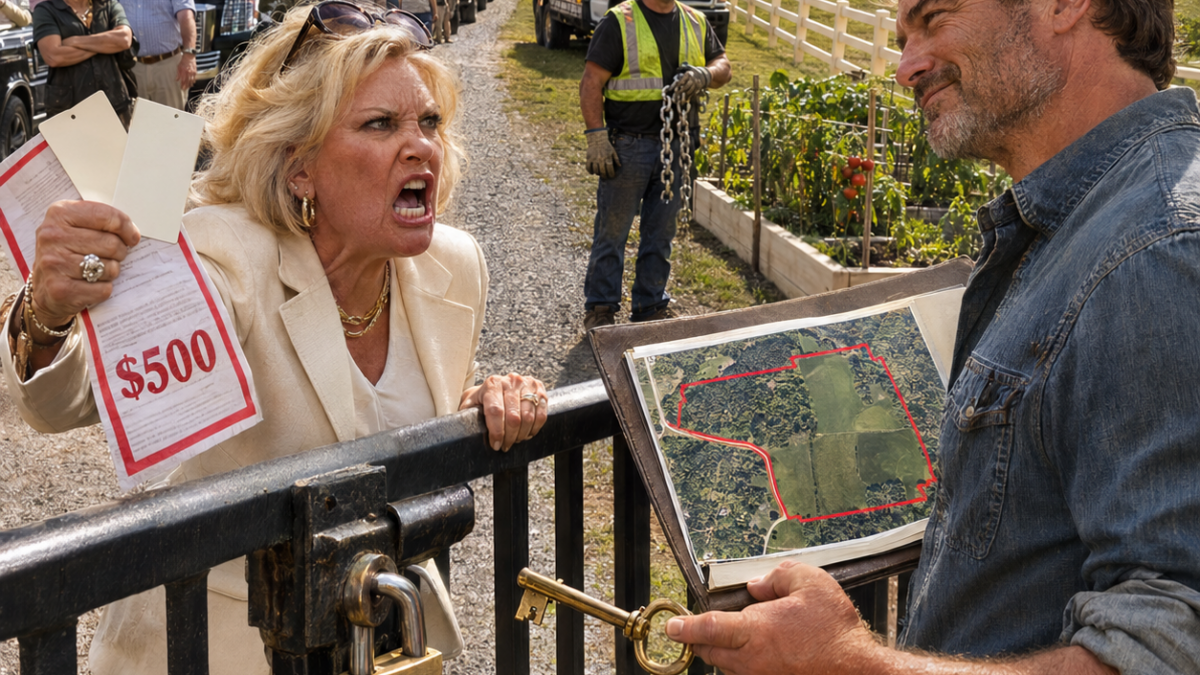
PART2
Paint colors were ridiculous.
Boundary claims were not.
The next morning, I called Delia.
She answered on the second ring.
“Willowbrook Estates, this is Delia.”
“Marcus Thompson.”
There was a pause.
“Oh.”
“You fined property that isn’t in Willowbrook.”
“We’ve already discussed this.”
“No. You talked. I listened.”
Her voice cooled.
“Mr. Thompson, every property affecting our community is expected to maintain certain standards.”
“That isn’t how covenants work.”
“You’re confused about your boundaries.”
That sentence did it.
Not because it offended me.
Because for forty years, people had paid me very good money specifically not to be confused about boundaries.
“What makes you think that?”
“Our survey information.”
“Send it to me.”
“You can review it when we meet.”
“No. Email it.”
“I think an in-person explanation would be easier.”
“For whom?”
Silence.
Then she said:
“I’ll bring our surveyor tomorrow.”
At 9:00 the next morning, Delia arrived with a man named Michael Graves.
Licensed surveyor.
Professional.
Quiet.
Clearly wishing he were somewhere else.
They spent almost two hours near my eastern line.
When Delia finally came to my porch, she looked pleased.
“Good news.”
“Wonderful.”
“Your house itself is outside Willowbrook.”
“I knew that yesterday.”
“But your fence encroaches into an area subject to our community boundary.”
“Show me.”
Her smile disappeared.
“We’re finalizing the documentation.”
“Then you haven’t shown anything.”
“Michael has confirmed—”
Michael looked uncomfortable.
I looked at him.
“Did you?”
He cleared his throat.
“I confirmed that the subdivision boundary and Mr. Thompson’s recorded parcel boundary should be compared against older monuments before any conclusion.”
Delia turned toward him.
“That isn’t what you told me.”
“That is exactly what I told you.”
I almost liked Michael.
Delia closed the folder.
“We’ll follow up.”
“No.”
She stopped.
“I want whatever map you relied on before issuing the fine.”
“You’ll receive it through proper channels.”
She walked back toward the BMW.
That evening, I pulled my deed from the closing file.
The legal description was clean.
But I wanted more.
So the next morning I drove to the county records office.
I arrived when they opened.
By 9:30, I had my 1987 deed.
Historical parcel maps.
Original monuments.
Tax maps.
Willowbrook’s development plat from 2002.
Phase-one and phase-two construction records.
Easements.
Road approvals.
Drainage plans.
Environmental review.
Completion certificates.
I bought coffee from a vending machine that tasted like boiled cardboard and settled in.
My property existed fifteen years before Willowbrook.
No restrictive covenants.
No HOA language.
No annexation.
No mysterious “visual influence” authority.
Willowbrook’s western boundary stopped exactly at mine.
Then I found the trail.
It appeared on a 2003 construction plan.
TEMPORARY CONSTRUCTION ACCESS — WESTBROOK PARCEL.
I leaned closer.
Purpose:
Construction vehicles serving phase two.
Duration:
Eighteen months maximum.
Restoration required upon completion.
Willowbrook phase two received its completion certificate in December 2004.
Meaning the temporary access right had ended approximately twenty years earlier.
I followed the line across the map.
It crossed my eastern land.
Then continued onto a neighboring undeveloped fifty-acre tract known as the Hartwell parcel.
And that was when I realized why the dirt track behind my pasture always seemed unusually worn.
I had seen cars there.
Not many.
Mostly mornings.
One especially familiar silver BMW.
I drove home by the long route and waited.
Next morning:
7:43.
Silver BMW.
Delia.
She came from Willowbrook, turned onto the old construction trail, crossed the rear edge of my land, and continued toward County Road 847.
I watched from my kitchen window.
The woman who had fined me $500 for a vegetable fence had apparently been using private land as her personal twelve-minute shortcut.
I did not march outside.
I did not block her.
I wrote down:
7:43 a.m. — Silver BMW — westbound.
Next day:
7:42.
Next:
7:44.
Next:
7:43.
Consistency.
Engineers appreciate consistency.
I called attorney Sarah Kaye.
Property law.
Real estate litigation.
Recommended by my closing attorney.
Sarah reviewed everything.
Then asked:
“How angry are you?”
“Professionally?”
“No.”
“Very.”
“Then don’t touch the trail yet.”
I stared at her.
“It’s my land.”
“Maybe.”
“Maybe?”
“Your deed says yes.”
“Then why maybe?”
“Because a lawyer who tells you long-term land use can never generate a legal argument is a lawyer you should fire.”
I leaned back.
“So Delia could have a claim?”
“She can make a claim.”
“That wasn’t my question.”
Sarah smiled.
“Now you understand lawyers.”
I did not appreciate that.
She continued.
“Long-term use can create complicated arguments depending on facts, permission, adversity, notice, continuity, and state law. We do this properly.”
“What does properly mean?”
“Independent survey.”
“Title review.”
“Written notice.”
“Then see what she does.”
I hired Calvin Moore.
Surveyor.
Sixty-one.
Sunburned.
Zero patience.
He walked my property for two days.
Used the old monuments.
GPS.
Recorded plat.
Existing markers.
His conclusion was simple.
“My fifteen acres stop where your deed says they stop.”
“The trail?”
“Private.”
“Public right-of-way?”
“No.”
“Permanent easement?”
“No recorded one.”
“Willowbrook?”
“Doesn’t own it.”
“Can I block it?”
“Ask your lawyer.”
Everybody was a comedian.
Sarah drafted the notice.
My property lay outside Willowbrook.
The $500 fine was disputed and rejected.
The temporary construction access had expired.
Continued use across my parcel was unauthorized.
Willowbrook residents should use recorded public access.
We sent it certified.
Delia signed for it.
Twenty-four minutes later, my phone rang.
“You hired a lawyer.”
“Yes.”
“That was unnecessary.”
“You fined me.”
“We could have resolved this civilly.”
“Certified mail was your opening move.”
Silence.
Then:
“You cannot obstruct that route.”
“Show Sarah the permanent easement.”
“Our counsel will.”
“Great.”
The HOA’s attorney responded nine days later.
Six pages.
Historical use.
Reliance.
Prescriptive rights.
Neighborhood access.
Potential nuisance.
No recorded permanent easement.
Sarah read it twice.
“They want to negotiate from the assumption that the route stays open.”
“What do you want?”
“Documentation.”
I liked her.
We installed temporary cameras on my property.
Not hidden on anybody else’s land.
My land.
Signs went up:
PRIVATE PROPERTY — USE BY PERMISSION ONLY PENDING ACCESS REVIEW.
Delia continued driving.
Every weekday.
Same BMW.
Same approximate time.
She had been formally told access was disputed.
She simply acted as if written notice were weather.
Something unpleasant but irrelevant.
Then one afternoon, driving home from the county office, I saw a FOR SALE sign.
HARTWELL TRACT — 50 ACRES.
I slowed.
Stopped.
Backed up.
The Hartwell property bordered my eastern line and wrapped along the old construction route.
I had already seen it on the maps.
Asking price:
$229,000.
The number beneath belonged to Patterson Real Estate.
I called.
“Patterson Real Estate, Jennifer speaking.”
“I’m calling about Hartwell.”
Pause.
“The fifty acres?”
“Yes.”
“You’re interested in building?”
“Maybe.”
Technically, a steel gate was a structure.
Two hours later, Jennifer Patterson walked me across the property.
Hardwoods.
Meadow.
Creek branch.
Hunting paths.
And the old Willowbrook access trail.
She pointed.
“That’s not a legal road.”
“I know.”
“Old construction access.”
“I know.”
She stopped.
“You’ve done homework.”
“Some.”
“The previous owner tolerated occasional neighborhood use.”
“Written agreement?”
“Not that I know of.”
“Any recorded easement?”
“Title company says no permanent one.”
I looked toward Willowbrook.
The rooftops were visible beyond the trees.
Then toward my original acreage.
If I owned Hartwell, every foot of the informal shortcut between Willowbrook and the county road would sit inside land I controlled.
Jennifer watched my face.
“You’re thinking about it.”
“I’ll offer two hundred.”
She blinked.
“Today?”
“Subject to title and survey.”
“Most people walk property twice.”
“I’ve been studying it for two weeks.”
“Why?”
I smiled.
“I’m having a boundary disagreement.”
She stared.
“You’re buying fifty acres because of a boundary disagreement?”
“I’m buying fifty acres because fifty acres of Tennessee land rarely gets cheaper after I’m dead.”
That sounded healthier.
The seller accepted $200,000.
I did not empty my retirement account impulsively.
That part matters.
I spoke with my financial adviser.
Reviewed income.
Taxes.
Insurance.
Maintenance.
Liquidity.
Ellen had spent thirty-eight years telling me not to do stupid things with money.
I had no intention of disrespecting her just because Delia Kramer annoyed me.
The purchase still made sense.
Barely.
Closing took longer than I wanted.
Title search.
Survey.
Environmental review.
Access verification.
Sarah reviewed everything.
Finally, on a Friday afternoon, I signed.
Fifty acres.
Added to my fifteen.
Sixty-five total.
The Hartwell trail was mine.
That evening my phone buzzed.
Unknown number.
Mr. Thompson, this is Delia Kramer. Your ongoing fence violations and interference with established community access have exceeded acceptable limits. Meet me at your property line tomorrow at 8:00 a.m. This ends now.
I showed Sarah.
She laughed.
“What?”
“She has extraordinary timing.”
Saturday.
7:55.
Coffee.
Folder.
Phone.
I stood near the eastern property line.
At 7:58, Delia’s BMW appeared.
She parked.
Out she came in a navy blazer and heels that made no sense on pasture grass.
Michael Graves was with her again.
Poor man.
Delia marched directly toward me.
“Finally.”
“Morning.”
“We are going to resolve your deliberate obstruction of Willowbrook access.”
“You’re standing on my land.”
She stopped.
“No, I’m not.”
I pointed toward Calvin’s survey stake.
“You’re six feet inside.”
Michael checked.
Then quietly stepped backward.
Delia did not.
“This area is under dispute.”
“Not by my deed.”
She opened her briefcase.
Thick legal memorandum.
“Willowbrook’s counsel has concluded that decades of continuous use establish access rights sufficient to prevent unilateral obstruction.”
I flipped through it.
Professional letterhead.
Real lawyer.
Carefully worded.
Not nearly as absolute as Delia sounded.
I pulled out the original 2003 temporary easement.
“Did your lawyer see this?”
Her face changed.
“Of course.”
“Then why did you tell residents this was an HOA road?”
“It has functioned as one.”
“That’s different.”
“Not practically.”
Michael read my certified copy.
Then looked at Delia.
“This specifically says temporary construction access.”
She snapped:
“I know what it says.”
“Expires eighteen months after recording or completion of phase two.”
“I KNOW.”
That was the first honest moment we had shared.
She knew.
Maybe not eight years ago.
But she knew now.
She simply believed convenience could overpower paper.
I added:
“And yesterday I closed on Hartwell.”
Silence.
“What?”
“The fifty acres east of me.”
Her face went blank.
“Why?”
“Land investment.”
“No.”
“You bought Hartwell because of this.”
“Partly.”
“You spent two hundred thousand dollars to spite me?”
“That would be emotionally satisfying but financially irresponsible.”
I took a sip of coffee.
“I bought fifty acres because I wanted fifty acres.”
She stared toward the old trail.
“You can’t close it.”
“Sarah disagrees.”
“You’ll destroy traffic flow.”
“Use Willowbrook’s public entrance.”
“That adds twelve minutes.”
“Then leave twelve minutes earlier.”
Her face turned crimson.
“This isn’t over.”
I believed her.
Monday morning, contractors arrived.
Not a prison wall.
Not barbed wire around sixty-five acres.
That would have been ridiculous.
I hired Fence Right Construction to secure the sections experiencing vehicle trespass.
A commercial steel gate across the old trail.
Agricultural fencing elsewhere.
Cameras at the main access points.
Reflective private-property signs.
Permits where required.
Setbacks verified.
Fire access reviewed.
Calvin rechecked placement.
Bobby Jenkins, Fence Right’s foreman, looked at my documentation and said:
“You expecting a war?”
“No.”
He looked at the eight-foot steel gate.
“Sure.”
Construction began.
At 10:12, Delia arrived.
Naturally.
She parked directly in front of a contractor truck.
“Who authorized this?”
Bobby pointed at me.
“Owner.”
“This violates Willowbrook architectural standards.”
Bobby stared at her.
“Willowbrook own this dirt?”
“The community has legal interests here.”
“That wasn’t my question.”
I liked Bobby too.
Delia called county building inspection.
Then planning.
Then the sheriff’s non-emergency line.
She spent almost two hours making calls.
County staff confirmed permits were in order.
Planning confirmed the route was not a public road.
The deputy who stopped by told her the property dispute was civil unless somebody damaged property or ignored lawful orders.
She left furious.
Tuesday morning, camera alert.
Silver BMW.
Not at the gate.
Across my original fifteen acres.
Delia had driven around the construction and crossed a section of pasture she had never used before.
I watched the video twice.
She had looked directly at a PRIVATE PROPERTY sign.
Then continued.
Sarah sent a cease-and-desist notice.
We extended lawful fencing along the vulnerable boundary.
Wednesday, Delia returned with another surveyor.
Different man.
Different company.
She carried new maps.
“These show Willowbrook’s development control area extends into both parcels.”
The surveyor unfolded the documents.
Compared them against the county plat.
Then Calvin’s pins.
Then my deeds.
His expression changed.
“Ms. Kramer.”
“Yes?”
“These aren’t recorded boundary maps.”
“They’re planning exhibits.”
“You told me they were updated county documents.”
“They reflect county information.”
“That is not the same thing.”
He packed his equipment.
Delia lowered her voice.
“I paid you to establish the historical access.”
“You paid me to survey.”
“Then survey.”
“I did.”
He left.
Thursday, she brought bolt cutters.
That was the moment everything changed.
Bobby called me from the site.
“Your HOA lady is cutting something.”
“She isn’t my HOA lady.”
“Noted.”
I opened the camera feed.
Delia stood at a secondary chain securing a temporary barrier.
Bolt cutters in hand.
I called the sheriff.
Then Sarah.
Then walked outside recording from a safe distance.
“Delia.”
She turned.
“This fence is unlawful.”
“Do you have a court order?”
“I don’t need one to remove an illegal obstruction.”
“You absolutely do not have permission to cut anything on my property.”
She put the cutters around the chain.
“Step back.”
“Deputy’s coming.”
She froze.
Then glared at me.
“You would have me arrested over a chain?”
“I would prefer you put down the bolt cutters.”
Deputy Rodriguez arrived twelve minutes later.
Calm man.
Patient.
He reviewed my survey and Delia’s documents.
Then:
“Ms. Kramer, did you damage anything?”
“No.”
“Were you about to?”
“I was removing an obstruction.”
“Do you own it?”
“The HOA has access rights.”
“Recorded?”
“Our attorney—”
“Do you have a court order?”
“No.”
“Then don’t cut the property owner’s chain.”
She stared at him.
“He is intentionally harming hundreds of families.”
Rodriguez looked at the public road less than a mile away.
“How?”
“He added twelve minutes to our exit.”
Rodriguez paused.
Then:
“Ma’am, inconvenience does not authorize bolt cutters.”
She left.
Friday, she came back with two laborers and a rented moving truck.
That was Delia’s problem.
Every time reality said stop, she interpreted it as a challenge to escalate.
The men unloaded pry bars.
A portable saw.
Shovels.
I used the camera speaker.
“You are on private property. The owner does not consent to removal of any fence or gate. Law enforcement has been notified.”
The first laborer stopped.
“What?”
Delia shouted:
“Ignore him. This is association property.”
The man looked toward my signs.
Then at her.
“You told us it was HOA common land.”
“It is.”
Sarah’s Honda came down my driveway.
She stepped out carrying a legal folder.
The laborer asked:
“You a lawyer?”
“Yes.”
He immediately started putting tools back.
Smartest man there.
The second followed.
Delia became furious.
“You signed a work agreement!”
The first man answered:
“You told us you owned the fence.”
They left.
Delia remained beside the truck.
Sarah approached.
“Your counsel has my number.”
“You people think you can intimidate me.”
“No.”
Sarah looked at the camera.
“I think you’re creating excellent documentation.”
That finally made Delia leave.
I expected the weekend to be quiet.
Instead, Sunday evening Channel 7 aired a short story.
I had not called them.
Neither had Sarah.
Bobby had apparently mentioned the dispute to a cousin, who knew investigative reporter Rita Walsh.
Rita pulled the public records herself.
Court filings.
Expired construction easement.
Police incident number involving the bolt cutters.
Then she contacted me.
“Mr. Thompson, are you willing to comment?”
“Yes.”
“Did you buy fifty acres specifically to stop the HOA president?”
“Partly.”
“Do you hate HOAs?”
“No.”
She looked surprised.
“Why not?”
“Because an organization is only as legitimate as the authority its documents actually give it.”
“That’s not very dramatic.”
“I’m sixty-five.”
“I’ve had enough drama.”
Her story was restrained.
PROPERTY DISPUTE RAISES QUESTIONS ABOUT WILLOWBROOK ACCESS ROUTE
No screaming headline.
No accusations of criminal conspiracy.
But it showed the 2003 easement.
The expiration.
The gate.
Delia’s attempt to remove barriers.
And one clip of her telling Rita:
“Mr. Thompson is weaponizing technicalities against an entire community.”
Technicalities.
That word did enormous damage.
Because Willowbrook residents began asking what other “technicalities” their president considered optional.
My phone started ringing Monday.
First:
Linda Harper.
Retired accountant.
Willowbrook homeowner.
“I’ve been waiting years for somebody to make her produce paperwork.”
“Produce paperwork about what?”
“Everything.”
Linda had served on Willowbrook’s finance committee.
She resigned after repeatedly requesting complete vendor records.
She still had meeting packets.
Approved budgets.
Partial statements.
Emails.
Nothing stolen.
Nothing hacked.
Her own copies.
We met with Sarah.
Linda laid out the first pattern.
Landscaping expenses increasing.
Security contracts inconsistent.
Management reimbursements with limited explanation.
Delia’s legal spending not clearly authorized by recorded board votes.
Sarah kept interrupting.
“This is not proof of theft.”
Linda nodded.
“I know.”
“This is not proof of fraud.”
“I know.”
“Good.”
Linda smiled.
“That’s why I brought numbers instead of accusations.”
I liked her too.
Then another homeowner called.
Then six.
Selective enforcement.
Election proxies.
Unexplained special assessments.
Friends receiving exceptions.
Critics receiving fines.
Again:
Some were ordinary HOA disputes.
Not crimes.
We separated them.
Outrage was useful for getting people to look.
Evidence was what mattered after they did.
Willowbrook members petitioned for a special meeting under their bylaws.
Delia attempted to reject signatures.
Residents collected more.
She delayed records.
They hired independent counsel.
Then a forensic accountant.
That was when the real trouble started.
Not for the HOA.
For Delia.
The association’s attorney discovered that Delia had used general presidential authority to direct legal spending over my property without a specific board vote.
Approximately $18,000.
Not automatically theft.
But questionable.
Then vendor records arrived.
Landscaping invoices.
One company had billed Willowbrook unusually high maintenance charges during months crews were photographed working at Delia’s private house.
The owner of that landscaping company was connected socially to one of Delia’s closest board allies.
Security invoices showed association billing for equipment that did not appear on common property.
Some equipment was installed at private homes.
Delia’s included.
Waste-management records showed discounts given to board-connected households while the association paid higher contract prices.
Still, Sarah cautioned me:
“Conflict of interest is not always criminal.”
“I know.”
“Bad governance is not always fraud.”
“I know.”
“Are you learning?”
“No.”
The independent audit expanded.
It took months.
That part matters.
Real justice is slow because somebody has to prove things.
Bank statements.
Checks.
Contracts.
Authorizations.
Vendor confirmations.
Deposits.
Emails.
Meeting minutes.
Proxy forms.
One by one, the assumptions became findings.
Roughly $400,000 in questionable or inadequately supported transactions over several years.
Some legitimate but badly documented.
Some approved improperly.
Some related-party arrangements residents had never been told about.
A smaller group looked much worse.
Payments routed to consulting entities associated with people close to Delia.
Services billed but not verifiably performed.
Association-paid work providing private benefit.
Proxy ballots submitted in elections bearing names of people who no longer owned property in Willowbrook.
That triggered referrals beyond the HOA.
County investigators.
State nonprofit regulators.
Tax authorities where relevant.
The district attorney’s office.
Nobody dissolved Willowbrook overnight.
Nobody invalidated every fine Delia had ever issued with a magic stamp.
Instead, the board suspended her spending authority.
Then members held a formal recall vote.
Delia fought it.
Of course she did.
She mailed a letter to every homeowner.
WILLOWBROOK UNDER ATTACK.
She blamed me.
Outsiders.
Disgruntled former volunteers.
Political enemies.
A “small faction seeking chaos.”
At the recall meeting, she stood behind the podium and said:
“I have dedicated eight years of my life to protecting this community from declining standards.”
Linda answered:
“We asked where the money went.”
Delia said:
“You don’t understand sophisticated association management.”
Linda was a CPA for thirty-two years.
That went badly.
Residents voted.
Paper ballots.
Independent count.
Delia was removed from the board.
When the result was announced, she did not cry.
She stared directly at me.
“You did this.”
I was sitting near the back.
I shook my head.
“No.”
She looked furious.
I pointed toward the residents.
“They did.”
That distinction mattered.
Willowbrook belonged to them.
Not me.
Not Delia.
Them.
The criminal investigation continued separately.
My own civil dispute moved forward.
Sarah filed for declaratory relief concerning my property.
Willowbrook’s temporary board changed strategy immediately.
They acknowledged the original 2003 easement had expired.
Recognized my parcels were outside the HOA declaration.
Agreed not to interfere with the gate.
Withdrew the $500 fence violation.
Then the $2,500 access fine Delia had later attempted.
They reimbursed documented damage and negotiated part of my legal costs.
My ridiculous vegetable fence remained galvanized steel.
Not Cream Dream.
That alone almost justified the entire adventure.
The investigation into Delia took nearly a year.
She eventually faced charges tied to specific transactions investigators believed they could prove.
Misappropriation of association funds.
False financial records.
Property damage connected to the fence dispute.
Other counts were considered and rejected.
That was appropriate.
Prosecutors are not revenge departments.
They do not exist to charge every rumor because somebody is unpopular.
Some of the wildest neighborhood claims never became charges.
Good.
The proven conduct was enough.
Delia ultimately entered a plea on multiple counts.
Restitution.
Financial penalties.
A custodial sentence on the most serious offense.
Followed by supervision.
And civil restrictions connected to the association’s claims and settlement.
The sentence was not fifty years.
No federal helicopter landed.
No judge called her a suburban dictator.
Reality did not need decoration.
A woman who had spent years using HOA letters to frighten residents stood in court and heard a judge explain that fiduciary authority belonged to the organization, not to her personally.
That was satisfying enough.
I attended one hearing.
Sarah asked why.
“I want to see it finish.”
Delia sat at counsel table.
No pearls.
No clipboard.
Hair still perfect.
She looked older.
For the first time, I wondered whether any of this had ever made her happy.
Control.
Winning meetings.
Fines.
People avoiding her at the mailbox.
What kind of victory had that been?
The judge asked whether victims wished to speak.
Linda did.
Two residents did.
I did not.
I had nothing Delia needed to hear.
My gate already said it.
No.
Afterward, Rita Walsh caught me outside.
“How does it feel?”
“Quiet.”
“That’s all?”
I thought about it.
“The goal was never to get her incarcerated.”
“What was the goal?”
“To stop her driving through my land.”
Rita laughed.
“You bought fifty acres.”
“Worked, didn’t it?”
Six months later, something happened I had not expected.
Willowbrook’s new board asked to meet.
The president was Robert Hayes.
Middle-school principal.
Patient man.
The board had finally addressed the legitimate reason residents liked Delia’s shortcut.
Morning traffic.
Willowbrook’s north entrance created a twelve-minute delay during peak periods.
Instead of pretending that inconvenience entitled them to my land, they approached the county.
Traffic study.
Turning-lane design.
Signal improvements.
Road widening.
Actual engineering.
I almost became emotional.
Then Robert put another proposal on my table.
“We’d like to discuss emergency access.”
I raised an eyebrow.
“Through my land.”
“Yes.”
“No daily resident traffic.”
“No.”
“Fire and medical only?”
“Yes.”
“Surveyed?”
“Yes.”
“Recorded agreement?”
“Yes.”
“Insurance?”
“Yes.”
“Maintenance?”
“Willowbrook.”
“Termination language?”
“Your lawyer can write it.”
I looked at him.
“You’re asking.”
“Yes.”
“Strange strategy.”
“I’ve heard it works.”
I laughed.
We negotiated.
That word Delia never seemed to understand.
The final agreement allowed a locked emergency-access route across a small edge of the fifty-acre tract.
Fire department keys.
No resident remotes.
No country-club shortcut.
Willowbrook offered annual lease payments.
I declined personal payment.
Instead, I asked the board to contribute an equivalent amount to a scholarship fund administered through a local community foundation.
Engineering.
Surveying.
Law.
Public administration.
Kids who understood that boring documents can prevent expensive disasters.
The first scholarships were modest.
Books.
Fees.
A few thousand dollars.
Then residents donated.
Local companies matched.
The fund grew.
The first engineering recipient was Maria Gonzalez.
At the award dinner, she shook my hand.
“So you’re the crazy fence guy.”
“Retired civil engineer.”
“Same thing.”
“Who told you?”
“Everybody.”
She wanted to study stormwater engineering.
I nearly cried.
That is what retirement does to a man.
The Hartwell property changed too.
I had bought it angry.
At first, every acre felt like a weapon.
That started bothering me.
Ellen would have hated it.
She loved land because land grew things.
Not because it blocked BMWs.
So I contacted conservation groups.
County educators.
Willowbrook’s new board.
We created a plan that still protected my ownership.
Twenty acres along the creek went under conservation restrictions.
Fifteen became community gardens under a lease.
Ten included walking trails and an outdoor education area used by local schools.
Five around the access corridors remained private and secured.
The cameras that once watched for Delia began catching deer.
Wild turkeys.
Coyotes.
One extremely stupid raccoon that repeatedly climbed the same signpost.
I saved those recordings.
Much better television.
At the grand opening of the garden, I stood on the hill where I had first toured Hartwell.
Children ran between raised beds.
Parents carried seedlings.
Maria showed a group of middle-school students how water followed contour lines.
Robert burned hamburgers.
Linda complained about his accounting for hamburger buns.
Normal community.
Rita returned for a follow-up story.
She asked:
“Did you ever imagine this when you bought the property?”
“No.”
“What did you imagine?”
“A gate.”
“That’s it?”
“A very satisfying gate.”
She laughed.
Then:
“What changed?”
I looked across the fields.
“Anger is a useful construction material.”
She waited.
“But it’s terrible architecture.”
That became the quote she used.
I still hate that.
It sounds like something printed on office wall art.
One year after Delia’s sentencing, I was sitting on my porch at 7:43 a.m.
My phone buzzed.
Gate camera.
For one stupid second, my body expected the BMW.
Instead, Maria stood there wearing a hard hat and holding a cardboard sign toward the camera.
FENCE COLOR VIOLATION.
I laughed so hard coffee came out my nose.
I opened the gate remotely.
She drove up.
Two coffees.
“Morning.”
“You’re banned.”
“You opened the gate.”
“Administrative error.”
She sat.
The old access trail behind her was disappearing.
Grass had reclaimed the tire ruts.
Young saplings grew near the old construction shoulder.
Nature had less patience for entitlement than courts did.
Maria asked:
“Do you regret buying it?”
“The coffee?”
“The fifty acres.”
I looked toward the creek.
“No.”
“Because Delia lost?”
“No.”
That surprised her.
“Then why?”
“Because eventually I stopped using the land to fight somebody.”
I took another sip.
“And started letting it become something.”
That was the real ending.
Not Delia’s sentence.
Not the gate.
Not even the $500 fine disappearing.
I had moved to Tennessee because Ellen and I had once imagined growing old somewhere quiet.
When she died, I told everyone I was moving because I needed a fresh start.
Truth?
I was running from a house full of memories.
Then Delia arrived.
For almost a year, anger gave me a reason to wake up organized.
County records.
Surveys.
Lawyers.
Contractors.
Cameras.
Meetings.
I told myself I was fighting for property rights.
I was.
But I was also avoiding grief.
That became obvious after everything ended.
One Monday morning, no lawyer called.
No camera alert.
No court date.
No contractor.
No Delia.
I sat in my kitchen and did not know what to do.
Sarah called around noon.
“You sound depressed.”
“I’m retired.”
“Same thing?”
“Apparently.”
“What are you doing today?”
“Nothing.”
“Bad answer.”
“You’re my lawyer, not therapist.”
“I billed enough to become both.”
She told me to find something bigger than the dispute.
That conversation led to the land project.
Then scholarships.
Then volunteering with a watershed group.
Then helping the county review drainage concepts for a school nature trail.
No pay.
I complained constantly.
I loved it.
Ellen had always said I would fail retirement.
Correct again.
The new Willowbrook HOA survived.
Some residents wanted to dissolve it entirely after Delia.
They voted not to.
Instead, they rewrote controls.
Independent financial review.
Conflict-of-interest disclosures.
Competitive bids above thresholds.
Open meeting minutes.
Proxy verification.
Two signatures for major disbursements.
Appeal panels that did not include the person issuing the original violation.
Term limits.
Boring safeguards.
The best kind.
HOAs were never the enemy.
Unaccountable people were.
That lesson mattered.
Years later, when Willowbrook asked me to speak at a homeowner meeting about the dispute, I agreed on one condition.
“No anti-HOA speech.”
Robert looked confused.
“You’re the guy who spent two hundred grand fighting our HOA.”
“I fought Delia.”
“Same thing at the time.”
“No.”
I pointed toward the room.
“You people are the HOA.”
That distinction became part of my short speech.
“Authority is not automatically abuse.”
“Rules are not automatically oppression.”
“But authority should always be traceable to a document.”
“Rules should be enforced through procedures.”
“And if somebody says they own a right over your property, ask them to prove it before you surrender it.”
Linda called from the second row:
“And never approve Cream Dream.”
Everyone laughed.
Including me.
The original vegetable fence lasted another seven years.
Deer bent one corner.
I repaired it.
Then eventually replaced it with black welded wire.
Not white.
No decorative caps.
Robert sent me a mock violation notice.
FINE: ONE APPLE PIE
I paid.
Homemade.
Excellent.
One afternoon my granddaughter Emma visited.
She was twelve.
We walked down to the emergency gate.
She had heard the story from her father.
Naturally, his version included exaggerations.
“So this is the two-hundred-thousand-dollar gate?”
“No.”
She looked around.
“You bought the land.”
“Yes.”
“For two hundred thousand.”
“Yes.”
“To build the gate.”
“Partly.”
“So it’s a two-hundred-thousand-dollar gate.”
“That is poor accounting.”
She grinned.
“You’re sensitive.”
I pointed toward the community gardens.
“What about those?”
“Gate accessories.”
Children are cruel.
We walked toward the creek.
Emma asked:
“Was Delia evil?”
That stopped me.
“No.”
She looked disappointed.
“But she stole money.”
“She misused money and was convicted of crimes.”
“She tried to cut your fence.”
“Yes.”
“She sounds evil.”
“She made bad decisions for a long time.”
“That’s the same thing.”
“Not always.”
She kicked a stone.
“Did you forgive her?”
I thought about it.
“I stopped needing anything from her.”
“That’s not forgiveness.”
“No.”
“Then what is it?”
“Freedom.”
She considered that.
At twelve, probably too young.
At sixty-five, it had taken me too long.
The truth was, I never needed Delia to apologize.
Never needed her to admit the easement was expired.
The recorded document did that.
Never needed her to agree that my property was outside Willowbrook.
The plat did that.
Never needed her to confess every financial problem.
Bank records did that.
Never needed her to believe the gate was lawful.
The permits and court did that.
Evidence is liberating because it does not require cooperation from the person denying it.
That was something forty years of engineering had taught me before I understood it emotionally.
A bridge does not care whether somebody “feels” overloaded.
Stress is stress.
A pipe does not care whether somebody believes the pressure is too high.
Pressure is pressure.
A boundary does not disappear because somebody finds it inconvenient.
And authority does not expand because somebody says the word community loudly enough.
The most satisfying moment came much later.
Not in court.
Not at the gate.
During a wildfire season, a brush fire started several miles away.
One of Willowbrook’s main streets was temporarily blocked by emergency equipment.
The fire department used our recorded emergency gate.
One engine.
Then another.
They unlocked it.
Crossed.
Closed it.
The agreement worked exactly as designed.
Afterward Robert called.
“Thank you.”
“For what?”
“The emergency route saved time.”
“That’s why it exists.”
He paused.
“Delia always said the shortcut was about community safety.”
“Sometimes she was right about the problem.”
“What?”
“She was wrong about the solution.”
Silence.
Then:
“That’s annoyingly fair.”
Community access could matter.
Traffic could matter.
Emergency routes could matter.
None of those concerns gave Delia the right to take land without permission.
The legitimate solution had existed the entire time.
Ask.
Negotiate.
Document.
Compensate.
Respect no.
That was all.
The scholarship fund eventually supported four students a year.
Maria graduated.
Civil engineering.
Joined a consulting firm.
She emailed me photographs from her first stormwater project.
James Patterson—the second early recipient—went to law school.
Later interned with Sarah.
Then joined a property practice.
Sarah complained he asked too many questions.
I told her:
“That’s what you people deserve.”
The community gardens donated produce to a food pantry.
The wildlife tract attracted birders.
One school built a small weather station near the education center.
The same fifty acres I once imagined as a weapon became something Ellen would have understood.
That mattered more than I expected.
I built a bench by the creek.
Small brass plate:
ELLEN’S VIEW.
No dates.
No long inscription.
The first time my daughter saw it, she cried.
Then sat.
“She would like this.”
“She’d complain I placed it crooked.”
My daughter looked at the bench.
“Dad.”
“What?”
“It is crooked.”
I checked with a level.
She was right.
Humiliating.
We fixed it.
Years passed.
Delia eventually completed her sentence and moved away.
Florida, according to Rita.
I never verified.
Did not care enough.
That was another victory.
For months, Delia had occupied my thoughts.
What was she doing?
Planning?
Calling lawyers?
Would she trespass?
Would she send another notice?
Then one day I realized I had gone almost a month without thinking about her.
That felt better than the gate.
People sometimes asked:
“If you could do it again, would you still buy the fifty acres?”
Yes.
But not for the reason they expected.
If the land had been worthless, buying it purely to hurt Delia would have been foolish.
If it endangered my finances, it would have been reckless.
If Sarah had told me blocking access was unlawful, I would have listened.
The satisfaction came because the facts happened to align.
Clear title.
No recorded permanent right.
Reasonable financial position.
Useful land.
Valid reason to preserve it.
The revenge story was entertaining.
The real story was better.
A man learned where his land ended.
A woman learned where her authority ended.
Residents learned their HOA belonged to them.
And an abandoned construction trail finally stopped pretending to be something it had never legally become.
One morning, many years after it started, I found the original violation notice while cleaning my office.
$500.
Unauthorized fence.
Approved color: Cream Dream.
I sat at the desk laughing.
Ellen’s photograph was beside me.
“Can you believe this?”
No answer.
Naturally.
I looked at the handwriting again.
The whole thing started because Delia thought a ridiculous fine would scare me into obedience.
For years afterward people told the story as though I had been waiting my whole career to destroy an HOA president.
I had not.
I wanted tomatoes.
That was it.
Tomatoes.
Deer.
Coffee.
Quiet.
Delia brought herself into the story.
She could have walked away at almost any stage.
When I said the land was outside Willowbrook.
When the surveyor hesitated.
When the county records showed the temporary easement.
When Sarah sent formal notice.
When the gate went up.
When Deputy Rodriguez told her not to damage property.
When residents requested financial transparency.
Every escalation was a choice.
That is why the ending belonged to her too.
Consequences were not something I did to Delia.
They were the accumulated cost of decisions she refused to stop making.
That distinction is important.
Revenge says:
I will make you suffer because I am angry.
Accountability says:
I will stop protecting you from what your own actions created.
I learned to prefer the second.
My granddaughter once asked what I would tell Delia if I saw her again.
I answered without thinking.
“Use the main road.”
Emma laughed.
But I meant it.
The main road was public.
Lawful.
Shared.
Designed for everybody.
The shortcut existed only because people spent years assuming that if something was convenient and nobody objected, it must somehow belong to them.
There are a lot of things in life like that.
Land.
Time.
Labor.
Silence.
Patience.
People mistake tolerance for permission.
Then become outraged when the person tolerating them finally says enough.
The steel gate is still there.
Older now.
Paint slightly faded.
Camera upgraded twice.
Private-property sign weathered.
The trail behind it has almost vanished beneath grass.
At 7:43 most mornings, nothing happens.
Occasionally a deer crosses.
A turkey.
One of the school volunteers.
No horn.
No BMW.
No woman shouting that the HOA owns a road it never owned.
Just quiet.
The quiet I had moved to Tennessee hoping to find.
Funny thing about peace.
Sometimes you discover it waiting for you.
Sometimes you have to defend the boundary around it first.
And sometimes, after the fight ends, you have to be wise enough to stop staring at the gate and turn around to see everything growing behind you.
That was the part Delia never understood.
She thought power meant controlling what other people could do.
The older I got, the more I realized real power was simpler.
Knowing what belonged to you.
Knowing what did not.
Having the courage to protect the first.
And enough decency to leave the second alone.
Delia Kramer spent eight years driving across somebody else’s land because nobody had made her stop.
Then she fined me $500 for the wrong shade of white and accidentally gave a retired civil engineer a reason to open forty years of county records.
The old temporary easement told the truth.
The surveys told the truth.
The cameras told the truth.
The invoices told the truth.
The homeowners eventually told the truth.
And after all the lawyers, gates, meetings, audits, court filings, elections, and consequences were over, there was really only one lesson left.
A title does not make you the owner of everything around you.
A clipboard does not make a false claim true.
A long habit does not automatically turn convenience into entitlement.
And when somebody calmly asks you to show them the document that gives you authority—
you had better hope that document actually exists.
Because Delia’s didn’t.
Mine did.
And that was the difference between her standing at my steel gate screaming that she owned the road—
and me taking one slow sip of coffee, looking at the recorded boundary behind her, and saying the sentence she had spent eight years assuming nobody would ever have the courage to say:
“No, Delia.
You don’t.”








