PART2:“OPEN EVERY BARN NOW, YOU BROKE FARMER—OR I’LL HAVE MY MEN CUT THE LOCKS!” HOA Karen Raided My Christmas Tree Farm—She Had No Idea the ‘Farmer’ She Was Threatening Was FB!
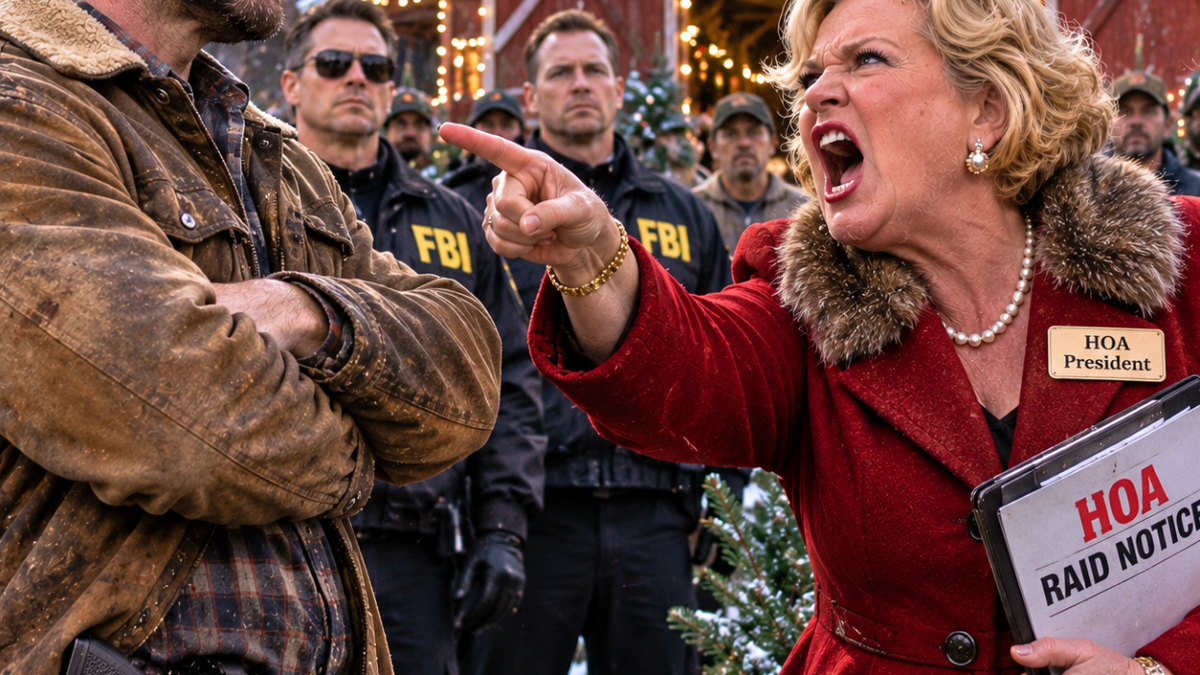
PART2
My name is Nolan Mercer.
I was forty-three years old that winter, and if you had asked almost anyone in Frostmere, Vermont, what I did for a living, half would have told you I grew Christmas trees.
They weren’t wrong.
They just didn’t have the whole answer.
Ten years earlier, my uncle Russell Mercer died and left me a 187-acre farm just outside Silver Pine Estates.
Russell had spent more than four decades on that land.
He was stubborn, private, generous when he trusted you, and almost impossible to convince that anything should be thrown away.
The farmhouse had drawers full of screws separated by size.
The machine shed contained engine parts older than I was.
The north field had an irrigation system Russell had repaired so many times that no two sections of pipe seemed to come from the same manufacturer.
When I inherited it, the place was tired.
Fence lines sagged.
The barn foundation had settled badly.
The internal roads turned to mud every spring.
A section of the irrigation line leaked constantly.
Financially, selling would have been easier.
I didn’t.
I spent weekends there.
Then vacation days.
Then most of the savings I had carefully accumulated.
I rebuilt the North Barn on a new foundation.
I graded roads.
Laid drainage.
Replaced water lines.
Restored fences.
Planted balsam and Fraser fir.
Year by year, the farm came back.
It also became the one place where my other life did not follow me.
On weekdays, I was a special agent with the Federal Bureau of Investigation assigned to financial crimes.
That job involved shell companies.
Wire transfers.
Bank records.
Corporate structures.
Fraud schemes designed by people who believed complexity could hide intent.
Most investigations were not dramatic.
No kicking doors.
No rooftop chases.
No cinematic arrests.
Mostly records.
Long hours.
Spreadsheets.
Emails.
Interviews.
Following money that had been deliberately moved through enough accounts to make an honest person give up.
The farm gave me silence.
Trees did not lie.
Snow did not falsify invoices.
A split irrigation line was a split irrigation line.
Repair it correctly and the problem stopped.
I liked that.
Silver Pine Estates sat beyond my southeastern boundary.
It was the most expensive gated residential community in the county.
Stone entrance pillars.
Large homes.
Landscaped medians.
Private clubhouse.
Lake views.
Everything polished.
Everything coordinated.
My farm had been there long before Silver Pine.
The deed was separate.
The chain of title went back generations.
No HOA covenant touched the Mercer property.
That had never been complicated.
Not until Verity Blackthorn decided it was.
Our trouble started three years before the morning she arrived with SUVs.
She came to my Christmas tree stand one afternoon in October.
No security.
No clipboard.
Just Verity in a dark coat and heels that sank slightly into the gravel.
“Mr. Mercer.”
“Yes?”
“I’m Verity Blackthorn. Silver Pine HOA president.”
“I know who you are.”
She smiled.
“I’d like to discuss a land purchase.”
That surprised me.
“What land?”
She showed me a map.
Thirty-four acres along the shore of the lake.
The tract included a natural drainage swale.
It also contained the only internal farm road wide enough for heavy trucks to reach the North Barn.
Her offer:
$190,000.
I looked at her.
“Why does Silver Pine want it?”
“Future green space.”
“What kind?”
“Community enhancement.”
That phrase meant absolutely nothing.
I folded the map.
“No.”
She blinked.
“You haven’t considered the price.”
“I know what the land does.”
“What does that mean?”
“It keeps spring runoff moving where it belongs, and that road is essential to my farm.”
“We can negotiate access.”
“No.”
Her smile thinned.
“You might want to speak with a financial adviser.”
“I have one.”
“Then he should explain that undeveloped land isn’t worth sentimental attachment.”
“It isn’t sentimental.”
I handed back the map.
“It’s functional.”
She left.
Two months later, the first HOA fine arrived.
$2,500.
Fence design violation.
I laughed.
Then checked my deed.
Exactly what I remembered.
No HOA.
I ignored it.
Next came:
$4,000 — EXCESSIVE HOLIDAY LIGHTING.
Then:
$7,500 — IMPROPER COMMERCIAL EQUIPMENT PARKING.
They cited Silver Pine bylaws as if my farm were a house inside their gates.
I brought everything to Mara Ellison.
Mara was thirty-nine then, a real-estate attorney with an office over the hardware store downtown.
She examined my deed.
Plat maps.
Recorded covenants.
Easements.
Subdivision history.
Then she looked at me.
“You’re not in Silver Pine.”
“I know.”
“They know too.”
“That part I wasn’t sure about.”
“They should.”
She tapped the documents.
“There is no plausible reading of these records that puts your farm inside their association.”
“What do I do?”
“Keep everything.”
“That’s it?”
“And never sign anything.”
“What kind of thing?”
“Anything they send.”
Mara paused.
“Especially anything containing the word access.”
At the time, I thought that was oddly specific.
Then I began noticing the letters.
Buried beneath complaints about tractors, tree-sale traffic, lighting, fertilizers, or “visual nuisance,” the same request kept appearing.
Silver Pine wanted access to the North Barn.
For inspection.
For safety review.
For drainage evaluation.
For environmental compliance.
Different excuses.
Same building.
That bothered me.
Because the North Barn had its own history.
For three years, I had leased part of it to a regional logistics company called Ironvale Freight Solutions.
The arrangement was legal and boring.
They stored equipment.
Boxes.
Business records.
Nothing that interested me.
Then, without warning, Ironvale ended the lease early.
Their trucks came one evening.
Workers loaded most of their material.
By morning, they were gone.
A few old pallets and filing cartons remained.
I notified them several times.
No one collected them.
Eventually I shoved the forgotten boxes into an old interior storage room and stopped thinking about them.
Until Verity became obsessed with entering the barn.
The night after the SUV confrontation, my phone woke me at 2:17 a.m.
Motion alert.
North Barn camera.
I opened the feed.
A white box truck sat on the county road near my rear fence.
Headlights dark.
Engine running.
Faded lettering on the side:
HARTWELL SITE SERVICES
Hartwell handled landscaping, snow removal, and maintenance for Silver Pine.
The truck remained eleven minutes.
Then drove away.
I saved the footage.
The next morning, Verity called an emergency HOA meeting.
Paul Avery, a retired engineer who lived inside Silver Pine, later told me she arrived with an entire slideshow.
Photographs of my tractor.
Fertilizer drums.
A rusted implement near the shed.
The barn.
She told residents that I had obstructed a lawful safety inspection.
She said hazardous chemicals might be stored near their homes.
She implied my FB! credentials might not even be genuine.
I attended.
Not as an agent.
I left my badge locked in my truck.
I wore my canvas farm jacket.
When Verity spotted me, she smiled.
“Well. Our neighbor decided to join us.”
I stood near the back.
“I was invited.”
She looked at the room.
“Then perhaps Mr. Mercer can finally explain why one man believes he is above the standards protecting every family here.”
A few people murmured.
Paul raised his hand.
“Verity, is his property actually within Silver Pine?”
She stiffened.
“The farm directly affects Silver Pine.”
“That’s different.”
“The distinction is legalistic.”
Paul frowned.
“It’s a property boundary.”
I walked forward.
Placed the county plat on a table.
Then my deed.
“My parcel predates Silver Pine.”
Verity rolled her eyes.
“Here we go.”
“The land has never been subject to your covenants.”
“Your lawyer’s interpretation.”
“No. The county record.”
“You expect eighty families to accept whatever document you put on a table?”
“I expect you to show a different recorded document if you believe mine is wrong.”
She ignored that.
Instead, she turned toward everyone.
“Look at him.”
Her voice became almost theatrical.
“He flashes a federal badge at private citizens and now believes nobody can question what he does on land directly beside our homes.”
I felt anger.
I controlled it.
“My badge has nothing to do with this.”
“Convenient.”
“I will allow any inspection performed by a government agency with lawful authority.”
Verity smiled.
“Then allow ours.”
“You’re not a government agency.”
Her expression changed.
Forty-eight hours.
That was the ultimatum.
Give Silver Pine full access to the farm or face a lawsuit so expensive, she said, I would eventually beg to sell.
Mara called me that afternoon.
“Now we know why she held the meeting.”
“Why?”
“They filed a county environmental complaint.”
Silver Pine alleged that my drainage system was sending contaminated runoff toward the development.
A county complaint could result in an actual inspection.
That didn’t bother me.
I called the county myself.
“I want you to inspect everything.”
The environmental officer sounded surprised.
“You’re the property owner?”
“Yes.”
“You understand the complaint alleges fertilizer runoff?”
“Yes.”
“And you’re inviting us?”
“Test the water. Soil. Culverts. Swales. Whatever you need.”
That was simple.
Real authority?
Come in.
Private HOA inventing authority?
No.
Then I made another call.
Graham Voss.
My supervisory special agent.
Graham was fifty-one, calm, relentless, and had spent most of his career in financial investigations.
The case our team had been working for fourteen months involved a web of consulting fees, real-estate payments, shell entities, and suspicious wire transfers totaling approximately $18.6 million.
I told him about Verity.
The North Barn.
Hartwell’s truck.
Then I mentioned Ironvale Freight Solutions.
There was silence.
Keyboard clicking.
“Nolan.”
“What?”
“Spell that company.”
I did.
More typing.
Then his voice changed.
“Ironvale appears in our case.”
I sat completely still.
“What?”
“Multiple wire transfers.”
“To whom?”
“I’m not discussing the whole file over an unsecured call.”
“Understood.”
“Did your team know they leased space from me?”
“No.”
“Did you know about the barn?”
“No.”
“Then I need to formally document this connection.”
“Yes.”
I made it clear that I was reporting a potential lead.
Not requesting federal help with an HOA fight.
That distinction mattered.
I was the property owner in one situation and a federal agent in another.
If the two intersected, they needed to intersect cleanly.
Verity escalated before her forty-eight-hour deadline expired.
A Boston law firm delivered an emergency motion asking the county court to order access to my property.
The claim rested on an alleged shared drainage corridor.
Attached was an old engineering map.
Yellow edges.
Faded lines.
And a dotted corridor running from Silver Pine, across my farm, past the North Barn, toward the lake.
If valid, it could create access rights.
Mara studied it.
“I’ve never seen this.”
“Neither have I.”
She went to the county records office.
Hours later she called.
“The official version doesn’t have the corridor.”
I drove in.
We placed the HOA exhibit beside the county copy.
Same base map.
Same roads.
Same engineering notations.
Except the county version had no dotted line crossing my land.
Someone had added it to the version used by Silver Pine.
“Could it be an old proposal?” I asked.
“Yes.”
“Would that matter?”
“Not unless Russell granted an easement and it was legally created.”
She searched deeper.
Chain of title.
Planning minutes.
Utility approvals.
Drainage plans.
Nothing.
Then she found the 1998 county approval for Silver Pine’s stormwater system.
The language was clear.
Silver Pine drainage would connect to the public drainage main along the eastern road.
It specifically did not cross adjoining private parcels.
Their own original approval undermined their claim.
Verity responded by attacking my business.
One morning, bright orange signs appeared beside my entrance.
RESTRICTED SAFETY ZONE
AUTHORIZED PERSONNEL ONLY
They were placed just outside my property line on association-controlled shoulder.
Technically clever.
Practically devastating.
Customers believed the farm was closed.
Two restaurants canceled wholesale orders.
A church canceled its annual tree delivery.
Sales dropped nearly in half during the most important weeks of the season.
I photographed every sign.
Saved every cancellation.
Printed past years’ sales numbers.
Mara filed for a temporary restraining order.
The judge ordered both sides to produce original documents.
That was when the next surprise arrived.
CONSENT TO ACCESS AND MAINTENANCE
Permanent entry to the North Barn and lakeshore corridor.
Signature:
Russell Mercer.
Date:
March 14, 2016.
I stared at the page.
My uncle had been hospitalized in Boston on March 14, 2016.
He never returned to Vermont.
I went into the farmhouse attic.
Dragged down his steel filing cabinet.
Russell kept everything.
Tax forms.
Equipment contracts.
Christmas cards.
Bank slips.
Old hunting licenses.
I found genuine signatures.
His R pressed hard.
Long loop at the end.
Distinctive tail beneath the surname.
The signature on Silver Pine’s consent form looked wrong.
But “looks wrong” is not evidence.
I knew that better than most.
Mara requested the original document for examination.
She also contacted the notary named beneath the signature.
Two days later, the notary’s office replied.
The registration number on Silver Pine’s document did not correspond to any journal entry in 2016.
No record showed Russell Mercer appearing before that notary.
Meanwhile, Graham’s investigation followed Ironvale.
The money led to Lakecrest Development Partners.
Lakecrest was planning a luxury resort on the northern shore of Frostmere Lake.
Estimated project value:
$42 million.
Then I saw the proposed access route.
It crossed the exact thirty-four acres Verity had tried to buy from me three years earlier.
It continued past the North Barn.
Then connected toward the county highway.
The flattest route.
The cheapest route.
The route across my farm.
Engineers estimated that securing that corridor could save the development somewhere between $6 million and $9 million.
The barn wasn’t the prize.
The land was.
Then the bank materials appeared.
Lakecrest had represented to lenders that legal access already existed across the neighboring parcel.
The cover letter supporting that representation carried Verity Blackthorn’s name.
I stared at it.
She had promised something she didn’t own.
Three days later, an anonymous manila envelope appeared in my mailbox.
Inside:
Silver Pine internal budget report.
One line circled red.
SPECIAL ACCESS RESOLUTION — $480,000.
Authorized by Verity.
Recipient:
Northgate Advisory Group.
I had never heard of Northgate.
Neither had most Silver Pine residents.
It wasn’t listed on the public vendor reports.
No engineering license.
No survey role.
No obvious legal function.
Nearly half a million dollars had disappeared into a company nobody had been told about.
Then the snowstorm arrived.
Fourteen inches.
State emergency.
Roads buried.
Verity sent another email.
Because of emergency conditions, all internal Mercer Farm roads were supposedly required to remain open for HOA vehicles and contractors.
Another invented power.
I called county emergency management.
They had requested nothing.
“If we need access through your property,” the duty officer told me, “we’ll contact you directly.”
I locked the gate.
That night, 11:40 p.m.
North Barn motion alert.
Two men moving through the snow.
Dark clothing.
Duffel bag.
One crouched near the rear padlock.
I wanted to go down there.
Every instinct as a property owner told me to confront them.
My training said no.
Distance.
Observation.
Call local law enforcement.
I dialed the sheriff.
Kept the cameras recording.
Watched from an upstairs window.
Blue and red lights appeared along the county road.
The men ran.
A pickup waited nearby with lights off.
They escaped.
But they left the duffel.
Sheriff Wade Hollister arrived personally.
Gray mustache.
Winter coat.
Steady voice.
He opened the bag.
Bolt cutters.
Cordless pry tool.
Headlamps.
Then a folded page.
Hand-drawn North Barn floor plan.
One interior room circled.
Beside it:
FILES
Wade looked at me.
“Somebody really wants something in this barn.”
I looked toward the dark building.
“Yes.”
“Do you know what?”
“No.”
That was true.
The following morning Verity arrived.
She stood outside my gate.
“You staged it.”
I stared at her.
“What?”
“The burglary.”
“Why would I do that?”
“To make Silver Pine look criminal.”
I studied her face.
“You should speak with my attorney from now on.”
“Are you threatening me with the FB!?”
“No.”
“You love making sure everyone knows you have a badge.”
“I haven’t mentioned it since the first morning.”
She opened her mouth.
My phone rang.
Mara.
I walked away.
Her voice was different.
“Nolan, someone called me.”
“Who?”
“Celeste Rourke.”
Silver Pine’s head bookkeeper.
“I know the name.”
“She says she has original payment records.”
I stopped walking.
“She wants protection.”
“From whom?”
“Verity.”
Celeste came to Mara’s office the next afternoon.
Canvas tote bag.
Nervous hands.
Eyes constantly moving toward the window.
Mara established rules immediately.
“This meeting concerns the civil property dispute.”
Celeste nodded.
“If anything touches an ongoing federal matter, I will send it through the appropriate attorney channel. Nolan will not interview you as an agent here.”
“I understand.”
I sat away from the table.
Celeste had managed Silver Pine’s books for eleven years.
Before Verity’s presidency, she said the job had been boring.
Monthly bills.
Landscaping.
Clubhouse expenses.
Insurance.
Repairs.
Then things changed.
Verity began approving large expenditures for surveys.
Consulting.
Engineering.
Legal research.
Some without the board votes required by the bylaws.
Celeste compared bank routing numbers.
Several recipients were connected to Lakecrest or companies working with it.
Descriptions on invoices changed after payment.
She had saved copies.
Then Mara asked:
“What was Northgate Advisory Group paid to do?”
Celeste looked down.
“Create access support.”
“What does that mean?”
Celeste opened a file.
The engagement letter said Northgate had been retained to prepare and present documentation sufficient to establish historic corridor rights for lender review.
Mara became very still.
Celeste continued.
“They were supposed to create a record package showing the corridor existed.”
“Did it exist?”
“No.”
“Did Verity know that?”
Celeste opened another email.
This one mattered more than anything.
Sent in June.
From Silver Pine’s own outside counsel.
The attorney had reviewed the county records.
Conclusion:
The Mercer farm lay outside Silver Pine boundaries.
No HOA covenant applied.
No existing right of entry existed.
No fines were enforceable.
Verity had received the memo.
She had known for six months.
Yet she kept fining me.
Kept demanding access.
Kept trying to pressure me into signing.
Then Celeste showed us another email.
Eight days old.
Sent by Verity to Hartwell Site Services.
One sentence:
If Mercer doesn’t sign before Christmas, make sure that barn doesn’t stay standing.
My stomach tightened.
Mara looked at me.
“Do not react.”
“I’m not.”
“You look like you’re about to.”
I stood.
Walked toward the window.
Breathed.
Celeste spoke quietly.
“I’m sorry.”
I looked at her.
“You didn’t send it.”
“I kept quiet too long.”
“Why?”
“She told me she’d destroy me.”
I understood fear.
More than Celeste probably realized.
Mara moved quickly.
Court motion.
Preservation order.
Removal of misleading signs.
No unauthorized entry.
Financial records preserved.
With Celeste’s permission, relevant material went through the proper channel to Graham and the federal prosecutors.
No shortcuts.
No badge theatrics.
No mixing my private civil dispute with my investigative authority.
Then Verity called a special HOA meeting for December 23.
She wanted homeowners to ratify Silver Pine’s “strategic partnership” with Lakecrest.
She also wanted retroactive approval for money already spent.
Including the $480,000.
Some homeowners had begun asking questions.
They invited me.
Mara and I agreed on limits.
We would show only civil evidence.
The deed.
Official maps.
1998 drainage approval.
Notary response.
Invalid fines.
We would not reveal the federal investigation.
We would not mention Graham.
We would not expose Celeste’s confidential evidence beyond what was appropriate.
I would not use my badge.
That night, the clubhouse was packed.
Verity stood at the podium.
Crimson dress this time.
Perfect hair.
Perfect control.
She talked about property values.
Economic opportunity.
Luxury development.
The resort.
Jobs.
Prestige.
Then she saw me.
“Mr. Mercer.”
The room turned.
“Since you’ve decided to join us, perhaps you can answer one question.”
I stood.
“Go ahead.”
“Will you finally open your farm for a proper safety inspection?”
“No.”
A murmur.
Verity smiled.
“Still obstructing.”
“No government agency with lawful authority has been obstructed.”
“You’re playing word games.”
“No. I invited the county to inspect everything.”
“Then why are you afraid of us?”
“I’m not afraid of you.”
Her face tightened.
“I simply don’t give private organizations powers they don’t possess.”
Mara stepped forward.
Projected the official county plat.
Then Silver Pine’s altered version.
Side by side.
People saw the dotted corridor.
One map had it.
The recorded map did not.
Next:
1998 drainage approval.
Silver Pine drainage stayed on public infrastructure.
No crossing of neighboring private land.
Next:
Notary letter.
No record matching Russell’s supposed consent.
Next:
Fines.
Thousands of dollars against a property the HOA’s own lawyer had concluded was outside its jurisdiction.
Then a homeowner stood.
“What is ‘special access resolution’?”
Verity froze.
The woman held a printed budget page.
“Why did we spend $480,000?”
Another voice:
“Who is Northgate Advisory Group?”
Verity’s composure began breaking.
First irritation.
Then anger.
Then she saw Celeste.
“You.”
Celeste stiffened.
Verity pointed.
“You stole confidential records.”
The meeting chairman, Harold Whitfield, banged his gavel.
“Mrs. Blackthorn.”
“She has association property.”
“Sit down.”
“I want her laptop.”
“No.”
“I am president of this association.”
“And you will not threaten an employee in a membership meeting.”
Verity stared at him.
Then Lawrence Abbott, a retired CPA, raised his hand.
“I looked up Northgate Advisory while Ms. Ellison was speaking.”
Everyone turned.
Lawrence held up his phone.
“It’s listed as a consulting partner in Lakecrest Development’s own public filings.”
Silence.
He continued.
“So our HOA paid almost half a million dollars to a company working with the developer we’re supposedly negotiating against?”
Verity said:
“That is a gross mischaracterization.”
“Then explain it.”
She couldn’t.
A motion came from the floor.
Suspend Verity’s unilateral spending authority.
Independent audit.
Preserve records.
Require board approval for any Lakecrest agreement.
Hands rose.
Enough to pass.
Verity gathered her notes.
Then left.
Outside, my phone vibrated.
Graham.
“Nolan.”
“Yes?”
“Judge signed the warrant.”
I went still.
“When?”
“An hour ago.”
“What locations?”
“Northgate. Hartwell. Storage site.”
Pause.
“We have information records may be destroyed tonight.”
By ten, agents were assembled outside Northgate Advisory Group’s office.
I participated only because Graham assigned me a specific role.
No evidence related directly to my farm.
No personal decisions.
The warrant controlled everything.
We entered at 10:30.
Two shredders were running.
One employee was carrying a box toward a rear stairwell.
He stopped when agents identified themselves.
We seized ledgers.
Bank records.
External drives.
Laptops.
Engagement letters.
Then another agent opened a locked drawer.
Inside:
Practice pages.
Dozens of attempts at the same name.
Russell Mercer.
Blank notary certificates.
Embossing seal.
My hands went cold.
I stepped away.
Let another agent process it.
At the storage facility, agents recovered Ironvale records.
Boxes that had once been associated with the logistics company.
Shortly after midnight, Verity appeared.
She demanded entry.
Said the documents were private HOA materials.
Insisted agents had no authority.
The lead agent showed her the warrant.
Explained the scope.
Told her she was free to call counsel.
Then she saw me.
FB! windbreaker.
Evidence box in my hands.
For the first time, she understood.
Not that I was powerful.
That I had told the truth from the beginning.
But she still misunderstood one thing.
The investigation had not started because she insulted me.
It had existed long before our confrontation.
A bank compliance officer had flagged suspicious transfers involving Ironvale, Northgate, and Lakecrest.
I had merely happened to own the land their development needed.
The opening-day “inspection” finally made sense.
She wanted the North Barn searched because Ironvale files might remain there.
And she needed me pressured into signing an access agreement before Lakecrest financing closed.
The raid had never been about safety.
It was evidence hunting and coercion dressed in HOA letterhead.
The federal prosecutors reviewed the seized materials.
Possible wire fraud.
Fabricated documents used in financing.
Conspiracy.
No one announced guilt.
A search warrant wasn’t a conviction.
Evidence still had to be tested.
Defendants still had rights.
That mattered.
On the civil side, the judge moved faster.
Silver Pine was ordered not to enter my farm.
Not to post misleading signs.
Not to enforce fines.
Not to claim access without recorded authority.
Two days after Christmas, Mara called.
“Settlement offer.”
“What do they want?”
“Confidentiality.”
I read it.
Broad language.
Too broad.
It tried to prohibit discussion of association conduct, records, and dispute circumstances.
Mara pointed at the clause.
“This cannot legally stop cooperation with law enforcement.”
“I know.”
“But its wording bothers me.”
“Reject it.”
“What do you want instead?”
“Every fine canceled in writing.”
“Good.”
“Permanent confirmation of my boundary.”
“Good.”
“Compensation for documented business losses.”
“How much?”
“Whatever the records prove.”
“No punitive demand?”
“No.”
Mara smiled.
“I knew there was a reason I kept you.”
The independent HOA audit took three months.
More than $700,000 in expenditures had been made without the required board approval.
Northgate payment included.
Residents packed the clubhouse when the report was presented.
Verity did not attend.
Her chair sat empty.
Then the vote happened.
Removal from office.
New board elected.
First action:
Full financial disclosure to every homeowner.
That mattered to me.
Not humiliation.
Transparency.
Summer came.
Federal charges were announced against several people connected to the scheme.
Two Northgate partners.
A Lakecrest executive.
Verity Blackthorn.
Wire fraud.
Conspiracy involving fabricated access documents used in financing efforts.
Verity entered a plea of not guilty.
She was presumed innocent unless prosecutors proved the charges beyond a reasonable doubt.
That was the law.
And despite everything she had done to me, I believed in that principle.
The resort financing collapsed.
The project was shelved.
Civil court concluded there was no Silver Pine easement across the Mercer farm.
No historic corridor.
No HOA right of entry.
Russell’s purported consent form had no legal effect.
The fines were void.
The new Silver Pine board settled my documented business losses and legal fees.
Fair amount.
No jackpot.
No revenge number.
Just what the records showed.
December returned.
I opened the Christmas tree stand.
Warm white lights ran from the gate up the drive.
Bright.
Exactly how I liked them.
Customers came back.
Some apologized for believing Silver Pine’s warning signs.
Others simply bought trees.
Sheriff Wade arrived during the second weekend.
He chose a nine-foot balsam.
“You’re not paying for that.”
“Yes, I am.”
“You helped me.”
“I did my job.”
“You want a smaller tree?”
“No.”
He handed me the money.
Then said quietly:
“The two men from the barn night were identified.”
I looked at him.
“Hartwell?”
He nodded.
“They’re cooperating.”
I let out a breath.
Not satisfaction.
Something closer to closure.
Mara visited with coffee.
We stood beside the tree stand watching snow begin.
“Celeste is helping the new board with audits,” she said.
“Good.”
“She had one condition.”
“What?”
“Every report goes to every homeowner.”
I smiled.
“Better.”
That night, after the last customer left, I walked into the farmhouse.
Opened Russell’s old desk.
My badge rested in the drawer beside a faded photograph of him standing in the north field forty years earlier.
I picked up the credential case.
For months, people had told the story as though the badge defeated Verity.
It didn’t.
The badge stopped a security guard from cutting my lock that first morning.
That was all.
What defeated the lie was paperwork.
A deed.
A plat.
A drainage approval.
A notary journal.
Bank records.
Emails.
Invoices.
A bookkeeper who finally spoke.
Homeowners who finally asked questions.
And investigators who followed evidence instead of personalities.
Verity’s real mistake was not threatening an FB! agent.
It was believing property lines only mattered when the person standing behind them looked powerful.
She saw mud on my jacket.
An old tractor.
A wooden Christmas tree stand.
A weathered barn.
She decided I was small.
And once she decided that, she believed my consent was optional.
That was the part I never forgot.
The following Christmas, Silver Pine looked different.
The new board still had rules.
Still had dues.
Still maintained shared property.
But financial reports were public to residents.
Major contracts required votes.
Conflicts had to be disclosed.
And nobody came near my farm with a clipboard.
One Saturday, a family from Silver Pine came for a tree.
The father recognized me.
“You’re Mercer.”
“Yes.”
“My wife wants a Fraser.”
I pointed toward the hill.
“Row four.”
He hesitated.
“I voted for Verity.”
I said nothing.
“I believed what she said about you.”
“That happens.”
“I’m sorry.”
I looked toward his little boy, who was already running between trees.
“Pick a good one.”
The man seemed surprised.
“That’s it?”
“That’s it.”
I did not want Silver Pine residents carrying shame forever.
They had enough responsibility simply to do better next time.
Later that afternoon, I walked toward the lakeshore tract.
Thirty-four acres.
The land Verity once offered $190,000 for.
Snow covered the drainage swale.
The farm road ran past it toward the North Barn.
Lake water showed between the pines.
I imagined the resort road Lakecrest had planned.
Construction traffic.
Utility lines.
Grading.
The barn torn down.
Perhaps none of that would have been inherently wrong if someone had come to me honestly.
Offered a fair proposal.
Explained the project.
Negotiated.
Maybe I still would have said no.
Maybe there was a number or design that would have made sense.
We would never know.
Because Verity chose pressure instead of permission.
That choice destroyed the deal.
Not my refusal.
Her methods.
People like Verity sometimes confuse negotiation with weakness.
They believe asking gives the other person too much power.
So they invent authority.
They create deadlines.
Issue threats.
Hide behind committees.
Use words like “safety,” “community,” and “emergency” until those words stop meaning anything.
But consent obtained through pressure isn’t cooperation.
And a line on a map doesn’t move because somebody needs it to.
Mara once asked whether I regretted showing the badge that first morning.
I thought about it.
“No.”
“Why?”
“It stopped the bolt cutters.”
“Fair.”
“But I’m glad I didn’t use it for anything else.”
She nodded.
“That would have complicated everything.”
More than complicated.
It would have ruined the point.
I wanted my property rights respected because they were valid.
Not because I worked for the FB!.
If I had been nothing more than a Christmas tree farmer in a canvas coat, Verity still would have been wrong.
That truth mattered more than anything.
A few years later, I replaced the old tree stand.
The boards had started rotting.
I built a new one from cedar.
Above the counter, I hung a small framed copy of Russell’s photograph.
Customers sometimes asked who he was.
“My uncle.”
“He start the farm?”
“Long before me.”
Then one December morning, an elderly Silver Pine resident named Lawrence Abbott visited.
He bought a small balsam.
Before leaving, he looked at the photo.
“You know what I remember most about that whole mess?”
“What?”
“Not the federal charges.”
I waited.
“Not even the half-million-dollar payment.”
“What then?”
“That first meeting.”
“When Verity accused me of hiding chemicals?”
He nodded.
“I asked where her authority came from.”
“I remember.”
“She never answered.”
“No.”
Lawrence looked toward the North Barn.
“I should have realized right then.”
“Most people don’t.”
“Why didn’t you?”
“Because I spend my weekdays being paid to ask where numbers came from.”
He smiled.
“Useful habit.”
“It can be annoying.”
“I believe that.”
He carried his tree toward his car.
Then turned.
“Nolan.”
“Yes?”
“Thank you for not treating all of us like Verity.”
I watched him drive away.
That sentence stayed with me.
It would have been easy to hate Silver Pine.
The fines came on Silver Pine letterhead.
The fake inspection came from the board.
The money came from resident dues.
But most homeowners had no idea.
Some were careless.
Some trusted too easily.
Some defended Verity longer than they should have.
But they weren’t the scheme.
They were people living inside it.
I had seen the same pattern in federal cases.
A bad actor hides behind a legitimate organization.
Employees believe the invoices.
Boards approve summaries.
Investors trust presentations.
Then eventually somebody opens the original records.
And the story changes.
That was what happened at Silver Pine.
One December evening, I stood beside the gate where Verity had first arrived with three SUVs.
Snow had started again.
The camera was still mounted above the post.
I had never removed it.
The gate chain was newer now.
Stronger.
I ran my hand over the steel.
I remembered the security man raising the bolt cutters.
Verity saying:
“You don’t understand how the law works for people like me.”
That sentence made me smile now.
Not because I had beaten her.
Because law does not work for “people like her” or “people like me.”
At least it is not supposed to.
It works through documents.
Evidence.
Procedure.
Rights.
Review.
Sometimes slowly.
Sometimes frustratingly.
Sometimes imperfectly.
But the alternative is what Verity wanted.
Power based on confidence.
Authority based on wealth.
Property based on desire.
If that were enough, nobody’s boundary would mean anything.
The next morning, a little girl came to the stand with her father.
She pointed toward the tallest tree in the row.
“That one.”
Her father laughed.
“That one is twelve feet tall.”
“It’s the best.”
“It won’t fit in our house.”
She looked at me.
“Can you make it smaller?”
I smiled.
“I can cut it shorter.”
Her father groaned.
“Don’t encourage her.”
We cut the tree.
They tied it to the roof.
Before leaving, the girl looked toward my barn.
“Do you live here?”
“Yes.”
“Do you own all these trees?”
“Most of them.”
She seemed impressed.
“Are you rich?”
Her father turned bright red.
I laughed.
“No.”
He looked relieved.
Then I added:
“I’m very rich in trees.”
She nodded as if that made perfect sense.
They drove away.
I stood there laughing.
That was how I preferred people to see me.
Not a badge.
Not a case.
Not a headline.
Just Nolan Mercer.
Farmer.
Agent.
Nephew.
Neighbor.
Owner of 187 acres he had nearly been pressured into surrendering.
Years after the investigation, I found one of Verity’s original violation notices inside an old file.
$4,000 — EXCESSIVE CHRISTMAS LIGHTING.
I took it outside.
Looked at the warm white lights running from the gate up toward the farmhouse.
Every one bright.
I thought about throwing the notice into the wood stove.
Instead, I put it back in the file.
Evidence matters.
Even after the fight ends.
Especially then.
Because memory changes.
People simplify.
Stories become cleaner than reality.
Someone will eventually say Verity was caught because she threatened an FB! agent.
Someone else will say the HOA collapsed because of corruption.
Another will say it was all about a resort.
None of those is completely wrong.
But the story began much more simply.
A woman wanted access to land she did not own.
The owner said no.
She decided no was unacceptable.
Everything that followed came from that decision.
Fines.
Fake inspections.
Threats.
Altered maps.
False access paperwork.
Hidden expenditures.
Pressure.
And finally the exposure of something much bigger than the original property dispute.
I didn’t win because I was an FB! agent.
I won the civil fight because my deed was valid.
My boundary was real.
My uncle had not signed away his land.
My records existed.
And enough people eventually chose to read them.
That lesson followed me back into federal work too.
Fraud is often complicated on purpose.
Shell companies.
Layers.
Consultants.
Documents designed to exhaust whoever asks questions.
But underneath all of it, there is usually something simple.
Someone wants something they do not have the right to take.
Money.
Access.
Property.
Control.
So they create paperwork to make taking it look legitimate.
Verity did that with my road.
Lakecrest did it for financing.
Northgate helped build the appearance.
And the whole structure held together only as long as nobody asked to see the original line on the map.
One winter morning, years later, I stood at that line again.
Snow.
Pines.
Gate.
North Barn in the distance.
The farm looked exactly like what Verity had mocked.
Rusty tractor.
Wooden stand.
Mud beneath snow.
Stacks of cut trees.
Nothing luxurious.
Nothing prestigious.
Nothing Silver Pine would put on a brochure.
I loved it.
I unlocked the gate.
A delivery truck entered.
Then an elderly couple came looking for a tree.
A local restaurant picked up wreaths.
Normal life.
That was the ending I wanted.
Not a courtroom.
Not an arrest.
Not headlines.
Normal.
A place where nobody needed permission from Verity Blackthorn to open my barn.
The federal case eventually took its course.
Lawyers argued.
Evidence was tested.
Defendants exercised their rights.
I did not celebrate anyone’s legal trouble.
That was never why I carried a badge.
Justice is not entertainment.
It is process.
The civil court’s decision mattered to me in a more personal way.
It permanently confirmed what Russell had always known.
The road was Mercer land.
The lakeshore tract was Mercer land.
No Silver Pine corridor existed.
No HOA access existed.
No signature changed that.
When the final order came, I drove to the cemetery.
Russell’s grave sat beneath a maple tree.
Snow covered the stone.
I brushed it away.
“You were right.”
No answer.
Of course.
“You should’ve written better instructions.”
Wind moved through the branches.
I smiled.
Then I told him the farm was safe.
That mattered.
Before leaving, I remembered the signature practice sheets found during the federal search.
Someone had spent time learning his name.
Trying to make his hand exist on paper after he was gone.
That still made me angry.
But the forged imitation had failed because Russell’s real life left records behind.
Real documents.
Real dates.
Hospital records.
Real signatures.
Truth is rarely dramatic.
It is repetitive.
Consistent.
Boring.
That is often its greatest strength.
The next Christmas season, I added one small sign beside the entrance to the farm.
Not a warning.
Not a threat.
Just:
MERCER FAMILY TREE FARM — EST. 1974
Below it:
PRIVATE PROPERTY — VISITORS WELCOME DURING BUSINESS HOURS
Mara saw it.
“Visitors welcome?”
“Yes.”
“That’s surprisingly friendly.”
“I’m a friendly person.”
“You threatened a Christmas tree with an axe in front of me last week.”
“It was ready.”
She laughed.
Then pointed toward the words PRIVATE PROPERTY.
“Necessary?”
I looked toward Silver Pine.
“Yes.”
She smiled.
“Fair.”
I never needed a bigger sign.
The boundary had finally been understood.
That was enough.
Sometimes, while helping families load trees, I would see one of Silver Pine’s black SUVs pass on the county road.
Not Verity’s.
She was gone from the board.
Eventually she sold her house.
I heard she moved south.
I never contacted her.
Never asked for an apology.
Never wanted a final confrontation.
There was no value in it.
The documents had spoken.
The homeowners had voted.
The court had ruled.
The rest belonged to her.
One evening, Celeste visited the farm.
She bought a small Fraser fir.
“You don’t have to pay.”
“Yes, I do.”
“You helped expose what was happening.”
“I also stayed quiet for too long.”
“That doesn’t mean you don’t pay for Christmas trees.”
She laughed.
Then became serious.
“I nearly didn’t call Mara.”
“What changed your mind?”
“That email about the barn.”
The Hartwell message.
If Mercer doesn’t sign before Christmas, make sure that barn doesn’t stay standing.
Celeste looked toward the North Barn.
“I realized it wasn’t just accounting anymore.”
“You were scared.”
“Yes.”
“That’s normal.”
“I hated being scared.”
“So does everyone.”
She looked at me.
“You weren’t.”
I smiled.
“Yes, I was.”
Celeste seemed genuinely surprised.
“Of Verity?”
“Of losing the farm. Of doing something wrong in the federal case. Of mixing my personal dispute with my job. Of somebody burning the barn. Of a court believing the wrong document.”
“You never looked scared.”
“That’s different.”
I helped tie her tree to the roof.
Courage, I had learned, rarely means feeling nothing.
It means knowing which part of fear deserves your attention and which part is trying to make decisions for you.
Verity had relied on fear.
Fear of legal bills.
Fear of HOA authority.
Fear of being isolated.
Fear of looking poor beside wealthy neighbors.
Fear that the government might eventually believe the paperwork.
She expected fear to make me sign.
Instead, fear made me document.
That was her miscalculation.
The old North Barn still stands today.
I renovated the storage room after the case.
Removed broken shelving.
Repaired the floor.
Installed better lighting.
For years I considered leaving it empty.
Then I turned part of it into a workshop.
The other section holds wreath supplies, irrigation parts, and Christmas inventory.
Ordinary things.
Sometimes I walk through the doorway and remember how many people were willing to risk everything for whatever they believed was hidden there.
By the time federal agents searched Northgate’s storage facilities, most Ironvale records were no longer in my barn.
The people behind the scheme had already moved the important material.
But their desperation to ensure nothing remained had exposed them anyway.
That happens often.
People trying hardest to hide evidence frequently create new evidence through the act of hiding it.
The SUV inspection.
Hartwell truck.
Break-in attempt.
Emails.
Payment records.
Shredders.
Practice signatures.
One action reinforcing another until the pattern became impossible to ignore.
Verity thought she was tightening control.
She was tightening the knot around her own story.
And that was perhaps the clearest lesson of all.
You do not need to destroy someone who is building a case against themselves.
Sometimes your job is simply not to interrupt.
Mara said that once over coffee.
“Your greatest legal skill was keeping your mouth shut.”
“I thought I hired you for legal skills.”
“You hired me because you don’t have enough of them.”
“Fair.”
She looked across the fields.
“Do you ever think about selling now?”
“No.”
“Never?”
“Ask again when I’m ninety.”
“You’ll still say no.”
“Probably.”
She smiled.
“I figured.”
The sun was dropping.
Warm lights came on along the entrance.
Silver Pine’s roofs glowed through the trees in the distance.
The community was still beautiful.
That had never been my problem with it.
People sometimes assume property disputes require one side to hate the other place.
I never hated Silver Pine.
I hated being told Silver Pine’s beauty gave it rights over my farm.
Those are different things.
Neighbors can share roads.
Views.
Lakes.
Drainage.
Communities.
But sharing requires agreements.
And agreements require consent.
Without that, “community” becomes a convenient word for taking.
Russell understood that.
Mara understood it.
Eventually Silver Pine homeowners understood it too.
A year after the case ended, their new president came to my farm.
Ruth Kessler.
Retired teacher.
Quiet.
She stood at the gate.
“May I come in?”
I smiled.
“You don’t need to ask every time.”
“I know.”
“But you’re asking anyway.”
“Yes.”
I opened the gate.
She brought a folder.
I laughed.
“That’s a bad start.”
“No fines.”
“Good.”
Inside was a proposed agreement.
Silver Pine wanted permission for emergency vehicles to use one short section of my internal road if the county route became blocked by snow or flooding.
Clear conditions.
No permanent rights beyond emergencies.
No HOA enforcement.
No construction.
No transferability to developers.
County emergency management involved.
Insurance requirements.
I read it.
Then sent it to Mara.
Two weeks later, I signed.
Ruth looked surprised.
“After everything, you’re giving us access?”
“For emergencies.”
“You could have said no.”
“Yes.”
“Why didn’t you?”
“Because this is what asking looks like.”
She became quiet.
That was the difference.
They asked.
I considered.
We negotiated.
I agreed.
No bolt cutters.
No fake maps.
No half-million-dollar consultant.
Just people respecting that the other side could say no.
The emergency agreement was never abused.
And ironically, it created a better relationship between the farm and Silver Pine than Verity’s years of intimidation ever could.
Children from the neighborhood came to the tree farm.
Some families volunteered during charity wreath events.
A group helped clean trash along the lake shore in spring.
Not because an HOA ordered them.
Because neighbors asked one another.
That felt like community.
Real community.
Not compulsory obedience.
On December first several years later, I woke before five.
Another irrigation pipe had frozen.
Some things never change.
I lay in mud beside the pump house with a wrench between my fingers.
Exactly like the morning Verity arrived.
Engines sounded at the gate.
For one ridiculous second, my body went tense.
Then I heard laughter.
A school bus.
Children from Frostmere Elementary.
Annual tree-farm visit.
I stood.
Mud on my jacket.
Walked toward the gate.
The teacher waved.
“Morning, Agent Mercer.”
I shook my head.
“Today I’m Nolan.”
She smiled.
“Morning, Nolan.”
I opened the gate.
That was how I wanted the story to end.
Not with somebody locked out.
With a gate opening because the owner chose to open it.
Years earlier, Verity Blackthorn had arrived at that same entrance believing three SUVs, expensive clothes, hired security, and a stack of HOA papers made her more powerful than the man standing behind the chain.
She called me poor.
Called me ignorant.
Threatened to cut my lock.
Threatened arrest.
Told me I did not understand how the law worked for people like her.
Then I showed her my FB! credentials.
Everyone remembers that part.
It makes a good story.
But it was never the point.
If I had been an ordinary farmer with no badge, she still would have had no right to my land.
If I had been broke, the deed would still have been valid.
If my truck were rustier, my barn uglier, my clothes cheaper, the boundary line would not have moved.
That was what Verity never understood.
Property rights do not become weaker because the owner looks less important than the person trying to take them.
And paperwork does not become true because it arrives in a leather folder.
The last time I looked at the old HOA inspection resolution, I noticed something I had missed that first morning.
At the bottom, beneath Verity’s signature, the document contained the phrase:
For the protection of the community.
I stared at it for a while.
Then put it back in the file.
Protection is a powerful word.
So is safety.
So is emergency.
So is community.
People should be careful when someone uses those words to demand something that belongs to somebody else.
Sometimes the request is legitimate.
Sometimes it is necessary.
Sometimes it saves lives.
And sometimes it is simply a prettier way of saying:
Give me what I want.
Verity wanted access.
I said no.
She tried to turn no into yes with pressure.
That failed.
And eventually, it was not my badge that stopped her.
It was the thing she had underestimated from the beginning.
A line on a map.
A signature that was not real.
A bookkeeper who kept copies.
A judge who asked for originals.
And dozens of records that did not care how expensive her red coat was.
On winter nights, when the final customers leave and the farm becomes quiet, I sometimes walk down to the gate.
The warm white lights glow along the drive.
Rows of firs stand beneath snow.
The North Barn is dark.
Silver Pine lights shimmer beyond the trees.
I lock the chain.
Not because I’m afraid anymore.
Not because I expect Verity.
I lock it because Russell taught me something long before I understood its value.
A boundary is not hostility.
A lock is not hatred.
And saying no is not an act of war.
Sometimes it is simply the sentence that protects everything you are responsible for.
Verity came to my farm believing I would eventually learn that lesson her way.
She was wrong.
I already knew it.
She was the one who had to learn.
And by the next Christmas, the only people inspecting hidden files line by line were auditors, attorneys, prosecutors, and investigators carrying something far more powerful than an HOA clipboard.
Evidence.








