PART2:ON MY WAY HOME, I SAW THE DOG WHO SAVED MY LIFE—Then the Airport Officer Told Me Why Rex Had Never Really Left Us
PART2
He hit me hard enough that I almost lost my balance.
“Easy!”
The officer grabbed my arm.
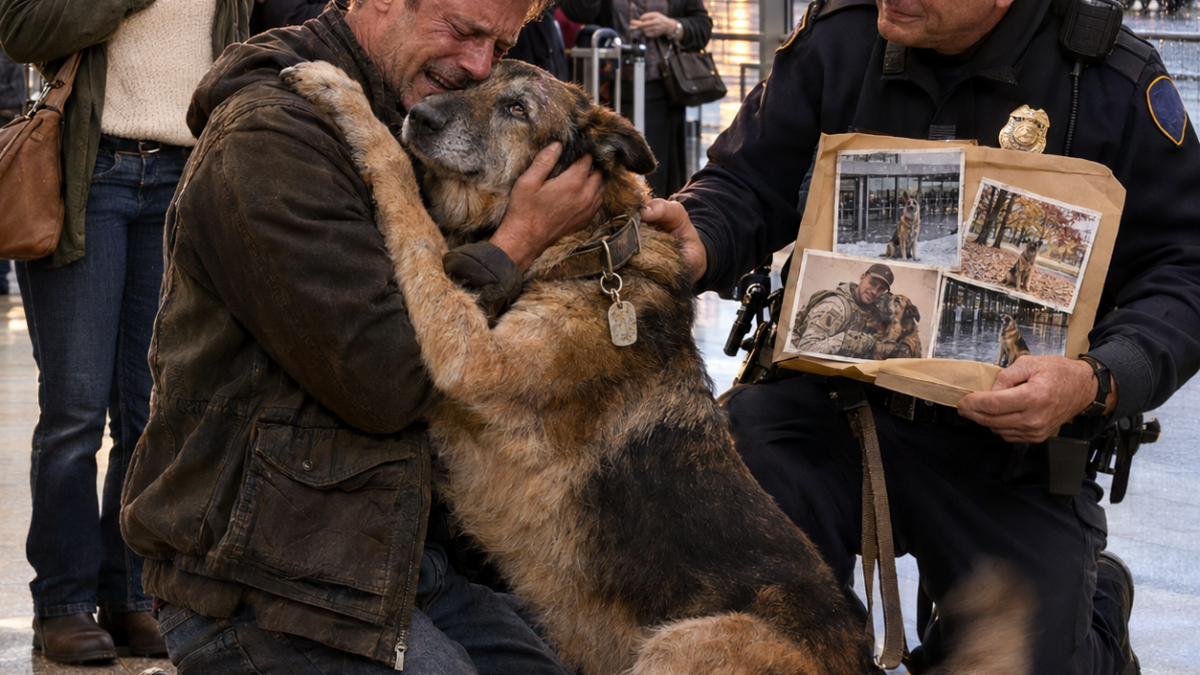
But Rex was already pressed against my chest.
His front paws were on either side of my hips.
His tail struck my leg so hard it hurt.
I didn’t care.
“Rex.”
He whimpered.
I buried both hands in the fur around his neck.
“Oh, buddy.”
People stopped around us.
Security officers.
Travelers.
A woman pulling a carry-on.
A little boy holding his father’s hand.
I heard someone ask:
“Does he know that man?”
I could not answer.
Rex knew me.
That was enough.
His nose moved over my jacket.
My hands.
My face.
Checking.
Remembering.
Then he made a sound that tore something open inside me.
A soft crying whine.
The same sound he sometimes made beside my hospital bed.
I dropped carefully to one knee despite my leg.
Rex pushed his head beneath my chin.
I held him.
For months, everyone had congratulated me for surviving.
Doctors.
Nurses.
Therapists.
Family.
They called me strong.
Lucky.
Determined.
Nobody understood how badly I sometimes wished I could go back to the wreck and trade places with Luke.
Rex did not congratulate me.
He simply recognized me.
That broke me.
I cried into his fur.
The officer stood nearby without interrupting.
Eventually Rex settled enough for me to look up.
“I’m sorry.”
The officer shook his head.
“Don’t apologize.”
His badge identified him as Officer Mark Sullivan, airport police K9 unit.
I wiped my face.
“You’re his handler?”
“Currently.”
“Currently?”
He studied me.
“You’re Jake Miller, right?”
I froze.
“How do you know my name?”
Mark looked at Rex.
Then at me.
“He never really stopped waiting for you.”
I thought I had misheard him.
“What?”
Mark crouched beside us.
“You and another man were hospitalized after a rollover on I-90.”
“Luke Henderson.”
“Yes.”
My chest tightened.
“How do you know that?”
“Because Rex worked at Mercy Regional during your recovery.”
I nodded.
“I saw him there.”
Mark gave a small smile.
“You saw a fraction of it.”
I stared.
“What do you mean?”
He sat on the edge of a nearby bench.
Rex remained pressed against my side.
Mark explained.
After the rescue, Rex’s original search-and-rescue handler had been injured during another call several weeks later.
Nothing catastrophic, but enough to temporarily suspend field work.
Rather than leave Rex inactive, the regional canine organization partnered with Mercy Regional’s animal-assisted therapy program.
Rex was temperament-tested.
Certified.
Placed temporarily with hospital staff.
He visited rehabilitation floors.
Trauma patients.
Children.
Veterans.
Stroke patients.
People learning to walk.
People learning to speak.
People afraid to sleep.
“He was good,” Mark said.
“Very.”
I smiled.
“He still is.”
Mark nodded.
“But then he found you two.”
I looked down at Rex.
“What happened?”
“The first day he saw you, he stopped in the corridor.”
Mark had been told the story by hospital staff after becoming Rex’s new handler.
Rex had been walking with a therapist when he smelled something familiar.
Maybe me.
Maybe Luke.
Maybe hospital disinfectant could not erase the scent of two people he had found bleeding inside a crushed truck.
He pulled toward our rooms.
When staff tried redirecting him, he resisted.
Not aggressively.
Just insistently.
He found my door first.
Then Luke’s.
“He remembered us.”
Mark smiled.
“Immediately.”
I felt my throat tighten.
“What did he do?”
“Waited.”
One word.
That was all.
But Mark continued.
The hospital team initially assumed Rex’s interest was temporary.
Dogs recognize people.
Nothing unusual.
Except Rex did not move on.
During scheduled rounds, he repeatedly returned to our hallway.
If my door opened, he tried to enter.
If Luke went to imaging or surgery, Rex became restless until he returned.
At night, when staff sometimes allowed Rex to settle in a central nursing area, he positioned himself where he could see both rooms.
“He slept there?”
“Apparently.”
I stared at him.
“All night?”
“Some nights.”
I looked down.
Rex’s eyes were fixed on me.
I remembered waking at two in the morning after surgery.
Pain tearing through my hip.
A nurse entering.
And outside the door, for a second, seeing two pointed ears.
I thought it was medication.
It wasn’t.
Mark continued.
“When you started physical therapy, he followed.”
“I remember.”
“You thought it was scheduled?”
“Yes.”
“Sometimes.”
“Sometimes?”
Mark smiled.
“Sometimes he simply refused to go anywhere else.”
I laughed through tears.
“That sounds like Rex.”
“It became a problem.”
The smile disappeared.
“Why?”
“He had other patients.”
Of course.
Rex was not ours.
He was supposed to serve an entire hospital.
But his attachment had become so strong that he was less available to others.
When Luke’s pain worsened, Rex became distracted.
When I had a setback during rehabilitation, he resisted leaving.
Hospital staff loved what he did for us.
They also knew a working service dog could not become emotionally consumed by two patients.
“So they transferred him?”
Mark nodded.
“To airport security?”
“Eventually.”
The original handler could not return to full field work.
Rex’s temperament and detection training made him suitable for another public-safety role.
Airport security needed an experienced dog.
Mark was assigned.
“He adjusted.”
I looked at Rex.
“Did he?”
Mark hesitated.
“Yes.”
Then:
“But every time we passed someone using a cane, he looked twice.”
My chest hurt.
“Every time?”
“Not every time.”
Mark smiled.
“Enough that I noticed.”
I looked toward the terminal.
People moved around us.
Flights announced.
Luggage wheels.
Ordinary life happening while mine tilted.
Then Rex pulled away from me.
Two steps.
Turned.
Whined.
Came back.
Then turned again.
I knew that movement.
I had seen it during the hospital months whenever Luke was taken away for tests.
“He’s looking for Luke.”
Mark did not answer immediately.
I looked at him.
“Isn’t he?”
“He probably remembers both of you.”
I swallowed.
“Luke is still at Mercy.”
Mark’s face softened.
“How is he?”
“Better.”
I hesitated.
“Not good.”
That was the truth.
Luke could stand with assistance.
Take a few steps between parallel bars.
Use his arms normally most days.
But the emotional part?
That was worse.
When I left, he smiled for me.
Afterward, one of the nurses called.
Luke had refused physical therapy the next morning.
Then again.
He told everyone he was tired.
I knew what he meant.
He was tired of being brave.
I looked at Rex.
He sat in front of me.
Waiting.
Suddenly going home felt wrong.
Not because I didn’t deserve to leave the hospital.
Because something unfinished was standing in front of me wearing an airport security vest.
“I need to take him to Luke.”
Mark blinked.
“What?”
“To the hospital.”
“That’s not exactly how police K9 assignments work.”
“I know.”
“You can’t just borrow him.”
“I know.”
“He’s on duty.”
“I know.”
Mark stared.
I stood carefully.
“Then come with us.”
He almost laughed.
“Mr. Miller.”
“Jake.”
“Jake, there are policies.”
“I’m not asking you to break them.”
He looked down at Rex.
The dog stared back.
“Let me make some calls.”
Three hours later, I was back in a hospital I had spent months dreaming of escaping.
Funny how quickly freedom changes shape.
My sister drove.
Mark followed in his department SUV with Rex.
Permissions had been arranged.
Airport supervisor.
Hospital administration.
Therapy program.
Luke’s physician.
No rules broken.
Just enough people deciding this mattered.
Walking through Mercy Regional’s automatic doors hit me harder than expected.
The smell.
Disinfectant.
Coffee.
Plastic.
The faint mechanical sounds from somewhere deeper in the building.
My hand tightened around my cane.
Rex looked at me.
Mark noticed.
“You okay?”
“No.”
He nodded.
“Want a minute?”
I almost said yes.
Then shook my head.
“If I take a minute, I may take an hour.”
We continued.
Rex changed the moment we reached the rehabilitation wing.
His pace quickened.
Not pulling.
But purposeful.
He knew.
Six months.
Different handler.
Different job.
He knew.
We turned one corner.
Then another.
Rex began whining.
A nurse named Carla looked up from the station.
She covered her mouth.
“Oh my God.”
“Carla.”
She stared at Rex.
“Is that—”
“Yes.”
She walked around the desk.
“Rex.”
The dog wagged his tail but did not stop.
Carla started crying.
“He remembers.”
Mark smiled.
“Apparently.”
Carla looked at me.
“Jake, what are you doing back?”
I nodded toward Rex.
“He made me.”
That was close enough.
Luke’s room was at the far end.
The door stood partly open.
I stopped outside.
My heart began hammering.
For months that room had represented everything I could not fix.
Luke’s wheelchair.
His medication.
His bad days.
The look he gave the ceiling whenever doctors discussed “functional goals.”
I knocked.
No answer.
I pushed the door open.
Luke sat beside the window in his wheelchair.
He looked thinner than when I left.
Gray T-shirt.
Hospital pants.
One hand on the wheel.
He was staring outside.
“Luke.”
He turned.
His face changed.
“Jake?”
“Hey.”
“What the hell are you doing here?”
“I forgot something.”
He laughed weakly.
“You got discharged yesterday.”
“I know.”
“You’re terrible at freedom.”
“Apparently.”
Then Rex entered.
Luke stopped breathing.
I watched disbelief travel across his face.
His eyes widened.
His lips parted.
No sound.
Rex moved slowly.
That surprised me.
At the airport, he had thrown himself at me.
With Luke, he seemed to understand.
Luke’s body was still fragile.
Rex walked directly to him.
Stopped.
Then lowered his head onto Luke’s hand.
Luke’s fingers trembled.
“Rex.”
The dog closed his eyes.
Luke began crying.
Not politely.
Not trying to hide it.
He bent forward and buried both hands in Rex’s fur.
“I knew it.”
I stepped closer.
“Knew what?”
Luke laughed through tears.
“I knew I heard him.”
I froze.
“When?”
“At night.”
He looked at Rex.
“When we first got here.”
“I thought I was hallucinating.”
His hands moved over the dog’s head.
“I’d hear nails in the hallway.”
“Sometimes he’d whine.”
“I asked a nurse once.”
“She told me I was imagining things.”
Carla stood in the doorway behind us.
Her face turned guilty.
“We were trying not to get you more attached.”
Luke looked at her.
“You knew?”
She nodded.
“Everybody knew.”
Luke laughed.
Then cried harder.
Rex rested his head against Luke’s chest.
For several minutes nobody spoke.
No speech could improve it.
Eventually Luke looked at Mark.
“You his handler?”
“Yes.”
Luke wiped his face.
“Take care of him.”
Mark smiled.
“I do my best.”
Luke looked at Rex.
“This idiot saved our lives.”
“I heard.”
“No.”
Luke pointed toward me.
“Literally.”
He began telling the wreck story.
Not for Mark.
For himself.
He remembered less than I did.
His last memory before waking in intensive care was losing control on the ice.
He never remembered Rex appearing at the truck.
I filled in those details.
Luke listened with one hand still buried in the dog’s fur.
“He found us?”
“Yes.”
“How long?”
“Rescue team said maybe twelve minutes after we went over.”
Luke stared.
“That fast?”
“Yep.”
“Jesus.”
I nodded.
“If not…”
I stopped.
He understood.
Rex had saved us once on the highway.
Nobody knew yet he was about to do it again.
Not dramatically.
No burning wreck.
No heroic leap.
The second rescue began the next morning.
Luke showed up for physical therapy.
That alone was unusual.
His therapist, Megan Walsh, looked at him.
“You’re early.”
Luke shrugged.
“Dog’s coming.”
She smiled.
“He is.”
Mark had arranged one more hospital visit before returning Rex to regular airport duty.
Luke stood between parallel bars.
His hands gripped tightly.
Rex lay ten feet away.
Watching.
Megan said:
“Weight forward.”
Luke shifted.
“Good.”
His knees shook.
“Now right foot.”
Nothing.
Luke’s face tightened.
“I can’t.”
“You did yesterday.”
“Badly.”
“You still did it.”
He looked at Rex.
The dog’s ears lifted.
Luke whispered:
“You’re judging me.”
Rex tilted his head.
I laughed.
Luke looked at me.
“Shut up.”
“Take the step.”
“You take it.”
“I already did.”
His face darkened.
I regretted it immediately.
Luke stared at my cane.
Then looked away.
There was the wound between us.
I was walking.
He wasn’t.
Neither of us had named it.
Megan said softly:
“Luke.”
He closed his eyes.
“I hate this.”
“I know.”
“No, you don’t.”
“I don’t.”
She did not pretend.
“But you’re here.”
He looked at Rex again.
Then moved his right foot.
Three inches.
Stopped.
Breathed.
Left foot.
Two inches.
His arms trembled violently.
Rex stood.
Not approaching.
Just standing.
Luke took another step.
Then another.
Four.
Five.
His knee buckled.
Megan caught him with the support harness.
Rex whined.
Luke laughed while gasping.
“Relax.”
Rex’s tail moved.
Luke lowered himself into the wheelchair.
Megan said:
“That was your longest distance this week.”
He stared at her.
“Seriously?”
“Yes.”
He looked at Rex.
“Show-off.”
The dog licked his hand.
That day changed Luke’s schedule.
Not because doctors suddenly prescribed Rex as medicine.
Life is not a movie.
Rex had a job at the airport.
He could not live inside the hospital.
But Mark and hospital administration created a temporary visitation arrangement.
Two afternoons a week when airport staffing allowed.
Sometimes one.
Sometimes none.
Other certified therapy dogs also visited.
But Rex was different.
He carried history.
When Luke refused a session, Megan would sometimes say:
“Fine. Tell Rex Thursday.”
Luke hated that.
It worked.
His progress remained slow.
Painful.
Uneven.
One day he walked twenty feet.
The next he could barely stand.
Some mornings his legs responded.
Other mornings muscle spasms ruined everything.
He threw a water bottle at the wall once.
Rex jumped.
Luke immediately broke down.
“I scared him.”
Mark said:
“He’s heard gunfire.”
“That’s not the point.”
Luke called Rex over.
The dog came.
Luke held his face.
“I’m sorry.”
Watching that taught me something.
Luke was not afraid of being weak.
He was afraid of becoming angry enough that people stopped wanting to stay.
Rex stayed.
So did we.
I delayed going fully home.
At first only two days.
Then a week.
My sister complained.
“You have a house.”
“I know.”
“You haven’t slept in it.”
“I know.”
“Jake.”
I stared at her kitchen floor.
“What if I go home and he doesn’t?”
She sat beside me.
“That is not your decision.”
“I know.”
“You keep saying that.”
“Because I know.”
“Then believe it.”
Harder.
Survivor guilt is arrogant in a strange way.
It convinces you that another person’s suffering must somehow be balanced by your own.
If Luke could not walk, how dare I enjoy walking?
If he could not go home, how dare I sleep in my own bed?
My therapist, Dr. Helen Brooks, said:
“You think staying miserable is loyalty.”
I hated her.
Mostly because she was right.
“Luke doesn’t need you injured.”
“I know.”
“He doesn’t need you trapped in the hospital.”
“I know.”
“He needs his friend.”
I looked at her.
“What if I don’t know how to be that anymore?”
“Then ask him.”
So I did.
Luke and I were in the hospital cafeteria.
He hated the soup.
I hated the coffee.
Perfect.
I said:
“Do you resent me?”
He stopped eating.
“What?”
“For walking.”
His face changed.
“No.”
“Luke.”
“Sometimes.”
That honesty saved us.
I nodded.
“Okay.”
“You wanted honesty.”
“I did.”
He looked out the window.
“When you left…”
He swallowed.
“I was happy for you.”
“I know.”
“And I hated you.”
I laughed once.
“Fair.”
“Then I hated myself for hating you.”
“Also fair.”
“No.”
He shook his head.
“None of this is fair.”
We sat quietly.
Then he said:
“You know what made it worse?”
“What?”
“You kept coming back looking guilty.”
I stared.
“You’d walk into my room like you were apologizing with your whole body.”
“I was.”
“I know.”
He leaned closer.
“Stop.”
“What?”
“Go home.”
“Luke.”
“Sleep in your bed.”
“See your mother.”
“Go to the grocery store.”
“Complain about traffic.”
He smiled sadly.
“Bring me pictures of normal life so I remember it still exists.”
My throat tightened.
“You sure?”
“No.”
He laughed.
“But do it anyway.”
So I went home.
The first night was terrible.
I stood inside my front door for five minutes.
Everything looked exactly the same.
That offended me.
How could the couch still exist?
How could mail still pile up?
How could a carton of expired milk remain inside my refrigerator when Luke was still learning how to move one foot?
I opened the windows.
Cold air.
Sat on the floor.
Cried.
Then slept.
The next morning I sent Luke a photograph of burnt toast.
Normal life.
He replied:
Your cooking surviving the crash is deeply unfair.
Good.
Weeks passed.
Rex became part of our rhythm.
Airport duty.
Hospital visits.
My therapy.
Luke’s rehab.
Mark became a friend.
An unlikely one.
He was forty-six, former Army MP, divorced, father of a teenage daughter.
He treated Rex like a professional colleague who occasionally ate garbage.
One afternoon I asked:
“Why did they choose airport security?”
“For Rex?”
“Yes.”
Mark shrugged.
“Temperament. Training background. Good search drive. Stable around crowds.”
“Did you know about us before the airport?”
“No.”
“Nothing?”
“Just that he had become overattached to two trauma patients.”
I laughed.
“Overattached.”
“That was the report language.”
“Sounds clinical.”
“It’s a hospital.”
He scratched Rex’s ear.
“Reality was he loved you idiots.”
I smiled.
“Probably.”
Mark looked at me.
“Dogs form associations differently than we do.”
“I know.”
“No, I mean people romanticize it.”
I waited.
“Rex didn’t lie awake understanding your biographies.”
“He associated you with high emotional intensity.”
“The rescue.”
“The hospital.”
“Your scent.”
“Your voices.”
“Routine.”
Mark paused.
“But whatever word you want to use…”
He looked down at Rex.
“…he definitely gave a damn.”
I laughed.
Good enough.
One Thursday, Luke refused to let Rex leave.
Not physically.
Emotionally.
Mark clipped the leash.
Luke’s face changed.
“Already?”
“Airport shift tomorrow.”
“Right.”
Rex stood.
Luke stroked his neck.
“When do you come back?”
Mark checked schedule.
“Next Tuesday, maybe.”
Luke nodded.
“Maybe.”
That word hurt.
Rex began moving toward the door.
Luke whispered:
“Stay.”
The dog stopped.
Mark looked at him.
Luke immediately corrected:
“No.”
He swallowed.
“Go.”
Rex looked between us.
Luke smiled.
“You have work.”
The dog finally followed Mark.
Luke stared at the empty doorway.
Then said:
“This is stupid.”
“What?”
“I’m jealous of an airport.”
I laughed.
He did too.
Then became serious.
“What happens when he retires?”
I had not thought about that.
Mark had.
Rex was seven.
Airport working dogs often retired based on health, ability, and agency needs.
Maybe years.
Maybe less.
“Not soon,” I said.
Luke looked at me.
“You don’t know.”
“No.”
He nodded.
Then:
“I don’t want him disappearing again.”
Neither did I.
That became the seed of something.
Not ownership.
Not yet.
But conversations began.
Mark with his supervisor.
Hospital with the airport.
The rescue organization that originally placed Rex.
His original handler had since retired permanently due to disability and lived across the country.
Everyone agreed on one thing:
Rex’s future should be planned before age or injury forced a decision.
Meanwhile, Luke worked.
Spring became summer.
Wheelchair to walker.
Walker to forearm crutches for short distances.
His first independent ten steps happened on a Tuesday when Rex was not there.
That mattered.
Luke needed to know the strength belonged to him too.
Megan stood behind him.
I stood near the wall.
Luke released one crutch.
Then the other.
“Ready?”
“No.”
He stepped anyway.
One.
Two.
Three.
By Step Six, his face was wet.
Eight.
Nine.
Ten.
He grabbed the rail.
Everyone clapped.
Luke shouted:
“Stop!”
We stopped.
He was laughing.
“Don’t make this weird.”
Megan wiped tears.
“You’re crying.”
“Pain.”
“Liar.”
He looked at me.
“Did you record it?”
“Yes.”
“Send it to Mark.”
“Why?”
“Rex needs to know I don’t need him.”
That afternoon Mark sent a video.
Rex watching my phone screen.
Of course the dog did not understand a rehabilitation video the way we did.
But when Luke’s voice played, Rex’s ears rose.
At the end, Mark said:
“He is deeply unimpressed.”
Luke replied:
Tell him I walked ten steps without his judgmental face.
Mark:
He says eleven or it doesn’t count.
Luke walked twelve the next day.
Competition with a dog became legitimate medical motivation.
By August, Luke received his first weekend home pass.
His apartment was on the second floor.
No elevator.
That was impossible.
His brother found a temporary accessible rental.
Luke hated it.
“This isn’t home.”
“It is for now.”
He looked around.
Beige walls.
Rental furniture.
Hospital equipment.
Rex visited that Saturday.
The moment the dog entered, Luke looked around again.
Then smiled.
“Okay.”
“What?”
“Feels better.”
That was the thing Rex did.
He did not make places home.
He made people feel less alone inside unfamiliar places.
Luke’s discharge finally came after nine months.
Nine months.
Long enough for seasons to change.
Long enough for the hospital cafeteria to know our orders.
Long enough for Luke to know which nurse had three children, which therapist was getting divorced, which security guard hated baseball.
The morning he left, half the rehabilitation unit seemed to appear.
Luke used forearm crutches.
Wheelchair folded in the vehicle for longer distances.
He hated that compromise.
Accepted it.
Progress.
Mark brought Rex with formal approval.
The dog wore no ceremonial bow.
I was grateful.
Rex would have eaten it.
Luke stood inside the automatic doors.
Looked outside.
Then froze.
I recognized the expression.
Same one I had when I left.
Freedom can be terrifying after months of structure.
I moved beside him.
“Want a minute?”
He looked at me.
“You said that?”
“What?”
“Mark said that to you at the airport.”
I smiled.
“Apparently it works.”
Luke inhaled.
Then looked down at Rex.
“Ready?”
Rex wagged his tail.
We walked outside.
Luke.
Me.
Rex between us.
Mark behind.
Air.
Sunlight.
Traffic.
Nothing extraordinary.
Everything extraordinary.
Luke made it to the curb.
Stopped.
Looked up at the sky.
Then laughed.
“What?”
I asked.
“Nothing.”
He shook his head.
“It’s huge.”
“What?”
“The sky.”
Months of hospital windows had reduced the world.
Now there was no ceiling.
Luke cried.
Nobody pretended not to notice.
That evening, we ate pizza at his temporary rental.
Rex slept beneath the table.
Mark drank soda because he was technically responsible for the dog.
Luke looked around.
“Remember the wreck?”
I stared.
“Unfortunately.”
“I don’t.”
“Lucky.”
“No.”
He looked at Rex.
“Sometimes I wish I did.”
“Why?”
“Because everyone tells me this dog saved me.”
Luke rubbed his head.
“But I don’t remember him.”
I thought.
“Maybe you don’t need to.”
He looked at me.
“I remember enough for both of us.”
That became our arrangement.
I carried the memory of Rex finding us.
Luke carried the memory of hearing Rex outside his hospital room when neither of us understood why.
Together, the story felt complete.
Life did not become easy after discharge.
That needs saying.
Hospital recovery is structured.
Home recovery is lonely.
At the hospital, someone checks on you.
At home, the bathroom is suddenly twelve steps farther than you remembered.
The shower becomes engineering.
Cooking becomes exhausting.
Insurance calls arrive.
Bills.
Forms.
Medication schedules.
Luke had panic attacks in vehicles.
The first time we drove past a highway guardrail in rain, he told me to pull over.
I did.
He vomited beside the road.
Then apologized.
“For what?”
“Ruining the trip.”
“We’re going to Target.”
He laughed weakly.
“Still.”
Rex helped there too, but not magically.
He was not officially Luke’s service dog.
He belonged to the airport.
Visits were limited.
So Luke adopted routines.
Therapy.
Breathing techniques.
Driving exposure.
Pool rehabilitation.
Sleep treatment.
Medication for a while.
He hated all of it.
Did it anyway.
I did too.
My nightmares had worsened once I returned home.
I dreamed of the truck rolling.
Except in dreams I always climbed out first and left Luke behind.
Dr. Brooks said:
“Your brain is trying to create responsibility where there was only survival.”
I said:
“My brain is an idiot.”
She smiled.
“Brains often are.”
Luke and I attended a trauma-support group twice.
We hated it.
Then went back.
That probably means it helped.
At the airport, Rex continued working.
Mark occasionally sent photographs.
Rex beside luggage.
Rex sitting near a training lane.
Rex asleep in the K9 vehicle.
Normal work.
That mattered.
Rex had a life outside us.
Love did not require him to abandon purpose.
That became another lesson I needed.
The first time I saw him after going three weeks without a hospital-style visit, I expected another dramatic reunion.
Rex walked over.
Sniffed me.
Tail wagged.
Then became distracted by a sandwich wrapper.
I stared.
“That’s it?”
Mark laughed.
“You wanted tears?”
“A little.”
“You’re needy.”
Rex found the wrapper.
I felt strangely relieved.
He could love us without living in constant emotional crisis.
Maybe humans could too.
A year after the accident, Luke and I returned to the crash site.
Bad idea.
Necessary idea.
We chose a clear day.
No rain.
No ice.
Mark asked whether Rex should come.
Luke said no.
I agreed.
This part was ours.
The guardrail had been replaced.
Trees damaged by the truck had been cut back.
No memorial.
No sign.
Traffic passed.
I stood beside Luke.
He used one cane now.
“Here?”
“Yes.”
“You sure?”
“I saw the police report.”
He looked down the embankment.
“I don’t remember.”
“I know.”
“Do you?”
“Everything.”
He was silent.
Then:
“Tell me.”
I hesitated.
“Luke.”
“Tell me.”
So I did.
The truck sliding.
His hands fighting the wheel.
Impact.
Roll.
Glass.
Blood.
The smell of fuel.
My trapped leg.
His silence.
Rex appearing.
Barking.
Leaving.
Returning with rescuers.
Luke listened.
When I finished, he looked down the hill.
“How long did you think I was dead?”
My throat tightened.
“A few minutes.”
He nodded.
“Were you scared?”
“Yes.”
“I’m sorry.”
I stared.
“For what?”
“For being unconscious?”
He laughed.
Then cried.
I put an arm around him.
Cars moved behind us.
Eventually Luke said:
“I think I’ve spent a year believing I owe you.”
“For what?”
“Being awake.”
“That’s ridiculous.”
“I know.”
“Then stop.”
He looked at me.
“Same to you.”
I understood.
We had both been trying to repay survival to each other.
Impossible debt.
We left it by the guardrail.
Not completely.
Enough.
The following winter, Mark called.
“Rex is retiring.”
My stomach dropped.
“What happened?”
“Nothing dramatic.”
“Health?”
“Early arthritis.”
“How bad?”
“Manageable.”
“Then why?”
“He’s done enough.”
I smiled.
“When?”
“Six weeks.”
“Where is he going?”
Pause.
“That’s why I’m calling.”
My heart began pounding.
Working dogs often retire with handlers.
Mark loved Rex.
I assumed he would keep him.
“I thought he’d stay with you.”
“I would.”
“But?”
Mark sighed.
“My daughter developed a serious allergy.”
I went quiet.
“We’ve managed because Rex doesn’t live inside full-time the way he would retired.”
“But afterward…”
“Not fair to either of them.”
“Right.”
He continued.
“The agency is evaluating placement.”
I knew what was coming.
Still afraid to hear it.
“Luke?”
“Maybe.”
My chest tightened.
“Why not me?”
Mark laughed.
“You want to fight him?”
“Possibly.”
“You have stairs.”
“So does he now.”
“Luke moved.”
“What?”
“You didn’t know?”
Apparently not.
Luke had purchased a small accessible ranch-style house outside Cleveland.
Fenced yard.
He had not told me because closing was not final.
Mark knew because Luke had asked questions months earlier about retired K9 adoption.
Sneaky bastard.
I called him.
“You’re trying to steal my dog.”
Luke laughed.
“He was never your dog.”
“I have emotional seniority.”
“He saved my life too.”
“I remembered it.”
“Cheap shot.”
“Fair.”
We argued.
Then stopped.
Because the question was not which of us loved Rex more.
It was what environment fit Rex.
Luke worked from home three days a week.
One-story house.
Fenced yard.
Near veterinary care.
No other animals.
I traveled frequently for engineering contracts.
Apartment.
No yard.
The answer was obvious.
I hated it.
“Take him.”
Luke went quiet.
“You sure?”
“No.”
“Jake.”
“I’ll steal him every weekend.”
“Deal.”
Rex retired on a Friday afternoon.
Small ceremony.
Airport employees.
Police.
Hospital staff.
Carla came.
Megan Walsh came.
My sister.
Luke.
Me.
Mark spoke briefly.
“Rex performed detection and public-safety duties with professionalism.”
Luke whispered:
“Unlike Jake.”
I elbowed him.
Mark continued.
“He also apparently maintained an unauthorized secondary career in trauma rehabilitation.”
People laughed.
Then Mark looked toward us.
“Some assignments are written on paper.”
He glanced at Rex.
“Others aren’t.”
That one hurt.
The airport removed Rex’s working harness.
For the first time I saw him there wearing only a collar.
He looked smaller.
Older.
Normal.
Luke knelt.
Rex walked to him.
No explosion anymore.
They had become familiar again.
Rex rested his head against Luke’s shoulder.
Mark handed Luke the leash.
“You ready?”
Luke looked at him.
“No.”
Mark smiled.
“Good answer.”
Rex went home with Luke.
The first night, Luke sent me a photo.
Rex had ignored the expensive orthopedic dog bed and fallen asleep on Luke’s couch.
Message:
Your hero is an ungrateful freeloader.
I replied:
Check if he wants oatmeal.
Luke:
Too soon. Wrong story.
I laughed until my stomach hurt.
Retirement suited Rex.
He gained five pounds.
The vet complained.
Luke blamed me for feeding treats.
Correctly.
Rex slept near Luke’s bedroom door.
Walked every morning.
Visited the rehabilitation hospital monthly as an approved therapy volunteer after appropriate screening.
That felt right.
He returned not as a dog unable to leave two patients.
As a retired dog with a new purpose.
The first time we brought him back, a teenage accident patient sat in the rehab gym refusing to participate.
Rex wandered over.
Lay beside his wheelchair.
The kid looked down.
“What does he want?”
Megan said:
“Nothing.”
“Why is he here?”
“He likes people who are having bad days.”
The boy almost smiled.
Luke watched from the doorway.
Later he said:
“That used to be me.”
“Yes.”
He shook his head.
“No.”
“What?”
“That still is me sometimes.”
That was healthier.
Recovery did not end.
It expanded enough to include bad days without being ruled by them.
Two years after the accident, Luke returned to work part-time.
Not his old field position.
Engineering review.
Remote design work.
Eventually office visits.
He walked with a cane when tired.
Without it on better days.
He never regained everything.
That mattered too.
Stories like ours often lie.
They say:
He learned to walk again.
As if that closes the medical file.
Luke had chronic pain.
Nerve damage.
Limited endurance.
Some days his left leg barely cooperated.
He built a good life anyway.
Not because he defeated disability.
Because he stopped treating a changed body as a failed one.
That lesson took longer than walking.
I changed too.
Before the crash, I was proud of never needing anyone.
Afterward, I learned a hospital gown can erase that illusion in ten minutes.
My sister helped me shower.
Luke saw me cry.
Therapists lifted my leg.
Nurses managed things no adult wants strangers managing.
Rex watched me fail to walk.
And somehow none of it made me less myself.
That became freedom.
Three years after the accident, Luke stood as best man at my wedding.
Yes.
I remarried.
Her name was Erin.
Physical therapist.
Not ours.
That would have been too much.
We met through friends.
On our second date she asked why I walked differently in cold weather.
I told her.
On our fourth, she met Luke.
On our sixth, she met Rex.
Rex liked her immediately.
I pretended to be offended.
At the wedding, Luke gave a speech.
“I’ve known Jake since we were thirteen.”
He looked at Erin.
“So I can say with authority that you could have done better.”
Everyone laughed.
Then he became serious.
“There was a year when Jake and I both thought survival meant returning to who we had been.”
I felt my throat tighten.
“We were wrong.”
He looked toward me.
“Survival meant learning who we were after.”
Then Rex barked from beside Luke’s chair.
Luke smiled.
“And apparently keeping this guy involved.”
Rex wore a bow tie.
Hated it.
Perfect.
Years passed.
Rex slowed.
Gray appeared around his muzzle.
Stairs became difficult—which was convenient because Luke’s house had almost none.
His airport instincts never fully disappeared.
Suitcases interested him.
Every time I visited with luggage, he inspected it.
Once Erin hid a tennis ball inside my bag.
Rex found it in twelve seconds.
Luke said:
“National security is safe.”
At eleven, Rex developed kidney disease.
Manageable initially.
Then less manageable.
Medications.
Special diet.
More vet visits.
Luke became quiet.
I knew why.
We had both survived once because Rex arrived in time.
Now there was nothing to rescue him from.
Age is not an emergency.
That makes it harder.
One evening Luke called.
“Come over.”
I knew.
Erin came too.
Rex lay on his bed near the living-room window.
Breathing slowly.
His head lifted when I entered.
Tail moved once.
Then twice.
I sat beside him.
“Hey, buddy.”
He pushed his nose into my palm.
Luke sat on the floor opposite me.
Neither of us pretended.
The veterinarian came the next morning.
Home visit.
Luke wanted Rex somewhere familiar.
We stayed.
Mark came.
Carla.
Megan.
Not all at once.
Quiet visits.
When it was time, only Luke, Mark, and I remained.
Rex’s head rested across Luke’s thigh.
My hand lay against his shoulder.
Mark scratched behind his ear.
Luke whispered:
“You saved us enough.”
I broke.
So did Mark.
Luke continued:
“You don’t have to do anything else.”
Rex’s eyes closed.
The veterinarian administered the medication.
His breathing slowed.
Then stopped.
Silence.
For years I had associated Rex with return.
Finding.
Rescue.
Motion.
That morning we had to let him leave.
Luke bent over him.
I put my hand on Luke’s back.
We stayed like that for a long time.
No one tried to make it beautiful.
Grief does not need improvement.
Rex’s ashes were divided only because Luke insisted.
I did not want that.
“It feels wrong.”
“He belonged to both of us.”
“And Mark.”
Mark shook his head.
“I had him for work.”
Luke looked at him.
“You loved him.”
Mark stared.
Then nodded.
Three small memorial urns.
Luke kept his beneath a photograph from the airport reunion.
I kept mine beside a photograph from my wedding.
Mark kept his beside Rex’s retired airport badge.
The hospital placed a photograph in the rehabilitation wing.
Not a shrine.
Just Rex sitting between Luke and me outside the hospital on discharge day.
Underneath:
REX — SEARCH, SERVICE, SECURITY, FRIEND
No mention of hero.
I liked that.
Heroes sound temporary.
Friend was the important part.
Years later, Luke and I volunteered at Mercy Regional’s annual trauma-survivor event.
A woman approached us.
She had heard the story.
Internet.
Article.
Social media.
However stories travel.
She said:
“Rex healed you.”
Luke and I looked at each other.
He answered first.
“No.”
She seemed surprised.
Luke smiled.
“Doctors kept us alive.”
“Surgeons repaired us.”
“Nurses carried us through nights we don’t remember.”
“Therapists taught us to move again.”
“Family helped.”
“Medication helped.”
“Counseling helped.”
He paused.
“Rex reminded us to keep showing up.”
That was exactly right.
The dog did not perform a miracle.
He gave us a reason to participate in ordinary miracles already happening around us.
A step.
Another.
One more session.
One more night.
One more attempt.
Years after Rex died, I still occasionally heard his nails in dreams.
Not the crash.
That dream eventually faded.
Now I dreamed of the airport.
Crowded terminal.
Me with a cane.
Rex across the concourse.
He always saw me first.
Always ran.
But in the dream, after he reached me, he would turn his head.
Looking.
Searching.
Where is the other one?
I always woke before answering.
Then one night the dream changed.
Luke appeared beside me.
No wheelchair.
No cane either, although real Luke still used one sometimes.
Dreams take liberties.
Rex stood between us.
Looked from Luke to me.
Then walked away down a bright corridor.
Not running.
Not afraid.
Just finished.
I woke crying.
Erin asked:
“Bad dream?”
“No.”
“What?”
“Good one.”
I told Luke the next morning.
He was silent.
Then said:
“You’re getting sentimental in old age.”
“So are you.”
“Never.”
Liar.
We were in our fifties by then.
The crash had become something that happened a long time ago.
Our bodies remembered.
Weather reminded us.
Scars remained.
But it no longer entered every room first.
That may be the clearest definition of healing I know.
The story people loved was the reunion.
A man walking through an airport.
A dog suddenly recognizing him.
An officer explaining that the dog had never really stopped watching.
Then the man returning to a hospital with the dog to help his injured friend.
Beautiful.
True.
But incomplete.
The real story was everything after.
Luke standing when he wanted to quit.
Me going home despite guilt.
Mark letting Rex love people outside his assignment.
Hospital staff finding a way to bring him back without ignoring rules.
Luke learning disability was not failure.
Me learning survival was not betrayal.
Rex retiring.
Growing old.
Becoming an ordinary dog.
Dying surrounded by the people he had once saved.
That is what loyalty looked like.
Not one heroic act.
Repetition.
Presence.
Return.
I used to believe Rex saved our lives on the highway because he found the wreck.
That was Rescue Number One.
Then I believed he saved Luke by returning to the hospital.
Maybe Rescue Number Two.
Years later, I understood the deepest thing he gave us.
He refused to let our worst moment become our last definition.
When Rex saw me at the airport, he did not see a man with a cane.
He did not know I had spent six months learning to walk.
He did not know about survivor guilt.
Insurance forms.
Nightmares.
Pain medication.
He smelled Jake.
The same Jake he had found bleeding inside a wrecked truck.
Changed.
Still Jake.
When he saw Luke, he did not see wheelchair.
Weakness.
Spinal injury.
A body that moved differently.
He saw Luke.
Maybe that is why animals can be so powerful in recovery.
They do not require you to explain who you used to be.
They simply recognize who is still there.
The officer who stopped me at the airport probably never understood what his sentence did to me.
He never really stopped watching you.
At the time, I thought Mark meant Rex had remembered us.
Years later, I heard something larger in it.
There had been months when Luke and I could not see a future.
Rex did not need one.
He only needed the next moment.
Wait outside the door.
Follow the wheelchair.
Lie beside the therapy mat.
Come back Tuesday.
Walk beside Luke.
Go home.
Return.
Stay.
Dogs live close to the present.
Trauma tries to trap humans in the past.
Maybe that is why Rex could lead us somewhere we could not find alone.
Not toward a perfect recovery.
Toward now.
One afternoon, many years later, Luke and I sat outside his house.
He still lived in the ranch he bought before Rex retired.
The fence remained.
No dog.
He had never adopted another.
Neither had I.
“Do you think we should’ve?” I asked.
“What?”
“Gotten another dog.”
Luke thought.
“Maybe.”
“Why didn’t we?”
He smiled.
“Because we’re idiots.”
Fair.
Then:
“I think I was afraid.”
“Of what?”
“Comparing.”
I nodded.
“Same.”
Luke looked toward the yard.
“That was probably unfair to every dog on Earth.”
“Definitely.”
“Maybe when we’re seventy.”
“We’re almost there.”
“Shut up.”
We laughed.
Then Luke became quiet.
“You remember when I said I knew Rex was outside my room?”
“Yes.”
“I never told you the whole thing.”
I looked at him.
“What?”
“One night after surgery, I thought I was dying.”
My chest tightened.
“What do you mean?”
“Pain.”
“Medication.”
“I couldn’t breathe right.”
“I panicked.”
“Did you call the nurse?”
“Eventually.”
He looked down.
“But before I did, I heard Rex outside.”
I waited.
“Nails.”
“Then one little whine.”
Luke smiled.
“And I thought, if the dog is still waiting, maybe I’m supposed to stay.”
My eyes filled.
“You never told me.”
“I know.”
“Why?”
“Sounded stupid.”
“No.”
“I know that now.”
He looked toward me.
“That night at the airport, when Mark told you Rex never left us…”
He swallowed.
“He wasn’t exaggerating.”
No.
He wasn’t.
I sometimes wonder whether Rex remembered the crash itself.
Dogs remember scent.
Emotion.
Association.
Maybe not stories.
Maybe memory for him was simpler.
Two men in danger.
Find them.
Two men hurt.
Stay near them.
One man disappears.
Wait.
Years later, one appears in an airport.
Run.
The other is missing.
Look for him.
Find him too.
Stay until both are home.
Mission complete.
If that is all Rex understood, maybe it was enough.
More than enough.
The final photograph we have of the three of us was taken a few months before he died.
Luke sits on his porch.
I stand beside him.
Rex lies between us.
Gray muzzle.
Old eyes.
No vest.
No harness.
No job.
Just Rex.
On the back, Luke wrote:
He found us twice.
I crossed out twice.
Wrote:
He kept finding us.
Luke called me dramatic.
He never changed it back.
And whenever I look at that picture, I remember the airport.
My cane.
The crowd.
Rex pulling away from his officer.
The shock of his body hitting mine.
My hands in his fur.
And Officer Mark Sullivan lowering his voice before saying the words that sent me straight back to the hospital:
“He never really stopped waiting for you.”
I thought those words meant Rex had missed us.
They meant much more.
Some bonds survive distance.
Some survive pain.
Some survive new jobs, new handlers, hospital doors, airport terminals, and years when everyone involved is trying to become someone different.
And sometimes the friend who helps you find your way home does not need to say a single word.
Sometimes he simply recognizes you.
Then turns his head toward the empty space beside you.
And reminds you that someone else is still waiting to be found.








