PART2:“NOT TONIGHT, KID—GO BACK TO BED.” My Sister-in-Law Hung Up on My Son’s 911 Call While Her Husband Broke Down His Door—Eight Months Later, She Answered My Call From Her Own Kitchen
PART2
Two weeks after I deployed, Micah woke to the sound of metal screaming behind the house.
It was nearly one in the morning.
A powered saw.
Not the quick sound of cutting wood.
A long grinding shriek that rose and fell through the darkness.
He went to his bedroom window.
The security light behind the barn had turned the yard amber.
Heath’s rollback was backed against the doors.
An unmarked black sedan sat on the bed.
No license plate.
Micah watched the car disappear into the barn.
The doors rolled shut.
Then came the flashes.
Blue-white bursts behind dusty windows.
Micah went downstairs.
David had just come home from a brutal hospital shift and was standing at the kitchen counter making coffee instead of sleeping because his body no longer seemed to know what time it was.
“Dad.”
David grunted.
“Uncle Heath’s in the barn.”
“He uses the barn.”
“He brought a car.”
“He owns a tow truck, Micah.”
“No plates.”
David rubbed his face.
“What do you want me to do?”
“Go look.”
“At one in the morning?”
“He’s cutting something off it.”
David took a sip of coffee.
“He does repair and recovery work.”
“Since when does he do it here at one in the morning?”
That was where David made the mistake that would follow him for years.
He chose fatigue over curiosity.
“Micah, your mother is deployed. I’m working twelve-hour nights. I cannot start a family war because Heath brought a car into a barn.”
“I’m not asking for a war.”
“You are asking me to accuse my sister’s husband of what exactly?”
Micah did not know.
That was the problem.
“I just think it’s weird.”
David put his mug down harder than necessary.
“Go to bed.”
Micah stared at him.
Then nodded.
“Okay.”
At sunrise, he walked behind the barn.
Fresh motor oil stained the concrete.
Metal shavings glittered near the threshold.
He picked up one curled piece with a work glove.
He carried it inside.
David was getting ready to sleep.
“Dad.”
David looked at the piece.
“Probably exhaust.”
“What if it isn’t?”
“What do you think it is?”
Micah opened his phone.
A local article filled the screen.
TASK FORCE INVESTIGATING INTERSTATE AUTO-THEFT NETWORK.
The article described stolen vehicles being stripped for high-value components before the remains were moved or abandoned.
One investigator warned that the group appeared to be using secluded rural buildings to consolidate vehicles and parts.
Micah pointed toward our back window.
David read the paragraph.
Then pushed the phone down.
“You are connecting two things because they sound similar.”
“What if they are connected?”
“Then law enforcement will investigate.”
“What if they think it’s Mom?”
David frowned.
“Why would they think it’s your mother?”
“It’s her barn.”
“Our barn.”
“Her name is on the property.”
David sighed.
“Micah.”
“What?”
“You are fourteen.”
“So?”
“So you are not responsible for protecting your mother from an interstate car-theft investigation that may not even have anything to do with us.”
Micah’s jaw tightened.
“You didn’t even look.”
That should have stopped David.
It didn’t.
“I need sleep.”
Micah left.
Years later, David could still repeat those words exactly.
I need sleep.
He would say them with the disgust of a man describing somebody else.
But the next Friday, Micah decided he would prove what he had seen.
He never told David.
He certainly did not tell me.
At around midnight, Heath’s diesel engine rolled down the driveway again.
Micah waited until the barn doors closed.
He put on dark sweatpants.
A hoodie.
Took his phone.
Crossed the yard.
The old corncrib had a narrow loft above the storage level.
From there, through a broken vent, he could see into the barn’s side window.
He climbed.
Dust.
Cobwebs.
Splintered wood.
He lay flat.
Opened his phone camera.
Recorded.
The video lasted twelve minutes and thirty-seven seconds.
I have watched it only twice.
The first time as a mother.
The second time because investigators asked me to identify property and people.
I will never watch it again.
Heath stood beneath fluorescent lights wearing a heavy leather apron.
The black sedan was raised on portable ramps.
Another man worked beneath it.
A third sorted components.
On wooden pallets were catalytic converters, vehicle computers, headlights, airbags, wiring harnesses.
License plates were stacked inside a milk crate.
Micah zoomed.
A whiteboard hung beside the workbench.
Plate numbers.
Vehicle descriptions.
Dates.
Cash figures.
Initials.
At one point Heath removed several small VIN plates from a plastic bag and spread them across the bench.
Micah’s breathing became audible.
He knew what he was seeing.
Not every detail.
Enough.
This was no legitimate tow job.
He shifted his position to get a better angle.
The old board beneath his sneaker groaned.
Crack.
The saw stopped.
Everything stopped.
Micah froze.
Heath rolled out from beneath the sedan.
Stood.
Looked toward the loft.
“Who’s up there?”
Nobody answered.
He picked up a flashlight.
The beam moved across the rafters.
Dust.
Old beams.
Closer.
Micah lowered his phone.
The light caught the edge of his sneaker.
Then the faint reflection of the camera lens.
Heath’s face changed.
“Micah?”
The boy ran.
He crawled backward.
Dropped through the other side of the corncrib.
Landed badly.
Kept going.
Across the grass.
Toward the farmhouse.
Heath shouted after him.
“Micah!”
Track saved him that night.
Those long legs carried him across the yard before Heath could get around the barn.
Micah reached the house.
Locked the back door.
Ran upstairs.
Locked his bedroom.
His phone was still recording.
He stopped it while crouched beside the bed.
What Micah did not realize was that his phone automatically uploaded videos whenever it reached our home Wi-Fi.
The file began syncing.
Twelve minutes.
Thirty-seven seconds.
Heath would spend eight months believing he destroyed the only copy.
The cloud had already kept it.
The next morning, Heath arrived with donuts.
That detail makes me angrier than the shouting.
The normality.
He sat at my kitchen table across from the boy he had chased the night before.
David was home.
Micah came downstairs.
Stopped when he saw him.
Heath smiled.
“Morning, track star.”
Micah did not answer.
“You sleep okay?”
“Fine.”
David noticed.
“What’s going on?”
“Nothing,” Heath said.
Micah stared at him.
Heath lifted a donut.
“Want one?”
“No.”
“Suit yourself.”
After Heath left, David asked:
“What was that?”
Micah almost told him.
Then remembered the first conversation.
Go to bed.
Leave it alone.
He said:
“Nothing.”
That afternoon, he reviewed the video.
Paused on the whiteboard.
Took screenshots.
He decided he would show David after his father woke for work.
He never got the chance.
At 2:46 the following morning, a vehicle entered our driveway.
Later GPS records would prove it was Heath’s truck.
Micah was asleep.
David was working at the hospital.
At 3:09, Micah woke to the bedroom handle rattling.
The hallway nightlight was off.
Not burned out.
Unscrewed.
Heath spoke.
“Micah.”
Micah sat up.
“Open the door.”
He did not answer.
“Come on, kid.”
Micah reached for his phone.
“What do you want?”
“My property.”
“What?”
“The phone.”
Micah’s entire body went cold.
“I don’t have anything of yours.”
“Don’t lie to me.”
The handle twisted harder.
“I know what you recorded.”
Micah backed away from the bed.
“Go home.”
Heath’s voice lowered.
“Give me the phone and nobody gets hurt.”
Micah locked the screen.
“Leave me alone.”
The first kick struck the door.
The frame cracked.
Micah jumped.
Second kick.
A family photograph fell in the hallway.
Glass shattered.
He backed toward the window.
His fingers found the emergency-call screen.
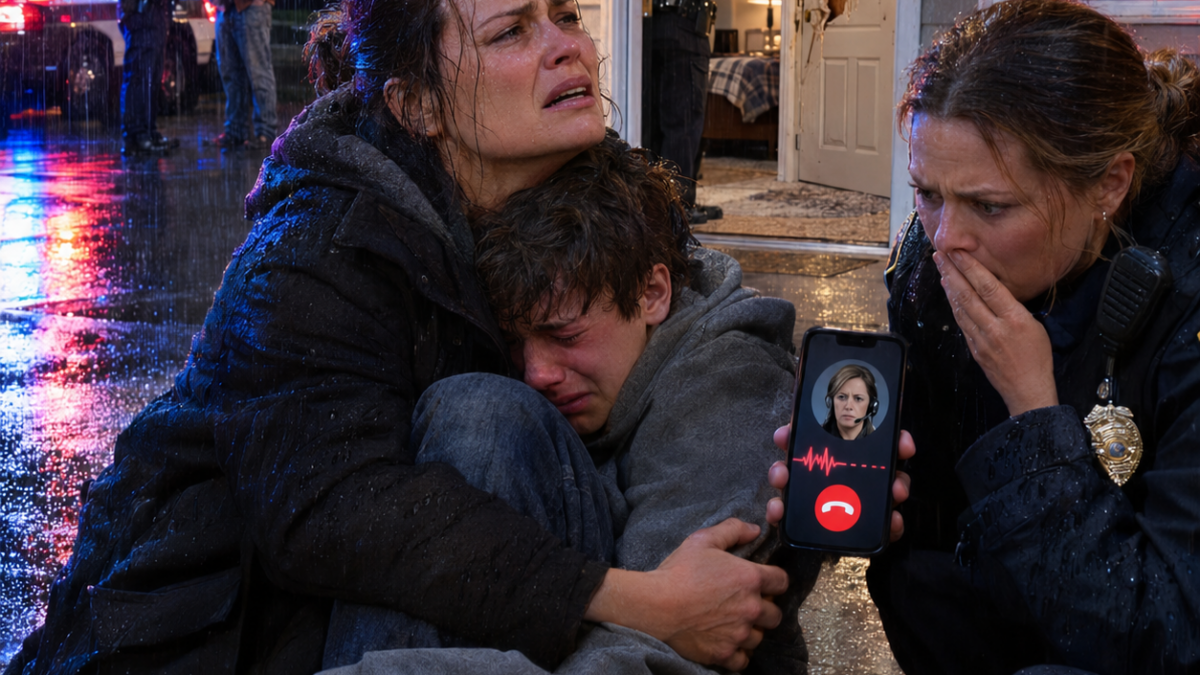
The line connected immediately.
“Brandon County 911. What is the address of your emergency?”
Micah recognized the voice.
His aunt.
Becky.
Relief hit him so hard he almost cried.
“5719 Pehl Road.”
Heath kicked again.
Wood split.
“5719 Pehl Road.”
Becky did not answer.
“Someone is kicking my bedroom door down.”
Another impact.
Micah pressed the phone closer.
“Please help me.”
Heath shouted from the hallway.
“You cannot hide in there forever!”
The threat was clear enough that later even Becky’s own defense attorney stopped pretending it could not be understood.
Micah whispered:
“Aunt Becky.”
Silence.
Then Becky exhaled.
A long, tired sigh.
“Not tonight, kid.”
Micah froze.
“Please.”
“Go back to bed.”
“Aunt Becky—”
“Enough.”
“5719 Pehl Road.”
Click.
Call ended.
Forty-one seconds.
Micah stared at the phone.
For a moment, I think the betrayal terrified him more than Heath.
Because until that second, the door was breaking but the world still had rules.
Call 911.
Say where you are.
Help comes.
Then the person answering was family.
And she chose the man breaking the door.
The next kick tore the lock assembly partially free.
Heath shoved an arm through the broken section.
His fingers reached blindly for the knob.
Micah looked behind him.
Window.
Second story.
Approximately eighteen feet.
Below:
Shrubs.
Wet grass.
Darkness.
He later told me he considered the closet.
Then realized Heath wanted the phone.
A closet would not stop him.
Micah opened the window.
Cold rain blew inside.
Heath shouted:
“Don’t do something stupid.”
Micah climbed onto the sill.
The door groaned.
He intended to hang from the sill and reduce the fall.
His hand slipped.
He dropped.
The world became impact.
His right femur fractured.
The left tibia and fibula broke.
His ankle shattered.
Pelvic fractures.
His shoulder dislocated.
He remained conscious.
That fact almost broke me when he finally told me.
He lay in wet grass unable to stand.
He could hear Heath inside his bedroom.
Then footsteps downstairs.
The front door opened.
Heath came outside.
Micah tried to move.
Pain exploded.
Heath walked toward him.
For one second Micah believed his uncle had come to help.
Heath looked down.
“Where’s the phone?”
Micah did not answer.
Heath searched the grass.
Found it in the flower bed.
The screen was cracked.
He picked it up.
Micah whispered:
“Help me.”
Heath looked toward the road.
Then at the phone.
And walked back into the house.
He did not call an ambulance.
Did not call David.
Did not call anyone.
He left Micah in the rain.
A delivery driver found him shortly before six.
The man had taken a rural shortcut after missing a turn.
He noticed something near our porch.
Stopped.
Walked closer.
Then called 911.
A different dispatcher answered.
Deputies came.
Ambulance.
David was pulled from an emergency-room treatment bay by his supervisor.
His son was being transported to the hospital where he worked.
When David reached the trauma entrance, Micah was unconscious again.
Heath arrived twenty minutes later.
Becky arrived still wearing her dispatch jacket.
That was how the lie began.
Not with a grand conspiracy meeting.
With people filling silence before the injured child could speak.
David asked:
“What happened?”
Heath looked devastated.
“I came over early because I thought I saw lights when I drove by.”
A lie.
“I found the door damaged.”
Another lie.
“And Micah outside.”
Partial truth.
David stared.
“Why was his door broken?”
“I don’t know.”
Becky put a hand on her brother’s arm.
“David, he may have panicked.”
“Panicked about what?”
“Nobody knows.”
“He doesn’t jump out windows.”
“Head injuries can happen during falls.”
“He got the head injury from the fall.”
Becky’s eyes held his.
“Let the investigators do their jobs.”
David asked:
“Did Micah call 911?”
One second.
Maybe less.
Becky shook her head.
“There was no dispatched event for your address.”
David did not notice the wording.
Not he didn’t call.
There was no dispatched event.
That difference mattered later.
The sheriff’s initial response treated the case as an unexplained fall.
The damaged bedroom door was photographed, but badly.
Heath suggested David might have broken it while rushing inside after being contacted.
David was too distraught to recognize how absurd that was.
The phone was found damaged.
Bagged.
The house became a chaotic family emergency instead of a clean crime scene.
By the time Micah woke properly, the public version already existed.
Local teen suffers severe injuries in nighttime fall.
Community rallies around military family.
Award-winning dispatcher aunt supports relatives.
Becky organized a meal train.
I am not making that up.
The woman who hung up on my son organized casseroles.
She posted:
Please pray for our brave Micah.
Hundreds of people did.
Then Micah woke enough to speak.
David sat beside him.
Five tubes seemed attached to his body.
Both legs immobilized.
His face swollen.
Micah opened his eyes.
“Dad.”
“I’m here.”
“Uncle Heath.”
David leaned close.
“What about Heath?”
“He came in.”
“Don’t talk yet.”
“He kicked my door.”
David stopped.
“What?”
“He wanted my phone.”
“What phone?”
“The video.”
“What video?”
“Barn.”
Micah began crying.
“I called 911.”
David’s heart started pounding.
“Okay.”
“Aunt Becky answered.”
David went still.
“She hung up.”
“What?”
“She told me to go back to bed.”
“Micah…”
“I gave her the address.”
“Son, you’re on a lot of medicine.”
That sentence.
David hated himself for it before it fully left his mouth.
Micah turned his face away.
He would remember that too.
David immediately stood.
“No. No, I’m sorry.”
Micah closed his eyes.
“I told you about the barn.”
David felt as if someone had hit him.
“Yes.”
“You didn’t believe me.”
“I know.”
Micah stopped talking.
David went into the hallway.
Called Becky.
She came to the hospital.
He confronted her in the parking lot.
“Micah says he called you.”
Becky did not flinch.
“He has a concussion.”
“He says you hung up.”
“I took dozens of calls that night.”
“Did he call?”
“If he called 911, it would be in the system.”
“Check.”
“I already did.”
“Show me.”
Her face hardened.
“Emergency records aren’t personal family records.”
“My son almost died.”
“And I am telling you there was no dispatch associated with your address before the delivery driver’s call.”
“Did you talk to him?”
Becky stared.
“David, be careful.”
“With what?”
“Accusing people because your son is confused.”
“He said Heath broke the door.”
“My husband loves Micah.”
“Then why is the door destroyed?”
“I don’t know.”
David called the sheriff.
Requested a formal review.
The active computer-aided dispatch system showed no emergency dispatched to 5719 Pehl Road at 3:09.
A brief entry existed around that time but had been closed as an abandoned juvenile nuisance call.
No complete address was visible in the main incident field.
No deputy sent.
The supervisor reviewing it assumed a child had called and disconnected.
Case closed.
Becky knew exactly which screen they would check.
What she did not control was the emergency center’s separate telephone recording server.
Nobody thought to request it.
Not yet.
Meanwhile David tried to reach me.
My assignment limited communications.
He sent:
Micah injured badly in fall. Stable. Multiple surgeries. Need you home when possible.
I got that message twelve hours later.
There are moments when military discipline is useful.
That was not one.
I went into a restroom.
Locked the door.
Sat on the floor.
Cried until I could breathe again.
I called when allowed.
David said doctors expected Micah to survive.
I asked:
“His legs?”
Long silence.
“What?”
“They’re doing everything they can.”
That told me enough.
Then he said:
“Dani, there may be more to what happened.”
“What?”
“I don’t want to tell you this over an unsecured line.”
Those eight months became their own form of punishment.
Micah underwent surgery.
Then another.
Then another.
External fixation.
Internal hardware.
Reconstruction.
Rehabilitation.
David spent every free hour beside him.
He also spent every night remembering the metal shaving Micah had put on the kitchen counter.
Every time Micah winced during therapy, David heard himself saying:
Leave it alone.
Becky and Heath continued playing concerned relatives.
That is how completely they believed they controlled the story.
Heath visited twice.
Micah refused to see him.
Becky called that “trauma confusion.”
David stopped answering her calls.
The town slowly divided.
Some people believed something was wrong.
Most trusted Becky.
Why wouldn’t they?
Sixteen years.
Awards.
Lives saved.
She was the voice they wanted answering if their own children called.
Who was easier to believe?
A respected dispatcher?
Or a fourteen-year-old with a concussion, heavy medication, and fragmented memories after a catastrophic fall?
Micah began doubting himself.
That was perhaps the cruelest thing they did.
One evening during rehab, he asked David:
“What if I dreamed the call?”
David sat beside him.
“You didn’t.”
“How do you know?”
David did not.
Not then.
“I believe you.”
“You didn’t before.”
David swallowed.
“No.”
Micah looked away.
That single syllable became the beginning of David earning his son back.
Not an excuse.
Not:
I was tired.
Not:
I didn’t understand.
Just:
No.
He had not believed him.
Months later, I finally came home.
David met me at the airport.
He looked thinner.
Gray in his beard.
I hugged him.
Then pulled away.
“Where’s Micah?”
“Rehab.”
“Drive.”
My bags stayed in the truck.
No homecoming meal.
No shower.
No photographs.
We went directly to the rehabilitation center.
Micah was between parallel bars when I entered.
For eight months I had imagined seeing him again.
In every version, he was sitting.
I had not imagined the braces.
Hard supports beneath his sweatpants.
A therapist at his elbow.
His body shaking from the effort of moving one foot six inches.
He looked over.
“Mom?”
I lost every ounce of military composure I had.
I crossed the room.
Micah released one rail.
I caught him.
He buried his face against my shoulder.
“I’m sorry.”
He pulled back.
“For what?”
“I left you.”
“You deployed.”
“I told you to watch the barn.”
He shook his head.
“Mom.”
“I should have—”
“Stop.”
I stared at him.
He whispered:
“You came back.”
Then he hugged me again.
I cried into his hair like he was four.
That night, after Micah slept, David told me the full story.
Every detail he knew.
When he finished, I asked:
“Where is the phone?”
“Sheriff’s evidence.”
“Did they search the cloud backup?”
His face changed.
“What?”
“Micah had automatic upload on.”
David stood.
“Oh my God.”
We woke Micah.
I hated doing it.
He gave us his password.
The cloud account opened.
Photos.
Homework.
Track videos.
Screenshots.
Then a video file.
Uploaded at 12:47 a.m. the night Heath saw him in the corncrib.
Twelve minutes.
Thirty-seven seconds.
I clicked.
When Heath’s face appeared, David whispered:
“No.”
I watched the vehicle.
Parts.
VIN plates.
Whiteboard.
Then the board cracked.
Camera jolted.
Heath’s flashlight.
His face turning upward.
Micah ran.
Recording ended.
David sat down.
Put both hands over his face.
“He told me.”
I did not comfort him.
Not then.
“He told me.”
“Yes.”
“I sent him back upstairs.”
“Yes.”
“I did this.”
“No.”
He looked at me.
“Heath did this.”
I moved closer.
“Becky did this.”
Then:
“You failed to listen.”
David closed his eyes.
“I know.”
“You will have to live with that.”
“I know.”
“So will I.”
He looked up.
“You?”
“I told him to be my eyes and ears.”
“Dani—”
“I know I didn’t mean this.”
“Then stop.”
“No.”
My voice broke.
“We don’t get to use good intentions to avoid looking at what happened.”
That became the rule in our family.
No lying to make ourselves easier to live with.
The next morning, we took the video to Detective Elena Ruiz with the state auto-theft task force.
Micah recognized her name from the article.
Ruiz watched the video.
Paused on the whiteboard.
Zoomed.
Then looked at me.
“Whose barn?”
“Mine.”
“Who is that?”
“Heath Maddox.”
Her expression changed.
“We know him.”
“How?”
“Not enough to charge.”
She turned the screen.
“Until this.”
One of the vehicles in Micah’s footage matched a stolen sedan.
A license plate on the whiteboard matched another open case.
Ruiz immediately requested the damaged phone, original house reports, towing records, and preservation of all relevant data.
Then I told her about 911.
She stopped writing.
“Who was the dispatcher?”
“Rebecca Maddox.”
“Becky Maddox?”
“Yes.”
“You’re sure?”
“She is Heath’s wife.”
Ruiz leaned back.
“That’s a conflict big enough to require outside review.”
“She says there’s no call.”
“Carrier records?”
“Nobody checked.”
“Raw audio?”
“Nobody checked.”
Ruiz’s jaw tightened.
“Then we check.”
Preservation notices went out that afternoon.
State emergency communications regulators became involved.
Internal affairs.
County counsel.
Phone carrier.
Dispatch systems vendor.
Everything.
Becky was placed on administrative leave.
By dinner, social media knew.
By bedtime, I was the villain.
Deployment mom comes home looking for someone to blame.
Becky saved this county for sixteen years.
Head injuries cause false memories.
Heath may be rough but he’s no murderer.
One man wrote:
Maybe Dani should have been home raising her kid instead of playing soldier.
I read that one twice.
Then a third time.
My hands started shaking.
David took my phone.
“Enough.”
“Give it back.”
“No.”
“They’re calling Micah a liar.”
“I know.”
“They’re saying I abandoned him.”
“You didn’t.”
“Didn’t I?”
David stared.
That question was not really for him.
It was for me.
He put the phone down.
Then said:
“If you want someone to blame for not listening, blame me.”
“I already do.”
The words came out before I could stop them.
David went pale.
I immediately regretted them.
But he nodded.
“You should.”
That took the anger out of me.
Not because he deserved everything I felt.
Because he wasn’t hiding.
He had spent eight months beside Micah.
Changed dressings.
Helped with showers.
Carried his son when he could not stand.
Slept in plastic hospital chairs.
And every day he had known the first warning came to him.
We sat at the kitchen table.
I reached for his hand.
“I’m angry.”
“I know.”
“I don’t know where to put it.”
“Put it where it belongs.”
“Heath.”
“Yes.”
“Becky.”
“Yes.”
“Not us.”
David’s eyes filled.
“We still have to fix us.”
“I know.”
Two days later, Ruiz called.
“Come to my office.”
David came with me.
Ruiz closed the door.
A small speaker sat on her desk.
My stomach turned before she said anything.
“We found the audio.”
I stopped breathing.
“Where?”
“Redundant telephony recorder.”
“Becky missed it?”
“She did not have administrative access to that archive.”
Ruiz explained.
The active CAD record had been manually reclassified and closed.
But the telephone controller automatically recorded caller metadata and location information.
A separate quality-assurance server recorded the audio.
The files had never been erased.
The automatic location data showed:
5719 Pehl Road.
Time:
03:09:14.
Duration:
00:41.
Ruiz asked:
“Do you want to hear it?”
No mother should answer yes to that question.
“Yes.”
She pressed play.
Becky’s voice.
Calm.
Professional.
“Brandon County 911. What is the address of your emergency?”
Then Micah.
Tiny.
Controlled.
Terrified.
“5719 Pehl Road.”
My hand found David’s.
“5719 Pehl Road. Someone is kicking my door down.”
Crash.
The speaker distorted with the impact.
Micah:
“Please help me.”
Heath in the background:
“You can’t hide in there forever!”
Micah:
“Aunt Becky, please.”
Silence.
Then Becky sighed.
“Not tonight, kid.”
My vision blurred.
“Go back to bed.”
Micah:
“5719 Pehl Road.”
Click.
Ruiz stopped it.
I stared at the speaker.
David bent forward.
Covered his face.
I could not move.
“She heard him.”
“Yes.”
“She heard Heath.”
“Yes.”
“She knew the address.”
“Yes.”
“And she changed the record.”
Ruiz pushed a printed audit report toward me.
Becky’s user credentials.
The call classification was manually changed minutes afterward.
The incident was closed without dispatch.
My son did everything right.
Everything.
He gave the address before explaining.
Repeated it.
Described the threat.
Stayed connected.
Used the caller’s name.
And she abandoned him anyway.
I stood.
Walked to the wall.
Put both palms against it.
Images came.
Heath.
Becky.
Micah in the rain.
I wanted to drive to their house.
I wanted them afraid.
I wanted the world to feel dangerous to them.
Ruiz must have seen something in my face.
“Dani.”
I turned.
“Do not confront them.”
I laughed without humor.
“You think I need that advice?”
“Yes.”
I hated her for the answer.
She continued.
“You are angry enough to make a bad decision.”
“My son may never run again.”
“I know.”
“She heard him.”
“I know.”
“She hung up.”
“I know.”
I stepped closer.
“You don’t know.”
Ruiz held my stare.
“My sister was killed by a drunk driver when I was twenty.”
That stopped me.
She said:
“I know what it is to want five minutes alone with someone.”
Silence.
“Five minutes can destroy the next thirty years of your life.”
I looked away.
“Let us build it.”
“How long?”
“As long as it takes to make it survive court.”
That became the hardest discipline I ever practiced.
Waiting while evidence replaced anger.
Investigators reopened the entire injury case.
They examined the broken bedroom door.
David had kept the damaged pieces in our garage.
He did not know why.
Guilt, maybe.
The splintering pattern supported force from the hallway side.
Micah’s medical records were reviewed.
The injuries were consistent with a fall.
Heath’s truck GPS data was subpoenaed.
His vehicle arrived at our farm at 2:46.
Left at 3:52.
The delivery driver found Micah at 5:41.
Nearly two hours.
Then Micah remembered more.
Trauma returned in pieces.
We were sitting in his room when he said:
“Mom.”
“What?”
“He came outside.”
My stomach dropped.
“Who?”
“Uncle Heath.”
“After you fell?”
Micah nodded.
David stopped breathing.
“What did he do?”
“He asked where the phone was.”
“Did he call for help?”
“No.”
“What happened?”
“He found it.”
“Where?”
“Flower bed.”
“And?”
“He left.”
I felt cold.
“He saw you?”
“Yes.”
“You were awake?”
“Yes.”
“You spoke to him?”
“I said help me.”
David turned away.
I gripped Micah’s hand.
“What did he do?”
“He looked at me.”
Micah swallowed.
“Then went inside.”
I left the room before my son watched me break something.
I went into the bathroom.
Locked the door.
Pressed a towel against my mouth.
Screamed into it.
Not because I wanted Micah not to know I was angry.
Because I wanted him to feel safe enough to remember without having to manage me too.
When I came back, he was staring at the floor.
“I’m sorry.”
“For what?”
“I should have remembered sooner.”
I knelt carefully in front of him.
“No.”
“I forgot.”
“No.”
“What if—”
“Micah.”
He looked at me.
“You were fourteen years old, injured, freezing, terrified, medicated, and betrayed by adults.”
His eyes filled.
“You do not apologize for surviving.”
That was the first time I saw something in his face loosen.
Investigators began mapping Heath’s operation.
Micah’s barn video opened doors.
Tow records.
Storage units.
Cash deposits.
Parts buyers.
Vehicle histories.
Several of Heath’s legitimate towing jobs had been mixed with stolen vehicles.
That was why the operation had survived.
If neighbors saw a tow truck moving cars at odd hours, they shrugged.
That was what tow trucks did.
The barn provided privacy.
My deployment provided opportunity.
David’s hospital schedule provided predictable empty nights.
Micah’s camera provided the first clear inside view.
Ruiz’s team identified three associates.
One agreed to cooperate.
Heath began moving records.
Storage property disappeared.
Becky hired an attorney.
Then investigators found something worse.
Texts.
Not hundreds.
They did not need hundreds.
One message from Heath to Becky sent hours before Micah’s call:
He got video. I’m dealing with it tonight.
Becky responded:
Do not bring this through dispatch.
I read that line in Ruiz’s office.
Once.
Twice.
Then pushed the paper away.
“She knew.”
“Yes.”
“Before he came.”
“Yes.”
There was no longer any possible version where Becky made a panicked decision after unexpectedly hearing Micah.
She knew her husband planned to confront him.
She anticipated emergency calls.
She told Heath not to involve dispatch.
Then when her nephew called begging for help, she acted on that plan.
I made it to the hallway before vomiting.
Ruiz handed me water.
I sat on the floor.
“She taught him how to call 911.”
Ruiz crouched nearby.
“I know.”
“She made him memorize the address.”
“I know.”
“Why?”
Ruiz did not answer.
Nobody could.
We wanted motives because motives feel like explanations.
Sometimes motives merely describe selfishness.
Becky protected her husband.
Her marriage.
Her reputation.
Maybe her own involvement.
She put all of that above a child.
There was no explanation large enough to make it comprehensible.
Meanwhile, Micah kept doing physical therapy.
That contrast became surreal.
While investigators discussed obstruction, auto theft, official misconduct, and criminal conspiracy, my son spent forty minutes trying to lift his left foot correctly.
His world had become small.
One more step.
One more degree of ankle movement.
One more lap with crutches.
The criminal case was huge.
His recovery was measured in inches.
He hated inspiration speeches.
A volunteer once told him:
“Everything happens for a reason.”
Micah stared.
Then answered:
“Do you know the reason my aunt hung up?”
The volunteer went pale.
I almost laughed.
Later I told him:
“That was mean.”
“So was what she said.”
“Fair.”
He smiled.
But at night, he cried sometimes.
Not loudly.
I heard it through the wall.
One night I sat beside him.
“I don’t want to be this person.”
“What person?”
“The kid everybody looks at and thinks, ‘That’s the one who fell.’”
“You aren’t.”
“I used to be fast.”
“I know.”
“I was going to run varsity.”
“I know.”
“I might never run like that again.”
I wanted to say:
You will.
Instead:
“I know.”
He looked at me.
That was what he needed.
Not false hope.
Someone willing to admit what had been stolen.
He whispered:
“I hate them.”
“You’re allowed.”
“Do you?”
“Yes.”
He looked surprised.
I continued:
“But I don’t want hate choosing what we do next.”
“Why?”
“Because they’ve already taken enough.”
Months into the investigation, county officials made a decision that almost pushed me over the edge.
Becky’s administrative leave status changed while employment proceedings were delayed.
She returned to limited dispatch duties under supervision.
I called Ruiz immediately.
“She’s answering calls?”
“Limited categories.”
“She hung up on my child.”
“I know.”
“What does somebody have to do to lose access to a 911 console?”
“Dani.”
“No.”
“Employment law and criminal prosecution are separate.”
“I don’t care.”
“You may not care, but prosecutors do.”
I drove to a county board meeting.
For the first time since returning, I spoke publicly.
No screaming.
I took Micah’s call-duration printout.
Placed it on the lectern.
Forty-one seconds.
I said:
“My son called your emergency system at 3:09 in the morning.”
The room went silent.
“He gave his address four times.”
I looked at the commissioners.
“He said someone was breaking into his bedroom.”
Nobody moved.
“The dispatcher heard the attacker threatening him.”
I paused.
“She disconnected him.”
One commissioner looked down.
“I understand that employment procedures exist.”
I held up the page.
“But if a dispatcher accused of intentionally suppressing a child’s emergency remains in any position to answer calls before a full safety review, then this county is asking every parent to trust a system it has not yet proven deserves that trust.”
No names.
No threat.
Just facts.
The video spread online.
Public pressure changed.
Not because people suddenly became better.
Because documentation was harder to dismiss than rumor.
The county placed Becky back on leave.
Then investigators obtained search warrants connected to Heath’s auto-theft operation.
One location was his and Becky’s farmhouse at 402 State Road.
I was not part of the warrant team.
That point matters.
The fantasy people later told was that I broke into Becky’s home and waited in the dark for Heath.
I didn’t.
My family had tools and records missing from our barn that investigators believed had been moved there.
Ruiz arranged for me to identify property after the search was secured.
The morning of the search, Becky was working a temporary administrative shift at dispatch pending final employment action.
Heath was believed to be away.
Agents entered under warrant.
I waited outside.
After about forty minutes, Ruiz came out.
“We found vehicle parts.”
“From our barn?”
“Some tools too.”
She paused.
“We need you to identify them.”
I entered.
Becky’s kitchen looked ordinary.
That upset me.
Granite island.
Coffee machine.
Holiday photograph magnets.
Family pictures.
One showed Becky holding Micah when he was a toddler.
I stared at it.
Ruiz said:
“Dani.”
“I’m okay.”
I wasn’t.
Then a truck turned into the driveway.
Ruiz looked through the window.
“Heath.”
Officers moved.
At almost the same moment, David texted:
Becky is on dispatch right now.
I looked at my phone.
Then at the kitchen.
Then at Ruiz.
“I want to call 911.”
“We have officers here.”
“I know.”
She immediately understood.
“This is not a revenge call.”
“No.”
“If you do it, everything becomes evidence.”
“I know.”
“No threats.”
“I understand.”
Heath’s key entered the front lock.
The sound was small.
To me, it was Micah’s bedroom handle at 3:09 a.m.
I dialed.
The connection opened.
“Brandon County 911. What is the address of your emergency?”
Becky.
That voice.
The voice newspapers praised.
The voice Micah trusted.
I put my palm on the granite.
“It’s me, Becky.”
Silence.
“Dani?”
“402 State Road.”
Her breathing changed.
“Your house.”
“Dani, why—”
“I’m standing in your kitchen.”
The line went completely quiet.
Heath opened the front door.
Saw investigators.
Stopped.
“Hands where we can see them.”
He looked past them.
Saw me.
His expression changed.
I stayed behind Ruiz.
On the phone, Becky whispered:
“When did you get back?”
“Months ago.”
“Why are you in my house?”
“Search warrant.”
Heath was being detained.
I watched him.
Then said:
“Your husband just walked through the door.”
Becky’s voice became frantic.
“Dani, don’t do anything.”
That sentence nearly made me laugh.
I did not.
“Micah’s recording survived.”
Nothing.
“The barn video uploaded.”
Becky inhaled.
“And your 911 call survived too.”
“Dani—”
“Forty-one seconds.”
“Please.”
I closed my eyes.
Then repeated exactly what she had said.
“Not tonight, kid. Go back to bed.”
Her professional voice disappeared.
“Please don’t do this on the line.”
“Why?”
“You know these calls are recorded.”
“I know.”
That was the entire point.
I looked at Heath.
“This is the last day he walks away from what he did.”
Ruiz glanced at me.
I immediately clarified:
“Because the evidence is here, Becky. Officers are here. Warrants are here. He is being arrested.”
That mattered.
I was angry.
I would not turn anger into a threat.
Becky began crying.
“Dani, I can explain.”
“No.”
“You don’t know everything.”
“I know my son gave you the address four times.”
Silence.
“You heard your husband at his door.”
Silence.
“You chose him.”
“Dani—”
“You chose him.”
Then I ended the call.
Not her.
Me.
Heath was arrested.
Not because I confronted him.
Because evidence had finally caught up to him.
Vehicle parts found during the search matched open theft cases.
Records linked transactions.
The whiteboard information from Micah’s video aligned with recovered vehicles.
Heath’s truck GPS placed him at our home.
An associate testified.
The case against Becky moved shortly afterward.
She was terminated from emergency communications.
Then arrested on charges connected to official misconduct, obstruction, evidence manipulation, and her role in preventing emergency response.
The town changed almost overnight.
That angered me too.
People who had called Micah confused now posted:
We always knew something was wrong.
No, they didn’t.
One commissioner who had publicly urged people not to “rush to judgment” suddenly declared that the county stood “united with the Mercer family.”
I saved both statements.
Micah asked:
“Why?”
“To remind myself that public certainty is cheap.”
He nodded.
The criminal cases took almost a year.
Real justice is slow.
Heath’s lawyer tried everything.
Micah had trespassed in the corncrib.
The barn arrangement was misunderstood.
Heath intended only to recover private business information.
The door damage occurred because he was concerned for Micah.
That argument collapsed against the 911 audio.
You can’t hide in there forever.
The truck GPS.
The broken frame.
Micah’s injuries.
And most damaging of all:
Heath saw Micah injured outside.
Asked for the phone.
Left without calling for help.
An emergency-medicine specialist testified about the additional danger of prolonged cold exposure after major fractures.
I watched Heath during that testimony.
He looked down.
Never at Micah.
Becky’s trial preparation was harder emotionally.
Her attorney emphasized her history.
Sixteen years.
Thousands of calls.
Lives saved.
Awards.
Excellent reviews.
All true.
Then the prosecutor played forty-one seconds.
No speech before it.
Just audio.
Becky:
“What is the address of your emergency?”
Micah:
“5719 Pehl Road.”
Crash.
“5719 Pehl Road. Someone is kicking my door down.”
Heath:
“You can’t hide in there forever!”
Micah:
“Aunt Becky, please.”
Then:
“Not tonight, kid. Go back to bed.”
Click.
The courtroom stayed silent for several seconds afterward.
Then prosecutors displayed the audit trail.
Her login.
Her reclassification.
Her closure.
Then the text:
He got video. I’m dealing with it tonight.
Her reply:
Do not bring this through dispatch.
That ended any credible claim that she thought Micah was prank calling.
She knew.
Before the phone rang.
She knew.
Becky eventually accepted a plea rather than force Micah through a full trial.
The plea acknowledged that she intentionally failed to dispatch assistance despite recognizing an active emergency and later altered the call record to conceal that failure.
Heath also entered a plea covering the home invasion, criminal conduct connected to the stolen vehicles, and reckless disregard in leaving Micah injured without seeking aid.
Several associates faced separate charges.
There was no courtroom cheering.
No judge telling us revenge had arrived.
Sentencing day was almost painfully quiet.
Micah chose to speak.
I offered to read his statement.
He said no.
He walked to the front without crutches.
A slight limp.
Metal still in one leg.
He stood behind the lectern.
Looked first at Heath.
Then Becky.
“My name is Micah Mercer.”
His voice shook.
He stopped.
Started again.
“I was fourteen when I called 911.”
Becky lowered her head.
“I was taught that the first thing you say is the address.”
He paused.
“So I said it.”
His hands tightened around the paper.
“Four times.”
My chest hurt.
“I used to think the worst thing that happened that night was falling.”
He looked toward us.
“It wasn’t.”
Then back toward Becky.
“The worst part was realizing someone heard me and decided not to help.”
Becky cried.
Micah continued.
“For a long time I thought maybe I did something wrong.”
Heath stared at the table.
“Maybe I shouldn’t have recorded the barn.”
“Maybe I shouldn’t have run.”
“Maybe I shouldn’t have jumped.”
He took a breath.
“But I know now that I was a kid trying to survive adults making choices.”
The courtroom was completely still.
“You do not get my running back.”
His voice broke.
“You do not get the surgeries back.”
“Or my dad’s guilt.”
David began crying beside me.
“Or my mom being overseas while everybody told her I fell.”
Micah wiped his face.
“But you also do not get the rest of my life.”
That was the sentence.
The one everyone remembered.
“You do not get the rest of my life.”
He folded his statement.
Walked back to us.
I stood.
Held him.
I did not look at Becky or Heath.
I did not need to.
The judge sentenced them.
Substantial prison time.
Restitution.
Permanent employment consequences for Becky in emergency communications.
Financial consequences tied to Heath’s criminal operation.
But the sentence that satisfied me most was not measured in years.
It was the public record.
No more accidental fall.
No more confused child.
No more family misunderstanding.
The record finally said:
Micah called for help.
He gave the address.
The threat was audible.
Help was intentionally withheld.
Heath caused the emergency.
That mattered more than vengeance.
The county faced its own investigation.
Because Becky was guilty.
But systems also failed.
No supervisor automatically reviewed the closure of a juvenile emergency call containing audible violence.
The raw audio sat untouched for eight months.
The dispatch center relied too heavily on one employee’s classification.
The county agreed to changes.
Calls involving minors and audible threats could no longer be closed by one dispatcher without supervisor confirmation.
Automatic location data had to remain visible.
Manual reclassification triggered audit review.
Conflict-of-interest rules required dispatchers to notify supervisors immediately if callers or suspects were close relatives.
Quality-assurance sampling expanded.
The county also created a direct state-review pathway for suspected dispatcher misconduct.
Some employees complained about increased documentation.
I did not care.
Forty-one seconds had converted me into a lifelong supporter of redundant records.
The county reached a civil settlement with our family.
We used it for Micah’s medical bills.
Future care.
Education.
And something Micah proposed himself.
A small scholarship for students entering emergency communications and public-safety oversight.
He named it:
The First Question Fund.
I asked:
“Why that?”
He looked at me like the answer was obvious.
“Because the first question is the address.”
Part of the program funded training around conflict disclosure and call preservation.
Micah refused to put his name on it.
“This isn’t about me being famous.”
I smiled.
“You sound like your mother.”
“That is deeply upsetting.”
David’s healing was harder.
There was no legal system for a father who failed to believe his son soon enough.
No sentence.
No settlement.
No document saying:
Paid.
Complete.
Closed.
He carried it.
Micah knew.
One night after dinner, David asked him to sit in the barn with him.
The barn had been released after the investigation.
No vehicles.
No parts.
Empty.
David said:
“I owe you something.”
Micah leaned against the workbench.
“You’ve apologized.”
“I know.”
“Like a thousand times.”
“I know.”
“Dad.”
David looked at him.
“I don’t want you to forgive me because I’m your father.”
Micah stopped.
“I want you to know that I understand what I did.”
Silence.
“You told me something scared you.”
David’s voice cracked.
“I made your age more important than what you were saying.”
Micah looked down.
“I was tired.”
David shook his head.
“That explains nothing.”
I stood outside the barn listening without meaning to.
“I treated peace in the family as more important than checking whether you were safe.”
Micah whispered:
“Yeah.”
David nodded.
“I will regret that for the rest of my life.”
Micah’s eyes filled.
Then:
“I don’t want you to.”
David looked surprised.
“What?”
“I want you to remember.”
Micah wiped his face.
“But I don’t want it to ruin you.”
David broke.
So did I.
Micah hugged his father.
Trust did not magically return.
But honesty made room for it.
Years later, when Micah disagreed with David, the old wound occasionally returned.
“You didn’t believe me then.”
That hurt.
But David never defended himself.
He said:
“You’re right.”
Eventually Micah stopped using it in arguments.
Not because he forgot.
Because he no longer needed to test whether his father would admit the truth.
Rehabilitation lasted years.
Five surgeries total.
Months of braces.
Crutches.
Pools.
Weights.
Stretching.
Pain.
His right leg recovered better.
The left ankle remained stiff.
Cold weather still bothers him.
The first time he attempted running again, he made about thirty yards.
Stopped.
Bent over.
Cried.
I went toward him.
He raised one hand.
“Don’t.”
So I stopped.
He stood there.
Breathing.
Then whispered:
“I used to be fast.”
I wanted to say:
You still are.
I didn’t.
“I know.”
He looked at me.
“My mile was five-oh-eight.”
“I know.”
“I was going under five.”
“I know.”
His face twisted.
“I hate them.”
“I know.”
Then he looked toward the track.
“Tomorrow.”
“What?”
“I’m doing this again tomorrow.”
That became Micah.
Not inspirational.
Stubborn.
He ran again.
Thirty-five yards.
Then fifty.
Then a hundred.
Months later, a mile.
Twelve minutes fourteen seconds.
David timed him.
At the finish, Micah looked at the watch.
“Twelve fourteen.”
David said:
“You finished.”
Micah’s mouth tightened.
“My old time—”
I interrupted.
“No.”
He looked at me.
“Your time today is twelve fourteen.”
Silence.
“No ghosts.”
Micah looked at the track.
Then nodded.
“Tomorrow under twelve.”
Eleven fifty-eight.
He laughed when he crossed.
A real laugh.
The kind I had not heard since before the fall.
He never returned to competitive high-school track.
That loss remained.
But he eventually ran recreationally.
Then stopped timing himself.
One evening I asked why.
He shrugged.
“Got tired of racing a dead version of me.”
That sentence stayed with me.
The back barn stayed empty for almost a year.
I hated walking near it.
Micah hated the corncrib more.
At first I wanted both structures torn down.
Then Micah said:
“No.”
“Why?”
“Heath doesn’t get the buildings.”
I stared at him.
He continued:
“He already took enough.”
So we repaired the corncrib.
Replaced rotted boards.
Turned it into ordinary storage.
The barn became farm equipment again.
Tractor parts.
Fence posts.
Feed.
Boring things.
That was perfect.
Ordinary life reclaimed the space.
Becky wrote Micah from prison.
The letter arrived addressed in her handwriting.
He stared at it.
Then handed it to me.
“What do you want me to do?”
“Whatever you want.”
“I don’t want to read it.”
“Then don’t.”
“Should I throw it away?”
“Your choice.”
He thought.
“Keep it somewhere.”
“Why?”
“In case future me wants it.”
I put it in a sealed file box.
Years passed.
He still has not read it.
People sometimes ask whether we forgave Becky.
I dislike the question.
It is often asked because forgiveness makes the listener feel comfortable.
Micah does not owe anybody a beautiful ending.
He built boundaries.
That was enough.
I never spoke to Becky privately again.
I did see her once during a court transfer.
Our eyes met.
She mouthed:
I’m sorry.
Maybe she was.
I looked away.
Her remorse belonged to her.
My responsibility was my son.
The dispatch center removed Becky’s award from the lobby.
Micah had mixed feelings.
“She did save people.”
“Yes.”
“Taking it down feels like pretending she never did.”
“What would you do?”
He thought.
“Stop treating dispatchers like heroes.”
I raised an eyebrow.
“You hate dispatchers now?”
“No.”
“Then what?”
“They’re professionals.”
He shrugged.
“They need training, checks, accountability. Hero stuff makes people think good people can’t do bad things.”
I stared at him.
“You’re fourteen going on forty.”
“I’m eighteen.”
“Same thing.”
The county replaced the display with a framed statement of duty.
The first line:
THE CALLER’S SAFETY COMES BEFORE PERSONAL RELATIONSHIPS, REPUTATION, OR ASSUMPTION.
Then:
VERIFY THE LOCATION. DISPATCH THE HELP. DOCUMENT THE CALL.
Micah read it.
Then said:
“They forgot one.”
“What?”
“Listen.”
The county never added that word.
But we did.
Listen became sacred in our family.
When Micah said his leg hurt, we listened.
When David admitted nightmares, we listened.
When I admitted that sometimes I still wanted to hear Becky begging on the phone, David listened without pretending that thought made me evil.
Then he reminded me:
“You didn’t act on it.”
That mattered.
Justice and revenge often begin in the same emotional place.
Someone you love is hurt.
You want balance.
Pain for pain.
Fear for fear.
The difference is what you do next.
I wanted Heath frightened.
The law made him accountable.
Those are not the same thing.
It took me time to understand why the second was better.
Fear fades.
A record remains.
Years after the case, Micah went to college.
He surprised us by studying criminal justice with a concentration in emergency communications oversight.
I laughed when he told me.
“Seriously?”
“Seriously.”
“You spent four years hating 911.”
“I hated what Aunt Becky did.”
“Difference?”
“Huge.”
He adjusted his backpack.
“Systems don’t become safer because good people assume everybody else is good.”
I stared at him.
“That sounded suspiciously mature.”
“Don’t tell anyone.”
After graduation, he began working in public-safety compliance and emergency-call quality review.
Not answering 911 calls.
Reviewing them.
Training supervisors.
Studying failure patterns.
Conflict procedures.
Call classification.
Preservation.
One day he invited me to observe a training session.
I sat in the back.
He stood at the front.
Slight limp when he got tired.
Confident voice.
No mention of Becky.
No dramatic personal story.
Just training.
He said:
“When a caller is frightened, they may repeat information.”
He clicked to the next slide.
“Do not interpret repetition as nuisance behavior.”
Another.
“When a minor reports an active threat, age is not evidence of unreliability.”
Another.
“Location first.”
Then he paused.
“If someone gives you an address once, verify it.”
My throat tightened.
“If they give it four times while violence is audible in the background…”
He stopped.
Just for a second.
Then:
“…help should already be moving.”
Nobody in the room knew why that sentence cost him something.
I did.
After class, we walked to the parking lot.
“You were good.”
He groaned.
“Mom.”
“I’m serious.”
“Don’t do the proud-parent thing.”
“I am a mother. This is protected activity.”
“Legally?”
“Constitutionally.”
“That is absolutely not true.”
“You work in criminal justice, not constitutional law.”
He laughed.
The limp was barely visible that day.
Maybe that is the ending people want.
But there was one more moment.
A few years later, I woke at 3:09 in the morning.
Exactly 3:09.
I noticed because my body had somehow remembered the time even when my mind had not.
I heard footsteps upstairs.
Micah was home visiting.
I walked into the hallway.
His bedroom door was open.
He sat on the floor with an old storage box.
Inside:
Braces.
Hospital wristbands.
Therapy bands.
The unopened letter from Becky.
He held it.
“You reading it?”
“I don’t know.”
I sat beside him.
“What do you want?”
“I want not to care.”
“That’s not the same as reading it.”
“I know.”
He turned the envelope over.
“What if she explains?”
“Would that change what happened?”
“No.”
“What if she apologizes?”
“She already apologized.”
“Would that change what happened?”
“No.”
He leaned back against the wall.
“Then why read it?”
“You don’t have to.”
He looked at me.
“Do you want me to forgive her?”
“No.”
That answer surprised him.
“I want you free.”
“Isn’t forgiveness supposed to do that?”
“Maybe for some people.”
I looked at the envelope.
“But boundaries can do it too.”
Micah smiled slightly.
“Military mom therapy.”
“Very expensive.”
He put the letter back.
Then noticed his first braces.
He lifted them.
“I hated these.”
“They smelled terrible.”
“They did.”
Silence.
Then:
“Do you ever think about what would’ve happened if she sent a deputy?”
Every day.
“Yes.”
“Heath gets stopped.”
“Maybe.”
“I don’t jump.”
“Probably.”
“I break five minutes.”
I could not answer.
Alternative lives are cruel because they cannot be disproved.
Micah looked at the braces.
Then said:
“But I like my job.”
“I know.”
“I like who I am.”
“I know.”
“That doesn’t make what happened okay.”
“No.”
He nodded.
“Good.”
We sat there for a while.
Then he carried the box into the closet.
Not thrown away.
Not displayed.
Stored.
That felt right.
The farm is quiet now.
No tow trucks after midnight.
No blue-white saw flashes.
No hidden vehicles.
The corncrib holds fencing supplies.
The barn holds a tractor.
David eventually reduced his hospital hours.
Not because he stopped loving emergency medicine.
Because he finally accepted that being exhausted all the time had consequences.
He became the nurse younger staff went to when a child said something strange or uncomfortable.
He never said:
“They’re just a kid.”
Not anymore.
I eventually left active service.
Retirement felt strange.
For years, people assumed deployment had made me tough enough to survive everything that followed.
That is not true.
Nothing trained me to hear my child begging his aunt for help.
Nothing trained me to watch him relearn walking.
Nothing trained me to love my husband while also being furious that he once failed our son.
We survived because survival became a series of ordinary decisions.
Go to therapy.
Show up for court.
Save the document.
Tell the truth.
Try one more step.
Eat dinner.
Sleep.
Wake up.
Do it again.
That is less dramatic than revenge.
It is also what brought our family back.
The phrase people remember from our story is usually mine.
This is his last day walking away from what he did.
I understand why.
It sounds powerful.
But if I am honest, the most powerful sentence was not mine.
It belonged to Micah.
Four words and a road number.
5719 Pehl Road.
Again.
5719 Pehl Road.
Again.
Again.
He kept telling them where to find him.
That was what haunted me.
Then, eventually, it became what made me proud.
Because my son never failed that night.
The adults did.
He identified danger.
He gathered evidence.
He ran.
He locked the door.
He called.
He gave the address.
He begged for help.
And when the system betrayed him, he chose the only exit left.
For years, he felt ashamed of jumping.
Now he understands.
He survived.
That is all.
There is no shame in surviving.
The last time I visited his office, a framed card sat on his desk.
Not his photograph.
Not a newspaper story.
Just six words:
WHAT IS THE ADDRESS OF YOUR EMERGENCY?
Underneath, in smaller letters:
Ask. Listen. Believe. Send help.
I stood there looking at it.
Micah came behind me.
“You like it?”
“Yes.”
“Too dramatic?”
“No.”
He smiled.
“Good.”
Then he grabbed his jacket.
“Lunch?”
We walked outside.
He moved with a slight stiffness in his left ankle.
Nothing more.
At the curb, a young man jogged past.
Micah watched him for a second.
Years earlier that would have broken him.
Now he just looked.
Then opened the passenger door.
“You coming?”
I realized I had stopped.
“Yes.”
As we drove away, I thought about the boy beneath that second-story window.
Fourteen.
Wet grass.
Broken legs.
Waiting for help that his own aunt decided not to send.
I wish I could go back to him.
I wish I could kneel beside him before the delivery driver arrived.
I would tell him:
Your mother is coming home.
Your father will learn how badly he failed you, and he will spend the rest of his life listening better.
The video is safe.
The call is safe.
Your memory is real.
You are not crazy.
You are not weak.
You are not responsible for what adults chose.
The woman who hung up will one day hear her own voice played back where she cannot erase it.
The man who kicked your door will one day stand before a judge while the truth about the barn is read into the record.
People who doubted you will learn that confidence is not the same thing as truth.
And those legs you think are the end of everything?
They will hurt.
They will scar.
They will never be exactly what they were.
But one day they will carry you into a room full of emergency professionals.
You will stand in front of them.
You will teach them how to answer frightened children.
And when you tell them that help should already be moving before a child has to repeat his address four times, nobody will know why your voice shakes.
But I will.
Because I will be sitting in the back row.
Listening.
The way you deserved to be listened to from the beginning.
Heath tried to silence my son.
Becky disconnected him.
For eight months, their lie survived because adults trusted reputation more than a wounded boy.
But they made one mistake.
They believed truth disappeared when the call ended.
It didn’t.
The video survived.
The server survived.
The audit trail survived.
The records survived.
And most importantly—
Micah survived.
They got one terrible night.
They never got the rest of his life.








