PART2:“NOBODY LEAVES!” My Ex-Husband’s Family Blocked My SUV While My Daughter Was Suffocating—Then I Opened the Black Wallet They Had Never Seen
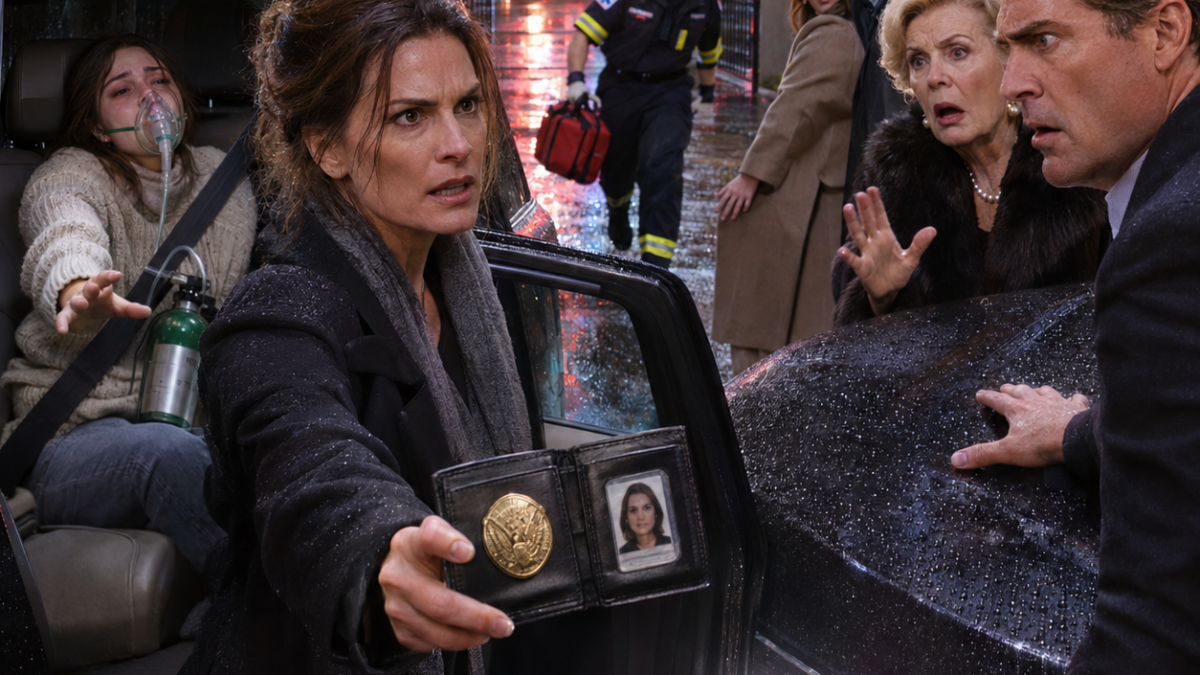
Of course.
They had brought the whole family.
I took the curb because there was no clean path to the front door.
My SUV crossed the lawn.
Mud sprayed behind me.
I stopped near the porch.
Ran inside.
The smell hit first.
Cold.
Metallic.
Wrong.
White vapor drifted low over the sunken living room.
Veta lay near the sofa.
Curled inward.
One hand at her throat.
Her lips were dark.
The main oxygen assembly had been smashed open.
Polymer casing split.
Control unit broken.
Tubing torn.
A heavy steel framing hammer rested on the coffee table.
And Bellamy was still holding her phone.
Recording.
I dropped beside Veta.
“Baby.”
Her eyes found me.
“Sloan.”
Declan’s voice behind me.
“Don’t overreact.”
I did not look at him.
I opened the trauma bag.
Portable oxygen.
Backup interface.
Monitor.
I had trained Veta on emergency switching a hundred times, but her hands were too weak now.
“Eyes on me.”
She tried.
“Good.”
I checked her airway.
Breathing.
Circulation.
Then fitted the emergency support.
Her first assisted breath sounded like something tearing open inside my chest.
Again.
Again.
Monitor on.
Numbers low.
Too low.
I supported her while the emergency system took over.
Color did not return immediately.
I expected that.
Bellamy spoke behind me.
“She’s fine.”
I turned my head slowly.
“What?”
Bellamy lowered the phone.
“She’s breathing.”
I looked at the hammer.
Then at her.
“Did you hit that system?”
She folded her arms.
“It was making this insane noise through my microphone.”
Declan said:
“It was an accident.”
Kieran shouted from near the hallway.
“It was not!”
Una snapped:
“Enough.”
I focused on Veta.
Not them.
“How do you feel?”
Her voice barely came.
“Dizzy.”
“Chest pain?”
She shook her head.
“Stay with me.”
I lifted her carefully.
Twenty-four kilograms lighter than she should have been.
Nineteen years old.
My whole world in my arms.
“I’m taking her to the hospital.”
Declan moved in front of me.
“No.”
I stopped.
He actually said it again.
“No hospitals.”
I stared at him.
“My daughter is hypoxic.”
“She’s stable now.”
“You don’t know what that word means.”
“Bellamy made a mistake.”
Bellamy hissed:
“I didn’t make a mistake.”
Good.
Every phone in that room seemed suddenly very visible.
Kieran’s.
Bellamy’s.
Declan’s.
Several relatives had been filming.
I carried Veta toward the front door.
Una stepped into my path.
“If police get involved, Bellamy’s entire career is over.”
I looked at her.
“Move.”
“Sloan.”
“Move.”
She did.
Not because my voice was loud.
It wasn’t.
Because people sometimes recognize certainty even when they do not respect morality.
I reached the porch.
Then the driveway.
My SUV was twelve feet away.
Eleven people followed.
Declan.
Una.
Bellamy.
Two uncles.
Three cousins.
Aunt Mirelle.
Bellamy’s boyfriend.
Declan’s older brother.
Even Kieran, though he stayed several steps behind.
I opened the passenger door.
Secured Veta into the medical transport restraint I kept installed.
Connected the portable supply.
Checked flow.
Checked monitoring.
Then went around toward the driver’s side.
Declan blocked me.
“We need to talk.”
“No.”
Una came beside him.
“You cannot leave until we know what you’re planning to tell people.”
I stared.
“You think this is about your reputation?”
Bellamy stepped forward.
“You need to calm down.”
Behind her, three relatives moved across the driveway.
Then four more.
A wall.
Someone shouted:
“Nobody leaves until this is settled.”
Another:
“Put your phone away.”
Another:
“No cops.”
Veta made a weak sound inside the SUV.
That ended the conversation.
I reached into my jacket.
Declan’s expression changed.
For one second, he thought I was reaching for a weapon.
I wasn’t.
I pulled out the black leather wallet.
Opened it.
First card.
Federal emergency-management contractor credential.
Second.
My crisis-extraction identification.
Then the document.
A certified family-court order.
I held it where Declan could see the seal.
His face changed.
Una went silent.
Bellamy stopped recording.
Three weeks earlier, after Declan had tried to prevent Veta from taking her backup respiratory equipment to a visitation weekend because he said it made Una’s house “look like a hospital,” my attorney had filed an emergency motion.
The judge had not ended visitation.
But the order was explicit.
If any member of Declan’s household interfered with medically necessary respiratory support, refused emergency care, or obstructed Veta’s lawful removal for medical treatment, my authority to remove her became immediate and exclusive pending further hearing.
More importantly, the order directed that any obstruction of emergency medical removal could be documented and referred to law enforcement.
Declan knew about it.
He had signed acknowledgment.
He had apparently assumed I would never carry it.
I looked at him.
“You remember this?”
His mouth opened.
No words.
Then I pulled out my phone.
The second thing that made them pale.
The 911 call was already connected.
Not dialing.
Connected.
My SUV’s emergency system had called while I was stabilizing Veta.
Dispatch had been listening for almost four minutes.
I raised the phone.
The dispatcher’s voice came through.
“Ms. Mercer, officers and EMS are less than two minutes out.”
Nobody moved.
I continued.
“For the record, eleven adults are presently obstructing the only vehicle carrying my medically fragile daughter away from a residence where her life-support equipment was intentionally damaged.”
Bellamy whispered:
“You’re insane.”
The dispatcher answered before I could.
“Ms. Mercer, do not engage physically. Remain with your daughter. Law enforcement is arriving.”
Kieran backed away first.
Then one cousin.
Then another.
Like a wall discovering it had no foundation.
Declan stepped aside.
Una grabbed Bellamy’s wrist.
“Delete the livestream.”
Bellamy looked at her.
“What?”
“DELETE IT.”
I almost smiled.
Not because I was amused.
Because Una still did not understand how the internet worked.
Kieran said quietly:
“It’s already saved.”
Bellamy turned.
“What?”
“I screen-recorded it.”
Her face went white.
“Kieran.”
“And it was live.”
“What did you do?”
“I made sure Sloan would know exactly what happened.”
Bellamy lunged toward him.
A siren sounded.
She froze.
Two police vehicles turned onto the street.
Then an ambulance.
I opened my driver’s door.
Officer Hale reached me first.
“What happened?”
I handed him the court order.
Then pointed through the SUV window.
“My daughter needs emergency transport.”
The paramedics took over.
That was the last moment I allowed myself to function as the lead person.
Once professionals arrived, I became Veta’s mother.
The switch almost broke me.
I rode in the ambulance.
Sat beside her.
Held her hand.
Her oxygen saturation began climbing.
Slowly.
The paramedic asked:
“What happened to the primary system?”
“My aunt smashed it.”
Veta’s voice was barely audible.
The paramedic looked at me.
I nodded.
“She witnessed it.”
He documented the statement.
Veta whispered:
“Dad filmed.”
I closed my eyes.
Of course he had.
At the hospital, everything became light.
White walls.
Monitors.
Questions.
Respiratory therapy.
Blood tests.
Imaging.
Observation.
The emergency oxygen had prevented the worst outcome, but Veta had experienced significant respiratory distress and hypoxemia.
The physicians kept her overnight.
I sat beside the bed.
At 6:40 p.m., she woke enough to speak comfortably.
“Mom.”
“I’m here.”
“Did they break my machine?”
“Yes.”
Her eyes filled.
“All of it?”
“The primary unit.”
She turned her face away.
I thought she was afraid.
Then she whispered:
“I helped design the paint on the casing.”
That sentence hurt more than the price.
The machine was not just equipment.
Veta had painted a blue-and-silver wave pattern on its protective shell.
Ocean colors.
She had spent four weekends choosing them.
I leaned close.
“We’ll build another.”
“It cost so much.”
“I don’t care.”
“You do.”
“Not tonight.”
She started crying.
“I wanted Dad to like having me there.”
My throat closed.
“Veta.”
“I tried to keep it quiet.”
I stared.
“What?”
“When Bellamy started filming.”
“How?”
“I turned alarms lower.”
My blood went cold.
“Baby, never do that.”
“I didn’t want them mad.”
That was when I realized the real damage went far beyond Bellamy’s hammer.
They had made my daughter feel ashamed of the machine keeping her alive.
I sat beside her until she slept.
Then I walked into the hospital bathroom and finally let myself cry.
Ten minutes.
That was all I gave the collapse.
Then I called my attorney.
Mara Ellison.
She answered on the second ring.
“Sloan.”
“You were right.”
“What happened?”
I told her.
Silence.
Then:
“Is Veta safe?”
“Hospital. Stable.”
“Good.”
“The system is destroyed.”
“Police have the scene?”
“Yes.”
“Livestream?”
“Kieran preserved it.”
“Declan filmed too.”
Another silence.
Mara’s voice hardened.
“I’m filing tonight.”
“For what?”
“Emergency suspension of visitation. Protective relief. Preservation of digital evidence.”
“Do it.”
Then:
“And Sloan?”
“Yes?”
“Do not contact Declan.”
“I wasn’t going to.”
“Do not contact Bellamy.”
“I know.”
“Do not post anything.”
“I know.”
“Do not threaten anyone.”
I almost laughed.
“Mara.”
“I know you know.”
“Apparently everybody thinks I’m going to rappel through a window.”
“Your ex-family thinks you have a secret government hit squad.”
“Let them.”
She laughed once.
Then became serious.
“What exactly is in the black wallet?”
“Credentials. Court order.”
“Nothing else?”
“Nothing else.”
“Good.”
The next morning, police returned.
Detective Nora Price.
Calm.
Organized.
She had already reviewed initial body-camera footage.
Bellamy’s public livestream had been preserved before it disappeared.
Kieran had provided his screen recording.
One cousin had turned over another phone video.
The footage showed the argument beginning.
Bellamy complaining about the sound.
Veta asking her not to touch the equipment.
Declan laughing.
Una telling Bellamy:
“Just move the ugly thing.”
Then Bellamy lifting the framing hammer.
The first blow cracked the external protective housing.
Veta screamed.
Kieran moved toward her.
Declan stopped him with one arm.
Bellamy struck again.
The second impact damaged the assembly severely enough to trigger rapid oxygen release and failure.
Then came the line from Bellamy.
“Maybe she’ll stop being so weak.”
Declan laughed.
He actually laughed.
On video.
Not nervous laughter.
Not shock.
Amusement.
Then Kieran shouted:
“She can’t breathe.”
Declan lowered his phone.
And said:
“Don’t call anyone yet.”
The detective paused the video.
I stared at the frozen image of my ex-husband.
“What happens now?”
“We investigate.”
“She could have died.”
“I understand.”
“What happens?”
Nora did not promise me punishment.
I respected her for that.
“We preserve evidence, interview witnesses, obtain medical records with consent, document the damaged equipment, and refer charges supported by the evidence.”
I nodded.
“Good.”
She looked at me.
“You’re very calm.”
“No.”
I folded my hands.
“I’m controlled.”
Difference.
The police had secured the damaged oxygen system as evidence after consulting appropriate safety specialists.
The manufacturer sent an engineer.
Not to repair it.
To assess failure and replacement value.
His report was devastating.
The damage was consistent with forceful impact.
Critical control components destroyed.
Pressure-management assembly compromised.
System beyond economical repair.
Replacement estimate:
$131,480.
Bellamy’s attorney later argued that number was exaggerated.
The insurer had already paid roughly that amount when the original system was commissioned.
Documentation existed.
Invoices.
Serial numbers.
Service records.
Nothing in my life was better documented than Veta’s medical equipment.
Declan should have remembered who he divorced.
The emergency custody hearing occurred forty-eight hours later.
Declan looked exhausted.
Una sat behind him.
Bellamy was absent on advice of counsel.
Mara presented the court order Declan had previously acknowledged.
Then the livestream.
Not all of it.
Enough.
Veta asking Bellamy to stop.
Hammer.
Failure alarm.
Kieran yelling.
Declan refusing immediate ambulance contact.
Then the driveway recording.
Relatives blocking the SUV.
Voices:
Nobody leaves.
No police.
We settle this privately.
The judge stopped the video.
Looked at Declan.
“Mr. Caldwell.”
“Yes, Your Honor.”
“Did you understand that your daughter’s respiratory system was medically necessary?”
“Yes.”
“Did you understand the prior order?”
“Yes.”
“Why was emergency care delayed?”
Declan looked toward his attorney.
Then:
“I panicked.”
The judge stared at him.
“You prevented another adult from calling an ambulance.”
“I was trying to avoid chaos.”
My hands curled.
Mara touched my arm.
Stay.
The judge said:
“Your daughter was unable to breathe.”
Declan looked down.
“I know.”
The court suspended his visitation pending further review.
No unsupervised contact.
No contact through Una.
No contact through Bellamy.
Medical decision-making authority remained exclusively with me.
Veta was nineteen, legally an adult, but because of certain support and guardianship arrangements related to her condition, the court’s existing structures still mattered in the limited areas at issue.
Most importantly, Veta herself spoke.
Quietly.
From a wheelchair beside me.
“I don’t want to go back.”
The entire room went silent.
Declan looked at her.
“Veta.”
She flinched.
The judge noticed.
So did everyone else.
Declan stopped.
That reaction ended something inside me.
Not legally.
Emotionally.
My daughter was afraid of her father.
After the hearing, he approached us in the corridor.
His attorney tried to stop him.
“Veta.”
She kept moving.
“Sloan.”
I turned.
“What?”
His eyes were red.
“I didn’t know Bellamy would do that.”
“You watched.”
“I thought she was just breaking the casing.”
“That casing contains her life support.”
“I know.”
“No.”
I stepped closer.
“You knew after the first alarm.”
He started crying.
“I screwed up.”
“You blocked Kieran.”
“I panicked.”
“You protected Bellamy.”
“She’s my sister.”
“And Veta?”
He looked past me toward our daughter.
I waited.
He had no answer good enough.
That was the point.
“You spent nineteen years calling yourself her father.”
I kept my voice low.
“And when being her father became inconvenient to Bellamy’s brand, you chose Bellamy.”
His face collapsed.
I turned away.
The criminal investigation widened.
Not because I made it.
Because Bellamy had been livestreaming.
Publicly.
Her own platform became the most damaging witness.
The deleted stream had been cached by viewers.
Clipped.
Mirrored.
Archived.
Her attempt to remove it only created more copies.
Sponsors suspended partnerships within days.
One company issued a statement that it was “reviewing conduct inconsistent with brand values.”
Another terminated her contract.
Bellamy blamed me online.
For twelve minutes.
Then her attorney apparently took her phone away.
The video was deleted.
Too late.
The internet had already preserved every frame.
I hated that part.
Not because Bellamy deserved privacy.
Because Veta did.
Her medical crisis was now circulating among strangers.
So I took a step nobody expected.
I released one statement through counsel.
No photographs.
No medical details beyond what was necessary.
Veta is alive, receiving appropriate care, and asks for privacy. We will not participate in online speculation. Evidence has been provided to the proper authorities.
Nothing else.
No interviews.
No revenge video.
No public war.
Bellamy had built a life where every crisis became content.
I refused to give her mine.
Then came the financial file.
The secret Declan’s family had forgotten.
Three years earlier, when they stole $25,000 from Veta’s trust, the repayment settled only the immediate loss.
It did not erase what my forensic accountant discovered.
Money had flowed through several Caldwell family entities.
Una’s property management company.
Bellamy’s media LLC.
A family “investment partnership.”
Transfers had been labeled inconsistently.
Some legitimate.
Some questionable.
At the time, Mara advised me not to overreach.
We preserved everything.
We waited.
That was the detonator.
Not some hidden offshore fortune.
Not an assassin’s file.
Records.
The dullest weapon in the world.
And, when accurate, one of the hardest to escape.
After the oxygen-system incident, my attorney obtained lawful access to additional records through the civil process connected to equipment destruction and prior trust misuse.
The picture sharpened.
Declan and Una had not merely borrowed $25,000 once.
They had treated Veta’s trust as a temporary source of liquidity several times before I discovered the final withdrawal.
Small amounts.
Returned.
Moved.
Reclassified.
Bellamy’s company had received benefits indirectly.
Travel.
Studio expenses.
Promotional purchases.
Some transactions were legal family-business activity.
Others were not clearly supported.
We did not call everything theft.
That mattered.
We identified what the records could prove.
Then an accountant discovered something worse.
One reimbursement document submitted during the original trust dispute carried my electronic signature.
I had not signed it.
That changed the character of the old case.
Mara called.
“Do you recognize this?”
“No.”
“Could you have signed electronically?”
“No.”
“Certain?”
“Yes.”
“Then we send it for examination.”
We did.
Metadata showed the document had been created from an old PDF bearing my authentic signature and modified afterward.
Forgery was now a legitimate question for investigators.
Declan called through attorneys begging to meet.
I refused.
Then Kieran asked.
I agreed.
Coffee shop.
Public.
No surprises.
He looked terrible.
“I should have called you sooner.”
“You called.”
“After Bellamy hit it.”
“Yes.”
“I knew they were getting worse.”
“Kieran.”
He shook his head.
“No.”
He needed to say it.
“I kept thinking Declan would eventually protect Veta.”
I looked at him.
“So did Veta.”
That silenced him.
He cried.
Then handed me a flash drive.
“What is this?”
“Family group chat exports.”
I did not touch it.
“Did you obtain these lawfully?”
“They’re my chats.”
“Then give them to Mara.”
He nodded.
The messages filled gaps.
Una complaining that Veta’s equipment made the house “look clinical.”
Bellamy calling the oxygen system “the refrigerator.”
Declan joking that his daughter traveled with “a personal power plant.”
Then, three days before the incident:
Bellamy:
If that machine ruins my live Sunday I’m moving it outside.
Una:
Please do.
Declan:
Just don’t break the $100k spaceship or Sloan will sue us into another dimension.
Bellamy:
Maybe insurance will finally buy something quieter.
Jokes.
Maybe.
But context matters when conduct later follows.
The most painful message came from Veta.
Sent privately to Declan a week earlier.
Dad, can we please eat in the smaller dining room Sunday? My machine won’t be as loud there and Bellamy won’t get mad.
Declan replied:
Stop worrying. She’ll get over it.
He had known.
He had reassured her.
Then watched.
The civil case over the equipment proceeded separately from the criminal investigation.
Replacement costs.
Medical expenses.
Emergency transport.
Related damages.
No fantasy billion-dollar lawsuit.
Documents.
Invoices.
Professional assessments.
Bellamy’s insurer denied coverage for intentional damage.
Her personal assets became relevant.
So did the financial health of her media company.
Una offered settlement first.
Mara brought it to me.
“They’ll pay for the full replacement system.”
“Bellamy admits responsibility?”
“No.”
“Then no.”
“Sloan.”
“What?”
“That is the full replacement value.”
“I heard you.”
“This case could take time.”
“I know.”
“What do you want?”
I thought about it.
Not Bellamy ruined.
Not Una homeless.
Not Declan publicly destroyed.
“I want Veta’s medical expenses covered.”
“Yes.”
“Replacement.”
“Yes.”
“Her therapy.”
“We can negotiate.”
“And a written acknowledgment that the system was intentionally damaged and that they had no right to interfere with her medical equipment.”
Mara leaned back.
“That last part is what they don’t want.”
“I know.”
“You care more about language than money.”
“Yes.”
“Why?”
“Because Veta has spent years being told she is dramatic.”
I looked at her.
“I want one document in this world that does not describe what happened as an accident.”
Mara nodded.
Negotiations continued.
Meanwhile, Veta came home with a temporary replacement system while the custom unit was built.
She hated it.
Too loud.
Too beige.
“Looks like a photocopier.”
“It’s keeping you alive.”
“So would a prettier photocopier.”
That was my daughter.
Good.
I bought watercolor paint samples.
We designed the new casing together.
Deep blue.
Silver.
A pale line of sea foam around the edge.
She painted a tiny lighthouse near one corner.
“Why?”
“So it knows where home is.”
I had to leave the room for a minute after that.
Recovery was not linear.
Veta woke from nightmares.
She panicked when someone raised a hand too quickly.
She muted alarms because she feared making noise.
We worked with respiratory therapists and a trauma counselor.
Her therapist asked one day:
“What do you think happened?”
Veta said:
“I ruined Bellamy’s livestream.”
I nearly stopped breathing.
The therapist waited.
Then:
“Is that why your equipment was damaged?”
Veta looked at me.
I shook my head.
Her answer.
Finally:
“No.”
“Whose decision was it to hit the machine?”
“Bellamy’s.”
“Whose decision was it not to call emergency services?”
“Dad’s.”
“Whose fault is your disease?”
Veta began crying.
“No one’s.”
The therapist nodded.
That session did more for my daughter than any court order.
The legal case mattered.
But courts can declare responsibility without removing shame from the person harmed.
Healing had to do that.
The family imploded slowly.
Una blamed Bellamy privately.
Bellamy blamed Declan publicly.
Declan blamed Una in therapy.
Kieran stopped attending family gatherings.
Two cousins cooperated with police.
One uncle admitted he had blocked the driveway because Una told everyone Sloan was “about to kidnap Veta and disappear.”
That accusation would have been laughable if it had not almost delayed medical care.
The relatives who blocked us were interviewed individually.
Their stories contradicted one another.
Some claimed they were protecting Veta.
Some said they were preventing me from driving recklessly.
Some said they wanted everybody to calm down.
Then the 911 audio played.
Their voices.
Nobody leaves.
No police.
We settle this here.
Evidence has a way of removing adjectives.
Eventually, appropriate charges and civil consequences followed based on each person’s proven conduct.
Bellamy faced the most serious direct consequences for intentionally damaging medically necessary equipment and endangering Veta.
Declan faced separate consequences connected to his actions and failure to respond appropriately, including the family-court consequences that mattered most to us.
Others faced lesser consequences consistent with what they actually did.
I refused to demand that eleven people be treated as if they had all swung the hammer.
That would have made me dishonest.
Bellamy swung it.
Declan filmed.
Una protected them.
Others obstructed.
Kieran called me.
Different conduct.
Different responsibility.
That distinction mattered.
The settlement over the medical system was finalized months later.
Full replacement.
Emergency medical costs.
Therapy costs.
Legal costs in the civil matter as negotiated.
And the language.
The document stated that Bellamy had intentionally struck and damaged Veta’s medically necessary respiratory equipment without permission.
No euphemism.
No “malfunction.”
No “accidental impact.”
Intentional.
Veta read the sentence.
Then looked at me.
“That’s all?”
“What do you mean?”
“She just pays?”
“There are other proceedings.”
“No.”
She shook her head.
“I mean this.”
She touched the page.
“That’s what I wanted them to say.”
I understood.
She had spent months hearing variations of:
Bellamy lost her temper.
Bellamy did not understand.
Bellamy was stressed.
Bellamy thought it was only the outer housing.
The document finally centered the act.
Not the excuse.
Declan’s relationship with Veta did not recover.
At least not then.
He wrote letters.
Veta did not read the first three.
The fourth she opened.
She handed it to me afterward.
I did not read it until she asked.
Declan wrote:
I failed you before Bellamy ever picked up the hammer. I made you believe the problem was the noise your medical equipment made instead of the way our family treated you for needing it.
Veta stopped me.
“That part.”
“What?”
“Read it again.”
I did.
She cried.
Then:
“He knew.”
“Yes.”
“That’s worse.”
I had no answer.
Sometimes apologies hurt because they prove the person understood more than you hoped.
Declan continued:
When Kieran said you could not breathe, I thought first about Bellamy being arrested. A father should not have needed another second after hearing that sentence.
Veta took the letter back.
She did not forgive him that day.
Or that year.
She had no obligation to.
The new oxygen system arrived nine months after the incident.
Custom casing.
Blue.
Silver.
Lighthouse.
The manufacturer invited Veta to inspect it before delivery.
She ran her fingers over the polymer shell.
Then asked:
“Can somebody hit this one with a hammer?”
The engineer froze.
I did too.
Then he answered honestly.
“Enough force can damage almost anything.”
Veta nodded.
“What protects it?”
He pointed.
“Reinforced housing.”
Then:
“Monitoring.”
Then:
“Backup systems.”
Veta looked at me.
I added:
“And boundaries.”
She smiled slightly.
We installed the new system at home.
Not hidden.
Not quieted.
Not apologized for.
The alarms stayed at medically appropriate settings.
The tubing stayed visible.
The backup cylinder stayed where anyone could see it.
For the first time, Veta decorated the equipment herself.
Not just the casing.
A tiny string of battery-powered paper stars around the stand.
A watercolor postcard taped to the side.
An ocean.
Of course.
The first night, she sat beside it painting.
I asked:
“Too loud?”
She looked at me.
Then smiled.
“No.”
Good.
The financial investigation into the old trust misuse concluded much later.
Not every suspicious transfer became a charge.
Again, proof mattered.
But the forged reimbursement document had consequences.
The original $25,000 incident was no longer dismissed as one family mistake.
Una and Declan had to answer formally for records that did not match reality.
The trust remained protected.
Bellamy’s media business never fully recovered.
Some sponsors returned eventually.
Others did not.
That was not my victory.
It was simply the market reacting to what became public.
Una sold the estate.
Not because I took it.
Because legal bills, civil obligations, and family finances changed.
I heard through Kieran that she moved into a smaller house.
I felt nothing.
Then guilt for feeling nothing.
Then eventually stopped feeling guilty about that too.
You are not required to mourn every consequence suffered by people who endangered your child.
Kieran remained in our lives.
Carefully.
Veta trusted him because he had called.
That call mattered.
He could have stayed silent.
He did not.
One Christmas, he came for dinner.
He brought Veta watercolor paper.
The expensive kind.
She hugged him.
Then asked:
“Did you really cry on the phone?”
He looked offended.
“No.”
I raised an eyebrow.
He sighed.
“Fine.”
“Like a baby?”
“Kieran,” I warned.
Veta grinned.
He looked at her.
“Yes.”
“Good.”
“Why good?”
“Means you cared.”
Kieran blinked.
Then looked away before anyone saw his eyes.
Years passed.
Veta never became physically strong.
That was not the miracle.
I hate stories that treat disabled people as incomplete until they recover.
Her disease remained.
Her equipment remained.
Appointments remained.
So did joy.
At twenty-two, she had her first gallery showing.
Watercolors.
Mostly oceans.
One painting stopped me.
A dark driveway.
SUV headlights.
Eleven vague silhouettes.
In the center, a blue line leading toward an open road.
Title:
Exit Route
I stood beside it for a long time.
“What’s the blue?”
She shrugged.
“Air.”
I looked at her.
“And the people?”
“People who thought they were walls.”
That was my daughter.
The painting sold.
I wanted to buy it.
She refused.
“You’re biased.”
“Yes.”
“That’s why.”
The buyer was a respiratory therapist.
Perfect.
At twenty-four, Veta gave a short speech at a medical-device design conference.
Not about surviving Bellamy.
About human-centered equipment.
She told engineers:
“Please stop designing life-support machines as if the person using them is embarrassed to be alive.”
The room went silent.
Then applause.
She talked about noise.
Portability.
Beauty.
Customization.
Dignity.
The blue-and-silver casing appeared on the screen behind her.
Lighthouse.
Afterward, one engineer approached me.
“You must be proud.”
I looked at Veta surrounded by people asking questions.
“Yes.”
Then:
“But she did that.”
He smiled.
“Fair.”
That distinction mattered.
I had saved her in an emergency.
I did not build the life she made afterward.
She did.
My own career changed.
After sixteen years of crisis extraction, I moved into training.
Less travel.
More teaching.
Young specialists always asked about adrenaline.
“How do you stay calm?”
I told them the truth.
“You don’t eliminate fear.”
“You create procedures strong enough to function while afraid.”
Then I taught them something else.
“Extraction is not winning a confrontation.”
They listened.
“It is getting the vulnerable person out.”
That lesson came from Veta.
Not a war zone.
The most dangerous extraction of my life happened in a wealthy suburban driveway where nobody had a gun.
Just entitlement.
Family pressure.
A blocked vehicle.
And a nineteen-year-old who could not breathe.
If I had stayed to argue, I would have failed.
If I had tried to punish Bellamy before stabilizing Veta, I would have failed.
If I had turned the driveway into a physical fight, I would have failed.
The objective was Veta.
Everything else came later.
Years after the incident, a trainee asked:
“What was in the black wallet?”
I smiled.
They expected something dramatic.
“A court order.”
He looked disappointed.
“And credentials.”
“That’s it?”
“That’s it.”
“No weapon?”
“Paper.”
He laughed.
I didn’t.
“People underestimate paper because it doesn’t look powerful.”
I thought of Declan’s face.
Una’s.
Bellamy’s.
“They stop laughing when the right paper meets the right evidence.”
Veta eventually decided to meet Declan again.
Seven years after the incident.
Her decision.
Not mine.
Public café.
Kieran nearby.
I did not attend.
She told me afterward.
“How was it?”
“Weird.”
“Good weird?”
“No.”
“Bad?”
“Just weird.”
She stirred her tea.
“He looks old.”
“So do I.”
“You do.”
“Rude.”
She smiled.
Then became serious.
“He apologized.”
“I assumed.”
“He asked if I hated him.”
“What did you say?”
“No.”
I waited.
“That surprised him.”
“Why don’t you?”
She looked toward the window.
“Hating him would still make him part of my breathing.”
I had to look away.
She continued.
“I told him I don’t trust him.”
“That’s fair.”
“He cried.”
“Okay.”
“I didn’t.”
Also okay.
“Will you see him again?”
“Maybe.”
Her life.
Her boundary.
I respected it.
Una wrote once.
A letter to Veta.
Veta returned it unopened.
Again:
Her boundary.
Bellamy never contacted us directly after settlement conditions took effect.
Years later, I saw her face in an online advertisement.
Smaller brand.
Different image.
I closed the page.
No anger.
No curiosity.
Nothing.
That indifference felt like freedom.
The hammer itself remained in police evidence until the relevant case was closed.
Eventually, I was notified it could be released or disposed of according to procedure.
I chose disposal.
I did not want it.
Veta laughed when I told her.
“You could’ve put it in a glass case.”
“Why?”
“Title it Influencer Marketing Tool.”
I stared at her.
“That’s terrible.”
“It’s funny.”
“It’s terrible and funny.”
She grinned.
We did not need the hammer.
The new system stood in her apartment years later.
Blue.
Silver.
Lighthouse.
The thing Bellamy tried to destroy had been replaced.
What she could not replace was our understanding of who she was.
That consequence belonged to her.
The old $130,000 machine did not come back.
Neither did the Sunday family dinners.
Neither did Veta’s illusion about Declan.
Loss remained.
Justice does not reverse time.
It establishes responsibility.
That was enough.
On the tenth anniversary of the incident, Veta and I drove past Una’s old street.
Not intentionally.
Road construction diverted us.
The house had new owners.
Children’s bicycles in the driveway.
A basketball hoop.
Different curtains.
Veta looked.
“Is that it?”
“Yes.”
“Smaller than I remember.”
“Fear enlarges architecture.”
She looked at me.
“Did you rehearse that?”
“No.”
“You definitely rehearsed that.”
I laughed.
We drove on.
After a few minutes, she said:
“Mom.”
“Yeah?”
“You know what I remember most?”
I expected:
The hammer.
The gas.
The driveway.
“What?”
“When you got there.”
I swallowed.
“You were so calm.”
“I wasn’t.”
“You looked calm.”
“That’s different.”
She nodded.
“I thought, okay.”
“Okay what?”
“Mom’s here.”
I had no answer.
She turned toward the window.
“That’s when I knew I probably wasn’t going to die.”
My vision blurred.
I pulled into a parking lot.
“What are you doing?”
“Nothing.”
“You’re crying.”
“No.”
“You’re terrible at lying.”
I laughed through it.
Then took her hand.
For years, people heard the story and focused on the reveal.
The black wallet.
The court order.
The 911 line.
The fake wall of relatives turning pale.
But that was never the most important moment.
The most important moment happened before the driveway.
When Veta was on the floor.
White vapor.
Blue lips.
Broken equipment.
Bellamy still filming.
Declan protecting the wrong person.
I dropped beside my daughter.
And despite everything screaming inside me, I did not look for someone to punish.
I looked for a way to help her breathe.
That decision determined everything afterward.
Evidence survived because I did not destroy the scene in rage.
The livestream survived because Kieran preserved it.
The medical record survived because professionals documented it.
The family-court case survived because our old concerns had been filed properly.
The financial investigation survived because records had been saved three years earlier instead of turned into gossip.
Justice was not one devastating move.
It was hundreds of small, disciplined choices.
Take the photograph.
Save the message.
Use the correct process.
Ask for the order.
Call the authority.
Protect the patient.
Do not exaggerate.
Do not retaliate.
Let the truth accumulate.
Eventually, enough truth becomes heavier than any family story built to hide it.
Declan’s family once believed they controlled what happened because there were eleven of them and one of me.
They were wrong.
Numbers are not authority.
Volume is not authority.
Family loyalty is not authority.
And love does not require silence when someone is being harmed.
The last time Veta asked about that day, we were sitting on my back porch.
She had brought her portable system.
Quiet evening.
Warm air.
One of her ocean paintings propped against the wall drying.
She said:
“Would you do anything differently?”
I thought.
“Yes.”
“What?”
“I would have fought harder to change the visitation arrangement before that Sunday.”
She looked at me.
“You tried.”
“Not enough.”
“That’s Mom guilt.”
“Probably.”
She adjusted the blanket over her legs.
“Anything else?”
I thought about the driveway.
Eleven faces.
“No.”
“You wouldn’t punch Bellamy?”
I laughed.
“No.”
“Even once?”
“No.”
“Boring.”
“Very.”
She smiled.
Then:
“I’m glad.”
I looked at her.
“Why?”
“Because then they would’ve spent ten years talking about what you did.”
That stopped me.
She continued.
“Instead everybody had to talk about what they did.”
Exactly.
That was the ending.
Not Bellamy losing sponsors.
Not Declan losing access.
Not Una selling the estate.
Not the settlement.
Not the court orders.
The ending was that their choices remained theirs.
No distraction.
No counterattack to hide behind.
No story about Sloan Mercer being unstable or violent.
Just the footage.
The records.
The hammer.
The blocked driveway.
A nineteen-year-old girl asking people not to touch the machine keeping her alive.
And eleven adults deciding reputation mattered more than her next breath.
They had laughed when I arrived.
They had laughed because they thought strength meant being willing to hurt someone.
Then I opened a wallet containing paper.
A court order.
Credentials.
A live emergency call.
And suddenly they understood the thing my career had taught me long before I ever needed it at home.
The most dangerous person in a crisis is not always the one shouting.
Sometimes it is the one who already knows the exit, has preserved the evidence, has called the right people, and refuses to waste a single second proving how angry she is.
I never wanted to destroy the Caldwell family.
I wanted my daughter out.
They destroyed the rest themselves.
And Veta?
She kept painting oceans.
Big ones.
Wild ones.
Blue enough to make a room feel like it had opened onto somewhere endless.
The woman who once tried to make herself smaller so her breathing machine would not annoy her family eventually built an entire body of work around taking up space.
At her largest exhibition, one wall carried a ten-foot watercolor of a storm breaking over a dark sea.
Tiny lighthouse in the distance.
Blue-white beam cutting through everything.
The title was only one word.
Breathe.
I stood beneath it while Veta talked to visitors.
No shame.
No apology.
Her portable oxygen system beside her.
Visible.
Necessary.
Beautifully decorated.
She caught me staring.
“What?”
“Nothing.”
“You’re doing the face.”
“What face?”
“Proud mom.”
“I don’t have a face.”
“You absolutely do.”
She smiled.
Then turned back toward her guests.
I watched her.
Breathing.
Living.
Taking up every inch of the life somebody once treated as inconvenient.
And for all the legal consequences, all the money repaid, all the reputations that collapsed afterward, that was the only justice I ever truly needed.








