PART2:MY POLICE DOG REFUSED TO LEAVE A HOMELESS MAN—Then He Pulled an Old Badge From His Coat and I Finally Understood Why
PART2
For a while, I couldn’t speak.
Thomas didn’t seem to need me to.
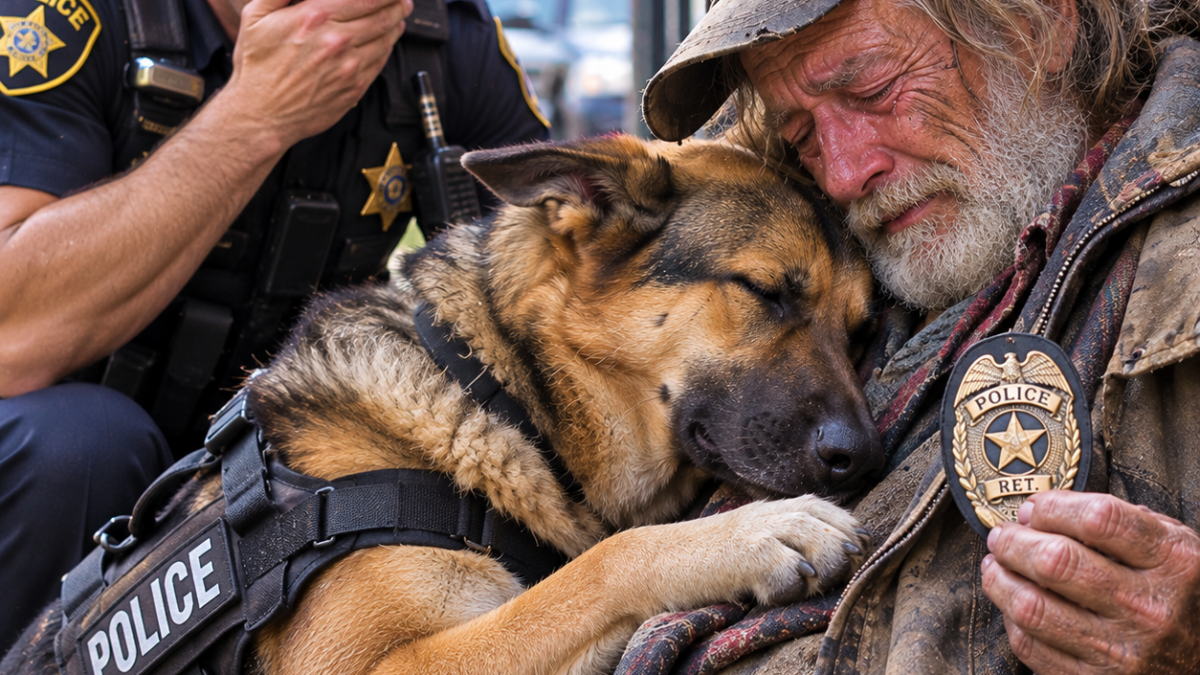
Ranger was practically lying across his lap now, eighty pounds of trained police dog behaving like an eight-week-old puppy.
Every few seconds, Thomas ran one hand along Ranger’s neck.
Checking him.
Feeling him.
As though making sure he was real.
“You trained him?” I finally asked.
Thomas nodded.
“From sixteen months.”
I looked at Ranger.
“You never told me.”
Thomas smiled faintly.
“He probably assumed you knew.”
I laughed once.
Then immediately felt guilty.
Thomas didn’t.
He kept stroking Ranger.
“He still hates slick floors?”
I stared.
“Yes.”
“Elevators?”
“Getting better.”
“Turkey?”
“Loves it.”
“Fireworks?”
“Hates them.”
Thomas nodded.
“Still sleeps facing the door?”
My chest tightened.
“Every night.”
That was when I stopped seeing the man’s dirty coat.
Stopped seeing the cardboard.
Stopped seeing homelessness first.
This man knew my dog the way I knew him.
Maybe better.
I sat on the curb.
“You want to tell me what happened?”
Thomas looked down the street.
“For tonight or the last six years?”
“The last six years.”
He laughed quietly.
“That’ll take longer.”
“I’m on shift.”
“Then you probably don’t have time.”
I radioed dispatch.
“Unit Twelve, status.”
“Go ahead, Twelve.”
“Put me unavailable fifteen minutes.”
Pause.
“Everything okay?”
I looked at Ranger.
“Yeah.”
Then at Thomas.
“Maybe.”
Dispatch cleared me.
Thomas noticed.
“You shouldn’t do that.”
“Do what?”
“Sit around listening to old stories when you’re supposed to be working.”
“That sounds like something a cop would say.”
He smiled.
The smile disappeared quickly.
For a moment, he looked almost exactly like the man in that faded K9 photograph.
Then he began.
“I joined Lakeshore when I was twenty-six.”
“Patrol?”
“Four years.”
“K9 after that?”
He nodded.
“I wanted it from Day One.”
“Why?”
“Dogs don’t care about politics.”
I laughed.
“That hasn’t changed.”
“No.”
He looked at Ranger.
“People tell you who they are. Dogs show you.”
Thomas had been thirty-one when he was accepted into the unit.
Ranger was his first assigned dog.
A young German shepherd imported through a police-working-dog program in Pennsylvania.
High drive.
Fearless.
Terrible manners.
Thomas smiled remembering.
“He bit my boot the first day.”
“Ranger?”
“He was an idiot.”
My dog raised his head at the sound of his name.
Thomas rubbed his ears.
“You were.”
Ranger licked his chin.
For months they trained together.
Tracking.
Building searches.
Obedience.
Suspect apprehension.
Article searches.
Vehicle deployments.
Long hours in heat.
Cold.
Rain.
Thomas learned Ranger’s breathing.
Ranger learned Thomas’s hands.
“A K9 partnership is strange,” Thomas told me.
“You spend more time with the dog than your family.”
“True.”
“You argue with him.”
I smiled.
“Constantly.”
“You blame him when you lose things.”
“Yes.”
“He ignores you when he knows you’re wrong.”
“Definitely.”
Thomas laughed.
“And then one day you realize he trusts you with his life.”
He looked down.
“And you trust him with yours.”
There was no self-pity in his voice.
That made the story harder.
The incident that ended his career happened during the final year he handled Ranger.
A late-night search.
Multiple officers.
Confusion.
Nothing glamorous.
No dramatic corruption conspiracy.
Just the kind of mistake that becomes enormous because it happens inside a profession where procedure matters.
A young officer named Caleb Morgan had been on the job less than a year.
Twenty-three.
Good kid.
Nervous.
Trying too hard.
The team had been securing evidence after an arrest when paperwork and chain-of-custody documentation got mishandled.
Thomas was supervising.
Caleb made an error.
A serious one.
Not malicious.
But serious enough that investigators began looking at possible discipline.
“What happened?” I asked.
Thomas shook his head.
“Details don’t matter anymore.”
“They might.”
“No.”
He looked at me.
“The important part is I was the senior officer.”
I waited.
“And I said it was mine.”
“The mistake?”
“Yes.”
“Why?”
“Because I thought I could absorb it.”
That sentence stayed with me.
He thought he could absorb it.
Thomas had twelve good years.
Commendations.
K9 certifications.
No major discipline.
Caleb had eleven months and a new baby at home.
Thomas believed admitting responsibility would result in a suspension.
Maybe demotion.
Something survivable.
“I told Internal Affairs I had handled the evidence.”
“Had you?”
“No.”
“You lied?”
“Yes.”
He did not flinch from the word.
“That was the mistake I actually made.”
I said nothing.
He continued.
“They found out.”
“How?”
“Cameras.”
Of course.
“And?”
“Then it wasn’t just a procedural violation.”
“It was dishonesty.”
“Yes.”
In police work, credibility can be everything.
Thomas had taken responsibility for an error he did not commit.
Then lost his badge for lying about it.
The irony was brutal.
“Caleb?”
Thomas looked down.
“Kept his job.”
“Did he know what you did?”
“Eventually.”
“What did he say?”
“Begged me to tell the truth.”
“Why didn’t you?”
Thomas stared at the street.
“Pride.”
That answer surprised me.
“I’d already made the sacrifice.”
He laughed bitterly.
“Backing out would’ve meant admitting the sacrifice was stupid.”
“So you doubled down.”
“Yes.”
He was fired eight months later.
Ranger was reassigned.
That separation almost broke him before homelessness did.
“They didn’t let you keep him?”
Thomas looked at me as if the question itself hurt.
“He belonged to the department.”
Of course.
“What happened on your last day?”
Thomas’s hand stopped moving across Ranger’s fur.
“They brought him outside.”
His voice became quieter.
“I was supposed to transfer his commands, feeding notes, medical history.”
“To the new handler?”
“Yes.”
“Who?”
“Sergeant Paul Ellis.”
I knew Ellis.
Retired now.
Good officer.
Thomas continued.
“Ranger kept trying to follow me.”
My throat tightened.
“I handed Paul the leash.”
“And?”
“I walked away.”
Ranger began whining softly as if somehow hearing the memory.
Thomas smiled through tears.
“I didn’t look back.”
“Why?”
“Because if I had…”
He stopped.
I understood.
The next year unraveled slowly.
That was the part people misunderstand about becoming homeless.
Most imagine one catastrophic event.
Sometimes there is one.
Often there isn’t.
There is only erosion.
Thomas lost the department salary.
Then health insurance.
He had some savings.
A pension contribution he could access later, but penalties and timing made it complicated.
He found security work.
Then lost it after the background check raised questions about termination for dishonesty.
He applied to private K9 companies.
Same problem.
He drove delivery routes.
Warehouse shifts.
Night security.
Anything.
His marriage had ended years before the department incident.
No children.
His mother lived in Arizona and died the second year after he lost his job.
He flew there.
Paid for funeral expenses.
Came back with almost nothing.
Then an injury.
Back strain.
Missed shifts.
Rent late.
Car repossessed.
He moved into a smaller apartment.
Then a rented room.
Then a motel.
Then his truck for several months before that disappeared too.
“Six years?” I asked.
“Not all on the street.”
“How long?”
“About two.”
I stared.
Two winters.
Lake Erie wind.
Snow.
Shelters full.
He survived.
Barely.
“You never contacted the department?”
Thomas smiled sadly.
“For what?”
“Help.”
“From the people I embarrassed?”
“You didn’t embarrass everyone.”
“That wasn’t how it felt.”
“What about Caleb?”
Thomas’s jaw shifted.
“He tried.”
“What does that mean?”
“He sent messages.”
“And?”
“I changed numbers.”
“Why?”
“Because every time I saw his name, I remembered.”
“What?”
“That I destroyed my own life trying to save his.”
There it was.
Resentment.
Not pure.
Not saintly.
Human.
“Did you blame him?”
“For a while.”
“And now?”
Thomas looked at Ranger.
“Mostly I blame myself.”
I studied him.
That answer was not performative.
It had taken him years to say.
My radio crackled.
Another unit needed cover.
I had to go.
I hated it.
Thomas saw my face.
“You have work.”
“Yes.”
“Go.”
I stood.
Ranger did not.
“Ranger.”
He pressed closer to Thomas.
“Come.”
Nothing.
Thomas laughed softly.
“You still use the same command?”
“Department standard.”
“He knows.”
“Apparently not.”
Thomas leaned close to Ranger’s ear.
“Go with him.”
Ranger froze.
Then looked at me.
Thomas touched his neck.
“Go.”
Ranger stood.
Slowly.
He took three steps toward me.
Then turned back.
Thomas smiled.
“I’ll be here.”
The dog did not believe him.
Neither did I.
I reached into my pocket.
“Thomas.”
He looked up.
“Where are you sleeping tonight?”
He pointed vaguely toward a shelter four blocks away.
“You have a bed?”
“If I’m early.”
It was already after nine.
The shelter filled by seven most winter nights.
“You don’t have a bed.”
“I’ll manage.”
“No.”
He gave me a tired smile.
“You going to arrest me for being cold?”
“No.”
I pulled out my phone.
There was a city emergency warming center operating overnight because of the temperature.
I knew the outreach coordinator.
“Let me make a call.”
Thomas shook his head.
“I don’t need—”
“Don’t do that.”
“What?”
“Decide what I’m offering before I offer it.”
He went quiet.
“I’m asking if you want somewhere warm tonight.”
He looked at Ranger.
Then at me.
“Yes.”
That one word mattered.
I called.
A bed was available.
The outreach van could pick him up in twenty minutes.
Thomas gathered his backpack.
Everything he owned seemed to fit inside it.
One blanket.
Two shirts.
Some paperwork.
Old badge.
I handed the badge back.
He closed his fingers around it.
Ranger watched every movement.
When the van arrived, Thomas hesitated at the door.
Then turned toward my dog.
“Hey.”
Ranger sat.
Thomas knelt.
“You do what he tells you.”
I laughed.
“Please don’t tell him that.”
Thomas smiled.
“You keep him safe.”
My throat tightened.
“I will.”
Then Thomas looked at me.
“And you let him keep you safe too.”
He entered the van.
The door closed.
Ranger watched until the taillights disappeared.
He refused to get into my cruiser for almost a minute.
That night, I could not stop thinking about Thomas Walker.
After shift, I went into the K9 office.
The old photograph was still there.
Unit picture from six years earlier.
There he was.
Younger.
Clean-shaven.
Uniform pressed.
Ranger sitting beside him.
Same ears.
Same eyes.
Thomas’s hand rested lightly against the dog’s shoulder.
I pulled up what department records I was allowed to access.
Termination.
Administrative findings.
No criminal conviction.
Loss of employment based primarily on dishonesty during internal investigation.
It looked brutal on paper.
Paper rarely shows why someone makes a bad decision.
I found retired Sergeant Paul Ellis’s number.
Then stared at it.
It was almost midnight.
I called anyway.
He answered sounding furious.
“Who is this?”
“Ryan Mitchell.”
Pause.
“K9?”
“Yes.”
“Ranger okay?”
“Yes.”
“Then why are you calling at midnight?”
“I found Thomas Walker.”
Silence.
Not:
Who?
Not confusion.
Just silence.
Then:
“Where?”
“Downtown.”
Another pause.
“How bad?”
I knew what he meant.
“Homeless.”
Paul cursed quietly.
Then:
“Ranger saw him?”
“Yes.”
“What happened?”
“He lost his mind.”
Paul laughed.
Then his voice broke.
“I bet.”
“You knew they were close?”
“Close?”
He sighed.
“That dog mourned him.”
I sat down.
“What?”
“For months.”
Paul told me things nobody had ever put in Ranger’s file.
The first week after Thomas left, Ranger stopped eating normally.
He slept facing the kennel gate.
Every male voice in the hallway made him stand.
At patrol scenes, Ranger occasionally reacted to men with Thomas’s build.
Once, six months later, he pulled toward a man in a parking lot because the man wore the same aftershave.
Paul had nearly called Thomas.
Department leadership discouraged it.
Clean transition.
Move forward.
Eventually Ranger adjusted.
Worked well.
Then Paul retired and Ranger was assigned to me.
I felt suddenly guilty.
As if I had stolen something.
Paul heard it in my silence.
“Don’t.”
“What?”
“You’re his handler now.”
“I know.”
“Thomas would tell you the same.”
“He did.”
Paul exhaled.
“Good.”
Then:
“Ryan?”
“Yes?”
“Don’t lose him again.”
The next morning, I walked into roll call with a question.
“Anybody remember Thomas Walker?”
The room changed.
Older officers looked up.
Lieutenant Harris frowned.
“Why?”
“I met him last night.”
Sergeant McBride stared.
“Where?”
“Franklin Avenue.”
Nobody spoke.
“He’s homeless.”
That word landed.
Harris sat back.
“Jesus.”
One officer, Dave Reynolds, whispered:
“No.”
“You knew him?”
“Worked patrol together.”
Others began talking.
Not gossip.
Memories.
Thomas staying late to help rookies finish reports.
Thomas volunteering for holiday shifts because married officers had kids.
Thomas sitting beside a rookie after his first fatal crash.
Thomas bringing Ranger into the station Christmas morning wearing a ridiculous red bow.
Nobody described a dishonest cop.
They described a man who made one dishonest decision.
There is a difference.
A huge one.
Lieutenant Harris said:
“We can’t just rewrite what happened.”
“I’m not asking to.”
“What are you asking?”
I didn’t know.
That was the truth.
“I don’t think we should pretend we didn’t see him.”
Harris looked around.
Nobody disagreed.
By noon, someone had contacted Paul Ellis.
By one, Paul was standing in the K9 office.
Retired seven months.
Still walked like a sergeant.
He saw Ranger.
Ranger greeted him politely.
Then Paul looked at me.
“So?”
“So what?”
“Where’s Thomas?”
“Warming center.”
“Let’s go.”
I almost laughed.
“You’re not police anymore.”
“Excellent observation.”
“I’m working.”
“Then use your lunch break.”
We went.
Thomas was sitting at a folding table eating soup.
When he saw Paul Ellis, his spoon stopped halfway to his mouth.
Paul stopped too.
For several seconds, two men who had shared one dog’s life simply stared at each other.
Then Thomas said:
“You got old.”
Paul laughed.
“So did you.”
Thomas stood.
Paul hugged him.
Not a polite handshake.
Not a shoulder clap.
A real hug.
Thomas resisted for maybe one second.
Then held on.
I looked away.
Some moments do not need witnesses.
Paul sat with him for nearly two hours.
I returned to duty.
Later, Paul called.
“He needs ID.”
“What?”
“Driver’s license expired.”
“Okay.”
“Social Security card gone.”
“Okay.”
“Birth certificate?”
“Maybe somewhere.”
“You making a list?”
“Yes.”
“Why?”
“Because surviving outside turns paperwork into a job.”
That sentence became our starting point.
We did not rescue Thomas in one magical week.
The original story people later told made it sound like we did.
Reality took longer.
Documents first.
The city outreach worker, Denise Parker, knew the system.
She helped him request a birth certificate.
Replacement Social Security card.
State identification.
Veterans services did not apply—Thomas had been police, not military—but a county reentry employment program helped with background explanations.
A nonprofit had transitional housing.
Not immediately.
Waiting list.
The police benevolent association paid for two weeks at a modest extended-stay motel.
Anonymous donor, officially.
Everybody knew it was mostly Paul.
Thomas hated accepting it.
Paul told him:
“Then pay me back by staying alive.”
That ended the argument.
The department could not simply rehire Thomas as an officer.
People online later invented that part.
Too complicated.
His termination remained valid.
His credibility history remained.
Certifications had expired.
State requirements mattered.
But K9 training?
Different.
Our department contracted with an independent regional training center.
The owner, Mark Ellison, remembered Thomas.
“He was one of the best dog men I had.”
“Would you hire him?”
Mark looked at me.
“To do what?”
“Help.”
“That’s not a job description.”
“Then create one.”
He laughed.
“I like you less every minute.”
Two weeks later, Thomas visited the training center.
He wore donated jeans.
New boots.
A clean jacket.
He had shaved.
Not because anyone required it.
Because he wanted to.
Ranger came with me.
The moment we entered the training yard, Ranger saw Thomas.
Same reaction.
Maybe stronger.
He broke position.
Ran.
Thomas dropped to one knee.
Ranger hit him in the chest so hard he nearly fell backward.
Everyone laughed.
Thomas cried.
Again.
This time so did Paul.
I pretended dust was in my eye.
Mark Ellison watched quietly.
Then handed Thomas a tug toy.
“Let’s see if you remember anything.”
Thomas stood.
His body changed.
Posture.
Voice.
Hands.
He became someone else.
Or maybe himself.
He gave Ranger a command.
Ranger responded instantly.
Not because Thomas had replaced me.
Because memory in a working dog runs deep.
They ran a basic obedience pattern.
Then article search.
Then controlled indication.
Thomas never raised his voice.
Never rushed.
Never tried to show off.
Mark watched for twenty minutes.
Then said:
“You free Tuesday?”
Thomas looked confused.
“For?”
“I have three young dogs that think humans are optional.”
Thomas smiled.
“What time?”
That was the beginning.
Three afternoons a week.
Cash at first.
Then payroll once paperwork cleared.
Assistant trainer.
Not officer.
Not K9 handler.
Something new.
Thomas moved into transitional housing after five weeks.
Small studio.
One bed.
Tiny kitchen.
A window facing a brick wall.
He stood in the doorway holding his backpack.
Denise handed him the key.
He stared at it.
“You okay?”
Thomas nodded.
Then did not move.
I realized why.
For two years, every place he slept could disappear by morning.
Shelter cot.
Bench.
Motel.
Tent.
Now somebody had handed him a key.
His key.
“You can lock it,” Denise said.
He smiled weakly.
“I know.”
“You don’t have to leave at six.”
“I know.”
“You can put things in drawers.”
“I know.”
His voice broke.
Denise stepped away.
I stayed.
Thomas looked at me.
“This is ridiculous.”
“What?”
“I’ve been shot at.”
“Okay.”
“I’ve chased armed men.”
“Sure.”
“I’m crying over a studio apartment.”
“Seems reasonable.”
He laughed.
Then sat on the edge of the bed.
Ranger, who had been allowed inside for the move-in, rested his chin on Thomas’s knee.
Thomas whispered:
“Look at us, buddy.”
I turned toward the window.
Again.
Some moments deserve privacy even when you are standing inside them.
Recovery was not a straight line.
Three months after Thomas began working at the training center, he disappeared for two days.
Didn’t show for work.
Didn’t answer his phone.
Paul panicked.
I got angry.
We found him back downtown near the old pharmacy.
Not drunk.
Not using drugs.
Just sitting.
I stood over him.
“What are you doing?”
Thomas looked up.
“Thinking.”
“For two days?”
“Apparently.”
“Mark thinks you quit.”
“I didn’t.”
“Then why aren’t you at work?”
Thomas looked at the sidewalk.
“I messed up.”
“What?”
“One of the trainees asked why I left the department.”
“So?”
“I told him.”
“And?”
“He looked at me differently.”
I waited.
“That’s it?”
Thomas’s eyes hardened.
“You don’t understand.”
“Then explain.”
“For six years, every application has a box.”
“What box?”
“Have you ever been terminated?”
I said nothing.
“Then there’s another.”
“Explain.”
“Then another person looks at me like the worst thing I ever did is the most important thing I ever did.”
I sat beside him.
“That’s not what the trainee thought.”
“How do you know?”
“I don’t.”
“Exactly.”
“So what?”
He looked at me.
“So maybe I’m tired.”
“Fair.”
“Maybe I don’t want to keep explaining.”
“Fair.”
“Maybe I should just stay down here.”
“No.”
His head turned.
“That one isn’t fair?”
“No.”
“Why?”
“Because that isn’t a preference.”
“What is it?”
“Fear wearing a philosophy.”
He stared.
I regretted it almost immediately.
“That sounded annoyingly therapeutic.”
“Yes.”
“Denise taught me.”
“I hate Denise.”
“No, you don’t.”
“No.”
He smiled.
Then went quiet.
I continued.
“You did something wrong.”
“Yes.”
“You lost your job.”
“Yes.”
“You suffered consequences.”
“Yes.”
“You also spent six years adding consequences nobody sentenced you to.”
His jaw tightened.
I continued carefully.
“You don’t have to do that forever.”
Thomas stared at the street.
“What if I deserve it?”
There it was.
The real problem.
Not homelessness.
Shame.
“You lied.”
“Yes.”
“You protected a young officer by lying.”
“Yes.”
“That doesn’t make the lie correct.”
“I know.”
“It also doesn’t mean you deserve to freeze to death ten years later.”
He said nothing.
I stood.
“Mark says you still have a job.”
Thomas looked up.
“Why?”
“Because you missed two days.”
“He should fire me.”
“He said if he fired every dog trainer with emotional problems he’d have to close.”
Thomas laughed.
“Sounds like Mark.”
“You coming?”
He looked toward the pharmacy.
Then stood.
“Yes.”
That was recovery too.
Not being perfect.
Returning.
Caleb Morgan learned Thomas was back in town through Paul.
The young officer Thomas had tried to protect was no longer young.
Thirty.
Detective now.
Married.
Two children.
He asked to meet Thomas.
Thomas refused.
Three times.
Then one afternoon Caleb appeared at the training center anyway.
I almost threw him out.
Thomas stopped me.
“No.”
Caleb stood near the gate.
He looked terrified.
Thomas walked toward him.
Neither spoke.
Finally Caleb said:
“I’m sorry.”
Thomas laughed bitterly.
“For what?”
“You know.”
“No.”
“Tom.”
“You made a mistake.”
“Yes.”
“I made mine.”
“You lost everything because of me.”
“No.”
Thomas stepped closer.
“I lost my job because I lied.”
Caleb’s eyes filled.
“If I had—”
“Stop.”
“But—”
“Stop making yourself the center of my bad decision.”
That silenced him.
Thomas continued.
“I wanted to save you.”
“You did.”
“No.”
He shook his head.
“I taught you the wrong lesson.”
“What lesson?”
“That loyalty means hiding mistakes.”
Caleb cried openly.
Thomas looked away.
“You should’ve owned yours.”
“I know.”
“And I should’ve let you.”
“I know.”
Caleb wiped his face.
“Do you hate me?”
Thomas thought.
“I did.”
Caleb nodded.
“Fair.”
“For a while.”
“And now?”
Thomas looked toward Ranger, who was watching from beside me.
“Now I’m tired of spending energy on it.”
Not forgiveness exactly.
Something better.
Freedom.
Caleb reached into his coat.
Pulled out a small envelope.
Thomas frowned.
“What?”
“My promotion ceremony.”
“No.”
“Just take it.”
“Caleb.”
“You don’t have to come.”
Thomas stared.
Caleb continued.
“But everything good I learned about working with people came from watching you before everything went bad.”
Thomas swallowed.
“That feels unfair.”
“It’s still true.”
He accepted the envelope.
Caleb left.
Thomas did attend the ceremony.
Sat in the back.
No uniform.
No introduction.
Caleb saw him.
That was enough.
Months passed.
Thomas became excellent at the training center.
Not because redemption magically restored old skills.
Because he worked.
Studied updated standards.
Learned new training philosophy.
Adapted.
The department had changed.
K9 programs had changed.
Use-of-force policies.
Documentation.
Medical care.
Training methods.
Thomas sometimes disagreed.
Then learned.
That humility impressed Mark more than old experience.
“He asks questions,” Mark told me.
“So?”
“Old cops usually tell you how everything was better in 2009.”
I laughed.
“Thomas does that too.”
“Yes.”
“But afterward he listens.”
Thomas also became useful with handlers who struggled emotionally.
Dogs sense frustration.
Fear.
Ego.
Thomas knew all three.
One rookie handler named Tyler could not stop correcting his dog too quickly.
Thomas watched for five minutes.
Then said:
“You’re punishing him for not knowing what you haven’t taught.”
Tyler bristled.
“He knows the command.”
“No.”
“He does.”
“Then why isn’t he doing it?”
“Because he’s stubborn.”
Thomas smiled.
“Dogs are rarely as interested in ruining your day as you think.”
That became a running joke.
Eventually Tyler improved.
His dog improved.
Thomas became the person handlers sought out when things felt wrong.
Not the hero.
The patient guy near the fence.
The man who had learned what happens when pride makes decisions.
A year after I found him, Thomas had saved enough for his own apartment.
Not transitional housing.
His lease.
His furniture.
His deposit.
The training center promoted him to full-time assistant training coordinator.
He refused the title at first.
Mark said:
“Then I’ll put it on your paycheck without telling you.”
Thomas accepted.
The department asked whether Thomas would speak at K9 orientation.
He laughed when I told him.
“No.”
“Why?”
“I was fired.”
“Yes.”
“From the department asking me to speak.”
“Yes.”
“What am I supposed to say?”
“Maybe the truth.”
He stared.
“I hate you.”
“Common response.”
He eventually agreed.
Not about his case.
About the dog-handler relationship.
The room held fourteen officers and six dogs.
Thomas stood in ordinary clothes.
No badge.
He began:
“Your dog does not care what your rank is.”
A few officers smiled.
“He does not care how many arrests you have.”
More smiles.
“He does not care whether you had an argument with your spouse before shift.”
Silence.
“But he will know.”
That got their attention.
“He will know when you are angry.”
“Afraid.”
“Distracted.”
“Dishonest with yourself.”
Thomas looked toward Ranger sitting beside me.
“And if you are lucky, he will trust you anyway.”
He paused.
“But don’t abuse that.”
That room became still.
“You are responsible for the fact that this animal goes where you send him.”
“That means your ego has to stay smaller than his trust.”
Nobody moved.
I thought about the man beneath the pharmacy awning.
Same person.
Different coat.
That was all.
After the session, a young officer approached him.
“You used to handle Ranger?”
“Yes.”
“Before Officer Mitchell?”
“Yes.”
“What was he like?”
Thomas smiled.
“Stubborn.”
I called across the room:
“He still is.”
Ranger looked offended.
Everyone laughed.
Thomas’s old badge remained in his apartment.
He never polished it.
I asked why.
“Looks better worn.”
He placed it inside a small shadow box.
Beside it, one photograph.
Young Thomas.
Young Ranger.
No captions.
He did not need them.
Ranger began slowing down during our fifth year together.
Hip stiffness.
Long recoveries.
Vet said age.
Nothing dramatic.
Then one spring, our K9 veterinarian called after imaging.
Degenerative joint disease.
More advanced than expected.
He could still live comfortably.
But police work?
Time to think about retirement.
I sat in my cruiser afterward for twenty minutes.
Ranger rested behind me.
I had known this day would come.
Knowing is useless.
I called Thomas.
He answered:
“Everything okay?”
“No.”
“What?”
“Ranger.”
Silence.
“What happened?”
“Nothing catastrophic.”
I explained.
Thomas listened.
Then:
“When?”
“Vet says sooner rather than later.”
Another pause.
“You okay?”
“No.”
“Good.”
“What?”
“Means you’re paying attention.”
I laughed.
We scheduled Ranger’s retirement for three months later.
The department ceremony was small.
Handlers.
Family.
Retired officers.
Paul came.
Caleb came.
Mark.
Denise.
Thomas stood in the back until I called him forward.
He shook his head.
I waited.
The chief said:
“Thomas.”
That surprised everyone.
Thomas finally walked over.
Ranger saw him.
Tail moving.
Always.
The chief spoke about Ranger’s years of service.
Two handlers.
Hundreds of calls.
Tracking missing children.
Finding evidence.
Assisting arrests.
Public demonstrations where schoolchildren pulled his ears.
Then the chief turned toward Thomas.
“This dog’s service began with you.”
Thomas looked uncomfortable.
“And it should end with both men who carried responsibility for him.”
My throat tightened.
The chief handed me Ranger’s retirement collar.
Then handed Thomas the old leather working lead from Ranger’s original equipment set.
Thomas stared.
“Where did you find this?”
“Storage.”
Paul laughed.
“I told them where.”
Thomas ran his thumb along the leather.
Six years disappeared from his face.
For a moment, he was thirty-something again.
The chief asked:
“Where’s Ranger going?”
Everyone looked at me.
That question had been decided privately weeks earlier.
I walked toward Thomas.
He knew.
His face changed.
“No.”
“Yes.”
“Ryan.”
“You have a fenced yard now.”
“No.”
“You work at a dog-training center.”
“I said no.”
“Why?”
His eyes filled.
“He’s yours.”
I looked at Ranger.
Then back.
“He was yours first.”
“That isn’t how this works.”
“No.”
I smiled.
“It’s how this works now.”
Thomas shook his head violently.
“I can’t take him from you.”
“You’re not.”
I crouched beside Ranger.
“When I found you on Franklin Avenue, he made a decision before either of us did.”
Thomas covered his face.
I continued.
“He gets to retire.”
“With someone who knows him.”
I swallowed.
“And I’ll visit.”
Thomas cried.
So did I.
Paul did not even pretend otherwise.
Ranger walked out of Lakeshore Police Department that day between both of us.
At Thomas’s house, he explored the backyard.
Sniffed every fence post.
Then walked inside.
Turned three circles beside the couch.
Lay down facing the front door.
Thomas sat beside him.
“Six years.”
He touched Ranger’s head.
“You waited six years.”
I said:
“He had other work.”
Thomas smiled.
“So did I, apparently.”
Ranger lived another three years.
Good years.
Slow years.
No suspects.
No commands shouted over sirens.
Walks.
Training-center visits.
Sleeping in sunlight.
Turkey on Thanksgiving despite my objections.
Thomas sent photographs constantly.
Ranger wearing a birthday hat.
Ranger asleep under a blanket.
Ranger stealing Thomas’s pillow.
The police dog became simply a dog.
Maybe that was his second chance too.
When Ranger died, Thomas called me at 5:12 in the morning.
I answered immediately.
“Tom?”
“He’s gone.”
Nothing else.
I drove over.
Ranger lay on his bed.
Peaceful.
Thomas sat beside him.
Same posture as that first night beneath the abandoned pharmacy.
Only now there was a house around them.
Heat.
Photographs.
A coffee mug on the floor.
A life.
I knelt.
Put my hand on Ranger’s neck.
No heartbeat.
I cried.
Thomas whispered:
“He waited until I woke up.”
I looked at him.
“He always liked an audience.”
Thomas laughed through tears.
We buried Ranger’s ashes later beneath a maple tree in Thomas’s yard.
Department policy allowed some retired-K9 memorial recognition.
The plaque was simple.
RANGER
K9 PARTNER. FRIEND.
HE REMEMBERED.
That last line was Thomas’s.
Years afterward, people still told the story.
The homeless man.
The K9 who recognized him.
The police badge.
The department helping him rebuild.
Some versions became exaggerated.
They said Ranger “saved his life.”
Maybe.
They said Thomas was immediately reinstated.
False.
They said the department apologized and erased his firing.
Also false.
The record stayed.
It should have.
Thomas had lied during an internal investigation.
Good intentions do not erase bad decisions.
But a bad decision did not erase an entire human being either.
That was what the real story taught me.
Thomas never became a police officer again.
He stopped wanting to.
Eventually he became lead trainer at the regional K9 center.
Not assistant.
Lead.
He trained police dogs.
Search-and-rescue dogs.
Therapy dogs.
Handlers.
Sometimes the handlers needed more work than the animals.
He became famous for saying:
“The dog is probably not the problem.”
People hated hearing it.
Usually because it was true.
Caleb Morgan became a lieutenant.
He and Thomas never became best friends.
They did become something.
Every Christmas, Caleb sent a card.
Thomas sent one back.
No dramatic reunion.
No constant guilt.
Just two men who finally stopped living inside one bad decision.
Paul Ellis died several years later.
Heart attack.
At the funeral, Thomas sat beside me.
Paul’s wife approached afterward.
She hugged Thomas.
Then handed him an envelope.
“He wanted you to have this.”
Inside was a photograph.
Paul’s first day with Ranger after Thomas left.
Ranger sat beside Paul.
But his head was turned toward the station door.
Waiting.
On the back, Paul had written years later:
He became my partner. He never stopped being yours.
Thomas had to sit down.
He kept that photograph beside his badge.
When I retired from the K9 unit, Thomas attended.
My next assignment was investigations.
No dog.
The first week felt wrong.
No breathing behind me.
No leash.
No nails on the cruiser floor.
I called Thomas.
“I hate this.”
“Good.”
“You keep saying that.”
“Means it mattered.”
I smiled.
Then:
“You ever miss the uniform?”
He thought.
“Sometimes.”
“The job?”
“Some parts.”
“Regret not going back?”
“No.”
That surprised me.
“Really?”
“No.”
“Why?”
He looked across the training yard.
A young shepherd chased a tug while an officer laughed.
“I spent years thinking the department was my whole identity.”
He nodded toward the dogs.
“It wasn’t.”
“What was?”
Thomas smiled.
“I’m still figuring that out.”
That answer made me happy.
Because people who think they have completely figured themselves out are usually about to make trouble.
Thomas eventually bought the small house he had been renting.
Thirty-year mortgage at an age when he joked the bank was wildly optimistic.
He planted tomatoes.
Terrible tomatoes.
Denise from outreach came to dinner sometimes.
Not romantically.
People asked.
They were friends.
Real friends.
The kind who remember you from the floor and do not require you to stay there.
On the tenth anniversary of our sidewalk meeting, Thomas asked me to meet him downtown.
Same block.
The pharmacy had become a coffee shop.
Of course.
Everything becomes a coffee shop eventually.
We stood outside.
“You sat there.”
I pointed.
“Yes.”
“Cardboard?”
“Yes.”
“Cold?”
“Very.”
He looked up at the new sign.
“Want coffee?”
“Sure.”
Inside, nobody knew.
The barista asked his name.
“Thomas.”
She wrote it on the cup.
Ordinary.
He sat by the window.
I looked at him.
“You ever think about that night?”
“Every day.”
“Really?”
“No.”
He smiled.
“Less dramatic answer.”
I laughed.
Then he looked toward the sidewalk.
“Sometimes.”
“What part?”
“Ranger.”
“Of course.”
“The way he looked at me.”
His eyes filled.
“Everyone else looked at what I had become.”
I stayed quiet.
“He looked at who I had been.”
I shook my head.
“No.”
Thomas frowned.
“What?”
“He looked at who you were.”
He stared at me.
“Still.”
That hit him.
Because that was the thing.
Ranger did not know termination records.
Employment gaps.
Credit scores.
Eviction notices.
Shame.
He knew the man who had trained him.
Fed him.
Protected him.
Trusted him.
To Ranger, six years had changed clothes.
Weight.
Smell a little.
But not identity.
Maybe dogs are better at that than people.
We label someone with the worst visible condition.
Homeless.
Fired.
Disgraced.
Addict.
Failure.
Ex-con.
Broken.
Sometimes those words describe something real.
They rarely describe everything.
Thomas had been homeless.
He had also been a police officer.
A trainer.
A liar once.
A loyal friend.
A proud man.
A frightened man.
A man who made one terrible professional choice because he thought sacrificing himself was noble.
A man who later made another terrible choice by refusing help because shame felt safer than hope.
And a man who rebuilt.
Slowly.
Imperfectly.
Ranger knew all of him without needing the categories.
Before leaving the coffee shop, Thomas reached into his coat.
Not the torn coat anymore.
A normal winter jacket.
He pulled out the old badge.
Still tarnished.
“You carry that?”
“Sometimes.”
“Why?”
He turned it over.
THOMAS WALKER — K9 UNIT 417.
“I used to carry it because I couldn’t let go.”
“And now?”
He smiled.
“Because I can.”
I understood.
Memory is different when it stops being a prison.
A year later, the city opened a new K9 training building.
They asked Thomas to speak at the dedication.
He refused.
Naturally.
Then agreed.
Naturally.
There were reporters.
City officials.
Police command.
Handlers.
Families.
Thomas stood at the podium.
No uniform.
No badge pinned.
Just a man.
He began:
“I’m supposed to talk about police dogs.”
Everyone laughed.
“So I will.”
He looked around.
“A working dog doesn’t understand your résumé.”
“He doesn’t understand why your bank account is empty.”
“He doesn’t care whether you have a title.”
“He doesn’t know if people are impressed by you.”
Silence.
“He knows whether you show up.”
I felt my throat tighten.
“He knows whether your hands are safe.”
“Whether your voice is consistent.”
“Whether you protect him when he trusts you.”
Thomas paused.
“I once thought service was something a badge allowed me to do.”
He looked toward the row of K9s.
“I was wrong.”
“Service is what you do when nobody is impressed.”
That line made the newspaper.
The next part did not.
I liked it better.
Thomas said:
“And loyalty is not protecting someone from every consequence.”
Caleb Morgan, now lieutenant, sat in the second row.
Thomas looked toward him briefly.
“Sometimes loyalty means letting someone tell the truth about what they did.”
Caleb nodded.
Thomas continued.
“I learned that too late once.”
Then:
“So teach your dogs well.”
“Teach your rookies better.”
“And if somebody disappears from your life, maybe look for them before six years pass.”
The room became very quiet.
Afterward, the chief walked over.
Different chief from the man who had fired Thomas.
He held out his hand.
“Mr. Walker.”
Thomas shook it.
“Chief.”
“I’ve heard a lot about you.”
“Most of it probably deserved.”
The chief smiled.
Then handed him a small framed certificate.
Not reinstatement.
Not erasure.
A recognition from the regional K9 training association for years of service as a trainer.
Thomas looked at it.
Then laughed.
“What?”
Chief asked.
“Nothing.”
Thomas shook his head.
“I spent years wanting one institution to give me back my worth.”
He looked at the certificate.
“Turns out that wasn’t their job.”
I stood beside him afterward.
“You going to hang it?”
“Maybe bathroom.”
“Very respectful.”
“Guests will see it.”
He did not hang it in the bathroom.
It went beside Ranger’s photographs.
When Thomas turned sixty, the training center surprised him.
Badly.
He hated parties.
They had cake.
Dogs.
Former handlers.
Current handlers.
Denise.
Caleb.
Me.
Someone gave Thomas a new jacket embroidered:
WALKER — K9 TRAINER
He stared.
“Subtle.”
Mark Ellison said:
“You finally have clothes without holes. Be grateful.”
Thomas laughed.
Then they brought out the final gift.
A framed enlargement of the photograph from the night Ranger retired.
Ranger between Thomas and me.
One hand from each of us on his shoulders.
Thomas looked at it.
Then at me.
“You set this up?”
“No.”
“Liar.”
“I learned from your example.”
He laughed.
It was good to hear.
Later, after everyone left, Thomas and I sat outside the training building.
He said:
“Do you know the worst part about being homeless?”
I expected:
Cold.
Hunger.
Safety.
He said:
“Becoming invisible.”
I looked at him.
“People stop making eye contact.”
He continued.
“Some because they’re uncomfortable.”
“Some because they’re afraid you’ll ask for something.”
“Some because seeing you might create an obligation.”
He rubbed his hands together.
“After a while, you start helping them.”
“How?”
“You stop looking at them too.”
I said nothing.
“That night Ranger saw me.”
Thomas smiled.
“Really saw me.”
“That’s why I cried.”
I understood.
Then:
“You saw me after.”
That caught me.
“I almost didn’t.”
“What?”
“I saw homeless guy first.”
Thomas nodded.
“Most people did.”
“Ranger didn’t.”
“No.”
He smiled.
“He always was smarter than us.”
True.
When Thomas finally retired from full-time dog training, he did not disappear.
He volunteered.
Two mornings a week.
Then one.
Then whenever someone called with a “dog problem” that was usually a human problem.
His back hurt.
Knees hurt.
He complained constantly.
Still came.
One young handler asked him:
“Why?”
Thomas replied:
“Because somebody gave me somewhere to come back to.”
That was the second chance.
Not the job.
Not the apartment.
Not even Ranger.
Those were doors.
Thomas still had to walk through them.
People like stories where kindness instantly repairs a life.
It rarely does.
Housing helped.
Documents helped.
Employment helped.
Friendship helped.
But Thomas had spent years learning how not to hope.
Hope became another skill he had to practice.
Show up Tuesday.
Then Wednesday.
Deposit paycheck.
Pay rent.
Answer phone.
Tell truth.
Ask for help before everything collapses.
Ordinary things.
That is what rebuilt him.
Years after that first night, I found myself driving down Franklin Avenue during another winter patrol assignment.
Different role.
Different dog in the back of another officer’s cruiser ahead of me.
I stopped at the light.
Looked toward the old pharmacy.
Coffee shop now closed for the evening.
Empty sidewalk.
For a second I could almost see it again.
Cardboard.
Old coat.
Ranger pulling the leash.
Thomas lifting his head.
I had almost kept walking.
That thought still bothers me.
Not because I would have been cruel.
Because I was busy.
There is a quieter kind of failure that comes from being too busy to notice.
Ranger did not allow it.
He pulled.
He whined.
He refused.
Police dogs are trained for obedience.
That night, the most important thing Ranger did was disobey me.
Or maybe he was obeying something older.
Memory.
Loyalty.
Love.
Whatever word fits.
Thomas once told me:
“You know I didn’t save Ranger.”
“What?”
“People say handlers save dogs.”
He shook his head.
“Ranger saved me twice.”
“When was the first?”
Thomas smiled.
“When I was still a cop and thought I didn’t need anyone.”
“And the second?”
I already knew.
“Franklin Avenue.”
He nodded.
The first time Ranger gave Thomas purpose.
The second time he reminded him he still had one.
I think about that whenever people talk about second chances as though someone hands them to you fully formed.
That is not what happened.
Ranger recognized Thomas.
I listened.
Paul showed up.
Denise helped with paperwork.
Mark offered work.
Thomas accepted.
Then failed.
Then returned.
Caleb apologized.
Thomas let go.
Again and again.
Dozens of people each moved one inch.
Eventually those inches became a life.
No miracle.
Just loyalty applied repeatedly.
Thomas kept the old badge until he died many years later.
Yes.
That part came eventually too.
Not on the street.
Not alone.
At home.
Cancer.
Fast.
Unfair.
When I visited him near the end, the badge was still in its shadow box.
Ranger’s photograph beside it.
Thomas had lost weight again.
Different reason.
He looked at me.
“You look old.”
I laughed.
“So do you.”
“Good.”
“Why good?”
“Would’ve been embarrassing if only one of us did.”
Still Thomas.
He pointed toward a drawer.
“There’s something for you.”
I opened it.
Ranger’s original leather lead.
The one Paul had found.
I stared.
“No.”
“Yes.”
“That’s yours.”
“Not for long.”
“Tom.”
He looked at me.
“Take it.”
I sat beside him.
“Why?”
“Because you were his partner too.”
I held the lead.
Leather cracked with age.
Years inside it.
Thomas whispered:
“I used to think love got divided.”
“What?”
“When Ranger became Paul’s.”
“Then yours.”
“I thought if he loved you, maybe what we had mattered less.”
I shook my head.
“I know.”
“He taught me otherwise.”
Thomas smiled.
“Dogs don’t divide it.”
“They add.”
That was the last long conversation we had.
Thomas died two weeks later.
At his memorial, there were no speeches about disgrace.
No effort to pretend he had been perfect.
His life did not need cleaning up to matter.
Caleb spoke.
Mark.
Denise.
Me.
I brought the old lead.
Placed it beside the badge and Ranger’s photograph.
Then I told the story.
Not the internet version.
The real one.
I said:
“Thomas Walker made a bad decision early enough in his life that he spent years believing it was the final sentence.”
The room was quiet.
“It wasn’t.”
“He lied in an investigation.”
“That was wrong.”
“He lost his job.”
“That was real.”
“He also spent twelve years before that serving this city.”
“Then spent years afterward teaching officers how to be safer handlers.”
“He helped young cops who were afraid to admit mistakes.”
“He gave people the lesson he learned at enormous cost.”
I looked toward Caleb.
“He became more than the worst thing he did.”
Then I looked at the photograph of Ranger.
“And a dog knew that before any of us.”
That was all.
After the memorial, I walked outside.
Cold.
Not as cold as that February night.
I stood there thinking about the first question I asked Thomas.
How do you know my dog?
Wrong question.
Ranger had answered before Thomas did.
The better question was:
How did we forget you?
Institutions forget people easily.
So do families.
Cities.
Friends.
We get busy.
Embarrassed.
Uncomfortable.
Someone falls far enough and we begin treating the distance as proof they wanted to be there.
Thomas did make choices.
Bad ones.
Prideful ones.
But nobody chooses every step that leads to the street.
And even when someone does contribute to their own fall, compassion does not require pretending they were flawless.
It only requires remembering they are still human.
Ranger never needed that explained.
Six years had passed.
Thomas smelled different.
Looked different.
Moved differently.
His uniform was gone.
Badge hidden.
Home gone.
Career gone.
Yet Ranger crossed the street as if no time had passed.
He did not ask:
What happened?
Why didn’t you call?
Did you deserve this?
He simply found his person.
Pressed his body against him.
And stayed.
I once thought the moment I understood why Ranger hugged that homeless man was the moment I saw the badge.
I was wrong.
The badge explained their history.
It did not explain the hug.
I understood that years later.
Ranger held onto Thomas because loyalty is sometimes the ability to recognize someone beneath everything life has piled on top of them.
Failure.
Shame.
Age.
Poverty.
Regret.
Six winters.
Ranger recognized him anyway.
Maybe that is why I knelt down and cried.
Not because Thomas had once been a police officer.
Not because the badge surprised me.
Because my dog had seen something I had almost missed.
A man can lose his job.
His apartment.
His reputation.
His confidence.
Even his sense of who he is.
And still not be lost completely.
Sometimes all it takes is one old friend refusing to walk past him to remind him where the road home begins.








