PART2:My German Shepherd Was Bleeding After Saving Three Puppies—The House Was About to Collapse, but He Still Tried to Run Back Inside. What Happened Next Left Us in Tears
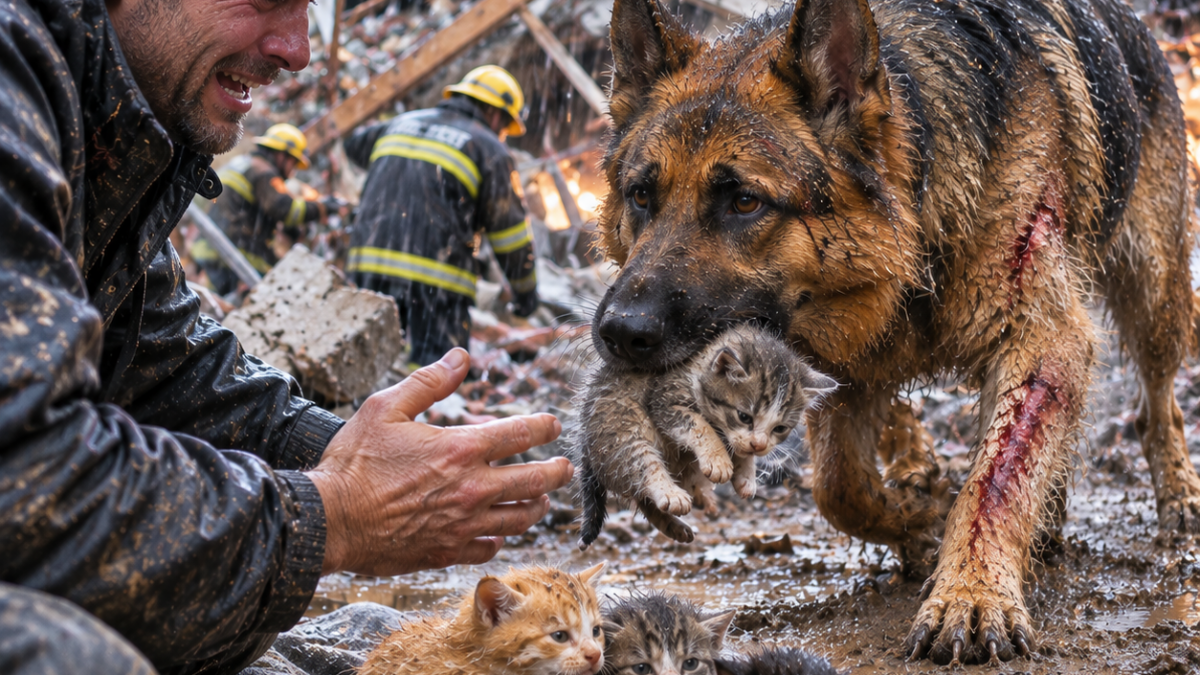
PART2
At first, I thought it was a rat.
Gray.
Tiny.
Covered in dust.
Then Kaiser stepped into the open and lowered his head.
A kitten.
Maybe four weeks old.
He placed it gently on the wet pavement.
The little thing did not cry.
It simply trembled.
Eyes crusted with dust.
One paw bleeding.
I stared.
“Kaiser…”
He was already turning back.
“No.”
He ignored me.
“Kaiser!”
Gone again.
I swore and moved toward the rubble.
Old instincts.
Structural collapse.
Unstable debris.
Do not enter without assessment.
Do not crawl under unsupported masonry.
Do not become another casualty.
Knowing all that did not stop my heart from trying to climb out of my chest.
“Kaiser!”
Nothing.
I grabbed the kitten.
Wrapped it inside my scarf.
Thirty seconds.
A minute.
Then Kaiser emerged.
Second kitten.
Black-and-white.
He laid it beside the first.
Panting.
Dust coating his muzzle.
He looked at me.
Then back.
I understood.
“There are more?”
He turned.
Gone.
I pulled out my phone and called emergency response.
The line was overloaded.
Eventually I got through.
“Possible animals trapped under structural collapse.”
I heard myself and nearly laughed.
The dispatcher had humans injured everywhere.
But I also knew something about rescue work.
If someone is alive under debris, you do not decide their life matters less because their species is different.
The woman took location.
Said animal rescue team would be sent when available.
Kaiser returned.
Third kitten.
Brown tabby.
This one cried.
Tiny rasp.
I knelt.
“You lunatic.”
Kaiser licked my wrist once.
Then turned again.
“Kaiser, wait.”
Nothing.
Fourth trip.
Longer.
I could hear debris shifting.
Every instinct in me screamed to go after him.
Then he appeared.
Fourth kitten.
Silver.
Barely moving.
He set it down.
I expected him to stop.
He did not.
He stood facing the ruin.
Rigid.
Then barked.
One short sharp bark.
I had never heard that sound from him.
Not his mailman bark.
Not play bark.
Command bark.
Once.
Then pawed the ground.
Barked again.
I followed his line of sight.
A section of concrete slab.
Broken plaster.
Timber.
Nothing visible.
“Kaiser?”
He pawed.
Same place.
Then whined.
That was when I knew.
The kittens were not the only ones.
A neighbor brought a cardboard box.
Someone else brought towels.
Within minutes, four kittens lay together wrapped in blankets.
Kaiser barely looked at them.
His entire focus remained on the rubble.
I tried pulling him away.
He planted his feet.
“No.”
He had never refused me like that.
I stepped closer to the debris.
Listened.
Nothing.
Kaiser barked.
Then I heard it.
A scratch.
Weak.
Underneath.
Not enough to locate precisely.
But there.
“Okay.”
I crouched.
“I hear you.”
Kaiser looked at me.
His body relaxed half an inch.
“Good boy.”
I called again.
Updated rescue.
Possible adult cat trapped.
Alive.
The first animal rescue vehicle arrived twenty minutes later.
Rachel Hughes and Mark Ellis.
Rachel was thirty-something, small, serious, carrying tools.
Mark larger, wearing helmet and gloves.
I told them everything.
Four kittens.
Dog retrieving.
Sound under slab.
Kaiser indicating.
Mark looked at German Shepherd.
“You sure?”
“No.”
Then:
“He is.”
Rachel smiled slightly.
“Good enough to check.”
They assessed.
The damaged extension was unstable.
They could not simply lift everything.
A municipal rescue team was still clearing another property nearby.
Rachel radioed for additional structural support.
While waiting, she approached kittens.
Checked breathing.
Temperature.
“They need warmth.”
A neighbor volunteered house across street where power remained through generator.
Rachel hesitated.
Kaiser immediately looked over.
I said:
“They go.”
I expected Kaiser to follow.
He did not.
He watched the box leave.
Then returned to the slab.
That told me everything.
The kittens had been phase one.
Somebody remained.
When firefighters arrived, I knew two of them.
You cannot work twenty-six years without former colleagues becoming old friends.
One, Dave Morgan, looked at me.
“Frank?”
“Morning.”
“You couldn’t stay retired?”
“Apparently not.”
He looked at Kaiser.
“Your dog?”
“Yes.”
“What’s under there?”
“Cat.”
Dave stared.
I pointed.
“Kaiser pulled four kittens out.”
He looked again.
“Of course he did.”
Then work began.
They removed debris slowly.
Brick first.
Loose timber.
Insulation.
Each movement calculated.
The slab could shift.
Kaiser stood ten feet away.
Tense.
Every time work paused, he approached.
Pawed toward same location.
Sharp bark.
Mark laughed once.
“He’s supervising us.”
I said:
“That’s what I used to do.”
Dave called over:
“Dog’s less annoying.”
Fair.
An hour passed.
No cat.
Kaiser remained.
Rain began again.
Light.
Cold.
I offered water.
He drank briefly.
Returned.
At one point Rachel said:
“Frank, he should rest.”
I clipped leash.
Led him ten yards away.
He fought.
Not aggressive.
Desperate.
Looking back.
Whining.
I let go.
He returned.
Sat.
Watch.
I had seen firefighters behave that way when someone remained inside.
You cannot convince a rescuer to rest while the job is unfinished.
Somehow Kaiser had found the same rule.
Nearly two hours after the kittens came out, Dave shouted.
“Got something.”
Everyone froze.
A gray shape beneath concrete.
Adult cat.
Silver coat covered in dust.
Pinned.
Rear legs beneath slab.
Head barely lifted.
Alive.
Rachel crawled close.
The cat’s mouth opened.
No sound.
Too dehydrated.
Too exhausted.
Kaiser moved.
I held him gently.
“Wait.”
He trembled.
Rescuers inserted lifting bags.
Supported slab.
Raised centimeters.
Enough.
Rachel reached.
The cat tried moving.
Could not.
“Easy.”
They shifted.
Freed rear legs.
Lifted her out.
The moment she cleared debris, Kaiser pulled from my hand.
I nearly stopped him.
Then let him approach under control.
He lowered himself.
Sniffed her muzzle.
Very softly.
The cat opened eyes.
Kaiser licked one ear.
One time.
She made a tiny sound.
Barely a meow.
Everyone around went silent.
No applause.
No cheering.
Something about that moment demanded quiet.
The cat looked at Kaiser.
Kaiser looked back.
Then he turned toward me.
I know dogs do not speak with cinematic glances.
I know.
But if I had translated his expression that morning, it would have been simple.
Done.
Your turn.
We took them to Woodside Veterinary Clinic.
Dr. Sarah Wood examined the mother first.
Several fractured ribs.
Severe dehydration.
Bruising.
Rear legs trapped but amazingly no major fracture.
Possible nerve irritation.
Exhaustion.
The kittens had hypothermia, dehydration and minor cuts.
All alive.
Sarah looked at me.
“Another few hours…”
She stopped.
No need.
Then looked at Kaiser.
“That dog did this?”
“He found them.”
“He carried all four?”
“Yes.”
Sarah crouched.
Kaiser sniffed her hand.
She scratched his neck.
“You knew, didn’t you?”
Again.
No mythology.
Maybe scent.
Sound.
Instinct.
But he knew something.
Enough.
The kittens were placed with their mother once she was stabilized.
We watched through the treatment window.
The first kitten was set beside her.
Then second.
Third.
Fourth.
The cat lifted her head.
Immediately started licking them.
Weak.
Slow.
One.
Then another.
As if trying to clean the storm off them.
A nurse started crying.
Sarah looked down.
I looked away.
Kaiser pressed against my leg.
Then came the strangest part.
I tried taking him home.
“Come on.”
He walked to car.
Stopped.
Looked at clinic.
“Home.”
Nothing.
I opened back door.
Kaiser sat.
Would not enter.
“Kaiser.”
No.
He turned.
Walked back to clinic entrance.
Lay down.
Head on paws.
I stared.
“You are joking.”
Rachel, who had followed to clinic, laughed.
“He’s waiting.”
“For what?”
“You know.”
I did.
Confirmation.
He had pulled kittens out.
Directed rescue.
Watched mother removed.
But she had disappeared behind doors.
His job still incomplete.
So I sat beside him.
Hours.
People came.
Dogs.
Cats in carriers.
Humans.
Kaiser stayed.
A little boy asked why he was outside.
I said:
“Waiting for a friend.”
Boy accepted.
Children often need fewer explanations.
At six that evening, Sarah came out.
Still in scrubs.
Kaiser stood before I did.
She smiled.
“She’s going to make it.”
His tail moved.
Once.
Then more.
He stretched.
Walked toward car.
I laughed so suddenly Sarah laughed too.
“That’s it?”
Kaiser jumped into back seat.
Done.
Information received.
Home.
The news spread.
Neighborhood first.
Then local paper.
GERMAN SHEPHERD SAVES FAMILY OF CATS AFTER STORM
Manchester site picked it up.
People loved story.
Of course.
The neighborhood needed one.
The storm had destroyed roofs.
Flooded homes.
Injured people.
Families displaced.
Everyone had lost something.
Then a dog pulled kittens from rubble.
Hope packaged itself neatly.
I was uncomfortable with that at first.
Kaiser had not repaired houses.
He had not reversed damage.
But I watched what happened outside clinic.
People came with food.
Blankets.
Donations.
One little girl emptied a jar of coins onto reception desk.
“For the babies.”
Her mother looked embarrassed.
Sarah accepted every coin.
The girl smiled.
That mattered.
I began to understand.
Kaiser had not saved anyone’s faith in humanity in some grand magical way.
He had given frightened people a direction for their kindness.
After disaster, people often want to do something.
Anything.
The kittens became something.
Food.
Blanket.
Money.
Adoption applications.
A reason to talk about life instead of loss.
That was valuable.
The mother cat got a name.
Nellie.
A nurse chose it.
Why?
No clue.
It fit.
Four kittens were temporarily called Storm, Brick, Dusty and Lucky.
I hated all four names.
Nobody consulted me.
Kaiser did not care.
We visited.
Mostly because clinic invited.
Kaiser entered.
Nellie heard his nails in hallway before she saw him.
She began meowing.
Rubbing cage front.
Sarah looked at me.
“That’s new.”
They brought Kaiser closer.
Nellie pressed face to bars.
Kaiser sniffed.
Tail slow.
When cage opened carefully, Nellie stepped out.
No fear.
Walked directly to him.
Rubbed along his front legs.
Then lay beside his paws.
Kaiser looked at me.
I laughed.
“Oh no.”
Sarah said:
“What?”
“I know that face.”
“What face?”
“You’re going to suggest something expensive.”
She smiled.
“Not me.”
I looked down.
Nellie curled against Kaiser.
“Oh, for God’s sake.”
Helen reacted exactly as expected.
“No.”
I had barely finished sentence.
“But—”
“No.”
“Kaiser—”
“No.”
“There are kittens.”
“Absolutely no.”
Ten minutes later, she asked:
“How many?”
Progress.
“Four.”
She closed eyes.
“Frank.”
“Two already have adoption interest.”
“What about other two?”
I said nothing.
She stared.
Then:
“No.”
Nellie came home as foster.
That was phrase we used.
Temporary.
Medical recovery.
Kittens too young.
Temporary.
Everyone understands what “temporary” means in animal rescue.
It means buy litter tray.
The first night, we separated.
Safety.
Nellie had room upstairs.
Kittens.
Food.
Beds.
Kaiser downstairs.
He lay at foot of stairs.
Waited.
Helen looked at him.
“You started this.”
He wagged.
Introductions slow.
Gate.
Scent.
Distance.
Kaiser gentle.
Nellie calmer around him than around us.
Within days, she began coming downstairs.
First time, Kaiser lay on rug.
Nellie walked directly to him.
Rubbed cheek along muzzle.
Then settled beside.
Helen saw.
That was end.
She sighed.
“We’re keeping her.”
I did not celebrate.
Danger.
“And kittens?”
“Two.”
I smiled.
“Which?”
She pointed at silver and black-and-white.
“Those.”
Fine.
Other two adopted by neighbors.
Close.
Family still saw.
Our house changed.
Dramatically.
I had lived decades with dogs.
Cats were different.
Rules imaginary.
Counters optional.
Doors suggestions.
One kitten climbed curtain on day three.
Another slept inside my boot.
Nellie stole Kaiser’s bed.
Kaiser slept beside it.
No objection.
Ridiculous.
Kaiser became guardian.
Not in aggressive sense.
Routine.
If kitten cried, he checked.
If one disappeared, he searched.
He allowed tails on face.
Paws in ears.
One kitten attempted climbing his back.
Kaiser sighed.
Parenthood.
We renamed kittens Milo and Fern.
Better.
Storm and Brick went to neighbors.
Their names changed too.
Good.
Nellie healed.
Ribs.
Leg bruising.
Strength.
Her first jump onto sofa made Helen clap.
Nellie looked insulted.
Cats dislike praise for basic competence.
At six every morning, Kaiser went to porch.
Habit.
Sunrise.
Nellie eventually followed.
Sat beside.
Not touching always.
Sometimes.
I started seeing them from kitchen.
Dog.
Cat.
Silhouettes.
Quiet.
Something about it became ritual.
Two animals that should have had nothing in common except one terrible morning.
Yet there.
People visited.
Too much initially.
Kaiser tired of being hero.
I limited.
One reporter asked for reenactment at rubble site.
No.
Absolutely not.
We did not need to put dog near unstable debris for camera.
Rescue happened.
Enough.
The storm cleanup took months.
Some houses demolished.
Others repaired.
Nellie’s original house belonged to elderly woman named Mrs. Harper.
She had evacuated before collapse.
She had believed Nellie escaped.
She did not know kittens were hidden under extension.
When she heard, she came.
Nellie recognized.
Immediately.
That complicated things.
Mrs. Harper cried.
Held her.
Nellie purred.
I thought:
Of course.
She should go home.
But Mrs. Harper’s new housing did not allow pets temporarily.
She was devastated.
“Keep her safe.”
She said.
“When I can…”
We agreed.
Fostering now real.
Months later, Mrs. Harper moved into permanent flat.
Pet-friendly.
She came again.
Nellie loved her.
But something surprising happened.
When Mrs. Harper prepared to leave with carrier, Nellie resisted.
Not panic.
She walked back to Kaiser.
Sat beside him.
Mrs. Harper watched.
Long silence.
Then she smiled through tears.
“She chose.”
I tried saying no.
“Mrs. Harper—”
“She chose.”
She crouched.
Touched Nellie.
“You stay.”
That generosity broke me.
Mrs. Harper visited afterward.
Nellie loved both.
Family expanded.
Milo and Fern stayed.
Storm—renamed Pippin—lived two doors away.
Brick became Ruby with Patel family.
They visited garden sometimes.
Kaiser tolerated reunions.
Nellie inspected each child.
The story stopped being “dog saves cats.”
It became neighborhood.
People who had barely spoken before shared tools.
Meals.
Pet care.
Storm damage had forced connection.
Kaiser had become symbol people joked about.
“Ask Kaiser where to dig.”
“Put Kaiser in charge.”
Old firefighter jokes resurfaced.
I did not mind.
One evening Dave Morgan visited.
Former colleague.
He looked at Kaiser surrounded by three cats.
“You trained him?”
“No.”
“Then why did he keep going back?”
I thought.
“He heard them.”
“That simple?”
“Probably.”
Dave nodded.
“Good rescue dogs do same.”
“He’s not rescue dog.”
“No.”
Dave smiled.
“Maybe he didn’t know.”
I liked that.
Kaiser eventually took part in community demonstrations.
Not official SAR.
We refused misleading story.
But rescue organization used case to teach:
Listen.
Report.
Do not enter unstable structures yourself.
Call professionals.
Animals can signal trapped animals.
Disaster plans should include pets.
Useful.
I appreciated that more than hero articles.
Stories should teach safer behavior.
At one event, a boy asked:
“Did Kaiser know cats are cats?”
“Yes.”
“Then why save them?”
I laughed.
“Why wouldn’t he?”
The boy shrugged.
“Dogs chase cats.”
“Kaiser sometimes does.”
Everyone laughed.
Then I said:
“Need came first.”
That felt right.
Species second.
Need first.
Kaiser did chase Fern once months later.
Play.
Fern chased back.
Nellie slapped him.
Parenting hierarchy established.
The porch mornings became famous in our family.
Helen made coffee.
I watched.
Kaiser out first.
Nellie second.
Sometimes Milo.
Fern rarely; she preferred bed.
Sunrise.
Quiet.
I once asked Helen what they were doing.
“Nothing.”
Exactly.
After chaos, nothing is luxury.
Years passed.
Kaiser gray.
Nellie older.
Kittens adults.
Milo enormous.
Possibly part tiger.
Fern delicate and mean.
Normal.
Storm became local memory.
New roofs.
Trees replanted.
Children forgot.
Good.
Disasters should fade from daily life.
Kaiser’s hips worsened.
Medication.
Ramp.
Shorter walks.
Nellie adjusted strangely.
She began slowing her pace when walking near him.
Did cats understand age?
Maybe.
She simply matched.
At night she slept near his back.
Warmth.
One winter, Kaiser slipped on porch.
Could not rise.
Nellie screamed.
Actual loud yowling.
We came running.
Helped him.
No injury serious.
After that, nonslip mat.
Nellie inspected every time.
Balance returned.
Role reversal.
When Kaiser turned twelve, Sarah Wood came to house.
Routine check.
She saw Nellie sleeping against him.
Shook her head.
“Still.”
“Always.”
She listened to heart.
Old.
Strong enough.
Arthritis worse.
We discussed quality.
Not yet.
At thirteen, Kaiser stopped climbing porch steps.
Ramp.
He hated.
Used.
Nellie waited at top.
Every morning.
He came.
They sat.
Sunrise.
Slower arrival.
Same ritual.
Grandchildren loved story.
They always asked dramatic parts.
“Did Kaiser jump through window?”
No.
“Did building fall while inside?”
No.
“Did he fight wolf?”
Absolutely not.
Children disappointed by truth.
I told them truth matters.
He heard something.
Went in.
Carried four kittens.
Stayed until mother rescued.
Enough.
No explosions needed.
My grandson Luke asked:
“Was he scared?”
That stopped me.
Probably.
I had never thought.
Kaiser had gone into unstable debris.
Noise.
Dust.
Strange smells.
Maybe fear.
Courage is not absence.
Maybe.
I said:
“He went anyway.”
Luke nodded.
Better lesson.
Nellie eventually stopped climbing counters.
Age.
We missed annoyance.
Funny.
Animals irritate while young.
Then when they stop, you would give anything to hear crash.
Kaiser’s final year arrived.
Thirteen.
German Shepherd.
Long life.
Good.
His heart okay.
Hips failing.
Appetite declining.
One morning, he did not go porch.
Nellie went alone.
Sat.
Then returned inside.
Meowed at him.
Kaiser lifted head.
Could not rise.
We knew.
Vet came.
Sarah.
Same woman who treated cats years ago.
She examined.
Pain.
Severe mobility.
Neurological decline.
She looked at me.
I had been firefighter.
Seen death.
Still.
“No.”
Word automatic.
Then I looked at Kaiser.
Eyes.
Tired.
I corrected.
“Not because of me.”
Sarah nodded.
We chose next morning.
Sunrise.
Porch.
If comfortable.
That night, Nellie lay against him.
Milo and Fern nearby.
All three cats.
Unusual.
Helen and I sat floor.
Family.
No hero narrative.
Just old dog breathing.
Before dawn, we carried Kaiser onto porch on blanket.
Nellie followed.
Sky pale.
Sarah arrived.
Quiet.
Kaiser lifted head once.
Looked outward.
Nellie pressed against shoulder.
I placed hand.
“Good boy.”
Weak tail.
“You did enough.”
That phrase.
He had.
Thirteen years.
Four kittens.
One mother.
Thousands ordinary days.
Enough.
Sarah administered sedative.
Kaiser relaxed.
Nellie remained.
No panic.
Just there.
Then final.
Heart stopped.
Sun rose.
Exactly like mornings.
But different forever.
Nellie stayed beside him for nearly twenty minutes.
Smelled.
Touched nose.
Then stood.
Walked inside.
No dramatic crying.
Cats grieve quietly sometimes.
So do old firefighters.
I did not that morning.
Not immediately.
Later.
We cremated Kaiser.
Ashes in garden.
Not rubble site.
Home.
Mrs. Harper came.
Dave.
Rachel.
Mark.
Dr. Wood.
Neighbors.
Not memorial service formally.
Just people.
Someone brought sandwiches.
Children ran.
Cats hid.
Perfect.
Nellie changed.
For weeks, porch alone.
Six a.m.
Sat in Kaiser’s spot.
I watched from window.
One morning, Milo joined.
Then Fern.
Three cats.
Sunrise.
Life rearranges.
Not replacement.
Continuation.
I finally cried about Kaiser two weeks later.
Found his old leash.
Simple.
Held.
Gone.
Helen held me.
No shame.
Firefighters cry.
Eventually.
Nellie lived four more years.
She became queen.
Milo and Fern followed rules.
We did too.
Every morning porch.
When weather allowed.
She always sat nearest Kaiser’s old spot.
Coincidence perhaps.
I let it mean something.
When Nellie died at seventeen, peaceful at home, we placed her ashes near Kaiser.
No dramatic plaque.
One stone:
KAISER & NELLIE
THEY STAYED
Helen chose.
I approved.
Milo and Fern grew old afterward.
Storm family continued long beyond storm.
That is part people forget.
Rescue headline lasts one day.
Care lasts years.
Vet bills.
Litter.
Medication.
Furniture.
Love.
Real rescue is after.
I became involved with local animal disaster planning.
Because of Kaiser.
Pet evacuation kits.
Microchips.
Temporary shelters.
Search safety.
Nothing glamorous.
Useful.
I had missed usefulness.
Found new version.
Kaiser gave that too.
Sometimes I wonder whether I projected my firefighter identity onto him.
“Orders.”
“Job.”
Maybe.
Dogs do not conceptualize duty like humans.
But he responded to need.
That is enough.
No need uniform.
The sound Kaiser made at rubble remains in memory.
Short bark.
Sharp.
Not normal.
Every time rescuers paused, same.
I had heard command tones on firegrounds.
Maybe that is why I interpreted.
But behavior was clear:
There.
Keep going.
Again.
His insistence saved Nellie.
The kittens he could reach.
The mother he could not.
That distinction matters.
He did what he could alone.
Then asked humans for what he could not.
That might be smartest part.
Heroism includes knowing when help needed.
If Kaiser had tried digging through slab alone, impossible.
Instead he signaled.
Humans brought tools.
Team.
People later said “dog saved five cats.”
True emotionally.
Technically, many saved.
Neighbors warmed kittens.
Rescuers lifted.
Vet treated.
Mrs. Harper trusted.
Helen fostered.
Kaiser initiated.
Rescue is relay.
Again and again.
I like that.
No single hero.
One notices.
Then next carries.
The storm damaged forty-three homes in our area.
People suffered.
I never wanted animal story to overshadow humans.
But grief is not competition.
Saving cats did not reduce human care.
It increased communal energy.
People came clinic after repairing own homes.
Kindness multiplies sometimes.
That was beautiful.
A woman who lost roof donated blankets.
I asked why.
She said:
“I have insurance.”
“They have nothing.”
Simple.
The little girl with coins? Her name was Amelia.
Years later, she volunteered at animal shelter.
Told me Kaiser story was why.
Maybe.
Children build identities from stories.
Important to tell accurately.
Not “dogs are magic.”
But compassion matters.
Listen.
Act.
Call help.
Stay.
Amelia later became vet nurse.
Sarah told me.
That made me smile.
Kaiser’s ripples.
Mrs. Harper died years after Nellie.
Her niece sent us old photograph.
Nellie before storm.
Young.
Sitting in conservatory window.
Behind her, barely visible, nest box.
Maybe where kittens born.
I framed.
Not disaster image.
Before.
Important.
Lives exist before trauma too.
We keep too many rescue photos of suffering.
I understand fundraising.
But animals deserve joy images.
Kaiser’s favorite photo is him asleep with Milo on his back.
No rubble.
No hero.
Just annoyed father figure.
That is who he was.
My grandchildren know that photo more.
Good.
The famous newspaper photo shows Kaiser outside clinic.
Serious.
Wet.
People think noble.
Truth: he was staring at sandwich behind photographer.
I tell everyone.
Keeps mythology under control.
No animal should be trapped in role of inspiration.
Kaiser was dog.
Nellie cat.
That is enough dignity.
At retirement, I missed being needed.
Kaiser taught me need is everywhere if you look.
Not sirens.
Neighbor.
Animal.
Grandchild.
Friend.
You do not need uniform to be useful.
That changed me.
After storm, I volunteered less dramatically.
Food bank deliveries.
Animal shelter repairs.
Elderly neighbor gutters.
Small.
No adrenaline.
At first boring.
Then satisfying.
Service without siren.
Maybe mature form.
Kaiser came often.
Toolbox.
Van.
He supervised.
Naturally.
One time he found injured hedgehog.
Not heroic.
Just barked at bush.
I groaned.
“Not again.”
Animal rescue laughed.
Hedgehog survived.
Kaiser built reputation.
He never pulled another kitten from ruins.
Good.
No need repeat.
One extraordinary event enough.
When people ask what would happen if another storm came, I say planning improved.
That is best legacy.
Not hoping another Kaiser appears.
Systems.
Preparedness.
Humans should learn.
Animals should not have to rescue around our failures.
Nellie’s kittens were fortunate.
Their hiding place collapsed but left voids.
Kaiser could access.
Mother pinned not crushed.
Many coincidences.
Again, luck matters.
Do not make survival moral.
Those who do not survive disasters are not less strong.
Important.
Stories can accidentally shame victims.
No.
Kaiser’s story celebration, not formula.
I remember holding first kitten.
Dust.
Heart racing.
Tiny claws.
Kaiser disappearing again.
I felt terror because I knew structure.
He did not.
Maybe he sensed less danger than me.
Courage? Instinct? Drive?
No certainty.
I stopped trying to label.
He did it.
Enough.
Helen once asked:
“Would you have gone in after him?”
“Yes.”
She stared.
“You idiot.”
“Probably.”
“That’s why I sent Kaiser with you?”
“What?”
“To stop you doing stupid.”
We laughed.
He did opposite.
Led toward rubble.
Marriage irony.
Still, I followed rules after first.
Called team.
Good.
Retired firefighter not invincible.
Important.
If anyone reads story and finds trapped animals after disaster:
Do not crawl into unstable debris blindly because dog did.
Call professionals.
Keep yourself safe.
A second casualty helps nobody.
Kaiser had four legs and instincts; still risky.
Humans need structure.
There.
Public safety message.
Kaiser would hate lecture.
He preferred action.
On final porch morning, I think he recognized sunrise.
Maybe.
He always loved it.
Nellie beside.
That image heals.
The first time they met, dust, injury.
Last, quiet light.
Bookends.
Humans love symmetry.
Life happened to provide.
Nellie’s first safe touch from Kaiser was lick on ear.
At end, her body against him.
Years.
That friendship grew.
Not because species overcame hatred trope.
Dogs and cats can coexist normally.
No need miraculous enemies.
They simply became companions through repeated home life.
Better.
One morning, Kaiser drank Nellie’s water.
She slapped him.
Friendship normal.
I laughed.
Trauma bond does not prevent domestic disputes.
Healthy.
Milo once stole his treat.
Kaiser looked betrayed.
Did not retaliate.
Helen gave another.
Cats learn crime pays.
Fern slept on his tail.
He moved, she attacked.
Parenthood.
These details matter because “hero dog” label flattens.
I want him remembered ridiculous too.
Full life.
Nellie never seemed afraid of Kaiser.
Maybe because first encounter rescue.
Maybe temperament.
We introduced carefully anyway.
Responsible.
Love story does not replace safety.
That principle guided fostering.
Separate spaces.
Slow.
Supervised.
Then trust.
Good outcomes need patience.
Mrs. Harper’s choice to let Nellie stay was one of kindest acts.
She could reclaim legally.
Instead watched cat choose familiar environment and respected.
Maybe animals do not “choose” same way humans, but attachment visible.
Mrs. Harper prioritized cat.
That is love.
She visited monthly.
Nellie purred.
No conflict.
Family expanded rather than transferred.
Beautiful.
At Mrs. Harper’s funeral, I thought of her saying:
“She chose.”
Sometimes love releases ownership.
Same with rescue.
Kaiser never owned Nellie either.
Protected.
Then shared space.
Enough.
I wrote his story once for grandchildren.
Not published.
Title:
The Dog Who Heard What We Couldn’t.
Accurate.
He heard faint life beneath rubble.
Then refused silence.
Maybe lesson.
Listen for quiet things.
Often need is not loud.
Nellie could not meow.
Dust.
Exhaustion.
Only scratching.
Kaiser heard.
Humans nearby missed.
Dogs have better hearing.
Not magic.
Biology.
Again, biology can be beautiful.
People sometimes think scientific explanation diminishes wonder.
No.
A dog’s ear detecting faint scratch under concrete is astonishing precisely because real.
No supernatural required.
Kaiser’s bark that day was different because arousal, urgency, communication.
I recognized because knew baseline.
Relationship as data again.
Know those you love enough to notice deviation.
Useful.
After Kaiser died, I began paying attention to Helen’s silences too.
Not joking.
She had supported me years.
I realized I often assumed fine.
One day asked.
She admitted exhaustion caring for her mother.
I helped more.
Kaiser again.
Listen.
Do not pass by.
Maybe that is why story stayed.
Not kittens.
Not heroics.
Attention.
Kaiser heard what others couldn’t.
Then would not walk past.
That standard applies.
Years later, a man on street sat alone after flood.
I almost kept walking.
Then thought Kaiser.
Stopped.
He needed phone charge to contact daughter.
Simple.
No rescue.
Just plug at my house.
Sometimes not passing by is small.
Still.
Grandchildren roll eyes when I turn everything into Kaiser lesson.
Fair.
Old men repeat.
Luke once said:
“Granddad, sometimes a dog is just a dog.”
Exactly.
He wins.
So perhaps final truth:
Kaiser did not teach philosophy.
He heard kittens.
Acted.
We built philosophy afterward.
That is human habit.
Fine.
As long as philosophy makes us kinder.
I still have one of original towels used for kittens.
Why?
Helen kept.
Tiny claw holes.
We should throw.
Haven’t.
Objects.
The house after Nellie gone became quieter.
Milo and Fern eventually left? No, stayed until their own deaths years later.
Milo sixteen.
Fern seventeen.
By then, Helen and I older.
Each loss.
Each memory.
Family slowly changes.
No more pets now.
Maybe.
We said same before.
Do not trust.
Porch remains.
Sunrise.
Two empty spots sometimes.
I sit.
Coffee.
Not sad every morning.
Mostly grateful.
Storm anniversary comes each May.
Weather often mild.
Neighborhood does informal barbecue now.
Not memorial.
Community day.
Kaiser’s photo on notice board.
People bring pet food donations.
Good.
Practical legacy.
One year, someone proposed statue.
I vetoed.
“No dog statue.”
Why?
“Spend money on rescue supplies.”
They did.
Kaiser would prefer treats.
Correct.
Emergency animal trailer purchased later partly donation drive.
Crates.
Blankets.
Microchips.
First aid.
If another storm, better ready.
That makes me proud.
Heroism should improve preparedness, not just inspire posts.
When I tell grandchildren story, I end same:
Kaiser gained nothing.
No idea kittens.
No reward expectation.
He heard something alive.
Could have walked past.
Did not.
That is it.
Listen.
Do not pass.
But now I add:
And call proper rescuers.
Helen insists.
Good.
The first kitten Kaiser carried out lived to eighteen? Perhaps too much timeline. We know two adopted neighbors, two stayed. We can mention all lived long lives, but no exact unsupported specifics maybe creative adaptation. We can say they grew up healthy.
Pippin and Ruby grew into healthy cats in neighborhood.
Milo and Fern stayed.
Nellie regained strength.
That is enough.
At Kaiser’s final veterinary appointment, Sarah said something.
“He gave you years after that day.”
I corrected.
“He gave them.”
She smiled.
“All of you.”
Yes.
Rescue changes networks.
One dog.
Five cats.
Neighbors.
Vet.
Children.
Me.
Unexpected.
Maybe every life touches more than visible.
Cliche.
True.
I used to think firefighter work meant entering danger.
Later learned sometimes it means standing back, calling team, holding space.
Kaiser entered.
I coordinated.
Roles.
Age brings wisdom if lucky.
The day he ran into rubble, I felt retired identity wake.
But not command.
Care.
I did not need uniform.
Skills remained.
Assessment.
Call.
Support.
That helped me reclaim purpose without job.
Important.
I stopped saying “I used to be firefighter.”
Started saying “I’m retired firefighter.”
Small language.
Past not erased.
Identity integrated.
Kaiser again.
Nellie had no concept.
She just wanted warmth.
Good.
Animals simplify.
Her purr beside Kaiser was one of softest sounds.
After storm noise, healing had sound.
Maybe that.
Storm shattered windows.
Kaiser barked.
Rescuers cut concrete.
Then years later, porch had silence.
Healing became quieter.
I think people chase dramatic recovery.
Sometimes best sign is boring morning.
Dog.
Cat.
Sunrise.
No emergency.
That was our reward.
One sunrise after Kaiser died, Nellie sat alone.
I joined.
She looked at me.
Then horizon.
We sat.
No words.
I understood why Kaiser liked.
Morning promises nothing dramatic.
Just another day.
Enough.
When Nellie died, I sat same.
By then no animals.
Still sunrise.
Ritual transferred.
Maybe that is inheritance.
I do not believe Kaiser consciously “taught” me.
But relationship changed habits.
That is enough.
The phrase people use:
“He saved faith in humanity.”
Maybe too much.
He reminded people caring still possible.
Humans did rest.
Donations.
Homes.
Support.
Give humans some credit.
Kaiser opened door.
People walked through.
That is how I would tell it now.
Not hero dog alone.
A chain of responders.
Dog notices.
Man calls.
Neighbors warm.
Rescuers dig.
Vet heals.
Community adopts.
Owner releases.
Home forms.
Team.
Firefighter in me likes that.
No one works a fire alone.
No one should work rescue alone.
Kaiser started alarm.
We answered.
His short bark was siren.
Maybe that metaphor I allow.
At final memorial, Dave Morgan said:
“Still bossing us around.”
We laughed.
Good.
My grandchildren now adults.
They tell their children.
Story grows.
I correct exaggerations.
Kaiser did not “dig through building.”
He retrieved kittens from accessible void.
He did not “lift concrete.”
Humans did.
Truth respectful.
No need inflate.
Real courage survives accuracy.
The strongest moment remains when mother emerged and Kaiser licked ear.
No roar.
No applause.
Contact.
Recognition.
Maybe cat not grateful in human sense.
She was exhausted.
But interaction real.
Enough.
I do not call weak sound gratitude anymore.
That was human projection.
I call it sound.
Still moving.
Alive.
Better.
Nellie’s eyes opened.
Kaiser there.
Then clinic.
Home.
Life.
We can honor without inventing her thoughts.
If this story teaches anything about animals, perhaps this:
They notice.
They form bonds.
They respond to distress.
They deserve care.
Simple.
And about us:
We notice too.
Or can.
Sometimes choose not.
Kaiser did not.
That is why memorable.
I have walked past needs before.
Everyone has.
Regret.
But next time, notice.
That is practical redemption.
After storm, one neighbor admitted he had heard faint kitten cries night before but thought impossible.
He felt terrible.
I told him no blame.
Storm deafening.
Structure dangerous.
Kaiser had better hearing.
Do not turn hindsight into punishment.
Another lesson.
We all do what can with information.
When new info, act.
Frank older now.
Me.
I write this with hands not steady.
Helen beside reading.
She says I make Kaiser too noble.
She is right.
He once ate half birthday cake.
I will include.
There.
Balance restored.
He also chewed my retirement slippers.
Hero.
Nellie slapped him for stealing her bed.
Hero.
He farted during newspaper interview.
Legend.
Reporter pretended not smell.
Professional.
I loved him more for those.
Perfection unrelatable.
The storm gave him one extraordinary day.
We got thousands ordinary after.
That is what I cherish.
If someone asked which day I would relive, not storm.
A random Tuesday.
Kaiser porch.
Nellie beside.
Helen making toast.
Milo asleep on radiator.
Fern destroying plant.
Me complaining.
No danger.
No one famous.
Home.
Rescue exists to make boring Tuesdays possible.
That may be best definition.
Kaiser gave Nellie’s family that.
Then they gave us theirs.
I thought I was retired and unnecessary.
Ended with house full of animals and grandchildren complaining about litter.
Be careful what you wish.
Useful indeed.
At dawn now, I still sometimes imagine two silhouettes.
Big Shepherd.
Silver cat.
Not ghosts.
Memory overlay.
Then light changes.
Porch empty.
I smile.
No sadness sharp.
Mostly warmth.
That is what time does when kind.
The storm took walls.
It also exposed connections.
Not trade.
I would never say disaster happens for reason.
It does not.
People lost too much.
But after, people create meaning.
Different.
Kaiser helped us create one good thing in wreckage.
That is all.
I reject phrase “everything happens for reason.”
Tell someone who lost home.
No.
Storm happened.
We responded.
Meaning came from response.
Important.
Kaiser heard.
Did not pass.
We followed.
That is response.
Years later, when grandchildren asked why he kept going, I said:
“Because one kitten wasn’t all.”
Maybe he heard more.
Smelled more.
He did not stop until silence changed.
Good.
He retrieved four in thirty minutes.
Then waited two hours for mother.
Persistence different forms.
Active.
Then patient.
Both rescue.
At clinic, refusing car looked stubborn.
Actually unfinished monitoring maybe.
Or attachment.
We interpreted.
He waited for signal mother alive.
Then left.
Maybe coincidence.
But behavior striking.
I honor without certainty.
That is how memory should be.
Precise enough.
Humble.
I named nothing after him.
Except Helen named a rose bush Kaiser.
I objected.
It died first year.
Terrible omen.
We laughed.
Planted another.
Thrived.
Not all symbolism works first try.
The thriving rose now near stones.
Kaiser and Nellie.
Nice.
When wind heavy, petals scatter.
No deeper meaning.
Just wind.
Good.
I am glad story circulated.
It brought donations.
Adoptions.
But I hope people do not share only because emotional.
Do something.
Microchip pets.
Disaster plan.
Donate.
Report trapped animals.
Help neighbor.
That would honor more.
Hero stories without action become entertainment.
Kaiser deserves better.
Maybe that is why I kept telling grandchildren:
Listen.
Do not pass.
Not:
Be heroic.
Heroism intimidating.
Not passing by is achievable.
One step.
One phone call.
One towel.
One donation.
One foster.
Small.
Kaiser took first step into rubble.
We took rest together.
That is all any community does when it works.
If I could speak to Kaiser now, I would say:
“You caused an unbelievable amount of paperwork.”
Then:
“Good job.”
He would wag if food.
Maybe.
I would tell Nellie:
“Thank you for not destroying curtains more than necessary.”
She would ignore.
Appropriate.
I would tell kittens:
“Your names were terrible at first.”
Truth.
I would tell Helen:
She was right about sending Kaiser with me.
Do not tell.
Too late.
And I would tell younger me, standing in devastated street, leash in hand, convinced retirement had made him useless:
Pay attention.
Your dog is about to show you usefulness does not require uniform.
It requires noticing what needs doing.
Then doing what you can.
Calling others for what you cannot.
Staying until finished.
That was Kaiser’s entire rescue.
Maybe my next chapter too.
The day after storm, neighborhood woke to damage.
But also news:
Four kittens alive.
Mother alive.
Dog alive.
Small victory.
People needed.
We carried.
Months later, houses repaired.
Family moved.
Cats grew.
People stopped talking storm daily.
Good.
Life.
Kaiser did not understand he was remembered.
Better.
Fame would ruin him.
He already had ego.
He understood porch.
Nellie.
Breakfast.
Walk.
Me.
Enough.
The last image I have of him alive is not final morning.
Week before.
Porch.
Nellie against side.
Sun.
His eyes closed.
Her tail wrapped around paws.
No disaster.
No urgency.
Just two old animals sharing warmth.
I printed large.
It hangs in hallway.
Underneath no caption.
Does not need.
Visitors ask.
I tell if they want.
Sometimes only:
“They were friends.”
That is enough summary.
Because beneath rubble and headlines, that is what remained.
A dog heard a family.
A cat survived.
They met.
Then became friends.
Years.
Ordinary.
Beautiful.
Kaiser did not know Nellie.
He had no obligation.
No training.
No reward.
He heard life under wreckage and moved toward it.
Maybe humans make morality complicated because we can.
Dogs sometimes show simpler version.
Something is hurting.
Go closer.
If safe.
Help.
If you cannot, call others.
Do not pretend you did not hear.
That is what I kept from him.
Not hero worship.
Attention.
And all these years later, when I sit at sunrise and the neighborhood is quiet, I still think of the first short bark beside rubble.
Sharp.
Insistent.
Impossible to misunderstand.
Here.
Keep looking.
Maybe those are words worth carrying.
Not only after storms.
Always.
Because sometimes what needs saving does not have enough strength left to call loudly.
Sometimes all you get is a scratch beneath concrete.
A faint movement.
A dog refusing to walk away.
And sometimes the difference between being lost and being found is simply that one living creature notices another—
and stays long enough for help to arrive.








