PART2:“MY DOG’S PAWS WERE BLEEDING… BUT HE NEVER STOPPED.” Baron Dragged His Unconscious Owner Through a Blizzard for Hours—What Happened When I Finally Woke Up Broke Me
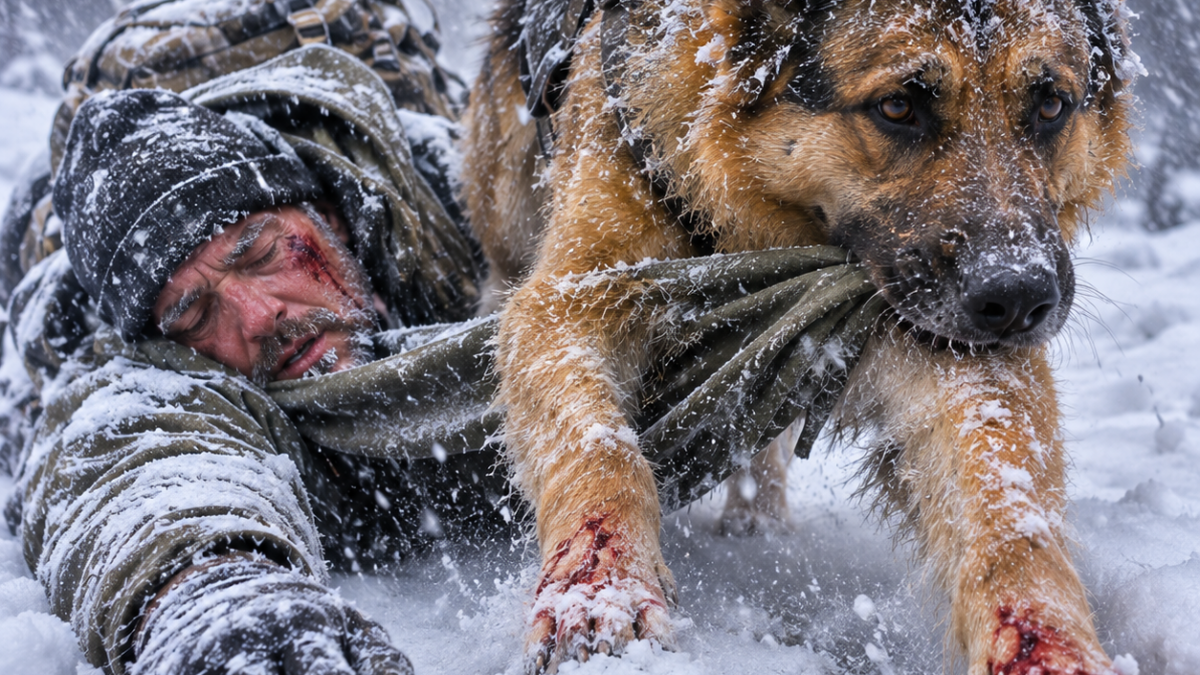
Baron never believed in unnecessary displays of affection.
He preferred proximity.
A shoulder against your knee.
A head against your boot.
A body positioned so that if you moved, he knew.
That was love in Baron’s language.
By the time he was eight, his hips had begun to stiffen.
The veterinarian called it early degenerative joint disease.
We managed it.
Medication.
Shorter walks.
A ramp into my truck.
He hated the ramp.
Naturally.
Every old man resents equipment designed to admit that he is an old man.
We understood each other.
The morning everything happened began with snow.
Not a storm.
Just one of those bitter winter mornings when the world seems to have been covered overnight in white silence.
The temperature was already below zero.
I remember making coffee.
Baron stood near the back door.
I let him out.
He returned ten minutes later with snow on his nose.
I told him:
“You’re smarter than me.”
Then, sometime after eight, I went outside.
That is the last clear memory I have.
I remember the back field.
The hard frozen ground.
The old shed.
Baron following.
Then nothing.
Doctors later believed I had fallen and struck my head hard enough to lose consciousness.
Whether I slipped on ice or simply lost balance, nobody could say.
There were no witnesses.
Except Baron.
What happened next, I learned from tracks in the snow, from Thomas Ryan, from the paramedics, and from the dog who could not tell me anything at all.
PART2
I fell in the vacant field behind my house sometime shortly after eight in the morning.
The field was not large.
Maybe two hundred yards from the back of the property to the road if you cut the right line.
But I had fallen behind the far corner of the old storage shed, partly hidden by scrub and a rise in the ground.
From the house, you could not see me.
From the road, impossible.
The snow around me showed what Baron had done.
For hours, he stayed.
At first, investigators found circles.
His tracks.
Around me.
Toward the house.
Back.
Toward the gate.
Back again.
He had apparently tried several things.
He scratched at the back door.
Nobody inside.
He returned.
He barked.
No one close enough to hear.
Baron was not a barker.
That matters.
Some dogs bark because a leaf moved three streets away.
Baron considered noise beneath his dignity.
If he barked twice in one week, something had happened.
But my nearest neighbor, Thomas Ryan, lived almost a mile away.
The wind carried sound the wrong direction.
Nobody came.
So Baron returned to me.
Again.
Again.
Again.
At some point, he stopped trying to summon help to the field.
He decided to move the problem.
Me.
Thomas later reconstructed part of the path.
Deep furrows in the snow.
My coat dragging.
Baron’s paw prints beside them.
Blood farther along.
He must have grabbed the collar of my winter jacket because the fabric was torn almost through when paramedics cut it away.
There were tooth marks around the collar.
Baron pulled.
Then rested.
Pulled.
Rested.
His hips were bad on a normal day.
Dragging me should have been impossible.
I weighed one hundred eighty-six pounds.
Baron weighed seventy-nine.
But animals do not understand impossible the way we do.
They understand here.
There.
Stay.
Come.
I was here.
Help was there.
That was enough.
The first stretch took him from the field to the corner of the house.
Maybe sixty yards.
The snow there was relatively deep.
My body left a clear trail.
Baron’s tracks ran beside it.
At several points, the drag marks stopped.
His paw prints circled me.
Then resumed.
I imagine him panting.
Tongue out.
Old hips burning.
Probably confused why I did not get up.
I had always gotten up.
That is what dogs know about us.
We rise.
We open doors.
We fill bowls.
We throw balls.
We return.
When we suddenly do not, they are forced to invent another version of the world.
Baron invented one in which he moved me himself.
From the house corner, he pulled me along the siding.
The snow was thinner there.
Ice worse.
That was where his pads began bleeding.
Thomas found small red marks.
Then larger.
Still Baron kept going.
Past the porch.
Into the front yard.
Toward the road.
The day shortened.
Winter sun slid lower.
Temperature fell toward minus fifteen.
My body temperature was dropping.
My breathing becoming shallower.
Baron did not know the numbers.
He knew I was colder.
He knew my chest moved less.
He knew nobody had come.
So he pulled.
I have tried many times to imagine what he thought.
That is dangerous.
We give animals our sentences because silence bothers us.
Baron did not think:
My owner is hypothermic and requires immediate roadside visibility.
He did not understand ambulances.
He did not calculate distance.
But he knew cars passed the road.
He knew people were there.
He knew nobody came to the field.
So he dragged me toward movement.
That is enough.
No need to make him human to make what he did extraordinary.
He was entirely dog.
That was more than enough.
Sometime near sunset, Baron reached the ditch.
The final slope rose toward the roadway.
The drag trail there became chaotic.
He had struggled.
My shoulder caught on frozen grass.
My coat tore.
Baron’s paw marks dug deep.
He must have pulled.
Slipped.
Pulled again.
At last, he managed to drag enough of me into view.
My legs remained partly in the ditch.
Upper body near the shoulder.
Baron released my collar.
Sat beside me.
And barked.
Once.
Wait.
Again.
Longer.
The sort of bark that carries.
Not fear.
Not aggression.
A signal.
Here.
Here.
Here.
Thomas Ryan heard the second bark.
He was stepping from his garage to get road salt.
He later told me he stood still because the sound was so strange.
He knew Baron.
We were not close friends then.
Neighbors.
Wave from truck.
Borrow a ladder.
Return a tool.
That kind of relationship rural men often call friendship without ever saying anything personal.
Thomas had once joked that Baron was “the quietest German Shepherd in the county.”
So when he heard repeated barking, he stopped.
Listened.
Another bark.
He got into his pickup.
Drove slowly down the road.
Headlights already needed because dusk had started.
He saw Baron first.
Large dark figure sitting at the shoulder.
Head up.
Barking directly at the truck.
Then the headlights moved past.
Hit my jacket.
My hat.
My body.
Thomas knew me immediately.
“Walter.”
He later told me the word came out like a prayer.
He stopped in the road.
Jumped from truck.
Baron did not run toward him.
Did not leave me.
That detail still gets me.
Help had arrived.
Baron’s job did not end until Thomas reached my side.
He watched.
Only when Thomas knelt beside me did Baron lower himself.
Almost as if confirming:
You are finally here.
I stayed.
Your turn.
Thomas called 911.
Then removed his own coat and covered me.
He spoke continuously.
“Walter.”
“Come on.”
“Stay with me.”
“You hear me?”
“You stubborn old bastard, this is not how you get out of shoveling snow.”
Normal Thomas.
Humor when frightened.
Baron lay on my other side.
Pressed his body against my chest.
Head resting over my ribs.
Warmth.
Seventy-nine pounds of it.
Thomas later said Baron shook so hard that his teeth chattered.
Yet he did not move away.
When Thomas tried examining his bleeding paws, Baron ignored him.
Eyes on me.
Every few seconds, he sniffed my face.
Then chest.
Checking.
Waiting.
The ambulance arrived fifteen minutes later.
Fifteen minutes is nothing in most lives.
Thomas said it felt like an hour.
Paramedics found my core temperature around thirty-two degrees Celsius.
Severe hypothermia.
Slow pulse.
Head injury.
Dehydration.
They moved me carefully.
Baron rose when stretcher lifted.
Tried following into ambulance.
One paramedic blocked him.
Baron pushed.
Not aggressive.
Determined.
Thomas grabbed his collar.
“Easy.”
Baron watched the doors close.
Then barked once.
The ambulance left.
Thomas said the dog stood in the road staring until the lights disappeared.
I spent the first night in intensive care.
Then another.
Then another.
I remember none of it.
My daughter drove through the night.
Rebecca arrived around three in the morning and sat beside me for almost twenty hours before sleeping.
When she heard what Baron had done, she asked immediately:
“Where is he?”
Thomas had taken him home.
Not my home.
His.
Because Baron’s paws needed treatment.
A local veterinarian cleaned cuts.
Bandaged two pads.
Checked hips.
He was exhausted.
Mild hypothermia himself.
But otherwise stable.
The veterinarian said something Thomas repeated later:
“That dog spent everything he had.”
I believe it.
Baron refused food.
First night, understandable.
Second day, still nothing.
Thomas tried chicken.
Beef.
Cheese.
Baron drank water.
That was it.
He stayed near the door.
Every time Thomas put on boots, Baron rose.
Every time truck started, Baron went to window.
So Thomas began visiting the hospital grounds.
Dogs were not allowed inside ICU.
He would park.
Walk Baron near the front entrance.
Sit on a bench.
Talk.
“Walter’s still there.”
Baron listened.
“I know.”
“I don’t like hospitals either.”
Baron rested head on his knee.
Thomas later told me he felt ridiculous giving medical updates to a dog.
Then decided dignity was overrated.
Every day, he said:
“He’s alive.”
That was the only sentence that mattered.
On the third day, Baron finally ate a small piece of chicken.
Thomas celebrated as though the dog had won an award.
The next morning, I woke.
Not dramatically.
No cinematic gasp.
My first memory is ceiling.
White.
A machine beeping.
My mouth dry.
Rebecca asleep in chair.
Then a nurse leaning over.
“Mr. Hayes?”
I tried speaking.
Nothing.
She gave water.
Again.
One word formed.
“Baron.”
The nurse leaned closer.
“What?”
“Baron.”
Then stronger:
“Where is Baron?”
That was my first question.
Not where am I.
Not what happened.
Not how long.
Baron.
Rebecca woke at my voice.
She burst into tears.
The nurse smiled.
“Your dog is okay.”
I closed my eyes.
That was enough.
Later they told me everything.
Seven hours.
Field.
Drag marks.
Road.
Thomas.
Ambulance.
Core temperature.
I listened.
Did not believe.
Not emotionally.
The information entered but did not attach to reality.
“Baron dragged me?”
Rebecca nodded.
“Most of the way from the back field.”
“He can barely get into truck.”
“I know.”
“He dragged me?”
She started crying again.
“Dad.”
I looked away.
My hands shook.
Nothing from cold anymore.
Something else.
Guilt.
Love.
Shock.
All tangled.
Doctors kept me another day.
Concussion.
Hypothermia recovery.
Observation.
They warned me not to return home alone immediately.
I said I would be fine.
Rebecca gave me a look that reminded me so much of her mother I nearly laughed.
“No.”
“Rebecca—”
“No.”
“You were unconscious in snow for seven hours and only survived because your elderly dog literally dragged you to traffic.”
She leaned closer.
“You have lost the right to say ‘I’m fine’ for at least six months.”
Fair.
On the fourth day, Thomas brought Baron to the hospital entrance.
A nurse arranged wheelchair.
Rebecca pushed me.
Automatic doors opened.
Cold air.
Thomas stood outside.
Baron beside him.
Bandages on front paws.
Gray around muzzle.
His leash loose.
At first, Baron did not react.
He stared.
Maybe wheelchair confused him.
Maybe smell.
Maybe he did not trust his eyes.
Then his ears lifted.
He took one step.
Stopped.
I whispered:
“Hey, Baron.”
His entire body changed.
Not wild.
Not jumping.
Baron had never been a dramatic dog.
He walked toward me.
Slow.
Careful.
As though afraid sudden movement might make me disappear.
When he reached my chair, he sat.
Placed his head on my knees.
Exactly where he always put it.
My hands trembled as I touched his ears.
I had spent my life thinking veterans did not cry.
That idea lasted about three seconds.
One tear.
Then another.
Then I stopped fighting.
“You saved me.”
Baron closed his eyes.
I scratched beneath his collar.
“You old fool.”
Tail moved.
“You dragged me all the way out there.”
Another wag.
“Why?”
Stupid question.
He did not answer.
I bent forward.
Pressed my forehead against his.
“Thank you.”
That was all.
Thomas turned away.
Rebecca cried openly.
The nurse standing behind doors cried too.
Baron just stayed.
Head on knees.
As if nothing unusual had happened.
As if he had simply fulfilled a task and now wanted his human back.
Dogs do not care about headlines.
Heroism is a word people add later.
Baron wanted routine restored.
Me.
Home.
Dinner.
Bed.
Enough.
The local newspaper ran a small article.
VETERAN SAVED BY FAITHFUL GERMAN SHEPHERD
They interviewed Thomas.
He hated it.
I hated it more.
Reporter asked:
“What do you think your dog was thinking?”
I said:
“I think he wanted me to get up.”
Probably the best answer.
They photographed Baron.
He looked annoyed.
Perfect.
The article spread farther than expected.
People began stopping.
Dropping food.
Letters.
A pet store sent dog treats.
Someone mailed a medal-shaped tag that said HERO.
I never put it on his collar.
Baron did not need more metal around his neck.
I kept it in drawer.
What happened afterward mattered more than the rescue.
That is the part nobody wrote about.
I came home.
And discovered the life I had insisted was perfectly manageable was not.
The front steps were icy.
The firewood pile too far.
Groceries heavy.
Bathroom lacked handrail.
My daughter stayed two weeks.
I tolerated her help badly.
She tolerated my stubbornness worse.
Then Thomas began arriving.
At first, excuse.
“Brought soup.”
Next day:
“Got extra wood.”
Then:
“Need anything from town?”
I said no.
He brought things anyway.
A week later, he installed rail by back steps.
I objected.
“Walter.”
He said.
“You were nearly killed by weather.”
“I fell.”
“You’re seventy-three.”
“So are you.”
“Seventy-one.”
“Child.”
That became our friendship.
Before, Thomas and I had waved.
Now he came in.
Coffee.
Sat.
Talked.
Not about anything important at first.
Engines.
Weather.
County taxes.
Football.
Then eventually:
His wife’s death.
My Margaret.
War.
Loneliness.
The strange shame older men feel when admitting a house is too quiet.
Baron lay between us.
Sometimes I thought he had dragged more than my body toward the road.
He had dragged my private life into view.
People noticed.
And instead of embarrassment, I found help.
The community changed too.
Or maybe I finally noticed it.
Mrs. Keller brought casseroles.
A high school boy named Eli shoveled walkway.
Church group offered rides even though I had not attended church in fifteen years.
Two veterans from local VFW came.
I had avoided them because I disliked talking about service.
They did not ask me to.
We played cards.
Baron received more attention than me.
Correct.
My daughter called daily instead of weekly.
For once, I answered honestly.
“How are you?”
“Tired.”
“Good.”
“Why good?”
“Because you didn’t say fine.”
She was right.
Baron’s paws healed.
His hips took longer.
The effort had inflamed everything.
Dr. Lawson, his veterinarian, increased therapy.
Warm compresses.
Medication.
Short controlled walks.
I felt guilty.
He had hurt himself saving me.
I said so once.
Dr. Lawson looked at me.
“Walter, he would have done it again.”
“That doesn’t help.”
“No.”
She softened.
“But guilt doesn’t honor what he chose.”
I looked at Baron.
He was asleep.
“What does?”
“Take care of him.”
Simple.
Good.
So I did.
Ramp improved.
Non-slip rugs.
Better bed.
Joint supplements.
Short walks.
He hated being fussed over.
Like me.
We both learned.
The first time Baron returned to back field, I almost stopped him.
Snow gone by then.
Spring mud.
Grass beginning.
He walked toward place I fell.
I knew exact spot because drag marks had remained frozen for weeks and Thomas had shown me.
Baron stopped.
Sniffed.
Then looked at me.
My chest tightened.
I said:
“No.”
Not a command.
A plea.
“Let’s not stay here.”
Baron turned.
Walked back.
I followed.
That was the last time we went to that spot together.
Not because I feared it.
Because it had already taken enough.
Doctors never determined exactly why I fell.
No stroke.
No heart attack.
Likely ice and head injury.
Simple.
Almost insulting.
People expect life-changing events to have grand causes.
Sometimes it is one wrong step.
That frightened me more than dramatic explanation.
Fragility is ordinary.
I began carrying a phone outside.
Thomas insisted.
Rebecca bought fall-detection watch.
I hated it.
Wore it.
Baron watched me put it on every morning.
I told him:
“Your retirement plan.”
Tail.
We settled into new routine.
Baron slept closer.
Before accident, always near bedroom door.
After, he moved beside bed.
Sometimes at night I woke and found his head against mattress.
Listening.
Checking.
I would put hand down.
He would sigh.
Return to sleep.
The first few weeks, he woke every time I shifted.
Hypervigilant.
I worried I had damaged him emotionally.
Dr. Lawson said:
“Give him time.”
We did.
Eventually he relaxed.
But he never stopped checking completely.
One night, months later, I had a bad dream.
War.
Not uncommon.
I woke suddenly.
Baron stood beside bed.
Head on chest.
Same position Thomas described in snow.
I placed hand on him.
“I’m here.”
Funny.
Which one of us was speaking to whom?
The article made Baron a local celebrity.
I disliked that word.
But children stopped during walks.
“Is that the dog?”
Parents whispered.
Baron accepted petting with patience.
One little girl hugged him too tightly.
I started to intervene.
Baron simply leaned.
Afterward she gave him a biscuit.
He decided fame had advantages.
A local school invited us.
I refused.
Rebecca said:
“Go.”
“Why?”
“Because kids need to see good old dogs.”
Odd argument.
Worked.
I sat in gym.
Baron beside me.
Children asked questions.
“How far did he drag you?”
“About two hundred yards.”
“Did he know you were dying?”
“I don’t know.”
“Was he scared?”
“Probably.”
“Why didn’t he leave?”
I looked at Baron.
“That’s easy.”
“What?”
“Because he’s Baron.”
The kids seemed satisfied.
So was I.
One boy asked:
“Was he trained to rescue people?”
“No.”
“Then how did he know?”
I thought.
“He knew me.”
That became my answer.
Not training.
Relationship.
Baron knew when I should move.
Knew I was not moving.
Knew cars were somewhere else.
Used what he had.
Teeth.
Strength.
Noise.
Persistence.
Sometimes competence grows from love plus observation.
Thomas said the same in better words.
“You’d been together long enough that your silence was an emergency.”
That line stayed.
People think loyalty means never leaving.
Sometimes loyalty means recognizing when staying is not enough.
Baron stayed seven hours.
Then acted.
Love changed form.
That was the miracle, if there was one.
Summer arrived.
Baron stronger again.
I recovered too.
Walked with cane at first.
Then without.
Thomas and I developed habit.
Morning coffee on porch.
His house still a mile away.
He drove anyway.
Wasteful.
I never complained.
Much.
We began checking on other older neighbors.
Not formally.
Just habit.
Need groceries?
Wood?
Ride?
Funny how being saved makes you notice who else might be quietly one bad day away from trouble.
Rebecca visited more.
Not because she feared constantly.
Because relationship changed.
We talked honestly.
She told me how angry she had been for years.
At me.
For refusing help.
For treating loneliness like pride.
I listened.
Hard.
She said:
“Dad, when Mom died, I lost her too.”
I closed eyes.
Of course.
I had centered my grief.
I had thought protecting Rebecca meant not burdening.
Instead I had shut her out.
“I’m sorry.”
Two words.
Difficult.
Necessary.
Baron lay between chairs.
Again.
Bridge.
Baron turned nine.
Then ten.
White muzzle increased.
Hip pain.
Less distance.
Still slept near me.
Still checked chest at night.
We stopped long walks.
Replaced with slow loops around property.
One day we reached road where Thomas found us.
Baron paused.
I did too.
No snow.
Cars.
Grass.
Ordinary.
I touched his head.
“This is where you yelled.”
He looked.
“You never yell.”
Tail moved.
I laughed.
“Had to pick the one day.”
We stood.
Then went home.
I began to understand that hero stories can hurt animals when people expect them to remain heroic forever.
Visitors wanted Baron to demonstrate.
Drag something.
Bark.
Perform.
No.
He was old.
The rescue was not a trick.
It was one desperate action in one terrible moment.
I protected him from being turned into spectacle.
When local TV asked for reenactment, I said no.
They asked why.
“Because he already did it once.”
Enough.
The best part of Baron’s later life was boring.
Meals.
Naps.
Thomas.
Porch.
Occasional steak.
Vet.
Rain.
Winter sun.
He had earned boring.
So had I.
At eleven, Baron began struggling with stairs.
We moved my bedroom downstairs.
At first, I told people it was for him.
Truth?
For both.
My knees too.
Pride adapts slowly.
I had a medical alert system installed.
Phone.
Watch.
Neighbor key.
Rebecca added cameras outside—no inside, my condition.
Baron was officially off emergency-rescue duty.
I told him:
“You are retired.”
He yawned.
That winter, snow returned heavy.
The first deep snow since accident.
I stood at window.
Could not make myself go outside.
Not fear exactly.
Memory.
Body remembers cold.
Baron stood beside me.
I opened door.
He stepped onto porch.
Looked back.
I laughed.
“Now you’re doing it again.”
He took one step into snow.
Then another.
Slow.
I followed.
We went no farther than driveway.
Enough.
I bent.
Touched white surface.
Cold.
Normal.
Not enemy.
Baron sniffed.
Then peed on snowbank.
Trauma therapy complete.
Thomas nearly fell laughing when I told him.
At twelve, Baron’s hearing declined.
Not completely.
Sometimes I called.
Nothing.
Then opened treat bag.
Miraculously restored.
Selective.
Still dog.
His heart remained strong.
Dr. Lawson always remarked.
“Good old engine.”
I liked that.
The heart I had listened to beside my bed.
The heart that warmed me in snow.
Strong.
Regular.
Alive.
Eventually, age won pieces.
Vision dimmed.
Rear legs weaker.
Appetite changed.
But Baron remained Baron.
Stubborn.
Quiet.
Watchful.
One evening, he tried climbing into my bed.
Failed.
I helped.
He settled against me.
Head on chest.
Too heavy.
I did not care.
I stroked.
“Still checking?”
His ear moved.
By then, Thomas visited every day without pretending reasons.
He would walk in.
“Coffee?”
“Make it.”
“Your house.”
“You offered.”
We argued.
Normal.
He loved Baron almost as much.
Maybe more openly.
Men of our generation sometimes use dogs to express affection safely.
You can say “I love that dog” without feeling exposed.
Eventually you learn it is practice.
One afternoon Thomas said:
“You know, before all this, I thought you didn’t like me.”
“What?”
“You never came over.”
“You never came over either.”
“I thought you wanted privacy.”
“I thought you did.”
We stared.
Then laughed.
Twenty years of neighborly loneliness built from mutual politeness.
Ridiculous.
Baron opened one eye.
Judging.
Correctly.
The accident changed entire street.
People checked each other.
Storm warnings triggered calls.
Who needs wood?
Who has generator?
Who lives alone?
Small network.
No committee.
No program.
Just attention.
Baron’s rescue became story people told, but community was real legacy.
Not because dog planned.
Because we were embarrassed enough by nearly losing someone unnoticed to start noticing.
That mattered to me.
I had spent years believing independence was virtue.
It is.
Until it becomes isolation.
There is a line.
I had crossed without realizing.
Baron dragged me back across.
Literally.
Figuratively.
I know that sounds neat.
Life is messier.
Still true.
At thirteen, Baron had a bad week.
Would not eat breakfast.
Slow breathing.
Dr. Lawson examined.
Kidneys weakening.
Arthritis severe.
No cancer.
Just age.
She said:
“We’re entering the stage where quality matters more than numbers.”
I nodded.
I had learned.
No denial.
No heroics.
Comfort.
We made a list.
Things Baron loved.
Chicken.
Porch sun.
Slow sniff walks.
Thomas.
Rebecca.
Sleeping beside me.
Things he hated.
Vet floor.
Rain.
Ramp.
Bananas for unknown reasons.
As long as good things remained, we continued.
One day he could not stand without help.
Next day better.
Old age comes in waves.
I did not panic at every bad morning.
But I watched.
He had watched me.
My turn.
Rebecca came for Christmas.
Baron slept near tree.
She sat beside him.
“You know he’s why you’re still here.”
“I know.”
She looked at me.
“And you’re why he had good life.”
I shook head.
“No.”
“He’d have had someone.”
“Maybe.”
She touched his ears.
“But he had you.”
That mattered too.
Rescue can become one-direction story.
It rarely is.
We make homes together.
Baron reached fourteen.
Very old for his size.
Dr. Lawson smiled.
“Stubborn.”
Yes.
He had survived bad hips.
Snow.
Dragging idiot owner.
Years.
No surprise.
That spring, Thomas and I had our own health scare.
Thomas needed heart surgery.
Suddenly roles reversed.
I visited hospital.
Brought stupid balloons because he hated them.
He said:
“You’re an ass.”
“Correct.”
His daughter stayed.
He recovered.
For weeks, I brought meals.
Wood unnecessary because summer.
Baron came to his porch when Thomas returned.
Thomas cried.
I said nothing.
Men get there eventually.
Baron’s final winter arrived quietly.
No dramatic storm.
Mostly mild.
He slept more.
One night, as I lay reading, Baron climbed—slowly—onto bed using ramp.
Turned.
Lowered himself beside me.
Head on chest.
I put book down.
Listened to his breathing.
Then realized he was listening to mine.
As always.
I whispered:
“Still there.”
His tail tapped once.
“Strong.”
Another.
“You did that.”
I knew medically he had not single-handedly controlled everything.
But emotionally?
Yes.
I was alive because of him.
No need to qualify private gratitude.
The next morning, he did not eat.
Then drank little.
Would not stand.
Dr. Lawson came to house.
Examined.
Her face told me before words.
Body shutting down.
Pain beginning despite medication.
I nodded.
No argument.
Baron had taught me not to make someone stay because I was afraid.
We scheduled that afternoon.
Thomas came.
Rebecca drove in as fast as weather allowed.
She arrived in time.
Baron lay on his bed near window.
Sunlight.
No snow.
Good.
I sat beside.
Thomas on other side.
Rebecca near his back.
Dr. Lawson prepared.
I put hand on Baron’s chest.
Heart still.
Slow.
Regular.
Living.
The same heart that had pressed warmth into me in road snow years earlier.
I leaned close.
“Remember?”
No.
Probably not in human story terms.
Still.
“You dragged me.”
His ear moved.
“You bled.”
My voice broke.
“You barked.”
Tail faint.
“And then you waited.”
I swallowed.
“You waited until I came back.”
Rebecca cried.
Thomas looked down.
I continued:
“So you don’t have to wait now.”
There.
Permission.
Hardest kindness.
“You can go first this time.”
Baron breathed.
I kissed his forehead.
“Thank you, old friend.”
Dr. Lawson gave sedation.
His body softened.
Head settled heavier against my hand.
Then final medication.
Heart slowed.
Stopped.
I kept hand there.
For a long time.
People say losing the dog who saved your life must feel different.
It does.
But not because of debt.
I did not owe Baron endless grief.
He did not save me so I could spend remaining years in sorrow.
He saved me because I was there.
His person.
That was enough.
My job afterward was to live.
So I did.
We buried his ashes near porch.
Not back field.
Never.
Near house.
Where he had chosen to stay.
I placed simple stone.
BARON
HE STAYED
Thomas wanted:
HE SAVED WALTER’S STUBBORN ASS
Rebecca voted no.
Probably correct.
The first night without him was terrible.
Silence.
No breathing near bed.
No nails.
No head on chest.
I woke at two and reached down automatically.
Nothing.
Grief is physical memory.
I sat.
Cried.
Then heard my phone.
Text from Thomas.
You awake?
I answered:
Yes.
He replied:
Me too. Coffee?
At two in morning.
Ridiculous.
He came anyway.
We sat at kitchen table until dawn.
Baron was gone.
I was not alone.
That was his last gift, in a way.
The people he had pulled into my life remained.
Rebecca called next day.
Then next.
Neighbors came.
Not because I was helpless.
Because community had become habit.
I finally understood something.
Being loved is not weakness.
Receiving help is not failure.
That took me seventy-something years and one German Shepherd to learn.
Slow student.
Months later, I volunteered at veterans center.
Not because I suddenly became outgoing.
Thomas bullied me.
A young veteran there had a service dog.
Malinois.
High energy.
Terrifying.
The man struggled after leaving military.
We talked.
Not advice.
Just truth.
I told him:
“Retirement can feel like someone cut a rope you thought you hated, then you realize you were holding it too.”
He looked at me.
“Yeah.”
Dogs lay between us.
Different generations.
Same problem.
Purpose.
Belonging.
I stayed involved.
I did not adopt another dog for two years.
People encouraged.
I resisted.
Not because replacement.
Because I needed time.
Then one afternoon the shelter called.
Older Shepherd mix.
Ten.
Owner deceased.
Overlooked.
I laughed.
“Of course.”
I visited.
Dog named Amos.
He ignored me.
Excellent.
No instant magic.
I sat.
Twenty minutes later, he leaned against my leg.
I whispered:
“You’re not Baron.”
Amos sneezed.
“Good.”
I adopted him.
Different dog.
Different chapter.
He hated car rides.
Loved rain.
Baron would have considered both offensive.
Life expanded again.
Thomas said:
“Baron would approve.”
I corrected:
“You have no idea.”
He smiled.
“No.”
“But I do.”
We left it.
I keep Baron’s old collar in drawer.
The hero medal too.
Still never wore.
Sometimes schoolkids ask to see.
I show.
Then explain the collar mattered more.
Not because symbolic.
Because it smelled like him for months.
Then didn’t.
That was grief lesson too.
Physical traces fade.
Relationship does not vanish because scent does.
The road where Thomas found us looks normal now.
No marker.
No plaque.
Good.
Not every rescue site needs monument.
Sometimes ordinary is the victory.
Cars pass.
Snow falls.
Melts.
Grass grows.
I drive by.
Think.
Keep going.
One year after Baron’s death, first heavy snow arrived.
I stood on porch with Amos.
He loved snow.
Ran into it.
Baron hated deep snow in old age.
Different.
I watched.
Then walked to edge of yard.
Looked toward field.
No fear.
No need.
Just memory.
I said:
“Thanks, buddy.”
Wind.
Nothing.
Enough.
People still tell me Baron saved my life.
Yes.
Physically.
That day.
But phrase is incomplete.
He saved my life afterward too.
Not by miracle.
By forcing people into it.
Thomas.
Rebecca.
Neighbors.
Community.
Honesty.
Need.
He made it impossible for me to keep pretending I was fine alone.
That may have mattered almost as much as dragging me to road.
I had thought loyalty meant staying beside someone.
Baron taught me sometimes loyalty means refusing to stay in the same place.
He could have remained in field.
Guarded me.
Waited.
That would have been devotion.
It also would have killed me.
Instead, he acted.
Dragged.
Moved.
Barked.
Love became effort.
Painful effort.
That is more useful lesson than sentiment.
Thomas once asked:
“What do you think made him finally drag you?”
I said:
“Got tired of waiting for me to get up.”
We laughed.
Then I added:
“He knew nobody was coming.”
Thomas nodded.
That is probably closest.
Dogs learn our routines.
Baron knew people came to road.
Mail.
Cars.
Snowplow.
Neighbors.
Road meant visibility.
Field meant silence.
He did not need abstract reasoning.
He needed memory and determination.
That makes his act more impressive to me, not less.
He used a dog’s mind perfectly.
I often think about first stop he must have taken.
Maybe after ten feet.
Maybe twenty.
Teeth aching.
Hips burning.
He could have quit.
He didn’t.
Then next rest.
Next pull.
Heroism, if we use word, is rarely one continuous act.
It is a hundred decisions not to stop.
Baron made them.
Thomas found blood on ice.
For years I could not think about that without guilt.
Then Dr. Lawson’s words returned.
Guilt doesn’t honor what he chose.
Care does.
I cared for him.
He lived six more good years after accident.
That is answer.
Not guilt.
Life.
His pads healed.
He ran again.
Ate steak.
Stole one sandwich from Thomas.
Slept.
Aged.
Was loved.
The rescue did not consume his identity.
Important.
Baron was not hero every day.
Most days he was dog.
That is better.
Once, two years after accident, a stranger stopped us.
“Is that the dog from newspaper?”
I said yes.
Man knelt.
“Hero!”
Baron walked past him and peed on fire hydrant.
Perfect.
I laughed.
The dog did not need story.
He had present moment.
We should learn.
When my daughter asks what I remember most, she expects hospital reunion.
I tell her something else.
Night years later.
Baron asleep against me.
My hand on his back.
No crisis.
No snow.
No blood.
Just ordinary breathing.
Because after rescue, we got ordinary time.
That is the gift.
Not survival itself.
The days survival permits.
Seven hours unconscious sounds dramatic.
Minus fifteen.
Ambulance.
ICU.
But the real story is everything after.
Coffee with Thomas.
Honest calls with Rebecca.
Community.
Baron sleeping.
My learning to accept handrails.
Years.
That is what Baron dragged me toward.
Not merely pavement.
A life visible enough for others to enter.
I had believed solitude was dignity.
Wrong.
Solitude can be chosen.
Isolation sneaks in wearing dignity’s coat.
Baron tore mine.
Literally.
The collar of it, at least.
There is humor somewhere.
Thomas still visits.
We are both older now.
He limps.
I complain.
He complains more.
We sit on porch.
Amos nearby.
Sometimes we talk about Baron.
Sometimes not.
Friendship does not need constant memorial.
Presence enough.
One afternoon Thomas said:
“You know if I hadn’t gone for salt…”
I stopped him.
“No.”
“What?”
“No alternate timelines.”
He looked.
I learned from him.
He laughed.
“Fair.”
We do not torture ourselves with what if.
He went.
He heard.
He came.
Baron barked.
Enough.
Rebecca keeps newspaper clipping framed.
I do not.
She says grandchildren should know.
My grandson once asked:
“Grandpa, were you dead?”
“No.”
“Almost?”
“Apparently.”
“Baron pulled you?”
“Yes.”
He looked at old photograph.
Then said:
“That must have hurt his mouth.”
Children.
Always find detail adults miss.
“Yes.”
I said.
“Probably.”
He became quiet.
Then hugged photograph.
Not me.
Baron.
Correct.
The photograph shows him younger.
Before gray fully.
Sitting beside me on porch.
No snow.
No drama.
I prefer that one too.
If there is one thing I want people to understand about old dogs, it is this:
Age does not erase loyalty.
But do not demand heroics from them.
Baron’s act cost him physically.
He did it because situation forced.
He deserved rest afterward.
We gave.
That is as important as praising rescue.
And about old men?
Same.
Do not wait until one collapses in a field to ask if he needs help.
We are terrible at saying yes.
Ask anyway.
Come anyway.
Bring soup.
Install handrail despite objections.
Stay for coffee.
Thomas learned.
Rebecca learned.
I eventually learned.
Sometimes salvation is a German Shepherd dragging you to road.
Sometimes it is neighbor knocking next morning.
Both count.
I still wake early.
Old military habit.
Coffee.
One mug.
Not lonely now.
Just one mug.
Amos snores.
Thomas maybe coming later.
Rebecca calling Sunday.
Life.
Different.
Good.
Baron’s stone near porch catches morning light.
HE STAYED.
Maybe words incomplete.
He stayed until staying was not enough.
Then he moved me.
That is truer.
I have considered changing stone.
No.
Simple is fine.
Memory can hold rest.
The last night Baron slept with me, before final day, his head lay on chest.
He listened.
I listened to him.
Two old hearts.
One human.
One dog.
Both still.
I thought of road.
Snow.
Thomas.
Seven hours.
Then realized I had stopped counting years by losses.
Margaret.
War.
Dennis.
Accident.
Instead I counted what came after.
Baron.
Thomas.
Rebecca closer.
Community.
Amos eventually.
That is healing.
Not forgetting pain.
Adding more life until pain is no longer whole map.
Baron gave me time.
I tried to use it.
Not perfectly.
Enough.
If he could understand me now, I would tell him one thing.
Not “you saved me.”
He knew I came back.
That was enough.
I would say:
“You were right not to quit.”
Because there were points in my own life when I had.
Not physically.
Emotionally.
After Margaret, I did what needed and called it living.
Baron demanded more.
First by needing walks.
Later by dragging me.
Then by connecting me to others.
He insisted I remain part of world.
Good dog.
Bossy.
Sometimes love is quiet.
Head on boot.
Sometimes it is violent effort.
Teeth gripping coat.
Paws bleeding.
Barking until someone hears.
Both are love.
Different circumstances.
The people at hospital told me Baron waited outside.
That image hurts almost as much as field.
He had done everything.
Then had no access to outcome.
He simply waited.
Trusted people behind door.
Dogs accept powerlessness better than we do sometimes.
Maybe because waiting is part of relationship.
They know return.
When I came through hospital doors, Baron did not celebrate wildly.
He approached cautiously.
That was him.
He wanted certainty.
Then head on knees.
Home restored.
That moment remains clearest.
Hands shaking.
Fur.
Tears.
“You saved me.”
Not enough words.
Still true.
People say dogs smile.
Baron did, in his way.
Soft mouth.
Eyes partly closed.
When lying beside me.
Especially at night after accident.
I used to think he was listening to heart.
Maybe he was.
Maybe he simply liked warmth.
Either explanation beautiful.
No need to make everything mystical.
Love works perfectly well in ordinary biology.
Warmth.
Scent.
Habit.
Attachment.
Action.
That is enough.
I have never returned to field alone.
Not fear.
Preference.
If I go, Thomas comes.
Or Rebecca.
Or dog.
Maybe that is symbolic.
Maybe practical.
Either way.
No more invisible falls.
No more proving independence.
Lesson learned.
Late.
Learned.
On the anniversary, Thomas still texts:
Don’t go outside alone.
I reply:
Go to hell.
Then:
Coffee at nine?
He comes.
Tradition.
The local paper once did follow-up five years later.
Reporter asked:
“What changed most?”
I said:
“I got better neighbors.”
Thomas offended.
“I was always good neighbor.”
“You were a mile away.”
“Geography not character.”
Fair.
Then I answered seriously:
“I stopped confusing privacy with loneliness.”
Reporter used quote.
I regretted honesty.
Then people wrote saying it helped.
Fine.
Maybe worth.
One widower called me.
Said he had not spoken to anyone in two weeks.
Saw article.
Went to veterans breakfast.
Made friend.
I sat phone quietly.
Baron asleep.
After call, I scratched him.
“Look what you started.”
He snored.
No concern.
That is how impact works.
Not planned.
One action creates next.
Dog drags man.
Neighbor sees.
Community responds.
Story travels.
Another man gets breakfast.
Nothing cinematic.
Still real.
I used to think survival meant staying alive.
Baron taught broader.
Survival means returning to participation.
Eating.
Laughing.
Asking.
Answering honestly.
Letting people in.
A heartbeat alone is not whole life.
Though I am grateful for heartbeat.
Baron made sure of it.
At hospital reunion, my hand shook because body weak.
He did not care.
Dogs do not prefer us strong.
They prefer us ours.
Alive.
Present.
That was enough.
Sometimes I wonder what Baron smelled in field.
My blood?
Fear?
Cold?
Changed breathing?
Probably all.
He knew something wrong long before any human.
Then translated concern into action.
Relationship as intelligence.
Again.
If you own a dog, do not assume you deserve this kind of loyalty because you feed them.
Baron’s act was his.
I am humbled.
I did not earn bleeding paws.
Nobody earns that.
Best I could do was honor gift by caring afterward.
If you are a veteran like me, and you believe tears are weakness, listen.
That belief nearly ruined half my life.
I cried when Baron returned.
Nothing bad happened.
Nobody revoked my service.
Nobody laughed.
Rebecca hugged me.
Thomas cried too later and denied.
We survived.
Emotion did not kill us.
Silence nearly did.
Margaret had been right.
Again.
Annoying from beyond grave.
“Talking won’t kill you.”
Fine.
She wins.
I visit her grave with Amos sometimes.
I tell her about Baron.
As if she does not know.
Again, I am not sure what I believe.
But speaking matters to speaker.
I say:
“He saved me.”
Then:
“You would have loved him.”
She would.
Maybe more than me.
Dogs usually did.
I tell her about Thomas.
Rebecca.
Retirement.
How I eventually learned to cook something besides eggs.
She would laugh.
I stand.
Go home.
Life continues.
Baron’s rescue made me famous for about a week.
His companionship made me alive for years.
Choose which matters.
Easy.
The field is still there.
Shed gone.
Snow comes every winter.
Road same.
Thomas still salts driveway.
Sometimes I see trucks stop near shoulder.
No clue history under tires.
That comforts me.
World does not need permanently marked wounds.
We carry enough.
The only mark that stayed on Baron was pad scar and hip flare.
He never complained.
Dogs are bad at complaint.
We must watch.
I learned.
Toward end, I knew when he was done.
Not because he told words.
Because I knew him.
Same way he knew me.
Relationship completed circle.
First, he recognized my silence as emergency.
Years later, I recognized his.
That symmetry feels sacred.
When Dr. Lawson asked if I was ready, I said no.
Then:
“But he is.”
That is love matured.
Not readiness.
Recognition.
Afterward, I dreamed of snow once.
Not nightmare.
Baron ahead.
Walking.
Not dragging.
I followed.
Then woke.
I do not assign supernatural meaning.
Brain processes grief.
Still, nice dream.
I am grateful.
For seven hours.
For Thomas hearing bark.
For paramedics.
Doctors.
Rebecca.
Community.
Mostly for Baron’s refusal to stop.
He had no training for rescue.
No vest.
No command.
Just bond.
And a road he knew people used.
Sometimes enough.
The headline said:
VETERAN SAVED BY FAITHFUL DOG.
Accurate.
Incomplete.
Better headline:
OLD DOG REFUSES TO LET STUBBORN MAN DISAPPEAR.
I prefer.
If Baron could read, he would not care.
He would ask for chicken.
Good.
Heroes should remain themselves.
Every night now, Amos sleeps near bed.
Not on chest.
He snores too much.
Sometimes I wake and place hand down.
Feel fur.
Different.
Present.
I am grateful without comparing.
Baron taught me heart has room.
Margaret taught too.
Loss does not demand vacancy forever.
And if I someday fall again—
God forbid—
I wear watch.
Phone.
Neighbors.
No need make Amos drag me.
We have systems.
Baron earned retirement for all future dogs.
Thomas jokes:
“Your next dog gets 911 button.”
Maybe.
At seventy-nine, I am not afraid of asking anymore.
Most days.
Still learning.
When wood low, I call.
When doctor appointment, Rebecca coordinates.
When lonely, Thomas.
This would have horrified old me.
Good.
Old me almost froze in field because nobody knew where I was.
Let pride freeze with snow.
Baron’s greatest act was movement.
Mine afterward was allowing others closer.
Both difficult.
Both worth.
So when people ask me what I remember from those seven unconscious hours, I say nothing.
I remember none.
But I know what happened because snow recorded it.
A trail.
Long.
Uneven.
Stopping and starting.
Blood.
Dragged coat.
Paw prints.
Evidence of persistence.
That trail was Baron’s testimony.
He could not tell story.
Ground did.
Every few yards, he stopped.
Then began again.
That is image that stays.
Not one impossible pull.
Many.
Rest.
Breathe.
Try again.
Maybe that is how we survive everything.
Grief.
Age.
Recovery.
Loneliness.
Not one heroic effort.
Small pulls.
Toward road.
Toward people.
Toward life.
Again.
Baron knew before I did.
The road mattered because someone might see us.
That became philosophy.
Get where you can be seen.
Pain hidden helps nobody.
Loneliness hidden hardens.
Ask.
Signal.
Bark if necessary.
Especially if you are normally quiet.
People notice.
Thomas noticed.
Thank God.
The last time Thomas and I visited Baron’s stone together, he said:
“You know, I only went out for salt.”
“Yeah.”
“Funny.”
“No.”
I shook head.
“Important.”
He nodded.
Ordinary tasks save lives.
Take salt.
Look up.
Listen.
Respond.
Not everything needs destiny.
Attention enough.
Thomas placed hand on stone.
“You were a hell of a dog.”
I said:
“Best.”
Amos sneezed nearby.
Thomas laughed.
“Careful.”
“Jealous.”
We went inside.
Coffee.
That is life now.
Memory.
New dog.
Old friend.
Warm house.
No dramatic music.
Good.
If I could speak to Baron one more time, I would not ask why he stayed.
I know.
I would not ask how he found strength.
He did.
I would say:
“You can stop listening for my heart.”
Because it is still beating.
Years later.
Strong enough.
Regular enough.
Alive.
He made sure of that once.
I took responsibility after.
And maybe that is what saving someone really means.
You get them far enough that they can continue themselves.
Baron dragged me to road.
Thomas took over.
Paramedics.
Doctors.
Rebecca.
Then me.
A relay.
No one saves anyone forever.
We carry until next hands arrive.
Baron carried first.
Literally.
He did not know where ambulance went.
Still waited.
He trusted.
Then I came back.
That was his reward.
Not newspaper.
Not medal.
Return.
Our routine restored.
His person alive.
Enough.
Years after, when he lay dying with my hand on his head, I thought about that hospital door.
He had waited for me.
Now I would wait with him.
No one alone.
Circle finally complete.
Baron had once spent seven hours in freezing field beside me.
Then dragged me through snow.
Barked until someone came.
Bled.
Waited outside hospital.
When I woke, I asked for him.
When he died, I stayed for him.
Nothing owed.
Everything returned.
That is family.
My name is Walter Hayes.
I am still here.
Older.
Slower.
Less stubborn than before, though Thomas disputes.
And every winter when the first snow falls, I stand at the window for a moment and remember a trail I never saw being made.
A trail carved by an old German Shepherd who should not have had strength left.
A dog who did not know rescue techniques.
Did not know hypothermia.
Did not understand clocks.
He only knew the man lying in the snow belonged to him.
And leaving was not an option.
So he pulled.
Stopped.
Breathed.
Pulled again.
Until the world could see us.
And because he did—
I got to come home.








