PART2:“MOVE YOUR STUPID LIGHTS OR I’LL CRUSH THEM ALL!” My HOA Karen Ran Her Cadillac Over My Property for Three Months — Until One Final Collision Turned Her Power Trip Into a Neighborhood Nightmare
PART2
My name is Miles Carver.
I’m forty-three years old, a former civil engineer, and the kind of man who would rather spend a Saturday planting shrubs than arguing with somebody about where his driveway ends.
I moved to Sagewood Circle because I wanted peace.
Nothing more complicated than that.
After years of living in Denver, where traffic seemed constant and even the quietest evenings came with sirens, I wanted somewhere I could hear birds in the morning.
Somewhere I could sit on my porch with coffee and not feel as though the whole world was rushing past.
Sagewood Circle seemed perfect.
A small residential neighborhood on the edge of a Colorado town.
Tree-lined streets.
Modest but well-maintained houses.
A little patch of forest behind my property.
And a cul-de-sac where children rode bicycles and neighbors occasionally waved to one another from their driveways.
My house stood near the closed end of the circle.
It had a cedar fence I’d stained myself, a narrow stone path leading toward the mailbox, and enough garden space to keep me busy.
I loved that house.
Not because it was expensive.
It wasn’t.
Not because it impressed people.
It didn’t.
I loved it because it was mine.
Every flower bed.
Every carefully planted shrub.
Every repaired fence board.
Every small improvement represented hours I’d spent making a quiet place where I could finally relax.
For a while, that was exactly what I had.
Then Tracy Harrove decided that my property line was something she could ignore.
When I first met Tracy, she seemed perfectly pleasant.
She arrived at my front door carrying a wicker basket with crackers, a bottle of wine, and a glossy brochure containing the neighborhood’s homeowners association guidelines.
She wore her blonde hair in a high ponytail and smiled like somebody posing for a real-estate advertisement.
“Miles Carver?”
I nodded.
“That’s me.”
She extended her hand.
“Tracy Harrove. Welcome to Sagewood Circle!”
I smiled.
“Thank you.”
She handed me the basket.
“We like to make new residents feel at home.”
I looked at the wine.
“That’s very kind.”
She stepped closer.
“Of course, we also take our community standards seriously.”
I glanced toward the brochure.
She smiled wider.
“Nothing unreasonable. We just believe everyone has a responsibility to maintain the neighborhood’s appearance.”
I nodded.
“Sounds fair.”
Her eyes moved toward my yard.
“I see you’re doing some landscaping.”
“Little by little.”
She tilted her head.
“Make sure you check the HOA guidelines before installing anything.”
I smiled.
“I will.”
She looked satisfied.
Then added something I didn’t appreciate until much later.
“People who cooperate usually have a wonderful time here.”
I laughed politely.
At the time, I thought she was joking.
I didn’t realize she was giving me a warning.
For the first few months, Sagewood Circle really was peaceful.
I got up early.
Made coffee.
Worked in my garden when the weather was good.
Sometimes I drove into town for supplies.
Other days I spent time in the garage repairing equipment or reviewing old engineering projects.
I’d worked for years designing industrial loading zones, protective structures, and vehicle-access areas.
It was demanding work.
There were deadlines.
Safety reviews.
Specifications.
Endless meetings where people argued over details that seemed insignificant until something went wrong.
I was proud of that career.
But after leaving Denver, I wanted fewer deadlines and more quiet mornings.
Landscaping became my therapy.
I planted native shrubs that could tolerate Colorado’s dry summers and cold winters.
I rebuilt the little stone path.
Repaired the fence.
Added solar-powered lighting near my driveway.
Nothing elaborate.
Just simple, low-profile fixtures that helped visitors see the curved edge of the driveway after dark.
I checked the HOA requirements before installing them.
Confirmed the permitted placement.
Verified that they remained on my property.
And made sure they wouldn’t obstruct the normal travel area.
I’d spent too many years working with engineering plans to begin guessing about boundaries on my own land.
The lights looked good.
They worked.
And I was pleased with them.
Then Tracy bought a Cadillac Escalade.
Or perhaps she’d owned it already and simply decided my driveway was the easiest place to turn.
Either way, the trouble began.
The first time she damaged one of my lights, I genuinely believed it was an accident.
I woke on a Wednesday morning and found a cracked fixture lying sideways near the driveway.
Plastic fragments were scattered across the gravel.
There were tire marks nearby.
I crouched.
Picked up the broken housing.
Then looked toward Tracy’s house.
Her driveway faced mine across the narrow curve of the cul-de-sac.
I figured she’d misjudged the turn while backing out.
The Escalade was enormous.
Mistakes happened.
I replaced the light.
Didn’t complain.
Didn’t confront her.
I simply repaired the damage and went on with my day.
The following week, it happened again.
Same edge of the driveway.
Same tire tracks.
Another broken light.
I stared at the pieces.
Then sighed.
I was annoyed.
But I still didn’t want a neighborhood argument.
So I checked the placement again.
Moved the replacement slightly farther inside my property, where it remained useful and compliant.
Then I went back to my routine.
I thought that would solve the problem.
It didn’t.
The third incident happened on a Friday afternoon.
I was inside when I heard a faint crunch.
Not loud.
Just the brittle sound of plastic breaking under pressure.
I looked through the window.
Tracy’s Escalade was moving away from the edge of my driveway.
She didn’t stop.
Didn’t check for damage.
Didn’t even look back.
I went outside.
Another light was broken.
For a long moment, I stood there staring.
Then I looked toward the security camera above my garage.
I’d installed it months earlier.
Mostly to monitor deliveries and keep an eye on the driveway when I wasn’t home.
Now I had a reason to review the recording.
I went inside.
Opened the footage.
And watched.
There was Tracy.
Backing out slowly.
Her Cadillac’s tires approaching the edge of my driveway.
Then turning just far enough to cross onto my property.
The tire rolled over the fixture.
The housing cracked.
And Tracy continued driving.
I watched the video twice.
Then a third time.
It could still have been careless driving.
I knew that.
One recording wasn’t proof of someone’s intent.
But it showed something important.
The fixture hadn’t moved into her path.
Her vehicle had moved into mine.
I saved the recording.
Then made a folder on my computer.
Driveway Incidents.
At the time, I hoped I wouldn’t need to add anything else.
I was wrong.
By the fourth incident, I had stopped giving Tracy the benefit of the doubt.
Not because I enjoyed blaming people.
Because I’d watched enough footage to recognize a repeated pattern.
Same approach.
Same turn.
Same section of my property.
Sometimes she drove normally.
Other times, when she knew I was outside, she’d cut the corner more sharply.
Once, she even seemed to glance toward my porch.
Then came the morning that removed the last of my uncertainty.
I was standing outside in my robe.
Coffee in hand.
The sun had barely risen.
The air smelled of pine.
Tracy’s garage door opened across the circle.
Her white Escalade emerged.
I watched her reverse.
She looked directly at me.
I know she saw me.
Our eyes met.
Then she smiled.
A small, deliberate smile.
And turned her wheel.
Her tire crossed the driveway edge.
The light disappeared beneath it.
Crunch.
I stood frozen.
Tracy stopped briefly.
Looked toward me.
Then gave a tiny shrug.
As though she’d just driven over a fallen leaf.
She continued down the street.
I stared after her.
My coffee had gone cold in my hand.
And for the first time, I understood that the damaged lights weren’t merely a parking problem.
They had become a way for Tracy to remind me who she believed controlled the neighborhood.
I didn’t confront her that morning.
I was too angry.
And I knew better than to start a conversation while my temper was rising.
Instead, I collected the broken pieces.
Photographed the damage.
Saved the camera footage.
Wrote down the time.
Then went back inside.
By the following afternoon, I had calmed down enough to walk across the circle.
Tracy was watering her hydrangeas.
She wore oversized sunglasses and held the hose as though she were supervising a landscaping crew.
“Morning, Tracy.”
She glanced toward me.
“Miles.”
I took a breath.
“Can we talk?”
She sighed.
“About what?”
“My driveway lights.”
Her mouth tightened slightly.
“Oh, those things.”
I nodded.
“You’ve damaged several of them.”
She continued watering.
“Have I?”
I stared.
“Your Cadillac keeps crossing onto my property.”
She laughed.
“Maybe you shouldn’t put decorations where people need to drive.”
I felt my jaw tighten.
“They’re on my driveway.”
She shrugged.
“Then perhaps your driveway is poorly designed.”
For a moment, I couldn’t speak.
Then I said, “Tracy, nobody else has driven over them.”
She lowered the hose.
Her sunglasses tilted toward me.
“Maybe nobody else has a vehicle large enough to need the space.”
I looked toward her Escalade.
Then back at her.
“Your vehicle’s size doesn’t change my property boundary.”
Her expression hardened.
“Don’t be difficult, Miles.”
I took a breath.
“I’m asking you to stop damaging my lights.”
She folded her arms.
“And I’m telling you that the neighborhood has appearance standards.”
I stared.
“What does that have to do with driving over my property?”
She gave a sharp smile.
“If your decorations create a problem, perhaps the HOA should review them.”
I felt something cold move through my chest.
There it was.
The threat.
Not even particularly subtle.
I looked at her.
“Are you saying you’ll report me because you’ve been driving over my lights?”
Tracy tilted her head.
“I’m saying you should be careful about turning a neighborly inconvenience into an official issue.”
I stood silently.
Then nodded.
“All right.”
She smiled.
“I’m glad we understand each other.”
I turned toward my house.
But before I reached the street, she called after me.
“And Miles?”
I stopped.
She gave me another sweet, poisonous smile.
“Try not to be so sensitive.”
That was when I began learning how much power Tracy had accumulated inside Sagewood Circle.
When I first moved in, she was an ordinary resident.
A very vocal one.
But still just a homeowner.
Within months, she’d joined the HOA board.
Soon, she became its most influential member, pushing enforcement decisions and positioning herself as the person residents had to satisfy if they wanted to avoid trouble.
Martin Bell was the board’s formal president at that stage.
A retired insurance agent who preferred quiet meetings and uncomplicated decisions.
But Tracy had become the loudest voice in the room.
She chaired committees.
Reviewed complaints.
Recommended violations.
Inspected landscaping.
And spoke about neighborhood rules as though she’d personally written every one.
People began referring to her as the real HOA president.
Eventually, she would obtain the title as well.
But she’d already learned how to exercise the power long before that.
And she used it enthusiastically.
One neighbor received a warning because his mulch didn’t match the recommended color.
Another was told her hedges had grown too tall.
A man farther down the street was fined two hundred fifty dollars for painting his shutters a shade of navy the board considered unacceptable.
A family received repeated notices about a basketball hoop that had been there for years.
None of those disputes involved serious safety problems.
At least, not from what the neighbors told me.
They were arguments about appearance.
Preference.
Interpretation.
And who had enough influence to make everybody else comply.
I began noticing something else.
People avoided talking about Tracy in public.
They would complain quietly in their driveways.
Shake their heads.
Roll their eyes.
But whenever she approached, their expressions changed.
Smiles appeared.
Conversations ended.
People suddenly remembered errands they needed to run.
At first, I thought they were being overly cautious.
Then my own HOA warning arrived.
And I understood.
The letter came the morning after I submitted my complaint.
I’d gone to the board meeting at the Sagewood Community Center with photographs and copies of the relevant HOA guidelines.
I thought it would be straightforward.
My lights were permitted.
My property boundary was documented.
My camera showed Tracy’s vehicle repeatedly crossing that boundary.
Surely the board would at least ask her to stop.
I arrived early.
The meeting room smelled of old carpet and burnt coffee.
Folding chairs stood in uneven rows.
A faded community notice board hung near the entrance.
Martin Bell sat at the front behind a stack of papers.
He looked tired before the meeting even began.
When my turn came, I stood.
“Good evening.”
Martin nodded.
“Miles.”
I placed the photographs on the table.
“I’d like to discuss repeated damage to my driveway lighting.”
He glanced at the papers.
Then looked up.
“Have you spoken to the neighbor involved?”
“Yes.”
“And?”
“She told me I shouldn’t put lights where people drive.”
A few residents shifted in their chairs.
I continued.
“But the lights are within my property boundary, and the vehicle is crossing onto my driveway.”
Martin rubbed his forehead.
“Could the placement be contributing to the issue?”
I stared.
“The placement?”
He sighed.
“Perhaps moving them would resolve the tension.”
“I’ve already adjusted them.”
He looked at me.
“Then move them farther.”
I felt my face grow warm.
“Martin, if I move them much farther, they won’t serve their purpose.”
He folded his hands.
“Miles, we’re trying to maintain neighborly harmony.”
I looked around.
Several board members avoided my eyes.
I took a breath.
“Does neighborly harmony include one homeowner repeatedly damaging another homeowner’s property?”
Martin looked uncomfortable.
“We don’t want to escalate this.”
I stared.
“I’m not asking you to escalate anything.”
My voice strengthened.
“I’m asking the board to acknowledge the evidence.”
He looked down at the papers.
Then said something I will never forget.
“Sometimes the person experiencing the problem needs to make an adjustment.”
For a moment, I couldn’t speak.
Because the message was clear.
Tracy could keep crossing my boundary.
And I was supposed to accommodate her.
The next morning, I found a letter in my mailbox.
It had the Sagewood Circle HOA letterhead.
Official formatting.
A reference number.
And language that sounded as though it had been carefully chosen to blame me without directly accusing me of violating a specific rule.
It said my decorative driveway lighting might constitute obstructive landscaping.
It warned that fixtures near adjacent vehicle access points could create safety concerns.
And it recommended that I reconsider their placement.
I read it once.
Then twice.
Then a third time.
I looked toward the driveway.
The broken lights.
The tire tracks.
The property markers.
Then back at the letter.
The woman damaging my property had somehow become the person the HOA was protecting.
And I had become the potential safety violation.
I sat at my kitchen table.
Placed the letter beside my complaint.
Then laughed.
Not because anything was funny.
Because sometimes an injustice is so absurd that laughter is the only thing keeping you from shouting.
I looked toward my laptop.
Toward the folder containing the videos.
And made a decision.
I was finished asking Tracy politely to respect a boundary she already knew existed.
But I was also finished relying on arguments.
From that point forward, everything would be documented.
Every incident.
Every expense.
Every warning.
Every statement about the rules.
And every effort I made to protect my property.
Because if Tracy wanted to use official procedures against me, I intended to make sure the facts were available for anyone willing to examine them.
I spent the following Sunday sitting at my kitchen table with a yellow legal pad, my laptop, and every HOA document I could find.
The kitchen window was open.
A breeze moved through the curtains.
Outside, the neighborhood looked peaceful.
A child rode past on a bicycle.
Somebody was mowing a lawn.
A delivery truck stopped three houses down.
Ordinary suburban life.
But I had begun to understand that peace meant something very different to Tracy Harrove.
For her, peace meant nobody challenged her.
Nobody questioned her violation notices.
Nobody asked why the HOA applied some rules enthusiastically while ignoring others.
And nobody expected her to respect a property line when it inconvenienced her.
I opened the HOA guidelines.
Read the landscaping provisions.
Then the sections concerning driveway access, decorative lighting, and common-area safety.
I checked the original approval materials associated with my lighting.
Then reviewed the property survey.
My lights were within my boundary.
That much was clear.
But I also wanted to know exactly what kind of protective fixtures I could lawfully install.
I wasn’t interested in building a hidden obstacle or creating a dangerous surprise for somebody.
A vehicle collision could injure a driver, passengers, or bystanders.
I understood that better than most.
My engineering career had taught me that any structure near moving vehicles needed to be considered as part of a larger safety system.
So I contacted professionals familiar with driveway protection.
I discussed the location.
The visibility.
The HOA restrictions.
The need for proper approvals.
And the repeated vehicle encroachments captured by my security cameras.
I wanted something simple.
A visible, properly installed barrier that would discourage vehicles from crossing into the part of my driveway where the lights belonged.
If Tracy kept ignoring it, I wanted the evidence to show that the boundary was clear.
Not because I wanted her vehicle damaged.
Because I wanted the damage to my property to stop.
I remembered something my old engineering supervisor used to say.
“Carver, the best protective design is the one nobody ever has to test.”
His name was Ed Wallace.
A gruff man with a gray mustache and a habit of inspecting every drawing as though somebody’s life depended on it.
Sometimes it did.
We worked around loading docks, delivery yards, and industrial access roads.
Heavy machinery.
Trucks.
Forklifts.
Vehicles that could cause serious damage if barriers were poorly placed or incorrectly specified.
Ed never accepted shortcuts.
He taught me that safety was about predictability.
Visibility.
Appropriate standards.
Reliable installation.
And making sure the people using a space understood what was there.
I’d carried those lessons into every project I worked on.
Now, standing in my own kitchen, I found myself remembering them again.
I didn’t want a fight with Tracy.
I wanted to make it impossible for her to claim she didn’t know where my driveway ended.
I called Ed.
He answered on the third ring.
“Carver?”
I smiled.
“Still answering like you’re running a construction site?”
He laughed.
“Miles? You finally decide retirement was boring?”
“Something like that.”
“What’s broken?”
I looked toward the driveway.
“Mostly my patience.”
He laughed again.
“That’s harder to replace than a transmission.”
I explained the situation.
The lights.
The Escalade.
The repeated damage.
The HOA letter.
For a while, he listened without interrupting.
Then he said, “Don’t tell me you’re planning to turn your driveway into a loading dock.”
I laughed.
“No.”
“Good.”
His voice became serious.
“Whatever you install, make sure it belongs there, is visible, and is reviewed for the actual conditions. Don’t build something to punish a driver.”
“I know.”
“Document everything.”
“I have.”
“Get qualified people involved.”
“Already working on it.”
He paused.
Then laughed softly.
“Well, Carver, sounds like you haven’t forgotten everything I taught you.”
I looked toward the driveway.
“No.”
My voice tightened.
“Not everything.”
The new fixtures arrived after the appropriate review and arrangements had been made.
They looked nothing like the flimsy plastic lights Tracy had destroyed.
They were substantial, professionally specified steel safety fixtures with integrated lighting.
Designed to be seen.
Designed to protect a boundary.
Designed for places where vehicles might accidentally enter areas they shouldn’t.
The installation was handled in accordance with the approved plan, with the relevant placement and visibility precautions documented.
I retained the paperwork.
The product information.
The installation records.
The applicable approvals.
And the professional documentation supporting the work.
I even photographed the finished driveway from several approaches.
Daylight.
Dusk.
After dark.
I wanted no ambiguity about what had been installed.
When everything was complete, I stood at the edge of the driveway and looked toward Tracy’s house.
Her garage door was closed.
Her Cadillac was parked inside.
The neighborhood was quiet.
The new lights looked clean and understated.
They were taller and more substantial than the old plastic markers, but they didn’t look out of place.
I walked back toward the house.
Then stopped.
For months, I’d been angry every time I saw Tracy’s Escalade.
Now I felt something different.
Not excitement.
Not anticipation of damage.
Relief.
I had taken a practical step to protect my property.
And for once, I wasn’t simply waiting for the next light to be destroyed.
I updated my security-camera coverage.
Not to spy on Tracy.
Not to watch her private life.
But to preserve a clear record of the driveway and property edge where the incidents had occurred.
I checked the footage.
Verified the date and time settings.
Saved copies of the previous recordings.
Then created a new folder.
Boundary Protection — Installation and Incident Records.
Inside, I organized the relevant documents.
Photographs.
Letters.
Receipts.
Survey information.
Videos.
The approved installation materials.
I knew some people would call that excessive.
Maybe it was.
But after the way Martin Bell had dismissed my first complaint, I wasn’t taking any chances.
Tracy had influence.
I had documentation.
And I intended to rely on the latter.
For three days, nothing happened.
Tracy drove in and out normally.
Her Escalade remained on the street and her own driveway.
She didn’t strike the fixtures.
I began hoping the problem was finally over.
Perhaps the new barriers were visible enough to make her reconsider.
Perhaps she’d noticed the professional installation and realized I wasn’t going to keep replacing flimsy plastic lights indefinitely.
Perhaps, for once, she’d decided to leave me alone.
On Wednesday evening, I sat on the porch watching the sunset.
The new lights came on as the evening deepened.
I smiled.
They looked good.
Simple.
Functional.
Exactly what I’d wanted from the beginning.
Then I heard Tracy’s front door close.
She walked toward her Cadillac.
Stopped beside it.
And looked across the street.
For a moment, her eyes settled on my driveway.
She stared at the new fixtures.
Then at my porch.
Her expression hardened.
I gave her a small nod.
She didn’t return it.
Instead, she climbed into the Cadillac and drove away.
I watched her disappear around the curve.
And felt the old unease return.
Because I recognized that look.
It was the same expression she’d worn when I asked her to stop damaging the original lights.
The expression of someone who considered a boundary a personal insult.
Thursday morning was beautiful.
The sky was clear.
The air cool.
Sunlight moved slowly across Sagewood Circle.
I woke early.
Made black coffee.
Put on my shoes.
Then stepped onto the porch.
I had no idea that within minutes, half the neighborhood would be looking out of its windows.
Tracy’s garage door opened a little after seven.
I heard the motor.
Looked across the circle.
And saw the white Cadillac Escalade.
It rolled backward.
Slowly.
The polished paint reflected the morning sun.
For a moment, everything looked normal.
Then the SUV’s trajectory changed.
Its front corner moved toward the edge of my driveway.
I frowned.
“Tracy.”
The vehicle continued.
There was no reason for it to be that close to my lights.
The street was open.
No parked cars blocked her path.
No delivery truck was approaching.
She had room to maneuver.
But her wheels kept turning toward my property.
I lowered my coffee.
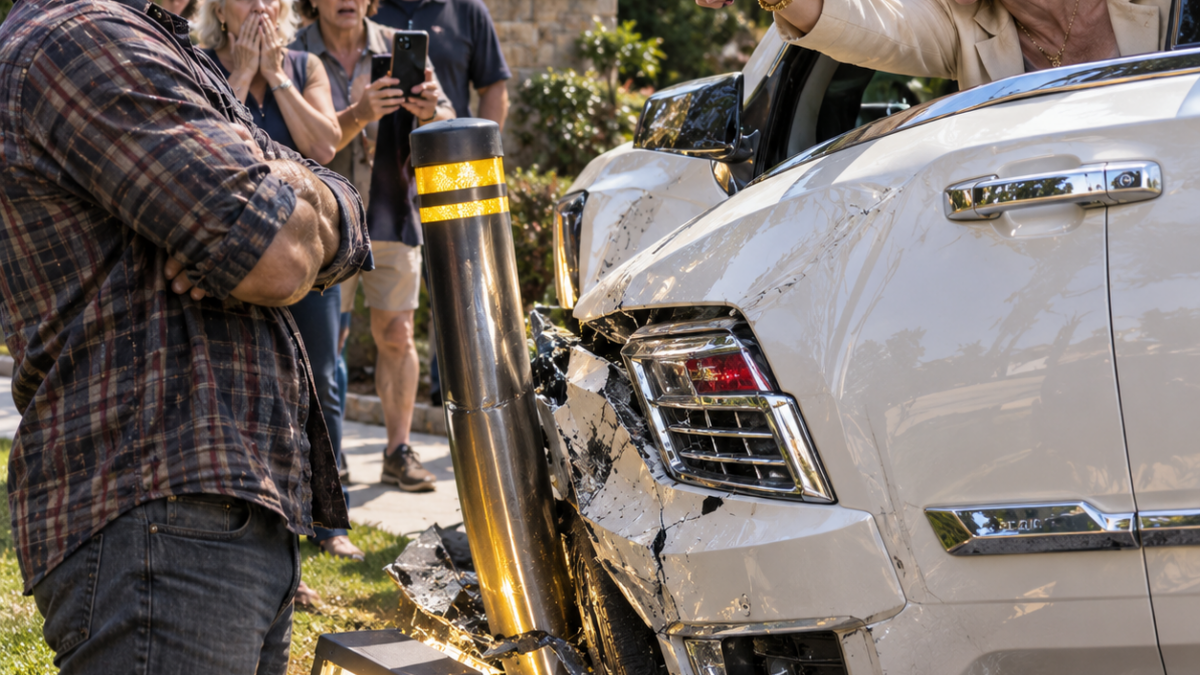
Then came the impact.
The sound was enormous.
A heavy crack.
Followed by the sharp hiss of a damaged tire.
Then metal scraping.
The Escalade jolted.
The front passenger corner dropped.
The bumper deformed.
And the vehicle stopped at an awkward angle near my driveway.
I stepped forward instinctively.
For one terrible moment, my first concern was whether Tracy had been injured.
“Tracy!”
The driver’s door opened.
She climbed out.
She was standing.
Moving normally.
Furious.
I felt a wave of relief.
Then she saw the damage.
And began screaming.
The first accusation came before she’d even looked closely at what she’d struck.
“You did this!”
I remained on the porch.
“Are you hurt?”
She stared.
“What?”
“Are you injured?”
She looked offended by the question.
“MY CAR IS DESTROYED!”
I took a breath.
“I’m asking whether you’re okay.”
She threw up her hands.
“DON’T PRETEND YOU CARE!”
I watched her march toward my driveway.
She stopped beside the damaged bumper.
Then turned toward the fixture.
It was still standing.
The light remained intact.
The visible marker had done what it was supposed to do.
But the Cadillac had not come through the impact unharmed.
Tracy pointed at it.
“That thing is illegal!”
I shook my head.
“It was installed after review.”
She glared.
“You put it there to damage my car!”
I looked at her.
“Tracy, it has been visible from the street since the installation.”
She took a step toward me.
“You knew I’d hit it!”
I felt my jaw tighten.
“I knew you’d been driving across my property.”
Her face reddened.
I continued.
“That’s why I took steps to protect the boundary.”
She opened her mouth.
Closed it.
Then shouted, “YOU CAN’T DO THAT!”
I looked toward the fixture.
Then back at her.
“You don’t have a right to keep driving over my landscaping.”
Her voice became shrill.
“I’LL HAVE THE HOA REMOVE IT!”
I nodded.
“You’re free to submit a complaint.”
She looked stunned.
I continued.
“And I’ll provide the installation documents and footage.”
For the first time, she seemed to understand that threatening me with the HOA wasn’t producing the reaction she’d expected.
Tracy snatched her phone from her handbag.
She began making calls.
First to Martin Bell.
Then to someone connected with her insurance.
Then, from the fragments I overheard, to a towing company.
She paced beside the Cadillac.
Her sunglasses slid down her nose.
She kept looking at me.
Every glance carried the same message.
This is your fault.
But I hadn’t driven her vehicle.
I hadn’t steered across the property line.
I hadn’t ignored the visible safety fixtures.
And I wasn’t going to accept responsibility simply because Tracy was angry.
Still, I didn’t celebrate the collision.
I knew vehicle damage could be expensive.
I knew collisions could cause injuries.
And I understood that everything about the installation and the incident might need independent review.
So I preserved the recording and contacted the appropriate parties to document what had happened.
I wasn’t going to argue with Tracy about engineering standards on a sidewalk.
I was going to let the evidence be examined.
By the time the tow truck arrived, several neighbors had appeared outside.
Mrs. Peterson stood on her porch holding a watering can.
She’d been watering the same plant for almost fifteen minutes.
James, who lived farther down the street, stood beside his mailbox.
A young couple near the corner walked their dog at a remarkably slow pace.
I noticed Daniel from Lot Seven watching from his driveway.
Nobody wanted to admit they were curious.
But everybody was.
Tracy seemed to notice.
Her face grew redder.
The tow truck driver crouched beside the Cadillac.
He examined the damaged wheel and front corner.
Then looked toward the safety fixture.
“That’s what it hit?”
Tracy pointed at me.
“He installed it to destroy my car!”
The driver looked uncomfortable.
He wasn’t there to determine legal responsibility.
He was there to move a damaged vehicle safely.
Still, he glanced at the driveway edge.
Then at the vehicle’s position.
“Ma’am, we’ll get your SUV loaded.”
Tracy stared.
“Don’t you want to know what happened?”
He nodded politely.
“The insurance company can review the details.”
She looked offended.
I almost smiled.
Not because I wanted her humiliated.
But because for once, somebody was refusing to accept her version of events simply because she stated it loudly.
Mrs. Peterson approached while the tow truck crew prepared the vehicle.
“Miles?”
I turned.
“Morning.”
She looked toward the Cadillac.
Then at me.
“Are you okay?”
I nodded.
“I’m fine.”
She lowered her voice.
“I heard the noise from my kitchen.”
I looked toward Tracy.
“Yeah. It was loud.”
Mrs. Peterson hesitated.
Then said, “She’s been driving over those lights for months.”
I looked at her.
“You noticed?”
She nodded.
“Of course.”
My heart tightened.
“Why didn’t you say anything?”
She glanced toward Tracy.
Then lowered her eyes.
“Because she threatened to fine us last year over our fence.”
I stared.
Mrs. Peterson continued.
“She said if we didn’t stop making complaints, she’d start reviewing everything on our property.”
For a moment, I couldn’t speak.
Then I looked across the street.
At Tracy.
At her expensive Cadillac.
At the neighbors watching from their porches.
And I realized how much fear one determined person had created inside a neighborhood that was supposed to feel welcoming.
Mrs. Peterson touched my arm.
“You didn’t deserve what she was doing.”
My throat tightened.
“Thank you.”
She nodded.
Then quietly returned home.
I watched her go.
And understood that the next part of this conflict wasn’t only about my driveway.
After the tow truck left, I went inside and opened my laptop.
My coffee had gone cold.
I didn’t care.
I downloaded the relevant security footage.
Made a backup copy.
Reviewed the sequence.
Then organized the material into a concise incident report.
I included the date.
The time.
Photographs of the vehicle’s position.
The earlier recordings.
The correspondence concerning my lights.
And the records showing the location and status of the installation.
I sent the materials to the HOA board through its official contact channel, requesting that they preserve the records and arrange an impartial review.
I also provided the appropriate information for the insurance process.
Then I sat back.
For months, I’d been asking people to look at what Tracy was doing.
Now there was an incident nobody could easily ignore.
Her Cadillac had been towed from the cul-de-sac in daylight.
Neighbors had witnessed the aftermath.
And the recording showed how the vehicle reached the edge of my driveway.
I didn’t know what the board would decide.
I didn’t know whether Tracy would try to sue me.
And I certainly didn’t know what the coming financial review would uncover.
But I knew one thing.
The story wasn’t going to be decided solely by whichever person shouted loudest.
By Friday afternoon, the footage had become the talk of Sagewood Circle.
I hadn’t posted it to invite strangers to mock Tracy.
But several residents who had received the official correspondence began discussing what the recording showed.
People contacted me privately.
Some apologized for remaining silent.
Others described their own experiences with the board.
A man named Charles told me he’d been fined over his shutters despite having received verbal approval before painting them.
Mrs. Peterson reminded me of the fence dispute.
James described repeated warnings over landscaping that had never been explained clearly.
None of those stories proved misconduct by themselves.
But together, they raised an uncomfortable question.
Had the HOA been enforcing its rules fairly?
Or had residents become so accustomed to Tracy’s influence that they no longer expected fair treatment?
Then came the email.
URGENT COMMUNITY MEETING — SATURDAY MORNING.
Martin Bell had sent it.
The subject line was vague.
The message referred to neighborhood safety and recent concerns involving private-property improvements.
But everybody knew why the meeting had been called.
Tracy’s Escalade.
My driveway.
And the evidence she’d spent months assuming nobody would use against her.
I stared at the email.
Then printed another copy of my documents.
Because if the board wanted a formal discussion, I was prepared to have one.
Saturday morning, the community center was crowded.
I’d attended HOA meetings before.
Usually fewer than a dozen residents came.
Most people preferred spending Saturday mornings doing almost anything else.
But that day, the room was nearly full.
Folding chairs filled the floor.
Neighbors stood along the walls.
People whispered as they entered.
I arrived five minutes early.
Carried a folder.
Took a seat near the front.
And waited.
Martin Bell sat behind the meeting table looking uncomfortable.
His tie was crooked.
His forehead shone with sweat.
Beside him sat Denise from Lot Twelve and James, both members of the board.
They were reviewing documents.
When Martin saw me, he gave a brief nod.
“Miles.”
I nodded back.
“Martin.”
He looked toward my folder.
Then away.
I didn’t smile.
Didn’t threaten him.
Didn’t ask whether he’d finally read my complaint.
I simply waited.
Because this time, he wasn’t going to be able to end the discussion by telling me to move my lights.
Tracy arrived ten minutes late.
The room fell quiet.
She wore a dark blazer, designer sunglasses, and an expression of absolute outrage.
Her heels clicked against the tile.
She marched toward the front.
Then dropped a thick folder onto the table.
“I am filing a formal complaint against Miles Carver.”
Her voice was loud enough to reach the hallway.
Nobody spoke.
She continued.
“He installed dangerous unauthorized structures that damaged my vehicle and endangered residents.”
Martin cleared his throat.
“Tracy, we’ll review your complaint.”
She turned toward him.
“You’d better.”
Her eyes moved across the room.
Then settled on me.
I met her gaze.
She gave a contemptuous smile.
“This is what happens when homeowners take matters into their own hands.”
I remained quiet.
She continued.
“People need to understand that we have rules for a reason.”
I looked toward the folder on my lap.
Then raised my eyes.
“On that point, Tracy, we agree.”
Her smile vanished.
A few neighbors shifted in their seats.
Martin cleared his throat again.
“Let’s begin with the evidence.”
For the first time, Tracy seemed uncertain.
The lights dimmed.
A projector came on.
Martin displayed the security recording.
The first clip showed Tracy’s Cadillac approaching my driveway weeks earlier.
The vehicle crossed the boundary.
A light disappeared beneath the tire.
The housing broke.
Tracy drove away.
Martin played the next clip.
Then another.
Then another.
The room grew quiet.
There was no dramatic narration.
No music.
No editing designed to exaggerate what happened.
Just dates, times, and clear recordings of the vehicle repeatedly crossing the same section of my property.
I watched Tracy.
Her arms were folded.
Her jaw tightened.
Then Martin played the most recent incident.
The Cadillac backing out.
The turn.
The visible protective fixture.
The vehicle crossing into the driveway edge.
The impact.
The sudden stop.
The room went silent.
For several seconds, nobody moved.
Then Martin turned on the lights.
“Tracy.”
She stared at him.
He continued.
“There are multiple recordings of your vehicle entering that part of Miles’s property.”
She gave a sharp laugh.
“Those videos are misleading.”
Denise leaned forward.
“In what way?”
Tracy looked at her.
“The angle.”
James frowned.
“The boundary survey is included with the report.”
Tracy waved one hand.
“Anybody can draw lines over a photograph.”
I felt my jaw tighten.
But Denise remained calm.
“The property records can be independently verified.”
She looked toward the rest of the board.
“And we should have verified them when Miles first submitted his complaint.”
A murmur moved through the room.
Martin looked down.
For the first time, I saw him appear ashamed.
I stood when invited to speak.
My hands were steady.
I held up a copy of the first HOA warning.
“This is what I received after reporting repeated damage to my property.”
Several people leaned forward.
I continued.
“The letter suggested my lighting might be obstructive.”
I looked toward Martin.
“But nobody identified a specific rule I’d violated.”
He swallowed.
I placed the survey on the table.
“The original fixtures were within my boundary.”
Then the installation records.
“The replacement fixtures were documented and reviewed.”
I looked toward Tracy.
“And the footage shows the vehicle crossing into the protected area.”
She leaned forward.
“You set me up!”
I took a breath.
“Tracy, I asked you to stop.”
Her expression hardened.
“I filed a complaint.”
I continued.
“I gave the board video evidence.”
She glared.
“And when the damage continued, I took lawful steps to protect my driveway.”
Her voice rose.
“You knew my car would hit those things!”
I looked directly at her.
“I knew you had repeatedly driven over the old ones.”
For a moment, the room was silent.
Then I continued.
“The fixtures were visible. The installation was documented. And there was no reason to drive across that section of my property.”
Tracy opened her mouth.
But I wasn’t finished.
“I don’t want anyone injured.”
My voice strengthened.
“I don’t want vehicles damaged.”
I looked around the room.
“I want the HOA to stop treating deliberate property damage as though it’s the victim’s responsibility to accommodate it.”
A few residents nodded.
Others murmured agreement.
Then Mrs. Peterson stood.
And the meeting changed.
“My name is Helen Peterson.”
Her voice trembled slightly.
She looked toward the board.
“I’ve lived here fourteen years.”
Martin nodded.
“We know, Helen.”
She swallowed.
“Then you should know I’ve spent the last two years afraid of receiving another violation notice.”
The room grew quiet.
She looked toward Tracy.
“Last year, I was threatened with fines because my fence didn’t meet somebody’s idea of the right shade.”
Tracy rolled her eyes.
“That’s not relevant.”
Helen’s voice strengthened.
“It is relevant.”
A few people turned toward her.
She continued.
“Because when I asked for the specific rule, nobody would give me a clear answer.”
She looked at Martin.
“And when I requested a review, I was told to stop causing conflict.”
I felt my chest tighten.
The same words.
The same pattern.
The same pressure to accept unfair treatment quietly.
Helen continued.
“I watched Tracy drive over Miles’s lights.”
Tracy’s face reddened.
“I saw it more than once.”
The room remained silent.
Helen swallowed.
“And I didn’t say anything because I was afraid she’d come after my property next.”
For a moment, her eyes filled.
Then she looked directly at the board.
“That is not how a neighborhood should operate.”
A murmur of agreement moved through the room.
Martin stared at his hands.
Denise nodded slowly.
And suddenly, Helen wasn’t the only one standing.
Charles stood next.
Then James.
Then a woman from the corner house whose name I barely knew.
One by one, residents described the same experience.
Warning notices that seemed arbitrary.
Fines issued without clear explanations.
Complaints that disappeared when Tracy was involved.
Appeals that never received meaningful answers.
The room grew louder.
Not chaotic.
Not violent.
But full of frustration that had been building for years.
I sat listening.
And realized the driveway lights had been the smallest part of this story.
Tracy had spent so long making people afraid of challenging her that many had stopped believing they had the right to ask questions.
Now the questions were coming.
And she couldn’t answer all of them by calling people sensitive.
Martin raised both hands.
“Everyone, please.”
The room quieted.
He looked older than I’d ever seen him.
His face was pale.
He glanced toward Tracy.
Then toward the residents.
“I think we need to acknowledge that mistakes have been made.”
Tracy spun toward him.
“Mistakes?”
He took a breath.
“Yes.”
Her eyes narrowed.
“Martin, don’t you dare.”
The room froze.
He looked at her.
For the first time, he didn’t immediately back down.
“Tracy, we have evidence of repeated damage to another homeowner’s property.”
She folded her arms.
“And I have evidence of an unsafe installation.”
Martin nodded.
“That concern will be assessed independently.”
Then he looked toward the board.
“But it doesn’t erase the earlier incidents.”
Tracy stared.
He continued.
“We should have taken Miles’s complaint seriously.”
For a moment, I couldn’t speak.
It was such a simple statement.
A complaint should have been reviewed fairly.
Evidence should have mattered.
The rules should have applied to everyone.
I hadn’t expected applause for asking for those things.
I hadn’t expected sympathy.
I only wanted the standards that governed the neighborhood to mean something.
Martin turned toward me.
“Miles, I’m sorry we dismissed your concerns.”
My throat tightened.
I nodded.
“Thank you.”
Tracy let out a sharp laugh.
“Oh, please. Are we going to hold hands now?”
Nobody laughed with her.
Denise opened a folder.
“There’s another matter.”
Tracy frowned.
“What matter?”
Denise looked toward Martin.
“During our review of complaints and enforcement decisions, we also began looking at certain discretionary expenses.”
For the first time, Tracy went completely still.
I noticed immediately.
So did several people sitting near me.
Martin cleared his throat.
“Denise, perhaps we should discuss that in executive session.”
She nodded.
“Some details may need confidential handling.”
Then she looked toward the residents.
“But the board has a responsibility to explain why additional financial oversight is necessary.”
Tracy’s face reddened.
“This has nothing to do with Miles Carver.”
Denise met her eyes.
“It’s about how association funds have been managed.”
The room became silent.
I leaned forward.
This was new.
I hadn’t investigated Tracy’s finances.
Hadn’t looked into association spending.
Hadn’t accused anyone of stealing.
My complaint concerned property damage.
But apparently, once the board began examining its own procedures, it had found reasons to look deeper.
Denise held up a preliminary expense summary.
“We’ve identified several transactions requiring documentation and independent review.”
Tracy sat rigidly.
Denise continued.
“A payment of approximately twelve hundred dollars to a yoga retreat business.”
A few residents exchanged glances.
“An expensive patio furniture purchase shipped to a private residential address.”
Martin looked down.
“And travel expenses categorized as conference-related spending.”
Tracy immediately spoke.
“Those were legitimate expenses.”
Denise nodded.
“Then we’ll need the corresponding approvals, receipts, business purposes, and supporting records.”
Tracy’s mouth tightened.
“You’re accusing me of theft?”
“No.”
Denise’s voice remained steady.
“I’m saying these transactions require explanation.”
The distinction mattered.
Nobody had yet established that the spending was fraudulent.
There were questions.
Records.
Possible conflicts of interest.
And a need for proper review.
But even that was enough to change the atmosphere.
Because the woman who had spent years demanding immediate compliance from everyone else was now being asked to provide documentation of her own.
And she looked furious.
Tracy turned toward Martin.
“Tell her to stop.”
He didn’t answer.
“Martin!”
He took a slow breath.
“Denise has raised concerns the board must examine.”
Tracy stared.
“You’re taking her side?”
He shook his head.
“I’m saying we have to follow the process.”
For a moment, she seemed unable to believe what she was hearing.
Then she turned toward me.
“This is your fault.”
I raised my eyebrows.
“My fault?”
She pointed.
“You started all of this.”
I looked at her.
For months, I’d imagined confronting Tracy.
Telling her exactly what I thought of her behavior.
Listing every insult.
Every broken fixture.
Every time she’d used the HOA to make me feel powerless.
Now, with the whole room watching, I found I didn’t need to shout.
I stood.
“Tracy, I reported damage to my driveway.”
My voice was calm.
“You chose how to respond.”
Her face reddened.
I continued.
“I didn’t tell you to drive across my property.”
She glared.
“I didn’t approve association expenses.”
The room went quiet.
“And I didn’t write the HOA letter that blamed my lighting instead of addressing the damage.”
For a moment, nobody spoke.
Then I said the one thing I wanted her to understand.
“You had opportunities to stop this long before your Cadillac was damaged.”
Tracy opened her mouth.
But no words came.
I sat down.
And for the first time, I didn’t feel the need to say anything more.
The board voted to pursue the available enforcement process concerning the repeated property damage.
Martin explained that any penalty needed to comply with the governing documents and applicable requirements, including proper notice and an opportunity to respond.
A proposed five-thousand-dollar sanction was discussed in connection with the repeated incidents, subject to the required procedures.
Tracy reacted as though she’d been personally attacked.
“Five thousand dollars?”
Her voice echoed across the room.
“For some driveway lights?”
Denise looked at her.
“For documented conduct, if the violations are established under the association’s rules.”
Tracy shook her head.
“Ridiculous.”
Then she pointed at me.
“I’ll sue him.”
I remained quiet.
Martin looked toward her.
“That’s your decision.”
She stared.
He continued.
“But threats won’t replace the review.”
For a moment, Tracy looked genuinely shocked.
Not because anyone had insulted her.
Because the people she’d relied on to support her were finally insisting on rules and evidence.
The same standards she’d spent years invoking against everyone else.
The financial questions were referred for further investigation.
The board arranged an independent review.
Records were requested.
Approvals checked.
Possible conflicts examined.
I didn’t know what those records would ultimately prove.
And I wasn’t going to claim otherwise.
But the residents had seen enough to insist on greater transparency.
One man near the back raised his hand.
“What about all the fines we’ve been paying?”
Martin looked up.
The man continued.
“Will anybody review whether they were properly issued?”
Denise nodded.
“That should be part of the governance review.”
A woman beside him spoke.
“And the appeals?”
Another resident added, “And the landscaping inspections?”
The questions continued.
Each one reasonable.
Each one something the board should have been prepared to answer without treating the person asking as a troublemaker.
For years, Tracy had controlled conversations by making people afraid of what would happen if they challenged her.
Now those people were speaking openly.
I watched Helen Peterson sitting near the aisle.
Her hands were folded in her lap.
Her eyes were wet.
Then she looked toward me.
And smiled.
It was a small smile.
But I understood it.
She wasn’t thanking me for damaging Tracy’s Cadillac.
I hadn’t.
She was relieved that someone had finally made the board look at evidence instead of simply accepting Tracy’s authority.
When the meeting ended, Tracy remained seated.
Most residents began moving toward the door.
People talked quietly.
Some sounded relieved.
Others angry.
A few were simply overwhelmed by what had happened.
I gathered my folder.
Then stood.
Martin approached.
“Miles.”
I looked at him.
He seemed nervous.
“I wanted to apologize again.”
I waited.
He rubbed his forehead.
“When you first came to the board, I treated your complaint like an inconvenience.”
I nodded.
“You did.”
His face tightened.
“I should have reviewed the footage.”
“Yes.”
He swallowed.
“I should have checked the property records.”
I looked toward him.
“Yes.”
He sighed.
“I was trying to avoid conflict.”
For a moment, I considered letting that pass.
Then I shook my head.
“Martin, ignoring somebody who’s being mistreated doesn’t prevent conflict.”
He looked at me.
“It just leaves that person dealing with it alone.”
His expression changed.
For a long moment, he didn’t speak.
Then he nodded.
“You’re right.”
I closed my folder.
“I hope you remember that.”
He stepped aside.
And I walked toward the door.
Outside, the air smelled of freshly cut grass.
The sun was warm.
Birds moved through the trees beyond the parking lot.
I took a deep breath.
For months, I’d been carrying anger around like a stone in my chest.
Every time I looked at my driveway.
Every time I heard Tracy’s garage door.
Every time an HOA envelope arrived.
I had wondered whether the next confrontation would be worse.
Whether Tracy would keep damaging my property.
Whether the board would eventually fine me for trying to protect it.
Now, for the first time, I felt that the situation might actually change.
Not because Tracy had been embarrassed.
Because the evidence was finally being treated seriously.
I was halfway across the parking lot when someone called my name.
“Miles!”
I turned.
Helen Peterson was approaching.
She moved quickly, her purse swinging against her side.
“Wait a second.”
I stopped.
She reached me.
Then took both my hands.
“Thank you.”
I blinked.
“Helen, I only filed a complaint.”
She shook her head.
“No.”
Her voice trembled.
“You did more than that.”
I looked at her.
She continued.
“You made them listen.”
Her eyes filled.
“For years, I thought we had to put up with whatever Tracy wanted.”
I swallowed.
Helen looked toward the community center.
“I was afraid of being fined.”
She laughed shakily.
“Imagine that. A grown woman afraid to paint her own fence because somebody might decide to punish her.”
I smiled sadly.
She squeezed my hands.
“Maybe things can finally be different.”
I looked toward the building.
Then back at her.
“I hope so.”
The following week brought more changes.
The HOA announced that Martin Bell would step down from his leadership role.
He described the decision as personal.
I didn’t know everything behind it.
But the timing was obvious.
The board’s handling of complaints and financial oversight was under scrutiny.
Residents wanted answers.
And Martin had spent too long allowing Tracy’s influence to dominate decisions he was supposed to oversee impartially.
A temporary leadership group was formed.
Denise helped coordinate the review.
James assisted with collecting governance records.
Outside professionals were consulted where appropriate.
The association began examining enforcement procedures.
Notice requirements.
Appeals.
Expense approvals.
Recordkeeping.
And the question everybody had been afraid to ask aloud.
How had one person been allowed to exercise so much influence without effective oversight?
Tracy reacted badly.
At first, she continued sending angry messages.
She insisted she’d been treated unfairly.
Claimed residents were conspiring against her.
Demanded that the board reverse its decisions.
Threatened legal action.
Then her messages became less frequent.
Her appearances in the neighborhood became rare.
The woman who used to walk around Sagewood Circle inspecting flower beds now seemed unwilling to leave her house.
The clipboard disappeared.
So did the smug smile.
Her Cadillac no longer occupied its usual place in the driveway.
A modest rental sedan appeared instead.
Whenever I saw it, I felt a mixture of things.
Relief.
Residual anger.
And, surprisingly, sadness.
Not because I missed Tracy.
Because the whole conflict had been so unnecessary.
All she’d needed to do was respect the same boundary everyone else respected.
If she’d apologized after the first light, I would have accepted it.
If she’d stopped after the second, we could have moved on.
Even after the fourth, I still wanted the situation resolved without a fight.
But she kept pushing.
Kept using the HOA against me.
Kept treating a neighbor’s property as though it belonged to her.
And the consequences became larger with every decision she made.
Three weeks after the emergency meeting, a real-estate sign appeared outside Tracy’s house.
FOR SALE.
I saw it while taking out the trash.
For a moment, I stood staring.
Then I looked toward her driveway.
The place where the white Escalade had stood.
The garage.
The perfectly trimmed hedges.
The hydrangeas she’d once watered while threatening to report me.
Everything looked the same.
Yet the house seemed strangely different.
Without Tracy standing outside issuing instructions, it was simply another attractive suburban home.
I didn’t know exactly why she’d decided to sell.
Perhaps the association dispute.
Perhaps financial concerns.
Perhaps personal circumstances unrelated to me.
I wasn’t going to pretend I knew her private reasons.
But I knew she was leaving.
And I couldn’t deny the relief I felt.
She moved on a Tuesday.
A rental truck arrived shortly after sunrise.
Two workers began carrying boxes from the garage.
Then furniture.
Lamps.
Chairs.
Several framed pictures.
I was working in my garden when I noticed.
I didn’t approach.
Didn’t take photographs.
Didn’t ask questions.
It was her moving day.
And for once, I wanted to give her the privacy I wished she’d given me.
By early afternoon, the truck was loaded.
Tracy stood near the front door holding her handbag.
She looked tired.
Her hair was tied back.
She wore jeans and a plain sweater.
No clipboard.
No sunglasses.
No expensive Cadillac.
Just a woman preparing to leave the house where she’d spent years trying to control everyone around her.
For a moment, I felt almost sorry for her.
Then I remembered the crushed lights.
The smirk.
The warning letter.
The way Helen had described being afraid of another fine.
And the sympathy faded into something quieter.
Accountability.
That was all I’d ever wanted.
When Tracy finally climbed into the rental sedan, I was standing on my porch.
Coffee in hand.
The same place I’d stood the morning her Escalade struck the protective fixture.
She started the engine.
Reversed carefully.
Then stopped.
For a moment, she looked across the cul-de-sac.
Our eyes met.
I didn’t smile.
Didn’t laugh.
Didn’t raise my coffee in celebration.
I simply nodded.
A peaceful, ordinary nod.
The sort of gesture one neighbor might offer another.
Tracy stared.
Her expression was unreadable.
Then she looked away.
Put the car into drive.
And left Sagewood Circle.
I watched until she disappeared around the bend.
Then I looked toward my driveway.
The fixtures stood where they’d been installed.
The lights were intact.
The property line was quiet.
And for the first time in months, I felt that my home was mine again.
The neighborhood changed after Tracy left.
Not overnight.
And not because every problem disappeared.
Homeowners associations still need rules.
Residents still disagree about landscaping.
People still complain about parking, noise, pets, fences, and maintenance.
But the tone of the conversations began changing.
The interim board published clearer explanations of its decisions.
Residents could ask questions without immediately being treated as troublemakers.
Previously issued violations were reviewed when there was reason to question the process.
Financial controls received closer attention.
And people who had once avoided HOA meetings began attending them.
I noticed the difference on a Saturday morning.
A neighbor named Charles was standing near his front steps, painting a wooden planter.
He looked up when I walked past.
“Morning, Miles.”
I nodded.
“Morning.”
He smiled.
“Guess what?”
I laughed.
“What?”
“I asked the HOA whether I needed approval to repaint this.”
I raised an eyebrow.
“And?”
“They sent me the actual rule.”
I grinned.
“Imagine that.”
He laughed.
“Turns out I don’t need permission at all.”
I looked at the planter.
It was a deep navy blue.
The same shade he’d once been warned about using on his shutters.
I smiled.
“Looks good.”
He laughed again.
“That’s what I thought.”
We stood talking for a few minutes.
Ordinary neighborly conversation.
No whispered complaints.
No nervous glances toward Tracy’s house.
Just two homeowners talking about paint.
It shouldn’t have felt like such a victory.
But it did.
One evening, Denise stopped by.
I was trimming shrubs near my driveway when she approached.
“Miles?”
I looked up.
“Hey, Denise.”
She carried a folder.
“Do you have a minute?”
“Sure.”
We sat on the porch.
I brought out two glasses of iced tea.
She looked tired.
Not defeated.
Just exhausted in the way people become when they’ve spent weeks cleaning up problems nobody wanted to acknowledge.
“How’s the review going?” I asked.
She sighed.
“Slowly.”
I nodded.
“I figured.”
She looked toward the cul-de-sac.
“We’ve found procedures that need serious improvement.”
I waited.
“Some expenses still require supporting documentation.”
I nodded.
She continued.
“And several enforcement decisions were poorly recorded.”
I looked down at my glass.
For a moment, I remembered Martin telling me that the placement of my lights was provoking the problem.
I shook my head.
“That’s a lot to untangle.”
Denise nodded.
“It is.”
Then she turned toward me.
“But we’re working through it properly.”
I smiled.
“Good.”
She hesitated.
“There’s something I wanted to ask.”
I raised an eyebrow.
“What?”
She smiled slightly.
“Would you consider joining an advisory group for property improvements and safety?”
I laughed.
“Denise, I moved here to get away from meetings.”
She laughed, too.
“I know.”
I shook my head.
“I’m serious.”
She smiled.
“That’s what makes you useful.”
I considered the request.
Then looked toward my driveway.
The lights.
The stone path.
The cedar fence.
For months, I’d been defending simple things that should never have become controversial.
I wasn’t interested in becoming another neighborhood tyrant.
But perhaps there was a way to help without turning my life into an endless series of arguments.
“I’ll review the proposal,” I said.
Denise grinned.
“That’s not a no.”
I laughed.
“Don’t get excited.”
She smiled.
Then raised her glass.
“To a calmer Sagewood Circle.”
I touched my glass to hers.
“I’ll drink to that.”
The strangest part of the whole experience was becoming recognizable to neighbors who had barely spoken to me before.
People stopped by while I was working in the yard.
Some wanted to ask about the lighting.
Others wanted to discuss what had happened with Tracy.
A few simply wanted to say they were glad the association was changing.
One man from farther down the street approached carrying a small cardboard box.
“Miles?”
I looked up.
“Yeah?”
He smiled.
“I brought you something.”
I frowned.
“What is it?”
He opened the box.
Inside was a coffee mug.
Printed across the side were the words:
THE BOLLARD WHISPERER.
I stared.
Then burst out laughing.
The man grinned.
“Figured you deserved a title.”
I shook my head.
“You’re kidding.”
“Nope.”
I lifted the mug.
It was ridiculous.
Absolutely ridiculous.
But I couldn’t stop laughing.
“Thanks, I guess.”
He smiled.
“Use it in good health.”
Then he walked away.
I stood in the driveway holding the mug.
For a moment, I thought about all the months I’d spent angry over broken lights.
Now, somehow, I had become a neighborhood joke in the best possible way.
I looked toward the fixtures.
Then laughed again.
“Bollard Whisperer.”
I shook my head.
“Unbelievable.”
That mug became my favorite.
Not because it was expensive.
It wasn’t.
Not because it made me feel like a hero.
It didn’t.
But because it reminded me that the neighborhood had begun laughing together again.
Not nervously.
Not behind closed doors.
Openly.
Neighbors talked across driveways.
Children played near the circle.
People brought food to block gatherings.
The man who’d once worried about his navy shutters now invited people over to help repaint a fence.
Helen Peterson began tending her flower beds without glancing toward the street every few minutes.
Sometimes I watched all of it from my porch.
And I found myself thinking about the strange way a community can change.
It doesn’t always require a dramatic event.
Sometimes it begins when one person says, “This isn’t right.”
Then another person admits they’ve noticed the same thing.
Then another.
And eventually, people stop treating fear as the normal price of belonging.
I never ran for HOA president.
Several neighbors suggested it.
Some were serious.
Others simply liked the idea of replacing Tracy’s style of leadership with the man she’d spent months trying to intimidate.
But I declined.
I didn’t move to Sagewood Circle to become president of anything.
I wanted to enjoy my home.
Grow shrubs.
Repair things.
Drink coffee.
Spend time in the garage.
And enjoy the peace I’d left Denver to find.
I was willing to attend meetings when necessary.
Offer technical advice.
Help residents understand the importance of safety reviews.
But I didn’t need a title to feel that my property mattered.
And I certainly didn’t need a clipboard to prove I was important.
Tracy had made that mistake.
She had confused authority with personal superiority.
I didn’t intend to repeat it.
There was one final conversation with Martin that I remember clearly.
It happened several weeks after Tracy moved.
I was returning from the hardware store when I saw him outside the community center.
He was loading old files into his car.
He looked up.
“Miles.”
I nodded.
“Martin.”
For a moment, neither of us spoke.
Then he said, “I hear things are calmer.”
I looked toward the building.
“They seem to be.”
He smiled faintly.
“Good.”
I hesitated.
Then asked, “How are you doing?”
He looked surprised.
“Me?”
I nodded.
He sighed.
“Trying to learn from a few mistakes.”
I considered that.
Then said, “That’s all any of us can do.”
He looked down.
For a while, he seemed lost in thought.
Then he said, “I really did think keeping the peace meant not taking sides.”
I leaned against my truck.
“And now?”
He looked toward me.
“I think I confused neutrality with avoiding responsibility.”
I nodded slowly.
He continued.
“When somebody brings evidence of repeated damage, you can’t just tell them to stop complaining.”
I looked toward the parking lot.
“No.”
He sighed.
“That’s what I did.”
I didn’t argue.
He knew.
Then Martin held out his hand.
“I’m sorry, Miles.”
I looked at it.
For a moment, I remembered the warning letter.
The dismissive meeting.
The feeling of standing before a board that refused to acknowledge what its own rules said.
Then I took his hand.
“Thank you.”
We shook.
That didn’t erase what happened.
But it mattered that he was finally willing to acknowledge it.
The independent review continued after Tracy left.
Some decisions were corrected.
Some procedures were rewritten.
The board strengthened its approval processes.
The questionable spending was referred to the appropriate people for further assessment.
I followed the updates when they were shared with residents.
But I didn’t try to insert myself into every detail.
My involvement had begun with property damage.
I had supplied the evidence.
The board had a responsibility to deal with the rest.
I didn’t need to become an investigator.
A prosecutor.
Or the person responsible for delivering punishment.
For months, Tracy had made her personal grudges part of neighborhood administration.
I wasn’t going to do the same.
One Saturday, I repaired the last damaged section of landscaping beside my driveway.
The old plastic lights were gone.
The new fixtures remained in place.
But the repeated tire crossings had left marks.
Compacted soil.
A few damaged plants.
An uneven patch of gravel.
I knelt beside the flower bed.
Loosened the soil.
Added fresh mulch.
Replaced a native shrub that hadn’t survived.
Then stepped back.
The sunlight was warm.
The air smelled of earth.
For a moment, I simply admired the result.
It looked ordinary.
There was nothing remarkable about a carefully maintained driveway edge.
But to me, that little patch of ground represented something I’d spent months fighting to keep.
The ability to make decisions about my own home without being threatened for refusing to surrender what belonged to me.
I stood.
Brushed dirt from my hands.
Then heard a voice.
“Looking good, Miles.”
I turned.
Helen Peterson was walking past with her dog.
I smiled.
“Thanks.”
She stopped.
Her dog sniffed a patch of grass.
Helen looked toward the driveway.
“Remember when Tracy used to drive right over that spot?”
I laughed softly.
“Hard to forget.”
She shook her head.
“I still can’t believe she kept doing it.”
I looked toward the fixtures.
Then said, “Neither can I.”
Helen studied me.
“Do you regret any of it?”
I considered the question.
For a moment, I thought about the collision.
The damaged Cadillac.
The furious confrontation.
The HOA meeting.
The months of wasted time.
Then I answered carefully.
“I wish it had never reached that point.”
She nodded.
“Me, too.”
I continued.
“I wish she’d stopped when I first asked.”
Helen smiled sadly.
“That would’ve been the decent thing.”
I looked toward the driveway.
“Yeah.”
Then I added, “But I don’t regret documenting what happened or insisting that the rules apply to everybody.”
Helen nodded.
“You shouldn’t.”
She continued down the sidewalk.
And I returned to my garden.
That evening, I sat on the porch watching the sky darken.
The lights came on automatically.
A soft glow along the driveway.
Nothing dramatic.
Nothing aggressive.
Just steady points of light marking the edge.
I held my ridiculous Bollard Whisperer mug.
The coffee was hot.
The street was quiet.
A car turned into the cul-de-sac.
Slowed.
Followed the curve.
Then continued without coming anywhere near my driveway.
I smiled.
That’s how simple it was supposed to be.
A vehicle stayed in the appropriate travel area.
A homeowner’s landscaping remained undamaged.
And nobody needed to scream about property rights.
For months, Tracy had acted as though respecting my boundary would somehow diminish her.
As though being asked to drive carefully was an insult.
As though the HOA existed to protect her convenience from everyone else’s rights.
Now she was gone.
And the neighborhood was learning something it should never have forgotten.
Rules mean very little if they only apply to people without influence.
Sometimes I think back to the first day Tracy arrived with the welcome basket.
The wine.
The crackers.
The glossy HOA brochure.
The cheerful smile.
People who cooperate usually have a wonderful time here.
I remember how innocent that sentence sounded.
How little I understood about the person saying it.
At the time, I believed she was talking about cooperation.
Now I recognize that she meant obedience.
Obedience to her preferences.
Her judgments.
Her version of what the neighborhood should look like.
But a community isn’t supposed to be one person’s kingdom.
It’s supposed to be a place where people live together under rules that everyone can understand and question.
A good HOA can help maintain shared property and resolve disputes.
A bad one can become a machine for turning personal grudges into official-looking threats.
Sagewood Circle had drifted dangerously close to the second.
And the people who should have prevented it spent too long looking the other way.
I still think about the morning Tracy smiled while driving over my lights.
That tiny shrug.
The sound of plastic cracking.
The way she looked at me as though my anger were amusing.
I remember standing on the porch with my coffee cooling in my hand.
Wondering how somebody could be so casually disrespectful.
I didn’t know then how many other people were feeling the same way.
Helen and her fence.
Charles and his shutters.
The families with repeated notices.
The residents who had stopped attending meetings because they believed nobody would listen.
For a while, I thought I was dealing with one difficult neighbor.
Eventually, I realized that the problem was larger.
One person had been allowed to exercise influence without enough accountability.
And everybody else had been expected to accept it.
That was why the emergency meeting mattered.
Not because people enjoyed watching Tracy lose her temper.
Because the evidence forced a serious conversation about how the neighborhood was being governed.
I have no idea whether Tracy ever looked back at Sagewood Circle and regretted what happened.
Perhaps she still believes I was wrong.
Perhaps she tells people that a vindictive neighbor destroyed her Cadillac.
Perhaps she remembers the HOA meeting as a conspiracy.
I can’t control her version of events.
And I don’t intend to spend my life trying.
I know what happened.
I asked her to stop driving over my lights.
She didn’t.
I documented the repeated damage.
The HOA dismissed my complaint.
I arranged a visible, professionally reviewed protective installation.
She drove into it.
Then the board examined the records and began confronting problems it should have addressed much earlier.
Those facts are enough for me.
I don’t need Tracy to admit she was wrong before I can enjoy my own home again.
The next spring, Sagewood Circle held a neighborhood gathering.
Nothing fancy.
A few folding tables.
Grilled food.
Children running around the grass.
People bringing salads and homemade desserts.
Someone hung colorful lights between two trees.
Charles arrived with a tray of brownies.
Helen brought lemonade.
James set up a little music speaker.
For a few hours, people sat together and talked about things that had nothing to do with fines or violations.
Gardens.
Vacations.
Work.
Dogs.
Children.
The weather.
I stood near the edge of the gathering with a plate of food.
Then Denise approached.
“Enjoying yourself?”
I smiled.
“More than I expected.”
She laughed.
“That’s not saying much.”
I looked around.
“It’s nice.”
She nodded.
Then glanced toward the houses.
“Feels different, doesn’t it?”
I watched a group of neighbors laughing near the tables.
“Yeah.”
I took a breath.
“It does.”
For a moment, neither of us spoke.
Then Denise said, “You know, people used to avoid these gatherings.”
I looked at her.
“Really?”
She nodded.
“Tracy would spend half the time criticizing someone’s yard or warning people about something.”
I shook my head.
Denise smiled.
“Tonight, nobody’s afraid of being inspected.”
I laughed.
“That’s a pretty low bar for a party.”
She laughed, too.
“Maybe.”
Then her expression softened.
“But it’s a good start.”
Later that evening, Helen came over and asked me to take a photograph with several neighbors.
I almost refused.
I’m not much for pictures.
But she insisted.
So I stood beside them.
Smiled.
And let somebody take the photo.
When Helen sent it to me afterward, I stared at the screen.
I was standing among people who seemed genuinely happy.
No one looked nervous.
No one was glancing toward a clipboard.
There were no raised voices.
No threats.
Just a group of neighbors smiling beneath the evening sky.
I saved the photograph.
Then placed my phone on the table.
For a while, I sat looking out the window.
And thought about the difference between a neighborhood that looks perfect and one where people actually feel safe and welcome.
Tracy had cared deeply about appearance.
The right flowers.
The right paint.
The right curtains.
The right people obeying the right instructions.
But she’d forgotten that a neighborhood’s greatest asset isn’t the uniformity of its landscaping.
It’s the trust between the people who live there.
Once that trust disappears, no amount of perfectly trimmed grass can replace it.
Now, every morning, I follow almost the same routine I followed before the trouble began.
I wake early.
Make black coffee.
Open the front door.
Step onto the porch.
And look toward my driveway.
The lights are still there.
Clean.
Functional.
Undamaged.
The native shrubs have grown around them.
The stone path looks good.
The cedar fence still needs occasional maintenance.
And the forest behind the house turns beautiful shades of gold and red every autumn.
Sometimes a neighbor waves.
Sometimes a delivery truck pulls into the driveway.
Sometimes children ride bicycles around the circle.
Everything is ordinary.
Beautifully ordinary.
And after everything that happened, I appreciate that more than I used to.
If you asked me whether I consider what happened a victory, I’d say yes.
But not for the reason people might expect.
The victory wasn’t the crunch of Tracy’s Cadillac.
I don’t celebrate vehicle damage.
The victory wasn’t watching her storm out of an HOA meeting.
It wasn’t the money she might have to pay.
Or the embarrassing questions about association spending.
Or even watching the for-sale sign appear outside her house.
The victory was that I could finally stand in my driveway without wondering whether she would deliberately damage it again.
It was Helen feeling comfortable enough to speak at a meeting.
Charles painting his shutters without fearing arbitrary punishment.
Martin acknowledging that ignoring evidence had been wrong.
And a board beginning to understand that its authority came with responsibilities, not personal privileges.
That was the outcome worth protecting.
I once spent years working on structures designed to withstand enormous forces.
Loading areas.
Protective barriers.
Vehicle access systems.
Industrial facilities.
I knew how to calculate what materials could tolerate.
How to review failure risks.
How to design things that kept people and property safer.
But Sagewood Circle taught me something no engineering textbook ever had.
Some boundaries can’t be protected by material strength alone.
They require people willing to speak.
Evidence that can be examined.
Procedures that apply fairly.
And neighbors who refuse to let intimidation become normal.
The fixtures protected my driveway.
The documentation protected the facts.
But the people who finally spoke up helped protect the neighborhood.
And that mattered far more than any piece of steel.
This morning, I stood on my porch as the sun rose over Sagewood Circle.
The air was cool.
A few birds were calling from the trees.
The street was empty.
No Cadillac engine.
No cracking plastic.
No shouting.
I held my coffee and watched the light move slowly across the houses.
Then I looked toward the driveway.
The fixtures stood quietly along the edge.
Exactly where they belonged.
I smiled.
For three months, Tracy Harrove had tried to convince me that protecting my own property made me unreasonable.
She’d called me sensitive.
Difficult.
A troublemaker.
She’d used her influence to turn a legitimate complaint into a warning against me.
And when she finally drove into the visible protective fixtures, she accused me of causing the very collision her own driving had created.
But the footage told a different story.
So did the records.
So did the neighbors who had watched her behavior for months.
And when those pieces finally came together, Tracy discovered something she had spent years making everyone else forget.
Authority doesn’t make a person immune to accountability.
I finished my coffee.
Set the mug on the porch railing.
Then walked down the steps.
The gravel crunched beneath my shoes.
I stopped at the edge of the driveway.
Looked toward the neatly maintained flower bed.
Then toward the place where Tracy’s Cadillac had struck the fixture.
There were no tire marks left.
No broken plastic.
No scattered debris.
Just a clearly marked boundary and a quiet street.
I knelt beside one of the shrubs.
Pulled a weed.
Smoothed the soil.
Then stood.
And laughed softly to myself.
Because after all the meetings, complaints, threats, and accusations, I’d finally gotten exactly what I wanted when I moved to Sagewood Circle.
A little house.
A peaceful neighborhood.
And the freedom to take care of my own property without being bullied for it.
I looked toward Tracy’s former house.
A new family had moved in.
Their children had been riding bicycles near the sidewalk the previous afternoon.
The new owners waved whenever they saw me.
We’d exchanged a few friendly conversations.
Nothing dramatic.
Nothing complicated.
Just ordinary neighborly courtesy.
The way things should have been all along.
I smiled.
Then turned toward my porch.
Before going inside, I looked at the little wooden sign hanging beside my front door.
I’d made it myself when I first moved here.
It said:
HOME SWEET HOME.
For months, I’d walked past that sign while feeling angry, frustrated, and exhausted.
I’d begun wondering whether leaving Denver had been a mistake.
Whether this peaceful neighborhood was worth the trouble.
Whether I should simply remove the lights and accept that Tracy would always get her way.
Now I looked at the words and felt something I hadn’t felt in a long time.
Certainty.
I belonged here.
My home mattered.
My property deserved respect.
And I didn’t have to become cruel or abusive to insist on those things.
I opened the door.
Stepped inside.
And placed my coffee mug in the kitchen sink.
Tomorrow, I’d wake early again.
Make coffee.
Check the garden.
Maybe repair the fence.
Maybe plant another shrub near the driveway.
And unless something genuinely needed attention, I wouldn’t give the HOA another thought.
That was the kind of life I’d wanted.
Ordinary.
Quiet.
Mine.
Tracy Harrove spent months using her Cadillac and her HOA influence to remind me that she thought she could cross any boundary she pleased. But the day she drove into my properly installed driveway protection, her own actions created the evidence that finally forced the neighborhood to confront her behavior—and when the board began asking questions about the power she’d been abusing, even her expensive Escalade couldn’t carry her away from accountability.
I didn’t need to destroy her kingdom. I only needed to protect my property, preserve the truth, and refuse to disappear when someone with authority told me I had no right to stand my ground.








