PART2:“MOVE YOUR STUPID BARRIERS, YOU PATHETIC LOSER!” HOA Karen Turned My Private Driveway Into a Neighborhood Shortcut—Then Destroyed Her $90,000 Mercedes Trying to Prove She Owned It
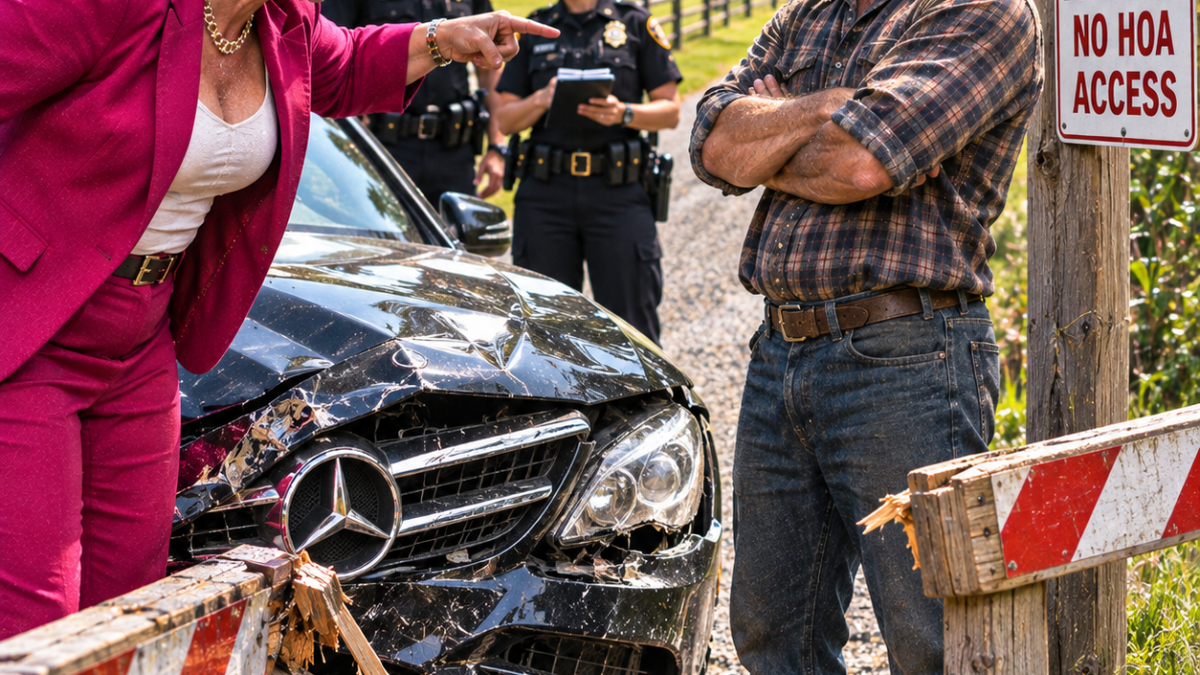
Three months earlier, nobody in Willow Creek would have believed I was capable of standing up to Victoria Langford.
At least, nobody except my wife.
My name is Ethan Brooks.
I’m thirty-eight years old, and I work as an electrical systems engineer for a regional manufacturing company.
I like quiet weekends.
I like fixing things.
I like knowing where my property ends and the rest of the world begins.
I don’t attend neighborhood cocktail parties unless someone drags me there.
I don’t spend my evenings arguing on Facebook.
And I have never understood why some people consider a neatly trimmed lawn more important than treating their neighbors decently.
That last opinion became especially unpopular after Victoria Langford took over our homeowners association.
Willow Creek was a comfortable suburban neighborhood outside a growing Texas city.
Tree-lined streets.
Two-story houses.
A small community park.
A pond near the entrance.
People walking dogs in the evening.
Children riding bicycles.
The kind of neighborhood where most families wanted exactly the same things.
A safe place to live.
Reasonable property values.
And neighbors who respected one another.
Clare and I had bought our house four years earlier.
It wasn’t the biggest property in Willow Creek.
It wasn’t the fanciest.
But we loved it.
The house sat near the rear boundary of the development, where the road curved toward a wooded strip separating the subdivision from the county highway.
Behind our garage ran an old paved access lane.
That lane was important.
My grandfather had owned the property before the subdivision existed.
He’d used the lane to reach agricultural equipment stored near the highway.
When the surrounding land was developed, he retained that narrow strip along with the parcel that eventually became our home.
The recorded property documents showed the lane belonged to our parcel.
It wasn’t a community road.
It wasn’t a public thoroughfare.
And it wasn’t burdened by an access easement granting Willow Creek residents the right to use it as a shortcut.
When Clare and I purchased the property, our title company reviewed those documents.
I kept copies.
I even had a survey showing the boundaries and the access lane.
At the time, I never imagined those papers would become some of the most important documents in our lives.
To me, the lane was just a convenient way to reach the back of our property.
I used it occasionally when bringing in supplies or arranging maintenance work.
Most days, it sat empty.
Clare loved that.
The quiet.
The privacy.
The trees.
And especially the sunlight along the side of the house.
She planted roses there the first spring after we moved in.
Not just a few bushes from a garden center.
A whole carefully planned bed of pink, yellow, and white roses.
She researched varieties.
Tested the soil.
Mixed compost.
Installed a drip irrigation system.
And spent evenings kneeling in the dirt while I pretended to understand the difference between hybrid teas and floribundas.
I didn’t.
But I loved watching her work.
Clare was a middle-school art teacher.
She could take an empty patch of ground and see something beautiful before a single flower existed.
When we learned she was pregnant with our first child, the garden became even more important to her.
She said she wanted our daughter to grow up beside something planted before she was born.
Something they could care for together.
She had already chosen which rosebush would be closest to the nursery window.
A pale pink variety that bloomed in soft clusters.
“I want her to look outside and see these every morning,” Clare told me.
I kissed her forehead.
“Then I’ll make sure the sprinklers work.”
She laughed.
“That’s your contribution?”
“I’m an engineer. Water pressure is my love language.”
We were happy.
Not wealthy.
Not famous.
Just a couple preparing for their first child.
Then Victoria Langford decided I was a problem.
It started with the solar panels.
I’d installed them on our roof after reviewing the HOA’s architectural requirements and applicable state protections.
I submitted the necessary paperwork.
Followed the approved placement restrictions.
Used a licensed installer.
And kept every document.
Victoria still objected.
She thought the panels looked ugly from the street.
At the monthly HOA meeting, she stood behind the podium wearing a pastel blazer and a gold bracelet that flashed beneath the fluorescent lights.
She held the microphone like she was delivering a speech to Congress.
“Neighbors, we all support responsible energy choices.”
A few people nodded.
“But we must also protect the beauty and consistency of Willow Creek.”
She paused dramatically.
Then looked straight at me.
“Unfortunately, some homeowners believe their personal preferences matter more than community harmony.”
I sat in the third row beside Clare.
I already knew where this was going.
Victoria continued.
“Ethan Brooks has installed a large collection of solar panels without obtaining my personal approval.”
I raised my hand.
“Victoria, the architectural review was completed, and I have the documentation.”
She smiled.
The kind of smile that never reaches the eyes.
“Ethan, we’re not debating paperwork.”
I stared at her.
“Then what are we debating?”
“Respect.”
Several people shifted uncomfortably.
Victoria sighed into the microphone.
“It’s unfortunate when a resident forces the rest of us to accommodate an eyesore.”
Clare squeezed my hand.
I could feel her anger.
But I stayed seated.
I wasn’t going to turn a neighborhood meeting into a shouting match.
Victoria mistook my silence for surrender.
Within forty-eight hours, posts began appearing in the Willow Creek Facebook group.
One suggested that certain homeowners cared more about saving money than maintaining property values.
Another accused me of ignoring community standards.
Someone called me antisocial.
Someone else claimed I stored junk behind my garage.
One particularly ridiculous comment suggested I probably didn’t even recycle.
I almost laughed.
Clare didn’t.
She sat at the kitchen table scrolling through the comments.
Her eyes filled with tears.
“They don’t even know us.”
I closed the laptop.
“Then their opinions aren’t worth worrying about.”
She looked at me.
“That’s easy for you to say.”
I sat beside her.
“I know.”
She rested a hand against her belly.
“I wanted our daughter to grow up in a neighborhood where people looked out for each other.”
I put my arm around her.
“She will.”
At the time, I believed that.
Then Victoria discovered the access lane.
The first time I saw her use it, I was carrying groceries from my truck.
A white Mercedes SUV turned slowly off the county road.
It stopped near the beginning of my private lane.
The driver checked both directions.
Then accelerated toward the back of my house.
I recognized the car immediately.
Victoria.
She drove along the lane, passed the garage, and cut across the edge of our driveway toward the subdivision street.
The route saved several minutes compared with the traffic-heavy intersection on Maple Avenue.
I stepped outside.
“Victoria!”
She braked.
Rolled down her tinted window halfway.
And smiled.
“Ethan, sweetheart. Lovely morning.”
“This is private property.”
She looked around theatrically.
“Is it?”
“Yes.”
“Well, it’s a very useful little road.”
“It’s my access lane.”
She laughed.
“Oh, don’t be dramatic. It’s thirty seconds of pavement.”
“That doesn’t make it public.”
She leaned toward the window.
“The traffic on Maple is terrible. One little shortcut helps reduce congestion.”
“Then take the public roads.”
Her smile tightened.
“Community cooperation, Ethan. Remember?”
I glanced down.
Her tires had rolled over the edge of Clare’s flower bed.
Several rose stems lay bent in the dirt.
“You’re damaging the garden.”
Victoria followed my gaze.
“Oh, those?”
She waved dismissively.
“They’ll grow back.”
Then she accelerated away.
I stood there watching her taillights disappear.
The entire encounter had lasted less than a minute.
But it told me something.
Victoria wasn’t confused about the property line.
She simply didn’t care.
And by the end of the week, she had made sure other people didn’t care either.
Susan Walsh, the HOA vice president, began using the lane on her morning drive.
Then Bob Clark started cutting through in his pickup.
Then two more residents.
By Friday, five different vehicles had used my property as a shortcut.
Some drove slowly.
Others didn’t.
One SUV crossed the grass near the rose bed because the driver misjudged the turn.
Another left deep tire marks along the edge of the lawn.
I placed bright orange traffic cones near the entrance.
They were temporary.
Visible.
Easy to understand.
Victoria simply steered around them.
The next morning, somebody posted a photograph in the neighborhood Facebook group.
It showed my cones beneath the caption:
Some residents still don’t understand the spirit of cooperation.
Thirty-seven people liked it.
Clare showed me the post.
Her face was pale.
“She’s making fun of us.”
I looked at the screen.
“She’s making herself look foolish.”
“But people are agreeing with her.”
I didn’t have a good answer.
Because she was right.
Victoria had a talent for making other people’s boundaries seem like personal insults.
If I asked her not to drive through my property, I was selfish.
If I cited the survey, I was obsessed with technicalities.
If I complained about the roses, I was putting flowers above the needs of the neighborhood.
And if I remained quiet, she treated that as permission.
So I installed clearer signs.
PRIVATE DRIVE.
NO THROUGH TRAFFIC.
PRIVATE PROPERTY.
The following afternoon, Victoria posted another photograph.
This time she added a message about residents who supposedly valued their own convenience over the collective welfare of Willow Creek.
I considered responding.
Then remembered Clare.
Her pregnancy.
The baby.
The stress already filling our home.
I closed the app.
I thought silence would prevent the situation from getting worse.
Instead, it gave Victoria more room to expand it.
Within two weeks, she was using the lane twice a day.
Morning coffee runs.
Evening exercise classes.
Trips to the grocery store.
She drove through as though it were a public street.
Sometimes she waved.
“Morning, neighbor!”
Sometimes she rolled down her window and shouted, “Saving the planet one shortcut at a time!”
And every time she passed, the tires came dangerously close to Clare’s flowers.
Then one evening, she missed the pavement completely.
I heard the engine before I saw the car.
The Mercedes swung around the corner too sharply.
Its passenger-side tires dropped onto the lawn.
The vehicle bounced through the edge of the rose bed.
Branches snapped.
Dark soil scattered.
Victoria corrected the steering and continued toward the subdivision.
She didn’t stop.
Didn’t apologize.
Didn’t even slow down.
I ran outside.
Three rosebushes were crushed.
A section of drip irrigation tubing had been pulled loose.
The soil was torn open.
Clare came to the doorway.
She stared at the damage.
Then covered her mouth.
“Oh, Ethan.”
I turned.
Her eyes filled immediately.
“Those were the pink ones.”
I looked down.
The roses closest to the nursery window.
The ones she’d planted for our daughter.
Clare stepped carefully onto the porch.
“She ruined them.”
I tried to sound reassuring.
“We can replace them.”
She shook her head.
“That’s not the point.”
I knew.
But I didn’t know what else to say.
She looked at the crushed stems.
“I planted those when we found out about the baby.”
I put my arms around her.
She started crying.
And I stood there staring at tire tracks that led from my private road straight through something my wife had built with love.
That was when I began to understand that this wasn’t a minor neighborhood disagreement anymore.
Victoria had decided she could use our property.
And she was willing to let us suffer the consequences.
I still didn’t know how far she’d go.
But the next HOA meeting gave me a very clear answer.
I arrived at the next HOA meeting carrying a folder.
Not a thick folder.
Not yet.
Just the property survey, several photographs of the damaged rose beds, and copies of the messages I’d sent asking residents to stop using the access lane.
Clare stayed home.
She’d had a difficult day at work, her ankles were swollen, and she’d spent most of the afternoon feeling exhausted.
I kissed her goodbye and promised I wouldn’t get into an argument.
That promise lasted approximately four minutes.
Victoria sat at the front of the clubhouse wearing a cream silk blouse and a pearl necklace.
Susan Walsh sat beside her.
Bob Clark leaned against the wall with his arms folded.
About twenty other homeowners occupied the folding chairs.
Victoria opened the meeting with a speech about the importance of neighborly cooperation.
Then she announced that Willow Creek was facing “an unfortunate access disagreement.”
I knew exactly what she meant.
“Mrs. Langford,” I said, raising my hand, “I’d like to address that.”
She smiled.
“Of course, Ethan. We’re always happy to hear from concerned residents.”
The way she said concerned made it sound like a medical diagnosis.
I walked toward the front table.
Placed my survey before the board.
Then spread out the photographs.
“This lane belongs to my property. It isn’t a public road, and the title records don’t show an easement allowing residents to drive through it.”
Susan leaned forward.
“Are you saying people can’t use a road that’s been there for decades?”
“I’m saying people can’t use my private driveway without permission.”
Victoria folded her hands.
“Ethan, sometimes the law and the needs of a modern community must be balanced.”
I stared at her.
“By whom?”
“The board.”
“The board doesn’t own my land.”
A murmur moved through the room.
Victoria’s smile tightened.
“Please don’t become confrontational.”
I pointed to the photographs.
“These are my wife’s rose beds. Cars have been driving through them. We’ve asked people to stop.”
Bob Clark spoke from the back.
“It’s just a few flowers.”
I turned.
“Bob, if I drove across your lawn and destroyed your landscaping, would you call it just a few flowers?”
He looked away.
Victoria tapped her pen.
“Ethan, we’re discussing efficient access, not gardening.”
“Those things are connected when people use my garden to reach the access lane.”
Susan shook her head.
“Honestly, I think you’re exaggerating.”
I placed another photograph on the table.
It showed a deep tire rut beside the irrigation tubing.
“That’s not an exaggeration.”
Victoria leaned back.
“Well, this is exactly why community standards exist. We can’t allow one resident’s personal preferences to inconvenience dozens of families.”
I felt my face grow warm.
“Property ownership isn’t a personal preference.”
“Neither is the need for reasonable traffic circulation.”
“Then petition the county to build another road.”
She smiled.
“That would cost taxpayers money.”
“And using my property costs me money.”
A few people nodded.
That surprised me.
Victoria noticed too.
Her expression hardened.
“Let’s move forward.”
She called for a vote on a resolution recognizing informal neighborhood access through the lane for traffic efficiency.
I stood up.
“Before you vote, I want it on the record that I object and that no such access right exists in my recorded property documents.”
Victoria looked irritated.
“Your objection is noted.”
The vote passed six to one.
The only dissent came from Mr. Hargrove, a retired school principal who lived near the community pond.
He raised his hand afterward.
“Madam President, this resolution cannot create property rights over land the association doesn’t own.”
Victoria narrowed her eyes.
“Thank you for your opinion, Harold.”
“It’s not merely an opinion.”
“Then perhaps you should arrange a legal seminar.”
A few people chuckled nervously.
Hargrove didn’t.
He looked at me.
“Get the county records, son. Don’t rely on this vote.”
I nodded.
“Thank you.”
Victoria struck the table with her little wooden gavel.
“Meeting adjourned.”
As people began leaving, she approached me.
Her perfume was overpowering.
“Was that really necessary, Ethan?”
I looked at her.
“You voted to use my property without permission.”
“We voted for what the neighborhood needs.”
“Your vote doesn’t change my deed.”
She leaned closer.
“You’re going to find life much easier here when you stop fighting everyone.”
I held her gaze.
“I’m not fighting everyone.”
She smiled.
“That’s not what people are saying.”
Then she walked away.
Two days later, Mr. Hargrove received a $250 violation notice concerning his overgrown hedge.
He called me that afternoon.
“Funny timing, isn’t it?”
I looked toward our driveway.
“Very funny.”
He chuckled without humor.
“She thinks everybody can be frightened into silence.”
“Seems to work.”
“Only until somebody stops being afraid.”
I thanked him.
Then stood in my kitchen staring at the survey.
The board’s vote had been meaningless as a transfer of property rights.
But it was dangerous in another way.
Victoria could now tell residents the HOA had officially recognized the shortcut.
And people who didn’t understand the difference between an HOA resolution and a legally recorded access easement might believe her.
Sure enough, the next morning, a neighbor drove through and pointed at the clubhouse as I waved for him to stop.
“Board approved it!” he shouted.
I called after him.
“The board doesn’t own this road!”
He kept driving.
By the third week, the lane had become Willow Creek’s worst-kept secret.
Twelve vehicles a day.
Sometimes more.
Morning commuters.
Afternoon errands.
Parents taking shortcuts after dropping off children.
People who didn’t even live on our street.
The pavement itself could handle occasional traffic.
But the lane wasn’t designed as a residential bypass.
Its entrance was narrow.
The turn near our garage was tight.
And drivers repeatedly left the paved surface while trying to save a few seconds.
I began recording the traffic with a security camera.
Not to spy on neighbors.
To document what was happening on my property.
Every evening, I reviewed the footage.
White Mercedes.
Gray SUV.
Black pickup.
Blue sedan.
More tire tracks.
More broken branches.
More damage to the lawn.
Clare tried to rescue the roses.
She cut back the crushed stems.
Replaced sections of irrigation tubing.
Added fresh soil.
But the next set of tire tracks would undo her work.
One afternoon, I found her kneeling beside the damaged bed.
She was eight months pregnant.
I hurried over.
“Clare, what are you doing?”
“Trying to save this one.”
She held a broken rose stem between her fingers.
I crouched beside her.
“Let me help you up.”
She shook her head.
“I just wanted the garden to be nice when the baby came.”
Her voice cracked.
I put my hand over hers.
“It will be.”
“You keep saying that.”
I didn’t answer.
She looked at the road.
Another SUV passed slowly.
The driver waved cheerfully.
Clare stared after it.
“Why do they act like we agreed to this?”
I helped her stand.
“Because Victoria told them we should.”
She brushed dirt from her hands.
“Then tell them she’s wrong.”
“I have.”
“No, Ethan.”
She looked at me with tears in her eyes.
“You’ve been polite. You’ve sent emails. You’ve shown them papers. And they keep driving.”
I swallowed.
She placed a hand against her belly.
“I feel like a prisoner in my own house.”
Those words hit me harder than anything Victoria had said.
I’d been so focused on not escalating the conflict that I’d failed to recognize what the conflict was doing to Clare.
She was frightened by the engines outside the bedroom window.
She was worried about people driving near the garden.
She had stopped sitting outside in the evenings.
She no longer felt comfortable opening the nursery window.
A home we’d bought for peace and privacy had become a shortcut for people who considered our objections an inconvenience.
“I’m sorry,” I whispered.
Clare shook her head.
“I don’t want another apology.”
I nodded.
“What do you want?”
She looked toward the road.
“I want it to stop.”
That night, after she went to bed, I opened my laptop.
I began reading.
County property-access rules.
Survey records.
Permit requirements for private vehicle-control systems.
Fire apparatus access.
Emergency-service requirements.
Driveway barriers.
Retractable bollards.
I wasn’t looking for a way to hurt anybody.
I wanted a lawful physical way to prevent vehicles from entering my private lane while preserving necessary emergency access.
Something permanent.
Something that didn’t depend on Victoria accepting a written notice.
Something she couldn’t simply move aside like a traffic cone.
By midnight, I had several pages of notes.
By two in the morning, I had identified contractors who installed vehicle barriers for commercial properties and private estates.
The next morning, I called the county permit office.
Then I scheduled a boundary survey.
And for the first time since Victoria began driving across our land, I felt like I was doing something more useful than asking her to stop.
The surveyor arrived Monday morning.
His name was Martin Ellis.
He’d worked in the county for more than twenty years.
He reviewed our deed, the recorded plat, and the old survey.
Then he spent several hours checking the property lines.
I followed him at a respectful distance.
He located the boundary markers.
Measured the lane.
Confirmed the property description.
And eventually stood beside the proposed barrier location.
“This strip belongs to your parcel,” he said.
I let out a breath.
“I know. I just needed somebody official to confirm it.”
He looked toward the subdivision.
“Any recorded access easement?”
“None in the title documents we found.”
He checked his notes.
“I haven’t found one either, but have your attorney confirm the full title history if you’re making an investment in permanent barriers.”
“That’s the plan.”
He nodded.
“Good.”
I asked whether the lane could legally be closed to through traffic.
He explained that the survey established boundaries, not every possible legal obligation, and that permit requirements and emergency access would need separate review.
That was fine with me.
I wasn’t interested in shortcuts.
I wanted everything done properly.
That afternoon, I called an attorney named Rebecca Shaw.
She specialized in real estate disputes and had been recommended by a colleague.
We met two days later.
I brought the survey.
The HOA meeting minutes.
The resolution.
Photographs.
Videos.
And copies of the correspondence I’d sent asking people to stop using the lane.
Rebecca studied everything.
Then asked a question.
“Has the HOA recorded an easement?”
“No.”
“Any agreement granting residents access?”
“No.”
“Has your family historically permitted unrestricted public use?”
“No. My grandfather used the lane for his own property.”
She reviewed the title materials.
“The board’s resolution doesn’t by itself grant an easement over privately owned land.”
I nodded.
“That’s what I’ve been telling them.”
“Unfortunately, being right doesn’t always stop somebody from driving where they shouldn’t.”
“Exactly.”
She looked at the photographs.
“Have you asked the county about physical access control?”
“I’m working on it.”
“Good. But make sure every barrier complies with applicable safety requirements. Give written notice. And document the condition of the property before construction.”
I leaned forward.
“Can I stop them?”
“You can take lawful steps to protect your property. We’ll verify the relevant restrictions and make sure you don’t create a hazard or block access you’re legally required to provide.”
For the first time in weeks, I felt relieved.
Rebecca didn’t promise that Victoria would vanish.
She didn’t tell me the HOA would automatically be punished.
She gave me a practical path.
Documents.
Permits.
Proper installation.
Notice.
And an enforceable response if people continued trespassing.
I could work with that.
The next day, I met with the contractor.
His name was Daniel Price.
He specialized in retractable vehicle bollards and controlled-access systems.
We walked the property together.
He measured the entrance.
Checked the pavement.
Reviewed the proposed foundation locations.
And explained the difference between ordinary decorative posts and properly designed vehicle barriers.
I asked about emergency access.
He showed me options for manual release, emergency override arrangements, and safe operating procedures.
I asked about visibility.
He recommended bright safety-yellow finishes, reflective caps, advance signs, and a clear approach that would give drivers ample opportunity to stop.
I asked whether the system could be installed entirely within my property boundary.
He reviewed the survey.
“That’s what we’d design around.”
We spent another hour discussing permits and the county’s requirements.
I specifically told him I wanted no automatic surprise movement when vehicles approached.
The bollards weren’t going to rise underneath somebody’s car.
They weren’t going to activate as a trap.
They would remain in a clearly visible, controlled position whenever through traffic was prohibited.
Only authorized access would involve lowering them.
Daniel nodded.
“Good. A barrier should prevent access, not create an accident.”
That was exactly what I wanted.
I wasn’t building a weapon against Victoria.
I was building a boundary she could no longer ignore.
The permit process took time.
The county reviewed the installation details.
The fire department reviewed the emergency-access arrangements.
The final approved setup included visible signage and an authorized override procedure.
I kept the paperwork.
Every page.
Every approval.
Every contractor specification.
Then Rebecca helped me prepare formal notices to the residents whose vehicles had repeatedly used the lane.
The letters were straightforward.
They identified the property.
Explained that the lane was private.
Revoked any implied permission for through traffic.
Provided advance notice of the planned barrier installation.
And instructed drivers to use the public road network instead.
The HOA board received the same information.
Victoria replied almost immediately.
Her email contained three sentences.
The first accused me of harassment.
The second claimed I was interfering with community access.
The third ended with:
We’ll see about that.
I printed it.
Not as a trophy.
As another piece of evidence.
Rebecca reviewed the response.
Then sent a formal letter disputing the HOA’s claimed access right and asking the board to stop encouraging unauthorized use.
Victoria did not apologize.
Instead, she posted another message in the neighborhood group.
She called my planned barriers an attack on community unity.
She said some residents valued personal power more than the greater good.
And she promised that Willow Creek would not be intimidated.
Susan Walsh responded with applause emojis.
Bob Clark commented that the neighborhood should stand together.
A handful of other residents agreed.
But something had changed.
Other people were starting to question Victoria.
One woman asked why the HOA was insisting on using a private road when the public entrance was available.
A father from the next street asked whether the shortcut had actually been approved by the county.
Mr. Hargrove posted a calm explanation that an HOA vote couldn’t simply create an easement over another homeowner’s land.
His comment disappeared from the page.
Then reappeared in screenshots that people began sharing privately.
I didn’t respond.
I was finished debating property boundaries with people who thought likes on Facebook counted as legal authority.
Instead, I focused on the work.
The installation crew arrived Friday morning.
Two trucks.
A small excavator.
Concrete equipment.
Steel components.
And a supervisor carrying a copy of the approved plans.
Daniel walked the site with me before anyone started.
He pointed out the designated location.
The warning signs.
The visible stopping area.
The emergency-access controls.
Then the crew began.
The sound of machinery echoed across the property.
Workers prepared the foundations.
Installed the approved assemblies.
Checked clearances.
Completed the required finishing work.
And tested the system before handing it over.
By the time everything was ready for use, two bright yellow steel bollards stood across the entrance to the private lane.
They were impossible to miss.
Reflective caps caught the sunlight.
Warning signs stood well ahead of the barriers.
The approach gave drivers room to turn away.
The access-control system had an authorized method for emergency use.
And the bollards were positioned entirely within our property.
Clare stood beside me when Daniel demonstrated the controls.
She looked at the posts.
Then at me.
“Those are really going to stop the cars?”
“They’re designed to prevent unauthorized access.”
She let out a breath.
I hadn’t realized how long she’d been holding it.
Her hand moved to her belly.
“The baby kicked.”
I smiled.
“She approves.”
Clare laughed.
For the first time in weeks, it was a real laugh.
Not the exhausted half-smile she’d been forcing whenever I asked how she felt.
A genuine laugh.
I wanted to remember that sound.
Daniel gave us the operating instructions and safety information.
I reviewed the emergency override with him one more time.
Then he handed over the final paperwork.
“You’re all set.”
I thanked him.
After the crew left, I photographed the installation from every approach.
The visible signs.
The bollards.
The lane.
The turning area.
The property markers.
I sent the final permit information and photographs to Rebecca.
Then I sent a notice to the HOA board confirming that the barriers had been installed.
Victoria’s response arrived less than an hour later.
All capital letters.
THIS IS AN ACT OF WAR.
I stared at the screen.
Then forwarded it to Rebecca.
She called me a few minutes later.
“Ethan?”
“Yeah?”
“Don’t respond to that.”
“I wasn’t planning to.”
“Good.”
She paused.
“And make sure you’re following the approved operating procedure exactly. Do not engage with anyone who tries to force the barrier.”
“I understand.”
“If they threaten you, document it and contact the appropriate authorities.”
I looked out the window.
The yellow posts stood beneath the afternoon sun.
Quiet.
Motionless.
Entirely indifferent to Victoria’s opinion.
“I think those posts can handle an angry email,” I said.
Rebecca chuckled.
“I’m more concerned about the people.”
She had a point.
Saturday morning, the neighborhood group erupted.
Susan posted aerial footage showing the barriers.
The caption read:
Our fearless president will handle this.
Victoria replied:
Monday morning, we show solidarity.
Bob Clark posted a picture of his truck.
Someone suggested a convoy.
Someone else called the installation a symbol of neighborhood division.
Then Victoria announced that she would lead a peaceful demonstration against what she described as the illegal closure of a community access route.
Clare sat beside me on the couch as I read the posts.
“She’s organizing a protest?”
“Looks that way.”
“At our house?”
“Apparently.”
Clare closed her eyes.
“Ethan, I thought this was supposed to be over.”
I put down the phone.
“It should be.”
“But it isn’t.”
I looked at her.
“No. Not yet.”
She rested her head against my shoulder.
I could feel the baby moving beneath her hand.
For a long time, we sat quietly.
Then she whispered, “I’m scared she’ll do something stupid.”
I kissed her forehead.
“Then we won’t give her a reason to make it worse. We’ll stay clear, keep everything documented, and call for help if she threatens anyone.”
I wanted to promise that nothing bad would happen.
But I’d learned enough about Victoria to know that I couldn’t control her choices.
That evening, Richard Langford came to our door.
Richard was Victoria’s husband.
A quiet man with tired eyes who usually stayed out of neighborhood disputes.
He drove an older silver Honda, which seemed almost comically ordinary beside his wife’s expensive Mercedes.
I invited him onto the porch.
He declined a beer.
Then stood beside the railing, staring at the bollards.
“Ethan, I need to tell you something.”
I waited.
“Victoria is planning a drive-through demonstration Monday morning.”
I frowned.
“Drive-through?”
“She wants people to bring their cars and prove the neighborhood won’t accept the barriers.”
I stared at him.
“Richard, there’s no public access through that lane.”
“I know.”
“The barriers are permitted.”
“I know.”
“Then what exactly is she planning?”
He rubbed his forehead.
“She thinks if enough people show up, you’ll lower them.”
I looked toward the lane.
“That isn’t happening.”
Richard sighed.
“She’s been telling everyone this is about standing up to a bully.”
I almost laughed.
“Me?”
He looked embarrassed.
“Yes.”
I shook my head.
He leaned against the porch railing.
“She lost her marketing director job eighteen months ago.”
I’d heard rumors, but I hadn’t known the details.
Richard continued.
“She’s had a hard time since then. The HOA presidency became the one place where she still felt important.”
I watched him carefully.
“Richard, I’m sorry she lost her job.”
He nodded.
“But that doesn’t give her the right to use my property.”
“I know.”
“And it doesn’t give her the right to frighten Clare.”
He looked toward the house.
“How is she?”
“Her doctor wants her taking it easy. The stress hasn’t helped.”
Richard’s shoulders sagged.
“I’m sorry.”
I believed him.
He wasn’t making excuses for the damage.
He was trying to explain how his wife had become so consumed by a fight over a road that she seemed willing to destroy everything around her.
He stared at the barriers again.
“Please be careful Monday.”
I nodded.
“Tell her not to drive at the posts.”
“I’ve tried.”
“Try again.”
Richard looked at me for a long moment.
Then he got into his Honda and drove away.
I watched his taillights disappear.
For the first time, I felt a small amount of pity for Victoria.
Losing a career can break someone’s confidence.
Feeling powerless can make people desperate to control something.
But that didn’t excuse what she had done.
Pain could explain her behavior.
It couldn’t justify it.
And I wasn’t going to sacrifice my family’s safety so she could feel powerful again.
Sunday was quiet.
Too quiet.
No cars entered the lane.
No new tire tracks appeared in the garden.
No engines passed the bedroom window.
Clare spent most of the afternoon resting.
I watered the surviving roses.
Then worked on replacing the damaged irrigation tubing.
Some of the bushes might recover.
Others would need replacing.
I made a list of the varieties Clare loved.
Pink.
Yellow.
White.
The pale clusters nearest the nursery.
I wanted the garden restored before our daughter arrived.
That evening, I sat on the porch watching the sunset.
The yellow bollards stood beyond the driveway.
The warning signs were visible even in the fading light.
I thought about everything we’d been through.
The humiliation at the HOA meeting.
The online rumors.
The ruined garden.
Clare crying beside the broken stems.
The traffic outside our bedroom.
The board’s meaningless vote claiming access over land it didn’t own.
The money spent proving boundaries that had already been established.
And now, apparently, a protest.
I wasn’t looking forward to Monday.
I didn’t want a crowd in front of our home.
I didn’t want Victoria shouting at my pregnant wife.
I didn’t want another neighborhood spectacle.
I just wanted people to use Maple Avenue.
The public road.
The route they had used before Victoria discovered a shortcut across my property.
It seemed like such a simple thing to ask.
At ten that night, Rebecca sent a final message.
She had reviewed the online posts I’d forwarded.
She reminded me not to physically confront drivers, not to alter the barrier’s operation in response to a vehicle approaching, and to preserve any recordings of threats or attempted trespass.
I confirmed that the barriers would remain in their normal visible, secured position.
Then I went inside.
Clare was asleep.
One hand rested on her belly.
The nursery door stood partly open.
Inside, a small white crib waited beside the window overlooking the roses.
I stood there for a moment.
Then whispered, “Tomorrow, sweetheart.”
Not to Clare.
To the baby.
“Tomorrow, I’m going to make sure things are different.”
I turned off the hallway light.
And went to bed.
Monday morning arrived at 6:30.
The sky was pale blue.
The air was cool.
I made Clare decaf coffee and brought it onto the porch.
She sat with her feet elevated, wrapped in a light blanket.
The doctor had instructed her to monitor her blood pressure and contact the office if concerning symptoms developed.
I didn’t want her anywhere near an argument.
But she insisted on sitting beside me.
“I’m tired of hiding inside,” she said.
So I stayed with her.
The cameras were recording.
The barriers were stationary and clearly visible.
The warning signs stood exactly where the contractor had placed them.
At 6:32, Susan Walsh appeared near the subdivision entrance.
Phone raised.
A few minutes later, Bob Clark arrived in his pickup.
He parked on the public street, then unfolded a lawn chair.
Other neighbors gathered.
Some were clearly there to support Victoria.
Others looked curious.
A few seemed uncomfortable.
Mr. Hargrove stood near the sidewalk with his arms folded.
He caught my eye.
Then gave me a small nod.
I nodded back.
At 6:41, Richard’s Honda passed slowly.
He didn’t stop.
But he looked toward our porch.
His expression was worried.
Then, just before seven, the white Mercedes arrived.
Victoria drove toward the private lane as though she were entering a parade.
Her window was down.
Her phone was mounted near the dashboard.
She appeared to be livestreaming.
She stopped well short of the bollards.
Then looked toward the gathering crowd.
“Good morning, Willow Creek!”
A few people cheered.
Clare closed her eyes.
“Oh, for heaven’s sake.”
Victoria smiled broadly.
“Today, we’re standing up against intimidation!”
Susan raised her phone higher.
Bob clapped.
Victoria gestured toward my property.
“For months, one selfish homeowner has tried to prevent this community from using an established neighborhood shortcut.”
I stood.
“Victoria, it’s private property.”
She looked toward me.
“Nobody asked you, Ethan.”
“The lane is posted. The barriers are authorized. Please don’t drive through.”
She turned back to her phone.
“You hear that, everyone? More threats.”
I shook my head.
“That isn’t a threat. It’s a warning.”
She stepped out of the Mercedes.
Her designer sunglasses caught the morning light.
“Let me show you how ridiculous this is.”
She walked toward the posts.
Looked at the gap.
Then returned to her car.
I could see her calculating.
The Mercedes itself appeared narrow enough to fit through part of the opening.
But its mirrors extended beyond the body.
And the approach required precise alignment.
More importantly, the opening wasn’t an invitation to drive between the barriers.
It was a controlled-access entrance.
The posts were there to prevent unauthorized vehicles from continuing down the lane.
I called out again.
“Victoria, don’t attempt it.”
She laughed.
“Afraid your little scare tactic won’t work?”
“Your mirrors won’t clear.”
She waved dismissively.
“It’s a Mercedes, Ethan. I know how wide my own car is.”
Clare stood beside me.
“Victoria, please. This is dangerous.”
Victoria turned toward her.
“Oh, sweetheart. Go back inside before you upset yourself.”
I felt my stomach tighten.
“Leave my wife out of this.”
Victoria grinned.
“Then stop hiding behind her.”
She climbed into the driver’s seat.
Closed the door.
Adjusted the phone.
Then looked directly into the camera.
“Watch this, everyone. This is what real leadership looks like.”
She started moving.
Slowly at first.
The front of the Mercedes approached the gap.
I shouted one last time.
“STOP!”
Victoria ignored me.
And a second later, the first side mirror struck steel.
The sound was sharp enough to make everyone flinch.
A metallic crack.
Then another.
The passenger-side mirror struck the opposite post almost immediately.
Victoria hit the brakes, but the Mercedes had already moved far enough between the barriers for the damaged mirrors to catch along the sides.
The vehicle stopped crookedly.
For a second, nobody moved.
Then Susan whispered, “Oh my God.”
Bob lowered his coffee.
Clare gripped my arm.
Victoria stared through the windshield.
Her livestream continued.
The car’s engine idled.
A broken mirror cover dropped onto the pavement.
And for the first time since she’d arrived, Victoria had nothing to say.
Then she exploded.
“ETHAN!”
I stepped toward the porch railing.
“Are you injured?”
“GET THESE POSTS OUT OF MY WAY!”
“Put the car in park and turn off the engine.”
“YOU DID THIS!”
I looked toward the neighbors.
“Somebody call for assistance.”
Victoria threw the transmission into reverse.
The Mercedes jerked backward.
The damaged mirror assemblies caught against the barriers again.
Another grinding sound echoed across the driveway.
“Stop moving the car!” I shouted.
But Victoria was furious.
She turned the wheel.
Tried another angle.
Then pressed the accelerator.
The tires slipped briefly against the pavement.
The vehicle lurched.
A scraping sound ran along the passenger-side bodywork.
The car was stuck because she had driven into an opening that couldn’t accommodate its full width.
Every attempt to force it free made the damage worse.
“Victoria!” Clare shouted. “You’re going to hurt yourself!”
Victoria slapped the steering wheel.
“SHUT UP!”
That did it.
I stepped away from the porch, keeping a safe distance from the vehicle.
“Victoria, stop operating the car. Help is coming.”
She glared through the window.
“You built these things to trap me!”
“They were installed to prevent unauthorized access.”
“YOU KNEW I WOULD DRIVE THROUGH!”
“I warned you not to.”
She pointed at the cameras.
“You planned this!”
I shook my head.
“No. You announced that you were going to drive through them. I told you not to. Then you did it anyway.”
She stared at me.
And I realized something.
Victoria hadn’t expected resistance that couldn’t be argued with.
She could dominate a meeting.
Manipulate a Facebook discussion.
Pressure neighbors.
Threaten fines.
But she couldn’t persuade steel to become wider because she believed she deserved the right of way.
She tried to restart her argument.
“THE HOA VOTED TO ALLOW ACCESS!”
I looked at her.
“The HOA can’t vote itself ownership of my land.”
“YOU’LL HEAR FROM MY ATTORNEY!”
“Then please stop damaging your car before he gets here.”
Behind me, somebody gave a short, involuntary laugh.
Victoria heard it.
Her face turned purple.
“THIS ISN’T FUNNY!”
She reached toward the gear selector again.
I raised my hand.
“Please don’t move the car.”
For a moment, she seemed to listen.
Then she pressed the accelerator.
The engine revved sharply.
The vehicle strained against the barriers.
A damaged panel scraped along the steel.
Something beneath the front end made a harsh mechanical sound.
Victoria released the accelerator.
Then tried again.
This time, a warning light appeared on her dashboard.
I couldn’t see which one.
But I could see her expression change.
The engine sounded rough.
A faint wisp of steam began rising from the front of the vehicle.
“Victoria, shut it off!”
She looked at the dashboard.
Then at me.
“What did you do?”
“Turn the engine off!”
She finally did.
A moment later, steam rose more visibly from beneath the hood.
One of the neighbors backed away.
Another called the fire department.
I moved toward Clare.
“Go inside.”
She shook her head.
“Ethan—”
“Please. The car may have a mechanical problem, and I don’t want you close to it.”
She looked toward the Mercedes.
Then stepped back into the doorway.
Victoria attempted to open her door.
It moved only slightly before the damaged side of the vehicle interfered with the nearby barrier.
She tried again.
Then began screaming.
“HELP ME!”
I called toward her.
“Stay calm. Emergency services are coming. Are you hurt?”
She didn’t answer.
“Victoria, can you hear me?”
“GET ME OUT!”
I looked toward the passengers’ side.
The vehicle’s position made ordinary exit difficult, but the situation was stable enough for us to wait for trained responders.
I wasn’t going to crawl between a damaged vehicle and a steel post while Victoria was panicking.
I stayed where I could see her.
Kept speaking calmly.
And asked the neighbors to move back.
The fire department arrived several minutes later.
An emergency crew assessed the vehicle, checked for immediate hazards, and helped Victoria exit safely.
She stumbled onto the pavement.
Her hair had come loose.
Her sunglasses were crooked.
Her perfect morning had collapsed into a very expensive mechanical problem.
But she appeared able to walk and speak.
A responder asked whether she was injured.
She began pointing at me.
“HE TRIED TO KILL ME!”
The responder looked toward the barriers.
Then at the car.
“Ma’am, we’re going to make sure you’re safe first.”
“HE BUILT A TRAP!”
I stood quietly.
The responder asked me to remain available while they handled the vehicle.
I agreed.
A police officer arrived shortly afterward.
Officer Martinez.
He examined the signs.
The barrier positions.
The damage.
Then asked for an explanation.
I gave him the straightforward version.
The lane was private.
The barriers had been installed through the county approval process.
Victoria had been notified.
She had announced an intention to drive through.
I’d warned her that the opening was unsafe for her vehicle.
She proceeded anyway.
Martinez listened.
Then spoke with Victoria.
She claimed I’d deliberately designed the system to damage her Mercedes.
He asked her whether the bollards had moved while she approached.
She hesitated.
“No.”
“Did they rise under the vehicle?”
“No.”
“Did Mr. Brooks direct you to drive through?”
“Of course not!”
“Did you see the warning signs?”
She looked away.
“They’re ridiculous.”
“Ma’am, that’s not what I asked.”
I watched her jaw tighten.
“Yes, I saw them.”
“Did you know he objected to you using the lane?”
She folded her arms.
“The HOA had approved access.”
Martinez looked toward the private-property sign.
“That doesn’t establish a legal right to enter privately owned land.”
Victoria stared at him.
Then pointed at me again.
“He’s been harassing the whole neighborhood!”
I remained silent.
Martinez continued gathering information.
He didn’t announce a final insurance ruling.
He didn’t promise anybody would be compensated.
He simply documented the circumstances and reviewed the available evidence.
That included Victoria’s livestream.
Susan had recorded part of the incident too.
And several neighbors had filmed from different angles.
Victoria had brought an audience because she wanted everybody to see her defeat me.
Instead, she’d created a public record showing the warning signs, the stationary barriers, and her decision to drive forward.
A tow truck arrived.
The operator examined the Mercedes and arranged a safe recovery.
It took time.
The damaged mirror assemblies and bodywork made the process awkward.
Victoria stood nearby, staring at her car.
Her hands were shaking.
I almost felt sorry for her.
Almost.
Then she turned toward Clare, who had stepped back onto the porch.
“This is all your husband’s fault!”
Clare looked at her.
“No, Victoria.”
Her voice was calm.
“You were told not to drive through.”
Victoria opened her mouth.
Clare continued.
“You knew it was private property. You knew the barriers were there. And you decided to do it anyway because you thought you could embarrass us.”
Susan lowered her phone.
Bob looked at the ground.
Clare rested a hand against her belly.
“You’ve spent months making us afraid in our own home.”
Nobody spoke.
“You destroyed my garden. You spread rumors about my husband. You brought people here to laugh at him.”
Her eyes filled with tears.
“But we’re not the ones who drove into those posts.”
I watched Victoria.
For a brief moment, she looked as though she might finally understand.
Then her expression hardened.
“This isn’t over.”
Clare nodded.
“I know.”
And with that, she turned and went inside.
I followed her.
For the first time in months, I left Victoria standing outside without feeling any need to win the argument.
There was nothing left to argue about.
The cameras had recorded what happened.
The police had documented it.
And the barriers were still standing.
Three days later, a certified letter arrived.
Victoria was suing me.
Her attorney alleged that the bollards constituted a dangerous obstruction and that their installation had been intended to cause damage.
She also sought compensation for the Mercedes and claimed emotional distress.
I read the papers at the kitchen table.
Clare watched my face.
“Another fight?”
I nodded.
“Looks like it.”
She lowered herself into a chair.
“How much does she want?”
I told her.
Clare closed her eyes.
“Unbelievable.”
I reached across the table.
“Rebecca will handle it.”
That afternoon, I took the papers to my attorney.
Rebecca read them carefully.
Then asked for the entire barrier-installation file.
Permits.
Approved plans.
Contractor specifications.
Survey.
Notice letters.
Photographs.
Videos.
Correspondence.
I gave her everything.
She reviewed the claim.
Then looked at me.
“This isn’t something to ignore, Ethan. We need to respond properly.”
“I know.”
“But the records you’ve kept are important. They show the barriers were approved, visible, stationary, and installed within your property boundary.”
I nodded.
“Victoria also livestreamed herself approaching them after being warned.”
Rebecca looked at me.
“That may be particularly useful.”
Over the following weeks, she prepared our defense.
The case became less about Victoria’s emotional accusations and more about questions that could actually be answered.
Who owned the lane?
What access rights, if any, existed?
Had the barriers been legally installed?
Were they properly marked?
Had Victoria been warned?
What did the recordings show?
I learned that lawsuits were nothing like television.
There was paperwork.
Deadlines.
Evidence exchanges.
Legal arguments.
And a great deal of waiting.
Victoria continued posting dramatic statements online.
She claimed she’d been targeted.
She suggested the bollards were part of an elaborate campaign to punish the HOA.
She described herself as the victim of an antisocial homeowner.
But this time, fewer people believed her.
The livestream had changed things.
Neighbors could watch her approach the clearly marked barriers.
They could hear the warnings.
They could see that the posts hadn’t suddenly moved into her path.
And they could see her attempt to force the Mercedes through after the first collision.
The comments under the original video changed.
People began asking why she’d ignored the signs.
Why she’d brought a crowd.
Why she’d continued driving when the opening was obviously unsafe.
Some residents apologized to me privately.
Others simply stopped defending her.
Susan Walsh deleted several posts.
Bob Clark stopped using the shortcut.
And the HOA board, which had once confidently voted to recognize informal access, became very quiet about the whole matter.
The court proceedings eventually resolved in my favor.
Victoria failed to establish that I had unlawfully obstructed an access right or intentionally caused her vehicle damage.
The court dismissed her claims, and the litigation over my property barriers ended.
The final financial consequences were handled through the applicable orders and agreements, including the dispute over legal expenses.
Victoria’s insurance situation was a separate matter.
I wasn’t party to her policy, and I didn’t know every detail of her claim.
But I knew she couldn’t simply send me the bill for the damage she’d caused while attempting to force her vehicle through a clearly marked barrier.
The Mercedes became an expensive reminder of a choice she had made herself.
Then came the emergency HOA meeting.
This time, the clubhouse was packed.
Homeowners stood along the walls.
People crowded near the entrance.
Mr. Hargrove sat in the front row.
Susan looked miserable.
Bob sat near the back.
Victoria arrived wearing a dark suit and carrying a folder.
She walked toward the board table as though she could still control the room.
But something had changed.
People weren’t looking at her with admiration.
They were looking at her with questions.
The acting chair opened the meeting by discussing the association’s handling of the access-lane dispute.
He explained that the board’s earlier resolution had not established an easement over my property.
He acknowledged that the association should have obtained proper legal advice before telling residents they could use the lane.
He also addressed the harassment and public accusations that had grown out of the disagreement.
Victoria interrupted.
“This is ridiculous. I was defending the community!”
Mr. Hargrove raised his hand.
The chair recognized him.
He stood slowly.
“I’ve lived here seventeen years.”
The room quieted.
“I’ve seen disagreements over fences, paint colors, landscaping, parking, and everything else people find to complain about.”
A few neighbors smiled.
“But I have never seen a board president turn one man’s private driveway into a neighborhood cause simply because she didn’t like being told no.”
Victoria’s face reddened.
“Harold, sit down.”
He looked at her.
“No, Victoria.”
The room went silent.
He continued.
“Ethan showed us a survey. He showed us the records. He brought photographs of damage to his wife’s garden.”
He turned toward the homeowners.
“We didn’t listen because it was easier to let somebody else use his property than take the long way home.”
I looked down.
For months, I’d felt like the entire neighborhood had decided I was the problem.
Hearing someone acknowledge the truth in front of everyone was almost overwhelming.
Mr. Hargrove continued.
“That wasn’t community cooperation.”
He looked directly at Victoria.
“That was taking advantage of a neighbor.”
He sat down.
Nobody laughed.
Nobody applauded.
The words didn’t need decoration.
The board proceeded through the association’s removal process.
Victoria fought it.
She argued.
Accused members of betrayal.
Demanded that her previous accomplishments be recognized.
She described herself as the only person willing to stand up for Willow Creek.
But the other board members had heard enough.
Her presidency ended.
The association also withdrew its earlier position that the lane should be treated as informal community access.
A written clarification went to the homeowners.
It confirmed that the lane was private and that residents should use the public roads.
The same neighborhood that had spent months accusing me of selfishness finally acknowledged something I’d said from the beginning.
My property was mine.
The HOA couldn’t vote that fact away.
The weeks afterward felt strange.
No engines outside our bedroom window at 6:45.
No vehicles cutting across the grass.
No new tire tracks.
No neighbors waving cheerfully while driving through our property without permission.
Just quiet.
The kind of quiet we’d paid for when we bought the house.
Clare began spending time in the garden again.
At first, only for a few minutes.
Her doctor still wanted her resting and monitoring her health as the pregnancy progressed.
But as she felt better and the conflict eased, she started planning how to restore the roses.
I ordered new plants.
The same pale pink variety she’d chosen for the nursery window.
Yellow roses for the fence.
White ones near the path.
We replaced the irrigation tubing.
Added fresh soil.
Repaired the damaged edging.
And gradually, the garden began to resemble what it had been before Victoria discovered our access lane.
The repairs took time.
Plants don’t recover because a court case ends.
But each new green shoot felt like a small victory.
Clare would sit on the porch and watch me work.
Sometimes she offered instructions.
Usually I followed them.
I wasn’t foolish enough to argue with a pregnant woman who knew considerably more about roses than I did.
One evening, while I was adjusting a sprinkler, she called my name.
“Ethan?”
I looked up.
She was smiling.
“The baby kicked.”
I hurried over.
She placed my hand against her belly.
A small movement pressed against my palm.
I laughed.
“There she is.”
Clare leaned against me.
“She likes the garden.”
“She has excellent taste.”
We stood there as the sun went down.
The air smelled of damp soil and roses.
No engines.
No shouting.
No cameras.
Just our home.
A few weeks later, our daughter Lily was born.
The first time I held her, the rest of the world seemed to disappear.
She had tiny fingers.
A serious little expression.
And a remarkable ability to make both of us forget how exhausted we were.
Clare looked at me from the hospital bed.
“She’s beautiful.”
I nodded.
“Just like her mom.”
Clare smiled.
Then reached for my hand.
“She’s going to grow up in a peaceful house.”
I looked at Lily.
“That’s the plan.”
Six months after the confrontation, Willow Creek was different.
The public roads were still there.
Maple Avenue still had traffic.
The extra commute hadn’t ruined anyone’s life.
Residents who wanted to reach the county highway simply used the same route they had used before Victoria’s shortcut campaign.
The bollards remained available to control access to our private lane.
Their emergency override system was maintained according to the approved procedures.
We kept the signs visible.
And I no longer spent my mornings watching neighbors drive across our property.
Victoria’s personal life had changed too.
Richard eventually filed for divorce.
I didn’t know everything that happened between them.
I didn’t want to.
Their marriage was their business.
I heard that the financial consequences of the Mercedes incident and the legal dispute had added to problems already growing between them.
Victoria moved out of the large house she’d once used as a symbol of her importance.
She rented a smaller place across town.
For a while, I didn’t see her at all.
I wasn’t disappointed.
Then one Tuesday afternoon, an envelope arrived.
Plain white.
No return address.
My name written across the front in elegant looping handwriting.
I recognized it immediately.
Victoria.
I stood in the kitchen holding the letter.
Clare was sitting nearby with Lily asleep against her chest.
“Who’s it from?” she asked.
I looked at her.
“Victoria.”
Her expression changed.
“What does she want now?”
“I don’t know.”
I opened it.
Inside was a single sheet of paper.
The handwriting was careful.
The message was short.
Victoria admitted she’d been wrong.
About the shortcut.
About the rumors.
About the way she had treated our family.
She wrote that losing her job had affected her more deeply than she wanted to admit.
She had become obsessed with the HOA presidency because it gave her a sense of control.
And instead of dealing with her own disappointment, she had taken her anger out on other people.
She said she had begun therapy.
She was volunteering at an animal shelter.
And she was trying to learn how to live without treating every disagreement as a challenge to her worth.
At the bottom were three simple words.
I’m truly sorry.
I read the letter twice.
Then handed it to Clare.
She read it slowly.
Lily shifted in her arms.
For a long time, neither of us spoke.
Finally Clare looked up.
“Do you believe her?”
I thought about it.
“I believe she wrote it.”
Clare nodded.
“That’s a start.”
I looked out toward the restored rose garden.
“I don’t know if I can forget what she did.”
“You don’t have to.”
She adjusted Lily’s blanket.
“But you can decide whether you want to keep carrying it.”
I sat beside her.
For months, anger had been part of every day.
I’d woken up thinking about Victoria.
Gone to bed thinking about her.
Spent hours collecting evidence, repairing damage, and trying to protect our home.
Even after the legal case ended, part of me was still waiting for the next attack.
Maybe accepting an apology didn’t mean pretending those months had never happened.
Maybe it meant deciding that Victoria no longer deserved a permanent place in our thoughts.
I took a blank sheet of paper.
Then wrote two short sentences.
Apology received. I hope we can treat each other respectfully from now on.
I signed my name.
Put it in an envelope.
And mailed it.
I didn’t offer to remove the barriers.
Didn’t invite her onto our property.
Didn’t erase the boundaries we’d fought so hard to defend.
I simply acknowledged her apology.
Because forgiveness and permission are not the same thing.
Weeks later, I saw Victoria driving along the county road.
Not through my property.
Along the public road.
She was in a modest vehicle I didn’t recognize.
As she passed the house, she slowed slightly.
Then raised one hand.
A small wave.
No performance.
No sarcasm.
No audience.
I waved back.
That was all.
And strangely, it felt like enough.
These days, Lily likes sitting by the nursery window.
She’s fascinated by the movement of the leaves and flowers.
When the light catches the rose petals, she reaches toward the glass with her little hands.
Clare laughs.
“She wants to touch them.”
I smile.
“Give her time.”
The pale pink roses are blooming again.
Brighter than they were the year before.
The yellow ones have filled out along the fence.
And the white ones near the path are growing beautifully.
Sometimes I stand outside at dusk and remember the day Clare sat crying beside those crushed stems.
I remember the engines.
The tire tracks.
The HOA meeting.
The comments calling me antisocial.
Victoria’s smug smile.
And the moment I realized that keeping peace with a bully isn’t the same thing as protecting your family.
I spent too long believing that if I stayed polite enough, Victoria would eventually behave reasonably.
She didn’t.
I spent too long hoping that neighbors would recognize unfairness without being asked to confront it.
Most of them didn’t.
And I spent too long treating the destruction of our privacy as a small inconvenience because I didn’t want to create a bigger conflict.
But there was nothing small about watching my wife become frightened in her own home.
Nothing insignificant about a neighborhood deciding that private property could be taken for convenience.
And nothing reasonable about a board president using her position to intimidate a family that simply wanted to live in peace.
The court case taught me something.
The board meeting taught me something else.
And Clare taught me the most important lesson of all.
A boundary doesn’t become selfish just because someone else benefits from crossing it.
Sometimes the kindest thing you can do for your family is stop explaining why they deserve peace and start taking lawful steps to protect it.
One evening, I was watering the roses when Clare came outside carrying Lily.
The sun was low.
A warm breeze moved through the trees.
Our daughter laughed at something neither of us could identify.
Clare stood beside me.
“Remember when Victoria said the roses would grow back?”
I looked at the flowers.
“Yeah.”
“She was right about one thing.”
I turned toward her.
Clare smiled.
“They did.”
I put down the hose.
Wrapped one arm around my wife.
And leaned down to kiss Lily’s forehead.
Beyond the garden, the private lane was quiet.
The warning signs stood where they belonged.
The yellow bollards marked the entrance.
And every car on the public road continued past our property without entering.
For months, Victoria Langford had tried to convince Willow Creek that I was the enemy because I refused to surrender something that belonged to my family.
She’d laughed at my survey.
Mocked my wife.
Destroyed our garden.
Used the HOA to justify a shortcut.
And finally driven her expensive Mercedes into the very barriers I had installed to prevent further damage.
But the greatest victory wasn’t watching her lose her presidency.
It wasn’t the damaged Mercedes.
It wasn’t the court decision.
It wasn’t even the apology.
It was standing beside my wife and daughter in a peaceful garden, knowing that nobody outside our family got to decide whether we deserved to feel safe at home.
Clare rested her head against my shoulder.
Lily reached toward a pink rose.
And I looked down the empty private lane with a smile.
Victoria had spent three months insisting the entire neighborhood had the right to drive through my property—but in the end, the only thing she proved was that no HOA title, no angry crowd, and no luxury Mercedes could make someone else’s land belong to her.








