PART2:“MOM TRANSFERRED YOUR CONDO TO ME—GET OUT!” My Sister-in-Law Changed the Locks While Wearing My Silk Nightgown—Then My Husband Told Me to Sleep at a Hotel and I Found My Forged Signature on the Deed
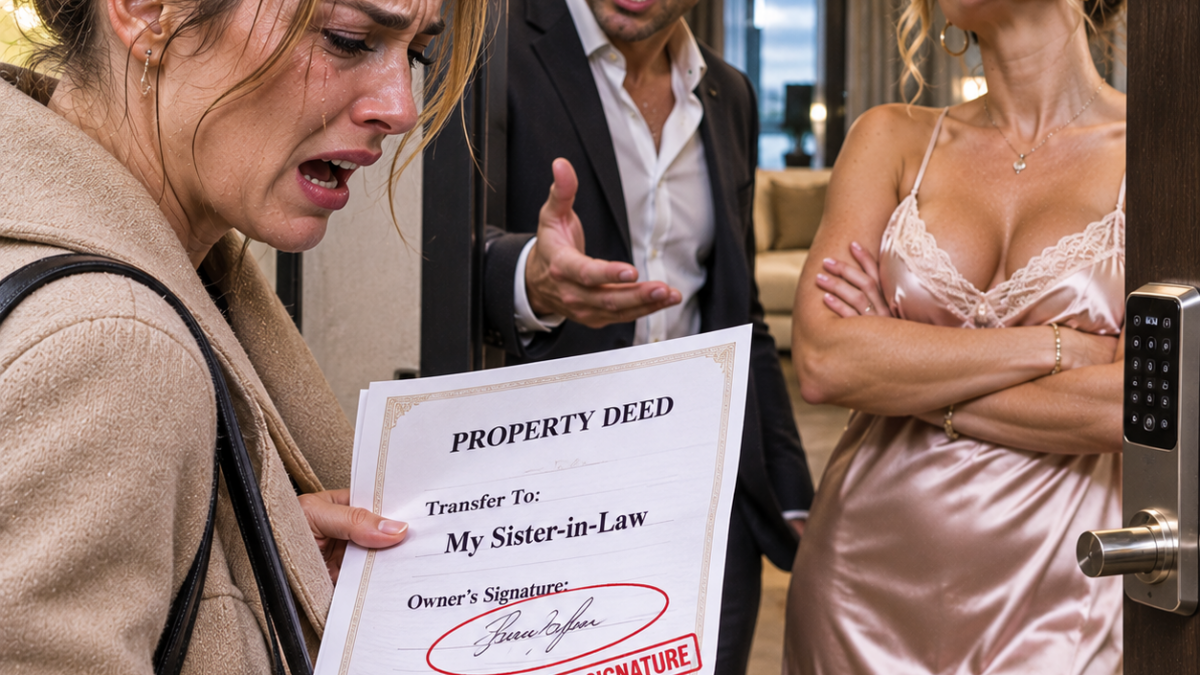
PART2
I did not argue with Madison again.
That surprised her.
Instead, I photographed all three pages.
Front.
Back.
Notary block.
Recording information.
Every signature.
Every stamp.
Madison reached for the papers.
“What are you doing?”
“Documenting.”
Her face tightened.
“You can’t just photograph my deed.”
I looked at her.
“You mean the deed with my forged signature?”
“It’s not forged.”
“Then you have nothing to worry about.”
She stared.
I called Tessa Warren.
Tessa had handled contract work for my consulting firm for almost five years.
She answered immediately.
“Hannah?”
“Tessa, someone changed the locks on my condo.”
Silence.
“My sister-in-law is inside.”
“Are you safe?”
“Yes.”
“She has a deed claiming I transferred ownership to her.”
Another silence.
“My signature is on it.”
“Did you sign?”
“No.”
Her voice changed.
“Do not touch anything else.”
I looked at the document in Madison’s hand.
“Too late.”
“Do not touch it again.”
“Okay.”
“Do not force entry.”
“It’s my home.”
“I know.”
“Can they take it?”
“Not simply by waving paper at you.”
I closed my eyes.
“Tessa.”
“I’m checking Hennepin County records now.”
Keys clicked through the phone.
I could hear her breathing.
Then:
“Oh.”
“What?”
“There is a recorded quitclaim deed.”
My stomach dropped.
“Recorded?”
“Yes.”
“When?”
“Yesterday.”
“Transferred to Madison?”
“Yes.”
I leaned against the hallway wall.
Madison’s confidence returned when she saw my face.
Tessa continued:
“That does not mean it is valid.”
“It’s on the official record.”
“A forged deed doesn’t become legitimate because somebody records it.”
I breathed.
“Can I lose the condo?”
“If you never signed and never authorized transfer, we fight the instrument.”
“Fight how?”
“First, preserve evidence.”
I looked toward the building elevator.
“Building security.”
“Yes.”
“Door access logs.”
“Yes.”
“Camera.”
“Yes.”
“Locksmith invoice.”
“Yes.”
“Do not threaten anyone.”
“Okay.”
“And Hannah?”
“Yes?”
“Has Gavin ever had access to your original deed, mortgage papers, identification, or anything containing samples of your signature?”
I looked past Madison.
Gavin’s laptop sat on the dining table.
Beside it:
My black document folder.
The one that belonged inside a locked cabinet in our bedroom.
Mortgage paperwork.
Passport copy.
Property deed.
Bank records.
Social Security card photocopy.
Tax returns.
Everything I had told Gavin never to remove.
My voice dropped.
“Yes.”
“Did he know the combination?”
“Yes.”
Tessa was silent.
Then:
“We have to consider that your husband may be involved.”
I stared at Gavin’s computer.
Madison said:
“What?”
I ignored her.
Tessa continued.
“Call building security.”
“I will.”
“I’m contacting a title attorney and checking the notary.”
“What notary?”
“The acknowledgment lists Brenda Kline.”
“Do you know her?”
“No.”
“Neither do I.”
“Good.”
“Why good?”
“Because if someone forged your signature, the notary becomes either a witness, a victim, or a participant.”
I swallowed.
“And Hannah?”
“Yes?”
“Do not sleep here tonight.”
I almost laughed.
“So Gavin wins?”
“No.”
Her voice hardened.
“Evidence wins.”
That distinction mattered.
I called the building manager, Robert Jensen.
He came upstairs with two security officers.
Madison immediately became defensive.
“This is my condo.”
Robert looked at me.
Then at her.
“Ms. Dawson, our ownership records list Hannah.”
Madison waved the deed.
“That’s changed.”
Robert frowned.
“When?”
“Yesterday.”
He looked at me.
“Did you sell?”
“No.”
“Then nobody enters or removes property until we document what happened.”
Madison’s face reddened.
“You can’t tell me what to do in my home.”
Robert said:
“I can tell you what not to do in a building I manage.”
He was sixty-two and had managed Riverview Heights for fifteen years.
I suddenly adored him.
He photographed the new lock.
Pulled access logs.
Checked service cameras.
Then asked:
“Who authorized this locksmith?”
Madison hesitated.
“My mother.”
“Does your mother own Unit 1408?”
“No.”
“Does she live here?”
“No.”
“Then why did the locksmith accept her authorization?”
Madison shrugged.
“She had paperwork.”
Robert looked toward me.
“I’ll get the invoice.”
I asked him to preserve hallway footage.
He nodded.
“We keep thirty days.”
“Don’t overwrite today.”
“I won’t.”
Then he looked at Madison.
“Until ownership is legally resolved, Ms. Hannah remains the resident of record.”
Madison laughed.
“She doesn’t have a key.”
Robert looked at the new lock.
Then at his security officer.
“Remove it.”
Madison’s face changed.
“What?”
The officer stepped forward.
“You can’t.”
Robert said:
“This replacement was unauthorized by management.”
Madison called Gavin.
I heard the first words.
“Your wife is going insane.”
I stood in the hallway while the smart lock was removed and my old system temporarily reinstalled.
Madison eventually left.
Not quietly.
She packed the pink suitcase.
My silk nightgown went into it.
I stopped her.
“That stays.”
She stared.
“I’m wearing it.”
“Then change.”
“You’re unbelievable.”
“That cost six hundred dollars.”
“You’re throwing me out over pajamas?”
“No.”
I looked at the forged deed.
“I’m throwing you out because you’re occupying property you do not own.”
Robert let her use the guest bathroom.
Ten minutes later she emerged wearing yoga pants.
She threw the nightgown at me.
I caught it.
My diamond earrings?
Still in her ears.
I pointed.
“Those too.”
She pulled them out.
“Cheap.”
“They were my grandmother’s.”
That silenced her.
For one second.
Then:
“Mom is going to destroy you.”
I almost smiled.
“She can join the line.”
Madison left.
Gavin arrived twenty-six minutes later.
Too late for my deadline.
He entered using his key.
Saw Robert.
Security.
My lawyer now on speakerphone.
His expression changed.
“What is all this?”
I held up my phone.
“Did you give your mother my documents?”
His face hardened.
“I’m not discussing this in front of security.”
“Then answer yes or no.”
“Hannah.”
“Did you?”
“I let Mom look at some things.”
My stomach dropped.
“What things?”
“Property documents.”
“Why?”
“She wanted to understand our situation.”
“Our situation?”
“Marriage.”
“The condo.”
“Everything.”
I stared.
“Did you know she planned to transfer it?”
He looked away.
That was answer enough.
“You knew.”
“No.”
“Gavin.”
“I knew she was trying to put Madison on title.”
My voice disappeared.
“Put Madison on title.”
“Yes.”
“Of my home.”
“Our home.”
Robert shifted uncomfortably.
Tessa said through the speaker:
“Mr. Dawson, this conversation should stop.”
Gavin looked at the phone.
“Who is that?”
“Tessa Warren.”
His face changed.
“You called a lawyer?”
I laughed.
“You forged a deed.”
“I did not forge anything.”
“Then who signed my name?”
“I don’t know.”
“Did you sign it?”
“No.”
“Did your mother?”
“No.”
“How would you know?”
He glared.
“Because she said everything was handled legally.”
Tessa interrupted.
“Gavin, stop talking.”
He stared.
“Why are you helping him?”
“I’m not.”
Tessa’s voice remained calm.
“I’m protecting my client from a later argument that she elicited statements improperly.”
That was Tessa.
Even furious, she thought three moves ahead.
She told me:
“Hannah, do not discuss this further tonight.”
I looked at Gavin.
He crossed his arms.
“So what now?”
“You leave.”
His eyebrows rose.
“Excuse me?”
“You heard me.”
“This is my home.”
“You told me to get a hotel.”
“That was different.”
“How?”
“Because Madison needed space.”
“And now I do.”
He laughed once.
“You cannot kick your husband out.”
I looked at Robert.
“I own this condo.”
Gavin said:
“We’re married.”
“Yes.”
“Then it’s mine too.”
Tessa spoke before I could.
“Not necessarily.”
Gavin looked at the phone again.
Tessa continued.
“Hannah acquired the property four years before the marriage.”
He stared at me.
“You’ve been married fourteen months.”
“You’re seriously using that?”
“No.”
I said it quietly.
“I’m seriously using the fact that someone forged my signature while you gave them access to my records.”
His face fell.
“I didn’t know anyone was going to forge anything.”
“Then you can explain that to an attorney.”
He stared.
“I’m your husband.”
“And yesterday that meant telling me to sleep in a hotel while your sister wore my clothes.”
Silence.
“Leave.”
For the first time, Gavin looked afraid.
He packed a bag.
Not everything.
Enough.
Before leaving, he said:
“You’re blowing up our marriage over paperwork.”
I looked at him.
“No.”
I held up the photographs.
“I’m finding out whether paperwork proves our marriage was already blown up.”
He left.
I slept badly.
At 6:11 the next morning, Tessa called.
“We found Brenda Kline.”
“The notary?”
“Yes.”
“Who is she?”
“Administrative assistant at Dawson & Wells.”
My stomach tightened.
“What is Dawson & Wells?”
“Your mother-in-law’s property-management company.”
Of course.
“Does Brenda admit notarizing?”
“She hasn’t spoken to us.”
“Can we see her journal?”
“Minnesota notary requirements are specific, and practices vary, but we can subpoena records if necessary.”
“Did she personally witness me?”
“That is the question.”
I sat up.
“What else?”
“The county recording packet includes a property tax statement and certificate of real estate value exemption notation.”
“What does that mean?”
“Someone tried to present this as a family transfer rather than a sale.”
“To avoid questions?”
“Possibly.”
“And the deed itself?”
“Quitclaim.”
“Does that make it easier?”
“To record? Sometimes simpler than a purchase transaction. To make a forged transfer valid? No.”
I breathed.
“Tessa.”
“Yes?”
“My mortgage paid off yesterday.”
“I know.”
“What?”
“You emailed me the confirmation last week because we were updating your estate plan.”
Right.
I had forgotten.
She continued:
“That timing concerns me.”
“Why?”
“If somebody wanted to encumber the condo, a property free of mortgage debt is attractive collateral.”
My body went cold.
“Collateral for what?”
“That is what we need to find out.”
At nine, I met Tessa downtown.
She had brought another attorney.
Daniel Cho.
Real-estate litigation.
Quiet voice.
Glasses.
The kind of man who looked as though he enjoyed boring people until they admitted facts.
He reviewed the deed.
Then asked:
“Did Madison mention why she needed the condo?”
“Wedding.”
“How expensive?”
“I don’t know.”
“Where?”
“Lake Minnetonka.”
He raised an eyebrow.
“Could be very expensive.”
“Tessa thinks they wanted collateral.”
Daniel nodded.
“We should check for any mortgage, HELOC, or private financing applications associated with the property.”
“How?”
“Credit reports. Title searches. Discovery if necessary.”
I looked at Tessa.
“Can somebody borrow against my condo with a forged deed?”
“Someone can attempt almost anything.”
“Would the lender catch it?”
“Usually there are verification steps.”
“Usually?”
Daniel said:
“Fraud succeeds by exploiting weak verification.”
Not comforting.
Then Tessa slid another document across the table.
“What is this?”
“Your credit report.”
I stared.
She pointed.
“One hard inquiry.”
“NorthStar Community Bank.”
“When?”
“Two days ago.”
I felt sick.
“I never applied.”
“Exactly.”
The condo scheme became larger.
We contacted NorthStar’s fraud department.
I identified myself.
Verified account information.
Then told them I had never requested financing.
The representative became extremely careful.
“I cannot disclose another applicant’s private information.”
“I understand.”
“But you can flag my identity.”
“Yes.”
“Can you tell me whether my condo address appears on any application?”
Pause.
“I need a supervisor.”
Forty minutes later, a fraud investigator named Melissa Grant joined.
She asked me security questions.
Then:
“Ms. Dawson, did you authorize a $350,000 home equity application?”
“No.”
Silence.
“Did you authorize Gavin Dawson to act under power of attorney?”
“No.”
“Do you have a power of attorney?”
“No.”
“Did you sign a quitclaim deed to Madison Dawson?”
“No.”
Another silence.
“Thank you.”
“What’s happening?”
“I cannot share details today.”
“That’s my identity.”
“Yes.”
“We are freezing the application.”
My heart pounded.
“Who submitted it?”
“I cannot answer yet.”
“Tessa?”
She took the phone.
“I’m attorney Tessa Warren. We’ll send representation and preservation notices.”
The bank investigator’s tone changed.
“Please do.”
After the call, I stared at the wall.
Three hundred fifty thousand dollars.
The amount was not random.
It was large enough to fund a very expensive wedding, debt, or both.
Tessa said:
“We do not know who intended to receive proceeds.”
“I know who.”
“No.”
She looked at me.
“You suspect.”
Right.
Evidence.
Always evidence.
That afternoon, building security sent the hallway footage.
At 11:08 a.m., while I was at work, Diane Dawson arrived.
My mother-in-law.
Cream trench coat.
Leather folder.
Beside her:
Brenda Kline.
The notary.
At 11:14, Madison arrived with Connor Hale, her fiancé.
At 11:22, locksmith.
At 11:31, Gavin.
My husband.
He stayed forty-three minutes.
I watched the footage twice.
Then a third time.
Tessa paused.
“You okay?”
“No.”
Gavin had told me he was busy at work.
He had been standing outside our condo while they changed the lock.
He knew.
Not vaguely.
Not theoretically.
He was there.
I whispered:
“He told me to get a hotel after watching them lock me out.”
Tessa nodded.
“Yes.”
There are betrayals you suspect.
And betrayals you see timestamped.
11:31 a.m.
My husband stepped into frame.
He opened the door with his original key.
He watched the locksmith remove the lock.
He carried my black document folder into the condo.
At 12:07, he left without it.
Tessa said:
“Hannah.”
I looked at her.
“We need to discuss police.”
I nodded.
Until then, part of me had wanted this contained.
Civil case.
Family nightmare.
Cancel deed.
Restore records.
Divorce Gavin privately.
But forged real-estate instruments.
Identity use.
Attempted bank financing.
Potential notary misconduct.
This was not just ugly family behavior.
It could be criminal.
We filed a police report.
Not dramatic.
A downtown interview room.
Detective Laura Medina took notes.
She was in her forties.
Direct.
“You purchased the condo when?”
“Five years ago.”
“Four years before marriage?”
“Yes.”
“Purchase funds?”
“My own.”
“Any contribution from Gavin toward acquisition?”
“No.”
“Mortgage payments after marriage?”
“Some household expenses were shared. Mortgage itself largely came from my account.”
“Doesn’t decide title, but noted.”
She reviewed photographs.
“Recognize the notary?”
“No.”
“Mother-in-law?”
“Yes.”
“Her company?”
“Yes.”
“Your husband present during lock change?”
“Yes.”
“Do you consent to us obtaining the building footage?”
“Yes.”
“Did you give anyone permission to sign?”
“No.”
“Any reason Madison would believe the condo was legitimately gifted?”
I thought.
“She trusts her mother.”
“Not what I asked.”
I looked at her.
“Madison was holding the deed and telling me I no longer belonged there.”
Medina nodded.
“So at minimum she believed she had ownership.”
“Yes.”
“Whether she knew the signature was forged is separate.”
That distinction annoyed me.
It was also fair.
I wanted everyone equally guilty because emotionally they had all stood together.
Law does not work like emotion.
The first person to crack was Brenda Kline.
Three days after my report, she retained counsel.
Then gave a statement.
She had notarized the deed.
She had never met me.
Diane brought the document into her office.
Told her I had already signed at home because I was “sick.”
Brenda knew notarization should not work that way.
She did it anyway.
Why?
Diane was her employer.
She had worked for her eleven years.
She feared losing her job.
Her lawyer called it pressure.
The prosecutor later called it knowing misconduct.
Both could be true.
Brenda said Gavin provided a photocopy of my driver’s license.
He told her:
“Hannah knows what we’re doing. She just doesn’t want to come downtown.”
That sentence destroyed the last excuse I had been constructing for him.
He was not a passive coward.
He facilitated it.
Brenda also revealed something else.
Diane had prepared two deeds.
One transferred my condo to Madison.
The other, unsigned, would later transfer a forty-percent interest to Connor after the wedding.
Why?
Because the NorthStar loan required both planned borrowers to have title interest if the financing was structured the way they intended.
Madison’s wedding was only part of the story.
Her fiancé Connor had a failing restaurant group.
He owed money.
A lot.
Diane wanted to rescue him without using her own properties.
So she chose mine.
I learned this from Tessa at 7:30 one Tuesday morning.
“How much?”
“Connor’s business debt?”
“Yes.”
“Roughly two hundred forty thousand secured and unsecured, based on what we can currently verify.”
“And they wanted a $350,000 line.”
“Enough to restructure debt, fund wedding expenses, and create liquidity.”
I laughed.
“What?”
“Nothing.”
I looked around my kitchen.
“The woman wearing my nightgown needed my condo to finance her wedding.”
Tessa did not laugh.
She rarely rewarded sarcasm.
Then she said:
“There’s more.”
Of course.
“Gavin.”
I stopped.
“He was supposed to receive fifty thousand from the loan proceeds.”
I stared.
“Why?”
“We have an email.”
“From who?”
“Connor to Gavin.”
Tessa opened her laptop.
Subject:
After Closing
Connor wrote:
Once NorthStar funds, we send your 50K immediately. Diane says that covers your part and the old card balances. Madison doesn’t need to know your exact number.
My heart stopped.
“Old card balances.”
Tessa nodded.
“We pulled your credit reports.”
“Mine?”
“Joint household review.”
“Gavin has debt?”
“Yes.”
“How much?”
“About seventy-eight thousand in credit cards and personal loans we can currently see.”
I stared.
“We have joint checking.”
“Yes.”
“He earns $142,000.”
“Yes.”
“Where did seventy-eight thousand come from?”
“We don’t know yet.”
I did.
Maybe not the details.
But I knew the life.
Golf weekends.
Sports betting he claimed was small.
Crypto.
New watches.
Business trips extended by two days.
The motorcycle he said belonged to a friend.
Suddenly fourteen months of marriage rearranged itself.
I asked:
“Why didn’t I know?”
Tessa looked at me.
“Because he hid it.”
Simple.
Not because I was stupid.
Not because I failed.
He hid it.
Gavin came home that night.
Or tried.
His access had been suspended because I requested it after meeting with counsel.
He called from the lobby.
“Let me upstairs.”
“No.”
“Hannah.”
“We can meet with lawyers.”
“I am not bringing lawyers into my marriage.”
“You already brought a forged deed into it.”
Silence.
“Please.”
“No.”
“I need to explain.”
“Then explain now.”
“Not by phone.”
I thought.
Then:
“Lobby.”
Robert arranged a conference room near management offices.
Security camera.
Public.
I sat across from Gavin.
He looked exhausted.
Same gray suit.
No wedding ring.
That hurt even though I had removed mine too.
“Hannah.”
I waited.
“My mother told me the transfer was temporary.”
I stared.
“Temporary ownership.”
“Yes.”
“Those words do not belong together.”
“I know.”
“Did you know she was forging my signature?”
“No.”
“Brenda says you told her I had authorized everything.”
His face changed.
“I was told you had.”
“By who?”
“Mom.”
“So why did you need to tell Brenda?”
“She was nervous.”
“You gave her my ID.”
“Yes.”
“You took my black folder.”
“Yes.”
“You watched them change the lock.”
“Yes.”
“You told me to sleep in a hotel.”
He closed his eyes.
“Yes.”
“You knew Madison thought she owned my condo.”
“Yes.”
I sat back.
“What exactly didn’t you know?”
He started crying.
Not loudly.
“I thought Mom had some legal structure worked out.”
“That doesn’t answer anything.”
“I thought you would be angry.”
“I was.”
“But I thought once Madison’s wedding passed, Mom would transfer it back.”
I stared.
“You were willing to transfer my property without asking because you thought I would eventually get it back.”
“Yes.”
“Why?”
“Because Connor was desperate.”
“Connor is not my responsibility.”
“I know.”
“And you?”
He looked down.
“What about me?”
“You were getting fifty thousand.”
Silence.
There.
The moment.
He knew I knew.
His face collapsed.
“Hannah.”
“How much debt?”
He rubbed his eyes.
“Seventy-eight.”
“Why?”
“Trading.”
I closed my eyes.
“Crypto?”
“Some.”
“Sports?”
He nodded.
“Cards?”
“Yes.”
“How long?”
“Before we married.”
That somehow made it worse.
“You married me carrying seventy-eight thousand dollars in hidden debt.”
“It wasn’t that much then.”
“How much?”
“Thirty-one.”
“And it grew.”
“Yes.”
“Why didn’t you tell me?”
“I thought I could fix it.”
“Using my house?”
“No.”
His voice rose.
“Using part of the loan.”
“A loan against my house.”
He stopped.
I leaned forward.
“You were willing to let your mother steal my title so you could clear debt you hid from me.”
His eyes filled.
“When you say it like that—”
“HOW ELSE SHOULD I SAY IT?”
The room went silent.
Security outside looked in.
I lowered my voice.
“No euphemisms.”
Gavin stared.
“No family emergency.”
“No temporary transfer.”
“No helping Madison.”
“No avoiding drama.”
I pointed between us.
“You wanted fifty thousand dollars.”
“Yes.”
“And you knew I would say no.”
“Yes.”
“So you removed me from the decision.”
He looked down.
That was it.
Not misunderstanding.
Control.
He whispered:
“I’m sorry.”
I laughed.
“What?”
“I am.”
“Do you know what I did yesterday?”
He looked up.
“I paid off the mortgage.”
He stared.
“What?”
“The final payment cleared the afternoon Madison locked me out.”
His mouth opened.
“So while your mother was forging a deed so you could borrow against my home, I was at work celebrating the fact that I finally owned it outright.”
Gavin started crying harder.
I felt nothing.
That frightened me.
Not anger.
Not love.
Not grief.
Just exhaustion.
“I want a divorce.”
His head snapped up.
“No.”
“Yes.”
“Hannah.”
“I’m done.”
“We can fix this.”
“Can you unforge my signature?”
“No.”
“Can you make me forget you stood there while they changed the lock?”
“No.”
“Can you make me trust you with my identity documents?”
He said nothing.
“That is marriage, Gavin.”
He whispered:
“I love you.”
I believed him.
That was the worst part.
People think love prevents betrayal.
It doesn’t.
Character does.
Boundaries do.
Choices do.
Love alone is just emotion.
I stood.
He reached for my hand.
I moved away.
“Do not come upstairs.”
“Hannah.”
“Your attorney can contact Tessa.”
I left.
The deed case moved faster than I expected.
Because no legitimate buyer was involved.
No innocent lender had funded.
No third party had taken title in good faith.
The forged quitclaim deed could be challenged and removed through court action.
Daniel filed immediately.
The county records did not magically vanish overnight, but a notice of dispute prevented the false record from quietly becoming the foundation for another transaction.
NorthStar froze its application.
No funds moved.
That saved me months, maybe years, of additional damage.
The civil court eventually declared the forged transfer void and restored record title solely to me after the evidence became uncontested enough.
Madison fought at first.
Her lawyer argued she believed Diane had lawful authority.
That argument could matter to her mental state.
It did not make the deed valid.
Madison lost the condo before she had even chosen curtains.
She called me afterward.
I almost ignored it.
Then answered.
“You happy?”
“No.”
“You ruined my wedding.”
I sat in my office.
“How?”
“Connor lost the financing.”
“Because my condo was never his collateral.”
“We had deposits.”
“That sounds like your problem.”
“You could help.”
I laughed.
“Hannah.”
“No.”
“You have money.”
“So?”
“Connor’s restaurant will collapse.”
“That is not my responsibility.”
She started crying.
“You always hated me.”
“No.”
“What?”
“I barely thought about you until you began wearing my jewelry without asking.”
“That’s not fair.”
“You changed my locks.”
“Mom said—”
“Stop.”
She went quiet.
“Your mother is not a legal system.”
Silence.
“You are thirty-one.”
“You held a deed with my signature.”
“You told me I had no home.”
“You stood in my bedroom wearing my clothes and enjoyed it.”
Her crying stopped.
“That part was you.”
She whispered:
“I thought you signed.”
“Maybe.”
“I did.”
“Maybe.”
“I swear.”
I believed she might have.
That did not erase the cruelty.
She asked:
“Are you pressing charges?”
“That decision isn’t mine alone.”
“Please.”
I closed my eyes.
“I will tell the truth.”
That was all.
Criminal investigators separated everyone’s roles.
Again, not emotionally satisfying.
Necessary.
Diane emerged as the central planner.
She had downloaded deed templates through a title-services portal.
She had Brenda notarize without me.
She coordinated the locksmith.
She approached NorthStar through a loan broker she knew.
She directed Gavin to obtain documents.
She told Madison the transfer was legitimate.
But Madison signed financing paperwork afterward.
That mattered.
Her lender application represented that she had lawfully received title and had authority to pledge the condo.
Investigators needed to determine what she knew by then.
Connor knew the plan involved my property.
Emails were worse.
He wrote to Madison:
Once your mom gets Hannah off title, she can scream all she wants.
Madison replied:
Gavin says she’ll calm down. She always does.
That one hurt.
Not because it proved fraud.
Because it proved my reputation in that family.
She always calms down.
Meaning:
Push her.
Take.
Insult.
Cross the line.
Hannah will eventually choose peace.
They had mistaken my patience for permission.
Diane retained the most expensive criminal attorney in Minneapolis.
Of course.
Her first public position was that this had been “an informal family estate-planning arrangement that unfortunately became misunderstood.”
Tessa showed me the statement.
I nearly choked.
“Estate planning?”
“Yes.”
“I’m forty.”
“Yes.”
“I was at work.”
“Yes.”
“Why am I being estate planned?”
“She needs language softer than forgery.”
I looked at Tessa.
“Does it work?”
“Not with bank records.”
Good.
The investigation recovered text messages.
Diane to Gavin:
Get Hannah’s ID and deed copy. Brenda will handle the signature acknowledgment.
Gavin:
Hannah will lose it if she finds out.
Diane:
Then she can find out after the wedding. You are her husband. Act like one.
Gavin:
What about the title?
Diane:
Temporary. She gets it back after Connor refinances.
Then the message that destroyed his last claim of ignorance:
Gavin:
She didn’t sign anything.
Diane:
She doesn’t need to be in the room.
He replied:
Fine. Just make sure this doesn’t come back on me.
It came back.
The prosecutor did not need me to explain the marriage after that.
Gavin eventually entered negotiations through counsel.
He was charged with offenses related to identity theft, attempted financial fraud, and participation in the forged-property scheme under the theories prosecutors believed the evidence supported.
Diane faced more extensive charges.
Brenda, the notary, cooperated early.
Connor faced attempted bank-fraud-related exposure and conspiracy allegations.
Madison’s case was complicated by her claim that she initially believed the transfer was authorized, but the lender communications and later messages undermined parts of that defense.
The criminal case took months.
My divorce took almost as long.
Fourteen months of marriage.
Ten months of divorce litigation.
That seemed unfair.
Gavin asked for part of the condo appreciation.
His lawyer was entitled to make property arguments.
I hated every one.
Tessa reminded me:
“Legal claim is not moral claim.”
“I know.”
“Say it like you believe it.”
“I don’t.”
She smiled.
“Better.”
The condo remained mine.
There were accounting disputes over certain marital contributions, furnishings, and joint expenses.
We resolved them.
Gavin kept his retirement.
I kept mine.
Joint checking divided.
His hidden debt stayed mostly his depending on classification and settlement terms.
No magical judge gave me everything because he had betrayed me.
That would have made a satisfying Facebook post.
Reality was paperwork.
Still satisfying.
Because when it ended, Gavin had no ownership interest in my home.
No access.
No key.
No code.
No black folder.
Nothing.
The first time I changed the lock myself after the divorce became final, Robert stood in the hallway.
“You want the same smart-lock model?”
“Yes.”
He smiled.
“Feels familiar.”
“Please don’t.”
He laughed.
I chose a new code.
Not wedding date.
Not anniversary.
Not Gavin’s birthday.
Mine.
Small thing.
Huge feeling.
Madison’s wedding never happened.
Not because I canceled it.
Connor’s restaurant business failed.
The financing disappeared.
Creditors closed in.
Connor and Madison began blaming each other.
He accused her family of promising money they could not legally deliver.
She accused him of using her.
Both statements were probably true.
They separated four months before their rescheduled ceremony.
Madison sent me one message.
I lost everything because of you.
I stared at it.
Then typed:
No. You lost a wedding financed by property that never belonged to you.
I did not send it.
I deleted the message instead.
Not every truth needs delivery.
Six months after the forged deed, Diane called me from a number I did not recognize.
I answered.
“Hannah.”
My body reacted before my mind.
Shoulders tight.
“Diane.”
“I want to talk.”
“Through attorneys.”
“No.”
“Yes.”
“This is family.”
“No.”
She went silent.
I continued.
“You used family to justify taking my home.”
“I was trying to help my daughter.”
“With my property.”
“You had plenty.”
That sentence.
There it was.
Her philosophy in four words.
You had plenty.
Therefore someone else could take.
I said:
“You never asked whether I could help.”
“You would have said no.”
“Exactly.”
She inhaled sharply.
“Gavin was your husband.”
“Yes.”
“He had rights.”
“Not the right to forge me.”
“He did not forge you.”
“He provided my identification.”
“He was desperate.”
“Then he should have told me.”
“You would have judged him.”
“Probably.”
Diane’s voice sharpened.
“You always looked down on this family.”
I laughed.
“I spent fourteen months feeding this family in my home.”
“You always made sure everyone knew it was your home.”
“No.”
My voice lowered.
“You made sure everyone behaved as though it was Gavin’s.”
Silence.
Then:
“You think you’re better than us.”
“No.”
“I think I’m entitled to decide what happens to property with my name on the deed.”
“That is not arrogance.”
“That is ownership.”
Diane hung up.
That conversation helped me more than an apology would have.
She still believed she had been entitled to override me because her need was greater.
Some people do not misunderstand boundaries.
They oppose them.
The criminal cases eventually resolved.
Brenda pleaded guilty to a lesser notary-related and fraud-related offense after cooperating.
She lost her commission and job.
Connor entered a plea tied to the attempted financing scheme and false statements.
Madison resolved charges related to the loan application and fraudulent property representations after prosecutors distinguished her early knowledge from later conduct.
Diane pleaded guilty to multiple fraud and forgery-related offenses rather than face trial on the full set of charges.
Gavin delayed longest.
He could not accept being called criminal.
He told his attorney he had only helped his family.
Then prosecutors showed him his texts.
The bank application.
The building footage.
Brenda’s statement.
My identification copies recovered from his email.
He pleaded.
His sentence included significant financial consequences, probationary or custodial terms according to the offense resolution, restitution and fees, and restrictions arising from the case.
I did not celebrate.
When Tessa told me the plea was entered, I was standing in a grocery store comparing pasta sauce.
“Okay.”
“That’s it?”
“What do you want me to do?”
“I don’t know.”
“Throw tomatoes?”
She laughed.
I bought sauce.
Went home.
Made dinner.
Justice can arrive while you are holding a jar of marinara.
That was strangely comforting.
Gavin wrote me a letter before sentencing.
Six pages.
I nearly threw it away.
Then read it.
The first page was apology.
The second explanation.
That irritated me.
By page three, something changed.
He wrote:
I kept telling myself I didn’t steal your condo because the plan was to give it back.
I stopped.
Then:
I understand now that taking someone’s decision away is still taking something even if you intend to return the object later.
Better.
I also told myself Mom was helping Madison and Connor. The truth is I wanted the fifty thousand dollars. I wanted my debt gone without having to admit to you that I had lied before our marriage and continued lying afterward.
I sat down.
When you asked me whether I gave Mom your records, I knew I had already destroyed something I could not repair. Instead of admitting it, I told you to stop making everything legal.
He wrote:
I used your desire to avoid conflict against you because I knew if I could keep the situation emotional and confusing, you might eventually give in.
That sentence hurt.
Because it was accurate.
You did that in our marriage before. You would become angry, then calm down, then try to see everyone’s side. I began treating your empathy like a weakness.
I cried.
Not because I wanted him back.
Because accountability can make betrayal clearer.
The night I told you to go to a hotel, I knew the locks had been changed. I knew Madison was inside. I knew you had not signed anything. I did not know exactly how Mom planned to fix the deed later, but I knew she had done something without you. I chose money and family approval over protecting you.
There.
No ambiguity.
He finished:
I loved you. I believe that. I also behaved in ways love should have prevented if love had been joined by honesty and character. It wasn’t. I am sorry. I do not expect forgiveness.
I folded the letter.
Stored it with divorce papers.
Not sentimental things.
Legal history.
That was where it belonged.
I stayed in the condo.
For a while, people asked why.
“Doesn’t it feel contaminated?”
Sometimes.
The first night back after Madison left, I threw away the facial mask container she abandoned.
Had the entire condo professionally cleaned.
Changed sheets.
Donated the silk nightgown.
Not because Madison had ruined it.
Because every time I touched it, I saw her smiling in my doorway.
The diamond earrings?
I kept them.
My grandmother had worn them to my mother’s wedding.
Madison did not get to erase that history.
I changed the furniture layout.
Moved the Crane print.
Painted the bedroom.
Bought new bedding.
Not expensive.
White cotton.
The first night in the repainted room, I slept ten hours.
Home returned slowly.
Not because walls forget.
Because new memories accumulate.
I started hosting my friends again.
Book club.
Wine nights.
Sunday brunch.
People who asked before opening cabinets.
Revolutionary.
Robert retired two years later.
At his farewell reception in the building lobby, he said:
“You know, Unit 1408 gave me the strangest month of my career.”
I laughed.
“Sorry.”
“You weren’t the one who showed up with a fake deed.”
“Fair.”
He leaned closer.
“You keeping the place?”
“Yes.”
“Good.”
“Why?”
He smiled.
“You fought too hard for it.”
I shook my head.
“No.”
“What?”
“I paid too hard for it.”
That was more accurate.
Four years of mortgage payments before Gavin.
Then five more.
Overtime.
Business growth.
No vacations some years.
Savings.
The final payment.
3:42 p.m.
I framed the payoff letter.
Not in the living room.
Inside the hall closet.
Private.
Sometimes I opened it just to look.
PAID IN FULL.
Those words had been true before any judge said anything.
The forged deed did not make them less true.
A lie on official paper is still a lie.
That became an important lesson.
Official-looking does not mean legitimate.
Recorded does not mean authorized.
Signed-looking does not mean signed.
Family does not mean consent.
Marriage does not mean ownership.
Need does not create entitlement.
I repeated those ideas until they felt like part of me.
Madison eventually reached out again.
Three years later.
Email.
Subject:
No excuse.
I almost deleted it.
Then read.
Hannah, I believed Mom when she told me the condo transfer had been handled. That part is true. What is also true is that once you arrived and said you had not signed, I knew something was wrong. Instead of stopping, I kept taunting you because I wanted the condo.
Good.
No hiding.
I wanted Connor’s wedding. I wanted the lifestyle I thought everyone expected from me. I liked the idea that I had won something from you because I had always resented how independent you were.
That surprised me.
Mom always compared us. She would say, ‘Hannah bought her own condo before thirty-five. What have you done?’ I started treating your success like an insult to me.
I had not known.
Diane had praised me to hurt Madison.
Then criticized me to control Gavin.
Same person.
Different weapon.
Madison continued:
Wearing your nightgown was deliberate. I wanted you to feel replaced. I am ashamed of that more than the stupid clothes themselves.
My throat tightened.
At least she understood.
I am not asking to be your friend or sister. I only want to stop telling myself I was an innocent idiot. I was an idiot. I was not innocent.
I read that twice.
Then replied:
I appreciate you taking responsibility. I do not want further contact, but I hope you build a life that does not require taking someone else’s place.
She answered:
Understood.
And stopped.
That boundary held.
Diane never apologized.
Not really.
Years later, I heard she sold Dawson & Wells.
Retired.
Moved to Arizona.
Good for Arizona.
Connor rebuilt a smaller restaurant business.
Madison married someone else eventually.
I learned through social media I did not follow but friends occasionally mentioned.
Gavin moved to Denver after completing the main consequences of the criminal case.
New job.
Different industry.
No idea whether he remarried.
For a while, I wondered.
Then one day I realized I had gone six months without wondering.
That felt better than forgiveness.
My own life grew.
My consulting company expanded.
I hired three employees.
Then five.
Tessa became outside general counsel.
She still enjoyed telling new associates:
“Never underestimate the woman who photographs the forged deed before she starts screaming.”
I told her:
“I did scream.”
“Later.”
“True.”
At forty-three, I bought myself another silk nightgown.
Not six hundred dollars.
Eight hundred.
Inflation and emotional symbolism.
My friend Leah saw the bag.
“What did you buy?”
“Closure.”
“That looks expensive.”
“It is.”
“Therapy would be cheaper.”
“Absolutely not.”
We laughed.
I wore it the first night.
Stood in my bedroom mirror.
No Madison.
No Gavin.
No locked door.
Just me.
It felt ridiculous.
Wonderful.
The condo appreciated too.
By the time I refinanced years later for a renovation—voluntarily, with my lawyer reviewing everything—it was worth substantially more.
The loan officer asked:
“Any title issues in the past?”
I laughed.
He looked worried.
“How much time do you have?”
The title report still showed the history.
Forged deed recorded.
Court order declaring it void.
Corrective record.
Every ugly step preserved.
At first that bothered me.
Then it didn’t.
Records should show what happened.
Not hide it.
I asked Daniel Cho once:
“Can we erase the forged deed entirely?”
“No.”
“Why?”
“The legal history remains.”
I frowned.
“Great.”
He smiled.
“You want a cleaner story.”
“Yes.”
“Real estate rarely gives you one.”
“Marriage didn’t either.”
He laughed.
Fair.
The record now told the truth:
Someone tried to take it.
They failed.
I kept it.
That was enough.
The most unexpected consequence came from the bank.
NorthStar asked whether I would participate anonymously in fraud-prevention training after the case concluded.
At first I said no.
Then yes.
I met with their risk team.
They showed how property-title fraud attempts exploit gaps.
Identity documents.
Recorded instruments.
Mail.
Borrower verification.
Notary misuse.
Internal assumptions.
One compliance officer said:
“Your situation reached us before funds moved because you reacted quickly.”
That stayed with me.
If I had gone to the hotel?
If I had believed Madison?
If I had spent three days crying before calling Tessa?
Maybe the loan would still have been stopped.
Maybe not.
I did not blame myself for that possibility.
But I learned something.
When something official appears suddenly and affects your property, identity, money, or legal rights, verify immediately.
Do not let family pressure turn urgency into surrender.
That lesson later helped someone else.
My coworker Dana received a strange mortgage notice for her mother’s house.
She almost ignored it.
I said:
“Call the lender.”
She did.
It turned out to be an administrative error.
Nothing sinister.
Still worth verifying.
Dana said:
“You’re paranoid.”
I smiled.
“Professionally.”
I never became anti-family.
That would have given the Dawsons too much power over who I became.
I still trust people.
Just differently.
Keys are earned.
Access is explicit.
Passwords are private.
Financial disclosure before marriage is non-negotiable.
I dated eventually.
Badly at first.
One man asked on Date Three:
“You own your place?”
I froze.
He laughed.
“Sorry, real-estate nerd.”
I ended things two dates later for unrelated reasons.
Still.
My nervous system remembered.
Then I met Benjamin Cole.
Civil engineer.
Divorced.
One daughter in college.
We met through a volunteer housing nonprofit.
On our fifth date, he asked:
“Can I ask something personal?”
I braced.
“Sure.”
“You seem to tense up whenever people talk about shared finances.”
I stared.
He continued:
“You don’t have to explain.”
That made me want to.
So I did.
Not every detail.
Enough.
He listened.
Then said:
“That is insane.”
I laughed.
“Thank you.”
“No, seriously.”
He paused.
“Your husband helped forge your condo away?”
“Yes.”
“Your sister-in-law was wearing your nightgown?”
“Yes.”
“Six hundred dollars?”
I stared.
“That’s the detail you’re stuck on?”
“I sleep in twenty-dollar T-shirts.”
I laughed so hard the waiter looked over.
Benjamin never asked for a key.
That became meaningful.
Six months in, I offered one.
He said:
“Are you sure?”
I almost cried.
That was the difference.
Not whether someone had access.
Whether they believed access was owed.
When we married three years later, we signed a prenup.
His lawyer.
My lawyer.
Full disclosure.
Every asset.
Every debt.
Benjamin had a mortgage.
Retirement.
College support obligations.
I had the condo.
Business.
Investments.
No surprises.
Before signing, he said:
“This is weirdly romantic.”
I smiled.
“Clarity is sexy.”
He laughed.
We kept the condo for another two years.
Then I chose to sell.
My choice.
That mattered.
A young couple bought it.
Newly married.
No children yet.
At closing, the woman asked:
“Was it hard to sell?”
“Yes.”
“Because you loved it?”
“Yes.”
And because someone once tried to steal it.
I did not say that.
Some history belongs to the people who survived it, not the people buying the walls.
The sale closed cleanly.
Wire verified.
No family drama.
No fake deeds.
No police.
I walked out carrying one folder.
Benjamin waited outside.
“You okay?”
“Yes.”
“Really?”
I looked back at Riverview Heights.
“Yeah.”
I smiled.
“This time I signed.”
He laughed.
That sentence felt like freedom.
We bought a house together.
Together.
Both names.
Both funds.
Both lawyers.
Both choices.
The first evening, Benjamin held up two keys.
“Yours.”
He handed me one.
“Mine.”
He held the other.
“No mothers?”
“No mothers.”
“No sisters?”
“I don’t have one.”
“Excellent.”
He smiled.
“Your standards are strange.”
“You knew that before marriage.”
“I signed disclosure.”
Fair.
We laughed.
Years later, my niece—not Madison’s child, one from my side of the family—asked why I was so obsessed with checking legal documents.
I told her:
“Because sometimes the most dangerous sentence in the world is, ‘Don’t worry, the family handled it.’”
She laughed.
I did too.
But I meant it.
The Dawsons believed family authority could replace consent.
Diane believed motherhood gave her the right to solve Gavin and Madison’s problems with my property.
Gavin believed marriage gave him enough claim to gamble my security without telling me.
Madison believed need plus family connection turned my condo into available inventory.
Connor believed future in-laws could deliver assets if they were powerful enough.
Brenda believed keeping her job justified violating basic notarial responsibility.
Each person had a reason.
None created permission.
That was the core of it.
The night everything began, Madison looked at me through a doorway and said:
You don’t belong here anymore.
I used to think the satisfying ending was proving her wrong.
Getting the deed voided.
Changing the locks.
Watching the bank freeze the loan.
Hearing about criminal pleas.
Divorcing Gavin.
Those mattered.
But years later, I understood something else.
Home is not only the place where your name appears on a deed.
It is the place where nobody has to convince you that your boundaries are unreasonable.
Where keys are offered, not demanded.
Where financial decisions require your voice.
Where love does not ask you to surrender proof of yourself.
The condo became that again.
Then, when I no longer needed it to prove anything, I sold it.
Voluntarily.
I signed every page.
Initialed every line.
The notary looked at my license.
Looked at me.
Asked:
“Are you signing freely and voluntarily?”
I laughed.
She looked confused.
“Yes.”
I took a breath.
“Yes, I absolutely am.”
Then I signed.
My real signature.
Not remarkably similar.
Not copied.
Not reconstructed from mortgage records.
Mine.
When I handed the pen back, Benjamin squeezed my shoulder.
No one took a photograph.
No dramatic music.
No Madison in silk.
No mother-in-law waiting with a hidden loan application.
Just a transaction.
Ordinary.
Lawful.
Boring.
I had never appreciated boring so much.
And that is what I remember whenever somebody asks whether I regret calling a lawyer instead of “working it out as a family.”
No.
Because family problems can sometimes be solved at a kitchen table.
Forged deeds should not be.
The people who loved me had fourteen months to tell me the truth.
Instead, they changed the locks.
So I changed something more permanent.
I changed the kind of behavior I was willing to forgive without consequence.
And once I did that, the strangest thing happened.
I stopped being the woman everyone expected to calm down.
I became the woman who stayed calm long enough to preserve the evidence.
That turned out to be far more dangerous to them.








