PART2:“LOAD HIS TRUCK OR I’LL HAVE HIM ARRESTED!” HOA Karen Tried to Auction My Grandfather’s 40-Acre Ranch—She Never Expected the Truth Hidden in the County Records
PART2
Brenda’s smile disappeared.
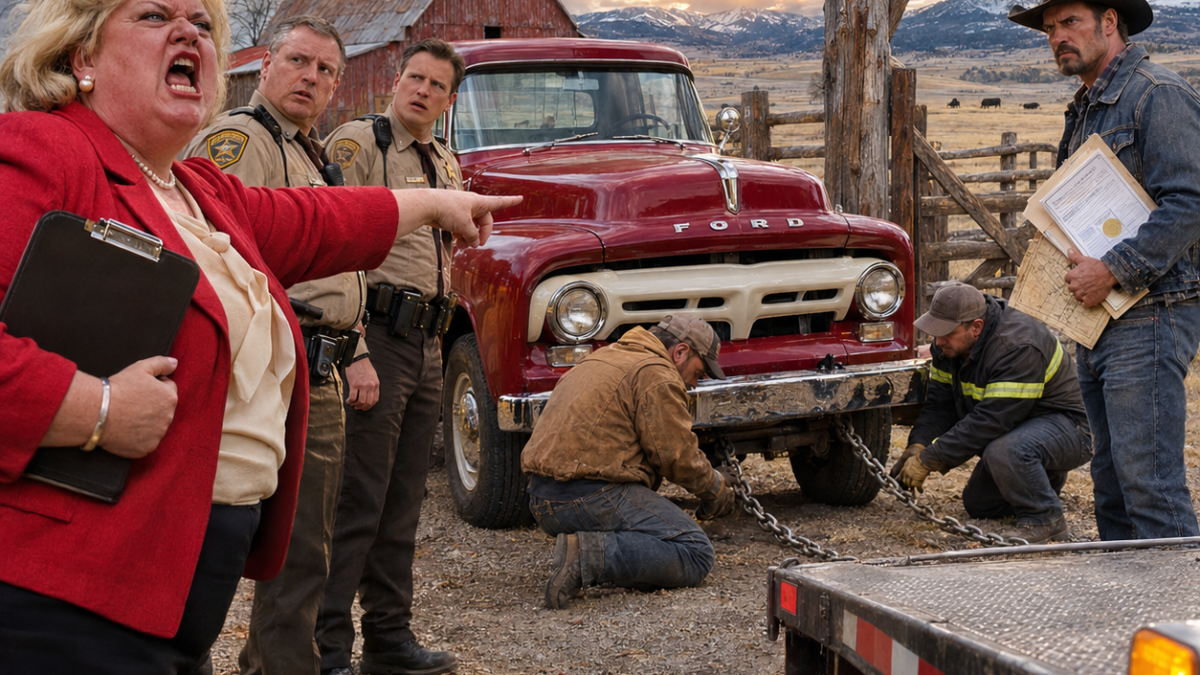
For a moment, the only sounds were the diesel engine idling near the barn and the metallic clatter of a towing chain against the Ford’s rear bumper.
One deputy stepped between us.
“Let’s keep everybody calm.”
Brenda turned toward him immediately.
“Officer, this man has been notified repeatedly. He has refused to comply with lawful HOA enforcement, and the property is now subject to foreclosure.”
The deputy looked at the papers she was holding.
“Do you have a court order authorizing a seizure today?”
Brenda blinked.
“I have the board resolution.”
“That wasn’t my question.”
I had to stop myself from smiling.
Not because anything was funny.
Because for six months, Brenda had been speaking in commands, and people had been responding as though she possessed powers nobody had bothered to verify.
Now someone had finally asked her to prove them.
She opened her leather portfolio.
Flipped through several pages.
Then removed a document stamped with the association’s name.
“Here.”
The deputy read it.
His eyebrows moved.
“Ma’am, this appears to be an internal association resolution.”
“It authorizes the collection of delinquent assessments.”
“Against an HOA member?”
“Yes.”
He looked at me.
“Are you a member of this association, sir?”
“No.”
Brenda snapped, “That’s what he’s been claiming.”
I opened my folder.
“It’s what the recorded property documents establish.”
Before I handed anything over, the tow operator called from beside my truck.
“Ma’am, I need somebody to tell me whether we’re actually taking this vehicle.”
Brenda spun toward him.
“Of course we are!”
He looked at the deputy.
The deputy shook his head.
“Not on the strength of that document.”
The operator loosened his grip on the chain.
Brenda’s face turned red.
I watched her realize that the first person willing to question her authority had already disrupted the entire performance.
But that morning was not where the story began.
To understand why a woman who had never owned a foot of my land was standing in my driveway trying to take my father’s truck, you have to go back six months.
Back to the morning she first arrived at my gate with a clipboard.
And back even farther, to a promise I made beside my father’s hospital bed.
Dad died fifteen years before the auction.
He was seventy-four.
His heart had been giving him trouble for a long time, though he rarely admitted it.
By his last winter, the man who once carried fifty-pound feed sacks like grocery bags needed help walking from the bedroom to the kitchen.
I was forty-seven when he died.
Old enough to understand what was happening.
Not nearly old enough to feel prepared.
One afternoon, I sat beside his hospital bed while rain struck the windows.
He had been unusually quiet.
Then he said, “Jake, you’re not obligated to keep the ranch.”
I stared at him.
“Don’t start.”
“I’m serious.”
“So am I.”
“You’ve got a business. You travel. You don’t have children waiting to inherit the place.”
I looked at his hands.
The skin was thin now, but the knuckles still carried the shape of a lifetime spent handling tools.
“You think I kept coming home because I felt obligated?”
Dad smiled.
“I think you love this place.”
“Then what’s the problem?”
“Love and duty aren’t the same thing.”
I didn’t understand why he was making the distinction.
He continued.
“Your grandfather bought land because he wanted a life he could call his own. I stayed because I wanted to. If you stay, make sure you’re staying for the same reason.”
I told him I would.
Then he asked me to bring him a photograph from the farmhouse.
It showed Grandpa standing beside the original workshop in 1948.
Two horses.
One old tractor.
Grandpa with his sleeves rolled up, looking directly into the camera.
Dad held the photograph for a long time.
“See that post?”
He pointed to a dark shape near the corner of the workshop.
“The one with his initials?”
“Yeah.”
“Still standing.”
Dad nodded.
“He used to say a fence tells the world where responsibility begins.”
I smiled.
“Sounds like Grandpa.”
Dad handed the picture back.
“Don’t let anybody make you feel ashamed of taking care of your own ground.”
He died eleven days later.
I kept the photograph.
And when the ranch became mine, I left that old post standing.
Not because I thought wood was sacred.
Because every time I passed it, I remembered what Dad had said.
That was the property Brenda wanted.
Not an empty investment parcel.
Not a neglected field waiting for development.
My home.
The first formal complaint arrived on a Wednesday in May.
It was a certified letter from Meadowbrook Heights Homeowners Association.
NOTICE OF ARCHITECTURAL NONCOMPLIANCE.
According to Brenda, the hay bales visible from the subdivision violated neighborhood appearance standards.
I read the letter twice.
Then called the number at the bottom.
Brenda answered.
“Meadowbrook Heights.”
“This is Jake Holloway.”
“Oh, Mr. Holloway. I was expecting you.”
“Why did you send me a violation notice?”
“Because your hay storage is unsightly.”
“It’s a working ranch.”
“That doesn’t excuse poor presentation.”
“I’m not asking you to excuse anything. I’m telling you your rules don’t apply.”
A pause.
Then Brenda laughed.
“Mr. Holloway, everybody says that when they receive their first violation.”
“I’m not in Meadowbrook.”
“Your property borders the community.”
“So does the county road.”
“Don’t be difficult.”
I looked across my office at the county plat hanging above my desk.
“My land was excluded when the subdivision was created.”
Brenda’s voice cooled.
“We’ll see what our attorney says.”
Then she hung up.
I assumed that would be the end.
It wasn’t.
The next letter concerned my tractors.
Then the barn.
Then a faded section of fencing near the creek.
Each notice arrived with an increasingly official-looking heading.
CONTINUING VIOLATION.
FINAL WARNING.
POTENTIAL COLLECTION ACTION.
Brenda included photographs taken from the roadside.
The photographs were carefully framed.
One showed hay bales without the covered storage area immediately behind them.
Another showed an old tractor beside the workshop but excluded the newer equipment I used regularly.
The third captured a leaning fence post that was already marked for replacement.
I repaired the post.
Not because Brenda told me to.
Because it needed repairing.
Three days later, another violation arrived claiming the repaired post was the wrong color.
That was when I hired Marcus Webb.
Marcus had handled my father’s estate and several property matters for my consulting business.
He was forty-six, quiet, meticulous, and almost impossible to provoke.
I brought him the notices.
He read them in silence.
Then looked up.
“Jake, are you certain you’ve never agreed to join this association?”
“Absolutely.”
“Any later restrictive covenant recorded against the ranch?”
“Not that I know of.”
“Any annexation agreement?”
“No.”
He nodded.
“Then let’s verify the title history and answer this properly.”
We spent the next week gathering documents.
Grandpa’s 1943 deed.
The later estate transfers.
Recorded maps.
The 1987 subdivision declaration.
And a crucial exhibit identifying which parcels the developer intended to bring under Meadowbrook’s restrictions.
The Holloway ranch was excluded.
Marcus highlighted the legal description.
“Here.”
He pushed the document across his desk.
“The developer deliberately left your property outside the community.”
“Then we’re done.”
Marcus looked at me.
“We should be.”
I remember those words.
Should be.
They would become painfully important.
At first, Brenda’s campaign was almost absurd.
She sent a letter demanding I stop operating agricultural equipment before seven in the morning.
Another complained about roosters, although I didn’t own any.
I called.
“Brenda, I have cattle. Not roosters.”
She replied, “There are loud animal sounds coming from your direction.”
“That’s not evidence of chickens.”
“Neighbors have complained.”
“Which neighbors?”
“Confidential.”
“Do you realize how ridiculous this sounds?”
She went quiet.
Then said:
“Mr. Holloway, I think you underestimate the resources available to this association.”
I replied:
“And I think you overestimate its jurisdiction.”
That was the first time she threatened to make me regret my attitude.
I hung up thinking I’d won the argument.
I hadn’t understood her.
Brenda didn’t need to win an argument.
She needed to keep starting new ones until defending myself became more expensive than giving in.
Chuck Torres lived west of Meadowbrook, in one of the older houses near the creek.
He was sixty-eight, a retired mechanic, and one of the few men I knew who could diagnose an engine problem by listening to it from fifty feet away.
His wife, Marlene, worked evening shifts at a medical supply warehouse.
They had known my family for decades.
Chuck had taught me how to replace a transmission seal when I was sixteen.
Marlene used to bring casseroles after Dad’s medical appointments.
One Saturday, Chuck appeared at my gate carrying a paper bag.
“Eggs,” he said.
I stared.
“You know I have chickens?”
“Not according to Brenda.”
I laughed.
He didn’t.
“Jake, that woman is getting worse.”
“How?”
He showed me a violation notice.
UNAUTHORIZED ORNAMENTAL OBJECTS — FRONT YARD.
I looked at him.
“Garden gnomes?”
“My grandkids bought those.”
“How many?”
“Four.”
“That’s a dangerous criminal enterprise.”
He tried to smile.
Then his face changed.
“She fined Marlene for her vegetable garden too.”
“Why?”
“Claims it’s visible from the road.”
I looked toward their property.
Marlene had been growing tomatoes there since I was a teenager.
“You’re joking.”
“Wish I was.”
Chuck sat on my porch.
“Brenda’s got the board scared of her. She talks about property values, legal costs, liability. Every time someone argues, they get another notice.”
“Then vote her out.”
“Easier said than done. Most folks don’t attend meetings until their own mailbox fills up.”
I thought about that later.
A community doesn’t surrender all at once.
Sometimes it just gets too busy to notice who has stopped asking permission.
I attended the next HOA meeting even though I wasn’t a member.
Marcus advised me to request permission to speak as an affected neighboring landowner.
The meeting room was packed with folding chairs.
A framed neighborhood photograph hung behind the board table.
Brenda sat in the center wearing a cream-colored jacket.
Her leather portfolio rested beside a silver water bottle.
When she saw me, her smile tightened.
“Mr. Holloway.”
“Mrs. Wickham.”
“This meeting is for homeowners.”
“I’m here concerning notices you’ve sent to property outside your association.”
Several people turned.
Brenda looked toward the other board members.
“Allow him two minutes.”
I stepped forward.
“My family has owned the ranch bordering Meadowbrook since 1943. The subdivision was recorded in 1987. The declaration expressly excludes our parcel.”
I held up a copy.
“I’d appreciate the association correcting its records and stopping enforcement attempts against land it doesn’t govern.”
Brenda didn’t look at the document.
Instead, she addressed the room.
“This is exactly the sort of attitude that creates problems for planned communities.”
A woman near the back raised her hand.
“What attitude?”
Brenda smiled.
“Resistance to reasonable standards.”
I answered:
“I’m not asking to violate standards. I’m asking you to stop claiming authority you don’t have.”
The woman nodded slowly.
Brenda’s face hardened.
“Your two minutes are over.”
I left.
The next morning, I received three new violation notices.
The first purchase offer came from Premier Property Management.
A polite man named Derek Paulson called my office.
He introduced himself as a developer interested in assembling a larger rural property.
He offered a figure well below the value indicated by my previous appraisal.
I declined.
He called again a week later.
Then sent a letter.
Then offered to meet over lunch.
“I understand the pressures of maintaining acreage near a growing residential area,” he said.
I remember the sentence because it sounded rehearsed.
“My ranch is profitable.”
“For now.”
I stopped.
“What does that mean?”
“I’m saying landowners sometimes find that selling early is better than struggling later.”
I looked at the HOA letters stacked on my desk.
“Funny you should say that.”
Derek laughed.
“Just business, Mr. Holloway.”
I refused again.
Months later, I learned Derek was Brenda’s son-in-law.
By then, the coincidence had already stopped looking like a coincidence.
My consulting work paid the bills, but keeping a ranch running wasn’t cheap.
Equipment repairs.
Feed.
Property taxes.
Insurance.
Water infrastructure.
Every dollar had a purpose.
Then legal fees joined the list.
Marcus charged fairly.
That didn’t make the bills easy.
I had recently divorced, and while the separation was amicable enough, dividing our savings had left me with less cash than I’d once had.
The ranch was still financially sound.
I wasn’t rich.
That distinction mattered to Brenda.
She seemed convinced any man working old land rather than selling it must be one expensive inconvenience away from surrender.
She didn’t understand that I had spent most of my life learning how to do more with less.
But she was about to make even that difficult.
In August, I received a contract in Nebraska.
Three commercial farms needed soil analysis and crop-rotation recommendations.
The work would take nearly a month.
It paid well.
Enough to cover the immediate legal expenses and fund several necessary ranch improvements.
I spoke to Chuck about checking the cattle.
He agreed.
We reviewed feed.
Water.
Veterinary contacts.
Automatic trough systems.
Security cameras.
Rex would stay with Chuck in the evenings and return to the ranch during daytime checks.
“You’ll be fine,” Chuck said.
“I know.”
He looked toward the Meadowbrook subdivision.
“It’s not the cattle I’m worried about.”
Neither was I.
The morning I left, I walked through the barn before sunrise.
The air smelled of hay and damp earth.
I checked the water systems.
Scratched Rex behind the ears.
Then went into Grandpa’s workshop.
Dad’s old tools hung exactly where he left them.
Socket sets.
Wrenches.
A hand plane with a worn wooden handle.
The blue Ford sat beneath a canvas cover.
I pulled the cover back.
Dust along the hood.
Small scratch near the driver’s door.
Dad had spent twenty years bringing that truck back to life.
When I was sixteen, he let me turn the key for the first time after rebuilding the engine.
It coughed.
Shuddered.
Then started.
Dad laughed so hard he nearly dropped his coffee.
That truck wasn’t a financial asset.
It was the closest thing I had to hearing Dad laugh again.
I replaced the cover.
Locked the workshop.
And drove toward Nebraska.
Three days later, Chuck called.
“Jake, something happened.”
He sounded shaken.
I was standing in a hotel parking lot near Omaha, holding a paper cup of coffee.
“What?”
“Brenda called an emergency board meeting.”
“About what?”
“You.”
I closed my eyes.
Chuck continued.
“She claimed your animals were abandoned, the structures were unsafe, and the property presented an immediate danger to the neighborhood.”
“That’s ridiculous.”
“I know.”
“She had photographs. A trough during the refill cycle. That old fence you fixed. Some weathered siding.”
“Chuck, you were there yesterday.”
“Twice.”
“Animals okay?”
“Healthy.”
“Water?”
“Full.”
He hesitated.
“Jake, they passed something.”
“What?”
“Emergency resolution twenty-three C. They’re claiming ten thousand dollars in assessments.”
I leaned against my rental truck.
For a moment, I couldn’t speak.
Ten thousand dollars.
For a ranch outside the HOA.
Based on conditions that didn’t exist.
I asked:
“Who voted?”
“Four of the seven board members attended. Brenda chaired it.”
“Was the resolution properly noticed?”
“That’s something Marcus should look at.”
“Send everything.”
Chuck lowered his voice.
“Jake, she’s telling people you’re planning to abandon the ranch.”
I looked across the parking lot.
A hotel employee was watering flowers near the entrance.
Normal life continuing.
Meanwhile, fifteen hundred miles away, somebody was rewriting mine.
Marcus called me that evening.
I emailed him the meeting minutes Chuck had obtained.
Marcus read them while I watched through video chat.
“This emergency basis is questionable.”
“Questionable?”
“Jake, I’m being careful with words because I want to use the right ones in court.”
“I’m not feeling careful.”
“I know.”
He looked down again.
“And none of this cures the biggest problem.”
“Which is?”
“The association hasn’t established that your parcel is subject to its covenants.”
“Then stop them.”
“We’ll seek appropriate court relief and challenge any recorded assessment or lien.”
I heard him typing.
Then he paused.
“There’s something else.”
“What?”
“Premier Property Management.”
My stomach tightened.
“Derek’s company?”
“Yes.”
“Why?”
“I’m looking at public filings. They’ve acquired interests in parcels around your ranch.”
I said nothing.
Marcus continued.
“And their preliminary development materials assume a contiguous tract that includes land you haven’t agreed to sell.”
I stared at him.
“Mine.”
“Appears so.”
For the first time, I understood Brenda’s persistence.
She wasn’t merely offended by hay bales.
My forty acres were in the way of somebody else’s plan.
The following week, anonymous notices appeared around Meadowbrook.
HOA POWER GRAB — IS YOUR PROPERTY NEXT?
Someone had listed the emergency meeting, the claimed fines, and the disputed authority over my ranch.
Chuck denied making them.
I believed him.
Mostly.
Brenda responded by sending him another violation.
This one concerned a lawn mower temporarily parked beside his garage.
Marlene received a warning about wind chimes.
Then Chuck called.
“Jake, I’m sorry.”
“For what?”
“People are scared.”
“I know.”
“No, I mean really scared. They see what’s happening to you and think if Brenda can do this to forty acres, what can she do to their houses?”
That frightened me too.
Not because I believed she had lawful control over everyone.
Because threats can work even when the threatened power is exaggerated.
People sometimes comply simply to avoid finding out how expensive resistance may become.
My first instinct was to stay in Nebraska and finish the contract.
I needed the money.
Marcus agreed that nothing required me to panic and drive home that night.
But when Chuck called to say Brenda had filed another animal-welfare complaint, I couldn’t concentrate.
The county inspector was scheduled to visit.
I arranged to finish the most urgent analysis remotely, told the client I had a property emergency, and headed home.
The drive lasted nearly eighteen hours with stops.
By the time I reached my gate, I was exhausted.
I parked.
Stepped out.
And heard cattle moving peacefully near the feed lot.
Rex came running from Chuck’s truck.
He was an old black-and-tan mixed breed with one bad ear and absolutely no respect for personal dignity.
He hit my legs like I’d been gone three years.
I held his head between my hands.
“You still here, buddy?”
He wagged hard enough to move his entire back half.
I looked across the ranch.
Full water troughs.
Healthy animals.
Working equipment.
Fence in place.
The whole property exactly as I had left it.
Except for one thing.
A fresh notice was taped to the gate.
PROPERTY UNDER INVESTIGATION.
Brenda’s handwriting appeared beneath the printed text.
FINAL OPPORTUNITY TO COOPERATE.
I tore it down.
Then went straight to the house and called Marcus.
The animal-control inspector arrived the next morning.
His name was Randy Kowalski.
He looked like a man who had been awake since four and did not appreciate unnecessary complaints.
I showed him the animals.
He inspected their condition.
Checked water.
Feed.
Shelter.
Veterinary records.
Then walked the perimeter.
At the end, Randy closed his notebook.
“Mr. Holloway, I don’t see neglect.”
“Thank you.”
He looked around.
“Frankly, this place is better maintained than several operations I visited last month.”
I was relieved.
Then he said:
“This is the third complaint we’ve received.”
My stomach tightened.
“Third?”
“Yes.”
“Same person?”
“I can’t tell you that.”
“Same allegations?”
“Variations.”
He put his notebook away.
“You should document these visits. I’ll document what I observed.”
I thanked him.
He drove away.
Then I stood in the driveway staring toward Meadowbrook.
Three complaints.
One HOA campaign.
One developer trying to buy my land.
I had been treating each problem separately.
That was my mistake.
A week later, Brenda published an opinion piece in a neighborhood newsletter.
The title was:
WHEN AGRICULTURE BECOMES A NUISANCE.
It was carefully written.
She didn’t accuse me of anything specific enough to make the falsehood immediately obvious.
Instead, she talked about aging structures.
Public safety.
Changing land use.
Protecting property values.
Responsible stewardship.
The sort of language that sounds reasonable until you understand whose property is being discussed.
A photograph of my barn accompanied the piece.
Taken at night.
Under harsh lighting that made the weathered boards appear almost black.
Below it, the caption read:
Is this what our community deserves?
I read it three times.
Then walked outside.
My barn was seventy years old in parts.
Its boards were weathered.
The roof had been repaired twice in fifteen years.
But it was sound.
It had sheltered cattle during storms.
Held equipment.
Stored hay.
And kept the blue Ford safe.
Brenda was making the building look like a public threat.
Because to her, anything old enough to have history was probably old enough to be removed.
My neighbors began avoiding me.
Not all.
Enough.
At the grocery store, a woman who used to buy honey from me suddenly became fascinated by a cereal display when she saw me.
A man from Meadowbrook stopped waving from his truck.
A couple who had toured the ranch for an agricultural workshop canceled.
Then a consulting client called to ask whether I was involved in litigation that might affect my professional schedule.
That hurt.
I could defend a fence.
I could answer a violation notice.
But when rumors began touching my work, Brenda’s pressure became something else.
I sat at my kitchen table with invoices spread around me.
Feed bill.
Insurance.
Legal bill.
Truck maintenance.
Equipment payment.
I wasn’t in danger of losing the ranch that week.
But I could see how a few more months like this might change that.
Marcus warned me not to respond emotionally in public.
I wanted to drive directly to Brenda’s house.
He said:
“Don’t give her the scene she’s hoping for.”
So I stayed home.
That night, I took Grandpa’s photograph from the workshop wall.
Held it beneath the kitchen light.
And wondered whether I had made a mistake promising Dad I’d keep the land.
Not because I wanted to sell.
Because I was tired.
I whispered:
“I don’t know if I can keep doing this.”
Rex put his chin on my knee.
I scratched his ear.
Then folded the bills back into their envelopes.
Tired wasn’t the same as finished.
The mortgage issue arrived in September.
A representative from my lender called about the disputed lien and potential title concerns.
She wasn’t threatening immediate foreclosure.
But she needed information.
Had a lien been recorded?
Was there pending litigation?
Was the collateral affected?
Her name was Janet Reeves.
She sounded professional and uncomfortable.
“We’ve received information suggesting an enforcement dispute involving your property.”
“From whom?”
“I can’t disclose every source of correspondence, but we’re reviewing the situation.”
“Janet, the dispute is with an HOA my land doesn’t belong to.”
“I understand that’s your position.”
“It’s not a position. It’s in the recorded declaration.”
She paused.
“Then please provide the documentation through the proper channel.”
I wanted to slam the phone down.
Instead, I called Marcus.
He prepared a response.
Then I hired independent appraiser Linda Chen to update the valuation.
Linda walked the ranch with me for almost three hours.
She examined the land.
Access.
Water.
Improvements.
Agricultural use.
Comparable sales.
She asked sensible questions.
Not whether my fence matched Meadowbrook’s preferred color.
Not whether cattle belonged beside luxury homes.
Actual questions about the property.
When she finished, she said:
“Jake, this isn’t distressed property.”
“I know.”
“Then why is somebody telling your lender otherwise?”
I looked toward the subdivision.
“That’s what I’m trying to prove.”
Her report later confirmed that the ranch had not experienced the dramatic decline Brenda suggested.
The lender eventually accepted the documentation.
But the experience frightened me.
It showed that a false impression could require real money to correct.
Then Chuck found something strange.
I was repairing irrigation tubing near the south pasture when he arrived.
“Jake, you need to see this.”
He showed me photographs taken from his front porch.
Brenda’s white Lexus beside my fence.
A second vehicle behind it.
Two people carrying camera equipment.
Bright lighting aimed toward my barn.
“What time?”
“Eleven forty-eight last night.”
“Did they come onto the property?”
“Couldn’t tell from my angle.”
I checked my cameras.
There they were.
The Lexus.
The men.
Lights.
One person crossing a boundary marker.
Another adjusting a camera.
I watched the recording twice.
Then called Marcus.
“Do I have enough to do something?”
“Preserve the original footage.”
“Already done.”
“Don’t confront them.”
“I wasn’t planning to.”
He paused.
“Jake.”
“Okay. I was considering it.”
“Document. Report trespass where appropriate. We’ll seek protective relief if the evidence supports it.”
I went outside afterward.
The fence looked exactly as it always had.
But it no longer felt private.
That was the part Brenda didn’t understand.
She could call her behavior inspection.
Monitoring.
Neighborhood safety.
But standing on my own property knowing someone had been photographing my buildings at midnight changed the way home felt.
I began leaving lights on.
Checking cameras before bed.
Listening to vehicles on the road.
Rex noticed.
He started sleeping closer to the front door.
I hated that most.
Brenda wasn’t only targeting land.
She was teaching an old man and an old dog to feel unsafe at home.
One afternoon, Marlene Torres came by with a casserole.
She found me sitting in the workshop, looking through legal bills.
“You look terrible.”
“Always nice to see you too.”
She put the dish on the workbench.
“Eat.”
“Not hungry.”
“Good thing I didn’t ask.”
I smiled.
She sat beside me.
For a while, neither spoke.
Then she said:
“Chuck thinks you’re going to sell.”
I turned.
“What?”
“He sees how tired you are.”
“I can’t.”
“Can’t or won’t?”
I looked around the workshop.
“Both.”
Marlene nodded.
Then said:
“You know your grandfather helped us buy our house?”
I stared.
“No.”
“He did.”
She smiled faintly.
“When Chuck’s hours were cut at the shop, we were short on the down payment. Your grandfather lent us the money.”
“Grandpa never told me.”
“He wouldn’t.”
She looked toward the old Ford.
“We paid him back over three years. He wouldn’t take interest.”
“Sounds like him.”
Marlene’s eyes filled.
“He told Chuck that a decent neighborhood wasn’t made by expensive houses. It was made by people who helped one another stay.”
I looked down.
She touched my arm.
“You’re not the only person who remembers Howard Holloway.”
For the first time in months, I cried in front of somebody other than Rex.
Marlene pretended not to notice.
Then she pushed the casserole toward me.
“Now eat before I become mean.”
The first real breakthrough came from public development records.
Marcus located a preliminary site plan filed by Derek’s company.
It showed proposed roads.
Luxury home lots.
Drainage areas.
Utilities.
And a large tract in the center labeled:
FUTURE ACQUISITION — HOLLOWAY PROPERTY.
I stared at the screen.
My ranch.
Not just a neighboring parcel.
Not an optional future expansion.
A critical piece of Derek’s layout.
I called him.
He answered cheerfully.
“Jake! Ready to talk?”
“I’ve seen your development plan.”
A pause.
“Which one?”
“The one showing forty acres you don’t own.”
He stopped sounding cheerful.
“Preliminary planning.”
“Then remove my land.”
“We’re considering several configurations.”
“Then consider one that doesn’t involve me.”
“Jake, you’re being emotional.”
That word.
Emotional.
As if caring about my family home were a defect in judgment.
I said:
“Tell Brenda to stop.”
Silence.
Then:
“I don’t control Brenda.”
“No?”
“She’s my mother-in-law.”
“I know.”
Another pause.
“You’re making assumptions.”
“Then correct them.”
He didn’t.
I hung up.
Marcus and I began assembling the case properly.
Not one giant dramatic revelation.
Pieces.
The 1987 recorded declaration.
My deed.
The purported HOA assessments.
The emergency meeting minutes.
The animal-control reports.
Photographs and camera footage.
Linda’s valuation.
Messages from potential buyers.
The newsletter accusations.
Neighbor statements.
The development plan.
Every item had a date.
Every document had a source.
Marcus was obsessive about that.
Once I said:
“We know what they’re doing. Why does every little thing have to be verified?”
He looked at me.
“Because knowing something and proving it are different jobs.”
I hated that answer.
Then learned to appreciate it.
At night, I began organizing the evidence myself.
Folders.
Labels.
Backup copies.
Timeline.
The kitchen table became a record room.
There were days when I felt ridiculous.
A fifty-two-year-old agricultural consultant photographing certified envelopes as though they were evidence from a bank robbery.
Then another threatening letter arrived.
And I kept going.
One morning, Chuck called before sunrise.
“Jake, Brenda came to the house.”
“What happened?”
“She offered to make my fines disappear.”
“In exchange for what?”
“She wanted me to write a statement saying your animals weren’t being cared for when you traveled.”
I sat up.
“Did you?”
“Are you crazy?”
“What did you say?”
“Told her to get off my porch.”
I exhaled.
Then Chuck said:
“She offered money.”
My whole body went still.
“How much?”
“Five thousand.”
“Chuck…”
“I didn’t take it.”
“I know.”
“She said nobody had to know.”
I stared out the bedroom window.
Rex was sleeping beside the door.
I whispered:
“Did anybody hear?”
“Marlene heard part.”
“Okay.”
“Jake, I’m sorry I didn’t record it.”
“Don’t apologize.”
Marcus advised Chuck to write down the conversation immediately, preserve any messages, and avoid trying to engineer another encounter.
That mattered.
We weren’t running a sting operation.
We were ordinary people trying to document what had happened.
And I didn’t want Chuck taking risks he didn’t understand because of my land.
When I told him that, he became angry.
“Jake, this is our neighborhood too.”
I couldn’t argue.
He was right.
That same week, a former board treasurer contacted Marcus.
Her name was Patricia Green.
She had resigned from the Meadowbrook board after disagreeing with Brenda over financial reporting.
Patricia wasn’t dramatic.
She arrived at Marcus’s office carrying a canvas tote bag and looking deeply uncomfortable.
“I don’t want trouble,” she said.
Marcus nodded.
“Then let’s be careful about what you provide and how we handle it.”
Patricia explained that several board decisions had been pushed through with little discussion.
Brenda frequently described the ranch as a threat to the association.
But financial conversations told a different story.
Patricia had seen invoices involving Premier Property Management.
She had also received an email in which Brenda encouraged board members to support “a development outcome that would remove the agricultural obstacle.”
“Did you know Derek was her son-in-law?” I asked.
“Yes.”
“Did the whole board?”
She hesitated.
“I assumed so.”
Marcus looked up.
“Was the relationship formally disclosed when related matters came before the board?”
Patricia shook her head.
“Not in the records I saw.”
She handed over copies of documents she was authorized to retain and identified others that could be requested through legal channels.
Marcus didn’t celebrate.
He simply said:
“Thank you. We need to verify the records.”
I sat in silence.
For six months, Brenda had accused me of damaging neighborhood values.
Now the evidence was pointing toward a financial motive.
She wasn’t trying to protect Meadowbrook from my ranch.
She was trying to change the ranch into something Derek could sell.
The emotional cost of the fight began showing up in places I hadn’t expected.
I stopped sleeping well.
Stopped cooking proper meals.
Took calls while repairing fences.
Forgot appointments.
I became impatient with Chuck.
Snapped at Marlene once when she suggested I take a day off.
Then apologized.
One evening, I found myself looking at the property sale websites Derek had mentioned.
Not because I wanted to sell.
Because I wanted to know what surrender would look like.
I imagined signing papers.
Paying the legal bills.
Moving into a smaller house.
Working without worrying whether another violation notice had arrived.
Then I imagined somebody demolishing the workshop.
Bulldozing the pecan trees.
Painting over the initials on the corner post.
The thought made me physically sick.
I closed the laptop.
Went outside.
Sat beneath the oldest pecan tree.
Rex followed.
He settled beside me with a tired grunt.
I looked toward the farmhouse.
The porch light was on.
Dad used to leave it on when I traveled.
Grandpa had done the same for him.
That light wasn’t worth anything to a developer.
To me, it meant somebody had always expected me to come home.
I rubbed Rex’s head.
“Not yet, buddy.”
I said.
“We’re not leaving yet.”
Then came the final disputed lien.
Twenty-five thousand dollars.
Brenda’s letter claimed the amount represented accumulated fines, administrative costs, and enforcement expenses.
Marcus challenged it.
The county recording office had accepted a document for recording, but that did not establish its validity or give Brenda an automatic right to auction my ranch.
I learned the distinction carefully.
A piece of paper can look terrifying.
It can also be legally defective.
Unfortunately, proving which one you’re dealing with costs time and money.
The filing affected conversations with my lender and potential refinancing.
Marcus sought court relief.
Brenda responded through counsel.
Derek continued calling with purchase offers.
Each one arrived at a moment when another legal bill was due.
The pattern was unmistakable.
Pressure.
Offer.
More pressure.
Lower offer.
One night, Derek left a voicemail.
“Jake, I’m trying to help you avoid a worse financial outcome. Call me before your options narrow.”
I played it three times.
Then forwarded it to Marcus.
I finally understood why Brenda kept increasing the numbers.
She wasn’t trying to collect fines.
She wanted me to believe selling was the only way to stop them.
The first court hearing did not deliver instant victory.
That disappointed me.
I had spent months gathering evidence.
I expected the judge to read the documents, recognize the problem, and end everything.
Instead, lawyers discussed notice.
Jurisdiction.
Recording.
Requests for relief.
Conflicting allegations.
The judge required additional submissions and set the next steps.
Marcus considered it progress.
I considered it unbearable.
Outside the courthouse, I asked:
“How much longer?”
He looked at me.
“I don’t know.”
I wanted him to promise victory.
He wouldn’t.
“What I can tell you,” he said, “is that we now have a formal process for examining the documents, and Brenda doesn’t get to decide the outcome herself.”
That was the first time I realized how much of her power came from making everyone believe the process belonged to her.
It didn’t.
The board wasn’t the court.
Her leather portfolio wasn’t a judge.
And her signature didn’t transform a false claim into lawful ownership.
The next evidence came through the legal process.
Derek’s company was required to produce responsive documents.
Not every document we wanted.
Not immediately.
There were disputes about scope and confidentiality.
Marcus handled them.
Eventually, the correspondence exposed a series of discussions about acquiring the ranch.
One email referred to the property as:
“the central parcel preventing final buildout.”
Another discussed the need for “continued association pressure.”
A later message warned that financing for Derek’s planned development depended on resolving the acquisition.
Then Marcus found a reference to a personal guarantee Brenda had made for part of Derek’s planning costs.
That explained the urgency.
She wasn’t simply helping family.
She had money at risk.
If the ranch wasn’t acquired, Derek’s plan became more expensive and uncertain.
If Derek’s plan failed, Brenda could suffer financially.
I sat across from Marcus reading the documents.
Finally, I said:
“She knew.”
Marcus nodded.
“She had access to the recorded exclusion before some of these communications.”
“She knew my ranch wasn’t in Meadowbrook.”
“The documents support that she had been told.”
I looked at him.
“And she kept doing it.”
“Yes.”
I folded my hands to stop them shaking.
For months, I had wondered whether Brenda truly misunderstood the boundary.
Now that excuse was becoming harder to believe.
The fight reached Meadowbrook itself.
At a public association meeting, several residents began asking for financial records.
They questioned the relationship between Brenda and Derek.
Asked whether association resources had been used to advance a private development.
Asked why an HOA was spending money pursuing a property its own recorded documents excluded.
Brenda attempted to end the discussion.
“Those matters are confidential.”
Patricia stood.
“Board financial decisions aren’t automatically confidential simply because they’re uncomfortable.”
Several people applauded.
Brenda struck the table with her pen.
“Order!”
Chuck stood next.
His voice was steady.
“My wife and I have lived here longer than most of you have been driving.”
A few people smiled.
“We don’t want chaos. We want rules that apply fairly.”
He held up his gnome violation.
“If you can explain how four garden ornaments threaten property values, I’d love to hear it.”
Laughter moved through the room.
Brenda glared.
Then Marlene stood.
“You threatened to fine my vegetable garden.”
She pointed toward Brenda.
“I’ve grown tomatoes in that same place for twenty-six years.”
Brenda opened her mouth.
Marlene continued.
“I followed the process you told us to follow. Every time we asked a question, you changed the answer.”
The room grew quiet.
Then Marlene said:
“You are supposed to represent this community, not make everyone afraid of you.”
That was the moment things began to change.
Not because Brenda confessed.
She didn’t.
Not because someone shouted louder.
Nobody did.
Because ordinary people began asking questions without waiting for her permission.
Brenda retaliated.
She called her supporters.
Sent emails claiming a small group of troublemakers was trying to undermine neighborhood safety.
Accused me of manipulating residents.
Suggested Chuck was confused because of his medical treatments.
That one made me furious.
Chuck had been receiving dialysis for years.
He was tired often.
Sometimes he needed help.
But his mind was sharp, and his integrity was stronger than half the men I had known.
When Brenda used his health against him, I nearly went to her house.
Marlene stopped me.
She appeared in my driveway with one look at my face.
“No.”
“I haven’t said anything.”
“You don’t have to.”
“She’s attacking Chuck.”
“I know.”
“She has no right.”
“I know.”
“Then why are you so calm?”
Marlene looked at me.
“Because I have spent forty years married to a man who knows how to fight without throwing the first punch.”
I stared.
Then she continued.
“Let her talk. We’re going to make her answer.”
By October, Marcus had obtained temporary protections that limited further interference with my property while the dispute proceeded.
The exact scope was narrow.
It did not end every claim.
It did not erase every bill.
But it meant Brenda could no longer simply act as though my land was already hers.
I slept better for two nights.
Then she found another way to apply pressure.
Derek began contacting potential buyers and contractors.
He wanted them to believe the acquisition was imminent.
One contractor called me directly.
“Mr. Holloway, I’m supposed to be preparing preliminary estimates for clearing structures on your tract.”
I almost dropped the phone.
“What?”
“I was given a site plan.”
“By whom?”
“Premier Property Management.”
“Do not enter my land.”
“We weren’t planning to without permission.”
“Good.”
He sounded confused.
“I thought the sale was nearly complete.”
I stared toward the workshop.
“No.”
I said.
“It isn’t.”
That was when I realized Derek was doing more than hoping to buy the ranch.
He was planning as though my refusal didn’t matter.
The auction stunt came after Brenda learned I was preparing for another out-of-state consulting assignment.
She had watched my schedule before.
She knew that travel kept my business alive.
I had a Colorado client expecting me for two weeks.
Marcus advised me to be cautious about leaving the property unattended while tensions were high.
So I rescheduled the trip.
Then drove to a small motel fifteen miles away for several nights while Chuck continued his routine checks.
The idea wasn’t to trick anyone into committing a crime.
It was to prevent another false abandonment claim while documenting any interference that occurred.
My cameras remained active.
Chuck visited twice a day.
The cattle were cared for.
Rex stayed with him overnight.
The first day was quiet.
The second wasn’t.
My cameras recorded Brenda’s Lexus near the property entrance.
The third day, a vehicle associated with one of Derek’s contractors stopped outside the workshop.
The men didn’t enter.
They took photographs.
Then left.
The following morning, a sign appeared near the road.
NOTICE OF UPCOMING AUCTION.
Chuck photographed it.
Called Marcus.
Then called me.
“Jake, get back here.”
I was already in the truck.
When I arrived, the scene looked like something staged for a television auction.
A large sign stood near the driveway.
Several workers wore reflective vests.
A flatbed trailer was positioned beside my barn.
Two sheriff’s deputies had been called after neighbors complained about a confrontation.
And Brenda stood in the middle of it all, giving orders.
At first, I genuinely feared the ranch had been sold while I was away.
That’s what the display was designed to make me believe.
Then I looked more carefully.
The purported auction paperwork came from the HOA and a private auction service.
There was no valid court order authorizing seizure of my truck.
No completed foreclosure transfer.
No deed placing Derek in ownership.
No lawful basis to remove my personal property.
The whole performance was built around the assumption that I would panic.
Brenda had apparently expected me to arrive frightened, confused, and ready to negotiate.
Instead, I arrived with Marcus’s folder.
And six months of learning exactly what questions to ask.
“You have thirty minutes,” Brenda told me.
“To do what?”
“Remove personal belongings.”
“From whose property?”
She smiled.
“Mr. Holloway, don’t embarrass yourself.”
I looked at the deputies.
“I’m the owner of record.”
Brenda lifted the lien notice.
“Not for long.”
I turned to the towing crew.
“Has anybody given you a court order authorizing removal of that truck?”
The operator hesitated.
Brenda answered for him.
“He works for the association.”
“I didn’t ask you.”
Her face darkened.
“Careful.”
I looked directly at her.
“I’m done being careful about your feelings.”
The deputy stepped forward.
“Sir, keep your voice down.”
I nodded.
Then opened my folder.
“This is the recorded 1987 declaration showing my parcel excluded from Meadowbrook Heights.”
I handed him a copy.
“Marcus Webb, my attorney, is on his way. The association’s purported lien and enforcement actions are in active litigation.”
The deputy read.
Then looked at Brenda.
“Do you have a judicial order?”
She held up the resolution again.
He shook his head.
“That isn’t authority for this seizure.”
The tow operator began removing the chain.
Brenda snapped:
“Stop!”
He looked at her.
“I’m not taking a truck without proper authority.”
She pointed at me.
“He’s trespassing on property subject to foreclosure!”
The deputy turned toward her.
“Ma’am, he appears to be the property owner, and you have not provided the document you claim gives you possession.”
Silence.
Then I heard a familiar voice.
“Jake!”
Chuck was walking up the driveway.
Marlene beside him.
Behind them, several neighbors had gathered at a respectful distance.
For months, I had fought as though I were alone.
Now they were watching.
Not filming for entertainment.
Watching to make sure Brenda couldn’t rewrite what happened.
Marcus arrived twenty minutes later.
He spoke to the deputies.
Reviewed the paperwork.
Then addressed the auction representative directly.
“You’ve been informed there’s a substantial dispute over the association’s authority, and no valid order authorizing this removal has been produced.”
The representative looked deeply uncomfortable.
He asked Brenda:
“Where is the foreclosure authorization you told us existed?”
Brenda’s voice rose.
“I sent you the lien!”
“That isn’t what you described.”
Derek appeared behind one of the trucks.
I hadn’t seen him until then.
He looked at Marcus.
“Let’s not make this dramatic.”
I turned.
“You hired these people?”
He hesitated.
“Premier was coordinating certain site arrangements.”
“On land you don’t own.”
“Jake…”
“No.”
I stepped toward him.
Not close enough to threaten.
Close enough that he had to meet my eyes.
“For six months, you’ve been calling me with offers while your mother-in-law threatened my livelihood.”
He looked away.
“You’re making accusations.”
“Then tell these people whose land they’re standing on.”
Derek said nothing.
And that silence answered more than his sales pitches ever had.
The workers left.
The chains came off Dad’s truck.
The foreclosure signs were removed after the deputies and lawyers clarified that the attempted activity could not proceed as claimed.
No one applauded.
There was too much confusion.
Too much embarrassment.
And I was too tired.
When the final truck drove away, I walked into the workshop.
The Ford sat exactly where it belonged.
One chain had left a faint scrape near the bumper.
I touched it.
My hand started shaking.
Not anger this time.
Relief.
I climbed into the driver’s seat.
The old upholstery smelled like dust and oil.
Dad’s folded road map was still in the glove compartment.
I took it out.
Opened it.
There was a coffee stain near a highway intersection.
Dad had made that stain the summer we drove to Oklahoma to collect an engine block.
He had been laughing because I’d spilled the coffee while arguing that we could reach home before dark.
We hadn’t.
We slept in a cheap motel.
Ate terrible breakfast sandwiches.
And spent the drive home arguing about music.
I held the map against the steering wheel.
Then finally let myself cry.
Not because Brenda had almost stolen a truck.
Because for one terrible morning, she had made me believe I might lose the last place where my father’s ordinary life still felt close.
The next court filings changed the case.
Marcus submitted the attempted auction documentation.
The disputed assessment history.
The recorded exclusion.
Supporting witness statements.
We also provided the relevant camera footage and communications through appropriate channels.
The court granted stronger relief against interference with the ranch while the core issues were adjudicated.
Brenda’s lawyers changed their tone.
They stopped sending letters that sounded like commands.
They began using words like:
Disputed.
Alleged.
Subject to determination.
I learned to appreciate those words.
They meant somebody was finally admitting that a claim wasn’t the same as a fact.
But the struggle wasn’t over.
Brenda still chaired the association.
Derek still wanted the land.
And the financial damage from months of harassment remained.
Then the board treasurer records became important.
Patricia and Marcus identified payments from association accounts to outside consultants associated with the property campaign.
Not every payment was improper.
Some related to ordinary legal advice.
But several lacked clear authorization or adequate documentation.
Other records showed that Brenda had repeatedly failed to disclose her family’s interest in Derek’s proposed development when discussing the ranch with the board.
A forensic accountant hired by the association’s new review committee began examining the transactions.
The findings were narrower than the rumors.
There wasn’t proof of some gigantic criminal empire.
But there was credible evidence of undisclosed conflicts, questionable spending, and an organized effort to use association pressure against a nonmember landowner.
That was more than enough to destroy Brenda’s claim that this had all been about protecting neighborhood values.
A special membership meeting was scheduled.
Unlike Brenda’s emergency sessions, this one had proper notice.
Residents received the agenda.
Relevant documents were made available.
Members who had never attended a board meeting came early.
Chuck wore his good shirt.
Marlene brought a folder thicker than my tax returns.
I sat near the back.
Not as a member.
As the neighboring landowner whose property had become the center of the dispute.
Brenda entered late.
Her white Lexus had disappeared from the parking lot after the auction incident.
Someone whispered that she had sold it.
I didn’t know whether that was true.
I didn’t care.
When she took her seat, the room became quiet.
A board member opened the meeting.
Patricia summarized the documented concerns.
Then questions began.
One woman asked:
“Why were association funds used to pursue land outside our recorded boundaries?”
Another:
“Why weren’t we told the president’s son-in-law wanted to buy the ranch?”
A third:
“Why were residents fined after speaking in support of Mr. Holloway?”
Brenda answered each question with a variation of the same phrase.
“I acted in the community’s best interests.”
Then Marlene stood.
“Whose interests?”
Brenda looked at her.
“The association.”
Marlene raised the vegetable-garden violation.
“Did my tomatoes threaten your son-in-law’s development?”
A low murmur moved across the room.
Brenda’s face flushed.
“That is an inappropriate accusation.”
Marlene nodded.
“Then explain the timing.”
Brenda couldn’t.
Chuck spoke next.
His hands trembled slightly around the microphone.
Dialysis had been hard on him that week.
I started to stand.
He shook his head.
He wanted to do this himself.
“I’ve lived in this community forty years,” he said.
“Before most of these houses existed.”
He took a breath.
“I remember Howard Holloway teaching my son to ride a horse.”
He looked toward me.
“I remember the Holloways helping us when work was short.”
Then he faced the board.
“When you moved here, you didn’t inherit an empty valley.”
“You moved into a place where people already had lives.”
His voice strengthened.
“Somebody’s grandfather worked that land before your subdivision had a name.”
Brenda stared at the table.
Chuck continued.
“You don’t get to call a neighbor’s history a nuisance just because it interrupts a developer’s plans.”
For several seconds, nobody moved.
Then people began applauding.
Not wildly.
Just steadily.
Chuck sat.
Marlene took his hand.
I looked away because my eyes were filling.
The board initiated formal steps to remove Brenda from leadership and replace members who had supported the improper actions.
The association retained independent counsel.
Financial records were reviewed.
The disputed fines against other residents were reexamined.
Some were withdrawn.
Others were reduced.
A new process for handling complaints was adopted.
It didn’t happen overnight.
There were votes.
Notices.
Arguments.
People changing their minds.
That was fine.
Democracy in a neighborhood wasn’t supposed to look like Brenda snapping her fingers.
It was supposed to be messy.
Documented.
Accountable.
And reversible when people got things wrong.
The civil case eventually reached settlement discussions.
Derek’s development plans had become difficult to finance without my land.
His lenders were no longer willing to treat my participation as inevitable.
Brenda’s association support was gone.
The attempted lien had been declared unenforceable against my ranch.
The false collection claims were withdrawn.
Marcus pushed for reimbursement of documented losses and attorney fees where legally available.
I wanted everything.
Every dollar.
Every hour.
Every canceled client.
Every sleepless night.
Marcus listened.
Then said:
“Jake, we need to separate what you deserve emotionally from what we can establish legally.”
I hated him for that sentence.
For about thirty seconds.
Then I knew he was right.
We documented the financial harm.
Negotiated.
Rejected offers that required me to pretend nothing wrong had happened.
Finally, we reached a resolution that covered a substantial part of my legal expenses and direct losses.
Not every dollar.
Not every hour.
There is no invoice for being afraid in your own driveway.
But the ranch was secure.
The mortgage dispute was cleared.
The attempted HOA lien no longer threatened title.
And the developer had no claim to the property.
Separate investigations continued into the property damage, false filings, and attempted bribery.
Not every accusation became a criminal charge.
That disappointed some of my neighbors.
They wanted dramatic arrests.
Instant prison sentences.
A sheriff marching Brenda away in front of cameras.
I understood the desire.
I had felt it myself.
But evidence must support consequences.
Ultimately, investigators substantiated serious misconduct related to the fraudulent property campaign.
Brenda faced criminal proceedings arising from false documentation and corrupt conduct, while Derek’s company faced civil claims and financial consequences tied to the failed acquisition plan.
The proceedings took time.
There were lawyers.
Hearings.
Agreements.
Restitution.
A sentence imposed through the court process.
None of it resembled the revenge fantasy I had imagined while sitting alone in the workshop.
It was slower.
Less cinematic.
More real.
And it still mattered.
Because Brenda could no longer hide behind association letterhead and pretend her decisions were above review.
The final neighborhood meeting after Brenda’s removal surprised me.
I expected celebration.
Instead, I saw embarrassment.
Residents looked at one another as though they were finally recognizing how long they had allowed one person to speak for everyone.
A man named Robert approached me.
He had signed the petition calling my ranch a threat to property values.
“Jake.”
I nodded.
He looked down.
“I owe you an apology.”
I waited.
“I believed what Brenda said.”
“I know.”
“She made it sound like your cattle were getting loose and your buildings were falling down.”
“They weren’t.”
“I know that now.”
He rubbed his hands together.
“I should’ve checked.”
That was the sentence I needed.
Not:
I’m sorry Brenda fooled us.
Not:
You know how persuasive she was.
I should’ve checked.
He looked at me.
“Can I do anything?”
My first instinct was to tell him to leave.
Instead, I remembered Grandpa.
A decent neighborhood wasn’t made by expensive houses.
It was made by people helping one another stay.
I said:
“There’s a stretch of fence near the creek that needs replacing.”
Robert looked surprised.
“You want help?”
“Yes.”
He nodded.
“I can do that.”
That was the beginning of something better.
The following Saturday, Chuck arrived at seven with a truck full of tools.
Marlene brought breakfast.
Robert appeared twenty minutes later.
Then two more neighbors.
By nine, there were nearly a dozen people at the ranch.
Some had defended me from the beginning.
Others had believed Brenda.
One woman admitted she’d avoided buying eggs from me because she didn’t want another violation notice.
I laughed.
“I don’t think there’s an HOA rule against omelets anymore.”
She smiled nervously.
Then picked up a shovel.
We worked.
Replaced damaged boards.
Straightened posts.
Repaired part of the irrigation system.
Cleared brush near the barn.
Nobody made speeches.
Nobody talked about justice.
They talked about nails.
Fence wire.
Coffee.
The weather.
Exactly what I needed.
At noon, Marlene set food on a folding table beneath the pecan trees.
Barbecue.
Potato salad.
Cornbread.
Lemonade.
Chuck sat beside me.
He looked tired.
I knew he had another medical appointment Monday.
“You shouldn’t be working this hard.”
He looked at me.
“Don’t start.”
“You have to take care of yourself.”
“So do you.”
Fair.
We ate quietly.
Then Chuck said:
“Your grandfather would like this.”
I looked at the volunteers.
Robert helping a teenager measure a board.
Marlene laughing with a woman who used to sit beside Brenda at HOA meetings.
Rex sleeping beneath the table.
“Think so?”
Chuck nodded.
“He liked a good fence.”
I smiled.
Then he added:
“He liked people better.”
That nearly broke me.
Over the next six months, the ranch changed.
Not into the luxury estate Derek envisioned.
Into something closer to the place Grandpa would have recognized.
The cattle stayed.
The barn was repaired.
The workshop remained.
I used part of the settlement money to improve irrigation and replace aging equipment.
My consulting business recovered.
Clients came back.
A few new ones arrived after hearing about the property dispute, though I never liked becoming known as “the HOA ranch guy.”
I wanted people to hire me because I understood soil.
Not because somebody tried to auction my truck.
Still, I took the work.
And for the first time in almost a year, I began planning improvements rather than defenses.
The local 4-H club approached me about educational visits.
At first, I declined.
I was tired of people coming onto the ranch.
Tired of explaining.
Tired of answering questions.
Then a teacher named Mrs. Alvarez called.
She said her students had been studying agriculture and local land use.
Several children had never stood near a cow.
One boy had apparently asked whether hay grew in plastic-wrapped rectangles.
I laughed.
Then I remembered Grandpa teaching me how to recognize healthy soil by crumbling it between my fingers.
I agreed to one visit.
Twenty-two students arrived on a Friday.
They were loud.
Curious.
Unimpressed by everything I’d spent my life finding important.
One child asked whether Rex was a wolf.
Another wanted to know why cows looked angry.
They weren’t angry.
They were cows.
By the end of the afternoon, several kids had learned about crop rotation, irrigation, and soil conservation.
One little girl stood beside the old workshop.
“Did your grandpa really build this?”
“Yes.”
“By himself?”
“Mostly.”
She looked at the weathered boards.
“That’s a long time.”
I smiled.
“Yeah.”
Then she asked:
“Are you going to knock it down?”
I looked at the workshop.
“No.”
“Good.”
She nodded solemnly.
“It looks like it remembers stuff.”
I had to turn away.
Because that eight-year-old understood more about the building than Brenda ever had.
The school visits continued.
Then a small community garden began near the south side of the ranch.
Nothing enormous at first.
A few raised beds.
Water access.
A tool shed.
Marlene organized the volunteers.
She ran the garden with the discipline of a military officer and the patience of a woman who had raised three sons.
Children planted tomatoes.
Retired residents taught them about compost.
A young couple learned how much work went into growing enough vegetables for a family.
At first, some people called it a victory garden.
I didn’t like that name.
Too much of the old fight.
Marlene agreed.
She suggested:
Holloway Community Garden.
I said no.
She ignored me.
The sign went up anyway.
That woman had learned all of Brenda’s stubbornness without any of her cruelty.
One afternoon, Derek’s former associate contacted me.
He wanted to know whether I would consider selling a small strip of land for road access to another project.
I listened.
Then said:
“No.”
He asked why.
I looked across the pasture.
“Because I don’t want to.”
There was a long silence.
Then:
“Fair enough.”
I laughed after hanging up.
For months, I had been forced to defend every refusal.
Now I could simply refuse.
The law had never required me to invent a grand explanation for keeping property I owned.
That freedom felt extraordinary because Brenda had spent so long trying to make it seem unreasonable.
The first anniversary of the attempted auction arrived quietly.
No cameras.
No reporters.
Just me in the workshop.
I pulled the cover from Dad’s truck.
The small scrape near the bumper remained.
I had chosen not to repair it.
Not yet.
I climbed inside.
Turned the key.
The engine coughed.
Then caught.
That sound.
Deep.
Uneven.
Familiar.
For a moment, I was sixteen again.
Dad standing outside with his hands on his hips.
Grandpa laughing from the workshop doorway.
I drove the truck slowly down the gravel lane.
Past the barn.
Past the cattle.
Past the old pecan trees.
Toward the corner post.
I parked beside it.
Turned off the engine.
And sat listening to the ticking metal cool.
That was when I realized something.
Brenda had nearly convinced me that preserving the past meant freezing it.
Never changing the ranch.
Never letting anyone in.
Never risking anything new.
But Grandpa had never lived that way.
He planted.
Built.
Repaired.
Changed.
Dad did too.
Keeping their legacy didn’t mean preventing the land from having a future.
It meant giving that future the same care they had.
I climbed out.
Walked to the post.
Ran my fingers over the letters.
HH.
Still there.
Later that year, the county extension service partnered with our community garden for agricultural workshops.
We established a modest scholarship program for local students interested in farming, conservation, and related trades.
The money wasn’t enormous.
It didn’t need to be.
The first recipient was a young woman whose family had worked ranches for generations but couldn’t afford all her college expenses.
At the small award ceremony, she told me she wanted to study soil science.
I laughed.
“Careful. You might end up like me.”
She smiled.
“I hope so.”
That sentence affected me more than any newspaper headline about Brenda.
For months, people had described my ranch as an obstacle.
A nuisance.
An outdated use of valuable land.
Now a young person was standing in my barn saying she wanted a future connected to the same work.
It felt like Grandpa had won something bigger than a boundary dispute.
Chuck’s health became more difficult the following winter.
He was still receiving dialysis.
Some days he couldn’t join us in the garden.
Marlene brought him anyway when he felt up to it.
He sat beneath the shade structure, wrapped in a blanket, telling teenagers how not to use tools.
They pretended to listen.
He pretended not to notice.
One afternoon, I sat beside him.
“Remember when Brenda fined your lawn mower?”
He laughed.
“Still got the notice.”
“Why?”
“Historical document.”
“That’s one word for it.”
He looked toward the garden.
“Jake, don’t spend the rest of your life talking about her.”
I turned.
“What?”
“Brenda.”
“You fought her. You won. Good.”
He paused.
“But don’t let her become the most interesting thing that ever happened on this ranch.”
I looked toward the children pulling weeds.
Then at the barn.
Then the workshop.
He was right.
For too long, Brenda had occupied every conversation.
Every thought.
Every plan.
Chuck continued:
“Your grandfather had eighty years of stories here before she showed up with that clipboard.”
He smiled.
“Make some new ones.”
So I did.
I hosted a small harvest dinner.
Invited neighbors.
Old friends.
Farmers.
A few people from Meadowbrook who had never set foot on the ranch before.
We put tables beside the barn.
Hung lights.
Cooked outside.
Children ran between hay bales.
Rex accepted more scraps than his veterinarian would have approved.
Chuck told the same story about Grandpa borrowing his truck three times.
Each version became less believable.
Marlene corrected him.
Nobody cared.
After dinner, a little boy asked if I would show him the old Ford.
I took him into the workshop.
He stared.
“Does it run?”
“Yes.”
“Can we start it?”
“Ask your mom.”
She agreed.
I turned the key.
The engine rumbled to life.
The boy’s eyes widened.
“Whoa.”
I looked at him.
Then at Dad’s old steering wheel.
For the first time in years, I could remember the truck without immediately remembering Dad’s death.
I remembered him alive.
Laughing.
Explaining engines.
Getting grease on my school clothes.
That was what healing looked like.
Not forgetting loss.
Finding the life on the other side of it.
By the second year, Meadowbrook was different too.
Not perfect.
No neighborhood is.
People still argued about parking.
Pets.
Landscaping.
Noise.
Some rules were reasonable.
Others needed revisiting.
But the new board published meeting notices properly.
Allowed residents to inspect records under applicable procedures.
Disclosed conflicts.
And stopped pretending every disagreement was rebellion.
Brenda’s old supporters didn’t all become my friends.
That was fine.
I didn’t need universal admiration.
I needed people to respect boundaries.
Literal boundaries.
And personal ones.
The association remained responsible for property actually governed by its documents.
My ranch remained outside them.
Simple.
As it should have been all along.
Sometimes strangers asked whether I had enjoyed seeing Brenda lose her position.
I answered honestly.
“Yes.”
Then I explained:
“For about a day.”
That surprised people.
But revenge loses its sweetness quickly when you have something better waiting.
A repaired fence.
A profitable season.
A neighbor laughing.
Children learning.
A dog sleeping in sunlight.
At some point, you have to stop measuring your happiness by the suffering of somebody who hurt you.
Otherwise, they continue controlling the story.
I didn’t want Brenda Wickham to remain the center of my life.
I wanted her to become a chapter I’d survived.
One evening, Marcus visited after a meeting in town.
We sat on the porch with coffee.
The ranch was quiet.
He looked across the pasture.
“You’ve done a lot here.”
“Mostly other people.”
“You let them.”
I smiled.
“Learned from Chuck.”
Marcus nodded.
Then asked:
“Ever think about selling?”
I looked at him.
He laughed.
“I’m asking professionally.”
“I know.”
I considered it.
For the first time, the idea didn’t frighten me.
If I someday chose to sell, it would be my decision.
Not because Brenda had frightened me.
Not because Derek had worn me down.
Not because legal bills had left me no choice.
That distinction mattered.
“Maybe one day,” I said.
Marcus raised his eyebrows.
“Really?”
“Not today.”
He smiled.
“Good answer.”
The following Thanksgiving, I hosted dinner in the old farmhouse.
Chuck and Marlene came.
Robert and his wife.
Several neighbors.
A couple of the students from the garden project.
I had spent years pretending I preferred a quiet house.
Some of that was true.
Some of it was a way of protecting myself from another goodbye.
After Dad died and my marriage ended, I stopped inviting people into the house.
It was easier to keep life small.
Brenda’s campaign had made that isolation worse.
Now the kitchen was crowded.
Someone burned the rolls.
Rex stole a napkin.
Chuck argued about whether sweet potatoes counted as vegetables when covered in marshmallows.
Marlene threatened to hide the pie.
The noise was ridiculous.
Wonderful.
After dinner, I stood alone for a moment at the kitchen sink.
Through the window, I could see the porch light shining over the gravel.
The same light Dad left on for me.
Behind me, people were laughing.
I realized I had spent years thinking I was the last Holloway responsible for keeping that light burning.
I had never understood that other people might want to help.
Later, Marlene found me on the porch.
“You okay?”
“Yeah.”
“Real answer?”
I smiled.
“Real answer.”
She leaned against the railing.
For a while we watched the cattle settle beyond the fence.
Then she said:
“You know Chuck kept the first violation letter.”
“I know.”
“He wants to frame it.”
“Please tell me you’re joking.”
“Nope.”
I laughed.
“Why?”
“He says someday the grandkids will ask why four garden gnomes nearly brought down a neighborhood dictatorship.”
I shook my head.
“Chuck needs a hobby.”
Marlene smiled.
“He has one.”
She looked toward the community garden.
“Thanks to you.”
I wanted to tell her that she had done most of the work.
That Chuck had held people together.
That Marcus had done the legal heavy lifting.
That the neighbors had repaired the fences.
Instead, I said:
“I’m glad they came.”
She took my hand.
“So are we.”
Years from now, I don’t know what will happen to the ranch.
Land changes.
Families change.
Businesses grow or fail.
Children leave.
Weather breaks fences.
People die.
That’s the truth my grandfather understood better than anyone.
He never believed a deed made land eternal.
He believed ownership meant responsibility while it was yours.
I used to think defending the ranch required me to fight every person who wanted something different from it.
Now I understand the more important work.
Keeping it useful.
Keeping it cared for.
Leaving room for people.
Remembering the hands that built it without treating the past like a locked room.
Brenda tried to turn my land into a financial transaction I never agreed to.
She wanted to make the decision for me.
She wanted me frightened.
Tired.
Broke.
Willing to sell simply to make her stop.
And for a while, she almost succeeded.
Not because she had a legal right.
Because she understood how exhausting it is to defend something you love against someone determined to make every day more difficult.
But she miscalculated one thing.
The land wasn’t the only thing my grandfather left behind.
He left neighbors.
Friends.
Promises.
An example of how to treat people.
And when the pressure became too great for one man, those people stood beside me.
On the third anniversary of the auction stunt, I drove the blue Ford down to the old corner post.
It was late afternoon.
The sun stood low over the pasture.
The grass had turned gold.
Rex, much older now, rode beside me.
He had trouble climbing into trucks these days, so I had built him a small wooden ramp.
Dad would’ve laughed.
Grandpa would’ve called me soft.
Then probably helped build a better one.
I parked near the workshop.
Walked to the post.
The letters were faded.
HH.
Still readable.
I touched them.
Then looked over the ranch.
The barn stood straight.
The fences were repaired.
The cattle were healthy.
Children’s voices carried from the garden near the south field.
Somewhere behind the farmhouse, a hammer struck wood.
A volunteer repairing a storage shed.
Ordinary sounds.
The kind that never make headlines.
I thought about the auction signs.
The chains around Dad’s truck.
Brenda’s leather portfolio.
The $25,000 lien.
The months I spent wondering whether the next letter would be the one I couldn’t afford to fight.
Then I thought about the neighbors.
Chuck refusing the bribe.
Marlene refusing to stay silent.
Patricia choosing to tell the truth.
Marcus bringing the documents.
Robert showing up with nails.
The children in the barn.
And that little girl who said the old workshop looked like it remembered things.
I understood now why Grandpa carved his initials.
Not because he wanted to claim the land forever.
Because he wanted the people who came after him to know that somebody had been there.
Somebody had worked.
Loved.
Built.
Stayed.
I rested my hand against the wood.
“We’re still here, Grandpa.”
Rex leaned against my leg.
I scratched his ears.
Then, for no reason I could explain except that I finally felt safe enough to do it, I began to cry.
Not the angry tears I had swallowed during hearings.
Not the frightened tears I had hidden in the workshop.
These were quieter.
The kind that come when a long fight is finally over and your body realizes it can stop bracing for the next blow.
I stood there until the sun touched the far fence line.
Then went back to the truck.
Before climbing in, I looked once more toward Meadowbrook.
The houses were still there.
People were still living their lives.
Some had beautiful lawns.
Some had ugly garden ornaments.
Marlene’s tomatoes were growing again.
And none of that threatened my ranch.
A neighborhood didn’t need an enemy to justify existing.
It only needed people willing to act like neighbors.
That evening, I returned to the farmhouse.
I put away my tools.
Checked the animals.
Fed Rex.
Then opened the workshop door and pulled the canvas cover over Dad’s truck.
My hand paused near the scrape left by Brenda’s towing chain.
I had once planned to have it repaired immediately.
Now I wasn’t sure.
The truck carried other marks.
Scratches from fence wire.
Dents from work.
A faded patch where Dad’s elbow had rested for years.
None of them made it less valuable to me.
Maybe this one could stay too.
Not as a monument to Brenda.
As a reminder of what I had survived without losing what mattered.
I switched off the workshop light.
Walked toward the farmhouse.
And stopped beneath the porch lamp.
For most of my life, I’d associated that light with somebody waiting for me.
Grandpa.
Dad.
The family I once thought I’d have.
But that night, I looked down the driveway and saw headlights approaching.
Chuck’s truck.
Marlene beside him.
They had promised to bring leftover pie.
Of course.
I smiled.
Rex started wagging before they reached the gate.
I opened the front door.
And for the first time since Dad died, the old Holloway farmhouse felt less like a place I was struggling to preserve and more like a place where life was still happening.
Brenda Wickham had tried to auction my grandfather’s forty acres because she believed land was worth whatever somebody could force another person to accept for it.
She had been wrong about the law.
Wrong about the boundaries.
Wrong about the people living around her.
And most of all, wrong about what she was trying to take.
Because my grandfather’s ranch was never just forty acres.
It was the workshop where Dad taught me to repair an engine.
The porch where Grandpa drank coffee before sunrise.
The pecan trees planted by hands I could no longer hold.
The fence post marked with two fading initials.
The neighbors who showed up when I needed them.
The children learning how to grow something instead of merely buying it.
And the simple freedom to stand on my own land without asking permission from someone who never had the right to give it.
I opened the gate for Chuck and Marlene.
Rex hurried to greet them.
Marlene held up the pie.
“Hope you’re hungry.”
I laughed.
“Always.”
Then I looked back toward the old corner post in the distance.
The letters were too far away to see.
I knew they were there.
HH.
Howard Holloway.
Built to last.
And after everything Brenda had done, everything I’d lost trying to defend it, and everything my neighbors had helped me rebuild, I could finally say the words I’d been afraid I might never say again.
“I’m home.”








