PART2:“IMMEDIATE FAMILY ONLY, MOM.” My Daughter Uninvited Me From Christmas—Then My Grandchildren Read the Letters She Never Wanted Them to See
PART2
Tessa climbed down from the stool.
Her cheeks were still red from the bicycle ride.
“You said Grandma wanted a quiet Christmas.”
Brenda looked at me.
Then at her daughter.
“Tessa, this is not the time.”
“You said she told you she was tired of hosting.”
“Tessa.”
“You said she didn’t want people here this year.”
Greg opened the front door.
Cold air came in around him.
He was wearing a wool coat over plaid pajama pants.
Behind him, Douglas stood on the porch looking irritated.
Marlene had both hands tucked beneath an expensive cream wrap and wore the expression of a woman who had arrived expecting to witness somebody else’s embarrassment.
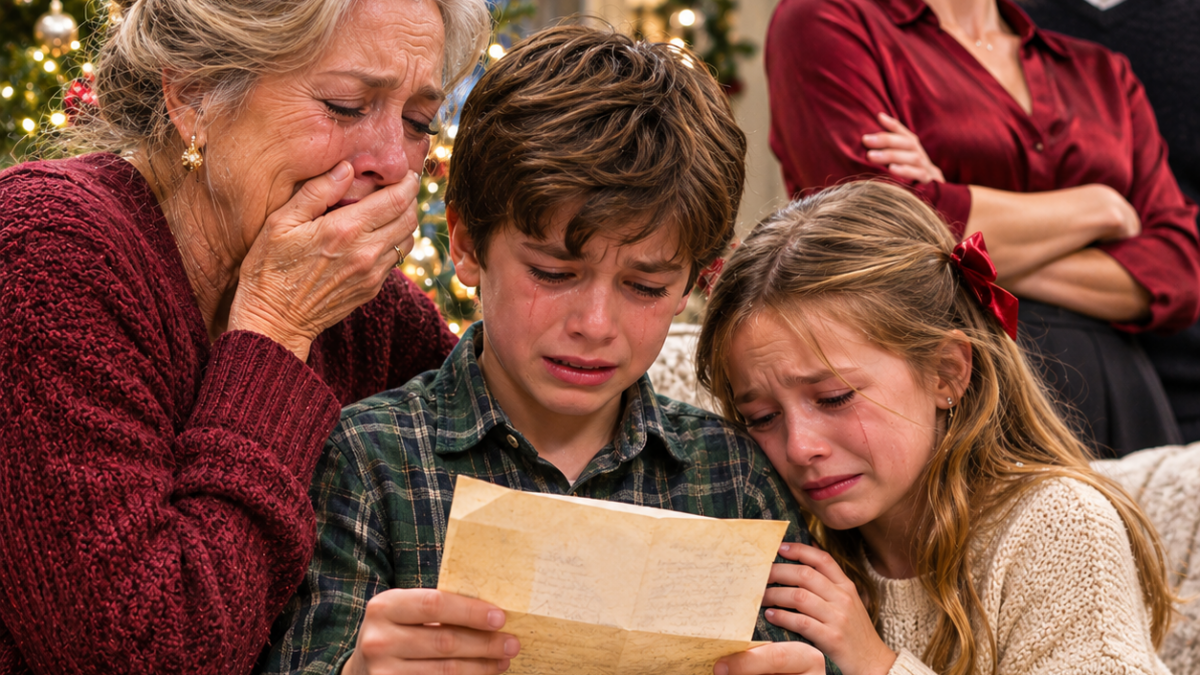
Tessa held up my letter.
“Grandma said the angel was waiting for me.”
Brenda’s eyes snapped toward the paper.
“You should not have left the house.”
“That’s not what I asked.”
“Tessa Marie.”
“Why did you lie?”
The room became very still.
Max appeared from the kitchen holding half a cinnamon roll.
Frost was melting from his hair.
He looked from his mother to me.
Then said:
“You told me Grandma went somewhere for Christmas.”
Brenda closed her eyes.
That one landed even harder.
I had not known that.
Greg stepped inside.
“Okay.”
He used the tone adults use when they believe volume and authority can put reality back where they want it.
“Everybody needs to calm down.”
I looked at him.
“I’m calm.”
He ignored me.
“Tessa, you and Max get your coats.”
“No.”
Greg stared.
“What did you say?”
Tessa’s voice shook.
But she repeated it.
“No.”
I immediately said:
“Tessa, you do need to listen to your parents.”
She looked at me, wounded.
I continued:
“You can disagree with them. But you do not need to fight them for my sake.”
Brenda looked almost relieved.
Then Tessa said:
“I’m not fighting for you, Grandma.”
She turned toward her mother.
“I’m fighting because you lied to me.”
That relief vanished.
Owen appeared in the doorway.
Fourteen years old.
Tall enough now that I sometimes saw his grandfather in the angle of his shoulders.
He held an envelope in one hand.
Mine.
“I found mine last night.”
Brenda whispered:
“Owen.”
He walked inside.
“I asked if Grandma knew we weren’t coming.”
Brenda said nothing.
Owen continued.
“You said yes.”
Greg stepped between them.
“That’s enough.”
Owen looked at his father.
“Did Grandma know?”
Greg’s jaw tightened.
“This was an adult decision.”
“That’s not what I asked.”
I watched Brenda’s face.
There was shame there now.
But also fear.
Not fear of me.
Fear of Greg.
That was the first thing that made me stop thinking only like a hurt mother.
I had known my daughter her entire life.
Brenda did not like confrontation.
Even as a child, she would apologize to a chair after bumping into it.
Marriage had not improved that tendency.
Greg, on the other hand, had opinions about almost everything.
How Christmas should be organized.
How much salt belonged on potatoes.
How long children should sleep.
How frequently Brenda should visit me.
Which side of the family was “too emotional.”
For years, I had told myself he was simply particular.
Standing in my living room that Christmas morning, I began wondering how many of Brenda’s decisions were actually negotiations she had already lost before she presented them to me.
Marlene entered without knocking.
“Dorothy.”
I turned.
She glanced at the bicycles dripping snow onto my floor.
Then at the tree.
“This is exactly what we were trying to avoid.”
I almost smiled.
“What?”
“Drama.”
Max looked at her.
“You came here.”
Douglas made a strangled sound that might have been a cough.
I bit the inside of my cheek.
Marlene ignored him.
She pointed toward the letters.
“Sending those was inappropriate.”
“Why?”
“You undermined their parents.”
I looked at Brenda.
“Did I tell any child to come here?”
Brenda said nothing.
“Did I tell them their parents were wrong?”
Nothing.
“Did I tell them to disobey?”
“No.”
Her voice was barely audible.
Marlene crossed her arms.
“You knew what you were doing.”
“Yes.”
That surprised everyone.
I continued.
“I knew I wanted my grandchildren to hear from me directly.”
“That is what I was doing.”
Marlene scoffed.
“You invited them.”
“I told them the door was open.”
“Same thing.”
“No.”
“It isn’t.”
Greg finally spoke.
“You knew Brenda and I wanted Christmas separate.”
“I knew Brenda sent me a message saying immediate family only.”
My voice stayed level.
“I did not know she told the children I had requested it.”
Brenda looked down.
Greg said:
“She was trying to protect their feelings.”
“From whom?”
He paused.
“From the situation.”
“What situation?”
He glanced at his parents.
Then at me.
And suddenly the answer was obvious.
Not fully.
But enough.
There had been an argument in that house about who counted.
And I had lost without being present.
Tessa sat on my sofa.
Max joined her.
Owen remained near the door.
I said:
“Children, go to the kitchen.”
Greg started:
“They’re coming home.”
I held up a hand.
“No.”
He stared.
“They are your children.”
“Yes.”
“And I am not telling them they can stay against your wishes.”
I looked at all three.
“But adults need to speak without you in the middle.”
Owen hesitated.
Then took Max’s shoulder.
“Come on.”
Tessa glared at Brenda.
I said gently:
“Sweetheart.”
She finally followed her brothers.
I waited until the kitchen door swung mostly shut.
Then turned toward Brenda.
“What happened?”
Greg answered.
“We decided to have Christmas at home.”
“I know.”
“My parents have been asking us to host for years.”
“I know.”
“Our house is larger.”
“It is.”
“My mother has trouble driving at night.”
“Also true.”
Marlene looked pleased.
Greg continued.
“And honestly, Dorothy, last year was stressful.”
I nodded.
“Your mother disliked my ham.”
“That’s not what I mean.”
“What do you mean?”
He hesitated.
Then:
“You have traditions for everything.”
I almost laughed.
“That is usually what traditions are.”
“You make the children feel obligated.”
“To do what?”
“The cinnamon rolls.”
“The angel.”
“The stockings.”
“The ornament exchange.”
“You’ve built all these expectations.”
I stared at him.
“They enjoy those things.”
“That isn’t the point.”
“What is?”
He exhaled.
“The point is that Christmas revolves around this house.”
There.
Finally.
I looked toward Brenda.
“Is that what you think?”
She rubbed both palms over her robe.
“I wanted one year where we didn’t have to split ourselves.”
I softened.
That was reasonable.
“You could have told me that.”
“I tried.”
“No.”
“You told me I was not immediate family.”
Her eyes filled.
“I didn’t mean it like that.”
“Then why did you write it like that?”
Silence.
Greg said:
“Because every time we try to set boundaries, you take it personally.”
I turned toward him.
“When did you try?”
He opened his mouth.
I waited.
No example arrived.
I continued:
“If Brenda had written, ‘Mom, we want to host at our place this year. Can you come at two?’ I would have been there with cinnamon rolls.”
Brenda looked at me.
“You would?”
“Of course.”
Greg shifted.
Marlene said sharply:
“That would have defeated the point.”
Everyone looked at her.
I asked:
“What point?”
Her lips tightened.
And there it was.
The sentence she probably wished she could pull back.
“We wanted one Christmas that was ours.”
I stared at her.
“Yours.”
“With our son.”
“With our grandchildren.”
“With Brenda.”
Not me.
Her face told me she understood what she had admitted.
I sat down.
The anger left me strangely quickly.
What replaced it was clarity.
This was not about my house.
Or my food.
Or my forty-one years hosting.
It was a contest no one had bothered to tell me existed.
Marlene wanted Christmas centered around her family.
Greg wanted to make his mother happy.
Brenda wanted to avoid conflict.
And I was the easiest person to remove because everyone assumed I would swallow hurt quietly rather than make a scene.
They were right about half of that.
I would not make a scene.
I also would not pretend the decision was harmless.
I looked at Brenda.
“Did you tell the children I did not want them?”
Her shoulders collapsed.
“Mom.”
“Please answer.”
“Yes.”
Greg said:
“Brenda—”
I looked at him.
“Do not answer for her.”
Something in my voice stopped him.
Brenda whispered:
“Yes.”
“Why?”
“Because they were upset.”
“About not coming here?”
“Yes.”
“So instead of telling them that you and Greg chose something different, you made me the reason.”
Tears filled her eyes.
“I didn’t want them angry at their father.”
That answer hurt more than the original text.
Because it was honest.
I leaned back.
“So you let them be hurt by me instead.”
Brenda covered her face.
“I’m sorry.”
Greg said:
“She was trying to protect the family.”
I looked at him.
“Which family?”
His face hardened.
I continued.
“Because the three children in my kitchen are also family.”
“My daughter is family.”
“I am family.”
“You do not protect a family by assigning the pain to whichever person complains least.”
No one answered.
The kitchen door opened slightly.
Max’s face appeared.
“Grandma?”
“Yes?”
“Can we eat the cinnamon rolls?”
The absurdity broke the tension.
I laughed.
Actual laughter.
“Yes.”
“All of them?”
“No.”
His head disappeared.
I heard Owen say:
“I told you.”
For the first time that morning, Brenda smiled through her tears.
Then Marlene ruined it.
“This is ridiculous.”
She picked up her purse.
“We have breakfast waiting.”
Tessa’s voice floated from the kitchen.
“We already ate Grandma’s.”
Marlene closed her eyes.
Douglas covered his mouth.
This time I knew he was hiding a smile.
Greg said:
“Kids.”
They emerged.
“We’re going home.”
Tessa looked at me.
I nodded.
“It’s okay.”
She hugged me hard.
Max hugged me next.
Sticky fingers.
Cinnamon icing on my sweater.
Owen waited until his siblings moved away.
Then said quietly:
“Grandma, did Grandpa really teach you those rolls?”
“Yes.”
“When?”
“First Christmas after we married.”
“Could you teach me sometime?”
My throat tightened.
“Yes.”
“Anytime.”
He hugged me.
That was when Brenda started crying again.
Not delicately.
Her whole face folded.
She turned toward the door.
Greg looked embarrassed.
Of course he did.
Strong emotions embarrassed Greg unless they belonged to Marlene.
They left at 9:41.
I watched the cars disappear.
Then closed the door.
The tree looked exactly as it had an hour earlier.
Except Tessa’s angel was finally on top.
I sat at the kitchen table.
Six cinnamon rolls remained.
My coffee had gone cold.
I expected to feel victorious.
I did not.
I felt seventy-two.
Widowed.
Tired.
And terribly sad that three children had ridden bicycles through snow because the adults who loved them had not trusted them with the truth.
At 10:08, my phone rang.
Brenda.
I let it go to voicemail.
At 10:11, again.
Then a message.
I’m sorry. I need time.
I replied:
Take it. I love you.
Nothing else.
I did not demand she come back.
Did not mention Greg.
Did not say:
I told you so.
That afternoon, I ate ham alone.
It was excellent.
I wish Marlene had been there so I could tell her.
December twenty-sixth, Owen came over.
Greg dropped him at the curb but did not enter.
Owen carried a notebook.
“What’s that?”
“Cinnamon rolls.”
“You need a notebook?”
“I’m fourteen.”
“I forget things.”
Fair.
I taught him.
Yeast.
Milk temperature.
Butter.
Flour.
Cinnamon filling.
Harold’s trick was orange zest.
Owen tasted the filling.
“Dad says orange doesn’t belong in cinnamon rolls.”
“Your grandfather said the same thing for twenty years while eating six at a time.”
Owen laughed.
Then became quiet.
“Grandma.”
“Yes?”
“Was Mom always scared of Dad?”
My hands stopped.
“That is not a question I can answer for her.”
“He gets mad when she disagrees.”
I measured flour.
“How mad?”
“He doesn’t hit her.”
The fact that Owen volunteered that answer told me something.
“He just…”
Owen searched.
“…makes everything miserable until she gives up.”
I kept my face neutral.
“What does that mean?”
“Silent treatment.”
“Complaining.”
“Calling his mom.”
I almost smiled at the final item.
Did not.
Owen continued.
“Christmas was Mom’s idea at first.”
I looked at him.
“What?”
“She wanted us to host everyone.”
“Everyone?”
“You.”
He nodded.
“Grandma Marlene said if you came, she wasn’t coming.”
There it was.
The missing piece.
I sat across from him.
“Did your mother tell you that?”
“I heard them arguing.”
“What did Greg say?”
“Dad told Mom she needed to choose her own household for once.”
I absorbed that.
It sounded reasonable on the surface.
That was Greg’s gift.
Control wrapped in therapeutic vocabulary.
Boundaries.
Household.
Priorities.
Loyalty.
All useful words.
Depending on who is allowed to have them.
I did not question Owen further.
Children should not become informants in their parents’ marriage.
Instead, we baked.
At noon, he took a tray home.
He texted thirty minutes later.
Mom ate two.
I smiled.
Tessa came December twenty-eighth.
She wanted to know why adults lie to children “to protect them.”
I told her sometimes adults are afraid the truth will make a child angry.
“So lying makes it better?”
“No.”
“Then why?”
“Because adults are not always as grown-up as they look.”
She accepted that.
Then asked:
“Are you mad at Mom?”
“Yes.”
Her eyes widened.
I smiled.
“You can love someone and still be angry.”
“Are you mad at Dad?”
“Yes.”
“Grandma Marlene?”
“Very.”
That made her laugh.
Then I said:
“But none of that is your responsibility.”
She nodded slowly.
“I know.”
Children say I know when they are still learning.
Adults do too.
Max arrived the day before New Year’s.
He had drawn me a picture.
My house.
Snow.
Three bicycles.
There had only been two.
I asked:
“Whose is the third?”
“Owen’s.”
“He came in the car.”
“I know.”
“Then why the bike?”
Max shrugged.
“He wanted to ride too.”
That nearly broke me.
Brenda did not visit until January seventh.
She came alone.
No robe this time.
Jeans.
Sweater.
No makeup.
She stood at my front door.
“Can I come in?”
“Always.”
She sat at the kitchen table where I had written the letters.
For several minutes, neither of us spoke.
Then she said:
“Greg is furious with me.”
“Why?”
“Because I apologized to the kids.”
I waited.
“And because I told them the truth.”
“What truth?”
“That you never excluded them.”
I nodded.
“That was necessary.”
“He says I undermined him.”
“Did he lie too?”
Brenda stared at the table.
“Yes.”
There it was again.
Truth arriving quietly.
“Whose idea was the message?”
She inhaled.
“Mine.”
I did not expect that.
Then she continued.
“But not the way I sent it.”
I waited.
“I originally told Greg I wanted Christmas at our house.”
“Fine.”
“I invited you.”
“I invited his parents.”
“Marlene said no.”
“Because of me?”
“Yes.”
Apparently last year’s ham had more political consequences than I realized.
Brenda gave a miserable laugh.
“She said she was tired of coming second at every holiday.”
I frowned.
“She hosted Thanksgiving.”
“I know.”
“And Easter.”
“I know.”
“And you have Mother’s Day brunch with her.”
“I know, Mom.”
“Sorry.”
She rubbed her eyes.
“Greg said it was time to show his parents they were equally important.”
I said nothing.
“Then he said if you came, his mother would make Christmas miserable.”
I almost laughed.
“Accurate assessment.”
Brenda smiled despite herself.
Then:
“I told him I would talk to you.”
“What happened?”
“He said talking would turn into negotiating.”
“Would it?”
“No.”
She looked at me.
“That’s the part I hate.”
“You would have said okay.”
“Yes.”
“I knew you would.”
I felt my chest tighten.
“Then why lie to the children?”
She whispered:
“Because Tessa started crying.”
I waited.
“She said it wasn’t Christmas without your tree.”
“Owen was angry.”
“Max asked if you were going to be alone.”
“So Greg said?”
Brenda closed her eyes.
“He said if they knew it was our decision, they would blame us.”
“And if they blamed me?”
Her face crumpled.
“You would forgive me.”
There it was.
The entire family dynamic in five words.
You would forgive me.
I leaned back.
“You used my love as the safest place to put the consequences.”
She started sobbing.
“I know.”
I did not rush around the table to comfort her.
That was difficult.
Motherhood trains you to stop your child’s pain.
Sometimes love requires letting them feel the exact weight of what they did.
When she calmed, I said:
“I will forgive you.”
Her eyes lifted.
“But forgiveness cannot mean you do it again.”
She nodded.
“And I am not going to help you hide things from your children so Greg stays comfortable.”
Another nod.
“Or from me.”
“I know.”
Then she said:
“I think I’m in trouble.”
That changed everything.
Not financial trouble.
Marriage trouble.
Brenda told me Greg had not spoken to her properly since Christmas.
He answered necessary questions.
Nothing else.
He slept in the guest room.
Marlene called daily.
Not to ask if Brenda was okay.
To explain how deeply Brenda had embarrassed the Carter family.
Greg told Brenda the children’s behavior proved I had “too much influence.”
He wanted to reduce visits.
He wanted all communication with me to go through Brenda.
He wanted the kids’ letters inspected.
I stared.
“Inspected?”
Brenda nodded.
“He says you manipulated them.”
“Do you think I did?”
“No.”
That answer was immediate.
Good.
She continued.
“He wants us to take a break from you until Easter.”
I laughed.
Could not help it.
Brenda looked startled.
“Sorry.”
I took her hand.
“He does not get to issue my visitation schedule.”
“I know.”
“Do you?”
Her eyes filled.
“I’m trying.”
That conversation became the beginning of something I had not expected.
Not divorce.
Not immediately.
Boundaries.
Actual ones.
For years, Greg had used that word whenever he wanted Brenda to do something.
Now she started using it correctly.
She told him:
“You do not decide whether my mother is family.”
He replied:
“I decide what happens in my house.”
She answered:
“So do I.”
Apparently that sentence produced three hours of silence.
Progress comes in strange forms.
The children continued visiting me normally.
No secret meetings.
No bicycle escapes.
Brenda drove them.
Sometimes Greg did.
He never entered.
I never complained.
One afternoon in February, he finally knocked.
I opened the door.
“Dorothy.”
“Greg.”
“Can we talk?”
“Depends.”
“On?”
“Whether talking means you explaining why everybody except you is wrong.”
His jaw tightened.
Then, surprisingly:
“No.”
I let him in.
We sat in the living room.
Tessa’s angel was packed away.
The tree gone.
Just ordinary February gray outside.
Greg looked older than he had at Christmas.
“I think you hate me.”
“I don’t.”
“You should.”
“I’m too old to spend that much energy.”
He almost smiled.
Then:
“I handled Christmas badly.”
“Yes.”
He inhaled.
“My mother put me in a terrible position.”
I waited.
There it was.
The escape route.
I said:
“Marlene did not send me the text.”
He looked down.
“No.”
“She did not lie to your children.”
“No.”
“She did not tell Brenda I wanted to be alone.”
“No.”
He rubbed his forehead.
“I was trying to keep everybody happy.”
“No.”
He looked at me.
“You were trying to keep your mother from being unhappy.”
That landed.
“Those are not the same thing.”
He sat quietly.
I continued:
“You knew I would not punish you.”
“You knew Brenda would eventually apologize to me.”
“You knew the children would still love me.”
“So I became the cheapest person to hurt.”
Greg stared at his hands.
I could almost see him resisting the sentence.
Then:
“That’s fair.”
I had not expected that.
He told me something else.
His mother had been complaining about my Christmas hosting for years.
Not the food.
Not the chairs.
The symbolism.
Marlene believed every holiday tradition around the children came from the Lane side.
My cinnamon rolls.
Harold’s stockings.
The angel.
Christmas Eve cocoa.
My handwritten gift labels.
She felt peripheral.
I said:
“She could have created traditions.”
Greg nodded.
“I know.”
“She could have asked.”
“I know.”
“She could have invited us.”
“I know.”
Then I realized something.
Greg had been raised the same way Brenda was now raising her children around him.
Manage Mom.
Prevent Mom’s disappointment.
Adjust everyone else.
Keep peace.
Marlene’s emotions had become a household weather system long before I met them.
Understanding that did not excuse Greg.
But it made him less mysterious.
I told him:
“I don’t need every Christmas.”
He looked up.
“I don’t even need Christmas Day.”
“I need honesty.”
“If you want Christmas with your parents one year, tell me.”
“I may be lonely.”
“I may be hurt.”
“Those feelings are mine to manage.”
He nodded.
“What I will not accept is being erased so you don’t have to watch your children disagree with you.”
His eyes filled.
That surprised me more than anything.
“I’m sorry.”
I believed he meant it in that moment.
Whether behavior followed would matter more.
Marlene did not apologize.
Of course she did not.
In March, she sent me a birthday card.
No message except:
Hope you have a lovely day.
Progress, perhaps.
Or postal diplomacy.
I sent her one on hers.
I am not a barbarian.
By spring, Brenda and Greg were in counseling.
I learned that because Brenda told me, not because I asked.
Their marriage had problems beyond Christmas.
Greg did not hit her.
Did not threaten her.
But he had turned discomfort into something everyone around him had to solve.
If Brenda challenged him, he withdrew.
If the children disagreed, he accused them of disrespect.
If Marlene became upset, Greg treated her feelings as evidence somebody else had done something wrong.
Therapy forced him to see that.
Brenda had her own work.
She avoided conflict by manipulating information.
Small lies.
Half-truths.
Different versions for different people.
Not maliciously.
Fearfully.
But fear can still damage trust.
She admitted that.
I respected her for it.
Owen became my regular Saturday-morning baker.
By June, he no longer needed the notebook.
He experimented.
Too much nutmeg once.
We survived.
At fourteen, he had begun asking questions about Harold.
Not just funny stories.
What kind of man he had been.
Whether he got angry.
Whether we fought.
I told the truth.
“Your grandfather could sulk.”
Owen laughed.
“Really?”
“For hours.”
“What did you do?”
“Eventually I stopped chasing him.”
“How?”
“I learned that if a grown man wants to sit silently in the garage, he can enjoy the garage.”
Owen nearly dropped the mixing bowl.
That became one of his favorite Harold stories.
Tessa asked for the angel early that year.
October.
“Why?”
“I want to make a box for it.”
She built one in her school woodworking class.
Crooked lid.
Beautiful.
Inside she painted:
FOR THE PERSON WHO PUTS ME ON THE TREE NEXT
I cried when she gave it to me.
“What does that mean?”
She shrugged.
“Someday you won’t be here.”
Twelve-year-olds can be brutal.
Then she hugged me.
“But the angel will.”
That was the point of traditions.
Not control.
Continuity.
I had never wanted the children chained to my house.
I wanted them to carry something forward after the house no longer belonged to me.
Max remained Max.
His only concern about the entire family crisis was whether cinnamon rolls could be made in July.
They can.
Then came the money.
There is always money somewhere in a family story, though in this case it was not a secret fortune.
It was college.
Harold and I had opened education accounts for each grandchild.
Nothing extravagant.
We contributed birthdays.
Christmas.
Tax refunds some years.
After Harold died, I continued.
Greg knew they existed.
He assumed, incorrectly, that the accounts were large enough to pay four years at any university.
They were not.
But they were meaningful.
One evening in August, Greg asked Brenda whether my “Christmas stunt” had changed my estate plans.
She told him she did not know.
Then asked:
“Why?”
Greg apparently realized the ugliness of the question as soon as it left the room.
He called me himself.
“Dorothy.”
“Yes?”
“I need to tell you something before Brenda does.”
“That sounds promising.”
He sighed.
“I asked about your will.”
“Why?”
“Because I was thinking about the kids.”
“Were you?”
Silence.
Then:
“Partly.”
I appreciated the honesty.
I said:
“My money is not a family behavior-management tool.”
“I know.”
“Do you?”
“I’m learning.”
Good answer.
I told him nothing about my estate.
Not because I was punishing him.
Because adults who plan their behavior around inheritance need less information about inheritance.
September brought something I did not expect.
Marlene came to my house.
Alone.
She stood on the porch holding a bakery box.
“Peace offering.”
I looked inside.
Cinnamon rolls.
Store-bought.
“That is aggressive.”
She blinked.
Then, to my surprise, laughed.
I let her in.
We drank coffee.
For twenty minutes, she talked around the subject.
Weather.
Her knee.
Douglas’s cholesterol.
Finally:
“I behaved badly.”
I said nothing.
“I was jealous.”
There it was.
“I hated that the children talked about your Christmas all year.”
“Why?”
“Because mine never mattered that much.”
I looked at her.
“Marlene.”
“I know how childish that sounds.”
“Very.”
She laughed again.
“Thank you.”
Then her eyes filled.
“When Greg was little, my mother-in-law controlled every holiday.”
I almost groaned.
The inheritance of bad behavior.
“She treated me like an outsider.”
Marlene continued.
“I promised myself when I had grandchildren, I would never feel like that again.”
“So you made me feel like that.”
“Yes.”
No excuse.
Just yes.
That was the first thing she had said that made forgiveness possible.
I told her:
“You know what would have worked?”
“What?”
“Call me.”
She looked confused.
“Say, ‘Dorothy, I want Christmas at my house this year.’”
“You would have agreed?”
“Probably.”
She shook her head.
“I truly thought you’d fight me.”
“Why?”
“Because I would have fought you.”
We both stared.
Then laughed.
Sometimes the person we fear is simply the version of ourselves we imagine in their chair.
Marlene asked about the angel.
I showed her Tessa’s new box.
She touched the lid.
Then said:
“I’d like to create something for them too.”
“Do it.”
“What?”
“Create a tradition.”
She looked almost offended by how simple I made it sound.
“Like what?”
“I don’t know.”
“That is the part you get to do.”
By Thanksgiving, Marlene had started teaching the children her mother’s pierogi recipe.
Max hated onions.
Owen liked rolling dough.
Tessa documented everything because apparently our family now required archival standards.
It became theirs.
I was invited.
I went.
I did not criticize the dough.
Growth.
The week before the next Christmas, Brenda called.
My stomach tightened despite everything.
“Mom.”
“Yes?”
“We want to talk about Christmas.”
I waited.
“We’d like to host.”
“Okay.”
Silence.
Then:
“That’s it?”
“What else?”
She laughed.
“We want everyone.”
“You.”
“Greg’s parents.”
“Daniel if he can fly in.”
“The kids.”
“Everyone.”
“That sounds nice.”
Then:
“We want to keep some traditions from your house.”
I looked around my kitchen.
Forty-two Christmases, if you counted the lonely one.
“Which?”
“Owen wants to make the rolls.”
“Good.”
“Tessa wants the angel.”
“Of course.”
“Max says your door needs to stay unlocked.”
I laughed.
“That one does not transfer well.”
Then Brenda’s voice softened.
“Mom.”
“Yes?”
“I want you to come early.”
“How early?”
“Seven.”
“That is offensive.”
“Owen says you supervise the dough.”
“He is lying.”
“He says you don’t trust him with yeast.”
“He killed yeast twice.”
I heard Owen yell in the background:
“ONCE!”
Brenda laughed.
It sounded like my daughter again.
Christmas morning, I arrived at 7:12.
I am seventy-three now.
I do not arrive anywhere at seven sharp unless someone is bleeding.
Greg opened the door.
“Late.”
“Cancel Christmas.”
He smiled.
Real smile.
“Coffee’s ready.”
That mattered.
Owen stood in the kitchen wearing Harold’s old apron.
I had given it to him that fall.
Flour everywhere.
The dough looked good.
I inspected it.
“Too much flour.”
He rolled his eyes.
“Grandpa would support me.”
“Your grandfather burned toast.”
“Family legend says otherwise.”
“Family legend lies.”
Tessa came downstairs carrying the angel box.
Max followed dragging a blanket.
At eight-thirty, Douglas and Marlene arrived.
Marlene carried pierogi.
Nobody insulted the cinnamon rolls.
I noticed.
At ten, we stood around the tree.
Not my tree.
Brenda’s.
Different ornaments.
Different room.
Same children.
Tessa climbed onto a step stool.
She held the wooden angel.
Then stopped.
“Grandma.”
“Yes?”
“You do it.”
I shook my head.
“It’s yours.”
“I know.”
“But last year…”
Her voice softened.
“…I put it on because you were waiting for me.”
She held it toward me.
“This year we’re waiting for you.”
I almost lost myself completely.
Instead, I took the angel.
Then looked at her.
“Together.”
She smiled.
We both placed it.
Her hand over mine.
Marlene stood behind us crying.
Greg pretended he had something in his eye.
Douglas said:
“Probably ham glaze.”
I turned.
That man had been waiting an entire year to make that joke.
Even Marlene laughed.
Dinner was imperfect.
Of course.
Greg overcooked the turkey.
Marlene thought the potatoes needed salt.
I did not say a word about the ham because there was no ham.
Brenda dropped gravy on her blouse.
Max spilled sparkling cider.
Tessa got angry because Owen used one of her fancy markers.
Daniel joined by video from Denver because weather grounded his flight.
It was noisy.
Ordinary.
Wonderful.
No one person owned it.
That may have been the greatest improvement.
After dinner, Brenda asked me to walk upstairs.
We went into her bedroom.
She closed the door.
I briefly wondered whether another Christmas crisis was arriving.
Instead, she handed me a small box.
Inside were my three letters.
The originals.
Owen’s.
Tessa’s.
Max’s.
I looked at her.
“The kids wanted you to keep them?”
“No.”
“They wanted copies.”
She had framed photocopies for each child’s room.
The originals came back to me.
Brenda sat beside me on the bed.
“I read them.”
“When?”
“Months ago.”
“They showed you?”
“Yes.”
She touched Owen’s envelope.
“I kept expecting to find something angry.”
“There wasn’t.”
“I know.”
“Something designed to make them blame me.”
“There wasn’t.”
“No.”
Her eyes filled.
“That made it worse.”
I understood.
Had I insulted her, she could have fought me.
Had I written:
Your mother is cruel.
Your father controls everything.
Come to Grandma because your parents are selfish.
She could have made me the villain.
Instead, I wrote about cinnamon.
An angel.
An unlocked door.
Truth is difficult to argue with when it does not arrive wearing accusation.
Brenda said:
“You gave them the truth without asking them to choose sides.”
“That was the goal.”
“I made them choose sides without even telling them.”
“Yes.”
She nodded.
Then whispered:
“I’m sorry.”
I took her hand.
“I know.”
She looked at me.
“Why did you only say ‘Understood’?”
I thought about that.
Because honestly, at the time, I had not been wise.
I had been hurt.
But wisdom sometimes grows around hurt afterward.
“I knew if I argued, you’d defend the decision.”
She nodded.
“If I begged, you’d feel guilty.”
Another nod.
“If I became angry, Greg could say, ‘See? This is why.’”
Her mouth tightened.
“So I accepted the information.”
“Then wrote to the people I loved.”
Brenda leaned her head against my shoulder.
“I hated that word.”
“Understood?”
“Yes.”
“Why?”
“Because I knew you understood more than I wanted you to.”
That was probably true.
We stayed upstairs ten minutes.
When we returned, everyone was opening dessert containers.
Marlene had brought a pecan pie.
I brought cheesecake.
No competition.
Mostly.
She looked at my cheesecake.
“Homemade?”
“Yes.”
She narrowed her eyes.
“Show-off.”
“Store-bought rolls.”
She gasped.
We were fine.
Not best friends.
We did not need to be.
Respect is enough for many adult relationships.
Later, after everyone exchanged gifts, Owen brought out a notebook.
The cinnamon-roll notebook.
He opened the first page.
My recipe.
Then pages of adjustments.
Orange zest reduced slightly.
Cardamom experiment.
Failed maple glaze.
Successful maple glaze.
He had titled it:
HAROLD & DOROTHY LANE CHRISTMAS ROLLS — CONTINUED BY OWEN CARTER
I had to remove my glasses.
“Grandma?”
“Yes?”
“You okay?”
“No.”
He smiled.
“Good.”
Teenagers can be cruel too.
Tessa’s angel went back into her handmade box after dinner.
Marlene wrapped leftover pierogi for me.
Max fell asleep on my lap even though at ten he was far too old for that, according to Max.
Greg carried him upstairs.
When he returned, he stood in the doorway beside me.
“Dorothy.”
“Yes?”
“Thank you for coming.”
“Thank you for inviting me.”
He nodded.
Then:
“And thank you for not trying to turn the kids against us last year.”
I looked at him.
“I would never do that.”
“I know.”
“Do you?”
“Yes.”
He sat across from me.
“I didn’t then.”
I appreciated that distinction.
Then he said:
“I thought any disagreement from you meant you were competing with my parents.”
“Why?”
“Because I was competing.”
There it was.
“I thought there was a limited amount of loyalty.”
I smiled sadly.
“Children can love four grandparents.”
“I know.”
“Adults too.”
He nodded.
“My mother and I made everybody prove things they never needed to prove.”
“Yes.”
He looked toward the kitchen where Brenda and Marlene were arguing cheerfully about foil.
“I’m trying not to do that anymore.”
“I can tell.”
That was enough.
We did not become a perfect family after that.
I want to be clear.
The following Easter, Brenda forgot to tell me brunch had moved by an hour.
I arrived early and annoyed Greg by reorganizing his refrigerator.
Marlene and I disagreed about whether Tessa was old enough for pierced ears.
Owen dropped a cinnamon-roll pan.
Max lied about finishing homework.
Greg occasionally became controlling when stressed.
Brenda occasionally avoided telling people things she knew would upset them.
I occasionally used the phrase:
“At my age…”
to win arguments I had no business winning.
Families do not heal by becoming flawless.
They heal by changing what happens after someone makes a mistake.
Now Brenda calls.
Greg apologizes faster.
Marlene asks instead of assumes.
I say when I am hurt.
The children are not asked to carry adult secrets.
That is the difference.
The letters became family history.
Not because I planned it.
Years later, Tessa told me she still remembered exactly what it felt like to open hers.
“I thought you had forgotten me.”
“Why?”
“Because Mom said you didn’t want Christmas.”
She looked embarrassed by how childish the thought sounded.
She had been twelve.
“It made sense then.”
Then she smiled.
“When I saw my name in your handwriting, I knew something was wrong.”
That sentence stayed with me.
Children recognize the handwriting of people who love them.
There is something beautiful about that.
I asked whether she regretted riding the bicycle.
“No.”
“Your fingers were blue.”
“I know.”
“You could have gotten hurt.”
“Max wanted to walk.”
I stared.
“From your house?”
She laughed.
“I saved his life.”
Fair.
Owen later admitted he had wanted to follow them but Brenda woke when the garage opened.
He stayed because he feared Max would be punished more severely if all three disappeared.
I hated that the children had to make those decisions.
But they also learned something important.
They learned they could question an adult without hating them.
They learned truth and loyalty are not enemies.
That is more useful than believing parents never make mistakes.
Max remembers almost none of the argument.
His memory is:
Snow.
Pajama pants.
Bicycle.
Cinnamon rolls.
He once told somebody:
“The year Mom banned Grandma from Christmas, we escaped.”
Brenda nearly died.
I corrected him.
“Your mother did not ban me.”
“She kind of did.”
“Max.”
He grinned.
Some stories become legends regardless of adult editing.
The following December twentieth, exactly one year after the text, my phone buzzed at 10:17 a.m.
Brenda.
I opened it.
Mom, we’ve decided Christmas will be immediate family only this year.
I stared.
Then another message arrived.
Which obviously means you, Dad’s memory, Marlene, Douglas, Daniel if the airlines cooperate, and three children who will apparently bike through a blizzard if anyone forgets that again.
Then:
Come at 7.
I laughed so hard I had to sit down.
I replied:
Understood.
Three dots appeared immediately.
MOM.
I laughed harder.
I still have the original text from that first Christmas.
I never deleted it.
Not because I enjoy pain.
Because language matters.
Immediate family only.
Three ordinary words.
The problem was never wanting a smaller Christmas.
The problem was defining family according to who was easiest to exclude.
That is what changed.
Now immediate family does not mean everyone must be in the same room.
Daniel sometimes cannot come.
I may one day prefer staying home.
The children will grow.
Marry.
Move.
Create other traditions.
Family changes shape.
What matters is that nobody disappears simply because their feelings are considered safer to hurt than somebody else’s.
I am seventy-six now.
Owen is eighteen.
College.
He took the cinnamon-roll notebook with him and now makes them in a dormitory kitchen that should probably be inspected by the fire department.
Tessa is sixteen.
The angel remains hers.
Max is thirteen and claims he no longer likes cinnamon rolls, which is a lie because he eats three.
Brenda is fifty.
Greg has more gray hair.
Marlene complains less.
Douglas complains exactly the same amount because apparently growth has limits.
And I no longer host Christmas every year.
That was harder to surrender than I expected.
But it was time.
Forty-one years was enough.
Now I rotate.
Sometimes Brenda hosts.
Sometimes Marlene.
One year Daniel hosted when he moved back east.
My house still gets Christmas morning breakfast every other year.
But I am no longer the machinery keeping the entire holiday alive.
That is good.
Traditions should survive the people who start them.
Otherwise they are obligations, not traditions.
Last Christmas, Owen came home from college on December twenty-third.
He walked into my kitchen.
No greeting.
Dropped his bag.
Opened my refrigerator.
I said:
“Lovely to see you too.”
He said:
“We need yeast.”
“We have yeast.”
“How old?”
I stared.
He checked the date.
“Grandma.”
“What?”
“This expired.”
“Yeast cannot read.”
He laughed.
Then drove to the store.
Harold would have loved him.
Christmas morning at eight, Owen made the rolls.
I sat at the table.
Did nothing.
That was difficult.
He asked:
“Are you capable of not supervising?”
“No.”
“Try.”
I drank coffee.
Watched him work.
When the rolls came out, the whole house smelled exactly right.
Max walked in.
Stopped.
Smiled.
Then said the same words he had said at nine years old after riding through the snow:
“It smells right.”
I turned away so nobody would see me cry.
Tessa brought the angel.
She is almost too tall to need a stool now.
She still uses one.
“Tradition,” she says.
She placed the angel on top.
Then looked at me.
“There.”
“Perfect.”
Brenda stood behind her.
Our eyes met.
We both remembered.
No need to say anything.
Some apologies become permanent through changed behavior.
That is better than repeating the words forever.
The letters now live inside the angel box.
All three.
After that second Christmas, the children decided they belonged there.
Owen’s cinnamon-roll letter.
Tessa’s angel letter.
Max’s unlocked-door letter.
Sometimes somebody reads them aloud.
Usually not.
They have become less about the conflict and more about what they represent.
A door left open.
People have asked whether I sent the letters intentionally hoping the children would rebel.
No.
And I am grateful for that.
If I had told them:
Come anyway.
Sneak out.
Your parents are cruel.
Then Christmas morning would have been partly my responsibility.
I did something simpler.
I refused to let somebody else tell my grandchildren what I felt.
That is all.
Brenda was free to make her decision.
Greg was free to choose his parents’ house.
Marlene was free to want her own traditions.
And I was free to tell my grandchildren:
I love you.
I remember you.
My door is open.
Sometimes truth creates consequences without needing help.
That is what happened Christmas morning.
Tessa read one letter.
Max read another.
Owen read his.
Then compared them with what they had been told.
Children can perform that math.
Adults sometimes underestimate them.
They did not ride through snow because I manipulated them.
They came because the story their parents gave them no longer matched the evidence in their hands.
And once that happened, the adults had to stop managing appearances and start telling the truth.
I used to believe Christmas traditions were fragile.
If the ham changed.
If we celebrated in another house.
If the angel went on another tree.
If someone did not make the rolls.
Maybe Christmas would not feel like ours anymore.
I was wrong.
The traditions were never the objects.
They were the relationships around them.
Harold taught me cinnamon rolls.
I taught Owen.
I bought Tessa’s angel.
Someday she will hand it to someone else.
Max remembers the unlocked door more clearly than any present I gave him that year.
That is inheritance.
Not money.
Not furniture.
A way of making someone feel expected.
Brenda once asked me whether I was lonely that Christmas before the bicycles arrived.
Terribly.
I had never told her.
She cried.
“Why didn’t you call me?”
“Because you had already answered the question.”
“What question?”
“Whether you wanted me there.”
She covered her mouth.
I took her hand.
“I am not telling you that to punish you.”
“I know.”
“I’m telling you because adults need to understand the impact of their choices.”
She nodded.
“I do.”
Then she said:
“I thought you were so strong.”
“I am.”
“Then why did it hurt so much?”
I smiled.
“Strong people have feelings, Brenda.”
“That is not what strength means.”
She laughed through tears.
Another family lesson.
I think that was one mistake everyone made with me for years.
Dorothy will understand.
Dorothy will adapt.
Dorothy does not mind.
Dorothy is strong.
The compliment became a permission slip.
Because I could absorb hurt, people assumed I should.
Christmas changed that.
Not because I became less forgiving.
Because I learned forgiveness works better when people are required to see what they are being forgiven for.
Marlene and I eventually discussed the ham.
This took three years.
We were drinking coffee.
She said:
“I actually liked it.”
I stared.
“What?”
“The ham.”
“You criticized it for twenty minutes.”
“I was nervous.”
“You become insulting when nervous?”
“Apparently.”
I laughed until I choked.
She said:
“Your glaze was excellent.”
I pointed at her.
“Too late.”
Now every Christmas she asks:
“Are we having Dorothy’s excellent ham?”
I tell her:
“No. It is too stressful for you.”
We have come a long way.
Douglas still thinks my chairs are hard.
I bought him a cushion.
He brings it to every gathering now.
It has his name embroidered on it.
Families are ridiculous.
Thank God.
Last week, I found the good stationery in the back of my desk.
Only seven sheets remain.
I touched the initials.
D.L.
Thought about buying more.
Then decided not to.
I like the idea that those three letters were written on paper I may never use again.
Some moments deserve their own material.
If I could go back to December twentieth and answer Brenda differently, would I?
No.
I would still write:
Understood.
Because I did understand.
Not everything.
Not the lie.
Not the argument with Marlene.
Not Greg’s pressure.
But I understood one important fact.
My daughter had made a choice.
I could chase her and force her to comfort me.
Or I could let the choice stand and decide what kind of person I wanted to be inside the hurt.
I chose not to beg for inclusion.
Not because I did not care.
Because love invited under pressure does not feel like love.
Then I wrote three letters.
No gifts.
No checks.
No guilt.
Just reminders.
Cinnamon.
Angel.
Door.
And those three small truths did something no confrontation could have done.
They made the lie unnecessary.
Once the children knew I had wanted them, every adult had to deal with the real decision.
That is why I still believe letters are powerful.
They sit quietly.
They do not interrupt.
They do not raise their voice.
They simply wait for someone to read the truth.
At 9:02 that Christmas morning, I opened my door expecting nobody.
Tessa and Max stood in snow.
At 9:06, Brenda arrived believing she needed to stop a disaster.
She did not know the disaster had already happened five days earlier when she decided that keeping her husband comfortable mattered more than letting her children know their grandmother loved them.
What happened in my living room was not the destruction of our family.
It was the moment the family stopped protecting the wrong things.
We stopped protecting Greg from disagreement.
Stopped protecting Marlene from jealousy.
Stopped protecting Brenda from guilt.
Stopped protecting me by assuming I could endure anything.
And most importantly, we stopped protecting the children from truths they were perfectly capable of understanding.
Years later, Tessa asked me:
“What would you have done if nobody came?”
I thought about the tree.
The angel in its box.
The untouched cinnamon rolls.
The unlocked door.
“I would have eaten breakfast.”
“Alone?”
“Yes.”
“Would you have cried?”
“Probably.”
She looked sad.
I touched her cheek.
“But I would still have been okay.”
That answer mattered to her.
And to me.
Because I do not want my grandchildren to believe love means somebody must always come through the door.
Sometimes love means leaving the door open without destroying yourself if they do not.
That Christmas, they came.
Two bicycles first.
Then two cars.
Then months of difficult conversations.
Apologies.
Counseling.
Changed traditions.
A new box for an old angel.
A teenage boy learning his grandfather’s recipe.
A mother learning that avoiding conflict can become dishonesty.
A father learning that loyalty is not a competition.
A jealous grandmother learning she could create something without stealing someone else’s place.
And one seventy-two-year-old widow learning that “understanding” does not mean accepting whatever people decide to do to you.
It means seeing clearly.
Then choosing your response.
I did not buy my grandchildren Christmas presents that year.
Not one.
I gave them letters.
Years later, I could not tell you what I bought them the Christmas before.
I doubt they could either.
But they remember those envelopes.
They remember the snow.
They remember the bicycles.
They remember Tessa standing on a stool with the angel in her hand and asking her mother why she lied.
And I remember opening the door.
That is the memory I keep.
Not Brenda’s text.
Not Marlene’s jealousy.
Not Greg’s anger.
Two children in snow.
A third waiting in a car because he wanted to come too.
And one little boy walking into my kitchen, breathing in cinnamon and orange zest, and saying the simplest, most beautiful thing anyone said to me that Christmas:
“It smells just right.”








