PART2:“I’M INNOCENT—AND MY DOG CAN PROVE IT.” Everyone in the Courtroom Thought Sara Had Lost Her Mind—Until Her Lawyer Opened the Forgotten Pet-Camera Archive
PART2
Sara met Jonathan through work.
He was thirty-nine.
Polished without looking polished.
Good suits.
Easy smile.
The kind of man who remembered a receptionist’s name and sent handwritten thank-you notes after business meetings.
He ran a small financial-strategy company called Vale Advisory Partners.
Not related to any famous firm.
Just Jonathan.
He hired Sara to help restructure reporting for several small businesses.
At first, he treated her with a kind of professional respect she had not felt in years.
“You notice things everybody else skips.”
He said it during their second project.
Sara smiled.
“That’s because everybody else finds spreadsheets boring.”
“I find people who understand them extremely useful.”
The compliment stayed with her.
Jonathan asked intelligent questions.
Paid invoices early.
Recommended her to other clients.
Their work expanded.
Then they started having coffee after meetings.
Coffee became dinner.
Dinner became weekends.
Sara was cautious.
Jonathan appeared patient.
“You don’t owe me a timeline.”
That sentence made her trust him more.
Milo did not.
The first evening Jonathan visited Sara’s apartment, Milo disappeared beneath the bed.
Jonathan laughed.
“Does he always do this?”
“No.”
“Maybe I smell like another dog.”
Possible.
Jonathan had mentioned his neighbor’s Labrador.
Sara coaxed Milo out with treats.
He emerged eventually but remained behind her legs.
His body trembled.
Jonathan crouched.
“Hey, buddy.”
Milo backed away.
“I’m offended.”
Sara laughed.
But she remembered.
The second visit was worse.
Milo began panting before Jonathan even entered.
Then hid in the bathroom.
Jonathan frowned.
“Your dog really hates me.”
“He doesn’t hate anybody.”
“Apparently he has standards.”
It was a joke.
Still, something about Jonathan’s face tightened.
After a month, Sara mentioned Milo’s behavior to their veterinarian.
The vet ruled out obvious medical causes and referred her to Dr. Elise Warren, a veterinary behavior specialist.
Elise asked questions.
Did Milo react to men generally?
No.
Voices?
No.
Hats?
Beards?
Certain movements?
No.
Only Jonathan.
Elise was careful.
“Dogs are excellent at noticing patterns humans don’t notice, but that does not mean they possess a supernatural ability to identify bad people.”
Sara nodded.
“He could be reacting to scent, body language, a movement pattern, something Jonathan wears, anything.”
“So I shouldn’t read into it.”
“Don’t treat the behavior as proof of anything.”
Elise smiled.
“But don’t ignore the dog’s stress either.”
She recommended installing a simple pet camera to understand what happened when Jonathan moved around the apartment.
Sara bought two.
One faced the living room.
One sat near the hallway outside her office.
The system recorded locally onto a small storage hub and also allowed live viewing through an app.
For several weeks, nothing dramatic appeared.
Jonathan entered.
Milo retreated.
Jonathan left.
Milo relaxed.
Sara concluded Milo simply disliked something about him.
Then the financial proposal arrived.
Jonathan called it the opportunity that would change both their lives.
A consortium was acquiring distressed small companies.
Jonathan had developed what he described as a restructuring fund.
Sara could become a managing participant.
Her role would be compliance and financial analysis.
The projected numbers were enormous compared with her consulting income.
Jonathan spread the documents across her dining table.
“If this works, neither of us worries about money again.”
Sara read.
There were layers.
Holding companies.
Acquisition entities.
Guarantees.
Management agreements.
A section giving Sara operational responsibility over transaction reporting.
She frowned.
“This is broad.”
“It needs to be.”
“I’d be certifying records I didn’t originate.”
“You’d be reviewing them first.”
“That isn’t what this clause says.”
Jonathan smiled.
“You’re doing your auditor thing.”
“My auditor thing keeps clients out of trouble.”
“And that’s why I need you.”
He kissed her forehead.
“Take tonight.”
Sara did.
At 2:00 a.m., she was still reading.
Milo had not slept.
He sat beside the dining room.
Watching the documents.
Watching her.
“Don’t start.”
His tail did not move.
Sara picked up the pen.
Milo stood.
Walked toward her.
“Seriously?”
He placed himself between Sara and the table.
She tried to step around him.
Milo moved again.
Then made a sound she had never heard from him.
Not a bark.
Not a growl.
A low, pleading whine.
Sara froze.
Milo looked directly at her.
His entire body shook.
She lowered the pen.
“What is wrong with you?”
He put one paw on her foot.
Sara stared at the signature line.
Then laughed nervously.
“I’m taking legal advice from a dog.”
She put the pen down.
“Fine.”
Milo immediately stopped whining.
That unsettled her enough that she emailed the documents to an independent business attorney the next morning.
The attorney called thirty minutes later.
“Do not sign these.”
Sara sat straighter.
“Why?”
“These agreements shift an extraordinary amount of operational liability onto you.”
“That’s what I thought.”
“There are also representations about existing transaction records you cannot reasonably verify.”
“What does that mean?”
“It means if the underlying activity is fraudulent, these documents could make you look like the person certifying it.”
Sara felt cold.
She called Jonathan.
“Where did these come from?”
His tone changed.
“Why?”
“I had counsel review them.”
“You showed our documents to somebody?”
“They were asking me to sign.”
“They were confidential.”
“I didn’t sign a confidentiality agreement either.”
Silence.
Then:
“You don’t trust me.”
Sara looked at Milo.
“I trust contracts to say what they mean.”
Jonathan came over that evening.
Milo hid beneath the bed.
Jonathan apologized.
He claimed his lawyer had drafted aggressively.
He would revise everything.
Sara wanted to believe him.
She almost did.
One week later, Jonathan Vale was arrested.
Not at Sara’s apartment.
At an airport hotel.
Federal investigators had been examining one of his business networks for months.
Investors alleged that money moved through multiple shell companies supported by false performance statements and fabricated vendor agreements.
Sara’s phone began ringing before breakfast.
Investigators.
Clients.
Journalists.
Then a detective asked:
“Ms. Morrison, did you sign a management certification for Northstar Capital Restructuring LLC?”
“No.”
“Are you certain?”
“Yes.”
“Did Mr. Vale offer you a role?”
“Yes.”
“Did you retain the documents?”
“Yes.”
That saved her.
The unsigned originals.
Email transmission to independent counsel.
Attorney timestamp.
Jonathan’s messages discussing revisions.
Sara was initially treated as a witness.
Then Jonathan changed tactics.
From custody and through his attorneys, he insisted Sara had been his partner.
Not a victim.
He claimed she designed portions of the reporting structure.
Emails appeared.
Messages bearing Sara’s name.
Documents she had never seen.
One purported email read:
Move the liabilities into the temporary vendor accounts before quarter close. We can clean the ledger after investors wire.
Sara stared at it.
“I never wrote this.”
Investigators asked:
“Could someone access your computer?”
“Jonathan had been in my apartment.”
“Passwords?”
“No.”
“Did he ever use the computer?”
“Not with permission.”
Her confidence began unraveling.
Another document appeared.
A spreadsheet created under her user profile.
Then another.
The press learned her name.
CONSULTANT LINKED TO VALE FRAUD NETWORK
Linked.
Such a small word.
Powerful enough to destroy a life.
Clients left.
One wrote:
Until this is resolved, we cannot maintain a relationship.
Another stopped answering.
Neighbors avoided eye contact.
Someone taped THIEF to her mailbox.
Sara removed it before sunrise.
Jonathan’s lawyer gave interviews.
“My client maintains Ms. Morrison was a knowing participant.”
Jonathan himself appeared in court looking calm.
Respectable.
Sara became a defendant after prosecutors concluded enough evidence existed to charge her alongside him.
The case against her looked terrible.
Digital files originated from her home internet connection.
Some emails contained phrases she commonly used.
A consultant claimed Sara had attended a meeting where fraudulent structures were discussed.
Jonathan produced notes that appeared to identify her as the compliance architect.
Sara’s court-appointed attorney was named Daniel Cho.
Twenty-eight.
Smart.
Exhausted.
Carrying nearly three times the caseload any sane person should manage.
The first time Sara met him, he had dark circles beneath his eyes.
“I believe you.”
Sara stared.
“That is not enough.”
“No.”
At least he understood.
Daniel challenged the emails.
Requested forensic review.
Asked prosecutors for metadata.
But Jonathan’s operation had been sophisticated.
Accounts had been accessed from Sara’s home network.
Some documents carried her computer’s device identifiers.
The prosecution argued that was consistent with her working from home.
Daniel argued it was consistent with unauthorized access.
Neither side could initially prove who was physically at the keyboard.
Sara searched her memory constantly.
What had she missed?
What could prove where she was?
Receipts?
Calendar entries?
Milo’s walks?
Nothing strong enough.
Then the prosecution produced its worst evidence.
A document titled:
Northstar Internal Risk Structure — A. Morrison
Created at 2:16 a.m. on November 18.
From Sara’s laptop.
The document outlined methods for disguising related-party payments.
Sara nearly vomited when she read it.
“Where were you November eighteenth?”
Daniel asked.
“At home.”
“Alone?”
Sara thought.
“No.”
“Who?”
“Jonathan.”
Daniel looked up.
“Doing what?”
“I don’t remember.”
The date was nearly eighteen months earlier.
She searched photographs.
Messages.
Nothing.
Jonathan claimed they had worked together until nearly 3:00 a.m.
Sara could not disprove it.
The prosecution’s theory hardened.
Sara became the technical mind.
Jonathan the salesman.
He found investors.
She built reporting.
Sara watched television commentators discuss her personality.
Quiet.
Analytical.
Reserved.
Apparently those qualities now looked sinister.
Milo stayed beside her.
When Sara cried, he pressed against her legs.
When reporters waited outside, he stood between her and the door.
When she stopped eating, he carried his food bowl into the living room and dropped it beside her.
“You’re manipulative.”
His tail moved.
She fed him.
Then herself.
The trial began eleven months after her arrest.
By then Sara had sold most of what she owned.
Her savings went to expert consultations Daniel could not obtain through public funding quickly enough.
Her reputation was gone.
Jonathan’s defense had successfully separated his trial schedule from hers while still blaming her publicly.
Sara felt as if she were being tried not only by the court but by every person who had ever seen her name online.
Daniel fought.
But the prosecution’s digital case remained strong.
Then one night after court, Sara sat on a bench in the courthouse corridor while Daniel argued with an expert by phone.
Milo was waiting with Sara’s neighbor Maribel outside the secure courtroom area.
The courthouse had allowed him only in designated public spaces under the accommodation plan Daniel had helped arrange because Sara’s therapist documented the severe anxiety she had developed.
When proceedings ended, Maribel brought Milo upstairs.
He immediately climbed onto the bench.
Placed his paw over Sara’s hand.
Same look.
Same folded ear.
Same stillness from the shelter.
Sara whispered:
“I’m tired.”
Milo leaned against her.
“I don’t think I can do this.”
His nose nudged her wrist.
Sara closed her eyes.
And suddenly remembered the cameras.
Not because Milo possessed mystical knowledge.
Because Dr. Elise Warren had recommended them specifically because of Milo’s reaction to Jonathan.
Sara sat upright.
“Daniel.”
He continued talking.
“Daniel.”
He held up one finger.
“Daniel!”
He ended the call.
“What?”
“The pet cameras.”
He stared.
“What pet cameras?”
“I installed them because Milo was afraid of Jonathan.”
“When?”
“Before the Northstar documents.”
“Where?”
“One in the living room.”
She stood.
“One facing the office hallway.”
Daniel went completely still.
“Do they record?”
“They did.”
“Cloud?”
“Local storage hub.”
“Where is it?”
Sara’s heart sank.
“When I moved after the vandalism, Maribel boxed some electronics.”
Daniel was already grabbing his coat.
“Call her.”
Maribel answered.
Yes.
There was a small white hub in a box labeled PET / ROUTER / OLD CABLES.
Daniel requested that nobody turn it on.
Nobody connect it to anything.
The next morning, with a court-approved forensic process, a digital examiner imaged the storage device.
Hours passed.
Then Daniel called Sara into a conference room.
He looked as though he had forgotten how to breathe.
“We have November eighteenth.”
Sara grabbed the table.
“What?”
“The camera clock was synchronized.”
He turned a monitor toward her.
2:07 a.m.
Hallway.
Jonathan.
Alone.
Walking toward Sara’s office.
Sara was not visible.
Daniel switched clips.
2:09.
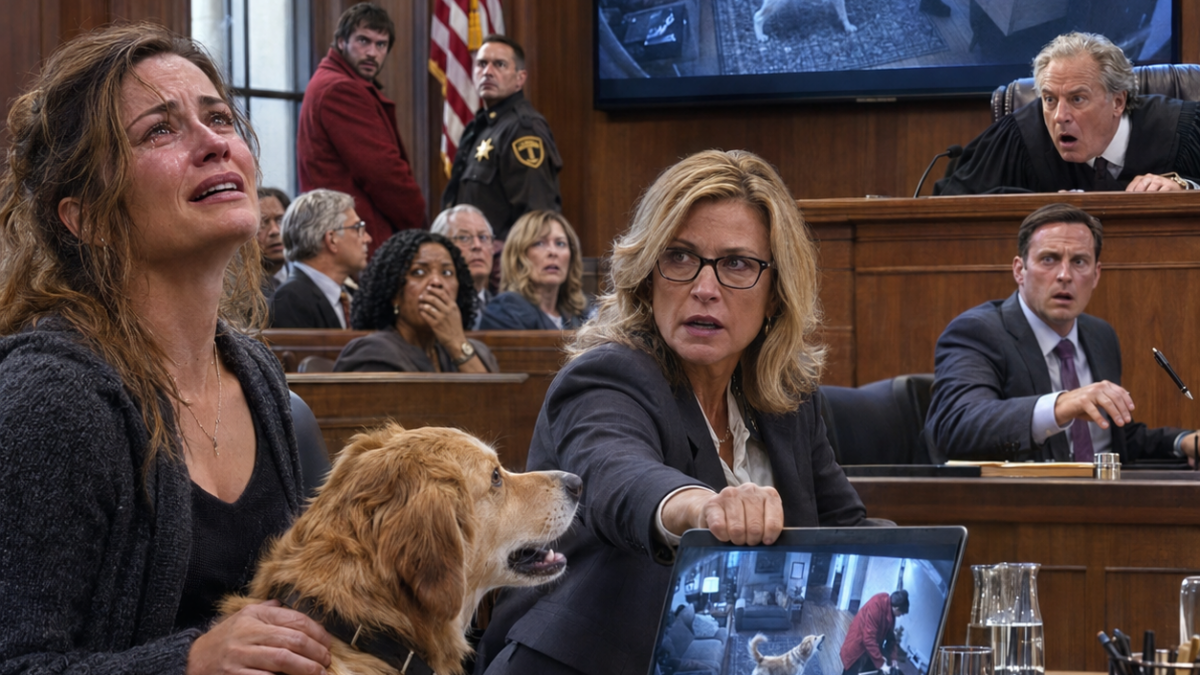
Jonathan returned carrying Sara’s laptop.
2:11.
Living-room camera.
Jonathan placed the laptop on the dining table.
Connected a small device.
Worked.
2:13.
Milo entered.
Stopped.
Began barking.
Jonathan whispered:
“Shut up.”
Sara covered her mouth.
The clip continued.
Jonathan looked toward the hallway leading to Sara’s bedroom.
Then said:
“She’s asleep.”
His phone was on speaker.
Another voice answered faintly.
The audio was imperfect.
But Jonathan’s next words were clear.
“I’m building it under her profile now.”
Sara began crying.
Daniel did not stop the recording.
Jonathan typed.
Milo barked again.
Jonathan kicked—not the dog, but the chair beside him.
“Get out.”
Milo backed away.
Then Jonathan said six words.
Six words that destroyed the prosecution’s theory.
“She’ll take the fall if needed.”
Daniel paused the video.
Nobody in the room moved.
Sara whispered:
“Oh my God.”
The digital examiner continued.
The timestamp of the camera recording aligned within seconds of the creation time of Northstar Internal Risk Structure — A. Morrison.
The same document prosecutors said Sara created.
At 2:18, Jonathan carried the laptop back toward Sara’s office.
2:20.
He emerged.
At 2:23, Milo sat outside Sara’s bedroom door.
Never entering.
Watching Jonathan leave.
Daniel requested an emergency hearing.
The next morning, Sara stood.
Not because she planned some theatrical declaration.
Because Daniel whispered:
“If the judge asks whether we have newly discovered evidence, I want you ready to confirm how the system was installed.”
Judge Hayes entered.
The courtroom rose.
Daniel explained the discovery.
Prosecutors objected to immediate admission until authentication could be completed.
Correctly.
The judge ordered expedited forensic examination and paused proceedings.
Jonathan’s attorneys immediately challenged the footage.
Clock drift.
Editing.
Ownership.
Chain of custody.
Device integrity.
For three days, experts examined it.
The result was stronger than Daniel dared hope.
The files were original recordings.
No evidence of editing.
The storage timestamps aligned with router logs and other independent time references.
Then investigators compared Jonathan’s phone-location history.
He was at Sara’s apartment.
His earlier statement had placed both of them there.
But now the video showed Sara was not working beside him.
Jonathan was using her computer alone.
The prosecution reopened its own review.
And once investigators approached the case without assuming Sara had created the files, other cracks appeared.
The emails allegedly sent by Sara had authentication irregularities.
Some had been generated through an account recovery session initiated from a device associated with Jonathan.
A witness who claimed Sara attended a fraud-planning meeting admitted under renewed questioning that he had seen her name on an attendance sheet but could not actually remember her being physically present.
The sheet itself had been produced by Jonathan’s office.
Then came the unsigned contract.
The one Milo had interrupted.
For months, prosecutors dismissed it as evidence that Sara merely avoided putting her name on one set of documents.
But the independent attorney Sara consulted the following morning still had the original email and attachment.
Jonathan’s later “signed” version contained changes made after Sara sent the document for review.
Her supposed signature was not authentic.
And the version she possessed contained no signature at all.
Her attorney had written back:
Do not sign this document under any circumstances.
Sara had replied:
I won’t.
Timestamped before Jonathan’s arrest.
Before anyone knew there would be a criminal case.
That mattered.
A great deal.
Daniel returned to court looking like a different man.
Still tired.
But no longer lost.
Judge Hayes asked:
“Mr. Cho, what precisely is the defense position regarding the animal?”
A few people smiled.
Daniel did too.
“Your Honor, the defense is not asking the court to accept a dog’s opinion about anyone’s guilt.”
Sara almost laughed.
Good.
“We are saying Ms. Morrison installed surveillance equipment because of documented behavioral concerns involving the dog.”
Daniel pointed toward the evidence monitor.
“That equipment captured the defendant Jonathan Vale using Ms. Morrison’s computer without her knowledge at the precise time a key incriminating file was created.”
Judge Hayes nodded.
“That is evidence.”
“Yes, Your Honor.”
The prosecution requested time.
Granted.
Then something happened Sara never expected.
The prosecutor, Assistant U.S. Attorney Laura Bennett, asked to meet Daniel.
Not secretly.
Formally.
She had spent months arguing Sara was guilty.
Now she sat across from Sara and said:
“We have an obligation to follow evidence wherever it leads.”
Sara stared at her.
“You thought I was lying.”
“Yes.”
The honesty shocked her.
“Do you still?”
“No.”
That was not an apology.
Not yet.
It was something perhaps more important inside a justice system.
A correction.
The government moved to dismiss the charges against Sara with prejudice after its review concluded the evidence no longer supported prosecution and substantial evidence instead supported that she had been framed.
Judge Hayes did not acquit Sara because Milo looked loyal.
He did something more meaningful.
He reviewed authenticated evidence.
He granted the dismissal.
Then he addressed Sara.
“Ms. Morrison.”
She stood.
“You have endured a prosecution based in significant part on digital materials that now appear to have been manipulated to implicate you.”
Sara’s eyes filled.
“The court does not erase what this process has cost you.”
Judge Hayes looked toward Daniel.
“But the integrity of this system depends not on never making an error.”
Then toward the prosecutor.
“It depends on correcting one when reliable evidence exposes it.”
Sara nodded.
“Thank you, Your Honor.”
The judge paused.
“I also understand there is a dog somewhere in this building who deserves a walk.”
The courtroom laughed.
Sara cried.
Outside the courthouse, Milo waited with Maribel.
The doors opened.
Sara stepped into sunlight.
For several seconds, Milo simply stared.
Then he ran.
Sara dropped to her knees.
He crashed against her chest.
She wrapped both arms around him.
“I know.”
His tail hit the pavement.
“I know.”
Maribel cried.
Daniel pretended he was not.
Reporters shouted questions.
“Sara!”
“Did your dog really solve the case?”
“Do you blame prosecutors?”
“What happens to Jonathan?”
Sara stood.
One hand on Milo’s collar.
She answered only one question.
“Did your dog prove you were innocent?”
Sara looked down at him.
“No.”
The reporters quieted.
“He reminded me where to look.”
Then she walked away.
Jonathan’s situation changed rapidly.
The newly recovered recordings became part of a broader investigation.
Digital forensics linked him to altered materials used against Sara.
Other victims came forward.
Several had been pressured into signing documents similar to the ones Sara refused.
One elderly investor said Jonathan assured him Sara Morrison had personally approved every transaction.
She had never met him.
Another business owner produced messages in which Jonathan described Sara as “our compliance shield.”
Not partner.
Shield.
That word mattered.
The fraud case against Jonathan expanded.
So did allegations related to fabricated evidence and obstruction.
Unlike the fantasy version newspapers preferred, the process took months.
No judge slammed a gavel and sentenced Jonathan immediately after Sara walked free.
Evidence was authenticated.
Charges amended.
Witnesses interviewed.
Defense motions filed.
Jonathan eventually faced trial on the conduct prosecutors could prove.
Sara testified.
This time from the witness stand as a victim and witness.
Jonathan sat at the defense table.
He looked at her once.
Then away.
The prosecutor asked:
“Why didn’t you sign the Northstar agreement?”
Sara almost smiled.
“My dog interrupted me.”
Jonathan’s attorney stood.
“Objection to anthropomorphizing the animal.”
The judge looked toward Sara.
“Ms. Morrison, describe only what happened.”
“Yes, Your Honor.”
She did.
“I picked up the pen.”
“Milo walked between me and the table.”
“He began whining.”
“I stopped.”
“Why?”
“Because his behavior was unusual enough to make me uncomfortable.”
“What did you do next?”
“I sent the documents to independent counsel.”
“And counsel advised?”
“Not to sign.”
No magic.
No supernatural claim.
Just a moment of hesitation leading to a verifiable decision.
The prosecutor then presented the pet-camera footage.
Jonathan using her laptop.
Jonathan’s voice.
She’ll take the fall if needed.
Sara watched the jury.
Nobody looked at Milo.
They looked at Jonathan.
That was as it should be.
He was convicted on multiple counts related to the fraud and evidence manipulation supported by the record.
Not because a dog hated him.
Because evidence did.
When the verdict was read, Sara felt no joy.
Only release.
Jonathan had once told her:
“You notice things everybody else skips.”
He had been right.
He simply never imagined Milo would make her notice him.
Sara’s name was legally cleared.
Restoring her life was harder.
Search engines remembered headlines longer than people remembered corrections.
Some former clients apologized.
Some returned.
Others did not.
One company wrote:
We regret acting before the complete facts were known.
Sara stared at the message.
Then deleted it.
She did not want regret from institutions that had abandoned her.
She wanted work.
So she started again.
Just as she had after the divorce.
One client.
Then two.
Then three.
Daniel Cho left the public defender’s office two years later for a nonprofit specializing in wrongful accusations involving digital evidence.
He remained Sara’s friend.
Whenever she called him brilliant, he shook his head.
“I almost missed the cameras.”
“So did I.”
“Milo didn’t.”
“No.”
Daniel looked at the dog.
“I hate that he gets all the credit.”
Milo yawned.
Sara laughed.
Dr. Elise Warren, the behavior specialist, became part of the public conversation after reporters found her original notes.
She repeatedly corrected journalists.
“No, dogs cannot testify to moral character.”
“No, fear behavior does not prove a person is dangerous.”
“No, you should not accuse someone of wrongdoing because a dog dislikes them.”
But then she always added:
“Behavior is information.”
A dog reacting unusually can tell you the dog is uncomfortable.
The responsible response is to investigate the trigger, not invent a supernatural explanation.
Sara appreciated that.
Milo was extraordinary to her.
He did not need magical powers to be extraordinary.
His gift was simpler.
He paid attention.
Years earlier, when Sara barely cared whether she got out of bed, Milo needed breakfast.
That saved her once.
Then, when she nearly signed away her future, Milo’s distress made her stop long enough to ask another question.
That saved her twice.
The camera existed because of him.
The footage existed because Sara had listened to professional advice about him.
Truth did not live inside Milo’s eyes.
The path toward it began there.
Sara eventually founded a small nonprofit.
Not one claiming animals could testify in court.
She called it Second Look Project.
Its mission was practical.
Help people facing financially devastating accusations obtain independent digital-forensic review when electronic evidence was central to the case.
The idea came from her own experience.
Digital evidence looks objective.
Sometimes it is extraordinarily powerful.
But a file created under your username does not automatically prove your fingers created it.
An email bearing your name may still need authentication.
Metadata needs context.
Devices can be accessed by other people.
Accounts can be compromised.
Sara wanted defendants with limited money to have access to experts capable of asking those questions.
The nonprofit also partnered with animal shelters.
Not because dogs solved crimes.
Because Sara never forgot the shelter where she had found Milo during the worst year of her life.
At fundraising events, she told the story carefully.
“Milo did not tell me Jonathan was a criminal.”
“He was afraid.”
“I paid attention.”
“That led to cameras.”
“The cameras recorded evidence.”
Those distinctions mattered.
People preferred the magical version.
Sara preferred the true one.
The true one respected both the law and the dog.
Milo became locally famous anyway.
People recognized him.
“Is that the courtroom dog?”
Sara hated the phrase.
Milo loved attention.
He accepted photographs.
Treats.
Children.
An absurd number of bandanas.
Someone mailed him a tiny necktie.
Daniel insisted he wear it to the nonprofit’s first anniversary dinner.
Sara refused.
Daniel brought it anyway.
Milo wore it.
Photographs went everywhere.
Sara accused Daniel of exploiting him for publicity.
Daniel said:
“He has an agent now.”
Sara laughed harder than she had in years.
Something else began to heal.
Her relationship with herself.
During the prosecution, Sara had become convinced she was foolish for trusting Jonathan.
She replayed every conversation.
Every compliment.
Every dinner.
Every time Milo hid.
Why had she not known?
Therapy eventually helped her separate warning signs from hindsight.
Jonathan was skilled at appearing trustworthy.
That was part of how fraud worked.
He did not introduce himself as a criminal.
He paid invoices.
Remembered birthdays.
Helped carry groceries.
Spoke gently.
People who manipulate others often understand kindness well enough to imitate it.
Sara’s mistake was not believing another person could be good.
Her strength was responding once enough evidence told her something was wrong.
The pen went down.
That mattered.
One afternoon, years later, Sara visited the original shelter.
Milo was older.
Gray around his muzzle.
Slower on stairs.
The staff recognized him before they recognized Sara.
A young volunteer crouched.
“You came from here?”
Milo sniffed her shoes.
The volunteer looked at Sara.
“Was he really returned twice?”
“Yes.”
“Why?”
“First family said he was too anxious.”
“And the second?”
“Too clingy.”
The volunteer looked offended.
“He’s perfect.”
Sara smiled.
“For me.”
They walked to the kennel aisle.
The final enclosure was occupied by a nervous black dog hiding near the back.
Sara stopped.
Memory hit.
Rain.
Loneliness.
Milo pressing his forehead against the gate.
The volunteer said:
“She hasn’t had much interest.”
Sara crouched.
The dog watched.
Milo lay beside Sara.
Did not approach.
Did not force anything.
Just waited.
Eventually, the black dog stood.
Took three cautious steps.
Sara whispered:
“There you go.”
She did not adopt her.
Milo deserved his old age without a young dog climbing over him.
But Sara funded the adoption fee.
Three weeks later, the shelter sent a photograph.
The black dog asleep beside a retired teacher.
Sara printed it.
Put it on her refrigerator.
Milo sat below.
“You did that.”
His tail moved once.
At twelve, Milo began having health problems.
Arthritis first.
Then kidney disease.
Sara reorganized her entire apartment around him.
Rugs across slippery floors.
A ramp beside the couch.
Raised water bowl.
Medication schedule.
Daniel visited and stared.
“You know he is going to demand a stair lift next.”
“He deserves one.”
“He has manipulated you for a decade.”
“Correct.”
Milo’s world became smaller.
No long park walks.
No events.
No nonprofit dinners.
He slept more.
But every evening, when Sara sat on the couch, he found enough strength to climb the ramp and rest his head on her leg.
Same position.
Same night as the first.
Sara sometimes ran her fingers over the white stripe between his eyes and thought about everything that happened in between.
The shelter.
Jonathan.
The pen.
The cameras.
Court.
Freedom.
Second Look.
Thousands of letters from strangers.
She had once thought Milo saved her because he possessed some mysterious insight into good and evil.
Age made her think differently.
Milo saved her because relationships change what we notice.
When Sara stopped valuing her own life, his dependence forced her to notice that her life mattered to another creature.
When Jonathan’s documents felt almost acceptable, Milo’s behavior forced her to notice her own unease.
When the trial convinced her everything was lost, seeing Milo again forced her to remember the cameras.
None of that required magic.
Love was enough.
One winter morning, Milo refused breakfast.
Sara knew.
She called the veterinarian.
Daniel came.
So did Maribel.
Sara sat on the floor beside Milo.
His head rested in her lap.
“I’m here.”
His breathing was shallow.
“I’m not going anywhere.”
She had said those words to him thousands of times.
This time, she knew they meant goodbye.
The veterinarian explained options.
Sara made the choice she had always feared.
Peace.
No prolonged suffering.
She kissed Milo’s forehead.
“Thank you.”
His eyes opened slightly.
The same brown eyes from the shelter.
Sara cried.
“You saved me twice.”
Daniel knelt nearby.
Sara shook her head.
“No.”
She smiled through tears.
“More than twice.”
Milo’s tail moved once against the blanket.
Then he became still.
Sara thought grief would destroy her.
It did not.
It hurt.
Wildly.
For months.
But grief was different now.
Five years earlier, loneliness had convinced Sara nothing needed her.
Milo had changed that.
Now, even after he was gone, the life they built remained.
People at Second Look needed her.
Clients.
Friends.
Daniel.
Maribel.
Shelter volunteers.
People she had never met who wrote:
Your story made me ask for another forensic review.
Or:
I adopted a senior dog because of Milo.
Or simply:
I believed I was alone. Your story helped.
Milo’s absence did not erase his work.
That surprised Sara.
On the first anniversary of his death, Second Look Project opened a small fund with the county shelter.
It paid adoption and veterinary expenses for older animals that were repeatedly overlooked.
They named it:
Milo’s Second Chance Fund.
Daniel wanted a photograph of Milo in the tiny necktie.
Sara overruled him.
They used the original shelter photograph.
Milo sitting quietly in the corner.
One folded ear.
Watching.
Under it:
Sometimes being noticed changes everything.
Sara liked that.
Years later, law students occasionally invited her to speak about the case.
The question was always the same.
“Did you really tell the judge your dog would prove your innocence?”
Sara smiled.
“Something close to that.”
“Did you actually believe it?”
She thought.
“Yes.”
The students laughed softly.
Then she clarified.
“I did not believe the judge should look into Milo’s eyes and declare me innocent.”
More laughter.
“I believed Milo had been trying to tell me something about his fear for years.”
She walked toward the screen.
A still image appeared.
Jonathan at the dining table.
Sara’s laptop open.
Milo several feet away.
“That fear led me to install the system that recorded this.”
Then another slide.
Timestamp.
Document creation.
Device activity.
Email-authentication logs.
“You cannot convict someone because a dog dislikes them.”
She paused.
“You also should not convict someone simply because a computer file carries their name.”
The room became quiet.
“Evidence must be examined.”
“Context matters.”
“Authentication matters.”
“And when reliable evidence changes the story, justice requires enough humility to change with it.”
Afterward, students often asked about Jonathan.
Was Sara glad he went to prison?
Did she hate him?
At first, she had.
Years later, the answer became more complicated.
“I hate what he did.”
That was enough.
Hating him as a daily practice gave him too much space.
She preferred using that space for Milo.
For work.
For life.
Jonathan once sent a letter through an attorney.
Sara read it.
He apologized.
Not perfectly.
Some excuses remained.
Fear.
Greed.
Pressure.
Then one sentence felt honest.
I chose you because you were competent enough to make the structure credible and isolated enough that I believed no one would fight very hard for you.
Sara had to stop reading.
That was the deepest cruelty.
Not that Jonathan thought she was weak.
He thought she was alone.
Five years earlier, he might have been right.
But he forgot Milo.
Then Maribel.
Then Daniel.
Then Elise.
Then investigators willing to revisit assumptions.
Then the prosecutor willing to dismiss a case when evidence changed.
Then Sara herself.
She had not been alone.
She had simply needed time to see the people standing beside her.
Sara never answered Jonathan.
She did not need him to know that he had been wrong.
Her life was the answer.
At fifty-two, Sara moved into a small house with a fenced backyard.
Not because she needed more space.
Because she was finally ready.
At the county shelter, a ten-year-old shepherd mix sat beneath a laminated card:
ROSE — SENIOR — OWNER DECEASED — NEEDS QUIET HOME
Sara crouched.
Rose looked away.
Sara waited.
Ten minutes.
Then Rose approached.
Placed her chin on Sara’s knee.
Sara laughed and cried simultaneously.
The shelter volunteer asked:
“Would you like some time to think?”
Sara stroked Rose’s head.
“No.”
At home that night, Rose walked through every room.
Then found the couch.
Sara sat.
Rose climbed carefully beside her.
Head on lap.
Sara stared.
“You have got to be kidding me.”
Rose sighed.
Sara looked toward a framed photograph of Milo on the bookshelf.
“Did you arrange this?”
Silence.
Good.
Dogs should not answer.
That was part of what made their companionship so honest.
No arguments.
No promises about forever.
No elaborate explanations.
Presence.
Years earlier, after Sara was cleared, a reporter had quoted her saying:
“Sometimes truth does not need words.”
For a long time, she regretted the line.
It encouraged the magical version of her story.
Eventually, she understood what she had meant.
Truth still required evidence in court.
Documents.
Metadata.
Authentication.
Witnesses.
Facts.
But another kind of truth existed outside courtrooms.
The truth that someone can love you without asking what you earn.
The truth that loyalty can exist without contracts.
The truth that a creature abandoned twice can still trust a third person.
The truth that someone can sit beside you all night without solving anything and make survival feel possible.
Milo had never proved Sara innocent by looking at a judge.
He did something harder.
He kept her alive long enough to prove it herself.
He interrupted a signature.
He inspired the cameras.
He helped her remember them.
He stayed when everyone else treated accusation like conviction.
And in the years afterward, the story of what he did became a reason for other people to stop, look again, ask another question, request another expert, adopt another unwanted animal, or simply survive another night.
Sara sometimes wondered whether Milo understood any of it.
Probably not.
He understood meals.
Walks.
Rain.
Sara’s sadness.
The sound of the treat drawer.
Sunlight on the living-room rug.
That was enough.
On quiet evenings, Rose slept beside her while Sara worked.
Sometimes Sara’s hand automatically reached down expecting a folded ear.
Instead she found Rose’s soft gray fur.
Different dog.
Different life.
Still good.
One night, as rain tapped against the windows almost exactly the way it had on the first night Milo came home, Sara closed her laptop.
Rose lifted her head.
Sara smiled.
“I’m okay.”
Rose’s tail moved.
“I really am.”
She turned off the lamp.
On the bookshelf stood Milo’s shelter photograph beside the court order dismissing Sara’s charges.
She had framed them together years earlier.
Not because a judge had believed a dog.
Because the two pieces represented the same lesson.
The photograph showed the moment somebody unwanted was finally given a chance.
The court order showed the moment somebody accused was finally given another look.
Second chances had shaped both their lives.
Sara walked toward the bedroom.
Rose followed.
Before turning out the final light, Sara looked once more at Milo’s photograph.
“Thank you.”
No answer.
There never had been.
And somehow, after all those years, she finally understood why that silence had always been enough.








