PART2:I Went to a Shelter to Adopt a Dog—Then My Paralyzed Golden Retriever Looked Up at Me After Three Years Apart
PART2
At first, I told myself I would visit.
Then I told myself I would call.
Then I told myself David needed space.
Then months passed.
The truth was uglier.
I was afraid.
Afraid of seeing Rex and having to leave him again.
Afraid David might sound happy without me.
Afraid he might sound miserable because of me.
Afraid that if I reached backward, I would never learn how to move forward.
So silence became easier.
Then silence became habit.
One year passed.
Then two.
Then three.
I moved twice.
Changed jobs.
Learned how to eat dinner alone without turning on the television just for noise.
Learned which grocery stores stayed open late.
Learned how to assemble furniture badly.
Learned how to sleep in the middle of the bed.
People called that healing.
Some of it was.
Some of it was simply getting used to absence.
But the quiet remained.
Especially mornings.
I used to wake to Rex’s nails clicking across the hallway.
His nose pushing against the bedroom door.
His ridiculous sigh if I took too long.
After the divorce, I sometimes woke expecting that sound.
Three years later, apparently part of me still did.
One Saturday morning, I made coffee and stood in my kitchen listening to nothing.
Not peaceful nothing.
Empty nothing.
I called my friend Emily.
“I think I want a dog.”
There was a pause.
Then:
“Finally.”
I laughed.
“Don’t sound so relieved.”
“You’ve been emotionally dating your houseplants for two years.”
“That is unfair.”
“You named the fern.”
“His name is Franklin.”
“Go adopt a dog.”
That afternoon I drove to Sunny Paws Rescue.
I had no plan.
No preferred breed.
No age requirement.
I told the woman at the desk:
“I’ll know.”
She smiled.
“Most people say that.”
“Do they?”
“Sometimes they’re right.”
I walked down the kennel aisle.
Dogs barked.
Paws hit metal gates.
A little terrier spun in circles.
An elderly black Lab rested his gray chin on his blanket and watched me pass.
I stopped at several kennels.
Touched noses through bars.
Read cards.
LUCY — 3 YEARS — LOVES CHILDREN.
BRUNO — 6 YEARS — NEEDS QUIET HOME.
MILO — 10 MONTHS — VERY ACTIVE.
Then I reached the final kennel.
It was darker there.
Quieter.
At first, I thought it was empty.
Then something moved.
Two small wheels turned.
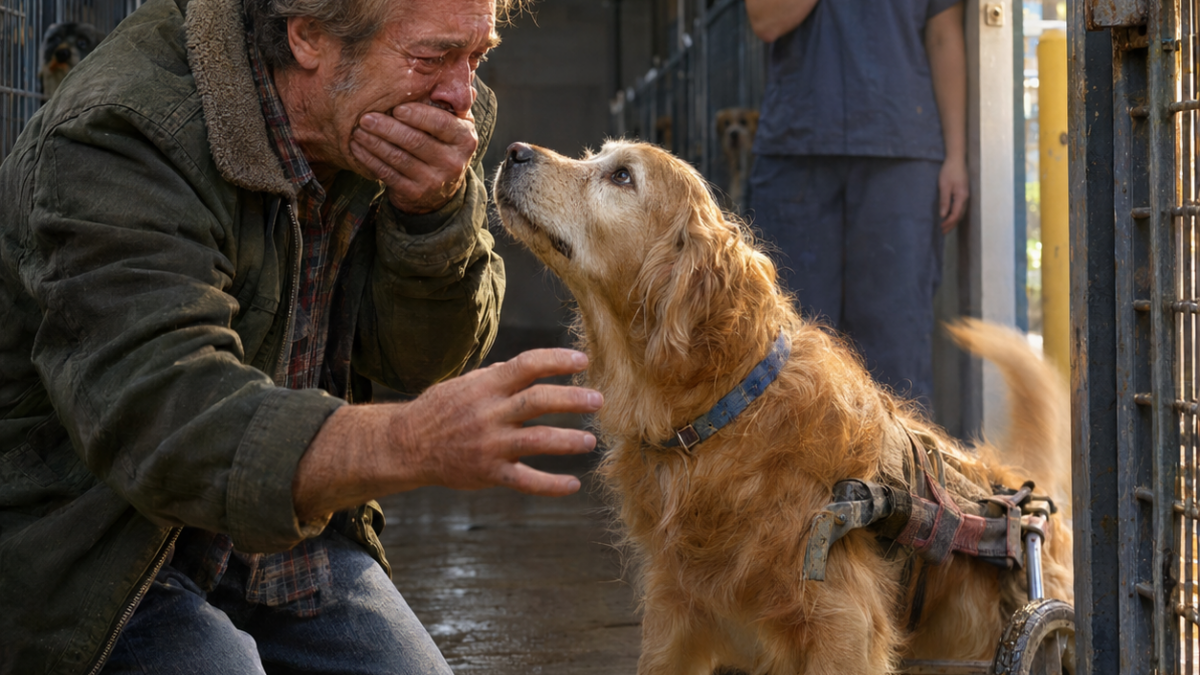
A Golden Retriever rolled slowly into the light.
My heart stopped.
His coat was thinner than I remembered.
Gray had begun appearing around his muzzle.
A scar disappeared beneath the fur near his shoulder.
His back legs hung motionless inside a support sling.
The little wheelchair squeaked softly as he moved.
I stared.
He stared back.
Three years vanished.
“Rex?”
His ears lifted.
His head rose.
Then his tail hit the floor.
Thump.
Thump.
Thump.
My hand flew to my mouth.
“No.”
He moved toward me.
Faster.
The wheels rattled.
His front paws pulled.
His useless back legs followed behind.
“Rex.”
My knees hit the concrete.
He reached the gate.
Pressed his nose through the bars.
I grabbed his face with both hands.
He licked me.
Once.
Twice.
Then frantically.
My cheeks.
My chin.
My fingers.
I started sobbing.
Not crying.
Sobbing.
The kind of crying that hurts your ribs.
“Oh, baby.”
Rex pushed harder against the bars.
“I’m sorry.”
His tail kept beating.
“I’m so sorry.”
He did not know what I was apologizing for.
Or maybe dogs understand more than we deserve.
A young employee came toward me.
“Ma’am?”
I couldn’t look at him.
“Are you okay?”
“This is my dog.”
He stopped.
“What?”
“This is Rex.”
He crouched.
“You know him?”
“I raised him.”
My voice cracked.
“My husband and I.”
Then I corrected myself.
“My ex-husband.”
The employee’s name tag read MICHAEL.
He looked at Rex.
Then me.
“His name was Rex on the paperwork.”
I gripped the bars.
“What happened to his legs?”
Michael’s face changed.
“What happened?”
He hesitated.
“Maybe we should sit down.”
“No.”
I grabbed his sleeve.
“Please.”
He glanced toward Rex.
“He was in an accident.”
“With David?”
Michael said nothing.
My stomach dropped.
“With David?”
“Yes.”
“Is David alive?”
“Yes.”
The air came back into my lungs.
Barely.
“Where is he?”
“A rehabilitation hospital.”
“What happened?”
Michael looked around.
“Come with me.”
They let Rex out.
He rolled beside me down the hallway.
Every few feet he looked up.
Checking.
Still there?
I kept touching his head.
“I’m here.”
We entered a small consultation room.
Michael brought tea.
I never drank it.
Rex rolled directly to my chair.
He rested his head on my knee.
I ran my fingers over his ears.
Same ears.
Older.
Still Rex.
Michael sat opposite me.
“About seven months ago, David was driving home from work.”
I closed my eyes.
“Rex was with him.”
“Yes.”
“He always went with David.”
“There was a serious collision.”
My fingers stopped moving.
“Rex was thrown from the vehicle.”
I looked at him.
“Through the window?”
Michael nodded.
I bent over Rex.
“Oh God.”
He lifted his head and licked my wrist.
“David was unconscious when emergency crews arrived,” Michael continued. “Rex was found beside the road.”
“Was he conscious?”
“I don’t know.”
“Was he alone?”
“I don’t know.”
That hurt.
Of course Michael didn’t know.
But my mind created the image anyway.
Rex lying on cold asphalt.
Unable to move.
Looking for David.
My David.
His David.
“He had a spinal injury.”
I stared at the wheels.
“Can they fix it?”
Michael shook his head slowly.
“No.”
I looked down.
Rex’s back paws rested uselessly against the sling.
I touched one.
He did not react.
Nothing.
I began crying again.
“He can’t feel that?”
“Not normally.”
“Does it hurt?”
“Not the paralysis itself.”
I nodded because I needed something factual to hold onto.
“What about David?”
“He had multiple injuries. He was hospitalized for a long time and then transferred to rehab.”
“How long was he unconscious?”
“I don’t know.”
“Did he ask about Rex?”
Michael’s face softened.
“Apparently the first thing he asked once he was stable enough was whether Rex survived.”
I turned away.
Of course he did.
Of course David did.
“What happened after that?”
“David couldn’t care for him.”
“Because he was still hospitalized.”
“Yes.”
“Who had Rex?”
“David’s sister Sarah.”
I remembered Sarah immediately.
David’s older sister.
Three children.
A job.
A house several hours away.
“She tried?”
“For months.”
Michael nodded.
“But Rex’s care is complicated.”
I looked down.
The cart.
The skin checks.
The lifting.
The bladder management.
The exercises.
The appointments.
Sarah had done what she could.
Eventually, she brought Rex to Sunny Paws.
“Did David know?”
“Yes.”
I covered my face.
“So he lost the dog too.”
Michael didn’t answer.
He didn’t need to.
I whispered:
“Three years.”
Michael waited.
“Three years and I never called.”
He spoke quietly.
“You were divorced.”
“I could still have asked.”
No answer.
“I could have sent one message.”
I looked at Rex.
“Just one.”
How’s Rex?
Three words.
Three years.
I could have typed them in ten seconds.
I didn’t.
Because I thought silence was maturity.
Because I thought people who leave should stay gone.
Because I was scared.
Rex had paid no price for our divorce.
Yet somehow he had disappeared from my life too.
Michael said:
“You didn’t know.”
“I chose not to know.”
That was different.
I sat there until the tea went cold.
When I stood to leave, Rex followed.
The wheels squeaked.
I stopped.
He stopped.
I looked at Michael.
“Does he think he’s coming with me?”
Michael’s eyes lowered.
That question broke me worse than anything else.
Rex stood by the door.
Waiting.
I crouched.
“Not yet.”
His tail slowed.
“I’m coming back.”
I touched his head.
“I swear.”
He watched me leave.
I cried the entire drive to the hospital.
David’s rehabilitation center was forty minutes away.
It took me three years and forty minutes to finally go looking for him.
The next morning, I stood outside his room.
My hand hovered over the door.
I almost walked away.
Then I remembered Rex watching me leave the shelter.
I knocked.
“Come in.”
David sat by the window.
For one second, my brain refused to connect the man in that chair with my former husband.
He was thinner.
Much thinner.
His shoulders had narrowed.
A scar crossed the skin near his right temple.
Crutches leaned beside him.
His hair had more gray.
But his eyes were the same.
He stared at me.
“Linda?”
My name in his voice nearly destroyed me.
“Hi.”
He blinked.
Then smiled.
That old David smile.
Warm.
A little shy.
A little sad.
“You’re here.”
Not:
Why are you here?
Not:
Where were you?
Just:
You’re here.
I sat down.
“I found Rex.”
The smile disappeared.
His eyes filled instantly.
“Where?”
“Sunny Paws.”
He looked down.
“You saw him?”
“Yes.”
“How does he look?”
The question came too quickly.
Too desperately.
“You haven’t seen him?”
David shook his head.
“I’m not cleared for the trip.”
He swallowed.
“Sarah sends pictures.”
My throat tightened.
“He recognized me.”
David laughed once.
Then covered his mouth.
“Of course he did.”
“I thought maybe he wouldn’t.”
“That dog remembered a delivery driver who gave him half a sandwich once.”
I smiled through tears.
Then we both went quiet.
I said:
“I didn’t know.”
“I know.”
“I didn’t know about the accident.”
“I know.”
“I didn’t know you were here.”
“I know.”
Each I know hurt more than an accusation.
“Why didn’t anyone tell me?”
David looked at me.
“Who was supposed to?”
That stopped me.
“I changed phones after the accident. Lost contacts. Sarah didn’t have your number.”
“You had my email.”
David looked toward the window.
“Yes.”
“So why?”
He was silent.
Then:
“I wrote you.”
I stared.
“What?”
“Several times.”
“You never sent anything.”
“No.”
“Why?”
He rubbed his hands together.
“I didn’t know what I was asking for.”
He looked at me.
“If I said I almost died, would it sound like I wanted you back?”
I said nothing.
“If I told you Rex was hurt, would that be fair?”
“David—”
“You had moved on.”
“I didn’t know if you were married.”
“I’m not.”
“I didn’t know if you had children.”
“I don’t.”
“I knew nothing.”
His voice cracked.
“Because we decided knowing nothing was easier.”
I began crying.
David’s eyes filled too.
“When I woke up,” he said, “I asked about Rex.”
I nodded.
“Then I asked about you.”
I looked at him.
“My sister thought I was confused.”
He gave a broken laugh.
“I wasn’t.”
“Why me?”
“Because when you almost die, you don’t remember who signed which divorce paper.”
That line broke whatever composure I had left.
I covered my face.
“I’m sorry.”
“For what?”
“For disappearing.”
He nodded slowly.
“I’m sorry too.”
We sat there as two people who once promised forever and then managed three years of almost complete silence.
Not enemies.
Worse.
Strangers by choice.
Eventually I told him:
“I’m taking Rex.”
David looked at me.
“What?”
“I’m adopting him.”
His face changed.
“Linda.”
“I’ve already decided.”
“You don’t understand his care.”
“Then teach me.”
“I can barely do anything for myself right now.”
“That’s why.”
“He needs help getting into the cart.”
“I’ll help.”
“He has accidents.”
“I’ll clean them.”
“His legs need stretching.”
“I’ll learn.”
“He needs skin checks.”
“I’ll learn.”
“He may never walk again.”
“I know.”
David’s eyes closed.
When they opened, tears were running down his face.
“He waited for me.”
“What?”
“At Sarah’s.”
His voice broke.
“Every time a car stopped outside, Rex dragged himself toward the door.”
I pressed a hand over my mouth.
“Sarah told me he would sit there.”
David looked down.
“I kept telling her I’d be home soon.”
His shoulders shook.
“I wasn’t.”
I moved toward him before thinking.
For the first time in three years, I put my arms around my former husband.
David collapsed against me.
Not romantically.
Not as husband and wife.
As two people grieving the same dog while he was still alive.
“He thought I left him,” David whispered.
“No.”
“He did.”
“No.”
“He doesn’t understand hospitals.”
Neither of us spoke.
Then I whispered:
“He didn’t understand our divorce either.”
David pulled back.
His face was wet.
“What?”
“I think maybe Rex has spent three years waiting for somebody to stop leaving.”
David started crying harder.
So did I.
That moment changed me.
I returned to Sunny Paws that afternoon.
Rex was sleeping.
When he heard my voice, his head lifted.
I crouched.
“I came back.”
Tail.
Thump.
Thump.
Thump.
“I told you I would.”
The adoption took a week.
Seven days felt endless.
I visited every one.
Rex began waiting near the kennel gate in the afternoon.
Michael told me:
“He knows your schedule.”
On adoption day, I signed the papers.
My hand shook.
Michael handed me the folder.
“Congratulations.”
I looked at Rex.
“No.”
Michael frowned.
“What?”
“I think this is more like an apology.”
He understood.
I brought Rex home Sunday morning.
I had built ramps.
Bought an orthopedic bed.
Moved furniture.
Covered slippery flooring.
Prepared washable pads.
Created a place by my bedroom.
When I opened the front door, Rex stopped.
His cart remained half outside.
I waited.
He looked into the house.
Then up at me.
I wondered how many unfamiliar doors he had crossed since the accident.
Hospital.
Sarah’s home.
Veterinary clinic.
Shelter.
Places that were temporary.
I sat on the floor.
“You don’t have to trust this yet.”
Rex watched me.
“But I’m not taking you back.”
His ears moved.
“This is home.”
He rolled inside.
The wheels rattled across the floor.
That sound became the heartbeat of my house.
The first nights were hard.
Rex panicked whenever I disappeared.
If I went upstairs, he whined.
If I closed the bathroom door, he scratched.
If I stepped outside to take out the trash, I returned to find him waiting at the entrance.
The first time I saw that, I sat down beside him and cried.
“Everybody keeps leaving you, don’t they?”
Rex put his head on my leg.
“I’m sorry.”
That became our routine.
Every night I lay beside his bed.
Sometimes for five minutes.
Sometimes an hour.
I whispered:
“I’m here.”
Rex would sigh.
“I’m here.”
His eyes would close.
“I’m here.”
Some nights I cried so quietly I thought he was asleep.
Then I would feel his nose press against my hand.
Two wounded things comforting each other.
I found a veterinary rehabilitation specialist.
She taught me how to stretch his legs.
Massage muscles.
Check his paws.
Protect his skin.
Strengthen his shoulders.
The first time I removed his cart and saw how thin his back legs had become, I had to turn away.
“Linda?”
“I’m okay.”
The therapist knew I wasn’t.
Rex looked up.
I wiped my face.
“Sorry.”
She crouched beside me.
“Don’t apologize.”
“I remember him running.”
“That memory isn’t gone.”
“He used to chase David around the yard.”
“I know.”
“And now…”
She touched Rex’s shoulder.
“Now we help him live this life.”
Not the old life.
This one.
That sentence saved me.
The first neighborhood walk was painfully slow.
Rex rolled a few feet.
Stopped.
Sniffed.
Rolled again.
Children stared.
One little boy asked:
“Is he broken?”
His mother looked mortified.
I almost cried.
Then I looked at Rex.
He was trying to chase a leaf.
“No.”
I smiled.
“He just moves differently.”
The boy nodded.
“Cool.”
Rex suddenly accelerated.
I stumbled after him.
The boy laughed.
So did I.
That may have been the first time I laughed without guilt since finding him.
Two months later, David came to visit.
He called that morning.
“I’m out.”
I sat down.
“Out of rehab?”
“Yesterday.”
“How are you walking?”
“Without crutches.”
I smiled.
“Good.”
“Badly.”
“Still counts.”
Pause.
“Can I see him?”
My throat closed.
“Yes.”
I told Rex:
“Dad’s coming.”
His ears rose.
I don’t know if he understood the word.
At two, someone knocked.
Then David called through the door:
“Linda?”
Rex froze.
I watched his face.
His ears lifted.
His entire body trembled.
Then he barked.
Once.
Twice.
Louder.
He tried to pull himself across the floor without the wheelchair.
“Wait!”
I grabbed the cart.
My hands fumbled with straps.
“Hold on.”
Rex whined.
The moment I secured him, he launched toward the door.
I opened it.
David stood there.
Thinner.
Still limping.
Hands shaking.
Rex stopped.
For one second, neither moved.
Then David whispered:
“Buddy.”
Rex made a sound I had never heard before.
Not quite a bark.
Not quite a cry.
Something in between.
He rolled forward so violently that one wheel clipped the doorframe.
David dropped to his knees.
“Rex.”
The dog crashed into him.
David wrapped both arms around him.
Rex licked his face.
His eyes.
His hands.
His neck.
David buried his face in Rex’s fur.
“I’m sorry.”
Rex’s tail hammered against the floor.
“I’m sorry I didn’t come.”
I stood behind them crying.
David kept repeating:
“I tried.”
Rex did not need the explanation.
Dogs are merciful that way.
He did not ask why David disappeared.
He did not punish him.
He simply celebrated his return.
David finally looked at me.
His face was soaked.
“He waited.”
“Yes.”
“He actually waited.”
“Yes.”
David kissed Rex’s forehead.
Then whispered:
“Thank you for bringing him home.”
I shook my head.
“You brought him home first.”
“What?”
“Three years ago.”
David looked at me.
“When I left.”
His eyes filled again.
“We both did what we could.”
That afternoon, the three of us sat in the living room.
For the first time since the divorce, it felt familiar without being painful.
David drank coffee.
I sat across from him.
Rex slept between us.
At one point David looked down.
“He’s yours now.”
I frowned.
“Don’t say that.”
“It’s true.”
“No.”
“The adoption paperwork—”
“I don’t care.”
“Linda.”
“He’s not furniture.”
David looked at me.
“He doesn’t belong to one of us.”
I touched Rex’s ear.
“He belongs with whoever shows up.”
David’s eyes lowered.
“That’s you.”
“Right now.”
He swallowed.
“What about me?”
“You show up too.”
He looked at me.
“Twice a week.”
“What?”
“At least.”
A smile appeared.
“Scheduled visitation?”
“Shared custody.”
David laughed.
It was the first time I had heard that laugh in years.
Rex opened one eye.
Then went back to sleep.
That became our new family.
Not a reunion.
Not remarriage.
Not the sentimental fantasy where divorce disappears because a dog brings two people together.
Our marriage remained over.
And it needed to.
But our cruelty toward ourselves ended.
David came Tuesdays and Saturdays.
Always with treats.
Far too many.
“Stop feeding him cheese.”
“He likes cheese.”
“He also likes eating tissues.”
“So?”
“That’s not an argument.”
Rex loved those days.
He learned the sound of David’s car.
Before the engine stopped, he would be moving toward the door.
Every time.
That part always hurt.
Because happiness and memory can occupy the same place.
David worked on his own recovery.
He gradually lost the limp.
Returned to work.
Started rebuilding.
I did too.
Rex changed visibly.
His shoulders grew stronger.
His coat became glossy.
His eyes brightened.
But the back legs never moved.
Some nights, I still touched them.
Not because I expected a miracle.
Because I remembered.
I remembered those legs running through the yard.
Launching into lakes.
Jumping onto beds despite being forbidden.
I grieved them.
You can love the life someone has and still grieve the life they lost.
Both are allowed.
At the one-year anniversary of finding Rex, Sunny Paws invited us to a fundraiser.
Michael displayed Rex’s intake photograph.
I had never seen it.
He was sitting in his first cart.
Coat dull.
Head lowered.
Eyes looking toward the kennel entrance.
I covered my mouth.
Michael said:
“He used to do that every afternoon.”
“Do what?”
“Watch the door.”
My heart sank.
“For David?”
“We didn’t know.”
He looked at me.
“Maybe for anybody familiar.”
I looked at the photograph.
Rex waiting.
Again.
Always waiting.
Michael continued:
“The day you walked in, he heard your voice before he saw you.”
I started crying.
“He knew?”
“He stood up on his front legs immediately.”
My knees weakened.
David was beside me.
He placed a hand on my shoulder.
Michael smiled sadly.
“He never moved that fast for anyone.”
I bent down and hugged Rex.
“I’m sorry you waited so long.”
His tail moved.
David crouched beside us.
“We’re here now.”
That sentence became the most important one.
We’re here now.
Not:
We should have been there.
Not:
We wish we could undo it.
Not:
We’re going to pretend nothing happened.
We’re here now.
Guilt looks backward.
Love has to eventually look forward.
Years passed.
Rex grew older.
His muzzle turned white.
He needed shorter walks.
More frequent rest.
His cart became lighter.
We replaced wheels twice.
David once arrived with expensive all-terrain tires.
I stared.
“You bought Rex off-road wheels.”
“He deserves quality.”
“He is eleven.”
“He has places to be.”
Rex wagged.
I sighed.
“You’re both ridiculous.”
We took him to the park.
He chased a squirrel.
Badly.
The squirrel barely reacted.
David laughed so hard he had to sit down.
I laughed too.
Rex looked offended.
Those were good days.
The ordinary ones.
I learned to value them more than dramatic moments.
Coffee.
Park.
Sun.
Rex sleeping.
David complaining about work.
The three of us existing without trying to define what we were.
Eventually David started dating Rachel.
When he told me, I felt a strange pain.
Not jealousy.
More like hearing the final click of a door that had already been closed for years.
He asked:
“You okay?”
I thought about it.
“Yes.”
And I was.
Rachel loved dogs.
That helped.
She owned two rescues.
The first time she came with David, she sat on the floor with Rex for twenty minutes.
No pity.
No baby voice.
Just scratching his chest.
Rex approved.
Later Rachel told me:
“David says you saved him.”
I looked at Rex.
“Which one?”
She smiled.
“Both.”
I shook my head.
“We saved each other badly and late.”
Rachel’s eyes softened.
“Still counts.”
She was right.
One winter, Rex developed an infection.
Nothing catastrophic.
But he was older.
His body did not recover as quickly.
He stopped eating.
That scared me more than anything.
Rex had never refused food in his life.
David came immediately.
We slept on the living-room floor beside him.
At 2:00 a.m., David whispered:
“Remember when he ate half the Thanksgiving turkey?”
I smiled through tears.
“You blamed me.”
“You left it too close.”
“It was on the counter.”
“He was ambitious.”
Rex opened his eyes weakly.
David touched his head.
“Come on, buddy.”
No response.
“Remember the turkey?”
Rex’s nose twitched.
David laughed and cried at the same time.
“He heard that.”
The next morning, Rex ate three bites.
I cried over three bites of chicken like someone had handed me the world.
He recovered.
Slowly.
But after that, I stopped pretending time was unlimited.
Every walk mattered.
Every Tuesday with David.
Every morning wheel-rattle.
Every ridiculous demand for breakfast.
One evening David asked:
“Do you regret leaving Rex with me?”
I looked at him.
For years, I would have said yes.
Now:
“No.”
He seemed surprised.
“You don’t?”
“No.”
“You missed three years.”
“I know.”
“He got hurt.”
“I know.”
“Then why?”
“Because you loved him.”
David looked down.
“You gave him good years.”
He nodded.
“And I would have been gone ten hours a day.”
Silence.
“We made the best decision with what we knew.”
David’s eyes filled.
“I needed you to say that.”
“So did I.”
There are wounds guilt keeps open because forgiveness feels like betrayal.
As though forgiving yourself means the loss did not matter.
It does.
I lost three years with Rex.
I lost three years of knowing whether David was okay.
That matters.
But punishment cannot return time.
Only presence can honor what remains.
When Rex was nearly twelve, he had a difficult week.
Age.
Urinary problems.
Arthritis in his front legs.
His strong legs.
The ones he depended on for everything.
That frightened me.
Our veterinarian said:
“We’re not at goodbye.”
I nodded.
“But?”
“But you should start thinking less about how long and more about how comfortable.”
I went home and cried in the car before going inside.
Rex waited behind the door.
Wheelchair on.
Tail moving.
I wiped my face.
“Don’t look at me like that.”
He wagged harder.
“You’re very inconsiderate.”
That evening, I lay beside him.
“You can stay as long as you want.”
I stroked his face.
“But you don’t have to stay for me.”
His eyes closed.
That was the hardest sentence I had ever spoken to him.
Because love changed again.
First, love meant leaving him with David.
Then love meant bringing him home.
Eventually love would mean allowing him to leave.
Not yet.
But one day.
David came the next morning.
We sat in the yard.
Rex slept between our chairs.
The sun was warm.
Birds moved through the trees.
Nothing happened.
I remember that afternoon more clearly than some major events in my life.
Maybe because I knew ordinary was becoming precious.
David looked at me.
“He gave us this.”
“What?”
“This.”
He gestured between us.
“You and me being able to sit here.”
I nodded.
“We did a terrible job staying friends.”
“Rex fixed it.”
“Eventually.”
David smiled.
“He’s stubborn.”
“Very.”
A year later, Sunny Paws asked me to speak to adopters of disabled dogs.
I hated public speaking.
I agreed anyway.
People expected inspiration.
I told them the truth.
Some days are exhausting.
Mobility care is work.
Medical bills hurt.
There is laundry.
There are accidents.
There are nights you worry.
There are things you grieve.
Then I showed them Rex at the park.
Head up.
Wheels turning.
Tail flying.
“Disability is not the sad ending,” I said.
“Abandonment is.”
The room became quiet.
I continued:
“Care is work. But being needed is not tragedy.”
Afterward, a woman approached.
She was considering adopting a dog with only three legs.
“I’m scared I won’t be enough.”
I looked at Rex.
“So was I.”
“What changed?”
“I stopped asking whether I could make his life perfect.”
She waited.
“I started asking whether I could stay.”
She adopted the dog.
Months later she sent me a photograph.
That is one of my favorites.
Rex lived longer than any of us expected.
Not forever.
No dog does.
But long enough to teach me almost everything I needed to know about forgiveness.
On his last Christmas, David came early.
Rachel brought a dog-safe cake.
Emily brought a ridiculous red blanket.
Rex wore a bow tie.
He hated it.
We took photographs.
One picture showed David and me sitting on the floor with Rex between us.
Later, I compared it to the old photograph from our marriage.
Same arrangement.
Different people.
Older.
Changed.
But Rex still in the middle.
That night, after everyone left, I removed his cart.
Placed him on his bed beside mine.
He was tired.
I lay on the floor.
He rested his head in my hand.
“I love you.”
His eyes opened.
I whispered:
“Even the years I wasn’t there.”
Tears ran down my face.
“I loved you then too.”
His tail moved once.
I smiled.
“And I’m sorry.”
He sighed.
Maybe forgiveness.
Maybe sleep.
With dogs, sometimes those look the same.
A few months later, Rex’s body began telling us it was tired.
Not dramatic.
Not sudden.
Meals became smaller.
Walks shorter.
He slept more.
One morning, he did not try to get into his cart.
That was when I knew.
I called David.
He came immediately.
We sat with Rex on the living-room floor.
David’s hands shook.
“No.”
I looked at him.
“David.”
“Not yet.”
“He’s tired.”
“No.”
Rex lifted his head.
David broke.
He leaned forward and kissed him.
“I’m sorry.”
I put my arm around David.
The veterinarian came to the house.
I couldn’t bear the idea of Rex’s last moments in a clinic.
We placed his favorite blanket beneath him.
David sat on one side.
I sat on the other.
Rex’s head rested in my lap.
David held one paw.
I kept whispering:
“You’re home.”
His breathing slowed.
“You’re home.”
David cried openly.
“You’re a good boy.”
I stroked his ears.
“No more waiting.”
That sentence destroyed both of us.
“No more shelters.”
My voice broke.
“No more doors.”
David bent over Rex’s paw.
“No more wondering who’s coming back.”
Rex looked at me.
Those eyes.
The same eyes from the last kennel.
The same eyes from three years earlier when I walked out of my marriage.
The same eyes that recognized me despite everything.
I kissed his forehead.
“We’re both here.”
His breathing became softer.
David whispered:
“We’re here, buddy.”
And Rex left with both of us beside him.
The two people he had loved.
The two people who had once disappeared from each other.
Together.
Afterward, the house became silent again.
The exact silence that had sent me to Sunny Paws years earlier.
But this time it was different.
The little cart stood near the door.
Empty.
His water bowl remained in the kitchen.
One golden hair stayed stuck to the couch for months because I refused to vacuum that corner.
For weeks, I woke expecting wheels.
Nothing.
That was the hardest sound.
Nothing.
David came every Tuesday anyway.
For several months.
The first Tuesday after Rex died, he knocked at two.
I opened the door.
We stared at each other.
No Rex barking.
No wheels.
No reason, technically, for David to be there.
He whispered:
“I didn’t know where else to go.”
I stepped aside.
“Come in.”
We sat in the living room.
Rex’s bed still beside the wall.
David cried.
I cried.
Then we drank coffee.
And that is how I realized Rex’s final gift.
He had taught us how to stay even after he was gone.
David and I never remarried.
Never became lovers again.
We did not undo our divorce.
But we became family in a quieter way.
Birthdays.
Calls.
Coffee.
Checking in.
Rachel became part of that family too.
So did Emily.
Eventually I began volunteering at Sunny Paws.
The first day was brutal.
I walked past the kennel where I had found Rex.
A different dog was inside.
I stopped.
Michael was still working there.
He stood beside me.
“You okay?”
“No.”
He nodded.
Then I said:
“But I’m staying.”
He smiled.
That became my rule.
Stay.
I sit with frightened dogs.
Disabled dogs.
Old dogs.
Dogs people walk past because they don’t look easy.
Sometimes someone asks:
“Why this one?”
I tell them:
“Because somebody stayed for me once.”
They usually think I mean a person.
I don’t correct them.
Rex’s little wheelchair eventually went back to Sunny Paws.
I couldn’t throw it away.
I couldn’t keep it forever.
They refurbished it.
Months later, Michael sent me a photo.
A small mixed-breed dog named Benny was using it.
Head high.
Tail wagging.
I cried for an hour.
Then I smiled.
The wheels that once carried Rex were carrying someone else toward home.
That felt right.
I still have Rex’s collar.
Blue.
Worn.
David kept the old tag.
We split them without planning to.
Sometimes I hold the collar when I miss him.
The years have softened the grief.
They have not erased it.
I don’t want them to.
Some pain is simply love with nowhere physical to go.
When people hear the story, they often say:
“What an incredible coincidence that you found him.”
Maybe.
But that is not the part that matters most to me.
I found Rex by accident.
I stayed by choice.
David came back by choice.
Rex forgave us without requiring either.
That is the story.
Not fate.
Presence.
Three years earlier, I left Rex in a doorway because I believed loving him meant giving him the more stable home.
Three years later, I found him behind metal bars, unable to use his back legs, still wagging his tail when I said his name.
I thought that moment was punishment.
Now I think it was mercy.
Because life gave me one chance I had no right to expect.
To kneel in front of the dog I had left behind and say:
“I’m here.”
And then prove it.
Day after day.
Walk after walk.
Accident after accident.
Vet visit after vet visit.
Tuesday after Tuesday.
Year after year.
Until the last one.
Rex never walked again on his own four legs.
But he moved forward.
So did David.
So did I.
And in the end, that little wheeled cart carried all three of us somewhere none of us had known how to reach alone.
Back to each other.
Not to the marriage.
Not to the old house.
Not to the life we lost.
To something gentler.
Forgiveness.
Friendship.
Presence.
Home.
I went to Sunny Paws Rescue because I thought I was ready to save a dog.
Instead, in the darkest kennel at the end of the row, a paralyzed Golden Retriever lifted his head, recognized the woman who had disappeared from his life three years earlier, and started wagging his tail.
Rex did not ask where I had been.
He did not ask why I never called.
He did not demand an explanation.
He simply came toward me as fast as his wheels would carry him.
And I have spent every year since understanding what that meant.
Love is not always the person who never leaves.
Sometimes love is the person who realizes they left—
and comes back.
Sometimes forgiveness is not spoken.
Sometimes it has golden fur, tired eyes, two useless legs, and a tail still wagging against a shelter floor.
And sometimes the most heartbreaking thing about being given a second chance is knowing exactly how close you came to never receiving one at all.








