PART2:I Was Retiring After 30 Years of Rescuing Dogs When I Found Mabel Dying Beneath an Abandoned Farm Fence — But Weeks Later, an Elderly Woman Walked Into the Shelter and Whispered Six Words That Left Me in Tears
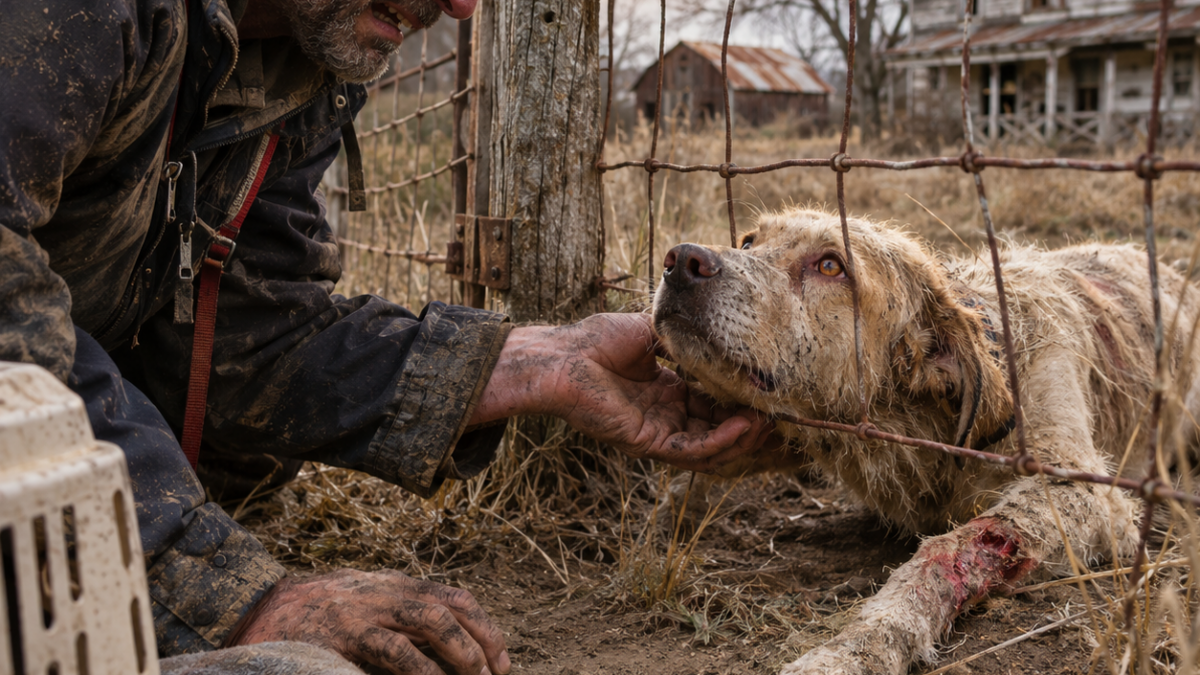
PART2
The drive to the veterinary hospital felt longer than any journey I’d made in years.
I had transported injured animals before.
Some bleeding.
Some frightened.
Some too weak to stand.
I’d learned to remain calm because panic doesn’t help an animal that needs urgent care.
But that morning, every time I glanced toward the place where the little dog was resting, my stomach tightened.
She was barely moving.
Her breathing was shallow.
And I couldn’t stop thinking about how close I might have come to missing her.
If the wind had been stronger, I might not have heard that faint breath.
If I’d walked along the opposite side of the property, I might never have looked beneath the fence.
If I’d decided the report wasn’t urgent because it was my last day, she might have remained there until it was too late.
I glanced toward her.
“Stay with me, sweetheart.”
There was no response.
I tightened my grip on the steering wheel.
“Just a little longer.”
The road curved past fields and a row of abandoned buildings.
I remembered the way her eyes had followed my hand.
That tiny movement.
It wasn’t much.
But it was enough to make me believe there was still a chance.
I had seen animals survive conditions that seemed impossible.
And I’d seen others die despite every effort we made.
Years in rescue had taught me not to promise miracles.
But they had never taught me how to stop wanting one.
I looked toward the little dog again.
“You’re going to have people helping you soon.”
My voice shook.
“Real people. People who won’t leave you under a fence.”
I paused.
Then added quietly, “I promise.”
The veterinary team was ready when we arrived.
I carried her through the entrance, holding her as carefully as I could.
“She’s extremely weak,” I explained. “Found beneath fencing at an abandoned farm. Possible leg injury. I don’t know how long she’s been there.”
The staff moved quickly.
They placed her on an examination table.
Began evaluating her condition.
Checked her breathing.
Her hydration.
Her temperature.
Her injured leg.
I stepped back to give them room.
That was always the hardest moment for me.
After spending the journey desperately trying to keep an animal alive, I had to surrender her into someone else’s hands.
I knew the veterinarians were better equipped to help.
I trusted them.
But trust didn’t make waiting easier.
The dog lay on the table without struggling.
I hated that.
Not because struggling would have been convenient.
Because she seemed too exhausted to protest.
A frightened, healthy dog might have tried to pull away.
Might have barked.
Might have looked for an escape.
This little dog hardly moved.
I watched her chest rise.
Then fall.
Rise.
Fall.
Each breath felt like something I needed to count.
A veterinarian looked toward me.
“Daniel, we’re going to take care of her. Why don’t you wait outside while we assess her?”
I nodded.
“Of course.”
But I couldn’t leave immediately.
I moved closer to the table.
Just enough to speak softly.
“Hey, girl.”
Her eyes shifted.
“You’re in the right place now.”
I swallowed.
“They’re going to help you.”
Then I stepped into the hallway.
The door closed.
And I stood alone with my hands still trembling from carrying her.
I’ve always hated hospital corridors.
Human hospitals.
Animal hospitals.
It doesn’t matter.
There is something about waiting outside a room while someone fights for a life that makes time behave differently.
Minutes stretch.
Every passing staff member makes you look up.
You hear a door open and wonder whether somebody is coming to give you news.
For years, I’d tried to become good at that kind of waiting.
I never succeeded.
That morning, I sat in a plastic chair and stared at my hands.
There was dirt beneath my fingernails.
A small scratch crossed one knuckle where I’d reached beneath the fence.
My jacket smelled of wet weeds and old wood.
I looked at the clock.
Then toward the treatment-room door.
And I thought about the abandoned farm.
The broken windows.
The empty fields.
The rusted wire.
I wondered how a dog had ended up in that place.
Had someone deliberately left her there?
Had she wandered onto the property after being abandoned somewhere else?
Had she been searching for shelter?
I didn’t know.
And I knew better than to invent an answer.
But the condition in which I’d found her told me that she had been without the care she needed.
She was thin.
Exhausted.
Injured.
And alone.
That was enough.
I leaned forward and covered my face.
“Please,” I whispered.
I didn’t even know whom I was speaking to.
“Please let her make it.”
A little later, the veterinarian came into the hallway.
I stood immediately.
“How is she?”
He looked tired.
“She’s in serious condition.”
My stomach dropped.
He continued explaining the findings.
She was severely weakened and needed supportive care.
Her injured leg required evaluation and careful treatment.
Her general condition suggested she had been struggling for some time.
There was no simple way to predict how quickly she might recover.
I listened.
Asked questions.
Tried to remember everything.
Then I asked the question that mattered most.
“Do you think she’ll survive?”
The veterinarian paused.
“We’re doing what we can.”
I nodded slowly.
It wasn’t the answer I wanted.
But it was an honest one.
I looked toward the treatment room.
“Can I see her?”
He nodded.
“Briefly.”
When I entered, she was resting.
Medical staff had begun caring for her.
She looked even smaller under the clinical lights.
I approached quietly.
“Hello again, little girl.”
One ear moved.
I smiled through tears.
“Still here, huh?”
I pulled a chair close enough to sit beside her without interfering with treatment.
For a while, I didn’t speak.
Then I looked at her face.
Those amber eyes.
That tiny spark I’d seen beneath the fence.
I thought about the way she’d allowed me to lift her.
Not because she trusted me.
Probably because she was too exhausted to resist.
But she had survived the journey.
And now she was receiving help.
I leaned closer.
“You know something?”
Her eyes shifted slightly.
“Today was supposed to be my last day.”
I laughed weakly.
“My retirement day.”
Her breathing remained steady.
“I was going to go home, put my feet up, and never crawl under another fence again.”
My smile faded.
Then I whispered, “And then I found you.”
I looked at her.
For some reason, a name came into my mind.
Mabel.
It was gentle.
Old-fashioned.
The kind of name that belonged to someone who deserved a warm home and a comfortable place to rest.
I smiled.
“How about Mabel?”
She didn’t react.
I laughed softly.
“Not much of an opinion, huh?”
I looked toward the veterinarian.
“Can we call her Mabel?”
He nodded.
“Of course.”
I turned back.
“Well, Mabel.”
My voice trembled.
“Let’s see what tomorrow brings.”
I didn’t retire that evening the way I’d imagined.
Technically, my scheduled employment was ending.
The paperwork was still there.
The farewell messages had already been written.
Someone had organized a small gathering for me.
But none of it felt important.
All I could think about was the dog lying in the veterinary hospital.
I drove back to the rescue center.
Returned the vehicle.
Signed the necessary forms.
And listened while my coworkers wished me well.
They were kind.
Some had worked beside me for years.
Others were younger rescuers I’d helped train.
They thanked me.
Told stories.
Laughed about old incidents.
Someone gave me a framed photograph of our rescue team.
I smiled.
I shook hands.
I said the things people say when a long career ends.
But when the small gathering was over, I didn’t feel free.
I felt worried.
One of the younger workers noticed.
“Daniel, are you okay?”
I looked at him.
“There’s a dog at the hospital.”
He nodded.
“Mabel?”
“Yeah.”
“She’s in good hands.”
“I know.”
He hesitated.
“You’re retired now. You don’t have to keep carrying every rescue home with you.”
I looked toward the photograph in my hands.
He wasn’t being unkind.
He meant well.
And perhaps he was right.
I couldn’t keep carrying every animal’s suffering forever.
It had already cost me more sleep than I could count.
But there was something about Mabel I couldn’t leave behind.
Maybe because she was the final dog I’d rescued.
Maybe because she’d been so close to death.
Maybe because her eyes had followed my hand when the rest of her body seemed unable to respond.
I swallowed.
“I know I don’t have to.”
Then I looked toward the door.
“But I want to make sure she has a chance.”
That night, I went home to a quiet house.
For years, my work had filled almost every part of my life.
There were always reports to complete.
Calls to answer.
Animals to check on.
Equipment to clean.
I used to complain that I never had enough time to rest.
Now I stood in my kitchen with an entire future of empty mornings stretching ahead of me.
It should have felt wonderful.
Instead, I felt strangely lost.
I made tea.
Sat beside the window.
And looked at the photograph my coworkers had given me.
There I was, standing beside people I’d shared so much with.
Younger rescuers.
Veterinary technicians.
Volunteers.
The people who knew exactly what it meant to lose an animal you had tried desperately to save.
I studied my own face.
I looked tired.
Older than I remembered feeling.
The years had left their marks.
But they had also given me memories I wouldn’t trade.
I thought about the first dog I ever rescued.
A frightened animal trapped in a drainage ditch.
I had been young then.
Too eager.
Too confident.
I thought caring was enough to solve almost anything.
Over the years, I’d learned otherwise.
Some animals needed weeks of treatment.
Some needed months.
Some never fully recovered.
And some died despite every effort.
There were losses I still remembered vividly.
A puppy whose condition deteriorated overnight.
An elderly dog found too late.
A cat that never regained consciousness.
Those memories had become part of me.
But so had the successes.
A dog taking its first steps after surgery.
A frightened animal choosing to approach a person.
A neglected puppy growing healthy enough to play.
I looked out the window.
Then whispered, “One more, Mabel.”
My eyes filled.
“Just let there be one more.”
The following morning, I called the veterinary hospital.
I tried to sound casual.
“Hello. This is Daniel. I’m calling about the dog brought in yesterday.”
The receptionist recognized my name.
“Mabel?”
“Yes.”
There was a pause while she checked for an update.
I held the telephone tightly.
Then she said the veterinarian would speak with me.
I closed my eyes.
For a moment, I was afraid the news would be bad.
But when he came on the line, his voice was calm.
“Mabel made it through the night.”
I sat down.
Those six words felt enormous.
“She did?”
“Yes.”
I covered my mouth.
He explained that she remained weak and required continued care.
Her condition was still serious.
But she had survived the first night.
I stared toward the window.
The morning sun was shining across the yard.
And for the first time since finding her, I allowed myself to smile without feeling afraid of hoping.
“Thank you,” I whispered.
The veterinarian continued explaining the next steps.
I listened carefully.
Then asked whether I could visit.
He agreed.
I was out the door almost immediately.
When I reached the hospital, Mabel was resting on a blanket.
She looked exhausted.
But her eyes were open.
I stepped closer.
“Hello, sweetheart.”
Her gaze moved toward me.
I smiled.
“Remember me?”
Of course, I didn’t know whether she recognized my voice.
But I liked to think something about my presence was becoming familiar.
I sat beside her.
“You gave us quite a scare.”
She remained quiet.
I looked at her injured leg.
There was still a long recovery ahead.
And her weakened body needed time.
But the terrible urgency of the previous day had eased slightly.
She was alive.
I watched her breathing.
Then leaned back in the chair.
“You know, I was supposed to be sleeping late today.”
Her ears moved.
I smiled.
“Retirement. That’s what people do, apparently.”
I looked toward her face.
“Instead, here I am.”
I paused.
“And I don’t mind.”
For a long time, I remained beside her.
Sometimes I spoke.
Sometimes I simply watched.
I didn’t need her to perform a dramatic gesture.
Didn’t need her to wag her tail.
Didn’t need her to express gratitude.
She had already done something extraordinary.
She had survived.
And for that day, survival was enough.
The days that followed were difficult.
Mabel’s body needed time to recover from the condition in which she’d been found.
The medical team treated her injured leg and monitored her progress.
Her appetite gradually improved.
She began responding more consistently to her surroundings.
But recovery wasn’t immediate.
There were mornings when she seemed brighter.
Other mornings when she looked tired and overwhelmed.
I learned not to expect a straight line.
Sometimes progress was as small as taking a few bites of food.
Sometimes it was resting comfortably.
Sometimes it was lifting her head when someone entered the room.
Those little changes mattered.
Because I remembered the dog beneath the fence.
The faint breathing.
The nearly motionless body.
The way I’d feared she might die before I reached the truck.
Now she was receiving meals.
Treatment.
Clean bedding.
Shelter.
And attention from people who wanted her to survive.
I visited when the medical team said it was appropriate.
Some days, I stayed only a little while.
Other days, longer.
I sat beside her and talked quietly.
Sometimes I told her stories from my years in rescue.
The funny ones.
A puppy that stole an entire sandwich from a volunteer.
A cat that escaped its carrier and spent twenty minutes hiding beneath a desk.
A dog that refused to leave the clinic until someone found the squeaky toy it had dropped.
I wasn’t trying to make Mabel understand the stories.
I was giving her a gentle, familiar voice.
And perhaps, in some way, I was giving myself permission to remain connected to the work I’d thought I was leaving behind.
One afternoon, I arrived to find Mabel sitting upright.
I stopped in the doorway.
She was on her blanket.
Her head was raised.
Her eyes were following a staff member moving across the room.
For a moment, I simply watched.
Then the woman noticed me.
“Daniel.”
I smiled.
“Look at her.”
She nodded.
“She’s doing better.”
I approached slowly.
“Hello, Mabel.”
Her eyes moved toward me.
Then she shifted slightly.
I sat in the nearby chair.
“Well, that’s new.”
She remained upright.
I felt tears gathering.
It was such a small improvement.
But I knew how much effort had gone into reaching it.
The medical treatment.
The feeding.
The rest.
The careful management of her injured leg.
The patience of the staff.
And Mabel’s own ability to continue despite how weakened she’d been.
I looked toward the veterinary technician.
“She’s a fighter.”
The woman smiled.
“She certainly hasn’t given us any reason to stop hoping.”
I nodded.
Then looked back at Mabel.
“No, sweetheart.”
My voice broke.
“You haven’t.”
Eventually, Mabel was well enough to leave the hospital and continue her recovery at the shelter.
That was another milestone.
She still needed care.
Her injured leg hadn’t suddenly become perfect.
Her body was still recovering.
But she was no longer in the immediate condition in which we’d found her.
I helped with her transition.
The shelter staff prepared a quiet room.
There was a comfortable blanket.
Fresh water.
An appropriate feeding routine.
And a plan for ongoing care.
When Mabel arrived, she seemed cautious.
She looked toward the doorway.
Then around the room.
Her amber eyes followed every person who passed.
I watched her settle.
She wasn’t the same dog I’d carried from the abandoned farm.
But she wasn’t fully confident yet, either.
Something about her behavior suggested she was still trying to understand what this new environment meant.
Would people remain kind?
Would food continue arriving?
Would she be allowed to rest?
Would someone suddenly take her away?
I couldn’t know what she was thinking.
But I knew she needed consistency.
So we gave her that.
The shelter staff treated her gently.
They learned her routines.
They watched her mobility.
They gave her space when she needed it.
And slowly, Mabel began showing more interest in the world.
Sometimes I stood outside her room and watched.
I tried not to interfere.
Mabel lay on her blanket with her head resting on her paws.
Her eyes followed the people who walked past.
She seemed to notice every movement near the doorway.
At first, she was hesitant.
Then she became a little more curious.
When someone approached with food, she lifted her head.
When a familiar staff member spoke, her ears moved.
Sometimes her tail shifted against the blanket.
Those moments made me smile.
Not because they proved she’d forgotten the abandoned farm.
They didn’t.
But because she was beginning to experience a life in which people brought care rather than uncertainty.
I thought about the place where I’d found her.
The wind whistling through broken boards.
The empty farmhouse.
The rusted fence.
The dirt beneath her body.
Then I looked at the shelter room.
Clean.
Warm.
Safe.
And full of people who knew her name.
Mabel.
It seemed such a simple thing.
A name.
But I wondered whether she’d had one before.
Someone might have called her something else once.
Someone might have known her as a puppy.
Someone might have watched her grow.
I didn’t know.
All I knew was that she’d been found alone beneath a fence.
Now people spoke about her with affection.
They asked how Mabel was doing.
Whether Mabel had eaten.
Whether Mabel was comfortable.
Whether Mabel was ready for another short walk.
She was no longer invisible.
And that mattered more than I could explain.
There was a day when I saw her stand more comfortably on her injured leg.
I had come to visit in the afternoon.
She was resting on her blanket.
I spoke softly from the doorway.
“Hello, Mabel.”
She lifted her head.
Then began rising.
Carefully.
One paw.
Then another.
She adjusted her weight.
I held still.
I didn’t want to startle her.
She stood.
Not perfectly.
Not without some caution.
But with more confidence than I’d seen before.
I felt my eyes fill.
“Look at you.”
She looked toward me.
I smiled through tears.
“That’s my girl.”
She took a few steps.
Then stopped.
I didn’t rush toward her.
I let her decide what to do.
She looked around.
Then settled again.
It was enough.
I remembered how her leg had looked beneath the fence.
How frightened I’d been when I lifted her.
How carefully I’d carried her to the truck.
Now she was standing on her own.
I put my hand against the doorframe.
For a moment, I couldn’t speak.
Then I whispered, “You made it this far.”
And I knew that, no matter how many rescues I’d seen in my career, I would never become tired of witnessing that kind of progress.
Mabel began becoming a favorite among the shelter staff.
Not because she was the loudest dog.
She wasn’t.
Not because she demanded constant attention.
She didn’t.
There was something gentle about her presence.
A quiet sweetness.
An ability to look at someone with those amber eyes and make them feel as though they needed to stop for a moment.
The employees began calling her their little survivor.
Someone brought a softer blanket.
Another made sure her feeding routine was carefully followed.
A volunteer spent time sitting nearby, allowing Mabel to approach if she wanted.
And gradually, she became more comfortable.
I watched the change with relief.
Her body was recovering.
Her coat looked healthier.
Her movements became less hesitant.
And she was beginning to understand that a hand reaching toward her might offer affection.
Yet I also knew the shelter wasn’t supposed to be the end of her story.
It had saved her.
Protected her.
Helped her regain strength.
But Mabel deserved something beyond recovery.
She deserved a home.
A place where she would be wanted every morning.
A person who would know her habits.
A familiar voice.
A comfortable bed.
The kind of ordinary companionship every dog should have the chance to experience.
I thought about taking her home myself.
Of course I did.
How could I not?
I’d been the one to find her.
Carry her.
Wait through those first frightening hours.
But I also knew that rescuing an animal and being the best permanent home for that animal were not always the same thing.
My life was changing.
Retirement brought uncertainties I hadn’t fully considered.
And Mabel needed someone who could offer the stability, time, and companionship she deserved.
So I began hoping the right person would find her.
Someone patient.
Someone gentle.
Someone who wouldn’t see only an injured rescue dog.
Someone who would see Mabel.
That person was Ellen Parker.
The first time I heard her name, a shelter employee mentioned that an older woman had expressed interest in meeting Mabel.
I was sitting near the reception area.
I’d come to drop off a few supplies.
The employee smiled.
“Daniel, I think we may have someone special.”
I looked up.
“For Mabel?”
She nodded.
“Her name is Ellen Parker.”
I waited.
“She’s been asking about Mabel’s recovery and wants to meet her.”
Something tightened inside me.
I had been waiting for that news.
Yet suddenly, I felt afraid.
What if Mabel didn’t like her?
What if Ellen found the dog’s medical history too overwhelming?
What if the adoption didn’t work?
What if Mabel finally learned to feel safe and then lost another home?
I knew these concerns were part of responsible placement.
The shelter would assess the adopter and discuss Mabel’s needs.
But my emotions weren’t nearly as practical.
I’d become attached to that little dog.
Much more attached than I’d intended.
I wanted her to have a home.
Yet some part of me dreaded saying goodbye.
I looked toward the employee.
“When is Ellen coming?”
“This afternoon.”
I nodded.
Then looked down at my hands.
“Could I be there?”
She smiled gently.
“Of course.”
I stood in the corner of Mabel’s recovery room when Ellen arrived.
I don’t know why I stayed so far back.
Perhaps I didn’t want my presence to influence the meeting.
Perhaps I wanted to see whether Mabel would respond to Ellen on her own.
Or perhaps I was afraid that if I stood too close, I wouldn’t be able to let her go.
Mabel was lying on her blanket.
Her head rested on her paws.
Her amber eyes followed the staff members moving past the door.
Then Ellen stepped inside.
She was an older woman with a gentle face and slightly trembling hands.
There was something quiet about her.
She didn’t rush forward.
Didn’t raise her voice.
Didn’t crouch dramatically and demand the dog’s attention.
She simply stopped near the doorway.
Looked at Mabel.
And smiled.
“Hello, Mabel.”
Her voice was so gentle that I felt the atmosphere in the room change.
“I’ve heard so much about you.”
Mabel lifted her head.
Slowly.
Carefully.
Her eyes fixed on Ellen.
I stood completely still.
Ellen took a small step.
Then stopped again.
“You’re a beautiful girl.”
Mabel watched her.
For several moments, neither moved.
Then Mabel began rising.
I felt my breath catch.
She placed weight carefully on her recovering leg.
Adjusted herself.
Stood.
And took a step toward Ellen.
Then another.
And another.
I had seen Mabel walk before.
I’d watched her growing stronger.
But there was something different about the confidence in those movements.
She wasn’t simply moving around the room.
She was approaching someone.
Choosing to cross the space between them.
Ellen waited.
Her hands remained relaxed.
Mabel reached her.
Then sat at her feet.
For one long moment, she looked up.
And then she rested her head against Ellen’s knees.
I felt tears begin filling my eyes.
Ellen lowered one trembling hand.
Stroked the dog’s head.
And began crying.
“Oh, sweetheart.”
Her voice broke.
“I’ve been waiting for you.”
She paused.
Then whispered words I would never forget.
“I didn’t know I was waiting for you until now.”
I covered my mouth.
Because I suddenly understood something.
Mabel had survived the abandoned farm.
The hospital.
The pain.
The uncertainty.
And now, in a quiet shelter room, she was sitting beside a woman who looked at her as though she were exactly what had been missing from her life.
Ellen remained beside Mabel for a long time.
She didn’t ask the dog to move.
Didn’t demand affection.
She simply stroked her head gently while Mabel rested against her.
I watched the two of them.
There was no dramatic music.
No crowd cheering.
No announcement that everything was perfect.
Just an older woman and a dog sitting together.
Yet I had witnessed enough rescues to recognize the significance of that kind of moment.
Mabel was comfortable.
Ellen was emotional.
And something about their interaction felt natural.
The shelter staff explained Mabel’s history.
Her condition when found.
Her injured leg.
The treatment she’d received.
The care she might continue needing.
Ellen listened carefully.
She asked questions.
Not about whether Mabel would be entertaining.
Not about whether she would make a good photograph.
She wanted to know how to keep her comfortable.
What routines helped.
Whether she preferred quiet places.
How much walking was appropriate.
What kind of follow-up veterinary care would be necessary.
I listened from the corner.
And with every question, I felt a little more certain.
Ellen wasn’t looking for a perfect dog.
She was looking for a companion.
And she understood that companionship included responsibility.
Finally, she looked toward me.
“You’re Daniel?”
I nodded.
“Yes, ma’am.”
She smiled.
“They told me you found her.”
I swallowed.
“At an abandoned farm.”
Her eyes filled.
“She was terribly ill?”
I nodded.
“I wasn’t sure she’d survive the trip to the hospital.”
Ellen looked down at Mabel.
The dog remained beside her.
She gently touched Mabel’s cheek.
“Well, sweetheart.”
Her voice trembled.
“You’ve come a long way.”
I looked away.
For a moment, I couldn’t speak.
The adoption paperwork was completed that day after the shelter finished its process.
I stood nearby as Ellen signed.
I had signed countless rescue reports over the years.
Intake forms.
Medical transfer documents.
Transport records.
Incident notes.
But watching Ellen write her name on Mabel’s adoption papers affected me more deeply than I expected.
Ellen Parker.
A woman who had come to the shelter because she saw something in a dog’s eyes.
A woman who had listened to the story of her injuries without looking away.
A woman who seemed more interested in providing comfort than in receiving gratitude.
I watched her finish signing.
Then she looked toward Mabel.
“Are you ready to come home?”
Mabel’s ears moved.
Ellen smiled.
“I’ve got a place for you.”
My throat tightened.
Home.
It was such a simple word.
But for Mabel, it represented something enormous.
No more abandoned farm.
No more sleeping beneath a fence.
No more uncertainty about whether someone would find her before it was too late.
She would have a place where she belonged.
A person who wanted her there.
A home that didn’t depend on whether she was useful.
The shelter staff came one by one to say goodbye.
Some stroked her head.
Others crouched beside her.
One woman began crying before she could say anything.
I understood.
They had cared for Mabel when she was fragile.
They had watched her regain strength.
They had learned her habits.
They had celebrated the little improvements.
And now they were letting her go.
Not because they wanted to be rid of her.
Because loving an animal in rescue sometimes means preparing her to leave.
Even when the goodbye hurts.
When Ellen led Mabel toward the exit, I stood near the window.
I wasn’t sure I could manage walking beside them.
Mabel moved carefully but confidently.
Her recovering leg carried her toward the door.
Ellen remained close.
The staff watched.
For a moment, I thought Mabel would simply leave without looking back.
And I told myself that would be wonderful.
It would mean she was ready.
It would mean she was looking toward her new life.
But just before reaching the doorway, Mabel stopped.
She turned her head.
Her amber eyes moved across the room.
Then rested on me.
I froze.
For a moment, neither of us moved.
I raised one hand.
“Goodbye, sweetheart.”
My voice cracked.
“Be happy.”
Mabel’s tail moved.
Just once.
A small, gentle wag.
Then she turned and followed Ellen through the door.
I stood completely still.
The room became quiet.
Her blanket remained in the corner.
Her water bowl was still beside the wall.
The place where she’d rested for weeks was empty.
I looked at the doorway.
Then covered my face.
And cried.
Not because I regretted letting her go.
Because I remembered the dog beneath the fence.
The dog whose breathing was so faint I feared she’d die in my arms.
And now that same dog had walked out of the shelter beside someone who loved her.
I lowered myself into a chair.
For a long time, I simply sat there.
Then whispered, “You made it, Mabel.”
The first evening after her adoption, I went home feeling strangely empty.
I had expected relief.
Happiness.
The satisfaction of knowing another animal had found a family.
And I felt all of those things.
But there was something else.
A sense that a chapter had closed.
My career had officially ended.
The last dog I’d rescued had been adopted.
The daily hospital visits were over.
The shelter no longer needed me to check on Mabel.
For the first time in years, I didn’t have an urgent responsibility waiting the next morning.
I sat beside the window with a cup of tea.
Outside, evening light settled over the street.
I looked at the clock.
Then at my phone.
I wondered whether Ellen had arrived home safely.
Whether Mabel was frightened.
Whether she’d eaten.
Whether she’d found a comfortable place to rest.
I almost called immediately.
Then stopped myself.
Ellen needed time to settle Mabel into her new environment.
I didn’t want to become the worried rescuer who couldn’t let go.
So I placed the phone on the table.
And waited.
At seven-thirty, it rang.
Ellen.
I answered so quickly that I nearly knocked over the tea.
“Hello?”
“Daniel?”
Her voice sounded warm.
“It’s Ellen.”
I smiled.
“How are you both?”
She laughed softly.
“Well, Mabel has inspected the entire living room.”
I felt my shoulders relax.
“Has she?”
“Oh, yes. Every chair leg. Every corner.”
I smiled.
“And now?”
“She’s lying on a blanket beside the sofa.”
My eyes filled.
“That’s wonderful.”
Ellen hesitated.
Then said, “Daniel, I think she’s going to be happy here.”
I looked toward the darkening window.
My throat tightened.
“I think so, too.”
The calls continued.
Not because I demanded updates.
Ellen simply enjoyed sharing them.
And I looked forward to every one.
During the first week, she told me how Mabel had gradually explored the house.
The living room.
The kitchen.
The hallway.
The bedroom.
At first, she moved cautiously.
She seemed unsure about unfamiliar furniture and new sounds.
But Ellen allowed her time.
She kept routines predictable.
Followed the veterinary instructions.
And made sure Mabel had quiet places to rest.
One afternoon, Ellen called laughing.
“Daniel, you’ll never guess.”
I smiled.
“What happened?”
“Mabel climbed onto the sofa.”
I laughed.
“She did?”
“Very carefully. I was sitting there reading, and she came over, looked at me, and climbed up beside me.”
I could hear the joy in Ellen’s voice.
“Did you tell her to get down?”
“Absolutely not.”
She laughed harder.
“I’ve spent years sitting on that sofa alone. She can have half of it.”
I smiled.
“Sounds like a fair arrangement.”
Ellen became quiet.
Then she whispered, “You know, Daniel, I hadn’t realized how lonely evenings had become.”
My smile faded.
I waited.
“Now I sit down with my book, and there’s someone beside me.”
Her voice broke.
“Someone who wants to be there.”
I looked down.
And for the first time, I began to understand that Mabel wasn’t the only one learning what home could mean.
A few days later, Ellen told me about the ball.
She had been sitting in the garden.
Mabel was exploring nearby.
There was a small rubber ball on the grass.
Ellen had bought a few toys before bringing her home, though she didn’t know whether Mabel would be interested.
At first, the dog ignored them.
Then one morning, Mabel nudged the ball.
It rolled.
She watched it.
Then followed.
Ellen laughed.
“She looked so surprised.”
I smiled.
“Really?”
“Yes. Like she wasn’t sure why it moved.”
She paused.
“Then she pushed it again.”
I could hear the emotion in her voice.
“Daniel, she played.”
I closed my eyes.
I remembered Mabel lying beneath the fence.
The injured leg.
The weakness.
The way I had feared she might not survive the day.
Now she was playing with a ball in someone’s garden.
I swallowed.
“That’s wonderful, Ellen.”
She laughed through tears.
“I sat there watching her like she’d just won an Olympic medal.”
I laughed.
“I understand.”
And I did.
Because when you’ve seen an animal at the edge of death, ordinary joy becomes extraordinary.
A dog chasing a ball.
A tail wagging.
A quiet afternoon in the garden.
Those things begin to feel like miracles.
Not because they are rare.
Because they were almost lost.
Then came the call about the bedroom.
Ellen sounded emotional.
I knew something had happened before she even explained.
“Daniel?”
“Yes?”
“Mabel slept beside my bed last night.”
I smiled.
“That’s good.”
“No, I mean she chose to.”
I waited.
Ellen continued.
“I put a comfortable bed near mine, but for the first few nights she stayed in the hallway.”
I nodded, though she couldn’t see me.
“Then yesterday evening, she followed me into the bedroom.”
Her voice trembled.
“She circled the bed twice, settled down, and stayed.”
I felt tears gathering.
“Did she sleep well?”
“Better than before, I think.”
Ellen paused.
“And so did I.”
For a moment, neither of us spoke.
Then she whispered, “Daniel, I haven’t slept that peacefully in years.”
My throat tightened.
I looked toward the empty room around me.
I had thought I was helping Mabel find a home.
Now I was beginning to see that Ellen had been searching for something, too.
Perhaps not consciously.
Perhaps she hadn’t known exactly what was missing.
But the dog who had once lain beneath an abandoned fence was now sleeping beside a woman who had spent too many nights alone.
I smiled through tears.
“Sounds like you found each other.”
Ellen was quiet.
Then she answered.
“Yes.”
Her voice broke.
“I think we did.”
Over the next several weeks, Ellen’s voice changed.
It was subtle at first.
Then unmistakable.
When she called, she sounded more energetic.
She laughed more easily.
She told stories.
Not only about Mabel.
About the garden.
The books she was reading.
The neighbors who had stopped by to meet the dog.
The walks they were beginning to take together as Mabel’s recovery allowed.
I began realizing how quiet Ellen’s life must have been before the adoption.
One afternoon, she mentioned that she had worked in a school for forty years.
I asked about it.
She laughed.
“Oh, Daniel, I could talk about teaching all day.”
I smiled.
“Then tell me.”
She began describing the children she’d taught.
The classrooms.
The funny questions students asked.
The little victories that made teaching worthwhile.
A child learning to read.
A frightened student becoming confident.
A teenager discovering a talent nobody had noticed before.
There was warmth in her voice.
A kind of affection that reminded me of the way rescuers talked about animals they’d helped.
She had spent forty years caring for other people’s children.
Encouraging them.
Teaching them.
Watching them grow.
But she had never had children of her own.
Her husband had left years earlier.
And after retirement, the house had become increasingly quiet.
I listened.
Then thought about Mabel.
A dog who had been found alone.
And Ellen.
A woman who had spent years wondering what to do with the silence.
Perhaps they understood something about each other that didn’t need words.
Two months after Mabel’s adoption, I decided to visit.
Ellen had invited me several times.
I’d always found an excuse.
Not because I didn’t want to see them.
Because I was afraid.
Afraid that Mabel wouldn’t remember me.
Afraid that she would.
Afraid that seeing her happy with someone else would make the end of my rescue career feel more final.
It sounds foolish now.
But the animals we rescue often become attached to parts of our lives we don’t fully understand.
Mabel had been my last rescue.
The final animal I’d carried from danger while still officially working.
If I saw her healthy and happy, perhaps I’d have to accept that my old life really was over.
Eventually, I realized that avoiding the visit wasn’t helping anyone.
So one Sunday, I drove to Ellen’s house.
It stood on a quiet street.
There was a small garden in front.
Flowers grew near the walkway.
The windows were bright.
A rocking chair stood on the porch.
I parked and sat for a moment.
Then took a breath.
And walked toward the door.
Ellen opened it almost immediately.
Her face lit up.
“Daniel!”
I smiled.
“Hello, Ellen.”
She stepped aside.
“Come in. Mabel will recognize you.”
I laughed nervously.
“We’ll see.”
Ellen smiled.
“Oh, I think she will.”
I entered.
The house smelled of tea and fresh flowers.
Books filled a shelf near the living room.
Sunlight fell across the rug.
And from somewhere beyond the hallway came the sound of paws moving over the floor.
I turned.
Mabel appeared.
For a moment, I couldn’t breathe.
She looked different.
Not just a little healthier.
Different in a way that almost made it difficult to connect her with the dog I’d found beneath the fence.
Her coat had become shiny.
Her body had filled out.
The frightening thinness was gone.
She moved with a livelier, more confident gait.
And her amber eyes—
Those were the same.
The same eyes that had followed my hand beneath the rusted wire.
The same eyes I’d watched in the hospital.
The same eyes that had looked back at me from the shelter doorway.
Mabel stopped several feet away.
She looked at me.
For a moment, neither of us moved.
I felt my throat tighten.
“Hello, Mabel.”
Her ears shifted.
I smiled.
“Remember me, sweetheart?”
She stood still.
Then began walking toward me.
One step.
Another.
Her tail moved gently.
I knelt.
She came closer.
Then pressed her head against my leg.
I closed my eyes.
“Oh, Mabel.”
My voice broke.
I placed one hand against her neck.
Felt the warmth of her body.
The healthy coat beneath my fingers.
The steady strength in the dog who had once been so weak I feared lifting her might hurt her.
I began crying.
I couldn’t help it.
Ellen stood nearby, smiling through tears.
“She remembers.”
I swallowed.
I didn’t know exactly what memories Mabel held.
But she was clearly comfortable approaching me.
And that was enough.
I stroked her head.
“Look at you.”
My voice trembled.
“Look how beautiful you’ve become.”
Mabel leaned against me.
For a long moment, I remained kneeling.
Then I whispered something I hadn’t expected to say.
“Thank you for staying alive.”
We sat in Ellen’s living room drinking tea.
Mabel lay near her feet.
Occasionally, she lifted her head when Ellen spoke.
Sometimes she looked toward me.
But mostly she seemed content simply to be there.
I watched her.
Then looked toward Ellen.
“She’s doing wonderfully.”
Ellen smiled.
“She’s changed my whole life.”
I listened.
“Every morning,” she continued, “she comes into the bedroom and puts her nose against my cheek.”
I laughed.
“Does she?”
Ellen nodded.
“Then she waits.”
“For what?”
“For me to open my eyes.”
Her face softened.
“And once I do, she wags her tail like she’s been waiting all night for the chance to say good morning.”
I smiled.
Ellen continued.
“In the evenings, she lies beside my bed.”
She glanced toward Mabel.
“Sometimes she makes this little sigh when she’s settling down.”
I felt my throat tighten.
“Sounds like she’s comfortable.”
Ellen nodded.
“That’s what I hope.”
She looked down at the dog.
“Sometimes I imagine she’s saying, ‘Finally. I’m home.'”
For a moment, the room became quiet.
I watched Mabel resting near Ellen’s chair.
Then looked toward the window.
I remembered the abandoned farm.
The cold wind.
The rusted fence.
The faint breathing.
The desperate journey to the hospital.
I thought about how close she’d come to never experiencing any of this.
A comfortable sofa.
A warm bedroom.
A woman who waited for her to wake each morning.
A garden.
A ball.
A home.
I pressed my fingers against my cup.
“She deserves every bit of it.”
Ellen asked me about the day I found Mabel.
I hesitated.
We’d discussed parts of it before.
But I had never told her everything.
Not the way I remembered it.
The silence at the farm.
The broken windows.
The way the wind moved through the weeds.
The first faint breath beneath the fence.
The moment I knelt and saw her eyes.
I told Ellen slowly.
She listened without interrupting.
I described Mabel’s injured leg.
The thinness of her body.
The way she barely moved when I approached.
Then I reached the part where I lifted her.
My voice broke.
“She was so light.”
Ellen’s eyes filled.
I looked toward Mabel.
“I’ve carried animals before. Hundreds of them.”
I swallowed.
“But there was something about her that frightened me.”
Ellen waited.
“She seemed as though she’d already used every bit of strength she had.”
I stared at my hands.
“And I remember thinking that if I didn’t get her out of there quickly, she might die without anyone ever knowing she’d existed.”
Ellen covered her mouth.
Tears rolled down her face.
I continued.
“Then she opened her eyes.”
I looked toward Mabel.
“Just enough to follow my hand.”
My voice cracked.
“And I thought, there’s still somebody in there. She’s still trying.”
Ellen began crying quietly.
I took a breath.
“That’s why I couldn’t leave her.”
I looked down.
“Even when the medical team took over, I couldn’t stop coming back.”
Ellen reached across the table.
Placed one hand over mine.
“You saved her, Daniel.”
I shook my head.
“The veterinary team saved her, too. The shelter staff. Everybody who cared for her.”
Ellen nodded.
“Of course.”
I looked toward Mabel.
“But I remember thinking, when I found her, that she might never survive the day.”
My eyes filled.
“And now look at her.”
Ellen wiped her cheeks.
Then smiled.
“Daniel, can I tell you something?”
I nodded.
“Of course.”
She looked toward Mabel.
“I thought my life was finished.”
I stared.
She continued.
“Not literally. I wasn’t ill. I wasn’t in any immediate danger.”
Her voice softened.
“But everything meaningful seemed to belong to the past.”
She looked toward the bookshelves.
“I taught for forty years.”
I nodded.
“Hundreds of children.”
She smiled sadly.
“I watched them learn. Grow. Graduate. Begin their own lives.”
Her expression became distant.
“Then I retired.”
She paused.
“My husband had left years earlier. We never had children. And suddenly, the house was quiet.”
I listened.
She continued.
“At first, I told myself I deserved the rest.”
Her smile faded.
“But after a while, I started waking up without knowing what I was looking forward to.”
My throat tightened.
“I’d make tea. Read. Clean something that didn’t need cleaning.”
She laughed softly through tears.
“Then I’d go to bed.”
I looked down at my cup.
Ellen continued.
“One afternoon, I saw Mabel’s photograph on the shelter page.”
She looked toward the dog.
“Her eyes…”
Her voice broke.
“There was something about them.”
I swallowed.
She continued.
“I couldn’t stop thinking about her.”
I looked toward Mabel.
Those amber eyes.
The same ones I’d seen beneath the fence.
Ellen smiled through tears.
“I kept looking at the photograph.”
“Why?”
She thought for a moment.
Then answered quietly.
“Because she looked like she needed someone to notice her.”
Her voice trembled.
“And I realized I needed someone to notice, too.”
I stared at her.
For a moment, I couldn’t speak.
Then I looked toward the dog resting at her feet.
And understood that Mabel had not simply found an adopter.
She had found another lonely heart.
I leaned back in my chair.
For a while, I watched the sunlight move across the living-room floor.
Then I said quietly, “When I found her, I saw something in her eyes.”
Ellen nodded.
“The spark.”
I looked at her.
She smiled.
“That’s how you described it.”
I nodded.
“I thought it might disappear before we reached the hospital.”
My throat tightened.
“But it didn’t.”
Ellen stroked Mabel’s head.
I continued.
“And now, seeing her here, I think you’ve helped that spark grow.”
Ellen shook her head gently.
“No, Daniel.”
I looked at her.
“You’ve got that wrong.”
I smiled faintly.
“Have I?”
She nodded.
“That spark was always hers.”
Her voice softened.
“You saw it when nobody else was there.”
She looked down at Mabel.
“The doctors and shelter staff helped keep her alive.”
Then she looked back at me.
“And I simply made room for her to become the dog she already was.”
I stared at her.
For a moment, I felt as though she’d said something much larger than she intended.
I had spent years believing rescue was primarily about saving animals from danger.
Getting them out.
Getting them treated.
Getting them strong enough to survive.
But Mabel’s story had continued after I carried her beneath the fence.
The medical team gave her treatment.
The shelter gave her safety.
Ellen gave her belonging.
And each part mattered.
No single person had done everything.
We had simply made sure somebody was there for the next step.
I looked at Ellen.
Then at Mabel.
And suddenly, I understood why I hadn’t been able to stop thinking about this last rescue.
She was teaching me that saving a life doesn’t end when the immediate danger passes.
Sometimes saving continues through the ordinary love that follows.
Before I left, Ellen showed me the garden.
Mabel followed us outside.
The grass was green.
Flowers grew along the fence.
There was a small sunny corner near the back steps.
Ellen pointed toward it.
“That’s her favorite place.”
I smiled.
Mabel walked over.
Sniffed the grass.
Then lay down in the sunlight.
I watched.
For a long time, I couldn’t speak.
I remembered her lying beneath another fence.
A rusted fence.
At an abandoned farm.
Her body pressed against the dirt because she was too weak to move.
Now she lay beside a garden.
In sunlight.
Within sight of a woman who loved her.
I felt tears gathering.
Ellen stood beside me.
“She spends a lot of time there.”
I nodded.
“Looks like she found a good spot.”
Ellen smiled.
“She has her own bed in the bedroom, her own bowl in the kitchen, and apparently this entire corner of the garden.”
I laughed.
“Sounds like she runs the place.”
Ellen grinned.
“Oh, completely.”
We stood quietly.
Then Mabel lifted her head.
Looked toward us.
And wagged her tail.
I smiled.
“Hello, sweetheart.”
She settled again.
And for a moment, the world felt very simple.
A dog in the sun.
A woman beside me.
A garden.
A quiet afternoon.
I had spent my career rushing toward emergencies.
Now I was witnessing something that required no emergency response at all.
A life being lived.
Safely.
Peacefully.
And with love.
When I left Ellen’s house that afternoon, Mabel followed us to the front door.
She stood beside Ellen.
Her tail moved gently.
I crouched.
“Well, Mabel.”
She looked toward me.
“I guess this is goodbye again.”
I smiled.
“But a better kind this time.”
I stroked her head.
“You’re doing just fine.”
Ellen watched quietly.
I stood.
Then she embraced me.
“Thank you, Daniel.”
My throat tightened.
“For what?”
She stepped back.
Her eyes filled.
“For stopping that morning.”
I couldn’t answer.
She continued.
“For hearing her.”
I looked toward Mabel.
“For bringing her to people who could help.”
Her voice broke.
“And for making it possible for her to find me.”
I swallowed hard.
“Ellen, you don’t owe me anything.”
She smiled through tears.
“I know.”
Then she said something I would remember for the rest of my life.
“But I hope you understand what you gave us.”
I looked toward her.
Then toward Mabel.
And realized I did.
Not completely.
Not in a way I could explain.
But enough.
I had given Mabel a chance to survive.
And that chance had eventually brought her to Ellen.
A woman whose life had become quiet.
A woman who had spent years caring for others and now had someone to care for again.
I smiled.
“Take good care of each other.”
Ellen nodded.
“We will.”
Then I walked down the garden path.
At the gate, I turned.
Mabel was still standing beside Ellen.
I raised one hand.
Her tail moved.
And I drove home with tears running down my face.
That evening, I sat beside my window for a long time.
The room was quiet.
My retirement photograph stood on the table.
I looked at it.
Then thought about the final day of my career.
I’d imagined it would end with paperwork.
A handshake.
A few kind words.
Maybe a small celebration.
Then I’d put the job behind me.
But instead, I’d crawled beneath a rusted fence and found a dog whose life was barely hanging on.
That moment had led to the hospital.
The shelter.
Ellen.
And now the peaceful home where Mabel was thriving.
I thought about the way Ellen’s face changed when she spoke about the dog.
The way Mabel rested at her feet.
The ease with which they seemed to have made room for each other.
And I realized something.
For years, I’d believed that once I retired, I would stop being a rescuer.
I wouldn’t answer emergency calls.
Wouldn’t drive a rescue vehicle.
Wouldn’t crawl through abandoned buildings or carry injured animals into hospitals.
That part of my life really had ended.
But caring didn’t have to end with it.
Maybe rescue wasn’t simply a job.
Maybe it was a way of noticing.
Noticing when someone needed help.
Noticing when an animal had been forgotten.
Noticing when another person had become lonely.
And choosing to respond.
I looked toward the evening sky.
Then whispered, “Thank you, Mabel.”
My voice broke.
“Thank you for reminding me.”
A year passed.
Mabel continued living with Ellen.
She had her own comfortable bed in the bedroom.
Her own bowl in the kitchen.
Her favorite spot in the sunny garden.
Each morning, she followed Ellen toward the back door.
When it opened, she went outside to explore.
In the evenings, she rested near Ellen while the older woman read.
The routines were ordinary.
Beautifully ordinary.
And they belonged to both of them.
Ellen still called.
Not every day anymore.
There was no need.
But often enough that I felt connected to their lives.
Sometimes she sent photographs.
Mabel asleep on the sofa.
Mabel standing in the garden.
Mabel carrying a toy.
Mabel lying beside a stack of books while Ellen read.
I saved every picture.
Not because I doubted she was happy.
Because I loved seeing what her life had become.
Sometimes I compared the photographs with the first image I had taken after rescuing her.
The difference was painful and wonderful.
Then, she was thin.
Weak.
Injured.
Terrified by the world.
Now she was healthy-looking, comfortable, and surrounded by things that belonged to her.
Her own places.
Her own routines.
Her own person.
I would stare at the photographs and remember something Ellen said.
The spark was always there.
She was right.
Mabel hadn’t become worthy of love when she recovered.
She’d been worthy of love beneath the fence.
When she was dirty.
When she was frightened.
When she couldn’t stand comfortably.
When her breathing was faint.
The recovery had simply allowed more of her life to become visible.
One morning, Ellen called while I was drinking coffee.
Her voice was cheerful.
“Daniel, are you busy?”
I smiled.
“Not particularly.”
“Good. I need to tell you something.”
I laughed.
“What has Mabel done now?”
Ellen sounded amused.
“She stole my reading glasses.”
I nearly choked on my coffee.
“She did what?”
“I left them on the sofa. When I came back, they were gone.”
I laughed.
“And?”
“I found her lying beside them in the garden.”
I shook my head.
“Did she damage them?”
“No. She just carried them outside.”
I laughed harder.
“Well, that’s a new hobby.”
Ellen joined in.
Then her laughter faded into something gentler.
“Daniel?”
“Yes?”
“I haven’t laughed this much in years.”
My smile softened.
I looked toward the window.
“I’m glad, Ellen.”
She continued.
“I used to think the house was too quiet because there weren’t enough people in it.”
I listened.
“Now I realize I was missing companionship.”
Her voice trembled.
“Someone to share ordinary moments with.”
I swallowed.
“Sounds like Mabel’s pretty good at that.”
Ellen laughed softly.
“She’s the best.”
I visited them several more times.
Each visit was a little different.
Sometimes Mabel greeted me immediately.
Sometimes she was more interested in a toy.
Sometimes she simply approached, accepted a gentle stroke, and returned to Ellen.
I didn’t mind.
Actually, I loved it.
Because it meant Mabel had a life that didn’t revolve around the day I found her.
She had routines.
Preferences.
Familiar places.
A person she loved.
Her identity was no longer defined by her rescue.
She was Mabel.
Ellen’s dog.
A companion.
A little troublemaker with a fondness for comfortable furniture and sunny spots.
And that was exactly what I’d wanted for her.
One afternoon, Ellen and I sat in the garden while Mabel rested nearby.
The breeze moved through the flowers.
Ellen looked toward me.
“Do you miss working?”
I considered the question.
“Sometimes.”
She nodded.
“What do you miss most?”
I looked toward Mabel.
“The feeling that I could make a difference.”
Ellen smiled gently.
“Daniel.”
I looked at her.
“You still do.”
I laughed softly.
“I’m retired.”
She shook her head.
“That’s not what I mean.”
She glanced toward Mabel.
“You come here. You visit the shelter. You talk to the younger rescuers. You help people understand why animals like her deserve a chance.”
I looked down.
She continued.
“You haven’t stopped caring.”
I smiled faintly.
“No.”
Ellen reached across the table.
“Then you haven’t stopped making a difference.”
For a moment, I couldn’t answer.
I looked toward Mabel.
She was lying in the sunlight, completely relaxed.
And I understood that Ellen was right.
The emergency calls had ended.
But the ability to care for another life hadn’t retired with me.
Sometimes people imagine a rescuer’s greatest moment is the dramatic rescue itself.
The animal pulled from danger.
The desperate race to the hospital.
The successful operation.
The moment a frightened creature survives something terrible.
Those moments matter.
Of course they do.
I will never forget lifting Mabel from beneath the fence.
Her fragile body in my arms.
The way I feared every shallow breath might be her last.
I will never forget the hospital corridor.
The uncertainty.
The exhaustion.
The relief when I learned she’d survived the night.
But when I think about Mabel now, the moment that means the most isn’t the rescue.
It’s the day she placed her head against Ellen Parker’s knees.
That quiet movement.
No command.
No performance.
No one forcing her to approach.
She simply walked toward a woman who spoke gently.
Then rested against her.
I remember Ellen’s trembling hand.
The tears in her eyes.
The words she whispered.
I didn’t know I was waiting for you until now.
In that moment, something happened that had nothing to do with emergency medicine.
Two lonely lives found companionship.
One had been abandoned and nearly died.
The other had spent years in an increasingly quiet house, wondering what remained to look forward to.
And somehow, they met.
Not through a miracle that erased suffering.
Through a sequence of ordinary acts of care.
A person stopping at an abandoned farm.
A veterinary team providing treatment.
Shelter staff helping a dog recover.
A woman noticing a photograph.
Then opening her home.
Each act was small compared with the whole story.
But none was insignificant.
Together, they changed two lives.
I think often about that morning at the farm.
The wind.
The empty windows.
The weeds moving beside the fence.
The faint sound that made me stop.
I wonder how many people passed that property before I arrived.
Perhaps none.
Perhaps several.
I don’t know.
But the thought still troubles me.
How easily a life can become invisible.
A dog lying beneath a fence.
Too weak to bark.
Too frightened to approach.
Too exhausted to move.
From a distance, she might have looked like a shadow among the weeds.
Something people could walk past without noticing.
Yet beneath that fence was a life.
A life with the capacity to recover.
To trust.
To play.
To find affection.
To become somebody’s beloved companion.
The dog I found was not simply a medical emergency.
She was Mabel.
Even before I gave her that name.
Even before the shelter.
Even before Ellen.
She was a living creature whose life mattered.
And that fact didn’t depend on whether I ever saw her healthy again.
It was true when I found her.
It remained true when she was in the hospital.
And it is true now that she sleeps safely beside Ellen’s bed.
On the anniversary of my retirement, I visited the old farm again.
Not because I wanted to relive the worst part of Mabel’s story.
Because I wanted to understand what that day had changed in me.
The farmhouse still stood in disrepair.
The fence remained weathered.
The fields were overgrown.
Wind moved through the weeds.
I parked at a safe distance and looked toward the place where I’d found her.
For a moment, the memory was so vivid that I could almost hear her faint breathing.
I remembered kneeling.
Reaching under the wire.
Seeing those amber eyes open.
I stood quietly.
Then thought about Mabel running through Ellen’s garden.
Healthy.
Loved.
Wanted.
I closed my eyes.
A year earlier, I’d believed I was reaching the end of something.
The end of my career.
The end of the work that gave my life purpose.
Perhaps even the end of the years in which I could do something truly meaningful.
Then a dog I’d never met changed all of that.
She didn’t do it by becoming famous.
She didn’t perform a heroic act.
She simply survived.
And her survival led me to understand that compassion doesn’t have an expiration date.
A person can retire from a profession.
But not necessarily from the values that made the work meaningful.
I no longer needed to wear a rescue uniform to notice suffering.
I no longer needed to drive an emergency vehicle to help someone.
I could support the shelter.
Encourage younger rescuers.
Help people understand what animals need.
And sometimes, simply be present when someone else was struggling.
That was enough.
Before leaving, I stood near the fence.
I looked down at the empty space beneath it.
The place where a little dog had once lain almost motionless.
Then I whispered, “They’re looking after you now, Mabel.”
The wind moved through the grass.
I smiled through tears.
“And you’re looking after her, too.”
I thought of Ellen.
The woman who taught hundreds of children.
Who spent years caring for other people’s families.
Who later found herself alone in a quiet house.
Now she had Mabel.
A dog who greeted her every morning.
Who followed her into the garden.
Who lay beside her while she read.
Who made her laugh over missing reading glasses.
Who brought ordinary warmth into the evenings.
I looked toward the abandoned farmhouse.
Then thought about Ellen’s bright living room.
The contrast was enormous.
A dog forgotten beneath a fence.
A dog asleep beside someone who loved her.
Between those two images lay so much suffering, treatment, patience, and kindness.
I couldn’t change what had happened before I found Mabel.
But I was grateful I’d heard her.
Grateful I’d stopped.
Grateful she’d survived.
And grateful that her story had continued long after I carried her out of the dirt.
Sometimes I wish I could tell Mabel what she taught me.
I would tell her that I had been frightened of retirement.
Not because I hated resting.
But because I’d spent so long measuring my worth by the lives I could help.
When I stopped working, I feared there might be nothing important left.
Then I found her.
And through her recovery, I watched the meaning of rescue change.
First it meant reaching beneath a fence.
Then it meant getting her to a veterinarian.
Then waiting.
Then trusting the people who could treat her.
Then supporting her recovery.
Then allowing someone else to love her.
And finally, it meant stepping away.
Not because I stopped caring.
Because she no longer needed me in the same way.
That was one of the hardest lessons of my career.
Sometimes the greatest success is becoming unnecessary.
Not forgotten.
Not unloved.
Simply no longer needed to stand between an animal and danger.
Mabel didn’t need me to carry her anymore.
She didn’t need me to sit outside the treatment room.
She didn’t need me to watch every movement of her injured leg.
She had a home.
A person.
A future.
And my job was to be glad.
I was.
More glad than I could ever explain.
Today, when I visit Ellen, Mabel sometimes comes to the door before her.
I hear the sound of paws moving across the floor.
Then Ellen’s voice.
“Mabel, sweetheart, give me a moment!”
The door opens.
And there she is.
The same amber eyes.
The shiny coat.
The confident posture.
Sometimes she presses her head against my leg.
Other times she simply wags her tail and returns to the living room.
I smile every time.
Because the dog I found beneath the fence had no strength to come toward me.
Now she can choose whether she wants to.
And that is a beautiful thing.
Ellen makes tea.
We sit together.
Mabel rests nearby.
We talk about books.
The garden.
Old memories.
Sometimes the shelter.
Sometimes the children Ellen taught decades ago.
Sometimes nothing important at all.
And those ordinary conversations have become some of my favorite moments of retirement.
One afternoon, while Mabel slept in the sunlight, Ellen looked at me and smiled.
“Daniel, do you remember what you said when you first visited?”
I thought for a moment.
“What?”
“You said Mabel had a spark.”
I looked toward the dog.
“Yes.”
Ellen’s eyes filled.
“Look at her now.”
I smiled.
“I am.”
For a moment, neither of us spoke.
Then Ellen whispered, “She saved me, you know.”
I looked at her.
She continued.
“I didn’t realize how much of my life had become waiting.”
Her voice trembled.
“Waiting for someone to visit. Waiting for a reason to get up. Waiting for something to change.”
I swallowed.
“Then Mabel came.”
Ellen nodded.
“Now I wake up because I know there’s someone looking forward to seeing me.”
I looked toward the sleeping dog.
The creature whose breathing had once been so faint I feared losing her.
And I felt tears gather.
Because the life I’d almost failed to reach beneath that fence had become the reason another person looked forward to tomorrow.
I used to think the end of a career should feel like a closing door.
A final report.
A returned key.
A goodbye.
An empty uniform hanging in a closet.
But my last day taught me something different.
Sometimes an ending is simply the moment when one kind of purpose becomes another.
I no longer spend my days rushing toward emergency calls.
I don’t crawl beneath fences as often as I once did.
My knees are grateful for that.
My back is, too.
But I still visit the shelter.
Still support the people doing the difficult work.
Still remember the animals I couldn’t save.
Still celebrate those who survived.
And whenever I hear about an abandoned dog, I think of Mabel.
Not because every rescue will end like hers.
It won’t.
Not every animal survives.
Not every recovery is complete.
Not every adoption happens quickly.
And sometimes the people who care most still experience heartbreaking losses.
I know that better than most.
But Mabel reminds me why the effort matters even when the outcome is uncertain.
Because sometimes, beneath a rusted fence, there is a dog whose life is barely hanging on.
And sometimes, if someone stops, that dog gets another chance.
A chance to heal.
To trust.
To play.
To find a home.
To become part of another life.
And perhaps to give someone else a reason to begin again.
I remember one detail from the day I carried Mabel away.
Her head rested against my arm.
She was weak.
Almost motionless.
I remember looking down at her eyes.
They were open.
And for a moment, I felt that she was watching me with the last bit of strength she had.
I told her, “We’re coming for you.”
I didn’t know whether she’d survive.
Didn’t know whether she’d ever walk comfortably.
Didn’t know whether she’d find a family.
I simply knew she wasn’t staying beneath that fence.
Now, more than a year later, I sometimes stand in Ellen’s garden and watch that same dog move through the sunlight.
She goes toward the door when Ellen calls.
She rests beside the older woman’s chair.
She explores.
Plays.
Sleeps comfortably.
And has a life filled with familiar routines.
I watch and wonder what would have happened if I hadn’t stopped that morning.
The thought is painful.
But I try not to remain there.
Because the important thing is that I did stop.
And Mabel lived.
She lived long enough to recover.
Long enough to meet Ellen.
Long enough to become a beloved companion.
Long enough to remind an older woman that life could still contain something wonderful.
And long enough to teach an aging rescuer that his most meaningful work didn’t necessarily end when his career did.
If there’s one image I’ll carry forever, it isn’t the abandoned farmhouse.
It isn’t the rusted fence.
It isn’t even the hospital room where I waited, afraid Mabel might never open her eyes again.
It’s Ellen sitting in her favorite chair with a book open on her lap.
Mabel lying beside her feet.
Afternoon sunlight coming through the window.
The room quiet.
Comfortable.
Safe.
Ellen looks down.
Smiles.
And reaches toward the dog’s head.
Mabel lifts her face.
Accepts the gentle touch.
Then settles again.
Nothing dramatic happens.
No one cries out.
No one rushes to save a life.
There is no danger.
No emergency.
No reason to be afraid.
Just a dog and a woman who belong together.
And after all the years I spent witnessing suffering, I think that may be the most beautiful rescue scene I’ve ever seen.
Because the real victory isn’t always the moment an animal escapes danger.
Sometimes it’s the ordinary afternoon when that animal no longer has to think about danger at all.
My name is Daniel.
I am a retired rescue worker.
And on the last day of my career, I found a dog who was so close to the edge of death that I feared she might never leave the abandoned farm alive.
I carried her out from beneath a fence.
Watched the veterinarians fight to stabilize her.
Waited through her recovery.
Saw her regain strength.
Then stood in a shelter room while an elderly woman named Ellen Parker spoke softly to her.
I watched Mabel rise.
Walk toward Ellen.
Sit at her feet.
And rest her head against her knees.
I watched Ellen begin crying.
And when she whispered, “I didn’t know I was waiting for you until now,” I understood that the story was no longer mine to guide.
It belonged to them.
The woman who needed companionship.
And the dog who needed a home.
I stepped aside.
They walked out together.
And I believed my part was finished.
But I was wrong about one thing.
The rescue didn’t end at the shelter door.
It continued each morning when Ellen opened her eyes and found Mabel waiting.
Each evening when Mabel settled beside the bed.
Each time the dog chased a ball.
Each time Ellen laughed.
Each time they shared a quiet moment that would have seemed impossibly ordinary to anyone who didn’t know what came before.
And perhaps that’s why I still visit them.
Not because I need to check whether I succeeded.
But because seeing them together reminds me that compassion can continue long after the emergency ends.
Yesterday, Ellen sent me another photograph.
Mabel was lying in the sunny corner of the garden.
Her eyes were half closed.
Her coat glowed warmly in the afternoon light.
Beside her stood a small bowl of water and a favorite toy.
Ellen had written a short message.
She’s having a wonderful day.
I stared at the photograph.
Then I opened the old image from the morning I found her.
The abandoned farm.
The fence.
The exhausted dog.
For a long time, I looked at both.
And then I cried.
Not because Mabel was suffering.
Because she wasn’t.
The little dog who had almost died alone beneath a fence was now spending a peaceful afternoon in a garden with someone who loved her.
I wiped my eyes.
Then called Ellen.
She answered cheerfully.
“Daniel!”
I smiled.
“How’s our girl?”
Ellen laughed.
“She’s wonderful.”
I looked at the photograph.
“Tell her I said hello.”
“Oh, I will.”
There was a pause.
Then Ellen’s voice softened.
“And Daniel?”
“Yes?”
“Thank you for finding her.”
My throat tightened.
I looked toward the window.
The afternoon sun was lowering behind the trees.
I thought about the last day of my career.
The faint breathing.
The rusted wire.
Those amber eyes.
Then I answered quietly.
“Thank you for giving her somewhere to belong.”
After we hung up, I sat beside the window for a long time.
I thought about all the animals I’d encountered during my years as a rescuer.
The ones who survived.
The ones we lost.
The ones who found homes.
The ones whose stories I never learned after they left our care.
Every one had mattered.
Every one had taught me something.
But Mabel had arrived at exactly the moment I was preparing to step away from the work.
And somehow, she had helped me understand that a person’s usefulness doesn’t disappear when their job ends.
My hands were older.
My knees were weaker.
I no longer had the strength to respond to every emergency.
But I could still care.
Still listen.
Still notice.
Still encourage someone else to stop when an animal needed help.
And sometimes, that was enough.
I looked at the photograph of Mabel resting in Ellen’s garden.
Then smiled through tears.
I had thought my final rescue would be the last chapter of something important.
Instead, it became the first chapter of something I hadn’t expected.
A new understanding of purpose.
Of patience.
Of love.
And of the extraordinary difference between keeping a life alive and giving that life somewhere to belong.
I still remember the words I whispered beneath the fence.
“We’ve come to get you.”
They were simple.
I didn’t know whether they would mean anything.
I didn’t know whether Mabel would survive long enough to hear another voice.
But she did.
And because she did, an elderly woman who had spent years alone now wakes every morning to the gentle touch of a dog’s nose against her cheek.
Because she did, a quiet house became a home again.
Because she did, an old rescuer learned that retirement wasn’t the end of having something meaningful to give.
And because one person stopped at an abandoned farm, a forgotten life became somebody’s whole world.
I went beneath that fence believing I was rescuing a dying dog. I didn’t know she would go on to rescue a lonely woman’s heart—and remind me that the most important thing we can ever give another living creature is the chance to be loved.








