PART2:“I WAS RETIRING AFTER 29 YEARS… THEN I FOUND SOMETHING THAT MADE ME PUT MY BADGE DOWN AND CRY.” A Chained Dog Had Been Walking the Same Circle for Two Years—But Three Strays Had Been Hiding a Secret
PART2
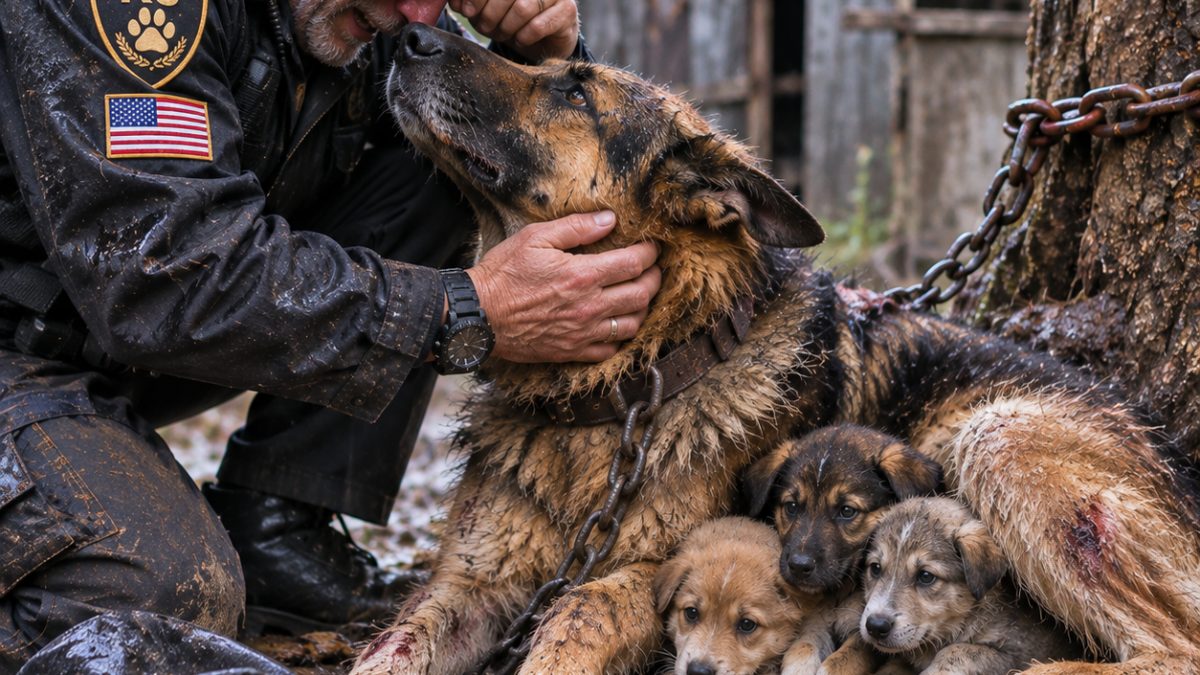
He was chained to an old support column near the far end of the platform.
Large dog once, I thought.
Now perhaps half the weight he should have been.
Brown-and-black mixed breed.
Shepherd somewhere in the bloodline.
Maybe Labrador.
Hard to tell beneath damage.
His coat was gone across much of his back.
Bare skin thick and cracked.
Ribs visible beneath what fur remained.
His neck carried a deep hardened band where the chain had rubbed for so long that skin and metal seemed to have learned each other’s shape.
The chain itself had once been silver.
Now nearly black-brown with rust.
Each link held tiny dark fragments that I did not want to examine closely.
The dog did not bark.
That disturbed me more than barking would have.
He looked at me.
Then lowered his head.
As though people arrived sometimes.
As though people also left.
I stepped closer.
That was when I saw the concrete.
Two curved grooves.
Deep.
Perfect arcs worn around the column.
The dog had paced the same small circle so often, for so long, that his feet had physically carved a path into stone.
I stood there staring.
“How long?”
My voice sounded strange in the empty station.
“How long have you been doing this?”
The dog gave no answer.
Obviously.
I kept talking anyway.
Silence felt unbearable.
“Two months?”
Nothing.
“A year?”
His ears moved weakly.
Then I saw something at the edge of the platform.
Movement.
Three dogs.
Strays.
One large black male.
One brown mutt with scarred muzzle.
One small white female with pointed ears.
They stood perhaps forty yards away.
Watching.
Not approaching.
Not running.
Just watching.
Beside the chained dog lay several objects.
A crust of bread.
Something that looked like part of a hamburger bun.
A chicken bone too old to be recent.
Bits of discarded food.
I looked from the scraps to the strays.
The small white female took one step forward.
Stopped.
The black dog looked at me.
Then at the chained one.
And suddenly the entire scene rearranged itself in my head.
They had been feeding him.
Those three.
The animal chained where he could travel only a few feet had survived because free dogs had brought him pieces of what they found.
I sat down on the cold concrete.
Not because procedure told me to.
Because my legs stopped feeling useful.
“My God.”
The chained dog looked at me again.
I pressed the radio.
“Dispatch, 442.”
“Go ahead.”
“I need animal control at East Junction.”
“Copy.”
I hesitated.
“And contact EMS standby.”
Silence.
“442, confirm EMS?”
“For a dog.”
Another pause.
Then:
“Copy, 442. We’ll contact appropriate services.”
I released radio.
The dog’s head rested on his paws.
I moved closer.
Slow.
No sudden reach.
“Hey.”
His eyes lifted.
“I’m Philip.”
Ridiculous introduction.
Still.
“Today’s my last day.”
I sat five feet away.
He watched.
“Guess yours hasn’t been great either.”
Wind moved loose paper down the platform.
The three strays remained.
I looked at the grooves again.
“You think you’re the only one who’s been walking in circles?”
That sentence came from somewhere too honest.
I leaned my elbows on knees.
“For two years, I’ve been doing about the same thing.”
The dog blinked.
“Wake up.”
“Coffee.”
“Work.”
“Home.”
“Window.”
“Bed.”
“Repeat.”
I laughed once.
No humor.
“My wife left.”
Why was I telling a dog?
Maybe because he could not interrupt.
Maybe because I had not told anyone else.
“She said she was tired of waiting for my job to end.”
I looked at uniform.
“Funny thing.”
“It ends today.”
The dog shifted.
Chain scraped.
“And now I have no idea who I am without it.”
There.
Truth.
Something I had refused to say.
I stared at him.
He stared back.
Two creatures tied to things that had outlived their purpose.
His chain visible.
Mine stitched into the uniform.
Animal rescue arrived at 3:42.
The woman stepped onto the platform carrying a black equipment bag and bolt cutters.
Young.
Late twenties.
Dark hair pulled back.
Blue jacket with county animal response patch.
She stopped when she saw the dog.
Then her eyes moved toward the three strays.
“They’ve been feeding him.”
Not a question.
I stood.
“How do you know?”
She pointed at scraps.
“Different types.”
“Different ages.”
“Some carried.”
She looked toward dogs.
“I’ve seen this before.”
“Dogs keep other dogs alive.”
I swallowed.
“How?”
“Food.”
“Company.”
“Warnings.”
She knelt at distance.
“My name’s Rachel Kim.”
“Philip.”
She studied chain.
Then concrete grooves.
Her face tightened.
“How long?”
“Was hoping you could tell me.”
Rachel ran gloved fingers along one link.
“Layers of oxidation like this…”
She looked at neck.
“Muscle wasting.”
“Nail wear.”
“Skin condition.”
“At least a year.”
She paused.
“Probably closer to two.”
Two years.
I looked at dog.
Two winters.
Two summers.
Rain.
Heat.
Cold.
Same circle.
My chest tightened.
“Who does this?”
Rachel did not answer immediately.
Then:
“Someone who decided leaving was easier than caring.”
That sentence found Ellen in my head.
I almost resented it.
Then realized difference.
Ellen had left me capable of opening a door.
This dog had been left with six feet of chain.
Not same.
Not remotely.
Rachel opened her cutters.
“Hey, sweetheart.”
The dog trembled when metal touched metal.
“Easy.”
She positioned blades.
Cut.
The first link snapped.
The dog flinched.
Second.
Third.
Each one made him shake harder.
Rachel kept talking.
“You’re okay.”
“No one’s tying you again.”
Another cut.
Then final rusted section fell.
The chain hit concrete.
For a moment, the dog did nothing.
He stared at it.
Then lowered his head toward his neck as though expecting weight that was no longer there.
He looked almost confused.
Rachel whispered:
“Go ahead.”
Nothing.
She stepped back.
The dog attempted to rise.
Front legs worked.
Back legs folded.
He fell.
My stomach dropped.
“Why can’t he walk?”
Rachel moved quickly but gently.
Examined hips.
Legs.
Range.
“Because he hasn’t.”
“What?”
“Two years taking maybe three or four steps each direction.”
“Muscles shorten.”
“Joints stiffen.”
“Nerves adapt.”
She looked at me.
“He may need months.”
“If he walks normally again.”
The dog tried once more.
Failed.
Then looked toward the three strays.
The black dog stepped forward.
Just one step.
The white female wagged her tail once.
Then all three turned.
Walked away.
Through weeds.
Behind crumbling wall.
Gone.
I stared.
“They came to say goodbye.”
Rachel looked where they had disappeared.
“Maybe.”
Then softly:
“Or maybe they saw enough.”
Rachel lifted the dog.
He could not have weighed more than twenty pounds.
He should have been nearly forty.
He did not resist.
He closed his eyes.
Rested his head against her shoulder.
“I can take him to county shelter first.”
She said.
“They’ll arrange veterinary stabilization.”
“No.”
The word left before I decided.
Rachel looked at me.
“No?”
“I’ll take him.”
She studied uniform.
Then face.
“You know what he may need?”
“No.”
“Medical bills?”
“I know.”
“Rehab?”
“I’ll learn.”
“Behavioral issues?”
“I’ll learn.”
She tilted her head.
“You’re retiring?”
I looked at badge.
“Six o’clock.”
Rachel smiled faintly.
“Interesting retirement plan.”
“Not exactly planned.”
She looked down at dog.
“Most important thing tonight is emergency veterinary assessment.”
“Then?”
“Then we see.”
I nodded.
“I’ll take him.”
Again.
This time slower.
Certain.
At 4:06, I sat in the back seat of my patrol car.
Technically against policy.
Did not care anymore.
The dog lay wrapped in my uniform jacket.
My coat over him.
Rachel followed in her vehicle.
He looked tiny against black seat.
I touched his head.
“You need a name.”
His eyes opened.
I had no inspiration.
“Buddy.”
He blinked.
“Yeah?”
“Buddy.”
Simple.
Maybe too simple.
I liked it.
“Okay, Buddy.”
His eyes closed.
Dr. Evelyn Parker had practiced veterinary medicine thirty-one years.
White hair.
No-nonsense voice.
She examined Buddy for nearly an hour.
Severe malnutrition.
Dehydration.
Anemia.
Skin infection.
Pressure wounds.
Muscle contracture.
Possible nerve damage.
Parasites.
Several broken teeth.
Old untreated fracture in one rear leg that had healed badly.
But heart?
Strong enough.
Kidneys?
Strained but functioning.
Liver?
Recoverable values.
Evelyn stepped back.
“I’ve seen terrible neglect.”
She said.
“This is near the top.”
Rachel told her about strays.
Dr. Parker shook her head.
“That explains food.”
“Somehow.”
I asked:
“Will he live?”
She looked at me.
“I think so.”
“Will he walk?”
“I don’t know.”
That answer hit harder.
She touched Buddy’s chest.
“This animal survived by willpower, scraps and luck.”
I said quietly:
“So did I.”
Dr. Parker looked at me.
For several seconds she said nothing.
Then simply:
“Then maybe you’ll understand each other.”
At 5:38, I drove back to station.
Buddy remained at clinic overnight.
I could have delayed retirement paperwork.
No reason.
I walked into locker room.
Removed badge.
Gun.
Radio.
Duty belt.
Each object went into its place.
The younger officers had cake.
Someone brought balloons.
I hated balloons.
Dennis would have made fun of the whole thing.
Captain gave speech.
Twenty-nine years.
Commendations.
Cases.
Community service.
Blah blah blah.
I heard almost none.
At exactly six, I signed final document.
Captain shook my hand.
“Congratulations, Phil.”
I looked at badge on desk.
Then thought about chain hitting concrete.
“Thanks.”
Walking out without that weight felt strange.
Not light.
Empty.
At first.
I went directly back to clinic.
Buddy was asleep.
IV fluids.
Blanket.
Rachel had left.
Evelyn looked at me.
“You came back.”
“Of course.”
She nodded like that mattered.
Maybe it did.
I sat beside Buddy’s kennel until midnight.
No uniform.
No badge.
Just Philip.
The name suddenly felt unfamiliar.
Buddy came home two days later.
Instructions filled three pages.
Small frequent meals.
Medication.
Wound care.
Physical therapy consultation.
Assisted standing.
No unrestricted food because severely starved animals can become dangerously ill if overfed too quickly.
I learned terms I never expected.
Refeeding syndrome.
Contractures.
Hydrotherapy.
Weight-bearing exercises.
I bought rugs because hardwood was too slippery.
Dog bed.
Bowls.
Harness.
Medication organizer.
Chicken.
More towels than any one man needs.
My house looked occupied for first time in two years.
Buddy lay on living-room floor.
Did not touch bed.
Did not eat.
Did not drink unless bowl held near mouth.
He stared at wall.
I sat in my chair.
“What now?”
No answer.
Fine.
I began talking.
Morning.
Evening.
Everything.
“I know.”
I said often.
Probably too often.
“I know it’s hard.”
Sometimes about him.
Sometimes myself.
“You don’t trust this.”
“Neither do I.”
“New house.”
“No chain.”
“No job.”
“Just us.”
On day three, Buddy lifted his head when I entered.
Small thing.
I nearly cried.
Day four, he licked my fingers once after wound cleaning.
Day five, drank from bowl himself.
Day seven, he ate a small piece of chicken from my hand.
Chewed slowly.
Swallowed.
Then looked directly at me.
Something changed.
Not love.
Too early.
Attention.
Possibility.
I smiled.
“There you are.”
Physical therapy began week two.
The therapist, Dr. Leah Morgan, came to house first.
Buddy could barely support hindquarters.
She showed me sling support.
Passive range-of-motion exercises.
Massage.
Warm compresses.
Tiny goals.
“Three seconds standing.”
She said.
“Celebrate three.”
“Then five.”
I had spent career measuring success in arrests, resolved calls, reports closed.
Now success became a dog standing for three seconds.
One.
Two.
Three.
Buddy collapsed.
I cheered.
Actually cheered.
He looked at me like I had lost my mind.
Leah laughed.
“Good.”
“What?”
“He’s judging you.”
“That means he’s engaged.”
Excellent.
Be rude, Buddy.
Anything but empty.
Weeks passed.
Buddy gained weight.
Twenty pounds became twenty-four.
Then twenty-eight.
His fur began returning in thin patches.
Skin softened.
The groove around neck slowly healed.
But the strangest thing was his movement.
At first, when awake, Buddy tried to pace.
Not around house.
A circle.
Always same direction.
He would stand with sling.
Take one step.
Turn.
Another.
Turn.
As if invisible chain remained.
The first time, I stopped him.
Then realized I should not.
So I followed.
Slow circle around rug.
Again.
Again.
My living room became concrete platform.
I understood too well.
I had my own invisible route.
Coffee.
Window.
Chair.
Bed.
Routine can become chain long after metal is gone.
One morning Buddy stopped mid-circle.
Looked toward hallway.
Then walked straight.
Three whole steps.
Not curved.
Straight.
I sat down on floor.
“Good boy.”
He fell against my leg.
I held him.
Not tightly.
Enough.
I started changing my own circle too.
I made coffee.
Then instead of window, porch.
Then grocery store at different time.
Called Dennis’s widow, Marla, whom I had avoided because grief conversations scared me.
She invited me for lunch.
I went.
Called my brother.
Joined retirement breakfast group even though they complained too much about politics and knees.
Walked without destination.
Small things.
Buddy learned straight lines.
So did I.
Rachel visited.
She brought photographs.
“What?”
I asked.
“The strays.”
My heart jumped.
“You found them?”
“Sort of.”
She had returned to station ruins several mornings.
The black male appeared first.
Then brown dog.
White female.
She began leaving food at safe distance.
Working with trap-neuter-return and rescue volunteers.
“They’re smart.”
She said.
“Very wary.”
“Can you bring them in?”
“Maybe eventually.”
I looked at Buddy.
He was sleeping.
“Do they know?”
Rachel smiled.
“Know what?”
“That he’s okay.”
She thought.
“Dogs don’t think in narratives like we do.”
Then:
“But they saw him leave alive.”
“That may be enough.”
I liked that answer.
Month two.
Buddy stood without sling for eight seconds.
Then twelve.
First step independently came on a Tuesday morning.
I had placed water bowl five feet away.
Not intentionally as test.
Forgot.
Buddy looked at it.
Looked at me.
I moved to get it.
He stood.
I froze.
One step.
Rear leg shook.
Second.
Third.
He reached bowl.
Drank.
I covered my mouth.
No one there to see.
“Buddy.”
He drank.
“Buddy.”
He looked up.
I started laughing.
Then crying.
Finally.
Two years of circle.
Now three steps toward water.
Freedom does not always look like running.
Sometimes it is three ugly steps across a rug.
Month three, we began hydrotherapy at clinic.
Buddy hated water at first.
Not panic.
Offense.
Leah supported him in warm pool.
Legs moved almost automatically.
Muscles remembered possibilities.
He swam badly.
I praised excessively.
On fourth session, tail wagged.
First real wag I saw.
Not tiny.
Full.
Once.
Then twice.
Leah looked at me.
“You saw?”
“I saw.”
That evening I bought steak.
Dr. Parker would have objected.
I cooked a small approved portion.
Celebration requires standards.
Buddy began gaining personality.
Important.
For weeks he had been only injury.
Fear.
Recovery.
Then preferences appeared.
He hated bananas.
Loved chicken.
Barked at vacuum.
Was suspicious of men wearing hats.
Loved women over sixty.
No explanation.
Stole one sock.
Slept near my chair but not on dog bed.
Preferred sun patches.
Hated rain.
Was fascinated by squirrels but too slow to chase.
This was progress no medical chart captured.
A traumatized animal becoming annoying is wonderful.
One afternoon, Mrs. Garcia from next door knocked.
Seventy-three.
Widow.
Built like someone who could win argument with a truck.
She looked at Buddy through doorway.
“That him?”
“Yes.”
“The train station dog?”
Word had spread.
Of course.
She entered slowly.
Buddy watched.
Mrs. Garcia sat on floor without asking.
Good instincts.
“Hello, handsome.”
Buddy crawled closer.
Placed head in her lap.
I stared.
“You have got to be kidding.”
She smiled.
“He has taste.”
Traitor.
She became regular visitor.
Brought approved treats.
Called me “Officer Morrison.”
I corrected:
“Just Philip.”
She waved.
“You’ll be Officer Morrison until I die.”
Fair.
Month four, Buddy ran.
Maybe ten feet.
More like awkward trot.
Still.
Backyard.
I unclipped long line.
He looked around.
Moved.
Faster.
One leg still crooked.
Body unbalanced.
Then something inside him opened.
He made a small circle.
I tensed.
Old pattern.
But this circle was different.
Tail up.
Mouth open.
Joy.
He ran one circle.
Then another.
Not because chain forced him.
Because he could.
I laughed so hard I had to hold porch railing.
“Look at you!”
Buddy ran toward me.
Nearly fell.
I caught him.
He licked my chin.
For first time.
Properly.
I sat on grass with him.
Two old fools.
One technically dog.
Both learning what movement feels like when chosen.
Rachel called that week.
“We got the white female.”
I sat straight.
“She okay?”
“Healthy enough.”
“Scared.”
“Pregnant?”
“No.”
“Spayed now.”
“What about others?”
“Still working.”
I asked:
“Can Buddy see her?”
Rachel hesitated.
“Maybe after quarantine and temperament check.”
Three weeks later, she brought her.
We met in fenced neutral yard at rescue facility.
Buddy walked slowly.
White female entered.
She froze.
Buddy froze.
No cinematic running.
No barking.
They stared.
Then her tail moved.
One wag.
Exactly as station.
Buddy’s entire body changed.
He pulled.
Not hard.
I loosened leash.
They approached.
Sniffed.
White dog licked Buddy’s mouth once.
Buddy leaned into her.
I cried immediately.
No dignity.
Rachel did too.
“She remembers him.”
Maybe.
Probably scent.
History.
Whatever.
They spent fifteen minutes together.
When white female left, Buddy watched door.
Then looked at me.
I scratched neck.
“Your friend’s okay.”
That mattered.
To me, at least.
The black dog was trapped a month later.
The brown one another six weeks after.
All three eventually entered rescue programs.
Black male adopted by a mechanic with two acres.
Brown mutt by retired schoolteacher.
White female by Rachel herself.
Of course.
She named her Hope.
Too sentimental.
I approved.
Once, Rachel brought Hope to my house.
Buddy and Hope slept side by side on porch.
No drama.
No gratitude ceremony.
Just two dogs asleep in sun.
That image did more for me than any speech.
The pack that had kept Buddy alive scattered into homes.
The chain had not only broken for him.
Six months after East Junction, Buddy weighed forty-two pounds.
Healthy for his frame.
Coat returned.
Not perfectly.
Some scarred areas stayed bare.
Neck groove remained visible beneath fur.
Rear leg always slightly crooked.
But he walked.
Ran.
Climbed three porch steps.
Jumped onto couch despite being specifically told not to.
Then onto my lap.
Forty-two pounds.
“My God.”
I said.
“You are too big.”
Buddy ignored.
Curled anyway.
This became nightly ritual.
Chair.
Television.
Buddy half on me.
Half hanging off.
I stroked head.
He slept.
House no longer quiet.
I no longer minded.
People asked why I retired that exact day.
As if Buddy caused it.
No.
Paperwork had been filed months earlier.
But emotionally?
Maybe he made retirement possible.
At six o’clock, when I handed over badge, I had somewhere to go.
Someone needed medication at eight.
Someone needed food in controlled amounts.
Someone needed help standing.
Duty did not disappear.
It changed uniform.
That mattered.
Mrs. Garcia came one evening.
Sat on porch.
Buddy at my feet.
“You look different.”
She said.
“How?”
“Less like a man waiting for something bad.”
I laughed.
“That specific?”
“Yes.”
She pointed.
“That dog did it?”
I looked down.
“No.”
Then reconsidered.
“Partly.”
“What did he teach you?”
I thought.
“Family isn’t always blood.”
Too obvious.
Then better answer came.
“Sometimes family is who feeds you when nobody is watching.”
Mrs. Garcia became quiet.
She knew about strays.
“Yes.”
She said.
“That’s better.”
I contacted Ellen eventually.
That might surprise you.
Not to reconcile.
Life is not movie.
She lived two states away.
Had new relationship.
We had signed divorce papers.
But Buddy changed something.
I stopped wanting to punish the past by refusing contact.
I sent one email.
I retired. I’m okay. Hope you are too.
She replied.
I’m glad, Philip. I’m sorry it took us losing each other for you to stop.
That sentence hurt.
Because true.
Then she added:
I heard about the dog. He sounds lucky.
I looked at Buddy sleeping.
I wrote:
I think we both are.
That was last exchange for long time.
Enough.
Closure is overrated.
Sometimes civility is enough.
I also visited Dennis’s grave.
First time since funeral.
Took Buddy.
Cemetery quiet.
I sat.
“Sorry.”
No idea why.
For not crying?
For avoiding Marla?
For retiring after him?
Buddy sniffed grass.
Then sat against leg.
I finally cried for Dennis.
Then Ellen.
Then years.
Grief had been waiting like water behind dam.
Buddy simply gave me reason to sit still long enough for it to break.
I went home exhausted.
Lighter.
East Junction station was demolished the following spring.
Before work began, Rachel and I went back.
Buddy too.
He entered platform.
Stopped.
I worried.
His body remembered.
He walked toward old column.
Chain gone.
Grooves remained.
Deep.
Visible.
Buddy sniffed them.
Then did something unexpected.
He stepped out of circle.
Walked twenty feet toward edge of platform.
Looked back at me.
Tail wag.
I followed.
Of course.
We stood where strays had watched.
Rachel took photo.
Not of grooves.
Buddy looking toward open sky.
That is only photo I kept from station.
Demolition crew offered me section of concrete with groove.
I said no.
At first.
Then changed mind.
A small piece.
Palm-sized.
Sits in garden now beneath maple tree.
Not shrine.
Reminder.
You can wear path into stone and still leave it.
Buddy became minor local celebrity.
I hated this initially.
Newspaper article.
“Retired Officer Saves Chained Dog.”
Wrong framing.
Strays saved him.
I arrived last.
I told reporter.
She included them.
Good.
Donations came to rescue.
Enough to fund outreach for abandoned animals near industrial sites.
Rachel called it “Buddy Fund.”
I argued.
She ignored.
White dog Hope appeared on logo too.
Better.
One school invited us.
Children sat cross-legged.
Buddy loved them.
A boy asked:
“Why didn’t he break chain?”
I explained dogs cannot cut metal.
Another asked:
“Why didn’t people help?”
Harder.
“I don’t know.”
Then a little girl said:
“The other dogs did.”
“Yes.”
She smiled.
“So dogs were nicer.”
The room laughed.
I didn’t.
Children sometimes identify truth too cleanly.
“They noticed.”
I said.
“That’s important.”
Maybe that was lesson.
Notice.
Buddy never became therapy dog officially.
Training around crowded spaces was too much.
But neighborhood children visited.
He tolerated gentle hands.
Once a boy who stuttered sat on porch with him for forty minutes without speaking.
Buddy placed paw on shoe.
Boy smiled.
No need certificates for every kindness.
Year one anniversary.
November 12.
I woke early.
Made one coffee.
Then looked at second mug in cabinet.
Old habit with Ellen.
Instead of grief, I poured a little warm broth into Buddy’s bowl.
Not coffee, obviously.
He drank.
We drove to park.
No ceremony.
Rachel met us with Hope.
Black and brown former strays’ adopters came too.
First time all four dogs together since station.
Would they remember?
Again, impossible to know.
But when Buddy saw them, his tail went wild.
Hope barked.
Black dog approached.
Brown mutt circled.
They sniffed.
Then ran.
All four.
Across fenced field.
Buddy slower.
Still crooked.
But running.
The three dogs who had once brought food to a chained friend now chased each other without chain anywhere.
People cried.
Dogs did not care.
Perfect.
I told Rachel:
“This is enough.”
“What?”
“If nothing else good happens to me.”
She frowned.
“Don’t say stupid things.”
I laughed.
She was right.
Life had more.
Buddy turned six.
Then seven.
We settled.
My retirement became real life instead of blank space.
Morning walks.
Volunteer work at rescue twice a week.
Coffee with old cops.
Lunch with Mrs. Garcia.
Physical therapy maintenance.
Gardening badly.
Buddy supervising.
I learned cooking beyond microwave.
Mostly because Buddy’s nutrition made me think about mine.
Embarrassing.
My doctor said blood pressure improved.
I blamed dog.
I adopted no second dog.
Buddy liked canine visitors but preferred house as his.
Fair.
Hope visited occasionally.
She and Buddy slept together.
Rachel joked they were married.
I said do not project human institutions.
Then bought matching holiday bandanas.
Hypocrisy.
At eight, Buddy developed arthritis in injured leg.
Medication.
Ramp.
Swimming.
He accepted.
We had years.
Good years.
Ordinary.
Those matter most.
Not dramatic rescue.
Mornings where he refused breakfast because pill hidden badly.
Evenings stealing my chair.
Rainy days.
Neighbors.
Vet appointments.
Small life.
Safe.
At nine, Mrs. Garcia died.
Stroke.
Her daughter came to tell me.
Buddy waited by fence for days.
She used to visit at four every afternoon.
At 4:05 first day, he stood.
Looked toward gate.
Nothing.
Second day.
Same.
I sat beside.
“She’s not coming.”
Buddy looked.
Could not understand words.
I understood enough for both.
We stayed.
Grief again.
Different.
But this time I did not run.
That was progress.
At ten, Buddy’s muzzle gray.
Scars softer.
People meeting him could not imagine station.
Good.
Trauma should not be only introduction.
He was not “chained dog.”
He was Buddy.
Hated thunderstorms.
Loved scrambled eggs.
Stole gardening gloves.
Barked at delivery trucks.
Farted dramatically.
Snored.
Preferred left side of couch.
Those facts deserved equal weight.
Rachel once asked:
“Do you ever think about who chained him?”
Less than before.
Investigation had found former property caretaker likely responsible, but evidence insufficient after time.
No satisfying justice.
I hated that at first.
Then Buddy taught something unpleasant.
Justice matters.
But life cannot wait for it.
Buddy did not need a conviction to heal.
He needed food.
Care.
Movement.
Safety.
A home.
I stopped letting unknown person occupy mental space.
Buddy deserved bigger story than cruelty.
At eleven, heart murmur.
Manageable.
At twelve, kidneys beginning decline.
Old age.
I knew where this went.
I also knew better than bargaining.
We adjusted.
Shorter walks.
More porch.
More lap despite weight.
He had slimmed.
Still too big for lap.
No one told him.
One November morning—the anniversary again—Buddy could not stand immediately.
I helped.
He looked embarrassed.
Dogs can look embarrassed.
I swear.
I used sling.
We went outside.
Cold.
He sniffed air.
Then walked to maple tree where concrete groove fragment sat.
Stopped.
Lay down.
I sat beside.
“Remember?”
Probably not.
Maybe body.
I touched old scar around neck.
“No chain now.”
Buddy sighed.
Several weeks later, Dr. Parker—older now too—gave me diagnosis.
Cancer.
Spleen.
Spread.
I stared.
“Time?”
“Weeks.”
Maybe.
My mouth went dry.
“Pain?”
“Can control for a while.”
I nodded.
No denial.
That surprised me.
Buddy had already taught goodbye indirectly.
Ellen.
Dennis.
Mrs. Garcia.
Strays scattered.
Everything changes.
Love does not prevent.
We made last weeks good.
Chicken.
Sun.
No unnecessary rules.
Hope visited.
Rachel sat.
Black and brown dogs’ families came once.
All older.
They sniffed Buddy.
Hope lay beside.
For an hour, pack reunited.
I watched.
No speeches.
Dogs do not need speeches.
On his final day, Buddy stopped eating.
Would not rise.
Breathing changed.
I knew.
Called mobile vet.
Rachel came.
Hope came.
I hesitated about others.
No.
Too much.
Quiet.
Buddy lay on couch because rules gone.
Head in my lap.
Exactly ritual.
I stroked.
“Good job.”
That phrase felt familiar.
I had said same at night years before.
“Buddy, we did good work, you and me.”
His tail moved.
Once.
Rachel cried.
I did too.
Before medication, I placed the old chain fragment on table.
Not around him.
Never.
Just visible.
Then I looked at Buddy.
“You know what I thought that day?”
He breathed.
“I thought I was saving you.”
I laughed quietly.
“Typical cop.”
“Always thinks he’s rescuing somebody.”
My voice broke.
“You got me out too.”
There.
Truth.
“I didn’t know I was chained.”
“Different chain.”
“But still.”
Buddy’s eye opened.
I kissed his head.
“You don’t owe me anything.”
“You already paid.”
Vet gave sedative.
His body relaxed.
For first time, no stiff leg.
No pain.
I held.
Then final injection.
Breathing slowed.
Stopped.
No dramatic sign.
Peace.
Just absence arriving.
I cried harder than I had at station.
Harder than Ellen leaving.
Harder than Dennis’s funeral.
Because by then I had learned how.
Buddy had taught me that too.
Hope placed nose against his paw.
Then looked at Rachel.
No panic.
She lay beside couch.
Stayed.
For nearly twenty minutes.
Then stood.
Walked to door.
Rachel whispered:
“She knows.”
Maybe.
Maybe scent.
Maybe change.
Enough.
I buried Buddy’s ashes beneath maple tree next to concrete groove fragment.
Not entire ashes.
Kept some.
I placed simple stone:
BUDDY
FOUND NOVEMBER 12
HOME EVER AFTER
Maybe corny.
I did not care.
The house became quiet.
Dangerous quiet.
For first week, I walked old circles again.
Kitchen.
Window.
Chair.
Bedroom.
Then stopped myself.
No.
Not this time.
I called Rachel.
Volunteered extra.
Called Marla.
Went to breakfast.
Visited my brother.
Walked.
Straight lines.
Buddy had left instructions without words.
Do not return to chain simply because familiar.
Months later, Rachel asked if I wanted foster.
I said no.
Then she showed me photograph.
Old brown dog.
Ten.
Owner died.
Shelter stress.
I said:
“Temporary.”
Of course.
His name Charlie.
He slept in Buddy’s old spot first night.
I cried.
Then Charlie snored so loudly I laughed.
Two weeks later, adopted by retired couple.
Good.
I did not keep him.
That mattered.
Buddy had not turned me into man who needed replacement dog constantly.
He turned me into man who could help and let go.
Different.
I never remarried.
Not tragedy.
Life filled differently.
Friends.
Rescue.
Old colleagues.
Rachel.
Dogs.
Garden.
Maybe love does not always return in same category.
That was okay.
Ellen sent condolence card when Buddy died.
How she heard, I do not know.
Probably newspaper.
She wrote:
I’m glad you found him, Phil. I’m even more glad he found you.
I sat holding card.
No anger.
No wish.
Just gratitude.
She had been part of life.
Then not.
Buddy taught me not every ending means failure.
Sometimes relationship completed what it could.
The three strays all died years later in homes.
Hope first? Actually brown dog passed first at twelve.
Black male next.
Hope lived longest.
Rachel called when Hope died.
We cried on phone.
She said:
“They’re all gone now.”
I looked at Buddy’s stone.
“Yes.”
Then:
“No.”
Not philosophically.
Their effects remained.
Four dogs entered one story because three refused to let fourth starve.
Each went on to homes.
People changed.
Programs funded.
Kids learned.
I changed.
Gone is not same as erased.
The old East Junction station site became a public greenway.
Funny.
City cleared debris.
Planted trees.
Walking path follows part of old platform.
I went opening day.
No dog.
Just me.
I found approximate column location.
Nothing remained.
No grooves.
No chain.
Grass.
Families.
Bicycles.
One boy threw ball for dog.
I stood too long.
Someone asked if I was okay.
“Yes.”
I said.
For once, completely true.
I sat on bench.
Thought about 3:00 p.m. years earlier.
A dog too weak to bark.
Three strays watching.
Officer almost retired.
All of us existing at intersection.
What if caller never phoned?
No point.
What happened happened.
Someone noticed.
Called.
I went.
Rachel cut chain.
Buddy lived.
That is enough.
People often tell story as if I heroically chose Buddy.
No.
Truth?
Words left mouth before thought.
“I’ll take him.”
Maybe because I saw myself.
Maybe because retirement terrified me.
Maybe because I needed duty.
Selfishness mixed with compassion.
Human motives are messy.
Good outcomes do not require pure motives.
I stayed.
Learned.
Loved.
That is what counts.
The real heroes, if we need that word, were probably three dogs nobody owned.
They had almost nothing.
Still shared.
Think about that.
A stray dog finds food.
Food means survival.
Yet brings some to chained dog.
Again.
Again.
For months.
Maybe years.
No applause.
No cameras.
No promise of reward.
They simply did not abandon one of their own.
That humbled me more than any badge I ever wore.
I spent career believing service came from oath.
Training.
Duty.
Uniform.
Those strays had none.
Yet served.
Buddy had no badge.
Yet gave me purpose.
Maybe decency exists before institutions.
Institutions simply try to organize it.
Sometimes succeed.
Sometimes fail.
My badge is in drawer now.
Not displayed.
People expect shadow box.
No.
It was job.
Important.
Proud.
Finished.
Buddy’s collar hangs near kitchen door.
That object I display.
Not because dog mattered more than twenty-nine years.
Because collar reminds me what came after.
There is always after.
Even when you cannot imagine it.
On cold mornings, I still make one coffee.
I no longer see it as absence of second cup.
Just my coffee.
That took years.
Funny what healing looks like.
Not big moment.
Ordinary thing losing pain.
Sometimes I sit by window and remember Ellen.
I hope she is happy.
Dennis.
Mrs. Garcia.
Buddy.
Hope.
No ache sharp enough to stop day.
Memory soft.
Peace.
That is home too.
If there is one thing I would tell the younger officers who worked retirement party, it is this:
Do not confuse usefulness with worth.
I did.
For years.
I thought badge made me necessary.
When badge came off, I feared disappearing.
Buddy had been chained because somebody decided his life was disposable.
Three strays disagreed.
They fed him without asking whether he was useful.
That lesson was waiting for me.
You do not have to earn right to be cared for.
Neither dogs nor men.
Buddy’s first week, when he would not eat, I told him:
“We’ll get through it.”
I thought I meant him.
Maybe I meant us.
We did.
Not permanently.
Nothing is permanent.
But through that season.
Then another.
Then years.
That is what life gives.
Not forever.
Next.
The most beautiful thing Buddy ever did was not run.
Though seeing him run after two years chained was extraordinary.
It was not licking my hand.
Not sleeping on lap.
It was not surviving.
Survival was forced on him.
The most beautiful thing was trust returning gradually despite no requirement that it should.
One bite of chicken.
One straight step.
One tail wag.
One couch nap.
He did not owe the world trust.
He gave some anyway.
That changed me.
The most beautiful thing the stray dogs did was not feed him once.
It was return.
Again.
Again.
Again.
Kindness repeated becomes rescue.
One meal might delay hunger.
Two years of scraps?
That is loyalty.
The most important thing I did was not adopt Buddy.
It was stay when adoption stopped feeling noble.
Wound cleaning.
Vet bills.
Accidents in house.
Sleepless nights.
Physical therapy.
Fear setbacks.
That is where rescue becomes relationship.
A dramatic choice is easy.
Repetition is love.
I learned from three strays.
Sometimes people ask whether Buddy ever saw them all together after first anniversary.
Yes.
Several times.
Did they form old pack?
No.
Lives changed.
Hope belonged with Rachel.
Black dog with mechanic.
Brown with teacher.
Buddy with me.
They greeted.
Played.
Then returned to their people.
That was success.
Rescue should not preserve suffering bonds forever for sentiment.
It should expand choices.
They chose homes.
Good.
I keep one photograph.
Four dogs in field.
Buddy center.
Hope white blur.
Black dog behind.
Brown dog running sideways.
No chain.
No station.
That is ending.
On the back, Rachel wrote:
They all made it.
Three words.
I used to think “made it” meant survived.
Now I think it means more.
They became safe enough to stop surviving every second.
Buddy learned naps.
Play.
Annoyance.
Rain preferences.
Love.
That is living.
If you find an animal chained somewhere, call someone.
Do not assume somebody else will.
If you notice neighbor dog starving, report it.
If something feels wrong, look again.
Buddy survived because three dogs looked.
Then one caller looked.
Then I looked.
Rachel looked.
Every rescue begins with attention.
And if you find a person walking circles too?
Maybe notice them too.
Retirement.
Divorce.
Grief.
Loneliness.
Humans hide chains better.
Sometimes all they need is reason to step out of groove.
Not advice.
Not motivational speech.
Someone requiring breakfast at seven can work.
Trust me.
Years ago, Mrs. Garcia asked what Buddy taught me.
I said:
“Family is who feeds you when nobody’s watching.”
I still believe that.
But I would add something now.
Family is also who waits while you learn to walk straight again.
Who does not shame you for circles.
Who celebrates three steps.
Who makes room on couch.
Who stays long enough for new habits to become home.
On Buddy’s last night, I said we did good work.
I meant it.
Not police work.
Life work.
He helped me become Philip after Officer Morrison.
I helped him become Buddy after chained dog.
Fair exchange.
Maybe more than fair.
If I could go back to East Junction at 2:56, I would not change much.
I would kneel sooner.
I would bring blanket.
I would thank the strays aloud.
I would tell Buddy:
“You are going home.”
He would not understand.
Still.
I would say it.
Because sometimes words matter mainly to speaker.
And perhaps I would tell myself:
“You are going home too.”
Not to old house.
To life.
There is difference.
November 12 is no longer retirement anniversary to me.
It is Chain Day.
Rachel hates name.
Too dramatic.
Every November 12, I donate to rescue.
Buy bags of food.
Three bags.
One for each stray that fed Buddy.
Then one more for him.
Four.
I take them to shelter.
No ceremony.
That feels right.
Food given where no one watches.
Full circle.
Better circle.
I do not know whether dogs understand gratitude.
Humans overuse that idea with rescues.
“They’re so grateful.”
Maybe not.
Maybe they are simply safe.
Safety is enough.
Buddy did not owe me gratitude.
The strays did not owe Buddy food.
I did not owe them life transformation.
Yet all happened.
That is beauty.
Unrequired kindness.
The concrete groove fragment beneath maple has moss now.
Almost covered.
I could clean it.
I don’t.
Let nature soften.
One day no groove visible.
Good.
Not every scar needs preservation forever.
Collar stays.
Photograph stays.
Memory stays.
Stone can disappear.
I am seventy now.
Slower.
Still volunteer.
Mostly paperwork.
Irony.
Sometimes transport animals.
Young volunteers call me Mr. Morrison.
I tell them Philip.
They ignore.
One asked recently:
“Were you really cop who found Buddy?”
“Yes.”
“Was it your last day?”
“Yes.”
“That’s insane.”
“Pretty much.”
Then she asked:
“What made you take him?”
I thought.
“Timing.”
Not satisfying.
She frowned.
I added:
“He looked like he needed someone.”
“And?”
“I needed someone too.”
Better.
She smiled.
“So you saved each other.”
I almost corrected.
Cliché.
Then stopped.
Sometimes cliché becomes cliché because true often enough.
“Yeah.”
I said.
“Something like that.”
At home, no dog currently.
I foster occasionally.
Maybe someday another permanent.
Maybe not.
House no longer frightening empty.
I learned to be alone without being abandoned.
Important distinction.
Buddy helped.
At night, I still sit in same chair.
Nobody climbs on lap.
Sometimes I miss weight.
Then smile.
My knees are grateful.
I look toward collar.
“Good work, buddy.”
Habit.
No answer.
Fine.
I do not need one.
And somewhere in my memory, East Junction remains intact.
Clouded sky.
Rust.
Broken windows.
One exhausted dog.
Three strays.
Chain.
Me in uniform.
Rachel cutting.
Last link falling.
Sound echoing.
Buddy looking down as if he cannot believe neck suddenly light.
That second changed both of us.
But not because chain fell.
Metal can be cut in minutes.
Real chains take longer.
Buddy’s muscles needed months.
Trust needed time.
My loneliness too.
Freedom is not instant after release.
It must be practiced.
That may be the truest thing I learned.
Buddy practiced.
One step straight.
Then another.
One meal.
One wag.
One run.
One couch nap.
Until freedom stopped feeling new.
I practiced.
One phone call.
One lunch.
One walk.
One morning without uniform.
One day without checking clock for shift.
Until being Philip felt enough.
The chain broke once.
We broke the rest together.
That is why, when people ask what happened on my final shift, I do not say:
“I rescued a dog.”
I say:
“I answered one more call.”
That is all.
One last call.
One forgotten station.
One chained animal.
Three stray witnesses.
And a decision I made before I had time to be afraid of it.
“I’ll take him.”
Sometimes life turns on sentences spoken too quickly to become excuses.
Mine did.
Buddy did not know I was retiring.
Did not know Ellen.
Dennis.
Loneliness.
Badge.
He did not come to save me.
He needed help.
That was enough to create my help.
Maybe that is how rescue often works.
The one in front of you gives you reason to stop staring at yourself.
Service becomes bridge.
Then relationship becomes home.
The last lesson belonged to the strays.
They never came to house expecting thanks.
Never asked reward.
They fed Buddy because he was there.
That is it.
Maybe kindness does not need philosophy.
Need appears.
You have something.
You share.
Again tomorrow.
I spent twenty-nine years wearing badge meant to represent service.
At sixty-one, on day I removed it, three homeless dogs taught me simplest version.
Feed the one who cannot reach food.
Stay near the one who cannot leave.
And when help finally comes—
let him go.
I think about the white female’s tail wag.
One time.
Then turning away.
No dramatic goodbye.
She did not follow ambulance.
She trusted enough to leave.
That might have been her final gift.
Buddy was someone else’s responsibility now.
She could stop.
Rescuers need that lesson too.
You cannot carry everyone forever.
Sometimes you hand them forward.
Rachel carried Buddy to car.
I carried him home.
Dr. Parker carried medical part.
Leah carried rehab.
Strays carried food.
Buddy carried me through retirement.
No one did everything.
That is another truth.
Rescue is relay.
If you are lucky, someone hands you life when your hands are empty.
Then you carry it awhile.
Then someday you hand something forward.
Buddy’s body is gone.
His work is not.
I volunteer because of him.
Rachel built better outreach because of him.
People adopted three strays because story reached them.
Children learned about reporting neglect.
I learned to cry.
That last one probably helped most.
I cried when Buddy died.
I cried for Ellen years late.
Dennis.
Mrs. Garcia.
Maybe myself.
No shame.
Old cops are bad at grief because training says control.
Dogs do not care about training.
Buddy put head on lap.
That was permission.
The first time he did that?
Not first week.
Month two.
He managed to climb beside chair.
Rested chin on knee.
I froze.
Same posture as white stray maybe? No.
Just Buddy.
I stroked.
He slept.
That was first night I did not feel alone.
Not because another body erased loneliness.
Because I had somewhere for affection to go.
That is different.
I hope everyone gets that at least once.
Someone or something that gives unused love a place to land.
On my wall there is no framed badge.
There is photo of four dogs running.
Underneath handwritten card from Rachel:
They all made it.
That is my retirement certificate.
Better.
And if you ask whether Buddy’s eyes had no pain in end?
No.
He was old.
Sick.
Pain existed.
But he was not afraid.
That matters more.
Peace is not absence of every hurt.
Sometimes peace is knowing where you are.
Whose hand is on you.
That no chain remains.
Buddy knew home.
At last.
So did I.
And for a dog who once spent two years walking the same few feet until his paws carved a circle into concrete—
that was enough.
More than enough.
It was everything.








