PART2:“I DON’T CARE IF HE’S AUTISTIC! KEEP THAT BOY QUIET OR PAY THE PRICE!” HOA Karen Humiliated a 72-Year-Old Veteran and Hit Him With Nearly $8,000 in Fines Over His 9-Year-Old Grandson — But When a Secret Recording Exposed Her Cruel Words, the Entire Neighborhood Discovered the Disturbing Pattern She Had Been Hiding
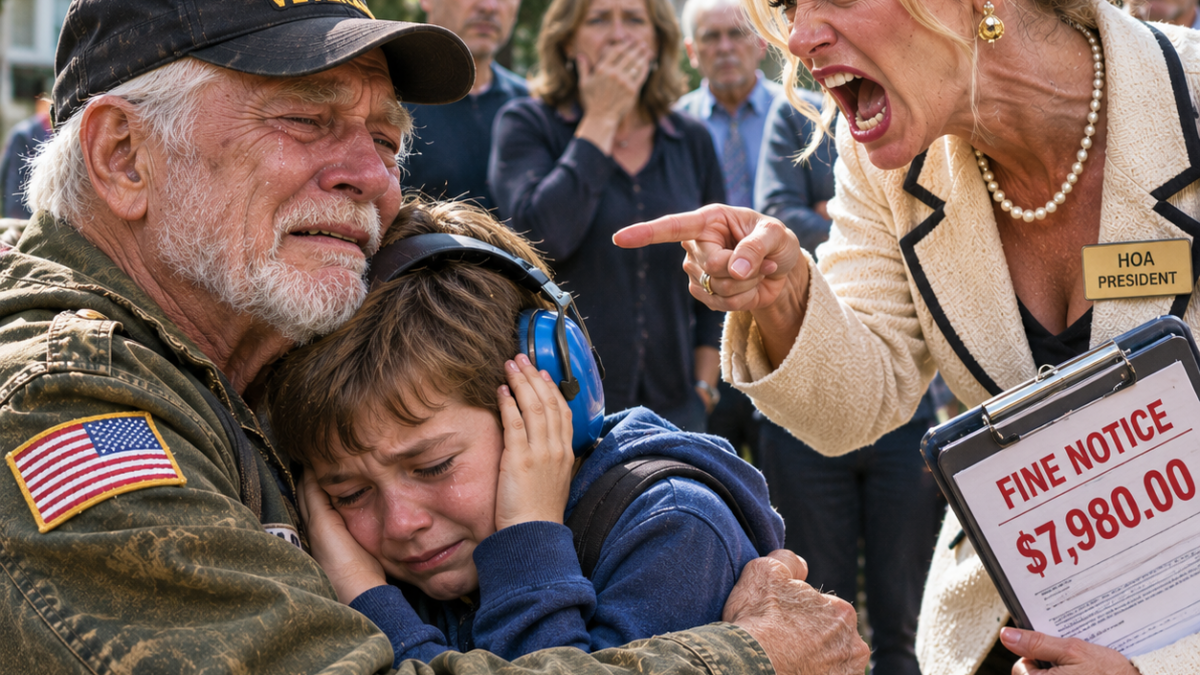
His stomach tightened.
He opened the envelope.
And began reading.
Persistent nuisance behavior.
Repeated disturbances.
Failure to comply with community standards.
Then he reached the amount.
$7,850 in outstanding fines and administrative penalties.
Walter stared.
He read the number again.
Then a third time.
Nearly eight thousand dollars.
For a moment, he wondered whether someone had confused his address with another homeowner’s property.
He had never hosted loud parties.
Never played music late at night.
Never threatened his neighbors.
His lawn was neatly maintained.
His garbage cans were stored properly.
And most evenings, his house was quiet by eight thirty.
Then he reached the paragraph explaining the alleged disturbances.
His hands began shaking.
The notices referred to his grandson.
Mason.
Nine years old.
Autistic.
A little boy who loved dinosaurs, colorful pencils, and drawing cartoon animals with enormous eyes.
A child who sometimes became overwhelmed by too much noise, too many people, or unexpected changes.
During those moments, Mason might shout.
Flap his hands.
Pace in circles.
Or need to move somewhere quieter until he felt regulated again.
Walter always stayed with him.
He knew Mason’s signals.
He knew when to speak softly and when to give him space.
He knew how to help the boy feel safe without shaming him.
And now the HOA was demanding thousands of dollars because his grandson’s disability-related behavior had supposedly lowered the neighborhood’s quality of life.
Walter lowered himself onto the porch steps.
The paper trembled between his fingers.
He had spent years believing his military service had prepared him for almost anything.
But no training had prepared him to explain to a nine-year-old child why a grown woman hated hearing his voice.
The front door opened behind him.
“Grandpa?”
Walter turned.
Mason stood in the doorway wearing dinosaur pajamas.
His dark hair stuck up on one side.
He held a little green plastic triceratops.
“Why are you outside?”
Walter quickly folded the notice.
“Just getting the newspaper, buddy.”
Mason looked at his face.
“Are you sad?”
Walter swallowed.
“No, sweetheart.”
Mason frowned.
“You look sad.”
Walter forced a smile.
“Come here.”
The boy stepped outside.
Walter reached up and gently straightened his pajama collar.
“Did you sleep okay?”
Mason nodded.
“Grandpa, did you know a triceratops had three horns?”
Walter smiled.
“I believe I did.”
“But scientists think the horns might have helped them recognize each other.”
“Is that right?”
Mason’s face brightened.
He began explaining everything he knew about dinosaur horns.
Walter listened.
He nodded.
Asked questions.
Smiled when Mason became excited.
But the red notice remained folded in his pocket.
Nearly eight thousand dollars.
For a little boy who had never deliberately hurt anyone.
For a child who sometimes needed to pace outside because the world became too loud.
For the grandson Walter had promised to protect after his wife died.
Mason suddenly stopped talking.
He looked toward the street.
A white SUV was moving slowly past the house.
Walter recognized it immediately.
Denise Harper.
The HOA president.
She lowered her window.
Her eyes moved from Walter to Mason.
Then toward the folded red paper sticking from his pocket.
A satisfied smile appeared on her face.
“Good morning, Walter.”
He stood slowly.
“Denise.”
She looked toward Mason.
“I trust you’ve received the final warning.”
Walter felt the boy move closer to him.
“This isn’t the time.”
Denise smiled.
“Community rules don’t stop applying because you’re uncomfortable discussing them.”
Mason covered one ear.
Her voice had become sharp.
Walter noticed immediately.
“Please lower your voice.”
Denise laughed.
“Oh, there we go again. Special treatment.”
Walter’s expression hardened.
“My grandson is standing right here.”
“I can see that.”
She glanced at Mason.
“Perhaps it’s time someone taught him that other people have a right to peace.”
Walter stepped between her and the child.
“Drive away, Denise.”
Her smile vanished.
“Excuse me?”
“You heard me.”
For a moment, she stared.
Then she leaned toward the open window.
“You have thirty days to resolve those fines, Walter. After that, the board will discuss further enforcement.”
She glanced at Mason one last time.
“And maybe you’ll finally understand that this neighborhood isn’t obligated to tolerate everything your family does.”
The SUV rolled away.
Walter remained in the driveway.
Mason stood behind him, clutching the triceratops.
Then the boy whispered something that made Walter’s heart feel as though it had cracked in two.
“Grandpa?”
Walter turned.
“Yes, buddy?”
“Am I the bad thing?”
Walter dropped to his knees despite the pain.
“No.”
His voice broke.
“Oh, Mason. No.”
He wrapped his arms around his grandson.
“You are not bad.”
But as he held the trembling child, Walter realized the fines were no longer his biggest fear.
Because Denise Harper wasn’t merely trying to collect money. She was teaching a little boy to believe that the neighborhood he called home would be happier if he disappeared.
FULL STORY CONTINUATION
Walter stayed beside Mason until the little boy’s breathing settled.
The red notice lay on the porch where it had slipped from his hand.
For several minutes, neither of them moved.
Mason rested against his grandfather, gripping his plastic dinosaur so tightly that the ridges pressed into his palm.
Walter could feel the child’s heartbeat through the thin cotton pajamas.
He kept his voice low.
“Listen to me, Mason.”
The boy looked up.
“Okay.”
“You haven’t done anything wrong by being yourself.”
Mason studied his face.
“But Mrs. Harper says I’m loud.”
Walter swallowed.
“Sometimes you are loud.”
Mason’s eyes dropped.
Walter gently lifted his chin.
“And sometimes I’m loud when I drop something on my foot.”
The boy blinked.
Walter continued.
“Sometimes people laugh loudly. Sometimes babies cry. Sometimes dogs bark. Sometimes the world feels so overwhelming that a person needs to make noise or move around.”
Mason looked thoughtful.
“That happens to me.”
“I know, buddy.”
“Sometimes it feels like everything is shouting.”
Walter’s throat tightened.
Mason’s fingers moved against the little dinosaur.
“Even when nobody’s shouting.”
Walter nodded.
“I know.”
The boy looked down.
“Then I need to make it stop.”
Walter carefully chose his words.
“That’s why we work together to find somewhere comfortable. Somewhere you can breathe and feel safe.”
Mason leaned against him again.
Walter kissed the top of his head.
“And nobody gets to tell you that you don’t belong in your own home.”
The child remained quiet for a moment.
Then asked, “Even Mrs. Harper?”
Walter looked toward the empty street.
“Even Mrs. Harper.”
Walter had never expected to become the primary caregiver for a nine-year-old boy at seventy-two.
His retirement plans had been simple.
A little fishing.
Gardening.
Occasional visits to old military friends.
Perhaps a trip with his wife to the mountains once her health improved.
But life had changed those plans.
His wife had died several years earlier.
The loss left a silence in the house that Walter never completely learned to accept.
He missed her in the ordinary moments.
The sound of her moving dishes in the kitchen.
The way she’d remind him to take his medication.
Her laughter when he complained about the weather.
The flowers she insisted on planting every spring.
For months after her funeral, Walter sometimes prepared two cups of coffee before remembering he needed only one.
He never told anyone how often that happened.
Grief was private to him.
He’d grown up in a generation where men were expected to endure difficult things quietly.
Then he’d served in Vietnam.
And afterward, he’d spent years learning how to build an ordinary life around memories that didn’t always stay in the past.
But losing his wife was different.
There was no deployment date.
No homecoming.
No moment when someone would tell him the separation had ended.
She was simply gone.
And the house was suddenly too quiet.
His daughter worked at a nearby hospital.
She was devoted to Mason, but the financial demands of raising a child and maintaining a household were significant.
She often accepted double shifts.
Some days, she left home before sunrise.
Other days, she returned after dark.
Walter had offered to help with Mason whenever he could.
At first, the arrangement was supposed to be occasional.
A few afternoons.
An evening when his daughter had an emergency shift.
A weekend when she needed rest.
But Walter quickly discovered how much he enjoyed having the boy around.
Mason brought movement back into the house.
Questions.
Drawings.
Dinosaur figures scattered across the living-room rug.
He could spend twenty minutes explaining why a stegosaurus wasn’t the same as an ankylosaurus.
He remembered facts Walter immediately forgot.
He loved bright green markers.
He disliked sudden changes in plans.
And when he became deeply interested in a subject, he could talk about it with a concentration Walter admired.
The little boy didn’t replace Walter’s wife.
Nobody could.
But he brought joy into rooms that had become painfully silent.
And Walter began looking forward to the sound of small footsteps approaching his bedroom every morning.
Mason’s autism was part of how he experienced the world.
Walter had learned that the boy sometimes noticed sounds other people barely registered.
The low mechanical hum of an appliance.
A sudden motorcycle engine.
Several conversations happening at once.
A bright room full of voices and movement could become exhausting.
When sensory overload built up, Mason might begin pacing.
His hands sometimes flapped rapidly.
He might shout or repeat words.
At other times, he needed quiet and very little conversation.
Walter didn’t treat these moments as misbehavior.
He had learned to notice early signs and respond calmly.
Sometimes they stepped onto the porch.
Sometimes they walked through the backyard.
Sometimes Mason paced in a familiar area while Walter stayed close enough to ensure he was safe.
Other times, they went into a quiet room and waited.
Walter never assumed the same strategy would work every time.
He listened to Mason.
Watched his signals.
And worked with the boy’s mother to support the routines that helped him.
Most neighbors understood.
They had seen Mason playing with toy dinosaurs beside the front steps.
Drawing cartoons at the picnic table.
Waving shyly when someone passed.
Occasionally becoming overwhelmed by a sudden noise.
Nobody had treated him as a threat.
At least, not until Denise Harper moved into the neighborhood.
Denise arrived in a white SUV that looked as though it had never touched a muddy road.
She bought a large house near the community entrance.
Within months, she had become president of the homeowners association.
Walter didn’t pay much attention at first.
He had lived in the neighborhood for years.
The HOA handled ordinary matters.
Landscaping.
Common-area maintenance.
Parking rules.
Architectural approvals.
He attended the occasional meeting, paid his dues, and kept his property tidy.
He wasn’t interested in neighborhood politics.
But Denise was.
She seemed to enjoy the smallest opportunity to exercise authority.
She complained about children leaving bicycles on lawns.
About cars parked too close to sidewalks.
About decorations that didn’t match her preferred appearance.
About noise.
Especially noise.
At meetings, she spoke about protecting property values with the seriousness of someone defending a national border.
Walter occasionally heard neighbors joking about her.
But he didn’t join in.
He’d learned long ago that making enemies unnecessarily was a poor use of time.
So he nodded politely when Denise passed.
Kept his lawn trimmed.
And hoped they’d have little reason to speak.
Their first disagreement happened on a warm afternoon.
Mason was drawing cartoon dinosaurs with sidewalk chalk near Walter’s driveway.
He’d drawn a large blue triceratops, a green tyrannosaurus, and something that looked suspiciously like a dinosaur wearing a firefighter’s helmet.
Walter sat nearby in a folding chair.
He was reading a newspaper when he heard footsteps.
Denise stood at the edge of the driveway.
She looked down at the chalk drawings.
Then at Mason.
“What is this?”
Walter folded his newspaper.
“Afternoon, Denise.”
She pointed toward the pavement.
“Are these permanent?”
Walter stared.
“It’s sidewalk chalk.”
“I can see that.”
“Then you know it’ll wash away.”
Denise pursed her lips.
“We have standards concerning visible markings.”
Walter looked toward Mason.
The child was busy drawing another dinosaur.
He hadn’t noticed the conversation.
Walter turned back.
“He’s playing.”
Denise tilted her head.
“Children need appropriate boundaries.”
Walter frowned.
“He’s inside my driveway.”
She looked irritated.
“I’m speaking generally.”
“Then I appreciate your concern.”
Denise stared at him.
For a moment, Walter thought she’d continue arguing.
Instead, she smiled thinly.
“Just make sure things don’t get out of hand.”
Then she walked away.
Walter looked down at the drawings.
Mason held up a piece of yellow chalk.
“Grandpa, what color should the stegosaurus be?”
Walter smiled.
“Whatever color you want, buddy.”
“Purple?”
“Purple sounds excellent.”
Mason grinned.
And Walter returned to his newspaper.
He didn’t know that Denise had already begun watching the boy.
A week later, Mason experienced sensory overload while they were outside.
A landscaping crew was working down the street.
Several machines were running at once.
A leaf blower started unexpectedly.
Mason covered his ears.
Walter noticed immediately.
“Too loud, buddy?”
The boy nodded rapidly.
His breathing became quick.
He began pacing near the porch.
Walter turned off the small radio he’d been listening to.
Then moved closer.
“We can go inside.”
Mason shook his head.
“Too loud.”
Walter kept his voice calm.
“Okay. We can stay here for a moment.”
The child flapped his hands.
Made a sharp vocal sound.
Then began walking in a small circle near the garden.
Walter stayed close.
He didn’t grab him.
Didn’t demand that he stop.
He simply monitored the situation and helped reduce the sensory demands around him.
After several minutes, Mason began settling.
His breathing slowed.
The landscaping crew moved farther down the street.
Walter offered him water.
Mason accepted it.
Then returned to his chalk drawing.
The entire incident lasted only a short time.
No one was hurt.
Nothing was damaged.
Walter thought little more about it.
Until the first HOA violation arrived.
The letter was waiting in his mailbox two days later.
EXCESSIVE NOISE DISTURBANCE.
Walter read it standing beside the driveway.
The document alleged that repeated outdoor disruptions were affecting neighboring properties.
He frowned.
Then checked the date.
He remembered exactly what had happened.
The landscaping machines.
Mason covering his ears.
The pacing.
The brief shouting.
Walter went inside and called the HOA office.
He explained that his grandson was autistic and that the behavior described in the notice had occurred during sensory overload.
He asked to discuss how the community could address any legitimate concerns without penalizing Mason for disability-related needs.
Denise took the call personally.
“Mr. Green.”
Her voice was cool.
“Denise.”
“I understand you’re disputing the violation.”
“Yes.”
She sighed.
“Of course.”
Walter ignored the tone.
“My grandson has autism. He sometimes experiences sensory overload, particularly when several loud noises occur at once.”
Denise was silent.
Walter continued.
“We manage those episodes carefully. He isn’t acting aggressively or trying to disturb anybody.”
She gave a short laugh.
“Mr. Green, community standards apply equally to everyone.”
Walter felt his jaw tighten.
“I understand that rules exist.”
“Then you understand the violation.”
“No. I’m asking you to consider an appropriate accommodation.”
Her voice hardened.
“We cannot have special rules for every household.”
Walter paused.
Then said quietly, “I’m not asking you to abandon the rules.”
“What are you asking?”
“I’m asking you to stop treating a child’s disability-related behavior as deliberate misconduct.”
Denise didn’t answer immediately.
Then she said, “The notice stands.”
The line went dead.
Walter stared at the phone.
He’d spent years dealing with difficult personalities.
People who shouted because they wanted control.
People who refused to listen because they had already decided what the answer should be.
But this felt different.
The issue wasn’t his lawn.
His fence.
Or his driveway.
It was Mason.
A little boy who already worked hard to navigate a world that could become overwhelming without warning.
Walter looked toward the living room.
Mason sat on the rug arranging dinosaur figures into groups.
Three triceratops.
Two stegosauruses.
A small green T. rex.
He was humming softly.
Walter watched him for a moment.
Then folded the HOA letter and placed it in a drawer.
He hoped the matter would end there.
It didn’t.
The next notice arrived the following week.
AGGRESSIVE OUTDOOR BEHAVIOR.
Walter stared at the words.
The letter described Mason flapping his hands and shouting while pacing near the house.
It claimed the movements were alarming to neighbors.
Walter read it twice.
Then looked toward the backyard.
Mason had been overwhelmed by a sudden burst of noise from a passing vehicle.
He had paced near the porch while Walter helped him calm down.
That was all.
Walter called Denise again.
She sounded annoyed.
“Mr. Green, we’ve already discussed this.”
“No, Denise. We’ve discussed noise. Now you’re accusing my grandson of aggression.”
“Residents have expressed concern.”
“Who?”
“I can’t disclose complainants.”
Walter took a breath.
“Did anyone report being threatened?”
Silence.
“Did Mason approach anyone?”
Denise sighed.
“You’re being confrontational.”
“Did he hurt anyone?”
“His behavior makes people uncomfortable.”
Walter closed his eyes.
Then said, “Discomfort isn’t the same as danger.”
Denise’s voice sharpened.
“Perhaps you should consider that other homeowners have rights too.”
Walter looked toward his grandson.
“So does Mason.”
The notices kept coming.
One claimed repeated pacing created a disturbing visual nuisance.
Another accused the household of allowing uncontrolled vocal disruptions.
Another cited failure to correct ongoing behavior.
Walter began collecting them in a folder.
He recorded the dates.
The allegations.
The amounts.
And the circumstances he remembered.
He also made notes about the ways he and Mason’s mother were already supporting the boy.
Predictable routines.
Quiet breaks.
Supervision.
Changes to activities when necessary.
He wasn’t ignoring the issue.
He wasn’t asking neighbors to tolerate unsafe conduct.
He was asking the HOA to recognize that disability-related behavior required an individualized, reasonable response.
Denise continued treating his explanations as defiance.
Within two months, the fines had grown into the thousands.
Walter stared at the newest statement.
He had a retirement income.
Some savings.
A modest house.
He could manage ordinary expenses.
But the HOA’s escalating penalties frightened him.
He worried about late fees.
Legal demands.
The possibility that the association might claim additional enforcement rights.
He had seen enough bureaucracy during his life to know that a large stack of official-looking letters could overwhelm someone even when the underlying allegations were questionable.
He began sleeping poorly.
Some nights, he sat at the kitchen table long after Mason had gone to bed.
The violation letters lay spread before him.
He tried to understand how a brief sensory episode could become a financial penalty.
Then another.
Then another.
And why nobody in charge seemed willing to listen.
One evening, his daughter returned from a double shift at the hospital.
She found Walter sitting with the folder open.
“Dad?”
He looked up.
“Hey, sweetheart.”
She set down her bag.
“What are those?”
“HOA letters.”
She frowned.
“Again?”
Walter closed the folder.
“Don’t worry about it.”
She sat across from him.
“Dad.”
He smiled weakly.
“It’s nothing I can’t handle.”
She reached for the papers.
He hesitated.
Then let her read.
Her expression changed as she moved through the notices.
“Dad.”
He looked down.
“They’re fining you because Mason paces outside?”
Walter sighed.
“That’s how they’re describing it.”
She picked up another notice.
“Because he flaps his hands?”
Walter nodded.
Her eyes filled.
“This is ridiculous.”
“I know.”
She looked at him.
“Why didn’t you tell me it had gotten this bad?”
Walter swallowed.
“You already have enough to worry about.”
She stared.
“Dad, he’s my son.”
“I know.”
“And you’re helping me care for him.”
Walter looked toward the hallway.
Mason was asleep.
The house was quiet.
His daughter reached across the table.
“You don’t have to fight this alone.”
Walter wanted to believe her.
But he knew how exhausted she was.
The hospital needed her.
Mason needed her.
She barely had enough hours to sleep.
He didn’t want to become another burden.
So he smiled.
“We’ll work it out.”
But the next morning, another notice arrived.
And Walter began wondering how far Denise intended to go.
The first public humiliation happened at an HOA meeting.
Walter attended because he wanted an opportunity to speak directly to the board.
He brought his folder.
Copies of the notices.
His written explanation.
And a carefully prepared request that the association reconsider its enforcement against his household.
The community clubhouse was crowded.
Residents sat in rows of folding chairs.
Denise occupied the central seat behind a long table.
She wore a dark blazer and a silver necklace.
A stack of documents sat before her.
Walter took a seat near the front.
He hoped the discussion would be orderly.
He had no desire to embarrass anyone.
He simply wanted the fines reviewed and the complaints handled fairly.
Denise began with routine business.
Landscaping.
Parking.
Maintenance expenses.
Then she moved to neighborhood conduct.
Her tone changed.
“Certain households have shown a persistent unwillingness to maintain acceptable behavioral standards.”
Walter felt his stomach tighten.
Denise continued.
“Children need discipline.”
She looked directly at him.
“Parents and grandparents cannot expect the entire community to accommodate uncontrolled behavior.”
Several residents shifted uncomfortably.
Walter looked down at his folder.
Then stood.
“Madam President, may I respond?”
Denise smiled thinly.
“Briefly.”
Walter faced the room.
“My grandson is nine years old.”
The clubhouse became quiet.
“His name is Mason.”
He swallowed.
“He’s autistic.”
A few residents nodded.
Walter continued.
“Sometimes he experiences sensory overload. He may shout or pace or flap his hands when he’s overwhelmed.”
His voice remained steady.
“We supervise him. We make sure he’s safe. We help him regulate without hurting himself or anyone else.”
He looked toward the board.
“I’m asking that the association consider his disability-related needs before issuing more penalties.”
For a moment, nobody spoke.
Then Denise leaned toward her microphone.
“Mr. Green, the community cannot be expected to accommodate constant disruptions just because you have a personal situation.”
Walter froze.
Several board members looked toward her.
One woman in the audience covered her mouth.
Walter stared.
“My grandson isn’t a personal inconvenience.”
Denise’s expression hardened.
“I didn’t say he was.”
Walter’s voice trembled.
“Then stop describing him like one.”
The room fell silent.
And Walter realized that the conflict had moved beyond paperwork.
Denise was willing to humiliate a child who wasn’t even present.
In front of an entire room.
And she expected everyone to accept it.
Walter remained standing.
For a few seconds, he could hear his own heartbeat.
He looked toward the other board members, searching their faces for some sign that they understood what Denise had just said.
One man stared at the table.
Another shifted in his chair.
An older woman near the end of the board leaned toward her microphone, then hesitated.
Denise folded her arms.
“Are you finished, Mr. Green?”
Walter took a breath.
“No.”
Her eyebrows rose.
He continued.
“I spent years teaching my grandson that he doesn’t have to be ashamed of how his mind and body respond to overwhelming situations.”
His voice grew rough.
“He works hard. His mother works hard. I do everything I can to support him.”
He lifted the folder.
“And you’re sending us letters calling him aggressive and dangerous because he sometimes makes noises when he’s overwhelmed.”
Denise looked irritated.
“Those are the terms used in the complaint reports.”
“Then the reports are wrong.”
She laughed sharply.
“You can’t simply dismiss every complaint because you don’t like it.”
Walter shook his head.
“I’m not dismissing people’s experiences.”
He looked around the room.
“If somebody has a genuine concern, I’m willing to listen.”
Then he looked directly at Denise.
“But I will not accept the idea that my grandson’s disability makes him less deserving of a home here.”
A quiet voice spoke from the back.
“That’s right.”
Walter turned.
A woman in her sixties sat near the aisle.
She looked nervous but determined.
Denise immediately reached for her microphone.
“Please refrain from interrupting.”
The woman leaned back.
Walter nodded toward her.
Then faced Denise again.
“I’ve explained our situation.”
He placed his folder against his chest.
“I’ve requested an accommodation.”
He swallowed.
“And I’m asking this board to stop punishing my grandson for being autistic.”
Denise’s mouth tightened.
“The board will take your remarks under advisement.”
Walter waited.
“Does that mean the fines are suspended?”
“No.”
“Does it mean you’ll review them?”
“Mr. Green, we have a full agenda.”
He stared at her.
She pointed toward his chair.
“Please sit down.”
Walter remained standing for another moment.
Then lowered himself into his seat.
Not because he’d accepted her answer.
Because he’d finally understood that he wasn’t going to receive a fair hearing from Denise while she controlled the discussion.
After the meeting, several residents approached him.
One woman touched his shoulder.
“Walter, I’m so sorry.”
He turned.
She looked toward the board table.
“That was awful.”
Walter nodded.
“Thank you.”
Another homeowner introduced himself.
“I’ve seen Mason outside.”
Walter braced himself.
The man smiled.
“He always waves when I walk my dog.”
Walter felt his throat tighten.
“He likes dogs.”
“I know.”
The man paused.
“He’s a sweet kid.”
For a moment, Walter couldn’t answer.
Then he whispered, “Thank you.”
An elderly neighbor named Eleanor stepped forward.
She lived several houses away and had known Walter since before his wife died.
Her expression was furious.
“Denise had no right to speak about that boy like that.”
Walter sighed.
“I tried to explain.”
“I heard you.”
She looked toward the clubhouse.
“And I’m writing the board a letter.”
Walter shook his head.
“Eleanor, you don’t have to get involved.”
Her eyes narrowed.
“Walter Green, don’t you dare tell me what I have to do.”
Despite everything, he laughed.
Eleanor pointed toward him.
“You have spent years helping your daughter and loving that grandson of yours.”
Her voice softened.
“Someone should be helping you.”
Walter looked away.
His eyes were wet.
The letter arrived at the HOA office three days later.
Eleanor had written it carefully.
She described Walter as a responsible homeowner and a devoted grandfather.
She explained that Mason’s behavior had never made her feel unsafe.
She questioned why the association was repeatedly issuing penalties without adequately considering the family’s explanation and requested accommodations.
She asked the board to review the fines and ensure that any genuine neighborhood concerns were handled fairly.
Then she signed her name.
Several residents added their own statements.
A young mother wrote that Mason had always been polite to her children.
Another neighbor described seeing Walter patiently help him recover from sensory overload.
A retired teacher explained that hand flapping and pacing should not automatically be interpreted as aggression.
Walter received copies.
He sat at the kitchen table reading them.
His eyes filled.
For weeks, he had felt as though the neighborhood had quietly turned against his grandson.
Now he was discovering how many people saw Mason differently.
Not as a disturbance.
Not as a threat.
As a child.
The kindness spread in small ways.
A mother stopped by with a little packet of dinosaur stickers.
She asked Walter whether Mason might like them.
He smiled.
“I think he’ll love them.”
When Mason opened the packet, his face lit up.
“Grandpa! Look!”
Walter laughed.
“That’s a pretty impressive triceratops.”
Mason examined each sticker carefully.
Then arranged them by species.
Another neighbor began greeting Mason by name.
Someone left a small coloring book for him.
A father walking his children past the house stopped to admire the dinosaur drawings on the driveway.
“That’s a great T. rex, Mason.”
Mason looked up.
“Actually, that’s an allosaurus.”
The man laughed.
“My mistake.”
Mason smiled.
Then launched into an explanation of the differences.
Walter stood nearby with tears gathering in his eyes.
The neighbors didn’t always understand everything about autism.
They didn’t need to.
They were willing to treat Mason with patience, respect, and ordinary kindness.
That was what mattered.
Denise noticed.
And the violations began arriving faster.
The first new notice had nothing to do with Mason.
LAWN MAINTENANCE NONCOMPLIANCE.
Walter stood on the porch holding the paper.
He looked toward the grass.
It had been cut two days earlier.
The edges were trimmed.
The flowerbeds were clean.
He photographed everything.
Then filed the notice.
A few days later came another.
IMPROPER TRASH BIN PLACEMENT.
Walter checked the time.
He had brought the bins in shortly after collection.
Then another letter arrived.
UNAPPROVED OR DETERIORATED FLAG DISPLAY.
Walter stared toward the garage.
A slightly faded American flag hung beside it.
It had been there long before Denise became president.
He loved that flag.
His wife had helped him choose it.
On warm evenings, they used to sit together near the garage while she talked about the garden and he listened.
Sometimes the flag moved gently above them.
Now Denise had decided it was another violation.
Walter lowered himself into his porch chair.
He felt suddenly exhausted.
The fines concerning Mason were frightening enough.
Now it seemed that no matter what he corrected, Denise would invent another reason to target him.
His daughter found him sitting in the dark one evening.
The television was off.
His dinner remained untouched.
The violation notices lay on the table.
“Dad?”
Walter looked up.
“Hey.”
She frowned.
“Why are you sitting here without the lights?”
He glanced toward the window.
“Didn’t notice.”
She switched on a lamp.
Then saw the papers.
Her shoulders dropped.
“More?”
Walter nodded.
She sat beside him.
For a moment, neither spoke.
Then she said, “You haven’t been sleeping.”
He tried to smile.
“Old men don’t sleep much.”
“Dad.”
He looked at her.
Her eyes were wet.
“You’re wearing yourself out.”
Walter swallowed.
“I’m all right.”
She shook her head.
“No.”
Her voice broke.
“You’ve spent months trying to protect Mason from a woman who won’t even listen.”
He looked toward the hallway.
Mason was drawing in the living room.
A green dinosaur took shape beneath his carefully moving pencil.
Walter watched him.
Then whispered, “I just don’t want him to think there’s something wrong with him.”
His daughter reached for his hand.
“Then we have to make sure he hears something different.”
Walter nodded.
But the next morning, another red notice appeared.
The neighborhood barbecue was supposed to be a relief.
It was an annual gathering held near the community clubhouse.
Families brought food.
Children played.
Neighbors sat under umbrellas and talked.
Walter hadn’t planned to stay long.
He knew crowded events could be difficult for Mason.
But the boy wanted to go.
He had heard there would be grilled food and games.
And several children had invited him.
Walter discussed the outing with Mason’s mother beforehand.
They made a simple plan.
They would arrive early.
Stay near the edge of the gathering.
Take breaks whenever Mason wanted.
And leave if the environment became too overwhelming.
Mason seemed excited.
He put on a T-shirt with a bright green dinosaur.
Then showed Walter the small sketchbook he wanted to bring.
“Can I draw the people?”
Walter smiled.
“Of course.”
“Can I draw dinosaurs too?”
“You can draw whatever you like.”
Mason grinned.
And for a little while, Walter allowed himself to hope that the day might be pleasant.
The barbecue began quietly.
Walter greeted Eleanor.
Several neighbors smiled when they saw Mason.
A young father offered the boy a juice box.
Mason accepted it politely.
Then sat near Walter and began drawing.
The music was moderate at first.
People talked.
Children laughed.
Someone turned food on a grill.
Walter relaxed a little.
Mason drew a dinosaur wearing sunglasses.
Walter looked over his shoulder.
“That’s a fashionable dinosaur.”
Mason smiled.
“He’s a velociraptor.”
“Of course he is.”
“He’s going to a party.”
Walter laughed.
For a moment, everything felt normal.
Then the music became louder.
A group of children began shouting near the tables.
Someone dropped a metal serving tray.
The sudden clang made Mason flinch.
He covered his ears.
Walter immediately noticed.
“Too much?”
Mason nodded.
His breathing quickened.
Walter leaned closer.
“Let’s go somewhere quieter.”
But before they could move, another burst of laughter came from nearby.
Mason made a loud vocal sound.
His hands flapped rapidly.
He stood.
Then began pacing near the edge of the gathering.
Walter stayed close.
“I’m here, buddy.”
The boy kept moving.
His face was tense.
“Too loud.”
“I know.”
Walter gently directed him toward the quieter path leading home.
“We can leave.”
Mason nodded.
Then shouted again as another wave of noise reached him.
Walter remained calm.
They were almost clear of the crowd.
Then Denise Harper’s voice cut through the afternoon.
“Oh, for heaven’s sake!”
Walter stopped.
Mason covered his ears more tightly.
Denise stood near a table with several board members and residents.
She looked directly toward them.
“Can we have one community event without that boy ruining it?”
Walter felt the blood drain from his face.
He stepped closer to Mason.
“Denise.”
She folded her arms.
“What?”
“Please stop.”
She laughed.
“Stop what?”
“Speaking about my grandson like that.”
Denise looked around at the gathered residents.
“Oh, I’m sorry. Are we supposed to pretend this is normal?”
Walter took a breath.
“Mason is overwhelmed. I’m taking him somewhere quiet.”
“Then perhaps you shouldn’t have brought him in the first place.”
Several people turned toward her.
Walter kept his voice steady.
“Enough.”
Her expression sharpened.
“Don’t you tell me what to do.”
He looked toward Mason.
The boy was trembling.
“Please lower your voice.”
Denise smiled cruelly.
Then did something Walter would remember for the rest of his life.
She imitated the sounds Mason had made.
Loudly.
Exaggerating them.
Moving her hands in a mocking imitation of his movements.
A few people gasped.
Someone whispered, “Oh, my God.”
Walter froze.
For a moment, he couldn’t believe what he was seeing.
A grown woman.
The president of the homeowners association.
Standing in front of families and children.
Mocking a disabled nine-year-old boy.
Denise laughed sharply.
“There. That’s what everyone has to listen to.”
Mason stopped moving.
His eyes widened.
Walter turned immediately toward him.
The boy stared at Denise.
His hands were still raised near his ears.
For one terrible moment, he looked utterly confused.
Then his face crumpled.
Walter felt something inside him break.
“Don’t ever do that again.”
His voice was low.
Denise blinked.
“What?”
Walter stepped between her and Mason.
“I said don’t ever mock my grandson again.”
The nearby conversations stopped.
Denise lifted her chin.
“I’m entitled to speak about disturbances.”
Walter’s hands trembled.
He forced himself to keep them still.
“You are speaking about a child.”
“A child whose behavior affects everyone.”
Walter looked at her.
“He’s nine years old.”
Denise rolled her eyes.
“And that excuses everything?”
“No.”
Walter swallowed.
“But being the HOA president doesn’t excuse cruelty.”
For a moment, Denise stared at him.
Then she laughed.
“Oh, please. You veterans always think you’re heroes.”
Walter’s face hardened.
“Don’t bring my military service into this.”
“Then stop acting like you’re above the rules.”
Walter shook his head.
“I have never asked to be above the rules.”
He looked around at the silent neighbors.
“I’ve asked that my grandson be treated with dignity.”
Then he turned back.
“And you just showed everyone exactly how little dignity you’re willing to give him.”
Denise’s smile faded.
Walter didn’t wait for another response.
He turned to Mason.
“Come on, buddy.”
The boy didn’t move immediately.
Walter lowered his voice.
“We’re going home.”
Mason reached for his hand.
Walter took it.
And together, they walked away from the barbecue.
Behind them, a neighbor lowered the phone she’d been using to record the confrontation.
Neither Walter nor Denise knew it yet.
But the video would change everything.
The walk home felt endless.
Mason held Walter’s hand tightly.
He didn’t ask questions.
Didn’t point toward the flowers or talk about dinosaurs.
He simply walked.
Walter tried not to show how angry he was.
His chest felt tight.
His jaw hurt from clenching it.
He wanted to turn around.
Demand that Denise apologize.
Tell every person at the barbecue what he’d spent months trying to explain.
But Mason needed something else.
Quiet.
Safety.
A familiar routine.
So Walter took him home.
They went inside.
He dimmed the lights in the living room.
Turned off the television.
Offered Mason his preferred quiet space.
The boy sat with his dinosaur figures.
Walter remained nearby.
After a while, Mason’s breathing became steadier.
His hands relaxed.
He took out the sketchbook.
But he didn’t draw.
Walter sat beside him.
For several minutes, neither spoke.
Then Mason whispered, “Grandpa?”
Walter turned.
“Yes, buddy?”
“Why did Mrs. Harper make those noises?”
Walter felt his throat close.
He took a breath.
“She was being unkind.”
Mason looked down.
“Because I made them first?”
Walter swallowed.
“She was wrong to mock you.”
Mason picked at the corner of his sketchbook.
“Does she think I’m funny?”
Walter shook his head gently.
“Not in a kind way.”
The boy remained quiet.
Then asked, “Do the neighbors hate me?”
Walter felt the words strike harder than anything Denise had said.
He stared at his grandson.
For a moment, he couldn’t speak.
Mason looked up.
“Grandpa?”
Walter leaned forward.
“Oh, sweetheart.”
His eyes filled.
“No.”
“Are you sure?”
Walter nodded.
“I’m sure there are people here who care about you.”
Mason looked down.
“But Mrs. Harper doesn’t like me.”
Walter couldn’t honestly deny what the child had experienced.
So he didn’t.
He said, “Mrs. Harper has treated you badly.”
The boy’s lower lip trembled.
“Why?”
Walter felt tears running down his face.
“I don’t know why she chooses to be cruel.”
Mason leaned against him.
Then whispered, “I was trying to be good.”
Walter closed his eyes.
He wrapped his arms around his grandson.
“You were good, Mason.”
The boy began crying.
“I tried to stop the noises.”
Walter held him more tightly.
“You don’t have to apologize for being overwhelmed.”
Mason sobbed against his chest.
And Walter, who had lived through things he rarely discussed, found himself wishing more desperately than ever that he could take another person’s pain into his own body.
Because he would have accepted every one of those fines.
Every cruel word.
Every humiliating notice.
If it meant his grandson never had to wonder whether he deserved to exist in the neighborhood he called home.
That night, Walter called his daughter.
She was finishing a shift at the hospital.
He told her what had happened.
He tried to keep his voice steady.
But when he reached the part about Denise mocking Mason, he began crying.
His daughter went silent.
Then whispered, “She did what?”
Walter explained.
The music.
The sensory overload.
The walk toward home.
Denise’s comments.
The imitation.
Mason asking whether the neighbors hated him.
For a moment, his daughter didn’t speak.
Then she said, “Dad, I’m coming home.”
Walter looked at the clock.
“You’re exhausted.”
“I don’t care.”
“Sweetheart—”
“Dad.”
Her voice broke.
“That’s my baby.”
Walter closed his eyes.
“I know.”
She swallowed.
“And nobody is going to make him feel ashamed of himself while we stand there doing nothing.”
Walter looked toward the living room.
Mason had finally fallen asleep.
The sketchbook lay beside him.
A dinosaur with enormous eyes filled one page.
Walter whispered, “I don’t know what to do anymore.”
His daughter was quiet.
Then she answered, “We’ll find out together.”
The next morning, Walter’s telephone began ringing.
At first, he ignored it.
He hadn’t slept well.
His eyes burned.
He didn’t want to explain the barbecue to anyone else.
Then someone knocked on the door.
He looked through the window.
Eleanor stood on the porch.
Beside her were two other neighbors.
Walter opened the door.
“Morning.”
Eleanor’s eyes were red.
“Walter.”
He frowned.
“What happened?”
She held up her phone.
“Have you seen the video?”
Walter stared.
“What video?”
She looked toward the living room.
“Of Denise.”
His stomach tightened.
The younger woman beside Eleanor spoke.
“Someone recorded what happened at the barbecue.”
Walter felt cold.
Eleanor continued.
“It’s online.”
For a moment, he couldn’t speak.
Then she held out the phone.
Walter watched.
There was Mason.
Overwhelmed.
Covering his ears.
Walter guiding him toward the path.
Denise turning toward them.
Then her voice.
Loud.
Cruel.
Mocking.
The video captured her imitating Mason’s vocalizations and movements.
Walter felt his eyes fill.
He had already lived through the moment.
But seeing it from a distance was somehow worse.
He could see his grandson’s expression.
The confusion.
The hurt.
The way Mason stopped moving when he realized he was being ridiculed.
Walter looked away.
“I can’t watch that again.”
Eleanor lowered the phone immediately.
“I’m sorry.”
He shook his head.
“No. You didn’t do anything wrong.”
The younger neighbor stepped closer.
“Walter, people are furious.”
He looked up.
“Who?”
“Everyone who’s seen it.”
Eleanor nodded.
“There are hundreds of comments already.”
Walter felt his stomach tighten.
He didn’t want Mason turned into an online spectacle.
Didn’t want strangers discussing the boy’s disability as though he were a public argument.
Eleanor seemed to understand.
“We’re not here to make this harder.”
She took Walter’s hand.
“We’re here because Denise crossed a line, and people need to know we’re standing with your family.”
Walter’s eyes filled.
For weeks, he’d been fighting alone.
Now three neighbors stood on his porch.
And for the first time, he wondered whether Denise had finally gone too far for the neighborhood to ignore.
By lunchtime, the video had spread through neighborhood groups and social media.
Walter didn’t want to watch it again.
He had seen enough.
But his daughter sat at the kitchen table reading comments from people who were horrified by Denise’s behavior.
Some were parents of disabled children.
Others were former teachers, nurses, and caregivers.
Many were ordinary homeowners who had never heard of Whispering Pines or Denise Harper before.
Their words were angry.
But Walter was struck by something else.
People weren’t merely criticizing Denise.
They were defending Mason’s right to be treated like a child.
A child who could attend a barbecue.
Who could enjoy community activities.
Who could become overwhelmed.
Who deserved assistance and respect rather than humiliation.
Walter’s daughter looked up.
“Dad.”
He turned.
“What?”
“Listen to this.”
She read a message from a woman whose autistic daughter sometimes needed quiet breaks during family gatherings.
The woman wrote that no child should have to earn acceptance by hiding a disability.
Walter looked down.
His daughter continued.
Another parent described how supportive neighbors had made an enormous difference in her son’s life.
Then she found a comment from a retired teacher.
The teacher explained that mocking a child’s disability-related movements was not discipline, community management, or maintaining standards.
It was cruelty.
Walter closed his eyes.
For months, Denise had made him feel unreasonable for asking that Mason be accommodated.
Now strangers were expressing the very concerns he had struggled to make the HOA acknowledge.
He felt relieved.
But there was sadness too.
Why had it taken a public humiliation?
Why had Mason needed to be hurt in front of so many people before his concerns received attention?
More neighbors arrived that afternoon.
Some wanted to apologize for staying silent during earlier meetings.
Others brought copies of notices they’d received from Denise.
One mother spoke about her daughter, who had Down syndrome.
She described the way Denise repeatedly complained when the girl played outside and became loud.
The family had initially tried to cooperate.
They adjusted playtimes.
Spoke with neighbors.
Made reasonable changes when needed.
But the warnings kept coming.
The mother looked at Walter.
“Eventually, I stopped letting her play in the front yard.”
Walter felt his heart sink.
The woman continued.
“She used to love sitting on the steps and watching the birds.”
Her voice broke.
“Now she asks whether she’s allowed to go outside.”
Walter stared at her.
For a moment, he thought about Mason asking whether the neighbors hated him.
The same fear.
A different child.
The same neighborhood.
The woman wiped her eyes.
“I thought we were the only family Denise treated this way.”
Walter shook his head slowly.
“So did I.”
Another homeowner described a meeting where Denise suggested that families with disabled children might be happier in communities designed specifically for them.
Walter felt his stomach tighten.
“She said that?”
The man nodded.
“In front of other people.”
Walter stared toward the window.
He remembered Denise telling him that Whispering Pines wasn’t obligated to accommodate his grandson.
He had thought the hostility was personal.
Now he was beginning to understand that Mason wasn’t the only target.
Denise had a particular idea of what a proper neighborhood should look like.
Quiet.
Predictable.
Uniform.
And apparently free from people whose disabilities made them behave differently from her expectations.
Walter looked down at the red final warning.
The nearly eight thousand dollars.
The accusations.
The deadlines.
What had seemed like a campaign against one household was beginning to look like part of a larger pattern.
He didn’t want to become the leader of a neighborhood rebellion.
That wasn’t why he had moved to Florida.
He wanted to care for his grandson.
Keep his home.
Attend ordinary gatherings without wondering whether Mason would be publicly humiliated.
But the stories kept coming.
And he could no longer pretend the problem would disappear if he quietly paid the fines.
That evening, he spoke with his daughter.
They sat at the kitchen table after Mason went to bed.
The notices lay between them.
His daughter had arranged them by date.
The amount was staggering.
The accusations had shifted repeatedly.
Noise.
Aggression.
Pacing.
Lawn maintenance.
Trash bins.
The flag.
All within a relatively short period.
Walter studied the papers.
Then looked toward his daughter.
“I think we need a lawyer.”
She nodded immediately.
“I agree.”
Walter sighed.
“I hate spending money on something like this.”
She reached for his hand.
“Dad, they’re threatening you with thousands of dollars in penalties.”
“I know.”
“And they keep refusing to listen.”
Walter looked down.
“I know.”
His daughter squeezed his fingers.
“We’ve tried explaining. We’ve tried asking. We’ve tried being reasonable.”
Her voice grew firm.
“Now we need someone who can explain what the law actually requires.”
Walter nodded.
He knew she was right.
The attorney they hired listened carefully.
Walter brought his folder.
His daughter brought copies of their accommodation requests and correspondence.
They explained Mason’s autism.
The sensory overload.
The outdoor pacing.
The warnings.
The escalating fines.
The public meeting.
And the barbecue video.
The attorney watched the recording.
Her expression became serious.
When it ended, she placed the phone down.
Then asked, “Has the association ever provided a meaningful written explanation for denying your accommodation requests?”
Walter shook his head.
“Just that the rules apply equally to everyone.”
She nodded.
“Did they discuss alternatives?”
“No.”
“Did they ask what accommodations might be reasonable?”
“No.”
“Did they identify any actual safety incident involving Mason?”
Walter looked toward his daughter.
Then back.
“Not that they’ve shown us.”
The attorney took notes.
She explained that federal fair-housing protections could be relevant to disability-related conduct and reasonable accommodations in residential communities.
Those protections didn’t mean every request had to be granted regardless of circumstances.
And a diagnosis didn’t automatically resolve every possible dispute.
But housing providers and associations generally couldn’t simply ignore disability-related accommodation requests or impose discriminatory treatment.
The specific facts mattered.
The governing documents mattered.
And the HOA’s own records could be highly important.
Walter listened carefully.
Then asked, “So they can’t just fine me because Mason is autistic?”
The attorney answered cautiously.
“They need a lawful basis for what they’re doing. And if the fines are tied to disability-related behavior or imposed in a discriminatory way, that raises serious concerns.”
Walter looked down at the notices.
His hands trembled.
“That’s what I’ve been trying to explain.”
She nodded.
“Now we’ll examine the records.”
The attorney requested relevant HOA documents.
Enforcement records.
Communications concerning Walter’s property.
The basis for the fines.
Board decisions.
Records relating to accommodation requests.
And information about how similar complaints involving other homeowners had been handled.
Walter expected resistance.
He got it.
Denise responded angrily through the association’s channels.
She called the requests excessive.
Accused Walter of trying to intimidate the board.
Claimed that involving legal counsel proved he had no intention of cooperating.
Walter read the message at home.
Then handed it to his daughter.
She sighed.
“She really can’t stand being questioned.”
Walter looked toward the table.
“No.”
His voice was tired.
“She can’t.”
But this time, he wasn’t the only person asking.
As records were reviewed and additional information emerged, the pattern became more disturbing.
The attorney identified repeated enforcement actions against households with disabled children.
There were notices involving outdoor play.
Noise.
Movements described as disturbing.
Complaints framed around neighborhood appearances.
Several older residents also appeared to have received disproportionate attention from Denise.
The records alone didn’t establish the legal outcome of every case.
But they gave the attorney reasons to investigate whether the HOA had been enforcing its rules selectively.
Walter sat across from her as she explained.
“So Mason wasn’t the only one?”
She shook her head.
“No.”
His eyes filled.
He thought about the mother whose daughter had stopped playing in the yard.
The elderly residents who paid fines because they couldn’t afford a fight.
The homeowners who lowered their voices when Denise entered a meeting.
Walter rubbed his forehead.
“I should’ve spoken sooner.”
His daughter looked at him.
“Dad, you did speak.”
He shook his head.
“I kept hoping she’d stop.”
The attorney leaned forward.
“Mr. Green, the responsibility for fair enforcement belongs to the association. You were entitled to ask questions and seek a review.”
Walter nodded.
But he remained troubled.
He had spent months believing that keeping the dispute quiet might protect Mason from more attention.
Now he wondered how many other families had made the same choice.
Then came the emails.
Internal HOA communications obtained during the review showed how Denise had discussed certain residents when she believed the public wasn’t listening.
Walter sat beside his daughter in the attorney’s office when the first message was shown to them.
It referred to families with disabled children as burdens on the community.
Another complained about residents expecting accommodations.
Then the attorney opened a message that mentioned Mason directly.
Walter read the words.
“That screaming boy is lowering property values.”
For a moment, he couldn’t breathe.
His daughter covered her mouth.
Walter stared at the screen.
That screaming boy.
Not Mason.
Not a nine-year-old child.
Not a neighbor.
A burden.
A problem.
Something allegedly lowering the value of houses.
Walter slowly leaned back.
His eyes filled.
He thought about Mason sitting on the living-room rug with his dinosaurs.
The way the boy carefully lined them up by species.
His excitement when he learned a new fact.
The cartoon animals he drew and proudly showed everyone.
The way he trusted his grandfather to help when the world became overwhelming.
And Denise had reduced him to four cruel words.
“That screaming boy.”
Walter tried to speak.
Nothing came out.
His daughter began crying.
“She doesn’t even know him.”
Her voice shook.
“She doesn’t know what he likes.”
Walter stared at the message.
“She doesn’t know how hard he tries.”
His daughter wiped her eyes.
“She doesn’t know how frightened he gets when sounds are too much.”
The attorney remained quiet.
She gave them time.
Then Walter whispered, “She doesn’t see him as a person.”
His daughter took his hand.
For a while, they sat silently.
The lawyer eventually explained that the correspondence could be important evidence of Denise’s attitude and the association’s handling of disability-related complaints.
The email alone wouldn’t answer every legal question.
But it was highly relevant to the pattern they were examining.
Walter looked up.
“Can you make them stop?”
His voice broke.
“I don’t care about humiliating Denise.”
He swallowed.
“I want my grandson to be able to walk outside without being afraid.”
The attorney nodded.
“That is what we’re working toward.”
The legal review also identified association spending connected to the disputes.
According to the records, Denise had approved substantial legal expenditures involving homeowners who challenged disability-related violations.
Walter struggled to understand the implications.
The attorney explained that associations sometimes legitimately spend money on legal advice.
The problem wasn’t the existence of legal fees by itself.
It was how the money had been authorized, what the expenditures supported, and whether they were part of discriminatory or improper enforcement practices.
The available records raised serious questions.
Walter listened.
Then asked, “So homeowners may have been paying dues to fund actions against families like ours?”
The attorney answered carefully.
“That is one of the issues requiring further examination.”
Walter looked away.
The irony was painful.
He had paid his HOA dues faithfully for years.
He had believed those payments helped maintain the neighborhood.
Now he was confronting evidence suggesting association funds might have been used to pursue families whose disability-related needs Denise resented.
Local reporters began hearing about the case.
The video from the barbecue had already spread widely.
Now residents were discussing the enforcement records and internal emails.
A reporter contacted Walter.
He was reluctant to speak.
He didn’t want Mason filmed while overwhelmed.
Didn’t want the boy’s medical information made public unnecessarily.
Didn’t want strangers turning his grandson into a symbol without considering his feelings.
But he also understood that remaining silent could allow Denise to continue claiming that everything had been ordinary, neutral enforcement.
Walter discussed the interview with his daughter and attorney.
They agreed to focus on what could be documented.
The fines.
The public comments.
The video.
The accommodation requests.
The broader concerns raised by the records.
Walter didn’t need to describe every private detail of Mason’s life.
The public already had enough evidence to understand that something was wrong.
The reporter met Walter on his porch.
The same porch where he’d found the red final warning.
Walter wore a clean button-down shirt and sat beside the small table where he usually drank coffee.
The American flag hung near the garage.
Mason was safely inside with his mother, drawing dinosaurs.
The reporter asked what had happened.
Walter began slowly.
“My grandson is nine.”
He paused.
“He’s autistic.”
The camera remained focused on him.
“Sometimes he becomes overwhelmed by noise or other sensory input, and we help him manage those moments.”
He swallowed.
“Instead of working with our family, the association began sending violation notices.”
The reporter asked about the fines.
Walter looked down.
“Nearly eight thousand dollars.”
He shook his head.
“For behavior connected to a child’s disability.”
Then she asked about the barbecue.
Walter’s expression changed.
For several seconds, he couldn’t answer.
Finally, he said, “My grandson asked me whether the neighbors hated him.”
His voice broke.
The reporter waited.
Walter looked toward the front door.
“I can handle someone insulting me.”
He swallowed.
“I’ve lived a long time.”
His eyes filled.
“But no nine-year-old child should have to wonder whether he deserves to live in his own neighborhood.”
The report aired that evening.
The story spread quickly.
Viewers saw the red fines.
The public confrontation.
The accounts from other families.
And the video of Denise mocking Mason.
People reacted with anger.
Some questioned the HOA’s authority.
Others asked why the board hadn’t intervened earlier.
Parents of disabled children described similar experiences in other communities.
Disability advocates emphasized the importance of individualized accommodation procedures and nondiscriminatory enforcement.
Walter didn’t read every comment.
He couldn’t.
The attention was overwhelming.
But he noticed that many people were asking for something concrete.
Not simply an apology.
Accountability.
Denise appeared before reporters shortly afterward.
She wore a tailored blazer and spoke with the same confidence she’d displayed at HOA meetings.
“I have always enforced community standards equally,” she insisted.
A reporter asked about the barbecue footage.
Denise’s expression tightened.
“My remarks have been taken out of context.”
Another asked about the fines against Walter.
She replied that the association couldn’t discuss ongoing matters.
Then someone asked about the internal emails referring to disabled children as neighborhood burdens.
For a moment, Denise hesitated.
She adjusted her jacket.
Then said, “Private communications are being mischaracterized.”
Walter watched part of the interview at home.
His daughter stood behind him.
Denise looked directly into the camera.
“Our responsibility is to protect the peaceful character of the neighborhood.”
Walter turned off the television.
He was tired of that phrase.
The peaceful character.
For months, Denise had used peace as an argument for excluding anyone whose needs were inconvenient to her.
But real peace couldn’t depend on making a child afraid to step outside.
Residents began organizing petitions demanding Denise’s resignation.
Walter didn’t lead the effort.
He was already overwhelmed.
But many homeowners had reached their own conclusions.
The barbecue video had disturbed them.
The enforcement records raised questions.
The emails angered them.
And Denise’s refusal to acknowledge the harm made matters worse.
Richard wasn’t part of this neighborhood; it was residents Walter had known for years who now came forward—parents, retirees, working families, and people who had once avoided association meetings entirely.
Eleanor helped gather signatures.
The mother whose daughter had Down syndrome spoke publicly about her family’s experience.
Several other homeowners requested an independent review of the HOA’s enforcement practices and finances.
Meetings became crowded.
Board members received calls.
Residents asked for records.
The quiet neighborhood Denise had tried to control was beginning to demand answers she couldn’t provide.
The attorney continued reviewing the evidence.
Some penalties issued against disabled residents appeared to lack adequate consideration of applicable fair-housing protections.
Several had been imposed after accommodation requests were submitted.
Others were associated with descriptions of disability-related behavior that appeared inconsistent with the facts reported by families.
The legal team identified potential violations and prepared appropriate complaints and claims.
Walter understood that allegations and findings weren’t the same thing.
Investigations would have to establish what happened.
Courts or responsible agencies would determine legal consequences.
But for the first time, his family wasn’t simply receiving another fine whenever Denise became angry.
There was a formal process examining the association’s conduct.
And that mattered.
One evening, Walter found Mason sitting on the living-room floor with his sketchbook closed.
The boy looked troubled.
Walter lowered himself into the armchair.
“Hey, buddy.”
Mason looked up.
“Grandpa?”
“Yes?”
“Are people still mad?”
Walter felt his stomach tighten.
“Some people are upset about what Mrs. Harper did.”
Mason studied his hands.
“Because of me?”
Walter shook his head.
“No, sweetheart.”
“But it happened when I made noises.”
Walter leaned forward.
“Listen.”
Mason looked at him.
“You didn’t make Mrs. Harper mock you.”
The boy frowned.
“She did that because she chose to.”
Walter nodded.
“Yes.”
Mason was quiet.
Then he asked, “Can I still draw outside?”
Walter swallowed.
“Of course.”
“Even if I get overwhelmed?”
Walter felt tears gathering.
“We’ll make sure you have support when that happens.”
Mason looked toward the window.
“Will the neighbors laugh?”
Walter thought about Eleanor.
The dinosaur stickers.
The people who had spoken up.
The families who were now challenging Denise.
He couldn’t promise that no one would ever behave badly.
But he could promise that Mason wouldn’t face it alone.
“Some neighbors are learning how to be better friends,” he said.
Mason considered that.
Then opened his sketchbook.
“Can I draw a dinosaur with a wheelchair?”
Walter smiled through tears.
“Absolutely.”
Mason picked up a green pencil.
“It’s a dinosaur who helps other dinosaurs.”
Walter watched him begin drawing.
And for the first time in days, the boy looked relaxed.
The next major HOA meeting was scheduled after the investigation became public.
By the time Walter arrived, cars lined both sides of the road.
People stood near the clubhouse entrance.
Some carried folders.
Others held printed notices or copies of emails.
The atmosphere was tense.
Walter hadn’t wanted to bring Mason into a crowd that large.
But Mason had asked to come, and his mother and Walter had discussed how to support him.
They prepared a quiet exit plan and made sure he could leave whenever he wanted.
Mason carried his small green triceratops.
Walter held his hand.
They entered the building together.
Several residents made room for them near the front.
Eleanor waved.
“Walter.”
He nodded.
She smiled at Mason.
“Hello, sweetheart.”
Mason lifted his dinosaur slightly.
Eleanor smiled wider.
“That’s a handsome fellow.”
“It’s a triceratops,” Mason explained.
“I thought so.”
Walter felt his throat tighten.
Such an ordinary exchange.
Such a simple kindness.
And after months of humiliation, it meant more than Eleanor could have known.
Denise sat at the front of the room.
She looked angry.
Her papers were arranged neatly.
Her expression was controlled.
But Walter noticed how often she glanced toward the crowd.
This wasn’t an ordinary meeting.
There were far more residents than usual.
Some stood against the walls.
Others waited outside near the open doors.
Several board members looked nervous.
Denise called the meeting to order.
Her voice was sharp.
“Before we begin, I want to remind everyone that disruptive conduct will not be tolerated.”
A few people muttered.
Walter looked toward Mason.
The boy sat quietly, turning his little dinosaur in his hands.
Denise continued.
“This association will not be bullied by social media outrage.”
A man near the back stood.
“Then answer the questions.”
Denise frowned.
“Sit down.”
He remained standing.
“Why did you fine families for disability-related behavior?”
The room became loud.
Denise struck the table with her hand.
“Order!”
Another resident called out.
“Why didn’t you review the accommodation requests?”
A woman near the aisle added, “Why did you call our children burdens?”
Walter felt his heart pounding.
For months, Denise had controlled meetings by deciding who could speak and when.
Now the questions were coming from every direction.
And she couldn’t silence them all.
A resident had prepared a presentation using copies of emails that had become part of the public dispute.
The screenshots appeared on the clubhouse wall.
The room quieted.
One message referred to disabled children as burdens.
Another complained about the inconvenience of accommodations.
Then Mason’s name appeared.
“That screaming boy is lowering property values.”
Walter felt Mason move beside him.
The boy looked toward the screen.
His eyes narrowed as he tried to read.
Walter gently touched his hand.
“Buddy, would you like to step outside with Mom for a minute?”
Mason considered.
Then nodded.
His mother stood.
She took his hand and led him toward the quieter hallway.
Walter watched until they were safely outside.
Then he turned back toward the wall.
He didn’t want Mason exposed to Denise’s cruel words again.
But he wanted every adult in that room to understand what had been written about him.
A homeowner stood.
“Denise, did you send that email?”
She leaned toward her microphone.
“These are private communications.”
The man shook his head.
“That wasn’t my question.”
She looked furious.
“I will not participate in this public humiliation.”
A woman near the front stood.
“Then why did you publicly humiliate Walter’s grandson?”
Denise opened her mouth.
No answer came.
Someone played the barbecue recording.
The room fell quiet as Denise’s voice filled the speakers.
Then the mocking sounds.
The exaggerated movements.
Walter’s calm request.
Mason’s frightened expression.
When the video ended, the silence lasted only a heartbeat.
Then the room erupted.
Residents stood.
Voices overlapped.
Some demanded resignation.
Others demanded a financial audit.
Several called for the board to suspend the disputed fines immediately.
Denise slammed her hand on the table.
“This is a disgrace!”
Walter stared at her.
For months, she had called Mason a disgrace to the community.
Now the entire room was watching her behavior.
And she seemed unable to understand why people were angry.
Then someone at the entrance called out.
“County investigators are here.”
The noise faded.
Several people turned.
Officials entered the clubhouse with sheriff’s deputies.
They carried documents and evidence containers.
The lead investigator approached the board table and identified the purpose of the visit.
The officials had come to obtain HOA records relevant to discrimination complaints and financial misconduct allegations.
The legal authority for the collection and seizure of records was presented to the appropriate representatives.
Walter watched as Denise’s expression changed.
Her face went pale.
Then red.
Then pale again.
“What is the meaning of this?” she demanded.
The investigator remained calm.
The board was instructed to preserve and produce the relevant records in accordance with the legal process.
Staff and officials began securing computers, financial binders, and other materials identified in the investigation.
The room was silent.
Walter could hear the scrape of a chair.
The sound of a folder closing.
The faint rustle of papers.
Denise looked toward the other board members.
Nobody moved to rescue her.
She raised her voice.
“I am the president of this association!”
The investigator continued explaining the process.
Denise stared.
For the first time since Walter had met her, her title didn’t seem to give her any control over what happened next.
Walter remained seated.
He wasn’t smiling.
Wasn’t celebrating.
He watched the officials carry the records away and thought about how desperately he’d wanted someone to listen when he first received the fines.
For months, Denise had treated his objections as an inconvenience.
Now the records themselves were being examined.
Not simply by neighbors.
Not by a board she controlled.
By officials responsible for evaluating allegations that the association had acted improperly.
Walter took a slow breath.
Then stood.
He walked toward the hallway.
His daughter sat on a bench with Mason.
The little boy was drawing in his sketchbook.
Walter crouched carefully beside him.
“Hey, buddy.”
Mason looked up.
“Grandpa!”
He held out the page.
“I made a new dinosaur.”
Walter smiled.
“Let me see.”
The picture showed a bright green triceratops standing beside a smaller blue dinosaur.
Above them was a big yellow sun.
Mason pointed.
“This one helps the little one when it’s scared.”
Walter swallowed.
“That’s a good dinosaur.”
Mason smiled.
“It’s a grandpa dinosaur.”
Walter felt tears gather.
He reached out and gently touched the boy’s shoulder.
“I like him very much.”
And while the officials worked inside, Walter sat beside his grandson, quietly realizing that the most important thing in his life had never been Denise’s fines or the HOA’s authority.
It was the child sitting beside him.
Still drawing.
Still trusting.
Still deserving of a neighborhood where he could be himself.
The weeks after that meeting were exhausting.
There were interviews.
Documents.
Legal filings.
More conversations with families who had received similar violations.
The county investigation examined the association’s records and financial practices.
Disability-related housing complaints proceeded through the appropriate legal channels.
Walter’s attorney continued working to challenge the fines and protect the family’s housing rights.
Walter didn’t pretend to understand every procedural detail.
He had never wanted to become an expert in homeowners association law.
But he understood the central issue.
The association had treated disability-related needs as problems to punish instead of properly examining requests for reasonable accommodations.
And there was growing evidence that Denise’s decisions hadn’t been applied fairly.
Several families filed legal claims.
Some challenged fines.
Others alleged discriminatory treatment.
The association faced questions about how its enforcement procedures had been authorized and whether funds had been spent properly.
Denise continued denying wrongdoing publicly.
She insisted that she had only tried to preserve community standards.
But the video, emails, and enforcement records had made that defense increasingly difficult to sustain.
Eventually, she resigned.
The announcement appeared in a brief community notice.
Walter read it at the kitchen table.
Denise Harper was no longer president of the homeowners association.
He remained silent for a long time.
His daughter looked up.
“Dad?”
He handed her the notice.
She read it.
Then closed her eyes.
“Oh, thank God.”
Walter nodded.
For months, Denise had dominated their conversations.
Their evenings.
Their worries.
Their plans.
Now she no longer held the position she’d used to threaten them.
Walter expected to feel triumphant.
Instead, he felt tired.
And profoundly relieved.
The HOA’s new leadership reviewed the disputed assessments.
Walter’s nearly $8,000 in fines were dismissed.
All of them.
The notices concerning Mason were withdrawn.
The additional lawn, garbage-bin, and flag allegations tied to the disputed enforcement campaign were reviewed and removed.
Walter received written confirmation.
He stood beside the kitchen window holding the letter.
For a moment, he couldn’t move.
His daughter approached.
“Dad?”
He turned.
His eyes were wet.
“It’s over.”
She took the paper.
Read it.
Then wrapped her arms around him.
Walter held her tightly.
He thought about the morning he’d found the red notice.
The amount.
The accusation.
Mason standing in the doorway asking whether he was the bad thing.
Then he began crying.
Not because he’d lost.
Because he finally understood that he didn’t have to spend the rest of his retirement defending his grandson against those fines.
The association also began changing its policies.
The revised procedures addressed disability accommodation requests.
Anti-discrimination protections.
Documented review processes.
And oversight of enforcement decisions.
Families who had been targeted previously received reconsideration of their cases.
Several had their disputed violations erased.
The board issued formal statements acknowledging problems in how the association had handled certain complaints.
Not every legal matter ended immediately.
Some claims continued through their own processes.
There were financial questions still being examined.
And trust in the HOA had been damaged.
But the most important immediate changes were real.
The fines were gone.
Denise was gone.
And the association could no longer pretend that disability-related requests were merely residents asking to be exempted from all rules.
Walter began sleeping better.
Not instantly.
For a while, he still woke before sunrise expecting another envelope.
He still checked the mailbox with a tight feeling in his chest.
He still remembered the red paper.
But gradually, the habit faded.
The mornings became quieter.
He drank coffee.
Read the newspaper.
Watched the birds.
And listened for Mason’s footsteps.
Sometimes the little boy appeared carrying a dinosaur.
Sometimes a drawing.
Sometimes a question Walter didn’t know how to answer.
One morning, Mason approached him with a green marker.
“Grandpa?”
Walter smiled.
“Yes?”
“Can we draw outside today?”
Walter felt his throat tighten.
“Of course, buddy.”
Mason hesitated.
“Mrs. Harper won’t yell?”
Walter looked toward the street.
“No. She’s not running the HOA anymore.”
The boy considered that.
Then asked, “Can I draw a really big dinosaur?”
Walter smiled.
“As big as you want on our driveway.”
Mason’s face brightened.
And a little while later, the pavement filled with colorful creatures again.
The neighborhood changed slowly.
Not through a single speech.
Not because every resident suddenly understood autism perfectly.
But because people began making more deliberate efforts to include one another.
Parents spoke with their children about being patient with classmates and neighbors.
Residents discussed accessibility and accommodations more openly.
The community board established clearer ways to raise concerns without humiliating people.
At gatherings, organizers began paying more attention to noise levels and quieter spaces for anyone who needed a break.
Walter noticed those things.
He appreciated them.
But he remained cautious.
He knew inclusion wasn’t proven by one kind gesture.
It was demonstrated through ordinary decisions.
Over and over.
Especially when accommodating someone required a little effort.
Several months later, the neighborhood held its annual holiday gathering.
Walter hadn’t planned to attend.
The memory of the barbecue remained painful.
He could still see Denise standing before the crowd, mocking Mason.
Could still remember the boy’s frightened expression.
Still hear the question that followed at home.
Do the neighbors hate me?
Walter wasn’t eager to risk another experience like that.
But Mason had seen the holiday decorations outside the clubhouse.
There were lights.
Games.
Tables covered with treats.
And a small display where children could make cards.
One afternoon, he approached Walter holding a flyer.
“Grandpa?”
Walter looked up.
“Yes, buddy?”
“Can we go?”
Walter studied the flyer.
Then his grandson.
“Are you sure?”
Mason nodded.
“They have dinosaur stickers.”
Walter smiled.
“Do they?”
“Eleanor told me.”
The mention of Eleanor made him relax slightly.
He looked at his daughter.
They discussed the gathering.
The possible noise.
The activities.
The quiet areas.
The plan for leaving whenever Mason wanted.
Then Walter nodded.
“All right.”
Mason grinned.
“We’re going?”
“Yes.”
The boy hurried toward his sketchbook.
Walter watched him.
And quietly hoped that this time, the neighborhood would give his grandson a happy memory.
The clubhouse looked beautiful that evening.
Warm lights hung along the entrance.
Families gathered near decorated tables.
Children played games.
Someone had arranged a craft area with paper, pencils, and stickers.
There were snacks and holiday decorations.
Walter arrived holding Mason’s hand.
His daughter walked beside them.
For a moment, Walter paused near the entrance.
He felt the old tension returning.
Then Eleanor appeared.
“Walter!”
He smiled.
“Eleanor.”
She looked down.
“Mason! I saved you something.”
The boy’s eyes widened.
“What?”
She held up a sheet of dinosaur stickers.
Mason gasped.
“Those are velociraptors!”
Eleanor laughed.
“I was hoping you’d know.”
Walter felt tears gathering.
They went inside.
Several neighbors greeted Mason.
One child invited him to join a game.
Another asked about his drawings.
Mason showed them his sketchbook.
He began explaining the differences between dinosaurs with horns and dinosaurs with plates.
The children listened.
Sometimes they asked questions.
Sometimes they became distracted.
But nobody mocked him.
Nobody called him a nuisance.
Nobody suggested he didn’t belong.
Walter stood nearby watching.
His chest felt strangely warm.
The evening continued.
Mason joined a simple activity.
Then spent time drawing at a table.
He laughed at something another child said.
Showed Eleanor a picture.
Accepted a snack.
Walter watched him carefully, as he always did in a busy environment.
The music was louder than he would have preferred.
Several conversations overlapped.
Children were moving around.
The atmosphere was cheerful but stimulating.
After a while, Walter noticed Mason rubbing his ears.
Then looking toward the door.
He recognized the signs.
Walter started to rise.
But Mason had already stood.
He moved toward the quieter area near the clubhouse entrance.
His hands began flapping.
His breathing grew quicker.
He started pacing.
Walter followed at a respectful distance.
He didn’t want to crowd him.
And this time, something happened that Walter would remember for the rest of his life.
Several neighbors noticed.
They didn’t stare.
Didn’t shout.
Didn’t make jokes.
They calmly helped create space.
One parent gently redirected a group of children away from the entrance.
Another lowered the music nearby.
Eleanor approached Walter.
“Would he like us to keep this area quiet?”
Walter nodded, his throat tightening.
“Yes. Thank you.”
A neighbor remained near the door to keep the path clear.
Another quietly offered water, leaving Mason free to accept or decline.
Nobody grabbed him.
Nobody insisted that he stop pacing.
Nobody turned his distress into a public spectacle.
They simply made the environment less overwhelming and allowed Walter and Mason’s mother to support him in the familiar ways that worked for him.
Walter stood nearby, watching.
And began crying.
Mason continued pacing for several minutes.
Then his movements slowed.
His breathing became steadier.
He looked toward Walter.
“Grandpa?”
Walter approached.
“Yes, buddy?”
“It’s quieter.”
Walter smiled through tears.
“Yes.”
Mason looked around.
Eleanor stood a little way off.
A parent smiled gently.
Another neighbor continued keeping the entrance clear.
Mason frowned slightly.
“Are they helping?”
Walter swallowed.
“Yes, sweetheart.”
The boy looked toward the people around him.
Then back at his grandfather.
“Because I’m overwhelmed?”
Walter nodded.
“Yes.”
Mason considered that.
Then whispered, “They’re not mad?”
Walter felt tears running down his cheeks.
“No, buddy.”
His voice broke.
“They’re not mad.”
Mason looked toward Eleanor.
She smiled.
“Would you like to sit somewhere quiet for a little while, Mason?”
The boy thought about it.
Then nodded.
“Can I bring my dinosaur?”
Eleanor laughed softly.
“Absolutely.”
Walter lowered himself beside his grandson.
He placed a gentle hand on the boy’s shoulder.
And for the first time in months, the simple act of being outside with Mason no longer felt like a confrontation waiting to happen.
Later that evening, Walter watched Mason return to the craft table.
He was calmer now.
He chose to draw instead of joining the louder games.
A few children sat nearby.
One asked him about his dinosaur.
Mason began explaining.
Walter stood beside his daughter.
For a moment, neither spoke.
Then she reached for his hand.
“Dad.”
He looked at her.
Her eyes were full of tears.
“Look at him.”
Walter nodded.
“I am.”
She smiled.
“He’s having fun.”
Walter swallowed.
“Yes.”
His daughter leaned against his shoulder.
Then whispered, “Thank you for fighting for him.”
Walter looked toward Mason.
The boy was holding up a drawing.
A bright green dinosaur stood beside a smaller blue one.
Above them was a yellow sun.
Walter remembered the picture Mason had drawn in the hallway during the meeting when investigators arrived.
The grandpa dinosaur.
The one who helped frightened little dinosaurs.
He felt his throat tighten.
“I wasn’t the only one.”
His daughter looked at him.
Walter gestured toward the neighbors.
“Not anymore.”
When they left, Mason held his drawing in one hand and Walter’s hand in the other.
The night air was cool.
Holiday lights glowed along the clubhouse.
Several families waved goodbye.
Mason waved back.
Then looked up.
“Grandpa?”
Walter smiled.
“Yes, buddy?”
“Can we come again next year?”
Walter stopped walking.
For a moment, he couldn’t speak.
Only a few months earlier, Mason had asked whether the neighbors hated him.
Now he was asking whether he could return.
Walter looked down at the little boy.
His dinosaur shirt.
His sketchbook.
The bright expression on his face.
Then he smiled through tears.
“Of course we can.”
Mason grinned.
“Good.”
He looked toward the lights again.
“I like it here.”
Walter closed his eyes for a moment.
Those four words were worth more than every argument he’d made before the HOA board.
More than the dismissal of the fines.
More than Denise’s resignation.
Because Mason wasn’t merely being allowed to remain in the neighborhood.
He was beginning to feel that he belonged.
That night, after Mason fell asleep, Walter sat alone on his porch.
The street was quiet.
The mailbox stood at the end of the driveway.
There was no red warning hanging from it.
No new penalty.
No demand for thousands of dollars.
The house behind him was warm.
Inside, Mason’s drawing rested on the kitchen table.
Walter thought about everything that had happened.
The first notice.
The accusations.
The nearly eight thousand dollars in fines.
The humiliating meeting.
The barbecue.
The video.
The cruel emails.
The investigation.
The lawsuits.
Denise’s resignation.
And the policy changes that followed.
He’d spent months trying to protect his grandson from a woman who believed certain children were an inconvenience to the neighborhood.
But he’d learned something important.
Protecting Mason didn’t mean hiding him from the world.
It meant helping create a world where he didn’t have to hide.
Walter looked toward the quiet street.
Then he remembered his wife.
How much she would have loved Mason’s drawings.
How gently she would have spoken to him during difficult moments.
How furious she’d have been to learn that someone had mocked their grandson.
For a moment, Walter could almost hear her voice.
Stand up for that boy.
His eyes filled.
He looked toward the stars.
“I did,” he whispered.
Then he paused.
“And so did the neighbors.”
A breeze moved the flag near the garage.
Walter smiled through tears.
For the first time since the trouble began, he felt the kind of peace he’d hoped retirement would bring.
Not the silence Denise had demanded.
Not a neighborhood where every child behaved the same way.
Real peace.
The kind that existed when people were allowed to be different without being treated as less worthy.
Walter was still seventy-two.
His knees still ached on cold mornings.
He still drank his coffee too early and read the newspaper before most people were awake.
His daughter still worked hard at the hospital.
Mason still loved dinosaurs.
He still sometimes experienced sensory overload.
He still paced or made loud sounds when overwhelmed.
The legal dispute hadn’t changed who Mason was.
It hadn’t needed to.
What changed was the neighborhood’s willingness to respond to him with understanding.
And the association’s obligation to take disability rights seriously.
A few weeks after the holiday gathering, Walter found another envelope in his mailbox.
For a moment, his stomach tightened out of habit.
Then he looked at the return address.
The new HOA board.
He opened it carefully.
Inside was a formal statement confirming that the disputed penalties had been removed and outlining the association’s revised procedures.
Walter read it.
Then placed it on the kitchen table.
Mason appeared carrying a new dinosaur drawing.
“Grandpa?”
Walter smiled.
“Yes?”
“What’s that?”
“Just a letter.”
“Is it a bad letter?”
Walter paused.
Then shook his head.
“No, buddy.”
He smiled.
“Not this time.”
Mason nodded.
Then held up the drawing.
“Look! This dinosaur has a friend.”
Walter examined it.
Two bright green dinosaurs stood beside each other.
One was smaller.
The larger one had a little blue hat.
Walter laughed.
“That’s quite a hat.”
Mason smiled.
“The big dinosaur helps when the little dinosaur gets scared.”
Walter felt his eyes fill.
“That’s a good friend.”
Mason nodded seriously.
“Everybody needs one.”
Walter looked toward the window.
Beyond it were the houses, sidewalks, and neighbors who had once seemed so distant.
He smiled.
“Yes, buddy.”
His voice softened.
“Everybody does.”
Walter never forgot what Denise had done.
He didn’t excuse it because she resigned.
Didn’t pretend the financial threats had been harmless.
Didn’t tell himself that the humiliating barbecue had somehow been worth it.
A child had been hurt.
Families had felt unwelcome.
Homeowners had faced unfair enforcement.
And those harms mattered.
But Walter also refused to let Denise’s cruelty become the final chapter of Mason’s childhood.
He wanted his grandson to remember the people who brought dinosaur stickers.
The neighbors who made room for him at the holiday gathering.
The children who listened to him explain his drawings.
The adults who quietly lowered the music when he needed space.
The family members who stayed beside him when things became overwhelming.
Those memories deserved to be bigger than Denise.
At seventy-two, Walter Green never imagined he’d have to fight his own homeowners association for his autistic grandson’s right to feel safe at home. Denise Harper accused nine-year-old Mason of being a nuisance, buried Walter in nearly $8,000 in fines, and publicly mocked the child during sensory overload—until a neighbor’s video revealed the cruelty the HOA had refused to acknowledge.
The investigation uncovered discriminatory communications, questionable enforcement patterns, and legal spending that raised serious concerns. Denise resigned, Walter’s fines were dismissed, and the association implemented changes that helped protect other families who had also been targeted.
But Walter’s greatest victory didn’t happen in a courtroom.
It didn’t come from a legal letter.
And it didn’t happen when Denise finally left the president’s chair.
It happened months later, outside the clubhouse, when Mason became overwhelmed and the neighbors quietly gave him the space and support he needed.
Nobody laughed.
Nobody called him a nuisance.
Nobody asked Walter to remove him from the community.
And when the little boy finally looked up, he saw people who cared.
That was the moment Walter knew the neighborhood had truly begun to change.
Because his grandson was no longer learning that the world would punish him for being different.
He was learning that kindness could meet him where he was.
The next morning, Walter opened his front door just after sunrise.
The newspaper lay near the porch.
The sky was pale.
A cool breeze moved through the yard.
He walked slowly toward the mailbox.
For a moment, he remembered the red final warning.
The shaking hands.
The terrifying amount.
The fear that the HOA might take away his peace.
Then he looked toward the house.
Through the window, he could see Mason sitting at the kitchen table with his dinosaurs.
The little boy lifted his head.
Saw his grandfather.
And waved.
Walter waved back.
Then smiled.
He no longer saw an eight-thousand-dollar problem when he looked at his grandson.
He saw what he’d always seen.
A bright, imaginative little boy.
A child who felt the world intensely.
A grandson who loved dinosaurs, drew colorful pictures, and trusted his grandfather to help when things became difficult.
Walter tucked the newspaper beneath his arm.
Turned toward the house.
And walked home.
Denise Harper had spent months trying to convince an entire neighborhood that Mason was the problem. In the end, the community discovered that the real problem was never the little boy who sometimes needed help with overwhelming sounds—it was the adults who refused to treat him with compassion.
And when Mason ran to the kitchen window to show his grandfather another dinosaur drawing, Walter smiled with tears in his eyes.
Because after all the fines, cruelty, fear, and public humiliation, his grandson had finally received something no HOA president should ever have been able to threaten.
The freedom to feel safe, loved, and welcome in his own home.








