PART2:“I CAN’T LET HIM TAKE THE FALL FOR ME ANYMORE!” The Soldier’s Dog Began Crying in Court—Then His Best Friend Stood Up and Revealed the Truth Everyone Had Missed
PART2
Thomas Bell grabbed Michael’s sleeve.
“Sit down.”
Michael pulled away.
“I can’t.”
“Michael.”
“I can’t do this anymore.”
Judge Marsh looked toward the back of the courtroom.
“Sir?”
Michael stepped into the aisle.
His face had gone pale.
Daniel finally turned.
Their eyes met.
For five months, Daniel had told Michael to stay quiet.
To take care of Elaine.
To finish his assignment.
To stop apologizing.
To let Daniel handle the consequences.
Michael had obeyed because guilt and gratitude can sometimes look dangerously similar.
But Luna cried again.
And something broke.
Michael walked forward.
“Your Honor.”
Judge Marsh’s expression hardened.
“Identify yourself.”
“Staff Sergeant Michael Reed.”
Daniel whispered:
“Michael, don’t.”
Michael stopped beside the first row.
“I’m sorry, Daniel.”
“Sit down.”
“No.”
Daniel’s jaw tightened.
“That’s an order.”
Michael laughed through tears.
“You’re not my platoon sergeant anymore.”
A few people in the gallery shifted.
Judge Marsh lifted one hand.
“Staff Sergeant Reed, if you intend to make a statement concerning this proceeding, you need to understand you may be exposing yourself to criminal liability.”
Thomas Bell was already walking toward him.
“He understands, Your Honor.”
Michael shook his head.
“No.”
He looked at his attorney.
“I don’t think I understood until now.”
Then toward the judge.
“But I understand enough.”
Daniel stood halfway from his chair.
His attorney, Captain Laura Bennett, placed a hand on his arm.
“Daniel.”
He looked at her.
“He can’t.”
Laura’s voice stayed calm.
“He can.”
Judge Marsh leaned forward.
“What are you attempting to tell this court?”
Michael swallowed.
Then said:
“Daniel Carter was not driving that truck.”
The courtroom exploded into whispers.
Judge Marsh struck the gavel once.
“Quiet.”
Daniel closed his eyes.
Michael continued.
“I was.”
Silence.
“I took the vehicle.”
Thomas Bell stepped beside him.
“Your Honor, I request a recess before my client makes any further statement.”
Michael shook his head.
“No.”
“Michael.”
“I’ve had five months of recess.”
Thomas stared.
Judge Marsh asked:
“Were you aware that Staff Sergeant Carter had entered a plea based on responsibility for this incident?”
“Yes.”
“And you allowed that plea to proceed?”
Michael looked toward Daniel.
“Yes.”
The answer seemed to physically hurt him.
“Why?”
That was the question everyone wanted.
Michael’s voice broke.
“My mother.”
The judge frowned.
“Explain.”
Michael breathed slowly.
“My mother’s name is Elaine Reed.”
He wiped his eyes.
“She’s sixty-four.”
Daniel stared at the table.
“She developed severe rheumatoid disease after my father died.”
Michael’s voice shook, but he continued.
“She can still live at home, but she needs help with things most people don’t think about.”
Groceries.
Medication pickups.
Driving to appointments.
Changing furnace filters.
Opening jars on bad days.
Helping her down the front steps when her knees swelled.
“She doesn’t need a nursing home,” Michael said.
“She needs me.”
The courtroom remained completely still.
“Daniel knew that.”
Judge Marsh looked toward Daniel.
Michael continued.
“The night of May seventeenth, Mrs. Hanley—my mother’s neighbor—called me because Mom had fallen in the kitchen.”
He swallowed.
“She couldn’t get up.”
His eyes closed.
“I panicked.”
The words came faster now.
“My truck was in the shop.”
“The duty vehicle I was supposed to have access to wasn’t there.”
“I tried calling the duty officer.”
“No answer.”
“I should have waited.”
“I should have called local EMS.”
“I should have followed procedure.”
“I didn’t.”
He looked directly at the judge.
“I took the transport vehicle.”
Daniel whispered:
“Michael.”
Michael ignored him.
“Daniel saw me leaving.”
“He got in.”
“I thought he was coming to stop me.”
A sad smile crossed his face.
“He probably was.”
Daniel looked away.
“We got off the installation.”
“I was driving too fast.”
“It was raining.”
“A deer came across Route 41.”
“I swerved.”
“The truck hit the maintenance barrier.”
A woman in the gallery covered her mouth.
Michael continued.
“The utility box went down.”
“The truck stopped.”
“No one was injured.”
“But I knew what I had done.”
He looked toward Daniel.
“I told him my career was over.”
“Daniel told me to shut up.”
A faint sound moved through the courtroom.
Michael laughed once.
“He said my mother needed me more than the Army needed another soldier with a clean record.”
Daniel finally spoke.
“That’s not exactly what I said.”
Michael looked at him.
“You said, ‘Your mother needs you. If somebody carries this, it’ll be me.’”
Daniel’s eyes filled.
“You weren’t supposed to remember it word for word.”
“I’ve heard it every night for five months.”
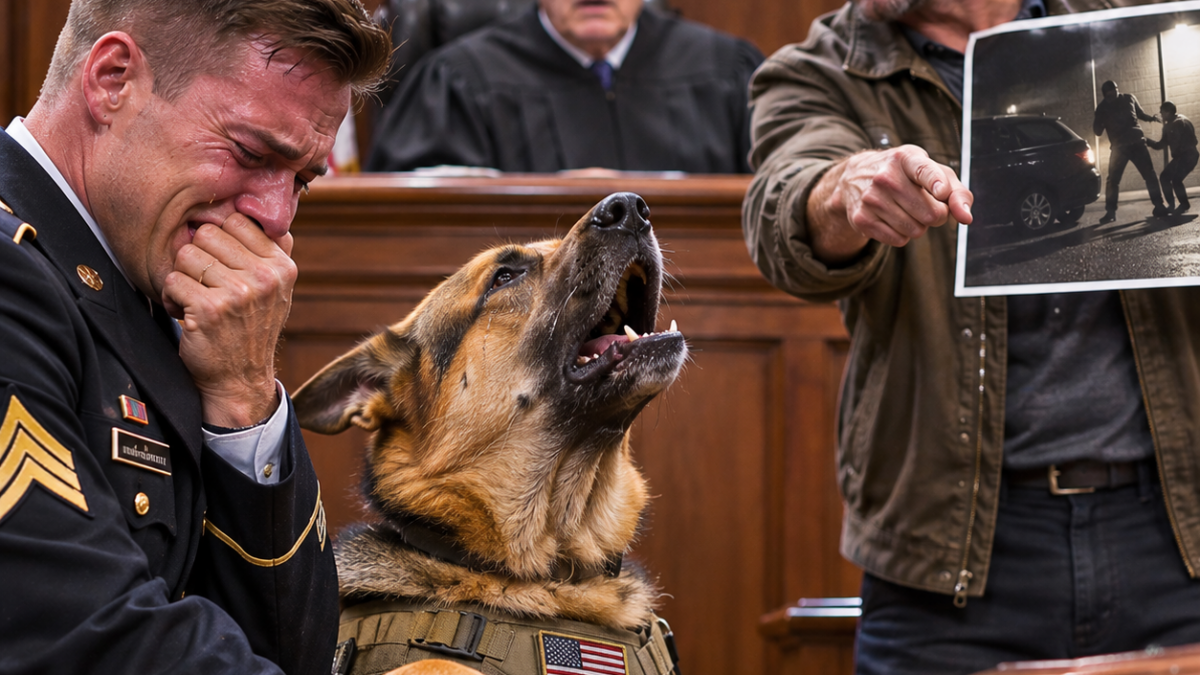
Luna left Daniel’s side.
Slowly.
She walked toward Michael.
Daniel did not call her back.
The golden retriever stopped beside Michael and pressed her head against his leg.
Michael bent slightly.
The gesture nearly destroyed him.
“She knew.”
He looked at Luna.
“Didn’t you?”
The dog’s tail moved once.
Judge Marsh looked down at the documents.
Then at Laura Bennett.
“Counsel?”
Laura stood.
“Your Honor, I need a recess and permission to confer with my client.”
The prosecutor, Major Nathan Greene, stood as well.
“The government also requests immediate recess and preservation of all testimony.”
Judge Marsh nodded.
“This court is in recess for one hour.”
Then she looked at Michael.
“Staff Sergeant Reed, do not leave the courthouse.”
“I won’t.”
“Mr. Bell, remain with your client.”
“Yes, Your Honor.”
Gavel.
The room erupted.
Reporters moved.
Attorneys spoke.
People stood.
Daniel did not.
He remained seated.
Luna returned to him.
Michael approached.
Daniel looked up.
For several seconds, neither man spoke.
Then Daniel said:
“You had one job.”
Michael laughed through tears.
“You’ve said that before.”
“You promised.”
“I know.”
“Your mother.”
“Is still my mother.”
“She needs you.”
“And she asked me last night why I hadn’t slept properly in five months.”
Daniel’s face tightened.
Michael continued.
“She said, ‘Whatever you’re hiding, tell the truth before it becomes heavier than you are.’”
Daniel looked away.
“Sounds like Elaine.”
“She also called you an idiot.”
“That sounds more like her.”
For one second they smiled.
Then Michael’s face collapsed.
“I’m sorry.”
Daniel stood.
He was taller.
Stronger.
Still looked like the man who had always moved first when everyone else hesitated.
“You don’t apologize for telling the truth.”
“I apologize for letting you lie.”
Daniel’s expression changed.
Michael continued.
“I told myself I was doing it because Mom needed me.”
He shook his head.
“That was only half.”
Daniel waited.
“The other half was fear.”
Michael looked at him.
“I was terrified.”
Daniel softened.
“I know.”
“I let you protect me because I was scared.”
“I know.”
“That isn’t friendship.”
“No.”
Daniel placed one hand on his shoulder.
“It was a bad decision made by two idiots.”
Michael almost laughed.
“Two?”
“I lied to investigators.”
“You were protecting me.”
“Still a lie.”
That was Daniel.
He never gave himself the clean version either.
Captain Bennett approached.
“Daniel.”
He turned.
“We need to talk.”
Daniel nodded.
Before leaving, he looked at Michael.
“Whatever happens now, you tell them everything.”
“I will.”
“Everything.”
“Yes.”
“Even the parts that make me look stupid.”
Michael managed a smile.
“That could take all day.”
Daniel pointed at him.
“There he is.”
Then walked away.
Luna followed.
The one-hour recess became three.
Investigators arrived.
Statements were taken.
The original crash report reopened.
The utility-box damage photographs were reviewed.
Base-entry logs.
Phone records.
Mrs. Hanley’s emergency call.
Michael’s attempts to reach the duty officer.
Location data.
The government did not rely solely on a dramatic confession.
That mattered.
Truth still required verification.
Mrs. Hanley confirmed calling Michael at 11:08 p.m.
Her emergency call to local EMS happened at 11:37.
Why the delay?
Because Elaine had initially refused an ambulance.
Embarrassed.
Stubborn.
Michael knew exactly what that meant.
The transport vehicle left the installation at approximately 11:16.
The crash occurred around 11:29.
Daniel’s phone location and Michael’s placed both at the scene.
Investigators also found something they had missed the first time.
The driver’s-side airbag contained a small blood trace.
Michael had cut his left hand that night.
Daniel had not.
The original investigator assumed Daniel’s confession made forensic clarification unnecessary.
Now it mattered.
At 4:20 p.m., Judge Marsh reconvened for a limited proceeding.
She did not sentence anyone.
Instead she vacated Daniel’s pending sentencing schedule and ordered the matter returned for investigation and amended charging review.
“The court will not decide guilt based on spectacle,” she said.
Her eyes moved briefly toward Luna.
“However emotionally compelling that spectacle may be.”
A few people almost smiled.
Judge Marsh continued.
“Nor will the court ignore a confession simply because it arrives late.”
She looked at Michael.
“You understand?”
“Yes, Your Honor.”
“Truth spoken late may still be truth.”
She paused.
“But delay has consequences.”
Michael nodded.
“I know.”
Daniel sat quietly.
The judge looked toward him.
“And Staff Sergeant Carter?”
“Yes, Your Honor?”
“If this new account is substantiated, your motive may explain your conduct.”
His face remained still.
“It will not automatically excuse knowingly making false statements.”
“I understand.”
“Good.”
That was the beginning.
Not the ending.
Outside the courthouse, cameras waited.
Daniel hated cameras.
Michael hated them more.
Luna loved everyone.
A reporter called:
“Staff Sergeant Carter, did you falsely confess to protect your friend?”
Daniel kept moving.
Another:
“Do you regret it?”
He stopped.
Laura Bennett whispered:
“Daniel.”
He looked toward the cameras.
“Yes.”
That surprised everyone.
The reporter asked:
“Which part?”
Daniel answered:
“Thinking loyalty gave me the right to interfere with the truth.”
Then walked away.
That quote spread everywhere.
Some people called him heroic.
He hated that.
Others called him foolish.
He agreed more readily.
Michael’s mother learned the full story that evening.
Not from television.
Michael drove home.
Elaine was sitting at the kitchen table wearing a blue sweater.
Her cane leaned against the chair.
She looked at him.
“You told them.”
Michael froze.
“How do you know?”
“Your face.”
He sat.
She reached for his hand.
“What happened?”
He told her everything.
When he finished, Elaine stared for a long time.
Then said:
“You let Daniel take responsibility for you because of me.”
Michael’s eyes filled.
“I thought—”
“No.”
Her voice shook.
“You thought I would want that?”
“Mom.”
“You thought I needed you so badly I would accept another man losing his life for your mistake?”
“He wasn’t losing his life.”
“Career.”
“Freedom.”
“Reputation.”
She tightened her grip.
“Those are pieces of life.”
Michael started crying.
“I was scared.”
Elaine softened immediately.
“I know.”
“I’m sorry.”
“I know.”
Then:
“You are allowed to be scared.”
He looked up.
“You are not allowed to make fear somebody else’s sentence.”
That line stayed with him.
The next morning, Elaine called Daniel.
He did not answer.
She called again.
Still nothing.
Third time, he answered.
“Mrs. Reed.”
“Don’t Mrs. Reed me.”
Daniel closed his eyes.
“Yes, ma’am.”
“You’re an idiot.”
“I’ve heard.”
“You thought sacrificing yourself for Michael would make me grateful?”
“I didn’t think that far.”
“Obviously.”
Daniel smiled despite himself.
Elaine continued.
“You saved my son from immediate consequences.”
“Yes.”
“And almost taught him that love means somebody else pays for your mistakes.”
Daniel’s smile disappeared.
“I know.”
“No.”
She said.
“You know now.”
Silence.
Then her voice softened.
“Thank you for loving him enough to want to help.”
Daniel swallowed.
“But never do that again.”
“Yes, ma’am.”
“Good.”
Then:
“How’s Luna?”
Daniel looked at the dog sleeping beside the sofa.
“Judgmental.”
“She has sense.”
“She does.”
The legal process took another six weeks before the next full hearing.
During that time, Daniel’s story became public enough that strangers sent letters.
Most praised him.
Some veterans criticized him.
One retired colonel wrote:
Taking the blame for another soldier may feel honorable in private. In an institution built on accountability, it can become another form of dishonesty.
Daniel kept that letter.
Another came from a woman whose brother had once accepted blame for a friend’s drunk-driving crash.
Her brother spent eleven months in jail before the truth emerged.
She wrote:
Please tell people that sacrifice is not always noble just because it hurts.
Daniel kept that too.
The internet preferred Luna.
Clips of her crying in court circulated.
People wrote:
THE DOG KNEW.
Daniel hated that phrase.
“She didn’t know legal facts.”
Michael said:
“She knew you were miserable.”
“That I’ll accept.”
Luna became a minor celebrity at the base.
Soldiers brought treats.
Daniel had to put a sign near his office:
PLEASE STOP FEEDING THE WITNESS.
Michael laughed for ten minutes.
Their friendship survived.
Barely at first.
Daniel was angry.
Not because Michael confessed.
Because he had forced Daniel to confront something ugly about his own motives.
He had told himself he acted entirely for Michael and Elaine.
But therapy required honesty.
Daniel’s counselor asked:
“Why was taking responsibility easier than letting your friend face consequences?”
Daniel answered too quickly.
“Because his mother needed him.”
The counselor waited.
Daniel sighed.
“What?”
“You tell me.”
Daniel looked down.
“I’m good at carrying things.”
“That wasn’t the question.”
Silence.
Daniel eventually said:
“I don’t know what I’m for if I’m not useful.”
There it was.
His military career had reinforced it.
The reliable one.
The calm one.
The man who volunteered.
Took extra watch.
Drove people home.
Fixed equipment.
Stayed late.
Luna had entered his life after his second deployment when his sister convinced him a dog might make his apartment feel less empty.
At first, Luna was simply a puppy who ate one boot and part of a tax return.
Later, she became something else.
A reason to go outside.
A living thing that did not need Daniel to solve anything.
She just wanted him present.
That was unfamiliar.
Michael had always admired Daniel’s reliability.
Too much.
When the crash happened, both men stepped into roles they already knew.
Michael panicked.
Daniel carried.
The lie fit their friendship too easily.
That was why neither saw how dangerous it was.
At the second hearing, the courtroom was full again.
This time Elaine came.
Michael tried to stop her.
She told him:
“I changed your diapers. I can sit through court.”
That ended the argument.
She sat in the front row with her cane.
Luna lay beside Daniel.
Judge Marsh entered.
Everyone stood except Luna.
The judge looked at the dog.
“Finally, one participant who does not perform for me.”
The courtroom laughed lightly.
Tension eased.
The prosecutor presented the revised facts.
Michael formally accepted responsibility for the unauthorized vehicle use and the collision.
Daniel withdrew his prior factual admission and entered responsibility for knowingly providing false information during the initial investigation and interfering with the accurate determination of events.
Both sides presented mitigation.
No one pretended Daniel’s conduct was harmless.
His lie consumed investigative time.
Distorted accountability.
Risked an unjust result.
But motive mattered.
So did his previously clean service record.
So did the absence of personal gain.
Michael’s case involved different considerations.
He had taken the vehicle.
Driven recklessly enough to strike the barrier in rain.
Failed to report immediately.
Allowed Daniel’s false confession to continue for months.
But he had eventually confessed voluntarily before sentencing.
He cooperated completely afterward.
No one was injured.
The property damage had already been repaid through insurance and restitution arrangements.
His mother’s dependency was not an excuse.
It was mitigation.
Judge Marsh spoke carefully.
“Staff Sergeant Reed.”
Michael stood.
“Your mother needing you did not authorize you to take that vehicle.”
“Yes, Your Honor.”
“It did not authorize you to drive unsafely.”
“No, Your Honor.”
“And it certainly did not authorize you to permit another man to accept your responsibility.”
Michael lowered his head.
“No, Your Honor.”
The judge continued.
“However, the court also recognizes that you ultimately came forward before sentence was imposed, accepted responsibility, and have cooperated fully.”
She looked toward Elaine.
“Family dependency matters when determining an appropriate sanction.”
Elaine’s hand tightened around her cane.
“It does not erase wrongdoing.”
Michael nodded.
Judge Marsh turned toward Daniel.
“Staff Sergeant Carter.”
Daniel stood.
Luna looked up.
“You believed you were helping your friend.”
“Yes, ma’am.”
“You were not.”
Daniel swallowed.
“I understand.”
“You deprived him of the opportunity to act honestly.”
Daniel looked at Michael.
“Yes.”
“You also placed investigators, this court, and your own command in the position of relying upon a false statement.”
“Yes.”
“Loyalty is valuable.”
Judge Marsh paused.
“But loyalty without truth can become another kind of harm.”
Daniel nodded.
“Yes, Your Honor.”
The final outcomes were serious but not catastrophic.
Michael received a reduced sentence emphasizing probationary supervision, restitution, formal reprimand, and service-related administrative consequences rather than confinement, in part because of his voluntary confession, lack of prior discipline, family caregiving obligations, and full cooperation.
His military career was damaged.
Not destroyed.
Promotion delayed.
Formal reprimand.
Additional administrative review.
He accepted all of it.
Daniel received sanctions for his false statement and obstruction of the original investigation.
His prior record, motive, cooperation after disclosure, and acceptance of responsibility mattered.
He lost a pending promotion opportunity.
Received formal disciplinary action.
Required ethics retraining.
No confinement.
No discharge.
Not a fairy-tale acquittal.
Not complete punishment.
Consequences proportionate to what each man had actually done.
When Judge Marsh finished, nobody applauded.
That would have been inappropriate.
But people exhaled.
Michael looked toward Daniel.
Daniel nodded once.
Elaine cried quietly.
Luna’s tail started thumping against the floor.
Judge Marsh looked down.
“Apparently the dog approves.”
This time even Daniel laughed.
Outside, reporters gathered again.
Michael stood beside his mother.
Daniel stayed slightly apart.
A reporter asked Michael:
“Do you regret confessing?”
“No.”
“Do you regret not confessing sooner?”
“Yes.”
Another asked Daniel:
“Do you still believe you did the right thing protecting your friend?”
Daniel looked toward Michael.
Then Elaine.
“No.”
People seemed surprised.
He continued.
“I believe I loved my friend.”
Pause.
“I also believe I was wrong.”
That quote spread farther than the original.
Months later, Daniel told me—if this story had a narrator sitting across from him—that those two sentences were the hardest public words he had ever spoken.
Because people enjoy simple moral stories.
Friend sacrifices himself.
Dog reveals truth.
Judge recognizes heroism.
Everyone goes home.
Real loyalty is more complicated.
You can love someone deeply and still help them avoid something they need to face.
You can sacrifice for someone and still hurt them.
You can confess late and still deserve credit for finally telling the truth.
You can be responsible and still deserve mercy.
Daniel and Michael learned that slowly.
Elaine learned something too.
For years she had felt guilty that Michael organized so much of his life around her.
After the trial, she insisted on changing that.
“I need more help,” she told him.
“I’m here.”
“That is exactly the problem.”
He stared.
She hired a part-time home aide twice a week through a community support program.
Accepted grocery delivery.
Agreed to use mobility transportation for two medical appointments each month.
Michael protested.
Elaine said:
“You are my son.”
“Yes.”
“You are not my infrastructure.”
He laughed.
“Who taught you that phrase?”
“The internet.”
“Terrible place.”
“Useful occasionally.”
Her increased independence did not mean Michael stopped helping.
It meant his help became chosen rather than compulsory.
That mattered.
One evening, about four months after the hearing, Michael sat at her kitchen table.
“You okay with the new aide?”
“She talks too much.”
“You talk too much.”
“I’m your mother.”
“Not an argument.”
Elaine smiled.
Then:
“Daniel coming Sunday?”
“Yes.”
“Good.”
She hesitated.
“Does he still feel guilty?”
“Yes.”
“About the lie?”
“Everything.”
She sighed.
“That boy would apologize for rain.”
Accurate.
Daniel did come Sunday.
Luna arrived first.
She ran through Elaine’s front door, nearly knocked over a basket of laundry, then found the exact cabinet where Elaine kept dog treats.
“Traitor,” Daniel said.
Elaine smiled.
“She knows quality.”
They ate chicken.
Talked about ordinary things.
Work.
Weather.
Michael’s delayed promotion.
Daniel’s ethics course.
At dessert, Elaine looked at both men.
“I have something to say.”
Michael groaned.
Daniel sat straighter.
“You two almost ruined your lives trying to protect each other.”
Daniel looked down.
Michael said:
“That sounds worse when you say it.”
“It should.”
Elaine continued.
“You’re both still treating what happened like a debt.”
They looked confused.
“Michael thinks he owes Daniel because Daniel took the blame.”
She pointed.
“Daniel thinks he owes Michael because Michael eventually confessed and saved him from sentencing.”
Daniel frowned.
“That’s not exactly—”
“It is.”
She turned toward her son.
“And I have spent months thinking I owe both of you because all of this was supposedly about helping me.”
Silence.
Elaine put down her fork.
“Enough.”
Michael stared.
“What does that mean?”
“It means nobody owes anyone anything.”
Daniel started to object.
She raised one finger.
“No.”
“You made bad decisions.”
“You corrected them.”
“You faced consequences.”
“You’re still alive.”
She looked at both men.
“Stop making friendship into bookkeeping.”
That sentence changed them.
Not immediately.
But it stayed.
A year passed.
Michael’s career recovered slowly.
He did not receive the promotion he had been expected to make before the crash.
At first that hurt.
Then he accepted a different assignment closer to his mother.
Less prestigious.
Better life.
He coached younger soldiers.
One of them once asked why Michael took documentation rules so seriously.
Michael answered:
“Because one bad night taught me paperwork exists after adrenaline leaves.”
Daniel laughed when he heard that.
Daniel remained in service too.
The ethics retraining he initially resented became unexpectedly important.
He began speaking occasionally to junior leaders about misplaced loyalty.
Not using his own case at first.
Then eventually:
“I once thought taking blame for someone was proof I loved them.”
The room would quiet.
“It wasn’t.”
He explained.
“If your friend makes a mistake, standing beside him while he owns it is harder than hiding it for him.”
That became his lesson.
Not:
Never help.
Not:
Rules matter more than people.
Something subtler.
Do not confuse protecting someone with preventing consequences.
Luna attended those talks when allowed.
She slept through most of them.
Daniel claimed she had already heard the material.
Two years after the trial, the local veterans’ association invited Daniel and Michael to speak at a fundraiser.
The organizer advertised them as:
THE SOLDIER WHO SACRIFICED EVERYTHING FOR HIS FRIEND—AND THE DOG WHO REVEALED THE TRUTH.
Daniel called immediately.
“No.”
The organizer panicked.
“What?”
“Change the title.”
“But it’s dramatic.”
“It’s wrong.”
“What would you prefer?”
Daniel thought.
Then:
WHEN LOYALTY GOES TOO FAR.
Michael hated it.
“Sounds like a workplace compliance webinar.”
“Good.”
“No one will come.”
They came.
Hundreds.
Daniel told the full story.
Including the parts that made him look bad.
Michael did too.
Elaine sat in front.
Luna slept beneath the podium.
During questions, a young man asked:
“Would you do it again?”
Daniel answered immediately.
“No.”
Michael looked at him.
Daniel continued.
“I would get in the truck.”
He smiled.
“To stop this idiot from driving.”
The room laughed.
“But if the crash still happened, I would call it in.”
He looked toward Michael.
“And I would stand beside him while he told the truth.”
Michael nodded.
“That would have been better.”
Another person asked:
“Did Luna really know you were innocent?”
Daniel smiled.
“No.”
The audience groaned.
“She knew I was upset.”
He scratched Luna behind the ears.
“She knew Michael was upset.”
“She knew the room was tense.”
“That’s enough.”
Then he added:
“Dogs don’t need courtroom theories to notice when humans are lying to themselves.”
That line got repeated everywhere.
Luna became older.
Golden fur whitening around her muzzle.
She slowed.
Daniel adjusted.
Shorter walks.
More rugs on slippery floors.
A ramp into his truck.
Michael teased him.
“You built a ramp for the dog?”
Daniel glared.
“She has arthritis.”
“You carry her.”
“She weighs seventy pounds.”
“You carried soldiers.”
“That was years ago.”
Luna looked between them.
Elaine said:
“She’s judging both of you.”
Probably.
When Luna turned ten, Daniel took her back to the courthouse steps.
Not inside.
Just outside.
Michael came.
Elaine too.
Judge Marsh had retired by then.
They sat on a bench beneath an oak tree.
Michael said:
“This is weird.”
Daniel nodded.
“Yes.”
“Why are we here?”
Daniel looked at Luna.
“I don’t know.”
Elaine smiled.
“Memory.”
Maybe.
The courthouse had become symbolic to strangers.
For them, it was simply where a friendship stopped lying.
Michael knelt beside Luna.
“You ruined everything, you know.”
Her tail moved.
Daniel said:
“She saved everything.”
Michael looked up.
“No.”
Daniel frowned.
Michael continued.
“She cried.”
“I stood.”
He looked toward Elaine.
“Mom made me tell the truth long before that without knowing she had.”
Daniel smiled.
“Fair.”
Elaine shook her head.
“Men.”
They sat until afternoon.
No reporters.
No courtroom.
No revelation.
Just people.
Luna died eight months later.
Quietly.
At home.
Daniel was beside her.
Michael arrived before the veterinarian left.
He found Daniel sitting on the floor with Luna’s head in his lap.
The same way she had placed her head on his knee in court years earlier.
Michael sat beside him.
Neither spoke.
After a long time, Daniel said:
“She knew before I did.”
Michael wiped his face.
“Knew what?”
“That I was tired.”
Silence.
Daniel looked down.
“She always knew when I was carrying too much.”
Michael nodded.
“I wish she could’ve talked.”
Daniel laughed through tears.
“No.”
“What?”
“She would’ve been unbearable.”
They cried.
Elaine had Luna cremated through a veterinary service and paid before Daniel could stop her.
He complained.
She said:
“Stop making friendship into bookkeeping.”
That ended it.
Daniel kept Luna’s collar in the cedar box that had once held her favorite toys.
Months later, the courthouse clerk contacted him.
Judge Marsh, now retired, had asked whether Daniel would accept something.
A copy of the courtroom transcript.
The page where Michael confessed was marked.
On a sticky note, Judge Marsh had written:
Truth spoken late may still be truth.
Daniel framed it.
Not because he was proud of what happened.
Because he wanted to remember that truth still matters after failure.
Michael kept a different object.
The old ring he used to twist in court.
His father’s.
He stopped wearing it after Elaine noticed.
“You’re going to rub the engraving off.”
Maybe.
He placed it in a drawer.
His anxiety improved once he no longer carried the secret.
So did his relationship with his mother.
That surprised both of them.
Michael had assumed Elaine’s dependence required constant proximity.
She had assumed Michael’s help meant she should never inconvenience anyone else.
Both beliefs created pressure.
Once they talked honestly, they found balance.
He still visited.
Often.
But because he wanted to.
Not because guilt drove the car.
Elaine eventually moved into an accessible apartment complex voluntarily.
Michael panicked.
“Are you sure?”
She stared.
“You sound familiar.”
“What?”
“Like someone deciding what another adult should do because he thinks he knows better.”
He laughed.
“Point taken.”
Her apartment had elevators.
Wide doors.
Community transportation.
A garden.
She loved it.
Michael helped hang photographs.
One was of Daniel, Michael, Elaine, and Luna after the second hearing.
Luna’s tongue hung out.
Daniel looked exhausted.
Michael looked relieved.
Elaine looked furious with both.
Perfect photograph.
At seventy, Elaine began telling people the courtroom story differently.
She never said Daniel tried to save Michael.
She said:
“Two young men nearly ruined themselves because neither understood the difference between love and responsibility.”
People would ask:
“Wasn’t Daniel heroic?”
Elaine answered:
“He was loving.”
Then:
“That does not make every decision correct.”
Daniel approved.
Mostly.
Michael complained:
“You always make me sound stupid.”
“You were stupid.”
“Fair.”
Their story reached military leadership training.
An instructor used a case study inspired by it.
Names changed.
Dog removed.
Daniel complained about that.
“The dog was the best part.”
The instructor laughed.
“The lesson is professional ethics.”
“Luna had excellent ethics.”
No argument.
The case asked:
When does loyalty to a teammate conflict with duty to truth?
Daniel’s answer changed over time.
At first:
When someone lies.
Later:
Earlier.
The conflict begins the moment you decide another adult cannot survive responsibility.
That was what he had done to Michael.
He had respected Michael’s devotion to his mother while disrespecting Michael’s capacity to face consequences.
Protection can become arrogance.
That realization hurt.
Useful truths often do.
Michael learned a mirror version.
Accepting sacrifice can become selfish even when you never ask for it.
He had not told Daniel:
Take the blame.
Daniel offered.
But Michael accepted.
Fear explained it.
It did not erase it.
Once, five years after the trial, Michael asked:
“Do you think you would’ve confessed eventually?”
Daniel thought.
“No.”
Michael stared.
“Really?”
“I probably would’ve kept going.”
“Even at sentencing?”
“Yes.”
Michael looked disturbed.
“That’s terrifying.”
“I know.”
“Why?”
Daniel looked toward Luna’s old collar hanging near his desk.
“Because once I decided suffering proved loyalty, backing out felt like betrayal.”
That became one of Daniel’s most important realizations.
People can become attached to sacrifice.
Once pain becomes proof of goodness, stopping feels selfish.
That happens in families.
Friendships.
Caregiving.
Marriage.
Military culture.
Everywhere.
Daniel learned to ask:
Is this helping—or am I just hurting myself because hurt feels noble?
Not easy.
Worth asking.
He eventually left active duty at thirty-seven.
Not because of the case.
Years had passed.
His body was tired.
He wanted something different.
He became an emergency-management coordinator for a county near Richmond.
Still helping.
Less uniform.
Michael attended the retirement ceremony.
Elaine insisted.
Daniel’s commander spoke.
No mention of scandal.
No need.
Military careers contain more than their worst incident.
The commander said:
“Staff Sergeant Carter taught generations of soldiers one valuable lesson: responsibility is not the same as blame.”
Daniel looked toward Michael.
They both smiled.
Afterward, Michael handed him an envelope.
“What?”
“Open it.”
Inside was a photograph of Luna outside the courthouse.
Below it, Michael had written:
SHE KNEW WE WERE BOTH IDIOTS.
Daniel laughed.
“I’m framing this.”
“I assumed.”
Daniel did.
It hung beside Judge Marsh’s transcript.
Years continued.
Michael eventually married.
Her name was Rebecca.
No relation to anyone in the case.
Elaine loved her immediately, which terrified Michael.
At the wedding, Daniel was best man.
During his speech, everyone expected courtroom references.
He made none.
He talked about Michael’s habit of putting hot sauce on eggs.
His terrible singing.
His ability to repair anything except relationships without help.
Then:
“Michael is the kind of man who once made a serious mistake and spent the rest of his life refusing to let that mistake become his identity.”
Michael cried.
Daniel continued.
“That matters.”
Afterward Michael whispered:
“You could have destroyed me.”
Daniel answered:
“I tried saving you once.”
They both winced.
“Bad wording,” Daniel said.
They laughed.
Elaine died peacefully years later.
Michael was beside her.
Daniel too.
Before she lost consciousness, she looked at them.
“Still idiots?”
Daniel smiled.
“Occasionally.”
“Good.”
Her hand tightened around Michael’s.
“Tell the truth faster.”
Those were among her last clear words.
Michael laughed and cried at the same time.
At the funeral, he told that story.
Everyone laughed.
Grief needs laughter or it becomes too heavy.
Daniel spoke too.
He said:
“Elaine Reed once told me friendship isn’t bookkeeping.”
He looked toward Michael.
“I needed that.”
Then:
“She also called me an idiot more times than anyone except my own mother.”
The room laughed.
Michael’s life changed again without Elaine.
For years he had organized everything around helping her.
After she died, he felt useless.
Daniel recognized it immediately.
“You’re doing what I did.”
Michael stared.
“What?”
“Making usefulness your identity.”
Michael hated hearing that from him.
Probably because it was true.
He began volunteering with a veterans’ transportation program.
Not every day.
Not to fill every hour.
Slowly.
He learned to have a life that was not rescue.
That may have been Elaine’s final gift.
Daniel and Michael remained friends into middle age.
Less dramatic friendship.
Better.
No one taking criminal responsibility for anyone.
Mostly text messages.
Football.
Bad jokes.
Occasional arguments about politics they learned not to have after ten p.m.
They visited Luna’s old walking trail once a year.
Not ceremony.
Habit.
On the tenth anniversary of the courtroom confession, a local reporter contacted them.
She wanted to write a retrospective.
Daniel initially refused.
Michael agreed.
Then Daniel changed his mind on one condition.
“No headline about the heroic soldier.”
The reporter asked:
“What headline would you choose?”
Daniel thought.
Then:
THE TRUTH YOUR FRIEND MAY NOT WANT TO HEAR
She used something close.
The article focused less on Luna.
More on what both men learned.
Daniel said:
“I used to think loyalty meant standing between your friend and consequences.”
Then:
“Now I think it means standing beside him while he faces them.”
Michael said:
“I used to believe accepting someone’s sacrifice meant honoring their love.”
Then:
“Sometimes the loving response is refusing to let them sacrifice something they should not.”
The article included Elaine’s line:
You are allowed to be scared. You are not allowed to make fear somebody else’s sentence.
That became the most shared quote.
Daniel was pleased.
“Finally.”
“What?”
“Elaine wins.”
Michael smiled.
“She usually did.”
The article barely mentioned the dog.
Daniel complained.
Michael said:
“She’s dead.”
“That doesn’t excuse disrespect.”
They laughed.
A month later, an elementary-school teacher contacted Daniel.
Her class had somehow heard the simplified version and wanted to know whether dogs could tell when people lied.
Daniel agreed to video call them.
A boy asked:
“Did Luna know Michael did it?”
Daniel smiled.
“No.”
The children looked disappointed.
“She knew people were upset.”
A girl asked:
“Why did she cry?”
“I don’t know.”
“Maybe because you were sad.”
“Probably.”
Another child asked:
“Was Michael bad?”
Michael happened to be beside Daniel off-camera.
He leaned into frame.
“Sometimes.”
The children laughed.
Daniel said:
“People aren’t only the worst thing they do.”
The room quieted.
The teacher later wrote that one student repeated that sentence for weeks.
Daniel kept the email.
He had stopped keeping medals years earlier.
He kept letters.
Maybe that was Luna’s influence.
Or Michael’s.
Or Elaine’s.
At forty-three, Daniel finally adopted another dog.
He waited almost six years after Luna died.
The dog was a rescue mutt named Cooper.
Michael hated the name.
“What’s wrong with Cooper?”
“Sounds like an accountant.”
Daniel stared.
“You know three accountants.”
“All named Kevin.”
“That proves nothing.”
Cooper was nothing like Luna.
Smaller.
Black fur.
Terrified of vacuum cleaners.
No courtroom intuition.
Once Michael said:
“He would’ve confessed immediately.”
Daniel laughed.
“He’d betray us for cheese.”
Exactly.
That helped.
Love did not require replacement.
Cooper did not need to become Luna.
He was Cooper.
Another lesson.
When Daniel turned fifty, Judge Marsh sent a birthday card.
He had no idea how she knew.
Inside:
I still remember the golden retriever.
Below:
More importantly, I remember two men who eventually accepted that truth matters more than performance. I hope life has treated you both kindly.
Daniel called Michael.
“You’ll never guess.”
“Judge?”
“How?”
“She sends me cards too.”
Daniel was offended.
“You never told me.”
“I have secrets.”
“That’s how we got into trouble.”
“Fair.”
Judge Marsh died the following year.
Daniel attended the memorial.
Michael did too.
They stood in the back.
No one recognized them at first.
A former clerk spoke about Marsh’s insistence that courts distinguish explanation from excuse.
Daniel smiled.
“That sounds familiar.”
Michael nodded.
Afterward, they placed no flowers.
Just signed the guest book.
Daniel Carter & Michael Reed — grateful.
That was enough.
Looking back, Daniel sometimes wondered what would have happened if Luna had remained silent.
Would Michael have stood?
Maybe.
Maybe not.
That question no longer tormented them.
Because stories become dangerous when we assign one miraculous moment all the power.
Luna’s cry mattered.
But Michael had been breaking for months.
Elaine’s words the night before mattered.
Thomas Bell’s advice mattered.
Daniel’s exhaustion mattered.
Judge Marsh’s questions mattered.
The truth had been pressing against Michael from many directions.
Luna gave it one final push.
That is often how change happens.
Not one cause.
Accumulation.
One more moment.
One more question.
One more person refusing silence.
People later romanticized Daniel’s original sacrifice.
He never did.
If asked whether he would change anything, his answer stayed the same.
“I would tell the truth on night one.”
Even though that meant Michael might have faced harsher immediate consequences.
Even though Elaine might have struggled.
Even though Daniel hated imagining it.
Because protecting someone from reality does not remove reality.
It transfers the cost.
To someone else.
To later.
Usually both.
Michael agreed.
The hardest consequence he faced was not probation.
Not delayed promotion.
Not embarrassment.
It was knowing Daniel almost accepted punishment in his name.
That knowledge changed how he handled other relationships.
When his wife Rebecca made a serious financial mistake years later—nothing criminal, just a bad investment she had hidden out of embarrassment—Michael’s first reaction was anger.
Then she cried:
“I didn’t tell you because I thought you’d try to fix it.”
He went silent.
The past arrived instantly.
He sat.
“Okay.”
She looked terrified.
“We tell the truth first.”
“What?”
“To ourselves.”
He took a breath.
“Then we fix what can actually be fixed.”
They did.
No rescue.
No secret.
No substitute blame.
When their daughter Hannah became a teenager and got caught cheating on a school exam, Rebecca wanted to call the principal and argue that stress had contributed.
Michael stopped her.
“Stress explains.”
He said.
“It doesn’t erase.”
Hannah hated him for forty-eight hours.
Then survived.
Michael called Daniel afterward.
“I sounded like Judge Marsh.”
“Terrifying.”
“I know.”
“You’re old.”
“Shut up.”
Life became ordinary.
That was success.
No courtroom.
No confession.
No dog crying under fluorescent lights.
Just people learning.
Changing.
Failing less destructively.
One evening, many years after everything, Daniel and Michael sat on Daniel’s porch.
Cooper slept beneath the table.
Sunset behind the trees.
Michael was fifty-four.
Daniel fifty-five.
They had both gone gray.
Michael said:
“Do you ever think about that day?”
“Court?”
“Yes.”
“Sometimes.”
“What do you remember first?”
Daniel thought.
Not Michael standing.
Not Judge Marsh.
Not the accusation.
“Luna’s head on my knee.”
Michael smiled.
“Of course.”
“She was shaking.”
“I didn’t see that.”
“She knew something was wrong.”
Michael looked toward Cooper.
“He’d be asleep.”
“He is asleep.”
“Exactly.”
They laughed.
Then Michael became serious.
“I’m glad I stood up.”
Daniel looked at him.
“So am I.”
“Were you angry?”
“Furious.”
“I knew it.”
“You ruined my brilliant plan.”
“Your plan was terrible.”
“Yes.”
Silence.
Michael asked:
“Do you forgive me for waiting five months?”
Daniel thought.
“I forgave you before the second hearing.”
Michael stared.
“Really?”
“Yes.”
“Why didn’t you say?”
“Because you were annoying.”
Michael laughed.
Then:
“Do you forgive yourself?”
That question took longer.
Daniel looked at the trees.
“Mostly.”
“Mostly?”
“I still hate what I did to the investigation.”
“Fair.”
“I hate that I put Laura in that position.”
“Fair.”
“I hate that I made you think suffering for you was noble.”
Michael nodded.
Then Daniel smiled slightly.
“But yes.”
He looked at his friend.
“I forgive the version of me who thought carrying everything was the only useful thing I could do.”
Michael’s eyes filled.
“That’s annoyingly healthy.”
“Therapy.”
“Terrible.”
“Expensive.”
They laughed again.
Cooper woke.
Looked offended.
Went back to sleep.
Michael said:
“Elaine would be happy.”
Daniel nodded.
“She’d insult us first.”
“Definitely.”
The porch went quiet.
No heavy silence.
Comfortable.
That was different too.
Years earlier, silence had hidden guilt.
Now it held friendship.
At some point, Michael said:
“You know what I finally understand?”
Daniel waited.
“You didn’t save me by taking the blame.”
“No.”
“You saved me later.”
Daniel frowned.
“When?”
“When you didn’t hate me for telling the truth.”
Daniel looked away.
Michael continued.
“I thought confessing meant losing you.”
“That was stupid.”
“I know.”
“You were right to confess.”
“I know now.”
Daniel looked back.
“Then maybe we saved each other badly first.”
Michael smiled.
“And better later.”
“Something like that.”
The sun disappeared.
Cooper stood and stretched.
Daniel went inside to make coffee.
Michael remained on the porch.
For a moment, he remembered the courtroom.
The heavy oak doors.
Judge Marsh.
Daniel in uniform.
Luna pressed against his knee.
His own hands shaking.
The moment he stood.
He remembered thinking the entire world was about to collapse.
It did not.
Consequences came.
Pain came.
Embarrassment.
Discipline.
Loss.
But truth did not destroy them.
It rearranged things that had already become crooked.
That may be the most important part.
People fear truth because they imagine truth creates the crisis.
Often truth simply stops hiding the crisis that already exists.
Michael had taken the vehicle.
Daniel had lied.
Elaine needed help.
Their friendship had become unbalanced.
All of that existed before Michael stood.
His confession did not create those facts.
It made them available for repair.
When Daniel returned with coffee, Michael said:
“I think I understand the whole thing now.”
Daniel handed him a mug.
“That’s concerning.”
Michael ignored him.
“The dog crying wasn’t the miracle.”
“No?”
“No.”
“The miracle was that everybody survived the truth.”
Daniel sat.
“Not a miracle.”
“What?”
“Work.”
Michael thought.
Then smiled.
“Yeah.”
Work.
Apologies.
Court hearings.
Counseling.
Restitution.
Changed habits.
Boundaries.
Mercy.
No miracle.
Something better.
Something repeatable.
That is why, if you ask what happened the day Luna cried in court, Daniel Carter will not tell you the dog exposed a secret.
Michael Reed will not tell you friendship conquered justice.
Elaine, if she were still here, would probably tell you both men were idiots.
And Judge Marsh would remind you that truth spoken late is still truth—but lateness has consequences.
The real lesson was simpler.
Daniel loved Michael enough to carry something that never belonged to him.
Michael loved Daniel enough, eventually, to take it back.
Both acts came from loyalty.
Only one came with truth.
And that was the one that finally set them free.








