PART2:I Asked the Shelter for the Dog Nobody Wanted—Then They Showed Me the One Who Had Stopped Believing Anyone Would Ever Come
PART2
The woman at reception smiled when she saw me.
Her name tag read SARAH.
She was probably in her thirties.
Kind face.
Tired eyes.
The kind of person who had likely watched too many animals arrive and not enough leave.
“What kind of dog are you interested in, Mr. Harrison?”
“I don’t know his breed.”
She smiled politely.
“Size?”
“Doesn’t matter.”
“Age?”
“The oldest.”
Her smile faded slightly.
“Temperament?”
“The one nobody wants.”
Sarah stopped typing.
“I’m sorry?”
I rested my hands on my wheels.
“I want the dog who has been here the longest.”
She stared.
“The one people look at and walk past.”
Silence.
“The oldest one. The hardest one. The dog everybody has decided belongs here because nobody wants the responsibility.”
Sarah’s eyes changed.
Not cold.
Concerned.
“That isn’t usually how we place animals.”
“Why?”
“We try to match dogs carefully with adopters.”
“Good.”
She looked at my chair.
Only for half a second.
But I saw it.
I always saw it.
“Some of our long-term dogs are large.”
“I know.”
“Some need physical handling.”
“I know.”
“Some have behavioral histories.”
“I know.”
She hesitated.
Then:
“With your mobility—”
“There it is.”
Sarah’s face reddened.
“I didn’t mean—”
“I know exactly what you meant.”
I kept my voice calm.
“You’re wondering whether a man in a wheelchair can take care of a dog other people find difficult.”
“I have to consider safety.”
“You should.”
“And suitability.”
“Absolutely.”
She relaxed slightly.
Then I added:
“But suitability does not begin with assuming my chair makes me helpless.”
She looked embarrassed.
“I’m sorry.”
“I’m not angry.”
That was true.
I had been having versions of that conversation for nineteen years.
At restaurants.
Airports.
Hospitals.
Stores.
Job interviews.
People usually meant well.
That didn’t make it hurt less.
“I’m asking for your longest-stay dog.”
Sarah looked toward the kennels.
Then back at me.
“Mr. Harrison, I really think the director should speak with you.”
“Call her.”
“You know her?”
“No.”
“What should I tell her?”
“Tell her Frank Harrison is here.”
Sarah picked up the phone.
She spoke quietly.
Paused.
Then looked at me sharply.
Her posture changed.
“Yes, ma’am.”
Another pause.
“He’s right here.”
She hung up.
“The director is coming.”
“All right.”
“She said not to let you leave.”
I smiled.
“That sounds threatening.”
Sarah laughed nervously.
“She’ll be here in twenty minutes.”
I thanked her.
Then rolled toward the kennel wing.
Barking filled the building.
High-pitched.
Deep.
Excited.
Anxious.
Some dogs jumped at the bars.
Some spun in circles.
Some pressed their bodies forward as if a single second of eye contact might be enough to change their lives.
Then I reached the last kennel.
Silence.
A large gray dog lay on a blanket with his head on his front paws.
He did not rise.
Did not bark.
Did not even lift his ears.
I stopped.
“That’s Duke.”
Sarah stood behind me.
“How long?”
“Three years and six months.”
I stared at him.
“Exactly?”
“Almost.”
“How old?”
“Ten and a half.”
“Why is he still here?”
Sarah sighed.
“He came in when his owners became too old to manage him.”
“What breed?”
“Mostly shepherd. Maybe some mastiff.”
He was big.
Eighty pounds, maybe more.
Broad chest.
Gray-black coat.
Slow eyes.
“Health?”
“Arthritis.”
“Manageable?”
“Yes.”
“Behavior?”
“Quiet.”
“Aggressive?”
“No.”
“Children?”
“He tolerates them.”
“Dogs?”
“Selective but generally calm.”
“Then why?”
Sarah looked through the bars.
“Because he’s old.”
I knew that answer before she said it.
“And big.”
She nodded.
“People want puppies.”
I watched Duke.
“He used to greet visitors?”
Sarah’s eyes softened.
“Yes.”
“What happened?”
“At first he came to the front every time.”
She leaned against the wall.
“Someone would enter the kennel. He’d wag. Bring a toy. Sit beside them.”
“And?”
“They’d choose someone younger.”
“How long until he stopped?”
“Maybe a year.”
I swallowed.
“Then?”
“He still lifted his head.”
She looked at him.
“After two years, barely that.”
I stared at Duke.
He had not stopped wanting a home.
He had stopped expecting one.
There is a difference.
I understood it too well.
At twenty-two, I still expected old friends to call.
At twenty-three, I hoped.
At twenty-four, I learned not to stare at the phone.
You do not stop caring because hope disappears.
You simply learn that expecting less hurts less.
I moved closer.
Duke lifted his head.
Our eyes met.
Nothing happened.
No tail.
No excitement.
Then his head lowered again.
“I know that look,” I whispered.
Sarah heard me.
“What?”
“Nothing.”
The front door opened.
Footsteps approached quickly.
A woman in her fifties entered the kennel wing.
Hair tied back.
Dark slacks.
Sharp expression.
“Mr. Harrison?”
“Yes.”
“I’m Virginia Bartlett.”
She held out her hand.
I shook it.
Then her eyes went to Duke.
“You came for him.”
Not a question.
“Yes.”
Virginia looked at Sarah.
“How long has he been listed?”
“Three years, six months.”
Virginia exhaled.
Then looked back at me.
“I know who you are.”
“That makes one of us.”
A small smile.
“The Last Hope Door.”
“Ah.”
“You adopted Lily eight years ago.”
“Yes.”
“Roscoe six years ago.”
“Yes.”
“Mabel four years ago.”
“Yes.”
“Mabel was nearly blind.”
“Still is.”
Virginia stared.
“She’s alive?”
“Very.”
“How old now?”
“Thirteen.”
A real smile appeared.
“I thought…”
“She sleeps eighteen hours a day and screams if breakfast is eight minutes late.”
Virginia laughed.
Then became serious.
“You live alone?”
“Yes.”
“With three senior dogs.”
“Yes.”
“And you want an eighty-pound senior shepherd mix with arthritis.”
“Yes.”
“Why?”
I looked at Duke.
“Because nobody else has.”
“That’s not enough.”
“It is to me.”
“For me, it isn’t.”
Fair.
I respected her immediately.
Virginia continued:
“I have to know you can handle him.”
“Come to my house.”
She blinked.
“Excuse me?”
“Inspect it.”
I gestured toward my chair.
“You’re worried about transfers, feeding, walking, emergency handling, veterinary transport.”
“Yes.”
“I have ramps.”
I counted on my fingers.
“Wide doorways. Dog door. Fenced yard. Vehicle lift. Emergency contact. Veterinarian five minutes away. Neighbor with a key. Home aide twice a week.”
Virginia’s expression changed.
“I’ve been doing this eight years.”
“I know.”
“Then why are we still talking?”
“Because Duke has been returned twice.”
That stopped me.
“When?”
“In his first six months.”
“Why?”
“One adopter said he was too large.”
“Why adopt him then?”
Virginia looked tired.
“I asked myself the same thing.”
“And the second?”
“They expected him to be more playful.”
I stared at Duke.
“What happened after that?”
“He became harder to place.”
Of course.
Every return leaves a mark, even when nobody can see it.
Virginia said:
“If I let him leave, he is not coming back.”
I looked at her.
“He won’t.”
“You can’t promise that.”
“Yes.”
“No one can.”
“I can promise what I will do.”
She waited.
“He stays.”
Virginia studied me.
Then:
“You don’t know him.”
“I know enough.”
“Frank.”
“He has spent three and a half years being evaluated.”
My voice tightened.
“Maybe somebody should finally choose him before asking him to prove one more thing.”
Nobody spoke.
Duke raised his head.
Virginia’s eyes filled.
She turned slightly.
“Sarah.”
“Yes?”
“Open the kennel.”
Sarah hesitated.
“The application—”
“Open it.”
The key turned.
The metal latch clicked.
The door swung inward.
Duke did not move.
That hurt more than if he had run away.
He had watched that door open thousands of times.
Cleaning.
Feeding.
Visitors.
Potential adopters.
Staff.
Every time, eventually, it closed again.
To Duke, an open door no longer meant freedom.
It meant interruption.
Sarah stepped inside.
“Come on, Duke.”
Nothing.
She crouched.
“Buddy.”
His eyes moved toward her.
Then away.
I rolled to the entrance.
“Let him decide.”
Sarah looked at me.
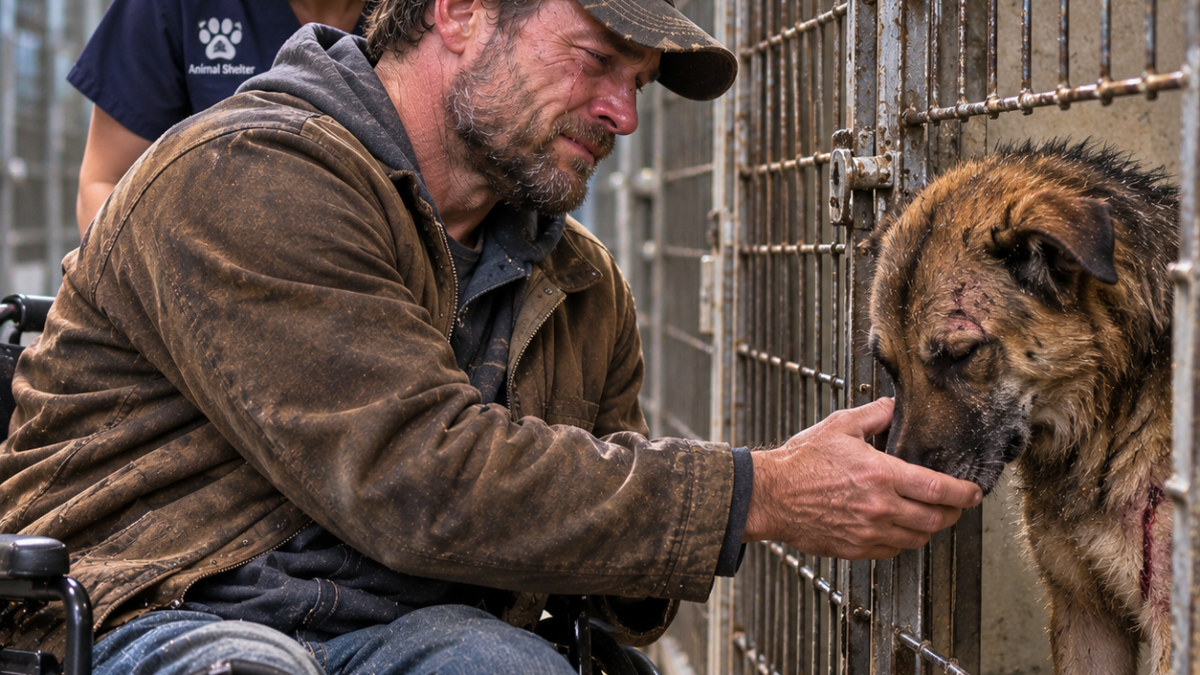
I held out my hand.
No treats.
No leash.
No commands.
Just my hand.
Duke watched it.
Then me.
“You don’t trust doors anymore.”
His ears twitched.
“I get it.”
I lowered my hand.
“You don’t have to come.”
Sarah’s eyes filled.
Virginia stood silently behind me.
I continued.
“You don’t owe me anything.”
Duke raised his head fully.
“You don’t have to wag.”
He stared.
“You don’t have to pretend you’re happy.”
Still nothing.
“You’ve probably done that for enough people.”
I swallowed.
“I did too.”
His eyes stayed on mine.
“For a long time.”
The kennel was suddenly silent despite the barking around us.
I looked at him.
“Nineteen years ago, people started talking about me like I was already gone.”
Duke’s nose moved.
“They stopped inviting me places because stairs were inconvenient.”
I laughed softly.
“Some stopped calling because they didn’t know what to say.”
His ears lifted slightly.
“And the person I thought would stay told me my life had become too much.”
My throat tightened.
“So I stopped expecting people too.”
Duke pushed himself upright.
Slowly.
Arthritic hips.
Stiff shoulders.
He stood.
Sarah covered her mouth.
One step.
Stop.
Another.
I held my hand open.
“That’s enough.”
Duke came closer.
Three feet.
Two.
He lowered his head.
Sniffed my fingers.
I didn’t move.
Then his tongue touched my palm.
Once.
Barely.
I smiled.
“Hi.”
Duke took one more step.
Then placed his head directly across my knees.
My breath disappeared.
His weight was heavy.
Warm.
Real.
I put one hand on his head.
Duke closed his eyes.
Sarah began crying.
Virginia turned away.
I stroked the rough fur behind his ears.
“You’ve been waiting a long time, haven’t you?”
His body leaned harder into me.
I don’t believe dogs understand sentences.
But they understand tone.
Safety.
Touch.
Stillness.
Maybe that is more important.
Virginia cleared her throat.
“Mr. Harrison.”
I looked up.
“Yes?”
“Do you want to take him home?”
I stared at her.
“I thought that was obvious.”
She laughed through tears.
“Paperwork first.”
“One condition.”
“What?”
“He does not spend tonight here.”
Virginia nodded immediately.
“He won’t.”
An hour later, Duke walked out through the shelter’s front doors.
No one dragged him.
No one rushed.
He stayed beside my wheelchair.
Every few feet he looked up at me.
Checking.
I recognized that too.
People who have been left learn to watch.
Are you still there?
Still?
Still?
At the van, Sarah knelt beside him.
“You be good.”
Duke licked her chin.
She cried harder.
“You could’ve done that any time in the last three years.”
His tail moved.
Just slightly.
Virginia helped secure him safely.
Before closing the door, she looked at me.
“Frank.”
“Yes?”
“Thank you.”
I shook my head.
“Don’t.”
“What?”
“He’s not charity.”
She nodded.
“I know.”
I looked at Duke.
“I’m the lucky one.”
On the drive home, I stopped at a park.
Sunset painted the sky orange and pink.
I opened the side door.
Duke stepped onto the grass.
He sniffed.
Then stood very still.
Wind moved through his coat.
People passed in the distance.
No kennel bars.
No barking.
No concrete.
Just grass.
I watched him stare at the horizon.
Three and a half years.
More than twelve hundred nights.
Same building.
Same door.
Same routine.
And now the whole world was in front of him.
I whispered:
“Take your time.”
He did.
We stayed until the sun disappeared.
When we reached home, Oliver was waiting.
So were Roscoe and Mabel.
I opened the door.
Duke froze.
Three dogs stared.
Mabel sniffed the air.
Roscoe barked once.
Oliver, my oldest, walked forward.
Slowly.
His legs were stiff too.
He stopped in front of Duke.
They sniffed.
Then Oliver did something I will never forget.
He rested his old head against Duke’s neck.
No growl.
No dominance.
No drama.
Just contact.
Duke closed his eyes.
I laughed.
“Apparently you’re approved.”
That first night, Duke refused the new bed I had bought him.
He slept beside my wheelchair instead.
I transferred into bed.
Turned out the light.
In the darkness, I heard him shift.
Then silence.
I whispered:
“You’re safe.”
No response.
“You’re home.”
I heard a long exhale.
I slept.
At 4:17 a.m., I woke.
Duke was standing beside the bed.
Watching me.
“What?”
Tail.
One slow movement.
“You checking?”
Another.
“I’m still here.”
He lay down.
So did I.
The next morning, sunlight came through the window.
Duke’s face was inches from mine.
His breath smelled terrible.
I laughed.
“So this is what gratitude smells like?”
He licked my nose.
“Disgusting.”
Tail.
For the first few weeks, Duke followed me everywhere.
Kitchen.
Bathroom door.
Living room.
Yard.
If I rolled out of sight, he appeared.
If I closed a door, he waited outside.
At night, he slept close enough that one paw touched a wheel.
Virginia called.
“How is he?”
“Clingy.”
She laughed.
“He wasn’t at the shelter.”
“I know.”
That made my chest hurt.
“Maybe he was saving it.”
“For what?”
“Someone he thought might stay.”
I looked down.
Duke slept beside me.
“I’m staying.”
His arthritis required medication.
Short walks.
Weight control.
Joint supplements.
Some mornings were hard.
On cold days, he struggled to stand.
I learned to use a support sling.
The first time I helped him up, I laughed at the absurdity.
A man who could not use his own legs helping a dog whose legs were failing.
Duke looked at me.
“You see the problem here?”
Tail.
“Exactly.”
I had equipment.
Technique.
Practice.
We managed.
People in the neighborhood stared at first.
Frank in his wheelchair.
Duke walking slowly beside him.
Oliver occasionally trailing behind.
One afternoon, a little girl stopped.
“Why are you in that chair?”
Her mother looked horrified.
I smiled.
“My legs don’t work.”
She nodded.
Then pointed at Duke.
“Why does he walk funny?”
“He’s old.”
She thought about us.
“Do you help him?”
“Yes.”
“Does he help you?”
I looked at Duke.
“All the time.”
That satisfied her.
Children often understand mutual dependence better than adults.
Adults want a hero and someone being rescued.
Children understand both people can need help.
Duke changed quickly.
Not physically.
Emotionally.
His tail appeared more often.
He started bringing me toys.
At first, only once.
An old rope from Oliver’s basket.
Duke dropped it beside my chair.
Then stared.
I picked it up.
“You want this?”
He lowered his front legs.
Play bow.
I almost cried.
Virginia had told me he stopped playing at the shelter two years earlier.
I threw the rope.
Badly.
Duke chased it.
Slowly.
Returned.
Dropped it again.
We played for fifteen minutes.
Afterward I called Sarah.
“He brought me a toy.”
Silence.
Then:
“What?”
“A rope.”
Sarah started crying immediately.
I laughed.
“You people cry a lot.”
“He hasn’t played in years.”
I looked at Duke.
He held the rope in his mouth.
“Apparently nobody told him that.”
Months passed.
Duke learned my routines.
Medication at seven.
Breakfast.
Morning yard.
Afternoon rest.
Evening walk.
He learned where I kept treats.
Unfortunately.
He learned how to open the lower cabinet with his nose.
Also unfortunately.
He learned Mabel was blind and stopped bumping into her.
He learned Roscoe hated thunderstorms.
During storms, Duke lay beside him.
Oliver and Duke became inseparable.
Two old men.
They slept together.
Walked together.
Ignored commands together.
Sometimes I watched them and wondered what they understood about each other.
Did Duke know Oliver had once been unwanted?
Did Oliver recognize the smell of shelter fear?
Probably not in human terms.
But pain has a language beyond words.
One winter, Oliver’s health declined.
He was very old.
Older than we knew when he first came to me.
His kidneys failed.
The final week, Duke never left his side.
Not once.
When Oliver could no longer get up, Duke lay against him.
I sat on the floor beside both.
My back hurt.
My legs, of course, felt nothing.
My heart felt everything.
I stroked Oliver.
“You saved me first.”
His breathing was shallow.
Duke put his head across Oliver’s paws.
The veterinarian came to the house.
Oliver left peacefully.
Duke remained beside the empty blanket for hours.
That night, he refused dinner.
Next morning too.
I rolled beside him.
“I know.”
He looked away.
“I miss him too.”
Duke pressed his forehead into my knee.
For the first time since adoption, I understood that Duke had not only found a home.
He had allowed himself to build attachments again.
And now he was paying the price.
Love gives.
Love also creates something that can be lost.
That is why frightened hearts stop trying.
I knew.
Duke knew.
But grief did not mean adoption had been a mistake.
Pain proved the opposite.
Oliver mattered.
Eventually Duke ate.
Then walked.
Then brought the rope again.
Life returned.
Not the same.
Life never returns the same.
It continues changed.
A year after Duke came home, Virginia invited us to a shelter fundraiser.
I almost declined.
I worried Duke might react badly.
But when we entered, he stopped.
He recognized the smell.
The barking.
The hallway.
His entire body stiffened.
I touched his neck.
“We can leave.”
Duke looked at me.
Then forward.
He walked.
Past the first kennels.
Past reception.
Past the last row.
Then stopped at his old cage.
Another dog was inside.
Young shepherd.
Terrified.
Pressed against the back wall.
Duke stood outside.
The young dog looked at him.
For a long time, nothing happened.
Then Duke lay down.
Just lay there.
The younger dog slowly moved closer.
Sarah stood behind me crying.
Again.
I whispered:
“Duke.”
His tail moved.
The young dog approached the bars.
Duke touched noses with him.
That photograph later appeared on the shelter website.
Caption:
Sometimes the one who waited longest knows exactly how to wait for someone else.
The younger dog was adopted two weeks later.
Duke became part of The Last Hope Door program.
Not officially.
He did not attend meetings.
He was terrible at paperwork.
But his story helped senior dogs get adopted.
People saw photographs.
Asked questions.
One couple adopted a twelve-year-old beagle.
A widower chose a ten-year-old Lab.
A family adopted a blind spaniel.
Every time Virginia sent me an update, I read it to Duke.
“Another one.”
Tail.
“Show-off.”
Over the next few years, Duke’s body slowed.
Arthritis worsened.
We shortened walks.
Added rugs for traction.
Installed more support handles.
I had always built my house around wheelchair accessibility.
Now I redesigned parts around aging dogs too.
A friend once visited.
He looked around.
“You realize this place is basically a nursing home?”
“Yes.”
“For dogs.”
“And me.”
He laughed.
I didn’t mind.
There are worse things a home can become than a place where old bodies are allowed to move slowly.
That mattered to me.
Because the world is impatient with slowness.
Slow walkers.
Slow minds.
Slow recovery.
Old dogs.
Disabled people.
Anyone who requires extra time.
We celebrate speed because speed is convenient.
Duke taught me the beauty of waiting.
Wait for him to stand.
Wait for him to reach the yard.
Wait while he smells one patch of grass for three full minutes.
Wait while he decides whether today is a good stair-ramp day.
There is dignity in allowing another creature to move at the speed his body permits.
I wish more people had understood that when I first became disabled.
Maybe that is why I understood Duke.
Not because our bodies were the same.
They weren’t.
Because both of us knew what it felt like when the world began measuring our worth by how easily we could move through it.
One evening, almost three years after adoption, Duke struggled to stand.
I helped.
He took several steps.
Stopped.
Looked toward the backyard.
“Want outside?”
Tail.
I opened the door.
We sat beneath the oak tree.
Spring buds were forming.
Same season as the day we met.
Duke lay beside my chair.
Gray muzzle resting on my footplate.
I looked at him.
“You know what Sarah told me?”
One ear moved.
“She said they couldn’t place a dog like you with someone like me.”
Tail.
“Rude.”
Another movement.
“I think we did okay.”
Duke sighed.
That was enough agreement.
By then, Mabel had died.
Roscoe was nearly fourteen.
The house was quieter.
Loss accumulates when you adopt old dogs.
People sometimes ask:
“How can you keep doing it?”
As if loving senior animals is choosing grief.
It is.
But grief is not the whole contract.
You get mornings.
Warm bodies.
Bad breath.
Walks.
Medicine hidden in cheese.
Ridiculous naps.
Small transformations.
An animal who arrived afraid eventually sleeping belly-up because he trusts the room.
You get all of that before goodbye.
The shortness is not a reason to refuse the love.
If anything, it makes showing up more urgent.
Duke turned thirteen.
Then fourteen.
No one at the shelter had imagined that.
Virginia sent him a birthday card.
Inside:
To the dog who waited 1,278 days for home and then refused to leave it.
I framed it.
Duke became slower.
Some mornings he needed help lifting his rear end.
I understood his frustration.
He would try.
Fail.
Look irritated.
I laughed gently.
“I know.”
Maybe I knew better than most.
The day comes when your body stops obeying instructions your mind still gives easily.
It is humiliating if people make it humiliating.
So I never did.
I helped.
No pity.
No baby talk.
“Ready?”
Lift.
Stand.
Move.
Dignity matters.
One afternoon, Sarah visited.
She had left the shelter and become a veterinary technician.
Duke recognized her immediately.
Tail.
He walked toward her.
Sarah sank to the floor.
“Oh, old man.”
Duke put his head in her lap.
She cried.
Naturally.
“I thought he’d die in that kennel.”
I looked at her.
“So did he.”
She stroked him.
“I’m sorry about what I said that first day.”
I knew what she meant.
My wheelchair.
“I’m not.”
She looked up.
“Why?”
“Because you learned.”
Sarah wiped her eyes.
“I did.”
“So did I.”
“What?”
I smiled.
“I came in expecting everyone to understand me immediately.”
She laughed.
“Fair.”
“We were both making assumptions.”
She nodded.
Then looked at Duke.
“He fixed us.”
“Dogs are annoying that way.”
When Duke was fourteen and a half, his health changed quickly.
Kidneys.
Heart.
Mobility.
The vet gave me options.
Medication could buy time.
But not much.
I asked the only question that mattered.
“Is he comfortable?”
“For now.”
“And when he isn’t?”
“You’ll know.”
I hated that answer.
Because she was right.
I knew.
A month later, Duke stopped waiting by the door in the morning.
He remained on his bed.
Eyes open.
Tail barely moved.
I rolled beside him.
“Hey.”
He looked up.
“Bad day?”
No response.
I touched his head.
His body felt tired in a way sleep could not fix.
I called the vet.
Then Virginia.
I don’t know why.
Maybe because she had opened the cage.
She arrived that afternoon.
Sarah came too.
Roscoe lay beside Duke.
Nobody spoke much.
Virginia sat on the floor.
“He got four years.”
I nodded.
“Four years outside that cage.”
“Not enough.”
“No.”
She looked at me.
“Never enough.”
Duke’s head rested across my knees.
Exactly as it had the first day.
I ran my hand over his ears.
The fur was softer now.
Years of care.
Good food.
Warm rooms.
Sunlight.
He looked up.
Those old eyes.
Still him.
I whispered:
“You don’t have to stay because I need you.”
My voice broke.
Virginia looked away.
“You waited long enough.”
Duke breathed slowly.
“You don’t have to wait anymore.”
When the veterinarian arrived, we moved Duke onto his favorite blanket.
I stayed in my chair.
He kept his head in my lap.
Roscoe lay beside him.
Sarah held one paw.
Virginia rested a hand on his back.
I whispered:
“You’re home.”
His eyes half closed.
“You hear me?”
One tiny tail movement.
“You’re home.”
Medication went in.
His breathing softened.
I kept stroking him.
“No cage.”
Tears fell onto his gray fur.
“No one walking past.”
My voice broke completely.
“No one choosing someone younger.”
Duke exhaled.
“No more waiting.”
Then he was gone.
The room became impossibly quiet.
I sat there with my hand on his head.
Virginia cried openly.
Sarah did too.
Roscoe sniffed Duke.
Then lay down.
I did not move for a long time.
Someone eventually asked:
“Frank?”
“I’m okay.”
I wasn’t.
But grief is not an emergency that needs immediate fixing.
Sometimes you sit inside it.
That night, for the first time in four years, there was no heavy body beside my wheelchair.
I woke at 3:00 a.m.
Looked down.
Empty floor.
I whispered:
“Duke?”
Nothing.
Old habits outlive bodies.
For weeks, I kept expecting him at doors.
His bowl remained.
His bed remained.
I could not move either.
Then one morning, Virginia called.
“I need your help.”
“I’m not ready.”
“I know.”
Silence.
“What happened?”
“We have a dog.”
I almost laughed.
“You run a shelter.”
“Frank.”
Her voice changed.
“Thirteen-year-old shepherd mix.”
I closed my eyes.
“No.”
“Owner died.”
“Virginia.”
“He hasn’t eaten in two days.”
I gripped the phone.
“I can’t replace Duke.”
“I’m not asking you to.”
“Then what?”
“Come sit with him.”
I almost said no.
Then I remembered the last kennel.
The open door.
Duke refusing to believe.
I went.
The dog’s name was Henry.
He lay facing the wall.
I rolled into the kennel.
Did not touch him.
Did not speak for several minutes.
Then I said:
“I knew somebody like you.”
One ear moved.
“He waited too long too.”
Henry did not look at me.
“That doesn’t mean you have to trust me.”
Silence.
I opened my hand.
“But you can if you want.”
Twenty minutes later, Henry lifted his head.
Not a miracle.
Not instant healing.
Just movement.
That was enough.
I did not adopt Henry.
A retired couple did three weeks later.
That mattered.
Because Duke’s story had changed me again.
I no longer believed rescue meant personally taking every broken thing home.
Sometimes rescue means staying long enough for somebody else to arrive.
The Last Hope Door program expanded.
Senior dogs.
Disabled dogs.
Long-term shelter animals.
We started funding medical care.
Home modifications.
Transport.
Temporary foster support.
Anything that removed the excuses people used to say:
“I’d love to, but…”
Duke’s photograph became the program’s symbol.
Not the shelter photo.
I refused.
We used one from the park.
Sunset behind him.
Head high.
Gray coat shining.
No bars.
Underneath:
HE WAITED 1,278 DAYS. SOMEONE FINALLY CAME.
People donated.
More importantly, people adopted.
Years passed.
My wheelchair changed.
New model.
Better support.
My hair turned gray.
Roscoe died.
I adopted another old dog.
Then another.
People sometimes introduced me as:
“The man who saves unwanted dogs.”
I always corrected them.
“No.”
They would smile.
“Frank, you do.”
“You don’t understand.”
“What?”
I would look at whichever old dog was sleeping beside me.
“I’m still here because the first one saved me.”
Oliver.
Then Lily.
Roscoe.
Mabel.
Duke.
Each one arrived carrying a history I could not erase.
And each taught me something no rehabilitation program had managed after my accident.
Worth is not movement.
Independence is not isolation.
Needing help does not make you a burden.
Age is not uselessness.
A body can fail without a life failing.
And being chosen once can change years of being overlooked.
I think about Duke whenever someone asks why senior dogs matter.
I could tell them about adoption statistics.
Medical realities.
Temperament.
But I usually tell them one moment.
The cage opening.
Duke not moving.
That is what three and a half years of disappointment looked like.
An open door that no longer meant anything.
Then I tell them what happened next.
I held out my hand.
He stood.
Slowly.
Walked forward.
Put his head in my lap.
That moment was not me saving him.
It was Duke deciding to believe again.
That is much harder.
Trust after nothing bad has happened is easy.
Trust after being abandoned, returned, ignored, and passed over requires courage.
Duke had more courage than most people I have known.
I still have his collar.
It hangs beside my front door.
Gray leather.
Scratched buckle.
His name on a worn metal tag.
Sometimes before leaving, I touch it.
Not for luck.
Just memory.
Years ago, I thought losing my legs had ended the useful part of my life.
I thought I had become someone people would tolerate but rarely choose.
Then an old stray walked into my yard.
Then more old dogs came.
Then one day a shelter employee looked at my wheelchair and wondered whether someone like me could handle someone like Duke.
She was asking the wrong question.
The question was never:
Could I handle Duke?
It was:
Could Duke and I make room for each other’s limitations?
We could.
That is what families do.
They do not require everyone to be easy.
Fast.
Young.
Healthy.
Independent.
Families adjust.
They wait.
They lift.
They build ramps.
They hide medicine in cheese.
They slow down.
They sit beside beds.
They keep doors open.
And when one member can no longer move quickly, everyone else learns to move at his pace.
I was twenty-one when I lost the use of my legs.
For years, I thought the most important steps of my life were behind me.
I was wrong.
Some steps are not taken with legs.
One of the biggest steps I ever took happened while sitting completely still in a wheelchair outside an old dog’s kennel.
I opened my hand.
Duke walked toward it.
That was enough.
Two forgotten lives moved forward together.
And if I could return to the day Sarah looked at my chair and said she was not sure she could give me “that kind of dog,” I would not be angry.
I would tell her:
“You were right to be careful.”
Then I would point toward the far kennel.
“But look closely.”
Because the man in the wheelchair was not the fragile one.
The dog behind the bars was not the hopeless one.
Neither of us needed pity.
We needed opportunity.
A door.
A hand.
Time.
That is all.
The last photograph I have of Duke was taken two weeks before he died.
We are sitting beneath the oak tree.
I am in my wheelchair.
He is lying beside me.
His muzzle completely gray.
One paw resting on my footplate.
Neither of us is looking at the camera.
We are looking toward the sunset.
People have told me it is sad.
I disagree.
It is peaceful.
Two old bodies that no longer worked the way they once had.
Still outside.
Still together.
Still enough.
Sometimes I imagine Duke back in that shelter kennel.
The younger Duke.
Waiting.
Watching people leave.
I wish I could somehow send him that photograph.
I would slide it through the bars.
And I would tell him:
Hold on.
Not forever.
Just a little longer.
One day the door is going to open.
You will think it is another false alarm.
You will think nobody is coming for you.
Then you will see a man in a wheelchair.
He will hold out his hand.
You will be afraid to believe him.
Believe him anyway.
There is a warm house waiting.
Three old dogs waiting.
Grass.
Sunsets.
Medicine wrapped in cheese.
A bed beside a wheelchair.
Four whole years without bars.
And when the end finally comes, you will not be alone.
Nobody will walk past.
Nobody will choose another dog.
Nobody will take you back.
The last thing you will hear is the same thing you waited three and a half years to hear.
You’re home.
That is why I still visit shelters.
That is why I still ask for the oldest dogs.
The quiet ones.
The ones sleeping at the back.
The ones who no longer rise when strangers enter.
Not because I think I am rescuing them.
I learned better long ago.
I ask because somewhere behind those tired eyes is still a small piece of hope that has gone into hiding.
Sometimes all it needs is one person willing to sit there long enough.
One open hand.
One door that opens and does not close again.
Duke taught me that.
He waited 1,278 days for someone to choose him.
I had spent nineteen years learning what it felt like to be looked at and quietly ruled out.
Maybe that is why, when he finally put his head in my lap, neither of us needed an explanation.
We already knew.
And for the first time in a very long time, neither of us was the one being left behind.








