PART2:“HOW DOES SHE KNOW MY DOG?” Five Retired Military K9s Broke Formation for a Quiet Hospital Nurse—Then a 14-Year-Old Letter Revealed Who She Really Was
PART2
Ben hurried toward them.
“I’m sorry.”
“He’s never—”
Clare lifted one hand.
“It’s okay.”
Duke’s eyes were closed.
Her fingers moved behind his left ear.
A specific place.
Slow circles.
Duke’s hind leg twitched.
Ben stopped talking.
“How did you know he likes that?”
Clare looked up.
For one second, she had no answer.
Then:
“Lucky guess.”
It might have ended there.
A strange dog moment.
A friendly retired Shepherd deciding he liked a nurse.
Ben would have laughed.
Clare would have returned to the wall.
Nobody would have known.
Then Ranger stood.
Staff Sergeant Marissa Cole felt the Malinois change through the leash.
One moment relaxed.
The next completely focused.
“Easy.”
Ranger’s ears locked toward the rear wall.
His nose worked.
Marissa followed his gaze.
Duke.
Nurse.
Nothing else.
“Ranger.”
The dog rose.
“Sit.”
Nothing.
Marissa tightened the lead.
Not harshly.
Enough to remind.
Ranger looked back at her.
Then forward again.
Marissa had handled him for two years.
Ranger obeyed commands when fireworks detonated twenty yards away.
He maintained position around screaming children.
He could ignore steak dropped beneath his nose.
He had never deliberately broken formation.
Not once.
“Ranger.”
He moved.
Marissa had to follow.
People began noticing.
The local reporter turned.
Camera operator followed.
Ranger crossed through folding chairs.
Past families.
Around a wheelchair.
Directly toward Clare.
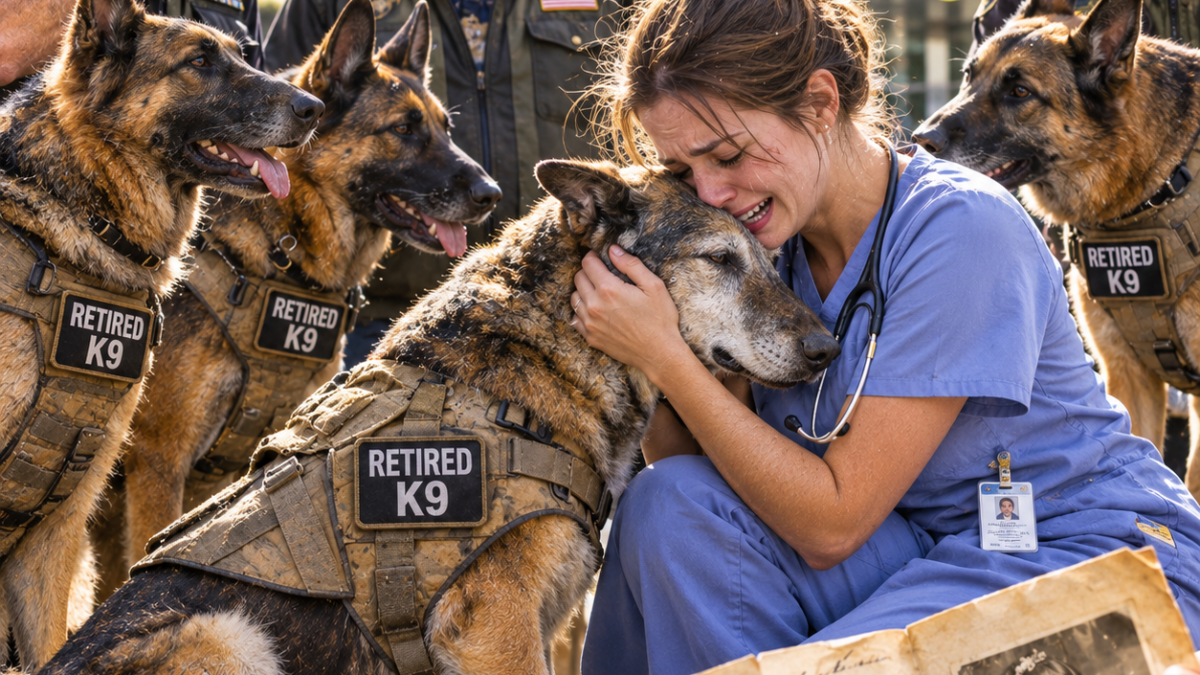
When he reached her, he did exactly what Duke had done.
Sat.
Leaned.
Clare’s other hand lowered automatically to Ranger’s shoulder.
Marissa stopped three feet away.
“Ma’am.”
Clare looked up.
“Do you know this dog?”
Clare looked at Ranger.
He looked older.
Of course he did.
His face had widened.
Black around his muzzle now flecked with silver.
But the eyes.
She remembered those eyes through the bars of a field kennel.
Furious.
Terrified.
Watching every hand like it might become another weapon.
“I think I might.”
Marissa frowned.
“Might?”
Clare swallowed.
“It’s been a long time.”
“How long?”
Clare should have lied.
She had spent fourteen years becoming excellent at lying through omission.
Instead:
“Fourteen years.”
Marissa blinked.
“Ranger is nine.”
Clare almost smiled.
“No.”
“Then he isn’t the one I knew.”
Marissa started to relax.
Then Clare reached beneath Ranger’s jaw and gave two soft taps against his chest.
Ranger immediately lowered his head between her knees.
Marissa’s expression changed.
“That command isn’t in his current training.”
Clare froze.
“Where did you learn it?”
Before Clare answered, Coach stood.
Dutch Shepherd.
Scar along the left side of his face.
Partial hearing loss.
His caretaker gave a hand signal.
Stay.
Coach stared past him.
Toward Clare.
Then began moving.
The caretaker repeated the signal.
Coach ignored him.
Now people stopped talking.
Coach crossed the room.
Clare saw the scar.
Her stomach dropped.
“No.”
She whispered it.
Not denial.
Recognition.
Coach reached her.
Clare lifted her left hand.
Palm forward.
Two fingers curled.
Then lowered slowly.
Coach stopped instantly.
Sat.
His body relaxed.
His handler went pale.
“That’s his calming signal.”
Clare looked at him.
“It used to be.”
The man stared.
“What does that mean?”
Then Nova rose.
The small female Shepherd moved faster than the others.
Her current caretaker barely had time to gather the leash before she pulled forward.
Not wildly.
Purposefully.
By the time Nova reached Clare, the entire front half of the event hall had turned.
The chaplain stopped speaking.
The reporter whispered:
“Keep rolling.”
Nova pushed between Duke and Ranger.
Clare laughed once.
A broken sound.
“Oh, you always did that.”
Marissa heard.
“Always?”
Clare looked around.
Four dogs.
Four impossible reunions.
Fourteen years of silence collapsing at her feet.
Then she saw Atlas.
Still sitting near the podium.
Massive.
Silver muzzle.
Older than the others.
Motionless.
Watching.
Clare forgot everyone else.
Atlas.
Her knees weakened.
“No.”
She whispered.
Not because she did not want him.
Because she did.
Too much.
Atlas had been the one she never allowed herself to imagine surviving.
His handler held his lead loosely.
The dog had retired from active duty years earlier.
Age had slowed him.
Arthritis.
Clouding eyes.
He rarely reacted to strangers.
But now he stared at Clare.
His chest rose.
Fell.
Then he stood.
It took effort.
One rear leg trembled.
Nobody told him to move.
He walked.
Slow.
Straight.
The crowd opened without being asked.
Clare remained crouched.
One hand covered her mouth.
Atlas reached her.
Stopped.
For several seconds, he simply stared.
Clare whispered:
“Hey, old man.”
Atlas made a sound.
Low.
Broken.
Not a bark.
Not exactly a whine.
The kind of sound an animal makes when emotion outruns training.
Every working-dog handler in the room recognized it.
Clare did too.
Her composure disappeared.
She wrapped both arms around his neck.
Atlas pushed his full weight into her.
Nearly knocked her backward.
Clare buried her face in his fur and cried.
Not gracefully.
Not quietly.
Fourteen years opened.
The event hall vanished.
She was twenty-five again.
Canvas recovery tent.
Emergency lights.
Atlas refusing food.
The empty cot where Sergeant Wyatt Price should have been.
Clare sitting on the dirt floor reading nonsense from a paperback novel because silence felt worse.
Atlas staring.
Waiting for the man who would never come back.
She remembered the first night he allowed her within five feet.
Then three.
Then one.
She remembered leaving food beside him and walking away.
The first time he ate only after she turned her back.
The first time he pressed his head against her knee.
Exactly like now.
Someone in the present said:
“My God.”
Clare barely heard.
Colonel Nathan Reyes moved through the crowd.
Sixty-one.
Senior veterinary officer.
Four decades around military working dogs.
He had been standing near the podium when Duke moved.
By the time Atlas reached Clare, Reyes knew this was not random.
He approached slowly.
Not because he feared the dogs.
Because the woman in the middle of them looked like a person whose entire private life had just been dragged into public.
He crouched.
“Ma’am.”
Clare looked up.
“I’m Colonel Reyes.”
“Clare.”
“Clare Dunore.”
He nodded.
Then looked at the dogs.
“I don’t think we’ve met.”
“We haven’t.”
“But they have.”
Clare closed her eyes.
“Yes.”
Reyes waited.
Professional silence.
Clare had used the same thing with frightened patients.
Give them space.
Eventually truth walks into it.
Reyes asked:
“Where?”
Clare’s hand remained buried in Atlas’s fur.
“Overseas.”
“When?”
“Fourteen years ago.”
“Doing what?”
The room held its breath.
Clare looked toward the exits.
She could still leave.
Maybe.
Then Atlas shifted closer.
Duke’s head rested across her thigh.
Ranger lay against her boot.
Coach watched her hand.
Nova squeezed against her hip.
They had already answered.
Clare looked at Reyes.
“I was a combat medic.”
Murmurs.
Then:
“Field surgical nurse.”
“I spent almost two years forward.”
“We treated soldiers.”
“And when veterinary teams couldn’t reach us fast enough…”
She looked at the dogs.
“…we treated them too.”
Nobody moved.
Patrice stood near the medical station staring.
Her book-loving, lunch-alone coworker.
Clare.
The woman she had teased about hospital corners.
A combat medic.
A field surgical nurse.
The reporter lowered her microphone.
This no longer felt like a cheerful community segment.
Reyes asked:
“These five came through your unit?”
“Different times.”
“Different circumstances.”
“Not one unit.”
“Not one deployment cycle.”
“But yes.”
She touched Duke.
“Duke came in after an IED strike.”
Ben’s mouth opened.
“How do you know that?”
“Shoulder.”
Clare pointed.
“Left side.”
“There should be an old fragment scar beneath the fur.”
Ben nodded slowly.
“There is.”
Clare moved to Ranger.
“Ambush.”
“Leg infection.”
“He bit two people before they let me near him.”
Marissa stared.
“That isn’t in his public retirement profile.”
“No.”
Clare said.
“It wouldn’t be.”
Coach.
“Blast injury.”
“Partial hearing loss.”
“We made hand signals because he panicked when people approached from the side he couldn’t hear.”
His caretaker whispered:
“The signal you used.”
Clare nodded.
“I made it up.”
Nova.
Clare smiled through tears.
“Pregnant.”
Everyone stared.
“Pregnant?”
“She was separated from her unit during an evacuation.”
“Malnourished.”
“Delivered five puppies in a supply tent.”
“Two in the morning.”
“Headlamp.”
“Medic kit.”
“No idea what I was doing.”
The crowd laughed softly.
Not because it was funny.
Because they needed breath.
Then Atlas.
Clare stopped.
Reyes noticed.
“What happened to him?”
Her hand tightened around the old dog.
“His handler died.”
The room became silent again.
“He didn’t know.”
Clare said.
“They brought Atlas back.”
“He waited.”
“For four days he barely ate.”
“Wouldn’t let anyone touch him.”
“Wouldn’t sleep unless exhaustion forced him.”
“I think he believed Wyatt would walk through the tent at any minute.”
She looked at Atlas.
“I didn’t know how to fix that.”
“So I stopped trying.”
Reyes frowned.
“What did you do?”
“I sat with him.”
“That’s all?”
“Every night.”
“How long?”
“Almost three weeks.”
Clare smiled faintly.
“I had a paperback I hated.”
“I read the whole thing out loud because my voice bothered him less than silence.”
Reyes looked at Atlas.
“He let you treat him?”
“Eventually.”
“Not because I commanded anything.”
“He decided.”
She swallowed.
“Working dogs decide more than people think.”
Reyes nodded.
“Yes.”
Clare continued.
“When I left eight months later, he was reassigned.”
“I never saw him again.”
“I didn’t know what happened.”
“I didn’t know if any of them survived long careers.”
Her voice cracked.
“I used to look at military-dog photographs online.”
“Then I stopped.”
“Why?”
Patrice asked from the edge of the crowd.
Clare looked at her coworker.
Because Patrice knew none of this.
Nobody did.
“Because finding out they died hurt.”
“And not knowing hurt.”
“So I chose not knowing.”
Atlas rested his head against her chest.
Clare closed her eyes.
Apparently Atlas had made a different choice.
He had remembered.
Fourteen years earlier, Clare had been twenty-five and still using her married name.
She rarely spoke about that marriage now.
Not because it was terrible.
Because it failed quietly.
Her husband, Andrew, had been a civilian engineer.
Kind.
Patient.
At first.
They married after nursing school.
Clare joined military medicine because she wanted experience, structure, and a way to repay school assistance.
She expected hospital work.
Maybe domestic bases.
Maybe overseas medical centers.
Then deployment orders arrived.
Andrew said:
“We’ll handle it.”
They did.
The first time.
Clare came home thinner.
Quieter.
She woke at sounds that had never bothered her.
Hated fireworks.
Stopped going to crowded restaurants.
Andrew tried.
Then she deployed again.
That time was worse.
Two medics she knew were killed.
One in an attack she survived.
She did not tell Andrew details.
He asked.
She said:
“I’m fine.”
The lie became architecture.
By the time Clare came home for good, they were strangers who still cared about one another.
Divorce arrived without betrayal.
No screaming.
Just exhaustion.
She returned to her maiden name.
Dunore.
Changed hospitals.
Eventually moved to Texas.
Fort Bellwood hired her in general medicine.
No trauma unit.
No military surgical ward.
No K9 program.
Quiet.
Predictable.
Exactly what she wanted.
The dogs had been harder to leave than the people.
She hated admitting that.
People asked questions.
People said:
Tell me what happened.
Dogs did not.
A dog in pain did not need explanation.
Clare could change a bandage.
Hold pressure.
Clean infection.
Sit nearby.
There was a task.
Then another.
Human grief often had no task.
That terrified her.
Duke was the first dog she treated long enough to remember.
He arrived at the field hospital after his patrol vehicle struck a roadside explosive.
Two soldiers critically wounded.
Duke’s handler, Corporal Evan Marsh, survived but underwent emergency surgery at another facility.
Duke had a shoulder wound.
Not catastrophic.
But painful.
He fought anyone approaching.
Not because he was aggressive.
Because his entire world had exploded and his person disappeared.
Clare volunteered.
A veterinary technician showed her enough to stabilize the wound.
“Do not get bitten.”
Great advice.
Duke growled when she approached.
Clare sat.
Waited.
She remembered saying:
“I don’t want to be here either.”
Duke stared.
“Apparently neither of us gets a vote.”
She placed the bandage supplies down.
Waited longer.
Eventually Duke allowed treatment.
Barely.
That night he cried.
Soft.
Constant.
Clare dragged a cot beside the kennel.
Not because she was assigned.
Because she could not sleep anyway.
For three nights she stayed.
When Evan Marsh finally returned in a wheelchair, Duke nearly tore the kennel gate apart.
Clare cried harder than either of them.
Evan hugged his dog.
Then looked at Clare.
“You stayed?”
She shrugged.
“He was loud.”
Evan laughed.
Clare never expected Duke to remember.
Why would he?
One nurse.
Three days.
Fourteen years.
Yet Duke had crossed that ballroom as if no time existed.
Ranger had been different.
Ranger arrived furious.
His unit had taken casualties during an ambush.
Two soldiers dead.
His handler wounded.
Ranger had blood on him that was not his.
A wound on his hind leg became infected.
He bit the first medic.
Snapped at the second.
Someone suggested sedation.
Clare said:
“Give me a day.”
“Why?”
“I don’t know.”
She took a book.
Sat outside his kennel.
Read.
Ranger paced.
Growled.
Watched.
The book was some terrible detective novel another medic left behind.
Clare read eighty pages aloud.
The next day, Ranger paced less.
Third day:
He lay down.
Fourth:
Clare opened the kennel door and did nothing.
Ranger watched.
She read another chapter.
Eventually he moved closer.
Not enough to touch.
Enough to smell.
By afternoon she cleaned the wound.
Ranger never bit her.
When his handler came back, Ranger returned to work after rehabilitation.
Clare thought:
Good.
Then forgot how to ask what happened later.
Coach arrived after an explosion damaged part of his hearing.
He startled violently when people approached from the wrong side.
Sound became unreliable.
Clare noticed hand movement worked better.
She created a sequence.
Palm open.
Two fingers curl.
Slow downward sweep.
Relax.
Stop.
Look.
Breathe.
Nobody called it training.
It was survival communication.
Years later, watching Coach obey the same signal across a Texas ballroom, Clare felt something almost supernatural.
Not because memory was magic.
Because something she improvised under fluorescent tent lights had survived longer than the version of herself who created it.
Nova was chaos.
Pregnant.
Malnourished.
Terrified.
A working dog who had somehow become separated from her unit during a messy evacuation.
By the time she reached the forward facility, contractions had begun.
Nobody wanted to believe it.
One medic said:
“Dogs can’t deploy pregnant.”
Clare looked at Nova’s abdomen.
“Apparently she did.”
No veterinarian.
No proper equipment.
One medical manual downloaded badly over unstable internet.
Clare delivered five puppies.
One appeared not to breathe.
She cleared its airway.
Rubbed.
Waited.
The puppy squeaked.
Every exhausted person in the supply tent cheered.
Clare cried.
Then pretended dust got in her eye.
Nova eventually transferred to veterinary care.
Her puppies were placed appropriately.
Clare never knew which ones survived.
Now, fourteen years later, Nova pressed against her side like an old friend.
Then Atlas.
Atlas was the one that followed her home.
Not physically.
In dreams.
Sergeant Wyatt Price had been killed in the field.
Atlas survived.
When they brought him to the forward hospital, he kept searching behind every person.
Every door.
Every vehicle.
Waiting.
Clare asked:
“Where’s his handler?”
Nobody answered at first.
Then:
“Didn’t make it.”
Atlas refused food.
Water only when desperate.
Would not accept touch.
Command responses inconsistent.
For four days, the animal functioned on instinct and waiting.
A handlerless working dog is not simply a pet missing an owner.
His entire working identity had been built around one partnership.
Voice.
Scent.
Routine.
Mission.
Then gone.
Clare remembered recognizing something in him.
Not the same grief.
But familiar enough.
She had just lost Staff Sergeant Malik Reed, a medic she considered a brother.
Explosion.
No warning.
One day there.
Next day belongings boxed.
Everyone expected Clare to keep working.
So she did.
Atlas expected Wyatt.
Everyone expected him to adapt.
He did not.
Clare understood refusing.
Every night she sat outside his recovery area.
Five feet away.
Then four.
Never reaching.
Sometimes talking.
Sometimes reading.
Sometimes silent.
One night she said:
“I know.”
Atlas looked at her.
“I know you’re waiting.”
She did not say:
He isn’t coming.
She could not.
Another night:
“I’m waiting too.”
That was the first time Atlas moved closer.
Not much.
One step.
Then down.
A week later, he ate while she sat inside the tent.
Two weeks:
Allowed touch.
Three:
Pressed his head against her shoulder.
Clare cried into his fur where nobody saw.
Atlas never asked why.
That was the gift.
When Clare’s deployment ended months later, she stood beside his new handler.
Atlas looked between them.
She crouched.
Pressed her forehead to his.
“You’re going to be okay.”
She did not know if she was talking to him or herself.
Then she left.
For fourteen years she believed that was the end.
Back in Fort Bellwood’s event hall, Colonel Reyes listened without interrupting.
When Clare finished the first version of the story, nobody applauded.
Applause would have been wrong.
The room held silence instead.
Then Marissa asked:
“Why didn’t anyone here know?”
Clare looked down.
Ranger had stretched across her shoes.
“Because I didn’t want anyone to.”
“Why?”
That came from Patrice.
Not accusation.
Pain.
Clare looked at her coworker.
“You have eaten lunch beside me for two years.”
Patrice said.
“You never said you served.”
Clare smiled sadly.
“What was I supposed to say?”
“Pass the salt, by the way I spent five years trying to keep people and dogs alive?”
“Maybe not like that.”
Someone laughed softly.
Clare’s smile faded.
“When I came home, everybody wanted a story.”
“What happened?”
“Were you scared?”
“Did you save anyone?”
“Did you kill anyone?”
“Was it like the movies?”
“People did not mean harm.”
“But they wanted a clean thing.”
“War isn’t clean.”
“Grief isn’t.”
“I didn’t know how to make it understandable.”
“So I stopped talking.”
Patrice sat beside her on the floor.
“I wouldn’t have asked you to make it understandable.”
Clare looked at her.
“I know that now.”
Patrice’s eyes filled.
“That sounds like an apology.”
“Don’t get used to it.”
Patrice laughed through tears.
Good.
Clare needed that.
Colonel Reyes asked:
“How long were you military medicine?”
“Five years.”
“How much forward?”
“Almost two.”
“Recognition?”
Clare shrugged.
“Normal commendations.”
“Nothing for the dogs.”
“Nobody tracked it that way.”
Reyes looked around.
“Somebody should have.”
Clare stiffened.
“No.”
“What?”
“I don’t want an award.”
Reyes smiled.
“I didn’t say award.”
“You thought it.”
“I did.”
“No.”
“Why?”
“Because I did my job.”
Reyes glanced at Atlas.
“Apparently not only your job.”
Clare’s face hardened.
“Colonel.”
He lifted both hands.
“Not today.”
“Fine.”
The news reporter approached carefully.
“Ms. Dunore.”
Clare immediately said:
“No.”
The reporter stopped.
“I haven’t asked.”
“I know.”
“We’re recording.”
“I noticed.”
“Do you want us to stop?”
That surprised Clare.
The camera remained pointed down.
Not at her.
She looked around.
Families had phones out already.
No hiding this.
But choice mattered.
“Yes.”
“Stop for five minutes.”
The reporter nodded.
Camera lowered.
Clare breathed.
That was the first respectful thing anyone with media equipment had done around her in years.
After five minutes, Clare said:
“You can film the dogs.”
“Not me speaking.”
“Understood.”
Then:
“If I change my mind?”
“You tell me.”
Clare nodded.
Agency.
Again.
Perhaps that was what the dogs had always given her too.
No demand.
They simply stayed.
The formal K9 ceremony never resumed.
Nobody cared.
The chaplain folded his prepared remarks and joined the crowd.
Families sat on the floor.
Handlers asked questions.
Records came out.
Retirement files.
Deployment histories.
Clare corrected nothing unless asked.
One by one, details aligned.
Duke.
Ranger.
Coach.
Nova.
Atlas.
Different deployments.
Different units.
Different injuries.
All passed through medical sites where Clare had served under her married name.
Her current coworkers searched her face as though it had changed.
It hadn’t.
Their understanding had.
Patrice whispered:
“What was your old name?”
Clare answered.
Then immediately:
“Don’t tell press.”
Patrice made a locking motion over her lips.
“Never.”
Clare believed her.
That mattered.
Near the end of the afternoon, a man approached.
Late thirties.
Civilian clothing.
Walked with an old injury.
He held his phone.
His name was First Sergeant Daniel Ooa.
Clare did not recognize him.
But when he said:
“Atlas,”
her body tightened.
“Were you his handler?”
“No.”
“Wyatt Price was.”
Clare stopped breathing.
“I served with Wyatt.”
“Closest friend in the unit.”
Atlas lifted his head at the name.
Daniel noticed.
“So did he.”
Clare’s eyes filled.
Daniel continued.
“Wyatt wrote home a lot.”
“His mother kept everything.”
“One letter mentioned a medic.”
Clare frowned.
“What medic?”
“You.”
“No.”
“He didn’t know your name.”
Daniel unlocked his phone.
Found a scanned page.
Old handwriting.
Smudged.
“He called you ‘the quiet one.’”
Clare covered her mouth.
Daniel read only part.
“He said there was a medic who sat with Atlas at night.”
“Didn’t push him.”
“Didn’t leave.”
“And Wyatt wrote that if anything happened to him, he hoped that person would stay with Atlas because Atlas trusted her.”
Clare stared at the screen.
Wyatt had noticed.
That was impossible.
She had barely spoken to him.
He had been in and out of the recovery area before returning to the field.
She remembered one conversation.
Wyatt kneeling beside Atlas.
Saying:
“He likes you.”
Clare had laughed.
“He tolerates me.”
Wyatt:
“Same thing with him.”
Then he left.
Days later, he died.
Clare had forgotten that conversation.
Or buried it.
“I didn’t know.”
She whispered.
Daniel nodded.
“Neither did I.”
“Not until today.”
He handed her the phone.
She read the scanned letter herself.
Atlas pressed closer.
Clare cried again.
This time not for the dog.
For the dead soldier who had somehow left behind proof that she had existed in his world too.
“I thought I was background.”
Daniel shook his head.
“You were the last kindness that dog had when everything went bad.”
Clare looked at Atlas.
The old Shepherd’s eyes were half closed.
Daniel said:
“He remembered.”
Fourteen years.
He remembered.
The local news aired seven minutes that evening.
No sensational soundtrack.
No giant graphics.
The reporter kept Clare’s interview brief because that was what Clare requested.
Most of the segment showed the dogs moving toward her.
One after another.
Duke.
Ranger.
Coach.
Nova.
Atlas.
Then Colonel Reyes explaining recognition memory in working dogs.
Then Daniel showing Wyatt’s letter.
The story traveled farther than anyone expected.
Military communities shared it.
Veterans.
K9 groups.
Nurses.
Animal rescue organizations.
By Monday morning, the hospital communications office had seventeen interview requests.
Clare refused sixteen.
Patrice found her hiding in a supply closet.
“You know people can see you through the window.”
“I’m not hiding.”
“You’re sitting behind saline boxes.”
“Inventory.”
“Sure.”
Patrice entered.
Closed the door.
“ABC called.”
“No.”
“National morning show.”
“No.”
“A military podcast.”
“No.”
“A dog magazine.”
Clare considered.
“No.”
Patrice laughed.
“Fine.”
Then softer:
“How are you?”
Clare looked at the shelves.
“Everyone keeps asking that.”
“Annoying?”
“Yes.”
“Still.”
Clare sighed.
“I don’t know.”
“I slept four hours.”
“Dreams?”
“Yes.”
“Bad?”
“Some.”
“Atlas?”
Clare nodded.
Patrice sat.
“You going back to the sanctuary?”
Clare looked at her.
“How do you know?”
“You requested Thursday off.”
“I’m observant.”
“You’re nosy.”
“Both.”
Clare smiled.
“Yes.”
“I’m going.”
“Good.”
“Want company?”
“No.”
Patrice nodded.
No offense.
That was friendship too.
Knowing when not to go.
The K9 sanctuary sat forty minutes from Fort Bellwood.
Open land.
Fenced exercise areas.
Low buildings.
Shaded kennels.
Retired working dogs who could not immediately transition to ordinary homes.
Some eventually adopted by veterans.
Some remained.
Atlas had lived there four years.
Duke eighteen months.
Coach two.
Nova rotated between sanctuary and foster care.
Ranger lived mostly with Marissa but spent training days there.
Clare arrived carrying nothing.
No treats.
No toys.
She did not want to buy affection from animals who had already given something far more frightening.
Atlas saw her through the fence.
He stood.
Clare’s throat tightened.
The caretaker opened the gate.
“You can go in.”
“Alone?”
“He seems to have voted.”
Clare entered.
Atlas walked to her.
No drama this time.
No crowd.
No cameras.
He pressed his head against her knee.
Clare sat on the ground.
“Hi.”
He lowered beside her.
For an hour, she did almost nothing.
That was the miracle.
No performance.
Nobody asking for war stories.
Duke eventually joined.
Then Nova.
Ranger arrived with Marissa.
Coach later.
Five dogs.
Grass.
Texas sun.
Clare sitting.
Exactly as she had fourteen years earlier in a canvas tent.
Except nobody was dying.
That difference took time to believe.
Marissa sat outside the fence.
Did not interrupt.
Eventually Clare said:
“You can come in.”
Marissa joined.
Ranger did not leave Clare.
Marissa laughed.
“I’m offended.”
“Apparently I have seniority.”
“Fourteen years I can’t compete with.”
Clare looked at Ranger.
“How long have you had him?”
“Two years.”
“Retired because of hip problems.”
“He sleeps on my couch.”
Clare smiled.
“Good.”
“He steals pillows.”
“Better.”
Marissa studied her.
“Do you miss it?”
Clare went still.
“War?”
“No.”
“The dogs.”
Clare looked around.
“Yes.”
“Every day.”
“Why didn’t you work with them again?”
“Because I didn’t know how to separate them from everything else.”
Marissa nodded.
“Makes sense.”
“I thought if I went near military dogs…”
Clare paused.
“I’d go backward.”
“And?”
She looked at Atlas sleeping against her.
“Maybe backward isn’t the same as back.”
Marissa smiled.
“That sounded expensive.”
“Therapy.”
“Definitely.”
Clare laughed.
Colonel Reyes began researching.
With Clare’s permission.
That mattered.
Every step:
Can I request this?
May I use your service records?
Can I contact former unit members?
Do you want your married name kept out of public material?
Clare said yes to some.
No to others.
Reyes respected each answer.
He found documentation.
Not heroic citations.
Ordinary military records.
Deployment rosters.
Medical assignments.
After-action reports.
Veterinary notes mentioning “medical support.”
One report described a nurse assisting treatment of an injured working dog under austere conditions.
No name.
Another named Clare.
One mentioned hand signals developed during recovery for a hearing-impaired dog.
Coach.
Reyes called.
“You should know something.”
Clare sighed.
“Is this about an award?”
“Maybe.”
“No.”
“Listen first.”
“I am listening.”
“The hand-signal sequence you created for Coach appears in later training notes.”
Clare went silent.
“What?”
“Not formally credited.”
“But the sequence traveled.”
“Handlers adapted it.”
“Some techniques for hearing-impaired working dogs resemble what you documented.”
“I made that up because he kept panicking.”
“That is often how useful things begin.”
Clare sat at her kitchen table.
She looked at her hands.
Fourteen years.
Something she improvised because a frightened dog could not hear had continued after she left.
“I don’t want people saying I invented some military program.”
“They won’t.”
“Good.”
“You helped solve one problem.”
“That mattered.”
Clare breathed.
“Fine.”
Reyes smiled through the phone.
“That’s almost gratitude.”
“Don’t push.”
The stories came back in fragments.
Duke’s handler.
Corporal Evan Marsh.
Still alive.
Reyes located him through veterans’ networks.
He lived in Colorado.
When he learned about the reunion, he called Clare.
She almost did not answer.
Then:
“Hello?”
A man laughed.
“Still reading terrible books to dogs?”
Clare froze.
“Evan?”
“Jesus.”
“You remember me?”
“Of course I remember you.”
Clare sat.
“How are you?”
“Old.”
“You?”
“Also old.”
He laughed.
“Duke found you.”
“He did.”
“I watched the video six times.”
“Why?”
“Because the first five I couldn’t see through tears.”
Clare swallowed.
Evan continued.
“You stayed beside him when I couldn’t.”
“I’ve thought about that for years.”
“I only stayed three nights.”
“Three nights was everything to him.”
Then:
“And to me.”
Clare closed her eyes.
“You were recovering.”
“Exactly.”
“I couldn’t be his handler.”
“You were.”
“Temporarily.”
She wanted to reject it.
Evan would not let her.
“Clare.”
“Yes?”
“You people kept telling us medics were just doing your jobs.”
“Maybe.”
“But sometimes your job is somebody else’s whole world.”
After the call, Clare sat at the kitchen table until sunset.
Not crying.
Just allowing the sentence to exist.
Ranger’s history hurt more.
His original handler had survived the ambush but later left service.
Reyes located him too.
He declined contact.
Clare respected that.
No pressure.
No reunion.
That mattered.
Not every past relationship needed reopening because the internet liked closure.
Some doors remained closed.
Coach’s original handler sent an email.
Short.
Thank you for teaching him how to hear with his eyes.
Clare printed it.
Placed it beside the little framed photograph on her desk.
Patrice finally saw the photograph clearly.
Five young people in military medical uniforms.
Clare among them.
Two men she had mentioned losing.
Patrice did not ask who.
She simply said:
“Good picture.”
Clare nodded.
“Yes.”
Nova’s puppy story became the favorite online.
People wanted photographs.
There were none Clare had.
Then the sanctuary found an old veterinary transfer note confirming five pups.
No dramatic reunion.
No miracle litter appearing.
Just evidence.
Five puppies had lived long enough to transfer.
Clare cried at that.
Because for fourteen years, she had wondered whether the smallest puppy survived the next morning.
Now she knew at least all five made transfer.
Sometimes closure is administrative paperwork.
Atlas remained hardest.
Daniel Ooa arranged something with Wyatt Price’s mother.
Her name was Margaret.
Eighty-two.
Living in Oklahoma.
She wanted to speak with Clare.
Clare delayed for two weeks.
Not because she did not care.
Because she cared too much.
Finally, video call.
Margaret appeared wearing glasses and a red cardigan.
Behind her:
Photograph of Wyatt in uniform.
Another with Atlas.
Clare could not speak.
Margaret smiled.
“So you’re the quiet one.”
Clare covered her mouth.
“I guess.”
“My son wrote about you.”
“I didn’t know.”
“He wrote about a lot of people.”
“He watched people.”
“That was Wyatt.”
Margaret lifted a letter.
Original.
Not scan.
“He said Atlas liked very few people.”
“He said you never forced him.”
Clare whispered:
“I didn’t know what else to do.”
“Sometimes that’s the right thing.”
Margaret’s voice shook.
“I always wondered what happened after Wyatt died.”
“I knew Atlas survived.”
“But I didn’t know those first weeks.”
Clare looked down.
“I can tell you.”
“If you want.”
“I do.”
So Clare told her.
Not battlefield details.
Not how Wyatt died.
Margaret already carried enough.
She told her about Atlas.
Refusing food.
Waiting.
The paperback novel.
The first meal.
The first touch.
The night Atlas slept with his head against Clare’s boot.
Margaret cried.
Then smiled.
“Wyatt used to let him sleep on his boots.”
Clare froze.
“What?”
“At home.”
“Whenever Atlas was unsettled.”
“He’d lie across Wyatt’s boots.”
Clare looked toward the sanctuary photograph on her wall.
That behavior had not started with her.
It had been memory.
Atlas had put his head on her boot because it was the closest thing he had to Wyatt.
The realization devastated her.
Margaret continued:
“I’m glad he had somebody.”
Clare whispered:
“I wish it had been Wyatt.”
“So do I.”
Then Margaret said something Clare would remember forever.
“But love does not become worthless because it comes second.”
Clare cried.
Margaret did too.
Neither apologized.
The recognition Reyes prepared was modest.
That was Clare’s condition.
No giant ceremony.
No publicity campaign.
A formal commendation acknowledging her medical support to working-dog teams during forward deployment and later contribution to welfare practices.
Clare tried refusing anyway.
Reyes called.
“You said modest.”
“I changed my mind.”
“You cannot change your mind after I did paperwork.”
“Of course I can.”
“Do you know how many signatures this required?”
“Colonel.”
“Three offices.”
“Two commands.”
“One person called me on vacation.”
Clare laughed.
Reyes continued:
“You are accepting because I suffered.”
“That’s emotional manipulation.”
“Yes.”
“Effective?”
Clare looked toward Atlas asleep beside her chair at the sanctuary.
“Yes.”
She accepted.
At the ceremony, she wore no old uniform.
She did not want one.
Navy dress.
Simple.
Patrice came.
Marissa.
Ben.
Daniel.
Margaret Price watched through video.
Duke, Ranger, Coach, Nova, and Atlas were there.
No speeches longer than five minutes.
Clare insisted.
Reyes violated that slightly.
“Seven.”
She whispered afterward.
“You promised five.”
“I’m a colonel.”
“Terrible excuse.”
“Works often.”
The commendation citation emphasized presence.
Calm.
Improvised care.
Support.
Not heroism.
Clare liked that.
She had never felt heroic.
Mostly tired.
Scared.
Young.
Doing whatever was next.
When Reyes pinned the recognition, he said quietly:
“You gave them something nobody else could give at those moments.”
Clare looked at the dogs.
“Time.”
“Presence.”
Reyes nodded.
“Exactly.”
Then:
“That is rarer than people think.”
The attention did not disappear.
Clare learned boundaries.
One interview.
Then another.
Only if the focus included working-dog retirement, veterinary support, and veteran mental health.
No questions about combat details she did not want to discuss.
No sensational reenactments.
No “secret war hero nurse” nonsense.
She corrected one reporter.
“I wasn’t hiding because I was humble.”
“I was hiding because I was hurting.”
That line spread.
Clare hated that it spread.
Then veterans wrote.
Some said:
Me too.
A former medic emailed:
I changed careers because people kept wanting stories from me I couldn’t tell. Thank you for saying pain and humility aren’t the same thing.
Clare printed that one too.
Her desk became less empty.
Photographs.
Letters.
A small wooden dog carved by a veteran patient.
Patrice noticed.
“Look at you.”
“What?”
“Decorating.”
“Stop.”
“You’re becoming emotionally available.”
“I’ll report you.”
“Worth it.”
Clare also started therapy again.
She had gone years earlier.
Stopped.
Returned now.
Her therapist asked:
“What did the dogs recognize?”
Clare frowned.
“Me.”
“Which version?”
“That sounds like therapist nonsense.”
“It is.”
Clare crossed her arms.
Then thought.
“The one before.”
“Before what?”
“Before I became this.”
“What is this?”
“Quiet.”
“You were quiet then too.”
Clare looked annoyed.
“Apparently.”
“What did Atlas recognize?”
Clare looked down.
“Someone who stayed.”
“Do you think you stayed for yourself after you came home?”
That question made her angry.
Good therapy often did.
“No.”
“Why not?”
“I kept working.”
“That wasn’t the question.”
Clare stared at the floor.
Eventually:
“No.”
She had survived by leaving parts of herself overseas.
The dogs had returned carrying them.
Not whole.
Not magically healed.
But recognizable.
Combat nurse.
Medic.
Woman who could sit in darkness without running.
She had spent fourteen years believing that version of herself existed only in trauma.
The dogs remembered something else.
Safety.
Clare had been safe to them.
She had never considered that.
Months passed.
Duke aged.
Coach’s hearing worsened.
Nova developed kidney problems.
Atlas moved slower.
Reunions are beautiful partly because time remains cruel.
Clare knew medicine.
She knew what was coming.
That made the sanctuary harder.
She went anyway.
Not going had never saved her before.
Nova was the first to decline significantly.
Her foster family called the sanctuary.
Clare visited.
Nova lay on a blanket.
Smaller than Clare remembered.
Eyes still sharp.
Clare sat.
Nova lifted her head.
Pressed it against Clare’s hand.
The foster mother asked:
“Were you really there when she had puppies?”
“Yes.”
“Five?”
“Yes.”
“Did she know what she was doing?”
“Better than I did.”
They laughed.
The foster mother had found records tracing two of Nova’s pups into military or law-enforcement training programs before retirement.
Not all five.
Enough.
Clare told Nova:
“Your babies did okay.”
Maybe the dog understood tone.
Maybe not words.
She relaxed.
Nova died months later with her foster family.
Clare grieved.
Hard.
But differently.
Fourteen years earlier, endings disappeared without confirmation.
This time, she knew.
She said goodbye.
That mattered.
Duke followed later.
Old age.
Evan Marsh flew in.
He wanted to be there.
Clare met him in person for the first time since deployment.
Older.
Scar along his jaw.
Cane.
They stared.
Then laughed.
“You look terrible.”
Evan said.
“You look worse.”
“Good.”
Duke lay between them.
Evan put one hand on his dog.
Clare the other.
“You stayed with him the first time.”
Evan said.
“I’ll stay this time.”
Clare nodded.
They did.
No cameras.
No reporters.
No viral posts.
Just two people and an old dog.
When Duke died, Clare cried.
Then went home.
Slept eight hours.
Her therapist later called that progress.
Clare called it exhaustion.
Both.
Ranger remained energetic despite age.
Marissa joked he had spite keeping him alive.
Coach learned new touch cues as vision changed.
Clare helped.
This time alongside professionals.
No pretending she knew everything.
She asked.
Learned.
Worked.
One veterinarian said:
“You ever consider returning to veterinary-support nursing?”
Clare laughed.
“At my age?”
“You’re forty.”
“Exactly.”
“That is not old.”
“It feels old around Malinois.”
Fair.
Clare eventually began volunteering two Saturdays a month at the sanctuary’s medical clinic.
Not military deployment.
No explosions.
No field tents.
Vaccines.
Arthritis medication.
Bandage changes.
Retirement care.
Boring medicine.
She loved it.
Atlas remained.
Always Atlas.
He lived longer than anyone expected.
The sanctuary staff called him stubborn.
Clare called it professional commitment.
Every visit:
Same patch of shade.
Same head against her knee.
Sometimes she read.
Good books now.
She refused to repeat the terrible detective novel.
One afternoon Daniel Ooa joined.
He sat beside her.
“Wyatt’s birthday.”
Clare looked at him.
“I know.”
Daniel smiled.
“Of course you do.”
“How?”
“Margaret told me.”
They sat.
Atlas slept.
Daniel said:
“Do you ever feel guilty?”
Clare laughed softly.
“For what category?”
“Being alive.”
Clare looked at him.
“Yes.”
“Me too.”
Silence.
Then:
“Wyatt would hate that.”
“I know.”
“Still.”
“I know.”
Daniel looked at Atlas.
“He got fourteen extra years.”
“More.”
“Because people took care of him.”
Clare shook her head.
“Not because of me.”
“I didn’t say you.”
“Lots of people.”
“Handlers.”
“Veterinarians.”
“Sanctuary.”
“Exactly.”
Daniel smiled.
“You’re learning.”
“What?”
“That being important doesn’t mean being the only person who mattered.”
Clare frowned.
“That sounds like therapy.”
“Margaret.”
“Worse.”
They laughed.
The hospital changed around Clare too.
Not dramatically.
People knew more.
That was unavoidable.
But her coworkers learned not to turn her into a mascot.
Patrice helped enforce.
A new nurse once said:
“Is it true five war dogs worship you?”
Patrice answered before Clare could.
“No.”
“They have a union.”
“Clare’s their attorney.”
The nurse looked confused.
Clare laughed.
Perfect.
Patients occasionally recognized her from news.
One veteran said:
“You’re the dog nurse.”
Clare replied:
“I’m currently your nurse.”
“Dog nurse sounds better.”
“Your blood pressure says otherwise.”
Normal.
That was what she wanted.
Not invisible.
Normal.
There is a difference.
A year after the event, Fort Bellwood held the retirement showcase again.
Clare almost refused.
Then accepted.
This time she was not medical coverage.
Guest.
She hated that.
Patrice forced her to attend.
“You survived combat.”
“You can survive a folding chair.”
“Debatable.”
The event was smaller.
No surprise reunion.
Ranger and Coach attended.
Atlas stayed at the sanctuary because travel had become difficult.
A young military working dog handler gave a speech.
Talked about retirement care.
Bond.
Handlers who die before their dogs.
Dogs who outlive missions.
Then he mentioned Clare.
Briefly.
No spotlight.
She appreciated that.
Afterward, a child approached.
Maybe ten.
“My dad says dogs remember good people.”
Clare crouched.
“Dogs remember lots of things.”
“Do they remember bad people?”
“Probably.”
The child thought.
“Then you should be good.”
Clare smiled.
“That is a decent plan.”
Simple.
Better than most adult explanations.
Atlas’s final winter was mild.
Texas sunlight.
Dry grass.
He struggled standing.
Clare visited more.
Not every day.
She had work.
Life.
That mattered too.
She had started having dinner with Patrice and her husband.
Joined a book club she hated but continued attending.
Went to North Carolina to visit a cousin.
Allowed her life to widen.
The dogs were no longer the only uncomplicated thing.
They were part of something bigger.
One February afternoon, the sanctuary called.
“Clare.”
She knew from the voice.
“Atlas?”
“Yes.”
“How long?”
“We don’t know.”
“I’m coming.”
She arrived thirty-eight minutes later.
Atlas lay beneath a blanket in the clinic.
Daniel Ooa was there.
Marissa.
Colonel Reyes.
Margaret Price on video through a tablet.
Not a crowd.
Family in the strange way people become family around shared grief.
Clare sat on the floor.
Atlas opened his eyes.
His tail moved once.
“Hi, old man.”
She placed her hand on his head.
He exhaled.
Margaret spoke through the tablet.
“Tell him Wyatt’s waiting.”
Everyone froze.
Clare looked at the screen.
Margaret was crying.
“Tell him.”
Clare leaned close to Atlas.
“Wyatt’s waiting.”
Her voice broke.
“You don’t have to keep watch.”
Atlas’s breathing slowed.
Clare pressed her forehead against his.
Fourteen years earlier, she had said:
“You’re going to be okay.”
Now she said:
“You already were.”
Atlas died with his head against her leg.
Quiet.
No dramatic sound.
No final bark.
One breath.
Then no next one.
Clare stayed.
Of course.
That was what she did.
She stayed.
The internet learned two days later.
The sanctuary posted one photograph.
Atlas in Texas sunlight months earlier.
Head against Clare’s knee.
Caption:
He remembered her for fourteen years. She remembered him every day.
Clare approved it.
Nothing more.
Thousands of comments.
Handlers.
Veterans.
Nurses.
Dog owners.
People telling their own stories.
Clare did not read most.
She read Wyatt’s letter again.
Then Sarah—no, there was no Sarah in this story; Clare caught herself in life, not narrative. She read Margaret’s note mailed after Atlas died.
Inside:
A copy of one sentence from Wyatt’s old letter.
Not the entire thing.
Just:
If I’m not there, I hope the quiet one stays with him.
Margaret had written beneath it:
You did.
Clare framed that.
Not the commendation.
Not the news story.
That.
Months later, Colonel Reyes found Clare at the sanctuary.
Coach asleep nearby.
Ranger chasing something imaginary along the fence.
Clare sitting under the same tree.
He lowered himself onto the bench.
His knees complained loudly.
“You’re old.”
Clare said.
“I outrank you.”
“Not medically.”
He laughed.
Then:
“Do you regret the event?”
“What event?”
“The day they found you.”
Clare looked across the yard.
Duke gone.
Nova gone.
Atlas gone.
Coach old.
Ranger older.
No.
“Yes.”
Reyes smiled.
“Both?”
“Yes.”
“I regret losing privacy.”
“I regret people turning pain into inspiration.”
“I regret strangers thinking dogs magically cured me.”
“They didn’t.”
“What did they do?”
Clare thought.
“They contradicted me.”
Reyes waited.
“I had spent fourteen years believing that part of my life only contained things I failed to save.”
“Then five animals crossed a room and remembered me as something else.”
Reyes nodded.
“Safe.”
Clare swallowed.
“Yes.”
“That changed the story.”
“No.”
She looked at him.
“It changed which parts I believed.”
Better.
Reyes smiled.
“You should write that down.”
“I’m a nurse.”
“Not a writer.”
“Good.”
“Writers are exhausting.”
“Colonels too.”
They sat.
Clare eventually told Patrice about the two medics she lost.
Not because Patrice asked.
One night after shift.
Coffee.
Break room.
Clare pointed at the photograph.
“That’s Malik.”
Patrice looked.
Tall young man.
Huge smile.
“And that’s Jenna.”
Red-haired woman making a face at the camera.
“They died?”
“Yes.”
Patrice did not say:
I’m sorry.
She had learned.
Instead:
“Tell me something stupid about them.”
Clare stared.
“What?”
“Something normal.”
Clare smiled.
“Malik cheated at cards.”
“How?”
“Badly.”
“Jenna?”
“She stole socks.”
“Why?”
“Claimed everybody else bought better ones.”
Patrice laughed.
Clare laughed too.
That was healing.
Not retelling how they died.
Remembering how they lived.
The dogs had taught her that too.
The formal recognition ended up in a drawer.
Patrice discovered it.
“Why isn’t this displayed?”
“Because I don’t want it displayed.”
“Fine.”
She closed the drawer.
No argument.
Then placed a photograph beside Clare’s computer.
The five dogs surrounding her in the event hall.
Clare frowned.
“That is worse.”
“Too bad.”
“You’re fired.”
“You’re not my boss.”
“Tragic.”
Clare never removed the photograph.
Two years after the reunion, Coach died.
Ranger remained last.
Marissa joked:
“He’s determined to win.”
Clare said:
“He always hated losing.”
Ranger eventually retired fully to Marissa’s home.
Clare visited.
He still recognized her before the car door closed.
Not running anymore.
Just waiting near the porch.
She sat with him.
Read.
He slept.
When Ranger died, Clare thought she would collapse.
Instead, she cried.
Called Patrice.
Went to work two days later.
Lived.
That was not betrayal.
It took her years to learn that survival was not betrayal.
Five dogs had crossed a crowded room.
People called it extraordinary.
It was.
But Clare eventually stopped thinking the extraordinary part was recognition.
Dogs recognize scent.
Voice.
Movement.
Emotional memory.
Colonel Reyes had explained that.
Trauma bonds can last.
Animals remember safety.
The extraordinary part was what they returned to her.
Evidence.
Not that she saved them.
She hated that phrasing.
Too grand.
Evidence that she had mattered.
That while she spent years remembering every person and animal she could not keep alive, there had also been lives she touched and released back into the world.
Duke returned to his handler.
Ranger recovered.
Coach learned new communication.
Nova delivered puppies.
Atlas learned to eat again.
Clare had been one part of each story.
A temporary bridge.
That was enough.
More than enough.
At forty-three, Clare accepted a permanent role splitting her schedule between Fort Bellwood’s general medical wing and a new veteran/K9 wellness program associated with the sanctuary.
Not because she became “the dog nurse.”
She made administrators promise never to put that on a badge.
Her official role remained clinical nursing with veteran and working-animal support coordination.
Ugly title.
She preferred it.
The program paired retired handlers, veterinary staff, nurses, social workers, and service-dog organizations.
Not therapy dogs pretending to solve PTSD.
Real support.
Practical.
Medical education.
Retirement planning for K9 handlers.
Grief resources when working dogs died.
Information for veterans adopting retired animals.
Clare’s main contribution was a rule she insisted appear in every training module:
Do not force contact.
Ask.
Wait.
Let trust move toward you.
It was how she had reached Ranger.
Atlas.
Patients.
Eventually herself.
One afternoon, a young medic named Lauren approached Clare after training.
“Can I ask something?”
“Yes.”
“How did you know when to stop trying with Atlas?”
Clare thought.
“I didn’t stop caring.”
“I stopped demanding a result.”
Lauren frowned.
“What’s the difference?”
“Sometimes helping becomes about proving we can help.”
“We touch.”
“Push.”
“Talk.”
“Command.”
“Because doing nothing feels useless.”
Clare looked toward the sanctuary yard.
“But presence is still doing something.”
Lauren wrote it down.
Clare laughed.
“You don’t need every sentence.”
“I do.”
“Why?”
“You’re famous.”
Clare groaned.
“Training over.”
Lauren laughed.
At home, Clare changed too.
Her apartment had photographs now.
Not many.
One of the five dogs.
One of Malik and Jenna.
One of Patrice’s wedding because Patrice had forced Clare to be in it.
One of Margaret Price holding Atlas during a visit shortly before he died.
And the old photograph she had once kept angled away from everyone.
Five military medical staff standing outside a field tent.
Clare no longer turned it toward the wall.
The past could be looked at without swallowing the room.
Most days.
Some days still bad.
Anniversaries.
Sudden smells.
Helicopters.
A dog barking in a certain tone.
Healing did not mean nothing hurt.
It meant pain stopped choosing every direction.
Margaret Price died three years after Atlas.
Daniel called.
Clare attended the funeral in Oklahoma.
Wyatt’s photographs covered the church lobby.
Young.
Laughing.
Atlas everywhere.
One display contained the original letter mentioning “the quiet one.”
Margaret had labeled it:
THE WOMAN WHO STAYED.
Clare stared.
Daniel joined her.
“She loved you.”
“I met her twice in person.”
“She loved efficiently.”
Clare laughed.
Then cried.
Margaret had left Clare something.
Not money.
A small metal tag.
Atlas’s first military ID tag.
Clare held it.
“I can’t take this.”
Daniel said:
“She wanted you to.”
“Why?”
“Because Wyatt had one.”
“Atlas had one.”
“And she said you were part of the chain that brought him home.”
Clare swallowed.
She kept it.
Not around her neck.
Inside the cedar box with the letters.
Some objects are too heavy for jewelry.
Years passed.
The viral clip became old internet history.
Occasionally resurfaced.
People still tagged Clare.
She ignored most.
New nurses came to Fort Bellwood without recognizing her.
She loved that.
One new hire named Jordan worked beside Clare for three weeks before Patrice told him.
Jordan stared.
“You’re that nurse?”
Clare groaned.
Patrice laughed.
Jordan said:
“The five dogs?”
“Yes.”
“You never mentioned it.”
Clare stared.
“We were busy with Mr. Franklin’s bowel obstruction.”
Fair.
Life continued.
That was perhaps the best ending anyone could have given her.
Not permanent spotlight.
Work.
Lunch.
Patients.
Books.
People she chose to know.
People who slowly knew her back.
On the tenth anniversary of joining Fort Bellwood, Patrice brought cake.
Clare hated surprise celebrations.
Patrice knew.
Did it anyway.
Small.
Six people.
No balloons.
Clare approved reluctantly.
Someone asked:
“What are you proudest of?”
Clare immediately said:
“Getting Mr. Herrera to stop smoking.”
Patrice laughed.
“He started again.”
“Then nothing.”
They pushed.
Clare thought.
Not the commendation.
Not the viral story.
Not the program.
Finally:
“Staying.”
Patrice looked at her.
“At Fort Bellwood?”
“In general.”
The room quieted.
Clare smiled faintly.
“Don’t make it weird.”
Too late.
Patrice hugged her.
Clare tolerated eight seconds.
Then:
“Enough.”
Progress.
One evening after shift, Clare drove to the sanctuary alone.
Most of the original dogs were gone.
New retirees lived there.
Different histories.
Different handlers.
One old Belgian Malinois sat near a fence refusing to approach volunteers.
Clare watched.
A young caretaker said:
“He doesn’t like anyone.”
Clare smiled.
“Probably not true.”
“Want to try?”
Clare shook her head.
“No.”
The caretaker looked surprised.
“You’re good with them.”
“That doesn’t mean he wants me.”
They stood.
After several minutes, the dog looked toward Clare.
She sat on a bench.
Did nothing.
Twenty minutes.
Nothing.
Thirty.
The dog moved closer.
Not all the way.
Enough.
Clare smiled.
No miracle.
No crowd.
No five dogs breaking formation.
Just one animal deciding one stranger might be safe enough to approach eventually.
That was more her speed.
Sometimes she still heard Atlas.
Not literally.
Memory.
The low broken sound when he saw her across the ballroom.
For years she thought that sound meant grief.
Later, she understood it differently.
Recognition can hurt.
You spend enough time convincing yourself a door is closed, and when someone opens it, relief arrives carrying every reason you closed it.
That was what happened in the event hall.
Not healing.
Recognition.
Healing came afterward.
Therapy.
Phone calls.
Funerals.
Visits.
Saying goodbye properly.
Allowing photographs on the desk.
Telling Patrice stupid stories about dead friends.
Learning that being remembered did not require becoming public property.
Learning to let people care without assuming they wanted something.
Learning she could work with dogs again without returning to war.
Those things were slower.
Less viral.
More real.
Colonel Reyes retired at sixty-five.
At his retirement dinner, Clare attended reluctantly.
He stood at the microphone.
“I promised not to tell the dog story.”
Clare pointed at him.
“Good.”
“So I won’t.”
He paused.
“But I will say that one of the best things I saw in forty years of military veterinary work was five highly trained animals collectively deciding human scheduling was irrelevant.”
Everyone laughed.
Clare shook her head.
Reyes looked toward her.
“They reminded some of us that memory is not always an injury.”
Clare stopped smiling.
“Sometimes it is also evidence of what kept us alive.”
That one stayed with her.
Afterward she said:
“That was unfair.”
“What?”
“You snuck wisdom into a retirement speech.”
“I’m old.”
“Privileges.”
He hugged her.
Clare hugged back.
Voluntarily.
Reyes noticed.
Said nothing.
Smart man.
At fifty, Clare finally told the full story to a room of military nurses.
Not press.
No cameras.
Training conference.
Topic:
Trauma-informed care.
She stood behind a podium.
Hated it.
Started with Duke.
Then Ranger.
Coach.
Nova.
Atlas.
Not the reunion.
The original care.
She told them mistakes.
Times she approached too fast.
Times fear made her impatient.
The puppy she nearly mishandled because she had no veterinary experience.
The night she yelled at another medic because exhaustion made her cruel.
She refused heroism.
Then she said:
“The most useful thing I did for Atlas was sit on the floor and stop asking him to improve on my schedule.”
She looked at the nurses.
“We do this to patients too.”
“We get uncomfortable with slow recovery.”
“Grief that lasts.”
Fear that doesn’t respond to reassurance.”
“So we start trying to make people easier for us.”
Silence.
“Don’t.”
“Care is not successful because someone becomes convenient.”
That became the sentence people remembered.
Clare would have preferred they remember the clinical slides.
Nobody ever remembers the slides.
Afterward, a young nurse waited.
“Ms. Dunore.”
“Clare.”
“My brother died overseas.”
Clare’s expression softened.
The nurse continued.
“People keep asking me when I’m going to be okay.”
Clare said:
“I’m sorry.”
“What should I tell them?”
Clare thought.
Then:
“Whatever is true.”
“What if the truth is I don’t know?”
“That counts.”
The nurse cried.
Clare did not hug without asking.
“Would a hug help?”
The nurse nodded.
Clare hugged her.
Ask.
Wait.
Let trust move.
Same rule.
Still working.
Clare eventually retired from full-time nursing.
Not completely.
People like Clare do not understand the word completely.
She volunteered.
Mentored.
Visited the sanctuary.
No original five left by then.
Their photographs remained on one wall.
Duke.
Ranger.
Coach.
Nova.
Atlas.
Underneath:
Service dates.
Retirement dates.
No photograph of Clare in the center.
Her request.
One day a sanctuary director said:
“We should add yours.”
“No.”
“You’re part of the story.”
“I know.”
“Then why not?”
Clare looked at the wall.
“Because that wall is theirs.”
The director smiled.
“Fair.”
Then added a small plaque beneath:
TO EVERY HANDLER, MEDIC, VETERINARIAN, CARETAKER, FAMILY MEMBER, AND STRANGER WHO STAYED WHEN STAYING MATTERED.
Clare approved.
No names.
Better.
Patrice remained her friend for life.
Annoyingly.
They took a trip to North Carolina after retirement.
Patrice insisted on the beach.
Clare hated sand.
One evening they sat outside a rental house.
Patrice asked:
“Do you ever think about what would’ve happened if Duke hadn’t smelled you?”
Clare smiled.
“He probably saw me.”
“Whatever.”
“If none of them moved?”
Clare thought.
“I’d have finished the shift.”
“Gone home.”
“Read.”
“Worked Monday.”
“Never told us?”
“Maybe not.”
Patrice stared.
“That makes me sad.”
“It shouldn’t.”
“Why?”
“Because I still had a life.”
Patrice considered.
Then:
“But smaller?”
Clare looked toward the ocean.
“Yes.”
“Probably.”
Patrice nodded.
“Then I’m glad Duke was disobedient.”
Clare laughed.
“Best insubordination of my career.”
The famous clip began with Duke.
But Clare’s favorite moment was never caught clearly.
Atlas.
After the crowd dispersed.
After the questions.
After Daniel showed Wyatt’s letter.
After cameras lowered.
Clare sat against the wall.
Exhausted.
Atlas beside her.
The old dog shifted.
Lowered his head into her lap.
Then sighed.
Long.
Slow.
Complete.
Clare remembered the first recovery tent.
Atlas never fully slept when she was near him at first.
Always listening.
Waiting.
Guarding.
Weeks later, finally, one night he slept.
Head against her boot.
That had felt like victory.
Fourteen years later, in a Texas hospital ballroom, he gave the same sigh.
The body remembering safety before the mind needed explanation.
That was what Clare carried.
Not the news headline.
Not the recognition.
Not even Wyatt’s letter.
The sigh.
A dog who had spent four days waiting for a dead man and fourteen years carrying whatever remained of that loss had found a woman from his past and decided, for one moment, that he did not have to keep watch.
Clare understood that better than anyone.
Because she had spent fourteen years keeping watch too.
For memories.
For danger.
For questions.
For the part of herself she believed she had left behind.
The dogs found her anyway.
Not because she was famous.
She wasn’t.
Not because she had done something legendary.
She would argue forever that she hadn’t.
They found her because once, in different tents, on different nights, during the worst moments of their lives, a tired young medic had sat close enough to say:
I’m not going anywhere.
And then she stayed.
Duke remembered.
Ranger remembered.
Coach remembered.
Nova remembered.
Atlas remembered longest.
Years later, after the cameras were gone and the original five had all passed, Clare sat beneath a Texas oak at the sanctuary while a newly retired working dog rested several feet away.
She had a book open.
Wasn’t reading.
The dog watched her.
Clare waited.
No command.
No reaching.
No demand.
Eventually the animal stood.
Walked halfway across the grass.
Stopped.
Clare smiled.
“That’s okay.”
The dog lay down.
Still several feet away.
Clare returned to her book.
Ten minutes later, she felt something against her shoe.
A nose.
Tentative.
Clare did not move.
A few seconds later, the dog rested his head on the toe of her boot.
Clare looked down.
Her eyes filled.
Not because she believed every dog carried some mystical message from the ones she had lost.
Because she knew what trust cost.
She knew how slowly it arrived.
How easily people could mistake silence for emptiness.
How long someone could spend believing they had been forgotten.
She placed the book beside her.
Waited another minute.
Then asked softly:
“Can I?”
The dog did not move away.
Clare rested one hand against his head.
Warm fur.
Slow breathing.
Nothing extraordinary.
No crowd.
No applause.
No cameras.
Exactly right.
For most of her life, Clare Dunore had believed the most important things she ever did happened in places nobody would remember.
A field tent.
A dark kennel.
A hospital room at two in the morning.
A chair beside a frightened veteran.
A hand resting near an animal too hurt to accept touch.
She had been wrong about one part.
Somebody remembered.
Not everyone.
Not forever.
But enough.
Five old dogs had once walked across a crowded room without a command and reminded her of that.
They did not bring her back from war.
They did not cure what happened there.
They did something quieter.
They showed her that the woman she had spent fourteen years hiding from was not only the woman who had witnessed death.
She had also been the woman who stayed beside life.
And once Clare finally understood that difference, she stopped trying so hard to disappear.
She never became loud.
Never became social in the way Patrice wanted.
Still ate lunch alone sometimes.
Still left parties early.
Still hated being introduced as “the nurse from the dog video.”
Still refused most interviews.
But the little framed photograph on her desk no longer faced the wall.
When people asked where she had worked before Fort Bellwood, she sometimes answered.
When a young medic told her she was struggling after coming home, Clare no longer changed the subject.
And when someone at the sanctuary asked why an old dog had suddenly crossed a yard to sit beside her, she no longer said:
“Lucky guess.”
Sometimes she simply smiled.
Then answered:
“We’ve met before.”
Because eventually Clare learned that remembering did not always mean reopening a wound.
Sometimes remembering was how you discovered the wound was not the only thing that survived.








