PART2:“HE’S LOOKING FOR SOMEONE WHO’S NEVER COMING BACK.” Two Years After His Owner Died, a Dog Walked Into My Bar and Scratched One Empty Stool—Then I Saw the Man Outside the Door
PART2
At first I did not recognize him.
Two years is a long time in a dog’s life.
His muzzle had gone gray.
He had gained a little weight.
The coat that had once been dark brown along the shoulders was faded in places.
And for one strange second, he was simply an old dog who had wandered into my café.
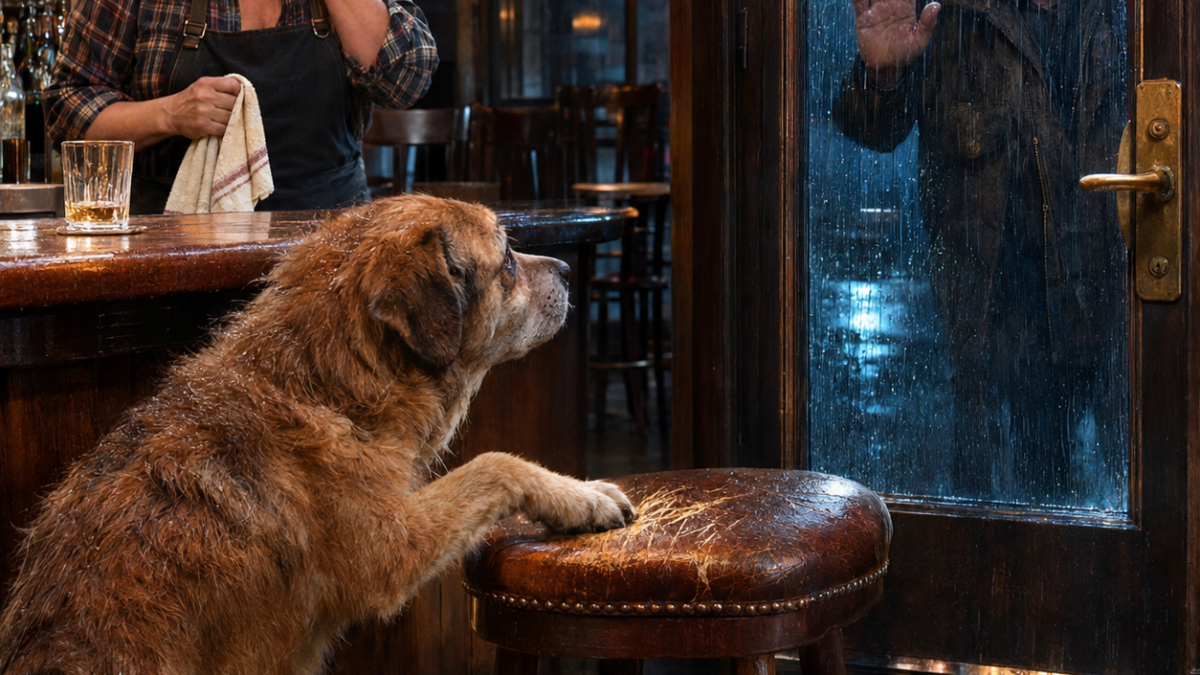
He stopped just inside the door.
The room became quieter gradually.
Not because anyone understood what was happening.
Because an unattended dog makes people look up.
Milo’s nose moved.
He smelled the floor.
The tables.
The air.
Then he lifted his head.
His eyes found the bar.
I felt my hand stop halfway through drying a glass.
“No.”
The word came out before I knew I had spoken.
Milo began walking.
Slowly at first.
Then faster.
He passed tables where people reached down instinctively toward him.
He ignored every hand.
He came straight to stool seven.
Stopped.
Looked up.
And placed both front paws against the seat.
My throat closed.
“Milo?”
His head snapped toward me.
There are things the brain remembers faster than conscious thought.
Voices.
Smells.
Movement.
The dog stared.
I came around the bar.
“Milo.”
His tail moved.
One uncertain sweep.
Then another.
I dropped to one knee.
He walked toward me and pressed his nose against my chest.
I put both arms around him.
“Oh, buddy.”
His tail moved harder.
“You remember me?”
He did.
But I was not who he wanted.
Almost immediately, Milo pulled away.
Returned to the stool.
Put his paws up.
Scratched once.
Twice.
Then looked behind the bar.
I knew exactly what he was asking.
Arthur?
Where is Arthur?
The realization hit so hard I had to stand.
Milo dropped down.
Circled the stool.
Sniffed beneath it.
Then looked toward the restroom hallway.
Arthur sometimes went there.
Milo checked.
Came back.
Went toward Arthur’s usual table when the bar was crowded.
Empty.
Back to stool seven.
He scratched again.
A woman near the window whispered:
“Is he looking for someone?”
I could not answer.
Milo made a sound.
Soft.
Not a bark.
A high, breathy whine.
Then he rested his chin on the stool.
My vision blurred.
“Arthur isn’t here.”
Milo lifted his head.
I hated myself for saying it.
“He’s not coming tonight.”
The dog looked at the door.
My chest hurt.
I had spent two years learning how to live with Arthur being gone.
Milo seemed to have arrived with the wound still open.
He had found the place.
He had found the stool.
He had found me.
Therefore Arthur should be next.
That was the logic of memory.
Simple.
Merciless.
Milo suddenly turned toward the glass entrance.
His entire body stiffened.
That was when I saw the young man outside.
Late thirties, maybe forty.
Dark coat.
Hands in his pockets.
Standing completely still beneath the awning.
He was crying.
Not dramatically.
He simply had tears running down his face while he watched Milo search the room.
I knew who he was before he entered.
Arthur had shown me enough photographs.
Daniel.
His son.
The same eyes.
The same slightly crooked posture when standing still.
Daniel opened the door.
Milo spun around.
For the first time since entering the café, happiness fully entered his body.
He ran toward Daniel.
Daniel dropped to his knees.
Milo collided with him.
Daniel held the dog’s head between both hands.
“I know.”
Milo licked his face.
“I know, buddy.”
His voice broke.
“I’m sorry.”
The entire café had gone silent.
Daniel buried his face against Milo’s neck.
“I know why you came.”
I looked away.
Some grief feels too private to witness even when it happens in public.
After a moment, Daniel stood.
Milo remained pressed against his leg.
He looked toward me.
“Luke?”
Arthur had told him my name.
I nodded.
“You’re Daniel.”
He gave a small, exhausted smile.
“My father talked about this place constantly.”
I looked at stool seven.
“So did his dog.”
Daniel’s face collapsed.
He pressed his lips together, trying to regain control.
“Can we sit?”
“Anywhere you want.”
He looked at the stool.
“That one?”
I nodded.
Daniel walked to it.
Milo followed.
The dog lay down immediately beside stool seven.
Exactly where he had for years.
Daniel sat.
I went behind the bar.
Then stopped.
For two years I had avoided touching the bottle Arthur drank from.
Not literally the same bottle.
The same label.
One small bourbon.
I reached for it.
Daniel said:
“He didn’t drink much.”
“No.”
“He always told me it was one.”
“It was.”
Daniel laughed weakly.
“He lied about his cholesterol.”
“Constantly.”
That earned the first real smile.
I poured a small glass.
Set it in front of him.
Daniel stared.
“This was his?”
“Every night.”
He touched the rim.
Did not drink.
Milo rested his head on Daniel’s shoe.
I put a bowl of water beside him.
Then, without thinking, reached into the jar beneath the counter.
Dog biscuits.
I still kept them for customers’ dogs.
I pulled one out.
Milo saw it.
Something almost unbearable happened.
He sat.
Perfectly straight.
Exactly as he had for Arthur.
I heard Arthur’s voice in my head.
Patience.
I could not speak.
Daniel watched the dog.
Then looked at me.
“What?”
I held up the biscuit.
“Your father used to make him wait.”
Daniel’s eyes filled.
“What would he say?”
My voice cracked.
“Patience.”
Milo stared at the biscuit.
“Then?”
“Character.”
Daniel covered his mouth.
I whispered:
“Your father thought it was hilarious.”
Daniel laughed and cried simultaneously.
Milo remained sitting.
Waiting.
Daniel took the biscuit from me.
Held it toward the dog.
“Patience.”
Milo’s ears lifted.
Daniel almost lost his composure.
“Character.”
Milo took the biscuit gently.
Daniel put his face in his hands.
I turned away and pretended to clean the counter.
Nobody in the café spoke loudly for a while.
Eventually customers returned to conversations, but softer than before.
Daniel stayed.
He told me what had happened after Arthur died.
He had flown home immediately from Portugal, where he had been overseeing restoration work on an old civic building.
By the time he arrived, Arthur was already gone.
“I missed him by fourteen hours.”
Fourteen.
I had never known that.
Daniel stared at the bourbon.
“My flight was delayed in Frankfurt.”
I said nothing.
“He died while I was in the air.”
His voice flattened.
“I spent two years thinking if I had taken the earlier flight…”
“No.”
He looked at me.
“You don’t know.”
“No.”
I repeated it.
“Do not do that to yourself.”
Daniel looked down.
“I wasn’t here enough.”
“Your father never complained.”
“He should have.”
“He was proud of you.”
“Proud people can still be lonely.”
That was true.
I did not argue.
Daniel ran one hand through Milo’s fur.
“What happened to him?”
“The dog?”
“Yes.”
Daniel exhaled.
“A neighbor kept him until after the funeral.”
“Then?”
“I took him.”
“Overseas?”
“Yes.”
That explained everything.
Daniel’s work contract still had almost three years remaining.
Milo moved with him.
“At first I thought keeping him was the obvious thing.”
“It was.”
“I don’t know.”
Daniel looked at Milo.
“He spent the first six months waiting beside my apartment door at six every evening.”
My stomach tightened.
“Six?”
“Almost exactly.”
Arthur’s café time.
Daniel nodded.
“He’d wake from sleep, walk to the door, and sit.”
“For how long?”
“Sometimes an hour.”
I looked at Milo.
“Did you know why?”
“No.”
Daniel swallowed.
“I thought maybe Dad used to come home then.”
I told him:
“Six-fifteen.”
His face changed.
“That’s when they came here.”
“Every night.”
Daniel looked down at Milo.
“Oh, buddy.”
Milo’s eyes remained closed.
Daniel continued.
“He stopped eventually.”
“That’s good.”
“I thought so.”
Then he looked around the café.
“Until tonight.”
Daniel had returned to town to settle the final pieces of Arthur’s estate.
The old house had remained rented for a while.
Now he planned to sell it.
He brought Milo because leaving him with friends felt wrong.
They had been walking back from the house when Milo suddenly stopped across the street.
Daniel had not recognized the café.
Why would he?
He had never been here.
Milo had.
“He just stared at the windows.”
Daniel pointed toward the entrance.
“I tried pulling him.”
“What happened?”
“He slipped his collar.”
I looked at the red mark around Milo’s neck where Daniel had quickly reattached it outside.
“He ran straight in.”
The dog had remembered.
Two years.
Another country.
Thousands of miles.
Different life.
Still remembered the door.
The smells.
The stool.
Maybe dogs do not understand death the way we do.
I am not an animal behaviorist.
I will not pretend Milo spent two years consciously expecting a dead man to return.
But memory does not require philosophy.
Places hold scent.
Routines hold emotion.
And when Milo entered Brennan’s Café, everything familiar was there except the one thing that had mattered most.
Arthur.
That was enough to break the heart of every person who understood what he was searching for.
Daniel returned the following evening.
And the evening after that.
Each time, Milo walked directly to stool seven.
The first night he scratched it again.
The second, once.
By the third, he did not scratch at all.
He simply lay down.
As if some part of him had finally accepted that Daniel would sit where Arthur once had.
That first week, Daniel and I talked more than Arthur and I had in months at a time.
That is the strange cruelty of death.
Sometimes you learn a person better through the people they left.
Daniel told me Arthur had been a teacher before retirement.
History.
Thirty-four years.
That explained the stories.
Arthur had taught students the same way.
“Dad hated dates.”
“History teacher who hated dates?”
“He said dates were coat hooks.”
I laughed.
“What?”
“Facts were coats. You hang them on the dates, but the coat is the thing that keeps you warm.”
“That sounds like him.”
Daniel smiled.
“He drove administrators insane.”
He told me Margaret’s death had changed Arthur.
Not visibly at first.
Arthur continued volunteering.
Walking Milo.
Calling Daniel.
But after losing his wife, stories became how he processed grief.
“He used to call me at two in the morning.”
“To tell stories?”
“To tell me something Mom said in 1997.”
Daniel smiled.
“I was terrible about answering.”
“You were working.”
“I was also impatient.”
He looked toward Milo.
“Dad always forgave me before I apologized.”
I knew that feeling.
Arthur forgave everybody in advance.
Sometimes that is beautiful.
Sometimes it allows people to postpone becoming better.
Daniel understood that now.
Too late.
Grief is full of lessons arriving after the exam.
On the fourth evening, I remembered the notebook.
It had been sitting in my office safe for almost three years.
Brown leather.
Worn corners.
Arthur had left it at the bar about six months before he died.
I intended to return it.
Then every time he came in, I forgot.
After his death, I opened it only far enough to identify the owner.
Arthur’s name on the first page.
I did not read further.
I tried contacting the estate through somebody I knew, but the notebook remained with me.
Eventually I told myself I would give it to Daniel if he ever appeared.
I had almost stopped believing that would happen.
I went into the office.
Returned with the notebook.
Daniel stared at it.
“What is that?”
“Your father’s.”
His face went still.
“Where did you get it?”
“He left it here.”
“When?”
“Months before…”
I did not finish.
Daniel reached for it.
Then stopped.
“Did you read it?”
“No.”
“Really?”
“First page.”
He took it.
His fingers trembled.
The leather had a small circular mark where Arthur once rested his bourbon glass on it.
Daniel touched the stain.
“That’s him.”
“What?”
“Uses a coaster for everybody else’s furniture.”
I laughed.
“Not mine.”
Daniel opened the notebook.
Arthur’s handwriting filled the first page.
Small.
Neat.
Blue ink.
Daniel read silently.
Milo raised his head.
Something changed in Daniel’s breathing.
“What?”
He shook his head.
Kept reading.
I gave him privacy.
Twenty minutes later, he called:
“Luke.”
I returned.
Daniel had tears on his face.
He turned the notebook toward me.
One entry was dated maybe a year before Arthur died.
It described the café.
Not by name.
Just:
My evening room.
Arthur wrote about the people.
The lonely widow who pretended she came for pie.
The construction worker who always called his daughter before ordering dinner.
The bartender who polished the same glass when worried.
I laughed.
“That’s rude.”
Daniel smiled.
Then pointed lower.
Arthur had written about Milo.
He watches the door less now.
I stopped.
Daniel read aloud softly.
“‘When I first brought him home, every sound made him think someone was coming either to hurt him or take him away.’”
Milo slept at his feet.
“‘Now he sleeps deeply enough to dream.’”
Daniel’s voice broke.
He continued.
“‘I suppose that is one definition of trust: eventually you stop waking to check whether love has left.’”
Neither of us spoke.
Arthur had never written to impress.
He simply saw things.
Daniel turned pages.
Small stories.
Observations.
Memories of Margaret.
Thoughts about aging.
About Daniel.
A lot about Daniel.
That surprised him.
“He talked about me?”
“All the time.”
“No.”
Daniel looked up.
“He really did?”
“Yes.”
“He never said much when we talked.”
“What did he say?”
“Are you eating?”
I smiled.
“Classic father.”
“He’d ask about weather.”
“Also classic.”
“Never this.”
Daniel touched the notebook.
“Never…”
He could not finish.
He read another page.
Arthur described visiting Daniel years earlier.
Watching his son stand inside a ruined stone church explaining how the building could be saved.
Arthur wrote:
I did not understand half the words he used, but I understood his hands. They moved the way Margaret’s did when she cared about something.
Daniel closed his eyes.
Then he began to cry in a way I had not seen before.
Not public grief.
Not funeral grief.
A child’s grief.
“I thought he didn’t understand why I left.”
“He did.”
“I thought he resented it.”
“He didn’t.”
“I thought…”
Daniel’s breath caught.
“I thought I disappointed him.”
Milo stood immediately.
Pressed against his leg.
Daniel put one hand on the dog’s head.
“He knew?”
I said:
“Yes.”
Arthur had told me more than once.
Daniel was the bravest person he knew.
Not because he went overseas.
Because he had built a life Arthur himself would have been afraid to build.
I told Daniel.
He covered his face.
Milo pushed his nose between Daniel’s hands.
That dog had probably comforted Arthur after Margaret died.
Now he was doing the same for Arthur’s son.
Maybe that was another form of inheritance.
Daniel read until closing.
At the end of the notebook were several blank pages.
Then, near the final written page, one unfinished entry.
No date.
Arthur had started:
Daniel says he may come home next spring. I am trying not to count the weeks because counting makes time slower. Milo does not understand calendars, which is probably wisdom.
The sentence ended there.
Daniel stared at it for a long time.
“I told him I might come.”
I did not say anything.
“I didn’t.”
His face twisted.
“Work changed.”
“Arthur knew.”
“But I should have.”
“He knew.”
“I should have come.”
“Yes.”
Daniel looked up sharply.
He probably expected comfort.
I gave him truth.
“Yes.”
“You should have.”
His eyes filled again.
“And you cannot change it.”
He looked away.
I continued.
“So what are you going to do with the part of your life that is still here?”
Milo rested his chin on Daniel’s knee.
Daniel looked down.
That was the question.
Not:
How do I undo regret?
You cannot.
What do I do with what remains?
That you can answer.
Daniel stayed in town three weeks.
Longer than planned.
He postponed two meetings.
Worked remotely from the café some afternoons.
Every evening at approximately six-fifteen, he entered with Milo.
I never asked whether it was intentional.
Probably was.
Sometimes he sat on stool seven.
Sometimes he chose a table.
Milo always started at the stool.
Then followed Daniel.
One evening an older regular named Martha asked:
“Are you Arthur’s boy?”
Daniel smiled.
“I’m forty-one.”
“To me, you’re Arthur’s boy.”
Fair.
She told him a story Arthur had once told about Margaret reversing their car into a mailbox.
Daniel laughed so hard he cried.
Another customer remembered Arthur paying anonymously for a waitress’s car repair.
Another remembered him sitting three hours with a widower who had just lost his wife.
Daniel began discovering a father who existed outside fatherhood.
That is one of adulthood’s strange gifts.
Our parents become people eventually.
Sometimes after they die.
Daniel wrote down everything.
Not to publish.
Not then.
Just to keep it.
Milo seemed calmer each night.
The first evenings, whenever the door opened, his head shot up.
By the second week, he mostly remained lying down.
Once, at exactly six-fifteen, another older man in a brown coat walked in.
Milo stood abruptly.
My heart stopped.
The man removed his hat.
Wrong face.
Milo stared.
Then slowly sat.
Daniel saw.
He reached down.
Milo leaned against him.
Nobody said anything.
That was the last time I ever saw Milo react to the door like that.
Maybe coincidence.
Maybe habituation.
Maybe the memory of Arthur was changing from expectation to something else.
Dogs cannot explain grief.
Neither can we very well.
On Daniel’s final night before flying back to Portugal, the café was crowded.
Word had gotten around about Arthur’s son.
Several old regulars came intentionally.
Not for spectacle.
To say goodbye.
Daniel sat on stool seven.
Milo beside him.
The notebook lay on the counter.
At seven-thirty, I placed a dog biscuit near Daniel’s glass.
He smiled.
“Patience?”
“Your father would insist.”
Milo sat.
Daniel held the biscuit.
“Patience.”
Milo waited.
“Character.”
He took it.
Everyone laughed.
Then became quiet.
Daniel looked around the room.
“My father used to tell stories here.”
Someone said:
“Every damn night.”
Laughter.
Daniel smiled.
“I’m not very good at this.”
“Neither was he,” I lied.
Several people protested.
Daniel opened the notebook.
“I want to tell one.”
He chose a short entry.
Not about grief.
Not about death.
A story about Milo stealing a sandwich from a construction worker who spent fifteen minutes insisting the dog had demonstrated “premeditation.”
The whole room laughed.
Daniel laughed.
I laughed.
Milo slept through the accusation.
That felt right.
Arthur’s place should not become a shrine where everyone whispered forever.
He had filled it with stories because stories made people feel alive.
Grief should not erase that.
When Daniel finished, he closed the notebook.
Then looked at me.
“Luke.”
“Yes?”
“Thank you.”
“For what?”
“For keeping his seat.”
I looked at stool seven.
“I didn’t really.”
“You did.”
I shrugged.
“I’m a sentimental bartender.”
“You’re terrible at hiding it.”
Arthur would have liked that.
The next morning, Daniel came to say goodbye.
No crowd.
No regulars.
Just me cleaning the espresso machine.
Milo walked in.
Went to stool seven.
Sniffed it.
Then turned away.
He walked to Daniel.
Sat beside him.
I noticed.
So did Daniel.
He crouched.
“You ready?”
Milo looked at him.
Daniel smiled through tears.
“Yeah.”
He stood.
Then handed me something.
The notebook.
I frowned.
“No.”
“I scanned everything.”
“It’s yours.”
“It belongs here for now.”
“Daniel.”
“I want to take the stories home eventually.”
He looked around.
“But Dad wrote most of them here.”
“What if something happens to it?”
“Then I’ll blame the bartender.”
“Excellent.”
He placed it behind the counter.
Then:
“I’ll come back.”
People say that easily.
Airports are full of those words.
Hospitals too.
Funerals.
Driveways.
I looked at him.
“Don’t say it unless you mean it.”
Daniel’s expression changed.
He understood.
“I mean it.”
He came back the following year.
And the next.
Not permanently.
Life remained overseas.
But every autumn, Daniel returned for a week.
Milo came for the first three visits.
Then age began catching him.
His muzzle turned white.
His hips stiffened.
The last year Milo came into Brennan’s, Daniel had to help him through the door.
He was nearly fifteen by then.
Maybe older.
Nobody knew.
Milo walked slowly toward stool seven.
Stopped beneath it.
Lay down.
Did not try to climb.
Did not scratch.
I brought water.
Daniel sat.
We did not talk much.
Arthur had been gone almost six years.
Time had softened some edges.
Not erased them.
Daniel said:
“He sleeps most of the day now.”
“That’s retirement.”
“He deserves it.”
Milo opened one eye.
Daniel rubbed his ear.
“He saved me after Dad.”
I believed him.
Not in the simple way people say animals cure grief.
They do not.
Daniel still needed friends.
Family.
Time.
Hard conversations.
He told me he spent a year in therapy after returning from that first trip.
Milo was not therapy.
Milo was continuity.
A living creature who had loved Arthur and loved Daniel too.
Something survived the rupture.
That matters.
Before leaving that year, Daniel whispered:
“This might be his last trip.”
I looked at Milo.
I knew.
“Then I’m glad he came.”
Daniel cried.
“So am I.”
Milo died the following February.
At home.
Daniel emailed me.
One photograph.
Milo lying on a blanket near a window.
Gray face.
Peaceful.
The message said:
He ate breakfast, walked into the garden, came back inside and went to sleep with his head on my foot. The vet came later. I held him. He wasn’t alone.
I closed the café office door and cried.
Then Daniel wrote:
Before he went, I told him Dad had probably been waiting long enough.
That line nearly ended me.
I do not know whether dogs meet dead owners somewhere.
I do not pretend to know.
But I understood what Daniel needed the sentence to mean.
I answered:
If Arthur has a bar stool wherever he is, Milo already found it.
Daniel replied:
And scratched the hell out of it.
I laughed while crying.
Arthur would have approved.
The following autumn, Daniel returned without a dog.
That was harder than I expected.
At six-fifteen, the door opened.
Daniel stepped inside.
Alone.
I automatically looked behind him.
He noticed.
“So did I.”
He came to the bar.
Stool seven.
Sat.
His hand dropped toward the floor instinctively.
Nothing there.
He froze.
Then closed his eyes.
“I still do that.”
“I know.”
“I keep reaching for him beside the bed.”
“I know.”
“I thought losing Dad was the worst grief.”
He looked at me.
“It wasn’t worse with Milo.”
“No.”
“Just different.”
“Yes.”
“With Dad, there were things unsaid.”
He touched the notebook.
“With Milo…”
His mouth trembled.
“He knew everything I needed him to know.”
That may be why losing animals sometimes hurts in such a clean, brutal way.
Human relationships collect language.
Arguments.
Missed calls.
Regret.
Animals collect presence.
Were you there?
Did you feed me?
Did I know your footsteps?
Did I feel safe when I slept?
Milo’s answer to Daniel was yes.
Daniel’s answer to Milo, eventually, was yes too.
That night Daniel told another of Arthur’s stories.
Then another.
He had become good at it.
Not exactly like his father.
He spoke faster.
Used his hands more.
But occasionally he paused before the final sentence, and in that pause I heard Arthur.
Over the years, Daniel began bringing new people.
A girlfriend.
Later, his wife.
Then a little boy named Samuel.
Arthur’s grandson.
The first time Samuel entered Brennan’s, he was four.
He climbed onto stool seven without permission.
Daniel laughed.
“Of course.”
Samuel spun around.
“Why this one?”
Daniel looked at me.
I let him answer.
“Your grandfather used to sit there.”
“The one in the book?”
“Yes.”
“The story grandpa?”
Daniel smiled.
“The story grandpa.”
Samuel looked underneath the stool.
“Where did the dog sit?”
Daniel pointed.
“Right there.”
Samuel climbed down.
Sat on the floor.
Daniel laughed.
“He would have liked you.”
That became another layer.
Arthur gone.
Milo gone.
Yet a child who had met neither knew where they sat.
That is what stories do when they are handled carefully.
They do not resurrect.
They connect.
There is a difference.
Eventually Daniel asked whether he could publish a small collection of Arthur’s notebook entries for family and friends.
Nothing commercial initially.
Just fifty copies.
Title:
The Evening Room.
He gave me number seven.
Of course.
Inside he wrote:
For Luke, who kept the room warm until we found our way back.
I kept it behind the bar.
Customers read it.
Some cried.
Some laughed.
Most found something ordinary that reminded them of someone they had lost.
That would have pleased Arthur more than any bestseller.
Years later, Brennan’s Café changed ownership.
I was approaching retirement.
My knees hurt.
My hands ached in winter.
The new owner wanted renovations.
New stools.
New counter.
Better lighting.
He pointed at stool seven.
“That thing has to go.”
“No.”
He laughed.
“I’m serious.”
“So am I.”
“It’s falling apart.”
“Repair it.”
“Luke.”
“Repair it.”
He stared at me.
Then noticed the small brass plate beneath the seat.
Daniel had installed it years earlier.
Nothing dramatic.
It said:
ARTHUR’S SEAT
Below that:
SAVE A GOOD STORY FOR TOMORROW.
The new owner read it.
Then sighed.
“Fine.”
Stool seven stayed.
Reupholstered.
Same frame.
Same scratches along the lower wood where Milo’s nails had once marked it.
I specifically told the carpenter:
“Do not sand those out.”
He thought I was insane.
Maybe I was.
Some damage is part of the object.
Some scars are history.
When I finally retired, Daniel flew in.
Samuel was twelve.
They sat at the bar.
Daniel gave me a box.
Inside was Milo’s old collar.
I stared.
“No.”
“I want it here.”
“Daniel.”
“I have his tag.”
He held up another small collar tag on his key ring.
“I kept part.”
I touched the worn leather.
“Why me?”
He smiled.
“Because this is where he came looking.”
We hung the collar beneath Arthur’s photograph near the back shelf.
Not like a memorial shrine.
Just something quiet.
Most new customers never asked.
Some did.
And if I happened to be visiting, I told them.
Not the exaggerated version.
Not:
A dog returned after two years because he knew his owner’s ghost was there.
No.
A dog who had spent years visiting one café with one man returned after living overseas.
He recognized a place.
Recognized a routine.
Searched for the person attached to it.
And in doing so, reminded a son that his father had left more behind than grief.
That was enough.
Arthur’s death did not become beautiful because Milo remembered him.
Milo’s death did not become easy because Daniel had loved him well.
Loss is still loss.
The chair stays empty.
The hand reaches downward and finds no fur.
The door opens at six-fifteen and for one irrational second you still expect the dead to walk in.
But memory changes shape.
At first it hurts because it proves something is gone.
Later, sometimes, it comforts because it proves something was here.
There is a difference.
I was seventy when Daniel asked me the question.
We were sitting at Brennan’s after closing.
Samuel, now grown, had gone out with friends.
Daniel had gray at his temples.
Stool seven stood between us.
He said:
“Do you remember exactly what Milo did that night?”
“Which part?”
“When he first came back.”
I nodded.
“Tell me.”
“You know.”
“I want to hear it.”
So I told him.
The door opened.
Milo stopped.
Smelled the room.
Walked to the stool.
Paws up.
Scratched.
Looked behind the bar.
Went down the hallway.
Came back.
Whined.
Daniel listened.
Then asked:
“Do you think he thought Dad was really here?”
I considered lying.
Something comforting.
Instead:
“I think he remembered that this was a place where your father existed.”
Daniel nodded slowly.
“And when he didn’t find him?”
“I think that hurt.”
His eyes filled.
“Animals grieve?”
“I’m a bartender, Daniel.”
He laughed.
“I don’t know.”
Then I said:
“But I watched a dog search for your father.”
That was enough.
Daniel looked at the stool.
“I’m glad I let him run inside.”
“So am I.”
“I almost stopped him.”
“Why?”
“I was embarrassed.”
He smiled sadly.
“Imagine.”
“About what?”
“A dog losing his mind in a café.”
I shook my head.
“Good thing you failed.”
“Yes.”
Then he whispered:
“If I’d pulled him away, I never would’ve met you.”
“You still might have.”
“I never would’ve found the notebook.”
“Maybe.”
“I never would’ve known Dad came here every night talking about me.”
That one had weight.
Daniel looked at his hands.
“I spent years thinking distance meant I mattered less to him.”
“No.”
“Milo knew better.”
I looked at the scratches beneath stool seven.
“Yes.”
The dog had never measured love in miles.
That may have been the wisest thing about him.
Arthur lived here.
Daniel lived across an ocean.
Milo had loved both.
No contradiction.
No scoreboard.
Humans make love competitive far more often than animals do.
Before we left that night, Daniel put his hand on stool seven.
“Dad.”
One word.
Then beneath the counter where Milo once slept:
“And Milo.”
He smiled.
“Ready?”
I put on my coat.
We walked outside.
The street was quiet.
For one second, I heard nails clicking behind us.
Memory again.
I did not turn.
I no longer needed to.
The story people like to tell is about the night a bartender cried because a dog walked into a café and scratched at an empty stool.
That happened.
I cried harder than I had in years.
But the part I remember most came later.
The third evening after Milo returned.
He entered.
Walked to Arthur’s stool.
Looked at it.
Then, instead of scratching or searching behind the bar, he turned toward Daniel.
Daniel had already sat down.
Milo walked over.
Curled beside his son’s feet.
And went to sleep.
That was it.
No miracle.
No ghost.
No dramatic sign.
Just an old dog finally understanding enough to rest.
Arthur was not coming through the door.
But someone Arthur loved was there.
And Milo, after two years of carrying an old routine inside him, allowed that to be enough.
Maybe that is what grief asks from all of us eventually.
Not to forget the footsteps we are waiting for.
Not to stop loving the person who will never make them again.
Just to look around one day and notice who is still in the room.
Then lie down beside them.
And rest.








