PART2:Henry Was in Tears as the Judge Read His Verdict—Then the Dog Who Had Never Abandoned Him Broke His Leash and Did Something No One in That Courtroom Will Ever Forget
The first call came across the county scanner on September 8, 2021.
Welfare check.
Old farm east of town.
Multiple animals.
Possible neglect.
I drove out with a notebook, camera and the professional detachment journalists cultivate because otherwise we would never make deadlines.
The smell reached the driveway.
That is the first detail I remember.
Not Henry.
Not Algernon.
The smell.
Ammonia.
Waste.
Wet fur.
Rotting food.
Heat trapped beneath an old metal roof.
One deputy stepped outside and bent over with his hands on his knees.
Another had tied a cloth over his nose.
Animal services vehicles lined the yard.
Carriers.
Slip leads.
Water jugs.
The farm itself looked as though time had stopped caring.
Fence sagging.
Porch boards rotten.
Grass waist-high.
A pickup truck sitting on two flat tires.
Inside the barn and house, conditions were worse.
Too many animals.
Not enough clean space.
Bowls dry or contaminated.
Dogs with overgrown nails.
Cats with respiratory infections.
Flea infestations.
Skin disease.
Weight loss.
I took notes until my handwriting stopped looking like words.
Then I entered the back bedroom.
That was where I first saw Algernon.
Large golden mixed-breed dog.
Maybe retriever.
Maybe shepherd.
Maybe several things.
He sat on the edge of Henry Boyd’s bed.
Not hiding.
Not barking.
Watching.
Around him, officers moved through rooms.
Other dogs had scattered.
Some crawled beneath furniture.
Some barked from fear.
Algernon remained.
Henry stood against the opposite wall.
Fifty-seven.
Thin.
Unshaven.
Shoulders rounded.
His hands trembled.
At the time, I wrote in my notebook:
OWNER APPEARS ASHAMED.
Years later I would look at that sentence and realize how quickly reporters label emotions we do not understand.
Shame was there.
But not alone.
Exhaustion.
Grief.
Physical pain.
Depression.
Fear.
Maybe relief.
Because sometimes being discovered is terrible.
Sometimes it is also the first moment somebody else finally sees how far you have fallen.
A deputy told Henry to sit.
He did.
Algernon immediately climbed down from the bed and sat beside his knee.
Henry put one trembling hand on the dog’s head.
That was the first photograph I took.
The accused man.
The dog.
The filthy room.
I remember looking at the camera screen and thinking:
There’s tomorrow’s front page.
I was wrong.
That photograph would follow the case for three years.
Henry was arrested that afternoon.
The animals were removed.
Veterinary examinations documented neglect.
No reasonable person who saw the evidence could deny it.
Several dogs were significantly underweight.
Dental disease.
Parasites.
Untreated infections.
Two cats required intensive treatment.
One elderly dog had arthritis so severe that walking across concrete made him cry.
Whatever Henry intended, animals suffered under his care.
That fact never changed.
It should not.
But during the following months, other facts emerged.
Henry had not beaten them.
No evidence of organized fighting.
No deliberate starvation scheme.
No torture.
No sadistic behavior.
Instead, investigators found something harder to fit into a headline.
Collapse.
Henry had inherited the farm from his father.
He had once kept only one dog and one cat with his wife, Margaret.
She died in 2018 after a long illness.
Neighbors said Henry changed.
He stopped repairing things.
Stopped attending church.
Stopped answering phone calls.
His small construction business failed.
His back deteriorated.
His hands developed tremors.
Medical records later showed untreated diabetes, degenerative spinal disease and severe hypertension.
A psychiatric evaluation eventually described symptoms consistent with prolonged major depression following bereavement.
And while his own life contracted, Henry kept bringing animals home.
A dog wandering beside the highway.
A pregnant cat behind a feed store.
Two puppies dumped near a drainage ditch.
Another dog.
Another cat.
He believed he was rescuing them.
At first, perhaps he was.
Then numbers exceeded ability.
Food money disappeared.
Cleaning became physically difficult.
Medical care became impossible.
But he kept saying yes to one more animal.
Love continued after competence had failed.
That distinction became the center of the case.
And Algernon remained beside him through all of it.
PART2
The first hearing was October 12, 2021.
2:15 p.m.
I remember because I wrote the time at the top of the page and underlined it twice.
Henry entered wearing a borrowed suit that fit badly.
His attorney, Thomas Reed, requested release pending trial, medical evaluation and limited supervised contact with Algernon, who had been temporarily placed with a rescue volunteer.
The prosecutor opposed unrestricted animal contact.
Reasonably.
Judge Victoria Rice compromised.
Henry could not own, acquire or independently care for animals while the case was pending.
But under controlled conditions, the court allowed visits with Algernon because the dog had shown significant separation distress after seizure and because the rescue organization supported continued contact.
The animal advocates sitting behind me were furious.
One whispered:
“He neglected thirty-eight animals and gets visitation?”
A neighbor on Henry’s side whispered back:
“That dog is all he has.”
Both statements were true.
That became the case.
Two truths constantly colliding.
Algernon appeared at the third hearing.
Harness.
Leash.
Volunteer handler.
He saw Henry from the doorway.
Stopped.
Then walked directly toward him.
Henry crouched.
Algernon placed his head against Henry’s chest.
No dramatic barking.
No movie moment.
Just contact.
Henry closed his eyes.
The prosecutor watched.
So did I.
For the next three years, whenever court rules permitted, Algernon came.
His presence was strictly controlled.
He did not wander.
He did not approach jurors.
He did not interfere.
He sat beside Henry.
Sometimes under the defense table.
Sometimes with his chin resting on Henry’s knee.
And in twenty-four hearings I personally attended, I never heard him bark once.
Not once.
That fact matters because of what happened at the last one.
The case dragged.
Continuances.
Medical reports.
Psychiatric evaluations.
Questions about competency.
Appeals over animal disposition.
Disputes about restitution.
Defense motions.
COVID-related scheduling problems still affecting county calendars.
Three years.
Thirty-nine months.
I wrote twenty-four stories.
At first my language was simple.
MAN FACES MULTIPLE ANIMAL-NEGLECT COUNTS.
Then:
MEDICAL RECORDS ENTER BOYD CASE.
Then:
EXPERTS DISAGREE OVER INTENT IN FARM NEGLECT CASE.
By year two, I no longer knew what the headline should mean.
Was Henry an animal abuser?
The animals had undeniably been neglected.
Was he a grieving, medically impaired man who had lost the ability to recognize his own collapse?
Also supported.
Did his love for the animals matter?
Emotionally, yes.
Legally, only within limits.
Because love does not fill a water bowl.
Love does not clean infected wounds.
Love does not schedule veterinary care.
That became one of the most important lessons of the trial.
Intent matters.
Outcome matters too.
Ellen Orton from county veterinary services gave testimony that changed the atmosphere.
She had been among the first people on the farm.
She described fleas.
Waste.
Untreated disease.
Then prosecutor asked:
“Ms. Orton, did these animals suffer?”
“Yes.”
No hesitation.
“Could Mr. Boyd’s affection for them eliminate that suffering?”
“No.”
Then defense attorney stood.
“Did you ever observe Mr. Boyd strike an animal?”
“No.”
“Did you see evidence that he intentionally injured them?”
“No.”
“Did the animals appear uniformly afraid of him?”
Ellen paused.
“No.”
“How did Algernon respond?”
She looked toward the dog.
Algernon sat beside Henry.
“He stayed with him.”
“Meaning?”
“When we entered the house, he would not leave Mr. Boyd voluntarily.”
“And in your professional opinion, does affection excuse neglect?”
“No.”
“Does neglect always require hatred?”
Ellen’s face changed.
“No.”
That answer stayed with me.
Neglect does not always require hatred.
Sometimes it grows beside love.
That may be harder to understand.
Henry testified only once.
His attorney did not want him on the stand.
Too fragile.
Too emotional.
But Henry insisted.
He spoke about Margaret.
His wife.
Thirty-two years together.
Cancer.
Hospice.
The empty house afterward.
“I stopped sleeping.”
He said.
“I stopped opening mail.”
Then the first stray dog appeared.
“I fed him.”
Then a cat.
Then another.
“At first it made me get out of bed.”
The courtroom became very quiet.
“They needed me.”
His hands trembled.
“So I thought that meant I still mattered.”
The prosecutor stood.
“Mr. Boyd, did you know some of those animals were sick?”
Henry looked down.
“Yes.”
“Did you obtain veterinary treatment?”
“Not enough.”
“Why?”
“No money.”
“Did you contact rescue organizations?”
“No.”
“Why?”
He cried.
“I thought if I told anyone, they’d take them.”
The prosecutor did not soften.
“And because you were afraid they would be taken, some animals remained without necessary medical treatment?”
Henry closed his eyes.
“Yes.”
That answer mattered too.
Accountability.
Not villainy.
Not absolution.
Accountability.
By 2024, Henry was physically worse but mentally clearer.
Court-ordered medical treatment had stabilized his diabetes.
He began therapy.
His lawyer documented compliance.
He lived temporarily with his sister.
He could not acquire animals.
Algernon stayed primarily with an approved foster but spent scheduled periods with Henry.
Every time they reunited, same thing.
Head in lap.
No excitement required.
The final sentencing hearing was November 15, 2024.
Friday.
10:47 a.m.
Courtroom full.
Animal advocates on one side.
Neighbors and several members of Henry’s church on the other.
Journalists.
Deputies.
County veterinary staff.
I sat second row, left side.
My usual seat.
Algernon was nine now.
Gray around muzzle.
His leash had been secured to a heavy chair beside Henry with a worn fabric tether used during many court visits.
Judge Rice entered.
Everyone stood.
Then sat.
She had prepared a thirty-seven-page ruling.
I saw the stack.
The first portion reviewed evidence.
Number of animals.
Medical findings.
Property conditions.
Henry’s health.
Psychological evaluations.
Compliance.
Risk factors.
Restitution.
Treatment recommendations.
Judge Rice spoke slowly.
No drama.
She explicitly said:
“Affection does not excuse inadequate care.”
Several animal advocates nodded.
Then:
“Likewise, sentencing requires consideration not only of harm but of intent, capacity, rehabilitation, public safety, and the likelihood of recurrence.”
Henry stared at the table.
Algernon sat beside him.
The judge continued.
When she reached:
“I find that the defendant…”
Henry broke.
Not a silent tear.
A sound came out of him.
Raw.
He covered his face.
His shoulders shook.
Algernon’s head lifted.
Henry tried to control himself.
Couldn’t.
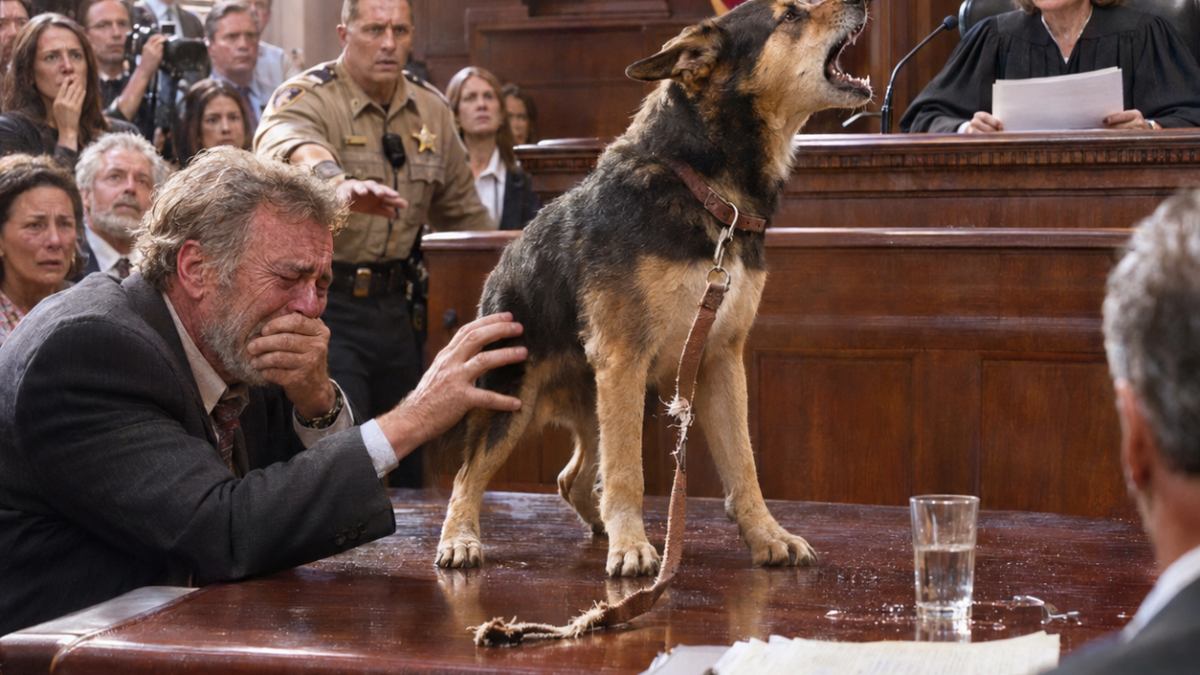
Then Algernon stood.
The tether pulled tight.
Henry did not notice.
Algernon pulled again.
The old fabric snapped at a frayed section near the chair.
Everything happened quickly.
He jumped onto the defense table.
Papers scattered.
A deputy stood.
Another moved toward him.
Judge Rice raised one hand.
“Hold.”
Algernon barked.
Once.
Loud.
Twice.
Henry looked up.
“Algernon.”
The dog barked again.
And again.
Not snarling.
No bared teeth.
Tail high but not wagging.
Body alert.
He looked at Henry.
Then toward the judge.
Bark.
Bark.
I counted without realizing.
Seven.
Eight.
Nine.
Ten.
Eleven.
Judge Rice said firmly:
“Silence.”
Algernon stopped.
Immediately.
The timing stunned everyone.
Not because he understood judicial authority.
More likely tone.
Still.
He stopped.
Then jumped down.
Security remained ready.
Henry’s attorney whispered:
“Come here.”
Algernon ignored him.
He walked into the center aisle.
Turned once.
Twice.
Slow circles.
He whined.
Then barked.
Another circle.
At every pass near Henry, his head turned toward him.
Henry was crying harder now.
Not from fear.
He held out his hands.
“Come back, boy.”
Algernon circled again.
Then stopped in the exact center aisle.
Sat.
Looked at Judge Rice.
The whole episode lasted less than four minutes.
It felt much longer.
No one applauded.
No one moved.
Ellen Orton had one hand over her mouth.
The prosecutor stared at the dog.
Judge Rice removed her glasses.
Looked at Henry.
Then at Algernon.
Then she called:
“Ten-minute recess.”
That was the legally important thing.
Not a dog changing the verdict.
A recess.
Security calmly reattached Algernon with a new lead.
He immediately returned to Henry.
Placed his head against Henry’s leg.
The courtroom emptied into whispers.
I remained seated.
My notebook was open.
Blank.
That almost never happens.
Carl had trained me thirty years earlier:
If the building is burning, write while you run.
Yet I had written nothing.
A young reporter beside me whispered:
“Did that just happen?”
“Yes.”
“Is she going to change the sentence?”
I looked at him.
“She shouldn’t.”
He seemed surprised.
“But the dog—”
“Is not evidence about whether twenty-seven dogs and eleven cats received proper care.”
That mattered.
I felt it strongly.
Algernon’s loyalty was moving.
It did not erase suffering.
If justice could be overturned because a defendant’s dog loved him, then defendants without loving dogs would receive different justice.
Impossible.
Unfair.
So what had Algernon changed?
Not the evidence.
The room.
He had forced everyone to see relationship and responsibility in the same frame.
Henry had failed animals.
Algernon still loved him.
Both could be true.
The court’s job remained to respond to the first without pretending the second meant nothing.
When Judge Rice returned, she did not tear up her ruling.
She did something more believable.
She summarized it.
Later I obtained the written order.
Its core sentencing framework had been drafted before Algernon ever broke loose.
Two years supervised probation.
Mandatory mental-health treatment.
Mandatory medical compliance.
Restitution toward veterinary costs.
Weekly supervised service at an approved animal shelter—not as punishment disguised as animal access, but as structured education and accountability.
A prohibition on acquiring animals without approval.
Regular welfare inspections.
A six-month review before any expansion of ownership privileges.
And Algernon?
Because he was already medically cleared, behaviorally stable, individually bonded with Henry, and because an approved care plan had been submitted, Henry would be permitted to keep him under supervision.
Not because Algernon barked.
Because the evidence supported it.
Judge Rice looked directly at Henry.
“Mr. Boyd, nothing that occurred in this courtroom today changes the condition in which those animals were found.”
Henry nodded, crying quietly.
“They suffered while under your responsibility.”
“Yes, Your Honor.”
“Love is not enough if love is not accompanied by care.”
Henry closed his eyes.
“Yes.”
She continued.
“But sentencing is also not an exercise in vengeance.”
The courtroom remained still.
“The evidence demonstrates significant medical and psychiatric deterioration during the period in question, substantial compliance since intervention, and a credible plan to reduce the risk of recurrence.”
Then she looked toward Algernon.
“He is not deciding this case.”
A few people almost smiled.
“But he has reminded everyone in this courtroom that human failure can coexist with attachment.”
She turned back to Henry.
“You will be held accountable.”
Pause.
“And you will be given an opportunity to demonstrate that accountability can become change.”
That sentence made my article.
Not the barking.
That.
When court adjourned, people did something I did not expect.
No universal applause.
The source story would later exaggerate that.
Reality was quieter.
Some animal advocates remained angry.
One told me:
“Probation is too lenient.”
A neighbor cried from relief.
Ellen Orton approached Henry.
She did not hug him.
She shook his hand.
“I’ll be at the shelter Wednesday.”
Henry nodded.
“I’ll come.”
“You show up.”
“I will.”
Then Ellen looked down.
Algernon’s head rested against Henry’s knee.
She scratched him once.
“Troublemaker.”
Tail.
Outside, Henry’s cuffs were removed before release processing.
He walked slowly.
Algernon beside him on a proper harness.
I caught up.
“Mr. Boyd.”
He stopped.
“Can I ask one question?”
He looked exhausted.
“Okay.”
“What are you feeling?”
He stared at Algernon for a long time.
Then lowered himself carefully.
His back clearly hurt.
He put both arms around the dog.
Algernon leaned.
Henry said:
“For three years, I kept thinking everybody believed I was a monster.”
He wiped his face.
“Then I started wondering if maybe they were right.”
I did not interrupt.
“I did fail them.”
“The animals?”
“All of them.”
His voice cracked.
“I loved them.”
He looked at me.
“But that wasn’t enough.”
That was the sentence I wanted.
Not:
My dog saved me from punishment.
Not:
I did nothing wrong.
Henry said:
“I thought loving them meant I was rescuing them.”
He looked at Algernon.
“Now I know if you love something and you can’t care for it, sometimes the loving thing is asking for help before it suffers.”
Then he pressed his forehead against Algernon’s.
“This one stayed.”
Pause.
“So I’m going to try to become someone worth staying for.”
That became the ending of my front-page story.
Six months later, May 12, 2025, I returned to the same courtroom.
Same chair.
Same judge.
Different Henry.
He had lost weight.
Not unhealthy.
Medical.
His clothes fit.
Face shaved.
Hair trimmed.
Hands still trembled from medication and neurological problems.
But his eyes were present.
That is the only way I can describe it.
Present.
Algernon walked beside him wearing a blue ribbon on his collar.
I asked Ellen why.
She smiled.
“Henry tied it on the day he passed his first full property inspection.”
The six-month review was detailed.
Not sentimental.
County social services.
Veterinary services.
Mental-health compliance.
Home inspection reports.
Finances.
Physical ability.
Emergency plan.
Volunteer schedule.
Henry had attended treatment.
He had not missed a probation meeting.
He volunteered four hours weekly at the shelter doing tasks appropriate for his health.
Laundry.
Food preparation.
Cleaning light areas.
Socializing calm senior dogs under supervision.
He was not allowed to simply start collecting strays again.
That boundary remained.
The farm had been cleaned with help from church volunteers and a county-supported assistance program.
Fence repaired.
Running water.
Separate animal spaces.
Veterinary records current.
Most importantly, his animal limit was controlled.
By that point, eight dogs and five cats were on the property—but that number requires context.
Only Algernon and a small number were permanently Henry’s.
Several were county-approved foster animals placed through a monitored partnership, with scheduled veterinary oversight and volunteer support.
Henry could not add another animal from the roadside because his heart told him to.
Every intake required approval.
That was the protection he had lacked before.
Love with structure.
Ellen testified.
“Mister Boyd has demonstrated substantial improvement.”
Judge Rice asked:
“Does that mean the prior neglect should be minimized?”
“No, Your Honor.”
“Do you believe he currently has capacity, with support, to maintain the approved number?”
“Yes.”
“Would you recommend unsupervised unlimited acquisition?”
Ellen almost laughed.
“No.”
Henry smiled faintly.
He knew.
The judge looked at him.
“You hear that?”
“Yes, ma’am.”
“No more bringing home every animal you see.”
“Yes, ma’am.”
A few people laughed.
Including Henry.
That laugh mattered.
A man able to hear a limit without experiencing it as rejection.
Progress.
Judge Rice approved continuation of the monitored care plan.
Regular inspections.
Numbers capped.
Treatment continued.
No spontaneous intake.
She finished:
“Mr. Boyd, a second chance is not a declaration that the first failure did not happen.”
Henry nodded.
“It is an opportunity to prove that you learned from it.”
“Yes, Your Honor.”
“Take care of the animals.”
“Yes.”
“Take care of yourself.”
Henry’s face tightened.
“Yes.”
Judge Rice looked toward Algernon.
“And try to keep your counsel under better control.”
The courtroom laughed.
Algernon yawned.
Perfect.
I visited Henry’s farm in November 2025.
Four years after the original seizure.
I almost missed the driveway.
Same land.
Different place.
Grass trimmed.
Fence upright.
Kennels clean.
Not cages.
Sheltered outdoor runs connected to indoor areas.
Fresh water stations.
Cat room with shelves and windows.
Medication chart on refrigerator.
Emergency phone numbers.
Volunteer schedule.
A whiteboard:
VET — TUESDAY 10:30, ROSIE
ELLEN — THURSDAY
THERAPY — FRIDAY 2:00
Structure everywhere.
Henry walked with a cane now.
Slow.
Algernon followed.
Older.
Muzzle nearly white.
No need for leash inside fenced yard.
Henry showed me a small reddish dog asleep beneath the porch.
“I found him by the road.”
I raised an eyebrow.
Henry laughed.
“I called Ellen before I touched him.”
“Good.”
“She made me wait two days.”
“Excellent.”
“He’s a foster.”
“Approved?”
Henry pointed to paperwork clipped beside the door.
“Signed in triplicate, André.”
Progress indeed.
We sat on the porch.
Texas evening.
Dry grass glowing gold.
Dogs moving lazily in yard.
Two cats sitting in windows.
Algernon lowered himself beside Henry.
Then, with the inevitability of gravity, put his head on Henry’s knee.
Henry scratched his ear.
“You know what I got wrong?”
I opened notebook.
“Everything?”
He laughed.
“Fair.”
Then serious.
“I used to think if I let someone take an animal, it meant I failed it.”
He looked toward the yard.
“So I kept saying yes.”
“One more.”
“One more.”
“Until saying yes became the thing hurting them.”
He swallowed.
“Now sometimes I say no.”
“That hard?”
“Harder than cleaning kennels.”
He smiled faintly.
“But Ellen says no can be an act of love.”
I wrote that down.
No can be an act of love.
I asked about Margaret.
Henry’s wife.
He looked toward sunset.
“She would’ve been furious with me.”
“For the animals?”
“For not asking for help.”
He laughed sadly.
“She always asked.”
“And you?”
“Thought men were supposed to fix themselves.”
Algernon shifted his head.
Henry rubbed the dog’s gray muzzle.
“This idiot knew better.”
I asked him what he thought Algernon was doing in court.
Henry smiled.
“You want the truth?”
“Yes.”
“He was probably scared because I was crying.”
That surprised me.
“No divine legal argument?”
“No.”
“He hates when I cry.”
Henry looked at me.
“I think everybody else gave him a speech because they needed one.”
That may have been the wisest sentence he ever gave me.
Animals act.
Humans turn action into meaning.
Sometimes responsibly.
Sometimes not.
Algernon did not understand sentencing law.
He understood Henry in distress.
He broke a worn tether.
Barked.
Circled.
Returned.
The meaning came from us.
But that did not make it meaningless.
“Did he save you?”
I asked.
Henry considered.
“Not from the judge.”
Good answer.
“From myself?”
Long pause.
“Maybe.”
He scratched Algernon.
“When Margaret died, I kept collecting living things because I couldn’t tolerate losing anything else.”
That sentence stopped my pen.
“I thought if I kept them all close, nobody was gone.”
He looked around his repaired farm.
“But keeping something close isn’t the same as caring for it.”
I waited.
“Algernon stayed when everything fell apart.”
“Not because I deserved it.”
“He just stayed.”
Henry’s eyes filled.
“And sometimes having one thing still beside you is enough to make you try one more morning.”
That was the heart of it.
Not innocence.
Not acquittal.
Not unconditional love magically canceling consequences.
One more morning.
Treatment.
Medication.
Cleaning.
Asking.
Accepting limits.
Trying again.
The animal advocates who once sat in court had mixed reactions to Henry’s rehabilitation.
I called several.
One still believed lifetime prohibition would have been safer.
Fair perspective.
Another said the monitoring changed her mind.
“I don’t forgive the suffering.”
She told me.
“But I care more about preventing the next suffering than hating him forever.”
That was justice too.
Not forgetting.
Prevention.
Ellen remained cautious.
She visited without warning sometimes.
Checked bowls.
Records.
Weight.
Medication.
Henry never complained.
“You should’ve seen him first year.”
She told me privately.
“He’d apologize every ten minutes.”
“Now?”
“He asks questions.”
Better.
Shame can paralyze.
Responsibility asks questions.
The farm never returned to thirty-eight animals.
Good.
The point was never to restore old life.
It was to build a different one.
Fewer animals.
More support.
Emergency backup.
Veterinary fund.
A neighbor with key.
Written plan if Henry became ill.
All the boring things tragedy had once lacked.
Boring systems save lives.
Algernon aged.
By early 2026, his hips deteriorated.
Henry installed ramps.
Orthopedic bed.
Medication schedule.
One afternoon Ellen arrived and found Henry sitting on floor beside Algernon because the dog could not stand.
Old pattern reversed.
The dog who had spent years resting his head on Henry’s knee now needed Henry’s hands beneath his chest.
Henry called vet immediately.
No delay.
No denial.
That fact mattered more than any speech in court.
He had learned.
The veterinarian adjusted medication.
Algernon improved for a while.
Still walked yard.
Still barked at delivery trucks.
Still slept beside Henry.
No dramatic miracle.
Old age.
Privilege.
When I visited again, Henry told me something I did not include in first article.
“Back in 2021, one dog got sick and I knew I couldn’t afford vet.”
“What did you do?”
His face tightened.
“I kept hoping tomorrow would be better.”
That is how neglect often survives.
Tomorrow.
Maybe appetite returns.
Maybe wound closes.
Maybe money arrives.
Maybe I feel stronger.
Tomorrow becomes week.
Week becomes month.
Henry looked at Algernon.
“Now if something’s wrong, I call.”
“Even if embarrassed?”
“Especially then.”
Good.
The court case changed me too.
I began covering animal welfare differently.
Not softer.
More precise.
I still wrote suffering plainly.
If an animal lacks water, say it.
If a wound is untreated, say it.
If someone knowingly allows suffering, accountability.
But I stopped pretending every neglect case contains one simple villain.
Sometimes cruelty is intentional.
Sometimes neglect grows from addiction.
Poverty.
Cognitive decline.
Mental illness.
Hoarding disorder.
Grief.
Ignorance.
Physical disability.
None erase harm.
But causes matter because solutions differ.
If you punish without treating cause, recurrence waits.
If you excuse harm because cause is tragic, animals remain unsafe.
Justice has to hold both.
I learned that watching one old dog sit beside one broken man for three years.
Carl, my editor, retired before final review hearing.
At his farewell dinner he said:
“Remember when I told you Boyd was ten inches?”
I laughed.
“I remember.”
“How many words now?”
“Too many.”
“That dog cost us a lot of ink.”
Yes.
Worth it.
Readers wrote letters.
Some angry.
“You’re excusing abuse.”
I answered carefully.
No.
Explaining is not excusing.
Others romanticized Henry.
“He was innocent.”
No.
He was responsible for animals who suffered.
Understanding context does not require pretending otherwise.
The case taught me to resist both simplifications.
Henry was neither monster nor martyr.
He was a man who failed terribly.
Then did the harder thing.
Admitted it.
Accepted limits.
Changed.
Not everyone changes.
Important.
Second chances are not automatic entitlements.
They require evidence.
Compliance.
Safety.
Accountability.
Henry received one because professionals assessed that risk could be managed.
If he had ignored treatment, violated limits or allowed new neglect, the outcome should have changed.
Compassion without boundaries can become negligence too.
Judge Rice understood that.
I interviewed her after retirement.
Not about confidential deliberations.
About sentencing philosophy.
I asked:
“Did Algernon change your verdict?”
She smiled.
“No.”
“Nothing?”
“He interrupted it.”
“That’s different.”
She nodded.
“The written order was substantially complete.”
“So the dog didn’t save him?”
“The dog reminded everyone there was a relationship involved.”
She looked at me.
“But courts cannot sentence based on whether a defendant has a sympathetic dog.”
Exactly.
“Then why mention him?”
“Because rehabilitation happens in human context.”
She paused.
“And because pretending emotion doesn’t exist in a courtroom doesn’t make justice more rational.”
I wrote that down too.
“What did you think when he jumped?”
“I thought my clerk was going to faint.”
I laughed.
“Were you afraid?”
“Briefly.”
“Then?”
“I saw where he was looking.”
“Henry?”
“Mostly.”
She smiled.
“He wasn’t advocating.”
“He was distressed.”
Correct.
The truth does not weaken story.
It strengthens it.
Algernon did not understand law.
But he understood his person crying.
He responded.
Humans responded to him.
Then humans returned to law.
That sequence is enough.
On November 15 each year, Henry texts me a photograph.
First year after sentencing:
Algernon asleep.
Second:
Henry cleaning bowls.
Third perhaps will never come depending on Algernon’s age.
Time does not care about anniversaries.
Still.
The date remains.
10:47.
Henry crying.
Fabric snapping.
One bark.
Then another.
A courtroom forced to pause.
Not to abandon justice.
To remember why justice exists.
Not merely to punish.
To protect.
To prevent.
To repair when possible.
Henry once told me:
“The only punishment I needed was Algernon’s love.”
I disagreed.
I told him.
“You needed probation.”
He laughed.
“You needed restitution.”
“True.”
“You needed treatment.”
“Definitely.”
“And inspections.”
He sighed.
“Ellen agrees with you.”
“But Algernon?”
Henry smiled.
“He made me want to survive all of it.”
That I could accept.
Love is not punishment.
Love is not treatment.
Love is not legal defense.
But love can be motivation.
Motivation matters.
The animals seized in 2021 had varied outcomes.
People often ask.
Most were adopted after rehabilitation.
Several went to long-term foster homes.
A few senior animals remained in sanctuary care.
One cat with severe disease died months later despite treatment.
That loss belongs in story too.
Rehabilitation of Henry does not erase consequences for animals.
The cat had a name.
Minnie.
Ellen made sure I knew.
I included it.
Second chances should never require forgetting those harmed.
Henry knows Minnie’s name.
He keeps a small notebook with every animal from the seizure.
What happened.
Where placed.
Those records he could obtain legally.
He says it keeps him honest.
Maybe.
Maybe it also hurts.
Some pain should instruct without destroying.
Balance.
The little red dog I saw in 2025 eventually went to a family with two teenagers.
Henry cried when he left.
Then smiled.
Ellen said that was the moment she knew he had changed most.
Not because farm was clean.
Because Henry allowed a dog he loved to leave for a home that could care for him better.
Years earlier, separation had felt like failure.
Now he understood release could be success.
That was rehabilitation.
Algernon remained.
Not because Henry could not let go.
Because his care needs were met.
Because he chose Henry.
Because professionals determined they could safely remain together.
One bond preserved.
Others allowed to move.
Healthy difference.
One evening, as sun set over the farm, I asked Henry:
“What happens when Algernon is gone?”
He went still.
I regretted asking.
Then he answered.
“I don’t know.”
Honest.
“Are you scared?”
“Yes.”
He stroked the dog.
“But I have people now.”
That was enormous.
Ellen.
Church volunteer.
Therapist.
Doctor.
Sister.
Neighbors.
Probation officer, oddly enough.
Me, perhaps.
Algernon had once been the only thing Henry allowed close.
Now he had a network.
Love had expanded.
That is how grief becomes less dangerous.
Not because one dog lives forever.
Because while he is here, he helps teach you to connect again.
Henry looked down.
“When Margaret died, I thought if I needed anyone, I was weak.”
“And now?”
“Now I know thirty-eight animals depended on me asking for help before I was drowning.”
He sighed.
“I didn’t.”
“That’s what I’m sorry for.”
No courtroom performance.
No self-pity.
Simple.
Good.
I do not know how much time Algernon has left.
He is old.
Gray.
Arthritic.
Still alert.
Still places his head on Henry’s knee.
That gesture has become so familiar that people treat it like symbol.
Maybe it is simply comfortable.
Dogs do not know symbolism.
Humans do.
I am okay with that as long as we remember the dog is still a dog.
He wants treats.
Shade.
Comfort.
His person.
Enough.
The last time I visited, Algernon barked once when I arrived.
Henry laughed.
“He remembers what you do.”
“What?”
“Ask too many questions.”
Fair.
I sat on porch.
Algernon sniffed my shoe.
Then lay down.
Henry brought coffee.
We watched evening.
No courtroom.
No protesters.
No deputies.
No verdict.
Just a farm finally quiet in the right way.
Clean bowls drying by sink.
Dogs sleeping.
Cats in windows.
Henry breathing.
Algernon beside him.
I thought about that first day in 2021.
Same land.
Different silence.
Back then silence meant collapse.
Now it meant order.
Care.
Enough hands.
Enough food.
Enough space.
A man learning that love requires measurable work.
People love saying justice should be blind.
Maybe.
But blind does not mean incapable of context.
Justice must see harm.
See risk.
See responsibility.
See possibility.
If it sees only punishment, it may miss rehabilitation.
If it sees only tragedy, it may fail victims.
Judge Rice managed both better than most of us in that courtroom.
Algernon did not teach her law.
He simply interrupted long enough for everyone to feel what law was trying to resolve.
Human failure.
Animal suffering.
Attachment.
Accountability.
Chance.
The dog never said:
“He is innocent.”
We invented that.
If Algernon could speak, maybe all he would have said was:
“That is my person and he is hurting.”
Nothing more.
That alone was powerful.
Because sometimes the question is not whether someone deserves consequence.
Henry did.
The harder question is whether consequences can be designed to make future harm less likely while leaving room for repair.
In his case, they were.
I still have the notebook from November 15, 2024.
Most pages full.
One page blank.
The page covering Algernon’s outburst.
At the bottom, written later, one sentence:
DOG DID NOT CHANGE THE FACTS. HE CHANGED THE SILENCE AROUND THEM.
That may be the best line I ever wrote.
Henry failed animals.
Algernon stayed.
The court punished Henry.
The court treated Henry.
Professionals monitored him.
Henry changed.
Those facts can live together.
Maturity is tolerating stories without forcing one fact to destroy another.
If you want a simple villain, Henry Boyd will disappoint you.
If you want an innocent victim falsely accused, he will disappoint you too.
He was responsible.
He was ill.
He caused harm through neglect.
He loved the animals.
He needed limits.
He deserved treatment.
He accepted both.
Human beings are inconvenient that way.
Dogs perhaps less so.
Algernon loved him without writing an argument.
Humans had to do the complicated work.
And maybe that is why the courtroom moment stayed with all of us.
For three years, every side had prepared speeches.
Prosecution.
Defense.
Activists.
Neighbors.
Journalists.
Experts.
Then Algernon broke a frayed leash and barked.
Not because he understood any of it.
Because Henry was crying.
Four minutes later, everyone resumed talking.
But differently.
At least I did.
Years of journalism had taught me to look for the quote.
The sentence that makes story.
Henry gave many.
Judge Rice gave several.
Ellen too.
But sometimes a story is held together by something without words.
A dog sitting beside one man for three years.
A head on a knee.
A leash going tight.
A bark in a courtroom.
Then, months later, a dog resting on a porch while that man cleans bowls properly.
That last image matters most.
Because the courtroom was only a turning point.
The real verdict came afterward.
Every morning.
Fresh water.
Medication.
Therapy.
Inspections.
Saying no to one more stray.
Calling for help.
Care.
Again.
Again.
Again.
Second chances are not moments.
They are schedules.
That is what Henry learned.
You do not receive one at 10:53 on a Friday and become different.
You wake Saturday.
Take medicine.
Clean.
Show up.
Sunday.
Again.
Monday.
Again.
Change becomes boring before it becomes believable.
Henry’s eventually did.
Algernon stayed through that too.
Not as judge.
Not savior.
Companion.
Maybe that was enough.
I sometimes receive letters from readers who tell me:
“My dog stayed with me through depression.”
“My cat was the reason I got out of bed.”
“My horse gave me routine after my husband died.”
I understand why Henry’s story reaches them.
Animals can anchor.
But I answer one thing when I can.
Let the animal be anchor.
Do not make it lifeboat alone.
Humans need humans.
Doctors.
Therapists.
Friends.
Systems.
Henry’s mistake after Margaret died was believing animals could absorb everything his grief had broken.
They could not.
No creature should carry that much.
Algernon helped him reconnect to people.
That is healthier ending.
If you are overwhelmed caring for animals, asking for help early is not betrayal.
Rehoming may be painful.
Still may be right.
Reducing numbers may be love.
Treatment may be love.
A welfare visit may save both animal and owner.
That lesson deserves to outlive one courtroom story.
Henry tells me he keeps one sentence on refrigerator now.
Not from judge.
Not from me.
Ellen wrote it:
IF YOU CAN’T DO IT TODAY, CALL SOMEONE WHO CAN.
Simple.
Practical.
Exactly what was missing in 2021.
Algernon’s blue ribbon still hangs from his collar sometimes.
Henry says it reminds him of first inspection.
I think it looks ridiculous.
Algernon does not care.
On my most recent visit, I asked Henry if he still thanked Algernon every morning.
He smiled.
“Most days.”
“What do you say?”
“Same thing.”
“What?”
Henry looked down.
Algernon was sleeping against his shoe.
“Thanks for staying.”
Then he added:
“And sometimes I tell him I’m sorry he had to.”
That was better.
Because loyalty should never be used to justify suffering.
Algernon stayed.
Beautiful.
Henry should still have asked for help sooner.
True.
Both.
The sun dropped behind the fields.
Orange.
Then red.
Henry’s dogs settled.
Cats disappeared from windows.
Algernon woke.
Stretched slowly.
Walked to Henry.
Sat.
Head on knee.
Henry placed his hand there.
I closed my notebook.
For once, I did not need another quote.
Four years earlier, I thought the story was about thirty-eight neglected animals and a man who had failed them.
Then I thought it was about a loyal dog defending his master.
Then about a judge offering mercy.
I was wrong every time I tried to make it that simple.
It was about responsibility after collapse.
About love that was real but insufficient.
About suffering that deserved acknowledgment.
About illness that required treatment.
About a court willing to punish without abandoning rehabilitation.
About a dog whose loyalty mattered emotionally without becoming legal evidence of innocence.
About a man learning that a second chance is not permission to repeat the first life.
And yes—
it was about Algernon.
The old golden dog who sat beside Henry when almost nobody else did.
On November 15, 2024, Algernon barked in court because his person was falling apart.
The judge listened.
Then she did something more important than listening to the dog.
She listened to the evidence.
She imposed consequences.
She required change.
And she left a narrow door open for Henry to prove he could walk through it.
He did.
Not perfectly.
Not alone.
But he did.
That is the story I will remember.
Not a dog magically saving a guilty man.
Something harder.
A dog reminding us that a guilty man was still a human being capable of change.
A court remembering that compassion without accountability is dangerous—but accountability without any possibility of repair can be empty.
And a man who once believed loving animals was enough finally learning the lesson those animals had paid too much for him to understand:
Love is what you feel.
Care is what you do.
Algernon had given Henry the first for years.
The second chance demanded the second.
Today, if you drive east out of Jefferson County and take the old farm road past the water tower, you can still find Henry’s place.
The fence is straight.
The yard clean.
Water fresh.
Records current.
Numbers limited.
Help close by.
And if you arrive near sunset, chances are you will see an old golden dog sitting beside an older man on the porch.
Algernon’s muzzle is almost completely white now.
Henry’s hands still shake.
Neither looks much like a symbol.
Good.
They look like what they actually are.
Two aging creatures who survived a bad chapter and were fortunate enough to receive time for another one.
Henry will probably scratch Algernon’s head.
Algernon will probably lower it onto his knee.
And if you ask Henry what that means, he will not tell you his dog proved he was innocent.
He knows better now.
He will simply look down and say:
“He stayed long enough for me to learn how to do better.”
And sometimes—
that is what a second chance really is.








