PART2:He Whimpered Once, But Never Stopped Chasing the Suspects—When I Finally Saw My Police Dog Limping at Dawn, My Heart Shattered
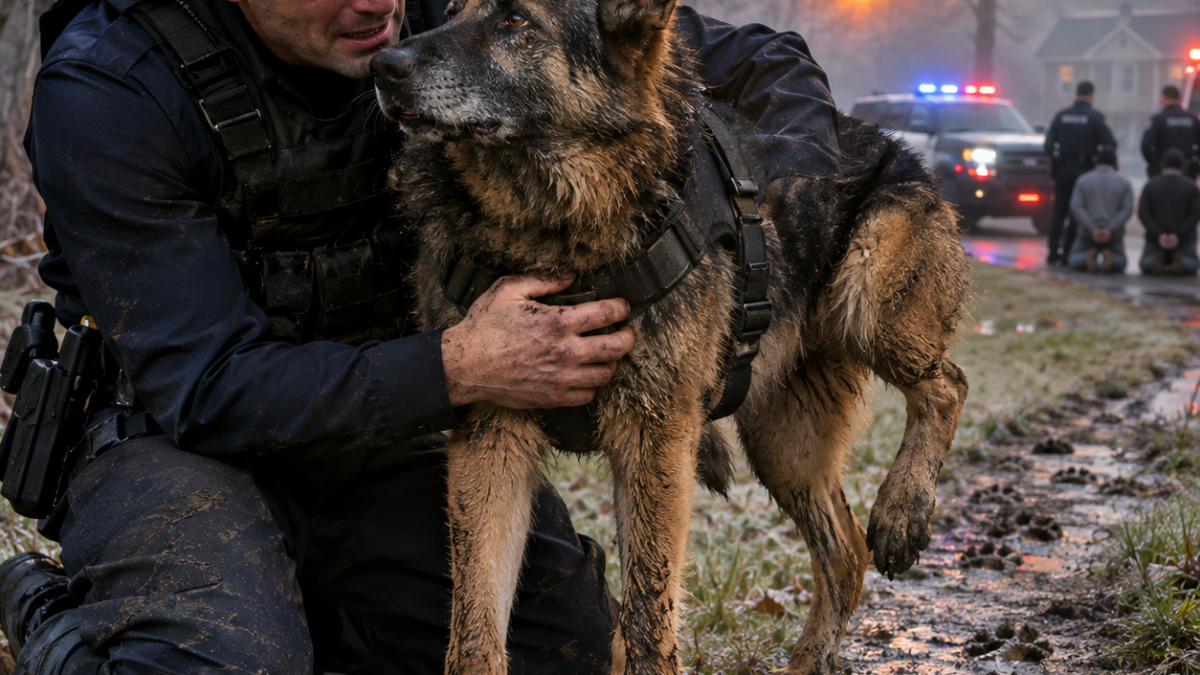
Long shifts.
Training days.
Hot Georgia summers.
Cold nights.
Hours waiting.
Seconds of absolute action.
He had protected me.
He had helped protect other officers.
He had gone into situations where I could feel adrenaline in my teeth, and he had done it because I asked him to.
That is a difficult thing to explain to someone who has never worked with a police dog.
Turbo did not understand pension.
Promotion.
Recognition.
He did not care whether anyone posted his photograph.
He did not know what a commendation meant.
He knew work.
He knew me.
He knew the sound of my equipment.
And he knew that when I wore the uniform, something important was about to happen.
Turbo had been born in Czechoslovakia or Slovakia before coming into law-enforcement work.
His training was one of the first things people found fascinating about him.
Five languages.
Czech.
German.
French.
Dutch.
English.
His commands could sound like something out of an international police movie.
People would look at me and laugh.
“Your dog speaks five languages?”
“I said he understands five. Nobody promised he respects all of us equally.”
Turbo would usually be sitting nearby looking like the only adult in the conversation.
He was serious about work.
That was the thing.
At home or around the station, he could relax.
But the moment he saw the boots, everything changed.
My duty boots were the first signal.
His head came up.
Then the belt.
He stood.
Uniform shirt.
Now he was pacing.
Keys.
Radio.
Harness.
By then, he was barking.
Not scared.
Not anxious in the ordinary sense.
Ready.
Impatient.
Almost offended that I was taking too long.
Turbo lived to work.
I do not use that phrase lightly.
There are dogs who enjoy activity.
Dogs who enjoy riding.
Dogs who love a particular toy.
Turbo’s entire body changed when he knew he was going on duty.
Purpose turned him on like a switch.
That was why the injury became so painful for both of us.
The physical pain was his.
The helplessness belonged to me.
The day it happened, we were helping the Cobb County Police Department locate two suspects connected to attempted home invasions and burglaries.
Turbo and I had been called in because tracking was what he knew.
Once he picked up a scent and committed to it, the rest of the world narrowed.
I had learned to read him over years.
How his breathing changed.
How his shoulders changed.
When the track was strong.
When scent drifted.
When he corrected.
When terrain distracted him.
A handler learns that communication does not always look like communication.
Sometimes it is a leash tightening half an inch.
A head turn.
A pause.
A dog shifting from one side of a path to the other.
That day, Turbo was working.
Focused.
Then I heard it.
One sharp yelp.
Not a scream.
Not repeated.
Just one sound.
I remember my entire body reacting before my mind did.
“Turbo?”
He kept moving.
No collapse.
No obvious lameness.
Nothing that said:
Stop everything now.
I watched him harder.
He was still tracking.
Still committed.
That was Turbo.
Pain did not automatically override the job.
We finished what we needed to finish.
That evening, I thought about the sound.
The next morning, I saw it.
A limp.
Small.
But there.
Someone who did not know Turbo might have missed it.
I did not.
His stride was wrong.
One rear leg was not carrying itself the way it had the day before.
My stomach tightened.
“Come here, buddy.”
He came.
I watched him turn.
There.
Again.
He was protecting the knee.
I touched around it carefully.
Turbo looked at me.
Not afraid.
Almost annoyed.
Like I was wasting time that should have been spent getting ready for work.
I took him to the veterinarian.
The examination led to imaging.
Then the words:
Luxating patella.
A kneecap that was moving out of its normal position.
Basically, a dislocated knee.
And the next word was the one that changed everything.
Surgery.
I remember asking questions too fast.
“Can you fix it?”
“Yes.”
“Will he walk?”
“That’s the goal.”
“Will he run?”
“We’ll see.”
“Will he work again?”
That answer did not come immediately.
And the pause scared me more than the diagnosis.
Because surgery could repair tissue.
But police work asks more than ordinary walking.
Turbo needed speed.
Strength.
Balance.
Endurance.
He needed to turn.
Climb.
Accelerate.
Stop.
Commit his entire body to motion without wondering whether one knee would fail beneath him.
A pet dog could have a wonderful life without any of that.
Turbo could too.
But I knew him.
And I knew what work meant to him.
The veterinary team explained what would happen.
Surgery.
Healing.
Medication.
Then rehabilitation.
Physiotherapy.
Hydrotherapy.
Reassessment.
No promises.
That night, Turbo lay near me.
I sat looking at him longer than I should have.
He had no idea that adults had just discussed whether the work he loved might already be behind him.
He only knew his knee hurt.
He only knew I was home.
And if I had taken out my boots, he probably would have tried to go right back on patrol.
PART2
The morning after surgery was when I first understood how difficult recovery was going to be.
Not medically.
Emotionally.
Turbo woke sore.
Groggy.
Confused.
The repaired leg had to be protected.
Movement controlled.
Everything about the next several weeks depended on restraint.
Try explaining restraint to a police dog who has spent years being rewarded for intensity.
He would look toward the door.
Then at me.
The question was always the same.
When are we going?
“Not today.”
He did not understand.
The next morning, I put on my boots.
Turbo’s head came up.
Habit.
His ears sharpened.
I reached for my duty belt.
He stood.
Then started barking.
Ready.
Just like always.
That was when I realized nothing about his mind had accepted what his body had been through.
I knelt.
“Sorry, buddy.”
His eyes stayed on mine.
“You can’t come out on the road today.”
He took one step toward the door.
“No.”
Another.
“You’ve got to stay in the office.”
The barking stopped.
That was worse.
He looked at me.
Then the door.
Then me again.
If a dog could accuse someone of betrayal without making a sound, Turbo did it.
I left.
I hated myself for the first several minutes of that shift.
Ridiculous.
I knew why he had to stay.
I knew if I let him work before the knee healed, I could undo the surgery.
I knew loving him meant saying no.
Still, knowledge and feeling do not always cooperate.
When I returned later, Turbo lit up.
Maybe now.
Maybe the mistake had been corrected.
Maybe now the harness would come out.
It did not.
That became our routine.
Boots.
Bark.
Hope.
No.
Again.
Again.
Again.
Sometimes officers at the station would laugh.
“Turbo thinks you forgot him.”
“I know.”
One officer would scratch him behind the ear.
“You’re on vacation, buddy.”
Turbo did not want vacation.
He wanted his job.
The station staff took care of him.
He was never alone in the sense people imagine.
But he knew when patrol cars left.
He knew the sounds.
He knew the smells.
He watched officers walk toward doors in uniforms.
Every departure was a reminder.
I began changing clothes differently when possible because watching his excitement collapse bothered me that much.
Then I stopped doing that.
Because recovery could not become a life built around avoiding his disappointment.
He needed routine.
I needed to tolerate the fact that sometimes doing what was right would make him unhappy.
That is part of care.
Something nobody puts in the sentimental stories.
Sometimes love looks like withholding the thing someone wants because their body is not ready.
The first rehabilitation sessions were basic.
Controlled.
Slow.
Turbo hated slow.
A dog built for purposeful movement suddenly had humans watching every step.
Range of motion.
Weight bearing.
Muscle response.
Swelling.
Pain.
I had never thought so much about one kneecap in my life.
The veterinary team had.
That is why we trusted them.
Dr. Kirk Underwood had performed the original surgery.
He knew what had been repaired.
He knew the surgical site.
Dr. Arvid and the rehabilitation team focused on returning Turbo’s function as safely as possible.
They were not trying to create a dog who looked okay standing still.
They needed a dog whose body could perform.
That distinction mattered.
Every week, Turbo went back.
Physiotherapy.
Hydrotherapy.
Assessment.
Exercise.
Then home.
Or station.
Then waiting.
The first time he put more confident weight on the repaired leg, I felt absurdly proud.
“Good job.”
Turbo looked at me like:
Obviously.
But a few better steps did not mean road duty.
That was the hardest part.
Recovery gives hope in tiny doses.
A good morning.
A little more movement.
Less swelling.
Then someone says:
“Still not yet.”
You become afraid of hope because every improvement makes you want the finish line closer than it is.
At night, I replayed the original track.
That yelp.
One sound.
Should I have stopped immediately?
Did I miss something?
Could I have prevented surgery?
Handlers are experts at hindsight.
We go back through seconds and invent alternate versions where we were more observant.
More skilled.
More perfect.
I had heard him.
He continued.
He had not shown clear lameness until later.
Once I saw the limp, I acted.
That was the reality.
Still, guilt does not need logic.
It asks questions anyway.
I remember looking at Turbo sleeping and thinking:
You trusted me to know when to stop.
Then answering myself:
And I did stop when I knew.
Both things could be true.
Eventually, I had to accept that police work contains risk.
Not reckless risk.
Not careless risk.
But real physical demand.
Dogs can be injured.
Handlers can be injured.
The responsibility is not to pretend risk can be erased.
The responsibility is to respond correctly when injury appears.
Turbo got surgery.
He got rehabilitation.
He got time.
Time was the thing he liked least.
Weeks passed.
The surgical area healed.
Turbo’s energy came back faster than permission did.
That created a new problem.
A dog who feels better before he is fully rehabilitated is dangerous to himself.
He wants to do normal things.
Run.
Launch.
Turn.
Jump.
The body says:
Maybe.
The brain says:
Absolutely.
Humans have to become the brakes.
Turbo would see something exciting and load his body before I could even finish saying his name.
“Easy.”
He disliked that word.
I became obsessed with controlled movement.
No dramatic bursts.
No proving anything.
There is a temptation with strong dogs to admire toughness so much that you forget toughness can hide damage.
Turbo had already taught me that when he worked through the original injury.
One yelp.
Then continued.
From then on, I stopped treating “he wants to” as evidence that “he should.”
That was one of the biggest lessons of the entire process.
Police officers visited him.
Some of the men Turbo had worked around for years.
He received attention.
Praise.
The kind of rough affection people give working dogs when they do not want anyone noticing how attached they are.
“Old man.”
“You getting soft?”
“You milking this?”
Turbo loved all of it.
Then someone would leave for duty.
And his attention shifted.
Every time.
Work.
That was where he believed he belonged.
It made me wonder what retirement would eventually look like.
I had avoided thinking about it before.
Of course I knew it would happen.
Working dogs do not have thirty-year careers.
But “someday” is easy to accept.
An injured knee suddenly makes someday feel like next month.
Maybe this was how it ended.
One track.
One yelp.
Then office duty forever.
I tried imagining it.
Turbo at home.
Long naps.
Short walks.
Food.
Comfort.
Safe.
There was nothing wrong with that life.
For many dogs it would be perfect.
But I knew Turbo would spend mornings watching my boots.
For how long?
Would he eventually stop?
Would that be peace?
Or surrender?
I hated myself for even thinking that way because retirement would not have been failure.
If his body could not safely work, retiring him would be the responsible act.
A dog does not owe us the destruction of his joints simply because he loves a job.
I knew all of that.
And still—
I wanted him back.
Selfishly.
Professionally.
Personally.
I wanted the sound of him behind me.
I wanted the patrol vehicle to feel complete again.
I wanted my partner.
Rehabilitation became our new job.
That is how I started thinking about it.
Turbo could not patrol.
Fine.
Then recovery was the mission.
Every controlled step mattered.
Every exercise.
Every session.
If Turbo needed purpose, I tried to give the rehabilitation routine purpose.
“Come on.”
“Good.”
“Again.”
“Nice.”
He responded to praise the way working dogs do.
Not with human pride.
With engagement.
Do the thing.
Get feedback.
Do again.
His muscles started rebuilding.
The repaired leg began looking less protected.
The gait improved.
Then came days that scared me.
A slightly awkward step.
A moment of stiffness.
I would feel panic rise.
“Did we push too much?”
“Is something wrong?”
The rehabilitation team would assess.
Sometimes the answer was simply:
Recovery is not a straight line.
That phrase is easy to say.
Hard to live.
Humans like graphs that go upward.
Bodies do not care.
One day strong.
One day tired.
Healing tissue.
Changing muscle load.
Adaptation.
The job was not to turn every imperfection into catastrophe.
Watch.
Measure.
Adjust.
Continue.
Turbo was better at that than I was.
He did not spend the night worrying about yesterday’s step.
He slept.
Then woke ready.
Dogs are lucky in that way.
They live closer to the moment.
I had to learn from him.
The station adjusted without him on the road.
That hurt too.
Work continues.
It has to.
Calls still come.
Officers still go.
The department cannot pause because one K-9 is rehabilitating.
That is healthy.
But there is something unsettling about seeing the machine continue when one of your most important pieces is absent.
You realize no one is indispensable.
Then you realize that does not mean no one is irreplaceable emotionally.
Another dog can work.
Another handler can assist.
That does not make them Turbo.
Years create their own language.
A new partnership starts from zero.
Turbo and I were not at zero.
We had history.
Danger.
Training.
Mistakes.
Successful calls.
Quiet drives.
You do not replace that.
You build something else eventually.
I was not ready to build something else.
One afternoon during recovery, I put my uniform on and Turbo began barking from across the room.
I looked at him.
“Seriously?”
More barking.
“You know the answer.”
He walked toward me.
The knee looked better.
That made it worse.
Because now to an ordinary eye, he looked ready.
He was not limping badly.
He was energetic.
He seemed like Turbo.
I crouched.
“You feel good.”
His ears up.
“I know.”
His body shifted toward the door.
“But feeling good isn’t the same as being ready.”
He stared.
I laughed softly.
“Yeah, I know. You don’t care.”
He put his nose against my shoulder.
That almost broke me.
I hugged his neck.
Police handlers do not always admit how often we talk to dogs who cannot answer.
Maybe because sometimes they answer better than people.
Not with words.
With presence.
I told him:
“We’re getting there.”
That was as much for me as him.
The day of the final assessment arrived almost like any other rehab day.
That is the strange thing about life-changing moments.
The morning still starts normally.
You still put on clothes.
Drive.
Park.
Walk through a door.
Except everything means more.
Turbo had been going to the practice every week.
Regular physio.
Hydrotherapy.
By then, the staff knew him.
He knew them.
We entered.
Dr. Arvid greeted me.
“Officer Hale.”
“Good to see you.”
Then immediately to Turbo:
“How you doing, man?”
Turbo looked good.
That was the first thing Dr. Arvid noticed.
Full weight on the limb.
No obvious limp.
“Man, he looks like he’s doing good.”
I smiled.
“He’s doing great.”
“How’s he doing on his medication?”
“Great.”
“Any problems?”
“No.”
Turbo stood there as though the conversation was unnecessary.
He was ready.
We were the slow ones.
Dr. Arvid said Dr. Underwood would perform one more surgical assessment.
Range of motion.
Stability.
Healing.
Then rehabilitation would challenge movement.
And, if everything went the way we hoped, this might be the final rehabilitation day before full active-duty release.
I heard the words.
Full active duty.
My chest tightened.
“Awesome.”
I said.
“We can’t wait.”
That was the truth.
But beneath excitement was fear.
Because if this was the final test, there were only two broad outcomes.
Go back.
Or not yet.
Maybe never.
I hated that second possibility so much I barely let myself name it.
Dr. Underwood examined the repaired knee.
Turbo tolerated manipulation.
The surgical site was fully healed.
That was important.
A well-healed incision does not guarantee full working function, but without it, nothing else matters.
Dr. Underwood had done the original surgery.
He knew how far Turbo had come.
Many dogs recover from this kind of procedure over a period of weeks.
Turbo had rebounded well.
Good recovery.
Good surgical healing.
But now came the part that mattered for a police dog.
Could the repaired joint perform under challenge?
Dr. Arvid explained what I already knew but needed to hear again.
“The rehab portion is very critical.”
Not optional.
Not decoration after surgery.
Critical.
We wanted Turbo as close to one hundred percent as possible.
Because he was not returning to a couch.
He was returning to duty.
High-level physical demands.
That meant strength.
Flexibility.
Balance.
Coordination.
Endurance.
Confidence.
Especially confidence.
The knee could be mechanically stable, but if Turbo did not trust it, his movement would reveal that.
He might shorten stride.
Shift weight.
Protect the limb.
Compensate with the other side.
That could create more problems.
We needed to see his body use the leg naturally.
No negotiation.
No hesitation.
I rubbed the side of his neck.
“All right, Turbo.”
His ears turned toward me.
“Let’s do it.”
The rehabilitation area had equipment arranged almost like a small obstacle course.
Raised blocks.
Steps.
Balance challenges.
Surfaces requiring controlled placement.
To someone watching casually, it might not look impressive.
A police dog stepping onto blocks.
That is the difference between spectacle and medicine.
Spectacle wants a sprint.
Medicine wants one correct paw placement.
Turbo approached.
One front paw.
Then the rear.
I watched the repaired leg.
Weight.
Full.
He moved carefully.
Not because he feared it.
Because the exercise required control.
One block.
Next.
His balance held.
“Good job.”
Dr. Arvid watched closely.
“Perfect.”
Turbo moved again.
“Good.”
I found myself whispering praise too.
“Come on, buddy.”
“Nice.”
“Good.”
I had watched him work dangerous tracks with less anxiety.
That seems impossible.
But danger on duty has momentum.
You react.
Here, I could only watch.
No suspect.
No decision.
No command that could change the result.
Turbo’s body would answer.
I wanted the answer so badly.
He handled the steps.
The blocks.
The controlled movement.
No obvious limp.
No refusal to load the leg.
Each successful step added something inside me.
Not certainty.
Hope.
Hope is dangerous during recovery because once you let it in, you begin imagining the future again.
Patrol car.
Harness.
Barking at boots.
Calls.
I tried to stay present.
One exercise at a time.
Turbo did not need my future.
He needed my attention.
Then came laser therapy.
Turbo settled while the team treated the knee.
The therapy was intended to support comfort and healing.
And, judging by Turbo’s expression, he had no objection.
I laughed.
“He’s really enjoying that.”
Dr. Arvid smiled.
I joked that maybe I needed to try it after a Monday night.
Everyone laughed.
The tension broke briefly.
Turbo looked as if he had discovered the one part of rehab he thought should continue indefinitely.
That moment mattered.
Recovery had been months of restriction.
But not every second needed to carry fear.
There could be humor.
Routine.
Normal interaction.
You do not have to make an injured dog’s entire identity injury.
That was something I had gradually learned.
Turbo was not “the damaged K-9.”
He was Turbo.
He happened to have a knee being rehabilitated.
The difference matters.
Then they prepared the underwater treadmill.
This was the part.
The tank allowed warm water to support part of Turbo’s weight while creating resistance.
Controlled.
Safe.
But revealing.
Walking in water engages muscles differently.
Increasing speed exposes endurance, symmetry, confidence.
Turbo stepped inside.
He knew the equipment.
The door closed.
Water began rising around his legs.
He looked around.
Calm.
The treadmill started.
Slow.
Turbo walked.
I stared at the rear legs.
Left.
Right.
Left.
Right.
The repaired knee flexed.
Extended.
Accepted load.
No obvious avoidance.
Dr. Arvid watched too.
This was not entertainment.
He was studying the movement.
The water resisted Turbo’s stride.
That resistance required strength.
And because the environment was controlled, we could see how the leg responded without the unpredictable ground of field work.
Turbo kept walking.
Comfortable.
Focused.
Then Dr. Arvid said they were going to increase the speed.
My stomach tightened.
Running.
This was where the truth would become harder to hide.
At slow speed, a dog can compensate subtly.
At a run, weakness becomes more visible.
The belt accelerated.
Turbo adjusted.
His stride lengthened.
Water moved around his legs.
He ran.
I leaned forward.
There.
The repaired leg landed.
Pushed.
Came forward.
Again.
Again.
Equal.
No hop.
No obvious favoring.
I barely breathed.
Dr. Arvid said:
“Looks like he’s putting equal weight on both limbs.”
I nodded.
“Yeah.”
My voice sounded wrong.
Too quiet.
Because if I spoke normally, I was afraid something inside me would crack.
Turbo ran.
Not like a patient.
Like a dog.
That sounds simple.
It was everything.
He was not consciously thinking about the knee.
No protective movement.
No visible negotiation.
Dr. Arvid said he was trusting the leg.
That sentence hit me harder than anything else that day.
Trusting the leg.
Turbo had spent years trusting me.
I gave a command.
He moved.
I asked him forward.
He believed there was a reason.
Now his own body had betrayed him once.
Pain.
Surgery.
Months of restriction.
And somewhere during rehabilitation, he had learned to trust himself again.
That might have been the most important part of recovery.
Not merely healing.
Trust.
The treadmill kept moving.
Turbo’s endurance held.
His muscles worked.
His gait stayed balanced.
I watched the dog I knew return in front of me.
The injury had interrupted something.
It had not erased him.
Months earlier, I had imagined retirement.
I had imagined trying to explain to a dog who lived to work that the work was finished.
Now I watched him run evenly through warm water and felt that future recede.
Not disappear forever.
Age still existed.
Retirement would still come.
But not because of this.
Not today.
Maybe not yet.
That was enough.
They slowed the treadmill.
Cooldown.
Turbo’s heart rate began settling.
His breathing relaxed.
He had done it.
I scratched the top of his head.
“Good job.”
He looked up.
I laughed.
“Yeah, you know.”
Dr. Arvid watched Turbo.
Then said the sentence I will probably remember for the rest of my career.
“It’s time for him to go back to protecting and serving.”
I stared at him.
I needed confirmation even though the words were clear.
“You’re clearing him?”
Everything looked good.
Turbo had come a long way.
Equal weight.
Confidence.
Strength.
Rehabilitation successful.
Full active duty.
I think I said:
“Man.”
Then again.
“Man.”
I could not find anything smarter.
I looked at Turbo.
“You ready to get back to work?”
His body changed immediately.
If enthusiasm could produce a medical clearance, Turbo would have passed weeks ago.
I laughed.
“We’re going back.”
He did not know what the official decision meant.
Not yet.
But he knew my energy changed.
Dogs read us.
Turbo knew something good had happened.
The relief felt physical.
My shoulders dropped.
My chest opened.
For months, every improvement had included an asterisk.
Doing better, but not cleared.
Walking well, but no running.
Surgical site healed, but still rehab.
Strong, but wait.
Now there was no asterisk.
Ready.
I thanked everyone.
Probably more than once.
Dr. Underwood.
Dr. Arvid.
The rehabilitation team.
Everyone who had touched the process.
Because Turbo’s recovery did not belong to one person.
It really did take a village.
Surgery had repaired the knee.
But surgery alone did not return him to work.
Medication controlled what needed controlling.
Physiotherapy rebuilt motion.
Hydrotherapy challenged the body safely.
Exercises rebuilt strength and coordination.
Repeated assessment made sure enthusiasm never outran biology.
That last part might have saved his career.
Because Turbo would have gone back too early.
Absolutely.
If I had opened the patrol door two weeks after surgery, he would have tried to jump in.
Desire was never the missing ingredient.
Time was.
Human judgment was.
Medicine was.
After the clinic, I wanted to see him run on normal ground.
Not because the doctors’ assessment was not enough.
Because I needed it emotionally.
I needed to see Turbo move outside the context of treatment.
No tank.
No blocks.
No one studying every angle.
Just run.
I brought him out.
He was alert.
Excited.
I held him for a moment.
“You ready?”
His muscles loaded.
There was the dog I knew.
I released.
Turbo took off.
Fast.
No limp.
No visible hesitation.
The stride opened.
The repaired knee did exactly what it was supposed to do.
He turned.
Ran.
His body looked free.
I laughed out loud.
I could not help it.
Months of memory collided.
The yelp.
The limp.
The diagnosis.
Surgery.
The office.
The barking every morning.
The looks when I left.
The blocks.
The treadmill.
And now this.
Turbo running.
I thought:
There you are.
Not the patient.
Not the injured dog.
My partner.
I watched him longer than necessary.
Part of me still scanned the knee.
Old fear.
Then I realized I needed to do what Turbo had already done.
Trust.
If the doctors had cleared him, if the rehab showed equal loading, if his movement looked right, then I could not spend the rest of his career treating every stride like a potential disaster.
Careful was good.
Fear was not.
Turbo had learned to trust the repaired leg.
Now I had to learn to trust Turbo’s body again too.
That took longer than the medical clearance.
The first time I opened the patrol vehicle after he was released back to duty, Turbo lost his mind.
There is no more professional way to say it.
He knew.
The door opened.
The scent.
The equipment.
The invitation.
Everything he had been waiting for.
I tried:
“Easy.”
He did not believe in easy.
He wanted in.
Now.
Months of being told no had ended.
I laughed.
“Okay.”
He climbed in.
Turned.
Looked at me.
The expression was almost accusation.
Finally.
I stood there for a second.
The vehicle had looked wrong without him.
Not visually.
Emotionally.
There had been an empty place in the rhythm of work.
Now the space was filled.
I climbed in.
For the first time in months, I heard Turbo behind me in a patrol setting and felt like a piece of my professional life had clicked back into place.
Our first return shift was controlled.
Of course.
Being medically cleared did not mean anyone needed to throw Turbo into the hardest physical situation available five minutes later.
I was fine with that.
Turbo was less interested in caution.
Every radio sound got attention.
Every movement.
Every possibility.
He was ready to work all the work at once.
I kept looking back.
Checking him.
He caught me staring.
I swear the look said:
What?
“Nothing.”
I turned forward.
A few minutes later, I looked again.
Same thing.
Eventually I laughed at myself.
I was the anxious one now.
Turbo was fine.
The first time he jumped out of the patrol vehicle, my stomach tightened.
He landed.
Stable.
Moved normally.
Nothing happened.
But my body remembered the injury.
That is one thing people do not talk about enough.
Recovery does not happen only to the patient.
The people beside the patient also have to relearn safety.
A spouse watching someone walk after surgery.
A parent watching a child run after a fracture.
A handler watching a working dog land on a repaired leg.
Every normal movement becomes evidence.
Safe.
Again.
Again.
Again.
Eventually your nervous system believes it.
Mine took time.
For the first several shifts, I noticed everything.
Was that stride shorter?
Did he hesitate?
Was he tired?
Did the knee look stiff?
Sometimes I had to stop myself from turning ordinary movement into a medical exam.
Turbo did not deserve to spend the rest of his working life being treated like glass.
He had earned trust.
So I watched responsibly.
Not obsessively.
That distinction took practice.
Then one day, during a completely ordinary moment, I realized I had gone a long time without thinking about the knee.
That was when I knew we were truly back.
Not when the clearance form was signed.
Not when he ran outside.
When I stopped seeing him as recently injured.
Turbo was just Turbo again.
His barking in the mornings changed meaning for me too.
Before surgery:
Normal.
During recovery:
Heartbreaking.
After clearance:
Beautiful.
Boots.
Head up.
Belt.
Standing.
Uniform.
Barking.
I would look at him.
“You’re coming.”
That was all he had wanted.
His entire body would say:
Obviously.
Police work returned to routine.
That was the gift.
Not a cinematic rescue.
Not a heroic comeback call.
Routine.
Turbo beside me.
The work he loved.
I began appreciating ordinary shifts in a way I had not before.
Because ordinary things are easiest to take for granted.
A dog loading into the car.
Waiting for a command.
Breathing behind you.
Getting out at the station after work.
Nothing worth filming.
Until you nearly lose it.
Then ordinary becomes precious.
The first night after one of our early shifts back, Turbo was tired.
Not injured.
Not miserable.
Good tired.
Working-dog tired.
He settled down.
Eyes half closed.
I sat beside him.
Rubbed his head.
“You happy?”
No answer.
Obviously.
But I knew.
Months earlier, he had been restless because I left without him.
Now he had worked.
Purpose satisfied.
I remember thinking:
This is why we did all of it.
Not to prove toughness.
Not to get one more statistic out of an aging dog.
To give him back a life that still fit him safely.
Quality of life is not always the absence of effort.
For Turbo, meaningful effort was part of quality.
The veterinary team understood that.
They were not trying to force him back into duty.
They were trying to determine whether duty remained physically appropriate.
Once the answer was yes, keeping him away simply because he had once been injured would not automatically have been kinder.
The goal was not endless work.
The goal was appropriate work while he could still do it.
I thought a lot about retirement afterward.
Not with the same fear.
The injury forced me to confront something I had avoided.
Turbo’s career would eventually end.
No amount of love changes age.
When that day came, I wanted to meet it honestly.
Not push him because I could not let go.
Not retire him because I was afraid of losing him to injury.
Watch the dog in front of me.
Listen to his body.
Use the people who know medicine.
Make the decision for him, not for my ego.
That became my promise.
The knee injury had almost ended his career.
It also taught me how I wanted the real ending to happen someday.
With respect.
People would ask:
“Why does he care so much about working?”
I never had one complete answer.
Genetics.
Training.
Bond.
Reinforcement.
Routine.
Drive.
All of it.
But there was something deeper in the way Turbo changed when he knew he had a task.
Humans understand purpose too.
Take someone who has worked the same meaningful job for decades and suddenly tell them:
Stay home.
Nothing is wrong.
Relax.
Some love it.
Some feel lost.
Turbo was the second kind.
That does not mean work was the only thing that made his life worthwhile.
But it mattered.
Deeply.
And once you know something matters to someone you love, you do not dismiss it because it would be simpler for you if it didn’t.
I also began thinking differently about courage.
People called Turbo brave.
He was.
But courage is an easy word when you only see the exciting part.
The track.
The suspect.
The bark.
The dramatic police-dog image.
Rehabilitation required another kind of courage, if we can use that word for a dog.
Submitting to controlled movement.
Letting people manipulate a healing knee.
Repeating exercises.
Entering the treadmill.
Trusting the body again.
There was no adrenaline reward in that.
No chase.
Just repetition.
That is where his future was actually rebuilt.
Heroes are not always running toward danger.
Sometimes they are putting one repaired leg onto a raised block correctly.
Again.
Again.
Again.
The staff at the clinic became part of Turbo’s world.
He might not have appreciated their restrictions, but he knew them.
They encouraged him.
Managed him.
Watched details I could not interpret medically.
A handler’s love does not replace expertise.
That is another lesson.
I knew Turbo better than anyone.
I could tell you his normal behavior.
His drive.
His subtle changes.
But I could not repair a patella.
I could not evaluate surgical healing like Dr. Underwood.
I could not design rehabilitation like Dr. Arvid’s team.
Partnership sometimes means admitting someone else knows the next step.
That can be hard for people trained to take control in emergencies.
There was no emergency action I could perform to make Turbo heal faster.
No suspect to catch.
No door to clear.
Just follow the plan.
Show up.
Wait.
That was difficult.
There were days during recovery when I wished someone would tell me exactly how it would end.
Yes, he returns.
No, he retires.
Certainty.
Medicine rarely works that way.
Bodies reveal themselves over time.
So we lived in the middle.
Better.
Not ready.
Promising.
Still healing.
Try again next week.
That uncertainty wore on me.
Turbo seemed unaffected.
Maybe because no one had told him there was uncertainty.
He assumed the future.
Work.
I sometimes envied that confidence.
One day, someone at the station joked:
“He’s going to forget how to be a police dog.”
I laughed.
Turbo barked at some equipment movement thirty seconds later.
“No.”
I said.
“He remembers.”
Work was not a trick he might forget.
It was identity built from years.
The physical skill needed refreshing perhaps.
But the drive was intact.
That was never in doubt.
The source of my biggest fear shifted over time.
At first:
Will surgery work?
Then:
Will he walk normally?
Then:
Will he build strength?
Then:
Will he be cleared?
Recovery is a ladder of fears.
Once one resolves, the next appears.
The final clearance felt so powerful because for once there was no immediate next medical question.
He could work.
That was the answer we had been climbing toward.
I kept thinking about the underwater treadmill.
Even months later.
Turbo running evenly while water resisted him.
Because the visual represented the whole process.
He was moving forward through resistance.
Not fighting it wildly.
Working through it.
Controlled.
Strong.
One repaired leg no longer acting like a weakness.
Humans love metaphors.
Turbo probably just wanted the treadmill session over.
Still, it stayed with me.
When Dr. Arvid said Turbo was trusting the leg, I realized trust is physical.
We usually think of trust as emotional.
Between people.
Handler and dog.
But a body must trust itself too.
After pain, a person hesitates before loading weight.
After injury, a dog may shift.
The nervous system remembers.
Confidence is not motivational speaking.
It is thousands of safe repetitions telling the brain:
This works.
This holds.
You can use it.
Turbo had accumulated those repetitions.
That is what I saw.
I became more protective of rehabilitation as a concept after that.
People sometimes see surgery as the fix.
Problem.
Operation.
Done.
No.
The operation gives you an opportunity.
The rehabilitation teaches the body how to live with the repair.
Without that work, the best surgery can fail functionally.
Turbo’s return was built after the operating room as much as inside it.
I also stopped laughing when people called physiotherapy boring.
Boring saved my partner’s career.
Steps.
Blocks.
Water.
Laser.
Controlled movement.
Boring.
Beautiful.
There was a point after his return when another officer watched Turbo move and said:
“You’d never know.”
That was one of the best compliments.
You’d never know he had been through surgery.
Not because the history did not matter.
Because the recovery had become integrated.
The knee was no longer the first thing someone saw.
Turbo was.
That is what we wanted.
I never forgot the scar.
I never forgot the yelp.
But I stopped letting those memories define him.
That mattered.
Injury can become identity if everyone around the patient keeps treating it as the most important thing.
Turbo’s identity was bigger.
Police dog.
Partner.
Worker.
Pain in the neck sometimes.
Multilingual show-off.
The dog who barked like my uniform was a personal invitation.
The repaired knee was one chapter.
Not the whole story.
People often ask whether police dogs know they are police dogs.
I cannot answer that scientifically in some philosophical way.
But Turbo knew his routine.
He knew the equipment.
He knew commands.
He knew when the job began.
And he definitely knew when he was being left out.
That was enough for me.
His relationship with my uniform was almost funny after recovery.
Sometimes I would put on boots for something unrelated and see him wake up.
“Not work.”
He stared.
“Seriously.”
Still staring.
Then the belt did not appear.
He would eventually settle.
But if the whole uniform came together?
No chance.
Barking.
Ready.
The same as before surgery.
That continuity reassured me.
His spirit, if you want to call it that, had not been broken by months off.
He had waited.
Now he had his answer.
One of the most painful memories from the recovery period was not medical at all.
It was walking away while he barked.
There were mornings I could hear him after the door closed.
That sound followed me.
I knew staff were there.
I knew he would settle.
Still.
It felt like abandoning someone who had never abandoned me.
That is why the return mattered emotionally beyond work.
Turbo had stood beside me through dangerous situations.
Now he could not understand why I would not let him stand beside me.
I had to believe that one day, if the rehabilitation worked, the separation would make sense in outcome even if it never made sense to him.
It did.
The first morning he came back to duty, there was no speech.
No ceremony.
That seems right.
Turbo did not need a cake.
He needed the door.
I opened it.
He came.
Simple.
After months of no, yes can be a complete celebration.
I learned something about myself too.
I was more emotionally attached to Turbo than I had admitted.
Police culture has changed in many ways, but some officers still like pretending we are unaffected by things.
We are not.
We learn to function despite emotion.
Different.
When Turbo was injured, I worried.
When surgery came, I worried.
When he limped, I felt it.
When he was cleared, relief nearly embarrassed me with its intensity.
That attachment does not make a handler less professional.
It can make you more responsible if you manage it correctly.
The danger is letting love push you into returning a dog too early.
I did not.
Because the people around us kept medicine in charge.
I am grateful for that.
If I could go back to the first day after surgery and explain anything to myself, I would say:
Do not measure progress by Turbo’s impatience.
He will feel ready before he is ready.
Do not measure by your loneliness in the patrol car.
That is your problem.
Measure the leg.
Measure the function.
Let the experts decide.
Wait.
It will feel too long.
Wait anyway.
He will forgive you the moment the door opens.
Dogs are generous like that.
And he did.
No resentment.
No months-long grudge.
Turbo did not get into the patrol car and say:
About those weeks you left me…
He moved forward.
That is another gift dogs give us.
They can remember training, people, places, fear, reward.
But they do not appear to nurture grievance the way humans do.
The door opened.
Work returned.
Good.
I needed that lesson.
Because I had carried guilt longer than Turbo carried frustration.
Guilt about the injury.
The track.
Leaving him behind.
Maybe I needed to move forward too.
Not forget.
Learn.
Then work.
Turbo showed me.
The day Dr. Arvid cleared him, I remember the pride in the whole team.
Not just me.
They had watched the progress too.
A successful outcome belongs to everyone who invested skill and time.
I could see that.
The final run was proof their work had meaning.
Veterinary professionals see many patients.
Not every case returns to a demanding job.
Turbo did.
That was special.
Dr. Underwood’s surgery gave him a chance.
The rehab team turned chance into function.
Turbo turned function into work.
That is the chain.
Break one link, maybe we do not get the same ending.
That is why I refuse to tell the story as:
“Tough police dog simply fought his way back.”
No.
Toughness helped.
But science mattered.
Professional care mattered.
Controlled recovery mattered.
You cannot out-tough a joint problem.
You treat it.
The same is true in police work sometimes.
Courage without procedure can become recklessness.
Drive without control can become injury.
Turbo had drive.
We had to provide control.
That balance brought him back.
I wish Turbo could understand how many people cared whether he returned.
Maybe he did in his own way.
He certainly knew he got attention.
But the idea that veterinarians, technicians, officers, viewers—people outside his immediate world—were cheering for him?
Probably meaningless.
His world was smaller.
Work.
Handler.
Task.
Reward.
Rest.
Maybe that simplicity protected him.
After he returned, I noticed how much he seemed to enjoy the ordinary act of being included.
Maybe I imagined it.
Handlers anthropomorphize.
We have to be careful.
Still.
There was energy in him.
The difference between watching doors and going through them.
Between hearing a patrol car leave and being inside it.
That was real enough.
I thought again about the phrase:
“He lives to work every day.”
It can sound sad if you misunderstand it.
Like exploitation.
For Turbo, working was enrichment at the highest level.
He had been bred and trained for engagement.
He wanted the task.
Responsible working-dog care means honoring that drive while protecting the animal.
Not endless work.
Appropriate work.
Health first.
Purpose where safe.
The rehab team gave him the chance to continue both.
When people asked how long he would continue after return, I never gave guarantees.
One shift at a time.
One assessment at a time.
Nine-year-old dog.
We would watch.
That became enough.
Before injury, I subconsciously imagined future as open.
After injury, I learned to value the present.
He is working today.
Good.
That is all anyone truly gets.
Today.
The return also changed how I watched younger dogs.
I appreciated their effortless movement.
Healthy knees.
Fast recovery.
Handlers sometimes assume youth will last.
It does not.
Turbo’s injury reminded me that careers are physical stories written into bodies.
Every jump.
Turn.
Track.
Training repetition.
The body keeps the record.
Care should start before injury.
Conditioning.
Monitoring.
Rest.
I became more vocal about that.
If Turbo’s case helped another handler notice a small limp earlier, good.
The yelp became less frightening in my memory as years passed.
At first, it was the sound of possible ending.
Later, it became the beginning of a recovery story.
Same sound.
Different context.
Memory changes when we survive what followed.
That does not make the original pain good.
It means pain no longer gets the final word.
If you ask me which moment hurt the most, it was not hearing the diagnosis.
It was one morning weeks later.
I put on my uniform.
Turbo started barking.
I turned toward the door.
He moved with me automatically.
Then I said:
“No, buddy.”
He stopped.
I opened the door.
He remained behind.
For some reason that morning, he did not bark after me.
He just watched.
That silence stayed with me all day.
Because I imagined confusion.
Why are we not partners today?
Of course I cannot know his exact thought.
But I knew the behavior.
He wanted to come.
I could not explain.
That helplessness hurt.
If you ask me which moment felt best?
Not the doctor’s clearance.
Not exactly.
It was the first morning after clearance.
Boots.
Belt.
Uniform.
Turbo barking.
Then me reaching for his leash.
His body instantly exploding with recognition.
This time, no “sorry.”
No office.
No closed door.
“Come on.”
The simplest words.
Maybe the best.
He ran to the patrol vehicle.
I watched the repaired leg.
One last habit.
Strong.
I smiled.
Opened the door.
Turbo got in.
I stood for half a second before closing it.
Not because I wanted to be dramatic.
Because I wanted to remember.
There would be a last time someday.
No idea when.
That morning was not it.
We had been given another first.
First shift back.
Those are rare.
I wanted to notice.
Then we drove.
Nothing cinematic happened immediately.
Good.
The road looked the same.
The station sounded the same.
Radio traffic.
Normal.
Turbo behind me.
Normal.
That normality nearly made me emotional.
Because after months of uncertainty, normal was the victory.
A lot of stories about police dogs focus on the moment they save someone.
Turbo had done that kind of work.
He had helped keep officers safe.
But this chapter of his life was about people saving him.
Veterinary surgeons.
Rehabilitation professionals.
Handlers.
Everyone making sure the dog who had spent years protecting others got the same seriousness when his own body needed help.
I like that symmetry.
Working dogs give.
We owe them care back.
Not sentimental care alone.
Real care.
Money.
Time.
Medical expertise.
Rehabilitation.
Patience.
Hard choices.
That is the contract.
They cannot negotiate it.
We have to honor it for them.
Turbo never thanked Dr. Arvid in English, Czech, German, French, or Dutch.
At least not verbally.
His thank-you was running.
Putting full weight on both limbs.
Returning to the life the team helped restore.
That seems enough.
I thanked them.
A lot.
Maybe embarrassingly.
Because you do not understand how valuable a veterinarian is until that veterinarian holds part of your partner’s future in his hands.
Watching Turbo run after clearance made me think about everything he had done for me.
Times he had gone first.
Times his presence changed a scene.
Times I trusted his senses more than my own.
He had given me confidence in dangerous moments.
Now other people had given him confidence in his leg.
What a strange circle.
There is one thing I would never say:
Turbo’s injury was “meant to happen.”
No.
Injuries do not need purpose.
Pain does not become good because recovery is inspiring.
He would have been better without the injury.
But once it happened, we made something good afterward.
Care.
Knowledge.
Gratitude.
That is different.
You do not have to romanticize damage to respect recovery.
Turbo’s comeback did not make him invincible.
He was still nine.
Still aging.
We still needed to monitor.
If he showed pain, we would listen.
The lesson was not:
He can work through anything.
The lesson was:
When he was injured, we stopped.
We treated.
We rehabilitated.
We returned only when medically appropriate.
That is the responsible version of toughness.
I became almost protective of that distinction when people called him a warrior.
Yes.
But warriors need doctors.
Athletes need rehab.
Police dogs need rest.
Drive does not cancel biology.
That is what the knee taught all of us.
If Turbo had failed the final test, this story would still have been about a good dog.
I want that understood.
His worth did not depend on returning to duty.
He had already served.
Already protected.
Already given.
Medical clearance was not proof he deserved love.
He had that regardless.
It was simply permission to continue something he loved.
That distinction mattered to me because working dogs can become valued only for output if we are careless.
Turbo was my partner even when he was stuck in the office.
Even when the knee hurt.
Even if he had never worked another day.
The return was a gift.
Not a requirement for worth.
I think that is partly why I could finally accept the idea of retirement later.
Because the injury forced me to separate who Turbo was from what Turbo produced.
He was a police dog.
But also Turbo.
A living animal.
His job mattered.
His health mattered more.
Once I understood that fully, the future became less frightening.
Whenever the real end of active duty came, I would know the partnership did not vanish with the job.
During rehab, I had sometimes wondered whether he thought I had stopped choosing him.
That sounds dramatic.
Still.
Every morning, I chose the uniform and left.
He stayed.
When clearance came, I could finally show him the answer.
No.
I had not stopped choosing him.
I had been protecting the chance for us to work again.
He could not understand the months.
He could understand the open door.
Maybe that was enough.
There is something beautiful about how dogs accept the result without needing explanation.
Humans want narratives.
Why?
How long?
Was it worth it?
Who was responsible?
Turbo wanted:
Are we going?
Yes.
Good.
We could learn something from that.
Not everything.
Humans need reflection.
But maybe we could spend less time demanding perfect closure before moving forward.
Turbo did not need the injury to make sense.
He needed his knee to work.
Then he ran.
I still remember the water around his legs in the treadmill.
Warm.
Controlled.
Turbo focused.
That image feels almost peaceful now.
At the time, my nerves were brutal.
But looking back, there was beauty in it.
A dog rebuilding strength without drama.
Professionals watching carefully.
A handler silently hoping.
No crowd.
No siren.
No danger.
Just recovery.
Some of the most important moments in life are quiet like that.
The television version of a police dog’s life would show the exciting call.
The track.
The suspect.
The bark.
Maybe slow motion.
Real life also has appointments.
Medication schedules.
Waiting rooms.
Water treadmills.
That is not less meaningful.
It is the infrastructure beneath the dramatic moments.
I became proud of Turbo’s rehabilitation in a way different from being proud of his police work.
The police work showed drive and training.
Rehab showed adaptability.
He had spent a career being rewarded for intensity.
Now he learned controlled movement.
That was a new skill.
A working dog can learn even late in career.
Nine did not mean finished.
It meant experienced.
The first time I saw him bear full weight without thinking, I felt like I had been holding my breath for months.
Maybe I had.
Eventually, Turbo’s return stopped being news.
That was good.
He went back to being part of the department.
Routine again.
People stopped asking:
“How’s the knee?”
They asked:
“Where’s Turbo?”
Or:
“You guys working tonight?”
Normal questions.
That was another milestone.
The injury no longer entered every conversation.
Sometimes I would catch myself looking at him after a shift.
Gray beginning around the muzzle.
Nine-year-old body.
Still eager.
I felt gratitude mixed with something sad.
Because comeback stories do not stop time.
They only give more of it.
More time is not forever.
But more time is precious.
I did not need forever.
I needed to notice what we had.
One shift.
Then another.
That became enough.
If there is one thing I would tell anyone who works with an animal, especially a working animal, it is this:
Learn their normal.
Not just commands.
Normal movement.
Normal appetite.
Normal energy.
Normal posture.
Normal breathing.
Because when something changes, you may be the only one who sees it early.
Turbo did not make a dramatic scene when he hurt his knee.
One yelp.
Then work.
The next morning, one small limp.
That was the message.
I listened.
Maybe not instantly enough for my guilty brain.
But I listened.
And because we acted, he got the chance to return.
I also learned not to let pride keep a dog working.
Handlers love capable dogs.
Sometimes too much.
There is a dangerous temptation to say:
“He’s tough.”
“He wants it.”
“He’ll push through.”
No.
Pain is information.
A dog’s willingness to ignore it does not make the injury disappear.
Turbo’s toughness could have made the knee worse if we had used it as an excuse.
Instead, we treated the willingness as something to manage responsibly.
That is respect.
His comeback was not a victory over pain through willpower.
It was a victory of proper care over an injury that could be treated.
That is the truth.
And truth is better than mythology.
I know people love the emotional part.
I do too.
But I hope they also see the team.
Dr. Underwood.
Dr. Arvid.
The rehabilitation staff.
Every person handling Turbo carefully.
That is what professional animal care looks like.
Not magic.
Skill.
When Dr. Arvid said:
“Time for him to go back to protecting and serving.”
I heard more than permission.
I heard validation for every morning we had said no.
All those moments Turbo looked abandoned.
All the controlled exercises.
All the waiting.
Worth it.
We had not been wasting time.
We had been buying his future.
Maybe that is why the first full-duty bark made me laugh.
Turbo had been right about one thing.
He was still a police dog.
His body just needed time to catch back up with what his mind had never stopped believing.
I do not know exactly what Turbo understood about his injury.
Probably not much in human terms.
He knew discomfort.
Restriction.
Repetition.
Then freedom.
Sometimes that is enough.
The day he ran without limp, I wanted to tell him:
“You did it.”
But that would have been incomplete.
“We did it.”
Better.
Then even that felt incomplete.
The whole team did.
Turbo did the physical work.
Medicine guided it.
I showed up.
That is partnership.
That night, after he had been cleared and after I had watched him run, I sat beside him for a while.
He was calm.
No barking.
No frustration.
I put my hand on his shoulder.
“Good day.”
He closed his eyes.
I thought about the months.
Then about the years before them.
Danger.
Training.
Calls.
All the times he had been there.
I whispered:
“Thanks for hanging in there, buddy.”
He probably thought I was being weird.
Good.
Handlers are allowed.
The next morning, I put on my boots.
His head came up.
Duty belt.
He stood.
Uniform.
Bark.
I looked at him.
Months earlier, I would have felt guilty.
That morning, I smiled.
“You ready?”
Another bark.
I grabbed the leash.
Turbo moved toward the door.
No limp.
No hesitation.
No one told him to stay in the office.
I opened it.
“Come on.”
He went through first.
Of course he did.
And I followed my partner back to work.








