PART2:He Had 32 Minutes Left on His Final Police Shift—Then a Weak Cry Came From an Abandoned Warehouse
PART2
The warehouse had been abandoned for almost eight years.
Rain had come through sections of the roof.
Rust covered old machinery.
Broken crates lay scattered across the concrete floor.
The air smelled like dust, damp wood, oil, and the cold metallic scent abandoned buildings develop after people stop using them.
Robert moved slowly.
His flashlight swept across peeling walls.
A broken chair.
Old pipes.
A workbench with one leg missing.
“Come on, buddy,” he called softly.
Nothing.
He took another step.
Then the sound came again.
A tiny whimper.
Left side.
Deep inside.
Robert followed it.
At first, he thought the dog might be trapped behind machinery.
Then he found an old sofa pushed crookedly against a wall.
Something white lay beneath it.
Robert crouched.
The flashlight beam caught fur.
Matted.
Dirty.
Almost gray in places.
Then one eye opened.
Robert froze.
The dog was medium-sized.
White underneath the dirt.
Terribly thin.
One eye swollen nearly shut.
Its ribs showed through the coat.
Its head rested on the concrete.
Robert had seen injured animals before.
Dogs struck by cars.
Animals abandoned in houses after evictions.
Strays wandering highways.
But this one looked different.
It wasn’t struggling.
It wasn’t trying to escape.
It had reached the stage where even fear required too much energy.
Robert lowered the flashlight.
“Hey.”
The dog’s open eye followed him.
“That’s all right.”
He slowly removed one glove.
“I’m not going to hurt you.”
No growl.
No attempt to crawl away.
Robert placed his hand flat against the floor.
“Come on.”
The dog stared at him.
One second.
Five.
Ten.
Then its head moved.
Barely.
Its nose touched the edge of Robert’s palm.
Robert swallowed.
“There you are.”
The dog moved another inch.
Then stopped.
Robert reached forward and touched the top of its head.
The reaction surprised him.
The dog closed its eyes.
Its entire body seemed to soften against the concrete.
Robert told me that moment was when the clock disappeared.
“I had thirty minutes left when the call came,” he said. “Once I touched him, there wasn’t a clock anymore.”
He carefully examined the dog without moving it much.
No obvious blood.
No severe open wound.
But when Robert tried encouraging it to stand, the dog’s front legs moved while its hindquarters remained almost completely still.
The dog whimpered.
Robert immediately stopped.
“Okay.”
He stroked its neck.
“No more of that.”
He keyed his radio.
“Dispatch, Seven-Twelve.”
“Go ahead.”
“I have the animal. Adult dog, severely underweight, weak, possibly injured hind legs. I’m transporting to Bennett Veterinary Clinic.”
The dispatcher hesitated.
Robert knew what she was thinking.
His retirement ceremony.
His final checkout.
His shift.
Then she said:
“Copy, Seven-Twelve.”
Robert removed his uniform jacket.
He spread it on the floor.
Carefully slid part of it beneath the dog.
The animal tensed.
“Easy.”
Robert moved one arm beneath its chest.
Another beneath the hips.
“I’ve got you.”
The dog was lighter than he expected.
Far too light.
He lifted.
A soft cry escaped the animal.
Robert stopped.
Adjusted his grip.
Held the dog against his chest so its weight stayed evenly supported.
“All right.”
Its head rested near his shoulder.
“You don’t have to do anything now.”
Robert stood.
The dog trembled.
Not violently.
Tiny vibrations through its exhausted body.
He took one step.
Then another.
The warehouse floor was dangerous.
Glass.
Splintered wood.
Loose metal.
Robert couldn’t use his flashlight properly while holding the dog with both arms.
So he moved slowly.
Testing each step.
The animal’s nose rested against his shirt.
Halfway toward the entrance, Robert felt something against his chest.
A lick.
Weak.
Barely there.
He looked down.
“You thanking me already?”
The dog’s eyes closed again.
“Save your energy.”
Outside, daylight hit them.
The dog opened its good eye.
Robert stopped just beyond the doorway.
The late-morning sun was pale but bright.
For perhaps the first time in days or weeks, warm light touched the animal’s face.
It lifted its nose.
Looked upward.
Then toward Robert.
Robert’s voice broke when he described it to me.
“He looked at the sky,” he said. “Then he looked at me.”
Robert paused.
“And I know people say things like this because they want animals to sound human. But I swear to you, Mark, there was something in that look.”
“What?”
“Trust.”
Robert carried the dog to the patrol car.
He normally would never place an injured animal loose on a back seat, so he used an emergency blanket to create support and kept the dog positioned as safely as possible.
Then he drove.
Bennett Veterinary Clinic was three neighborhoods away.
Robert called ahead.
Dr. Suzanne Bennett met him at the door with two technicians and a rolling stretcher.
The moment Robert stopped, Suzanne looked at him.
“Robert?”
“Yeah?”
“Isn’t today your last day?”
Robert looked down at the dog.
“Apparently he didn’t get the memo.”
Suzanne smiled.
“Bring him in.”
The team moved quickly.
Temperature.
Heart rate.
Blood.
Fluids.
Pain assessment.
Weight.
The dog was dehydrated and dangerously undernourished.
Robert stood against the wall.
His shirt was covered with dust and white hair.
His uniform jacket lay folded on a chair.
For the first time since entering the warehouse, he checked his watch.
1:06 p.m.
He stared.
His official shift had ended forty-seven minutes earlier.
Suzanne noticed.
“You’re late.”
“My wife is going to kill me.”
“For this?”
Robert looked through the examination-room window.
“No.”
“You’re retired now anyway.”
“I’m not sure it counts until they get the badge back.”
Suzanne laughed.
Then her expression became serious.
“Robert.”
“What?”
“I don’t think he’s paralyzed.”
Robert straightened.
“You’re sure?”
“Not yet. But I’m not seeing what I’d expect from a spinal injury.”
“Then why can’t he stand?”
Suzanne looked toward the dog.
“Starvation. Muscle loss. Exhaustion. Severe weakness.”
Robert felt both relief and anger.
“So somebody did this to him?”
“I don’t know that.”
She looked at him firmly.
“He may have been lost. He may have been surviving outside. We don’t know yet.”
Robert nodded.
Years in policing had taught him the same lesson.
Facts first.
Suzanne continued.
“If the tests don’t show something else, food, fluids, rest, physical rehabilitation, and time may get him walking again.”
“How long?”
“Maybe six weeks before we know what full recovery looks like.”
Robert exhaled.
Then one of the technicians stepped into the doorway.
“Doctor?”
“Yes?”
“He has a chip.”
Everything changed.
Suzanne scanned it again.
Number confirmed.
They searched the registry.
The record was old but active.
Owner:
James and Elizabeth Miller.
Address:
North side of town.
Dog’s registered name:
Buddy.
Robert stared at the screen.
“Can you call them?”
Suzanne nodded.
“You want to stay?”
Robert looked at the dog.
“Yes.”
The first number went unanswered.
Second number.
No answer.
Suzanne tried again.
Finally, someone picked up.
“Hello?”
An older woman.
Suzanne identified herself.
Asked whether she was Elizabeth Miller.
“Yes.”
“Mrs. Miller, did you once have a white dog named Buddy?”
Silence.
Robert watched Suzanne’s face change.
Then a woman screamed through the phone.
Not fear.
Shock.
“Oh my God.”
Suzanne pulled the phone slightly from her ear.
“Yes, ma’am. He’s alive.”
More crying.
A man’s voice appeared in the background.
“What? Liz? What happened?”
Elizabeth could barely speak.
“Buddy.”
“What?”
“Buddy.”
Then the man took the phone.
“This is James Miller.”
Suzanne explained.
Found at the Brown Street warehouse.
Weak.
Underweight.
Receiving treatment.
Microchip matched.
James said nothing for several seconds.
Then:
“We lost him eight months ago.”
Robert closed his eyes.
Eight months.
The Millers had owned Buddy for almost nine years.
A storm had damaged part of their backyard fence.
A side gate had blown open.
By the time Elizabeth noticed, Buddy was gone.
They searched every street.
Called shelters.
Visited veterinary clinics.
Printed hundreds of flyers.
Posted online.
Walked neighborhoods.
James drove roads at night.
Elizabeth left a bowl near the porch for months.
Nothing.
Eventually friends started telling them gently that perhaps Buddy was gone.
Maybe someone had taken him in.
Maybe he had been hit.
Maybe wild animals.
Maybe age.
Elizabeth refused to remove the missing-dog flyer taped inside their front window.
Every evening, she still checked the backyard before going to bed.
“Just once,” she told Suzanne over the phone, “I want to see him come through that gate.”
Suzanne explained Buddy couldn’t come home immediately.
He needed fluids.
Food introduced carefully.
Observation.
Elizabeth said she understood.
Then asked:
“Can we see him?”
Robert looked at Suzanne.
Suzanne nodded.
“Yes.”
James and Elizabeth arrived twenty-two minutes later.
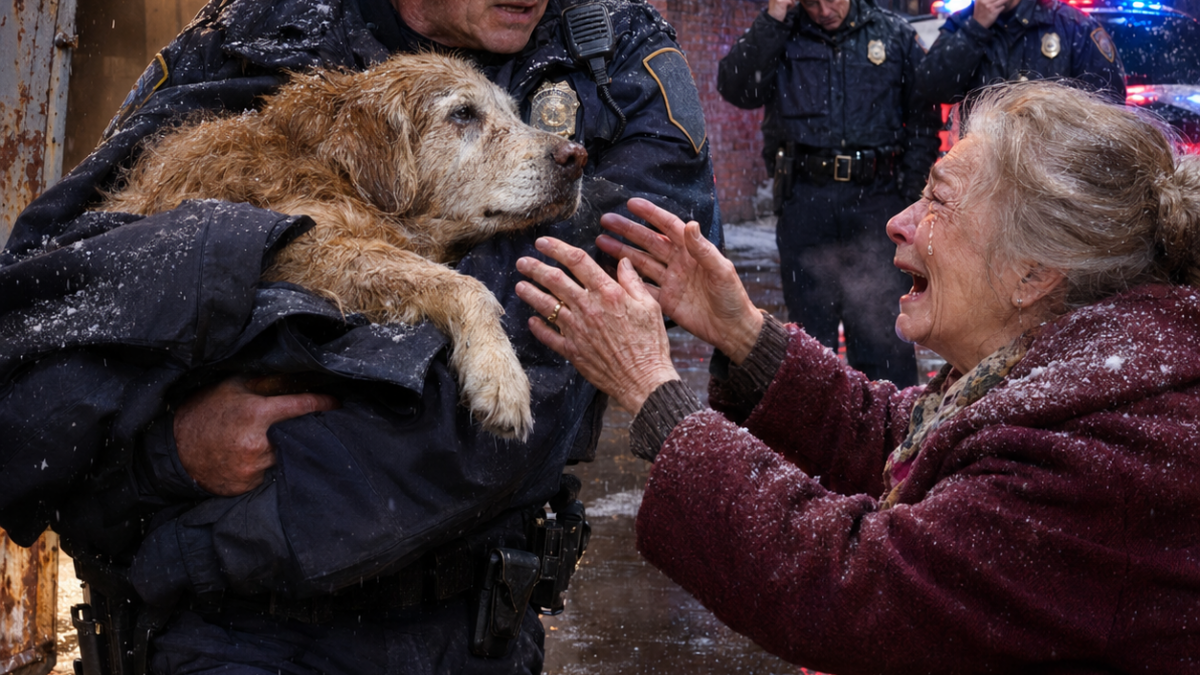
Elizabeth came through the clinic door first.
Seventy-something.
Small.
Gray hair.
Winter coat only half buttoned.
James followed with one hand under her elbow.
“Where is he?”
Suzanne met them.
“Before you go in, I need you to understand he looks rough.”
Elizabeth’s mouth trembled.
“I don’t care.”
“He’s very thin.”
“I don’t care.”
“One eye is irritated. His coat is badly matted.”
“I don’t care.”
Suzanne nodded.
“Okay.”
She opened the door.
Buddy lay beneath a blanket.
His head rested on a folded towel.
Elizabeth stopped.
For one terrible second, she didn’t move.
Then:
“Oh, baby.”
Buddy’s head lifted.
Not far.
Just enough.
His good eye opened.
Elizabeth dropped to her knees.
“Buddy.”
The tail moved.
Once.
Then again.
Slow.
Weak.
But unmistakable.
James covered his mouth.
Elizabeth crawled the last few feet.
“Buddy, it’s Mama.”
The dog tried to move.
Suzanne put a hand out.
“Let him stay down.”
Elizabeth leaned over him instead.
She touched his face.
Buddy licked her wrist.
She began sobbing.
Not quiet tears.
The kind that come from somewhere beneath language.
Eight months of searching.
Eight months of imagining.
Eight months of not knowing.
James stood behind her crying openly.
“I thought you were dead, boy.”
Buddy’s tail moved again.
Robert stepped backward.
He suddenly felt like an intruder.
He headed toward the hallway.
James noticed.
“Officer.”
Robert turned.
James crossed the room.
He reached out.
Robert expected a handshake.
Instead, James embraced him.
Hard.
The kind of embrace men from his generation usually reserve for sons and funerals.
“You found him.”
Robert looked at Buddy.
“Somebody called.”
“You went.”
“That’s my job.”
James pulled back.
“Not anymore.”
Robert smiled.
“I guess not.”
Elizabeth looked toward him.
“Please come here.”
Robert stepped closer.
She took his hand.
“Thank you.”
“I’m glad I got there.”
“No.”
She shook her head.
“You don’t understand.”
Then Elizabeth told him about the last eight months.
About the flyers.
The nighttime drives.
The shelters.
The little dog bed she had never removed.
The bowl she kept washing even after James said maybe they should put it away.
“He slept beside me every night for nine years,” she said.
Her voice trembled.
“The house has sounded wrong without him.”
Robert looked at Buddy.
“He’s going home.”
Elizabeth nodded.
“He already is.”
Robert finally left the clinic shortly after two.
He arrived at police headquarters more than an hour late for his retirement ceremony.
The cake icing had begun to soften.
Several officers pretended to be angry.
Sergeant Mike Dorsey looked at his watch dramatically.
“Nice of you to show up.”
Robert raised both hands.
“Write me up.”
“Can’t.”
“Why?”
“You’re retired.”
Someone laughed.
Then everybody noticed Robert wasn’t wearing his uniform jacket.
“Where’s your coat?” Dorsey asked.
“Veterinary clinic.”
That got the room quiet.
Robert told them.
Not dramatically.
Just facts.
Warehouse.
Dog.
Couldn’t walk.
Microchip.
Missing eight months.
Family found.
By the time he reached the part about Buddy wagging his tail when Elizabeth entered the room, one of the younger officers was wiping his eyes.
Dorsey cleared his throat several times.
Then the chief stepped forward.
“We had a speech prepared.”
Robert smiled.
“Sorry.”
“No. Your timing is terrible, but I think your story is better.”
They gave Robert a plaque.
Twenty-nine years of distinguished service.
A framed photograph.
Retirement papers.
Then Mike Dorsey held up a tiny box.
“We weren’t going to give you this today.”
Robert frowned.
“What?”
“Because we bought it after you called from the vet.”
Inside was a small silver pendant shaped like a dog.
On the back they had engraved:
THE BEST THING YOU DID ON YOUR LAST SHIFT.
Robert laughed.
Then stopped laughing.
His eyes filled.
“You idiots.”
Dorsey nodded.
“Yes.”
Robert put it around his neck.
That was the ceremony I attended.
And when Dorsey told the story from the podium, the entire auditorium became silent.
I watched Robert sitting beside his wife.
His fingers moved unconsciously toward the little silver dog.
That was when I knew I needed the whole story.
After the ceremony, I asked if he would talk to me.
Robert sighed.
“You reporters.”
“You’ve avoided me for fifteen years.”
“For good reason.”
“Give me twenty minutes.”
“Ten.”
We talked for almost two hours.
Robert started with the radio call.
Then the warehouse.
Then Buddy.
At one point, he looked down at his coffee.
“You’re going to make this sound bigger than it was.”
“I’m going to write what happened.”
“It was a dog call.”
“It was your last call.”
“That doesn’t make it holy.”
“No.”
He looked at me.
“But?”
“But you had every reason to say no.”
Robert was quiet.
Then he nodded.
“That’s the part that bothers me.”
“Why?”
“Because I almost did.”
He leaned back.
“I keep thinking about that.”
“The dispatcher could have sent someone else.”
“Eventually.”
“Animal control.”
“Maybe.”
“He probably would’ve been found.”
Robert looked at me.
“Maybe.”
He didn’t say anything else for several seconds.
Then:
“People like to believe the good ending was guaranteed.”
“It wasn’t.”
“No.”
He rubbed his thumb against the coffee cup.
“That warehouse was cold. Buddy was already in bad shape. Another night? Another day? I don’t know.”
“You couldn’t have known.”
“That’s the point.”
I waited.
Robert continued.
“We almost never know.”
That sentence became the center of my article.
We almost never know.
We don’t know whether the call we ignore matters.
Whether the person we pass needs help.
Whether five minutes changes something.
Whether the animal crying behind a warehouse wall has people somewhere still searching.
Robert had answered thousands of calls.
Many looked important and became routine.
Others looked routine and became unforgettable.
This one had been labeled animal distress.
No officer down.
No weapon.
No child missing.
No flashing emergency code.
Just a weak sound from an old building.
But somebody was waiting.
Buddy stayed at Bennett Veterinary Clinic for nine days.
Elizabeth visited every morning.
James every afternoon.
They brought his old blanket from home.
A favorite toy.
A faded blue collar.
Suzanne created a careful feeding plan because giving too much food too quickly after severe starvation can create medical problems.
Small meals.
Fluids.
Supplements.
Rest.
Then physical therapy.
At first, Buddy couldn’t stand more than a few seconds.
Elizabeth crouched beside him.
“Come on, baby.”
His back legs shook.
He collapsed.
She kissed his head.
“That’s okay.”
Next day:
Five seconds.
Then ten.
Then several steps.
Robert visited once during the first week.
He stood outside the therapy area watching Buddy attempt to cross a rubber mat.
Buddy noticed him.
Stopped.
Tail began moving.
Robert laughed.
“You remember me?”
Buddy tried to walk toward him.
His legs gave way.
Robert immediately crouched.
“No heroics.”
Buddy dragged himself the final few inches.
Robert touched his head.
Suzanne watched.
“He absolutely remembers you.”
Robert looked uncomfortable.
“He remembers the jacket.”
“Robert.”
“What?”
“Accept that the dog likes you.”
“I’m a retired police officer. I don’t have to accept anything.”
Suzanne rolled her eyes.
Two weeks later, Buddy went home.
The Millers’ little house looked almost exactly as it had the day he disappeared.
Doghouse in the yard.
Water bowl.
Old missing flyer still behind the window.
Elizabeth refused to take it down until Buddy physically crossed the threshold.
James carried him from the car.
Set him inside.
Buddy sniffed the floor.
The wall.
The old rug.
Then Elizabeth placed the faded blue bed in front of him.
Buddy lowered himself onto it.
Rested his head.
Closed his eyes.
Elizabeth removed the missing poster.
Folded it carefully.
She still has it.
They eventually started calling him Hope.
Not because they wanted to erase his old name.
Buddy remained Buddy.
But Elizabeth began saying:
“There’s our little Hope.”
The name stayed.
Six weeks after the warehouse rescue, Suzanne sent Robert a video.
Hope was standing in the Millers’ backyard.
James held a treat several feet away.
Elizabeth crouched behind the dog.
“Come on.”
Hope stepped forward.
One.
Two.
Three.
His hind legs wobbled.
Four.
Five.
Then he reached James.
Tail wagging.
Robert watched the video three times.
Anne found him sitting at the kitchen table.
“Are you crying?”
“No.”
“You’re absolutely crying.”
“Dry eyes.”
“While watching a dog walk?”
“Coincidence.”
She kissed the top of his head.
Retirement was not easy for Robert.
That surprised him.
For twenty-nine years, his days had structure.
Uniform.
Radio.
Patrol car.
Briefings.
Calls.
Reports.
Problems that required immediate decisions.
Then suddenly:
Nothing.
He woke at 5:30 anyway.
Made coffee.
Checked the weather.
Looked toward the closet where the uniform used to hang.
Anne tolerated him pacing around the house for three weeks.
Then one morning she placed a piece of paper beside his coffee.
“What’s this?”
“An address.”
Robert read it.
Local animal shelter.
He looked at her.
“No.”
“Yes.”
“I’m retired.”
“Exactly.”
“I am not becoming one of those old men who volunteers because his wife wants him out of the house.”
Anne smiled.
“I also want you out of the house.”
He went.
The shelter director knew the warehouse story.
Robert hated that.
“You don’t have to tell anyone.”
She smiled.
“We heard.”
“Of course you did.”
“Can you walk dogs?”
“I’ve arrested armed people.”
“That wasn’t the question.”
Robert stared at her.
“Yes.”
“Good.”
His first volunteer shift lasted two hours.
Then three.
Soon he was going three days a week.
He liked the difficult dogs.
The frightened ones.
The animals who remained at the back of their kennels while potential adopters walked past.
He didn’t force contact.
He sat.
Talked quietly.
Waited.
Same technique he had used in domestic calls.
With frightened children.
With people standing on bridges.
With Buddy beneath the sofa.
One afternoon, a young shelter employee found Robert sitting on the floor outside the kennel of a large shepherd mix named Rex.
Rex had refused to approach anyone for four days.
Robert sat reading the newspaper aloud.
“What are you doing?”
“Sports section.”
“To the dog?”
“He has opinions.”
Rex eventually moved forward.
Placed one paw near the kennel door.
Then another.
Robert continued reading.
Twenty minutes later, Rex rested his head against the bars beside Robert’s knee.
The employee whispered:
“How did you do that?”
Robert shrugged.
“I waited longer than he did.”
That became his retirement.
Not golf.
Not fishing.
Not traveling the country in an RV.
He helped frightened animals trust people again.
Hope recovered slowly.
By summer, he could walk comfortably.
By fall, he could run short distances.
Not fast.
Not like a young dog.
But enough to chase leaves across the Miller backyard.
Elizabeth sent Robert photographs.
Hope asleep beside James.
Hope sitting in the kitchen waiting for food.
Hope wearing a ridiculous Christmas sweater.
Robert complained about that one.
“Police rescued him so he could be humiliated like this?”
Elizabeth replied:
He loves it.
Robert didn’t believe her.
Eight months after the rescue, I visited the Millers for a follow-up story.
Elizabeth met me outside.
Hope walked beside her.
Older.
A little stiff.
But healthy.
His white coat had grown back soft.
The damaged eye had healed enough that he could see from it, though not perfectly.
I crouched.
“Hello, celebrity.”
Hope sniffed my hand and lost interest.
Elizabeth laughed.
“He only cares about people carrying food.”
We sat in the backyard.
Hope rested his head on her knees.
The sun was dropping behind the neighboring houses.
I asked Elizabeth what she remembered most about the day Robert called.
“It wasn’t Robert who called.”
“Right. The clinic.”
She nodded.
“But Robert brought him.”
She stroked Hope’s ear.
“Eight months is a long time to hope for something everyone else has stopped expecting.”
“Did you ever believe he was dead?”
She looked toward the yard.
“Some days.”
“Then why keep the flyer?”
“Because not knowing isn’t the same as knowing.”
James came outside carrying three glasses of lemonade.
“Ladies,” he said, looking at Elizabeth and Hope, “your refreshments.”
Elizabeth rolled her eyes.
“He calls us ladies.”
James sat beside her.
I asked him what he thought when he first saw Hope at the clinic.
James rubbed his hands together.
“I was ashamed.”
“Why?”
“I had stopped believing.”
Elizabeth looked at him.
“You were trying to protect yourself.”
“I know.”
James looked toward Hope.
“But that officer didn’t know any of us.”
“No.”
“He didn’t know whether the dog belonged to somebody.”
“No.”
“He just heard something.”
James’s voice became quieter.
“And he went.”
That was the thing everyone returned to.
He went.
Robert had no guarantee of a happy ending.
No idea a microchip would work.
No idea two elderly people had been waiting eight months.
No idea the dog would walk again.
No idea that thirty-two minutes would become the story people remembered at his retirement.
He simply went.
When my article appeared, I expected it to be popular locally.
I did not expect letters from across the state.
Retired officers wrote about final calls they still remembered.
Veterinarians wrote about microchips.
Shelter volunteers wrote about lost pets.
One woman sent a photograph of her seventeen-year-old Labrador with a note:
Sometimes saving something doesn’t mean giving it more years. Sometimes it means making sure the years it has left are safe.
I showed that letter to Robert.
He read it twice.
Then folded it.
“Can I keep this?”
“Of course.”
Months later, our town council invited Robert to receive a community service citation.
He declined.
The mayor called.
Robert declined again.
Finally Anne intervened.
“You’re going.”
“I already had a retirement ceremony.”
“This isn’t retirement.”
“It’s a dog.”
“It’s never just the dog when you tell the story.”
Robert glared at her.
“You’ve been talking to Mark.”
“Mark is smarter than you.”
He attended.
Hope attended too.
Elizabeth brought him wearing a blue bandana.
When Robert walked onto the small stage, Hope saw him.
The dog pulled gently against the leash.
Then walked directly toward him.
Robert crouched.
Hope placed his head against Robert’s chest.
The room stood.
Applause filled the hall.
Robert looked miserable.
Not emotionally.
Socially.
He hated public attention.
I was sitting near the aisle.
Afterward he found me.
“This is your fault.”
“Mostly Anne’s.”
“I’m blaming you.”
“Fair.”
Then he looked toward Hope.
The dog was standing beside Elizabeth.
Healthy.
Tail moving.
Robert touched the silver pendant around his neck.
“Worth it.”
Years of policing had given Robert complicated memories.
He told me once about an accident early in his career.
A teenage driver.
Snowy road.
Nothing Robert could do.
For years, he had remembered the mother arriving.
Another time, he found a lost six-year-old after an all-night search.
He remembered the father’s knees collapsing when the child came out of the woods.
There were arrests he felt good about.
Arrests he questioned afterward.
People he helped who later turned their lives around.
People he helped who didn’t.
Police work had never given him clean stories.
That bothered him less as he grew older.
“People want careers to add up,” he told me one afternoon at the shelter.
“What does that mean?”
“They want twenty-nine years to mean one thing.”
“And it doesn’t?”
“No.”
He attached a leash to a nervous brown dog.
“Some days I was good at the job. Some days I was tired. Some days I made mistakes. Some calls I still think about.”
“What about the last call?”
Robert smiled.
“That one was easy.”
“You went into an abandoned warehouse.”
“That’s not what I mean.”
He opened the kennel.
“The choice was easy once I heard him.”
We walked outside.
The dog hesitated at the doorway.
Robert stopped.
Waited.
The animal looked at him.
Then stepped into sunlight.
Almost exactly as Hope had.
Robert noticed.
So did I.
Neither of us said anything for a while.
Then Robert laughed.
“I suppose I have a type.”
His retirement pendant still hangs around his neck most days.
Small silver dog.
Most people don’t notice it.
Those who do usually think it represents his shelter volunteering.
Robert rarely corrects them.
He doesn’t need to.
Hope continued living with James and Elizabeth.
His recovery never made him young again.
He had arthritis.
He tired easily.
Some mornings his back legs were stiff.
But he walked.
He explored the yard.
He slept beside Elizabeth’s chair.
And every evening near sunset, Elizabeth sat on the wooden bench behind the house.
Hope rested his head across her lap.
They watched the sky change.
James would eventually open the back door.
“Ladies, dinner.”
Elizabeth would say:
“We’re coming.”
Hope would lift his head slowly.
Then follow.
I visited Robert again on the first anniversary of his retirement.
At exactly 11:47 a.m., I texted him:
One year.
He replied:
You journalists are strange.
Five minutes later:
I remembered too.
That evening, Robert drove to the Millers’ house.
He didn’t tell me until later.
He brought Hope a bag of treats.
Elizabeth made coffee.
James complained that the dog was spoiled.
Robert sat on the floor.
Hope eventually lowered himself beside him.
For an hour, they talked.
Not about policing.
Not about the warehouse.
Ordinary things.
Weather.
The shelter.
James’s garden.
Robert and Anne’s plans.
Before leaving, Robert crouched beside Hope.
“You gave me a pretty good retirement.”
Hope licked his hand.
Elizabeth started crying.
Robert pretended not to notice.
The years after policing changed him.
Anne told me he became more patient.
Robert disagreed.
“I was always patient.”
She laughed for almost thirty seconds.
He started giving talks to younger officers, but only when asked.
He never spoke about tactics.
Never gave heroic speeches.
He talked about attention.
“The call that sounds stupid may not be stupid.”
“The person who annoys you may be having the worst day of their life.”
“The animal call still matters.”
“If you’re tired, admit you’re tired before you start treating people like they deserve your exhaustion.”
And always:
“Finish the shift.”
One rookie asked him:
“Even your last one?”
Robert smiled.
“Especially your last one.”
When I asked why, he told me:
“Because you don’t get to choose which minute matters.”
That line stayed with me longer than anything else.
We live as if we know which moments are important.
Wedding days.
Graduations.
First jobs.
Funerals.
Retirements.
Births.
Those days announce themselves.
But sometimes the moment that changes everything arrives at 11:47 on an ordinary morning through a crackling radio.
Sometimes it sounds like an inconvenience.
Sometimes you have thirty-two minutes left.
Sometimes you’re already thinking about cake.
Robert’s official career ended that afternoon.
But the call did something strange.
It showed him what came next.
He had spent twenty-nine years responding to human emergencies.
Then one exhausted animal led him toward the work that would fill his retirement.
Years later, Robert still volunteers at the shelter three times a week.
He opens kennels.
Walks old dogs.
Cleans bowls.
Sits with frightened animals.
Drives some to veterinary appointments.
Helps reunite lost pets with families.
Nobody calls him Officer Hol there.
He’s Robert.
Occasionally a new volunteer learns his story.
They ask:
“Is it true you rescued that dog on your final shift?”
Robert usually shrugs.
“I picked him up.”
“You saved him.”
“The veterinarian saved him.”
“But you found him.”
“Someone else made the phone call.”
He never wants ownership of the whole miracle.
Maybe that’s part of why people trust him.
The last time I interviewed Robert, I asked him a question I had avoided from the beginning.
“What if you had ignored the call?”
He stared at me.
“I’ve asked myself that.”
“And?”
“I don’t anymore.”
“Why?”
“Because I answered.”
He touched the little pendant.
“You can torture yourself forever with every road you might have taken.”
He looked toward the shelter yard, where two volunteers were walking dogs beneath the afternoon sun.
“The better thing is to pay attention when the next call comes.”
Hope eventually became something of a quiet local legend.
Children knew him from photographs.
The shelter used his recovery story to encourage pet owners to microchip their animals.
Veterinary clinics reminded people to keep registration information updated.
The police department added animal-distress response reminders to training.
None of those things made headlines outside our town.
They didn’t need to.
Small changes matter.
That might be the real lesson of Robert’s final call.
Not that one retired officer did something extraordinary.
But that ordinary choices accumulate.
A resident heard an animal.
They called.
A dispatcher sent the nearest unit.
A tired officer answered.
A veterinarian scanned a chip.
An elderly couple had kept the registration active.
Each link mattered.
Remove one, and the ending could have been different.
Years after the rescue, I returned to Brown Street.
The warehouse had finally been demolished.
A small commercial building was going up.
Fresh foundations.
New framing.
Nothing remained of the dark interior where Hope had waited beneath the sofa.
I stood near the fence for several minutes.
It felt strange.
Places don’t remember what happened inside them.
People do.
Dogs probably do in their own way.
But concrete comes down.
Steel gets hauled away.
Dust settles.
Life moves forward.
I called Robert.
“They demolished the warehouse.”
“Good.”
“That’s all?”
“What did you expect?”
“I don’t know. Nostalgia?”
“It was a terrible building.”
I laughed.
“You’re impossible.”
“No. I’m retired.”
Then his voice softened.
“Mark?”
“Yeah?”
“I’m glad it’s gone.”
“Why?”
“Nothing should have to wait in there again.”
That was Robert.
No romance about suffering.
No desire to preserve the place because something meaningful happened there.
The meaning wasn’t the warehouse.
It was leaving it.
One winter evening several years later, I visited James and Elizabeth again.
Hope was older.
Much older.
White around the face.
He walked slowly.
But when I entered, his tail moved.
Elizabeth smiled.
“He remembers everybody now.”
“I doubt that.”
“He remembers people who bring snacks.”
“Then definitely not me.”
We sat beside the fire.
Hope slept near Elizabeth’s feet.
James brought tea.
The old missing flyer was framed now.
Not proudly.
Quietly.
A reminder.
On the wall beside it was a photograph of Robert carrying Hope out of Bennett Veterinary Clinic after one of his checkups.
I asked Elizabeth why she kept both.
She looked at them.
“One reminds me what it feels like to lose hope.”
She pointed toward Robert’s photograph.
“The other reminds me why you shouldn’t.”
Hope opened his eyes at the sound of his name.
Elizabeth reached down.
“I know, sweetheart.”
She stroked his head.
Robert once told me the real job of a police officer was not punishment.
I challenged him on that.
“That sounds nice, but police arrest people.”
“Of course.”
“They use force sometimes.”
“Yes.”
“They enforce laws.”
“Yes.”
“So how is the job not punishment?”
Robert shook his head.
“The goal.”
“What?”
“The goal isn’t punishment. Courts decide punishment.”
“What’s the officer’s goal?”
He thought for a moment.
“To get people safely to tomorrow whenever you can.”
I liked that better.
Get them safely to tomorrow.
Sometimes that meant stopping a drunk driver.
Sometimes separating people during a fight.
Sometimes finding a missing child.
And once, during the final thirty-two minutes of a twenty-nine-year career, it meant carrying a starving white dog across broken glass.
Robert Hol never became famous.
He doesn’t want to.
He still complains when my newspaper prints his photograph too large.
He still says the word “hero” is overused.
He still insists Hope did more for him than he did for Hope.
Maybe he is right.
Retirement had frightened Robert more than he admitted.
For nearly three decades, the uniform told him who he was every morning.
Then the badge went into a box.
The patrol car belonged to someone else.
The radio stopped calling his number.
And there was Robert.
No rank.
No shift.
No emergency demanding him.
Hope gave him an answer.
Not a replacement career.
Something better.
A reminder that usefulness doesn’t retire.
Compassion doesn’t require a badge.
Being needed does not depend on a title.
You can still answer.
You can still kneel on a dirty floor.
You can still hold out your hand.
You can still help something frightened trust the world again.
At Robert’s retirement ceremony, the chief ended with a traditional line:
“Thank you for your service.”
Everyone applauded.
Robert stood.
He looked uncomfortable.
Then he touched the silver dog pendant.
“I thought service ended today,” he said.
The room quieted.
“Turns out I was wrong.”
That was all.
No big speech.
No dramatic goodbye.
Just Robert.
Later, I asked what he meant.
He smiled.
“You know exactly what I meant, reporter.”
I did.
And now, years after I first heard this story, I think about Robert every time someone tells me they are finished.
Finished with work.
Finished trying.
Finished hoping.
Finished believing anything unexpected can still happen.
Maybe sometimes we really are at the end of something.
Robert’s police career truly ended that day.
But endings are strange.
They create empty space.
And empty space leaves room for something you never planned.
For Robert, it arrived through his radio.
A weak animal cry.
An abandoned warehouse.
Thirty-two minutes.
For James and Elizabeth, it arrived through a veterinarian’s phone call eight months after they thought hope had become unreasonable.
For Hope, it arrived as a flashlight beam moving through darkness and a man lowering one bare hand to the floor.
That may be why this story has stayed with me longer than stories involving bigger crimes, bigger headlines, and louder victories.
Nobody conquered anything.
Nobody defeated an enemy.
Nobody became rich.
One man simply decided not to go home yet.
One dog decided to trust one more human being.
One elderly couple got back someone they thought they had lost forever.
And a retired police officer discovered that the final call of one life could become the first call of another.
Robert still wears the pendant.
Hope still appears in photographs around the station.
And at the local shelter, frightened dogs still sometimes find a fifty-something retired officer sitting quietly beside their kennels, refusing to rush them.
If they hide, he waits.
If they growl, he waits.
If they tremble, he waits.
Eventually, many move closer.
Robert holds out his hand.
And when they finally touch it, he says the same words he said beneath that broken sofa on Brown Street:
“Easy, buddy.”
“You don’t have to do anything now.”
“I’ve got you.”
Because after twenty-nine years in uniform, Robert Hol learned the lesson that mattered most during the final thirty-two minutes of his career.
Sometimes the most important call of your life comes when you are already convinced your work is finished.
And when it does, the only thing that matters is whether you answer.








