PART2:“HANDCUFF THAT FILTHY ELECTRICIAN—HE’S TRESPASSING ON MY HOA PROPERTY!” HOA Karen Had Me Arrested in My Own Driveway—She Never Expected the 37-Year-Old Court Order Hidden in My Basement
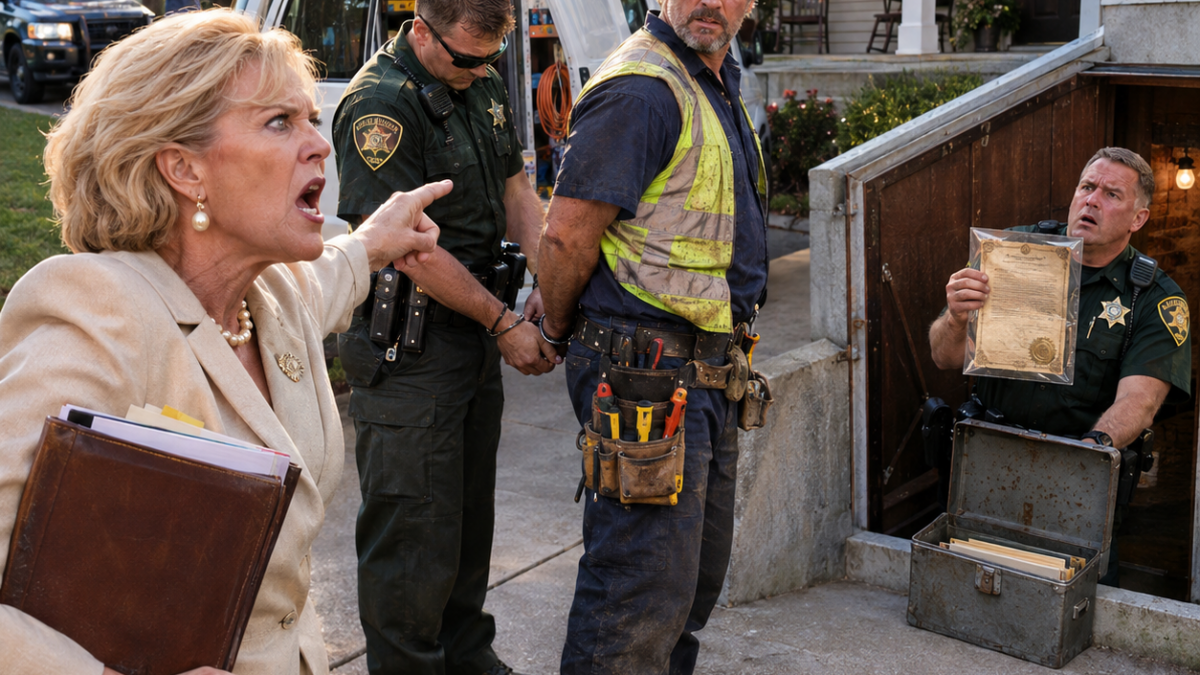
My name is Jake Carter.
I was forty-five years old when I bought the farmhouse beside Willowbrook Estates.
I’d been an electrician for twenty-three years, long enough to know the difference between a difficult job and a dangerous one.
I’d rewired old restaurants where the owners had spent decades ignoring safety problems.
I’d repaired electrical systems in barns, workshops, small factories, and family homes.
I’d worked through snowstorms, summer heat, and enough emergency calls to understand that problems rarely improve when people pretend they don’t exist.
My marriage had ended two years earlier.
The divorce wasn’t dramatic in the way television divorces are dramatic.
There were no shouting matches in court.
No secret second family.
No spectacular betrayal.
Just two people who had stopped understanding each other and finally admitted they wanted different lives.
But it had still cost me.
Financially.
Emotionally.
And in ways I didn’t fully understand until I found myself living alone.
My former wife’s subdivision had been governed by an HOA that seemed determined to control everything.
Mailbox colors.
Fence heights.
Approved landscaping.
Where you could park.
What kind of doormat you could put outside.
After years of that, I wanted somewhere quiet.
Somewhere I could leave my boots by the door without receiving a violation notice about neighborhood appearance standards.
When I found the farmhouse, I thought I’d discovered exactly that.
Two acres on the outskirts of a Colorado town.
A weathered house with creaking hardwood floors.
A kitchen that hadn’t been remodeled since the Reagan administration.
A detached workshop.
An old fence.
And a gravel driveway wide enough for my truck and equipment trailer.
It wasn’t fancy.
But it was mine.
Most importantly, the property was not part of Willowbrook Estates.
The subdivision stood along the eastern boundary.
Its houses were neat and almost identical, with matching mailboxes, carefully landscaped lawns, and decorative street signs.
My farmhouse had been there decades before those houses existed.
The title records reflected separate ownership.
No Willowbrook HOA declaration burdened my parcel.
No neighborhood architectural committee controlled my workshop.
I thought that settled the matter.
Then I met Bethany Morrison.
It was my second week in the house.
I was trimming an overgrown hedge near the property boundary when a white Cadillac Escalade rolled into my driveway.
The driver got out wearing designer heels and enough perfume to overpower the smell of freshly cut branches.
She looked to be in her early fifties.
Perfectly styled hair.
Expensive sunglasses.
A laminated folder clutched against her chest.
“Good morning!” she announced.
I switched off the hedge trimmer.
“Morning.”
“I’m Bethany Morrison.”
She extended one manicured hand.
“President of the Willowbrook Estates Homeowners Association.”
I shook it.
“Jake Carter.”
“I know.”
That should have warned me.
She looked around the yard.
Then at my truck.
Then at the old fence.
Her smile grew thinner.
“We need to discuss community standards.”
I stared at her.
“Community standards?”
“Yes. The appearance of this property affects everyone around you.”
I set down the hedge trimmer.
“Bethany, this house isn’t part of your HOA.”
Her expression changed.
Only slightly.
But I noticed.
“Well, technically, yes.”
“Not technically. Legally.”
She gave a tight laugh.
“Your property sits directly beside our community.”
“I know where it sits.”
“And we maintain very high standards.”
“That’s nice.”
She pointed toward my 1987 Ford pickup.
“That vehicle is completely inappropriate for this neighborhood.”
I looked at the truck.
It was a project I’d been restoring for years.
Original body.
Original engine block.
New suspension components waiting in my workshop.
A vehicle I planned to keep long after most modern trucks had become computer problems on wheels.
“What’s wrong with it?”
“It’s old.”
“Excellent observation.”
She didn’t appreciate that.
“Old vehicles can create a blighted appearance.”
“It’s registered, insured, and parked on my property.”
She opened her laminated folder.
“Your vegetation is also overgrown.”
I glanced toward the hedge I’d been trimming.
“Working on that right now.”
“Well, I expect improvements.”
I slowly removed my gloves.
“Bethany, you can expect whatever you like. But your HOA doesn’t govern this parcel.”
Her smile vanished.
“You don’t understand how this community operates.”
“I understand property boundaries.”
She stepped closer.
“Your choices affect our values.”
“And your choices don’t change my deed.”
Her face reddened.
“People who move into this area should respect the neighborhood.”
“I respect my neighbors.”
“Then show it.”
I looked at the Escalade parked on my gravel.
“Start by moving your car out of my driveway.”
Her eyes widened.
For a moment, she seemed genuinely shocked that someone had spoken to her that way.
Then she snapped her folder shut.
“I’ll be watching this property, Mr. Carter.”
I picked up my hedge trimmer.
“Have a nice day.”
She marched toward her SUV.
But before leaving, she stopped beside my mailbox.
Raised her phone.
And photographed the house number.
Then my truck.
Then my fence.
Then the hedge.
I stood watching.
“Bethany, what are you doing?”
“Documenting community concerns.”
She lifted the phone toward her ear.
And in a voice loud enough for me to hear, began discussing a complaint about unsafe vehicle storage and possible property-maintenance violations.
I couldn’t tell whether anybody had answered.
She wanted me to hear the threat.
That much was obvious.
When the Escalade finally left, I stood alone in my driveway.
The hedge trimmer lay silent.
The morning air smelled of pine and cut branches.
I remember thinking that the encounter was ridiculous.
An annoying neighbor.
An arrogant HOA president.
Nothing more.
I had no idea how much trouble that woman was about to cause.
Two days later, I found tire tracks through the flower bed beside my driveway.
I’d planted marigolds there the previous weekend.
Nothing expensive.
Just a little color near the porch.
The tire ruts had crushed nearly every plant.
Dark soil covered the gravel.
Broken stems lay flattened beneath the tracks.
I stood there for a long time.
Then walked toward the road.
The marks were wide enough to match an SUV.
But I hadn’t seen the vehicle responsible.
I wasn’t going to accuse Bethany of something I couldn’t prove.
Not yet.
I photographed the damage.
Made a note of the time.
And went back to work.
That afternoon, a certified letter arrived.
WILLOWBROOK ESTATES COMMUNITY STANDARDS BOARD.
NOTICE OF VIOLATIONS.
The letter claimed my truck violated community appearance rules.
My hedge supposedly failed to meet vegetation standards.
My fence was described as deteriorated.
And I was given seventy-two hours to correct the alleged violations or face escalating enforcement actions.
I read the document twice.
Then checked the address.
A commercial mailbox service.
Not the HOA’s actual registered office.
The telephone number didn’t connect.
Something about the letter felt wrong.
Not merely aggressive.
Manufactured.
I pulled out my closing documents.
Read the property description.
Read the title commitment.
Checked the recorded subdivision information I’d received when buying the house.
Nothing placed my farmhouse inside Willowbrook Estates.
No membership obligation.
No architectural restrictions from its declaration.
No basis for its president to fine me over an old pickup.
I called the county records office the next morning.
The clerk confirmed where I could obtain the relevant recorded documents.
Then I called the property attorney who had handled part of my divorce.
He listened while I described the situation.
“Jake, don’t throw those letters away.”
“I wasn’t planning to.”
“Keep copies. And if she makes a claim about your property line, get a current survey.”
I looked out toward the hedge.
“Already thinking about it.”
He paused.
“Don’t try to win this by arguing with her.”
“Believe me, I’m not interested in arguing.”
“Good. Let the records do the work.”
That advice would save me more trouble than I understood at the time.
Because Bethany wasn’t finished sending letters.
She was about to move from imaginary community standards to a claim against my actual land.
And when she did, I discovered she wasn’t the first HOA president who had tried it.
The next Monday, I was loading electrical supplies into my truck when Bethany arrived with a measuring tape, a clipboard, and a man in a wrinkled gray suit.
She marched directly toward the driveway.
“Mr. Carter, we’re conducting a boundary assessment.”
I set down a toolbox.
“Are you?”
“Your driveway encroaches three feet onto HOA property.”
I stared at her.
“That’s interesting.”
She smiled triumphantly.
“I’m glad you understand.”
“I understand that you just made a claim without showing me a survey.”
Her smile disappeared.
The man beside her shifted uncomfortably.
Bethany unfolded a large sheet of paper.
Colored lines marked several parcels.
A thick red line ran across the outer edge of my driveway.
“There,” she announced. “HOA buffer-zone property.”
I examined the paper.
It looked like a subdivision marketing map with additional markings.
No surveyor’s seal.
No legal description explaining the supposed encroachment.
No reference to a recorded boundary adjustment.
“Where did this come from?”
“Our consultant.”
I looked at the man.
“Are you a licensed surveyor?”
He cleared his throat.
“I’m assisting with a community review.”
“That’s not what I asked.”
Bethany stepped between us.
“Don’t interrogate him.”
“I’m asking what qualifications he has to establish a property boundary.”
She slapped the paper with one hand.
“The county records support us.”
“Then show me the actual records.”
Her eyes narrowed.
“You always have to make everything difficult.”
I looked down at the gravel.
“Bethany, you came onto my property and announced that part of my driveway belongs to you. That’s a pretty serious claim.”
She took three orange marking flags from her folder.
Then pushed them into the ground along her imaginary boundary.
“There. Now you can clearly see the HOA line.”
I watched her plant the last flag.
“Those aren’t legal boundary markers.”
“They are notice of the association’s position.”
“Then you’ve notified me.”
I picked up my toolbox.
“And now I’m notifying you that I dispute it.”
Bethany leaned closer.
“Keep pushing, Jake. You’ll find out how expensive these disputes can get.”
I looked at her.
“Is that a threat?”
“It’s advice.”
She smiled.
“Free advice. You should appreciate it.”
Then she left.
The consultant followed without looking back.
That evening, Bethany parked her Escalade near the entrance to my driveway.
Not completely blocking it.
Just far enough into the approach to make turning my work truck difficult.
I had to maneuver carefully to get around her.
The next morning, she did it again.
When I asked her to move, she said she was legally parked near the community buffer zone.
I photographed the vehicle and sent a written objection.
No argument.
No shouting.
Just a record.
I’d spent twenty-three years dealing with electrical inspectors.
One thing the good ones taught me was that proper documentation mattered more than anybody’s confidence.
A contractor could insist a system was safe all day long.
But if the inspection records, test results, and installation didn’t support that claim, confidence meant nothing.
I decided property boundaries deserved the same approach.
The following morning, I drove to the county records office.
I paid for certified copies of the available historical survey and related property documents.
The older survey dated back to 1987.
I spread it across a table beneath the fluorescent lights.
And immediately saw why Bethany had been so careful about which lines she showed me.
The established property boundary didn’t stop at my driveway.
It extended beyond it.
The supposed HOA buffer strip was, at least in the area she was claiming, inside my parcel.
The historical survey showed that clearly.
I sat staring at it.
Then checked the legal description.
Then checked the associated plat.
Everything was consistent.
I asked the records clerk whether there were related court filings concerning the property.
She helped me identify the records and the appropriate place to request them.
There were references to a dispute from the late 1980s.
I wrote down the case information.
Then drove home.
Because something about those dates sounded familiar.
When I bought the farmhouse, the previous owner had left several boxes of documents in the basement.
Old insurance papers.
Repair receipts.
Property-tax records.
Copies of correspondence.
I’d glanced through them during the move and stacked them on a shelf.
One box had a handwritten label.
HOA LEGAL BATTLE — 1987–1989.
I remembered laughing when I first saw it.
At the time, I’d assumed the old owner had complained about some minor neighborhood issue.
Now I carried the box upstairs and opened it on my kitchen table.
Inside were letters, maps, legal bills, photographs, and a copy of a court order.
The more I read, the colder I felt.
Decades earlier, during the early development of the neighboring subdivision, there had been a dispute over the land now occupied by my driveway and part of the adjoining strip.
The association’s predecessor had tried to assert control over the area.
The property owner had challenged the claim.
A survey had been presented.
The legal descriptions had been reviewed.
And the court had entered an order confirming the boundary and rejecting the asserted claim.
The disputed strip had remained with the farmhouse parcel.
The order also addressed the parties’ conduct concerning the established boundary.
I looked at the date.
Thirty-seven years.
Bethany wasn’t merely arguing over an uncertain line.
The property had been the subject of litigation long before she became president.
And the documents in my hands showed that the HOA side had already lost.
I spread the old survey beside the court order.
Then placed Bethany’s homemade map next to them.
The contrast was almost comical.
Her thick red line ran across land that the earlier court proceedings had already identified as belonging to the farmhouse.
I could hardly believe it.
My driveway wasn’t three feet onto HOA property.
The historical boundary placed the HOA line several feet beyond the outer edge of the driveway.
I sat back.
Then laughed.
Not because the problem was funny.
Because for weeks Bethany had been threatening me with legal consequences over land that her association’s predecessor had already tried and failed to claim.
I called my attorney.
“You’re going to love this.”
He wasn’t as excited as I expected.
“Jake, what did you find?”
“A court order from the eighties.”
I explained.
He asked me to send copies.
Then said something sensible.
“Don’t assume the old order answers every current question until we’ve reviewed the parties, parcels, and subsequent records.”
“Fair enough.”
“But if it concerns the same property and the same claim, it could be very important.”
I looked at Bethany’s map.
“Oh, it’s important.”
The next step was hiring a current surveyor.
I wanted no ambiguity about the present boundary.
Within a week, a licensed professional had reviewed the records, measured the property, and established the relevant corners in the field.
The new survey agreed with the ownership line shown in the historical documents.
It also made Bethany’s claim look even more ridiculous.
My driveway sat comfortably inside my property.
The ground she’d been calling an HOA buffer zone wasn’t hers to control.
I stood beside one of the survey markers while the crew finished.
The mountain air smelled of pine.
The nearby grass moved in the wind.
It was the first time since meeting Bethany that I felt the situation becoming manageable.
Not because she had stopped.
Because I finally had records strong enough to challenge her claims in the proper place.
I sent the survey and court order to my attorney.
He prepared a formal response.
Bethany received notice that her claimed encroachment was disputed, that the recorded boundary evidence supported my ownership, and that she was not authorized to enter or interfere with my property.
The letter also asked her to remove her unofficial flags.
She didn’t.
So my attorney arranged the next appropriate steps rather than having me start pulling markers while she filmed.
I was learning.
The strongest response wasn’t always the most satisfying one in the moment.
Sometimes it was simply keeping your hands clean and letting the evidence accumulate.
My neighbors began noticing the survey crew.
Carlos, our mail carrier, stopped beside my mailbox one morning.
“Jake, what’s all the measuring about?”
“Property-line dispute.”
He glanced toward Bethany’s house.
“Let me guess.”
I smiled.
“Go ahead.”
He laughed.
“That woman tried telling me I owed fifty dollars for stopping my mail truck on the wrong side of the street.”
I stared at him.
“She tried to fine the mail carrier?”
“She sure did.”
“What happened?”
“I told her to contact the Postal Service if she had a concern about official deliveries.”
He shook his head.
“Never heard another word.”
At the hardware store, Dutch, the owner, asked about the survey.
I explained.
He gave a low whistle.
“Bethany Morrison.”
“That name seems familiar to everybody.”
“Because everybody’s had trouble with her.”
He leaned against the counter.
“She files complaints like some people send Christmas cards.”
“About what?”
“Anything. Signs. Fences. Animals. Trucks. Noise. You name it.”
I shook my head.
“That’s what I’m finding out.”
Dutch looked at the electrical supplies I’d purchased.
“Don’t let her push you around.”
“I’m trying not to.”
He nodded toward my truck outside.
“That old Ford looks better every time I see it.”
I smiled.
“Finally, somebody with taste.”
It was a small exchange.
But after weeks of being treated like an unwelcome outsider, even one friendly conversation helped.
Then Bethany escalated.
I came home late after rewiring the electrical service in a restaurant.
It was dark.
Cold.
And I was exhausted.
I noticed the damage before I reached the porch.
Fresh tire ruts crossed the lawn.
A section of the flower bed had been torn apart.
My security camera near the garage was hanging at an odd angle.
I stopped the truck.
Got out.
And walked toward the camera.
Its mounting bracket had been knocked sideways.
Someone had driven across the yard.
Not along the driveway.
Across the grass.
The marks curved in a broad loop before returning toward the road.
I checked the main camera recording.
The view was partly obstructed.
Then I remembered the backup system.
I’d installed it shortly after moving in.
Separate camera.
Different angle.
Independent storage.
I opened the recording.
At 2:17 that morning, a white Cadillac Escalade had entered the edge of my property.
The driver accelerated across the lawn.
Turned sharply.
Then drove back toward the street.
The license plate was visible.
So was the vehicle’s distinctive rear bumper.
I watched the recording twice.
Then sat very still.
I’d suspected Bethany before.
Now I had footage of a vehicle matching hers damaging my property.
I saved the original recording.
Made a backup.
Photographed the tire ruts.
And called the sheriff’s office to report the incident.
I didn’t post the video online.
I didn’t march to Bethany’s house.
I wanted the evidence preserved properly.
The following morning, Officer Rodriguez appeared at my door.
The same officer who would later respond to Bethany’s early-morning accusation.
He had a partner with him.
“Mr. Carter?”
“Morning.”
“We received a complaint concerning threatening conduct toward a neighbor.”
I stared at him.
“Another one?”
Rodriguez raised an eyebrow.
“You’re aware of a complaint?”
“I’m aware that Bethany Morrison keeps making accusations.”
He remained professional.
“She reports that you’ve been photographing her property and making threatening statements.”
I gestured toward my kitchen.
“Would you like to see why I have cameras?”
A few minutes later, we were watching the Escalade footage.
Rodriguez examined the timestamp.
Then the vehicle.
Then the tire tracks.
“Is this your property?”
“Yes.”
“Do you have the survey?”
“Right here.”
I handed him a copy.
He studied the relevant boundary.
Then asked for the recording to be submitted through the department’s evidence process.
I complied.
The officers explained that a vehicle appearing in a recording didn’t automatically establish who was driving it, but it provided grounds for further investigation.
That distinction mattered.
I wanted the truth.
Not another person making accusations without proof.
Rodriguez looked toward Bethany’s house.
“We’ll follow up.”
I nodded.
“Thank you.”
He paused at the door.
“Mr. Carter, don’t confront her directly about the recording.”
“I wasn’t planning to.”
“Good.”
After they left, I watched Bethany’s curtains move across the street.
Someone was looking out.
I couldn’t tell who.
For the first time, I wondered whether she was beginning to realize that her actions could have consequences beyond an HOA meeting.
I got my answer the following Monday.
Six separate county complaints appeared in my records within a short period.
Electrical work without proper licensing.
Improper storage of a junk vehicle.
An unsafe outbuilding.
An alleged hazardous structure.
Vegetation concerns.
And complaints about a small chicken coop I’d recently built.
Every allegation sounded like a new version of Bethany’s original laminated folder.
The electrical accusation irritated me most.
I’d worked in the trade for twenty-three years.
My license information was available through the proper state system.
My business records were current.
And the work on my own property had been documented through the required channels.
I had no interest in letting someone damage my professional reputation with unsupported complaints.
So I called the county.
Maria Santos was the inspector assigned to review the property concerns.
I’d met her professionally during earlier construction work.
She was in her forties, direct, patient, and thoroughly unimpressed by people who tried to substitute drama for evidence.
She arrived the following morning.
“Jake.”
“Maria.”
She looked toward my farmhouse.
“Apparently you’ve been very busy.”
I sighed.
“According to the complaints, I’m running a criminal empire out of a chicken coop.”
She almost smiled.
“Let’s look at the actual conditions.”
We walked the property.
She reviewed the permits relevant to the structures.
Examined the chicken coop.
Checked the information concerning the alleged electrical violation.
And reviewed the vehicle complaint through the applicable process.
The chicken coop was empty.
The pickup was being restored.
The electrical records supported my professional credentials and the work I’d documented.
Maria made notes.
Asked questions.
Then closed the inspection.
“Based on what I’ve seen today, I don’t have grounds for the violations alleged in these complaints.”
I leaned against the fence.
“That’s good to hear.”
She looked toward the subdivision.
“You seem to be having a disagreement with somebody.”
“That’s one way to describe it.”
“Do you have records of the previous complaints?”
“Every one.”
She nodded.
“Keep them. If you believe somebody is abusing the complaint process, there are formal channels for raising that concern.”
I looked at her.
“Can the county see who filed them?”
“That depends on the reporting system, the information collected, and what can lawfully be disclosed.”
I appreciated that answer.
Maria wasn’t promising me confidential information or pretending every anonymous complaint could be traced immediately to Bethany.
She was explaining what could be investigated.
She also told me that repeated unsupported reports could be reviewed under the county’s applicable procedures.
By the time she left, I had another set of records supporting my position.
And Bethany had failed to produce a single substantiated property violation.
That afternoon, my phone rang.
Unknown number.
I answered.
A woman’s voice came through.
“Jake Carter?”
“Speaking.”
“This is Bethany Morrison.”
I almost dropped the phone.
She sounded pleasant.
Actually pleasant.
“Bethany.”
“I think we’ve gotten off on the wrong foot.”
I sat down.
“That’s an interesting way to describe it.”
She gave a nervous laugh.
“There’s been a lot of confusion.”
“About what?”
“Property boundaries. Community expectations. The usual neighborhood misunderstandings.”
I looked at the county inspection report on my table.
“Okay.”
“I thought perhaps we could discuss a mutually beneficial solution.”
I waited.
“Would you come over for coffee?”
I glanced toward her house.
“Why?”
“I have a proposal.”
“What kind of proposal?”
“Something that could make this situation easier for both of us.”
Her voice was too sweet.
Too controlled.
Nothing like the woman who had marched across my driveway with orange flags and a fake-looking boundary map.
I suspected she wanted me to stop challenging her claims.
But curiosity wasn’t enough reason to ignore caution.
I called my attorney.
Explained the invitation.
He told me to keep the conversation focused, avoid agreeing to anything on the spot, and leave if she became threatening.
I decided to hear what she wanted.
Not because I trusted her.
Because after weeks of hostility, the sudden invitation suggested that something had changed.
When I arrived, Bethany opened the door before I knocked twice.
Her house looked like a luxury furniture showroom.
Cream walls.
Cream sofas.
Cream rugs.
A perfectly arranged dining room.
Not a single object out of place.
Even the decorative pillows looked afraid to move.
She led me into the kitchen.
A pot of coffee sat on the counter.
Beside it was a thick envelope.
“Please sit.”
I remained standing.
“What’s this about, Bethany?”
She smiled.
“I’d like to put the unpleasantness behind us.”
“That would be nice.”
She slid the envelope toward me.
“Three thousand dollars.”
I stared at it.
“What?”
“For your inconvenience.”
I didn’t touch it.
“Why would you pay me three thousand dollars?”
She folded her hands.
“Because I’m a reasonable person.”
I almost laughed.
But her hands were trembling.
And she kept glancing toward the window.
I looked at the envelope again.
“What’s the catch?”
“No catch.”
“Bethany.”
She sighed.
“Well, perhaps you’d consider selling the farmhouse.”
I stared at her.
“Excuse me?”
“I know some real estate investors. They could offer you more than market value.”
“My house isn’t for sale.”
“Everything has a price, Jake.”
“Not everything.”
Her smile disappeared.
“Don’t be stubborn.”
I looked around her perfect kitchen.
For the first time, the room didn’t seem luxurious.
It seemed carefully arranged to conceal chaos.
“Why do you want me gone so badly?”
She looked toward the window again.
“The community would benefit from a more suitable property owner.”
“Suitable according to whom?”
“According to people who care about standards.”
I shook my head.
“No.”
Her expression hardened.
“No?”
“I’m not selling my house.”
She moved the envelope closer.
“Take the money. Think about the offer.”
“I don’t want your cash.”
“You’re making a mistake.”
I looked at her.
“Is that another threat?”
She leaned against the counter.
“County investigations can become very complicated.”
I said nothing.
She continued.
“Electrical contractors depend on licenses. Insurance. Inspections. Reputation.”
I felt a cold knot form in my stomach.
“Are you suggesting my business will have problems if I don’t sell?”
She lifted one shoulder.
“I’m saying life can be difficult when a homeowner refuses to cooperate.”
I stared at her.
For weeks, she had threatened my property.
Now she was talking about my livelihood.
The work I’d spent twenty-three years building.
The customers who trusted me.
The license I depended on.
All because I wouldn’t surrender my farmhouse to satisfy her version of neighborhood perfection.
I took a slow breath.
“Bethany, you need to stop filing unsupported complaints and leave my property alone.”
She folded her arms.
“Then stop being difficult.”
I looked down at the envelope.
“I don’t accept your money.”
“You’re going to regret that.”
I turned toward the door.
She called after me.
“Jake!”
I stopped.
“This could’ve been a simple transaction.”
I looked back.
“No, Bethany. You made it something else.”
I left.
Outside, the mountain air felt clean after the heavy vanilla scent inside her house.
I walked to my truck.
Sat behind the wheel.
And wrote down everything I could remember about the conversation.
The exact words.
The offer.
The implied threats.
The time.
The location.
I sent the notes to my attorney.
I wasn’t going to use a private recording or an accusation as leverage to threaten Bethany into silence.
I wanted the situation handled through lawful channels.
If she’d tried to pressure me into selling by threatening my business, the proper response was preserving evidence and seeking legal help.
Not becoming the kind of person who used secrets to control someone else.
As I drove home, one question kept returning.
Why was Bethany suddenly offering money?
She’d never seemed interested in compromise.
She had treated every refusal as an insult.
Every disagreement as a challenge to her authority.
Now she was nervous.
Desperate, even.
Something was happening behind the polished windows of Willowbrook Estates.
And I suspected the answer had less to do with my driveway than Bethany wanted me to believe.
That suspicion became much more serious when I met Linda Juliette.
Linda was a member of the Willowbrook HOA board and had been responsible for financial oversight.
She called me after hearing that Bethany had tried to negotiate a purchase of my property.
“Mr. Carter?”
“Jake is fine.”
“Jake, I’m Linda Juliette. I think we need to talk.”
I looked toward the subdivision.
“About Bethany?”
“Yes.”
“Is this another boundary complaint?”
“No.”
Her voice grew quieter.
“It’s about whether Bethany has any authority to make these complaints at all.”
I sat down.
“What do you mean?”
There was a pause.
Then Linda said something that changed the entire case.
“Jake, Bethany Morrison hasn’t been president of the Willowbrook Estates HOA for eight months.”
I stared at the phone.
“Say that again.”
“She was removed by the board after serious questions arose about the association’s finances and her conduct.”
I looked toward the stack of violation letters on my kitchen table.
“Then why is she still sending notices?”
“That’s what we’re trying to stop.”
“Why is she still telling everybody she’s president?”
“Because she refuses to accept that she’s been removed.”
I leaned back.
The room seemed suddenly very quiet.
The woman who had spent weeks demanding that I obey her authority might not even possess the position she claimed.
And that meant the fake-looking letters, the strange mailing address, and the unsupported fines were no longer isolated incidents.
They were pieces of something larger.
Linda asked whether I would meet with her and provide copies of the documents Bethany had sent me.
I agreed.
Then I looked at the laminated notice on my table.
The words COMMUNITY STANDARDS BOARD were printed across the top.
I had been so focused on proving my property wasn’t subject to the HOA that I’d overlooked a second question.
Who was actually issuing those demands?
And where was the money supposed to go?
Linda came to my workshop the following afternoon.
She carried a worn leather folder and looked like someone who hadn’t enjoyed a full night’s sleep in months.
I cleared a space on my workbench.
She sat down.
Then opened the folder.
Inside were copies of meeting minutes, notices, financial summaries, and correspondence from the association’s attorney.
The first document was a resolution removing Bethany from the presidency eight months earlier.
The vote had been unanimous among the participating authorized board members.
The minutes cited concerns about financial management, unauthorized decisions, and repeated abuse of the association’s enforcement process.
I stared at the page.
“She’s been telling everybody she’s still president.”
Linda nodded.
“I know.”
“She’s been sending me violation notices.”
“I know that too.”
“She’s been claiming my driveway belongs to the association.”
Linda rubbed her forehead.
“Jake, we’ve been trying to stop her.”
“How does somebody get removed and keep pretending nothing happened?”
“She had controlled the records and communications for years. Several residents never saw the official notice. She also kept using accounts and contact information she originally set up.”
I looked at the stack of papers.
“Couldn’t the board just change the passwords?”
“We changed everything we could. But some financial arrangements and old accounts have been more difficult to sort out.”
She slid a bank summary toward me.
“The association’s attorney is helping us trace payments that never reached the approved operating account.”
I studied the document.
“How much?”
Linda hesitated.
“Nearly thirty thousand dollars in collections are under review.”
I looked up.
“Thirty thousand?”
“Potentially. We haven’t finished reconciling every transaction.”
“And Bethany controlled the accounts?”
“Several were under her control. That’s part of what we’re investigating.”
I remembered the violation letters.
The commercial mailbox.
The disconnected telephone number.
The threatening deadlines.
“Are you telling me the fines she demanded weren’t even going to the association?”
“I can’t say where every payment went yet,” Linda replied. “But I can tell you the board didn’t approve the notices you received.”
I felt my jaw tighten.
“Did they approve any action against my property?”
“No.”
“The survey?”
“No.”
“The supposed buffer-zone enforcement?”
“No.”
“The complaints about my truck?”
Linda shook her head.
“Not through the board.”
I leaned against the workbench.
For weeks, Bethany had invoked the HOA as though it were an army standing behind her.
She had presented her demands as official association business.
But the actual board hadn’t authorized those actions.
And the people responsible for the association’s finances were themselves trying to determine whether money had been collected under false pretenses.
Linda continued.
“There’s another issue.”
I looked at her.
“Of course there is.”
“Bethany’s own property has substantial unpaid association assessments and charges.”
“How substantial?”
“The records we’re reviewing show approximately forty-seven thousand dollars in outstanding obligations and disputed balances.”
I stared at her.
“Forty-seven thousand?”
She nodded.
I thought about the fines Bethany had threatened over my old truck.
The letters complaining about my hedge.
The way she had spoken about maintaining high standards.
And the possibility that she’d been neglecting her own legitimate financial responsibilities while demanding money from neighbors who didn’t owe her anything.
“That’s unbelievable.”
Linda gave a tired smile.
“That’s what I said.”
She handed me a copy of the official board notice confirming Bethany’s removal.
Then asked for my letters.
I gave her everything I had.
She examined the addresses.
The signatures.
The supposed deadlines.
Her expression grew darker with every page.
“These weren’t issued through our approved management process.”
“That’s what I suspected.”
She pointed to the payment instructions.
“This account isn’t listed in our current association records.”
I sat down.
“Linda, I think you need an attorney.”
“We have one.”
“Good.”
“And law enforcement has been contacted about the financial concerns.”
I looked at her.
“Then why did you come to me?”
“Because you’re one of the few people who kept every document.”
I glanced toward the boxes stacked beside my bench.
Twenty-three years as an electrician had made me obsessive about invoices, permits, and inspection reports.
I never imagined that habit would become valuable in a dispute over an HOA’s questionable financial activity.
Linda closed her folder.
“Jake, she’s been frightening people for years.”
I nodded.
“I’ve heard stories.”
“Most residents don’t want trouble. They pay a small fine because it’s easier than arguing. They apologize for things they haven’t done.”
She looked toward the farmhouse window.
“Some people have moved away.”
I thought about the way Bethany had stood in my driveway and mocked my truck.
“Why didn’t somebody challenge her sooner?”
Linda looked at me.
“Some did.”
She paused.
“They were isolated. Nobody had the whole picture.”
That was when I understood the real problem.
Bethany had survived by keeping every conflict separate.
One homeowner received a fence complaint.
Another got threatened over landscaping.
Someone else was accused of improper parking.
A delivery driver was harassed.
A rancher was told his barn violated neighborhood aesthetics.
Each person believed the issue was theirs alone.
Bethany counted on that.
But once the documents were placed side by side, the pattern became much harder to ignore.
I asked Linda to help me contact neighbors willing to share their own records.
Not to organize a confrontation.
To understand what had happened.
She agreed.
Over the following week, I heard more stories than I expected.
Buck, the rancher who owned land north of mine, came over one afternoon.
He was in his late sixties, with weathered hands and a deep voice.
He brought a folder containing letters Bethany had sent him.
One claimed his barn violated Willowbrook’s appearance standards.
The barn had stood on his property for decades before the subdivision existed.
Another demanded that he remove agricultural equipment from view.
Buck shook his head.
“Lady stood at my fence telling me a working ranch was bad for property values.”
“What’d you tell her?”
“That she was welcome to buy curtains.”
I laughed.
He smiled.
“Didn’t improve our relationship.”
Mrs. Juliet, who kept rescue horses on a nearby property, brought animal-control complaint records.
Someone had accused her of neglecting the animals because their coats were dirty after a rainy week.
An officer had inspected the property and found no supporting evidence of neglect.
She suspected Bethany had been involved.
But she was careful to distinguish suspicion from proof.
“I don’t know who made every call,” she told me. “But I know what Bethany threatened before the complaints appeared.”
Tom, a FedEx driver, described being blocked during deliveries because Bethany disliked commercial vehicles stopping near Willowbrook homes.
Carlos had his own story about the attempted mail-truck fine.
Dutch brought records of several complaints made against his hardware store’s outdoor storage area.
Some were unrelated to Willowbrook.
Others had been filed during disputes involving Bethany.
Not every complaint was necessarily false.
Not every unpleasant interaction proved a legal violation.
But the overall pattern was impossible to ignore.
Bethany repeatedly invoked rules, authorities, and threats far beyond what her actual position allowed.
I began organizing the information.
Names.
Dates.
Documents.
Official outcomes.
Photographs.
Witnesses.
I didn’t include gossip or unsupported accusations.
I asked people to describe what they’d personally observed.
The more I learned, the less interested I became in humiliating Bethany.
What mattered was stopping the conduct.
And ensuring the people she’d intimidated had somewhere to bring their complaints without facing her alone.
One evening, we held an informal meeting in my garage.
Linda attended.
Buck came.
Mrs. Juliet brought cookies.
Dutch arrived with coffee.
A few homeowners from Willowbrook joined us.
No microphones.
No speeches.
Just folding chairs and a workbench covered in paperwork.
Linda explained that the legitimate HOA board was reviewing its records and working with counsel.
She encouraged affected residents to preserve documents and submit formal complaints where appropriate.
I spoke about my property boundary.
The survey.
The old court order.
The county inspection.
And the security video.
Mr. Hargrove wasn’t part of this neighborhood, but Buck reminded me of the same lesson I’d learned during other disputes.
A person with actual evidence doesn’t need to shout.
At the end of the meeting, Mrs. Juliet approached me.
“Jake, I want to thank you.”
“For what?”
“For making it feel like we’re allowed to say no.”
I looked at her.
She was an older woman with kind eyes and hands roughened by years of caring for animals.
“You were always allowed.”
She smiled sadly.
“Sometimes you forget that when somebody keeps threatening you.”
I thought about those words for a long time.
A few days later, another disturbing issue emerged.
Rick, a friend from a local veterans’ support group, contacted me after hearing about the investigation into Bethany’s association activities.
He mentioned that questions had been raised concerning representations Bethany had made about military service and benefits.
At first, I didn’t know what to think.
I’d seen an envelope from a veterans-related office during my visit to her house.
But an envelope wasn’t evidence of fraud.
Neither was a rumor.
I told Rick I didn’t want confidential records or private information obtained improperly.
He agreed.
If there were legitimate concerns, he said, the appropriate federal investigators could examine them.
Linda’s association attorney reached a similar conclusion.
Financial irregularities and possible false representations should be reported through proper channels and handled by people with the legal authority to investigate.
I wasn’t going to search for Bethany’s protected records.
I wasn’t going to use a rumor about federal benefits to blackmail her.
And I certainly wasn’t going to threaten to keep quiet if she stopped bothering me.
That would turn a legitimate complaint into a dangerous game.
Instead, I submitted the evidence I actually possessed concerning my property and the threats against my business.
Linda and the authorized HOA board handled the financial records available to them.
The possible veterans-benefits issue was referred for review through the appropriate channels.
Then we waited.
For a while, Bethany became quieter.
Her Escalade stayed in the driveway.
The stream of threatening notices slowed.
The supposed community standards letters stopped arriving at my house.
I began repairing the flower bed she’d damaged.
Then, one Saturday morning, she appeared at my door again.
This time, she carried another envelope.
Her expression was strained.
“Jake, we need to talk.”
I stood inside the doorway.
“About what?”
“Your little neighborhood meeting.”
I glanced at the envelope.
“What about it?”
“I want it stopped.”
“People are allowed to meet.”
She looked past me into the house.
“I know what you’re doing.”
“Then you know we’re keeping records.”
Her jaw tightened.
She held out the envelope.
“Twenty thousand dollars.”
I stared at her.
“What?”
“Twenty thousand. Cash.”
I didn’t take it.
“Why?”
“To end this nonsense.”
I looked at her carefully.
“Bethany, are you offering me money to stop people from discussing complaints about your conduct?”
She swallowed.
“I’m offering a reasonable settlement.”
“Then have your attorney contact mine.”
Her expression changed.
“Jake, you don’t understand how difficult I can make your life.”
I took a slow breath.
“I think I understand that very well.”
“Your electrical business depends on regulatory approvals.”
I said nothing.
“County inspections. Insurance. Licenses.”
I looked directly at her.
“If you’re threatening to file more false complaints, this conversation is over.”
She opened her mouth.
Then closed it.
Her hand trembled.
I stepped back.
“Please leave.”
For a few seconds, she looked as though she might throw the envelope at me.
Instead, she lowered it.
Then glanced toward her Escalade.
The back was filled with moving boxes.
I noticed them through the open rear window.
“Are you moving?” I asked.
“None of your business.”
“Fair enough.”
She turned away.
But before reaching the SUV, she looked back.
“Everything I’ve done has been for this community.”
I stood silently.
She continued, her voice breaking.
“I maintained standards. I protected values. I made people take responsibility.”
“And who made you accountable?” I asked.
She stared at me.
Then climbed into the Escalade and drove away.
I closed the door.
Sat at my kitchen table.
And wrote down the conversation.
Then called my attorney.
The cash offer, combined with threats concerning my professional license, needed to be preserved and evaluated.
I wasn’t interested in making Bethany disappear through some private bargain.
I wanted the proper authorities to decide what the evidence supported.
But her desperation told me something important.
Whatever was happening inside the HOA’s finances was getting worse.
And Bethany knew it.
That afternoon, Linda called.
The board’s financial review had progressed.
Some accounts had been frozen or restricted while authorized signatories and institutions worked through the disputed arrangements.
The association had also identified payments and collections requiring further investigation.
Bethany was being asked to explain transactions.
Residents were receiving corrective notices concerning unauthorized demands.
And the board had arranged a formal meeting to provide the community with verified information.
I told Linda about the cash offer.
She sighed.
“She’s trying to buy silence.”
“That’s what it looked like.”
“Did you accept anything?”
“No.”
“Good.”
I looked toward the workshop.
“What happens now?”
Linda was quiet for a moment.
“Now the people responsible for investigating these things need time to do their work.”
I hated that answer.
But she was right.
And while the investigations progressed, the neighborhood began something Bethany had never expected.
People started talking to one another.
Not through her.
Not through fake compliance letters.
Not through whispered rumors.
Directly.
Buck suggested we organize a property-boundary information gathering.
Dutch offered to help with refreshments.
Linda agreed to explain how the legitimate HOA board operated and how residents could verify official notices.
I offered to share my experience obtaining surveys and historical court records.
The gathering wouldn’t determine anyone’s legal rights.
It wouldn’t replace professional advice.
But it would help people understand where to find reliable information.
We scheduled it for Saturday.
A simple morning discussion followed by a neighborhood barbecue.
I thought it might be the first pleasant event associated with Bethany’s mess.
Instead, she decided to make it the final battlefield.
The evening before the gathering, I was checking the outdoor lights when my phone alerted me to motion near the property boundary.
It was 2:17 in the morning.
I opened the security feed.
And there she was.
Bethany.
Dressed in dark clothing.
Standing beside one of the survey markers.
She held a crowbar.
I sat upright.
“What the hell?”
She bent down.
Jammed the tool into the ground.
And began prying at the marker.
I watched in disbelief.
The surveyor had established the boundary.
The original court order supported it.
Her own association’s legitimate board had disavowed her claims.
And Bethany was out there in the dark trying to destroy the physical evidence.
I called the sheriff’s office.
Then saved the camera recording.
Outside, Bethany kept working.
The metal tool scraped against stone.
She pulled.
Cursed.
Then tried again.
A moment later, she moved into the part of the yard covered by my automatic irrigation system.
The sprinkler activated on its normal programmed cycle.
Water swept across the grass.
Bethany jumped backward.
The spray caught her coat.
She shouted.
Then stepped awkwardly into the wet flower bed.
I watched her stumble and grab the fence to steady herself.
It would have been easy to laugh.
But I wasn’t interested in seeing her hurt.
I stayed inside until the immediate situation was safe, keeping the dispatcher informed.
Bethany recovered her balance and hurried back toward the subdivision.
The crowbar remained in her hand.
The damaged survey marker was visible on the recording.
I preserved the footage and reported what I’d seen.
I did not turn the irrigation system into a trap or increase its pressure to punish trespassers.
The regular watering cycle had been enough to interrupt her.
And the camera evidence was much more useful than any prank could have been.
The next morning, Buck came over early.
I showed him the footage.
He shook his head.
“That woman really went after a survey marker with a crowbar?”
“At two in the morning.”
He stared at the screen.
Then looked toward my property line.
“Jake, I’ve spent forty years dealing with land boundaries. This is one of the dumbest things I’ve seen.”
I almost smiled.
“That’s a high bar.”
He nodded.
“Very high.”
We repaired the disturbed area only after documenting it and confirming what the surveyor needed preserved.
Then we prepared for the gathering.
Dutch arrived with folding tables.
Mrs. Juliet brought potato salad.
Carlos arrived with his family.
Tom, the FedEx driver, stopped by on his day off.
Linda carried a binder containing the legitimate HOA board’s published procedures and available financial summaries.
Marcus, a friend who worked with video production, helped us document the public portions of the event.
I didn’t want hidden microphones pointed into neighbors’ conversations.
I wanted a clear, ordinary record in case Bethany appeared and tried to disrupt the gathering.
By ten o’clock, several dozen people had arrived.
Some lived inside Willowbrook.
Others owned nearby farms or houses outside the association.
A few had driven from neighboring communities because they’d heard what happened with my property.
We set up chairs.
Poured coffee.
And began with the most basic question.
How can a homeowner tell whether an HOA actually has authority over a particular parcel?
I held up my property survey.
Explained recorded declarations, plats, and title records.
Then showed the historical court order.
I made clear that a homeowner’s rights depended on the actual documents and applicable law, not merely on what a neighbor claimed.
Linda explained the association’s legitimate governance process.
Who could authorize official notices.
How dues were supposed to be collected.
Why financial records required oversight.
And how residents could challenge improper demands.
People asked questions.
Real questions.
Without sarcasm.
Without shouting.
Without Bethany standing at the front telling everybody what to think.
For the first time, Willowbrook felt like a community.
Then somebody near the road called my name.
“Jake!”
I turned.
A black sedan had stopped in Bethany’s driveway.
Two men in dark suits climbed out.
They carried briefcases.
Bethany stepped onto her porch to greet them.
For a moment, I wondered whether they were her attorneys.
Then she pointed toward our gathering.
The men looked in our direction.
I felt something tighten in my stomach.
Whatever Bethany was planning, she clearly wanted an audience.
And I suspected our peaceful Saturday was about to become anything but peaceful.
The first strange message arrived on my phone at 11:17.
Unknown number.
It claimed a federal investigation required the cancellation of our neighborhood meeting.
The message warned that continuing the gathering could constitute interference with official proceedings.
I read it twice.
Then handed the phone to Linda.
She frowned.
“Did you request anything from a federal agency today?”
“No.”
“Neither did I.”
We looked toward Bethany’s driveway.
The men in suits were still standing beside the black sedan.
I called my attorney.
Rebecca’s advice was immediate.
“Don’t assume an anonymous text is an official legal order. Preserve it, verify any claimed authority through an independently obtained agency contact, and don’t confront those men.”
I thanked her.
Then returned to the tables.
A few minutes later, Mrs. Patterson arrived looking irritated.
“Some woman called my house and said this meeting was canceled by the county.”
I frowned.
“Who?”
“Didn’t give a proper name.”
“What did she say?”
“Something about a criminal investigation and unauthorized public assembly.”
I looked at Linda.
She looked back.
Then Dutch arrived carrying another cooler.
He’d received a similar call.
So had two other neighbors.
The messages weren’t identical, but the purpose was obvious.
Someone wanted people to believe they weren’t allowed to attend.
I didn’t know who had made every call.
And I wasn’t going to claim I knew without evidence.
But I saved the reports and kept the gathering going.
We were on private property with permission from the owner.
We weren’t interfering with an investigation.
We weren’t claiming government authority.
We were sharing information and eating hamburgers.
By noon, more than fifty people had arrived.
Buck was explaining how land surveys worked.
Linda was answering questions about HOA financial oversight.
Dutch had started cooking.
The smell of charcoal drifted across the yard.
Then Bethany appeared.
She wore a dark business suit.
Her hair was perfectly arranged.
The two men from the black sedan walked beside her.
She carried a thick stack of papers.
And from the expression on her face, she expected everyone to stop talking the moment she opened her mouth.
“Ladies and gentlemen!”
Several people turned.
Bethany raised one hand.
“This gathering is being conducted in violation of federal requirements related to an active investigation.”
I stared at her.
She continued.
“As the duly appointed community standards representative, I am ordering everyone to disperse immediately.”
Nobody moved.
Linda stepped forward.
“Bethany, you are not the president of Willowbrook Estates.”
Bethany ignored her.
“These gentlemen are here in connection with federal authorities.”
One of the men adjusted his jacket.
I couldn’t see a badge.
Didn’t see any official identification.
And hadn’t heard either man identify an agency or explain his lawful purpose.
I remained near the porch.
“Bethany, what agency are you claiming has ordered this gathering canceled?”
She glared at me.
“You know perfectly well.”
“No, I don’t.”
“Federal authorities.”
“Which ones?”
She looked toward the men.
One of them stepped forward.
He announced that the gathering could interfere with an active investigation and demanded that attendees stop recording.
Marcus lowered his camera slightly.
Not because he accepted the man’s authority.
Because we were trying to avoid a confrontation until his identity could be verified.
Linda raised her phone.
“Sir, could you identify your agency and provide credentials?”
The man looked irritated.
“You’re obstructing official business.”
Linda remained calm.
“I’m asking who you represent.”
He didn’t answer clearly.
Maria Santos had arrived a short time earlier, off duty, to attend the discussion.
She approached the edge of the gathering but kept a careful distance.
“Nobody here should assume an official order exists without verification,” she said.
One of the men turned toward her.
“Who are you?”
“Maria Santos.”
She didn’t claim to be investigating anyone that day.
She was simply another attendee.
The man demanded that she stop questioning his authority.
I saw her expression change.
She took out her phone.
And called the sheriff’s office.
Within minutes, the mood had shifted.
Bethany was no longer giving a triumphant speech.
She was arguing with the men she’d brought.
One of them wanted to leave.
The other was looking toward the road.
Then Linda asked a question that seemed to finish whatever confidence Bethany had left.
“Did you hire these people?”
Bethany froze.
“What?”
“Are they actually federal officials, or did you pay them to come here and pretend they had authority?”
Bethany looked toward the black sedan.
Neither man answered.
Then one began walking toward the car.
Bethany followed him.
“Where are you going?”
He kept moving.
“We’re leaving.”
“You can’t leave!”
He opened the door.
Bethany grabbed at the sleeve of his jacket.
“We had an agreement!”
The entire gathering fell silent.
The man pulled away.
Bethany’s voice rose.
“I PAID YOU TO HELP ME!”
I stood very still.
There it was.
Not proof of every accusation.
Not a complete explanation of what the men had been told to do.
But enough to raise serious questions about the performance we’d just witnessed.
Buck looked at me.
“Well, that was interesting.”
I didn’t laugh.
I called the sheriff’s office and provided the vehicle description, the messages, and an account of what had happened.
I was tired of Bethany treating official authority as something she could borrow, invent, or purchase.
The sheriff’s deputies arrived while the men were preparing to leave.
They spoke with the individuals involved and began documenting the claimed federal connection.
I later learned that the men did not possess the law-enforcement authority Bethany had represented.
The details of their involvement became part of the broader investigation.
Bethany stood beside her driveway, watching the deputies.
Then she turned toward our gathering.
Her face was twisted with rage.
“This is all your fault, Jake!”
I didn’t answer.
She stepped toward the property line.
“YOU’VE BEEN TRYING TO RUIN ME!”
I looked at her.
“Bethany, go home.”
She pointed toward the survey markers.
“You think those stupid stakes make you better than everybody else?”
“No.”
“You think that old court order gives you the right to humiliate me?”
“It establishes a property boundary.”
She made a sound somewhere between a laugh and a scream.
“PROPERTY BOUNDARY!”
Then she grabbed a shovel leaning beside her yard.
I didn’t know what she intended to do with it.
But I didn’t wait to find out.
“Bethany, put that down.”
She marched toward the boundary.
“You’ve turned this entire neighborhood against me!”
Linda called out.
“Bethany, stop!”
Bethany kept walking.
She reached the line where the survey markers stood.
Then stepped across.
The shovel struck the ground near one of the markers.
I backed away and told the people closest to her to give her space.
I wasn’t going to wrestle a tool out of an angry woman’s hands while a crowd stood nearby.
Deputies who were already present moved toward her.
“Ma’am, put the shovel down.”
She ignored them.
“This is MY community!”
A sprinkler head began watering the nearby flower bed on its scheduled cycle.
Water swept across the grass.
Bethany stepped backward to avoid the spray.
Her shoe slipped in the wet soil.
She stumbled and caught herself with one hand.
The shovel dropped beside the marker.
A deputy moved forward.
“Stay where you are.”
Bethany tried to stand.
Mud covered one knee of her suit.
Her hair had come loose.
The polished image she’d maintained for years had finally disappeared.
But nobody needed to laugh at her.
The situation had become too serious.
A person who’d spent months making threats was standing on someone else’s property, holding a tool she’d just used near a disputed boundary while police officers instructed her to stop.
The deputy repeated his command.
This time she obeyed.
He directed her away from the shovel.
Another deputy secured the tool.
Bethany began crying.
Not the quiet kind.
She sobbed and shouted at the same time.
“I BUILT THIS NEIGHBORHOOD!”
Nobody answered.
“I KEPT EVERYBODY IN LINE!”
Linda stood near the tables.
Her face was pale.
Bethany turned toward her.
“YOU TURNED THEM AGAINST ME!”
Linda shook her head.
“No, Bethany. You did that yourself.”
The deputies took control of the situation.
I provided the video recordings and the existing complaint information.
The damage to the boundary marker was documented.
The people who had witnessed Bethany’s actions gave their accounts.
I didn’t try to make the moment more dramatic.
The evidence was already dramatic enough.
But the day wasn’t over.
While the deputies handled the disturbance, another vehicle arrived near the end of the road.
The occupants identified themselves through the proper process as investigators working on a separate matter connected to the ongoing financial and federal-benefits inquiries.
I didn’t learn everything they knew.
They didn’t stand in front of the barbecue crowd explaining confidential evidence.
They didn’t perform a dramatic public interrogation for our entertainment.
They met with the relevant parties, coordinated as required with local authorities, and continued the investigation that had been developing long before that afternoon.
Linda provided the association records through the appropriate channels.
The disputed collections.
The account information.
The authorization records.
The documentation showing Bethany had continued making official-looking demands after her removal.
And information concerning payments that had not reached the association’s legitimate accounts.
I watched Linda hand over a folder.
For months, she’d been trying to convince people that the HOA’s financial problems were real.
Now the evidence was finally where it belonged.
In the hands of investigators who could examine it.
Bethany was taken into custody following the events of that day and the applicable investigative and legal processes.
The exact charges and federal proceedings developed afterward.
There was no instant declaration that she was guilty of every offense anyone suspected.
No magical confession resolving an entire investigation in seconds.
But the question of whether Bethany could simply return to her kitchen and continue controlling the neighborhood had finally been answered.
She couldn’t.
Not that afternoon.
And, as the following months proved, not again.
After the vehicles left, the barbecue continued quietly.
Nobody felt much like cheering.
Mrs. Patterson gathered the plates.
Dutch checked the grill.
Buck helped straighten the chairs.
Carlos stood beside me for a moment.
“Well,” he said, “that was one heck of a property-line meeting.”
I exhaled.
“Not exactly what I planned.”
He looked toward the survey stakes.
“At least they’re still there.”
I nodded.
“Yeah.”
He smiled.
“That’s something.”
We finished the afternoon talking.
Not about Bethany.
Not mostly.
People exchanged phone numbers.
Shared stories about their families.
Asked about each other’s work.
Discussed the upcoming winter.
Mrs. Juliet invited neighbors to visit her rescue horses.
Dutch offered to help organize another barbecue.
And Linda announced that the legitimate HOA board would schedule an open meeting to explain the verified financial findings and the steps being taken to restore proper governance.
The conversation slowly became ordinary.
That felt like the first real victory.
For years, Bethany had made herself the center of every neighborhood discussion.
Now people were beginning to discover that their community existed without her.
The legal proceedings took months.
Investigators examined the association’s financial records and the unauthorized collections.
They reviewed the questionable notices.
They looked into Bethany’s continued representation of herself as HOA president after her removal.
Separate federal investigators pursued allegations involving false military-service representations and a veterans-related loan or benefits application.
I didn’t participate in that part beyond providing information I legitimately possessed when requested.
I wasn’t an investigator.
I wasn’t entitled to Bethany’s confidential records.
And I had no interest in claiming knowledge I didn’t have.
What eventually became public through the proceedings was far more substantial than the rumors I’d heard.
Evidence supported charges concerning fraudulent financial representations, unauthorized collections, and conduct connected to the federal benefits matter.
Bethany’s defense had an opportunity to challenge that evidence.
The process included formal filings, legal representation, and judicial review.
The courtroom wasn’t the instant public spectacle she’d tried to create in my driveway.
It was slow.
Careful.
And serious.
Which was exactly what it needed to be.
Ultimately, Bethany entered a plea resolving the principal charges against her.
The court imposed an eighteen-month custodial sentence, along with restitution and other conditions supported by the final disposition.
The total restitution obligations addressed substantial financial losses connected to the proven misconduct.
The public reporting placed the figure at approximately $73,000.
Some victims were homeowners who had paid improper assessments.
Others had suffered financial losses linked to the transactions examined in the case.
The court’s orders determined how restitution would be administered.
Bethany also lost the authority she’d spent years claiming.
She could no longer present herself as president of Willowbrook Estates.
The association’s legitimate board amended its internal controls to prevent any one officer from maintaining unchecked control over financial records, collection channels, or official communications.
And the federal benefits consequences were handled through the relevant agencies and lawful orders.
I didn’t need to invent additional punishments.
The actual consequences were enough.
I sat at my kitchen table reading the newspaper article when the case was resolved.
The headline described a local woman sentenced in a fraud case.
Bethany’s photograph appeared beside it.
She looked tired.
Older.
Nothing like the perfectly arranged HOA president who had stepped out of a white Escalade and demanded I remove my old Ford truck.
I read the article slowly.
Then folded the newspaper.
For a long time, I sat there.
I thought about the first violation letter.
The imaginary boundary flags.
The crushed marigolds.
The police complaint.
The offers of cash.
The threats against my electrical business.
And the morning she’d stood in a pink bathrobe filming while officers restrained me in my own driveway.
At the time, I’d felt completely powerless.
A man who had spent decades building a life was suddenly being treated like a criminal because a stranger claimed authority she didn’t have.
Now that authority was gone.
The financial misconduct had been exposed.
And the person who had spent years demanding consequences for everybody else was finally facing consequences of her own.
But I didn’t feel the wild triumph I’d imagined.
Mostly, I felt tired.
Relieved.
And grateful that I’d kept the documents.
The old court order from the basement sat beside me.
Thirty-seven years.
One property line.
Two generations of homeowners forced to defend the same ground against versions of the same claim.
I ran my fingers over the edge of the paper.
Then placed it back inside its protective folder.
I wasn’t going to throw it away.
Not ever.
Some lessons deserve to be preserved.
Especially when the next owner might need them.
Six months later, Willowbrook Estates hardly resembled the neighborhood I’d first encountered.
The houses were still there.
The mailboxes still matched.
The lawns were still neatly maintained.
But something about the place felt different.
People talked to one another without glancing over their shoulders.
Homeowners attended board meetings because they wanted to participate, not because they were afraid of what might happen if they stayed home.
The legitimate board established clearer financial controls.
Association payments went through verified accounts.
Financial reports were made available under the governing requirements.
Enforcement notices had to be supported by actual rules and proper authorization.
No single individual could simply create a violation, demand payment, and treat every question as insubordination.
Linda Juliette helped oversee those changes.
She once told me that the hardest part wasn’t repairing the financial records.
It was repairing trust.
“People got used to assuming that every official-looking letter was a threat,” she said.
I nodded.
“I know the feeling.”
She smiled.
“But they’re asking questions now.”
“Good.”
“They’re checking records.”
“Even better.”
“And they’re not afraid to challenge us.”
I laughed.
“Then you’re doing something right.”
Our first neighborhood barbecue after Bethany’s sentencing drew more people than the original gathering.
Dutch brought ribs.
Mrs. Patterson made potato salad.
Carlos arrived with his wife and children.
Tom stopped by after finishing his deliveries.
Buck spent half the afternoon telling stories about ranch fences, escaped cattle, and the time a surveyor’s dog stole his lunch.
Even Maria Santos came.
She wasn’t there as a county inspector.
She was there because I’d invited her.
Somewhere between the property inspections, the legal case, and our conversations about old houses and electrical work, we’d become friends.
Real friends.
The kind who could sit on a porch drinking coffee without spending the entire time discussing permits.
She had a quick sense of humor and an impressive ability to recognize when I was trying to avoid an uncomfortable question.
One afternoon, while we were fixing a light fixture in my workshop, she looked around.
“Jake, do you ever do anything that isn’t work?”
I glanced at the ladder.
“Sometimes I sleep.”
She shook her head.
“That’s not a hobby.”
“Neither is inspecting my wiring.”
She smiled.
“Fair point.”
A few weeks later, I asked her to dinner.
She said yes.
I was forty-five years old and somehow more nervous asking Maria to dinner than I’d been climbing electrical poles during winter storms.
But she made it easy.
We went to a small restaurant outside town.
Talked about our families.
Our work.
The future.
And almost nothing about Bethany.
That alone felt wonderful.
We took things slowly.
Neither of us needed another life filled with unnecessary drama.
But as the months passed, I discovered that having someone who respected my boundaries and didn’t consider every disagreement a battle was a kind of happiness I’d almost forgotten existed.
Maria liked the farmhouse.
She loved the mountain view.
And she thought my old pickup was charming.
That last part nearly convinced me I’d met the perfect woman.
“Charming?” I asked.
She examined the Ford’s unfinished paintwork.
“Well, it has character.”
“That’s what people say when something needs work.”
She grinned.
“Then you have plenty of character too.”
I laughed so hard I nearly dropped my coffee.
We started talking about adding a small room to the house.
Nothing extravagant.
Just a brighter space overlooking the mountains.
A place for books, plants, and long Sunday mornings.
If we ever built it, I intended to do everything properly.
Drawings.
Permits.
Inspections.
The whole process.
Not because I was afraid of another Bethany.
Because I believed good construction and clear rules protected everybody involved.
My electrical business changed too.
After the property dispute became widely discussed around town, people began contacting me.
Some needed electrical repairs.
Others wanted advice about cameras, outdoor lighting, or properly designed access-control systems.
A few simply wanted to tell me their own neighborhood stories.
I couldn’t solve every dispute.
And I was careful not to present myself as a property lawyer.
But I could explain the importance of preserving documents and using qualified professionals.
I also started offering more work involving outdoor electrical systems and security equipment.
It was a natural extension of my trade.
Not a magical business empire created overnight.
Just steady growth built on work I already knew how to do.
I hired another apprentice.
Then an experienced technician.
We expanded the workshop.
Reorganized the service schedule.
And took on projects I’d previously turned down because I couldn’t handle the workload alone.
For the first time since my divorce, I felt financially secure again.
Not rich.
Secure.
There was a difference.
Buck organized a small neighborhood watch group focused on actual safety concerns rather than imaginary property violations.
They coordinated with local authorities and encouraged residents to report genuine problems without harassing their neighbors.
Mrs. Juliet began inviting schoolchildren and their families to learn about caring for rescue horses.
She believed that teaching children kindness toward animals was more useful than spending her retirement arguing with people over fence colors.
Carlos’s oldest son, Miguel, became interested in electrical work.
He started visiting my workshop on weekends, asking questions about tools, circuits, and apprenticeships.
He was smart.
Curious.
And willing to listen.
One Saturday, I showed him an old breaker panel I’d removed from a restaurant.
“What’s wrong with it?” he asked.
I pointed toward the damaged connections.
“Tell me what you see.”
He studied it.
“Somebody overheated the conductors?”
“Good. What else?”
He leaned closer.
“The connections weren’t properly maintained.”
I nodded.
“Exactly.”
Then I said something I’d learned through experience.
“Most serious problems start small. Somebody sees a warning, decides it isn’t important, and keeps going until the whole system fails.”
Miguel looked at me.
“Like what happened with that HOA lady?”
I smiled.
“Something like that.”
He laughed.
But I wasn’t entirely joking.
Bethany’s downfall hadn’t begun with federal investigators.
It hadn’t begun with the sheriff’s office.
It hadn’t even begun with the missing money.
It began with the belief that her personal authority mattered more than anyone else’s rights.
That rules could be invented when convenient.
That documents were decorations.
And that ordinary people would surrender because challenging her seemed too difficult.
For years, she’d been right about one thing.
Most people didn’t want a fight.
They had jobs.
Families.
Bills.
Health problems.
Aging parents.
Children to raise.
They didn’t have endless time to argue over property records and imaginary violations.
Bethany had used that exhaustion against them.
But she hadn’t accounted for what would happen when those same people started comparing their experiences.
When Linda opened the actual financial records.
When neighbors shared their letters.
When a legitimate survey replaced an invented boundary.
When old court documents came out of a forgotten box.
And when government investigators examined evidence instead of relying on the loudest voice in the room.
The system she’d abused eventually became the system that held her accountable.
That was a lesson worth remembering.
Using part of the money I recovered through the property-damage resolution and setting aside a contribution from my business, I established a small vocational scholarship fund.
The Good Neighbor Scholarship.
It helped local students pursue practical training in electrical work, plumbing, construction, and related skilled trades.
I didn’t announce it with a fancy ceremony.
I simply wanted to help young people learn trades that could support their families.
Skills that built things.
Repaired things.
Made homes safer.
And gave people a way to earn an honest living.
Miguel became one of the first recipients.
In his application, he wrote that watching adults stand up for their rights had taught him the importance of knowing the rules before challenging them.
When I read that, I smiled.
I’d spent so much time worrying about the damage Bethany had caused that I hadn’t fully appreciated what other people might learn from the way we’d handled it.
The old farmhouse looked better too.
I repaired the fence.
Repainted the porch.
Restored the marigold bed.
And finally completed more work on the 1987 Ford.
One Sunday morning, Maria came over and found me polishing the truck.
“You’re going to wear the paint off.”
“Only the parts that aren’t original.”
She laughed.
“Want some coffee?”
“Always.”
We carried our mugs onto the porch.
The Colorado mountains rose beyond the trees.
Morning sunlight spread across the fields.
A light wind moved through the grass.
For a long time, we sat without speaking.
Then Maria looked toward the property boundary.
“Funny how peaceful it is now.”
I nodded.
“Funny how much noise one person can make.”
She smiled.
“Not just one person, Jake. A whole system that let her keep doing it.”
I considered that.
She was right.
Bethany had been responsible for her choices.
But the silence around her had allowed those choices to affect more people than they should have.
The real improvement wasn’t simply that she was gone.
It was that the neighbors had stopped treating authority as something that couldn’t be questioned.
I looked toward the driveway where the police cars had stood that freezing morning.
The gravel had been repaired.
The tire ruts were gone.
My truck sat beside the workshop.
My lunch box was probably inside somewhere, waiting to be cleaned out after another long week.
And the property boundary was exactly where the surveys and court records said it belonged.
It hadn’t moved.
Not when Bethany threatened me.
Not when she planted orange flags.
Not when she sent violation letters.
Not when the police arrived.
Not when she tried to pay me to leave.
The line had always been there.
The only thing that changed was that I finally understood how important it was to defend it.
A few weeks later, I moved the old cardboard box from the basement to a dry shelf in my office.
HOA LEGAL BATTLE — 1987–1989.
I added a second folder beside it.
CARTER PROPERTY DISPUTE.
Inside were the survey, the historical order, the correspondence, and the final records resolving my case.
I hoped the next owner would never need them.
But if another person someday arrived with a clipboard and an imaginary boundary, those records would be ready.
I stood for a moment looking at the two folders.
Then turned off the office light.
Outside, the mountains glowed beneath the evening sky.
Someone down the road was grilling dinner.
Children were laughing near the fence.
Maria was waiting on the porch with two cups of coffee.
And for the first time in a long while, I felt completely at home.
Bethany Morrison had once stood in my driveway wearing expensive heels and told me I didn’t belong beside her perfect neighborhood.
She’d demanded that I remove my truck.
Change my property.
Obey her rules.
Surrender my driveway.
And finally leave the home I’d purchased with twenty-three years of honest work.
She had even summoned the police and filmed while I stood restrained on my own land.
But she never understood the one thing that made all her threats meaningless.
You don’t become the owner of somebody else’s property by shouting louder, sending more letters, inventing more rules, or wearing a title you no longer possess—and after everything Bethany Morrison did to drive me out of my own home, I was still standing on my porch while she was the one who had lost the right to rule anyone.








