PART2:“HAND OVER THE KEYS OR I’LL HAVE YOU ARRESTED!” HOA Karen Called the Sheriff on My Inherited Mountain Cabin—She Had No Idea What My Grandfather’s 1963 Deed Protected
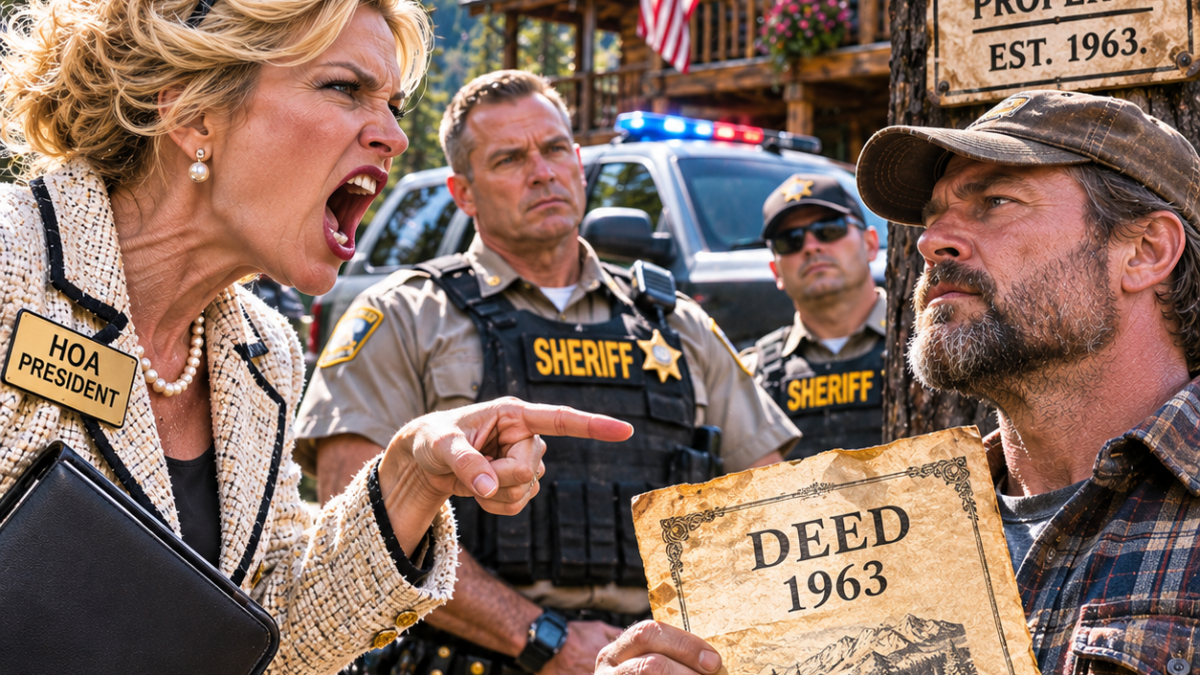
PART2
I was on a construction site when the sheriff’s department reached me.
Twenty electricians and carpenters were working around me.
My phone buzzed.
Unknown county number.
“Mr. Blackwood?”
“Yes.”
“Deputy Rodriguez. We need to speak with you concerning a reported theft.”
“Theft of what?”
Pause.
“Keys.”
I looked at the conduit in my hand.
“What keys?”
“Keys associated with a cabin in Pine Ridge.”
I almost laughed.
Then I realized exactly what Brenda had done.
“My cabin?”
“That’s part of what we need to establish.”
Every man around me suddenly found a reason to become quiet.
Small-town work crews hear everything.
I put down my tools.
“I’ll be there.”
The sheriff’s station interview room smelled like disinfectant and old coffee.
Deputy Rodriguez was younger than I expected.
Local.
Practical.
The kind of man whose expression told you he had already decided this was nonsense but still had a report to finish.
He slid a complaint across the table.
Brenda claimed I had unlawfully retained keys belonging to HOA property.
She also questioned the legitimacy of my inheritance.
I stared at the page.
“She told you I forged probate documents?”
“She made allegations.”
“I can prove ownership in five minutes.”
“That would help.”
I opened the cloud folder on my phone.
Deed.
Probate order.
County tax record.
Survey.
Insurance.
Rodriguez read.
Then leaned back.
“Looks straightforward.”
“It is.”
He tapped the complaint.
“We still document everything.”
“Good.”
I looked at him.
“Put in the report that I showed proof.”
“I will.”
“And that the keys open my cabin.”
He almost smiled.
“I figured.”
When I left, two neighbors were in the station parking lot.
One looked away.
The other stared openly.
That was Brenda’s real purpose.
Not arrest.
Reputation.
In a mountain community, people loan chainsaws based on trust.
Hire contractors based on a name.
Let neighbors watch property during winter.
A police complaint creates smoke even when there is no fire.
Brenda understood that.
My grandfather had another saying.
“Locks keep honest people honest. Dishonest people make paperwork useful.”
So I started a file.
The first thing I did was confirm the HOA boundary.
Not because Brenda had a convincing argument.
Because I never trust memory when a deed can answer.
County records showed the Pine Ridge HOA had been created decades after Grandpa built the cabin.
The recorded map did not place my forty acres inside the association.
That alone should have ended everything.
It didn’t.
Then I found something stranger.
The association’s corporate records were a mess.
Its original governing entity had been created in the early development years, but certain renewals, amendments, and property schedules had not been maintained cleanly.
I did not leap to:
The HOA doesn’t exist.
Real law is rarely that tidy.
But the records absolutely did not support Brenda’s claim that she had unrestricted enforcement authority over my land.
I hired an attorney.
Sarah Donnelly.
Property lawyer in Denver who specialized in land-use and association disputes.
She read the deed.
Maps.
Probate.
Brenda’s violation letter.
Then said:
“Miles, do not debate her at the mailbox.”
“I wasn’t planning to.”
“Yes, you were.”
I looked at her.
She smiled.
“You’re an electrical contractor. You think if you explain the circuit clearly enough the problem will stop being stupid.”
Fair.
“What do I do?”
“We put the jurisdiction question in writing.”
She sent Brenda a formal letter.
My property was outside the recorded HOA boundary.
No consent to entry.
No permission to inspect.
No authority to demand keys.
All further communications through counsel.
Brenda responded by calling an emergency community meeting.
I did not attend.
That was deliberate.
Frank Kowalski called me afterward.
Frank lived near the lower access road.
Retired accountant.
Big shoulders.
Gray beard.
He had spent fifteen years saying almost nothing at meetings.
That night, apparently, he had found his voice.
“She told everyone you’re dangerous.”
“Dangerous how?”
“Unstable. Making threats. Hoarding weapons.”
I looked around Grandpa’s workshop.
There was a nail gun.
Three fishing knives.
A broken radio.
“Terrifying.”
“She says the association has evidence.”
“What evidence?”
“That’s what I asked.”
“You asked?”
“Yeah.”
I smiled.
“How’d she take that?”
“Poorly.”
Then Frank became serious.
“You’re not the first.”
Something in his tone stopped me.
“First what?”
“Property.”
He lowered his voice.
“Tom Bradley got hit with accessibility violations last month.”
“Tom’s disabled.”
“I know.”
“Why would they fine him for accessibility?”
“They claimed his ramp violated design rules.”
I stared at the wall.
Frank continued.
“Sarah Mitchell got septic notices.”
“Actual problem?”
“County says no.”
“How many others?”
“That’s what we’re starting to ask.”
The next day, Tom called me himself.
Retired veteran.
Leg injury.
Walked with a cane.
Eight thousand dollars in fines related to a ramp he needed to enter his own house.
Then Sarah Mitchell.
Elementary-school teacher.
False septic notices.
Threats of enforcement.
Then Eleanor Denver.
Seventy-three.
Widow.
She came to my cabin holding a manila folder so tightly the edges bent.
“Brenda did this to Harold.”
Her husband.
Dead six months.
She sat at Grandpa’s kitchen table.
Took out letters.
Violation notices.
Inspection orders.
Property-sale documents.
“My husband thought we were going to lose everything.”
Her hands shook.
“He fought them for months.”
“What happened?”
“He had a heart attack.”
I did not tell her stress caused it.
I’m not a doctor.
Neither was she.
But grief does not care about clinical precision.
“He died believing he had failed me.”
She pushed the folder across the table.
“Then they bought the land.”
“Who?”
“Mountain Vista Development.”
That name mattered.
I had seen it before.
On one of Brenda’s contractor notices.
I opened the state business registry.
Mountain Vista Development.
Registered agent:
Rick Donovan.
Brenda’s boyfriend.
That was when the story changed.
I stopped thinking about an HOA dispute.
I started thinking about a pattern.
County property records showed several families who had received severe Pine Ridge “compliance” pressure eventually sold.
Mountain Vista bought multiple properties.
Prices were low compared with nearby sales.
Months later, properties resold.
Higher.
Sometimes much higher.
That alone was not proof of crime.
Distressed properties sell.
Developers buy low.
Renovate.
Flip.
Normal.
But combined with questionable violations?
That demanded attention.
Sarah filed additional public-record requests.
I built a timeline.
Household.
Violation.
Inspection.
Demand.
Sale date.
Buyer.
Resale.
Six properties formed a repeating pattern.
Older owner.
Disabled owner.
Single parent.
Recent widow.
People Brenda might have assumed had less money or less energy to fight.
Then the trucks started appearing at my driveway.
White.
Unmarked.
Men with measuring equipment.
Never technically crossing far enough onto my property to create an obvious confrontation.
Photos.
Notes.
Then gone.
I installed more cameras.
That part I understood.
Not booby traps.
Not movie gadgets.
Just professional documentation.
Overlapping coverage.
Time synchronization.
Secure off-site backup.
License-plate capture where lawful.
Motion alerts.
Redundant power.
Grandpa’s cabin became the best documented piece of rural property in Colorado.
Brenda should have known better than to harass a security contractor.
The first camera hit came Thursday morning.
A crew arrived near my western fence.
One man cut wire.
Another dragged construction debris near the stream.
I watched remotely.
Called the sheriff.
Did not confront them.
By the time deputies arrived, the crew was gone.
But the footage remained.
Faces.
Truck.
Plate.
Time.
A man resembling Rick Donovan directing them.
Deputy Rodriguez watched the clip.
“That’s useful.”
“Can you identify him?”
“We’ll investigate.”
I gave him the original export.
Not a phone recording of a screen.
Original file.
Metadata preserved.
Chain of custody.
Years in security had taught me that evidence is only as good as your ability to explain where it came from.
The next week, a county inspector arrived.
Dale Hoffman.
Thirty years in building inspection.
Brenda—or someone connected to her—had reported my solar system as a fire hazard.
Dale spent nearly two hours checking.
Grounding.
Disconnects.
Panels.
Battery enclosure.
Permits.
Finally:
“This installation exceeds what I usually see.”
“My grandfather started it. I upgraded.”
“He knew what he was doing.”
“Yes.”
Dale closed his tablet.
“This complaint doesn’t hold.”
“How many like it have you seen?”
He hesitated.
“Off record?”
“Off record.”
“Several.”
“Same neighborhood?”
He looked toward the mountain road.
“Enough that I’d keep documentation.”
He left.
I added his report to the file.
Then the power company came.
Anonymous complaint about illegal grid connections.
Inspection.
No violation.
Then insurance called.
They had received reports of hazardous activity.
My policy review was opened.
I sent them inspection documents before they could make a decision based on rumor.
Every agency Brenda touched created another independent record contradicting her.
She was trying to bury me in paperwork.
Instead, she was accidentally building my evidence folder.
Frank came to the cabin one evening carrying bourbon.
“I used to do forensic accounting.”
I looked at him.
“You told me you were an accountant.”
“I left out the fun part.”
“What’s fun about forensic accounting?”
“Catching liars.”
Fair.
We spread records across Grandpa’s workbench.
Mountain Vista.
Property purchases.
Loans.
Contractor payments.
Association fees.
Public filings.
Frank traced connections carefully.
No dramatic leaps.
No accusations unsupported by records.
He kept saying:
“This proves a relationship.”
“This suggests a transaction.”
“This does not yet prove intent.”
I liked working with him.
By midnight, one thing was clear.
Brenda’s financial interest in Mountain Vista was deeper than neighborhood aesthetics could explain.
Rick Donovan’s company had profited from properties under HOA pressure.
And several Pine Ridge owners had been pushed toward sales benefiting the same network.
Eleanor’s folder added more.
Not forged documents conclusively.
Not yet.
But inconsistencies.
Inspection notices that did not match county files.
Fees paid to entities related to Mountain Vista.
Different families receiving nearly identical language.
Then a young contractor showed up at my door.
Nineteen.
Maybe twenty.
Nervous enough that his knee bounced while sitting.
“I work for Rick.”
I said nothing.
“He told us to mess with you.”
“Define mess.”
“Trash. Complaints. Fence. Make it look like you don’t maintain the place.”
“Why are you telling me?”
He looked toward Grandpa’s memorial garden.
“Because they wanted us to wreck that.”
My jaw tightened.
A small stone monument sat beside the stream where Grandpa used to fish.
Nothing expensive.
Family name.
Dates.
One carved trout.
The kid continued.
“I told them I wasn’t doing it.”
He gave me a folder.
Work assignments.
Payment screenshots.
Property addresses.
Target list.
I did not treat him like a hero.
I treated him like a witness.
“Have you spoken to law enforcement?”
“No.”
“Then we’re going to call my attorney before I touch anything.”
Smartest thing I could do.
Sarah arranged for the documents to be copied and preserved.
The contractor gave a formal statement.
Investigators became more interested.
Now we had allegations coming from inside the crew, not only property owners.
Among the papers was a supposed emergency condemnation notice concerning my cabin.
Scheduled enforcement date.
The language looked official.
But Sarah immediately noticed errors.
Wrong county formatting.
Wrong signatory title.
No matching file number in public records.
She called the county.
No such order existed.
Someone was preparing to make an official-looking paper say my land had been condemned.
Why?
That was the question.
Why forty acres?
Why so much effort?
There were easier parcels.
Less stubborn owners.
Less surveillance.
Then I found Grandpa’s old geological report.
It slid from between workshop documents.
BLACKWOOD MINING SURVEY — 1961.
The title surprised me.
Grandpa wasn’t a miner.
The report had been prepared before construction to evaluate soil and rock.
Most of it was exactly what you would expect.
Slope stability.
Granite.
Drainage.
Subsurface conditions.
Then one paragraph.
Unusual mineral concentrations.
Lithium-bearing formations.
Cobalt indications.
Other rare-earth-associated elements.
The report did not say:
Congratulations, you are rich.
It said further assessment would be necessary.
I sent the document to an independent geologist.
Not because I was already spending imaginary millions.
Because now Mountain Vista’s behavior made more sense.
The geologist reviewed historical reports and regional data.
His answer was cautious.
“There may be commercially significant mineralization.”
“How significant?”
“Potentially very significant.”
“Fifty million?”
He laughed.
“Anyone giving you an exact number before drilling and feasibility work is selling something.”
I appreciated that.
“What do I know?”
“You know the mineral rights could have substantial value.”
That was enough.
I pulled my deed.
There it was.
Grandpa had retained all mineral rights.
Explicitly.
Not separated.
Not leased.
Not sold.
Then we checked the other Mountain Vista properties.
Some sales included mineral-right transfers.
Some owners likely never understood the language.
My forty acres sat in a strategically important position along the ridge.
It did not prove a giant mining conspiracy by itself.
But it supplied a financial motive far larger than cabin aesthetics.
Frank reviewed Mountain Vista financing.
Loans tied to future resource development.
Investor materials describing a consolidated mineral corridor.
One map stopped me.
It showed a continuous development zone.
My property sat in the middle.
Unacquired.
A gap.
The missing tooth.
Suddenly the forty-five-thousand-dollar “compliance” demand looked different.
So did the demand for my keys.
We sent the evidence to investigators.
State.
Federal contacts where appropriate.
Not because I wanted a dramatic raid.
Because potential fraud involving property transactions, financial institutions, government documents, and mineral rights goes beyond an HOA board.
That was the point when Sarah told me:
“You stop playing detective.”
“I’m not playing.”
“Good. Stop anyway.”
“What do I do?”
“Protect your property. Preserve evidence. Let investigators investigate.”
I hated that answer.
She was right.
Brenda responded with social media.
A private Facebook group called Pine Ridge Community Safety appeared.
Photographs of my security cameras.
Captions calling them militarized.
A picture of Grandpa’s workshop labeled:
POSSIBLE WEAPONS STORAGE.
A video showed me carrying electrical cable.
Edited to imply something sinister.
Another showed me walking the perimeter at night.
No mention that I was inspecting vandalized fencing.
People who had never met me began commenting.
Dangerous.
Paranoid.
Threat.
I nearly replied.
Then remembered what public arguments do.
Screenshots survive tone.
I saved every post.
No insults.
No engagement.
Then deputies arrived because anonymous callers said I had threatened older residents.
Rodriguez stood on my porch.
Again.
“Multiple reports.”
“Any named witnesses?”
“Some anonymous.”
“Any actual threat quoted?”
“We’re checking.”
I handed him copies of recent vandalism reports.
Camera footage.
Restraining-order paperwork.
He sighed.
“Miles, I know this is getting ridiculous.”
“Put that in the report.”
He smiled.
“Not exactly in those words.”
That night, my cameras caught two men trying to enter the workshop.
They fled when lights activated.
No confrontation.
Footage preserved.
Plate captured at the access road.
The net tightened.
Then Brenda’s people made the mistake I had been afraid of.
They approached my electrical equipment at night carrying small packets.
I watched the live feed.
Did not go outside.
Called law enforcement.
The men left before deputies arrived.
But items remained near the equipment.
I did not touch them.
Investigators handled collection.
What was inside mattered less to me than the act itself.
Someone appeared to be planting material near my property infrastructure.
Combined with an anonymous complaint the following day alleging illegal activity at my cabin, the sequence was difficult to dismiss as coincidence.
The evidence was now moving out of HOA territory entirely.
Federal investigators became involved more directly.
Frank’s financial analysis had also identified millions flowing through connected companies.
Eleanor and other former owners provided statements.
The young contractor cooperated.
The case was no longer mine alone.
That was both comforting and terrifying.
Brenda called another emergency meeting.
Forty-three residents.
Her message:
I had become dangerous.
My cameras threatened community safety.
My refusal to follow HOA standards endangered property values.
This time, people came prepared.
Tom Bradley stood first.
“Show us the authority.”
Brenda stared.
“What?”
“The document putting Miles’s property in the HOA.”
“We’ve covered that.”
“No.”
He tapped his cane.
“You talked. You never showed us.”
Sarah Mitchell stood.
“I want the inspection record you used for my septic fine.”
Brenda’s jaw tightened.
Eleanor held up Harold’s files.
“I want every fee you charged my husband explained.”
Frank sat quietly with a binder thick enough to stop a door.
Brenda looked around.
The room was no longer afraid.
That was the moment her power actually began dying.
Not when agents arrived.
When questions did.
The financial picture worsened.
Mountain Vista had borrowed heavily based on future development.
Investor materials depended on assembling property and mineral interests.
Payments to local intermediaries appeared suspicious.
Investigators began examining whether any public officials had improperly assisted emergency complaints or property actions.
I stayed careful.
Rumor spreads faster than indictments.
I told neighbors:
“Do not call somebody corrupt because a name appears in an email.”
Tom agreed.
“We win by being more accurate than they are.”
That became our rule.
The young contractor’s documents contained one more thing.
A schedule showing planned entry onto my property.
Not a legitimate condemnation.
A manufactured one.
Sarah obtained emergency legal protection before anyone could act on it.
The supposed order was exposed as false.
That should have ended the physical harassment.
Instead, Rick Donovan grew desperate.
My cameras captured another attempted forced entry.
This time, investigators were ready.
No movie-style fortress battle.
No exploding doors.
No armed standoff.
Just law enforcement responding to documented unlawful entry attempts while evidence was preserved.
Rick was detained and questioned.
Search warrants followed.
Digital records came out.
Emails.
Payment records.
Messages.
One message referenced my property.
NEED BLACKWOOD PARCEL TO COMPLETE RIDGE ACCESS.
Another:
HE WON’T SELL. PRESSURE THROUGH HOA.
That was the sentence I had been waiting for.
Not because it made me happy.
Because it made the whole thing understandable.
The HOA violations were not the business.
They were the tool.
Brenda was arrested later as part of a broader fraud investigation.
No cheering.
No dramatic community applause.
I watched from across the parking lot when agents approached her.
She looked smaller than she had on my porch.
No clipboard.
No sunglasses.
Just a woman being told she needed to come with them.
I felt no joy.
Mostly exhaustion.
Tom stood beside me.
“Thought this would feel better.”
“Me too.”
He looked toward the mountains.
“It will later.”
Maybe.
The investigation expanded.
Property owners from outside Pine Ridge came forward.
More questionable sales.
More fees.
More Mountain Vista purchases.
Some were legitimate deals.
Important distinction.
Not every property Rick had ever touched was stolen.
But enough transactions showed patterns investigators believed deserved prosecution.
Frank worked with attorneys to organize financial material.
Eleanor gave testimony.
Tom connected veteran owners with legal help.
Sarah Mitchell organized affected families.
And I did what I had always done.
Security documentation.
Records.
Timelines.
Backups.
No more.
Sarah would not let me do more.
The mineral-right question became its own legal mess.
Some families had transferred rights knowingly.
Some did not appear to understand.
Some transactions became subjects of fraud claims.
My deed was cleaner.
Grandpa’s language was explicit.
The Blackwood family owned the surface and mineral estate unless properly conveyed.
No HOA president could change that.
No fake violation could.
No invented emergency.
That gave me choices.
Mining companies eventually approached.
Real ones.
Lawyers.
Geologists.
Offers.
Numbers larger than anything my electrical business had ever produced.
I declined.
People thought I was crazy.
Maybe.
But I knew what Grandpa had protected.
The trout stream.
Pines.
Elk moving across the upper slope.
The silence that made the cabin matter.
I had nearly watched Brenda destroy families because she believed underground value was more important than everything above it.
I was not going to prove her right the moment the money became mine.
I began working with a conservation organization.
The criminal case took more than a year.
Not six dramatic months.
Real cases move slowly.
Brenda ultimately received a lengthy federal sentence after convictions and pleas tied to fraud, conspiracy, bribery-related conduct, and property schemes.
Rick Donovan received prison time for his role in intimidation, break-ins, evidence manipulation, and fraudulent property activity.
A county official involved in improperly facilitating certain actions also faced conviction.
The exact sentences mattered less to me than restitution.
Millions were recovered or ordered for affected families.
Some families got property interests back.
Others received money.
Some cases settled because complete restoration was impossible.
Eleanor received enough to secure her home and create a scholarship in Harold’s name.
Tom helped establish legal assistance for disabled veterans dealing with property-rights abuse.
Sarah created a network connecting rural homeowners to independent inspectors and attorneys.
Frank turned his forensic-accounting skills toward nonprofit fraud detection.
Everyone took what had happened and tried to turn one piece of it into something useful.
That was the part I was proud of.
Not the arrests.
What came after.
My cabin remained mine.
Forty acres.
No lien.
No HOA authority.
No forced sale.
I upgraded security, but not into some ridiculous fortress.
Better locks.
Better cameras.
Resilient communications.
Clear signage.
Legal access control.
Things I would recommend to any remote property owner.
The famous “unbreakable lock” became a running joke because reporters loved that angle.
Security contractor defeats corrupt HOA with super lock.
Catchy.
Not true.
The lock didn’t save my property.
Paperwork did.
Witnesses did.
Grandpa’s deed did.
Investigators did.
Neighbors did.
The cameras simply prevented liars from having the only version of events.
One journalist asked me:
“What was your most important security device?”
She expected a brand.
I said:
“A folder.”
She laughed.
I didn’t.
Deed.
Probate.
Inspection reports.
Police case numbers.
Emails.
Property records.
Camera logs.
Without those, a lock only delays somebody.
Documentation changes what happens after.
The mineral survey was reevaluated with modern methods.
The potential value beneath the property was enormous.
Not a guaranteed eighty-million-dollar treasure chest.
Mineral economics are never that simple.
Extraction costs.
Permitting.
Commodity prices.
Environmental restrictions.
Access.
Processing.
Still, there was enough confirmed value that conservation became urgent.
I placed strong restrictions over the property through a conservation arrangement.
Surface protection.
Stream protection.
No open-pit mining.
No large-scale extraction.
Grandpa’s land would remain what he intended.
A mountain refuge.
Not an industrial scar.
When I signed the papers, the attorney asked:
“You understand you may be giving up a significant amount of future wealth?”
“Yes.”
“You’re comfortable?”
I thought about Grandpa adjusting his wire-rim glasses while sixteen-year-old me confidently wired the wrong terminal.
“Yes.”
He taught me value and price were different things.
The workshop became quiet again.
That mattered.
For almost two years, every vehicle on gravel made me look up.
Every unknown number made my chest tighten.
Every camera notification felt like another attack.
After the cases ended, I had to teach myself not to live under surveillance just because I knew how.
One evening I disabled half the unnecessary alerts.
That was harder than installing them.
Hypervigilance feels like safety until you realize it has become another prison.
Grandpa did not build the cabin so I could watch live feeds of the driveway twenty-four hours a day.
He built it so someone could sit beside the stream.
I had forgotten.
Eleanor came up one spring.
We sat on the porch.
She brought Harold’s old fishing hat.
“He loved this place.”
“Mine?”
“The mountains.”
She looked toward the stream.
“He died thinking Brenda had beaten us.”
I didn’t know what to say.
She continued.
“I used to hate that.”
“Used to?”
She nodded.
“Now I think about everything his files helped prove.”
She smiled through tears.
“He kept copies because he thought nobody was listening.”
I looked at her.
“People listened eventually.”
“Yes.”
She placed the hat on the porch rail.
“That has to be enough.”
Sometimes justice does not arrive in time for the person who deserved to see it.
That is one of the hardest truths in the story.
We cannot rewrite that.
We can only make sure the next family stands a better chance.
Tom Bradley became one of my closest friends.
He still uses the ramp Brenda fined him for.
Every time I visit, I say:
“Noncompliant.”
He says:
“Get off my porch.”
Then gives me coffee.
The veteran advocacy group he helped expand eventually assisted hundreds of people with property and accessibility disputes.
Most cases ended quietly.
Letters corrected.
Fines withdrawn.
Reasonable accommodations approved.
No FBI.
No mineral rights.
No headlines.
Tom liked those best.
“So do I,” I told him.
“Nobody wants to become a symbol.”
He looked at my cabin.
“You kind of did.”
“Unfortunately.”
The young contractor who came to my door testified.
I will not use his name.
He made mistakes.
Serious ones.
But he also made the decision that broke the silence inside Rick’s crew.
Years later, he sent me a photograph.
Electrical apprenticeship certificate.
Message:
Figured I should learn a trade where doing things right matters.
I wrote back:
Every trade is that trade if you’re doing it correctly.
Grandpa would have approved.
Frank Kowalski became unbearable after the case.
Every questionable invoice anywhere in the county became:
“Probably money laundering.”
I told him forensic accountants were conspiracy theorists with spreadsheets.
He said electricians were paranoid people with wire cutters.
Fair.
We still drink bourbon on the porch.
The Pine Ridge association changed too.
New leadership.
Transparent finances.
Independent review for large assessments.
No enforcement outside recorded jurisdiction.
Written notice.
Appeals.
Actual procedures.
Some residents wanted to dissolve the entire association.
I understood.
But shared roads still needed maintenance.
Snow removal still cost money.
Common wells did not run on righteous anger.
Good governance is not the absence of rules.
It is limits.
Transparency.
The ability to challenge the person enforcing them.
Brenda had not been dangerous because she was an HOA president.
She was dangerous because people stopped asking her to prove what she claimed.
The original stolen-keys complaint stayed in the sheriff’s records.
I requested the final disposition.
Unfounded.
Closed.
I framed nothing.
Put it in the file.
Deputy Rodriguez eventually became sergeant.
When I ran into him at a diner, he said:
“You still carrying cabin keys?”
I held them up.
“Illegally.”
He laughed.
“Careful.”
I replaced Grandpa’s old key ring.
Not because I wanted to.
The leather loop finally split.
I kept the old one in the workshop.
The new ring holds three keys.
Front door.
Workshop.
Storage shed.
Every time I pick them up, I remember Brenda holding out her hand.
HOA emergency access.
No.
One syllable.
Everything that followed came because she could not accept it.
That may be the simplest explanation of the entire case.
She believed refusal meant negotiation.
Then resistance.
Then defiance.
Then threat.
She never treated no as an answer.
People who cannot hear no eventually cross lines they cannot uncross.
My business grew after the publicity.
I hated that at first.
People called asking for “the Blackwood system.”
There was no magical system.
I designed sensible layered security.
Still, requests came from ranchers.
Remote homeowners.
Utility operators.
Eventually we created a rural-property security package.
Not marketed as anti-government.
Not anti-HOA.
Not a fortress fantasy.
Simple principle:
See what happens.
Preserve what matters.
Alert the right people.
Stay lawful.
We also gave free consultations to elderly property owners referred by legal-aid groups.
That part I liked.
One magazine wanted me to demonstrate how to defeat sophisticated break-in tools.
I refused.
“Why?”
“Because the same article teaches the wrong person what to try.”
We talked instead about redundancy.
Lighting.
Camera placement.
Backups.
Door reinforcement.
Documentation.
Boring.
Useful.
That was the version Grandpa would have respected.
The mineral rights could have changed my family financially.
They still might, in limited ways consistent with conservation.
But I never built my life around extraction.
Instead, a portion of legal settlements and licensing income went into the Mountain Heritage Protection Fund.
Legal aid.
Environmental review.
Title research.
Emergency grants for rural families dealing with fraudulent property pressure.
Eleanor helped name it.
Tom hated the name.
“Sounds like a folk festival.”
Eleanor told him to be quiet.
We kept it.
At the first annual Heritage Day, somebody asked me to demonstrate the “legendary lock.”
I almost refused.
Then agreed on one condition.
I placed Grandpa’s old key ring on the table beside the modern system.
Children gathered.
Adults watched.
I said:
“This lock is useful.”
Then held up the old deed copy.
“This is more useful.”
People laughed.
I continued.
“No security system can substitute for knowing what you own.”
That became the line they put on the brochure.
The biggest myth about what happened is that I defeated Brenda because I was smarter.
No.
I had advantages previous victims did not.
Technical experience.
Money to hire counsel.
Knowledge of records.
A property with unusually strong deed language.
Cameras already part of my professional world.
And by the time Brenda reached me, enough people were angry that witnesses finally spoke.
Eleanor’s husband faced her earlier.
So did other families.
They were not weaker.
They were isolated.
That difference matters.
Bullies love one-on-one fights.
Community changes the math.
That is why the best moment was not Brenda’s sentencing.
It was the night neighbors started standing up in the community center.
Tom:
“Show us the evidence.”
Sarah:
“Show me the septic report.”
Eleanor:
“Explain what you did to my husband.”
Questions.
Nothing dramatic.
But once those questions became public, Brenda could not control every conversation separately.
The walls fell.
My grandfather’s memorial garden was repaired.
The stone monument had been cracked during vandalism.
I could have replaced it with new granite.
I didn’t.
A stoneworker pinned the original pieces together.
You can see the fracture.
I like that.
Restoration does not require pretending damage never happened.
Eleanor once touched the crack.
“Why leave it visible?”
“So I remember it survived.”
She nodded.
She understood.
The trout stream remains clear.
Environmental testing became more rigorous during the investigation.
No contamination.
No mining runoff.
No development corridor.
Sometimes I stand ankle-deep in that water with Grandpa’s old fishing rod.
I am terrible at fly fishing.
He was worse.
That is one family tradition I preserved perfectly.
One afternoon, a black SUV came up the drive.
For a second, my body reacted before my mind.
Shoulders tight.
Heart faster.
Then my daughter stepped out.
Megan.
She lives in Boulder now.
She brought my grandson.
“Dad?”
I realized I was staring.
“What?”
“You look like you were about to arrest us.”
“Old habit.”
She hugged me.
My grandson ran to the stream.
I watched him.
That was when I knew the land had returned to being family property instead of evidence.
A child can tell the difference.
He did not see mineral value.
Fraud.
Federal charges.
He saw rocks.
Water.
Trees.
Perfect.
Megan asked me once:
“Would Grandpa have mined it?”
I thought for a long time.
“No.”
“How do you know?”
“He knew about the mineral indicators.”
“Maybe he was waiting.”
“Maybe.”
I looked toward the workshop.
“But Grandpa lived to ninety-one.”
She smiled.
“Fair.”
If he wanted the mountain torn apart for ore, he had decades to start.
He didn’t.
That was enough of an answer for me.
I later found another letter from Grandpa’s attorney confirming his intent to keep mineral rights with the family.
Not a secret treasure map.
Not a final twist worth eighty million.
Just careful estate planning.
That was better.
Grandpa had anticipated that surface land and mineral rights might become valuable separately.
He kept them together.
He protected his heirs from accidentally giving away what they did not understand.
That document made me smile more than any valuation.
He was still teaching me after he was gone.
People sometimes ask if I ever saw Brenda after sentencing.
No.
And I’m glad.
I don’t need a final conversation.
I do not need her apology.
The court record exists.
The restitution record exists.
The families exist.
The land exists.
Sometimes closure is overrated.
A locked file cabinet works fine.
Rick Donovan eventually cooperated to reduce his exposure.
His testimony helped untangle transactions.
I felt no gratitude toward him.
But truth from a bad person remains useful truth if verified.
That was another lesson.
Do not confuse witness character with evidence.
Check both.
Several county employees lost jobs.
Some faced charges.
Others were cleared.
That distinction mattered.
Early in the case, people wanted to label the entire county corrupt.
It wasn’t.
Deputy Rodriguez helped.
Dale Hoffman documented false complaints.
Other officials refused improper requests.
Corruption had participants.
So did integrity.
A good story should remember both.
The insurance company reinstated my policy after reviewing evidence.
They also revised how they handled anonymous risk allegations involving property disputes.
Small change.
Useful.
The power company added verification steps before escalating anonymous complaints.
Another small change.
None of those reforms made headlines.
They mattered more than headlines.
Systems improve one boring procedure at a time.
My daughter says I have become impossible at family gatherings.
“Dad, nobody wants a lecture on deed language.”
Then somebody mentions buying property.
I ask:
“Mineral rights?”
She puts her head in her hands.
I can’t help it.
At sixty-one, I reduced my contracting workload.
More consulting.
Less crawling through equipment rooms.
Knees appreciate it.
Hands still work.
Most mornings, I drink coffee in Grandpa’s workshop.
Sawdust.
Motor oil.
Old tools.
A modern security panel mounted beside a hand plane made in 1958.
Past and present.
Grandpa would have complained about the panel.
Too many lights.
Then asked me to explain every one.
The cabin still has the solar system.
Updated again.
Dale Hoffman came back unofficially after retirement.
He looked at the new equipment.
“Still museum quality.”
“Better.”
“Arrogant.”
“I’m an electrician.”
He laughed.
Tom’s ramp remains too.
Sarah’s septic system never had the violations Brenda claimed.
Eleanor kept her home.
Other families recovered varying amounts.
A few properties could not be restored because innocent third-party buyers had become involved.
Those cases settled financially.
That was painful.
There is no perfect rewind button.
Anyone promising one is selling fantasy.
Justice often arrives with compromise around the edges.
The important thing is that the scheme stopped.
The land Brenda wanted is worth more now than when Grandpa died.
That no longer impresses me.
Numbers go up.
Down.
Markets change.
The stream sounds the same.
Pines smell the same after rain.
The workshop floor still creaks near the east wall.
My grandson now knows which rock Grandpa used as a chair when fishing.
Those are more stable measurements.
The strangest part is that Brenda’s first complaint was about aesthetics.
Logs.
Solar panels.
Old truck.
Everything she said made my property less valuable supposedly.
Later we learned the very qualities she wanted erased—undeveloped acreage, preserved land, mineral estate, strategic location—were exactly why Mountain Vista wanted it.
She never believed the cabin lowered value.
She believed I did not understand the value.
That was her gamble.
She lost.
I sometimes replay that first porch conversation.
“Cabin keys.”
“No.”
Imagine if I had handed them over.
Maybe they would have photographed interiors.
Claimed inspection rights.
Created more documents.
Maybe nothing would have changed.
Maybe everything.
I don’t obsess over it.
But I respect small boundaries now.
A key is small.
So is a signature.
So is one checkbox on a form.
Small objects can carry enormous authority.
Know who you are giving it to.
Grandpa’s old line sits on a plaque in the workshop now.
Not because he ever wrote it dramatically.
Because I heard it enough times to remember:
LOCKS KEEP HONEST PEOPLE HONEST. DISHONEST PEOPLE REQUIRE BETTER RECORDS.
I changed the last part.
He used to say “creative solutions.”
After everything, I prefer records.
A young couple bought a cabin down the road last year.
They came over.
“Are you Miles?”
I sighed.
“What did they tell you?”
The husband laughed.
“That you fought an HOA and discovered a fortune underground.”
“Of course.”
His wife asked:
“Any advice?”
“Yes.”
“Security?”
“Later.”
I pointed toward their folder.
“First, understand your deed.”
They looked disappointed.
Good advice often is.
They returned a week later.
“You were right.”
“About?”
“Our driveway easement.”
I smiled.
“Problem?”
“No. We just finally understand it.”
Perfect.
That is what success looks like.
No fight.
No lawsuit.
No federal agents.
Just two people reading before a problem starts.
The Mountain Heritage Protection Fund now runs title-literacy workshops.
Not exciting.
Attendance is surprisingly good.
People bring deeds.
Old plats.
Questions.
Lawyers explain what documents mean.
Surveyors explain boundary descriptions.
Environmental specialists explain conservation restrictions.
Security professionals explain documentation.
Frank explains financial red flags.
Tom tells everyone not to sign anything before coffee.
Eleanor provides cookies.
That is my favorite part of the entire legacy.
Not the book offer I declined.
Not television.
Not the security licensing.
People learning enough to become harder to exploit.
I did eventually write down the story.
Not as revenge.
For Megan.
My grandson.
Future Blackwoods.
The first page says:
IF SOMEONE CLAIMS AUTHORITY OVER THIS LAND, START WITH THE DEED.
The second page:
CALL A LAWYER BEFORE CALLING THEM AN IDIOT.
Sarah insisted on that one.
The cabin will pass to Megan someday.
Then maybe my grandson.
The conservation restrictions will remain.
Mineral rights will remain controlled under the family and conservation structure we created.
No one will get rich tearing apart the mountain.
Maybe that disappoints some future heir.
They can complain at my grave.
Grandpa survived my teenage opinions.
I can survive theirs.
My truck changed.
Grandpa’s old pickup finally died.
Transmission gave up.
I kept the tailgate.
Mounted it in the workshop.
Tom said:
“That’s ridiculous.”
“Sentimental.”
“Same thing.”
Maybe.
One fall afternoon, I sat on the porch with Eleanor.
She looked toward the driveway.
“Remember when Brenda demanded your keys?”
“Yes.”
“What would you do now?”
“Same thing.”
“Say no?”
“Yes.”
She smiled.
“Good.”
Then:
“Maybe don’t make that face.”
“What face?”
“The one that makes people think you’re planning an electrical accident.”
I laughed.
Maybe she was right.
The biggest thing Brenda stole from people was not land.
It was confidence.
Owners stopped trusting their own understanding.
Official-looking letters arrived.
People assumed somebody else knew better.
A president.
Inspector.
Contractor.
Management company.
That is why education matters.
Not because every homeowner should become a lawyer.
Because every homeowner should know when to ask:
“Show me.”
Show me the rule.
Show me the deed.
Show me the inspection.
Show me the invoice.
Show me the authority.
Four words can stop a surprising amount of nonsense.
The second biggest thing she stole was isolation.
She made each victim believe the problem belonged only to them.
Tom’s ramp.
Sarah’s septic.
Eleanor’s fees.
My cabin.
Separate shame.
Separate fear.
Once people compared notes, the pattern emerged.
That is why community matters even when the community institution is part of the problem.
Neighbors are not the HOA.
The HOA is not one president.
Brenda forgot that.
Eventually everyone else remembered.
One reporter called the case:
THE HOA THAT TRIED TO STEAL A MOUNTAIN.
Good headline.
Wrong.
Brenda never controlled the entire mountain.
She controlled enough frightened people to make it look that way.
Those are different things.
I never donated eighty million dollars of minerals to anything.
People love that version.
Reality is less cinematic.
We created conservation structures that restrict exploitation and preserve the watershed while allowing carefully controlled future decisions consistent with environmental protections.
Boring sentence.
Better outcome.
Grandpa did not need me to become a millionaire.
He needed me not to be careless.
When I was sixteen, after wiring that solar connection wrong, Grandpa made me undo the whole circuit.
“But only one wire is wrong.”
He shook his head.
“You don’t know what else you misunderstood.”
I was furious.
We rebuilt it.
Every connection checked.
Years later, that lesson returned.
When Brenda’s first claim proved false, I could have stopped at:
She’s wrong about HOA jurisdiction.
Instead, we kept checking.
Financial connections.
Property history.
Complaints.
Mineral rights.
One wrong wire suggested the circuit deserved inspection.
Grandpa had trained me for this decades before Brenda ever bought her Mercedes.
The Mercedes was eventually sold as part of Brenda’s financial mess.
Tom found the listing online.
Sent it to me.
LOW MILEAGE. ONE OWNER.
He wrote:
Possibly used for light extortion.
I laughed.
Deleted it.
Some jokes do not need archiving.
The security system still logs access.
Mostly boring.
Megan.
Delivery driver.
Deer.
A bear once triggered three cameras and became the most suspicious visitor in months.
I sent the clip to Tom.
He replied:
HOA COMPLIANCE OFFICER.
I laughed until coffee came out my nose.
That is healing too.
On the anniversary of Grandpa’s death, I walk to the stream.
Sit beside the repaired memorial.
No ceremony.
No speech.
I tell him what changed.
The first year:
“We kept the land.”
Second:
“Eleanor’s doing better.”
Third:
“Tom still won’t stop talking.”
Fourth:
“Your great-great-grandson caught a trout.”
I imagine Grandpa nodding at that one.
Then asking whether I checked the hook properly.
His cabin survived.
Not because it had the strongest lock.
Because enough people eventually chose truth over convenience.
That is important.
Technology helped.
But a camera cannot care.
A deed cannot speak.
A server cannot testify by itself.
People made decisions.
Rodriguez took my documents seriously.
Dale wrote an honest inspection.
The contractor walked away from Rick.
Eleanor kept Harold’s files.
Tom spoke.
Sarah asked questions.
Frank followed money.
Lawyers filed motions.
Investigators checked claims.
Judges looked at evidence.
The system failed in places.
It worked in others.
We strengthened the parts worth keeping.
The day the final major case closed, I expected relief.
Instead, I felt empty.
For two years, the fight gave every day a task.
Call.
Scan.
Meet.
Save.
Prepare.
Then nothing.
Sarah warned me.
“You’re going to miss having an enemy.”
“I am not.”
“You’ll miss having a mission.”
That was different.
She was right.
So the fund gave me one.
Help people before their dispute becomes war.
Better mission.
My grandson is old enough now to ask about Brenda.
“Was she evil?”
Children like categories.
I thought.
“No.”
He looked disappointed.
“She did bad things.”
“Very bad.”
“Then evil.”
“Maybe.”
I pointed toward the workshop.
“But if you think only evil-looking people do bad things, you won’t recognize danger when it arrives with paperwork.”
He frowned.
Too young.
Someday.
He asked:
“Did you win?”
“Yes.”
“What did you get?”
I looked around.
“Same cabin.”
“That’s it?”
Kids.
“Yes.”
Then I smiled.
“That’s the point.”
I could have lost the cabin.
Not because Brenda’s original HOA argument was valid.
Because fraud creates chaos.
False records still require correction.
False accusations still cost time.
Insurance cancellations still create risk.
People underestimate how damaging a lie can become before anyone proves it false.
That is why prevention matters.
Not fear.
Preparedness.
There is one camera I removed permanently.
It watched the porch.
For months, I could see myself on recordings.
Checking drive.
Looking over shoulder.
Never relaxed.
One morning I realized Grandpa’s porch had become a surveillance platform.
I took the camera down.
Coverage remains from other angles.
The chair feels different now.
Open.
That was symbolic enough for me.
The workshop still smells like sawdust and oil.
I keep Grandpa’s wire-rim glasses in a drawer.
They are not useful.
Prescription ancient.
But I occasionally put them on.
Everything becomes blurry.
That makes me laugh.
The man who taught me to see clearly left me glasses that make everything worse.
Life has a sense of humor.
Eleanor’s scholarship fund sends me annual reports.
Students.
Children and grandchildren from rural families hit by property fraud.
One became a land-use attorney.
Another environmental scientist.
Harold would have liked that.
Eleanor says:
“He would complain they waste money on tuition.”
Then smile.
Grief and humor learn to share a room eventually.
Tom’s organization helped pass stronger state-level protections around accessibility disputes.
Not because our case magically changed all law.
Because advocacy created pressure.
Testimony.
Data.
Drafts.
Committees.
Slow work.
Real reform.
Anyone promising one sensational case instantly rewrites the legal system is selling fiction.
We got useful changes.
That was enough.
Mountain Vista Development dissolved.
Related entities were litigated.
Some assets sold for restitution.
The name disappeared from property signs.
I drove past one old sign once.
Letters faded.
I felt nothing.
That surprised me.
For years, the company name raised my heart rate.
Now it was paint on plywood.
Power fades when people stop feeding it.
Brenda’s old house sold to a family from Denver.
They have two dogs.
No interest in HOA politics.
The wife came to a workshop once.
“I’m embarrassed to tell people which house we bought.”
“Why?”
“You know.”
“House didn’t commit fraud.”
She laughed.
Good.
People should not inherit shame with property either.
Pine Ridge remains imperfect.
Someone complains about snowplow timing every winter.
Somebody else hates short-term rentals.
People argue about road gravel.
Normal.
I love normal arguments.
No forged condemnation orders.
No planted evidence.
Just:
“Why did the plow leave snow by my driveway?”
Civilization.
The keys Brenda wanted are hanging beside the workshop door right now.
Three simple pieces of metal.
I could lose them tomorrow.
Replace them.
The property would remain mine.
That is the final irony.
She believed the keys represented control.
They didn’t.
They represented access.
Authority came from somewhere deeper.
The deed.
Consent.
Law.
Family.
Truth.
If I could speak to Grandpa today, I would tell him:
“You were right about dishonest people.”
Then he would ask:
“Which time?”
Because old men enjoy being right more than young men realize.
I would show him the cameras.
He would say too many.
The conservation papers.
He would read every page.
The fund.
He would pretend not to be impressed.
Then we would go fishing.
That would be enough.
I am sixty now.
Still working.
Less.
Megan says retire.
I say contractors don’t retire.
We become consultants until people stop answering the phone.
The cabin remains my reset button.
Drive up Friday.
Unlock.
No Mercedes.
No clipboard.
No deputy.
Coffee.
Stream.
Workshop.
Silence.
That is wealth.
The original violation notice is framed inside the workshop.
Only thing from Brenda I display.
NONCOMPLIANT RUSTIC EXTERIOR.
Grandpa’s hand-hewn logs behind it.
I put a small label beneath:
BUILT 1963. STILL NONCOMPLIANT.
Tom loves it.
Beside the notice is the probate deed.
Not original.
Certified copy.
Below it, the sentence I wish every owner understood:
KNOW WHAT YOU OWN BEFORE SOMEBODY ELSE TELLS YOU WHAT YOU DON’T.
That is the entire story in one line.
Brenda Hartwell came to my mountain cabin believing her title as HOA president gave her the power to demand my keys, rewrite my grandfather’s property rights, and frighten me into selling forty acres her business network desperately needed.
She tried police complaints.
Inspections.
Rumors.
Paperwork.
Contractors.
Financial pressure.
And when those failed, the people around her crossed lines that eventually turned a neighborhood dispute into a criminal investigation.
But the thing that defeated her was not my most expensive camera.
Not my strongest lock.
Not the mineral valuation.
It was the fact that her story could not survive contact with everybody else’s records.
My deed.
Eleanor’s files.
Tom’s testimony.
Sarah’s inspection history.
Frank’s financial trail.
The contractor’s documents.
County records.
Security footage.
One fact after another.
Grandpa once told me dishonest people required creative solutions.
After everything, I would amend that.
Dishonest people require patient ones.
People willing to preserve the receipt.
Ask for the file number.
Photograph the damage.
Read the deed.
Call the attorney.
Wait for the report.
And refuse to let anger become the easiest evidence the other side has against you.
That is less exciting than revenge.
It also works better.
Tonight I’m sitting on the porch.
The temperature is dropping.
Pines black against the sunset.
Stream below.
Grandpa’s old workshop behind me.
Keys in my pocket.
My grandson left a fishing pole leaning against the wall.
The mountain is quiet enough that I can hear water moving over stone.
Nothing here looks like eighty million dollars.
Good.
It looks like home.
That is what Brenda never understood.
She saw acreage.
Mineral rights.
Leverage.
A gap in a development map.
I saw the place where my grandfather taught me how to wire a solar panel and laugh at my own mistakes.
She thought that difference made me naïve.
Instead, it made me difficult to buy.
I reach into my pocket.
Pull out the cabin key.
Plain steel.
No blue tape.
No special mark.
Just a key.
I remember Brenda holding out her hand.
Give me those.
I remember the deputies.
The reports.
The rumors.
The years that followed.
Then I look at Grandpa’s cabin.
Still here.
The stream.
Still clear.
The ridge.
Still protected.
And I smile.
Because Brenda was right about one thing.
Those keys mattered.
Just not for the reason she thought.
They reminded me of the moment I chose not to surrender something simply because another person spoke as though she already owned it.
Brenda Hartwell thought taking my keys would give her control of my grandfather’s land; instead, her demand made me open every deed, every file, every financial record, and every camera log until the entire scheme surrounding Pine Ridge finally came into view.
The cabin stayed.
The forty acres stayed.
The mineral rights stayed protected.
Families who had been isolated finally compared their stories.
People who had been afraid finally spoke.
And the woman who believed a clipboard made her more powerful than a deed eventually learned the same lesson Grandpa had taught me when I was sixteen:
Confidence can open a conversation. Only truth gets to decide where the line actually is.








