PART2:“GO COMPLAIN TO THE SHERIFF!” HOA Karen Hired Fake Deputies to Seize My Dock—She Never Realized I Was the Sheriff
PART2
I could have sent every available deputy down there.
That would have been satisfying for about ten minutes.
It also would have been the worst possible decision I could make as sheriff.
The victim was me.
The property was mine.
The forged name was mine.
If I personally directed the investigation, Sloan’s attorney would have only needed one phrase:
abuse of power.
So my first instruction was not:
Arrest everyone.
It was:
“Secure the scene, preserve evidence, and call the state police.”
The dispatcher hesitated.
“Sir?”
“I want an outside investigator.”
“Yes, Sheriff.”
“And nobody touches Sloan Marfield unless there is an immediate safety issue.”
“Understood.”
I called our county attorney next.
Then my private attorney.
Then I stood outside my own locked gate and waited like any other property owner whose rights had just been violated.
That mattered.
It would matter much more later.
State Investigator Ellis Pritchard arrived shortly after noon.
Forty-four.
Lean.
Gray scarf.
The kind of investigator who read every document twice and rarely filled silence just because silence made other people uncomfortable.
He photographed the sign.
Lock.
Gate.
Vehicle tracks.
Then we reviewed the security footage.
The black SUV arrived at 5:17.
Voss clearly visible.
Second man visible.
Uniform patches.
Dashboard lights.
Sloan’s vehicle.
Audio.
Everything.
Ellis paused the video on Voss.
“Deputy?”
“Not mine.”
“You know him?”
“No.”
He enlarged the shoulder patch.
Almost our emblem.
Not quite.
The star points were wrong.
County name curved differently.
The state seal was missing.
“Somebody spent money making that close,” Ellis said.
“Yes.”
He looked at the forged order.
“Mind if I ask the obvious question?”
“Go ahead.”
“Did you seize your own dock?”
“No.”
His mouth moved slightly.
Almost a smile.
“Good.”
County counsel confirmed within the hour that no valid shoreline possession order existed.
More importantly, the sheriff’s office did not possess the power described in the fake document.
No sheriff in Tennessee could simply sign a page and transfer private dock possession to an HOA for a Christmas party.
That was not how property law worked.
The document had been designed to intimidate, not survive scrutiny.
Ellis traced the black SUV.
Rental.
Event-production fleet.
Contract signed by Clifford Voss.
Purpose:
AUTHORIZED COUNTY DETAIL.
The rental manager, Doug Haskell, told Ellis that Voss had specifically requested a dark SUV with flat doors suitable for magnetic decals and a dashboard where portable warning lights could be mounted.
“He said he was assisting the sheriff.”
“Did he show identification?” Ellis asked.
“Security company badge.”
“Deputy credentials?”
“No.”
“Did you ask?”
Doug looked miserable.
“No.”
That was the first indication the seizure was not impulsive.
Someone had planned the visual effect.
Uniforms.
Vehicle.
Lights.
Government sign.
Paper order.
My signature.
Sloan had wanted me to see law enforcement and surrender before asking questions.
The ironic part was that I had spent twenty-three years in law enforcement before becoming sheriff.
Bad impersonation was still impersonation.
I noticed things.
That afternoon, a lake maintenance worker named Aaron Pike called me.
We had known each other for years.
“Sheriff?”
“Corbin is fine.”
“You know a Clifford Voss?”
“Learning.”
“He runs security.”
“That’s what Ellis found.”
“Weddings. Concerts. Stuff like that.”
“Not sworn?”
“Not ever that I know.”
Then Aaron told me something else.
His cousin worked at a uniform supplier.
Voss’s company had recently ordered custom shoulder patches designed to look “county law enforcement style.”
“Did your cousin think that was strange?”
“He thought it was for a film job.”
I looked across the lake.
Silver Crest Shores sat uphill from my property.
Stone mailboxes.
Manicured hedges.
Gated entrance.
Expensive homes.
Christmas lights everywhere.
At the center of the association was Sloan Marfield.
She had become HOA president eighteen months earlier and promised residents she would make Silver Crest “the premier address on Cold Water Lake.”
The Christmas Harbor Gala was supposed to prove it.
Black tie.
Live music.
Catered dinner.
Yachts.
Floating VIP lounge.
Sponsors.
Two hundred sixty guests.
There was one problem.
Silver Crest had beautiful shoreline.
It did not have a dock capable of receiving passenger yachts.
I did.
Three weeks before the fake seizure, Sloan sent me a rental offer.
Five thousand dollars for four days.
I declined.
Not because I hated the HOA.
Because my access road was narrow and my gangway old.
The landing worked perfectly for eight private slips.
It was not an event venue.
She raised the offer.
Twelve thousand.
I declined again.
Then she came in person.
Same coat.
Same confidence.
She unrolled an old subdivision map over my workbench.
“There’s historic community access.”
“No.”
She pointed.
“This route.”
“That line is an old drainage easement.”
“It reaches the lake.”
“Not through my landing.”
“The neighborhood has used this shoreline for decades.”
“Not this dock.”
She stared at me.
I brought out my deed.
Survey.
Tax map.
Recorded plats.
Sloan read them.
She did not find what she wanted.
So she changed arguments.
“You have one dock.”
“Yes.”
“I have an entire community.”
“Yes.”
“You’re going to deny hundreds of families a Christmas celebration because you want to prove a point?”
“No.”
“What do you call it?”
“Ownership.”
She rolled the map.
“You’re very difficult.”
“I’m letting you have your party.”
“Not without the landing.”
“That sounds like a planning problem.”
She left.
A week later, official-looking letters began.
Dock safety concern.
Shoreline inspection notice.
Request for emergency access.
None came from real authorities.
I forwarded every one for verification.
No agency recognized them.
I sent Sloan written notice.
No use.
No staging.
No installation.
No guest access.
No mooring.
No floating structures attached to my dock.
She kept planning.
The gala site map appeared online.
A red line led directly to Aldridge Landing.
Beside it:
SECURED COUNTY ACCESS — APPROVED.
The engraved VIP invitations described my landing as the exclusive yacht arrival point.
She had begun selling a reality in which my no no longer existed.
After the fake seizure, Ellis asked me to meet at the Silver Crest clubhouse.
Recorded.
State-controlled.
December twentieth.
Sloan arrived with an attorney.
Silver-haired.
Leather portfolio.
He advised her to answer narrowly.
She ignored him almost immediately.
Ellis asked:
“Who hired Clifford Voss?”
“The association contracted event security.”
“Did you instruct his team to wear sheriff-style uniforms?”
“No.”
“Did you believe the men at Mr. Aldridge’s dock were actual deputies?”
“Yes.”
“How did you verify that?”
Sloan folded her arms.
“I’m under no obligation to explain administrative details to a landowner obstructing a community project.”
Ellis glanced at me.
I had deliberately worn my old jacket.
No uniform.
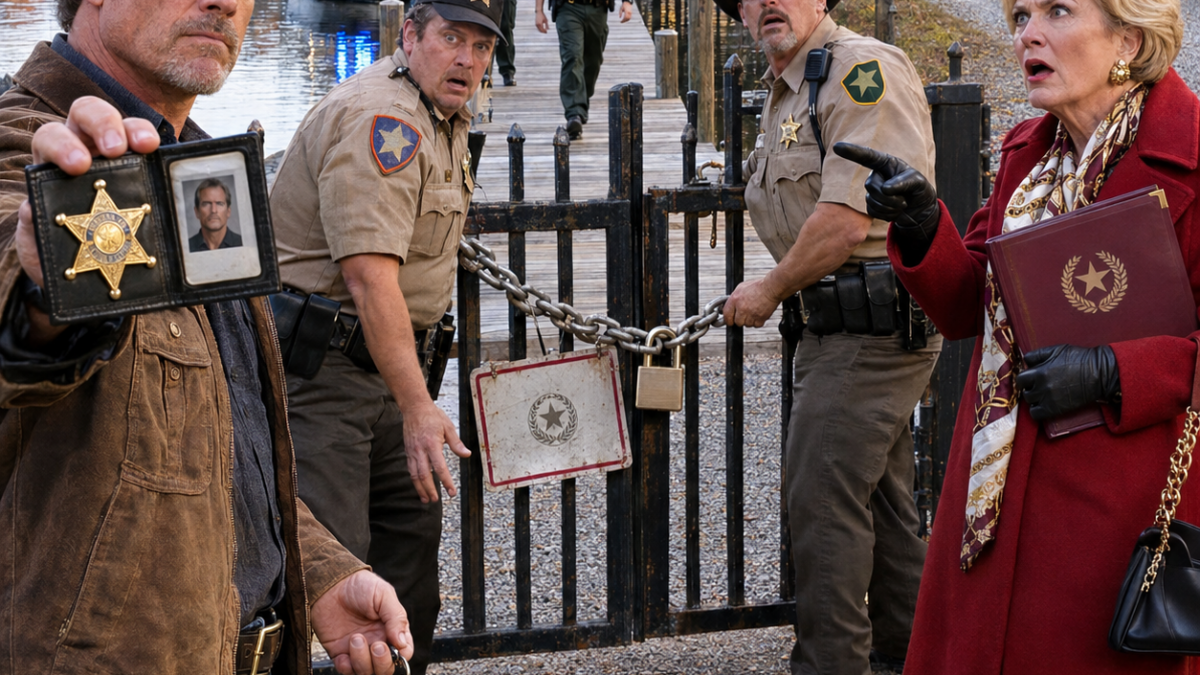
Then I reached inside and placed my credential case on the table.
Badge.
Identification.
CORBIN ALDRIDGE — SHERIFF, BRIDGEWATER COUNTY.
Sloan stared.
At the badge.
At me.
Back to the badge.
Her attorney stopped breathing for about two seconds.
I said:
“Corbin Aldridge.”
Pause.
“Sheriff of Bridgewater County.”
Sloan’s face emptied.
For six weeks, my name had been in newspapers.
Campaign notices.
County announcements.
She knew the sheriff’s name.
She just had not connected it to the man in faded jeans who maintained his own dock.
“You…”
She stopped.
I waited.
“You never said.”
“You never asked.”
Her attorney whispered:
“Sloan.”
I continued.
“You may not have known who I was when you arrived.”
She looked at me.
“But the men you hired claimed they worked for my office.”
Sloan recovered faster than I expected.
People like her often do.
Instead of apologizing, she attacked.
“This proves exactly why this investigation is improper.”
Ellis leaned back.
“How?”
“The sheriff has a financial interest in the property.”
“Yes.”
“And now law enforcement is targeting the HOA.”
“I’m state police.”
“You’re here because he called you.”
“He called because individuals impersonated deputies.”
Sloan pointed at me.
“He is using his office to bully us.”
Ellis wrote something.
Then said:
“For the record, Sheriff Aldridge requested state jurisdiction specifically because he is the property owner.”
Her attorney touched her arm.
She ignored him.
“You expect me to believe he isn’t controlling this?”
I finally answered.
“You don’t have to believe anything.”
I gestured toward Ellis.
“That’s why he has the evidence.”
I made no demand for her arrest.
No threat.
No order.
I wanted the case clean.
Who created the forged seizure document?
Who hired Voss?
Who paid him?
Who forged my signature?
Who submitted anything to the county?
Facts.
Not revenge.
As Ellis packed his notes, his phone buzzed.
A technician who serviced the HOA office wanted to talk.
That technician had seen copies of the fake seizure order sitting in the association printer tray several days before my dock was taken.
That changed the direction.
Voss might have executed the seizure.
Someone inside Silver Crest had prepared paperwork.
On December twenty-first, investigators obtained the original order Voss carried.
Document examiners began pulling it apart.
The case number belonged to no shoreline enforcement matter.
County seal copied from a public website.
Pixels stretched.
Signature:
Mine.
Lifted from a public swearing-in document.
Cleaned digitally.
Pasted.
Ellis called me.
“You recognize this source?”
He showed me the public document.
“That’s my signature.”
“Original?”
“Yes.”
“On this?”
“No.”
He nodded.
“Good.”
That seemed strange.
“Good?”
“Clear comparison.”
The forged signature was bad news.
A clean source comparison was good evidence.
Then the case got worse.
Inside the gala permit application, Leona Bickford, our county fire marshal, found a document titled:
PRIVATE DOCK USE CONSENT.
My name.
My property.
Permission for the association to use Aldridge Landing as part of the gala’s emergency egress and waterborne guest plan.
Another forged signature.
Mine.
I had never seen it.
That page mattered far beyond my property dispute.
Large events require workable access.
Evacuation.
Emergency routes.
Structural capacity.
Silver Crest’s submitted plan counted my private dock as one of its backup exit routes.
If guests needed to evacuate toward the water, the plan assumed they had lawful use of a place they did not own.
Leona called Sloan.
I was not present.
Ellis later played me the recorded summary.
Leona said:
“I need lawful consent for the dock.”
“The permit was approved.”
“Approval based on inaccurate documents does not create lawful access.”
“We have county authorization.”
“Send it.”
“You already have it.”
“I have a page carrying Sheriff Aldridge’s signature that he states is forged.”
Silence.
Then Sloan:
“This is harassment.”
Leona’s voice stayed flat.
“No. It’s a safety review.”
Sloan hung up.
Two hours later, every Silver Crest homeowner received an HOA blast email.
SHERIFF ALDRIDGE ATTEMPTS TO SABOTAGE COMMUNITY CHRISTMAS EVENT OVER PERSONAL PROPERTY DISPUTE.
The email accused me of abusing public office.
It did not mention the forged signature.
Or fake deputies.
Or counterfeit sign.
Sloan’s attorney sent a formal warning demanding that I stop using law enforcement resources to interfere with the gala.
I forwarded everything to Ellis.
No public response.
That was harder than people imagine.
Being sheriff means reputation matters.
A false accusation can still damage trust.
The easy response would have been:
Press conference.
Badge.
Documents.
Destroy her publicly.
I did not.
Instead, I filed a written conflict statement.
I identified myself as the victim.
Requested continued state control of the criminal investigation.
I signed no investigative warrant.
Ordered no criminal search.
Directed no arrest related to the forgery case.
For the property side, I hired Margaret Hollis.
Private attorney.
Property law.
Careful.
She filed as my lawyer.
Not the county’s.
That line became essential.
My badge would not become my weapon.
Sloan mistook restraint for weakness.
On December twenty-second, she held an emergency HOA meeting.
Almost one hundred homeowners filled the clubhouse.
Coffee cups.
Winter coats.
People irritated that their Christmas plans had become legal news.
Sloan stood beneath a giant rendering of the gala.
She projected cropped photographs of me at my own gate with uniformed deputies.
The evidence markers were outside the crop.
State investigator outside the crop.
Counterfeit sign outside the crop.
What remained looked like a sheriff surrounding a neighborhood event site with armed men.
Smart.
Dishonest.
Effective.
“We have two hundred sixty guests,” Sloan said.
“Major sponsors.”
“Businesses.”
“Families.”
She put one hand against her chest.
“And one man believes his personal grievance matters more than everyone else.”
Several residents nodded.
“No sheriff has the right to use his private property to bring this community to its knees.”
One homeowner stood.
“What can we do?”
“File complaints with state authorities.”
Hands rose.
People volunteered.
Sloan smiled.
She believed the first person who told the story loudly owned the truth.
That night, more than thirty complaints were filed against me.
Conflict of interest.
Abuse of office.
Intimidation.
Selective enforcement.
I read every one.
Then forwarded them to the appropriate oversight office myself.
My chief deputy asked:
“Why help them?”
“I’m not helping them.”
“What are you doing?”
“Making sure nobody can say I hid complaints.”
He shook his head.
“You’re enjoying none of this.”
“No.”
“Good.”
“Why good?”
“If you were enjoying it, I’d worry.”
The next morning, Sloan staged a press event outside my chained landing.
She placed a giant red wreath against the gate.
Reporters arrived.
I drove down in jeans.
No uniform.
A reporter asked:
“Sheriff Aldridge, why are you shutting down Christmas?”
“I’m not.”
“Sloan Marfield says you’re blocking the association’s lawful event.”
“I’m objecting to fake police officers taking private property.”
Another reporter asked:
“Why haven’t you arrested anyone?”
“Because arrests should follow evidence and lawful process.”
“Even when they impersonated your deputies?”
“Especially then.”
“Why?”
“Because I’m the victim.”
I pointed toward the gate.
“That is my property.”
Then toward the county.
“And this is my office.”
“I am not mixing them.”
The quote ran that evening.
Sloan responded with another statement accusing me of hiding behind bureaucracy.
She told her board:
“He has a badge.”
Then lifted the gala permit.
“But I have this.”
She did not know Leona had already reopened the permit review.
Or that Ellis had received a call from Silver Crest treasurer Jolene Bradberry.
Jolene had been uncomfortable for weeks.
She had access to the association’s financial records.
She had seen unusual payments.
Project accounts.
Vendor names.
Contracts.
At first she assumed there was an explanation.
Then she saw the fake seizure story unravel.
After the December twenty-second meeting, she sat in her car and called Ellis.
“I think the Christmas party is only part of it.”
The next morning, Jolene entered the state police field office carrying a folder.
Every page came from records she was legally permitted to access as treasurer.
She was not stealing documents.
That mattered.
She laid out contracts.
Twenty-four.
Each sold what Sloan called long-term private marina access rights at Aldridge Landing.
Twenty-four thousand dollars each.
Ellis did the arithmetic.
Five hundred seventy-six thousand dollars.
My dock had eight slips.
Even if Silver Crest owned it—which it did not—Sloan had sold three times more long-term rights than physical slips existed.
Ellis asked:
“Do the buyers know these are the same slips?”
“I don’t know.”
“Where did the money go?”
“Project account.”
“Who controls it?”
“Sloan.”
“Board approval?”
Jolene swallowed.
“Not for every transaction.”
The Christmas gala suddenly made more sense.
Every one of those twenty-four buyers had been invited as VIPs.
Christmas Eve was supposed to include a marina handover ceremony.
Certificates.
Champagne.
Photographs.
Public evidence that the new “Silver Crest Private Marina” existed.
If buyers stood on my dock receiving certificates, Sloan could use those photographs to reassure people long after questions began.
She did not need legal ownership.
She needed the appearance of ownership.
Jolene revealed another payment.
Thirty-eight thousand dollars.
Emergency Property Access and Event Security.
Paid to Clifford Voss’s company.
Attached scope:
Uniformed security presence.
Property-owner control.
Restricted access establishment.
Government-authorized enforcement support.
Not language a normal event-security contract should contain.
Then another problem.
A large portion of gala production costs had gone to an event-planning company partially owned through a business entity tied to Sloan.
Association money.
Sloan-linked vendor.
Private profit.
The investigation was no longer about one dock.
It was about money.
Contracts.
Forged authority.
A project Sloan had already sold.
When Ellis told me the basic findings, I sat quietly.
Then said:
“She didn’t need the party.”
“What?”
“She needed witnesses.”
He looked at me.
I continued.
“Two hundred sixty people.”
“Twenty-four buyers.”
“Photographs.”
“Certificates.”
I shook my head.
“She needed everyone to see the lie at the same time.”
Ellis nodded.
“Yes.”
That afternoon investigators began looking for Clifford Voss.
He stopped answering.
His office locked.
Rental SUV overdue.
Second fake deputy identified as Travis Keer.
Private guard.
Not sworn.
Also missing.
Sloan sent a final message to guests:
THE CHRISTMAS HARBOR GALA WILL PROCEED EXACTLY AS SCHEDULED.
She doubled down.
Christmas Eve morning, Leona Bickford arrived at the shoreline with Franklin Beexley, an independent marine engineer.
I was not part of the inspection.
Again:
Clean lines.
Franklin found the floating stage already lashed against my dock.
Lighting rigs.
Speakers.
Generator.
Equipment cases.
Pilings taking lateral loads they had never been designed for.
The gangway was rated for normal private use.
Not hundreds of guests.
Leona found the most dangerous detail.
Decorative panels and stage scaffolding partially blocked one road exit.
The other emergency path relied on my dock.
A dock they did not lawfully control.
If fire broke out, generator failed, crowd panicked, or the stage shifted, the evacuation plan would funnel people into an unapproved space.
Leona asked the event manager:
“Who approved this layout?”
“President Marfield.”
“Where’s the revised safety plan?”
“This is the plan.”
“It doesn’t match what was submitted.”
The manager looked nervous.
Leona issued a closure notice pending correction.
At the same time, Margaret stood before Judge Sylvia Northam with my deed.
Survey.
Camera footage.
Counterfeit seizure order.
Fake consent.
The judge was careful.
She did not decide criminal guilt.
That belonged elsewhere.
But she did find grounds to protect the property.
Temporary order:
Silver Crest could not occupy Aldridge Landing.
Could not place guests or equipment there.
Could not rely on the fake seizure documents.
Could not treat the dock as association property.
The HOA remained free to hold a lawful event on land it actually controlled.
Important distinction.
Nobody was “banning Christmas.”
At three in the afternoon, Sloan received both the court order and Leona’s event closure notice.
Witnesses later said she tore the safety notice in half.
Then told event staff:
“Finish the stage.”
One manager asked:
“What if officials come tonight?”
Sloan smiled.
“There will be two hundred sixty guests.”
Pause.
“Nobody will dare shut us down in front of everyone.”
That assumption became her final mistake.
Across town, Ellis, Leona, Margaret, county counsel, my chief deputy, and I met around a conference table.
We divided responsibilities.
Ellis:
Criminal investigation.
Leona:
Safety order.
Margaret:
Property court order.
My role:
Maintain public order.
Support lawful enforcement.
Protect guests.
No revenge.
No dramatic arrest on stage just because it would feel satisfying.
If the event had to end, people would leave safely.
Qualified technicians would handle electrical shutdown.
Marine patrol would manage yachts.
Deputies would not argue with guests.
Nobody arrested for complaining.
At 6:40 p.m., I stood in my office and put on my uniform.
For the first time in the entire dispute, I pinned the sheriff’s star to my chest for a purpose connected to Sloan.
Not to win my property.
The judge had already handled that.
Not to lead the fraud case.
Ellis had that.
To keep two hundred sixty people safe while lawful orders were enforced.
I looked at myself in the mirror.
Old habit.
Badge straight.
Body camera on.
Radio tested.
Then I thought about 5:17 five mornings earlier.
Voss telling me:
If you have a problem, call the sheriff.
I almost smiled.
Christmas lights were already glowing across Cold Water Lake.
Thousands.
Silver Crest looked beautiful.
That was the dangerous thing about appearances.
At seven, the gala was fully alive.
Tuxedos.
Sequined gowns.
Champagne.
String quartet.
Yachts covered in white lights.
An illuminated sign above the waterfront:
WELCOME TO SILVER CREST PRIVATE MARINA.
My marina.
According to Sloan.
She stood on the stage in a silver gown.
Twenty-four buyers sat near the front.
Their certificates were arranged on a velvet-covered table.
Sloan raised a champagne flute.
“Tonight, we are not only celebrating Christmas.”
Applause.
“We are witnessing the birth of the finest private marina on Cold Water Lake.”
More applause.
Behind them, patrol vehicles entered quietly.
No sirens.
No dramatic lights.
Guests did not need panic.
I stepped out.
Ellis beside me.
Leona.
Deputies.
A private security guard moved to stop us.
I showed my badge.
“Sheriff’s office.”
His eyes widened.
“We need to speak with whoever is in charge.”
He looked toward the stage.
Sloan saw me.
Her sentence stopped halfway.
The quartet continued for another five seconds.
Then faded.
She forced a smile.
Into the microphone:
“Sheriff Aldridge.”
The crowd turned.
“Have you finally decided to join us?”
I walked closer.
“No, ma’am.”
Her smile tightened.
“I’m here to ensure the closure order is carried out safely.”
The room—or lawn, really—changed.
Conversation stopped in waves.
Sloan raised her voice.
“This is exactly the abuse I warned everyone about.”
Leona stepped forward.
“Leona Bickford. County fire marshal.”
Sloan ignored her.
“He is using police power over a private disagreement.”
Leona spoke again.
“This event area was suspended for uncorrected safety violations.”
Sloan pointed toward me.
“He forced that decision.”
Leona’s expression did not move.
“No.”
Then Ellis identified himself.
“State police.”
Murmurs.
He said:
“Forged government documents connected to this event are under independent investigation.”
Sloan’s face tightened.
Then she made the worst possible choice.
She doubled down publicly.
“The sheriff’s office already granted Silver Crest possession of the dock.”
I looked at her.
“Are you referring to the order with my signature?”
She lifted her chin.
“Yes.”
I turned slightly toward the nearest tables.
“That signature is forged.”
The silence became physical.
Someone dropped a glass.
I continued.
“The sheriff’s office never issued that order.”
People looked from Sloan to me.
“Two men came to my private dock wearing uniforms designed to look like Bridgewater County deputies.”
Now twenty-four buyers were listening very carefully.
“They told me they had been sent by Sheriff Corbin Aldridge.”
Pause.
“I am Corbin Aldridge.”
I touched the badge.
“I never sent them.”
The murmur rolled through the crowd.
Sloan’s attorney appeared near the stage.
He looked as though he wanted to disappear into the lake.
A buyer stood.
“What does this mean for the marina certificates?”
Sloan snapped:
“Sit down.”
That was not a good answer.
Another buyer:
“Does the HOA own that dock?”
I answered:
“No.”
Sloan shouted:
“Do not answer my guests.”
I looked at her.
“They asked about my property.”
Leona instructed the event staff to cease activities subject to the safety closure.
The sound system switched to a calm announcement.
Guests were directed toward the safe road exit.
Deputies removed no one by force.
Technicians kept essential walkway lights on.
Then shut decorative circuits section by section.
The shoreline dimmed slowly.
String quartet stopped.
Singer canceled.
Vendors closed.
Marine patrol directed the yachts away from unapproved moorings.
The giant SILVER CREST PRIVATE MARINA sign flickered.
Then went dark.
Sloan stood on stage watching months of planning disappear one circuit at a time.
“You cannot destroy my Christmas!”
Her voice carried without the microphone.
I answered:
“You turned it into the scene of a fraud.”
She stared.
“I’m making sure people leave safely.”
Her attorney grabbed her arm.
“Stop talking.”
She pulled away.
“File something.”
“Sloan.”
“File an emergency motion.”
“Sloan, stop.”
One of her own board members pushed forward.
“How many dock rights did you sell?”
Her face changed.
“What?”
“How many?”
No answer.
“Do we even own Aldridge Landing?”
I took a folded certified ownership map from my coat.
“No.”
I opened it.
“It never belonged to Silver Crest.”
Guests began pulling out phones.
The twenty-four buyers started comparing contracts.
One man looked at another.
“You have Slip Four?”
The second man frowned.
“I have Slip Four.”
That was almost the perfect summary of the fraud.
At 7:26 p.m., the gala ended.
No handover ceremony.
No certificates.
No singer.
No fireworks.
Guests left safely.
That was the most important part.
Not one injury.
Not one panic.
Not one needless arrest.
Sloan remained standing on the darkened stage.
Around her:
Buyers.
Board members.
Attorneys.
Questions.
She finally had the audience she wanted.
Just not the story.
At 7:31, Ellis received a message.
Clifford Voss had been located.
Motel two counties away.
Rental SUV behind a dumpster.
Magnetic decals removed.
Warning lights in the back.
Uniforms.
Counterfeit patches.
Investigators arrested him under proper authority.
At his company office, they found the contract with Silver Crest.
The landing takeover described as a:
government-authorized enforcement action.
Client signature:
Sloan Marfield — HOA President.
Clifford initially blamed Sloan.
Then blamed misunderstanding.
Then claimed he believed everything was lawful.
Phone records and payments made that difficult.
Eventually, he produced something he had kept.
A voice message.
Forensic analysts verified it.
Sloan’s voice.
Clear.
She instructed Clifford that the team had to look “exactly like county officers.”
She told them to put the county-controlled sign on my gate before decorators arrived.
Then:
If the dock owner asks, just tell him it’s an order from the sheriff’s office. He’ll have to back down.
That sentence ended her final plausible defense.
She had not been fooled by Voss.
She had directed the impersonation.
Money completed the picture.
Twenty-four marina contracts.
Five hundred seventy-six thousand dollars.
Thirty-eight thousand paid to Clifford’s company.
Hundreds of thousands committed to gala production and related services.
Payments to Sloan-linked event businesses.
Association funds.
Private interests.
Documents signed after I had refused in writing.
Evidence that she knew Silver Crest did not own the dock yet kept selling access anyway.
That was the line.
Bad business can fail.
Ambitious projects can collapse.
People can misunderstand property boundaries.
But continuing to sell rights after knowing they do not exist is different.
Forging signatures is different.
Hiring men to mimic deputies is different.
Sloan tried one final explanation.
Clifford went rogue.
He chose the uniforms.
He created the paperwork.
She had trusted contractors.
The recording disagreed.
The contract disagreed.
Payment records disagreed.
Printer evidence disagreed.
Permit file disagreed.
Jolene’s records disagreed.
When Ellis’s team finished assembling the case and the district attorney approved the appropriate charges, Sloan was arrested.
Not at the height of the gala.
Not because I wanted spectacle.
After the last guests had gone.
She still wore the silver gown beneath a borrowed winter coat.
I stood near one patrol vehicle because I was coordinating the remaining public-safety presence.
She saw me.
“All this?”
She almost spat the words.
“Because you wouldn’t share one lousy dock?”
I looked at her for a moment.
“No.”
She waited.
“All this happened because you thought you could buy the authority of the law.”
For once, she had no answer.
Christmas morning, Silver Crest Shores woke to a very different holiday.
The twenty-four buyers called attorneys.
The board scheduled an emergency session.
Independent audit.
Legal review.
Jolene’s records became central.
Funds connected to the disputed marina scheme were traced and preserved through lawful process.
Vendors wanted payment.
Buyers wanted refunds.
The HOA needed to separate legitimate event expenses from Sloan’s personal transactions.
The first audit report was ugly.
Five hundred seventy-six thousand dollars in dock-right contracts.
Thirty-eight thousand dollars to Clifford’s security company.
More than three hundred thousand dollars committed to event production and decoration.
Additional legal, audit, and restoration costs.
Not every dollar would become a final loss.
Some contracts could be refunded.
Some vendor amounts disputed.
Some assets recovered.
But the exposure was enormous.
Silver Crest homeowners who had cheered Sloan’s promise of a prestigious marina suddenly understood that her ambition had put their association’s finances at risk.
A special meeting was called under the bylaws.
Proper notice.
Agenda.
Member vote.
Sloan’s executive authority was suspended.
Then recall.
She lost.
The same homeowners she had urged to file complaints against me voted her out.
I did not celebrate.
I had learned something during the case.
An HOA is not one person.
Jolene was the HOA too.
So were residents who asked questions.
Board members who demanded the audit.
People who had believed Sloan and later corrected themselves.
Treating everyone as the enemy would have been easy.
It also would have been wrong.
My gate came next.
The fake lock was removed.
Counterfeit sign came down.
Unauthorized fixtures removed.
Marine engineer inspected the pilings.
The floating stage had placed stress on hardware.
Repairs were needed.
Those costs became part of the appropriate claims and legal process.
No one transferred ownership back to me.
Because ownership had never left.
That distinction mattered.
People kept saying:
“You got your dock back.”
No.
I got access back.
The dock had always been mine.
Property does not become someone else’s because they put a convincing sign on it.
A few weeks later, Aldridge Landing was quiet.
Normal.
Lake rescue volunteers stopped by.
A couple local fishermen.
Ellis.
Leona.
Jolene.
Someone suggested a small thank-you gathering.
I agreed.
Folding chairs.
Coffee.
One strand of lights.
No stage.
No VIP lounge.
No yacht ceremony.
No speeches about prestige.
Just people standing beside the lake laughing about the strangest December we could remember.
Jolene looked at the water.
“I almost didn’t call.”
I turned.
“Why?”
“I thought maybe I misunderstood the accounts.”
“You were treasurer.”
“That made it worse.”
“How?”
“I thought if I didn’t understand them, maybe I was bad at my job.”
Ellis said:
“That is exactly why complicated fraud works.”
Jolene nodded.
“Sloan always had an explanation.”
I asked:
“When did you stop believing her?”
“The dock contracts.”
“Why?”
“Twenty-four.”
She pointed toward the slips.
“You have eight.”
Simple arithmetic.
Sometimes evidence is complicated.
Sometimes it is eight slips and twenty-four buyers.
Leona drank coffee.
Then said:
“My part was easier.”
“How?”
“Crowd capacity doesn’t care about personality.”
That made me smile.
Fire codes are wonderfully unimpressed by social status.
A few days after Christmas, I received notice of the next criminal hearing.
I read it.
Put it in a folder.
Locked the drawer.
I refused to declare victory before courts completed their work.
That also mattered.
Charges are not convictions.
Investigation is not a sentence.
My responsibility as sheriff required me to respect that line even when I personally believed the evidence was overwhelming.
The public wanted dramatic quotes.
I gave them boring ones.
“The matter is before the court.”
“The investigation remains with state authorities.”
“I will not comment on evidence beyond public filings.”
Reporters hated it.
Good.
My dock case was not entertainment.
Sloan’s actions created real victims.
The twenty-four buyers had paid real money.
Silver Crest homeowners faced real financial risk.
Clifford and Travis faced real criminal allegations.
And my office’s name had been used to frighten a private citizen.
Me.
That part remained strange.
For weeks, people joked:
“They picked the wrong dock.”
I understood the humor.
But something about it bothered me.
What if I had not been sheriff?
That question kept returning.
What if Aldridge Landing belonged to a retired teacher?
Widow?
Young family?
Someone unfamiliar with law enforcement?
Someone who saw two uniforms and a government seal and believed surrender was mandatory?
The fake order should have failed regardless of who owned the dock.
My badge made the irony dramatic.
The crime mattered without the irony.
That was why I asked Ellis whether the state planned outreach to other recent clients of Clifford’s company.
“We’re reviewing.”
“Good.”
“Think there are others?”
“I think anyone willing to imitate deputies once might have tried intimidation before.”
The review found other questionable security practices.
Nothing identical.
Still useful.
The sheriff’s office changed some procedures too.
We published a public verification guide.
How to confirm whether a deputy is real.
How warrants and property orders work.
What the sheriff can and cannot do.
Where to call.
No law-enforcement officer in Bridgewater County would be offended if a citizen independently verified authority during a non-emergency property enforcement situation.
I told my deputies:
“If someone asks your name and badge number, give it.”
One deputy joked:
“Because of Voss?”
“Because it was always the right answer.”
We also redesigned parts of our public patch guidance to help event-security companies avoid confusing insignia.
The county attorney reviewed regulations regarding emergency lighting.
None of that was glamorous.
That is what reform usually looks like.
Small safeguards after someone proves why they are needed.
The state eventually resolved the cases against the principal players through the legal process.
Clifford faced consequences for impersonation-related conduct and forged-document use.
Travis’s responsibility was handled according to what investigators could prove he knew and did.
Sloan faced charges tied to conspiracy, forgery, and fraud.
Some counts were stronger than others.
Some allegations were negotiated.
I did not control the charging decisions.
That was exactly how it should be.
What mattered to me was that the final public record no longer described the December nineteenth event as an “HOA access dispute.”
It described what actually happened.
Private security personnel dressed to resemble deputies.
A counterfeit county order.
A forged sheriff signature.
A private dock seized without authority.
Those facts could not be polished back into a misunderstanding.
The marina buyers eventually recovered significant portions of their money through traced funds, insurance issues where applicable, settlements, and legal claims.
Not instantly.
Not perfectly.
A few lost money in costs and delays.
That was another thing I refused to romanticize.
Fraud damages people even when the fraudster is caught.
Time.
Legal fees.
Trust.
Embarrassment.
One buyer came to see me months later.
Name was Leonard Price.
Sixty-one.
Owned a medical-device company.
He had bought what Sloan called a ten-year premium slip right.
Twenty-four thousand dollars.
He stood beside my dock.
“I feel like an idiot.”
“You’re not.”
“I signed a contract for something she didn’t own.”
“She showed you documents.”
“I should’ve checked.”
“Yes.”
He looked at me.
That answer surprised him.
“You’re not going to tell me anyone could’ve been fooled?”
“Anyone can be fooled.”
I pointed toward the slips.
“But checking still matters.”
He nodded.
“I wanted it to be true.”
That was the sentence.
Fraud does not survive only because victims are ignorant.
It survives because the lie offers something people want.
Prestige.
Profit.
Urgency.
Relief.
Sloan sold more than dock rights.
She sold belonging to an exclusive marina that did not exist.
People paid partly because the fantasy felt good.
That did not make them responsible for her fraud.
But it explained why the lie moved quickly.
Silver Crest changed after Sloan.
Jolene was not interested in becoming president.
Neither was I surprised.
The board selected an interim leader.
Then held a proper election.
Financial controls tightened.
Two signatures for large expenditures.
Independent review for projects involving property outside HOA boundaries.
Conflict disclosures for board members with vendor relationships.
Contracts over a set amount had to be available to members.
No president could independently commit the association to a real-estate or marina transaction.
Again:
Boring.
Wonderful.
I was invited to speak at one meeting.
I declined at first.
Then Jolene called.
“Please.”
“Why?”
“Some residents still think the HOA lost because you’re sheriff.”
I understood.
That bothered me too.
So I attended.
No uniform.
I stood at the front.
About seventy residents.
I said:
“Your association did not lose a fight with the sheriff.”
Quiet.
“It had a president who claimed rights the association did not own.”
I held up my deed.
“This would have been my deed if I sold insurance.”
Laughter.
Good.
“Ownership did not depend on my job.”
Then:
“The fake order would have been fake if I were unemployed.”
More quiet.
“The uniforms would have been fake if I were a plumber.”
I looked around.
“The point is not that Sloan picked the wrong victim.”
Pause.
“The point is that no property owner should have to be the sheriff to make ‘no’ mean no.”
That was the only speech from the whole case that I kept.
Not because it sounded good.
Because I meant it.
Afterward, an older woman approached.
“I filed a complaint against you.”
“I know.”
She looked embarrassed.
“I’m sorry.”
“You believed information from your president.”
“I should’ve checked.”
“Yes.”
She smiled.
“You don’t make apologies easy.”
“I accept it.”
That was enough.
Another resident asked:
“Do you hate our neighborhood?”
“No.”
“Really?”
“Yes.”
“After all this?”
“Sloan made decisions.”
“So did people who voted for her.”
“Yes.”
He waited.
I continued.
“Then people voted her out.”
He nodded.
That was the difference.
Organizations can correct themselves.
Slowly.
Painfully.
But they can.
A year later, Silver Crest held another Christmas gathering.
Small.
On association property.
No yachts.
No fake marina.
They invited me.
I almost did not go.
Then Leona said:
“You should.”
“Why?”
“Because normal is useful.”
So I went.
Wore a sweater.
No uniform.
The party had a tent.
Hot cider.
Local choir.
Children.
At one point, the new president approached.
“We thought about fireworks.”
“No.”
He laughed.
“Fire marshal said the same.”
Leona raised her cup across the lawn.
I smiled.
I stayed forty minutes.
Then walked home along the lake.
My dock lights reflected on the water.
That was healing too.
Not making Silver Crest disappear.
Letting it become a neighborhood again instead of Sloan’s symbol.
The fake COUNTY CONTROLLED PROPERTY sign remained in evidence for a long time.
When the case no longer required it, Ellis asked if I wanted it back.
“For what?”
“Souvenir.”
“No.”
He laughed.
“You sure?”
“Very.”
The forged order was different.
I kept a certified copy.
Not framed.
Folder.
Office drawer.
Sometimes I used it in deputy training.
I would hand it to a new supervisor.
“Tell me what’s wrong.”
They usually found:
No issuing court.
No statute.
Improper seal.
Wrong authority.
Then I pointed to the signature.
“That’s mine.”
People always looked up.
Then I asked:
“What makes this dangerous?”
A recruit once answered:
“Because it looks real.”
Exactly.
Counterfeit authority works in the gap between appearance and verification.
Voss did not need to pass inspection inside my sheriff’s office.
He needed a frightened property owner to see a uniform and obey before asking questions.
That lesson applied beyond my case.
I also kept a copy of the forged dock-consent form.
Same reason.
Real signatures can be copied.
Official seals downloaded.
Professional formatting purchased cheaply.
Paper is evidence only after verification.
Sloan knew that.
She weaponized appearance.
Her biggest mistake was assuming I would react emotionally enough to contaminate the investigation.
She wanted me angry.
Public.
Aggressive.
Imagine what her narrative would have looked like if I had personally arrested her December nineteenth.
SHERIFF ARRESTS HOA PRESIDENT DURING PERSONAL PROPERTY DISPUTE.
Imagine if my deputies had executed searches.
COUNTY RESOURCES USED TO PROTECT SHERIFF’S PRIVATE BUSINESS.
She would still have been wrong.
But she would have created reasonable questions about me.
Restraint denied her that defense.
That was probably the hardest part.
People think authority feels powerful.
Often authority means being the person who must do less when doing more would feel better.
My chief deputy once asked:
“You ever wish you’d shown Voss the badge that first morning?”
“Yes.”
“How often?”
“Every time I remember his face.”
He laughed.
“What would you have said?”
I thought.
Probably something childish.
Then:
“Maybe nothing.”
Because the image itself would have been satisfying.
Voss saying:
Go call the sheriff.
Me opening the credential.
That would have made a great movie scene.
But if I had done it, he might have fled.
Sloan might have destroyed records sooner.
The forged permit trail might have changed.
Clifford might have called ahead.
Jolene might never have come forward.
Sometimes not taking the satisfying moment gives you the stronger ending.
Christmas after the case, I was at the landing before dawn again.
Same time.
5:17.
Not intentionally.
My body remembered.
Frost.
Gray lake.
No SUVs.
I walked to the gate.
New lock.
My lock.
Then I noticed how ordinary the morning felt.
That made me stop.
Trauma is an overused word sometimes.
But there is something real about having your own property suddenly feel unsafe.
For weeks after the seizure, headlights on the access road made my shoulders tighten.
Uniformed private guards irritated me more than they should.
I checked the gate twice.
Then three times.
Eventually that faded.
The dock returned to being the place I came to think.
Not the place men dressed as my deputies took from me.
One Saturday, a father and teenage son approached from the lake in a small fishing boat.
Engine trouble.
They asked if they could tie up temporarily.
“Of course.”
The boy recognized me.
“You’re Sheriff Aldridge.”
“Yes.”
“Is this the dock from the Christmas thing?”
His father said:
“Tyler.”
“What?”
“Don’t be rude.”
I laughed.
“It’s fine.”
The boy looked at the gate.
“Where’s the fake sign?”
“Gone.”
“Did you keep it?”
“No.”
“Why not?”
I pointed toward the water.
“Because I’d rather this place be a dock.”
He thought.
Then nodded.
His father fixed the fuel line.
They left.
Simple.
That interaction stayed with me.
Places can become famous for what happened to them.
People too.
If you are not careful, the worst event becomes the identity.
I did not want Aldridge Landing to become the fake-deputy dock.
It was eight slips.
A gangway.
A place to fish.
A place rescue boats could temporarily tie during drills.
A place I drank coffee.
That was enough.
The small metal plaque came later.
I almost did not install one.
Then Margaret suggested:
“Something clear.”
“Private property?”
“Could prevent future ambiguity.”
“There was never ambiguity.”
“No.”
She smiled.
“But clarity is cheap.”
So I ordered a plaque.
Not flashy.
Brushed metal.
ALDRIDGE LANDING — PRIVATE PROPERTY.
Below it:
OWNERSHIP IS NOT AUTHORITY, AND AUTHORITY CANNOT BE FORGED.
Ellis mocked me.
“Little dramatic.”
“You investigated fake deputies at my dock.”
“Fair.”
I screwed it into the same post where Sloan’s counterfeit county sign had hung.
Four steel screws.
Then stood back.
The plaque did not make me feel victorious.
It made the gate look finished.
That was better.
There was one part of the story I struggled with longer than expected.
Sloan’s motivation.
People wanted a simple answer.
Greed.
Power.
Narcissism.
Maybe.
But the records told something more specific.
She wanted Silver Crest to become prestigious.
The marina project would raise the neighborhood’s status.
Her event business could profit.
Buyers would fund the project.
The gala would prove success.
Then I said no.
My no did not fit the story she had already sold.
So she began treating the obstacle as illegitimate.
First:
Historic access.
Then:
Safety authority.
Then:
County approval.
Then:
Emergency possession.
Each lie solved the weakness of the previous lie.
That is how fraud grows.
Not always one giant invention.
Often a chain of smaller substitutions.
I don’t have permission.
Becomes:
I will soon.
Then:
I probably have implied permission.
Then:
The community needs it.
Then:
The county supports it.
Then:
Here is a document saying the county supports it.
Then:
Here are two men dressed like the county.
Each step makes the next feel less outrageous to the person already committed.
Jolene told me that during the audit.
“She stopped saying ‘if we get the dock.’”
“When?”
“Early December.”
“What did she say?”
“When the marina opens.”
Language changed before ownership did.
That was another warning sign.
Sloan had started speaking about my property as settled before any legal right existed.
Once people around her accepted the language, reality became easier to replace.
Board minutes said:
marina access coordination.
Not:
attempting to obtain permission from Aldridge.
Budget said:
dock security.
Not:
private property not owned by association.
Little words.
Big consequences.
I told the new board:
“When a project depends on property you don’t own, write the owner’s name into every plan.”
They did.
Simple safeguard.
Years later, Sloan’s name rarely came up.
That was healthy.
People moved.
New families arrived.
Children who had been toddlers during the gala grew older.
The darkened stage story became local Christmas folklore.
Some versions absurd.
One claimed I arrived by patrol boat with twenty deputies.
No.
Another said Sloan tried to escape on a yacht.
No.
Someone insisted Clifford drew a gun.
Absolutely not.
The truth was better.
Nobody needed gunfire.
Nobody needed a chase.
The evidence had been building for days.
By Christmas Eve, the most dramatic thing was watching a woman who depended on performance discover that paperwork was stronger than performance.
One buyer asked for a refund before the last decorative circuit went dark.
That image still makes me smile slightly.
Not because he lost money.
Because the illusion vanished that quickly.
Ten minutes earlier:
Exclusive private marina.
Ten minutes later:
“Who do I call about my twenty-four thousand dollars?”
Truth can be sudden after a long buildup.
My office benefited from the scrutiny too.
State authorities reviewed the complaints Sloan encouraged.
No abuse finding.
No improper criminal direction.
No misuse of office.
That mattered personally.
But I was glad the review happened.
Public trust should not depend on me saying:
Trust me.
The investigation showed records.
Recusal.
Delegation.
Body-camera logs.
Written directives.
That cleared the office more effectively than any press release.
My deputies learned from it.
One young deputy told me:
“I thought recusal meant weakness.”
“What do you think now?”
“Protection.”
“Of who?”
He considered.
“Everybody.”
Exactly.
Sloan’s accusation that I was conflicted was not completely absurd.
I was conflicted.
That is why I stepped away from the criminal investigation.
Recognizing a conflict does not mean surrendering your rights.
It means handling them through the correct channel.
That became one of my favorite lessons from the whole mess.
You can be a sheriff and still be a citizen.
You can own property and still respect investigation boundaries.
You can defend yourself without turning public authority into a private weapon.
Sloan believed power meant using every tool available.
I learned power often meant refusing to use the wrong tool.
A year after the gala, Leona retired.
Small reception.
County building.
Cake.
Bad coffee.
I asked her what she remembered most.
She said:
“The generator.”
“What?”
“On that floating stage.”
“Why?”
“It was too close to decorative fabric.”
I laughed.
“Of everything?”
“Yes.”
“Fake deputies?”
“Not my department.”
“Fraud?”
“Not my department.”
“Two hundred sixty guests?”
“My department.”
She smiled.
“Everybody thinks dramatic cases are about dramatic facts.”
“What are they about?”
“The boring thing that kills someone if nobody notices.”
That was Leona.
The event could have become physically dangerous.
That part often disappeared behind the forgery story.
But it mattered.
Sloan’s desire to force the gala forward did not only violate ownership.
It compromised safety.
Scaffolding blocked one exit.
My dock was counted without permission.
Gangway overloaded.
Stage lashings inappropriate.
If something failed, innocent guests would have paid.
Ending the event safely was not punishment.
It was prevention.
That was why I never apologized for the shutdown.
Even if the fraud case had vanished the next morning, Leona’s closure would still have been correct.
Public anger does not rewrite load calculations.
I kept the lake quiet for a while after that.
No large events.
No rentals.
Eventually, I did allow a charity fishing fundraiser to use two slips.
Twenty-five people.
Daylight.
Written agreement.
Insurance.
Load limits.
No floating stages.
The organizer laughed.
“You’re very specific.”
“I’ve had experiences.”
We signed.
Event went perfectly.
That also taught me something.
The answer after boundary violations is not always permanent refusal.
Trust can be rebuilt through process.
Permission can exist where coercion failed.
The difference is consent.
Sloan never understood that.
She believed if an outcome was useful enough, permission became a technicality.
It doesn’t.
Whether it is a dock, driveway, lawn, access road, or shoreline, ownership is not a community suggestion.
I said no.
That should have ended the use of my property.
Everything afterward came from refusing to accept that answer.
The day the final marina-related civil claims were largely resolved, Margaret called me.
“You can stop keeping this on your kitchen table.”
I looked down.
Folders.
Contracts.
Copies.
Notes.
For months, my kitchen had become a second office.
“What am I supposed to put there?”
“Food?”
“Radical.”
“Try it.”
That evening, I moved the documents into a filing cabinet.
Then made dinner.
Nothing special.
Soup.
Bread.
I ate at the table.
No forged signatures beside the salt.
That was a milestone nobody photographed.
The case papers stayed available.
But they stopped occupying the center of my home.
People need that moment after conflict.
The records remain.
The conflict moves out.
Christmas two years later, snow fell lightly over Cold Water Lake.
Silver Crest had another neighborhood party.
Quiet music carried across the water.
I stood at my gate with coffee.
Their lights reflected beside mine.
No resentment.
No urge to prove anything.
Just distance.
Jolene had moved away by then but sent a card.
Leona was retired.
Ellis still worked too much.
Margaret continued billing in six-minute increments with merciless precision.
My chief deputy joked that I had finally stopped checking the dock camera every ten minutes.
He was wrong.
It was every twenty.
Progress.
At 5:17 the next morning, I woke naturally.
Walked down to the landing.
Frost.
Still water.
Same gray sky as the morning Sloan took it.
I checked the mooring lines.
One.
Two.
Three.
Routine.
When I reached the post, I brushed frost off the plaque.
ALDRIDGE LANDING — PRIVATE PROPERTY.
Below:
OWNERSHIP IS NOT AUTHORITY, AND AUTHORITY CANNOT BE FORGED.
I remembered Clifford telling me:
Go complain to the sheriff.
I could finally laugh.
Quietly.
Not because I was sheriff.
Because he had believed authority could be manufactured with a patch, lights, and a printed page.
Sloan believed the same thing.
She thought the appearance of authority was enough.
For a few days, it almost was.
Then people started checking.
Ellis checked the order.
Leona checked the permit.
Margaret checked the deed.
Jolene checked the money.
Franklin checked the load.
Buyers checked their contracts.
Board members checked what Sloan had actually approved.
Once everyone checked the thing in front of them instead of trusting the confident person describing it, the entire structure fell apart.
That was the real justice.
Not the handcuffs.
Not the recall.
Not the darkened gala.
Verification.
The truth did not need a bigger performance than Sloan’s.
It only needed enough people willing to ask:
Where is the authority for this?
And:
Who actually signed it?
And:
Who owns this property?
And:
Where did the money go?
Sloan had answers when nobody asked to see proof.
Once they did, she had none.
Years later, people still tell me she made one fatal mistake:
She tried to forge the sheriff’s signature without realizing the property owner was the sheriff.
It is a good line.
It is not the lesson I want remembered.
Her mistake was not choosing the wrong man.
Her mistake was believing the law was something she could imitate until other people surrendered.
If Aldridge Landing had belonged to someone else, the forgery would still have been wrong.
The fake deputies would still have been wrong.
The marina contracts would still have sold rights that did not exist.
The permit would still have relied on false consent.
The safety problems would still have endangered guests.
I just happened to be standing there when the lie wore my own name.
That made it easier for me to recognize.
It did not make it more illegal.
So whenever someone tells the story and says:
“She picked the wrong homeowner.”
I correct them.
“No.”
They look surprised.
“She made the wrong choice.”
“What choice?”
“To believe somebody else’s rights stopped mattering because they interfered with what she wanted.”
That was the beginning.
Everything else was paperwork.
One winter afternoon, a new family from Silver Crest walked down to the landing.
Mother.
Father.
Two kids.
They stopped at the gate.
The father called out.
“Sheriff?”
I came from the office.
“What can I do?”
“Our son’s fishing lure is stuck on your side.”
The boy looked terrified.
“Sorry.”
I opened the gate.
“Come get it.”
The father paused.
“We can?”
“You asked.”
That was all.
The boy retrieved the lure.
Then stared at the plaque.
“What does that mean?”
He read:
“Authority cannot be forged.”
His mother looked uncomfortable.
I smiled.
“It means a piece of paper isn’t powerful just because someone makes it look official.”
He thought.
“Like fake money?”
“Pretty close.”
He nodded.
Then ran back toward his parents.
The gate closed behind them.
Unlocked from my side.
Mine.
Normal.
I watched them walk uphill toward Silver Crest.
Then I looked across the lake.
Sunset turned the water orange.
Nothing dramatic happened.
No deputies.
No reporters.
No courtroom.
No applause.
Just a dock doing what a dock was built to do.
That became my favorite ending.
Because Sloan had tried to turn Aldridge Landing into evidence of her power.
A VIP arrival.
A marina.
A stage for people to believe her.
Instead, after every document was checked and every light went dark, it became mine again in the only way that really mattered.
Quiet.
Ordinary.
Unquestioned.
The law did not give me that dock.
My deed did.
The badge did not make my refusal valid.
Ownership did.
And Sloan’s downfall did not come because the real sheriff was stronger than the fake deputies she hired.
It came because authority has a source.
A court.
A statute.
A lawful office.
A real signature.
A real record.
She tried to manufacture all of them.
For five days, she believed she had succeeded.
Then on Christmas Eve, standing beneath a sign that called my property Silver Crest Private Marina, she finally saw the difference between looking powerful and actually having lawful authority.
The lights went dark.
The buyers demanded answers.
Her own board turned against her.
The state police held the forged documents.
The fire marshal held the closure order.
The court had protected my property.
And the man she had mocked at 5:17 on a freezing December morning stood in front of her wearing the badge whose authority she had tried to counterfeit.
I did not need to shout.
I did not need to threaten her.
I did not need revenge.
I only needed to tell the truth.
“That signature is forged.”
Six words.
The rest of Sloan Marfield’s empire collapsed under its own paperwork.








