PART2:“GIVE MY SON YOUR RANCH BY SUNRISE—OR I’LL DESTROY YOU IN COURT!” HOA Karen Tried to Steal My Disabled Veteran Brother’s Sanctuary—She Had No Idea I Was the County Sheriff
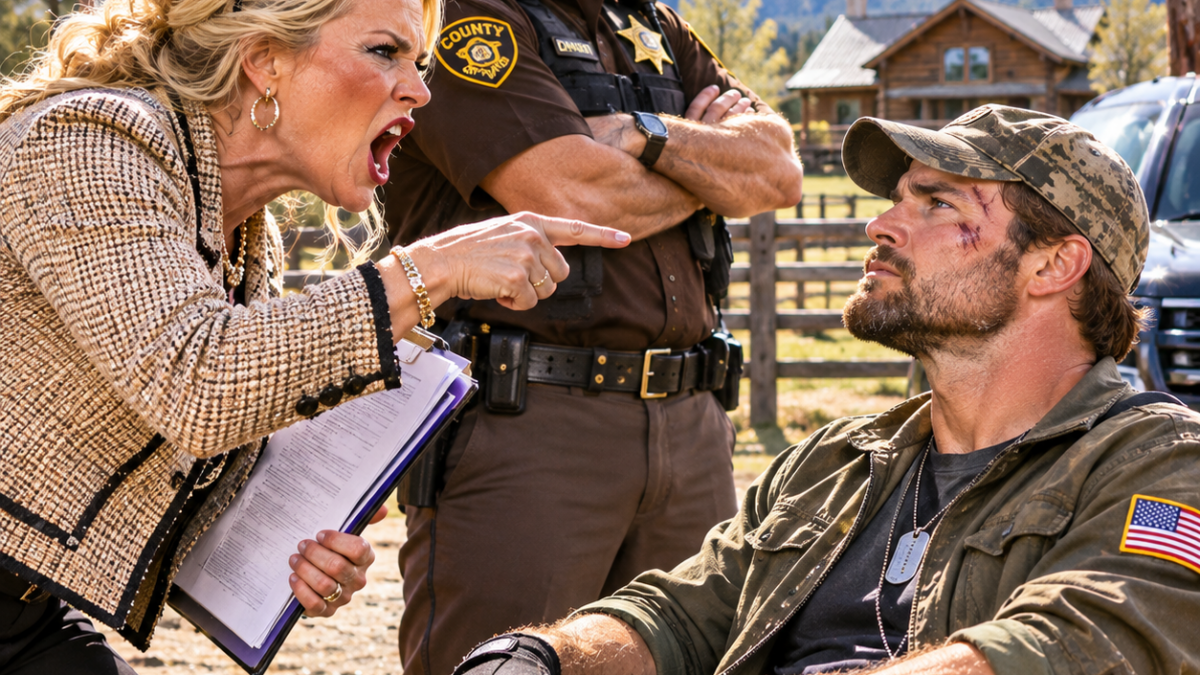
PART2
The trouble had actually started before that conversation.
Fresh tire tracks through my east pasture.
First once.
Then again.
The second time, someone cut three strands of fence wire instead of using the gate.
Eddie found it during his morning walk.
I saw his hands shaking before I saw the damage.
Cattle could have wandered onto the county road.
A driver could have hit one at highway speed.
Someone could have died.
That was when I installed trail cameras.
Not law-enforcement equipment.
Ordinary ranch cameras.
Infrared.
Motion activated.
Legal on my own property.
Two nights later, Trevor Worthington appeared on screen.
Thirty-two.
Recently divorced.
Red ATV.
2:17 in the morning.
He drove along my east pasture as if he owned it.
Stopped near the barn.
Took photographs.
Measured distances with his phone.
Then left.
Next night, same thing.
Third night, he brought another man.
They carried surveying equipment.
Wooden stakes.
Measuring tools.
They spent nearly two hours walking my property.
I watched from inside my house.
Eddie stood behind me.
“Are you going out there?”
“No.”
“Why?”
“Because I want to know what they’re doing.”
“You know what they’re doing.”
“No.”
I shook my head.
“I know they’re trespassing.”
“I don’t know why.”
That distinction mattered.
People assume law enforcement makes you eager to confront criminals.
Good law enforcement teaches the opposite.
Slow down.
Document.
Understand.
Do not turn suspicion into certainty just because it feels satisfying.
I saved the footage.
Backed it up.
Wrote dates.
Times.
Locations.
Then the calls started.
Stella called emergency dispatch claiming an “unstable squatter” was threatening her son.
On my land.
My deputy, Luis Martinez, responded because that was his job.
He found me repairing tack in the barn.
“Sheriff.”
I lifted a finger.
“Tom out here.”
He smiled.
“Tom, then.”
He explained the complaint.
I handed him a tablet.
Trevor on the ATV.
Trevor with surveying equipment.
Trevor crossing clearly posted private property.
Martinez watched.
Then looked at me.
“You’re kidding.”
“No.”
“She told dispatch her son was lawfully inspecting land for housing.”
“Did she?”
“She also called you a squatter.”
That made me laugh.
Martinez didn’t.
“Want me to cite him?”
“Document the complaint first.”
“You’re being generous.”
“No.”
“I’m being careful.”
There were reasons.
One was Eddie.
If I made a high-profile arrest immediately, Stella could claim I had used my office to win a private property dispute.
So I did something that drove Martinez crazy.
I treated myself like any other property owner.
Reports went through ordinary channels.
Another supervisor reviewed decisions involving my ranch.
I disclosed the conflict.
Every move documented.
Stella wanted a fight between a wealthy HOA president and a country sheriff.
I refused to give her that story.
As far as she knew, I was just Tom.
That misunderstanding became useful.
The next week, she came to the ranch again.
This time Trevor sat in the passenger seat.
He climbed out wearing loafers and an expression that made me instantly understand why his ex-wife probably had a very good lawyer.
Stella said:
“We’re prepared to offer two and a half million dollars.”
I almost whistled.
I had paid around six hundred thousand for the property five years earlier.
Even with appreciation, two and a half million was absurd.
“Why?”
She looked offended.
“What?”
“Why is my land worth that much to you?”
“Location.”
“You have developments on three sides.”
“Exactly.”
“So buy somewhere else.”
Trevor spoke.
“My kids need stability.”
I looked at him.
“Then build stability.”
His face hardened.
“That’s what we’re trying to do.”
“On my property.”
“You don’t even use half of it.”
That sentence told me more than he intended.
I said:
“You’ve been studying it.”
Trevor went still.
Stella stepped in quickly.
“We reviewed public records.”
“Public records tell you which half I use?”
Silence.
Then Stella said:
“Mr. Bridgewater, I don’t think you understand the legal realities.”
I almost smiled.
“Educate me.”
“My son’s custody evaluator has emphasized the need for appropriate housing near his children’s schools.”
“That doesn’t create rights in my land.”
“It creates pressure.”
There.
Not law.
Pressure.
Stella knew exactly what she was doing.
She was not trying to prove Trevor owned my ranch.
She was constructing enough litigation, paperwork, complaints, regulatory noise, and financial harassment to make selling seem easier than resisting.
I had seen that strategy before.
Different criminals.
Same principle.
Make compliance cheaper than defiance.
Two days later, I was served.
The paperwork looked impressive.
Emergency petitions.
Requests for evaluation.
Claims that my refusal to negotiate was “interfering with a proposed child-stability housing plan.”
There was no magical family-court power to seize my ranch.
Stella knew that.
Her goal was not an immediate court-ordered transfer.
Her goal was to create a record that could be quoted, distorted, appealed, cross-filed, and dragged through multiple proceedings until I got tired.
I hired outside counsel.
Not county counsel.
My own money.
My attorney, Rachel Price, read the filings twice.
Then looked at me.
“This is garbage.”
“Expensive garbage.”
“Yes.”
“She knows enough law to make every piece irritating without making any one piece immediately fatal to her.”
“That was my read.”
Rachel tapped the file.
“This is harassment through process.”
“Can we prove intent?”
“Not yet.”
Important words.
Not yet.
We responded.
Calmly.
Title documents.
Survey.
No easements supporting Trevor’s claims.
No option contract.
No purchase agreement.
No legal basis to force sale.
A court-appointed appraiser later visited because one of Stella’s filings had managed to trigger an evaluation of the proposed housing site.
Janet Morrison arrived with a clipboard and the tired eyes of a professional who had already realized the case made little sense.
She spent three hours walking the ranch.
At the east fence, she asked:
“Have the Worthingtons been on the property?”
I handed her the camera footage.
She watched Trevor’s ATV.
Then the surveying equipment.
Her eyebrows rose.
“They did this before receiving permission?”
“They never received permission.”
“Police report?”
“Yes.”
“Charges?”
“Investigation ongoing.”
I did not mention that I was sheriff until the conflict-disclosure section required it.
Morrison stared.
“You’re Sheriff Bridgewater?”
“Yes.”
“And they know?”
“No.”
She laughed.
Then stopped herself.
“Sorry.”
“Understandable.”
Her written report did not recommend any forced acquisition because, obviously, she had no authority to do that.
Instead she noted that the property was privately owned, occupied, actively used as a working ranch, and already subject to documented unauthorized entry by parties associated with the proposed buyer.
That report hurt Stella.
So she escalated.
Three black SUVs arrived on a Saturday.
Stella.
Trevor.
Two attorneys.
A development consultant.
And a man whose sole job seemed to be standing slightly too close to people.
They offered three million.
I refused.
Three point two.
No.
Trevor snapped:
“You’re selfish.”
I looked at him.
“Your custody dispute doesn’t entitle you to my brother’s home.”
He laughed.
“Your brother?”
“Yes.”
“What does he need fifty acres for?”
I felt something inside me go cold.
“Be careful.”
Stella immediately stepped between us.
“Trevor.”
But he was angry.
He looked toward Eddie near the barn.
“I heard he’s some broken-down vet.”
Everything in me wanted to step forward.
I did not.
Eddie did.
His prosthetic clicked against gravel.
He stopped six feet from Trevor.
“Yes.”
He looked Trevor directly in the eye.
“I’m the broken-down vet.”
Trevor suddenly found the ground interesting.
Eddie continued.
“I left part of my leg in Afghanistan.”
“Want to compare what you’ve sacrificed for your family?”
Silence.
Stella said sharply:
“This emotional theater is irrelevant.”
I looked at her.
“You brought your son here.”
She lifted her chin.
“We brought an offer.”
“Declined.”
The development consultant opened a folder.
“Mr. Bridgewater, this acreage is likely to increase substantially in value if surrounding zoning changes.”
There it was.
Finally.
“Zoning.”
Stella’s eyes flickered.
The consultant realized he had said too much.
I smiled.
“I thought this was about children.”
“It is.”
“Then why are we discussing zoning?”
Nobody answered.
They left.
That evening, Eddie sat on the porch.
I brought him coffee.
He said:
“They want to develop it.”
“Yes.”
“You knew?”
“Suspected.”
He stared across the pasture.
“I hate this.”
“I know.”
“I don’t mean them.”
I looked over.
“I hate that I’m the reason you won’t sell.”
That hit me.
“Eddie.”
“If someone offered three million dollars—”
“No.”
“Tom.”
I set down my mug.
“I didn’t buy this ranch as a financial instrument.”
“You bought it because of me.”
“Yes.”
His jaw tightened.
“That’s too much.”
“No.”
“It isn’t.”
He looked angry.
“You don’t get to decide that for me.”
I understood suddenly.
I had spent five years telling myself the ranch saved Eddie.
Maybe I had accidentally turned it into a debt he carried.
I said:
“You’re right.”
He looked surprised.
I continued.
“I bought it because I wanted you alive.”
“That part is true.”
“But I stayed because I love it too.”
“The horses.”
“The mornings.”
“The work.”
“The quiet.”
I gestured toward the pasture.
“This is my home.”
“Not your hospital.”
His eyes filled.
I said:
“If I ever sell, it’ll be because I want to.”
“Not because Stella Worthington sends enough lawyers.”
Eddie nodded.
Then:
“Good.”
That conversation mattered later.
Because the fight stopped being about protecting my fragile brother.
Eddie hated being treated as fragile.
It became what it should have been from the beginning.
Two brothers protecting their home.
The next escalation was not legal.
It was destruction.
I came home from an afternoon shift and found water running through the east pasture.
Fence posts broken.
Irrigation line severed in multiple places.
A camera twisted downward.
Electrical conduit damaged near the pump.
Eddie stood beside the barn.
His face was gray.
“Big utility truck.”
“You see a plate?”
“No.”
“Logo?”
“Covered.”
“Driver?”
“Baseball cap.”
His hands were shaking.
I wanted to ask more.
Then stopped.
“Go inside.”
“I can help.”
“No.”
“You can help by getting your nervous system out of this scene.”
He hated that.
But understood.
I called the appropriate investigative team.
Not my own direct command decisions.
Another supervisor handled scene management because the victim was me.
Forensics documented cuts.
Tire impressions.
Tool marks.
Camera position.
No magical fingerprint that solved everything.
Real evidence rarely arrives with a soundtrack.
But we got enough to establish deliberate sabotage.
Repairs cost thousands.
More importantly, the water interruption stressed livestock.
Two days later, Trevor came by.
Alone.
Concerned face.
“Man, heard about the damage.”
I stared.
“Did you?”
“My mom said.”
“How did she know?”
He hesitated.
“Word gets around.”
Interesting.
No public report had been released.
“Does it?”
He smiled too quickly.
“We want to help.”
“Why?”
“Good neighbors.”
I nearly laughed.
Then Trevor said:
“You can’t keep paying to repair stuff every time this happens.”
There it was.
Every time.
Not:
If it happens again.
Every time.
I said:
“Sounds like you expect it to continue.”
His smile vanished for half a second.
“Just saying rural property gets expensive.”
Then:
“My mom knows people.”
“She could make things easier.”
“For a sale.”
“For everybody.”
I let silence stretch.
Trevor became uncomfortable.
Good.
Then he said:
“Things change, Tom.”
“Areas develop.”
“People either move with it or get moved by it.”
I asked:
“Is that a threat?”
He laughed.
“Reality.”
He left.
I wrote every word down immediately.
That week, trucks belonging to Worthington Construction were observed along the public road bordering my property.
Taking photographs.
Measurements from legal public access.
Not illegal by itself.
But part of a pattern.
Then my phone rang.
Unknown number.
Woman’s voice.
“Is this Tom Bridgewater?”
“Yes.”
“My name is Angela Martinez.”
Pause.
“I used to be Angela Worthington.”
Trevor’s ex-wife.
That conversation changed everything.
Angela did not begin with dramatic accusations.
She began with fear.
“Is Trevor trying to tell people he needs your ranch to get custody of our children?”
“Yes.”
Silence.
Then:
“Oh God.”
She explained.
Trevor’s custody problem was not primarily housing.
There had been documented domestic violence.
Protective orders.
Supervised contact.
Psychological evaluations.
Financial misconduct allegations.
The children’s safety plan had conditions unrelated to owning fifty acres.
She had records.
Police reports.
Court orders.
Communications.
And something more important.
Messages Trevor had sent during the divorce.
He had talked for months about land near Willowbrook.
Not for a house.
For development.
Luxury cabins.
Events.
High-end rural retreats.
Eventually subdivision if rezoning became possible.
I asked:
“Why tell me?”
Angela was quiet.
Then:
“Because his mother protects him from consequences.”
“She has his whole life.”
“And every time she protects him, he gets worse.”
I did not need more motive than that.
Still, I asked her not to send me private medical or protected records casually.
We handled it through attorneys and lawful court processes.
That is another thing dramatic stories get wrong.
Evidence is not useful because somebody says they have it.
It becomes useful when obtained and authenticated properly.
Rachel coordinated with Angela’s attorney.
Public court records were gathered.
Law-enforcement reports requested through appropriate channels.
Messages preserved with metadata where available.
One conversation stood out.
Trevor to a business partner:
Fifty acres next to Willowbrook is the whole play. Housing story keeps Mom’s legal people motivated. Once we control it, events first, cabins second, development later.
Another:
Just need the ranch guy tired enough to sell.
Ranch guy.
Me.
I laughed when I read that.
Rachel did not.
“This gives us motive.”
“Yes.”
“And potentially conspiracy depending on what else connects.”
“Yes.”
“No heroics, Tom.”
I looked offended.
“What?”
“You’re smiling.”
“I smile all the time.”
“You are the least smiling sheriff I know.”
Fair.
The next big break came from money.
Worthington Construction had paid a subcontractor who had recently rented a utility truck matching the general description Eddie provided.
That did not prove sabotage.
But investigators dug.
The subcontractor was named Danny Walsh.
Construction foreman.
Debt problems.
Gambling.
When interviewed, he denied everything.
Then surveillance footage from a fuel station placed his truck near my road on the afternoon of the irrigation damage.
Still circumstantial.
Then a payment from an entity associated with Trevor appeared two days later.
That got interesting.
Danny changed lawyers.
Then changed his story.
He had been paid to “inspect access.”
He claimed he did not know vandalism was planned.
Investigators kept working.
Meanwhile Stella doubled down.
She came to the ranch Friday afternoon with a new attorney named Victoria Walsh—no relation to Danny—and another man who introduced himself only as a “consultant.”
Offer:
$3.7 million.
Thirty-day closing.
Legal costs covered.
I said no.
Stella’s control finally cracked.
“My grandchildren need stability.”
“Your grandchildren live safely with their mother.”
Her face changed.
That was the first moment she knew Angela had contacted me.
“Who have you been speaking to?”
“People with records.”
Trevor was not there.
Probably wise.
Stella said:
“You have no business interfering in family matters.”
I almost laughed.
“You used family matters to justify taking my ranch.”
Victoria stepped in.
“Mr. Bridgewater, no one is taking anything.”
“Then why am I looking at draft regulatory complaints in your folder?”
Her hand moved slightly over the papers.
Too late.
They had prepared possible zoning complaints.
Agricultural exemption challenges.
Environmental inquiries.
Utility-access petitions.
Some legitimate mechanisms if grounded in real facts.
Here, apparently designed as leverage.
The consultant spoke.
“Fighting multiple proceedings can become expensive.”
I looked at him.
“Are you advising me?”
“Explaining reality.”
“Would those proceedings disappear if I sell?”
Stella answered.
“Yes.”
Too fast.
Victoria closed her eyes for half a second.
Stella continued.
“We are offering you generational wealth instead of years of legal bills.”
I said:
“Sounds like coercion.”
Her face sharpened.
“It sounds like a choice.”
Everything was being recorded.
Openly.
My ranch.
My attorney had advised me to record meetings consistent with applicable law and to provide notice where appropriate.
A small sign near the entrance stated audio/video surveillance was active.
Stella had walked past it.
She pointed at me.
“You think because you own some dirt you can hold back development forever?”
Finally.
No children.
No custody.
Development.
I said nothing.
She continued.
“This area is changing.”
“Your brother’s therapy project does not override economic reality.”
Eddie had walked up behind me.
He heard that.
Stella saw him.
Then made the mistake that ended whatever sympathy I might have retained.
“You should consider a veterans facility somewhere more appropriate.”
Eddie stared.
“This is my home.”
She smiled tightly.
“Exactly.”
“An individual preference cannot dictate regional growth.”
Eddie said:
“Neither can your son’s custody excuse.”
Her face went white.
We had her.
Not legally.
Emotionally.
She knew the cover story had collapsed.
She left without another word.
That evening, Eddie asked:
“When are you telling her?”
“Telling her what?”
“You know.”
I smiled.
“My job?”
“Yes.”
“Not yet.”
He laughed.
“You’re enjoying this.”
“A little.”
Then I became serious.
“The longer she thinks I’m an ordinary rancher, the more naturally she behaves.”
Eddie nodded.
“You think she treats you worse because she thinks you have no power.”
“Yes.”
“That bother you?”
“More than I expected.”
I looked across the pasture.
“It means she probably treats a lot of people this way.”
People who cannot call a district attorney they know.
People who do not understand court filings.
People who panic when black SUVs arrive.
People who sell because fighting feels impossible.
That was when the case became bigger than my ranch.
Not because I was sheriff.
Because Stella had built a method around assuming her targets were weaker.
The following week, investigators obtained enough evidence to connect Danny Walsh more directly to the ranch sabotage.
A recorded conversation—lawfully obtained during the investigation—captured Trevor discussing another planned attack.
I was briefed because I was the victim, but operational decisions were handled by investigators outside my direct control.
That was essential.
The plan was simple.
No traps.
No engineered bridge failures.
No movie nonsense.
We would let them enter the property if they chose to do so unlawfully.
Cameras would document.
Deputies would intervene before major damage occurred.
Eddie would be inside and safe.
I would not personally lead the arrest unless necessary.
Saturday night arrived warm and still.
At 11:47, headlights slowed near the east boundary.
A side-by-side vehicle stopped.
Two men.
Trevor.
Danny.
They sat for several minutes.
Then crossed onto posted private property.
Cameras captured it.
Trevor moved toward the irrigation infrastructure.
Danny headed toward the utility area.
Deputies had already established probable cause based on the broader investigation and were positioned nearby.
The audio picked up Trevor saying:
“Do the water first.”
Then:
“Electrical after.”
Danny answered:
“This is the last time.”
Trevor said:
“Mom already paid you.”
That sentence would matter.
A lot.
The deputies moved.
Lights came on.
Trevor froze.
Danny dropped a tool bag.
For about three seconds, nobody moved.
Then Trevor did what men like Trevor often do when consequences finally arrive.
He ran.
Not far.
Across uneven pasture at midnight.
He reached the irrigation ditch and tried to jump it.
Bad decision.
He slipped down the muddy bank, landed waist-deep in water, and began screaming that he had been attacked.
No broken legs.
No engineered collapse.
Just gravity and poor judgment.
Deputy Martinez reached him first.
“Do not move.”
Trevor shouted:
“This is illegal!”
Martinez said:
“You’re trespassing.”
“My mother has legal rights here!”
“No, she doesn’t.”
Danny surrendered immediately.
Trevor kept yelling.
I remained near the barn until the scene supervisor called me forward.
Then headlights raced down the driveway.
Silver BMW.
Stella.
How she learned so quickly became another investigative question.
She got out wearing a robe over pajamas.
No sunglasses this time.
“Officer!”
Martinez turned.
“My son is injured!”
“He appears uninjured, ma’am.”
“He was trapped!”
“He fell into an irrigation ditch while fleeing.”
Stella saw Trevor in handcuffs.
Then saw Danny.
Then the tools.
Her face changed.
“This is a setup.”
Martinez said:
“Ma’am, step back.”
“Where is that man?”
“What man?”
“The ranch owner.”
She screamed toward the barn.
“Bridgewater!”
I stepped out.
Not in ranch clothes.
Uniform.
Duty belt.
Badge.
Sheriff’s star.
Stella stopped speaking.
Actually stopped.
Her mouth opened.
Nothing came out.
Trevor saw me from beside the patrol vehicle.
His face changed too.
I walked slowly.
Not because I wanted drama.
Because mud and duty boots are a bad combination.
I stopped under the floodlight.
“Evening, Mrs. Worthington.”
She stared at my badge.
“You…”
“Yes.”
“You’re…”
“Tom Bridgewater.”
I touched the badge lightly.
“County sheriff.”
Silence.
Then Trevor shouted:
“You can’t arrest me!”
I looked at him.
“I’m not arresting you.”
He seemed confused.
I nodded toward Martinez and the supervising investigator.
“They are.”
That distinction mattered.
Stella recovered enough to become angry.
“You hid this.”
“My occupation?”
“You deliberately deceived us.”
“No.”
“You never asked.”
She stared.
I continued.
“You asked whether I owned the ranch.”
“I answered.”
“You asked whether I would sell.”
“I answered.”
“You called me a squatter.”
“That was your choice.”
Her face turned red.
Then:
“My son was lured here.”
The supervising investigator stepped forward.
“No one invited him.”
Stella pointed at the cameras.
“You were waiting.”
“Yes.”
“Because there was evidence of planned criminal activity.”
Her eyes moved to Danny.
He would not look at her.
She whispered:
“Trevor.”
Trevor said:
“Mom, call Victoria.”
Danny said quietly:
“She already knows.”
Everyone looked at him.
Stella’s face emptied.
Danny continued:
“I’m done.”
The investigation exploded from there.
Not overnight.
Real cases are slow.
Search warrants.
Subpoenas.
Interviews.
Digital records.
Payments.
Messages.
Court filings.
False complaints.
Construction invoices.
Stella’s communications with Trevor.
Her legal strategies.
What she knew.
What she did not.
Some dramatic claims from the original dispute did not survive scrutiny.
Others became worse.
The custody story had been exaggerated repeatedly.
The ranch was never legally required for Trevor’s children.
Development planning predated the custody excuse.
Worthington-connected entities had discussed commercial uses.
Trevor had coordinated trespass and harassment.
Danny admitted involvement in property damage in exchange for consideration from prosecutors, subject to the facts and law.
Stella’s position became far more difficult when investigators found messages showing she knew Trevor’s actual custody restrictions while continuing to describe land acquisition as necessary to restore ordinary custody.
One message from Stella read:
Keep the child angle clean. People are afraid to oppose anything framed around kids.
Rachel read it.
Then looked at me.
“That one’s ugly.”
“Yes.”
Another:
If Bridgewater won’t sell, increase pressure through every lawful channel available. If lawful doesn’t work, Trevor needs to stop freelancing and making things worse.
That one was more complicated.
It showed Stella knew Trevor was doing things outside legal channels.
But it also suggested she had told him to stop.
Evidence rarely arrives perfectly aligned with anger.
We had to accept complexity.
Stella was not personally present for every act.
Not every crime Trevor committed automatically became hers.
Prosecutors separated conduct.
That frustrated the public later.
It did not frustrate me.
Justice is not supposed to be emotionally convenient.
Trevor faced charges tied to trespass, property damage, conspiracy, and related offenses supported by evidence.
Danny faced his own exposure and cooperation consequences.
Stella faced investigation for her role in filings, pressure tactics, communications, and any provable participation in unlawful conduct.
Professional ethics complaints were also made regarding her conduct as an attorney where appropriate.
Her HOA position became a separate disaster.
Willowbrook residents learned what had been happening next door.
The first board meeting after the arrests was standing-room only.
I did not attend.
Eddie did.
I asked why.
He said:
“I want to see whether rich people yell differently.”
Apparently they do not.
Stella tried to defend herself.
According to Eddie, she said the HOA had been acting to protect community values.
A retired teacher stood up and asked:
“Does community value include cutting a veteran’s water line?”
Applause.
Stella insisted she had not personally authorized that.
Fair point legally.
Terrible point politically.
Then residents discovered HOA legal resources had been used for portions of correspondence connected to the dispute.
That became the breaking point.
Homeowners demanded records.
Budgets.
Authorizations.
Votes.
Some expenses had proper board approval.
Others became disputed.
A recall petition circulated.
Within weeks, Stella was removed from the presidency.
Not because I marched into their gated community wearing a badge.
Because her own neighbors voted.
That was better.
The new board president was a woman named Denise Harper.
Retired school principal.
First thing she did was call me.
“Sheriff Bridgewater?”
“Yes.”
“This is Denise Harper from Willowbrook.”
I braced.
“I’m the new HOA president.”
“Congratulations or condolences?”
She laughed.
“Still deciding.”
Then:
“I’d like to apologize.”
“You didn’t do anything.”
“Our association’s name was used repeatedly in this dispute.”
“I know.”
“We should have stopped it sooner.”
I looked toward Eddie working with a horse.
“Then stop it now.”
“We have.”
She asked whether she could come over.
I said yes.
Denise arrived in a ten-year-old Honda.
Good start.
She sat on my porch with Eddie and me.
No lawyers.
No offers.
No demands.
She said:
“Most of us didn’t know the full story.”
Eddie asked:
“Did you know Trevor was coming onto our land?”
“No.”
“Did you know Stella was trying to buy it?”
“Yes.”
“Did anyone ask why?”
Denise looked ashamed.
“Not enough.”
There it was.
The ordinary version of how abuse of power grows.
Not everyone actively helping.
Most simply not asking enough.
Denise said:
“We’re changing financial approval rules.”
“Legal spending.”
“Conflict disclosures.”
“President authority.”
I smiled.
“Sounds boring.”
“Very.”
“Good.”
Boring governance prevents exciting disasters.
The media eventually found the story.
Of course.
We tried to keep Eddie out of it.
I refused interviews that centered his PTSD as spectacle.
One local reporter asked if she could film him during a therapy episode.
I told her to leave.
Another reporter, Jessica Rowe, approached differently.
She said:
“The public story is wealthy HOA president versus county sheriff.”
“That’s not the story.”
“What is?”
I looked at Eddie.
He nodded.
I said:
“The story is what people do when they think the person they’re hurting has no power.”
That became her opening line.
I liked that.
She covered the documented facts.
No invented felony enhancements because I was sheriff.
No claims that insulting a law-enforcement officer magically changed crimes.
No cartoon language.
Just:
A family had targeted private property.
The owner happened to be sheriff.
The owner’s brother happened to be a disabled veteran.
Evidence documented a pattern.
The custody justification was contradicted by records.
The commercial motive emerged.
The HOA president lost her position.
Trevor faced consequences.
That was enough.
The story went viral anyway.
People love HOA stories because almost everyone understands the fear of a small authority becoming personal.
Comments were brutal.
Some were funny.
Some crossed lines.
I stopped reading.
Eddie read all of them.
Bad idea.
One night he came onto the porch laughing.
“What?”
“Somebody called Stella ‘the Duchess of Cul-de-Sac.’”
I tried not to laugh.
Failed.
Then he became quiet.
“People keep calling me a hero.”
“You are.”
“No.”
He shook his head.
“I mean because of this.”
“Oh.”
“I didn’t do anything.”
“You survived.”
“That’s not nothing.”
He looked across the ranch.
“I don’t want to be the wounded veteran in every story.”
“I know.”
“I want to be Eddie.”
“Then be Eddie.”
He nodded.
That conversation planted the next idea.
Civil proceedings came after criminal matters were underway.
Property damage.
Harassment-related claims.
Legal expenses.
Lost agricultural use.
Documented treatment impacts where legally supportable.
We did not demand fantasy numbers.
No hundred-million-dollar revenge verdict.
The eventual financial resolution covered repairs, certain costs, and negotiated damages.
Enough to make us whole where money could.
Money could not refund sleep.
Could not erase Eddie hearing ATVs at night and sitting upright for months afterward.
Could not undo the day he saw water spraying through the pasture and thought the safe place was gone.
That recovery took time.
For the first month after arrests, Eddie slept worse.
That surprised me.
The threat was gone.
Why worse?
His therapist explained.
During danger, people sometimes function.
After danger, the body finally processes what it survived.
So we slowed down.
No press.
No visitors without notice.
We installed better lighting designed not to ruin the dark.
Upgraded gates.
Repaired irrigation.
Rebuilt the east fence.
And replaced the narrow crossing over the ditch with a properly engineered ranch bridge strong enough for legitimate equipment.
No tricks.
No traps.
A real bridge.
Eddie watched construction.
Then said:
“You know people are going to expect some dramatic plaque.”
“What would it say?”
“Trevor Fell Here.”
I laughed.
“No.”
“Privilege Meets Gravity?”
“No.”
“Private Property Means Private Property?”
“Maybe.”
We put up nothing.
The bridge was not a monument.
It was infrastructure.
That felt right.
Six months later, Eddie came into my kitchen carrying a yellow legal pad.
He sat.
“I have an idea.”
“That sounds expensive.”
“Probably.”
“What?”
He slid the pad over.
At the top:
Bridgewater Ranch Veterans Recovery Initiative.
I looked at him.
He continued.
“This place helped me.”
“Yes.”
“Not cured.”
“I know.”
“Helped.”
“I know.”
“What if we let it help other people?”
My throat tightened.
He had written notes.
Partnership with licensed therapists.
Equine-assisted programs where clinically appropriate.
Outdoor skills.
Peer support.
Quiet retreat days.
No promise of miracles.
No pseudo-medical claims.
Real treatment professionals.
Real veterans.
Real ranch.
I said:
“You’ve been thinking about this.”
“For years.”
“Why now?”
Eddie looked toward the window.
“Because Stella made me realize how scared I am of losing this place.”
“And?”
“If the only purpose is keeping it safe for me, fear owns it.”
I stared.
He continued.
“If we make it useful to other people, then it becomes bigger than what happened.”
That was Eddie.
Not broken veteran.
Not victim.
My brother.
We formed a nonprofit properly.
Board.
Insurance.
Clinical advisors.
Veterans organizations.
Privacy policies.
Funding.
Some settlement money helped with infrastructure.
Donations came after the story spread.
I refused donations that required us to turn Eddie into a mascot.
One wealthy donor wanted a promotional video showing veterans crying beside horses.
No.
Another wanted naming rights to the barn.
Eddie said:
“For enough money, maybe.”
I kicked him under the table.
We accepted support from people who understood dignity.
The first group was six veterans.
Not thirty-seven.
Six.
Small enough to learn.
A retired Marine who had not slept outside his house in two years.
An Army medic.
A woman who had served multiple deployments and hated being treated like trauma made her fragile.
A former infantryman who barely spoke the first day.
Eddie welcomed them.
Not as patients.
Not as heroes.
People.
He said:
“We have coffee.”
“Horses.”
“Too much fence to fix.”
“And licensed professionals who know more than Tom.”
I said:
“That’s a low bar.”
The group laughed.
Good beginning.
Months passed.
More groups.
Slow growth.
Waiting list.
Partnerships.
The ranch changed.
Not physically at first.
Emotionally.
For years it had been Eddie’s sanctuary.
Then it became a place where other people borrowed peace for a while.
I still worked as sheriff.
But at home, I became fence repairman again.
Exactly what I wanted.
Angela brought her children one Saturday.
That was the first time I met them.
Three kids who had been names in court documents.
Suddenly real.
Shoes.
Questions.
Arguments over who got to feed which horse.
The youngest asked Eddie:
“Does your leg hurt?”
Angela went pale.
“Sweetheart—”
Eddie smiled.
“Sometimes.”
The child nodded.
“My arm hurt when I broke it.”
“Then you understand.”
That was it.
Children are often better than adults at accepting facts without turning them into identity.
Angela stood beside me later.
“They’re sleeping.”
“Good.”
“They don’t ask if Dad is coming anymore.”
I did not know what to say.
So I said:
“I’m sorry.”
She nodded.
“Me too.”
Trevor’s legal outcomes took time.
Some charges resolved through plea agreements.
Others were dismissed or consolidated based on evidence.
That is how real cases work.
Not every allegation becomes a conviction.
Not every ugly act has a perfect statute attached.
But he did face significant consequences.
Court supervision.
Restitution.
Restrictions.
A record that made pretending nothing happened impossible.
His family-court matters remained separate and were decided by that court based on the children’s interests and admissible evidence.
I never celebrated his relationship with his children deteriorating.
Those kids had already lost enough.
I celebrated safety.
Different thing.
Stella’s consequences were also less cinematic than internet commenters wanted.
She did not spend decades in federal prison.
She did not lose every dollar.
No judge gave me her mansion.
What happened was more realistic.
Professional investigations.
Legal costs.
Reputation damage.
Loss of HOA office.
Civil liability.
Court scrutiny.
Years of expensive consequences created by years of believing consequences were for other people.
I saw her once after everything.
Grocery store.
Of all places.
No courtroom.
No cameras.
Produce section.
She looked older.
No oversized sunglasses.
She saw me.
Stopped.
I expected her to turn away.
Instead she approached.
“Tom.”
“Stella.”
Silence.
Then:
“Eddie doing well?”
That surprised me.
“Yes.”
“I heard about the veterans program.”
“Yes.”
She nodded.
“That’s good.”
I waited.
She looked down at her cart.
Then said:
“I was wrong.”
Three words.
I did not know what to do with them.
She continued.
“I told myself Trevor needed help.”
“I kept helping long after help became protection from consequences.”
My jaw tightened.
She looked at me.
“I know you don’t owe me forgiveness.”
“No.”
“I’m not asking.”
Good.
Then:
“I’m sorry for what happened to your brother.”
I wanted to say:
You mean what you did.
But something stopped me.
Not mercy.
Accuracy.
Stella had responsibility.
Trevor had responsibility.
Danny had responsibility.
Different proportions.
I said:
“I appreciate you saying that.”
She nodded.
Then left.
No dramatic confrontation.
No aisle full of applauding shoppers.
Real accountability often happens under fluorescent grocery lights while someone is holding avocados.
I went home.
Eddie was on the porch.
“Guess who I saw.”
“Beyoncé.”
“Stella.”
He looked disappointed.
“Less exciting.”
“She apologized.”
He stared.
“For what?”
“Everything, generally.”
“That sounds legally vague.”
I laughed.
“You spend too much time around me.”
“What did you say?”
“Thank you.”
He nodded.
Then:
“You forgive her?”
“No.”
“Do you hate her?”
I thought.
“No.”
“That seems inconvenient.”
“Very.”
Eddie looked toward sunset.
Then:
“Maybe that’s peace.”
I hated how wise he sounded.
“Don’t get poetic.”
“Ruins your image?”
“Yes.”
Our first year of the veterans program ended with thirty-seven participants having completed some form of retreat or partnered programming.
That number got repeated online.
What mattered more were smaller moments.
The Marine who eventually slept six hours.
The medic who returned with her husband because she wanted him to understand why open spaces helped.
The veteran who had not ridden a horse since childhood and laughed so hard when he nearly slid from the saddle that everyone else started laughing too.
No miracles.
No cure.
Progress.
The ranch remained a ranch.
Cattle.
Mud.
Bills.
Broken equipment.
Veterans did not arrive and become healed through sunsets.
They worked with licensed clinicians.
They did peer groups.
They used the space as one tool among many.
That was important to Eddie.
He hated inspirational nonsense.
One journalist asked:
“So the ranch cured your PTSD?”
Eddie stared.
“No.”
She looked confused.
He continued.
“My prosthetic doesn’t grow my leg back either.”
“It helps me move.”
“This place helps me breathe.”
That quote became more popular than any dramatic version.
Rightly so.
Willowbrook changed too.
Denise turned out to be a good HOA president.
Annoyingly competent.
We occasionally disagreed.
Fence-screening rules near the shared boundary.
Drainage.
Road maintenance.
Normal neighbor problems.
The first time she called about weeds, I laughed for thirty seconds.
She waited.
Then:
“Finished?”
“Almost.”
“Tom.”
“I’m sorry.”
“No, you’re not.”
She was right.
Normal HOA complaints felt wonderful.
No fake custody claims.
No midnight ATVs.
Just weeds.
I trimmed them.
Peace is underrated because it makes bad storytelling.
Eddie’s nightmares never disappeared completely.
Neither did his limp.
Stress could still pull him backward.
Certain anniversaries were hard.
Fireworks remained awful.
We worked around them.
One Fourth of July, Willowbrook voluntarily moved its biggest fireworks display farther from the ranch after Denise asked residents to consider veterans attending our program.
Nobody demanded it.
They voted.
Eddie watched distant light flicker without the concussion hitting our windows.
He said:
“Okay.”
“What?”
“I might like HOAs now.”
“Take that back.”
He laughed.
For years, I had thought justice would feel like Stella losing.
Trevor in handcuffs.
Charges.
Court orders.
HOA recall.
Money.
None of those moments became the one I remembered most.
It happened on an ordinary Tuesday morning.
6:03 a.m.
I stepped onto the porch with coffee.
Five years earlier, that time of day had meant dispatch calls.
False complaints.
ATV tracks.
Eddie waking from nightmares.
That morning, the pasture was quiet.
A veteran staying for a supervised retreat was already near the barn helping Eddie fill water buckets.
I heard Eddie laugh.
Same kind of laugh I had heard years earlier when the mare stole his hat.
I stood there.
Coffee cooling.
And realized the ranch had survived.
Not untouched.
Nothing survives conflict untouched.
But intact in the ways that mattered.
Stella thought land was valuable because fifty acres beside Willowbrook could become cabins, weddings, subdivisions, revenue.
Trevor saw numbers.
Developers saw zoning.
I had once seen therapy.
Eddie eventually saw community.
Same dirt.
Different value.
That may be the biggest thing they never understood.
Not everything valuable is waiting to be monetized.
Sometimes a pasture is worth more because a man finally sleeps there.
Sometimes an old barn matters because someone whose hands shook for three years can calmly saddle a horse inside it.
Sometimes refusing three million dollars is rational because money is not the only unit human beings use.
And sometimes the most dangerous mistake an entitled person can make is assuming somebody who looks ordinary has no ability to defend himself.
Stella saw dirty boots.
Not a sheriff.
But even that is not the real lesson.
Because I should not have needed a badge to deserve respect.
If I had been exactly what she thought—a middle-aged rancher with no political connections, no law-enforcement career, no powerful friends—her conduct would still have been wrong.
That is the part people miss when they tell the story.
They love the reveal.
She didn’t know he was sheriff.
Fine.
Satisfying.
But what if I had not been?
Would cutting a man’s fence become acceptable?
Would using children as a sales argument become legitimate?
Would intimidation become reasonable?
No.
The badge did not make Stella wrong.
It only prevented her from understanding how thoroughly her conduct could be documented.
Years later, a new participant at the veterans program asked me about the old story.
He had seen it online.
“Is it true that HOA woman tried to steal the ranch?”
“Basically.”
“And you were secretly sheriff?”
“Not secretly.”
“She just never asked.”
He laughed.
Then:
“Did you really set a trap that dumped the guy into a ditch?”
“No.”
He looked disappointed.
“Internet says you did.”
“Internet lies.”
“What happened?”
“He trespassed at night during an investigated sabotage attempt, ran from deputies, slipped into the irrigation ditch.”
“That’s less cinematic.”
“Reality usually is.”
He thought.
Then smiled.
“Still funny.”
A little.
The irrigation ditch became ordinary again.
That was best.
We rebuilt the crossing safely.
Every truck that had legitimate business used it.
Every horse trailer.
Every maintenance vehicle.
Every ambulance during one medical emergency.
A bridge should carry people who belong there.
Not punish people who do not.
The law handled trespass.
That is what law is for.
My badge eventually came off for good.
Twenty-four years.
Retirement ceremony.
Eddie sat in the front row.
Denise from Willowbrook attended.
Martinez—now captain—gave a speech far too long and mostly inaccurate.
He said:
“Sheriff Bridgewater taught us patience.”
I whispered to Eddie:
“That’s a lie.”
Eddie whispered back:
“He’s trying to be nice.”
Afterward, I drove home.
Placed my badge in a drawer.
Went outside.
Fixed a gate.
Perfect retirement.
People asked whether I missed being sheriff.
Sometimes.
I missed the team.
The sense of purpose.
I did not miss phone calls at 3:00 a.m.
The ranch gave me another purpose.
Not saving Eddie.
He never needed me to make his life my mission forever.
That took me years to learn.
We became partners in the nonprofit.
He handled veteran outreach.
I handled operations and facilities.
Clinical professionals handled treatment.
Board handled governance.
Nobody got to become king.
After Stella, I had developed an allergy to concentrated authority.
Eddie teased me.
“HOA trauma.”
“Real.”
We even wrote conflict-of-interest rules stronger than required.
Denise reviewed them once.
“This is basically anti-Stella legislation.”
“Exactly.”
She laughed.
Good governance can be personal.
Angela’s children grew.
The oldest eventually volunteered at the ranch during summers.
Not because we wanted to recruit them into the story.
Because he liked horses.
One afternoon, I saw him repairing a gate with Eddie.
He was maybe fifteen.
Tall.
Quiet.
He asked:
“Did my dad really think he could take this place?”
Eddie stopped working.
Looked at me.
I let Eddie answer.
“He thought people would get tired of fighting.”
The boy nodded.
“Did you hate him?”
Eddie thought.
Then:
“I hated what he did.”
“That’s not the same?”
“No.”
The boy looked down.
Eddie continued.
“You’re allowed to love somebody and still know they’re dangerous for you.”
I walked away.
That conversation belonged to them.
Later Eddie said:
“You hear that?”
“What?”
“I’m emotionally intelligent now.”
“Terrible development.”
He laughed.
Sometimes I think about the version of myself from the beginning.
Angry.
Badge hidden.
Case file growing.
Watching cameras.
Thinking justice meant waiting for the perfect moment to drop a hammer.
I understand him.
He needed control because Eddie was suffering.
But the older I get, the less I believe justice is a hammer.
Hammers are useful.
Mostly they break things.
Justice was documentation.
Conflict disclosure.
Outside investigators.
Evidence rules.
Attorneys telling me when I was wrong.
Judges separating facts from anger.
Neighbors voting.
A brother choosing to turn a threatened sanctuary into something generous.
Slow.
Boring.
Better.
Stella had believed the system belonged to people with money and connections.
Trevor believed rules were obstacles his mother could remove.
I believed my badge would eventually be the dramatic answer.
All three views were too simple.
Systems work when enough people inside them refuse to be bent.
Martinez.
Rachel.
Angela.
Denise.
Investigators.
Judges.
Neighbors.
Veterans.
Eddie.
That was what stopped them.
Not one sheriff.
Not one viral confrontation.
A network of people choosing not to look away.
Years after Stella left the HOA board, Willowbrook held a charity run.
They asked whether proceeds could support the veterans program.
I said yes.
The starting line was at their clubhouse.
Finish line at the ranch entrance.
I stood near the gate watching hundreds of people run down the road.
Families.
Kids.
Older residents.
Veterans.
Denise approached.
“You know what this would have done to Stella?”
I laughed.
“Please don’t ruin a nice day.”
She smiled.
Then:
“Full circle.”
I looked at the sign.
WILLOWBROOK 5K FOR VETERAN RECOVERY
Maybe.
But I have become suspicious of perfect circles.
Life spirals.
You revisit old places with different eyes.
That afternoon, three children crossed the finish line holding hands.
Angela’s kids.
Older now.
Free enough to be annoyed at each other about ordinary sibling things.
Their mother stood crying.
Eddie handed them medals.
I looked toward the fifty acres Stella once said Trevor “needed.”
No luxury cabins.
No wedding venue.
No subdivision.
Just grass.
Barn.
Horses.
People.
The land had become profitable in a way Stella never could have calculated.
Not financially.
Humanly.
That evening, everyone left.
Quiet returned.
Eddie and I sat on the porch.
Two mugs.
Sunset.
He said:
“You ever regret not taking the three point seven million?”
I considered.
“Yes.”
He stared.
“What?”
I laughed.
“Every time the tractor breaks.”
He shoved my shoulder.
Then:
“Seriously.”
“No.”
“You?”
He looked across the field.
“No.”
Pause.
“Sometimes I regret being the reason you bought it.”
I sighed.
“We covered this.”
“I know.”
He smiled.
“I also know you’d have bought some terrible suburban house if I hadn’t needed this.”
“True.”
“So really I saved you.”
“From granite countertops.”
“Exactly.”
We laughed.
Then sat quietly.
The sun went down.
Cattle shifted in the pasture.
A horse snorted near the barn.
Somewhere far beyond the property line, Willowbrook lights came on one by one.
Eddie said:
“Peace is loud when you almost lose it.”
I looked at him.
“That makes no sense.”
“You know what I mean.”
I did.
Six o’clock mornings used to mean dispatch calls.
Now they mean coffee.
Two a.m. used to mean ATV engines.
Now coyotes.
The east fence used to feel like a battle line.
Now it is just a fence.
That is justice too.
When the conflict began, Stella told me everyone had a price.
She was wrong.
People have values.
Different thing.
A price tells you what someone will take.
A value tells you what they refuse to trade.
My brother’s peace.
Our home.
The right to say no.
Those had value.
They were never for sale.
And the woman who thought money, lawyers, an HOA title, and a custody story could turn my no into yes eventually learned the one rule she had spent her life avoiding:
Private property does not become yours because you want it. Children do not become leverage because their story is emotionally powerful. And another person’s refusal is not an invitation to keep pushing until they break.
Stella learned that through loss.
Trevor learned it through consequences.
I learned something too.
I learned that protecting people does not mean controlling every outcome.
Eddie learned that accepting help did not make the ranch his debt.
Willowbrook learned an HOA was supposed to serve homeowners, not become the private weapon of whoever held the gavel.
And fifty acres that one family wanted to turn into another luxury development became something none of us planned.
A place where people who had lived too long in survival mode could hear wind through oak trees and remember that quiet still existed.
That is how the story ended.
Not with Stella screaming.
Not with Trevor in handcuffs.
Not with me revealing a badge.
Those were only the loud parts.
The ending was a porch.
Two brothers.
Coffee.
A repaired fence.
A safe bridge.
And nothing coming down the driveway that did not belong there.








