PART2:“GET YOUR HUSBAND—WOMEN DON’T HANDLE PROPERTY.” HOA Karen Shoved My Wife Down Our Steps, Then Smirked at the Blood—She Didn’t Know Her Own Bylaws Would End Her Reign
PART2
Derek had his phone out.
Taking pictures.
Not helping her.
Photographing her.
Colin was doing the same.
“Documentation of resident resistance,” Derek muttered.
I stopped.
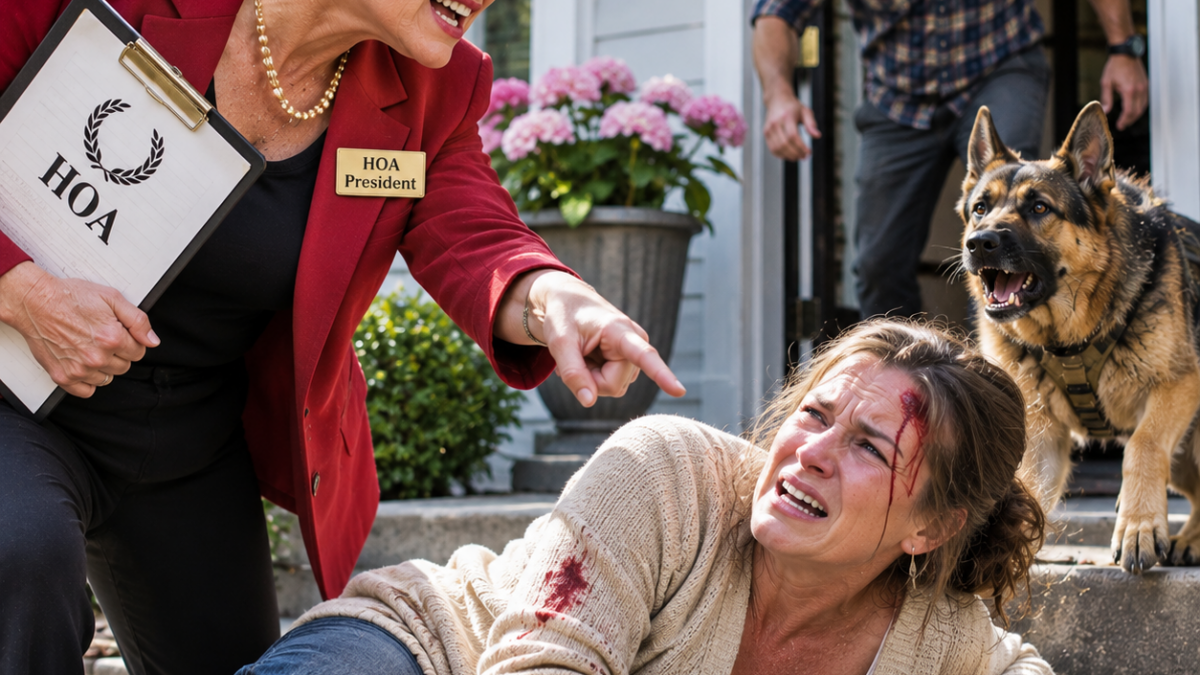
For one second, I saw nothing except Mia sitting on the concrete with one hand pressed against her forehead.
Blood between her fingers.
Then I looked at Victoria.
She adjusted her sunglasses.
No panic.
No apology.
No horror.
Annoyance.
As though my wife had inconvenienced her by bleeding in the middle of an inspection.
“What the hell did you just do?”
Victoria lifted her chin.
“Control yourself, Mr. Caldwell.”
I dropped beside Mia.
“Mia.”
“I’m okay.”
She wasn’t.
Her hands were shaking.
The skin near her eyebrow had split.
I looked up.
“You shoved her.”
Victoria sighed.
“She became physically uncooperative.”
“She was walking into her own house.”
“She was refusing an official directive.”
I stood.
Very slowly.
Derek moved half a step closer.
Victoria noticed.
That smug smile came back.
“If your wife had simply followed instructions, she would still be standing.”
Everything inside me went cold.
I pointed toward the doorbell camera.
“Say that again.”
Her smile flickered.
“What?”
“Say it again.”
I stepped aside so she could see the camera clearly.
“Tell the camera my wife deserved to bleed because she didn’t obey you.”
Derek said:
“Watch your tone.”
I looked at him.
“Did you call an ambulance?”
Silence.
“Did you check whether her neck was injured?”
Nothing.
“You two took pictures.”
Derek folded his arms.
“Evidence.”
“Of what?”
“Resident hostility.”
I stared at him.
“My wife is on the ground.”
He smirked.
“She shouldn’t have resisted.”
Mia whispered:
“Ethan.”
I turned instantly.
She looked pale.
“I need to go.”
That ended the argument.
I helped her up.
Victoria said behind me:
“You still have forty-eight hours to correct the landscaping.”
I stopped.
Slowly turned.
She held out a violation notice.
Twelve hundred dollars.
“You’re giving me a fine?”
“Administrative assessment.”
“You just pushed my wife down concrete stairs.”
“She fell during enforcement.”
Then Victoria stepped closer.
Close enough that only a few feet separated us.
Her voice dropped.
“This neighborhood has standards, Mr. Caldwell.”
“So do I.”
“Then teach your wife some respect.”
I actually smiled.
Not because anything was funny.
Because I had reached the point where anger became clarity.
“You should stop talking.”
Victoria laughed.
“Why?”
“Because every sentence you say is becoming evidence.”
Her expression shifted.
I continued.
“You touched my wife.”
“You refused medical assistance.”
“You photographed her while she was bleeding.”
“And now you’re handing me a twelve-hundred-dollar fine.”
Derek shoved the paper toward me.
“Take it.”
I looked at his hand.
Then at him.
“Put it on the table.”
He stepped closer.
“You scared?”
“No.”
I looked directly into his eyes.
“But you seem very eager to touch somebody today.”
His jaw tightened.
I pointed toward the camera.
“Go ahead.”
Derek stopped.
Good.
Victoria scoffed.
“What exactly do you think you’re going to do, Mr. Caldwell?”
She glanced toward my upstairs office.
“Write one of your little computer complaints?”
Derek laughed.
Victoria smiled wider.
“Maybe code an app.”
I said nothing.
She leaned closer.
“People who fight this board usually discover something.”
“What?”
“They can’t afford to live here anymore.”
There it was.
Not a rule.
A threat.
I memorized every word.
Then I helped Mia into the car.
She needed seven stitches.
Mild concussion.
Bruised shoulder.
Scraped palm.
No fracture.
At urgent care, the nurse asked:
“How did this happen?”
Mia stared at the wall.
“The HOA president grabbed me.”
The nurse stopped typing.
“Your homeowners association?”
“Yes.”
“And pushed you?”
“Yes.”
The nurse looked at me.
I said:
“Door camera recorded it.”
She resumed typing.
Good.
Medical documentation.
Police took a report that evening.
The responding officer watched the footage.
Victoria’s hand.
Mia pulling away.
The shove.
The fall.
He replayed it.
Then said:
“Do not edit this recording.”
“I won’t.”
“Don’t upload it.”
“I wasn’t planning to.”
“Keep the original system copy.”
“Already backed up.”
He nodded.
“You work in IT?”
“Systems architecture.”
“That explains the backup.”
No.
What explained the backup was Victoria.
By nine that night, Mia sat on our couch with an ice pack against her forehead.
I sat beside her with the HOA violation notice.
She watched me.
“You’re doing the thing.”
“What thing?”
“That quiet thing.”
“I’m thinking.”
“No.”
She winced slightly.
“You’re furious.”
“Yes.”
“But you’re not yelling.”
“No.”
“That’s worse.”
I opened the Desert Vista governing documents.
“Ethan.”
“What?”
“Please don’t do anything stupid.”
I looked at her.
“I’m not.”
“Promise.”
“I promise.”
I meant it.
I was not going to threaten Victoria.
I was not going to confront Derek.
I was not going to send some satisfying email saying:
YOU PUT YOUR HANDS ON MY WIFE AND I WILL DESTROY YOU.
I actually typed that sentence.
Looked at it for ten seconds.
Deleted it.
Threats are emotional.
Logs are permanent.
At 5:22 the next morning, I began reading.
By 6:04, I had a list.
By 7:18, I had a structure.
By 8:02, I had forty-seven pages.
Sixty-three separate requests for clarification.
Not insults.
Questions.
Which covenant established the claimed twenty-four-inch agave setback?
Who authorized retroactive withdrawal of the previously approved landscape plan?
Where was that withdrawal recorded?
Which board vote authorized the $1,200 fine?
Who approved “administrative assessment” charges?
Under what written authority could HOA representatives demand immediate backyard access?
What policy authorized physical contact with residents?
Was Derek an employee or independent contractor?
What training was required for enforcement personnel?
What insurance covered contractor misconduct?
Were enforcement interactions required to be documented?
What appeal rights existed?
What was the timeframe for written answers?
Every question cited their own documents.
Chapter.
Article.
Section.
The association had adopted a formal owner-inquiry policy requiring written responses within specified administrative periods.
Victoria loved rules.
I was about to give her all of them.
At 8:12 a.m., I emailed the packet.
Certified copy followed.
At 8:41, Victoria replied.
One sentence.
Your harassment will not delay enforcement.
I smiled.
Saved the email.
At 9:03, I replied:
Thank you. Please identify which of the sixty-three requests you classify as harassment and cite the governing authority permitting the association to decline each request.
No answer.
At 9:17:
Also, please preserve all enforcement photographs, body-camera recordings if any, contractor communications, board communications, inspection notes, and correspondence concerning Lot 117 from the previous twelve months.
Silence.
That was when I started talking to neighbors.
Mrs. Rosa Alvarez lived three houses down.
Seventy-two.
Widowed.
She opened her door, saw Mia’s bandage, and immediately whispered:
“Victoria?”
Not:
What happened?
Not:
Did you fall?
Victoria.
That told me everything.
Rosa brought us inside.
Then she opened a kitchen drawer.
Pulled out a folder.
Eight hundred fifty dollars in fines.
Three strings of white Christmas lights.
A wreath.
One planter.
“That’s it?”
Rosa nodded.
“Why didn’t you appeal?”
“I did.”
“What happened?”
“She came here.”
“Victoria?”
“Yes.”
“Alone?”
Rosa’s hands tightened.
“She told me women my age should know when to stop arguing.”
Mia looked at her.
“What exactly did she say?”
Rosa swallowed.
“She said, ‘Old ladies who keep causing trouble have unfortunate falls.’”
Nobody spoke.
Mia’s hand moved instinctively toward her stitches.
I asked:
“Did anyone hear?”
“No.”
“Did you tell anyone afterward?”
“My daughter.”
“When?”
“Immediately.”
“Would she still have the messages?”
Rosa looked at me.
“I think so.”
Good.
Not proof by itself.
Corroboration.
That distinction mattered.
Next came the Parkers.
Their fourteen-year-old son had left a portable basketball hoop near the street.
Twenty minutes.
Fine.
Then another.
Then an enforcement warning.
Mr. Parker showed me the cited regulation.
I opened the official covenant version.
The section did not exist.
I checked revision history.
The rule appeared in a later document.
Weeks after the violation.
I looked at him.
“They fined you under a rule that wasn’t effective yet.”
He laughed bitterly.
“I told them.”
“What did Victoria say?”
“Standards don’t require technicalities.”
I stared.
That phrase went into my notes.
Then more homeowners.
A veteran fined over his flagpole.
A family cited because their kids left bicycles near the garage.
A widow threatened over artificial flowers.
Another homeowner fined for driveway staining that matched every third driveway on his block.
Patterns.
But patterns are not evidence until you can test them.
So I requested records.
Fine logs.
Vendor contracts.
Board minutes.
Legal bills.
Consulting expenses.
Inspection policies.
Architectural approvals.
Complaint histories.
Victoria called me personally.
“You need to stop.”
“Stop what?”
“Flooding the office with nonsense.”
“They’re member records.”
“You submitted more demands in forty-eight hours than most owners submit in ten years.”
“That sounds like a records-management problem.”
“You think you’re clever.”
“No.”
“I think your documents are inconsistent.”
“You are retaliating because your wife lost her balance.”
I stopped breathing for half a second.
“Victoria.”
“What?”
“You grabbed her.”
“She pulled away.”
“The camera shows your hand on her.”
“She became emotional.”
“Police have the recording.”
Silence.
A different silence this time.
Then:
“You’re threatening me?”
“No.”
“I’m informing you.”
Her voice hardened.
“Your compliance inspection remains scheduled Friday.”
I smiled.
“Perfect.”
“What?”
“We’ll be ready.”
She hung up.
Mia looked at me from the kitchen.
“You enjoy this too much.”
“Not yet.”
Thursday afternoon, the financial records arrived.
That was when the story stopped being about an agave.
The HOA had collected a surprising amount in fines.
Not illegal.
Then:
Sonoran Community Development Advisors.
Nearly $190,000 over two fiscal years.
Strategic development coordination.
Community planning.
Asset optimization.
Resident transition consulting.
Resident transition.
Interesting phrase.
I searched Arizona corporate records.
Registered manager:
Mark Delaney.
Victoria Langford’s brother-in-law.
I leaned back.
Then searched Delaney.
His firm had consulting ties to Horizon Crest Resorts.
A development company with an active proposal near Desert Vista’s eastern boundary.
Luxury villas.
Spa complex.
Road expansion.
Potential golf redevelopment.
The most convenient access path crossed property adjoining the oldest part of Desert Vista.
A cluster of homeowners there had sold during the previous two years.
I mapped them.
Seven transactions.
Five owners had received unusually heavy HOA enforcement during the eighteen months before selling.
Two buyers were LLCs.
Those LLCs connected through ownership records to Horizon-related entities.
Mia stood behind me.
“What are you looking at?”
“Nothing proven.”
“Ethan.”
“Seriously.”
I pointed.
“Correlation.”
“What kind?”
“HOA pressure here.”
I highlighted the lots.
“Developer purchases here.”
Her face changed.
“Are they forcing people to sell?”
“I don’t know.”
“You think they are.”
“I think I need better evidence.”
She stared at the wall beside my monitors.
I had printed maps.
Vendor charts.
Company relationships.
She raised an eyebrow.
“You built a conspiracy wall.”
“It’s a relationship diagram.”
“That is what conspiracy-wall people say.”
I laughed.
First time since Tuesday.
Then she sat.
“What do you actually have?”
“Victoria’s HOA paid her brother-in-law’s company.”
“Okay.”
“His company works with the resort developer.”
“Okay.”
“Fine pressure overlaps with properties inside the development corridor.”
“Okay.”
“Enough?”
“No.”
“Good.”
She smiled.
“Why good?”
“Because you still know the difference between angry and stupid.”
That woman married me for a reason.
Then I found Article 4.8.
Victoria’s favorite type of rule.
Board members and enforcement officers were required to remain in material compliance with the governing documents as a condition of participating in enforcement actions where conflicts existed.
Not:
Wrong garage color equals immediate removal.
Nothing that ridiculous.
But formal complaints against a board member could require review and recusal.
Victoria had violations.
Her ornamental fountain operated despite drought restrictions she had enforced against another homeowner.
Her garage door was Desert Taupe.
Approved elevation required Sedona Sunset Beige.
Decorative screening extended above permitted wall height.
Petty?
Absolutely.
Important?
Procedurally, yes.
Then Article 7.
Conflict disclosure.
Related-party transactions.
Meeting notice.
Vendor approval.
I searched board minutes for Sonoran Community Development Advisors.
No meaningful discussion of Delaney being Victoria’s brother-in-law.
No conflict disclosure that I could find.
No detailed vote.
Maybe missing records.
Maybe worse.
Friday morning, I filed six complaints.
Only six.
Three property-compliance issues.
Three governance issues.
Each documented.
No dramatics.
No accusations beyond what evidence supported.
Then I filed a petition requesting an independent compliance and conflict review.
At 2:00 p.m., Victoria came marching up our walkway.
Derek beside her.
Colin.
And Board Member Alan Pierce.
Four people.
Tablets.
Cameras.
Clipboards.
Victoria stopped when she saw my phone recording.
“Turn that off.”
I smiled.
“Why?”
“You don’t have permission.”
I held up their policy.
“Transparent Enforcement Procedure, Section 3.”
Her eyes narrowed.
“Interactions may be documented by either party.”
Derek laughed.
“You really spent your week reading rules?”
“I had time while my wife was recovering from stitches.”
His smile disappeared.
Victoria pointed toward the backyard.
“Open the gate.”
“No.”
Her face went blank.
“What did you say?”
“No.”
“This is an authorized compliance inspection.”
“Show me the access authorization.”
“You received notice.”
“Notice is not consent to enter a fenced private yard.”
“Mr. Caldwell.”
“Section.”
She stared.
I smiled.
“Come on, Victoria.”
“You know these rules better than anyone.”
“Show me.”
Derek stepped forward.
“Move aside, keyboard boy.”
Mia appeared behind me.
Bandage still visible.
I looked at Derek.
“Say it again.”
“What?”
“Call me keyboard boy again.”
He smirked.
“You heard me.”
“I did.”
I tilted the phone slightly.
“So did the recording.”
He stepped closer.
“You think that camera makes you tough?”
“No.”
“I think it makes you honest.”
His face hardened.
I continued.
“You stood here Tuesday while my wife bled.”
“She resisted.”
“You photographed her.”
“That’s my job.”
“Did your job include calling 911?”
Silence.
“Checking whether she had a concussion?”
Nothing.
“Stopping Victoria from putting hands on a homeowner?”
Derek’s jaw worked.
“You don’t know what happened.”
Mia said behind me:
“I do.”
He turned.
She stepped onto the porch.
No fear this time.
“You watched her grab me.”
Derek said:
“You pulled away.”
Mia smiled without humor.
“I’m allowed to pull away from someone touching me.”
Victoria cut in.
“We are not relitigating Tuesday.”
“No.”
I handed her a folder.
“We’re dealing with Friday.”
She opened it.
First page:
NOTICE OF PROCEDURAL DEFECT.
“What is this garbage?”
“Section 14.2.”
Alan Pierce looked down at his tablet.
His eyebrows rose.
Victoria noticed.
“What?”
Alan said:
“Assessments above five hundred require two authorized board reviewers or recorded ratification.”
Victoria snapped:
“I am president.”
I smiled.
“That’s one.”
Derek said:
“I’m enforcement.”
“You’re an outside contractor.”
He stepped closer.
“You think you’re smarter than everybody?”
I looked at him.
“I think the rules are the rules.”
He laughed.
I continued.
“Isn’t that what you told my wife while she was bleeding at your feet?”
He stopped laughing.
Then a voice came from the sidewalk.
“He’s right.”
Rosa Alvarez.
Folder in hand.
Victoria turned.
“What are you doing here?”
Rosa walked closer.
“Participating in community enforcement.”
Then the Parkers arrived.
Then Jim Wallace.
Then another family.
Then three more.
Twelve households.
Then twenty-three.
Not screaming.
Not threatening.
Folders.
Phones.
Letters.
Photographs.
Victoria stared at them.
Her confidence actually flickered.
“What is this supposed to be?”
Rosa held up a picture.
“Your fountain.”
Victoria snapped:
“You trespassed on my property?”
“No.”
“Public sidewalk.”
Rosa smiled.
“Your rule.”
People laughed.
Mr. Parker stepped forward with his phone.
“Want to hear Derek?”
Derek’s face changed.
The recording played.
His own voice:
Your kid wants to keep that basketball hoop, maybe he should learn who makes the rules around here.
People murmured.
Derek shouted:
“That was a joke.”
Mr. Parker stared.
“My son was fourteen.”
Victoria raised her voice.
“Enough!”
Silence dropped.
She looked around at the residents.
At their folders.
At their cameras.
Then something ugly came out.
“I built this community into what it is.”
A man said:
“You bought a house here like everybody else.”
Victoria ignored him.
“For six years, I have kept property values stable while half of you complain every time someone asks you to trim a bush.”
Rosa’s face hardened.
Victoria pointed toward us.
“This man arrives and suddenly all of you think you’re constitutional scholars.”
I said:
“No.”
“You’re the one who taught us to read the rules.”
Laughter.
She glared.
“Standards require judgment.”
“Whose?”
“Mine.”
“Even when the written rules disagree?”
She exploded.
“YES, ETHAN.”
Everyone froze.
She stepped forward.
“Because somebody has to maintain order.”
“People like you think communities run themselves.”
“They don’t.”
“Someone has to decide what is acceptable.”
I waited.
Then asked quietly:
“So the standards are whatever you say they are?”
She realized too late.
Her eyes moved to my phone.
Then to twenty other phones.
“You’re twisting my words.”
“No.”
“You said them.”
“I said judgment matters.”
“You said you decide what’s acceptable.”
“Because I’m president!”
I opened the covenants.
“Article 2.3.”
Her face tightened.
“Selective or arbitrary enforcement is prohibited.”
I looked around.
“Her words.”
“Not mine.”
Colin whispered:
“Oh, shit.”
Victoria spun on him.
“Excuse me?”
He stepped back.
Alan Pierce did too.
That was the moment I knew she was losing them.
Not the homeowners.
Her own people.
Alan said:
“We need to suspend the inspection.”
Victoria stared.
“Absolutely not.”
“Victoria.”
“You will not undermine me in front of residents.”
Alan looked at Mia.
Then the photographs.
Then the documents.
“I’m not undermining you.”
He swallowed.
“You did that yourself.”
Victoria’s face changed.
Red.
Then pale.
Then red again.
“You weak little coward.”
Alan stared.
“What?”
“You’ve sat on that board for four years because I carried you.”
People gasped.
There went another ally.
Victoria pointed at Colin.
“And you.”
“You think these people respect you?”
“They don’t.”
“They’re using you.”
Colin took off his HOA badge.
Placed it on top of his tablet.
“I’m done with this inspection.”
Victoria looked at him as if he had slapped her.
I almost felt sorry for her.
Almost.
She pointed at me.
“This is your fault.”
I said:
“No.”
“You shoved my wife.”
“You threatened residents.”
“You created the invoices.”
“You chose your brother-in-law.”
“You chose the developer meetings.”
“What?”
Her face went completely still.
That was the first time I mentioned the money.
Quietly.
In public.
I watched realization hit.
“You have no idea what you’re talking about.”
“Sonoran Community Development Advisors.”
Nobody spoke.
“Mark Delaney.”
Victoria’s mouth opened.
Closed.
I continued.
“One hundred ninety thousand dollars.”
Derek looked at her.
That interested me.
“You said this was about landscaping.”
“It is.”
“No.”
I looked around.
“It stopped being about landscaping the minute I followed the money.”
Victoria stepped toward me.
Mia moved beside me.
Victoria pointed.
“You think you can stand there and accuse me of theft?”
“I didn’t.”
That stopped her.
“I said the HOA paid your brother-in-law’s company.”
“Public records say his company has ties to Horizon Crest Resorts.”
“Board minutes I received contain no conflict disclosure.”
“Those are facts.”
Her voice rose.
“You’re insinuating—”
“No.”
I smiled.
“I’m asking for an independent review.”
That is the problem with people who rely on intimidation.
They need you to accuse too much.
They need one wild claim.
One emotional exaggeration.
One threat.
Something they can attack.
I gave Victoria none.
She turned to Alan.
“End this.”
He shook his head.
“We need counsel.”
Her eyes went wide.
“You answer to me.”
Alan stared.
“No.”
Then:
“I answer to the board.”
That ended the inspection.
Not formally.
It collapsed.
Victoria left without saying goodbye.
Derek followed.
The crowd stayed.
Rosa looked at Mia.
“You okay?”
Mia nodded.
Then looked at me.
“Ethan.”
“Yeah?”
“You’re smiling.”
“A little.”
“That worries me.”
“It should.”
At 4:00 p.m., forty-three percent of eligible homeowners had signed a petition demanding an emergency special meeting.
The bylaws required twenty.
Victoria could not block it.
The meeting began at seven.
The clubhouse had never been that full.
Residents stood along walls.
People crowded outside the open doors.
The HOA’s independent counsel appeared by video.
Victoria sat at the head table in a white blazer.
No polo.
No clipboard.
She looked like she was going to court.
Maybe emotionally, she was.
She struck the gavel.
“This meeting has been called because a small group of disgruntled homeowners is attempting to destabilize Desert Vista through misinformation, harassment, and personal attacks.”
A man near the back shouted:
“You shoved a woman down the stairs!”
The room erupted.
Victoria hammered the gavel.
“SILENCE!”
Nobody immediately obeyed.
Her voice rose.
“I SAID SILENCE!”
Finally the attorney on the screen said:
“Ms. Langford.”
Victoria stopped.
The attorney continued:
“This is a homeowners meeting.”
“Not a disciplinary tribunal.”
“Allow resident comment.”
Her mouth tightened.
Rosa spoke first.
That mattered.
Not me.
A seventy-two-year-old widow.
She walked to the microphone holding her fine notices.
Victoria smiled coldly.
“Mrs. Alvarez.”
Rosa looked at her.
“Don’t sweetheart me tonight.”
People laughed.
Victoria’s smile vanished.
Rosa described the Christmas lights.
Then the threat.
Victoria said:
“That never happened.”
Rosa’s daughter stood.
“My mother called me crying five minutes afterward.”
Victoria snapped:
“Secondhand hearsay.”
The attorney said:
“Ms. Langford.”
She stopped.
The Parkers played Derek’s recording.
Another homeowner showed inconsistent effective dates.
A retired accountant named George Hill presented enforcement statistics.
Fine rates in the eastern corridor were nearly four times higher than elsewhere.
Those blocks overlapped significantly with the proposed resort-access area.
Then I walked to the front.
Victoria looked at my laptop.
“Oh, good.”
“Here comes the slideshow.”
I connected it.
First slide:
WHAT WE CAN PROVE
Second:
WHAT REQUIRES INVESTIGATION
Third:
WHAT I WILL NOT CLAIM WITHOUT EVIDENCE
The room went quiet.
Victoria laughed.
“Very dramatic.”
“No.”
I looked at her.
“This is what prevents people from doing what you’ve been doing.”
“What?”
“Making the rules whatever they want.”
Slide.
Fine patterns.
Slide.
Property sales.
Slide.
Purchasing LLCs.
Slide.
Sonoran Community Development Advisors.
Slide.
$190,000 in HOA payments.
Slide.
Arizona corporate records.
Mark Delaney.
Slide.
Relationship:
Brother-in-law of Victoria Langford.
The room erupted.
Victoria slammed the table.
“This is defamatory.”
I said:
“No.”
“It’s a corporate filing.”
Next slide.
Sonoran’s work for Horizon Crest Resorts.
Next.
County development plan.
Next.
Eastern-access corridor.
Next.
Homeowners subjected to elevated enforcement.
I stopped.
“Correlation.”
“Not proof of causation.”
Victoria blinked.
She had been waiting for the accusation.
I didn’t give it.
Then came the email.
Obtained through the association records process.
Victoria to Mark Delaney.
We need continued pressure in the eastern section. Holdouts are slowing everything.
The clubhouse went silent.
Victoria stood.
“That is out of context.”
I nodded.
“Probably.”
She stared.
“What?”
“So let’s use the context.”
Next slide.
The entire email chain.
Resort access.
Acquisition timeline.
Then:
Once enough parcels move, Horizon can make a serious offer.
Someone shouted:
“You were using fines to push people out!”
Victoria screamed:
“NO!”
The room exploded.
The attorney said:
“Everyone stop.”
Eventually quiet returned.
He looked directly at Victoria through the screen.
“Was your familial relationship with Mr. Delaney disclosed before association funds were paid to his company?”
She stared.
“I don’t recall.”
Susan Cho, another board member, turned toward her.
“What do you mean you don’t recall?”
Victoria said:
“You approved the budget.”
Susan’s face changed.
“I approved a consulting line.”
“You never told me Mark Delaney was your brother-in-law.”
Victoria scoffed.
“That was irrelevant.”
The attorney immediately said:
“No.”
One word.
Victoria froze.
He continued.
“That relationship was potentially material.”
Victoria sat.
Alan Pierce looked physically sick.
Then Susan asked:
“How long?”
“What?”
“How long were you meeting with Horizon?”
“Development discussions are normal.”
“HOW LONG?”
Victoria stared at her.
“Do not raise your voice at me.”
Susan laughed.
Not humor.
Disbelief.
“You had your brother-in-law receiving association money while you were discussing land movement with a developer and you’re worried about my tone?”
That was when the board began eating itself.
Victoria pointed at Susan.
“Don’t pretend innocence.”
“You signed the budgets too.”
Susan stood.
“Because you hid the conflict!”
Victoria stood too.
“You people begged me to run this association!”
A homeowner shouted:
“No one begged you!”
Another:
“We were afraid to run against you!”
Then another:
“You threatened my wife!”
Another:
“You fined me after I refused to sell!”
The room became chaos.
Victoria grabbed the microphone.
“SHUT UP!”
Everything stopped.
She was breathing hard.
Face red.
Eyes wild.
Then she said the sentence that ended her presidency.
“This neighborhood was a mess before I took control.”
Silence.
“You people couldn’t manage your own trash cans without me.”
Someone whispered:
“Jesus.”
Victoria kept going.
“I protected your property values.”
“I made buyers want to live here.”
“I kept out people who didn’t belong.”
Rosa shouted:
“WHO DIDN’T BELONG?”
Victoria froze.
Rosa stepped toward the microphone.
“Widows?”
“Families with kids?”
“Veterans with flags?”
“People who wouldn’t sell to your developer?”
Victoria said:
“That’s not what I meant.”
Rosa pointed toward Mia.
“Women who ask which bylaw?”
The room erupted.
Mia stood.
Slowly.
Walked to the front.
Victoria stared at her stitches.
For the first time all night, she looked uncomfortable.
Mia took the microphone.
“You told me women shouldn’t handle property matters.”
Victoria said:
“I was frustrated.”
“You grabbed my arm.”
“You pulled away.”
“Because I didn’t want you touching me.”
“You became confrontational.”
Mia laughed.
Quietly.
“I asked you to show me a rule.”
She pointed toward Victoria.
“You shoved me because I walked away from you.”
Victoria’s jaw tightened.
Mia continued.
“Then while I was bleeding, you said I should have followed instructions.”
Victoria looked toward the attorney.
Then the board.
Then the crowd.
She knew the camera existed.
She knew denial was dangerous.
So she tried justification.
“I was under enormous pressure.”
Mia nodded.
“So was I.”
Pause.
“I was on concrete stairs.”
That line broke the room.
People applauded.
Victoria shouted:
“Oh, spare me!”
The applause stopped.
She stepped toward Mia.
“You act like I tried to kill you.”
I moved.
Mia lifted one hand.
Stopped me.
Then she looked at Victoria.
“No.”
“You didn’t try to kill me.”
Silence.
“You just thought you were important enough to put your hands on me.”
Victoria stared.
Mia continued.
“That’s worse in a different way.”
“You thought I belonged to your system.”
“You thought my home belonged to your system.”
“You thought my husband belonged to your system.”
“You thought every person in this room belonged to your system.”
She pointed toward the governing documents on the table.
“But you forgot something.”
“What?”
Mia’s voice became cold.
“Those rules were supposed to control you too.”
Nobody moved.
Then Alan Pierce spoke.
“I move that Victoria Langford be immediately suspended as president and stripped of enforcement authority pending independent legal and financial review.”
Susan Cho:
“Second.”
Victoria whipped around.
“You cannot do this.”
Alan looked at her.
“Yes.”
“I appointed you committee chair.”
“You didn’t appoint me to the board.”
“You owe me.”
“No.”
His voice shook.
But he kept going.
“I owe the homeowners.”
Victoria pointed toward Susan.
“You vote for this and I will expose every decision you signed.”
Susan stared.
“Good.”
That visibly stunned Victoria.
Susan continued.
“Let the lawyers review all of it.”
“Mine too.”
“Yours too.”
Silence.
That was the moment Victoria lost.
Not because everyone thought Susan was innocent.
Because someone finally stopped being afraid of investigation.
Vote.
Alan:
Yes.
Susan:
Yes.
Colin:
Yes.
Another director:
Yes.
Victoria:
No.
Four to one.
Her presidency ended in less than thirty seconds.
She stood.
“You think this is over?”
Nobody answered.
She pointed at me.
“You think you won?”
I looked at Mia.
Then at Victoria.
“No.”
She laughed bitterly.
“Then what do you call this?”
I said:
“My wife told you to let go.”
“You should have listened.”
Security approached.
Victoria looked at them.
“You’re removing me from my own meeting?”
Alan said:
“It isn’t your meeting.”
She turned toward the residents.
“After everything I did for you?”
Nobody spoke.
That silence hurt her more than shouting.
She grabbed her purse.
Started walking out.
Then saw two police officers waiting outside.
She stopped.
Looked back at me.
“You called them?”
“No.”
I looked at Mia.
“The investigation did.”
Victoria’s face finally lost every trace of arrogance.
No gavel.
No board.
No Derek.
No clipboard.
Just a woman standing beneath fluorescent lights while the institution she had weaponized continued without her.
The officers asked to speak with her concerning the assault report.
No cinematic handcuffing inside the clubhouse.
No screaming arrest.
Process.
Exactly what she had spent years claiming to represent.
The financial investigation took months.
An independent forensic firm reviewed HOA records.
Sonoran Community Development Advisors had received substantial payments supported by vague invoices and limited work product.
Victoria’s relationship to Mark Delaney had not been properly disclosed in multiple transactions.
Emails showed continued coordination around development and acquisition conditions.
Enforcement patterns showed unusual concentration around several households that had resisted sales.
Not every fine was false.
Not every developer representative was corrupt.
Not every payment became criminal fraud.
That mattered.
The facts were strong enough without exaggeration.
County prosecutors received relevant records.
State regulators reviewed Victoria’s conduct because she held a real-estate license.
Horizon Crest Resorts issued statements distancing itself from unauthorized HOA pressure.
Some of their executives genuinely appeared not to know how Victoria was using enforcement.
Others had emails suggesting they understood the pressure strategy more than they later wanted to admit.
Lawyers fought over that distinction.
I didn’t.
I had learned my role.
Evidence.
Not storytelling.
Victoria resigned from the board before the final resident-removal vote.
The homeowners held it anyway.
Unanimous among ballots cast.
Derek’s contract disappeared.
He threatened to sue.
Then his attorney apparently explained recordings.
He became quieter.
The $1,200 agave assessment was voided.
So were dozens of penalties that lacked proper procedure.
Some fines remained.
Real violation.
Real rule.
Real process.
Fine.
That was what we wanted.
Mia filed a civil claim over the assault.
I wanted everything.
She wanted accountability.
Her attorney wanted documentation.
They were both smarter than my anger.
The case eventually settled.
Medical costs.
Damages.
No admission more dramatic than the negotiated terms required.
The criminal matter resolved separately through a plea to a reduced offense based on the evidence prosecutors chose to pursue.
Some residents complained:
“She got away with it.”
No.
She lost the presidency.
Lost her influence.
Faced civil liability.
Faced criminal consequences.
Her real-estate license came under disciplinary scrutiny and was suspended for a period after regulators reviewed related conduct.
Her brother-in-law’s company faced civil claims and financial penalties tied to contracting and disclosure issues.
Some funds were recovered.
Other allegations could not be proven strongly enough.
That’s reality.
Not every ugly thing becomes a felony.
The resort expansion collapsed.
Not because Ethan the Tech Guy hacked the developer.
Because homeowners stopped selling.
Regulators slowed approvals.
Investors became nervous.
Horizon Crest suspended the project.
The land remained homes.
Rosa stayed.
The Parkers stayed.
Other families who had been ready to leave decided not to.
Six months after Victoria’s removal, Desert Vista looked nearly identical from the road.
Same beige houses.
Same red tile.
Same cactus.
But nobody lowered their voice when an HOA board member walked past.
That was the difference.
The new board hired independent management.
Fine revenue dropped.
More important, courtesy notices came first.
Complaint evidence could be reviewed.
Fines above set thresholds required more than one reviewer.
Conflicts were disclosed.
Vendor contracts faced competitive bidding.
Closed-door decisions decreased.
Meeting minutes became painfully detailed.
I loved them.
Mia did not.
“You created boring government.”
“Thank you.”
“That wasn’t praise.”
“Still taking it.”
Residents asked Mia to run for the board.
“No.”
They asked me.
“Absolutely not.”
Someone laughed.
“Why?”
“I would turn the covenant database into software.”
Silence.
I was serious.
Instead, I built the portal.
Every current rule.
Effective date.
Revision history.
Board vote.
Archived version.
Searchable.
No more regulation appearing after somebody allegedly violated it.
When the portal went live, Mia looked at the screen.
Then at me.
“You did it.”
“What?”
She smiled.
“You coded an app to complain.”
I stared.
Then started laughing.
Victoria’s insult had aged perfectly.
The agave stayed.
Exactly where we planted it.
Twenty-two inches from the walkway.
The independent review confirmed our original approved plan contained no twenty-four-inch rule.
Mia named the plant Victoria.
I objected.
“Too mean.”
“To the plant?”
“Yes.”
She renamed it Karma.
Worse.
A year later, Karma the agave had grown enough that it genuinely began intruding into the walkway.
A polite HOA notice arrived.
Mia brought it to me.
Arms crossed.
“Well?”
I measured.
“They’re right.”
Her mouth fell open.
“You traitor.”
“Eleven inches into clearance.”
“Victoria would be so proud.”
“Take that back.”
We trimmed it.
No board war.
No forty-seven-page letter.
No emergency meeting.
Because fair enforcement feels boring.
That’s the point.
Mrs. Alvarez put up four strings of Christmas lights the following year.
New president walked past.
She whispered:
“Think I’ll be arrested?”
He heard.
Shouted from the sidewalk:
“Five strings and I call SWAT.”
Rosa laughed so hard she had to hold the porch rail.
People used to become quiet when Victoria’s Lexus came down the street.
Now they made jokes with the board president.
That is what legitimacy looks like.
Mia healed physically.
The scar faded.
Emotionally took longer.
For months, unexpected touch on her arm made her flinch.
A delivery driver stepped too close once.
She backed into the door.
I saw it.
Later:
“You okay?”
“Yes.”
“Mia.”
She looked at me.
“No.”
We found a therapist.
I went too.
My issue was different.
Rage disguised as vigilance.
I watched the cameras constantly.
Saved everything.
Checked the driveway whenever a car slowed.
One night Mia said:
“She’s gone.”
“I know.”
“You checked the door camera six times during dinner.”
“There was motion.”
“A lizard.”
“It was a large lizard.”
She stared.
I sighed.
“Fine.”
Healing for a systems architect turned out to involve fewer logs.
Humiliating.
I disabled unnecessary alerts.
Removed two cameras.
Kept the doorbell.
Home became home again instead of an operations center.
Victoria remained in Desert Vista for almost eighteen months.
I expected her to disappear immediately.
She didn’t.
Her fountain stopped running.
The garage door got repainted Sedona Sunset Beige.
That nearly killed me with irony.
Then one afternoon, Mia and I were outside when Victoria walked down the sidewalk.
No blazer.
No polo.
No sunglasses.
She stopped at the property line.
Actually stopped.
Did not step onto our lot.
Progress.
“Mia.”
My wife stiffened.
Victoria looked at her.
“I owe you an apology.”
Mia said nothing.
Victoria swallowed.
“I should never have touched you.”
Mia answered:
“No.”
Victoria frowned.
“What?”
“No, you shouldn’t have.”
Silence.
“I was angry.”
“That doesn’t explain it.”
“I know.”
Mia looked at her.
“Do you?”
Victoria’s eyes dropped.
“I thought you were disrespecting me.”
Mia almost laughed.
“So you shoved me.”
“I lost control.”
“No.”
Mia stepped closer.
“You used control.”
Victoria looked up.
Mia continued.
“That’s the part you still don’t understand.”
“You didn’t lose power that afternoon.”
“You thought you had too much.”
Victoria went silent.
I said nothing.
This was theirs.
Finally Victoria looked at me.
“You enjoyed what happened to me.”
I thought about it.
“No.”
She raised an eyebrow.
“I enjoyed stopping you.”
“You turned everyone against me.”
Mia answered before I could.
“No.”
Victoria looked at her.
“You gave everyone the same reason.”
Then Mia smiled slightly.
“Ethan just organized the files.”
I loved her.
Victoria looked toward the agave.
“The developer situation wasn’t what people claimed.”
I said:
“Parts of it weren’t.”
She looked surprised.
“I read the final report.”
“Of course you did.”
“Not every allegation was proven.”
“No.”
“But you hid conflicts.”
She closed her eyes.
“Yes.”
“You pressured certain owners harder.”
“Yes.”
“You held meetings without proper disclosure.”
“Yes.”
“You approved money involving your brother-in-law.”
“Yes.”
“And you shoved my wife.”
Long pause.
“Yes.”
I nodded.
“That’s enough.”
Victoria looked older.
Tired.
Human.
“I really thought I was protecting property values.”
I believed that she had probably started there.
Then protecting became controlling.
Controlling became benefiting.
Benefiting became justifying.
One exception.
Then another.
Then a threat.
Then a hand on Mia’s arm.
Systems rarely become corrupt all at once.
They decay one permission at a time.
Victoria sold the house shortly afterward.
I never saw her again.
Years passed.
The story turned into Desert Vista folklore.
New neighbors heard:
Tech Guy Deletes HOA Karen Using Her Own Bylaws.
Funny.
Viral.
Incomplete.
I didn’t delete her.
I didn’t hack anything.
Didn’t expose private bank accounts.
Didn’t manipulate elections.
I asked questions.
Requested records.
Compared dates.
Mapped ownership.
Preserved video.
Separated accusation from proof.
Then let the system process what remained.
The strongest thing I ever wrote during the entire fight was not:
I WILL DESTROY YOU.
It was:
Please identify the governing authority for this action.
People like Victoria understand rage.
They know what to do with it.
Label you hostile.
Unstable.
Difficult.
Vindictive.
Then make themselves the victim.
Documentation is harder to insult.
Date.
Time.
Section.
Vote.
Invoice.
Email.
Video.
Signature.
Money.
Evidence does not care who has the better sneer.
That became my favorite thing about it.
Five years later, Mia and I still live in Desert Vista.
The agave became enormous.
Neighborhood children play basketball.
Flags fly.
Holiday lights get ridiculous.
People argue with the HOA.
Sometimes they lose.
That matters too.
A homeowner once contested a parking fine and was completely wrong.
The board showed him the rule.
Photograph.
Date.
Notice.
He paid.
No revolution.
Fair rules feel different.
I still work in systems architecture.
Junior engineers sometimes ask why I’m obsessed with audit logs.
I tell them:
“Because power without logging becomes storytelling.”
They think I mean cybersecurity.
I do.
Mostly.
But I also remember Victoria.
A rule selectively enforced leaves a trace.
A retroactive amendment leaves a trace.
A related-party contract leaves a trace.
An undisclosed development email leaves a trace.
A hand grabbing someone’s arm leaves a timestamp.
Human systems create logs whether people realize it or not.
Justice often begins when someone finally compares them.
Mia’s scar is barely visible now.
A thin pale line near her hairline.
Sometimes the Arizona sun catches it.
I still feel anger.
Less.
Never zero.
One night we sat on the porch while kids played basketball down the street.
She rested her feet on my chair.
The agave moved slightly in the hot wind.
She said:
“You know what still bothers me?”
“What?”
“She called me sweetheart.”
I laughed.
“That’s the part?”
“Yes.”
“She shoved you down stairs.”
“I know.”
“But sweetheart?”
She looked at me.
“The shove was the climax.”
“The disrespect started first.”
She was right.
Victoria didn’t wake up that Tuesday and suddenly decide she could put hands on another person.
She had spent six years learning people moved when she told them to.
Homeowners surrendered.
Board members deferred.
Contractors obeyed.
People apologized for asking questions.
By the time Mia walked away from her, Victoria did not see a homeowner exercising a boundary.
She saw disobedience.
That was the real danger.
People who build their identity around authority eventually begin interpreting independence as aggression.
That is why systems need limits even when the person in charge seems competent.
Especially then.
Desert Vista changed its governance procedures permanently.
No president controls enforcement appointments alone.
Board-member complaints go to independent management.
Vendor conflicts require written disclosure.
Development contacts involving common-interest matters are shared with the full board.
Resident petitions can trigger defined independent review procedures.
One homeowner complained:
“This is overkill.”
Maybe.
Then he said:
“Do we need all this because one president went crazy?”
I answered:
“No.”
He looked confused.
“We need it because future presidents might be perfectly reasonable.”
“What does that mean?”
“Systems shouldn’t depend on reasonable people.”
That is what technology taught me.
Design for failure.
Not because everyone fails.
Because someone eventually will.
Victoria believed the HOA existed to protect appearances.
Perfect stucco.
Perfect landscaping.
Perfect compliance.
But communities are not held together by beige paint.
They are held together by legitimacy.
People follow rules when they believe the rules apply equally.
They tolerate inconvenience when they believe process is fair.
They pay assessments when they understand where money goes.
They accept authority when authority accepts boundaries.
Take those things away and you don’t have homeowners.
You have subjects.
For six years, Desert Vista had subjects.
Then Mia stood beside an agave with dirt on her jeans and asked one simple question:
“Which bylaw?”
That was the beginning.
Not me.
Not my spreadsheets.
Not my portal.
Not the financial map.
Mia.
Victoria could have answered.
Could have checked the rule.
Could have admitted the landscaping was approved.
Could have scheduled a formal review.
Could have walked away.
Instead, she put her hands on my wife because she believed authority meant never having to explain herself.
That decision cost her everything authority had given her.
People sometimes ask whether I feel guilty.
No.
Do I feel triumphant?
Not really.
Victoria lost power.
Desert Vista gained memory.
We know what unchecked enforcement looks like.
We know what selective fines feel like.
We know why conflicts matter.
We know silence is not peace.
And most important:
We know the HOA president is not the HOA.
The homeowners are.
Maybe that memory fades eventually.
All institutional memory does.
New residents arrive.
Old board members leave.
Documents become dusty.
Someone complains disclosure rules are annoying.
Someone says enforcement would be easier if one person could “just handle it.”
Maybe somebody will remember Victoria.
If not Victoria, they’ll remember the agave.
The plant became famous.
At one annual block party, somebody stuck a tiny sign beside it.
HISTORIC SITE — DO NOT MOVE TWO INCHES.
Mia laughed for ten minutes.
I pretended to be offended.
Then took a picture.
For documentation.
The best revenge was never Victoria’s legal trouble.
Never the license suspension.
Never the civil settlement.
Never even seeing her removed as president.
The best moment happened two years later.
Mia stood on the same front steps.
Same concrete.
Same place where her blood had hit the edge.
A new neighbor approached carrying a landscape application.
Young couple.
Nervous.
They had planted first and submitted paperwork afterward.
The woman asked:
“Are we in trouble?”
Mia looked at the plant.
“No.”
“But the HOA—”
“Talk to the committee.”
“Will they fine us?”
“Probably not if you fix whatever is wrong.”
“What if they’re wrong?”
Mia smiled.
“Ask them to show you the rule.”
That was it.
No fear.
No trembling.
No Victoria.
That was justice.
Victoria left my wife bleeding on those steps because she wanted Mia to understand who controlled Desert Vista.
Years later, those same steps became the place where Mia taught new homeowners they were allowed to ask questions.
That beat revenge.
Rules are not weapons.
They are promises.
A promise the same standards apply to residents and presidents.
A promise that boards serve owners.
A promise enforcement corrects problems instead of creating fear.
A promise authority has boundaries.
Victoria broke every one.
Then blamed me when her authority collapsed.
She was wrong.
I did not destroy her system.
I audited it.
There wasn’t much underneath.
So if you ask what finally ended Victoria Langford’s reign, it wasn’t a brilliant hacker.
It wasn’t an angry husband.
It wasn’t a mob.
It wasn’t even karma.
It was the one thing she had spent six years pretending belonged only to her.
The rules.
She wrote them.
She quoted them.
She threatened people with them.
She used them to scare widows, families, veterans, and anyone too exhausted to fight back.
Then one blistering Tuesday afternoon she shoved my wife down three concrete steps, looked at the blood on Mia’s face, and told me people who fought her board usually lost their homes.
That was when Victoria made the mistake every bully eventually makes.
She forgot the rules applied to her too.








