PART2:“GET YOUR FILTHY WORK TRUCK OUT OF MY NEIGHBORHOOD!” HOA Karen Stole My Driveway for Her $100,000 BMW—She Never Imagined What I Could Build on My Grandmother’s Land
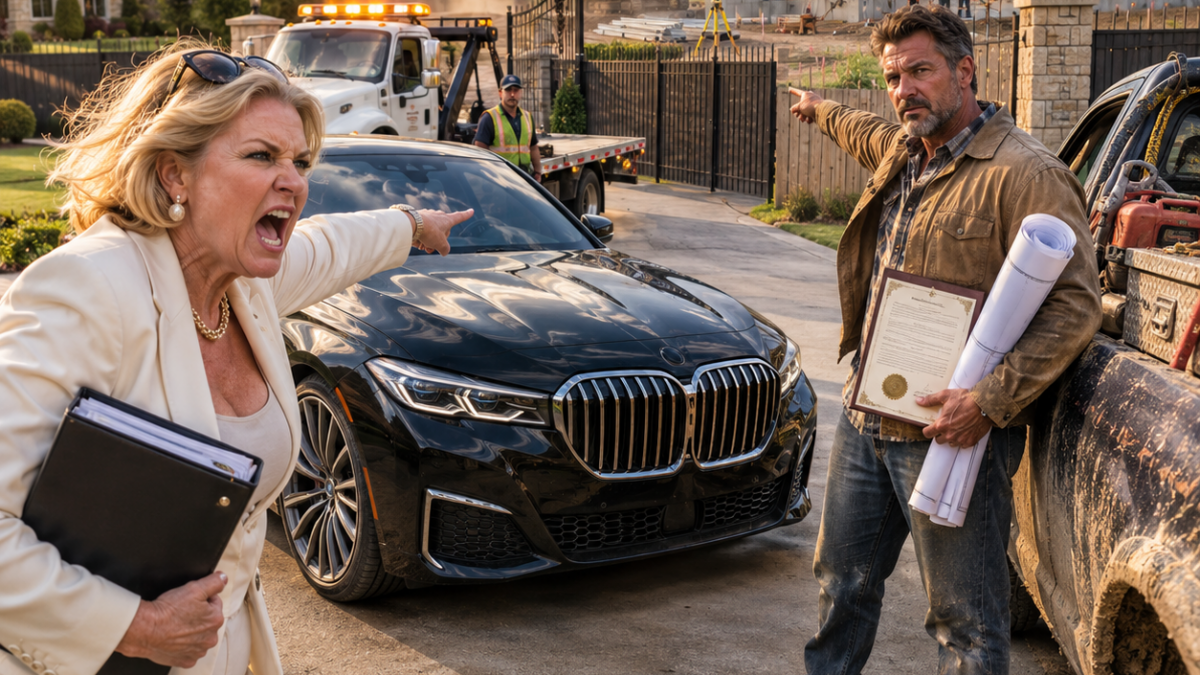
I didn’t argue with Brenda in front of her clients.
That’s probably not what she expected.
She had the sort of expression people wear when they’ve delivered a deliberately insulting remark and are waiting to see whether the other person will embarrass himself.
I could have shouted.
I could have told her exactly what I thought of a real estate agent who treated somebody else’s driveway like a free parking reservation.
But my daughter was standing behind the living-room window.
And I wasn’t going to teach her that the only way to defend yourself was to lose control.
I took out my phone.
Photographed the BMW.
Made sure the license plate and driveway were visible.
Then asked Brenda one final time to move.
She gave an exaggerated sigh.
“Mr. Morrison, I’m conducting business.”
“So am I.”
“Then go conduct it somewhere else.”
I looked at her.
“My workday ended twelve hours after it started. I’d like to park at my own house.”
The older man standing beside her clients cleared his throat.
“Mrs. Whitmore, perhaps we should come back another time.”
Brenda turned quickly.
“Oh, there’s absolutely no need—”
But the couple was already walking toward its Range Rover.
I watched them leave.
Then looked at Brenda.
For the first time, her face showed something besides disdain.
Anger.
She waited until the clients were out of earshot.
“You just cost me a serious buyer.”
I almost laughed.
“Your car is in my driveway.”
She pointed a finger at my chest.
“Don’t think you’re going to move into this neighborhood and start making enemies.”
I stepped back.
“Move the car, Brenda.”
She glared at me.
Then walked toward the BMW.
As she opened its door, her husband appeared from across the street.
Dale Whitmore.
He was a broad-shouldered man in his late forties, wearing khaki pants and a golf shirt tucked so neatly into his waistband that I wondered whether he slept standing up.
He worked in the insurance business and served as president of the Willow Brook Estates homeowners association.
I knew that because Brenda had mentioned his position three times before breakfast.
“Everything all right, sweetheart?” he asked.
Brenda pointed toward me.
“Your new neighbor is being aggressive.”
Dale turned.
His expression grew serious.
“Mr. Morrison, I’m sure we can all behave like adults.”
I nodded toward the car.
“Then your wife can stop parking on my property.”
Dale glanced at the BMW.
Then shrugged.
“She uses that spot when she’s showing nearby homes.”
“I’m aware.”
“It’s been the arrangement for years.”
I folded my arms.
“An arrangement with whom?”
He smiled.
“My wife and your grandmother always understood each other.”
Something about the way he said my grandmother’s name made me uncomfortable.
Grandma had been stubborn, proud, and very particular about her home.
I couldn’t imagine her freely agreeing to give a real estate agent use of her driveway whenever it suited that agent’s business.
But she was gone.
And I didn’t have enough information yet to challenge their story.
So I said:
“If there was a formal agreement, I’d appreciate a copy.”
Dale’s smile tightened.
“Not everything needs to be turned into a legal dispute.”
“Then moving the BMW shouldn’t be difficult.”
Brenda slammed the car door.
“Unbelievable.”
She started the engine, reversed out, and drove toward her house.
Dale stood beside me for a moment longer.
“You should know that the HOA expects cooperation from residents.”
I looked at him.
“And I expect people to stay off my driveway unless I invite them.”
He gave a little laugh.
“Sounds like we have some things to work out.”
I nodded.
“Apparently.”
He walked away.
I parked my F-150.
Went inside.
And found Mila sitting at the kitchen table with two plates of reheated lasagna.
She looked at my face.
“Bad day?”
I dropped my keys beside the counter.
“Long one.”
She nodded toward the window.
“Was that the same lady from this morning?”
“Yes.”
“Why was her car here?”
I sat down.
“Because she seems to think our driveway belongs to her.”
Mila stared.
“That’s weird.”
I laughed.
“That’s one word for it.”
Then she looked at me seriously.
“Dad, Grandma would’ve hated that.”
I glanced toward the framed photograph beside the refrigerator.
Grandma was standing under the oak tree, wearing a blue cardigan and smiling as though she knew something the rest of us hadn’t figured out.
I nodded.
“Yeah, kiddo.”
I took a bite of lasagna.
“She probably would’ve.”
The first HOA fine appeared the following Monday.
It was tucked beneath the windshield wiper of my truck.
A crisp white notice.
Official Willow Brook Estates letterhead.
VIOLATION: PROHIBITED COMMERCIAL VEHICLE PARKING.
FINE: $50.
At the bottom was Dale Whitmore’s signature.
I stared at the paper.
The truck had been parked on the street overnight because Brenda had occupied my driveway again.
The irony was almost impressive.
A woman could commandeer my private property for her real estate business, but I was supposedly breaking neighborhood rules by leaving my own work truck outside.
I took a photograph of the notice.
Then the street.
Then Brenda’s BMW.
I checked the time.
6:02 a.m.
Her car was already in my driveway.
I was beginning to suspect she timed her arrivals around my work schedule.
I sent an email to the HOA management address requesting the specific recorded covenant or rule authorizing the fine, its effective date, and the procedure for contesting the violation.
Then I drove to work.
That evening, I found another notice waiting.
This one claimed I had failed to comply with a previous warning.
I read it.
Then laughed.
Not because it was funny.
Because the Whitmores were treating parking rules like weapons.
By Thursday, there were three more notices.
Another $150 in threatened fines.
I collected them.
Placed them in a folder.
And labeled it:
WILLOW BROOK — PARKING DISPUTE.
I’ve worked in construction long enough to know that arguments fade.
Records don’t.
On a job site, if a contractor claims he delivered forty sheets of drywall, I don’t rely on his memory.
I check the delivery ticket.
If a subcontractor says a measurement changed, I look for the revised drawing.
If somebody insists a foundation was built according to plan, I check the specifications.
And when an HOA president tells me I can’t park on the street while his wife uses my driveway as her private parking lot, I start recording dates.
Times.
Photographs.
Locations.
Not because I enjoy paperwork.
Because I’ve seen what happens when somebody with authority expects everyone else to accept his version of events.
Friday evening, I decided to try diplomacy.
I’d been on a difficult site all day.
One of our drywall deliveries was late, the electrician needed a revised layout, and a young apprentice had nearly put a drill through a pipe because he hadn’t checked what was behind the wall.
By the time I got home, my patience was almost gone.
But I showered.
Changed clothes.
And walked across the street.
Brenda opened her door wearing a cream-colored blazer and a necklace that looked expensive enough to require insurance.
Her house smelled of vanilla candles and lemon cleaner.
She looked surprised.
“Mr. Morrison.”
“Brenda.”
She glanced past me.
“Is something wrong?”
“We need to discuss the driveway.”
Her smile disappeared.
“Oh, that again.”
I took a breath.
“Yes. That again.”
She folded her arms.
“I’ve explained our arrangement.”
“You’ve described an arrangement with my grandmother. I haven’t seen anything showing she gave you ongoing permission.”
Brenda sighed.
“Your grandmother and I helped each other.”
I looked at her.
“How?”
“She was elderly. I kept an eye on the property.”
“By parking your BMW in her driveway?”
Her expression hardened.
“Don’t be sarcastic.”
I nodded.
“Then tell me what permission you had.”
She stared.
“I don’t have time to dig through years of neighborhood history because you’ve decided to be difficult.”
I felt my jaw tighten.
“Brenda, I need you to stop using my driveway.”
Her eyes narrowed.
“Maybe you should consider whether that enormous work truck belongs in a neighborhood like this.”
There it was again.
The truck.
My job.
My clothes.
Every word was supposed to make me feel as though I didn’t belong.
I looked toward the family photographs lining her hallway.
Luxury vacations.
Country clubs.
Gala dinners.
Brenda beside a real estate award.
Dale shaking hands with local business owners.
They looked like people who had never been told they should be grateful simply to have a place in a neighborhood.
I looked back at her.
“My grandmother lived here before most of those houses existed.”
Brenda’s smile returned.
“Times change, Garrett.”
I nodded.
“Property rights don’t disappear because your tastes change.”
Her face went cold.
“If you insist on making this unpleasant, I’m sure Dale can review the compliance issues affecting your property.”
I stared.
“Is that a threat?”
She tilted her head.
“It’s a reminder that communities have standards.”
I stood there for a moment.
Then said quietly:
“I’m asking you to stop parking on my property.”
She opened the door wider.
“And I’m telling you that being a good neighbor sometimes requires compromise.”
I looked at her.
“Then perhaps you can start.”
Her expression hardened.
I turned and walked away.
By the time I reached my front porch, I knew diplomacy wasn’t going to solve this.
Not because I hadn’t tried.
Because Brenda wasn’t asking for a compromise.
She was asking me to accept that her convenience mattered more than my right to use my own driveway.
And Dale was making sure the HOA’s rules reinforced that message.
The next morning, I began documenting everything.
I photographed the driveway before leaving for work.
Recorded when the BMW arrived.
Noted how long it stayed.
Saved the HOA notices.
Preserved emails.
Kept copies of my requests for the applicable rules.
And made a point of recording my own parking locations, because I didn’t want somebody claiming my truck had been somewhere it wasn’t.
That Saturday, Brenda arrived at 8:47 a.m.
Her BMW remained in my driveway until 3:22 that afternoon.
On Sunday, it arrived at 10:15.
It stayed until nearly five.
I took photographs from my property.
I didn’t follow her.
Didn’t confront her clients.
Didn’t drive to the houses she was showing.
I simply documented the use of my driveway.
Then Monday morning arrived.
And Brenda made her first mistake so obvious that even Mila burst out laughing.
Orange traffic cones were arranged across the driveway entrance.
Between them stood a sign.
PRIVATE STAGING AREA — AUTHORIZED VEHICLES ONLY.
I stared.
Then looked toward Brenda’s house.
Her BMW was nowhere in sight.
She had set up a parking reservation on property she didn’t own.
I took photographs.
Removed the cones from my driveway without damaging them.
Placed them together near the edge of my yard.
Then parked my F-150 exactly where it belonged.
Mila came outside carrying her backpack.
She looked at the sign.
Then at me.
“Dad?”
“Yes?”
“Did she just put up a sign saying our driveway is private?”
I nodded.
“Apparently.”
Mila considered that.
Then grinned.
“She’s right.”
I looked at her.
“She is?”
“It’s private.”
She pointed toward our house.
“Yours.”
I started laughing.
Mila smiled.
“Maybe she should read her own sign.”
I shook my head.
“Get in the truck, kiddo.”
She climbed into the passenger seat.
As we pulled away, she looked back at the cones.
Then said:
“Grandma would’ve moved those before breakfast.”
I smiled.
“Without a doubt.”
The smile faded when I remembered something.
My grandmother had spent years in this house.
Years living across the street from Brenda.
And Brenda kept insisting the two of them had an understanding.
Maybe she was telling the truth.
Or maybe Grandma had endured the same treatment I was experiencing.
I decided that evening I was going to search her old files.
I should have done it much sooner.
Tuesday morning, a tow truck stopped in front of my house at 6:15.
I was drinking coffee when I heard its diesel engine.
At first, I assumed somebody’s car had broken down.
Then I saw the sheriff’s deputy arriving behind it.
Both vehicles stopped beside my driveway.
I looked through the window.
My F-150 was parked where I’d left it, entirely on my own concrete.
I hadn’t blocked the sidewalk.
Hadn’t parked in the street.
Hadn’t touched Brenda’s cones.
I walked outside.
The tow truck driver stepped down from his cab.
I recognized him immediately.
“Miguel?”
He turned.
“Garrett?”
We’d worked around the same construction sites for years. His company handled equipment recovery and towing, and I’d watched him pull delivery trucks out of muddy job entrances more than once.
He looked uncomfortable.
“Sorry, man. We got a complaint.”
“About what?”
He glanced toward my pickup.
“Illegal parking and an escalating property dispute.”
Deputy Martinez approached.
He was a younger man with a measured voice and the expression of someone who’d already discovered that this call wasn’t going to be straightforward.
“Mr. Morrison?”
“Yes.”
“We’ve received complaints about threatening behavior and a vehicle allegedly parked in violation of neighborhood restrictions.”
I looked toward my truck.
Then at the deputy.
“That’s my vehicle, on my driveway.”
He nodded.
“I can see that.”
Across the street, Brenda’s front door opened.
She stepped outside in expensive exercise clothes.
Dale followed.
Brenda looked relieved when she saw the uniform.
“Officer, thank goodness you’re here.”
Martinez turned.
“Mrs. Whitmore?”
“Yes. This situation has become terribly frightening.”
I stared.
Brenda pressed one hand against her chest.
“He moved my safety cones and has been behaving aggressively.”
The deputy looked toward the stack of cones near my flower bed.
“Those?”
“Yes.”
I took a breath.
“They were placed across my driveway without permission.”
Brenda shook her head dramatically.
“They were there for neighborhood safety.”
I looked at her.
“What safety issue?”
She turned toward Martinez.
“Do you see how confrontational he is?”
I almost laughed.
The deputy held up one hand.
“Let’s take this one at a time.”
He asked Brenda exactly what threatening statements I’d made.
She described our argument about parking.
Then mentioned the cones.
Then complained that I’d photographed her vehicle.
Martinez listened.
Asked questions.
Made notes.
I showed him the property survey, photographs, and correspondence concerning the dispute.
He examined the position of the truck.
Then turned toward Miguel.
“Is there a valid basis for towing this vehicle under the circumstances presented?”
Miguel shook his head.
“Not that I’ve been shown.”
Martinez nodded.
He explained that the HOA’s disputed fines were a private civil matter and that he wasn’t going to order a truck removed from its owner’s driveway merely because the association disliked the vehicle.
Brenda’s face reddened.
“But our bylaws—”
“Ma’am,” Martinez interrupted, “questions about the enforceability of your covenants need to be handled through the proper process.”
Dale stepped forward.
“Officer, as HOA president, I can assure you we’re dealing with a serious compliance problem.”
Martinez looked at him.
“Then document it and use the appropriate civil procedure.”
Dale’s expression tightened.
The deputy continued:
“I’m not seeing evidence of a criminal threat from Mr. Morrison during this encounter.”
Brenda stared.
For a moment, she seemed unable to understand how the conversation had gone wrong.
She had called the authorities.
They had arrived.
And I was still standing beside my truck.
Miguel climbed back into his cab.
He gave me a brief nod.
“See you around, Garrett.”
“Hopefully under better circumstances.”
He laughed.
Martinez finished his notes and left.
Brenda and Dale remained on the sidewalk.
Their expressions were almost identical.
Angry.
Disbelieving.
Personally offended that the rest of the world hadn’t accepted their authority as readily as they accepted it themselves.
I picked up my coffee.
Then walked back toward the house.
Behind me, Brenda shouted:
“THIS ISN’T OVER!”
I stopped.
Turned.
And answered calmly:
“I know.”
Then I went inside.
Because by that point, I had stopped believing she would get tired of the fight.
And I was beginning to understand that she might become more dangerous as each attempt to control me failed.
That afternoon, a process server knocked on my door.
He handed me a packet of legal documents.
I recognized the name at the top.
WHITMORE & ASSOCIATES REAL ESTATE.
The complaint alleged that I’d interfered with Brenda’s business operations and caused the loss of prospective real estate commissions.
She demanded $5,000 in damages.
I stared at the pages.
For a moment, I thought somebody was playing a joke.
Brenda was suing me because I wouldn’t let her park on my property.
I sat at the kitchen table and read the complaint carefully.
She claimed she’d used my driveway for business purposes for approximately three years.
She described the use as an established arrangement with the previous owner.
She alleged that my objections had disrupted several showings.
And she presented my refusal to accommodate her as unreasonable interference.
I read the phrase reasonable expectation of continued access three times.
Then I looked toward Grandma’s photograph.
Three years.
Brenda claimed she’d been using the driveway while Grandma was still alive.
That meant this didn’t begin with me.
It also didn’t necessarily mean Brenda had acquired any legal right. A history of permissive parking, even if true, was different from ownership or an enforceable permanent property interest.
But the admission mattered.
She had placed a specific history of using my driveway into a formal document.
That history could be investigated.
I called Mark Patterson.
Mark had handled the property arrangements during my divorce and knew enough about my situation to understand why I valued stability.
He answered on the second ring.
“Garrett.”
“Hey, Mark.”
“How’s the house?”
I looked at the legal packet.
“Apparently I’m being sued for using my own driveway.”
Silence.
Then:
“I’m sorry. What?”
I explained.
Mark listened.
Then said:
“Email me the complaint and your property documents.”
“Can you help?”
“I’ll review it and tell you whether I can handle the relevant issues or need to bring in another attorney.”
I nodded.
“And Garrett?”
“Yeah?”
“Don’t build anything, remove anything, or confront anybody until we’ve checked the rules and the claims.”
I glanced toward my garage.
Construction was what I understood.
It was tempting to solve the problem with a physical barrier instead of another stack of paperwork.
But I knew Mark was right.
A construction mistake could give Brenda a legitimate complaint.
I wasn’t going to let that happen.
“I’ll wait,” I said.
Then I opened the closet where Grandma had stored her old records.
Grandma kept everything.
Tax bills.
Insurance policies.
Repair receipts.
Old photographs.
Warranty cards for appliances she’d thrown away twenty years earlier.
Instructions for a washing machine that no longer existed.
As a kid, I used to tease her.
“Grandma, why do you save all this junk?”
She’d look at me over her glasses.
“Because the day you throw something away is the day somebody asks you to prove it.”
I’d laugh.
She never did.
Now I was sitting on her living-room floor, surrounded by cardboard boxes, hoping she’d been right.
The first folder contained utility bills from the 1990s.
The second held property-tax statements.
The third included letters from the HOA.
Lots of them.
I opened one.
NOTICE OF VIOLATION — VEHICLE STORAGE.
Date: 2019.
Another.
NOTICE OF NONCOMPLIANCE — PROPERTY APPEARANCE.
Another.
FINE ASSESSED — $100.
I stared.
Grandma had been receiving violation notices for years.
Some concerned maintenance issues.
Others appeared to target the vehicles of relatives and service workers visiting her property.
There were charges for parking arrangements, landscaping standards, and supposed noncompliance with neighborhood appearance rules.
She’d kept copies of her replies.
I recognized her handwriting immediately.
Small.
Careful.
Precise.
In one letter, she’d written:
My driveway is part of the property I have owned since 1960, and I do not give Mrs. Whitmore permanent permission to use it for her business.
I stopped breathing.
Then read it again.
Grandma had objected.
Explicitly.
I found another letter.
I have permitted temporary parking as a courtesy on certain occasions. That courtesy can be withdrawn. It does not transfer any ownership or access rights.
I sat back.
The woman Brenda described as happily accommodating her business had written letters saying the exact opposite.
I kept reading.
There were payment receipts totaling more than $2,000.
Some appeared to relate to HOA fines Grandma had paid rather than continue fighting.
Other documents showed that she’d disputed the association’s authority to impose restrictions on her property.
Then I found a letter addressed to the city attorney.
It had never been mailed.
Grandma’s handwriting was slightly shakier.
She described repeated demands from Brenda Whitmore.
The pressure to allow business parking.
The fines.
The fear of confrontation.
And the sense that the HOA treated older residents differently when it believed they wouldn’t fight back.
Near the bottom, she wrote:
I have lived here since before this development existed, and I don’t understand how people who arrived decades later can threaten me for using my own driveway while insisting they may park their cars on it.
My eyes filled.
I looked toward her photograph.
“Grandma.”
For a moment, I couldn’t speak.
She’d been eighty-seven.
Living alone.
Trying to preserve the home she’d spent most of her adult life maintaining.
And Brenda had apparently been pressuring her in ways I hadn’t known about.
I remembered visiting a few years earlier and finding Grandma unusually upset.
She’d said the neighborhood board was bothering her again.
I’d offered to help.
She’d smiled.
“Oh, honey, you have enough going on.”
I’d been dealing with my marriage then.
Working long hours.
Trying to keep things stable for Mila.
Grandma had changed the subject.
I had let her.
Now I wished I’d asked more questions.
I gathered the letters carefully.
Placed them in chronological order.
Then called Mark.
“There’s something else.”
“What?”
“My grandmother kept records.”
“How many?”
I looked around the living room.
“Enough to fill a box.”
Mark was quiet.
Then said:
“Bring them.”
Mark’s office smelled like leather furniture and coffee.
He spread the lawsuit across his conference table while I arranged Grandma’s letters beside it.
He read the complaint.
Then examined the photographs showing Brenda’s BMW parked across my driveway.
He compared the dates.
Then read Grandma’s objections.
For a long time, he said nothing.
Finally, he leaned back.
“Garrett, her complaint may be much less persuasive than she thinks.”
I stared.
“Why?”
“She describes continued access as an established arrangement.”
I nodded.
“But your grandmother’s letters show that she objected and expressly limited any permission she gave.”
“So Brenda can’t claim the driveway?”
Mark raised a hand.
“Let’s not jump to conclusions. There are different legal theories for property access, and we need to examine the facts under Michigan law.”
I nodded.
He continued:
“But ordinary permission doesn’t automatically become a permanent right, and a relatively short period of contested parking isn’t the same thing as proving a prescriptive easement.”
I looked toward the letters.
“And the HOA fines?”
“That depends on whether valid restrictions actually apply to your lot and whether the association followed its governing documents.”
I sighed.
“Brenda says the house has always been under the HOA.”
“Then let’s examine the recorded declaration and chain of title.”
He studied the papers.
“Does your grandmother have the original property file?”
I hesitated.
“Maybe.”
He smiled faintly.
“Find it.”
I drove home that evening and began searching again.
I was tired.
My back ached.
Mila had homework spread across the dining table.
And I had a subcontractor calling about a delivery for the following morning.
But somewhere inside those boxes might be the answer to a question nobody in Willow Brook seemed interested in asking.
Did the HOA actually have the authority over Grandma’s property that Dale and Brenda kept claiming?
Two days later, I found the folder.
It was underneath a box of old Christmas decorations.
A yellowed manila envelope.
On the front, in Grandma’s handwriting:
ORIGINAL PROPERTY & HOA DOCUMENTS.
Inside were copies of her original 1960 deed, an old plat, later recorded documents concerning the development, and correspondence from when Willow Brook Estates was organized in 1987.
I sat at the table with the papers spread before me.
The property had existed long before the modern subdivision.
That alone didn’t necessarily exempt it from later valid covenants.
I understood that much.
But one document caught my attention.
A recorded declaration associated with Willow Brook’s formation identified certain preexisting lots and described a specific exception for property not brought into the association through the required consent or recorded process.
Grandma’s parcel appeared among the excluded descriptions.
Another document reserved existing residential and certain previously lawful uses on the older lots.
I read the language repeatedly.
Then looked at the HOA fine notices.
The issue was no longer simply whether my grandmother’s house was old.
The issue was whether her particular parcel had ever become subject to the parking restrictions Dale had been enforcing.
I called Mark.
“Found the old documents.”
“Good.”
“There’s an exception for preexisting parcels.”
“Does it identify your legal description?”
“I think so.”
He paused.
“Don’t guess. Bring it in, and we’ll compare it to the recorded chain.”
I smiled.
“Already making copies.”
Mark laughed.
“Your grandmother would approve.”
I looked toward her photograph.
“She would.”
And for the first time since Brenda had parked her BMW in my driveway, I began to believe the dispute might expose something bigger than one woman’s entitlement.
If Grandma’s property had never been properly subjected to the newer HOA restrictions, then years of fines might have been imposed without the authority Dale kept claiming.
And I had no reason yet to think my house was the only one with a question worth investigating.
The next week brought unexpected company.
Jim Rodriguez, a postal worker who lived two blocks away, knocked on my door carrying an HOA violation notice.
He was a broad man with a tired expression and hands that looked as though they understood physical work.
“Garrett?”
“Yeah.”
“Mind if we talk?”
I stepped aside.
He sat at my kitchen table.
Then placed the notice in front of me.
COMMERCIAL VEHICLE VIOLATION — $50.
I stared.
“Your mail truck?”
He nodded.
“I’m allowed to take the vehicle home under my work arrangement, but the HOA doesn’t like it being visible.”
I frowned.
“Did they just start enforcing this?”
Jim gave me a tired smile.
“Strangely enough, right after you began arguing with the Whitmores.”
He pulled out two older notices.
Then another.
“Rosa Martinez on Oak Street has been fined for her electrical service van.”
I looked up.
“Rosa?”
He nodded.
“She got six notices in a month.”
I leaned back.
“What about the other work vehicles?”
Jim shook his head.
“Depends who owns them.”
We spread the notices across the table.
The pattern was troubling.
Residents who worked in construction, electrical services, maintenance, and similar trades seemed to be receiving particular attention.
Some had their vehicles parked entirely on private driveways.
Others had received citations under restrictions whose scope and validity remained disputed.
Jim looked at me.
“Brenda keeps saying work trucks make the neighborhood look cheap.”
I stared.
“Did she say that to you?”
He nodded.
“She told me people didn’t buy expensive homes so they could look at service vehicles every morning.”
I felt my jaw tighten.
My truck paid my mortgage.
Jim’s work helped his family.
Rosa’s van carried the tools she needed to earn a living.
And Brenda was treating the visible evidence of honest work like a neighborhood defect.
I looked at the notices.
Then said:
“We need to ask for the actual rules and the records showing how they’re enforced.”
Jim nodded.
“Rosa’s already doing that.”
I looked up.
“Good.”
He smiled faintly.
“She doesn’t scare easy.”
I laughed.
“Neither did my grandmother.”
Jim noticed her photograph.
Then his expression softened.
“She was a good woman.”
I nodded.
“Yeah.”
He looked down at the notices.
“She used to tell us the board was treating people unfairly.”
My throat tightened.
“Did she?”
He nodded.
“I wish we’d listened sooner.”
For a moment, neither of us spoke.
Then Jim tapped the papers.
“Maybe we can do something about it now.”
I looked at him.
And realized Brenda had made another mistake.
She believed she was dealing with one construction worker whose driveway she wanted.
But she’d been treating an entire category of neighbors as though their jobs made them less deserving of respect.
Those neighbors had records too.
And some of them were ready to compare them.
Mark reviewed the old declaration with a real estate attorney from his firm and a title researcher who specialized in older subdivisions.
I attended the meeting carrying Grandma’s folder.
They had already compared the documents against the county’s recorded instruments.
The title researcher, a woman named Denise Harper, placed two property descriptions side by side.
One came from Grandma’s original deed.
The other came from the recorded Willow Brook declaration.
“Mr. Morrison,” she said, “the important thing isn’t simply that your house predates the HOA.”
I nodded.
“I understand.”
She pointed toward a paragraph in the declaration.
“This instrument identifies certain existing parcels that were not automatically included within the association’s restrictive covenant scheme.”
She turned another page.
“Your grandmother’s lot appears within that exclusion.”
My heart began pounding.
“Was it ever added later?”
Denise shook her head.
“We haven’t found a recorded instrument bringing this particular parcel under the restrictions Dale has been citing. We’ve also reviewed the later amendments available in the chain.”
Mark leaned forward.
“That doesn’t mean no one can ever challenge our interpretation. But it gives us a strong basis to contest the association’s authority over this specific lot.”
I stared at the documents.
For years, Dale had sent Grandma notices.
Threatened fines.
And treated her driveway as though it were subject to the same rules as the newer houses.
But the recorded property history suggested her home wasn’t part of the restricted development in the way he’d claimed.
I felt my hands begin shaking.
“What about the money she paid?”
Mark looked at me.
“We’ll review the individual assessments, what authority was claimed, applicable deadlines, and whether any recovery is available.”
I nodded.
“Can I put up a wall?”
Both attorneys looked at me.
Mark sighed.
“Garrett.”
I smiled faintly.
“Just asking.”
Denise folded her hands.
“What kind of wall?”
“A decorative brick privacy wall along the side of the driveway.”
Mark studied me.
“Because you want privacy?”
I looked at him.
“And because Brenda keeps parking there.”
He nodded slowly.
“Then we need to examine the precise boundary, any setback and sight-distance requirements, utility easements, drainage, municipal permits, and whether construction would create an unlawful obstruction or interference with an existing vehicle.”
I shrugged.
“That’s manageable.”
“Maybe. But don’t pour concrete until we’re sure.”
I looked at Denise.
She smiled faintly.
“For someone who builds things professionally, you seem unusually eager to skip the paperwork.”
I laughed.
“Fair enough.”
Mark leaned back.
“And Garrett?”
“Yeah?”
“Don’t build it as a trap.”
I stared.
He continued:
“Build something lawful and useful that belongs on your property. Don’t use construction to detain somebody’s vehicle or create a safety hazard.”
I nodded.
That distinction mattered.
I wanted Brenda off my driveway.
I didn’t want to end up defending myself because I’d deliberately trapped her car behind a wall.
We had enough problems already.
The wall design took shape over the next several days.
Four feet high in the main section, with an eight-foot-long decorative brick face and a properly engineered foundation.
The exact location was determined from a current boundary survey, with adequate clearance for the driveway, municipal requirements, and safe access.
I asked the building department what permits or approvals applied.
They reviewed the proposed location and construction details.
Where approvals were required, I obtained them.
No shortcuts.
No invented exemption based solely on the house being old.
No pretending a private property line erased building or safety rules.
I wanted a wall that would still be standing after the HOA dispute ended.
Something attractive.
Something useful.
And something nobody could reasonably call an unsafe construction stunt.
I called Tommy, one of my oldest friends in the trades.
He came by Wednesday evening.
Miguel joined us.
Then Steve, a mason I’d worked with for years.
We stood near the driveway studying the drawings.
Tommy looked toward Brenda’s house.
“That’s the woman?”
I nodded.
“The one with the BMW?”
“Yep.”
He shook his head.
“She really keeps parking here?”
“Whenever she can.”
Miguel laughed.
“After the tow truck incident, I’m surprised she hasn’t moved to Florida.”
Steve examined the design.
“You planning a garden wall?”
I nodded.
“Something that’ll look good beside Grandma’s oak tree.”
He studied the measurements.
Then smiled.
“Nice brick face. Reinforced core. Proper footing.”
Tommy leaned closer.
“Conveniently discourages unauthorized parking, too.”
I shrugged.
“That’s a pleasant side effect.”
Everybody laughed.
We discussed materials.
Labor.
Safety barriers.
Drainage.
How to keep access clear while the work was underway.
Then Steve looked toward the driveway again.
“Garrett, if she parks here while we’re working, don’t trap the car.”
“I know.”
“Give notice. Document it. If she refuses to move, handle it through the proper towing or trespass process.”
I nodded.
“I want the wall finished. I don’t want another lawsuit.”
Tommy grinned.
“She already sued you.”
“Exactly.”
We agreed to help one another with the work.
The materials cost a little more than I’d originally hoped after accounting for the required foundation and finish.
But I could afford them.
And the structure would last.
For the first time since Brenda began using my driveway, I had a practical plan that didn’t depend on her deciding to become reasonable.
Saturday morning arrived clear and cool.
Our materials were scheduled for delivery shortly after sunrise.
The crew would begin with layout checks and site preparation.
At 7:10, I walked outside.
Brenda’s BMW was in my driveway.
Of course it was.
I stared at the white vehicle.
Its paint gleamed.
The SOLD4YOU plate looked almost cheerful.
Brenda had parked there despite the repeated objections, legal correspondence, and notices about the construction schedule.
I took photographs.
Then called the nonemergency number and the towing service I’d arranged through the proper process for unauthorized vehicles.
I also sent a written request to Brenda to move the car promptly.
She appeared from across the street twenty minutes later.
Her expression was already furious.
“What is all this?”
I stood beside the marked construction area.
“Driveway improvement.”
She looked at the bricks.
Then at the foundation layout.
“You’re building a wall?”
“Yes.”
“Here?”
“On my property.”
She stepped closer.
“That will interfere with my parking.”
I stared.
“That’s one reason you’ve been asked to move your car.”
Her face turned red.
“You are not entitled to interfere with my business.”
I looked at the BMW.
“Brenda, your business doesn’t give you the right to occupy my driveway without permission.”
She glanced toward the crew.
“Who authorized this?”
“The relevant municipal approvals have been addressed, and the work has been laid out by professionals.”
She looked toward Steve.
He nodded politely.
“Morning, ma’am.”
Brenda ignored him.
“You are doing this to humiliate me.”
I took a breath.
“No. I’m improving my property and ending unauthorized use.”
She pointed toward the bricks.
“If you build that, I’ll have it removed.”
I nodded.
“You can raise any legitimate concerns through the proper channels.”
Her jaw tightened.
I looked toward her BMW.
“Please move your vehicle so the crew can work safely.”
She folded her arms.
“I have an open house.”
I stared.
“Then you’ll need another parking space.”
For several seconds, she didn’t move.
The crew waited.
A delivery truck slowed at the curb.
Then Brenda looked toward the prospective buyers approaching the house she’d been showing.
Her expression changed.
She straightened her jacket.
Forced a smile.
And said quietly:
“You’re going to regret this.”
I watched her walk toward the BMW.
She got in.
Started the engine.
Then sat there for nearly a minute.
Finally, she reversed onto the street.
She drove away fast enough to leave a small cloud of dust near the construction materials.
Tommy watched her disappear.
“Well.”
I looked at him.
“What?”
He grinned.
“That’s one way to clear a job site.”
I laughed.
Then picked up the plans.
“Let’s build a wall.”
The work attracted attention almost immediately.
Concrete mixers are not quiet.
Neither are masonry saws.
And a crew of tradesmen working on a Saturday morning tends to make neighbors curious.
By ten, several people had stopped to watch.
Jim arrived carrying coffee.
Rosa Martinez, the electrician from Oak Street, came by with her son.
Mila watched from the porch, occasionally taking photographs.
She loved seeing construction work close up.
I had taught her how to read a basic plan when she was ten.
She’d spent entire afternoons watching me repair furniture or build shelves.
Now she was almost old enough to decide whether she wanted to follow me into the trades or pursue something completely different.
I hoped she’d choose whatever made her happy.
We set the foundation carefully.
Checked measurements.
Verified clearances.
Documented the work as it progressed.
The structure was designed to complement the old brick house and protect the edge of the driveway without obstructing lawful public access.
By early afternoon, the concrete foundation was in place and the brickwork was underway.
Brenda returned shortly after two.
Her BMW rolled slowly along Maple Ridge Drive.
She stopped in front of my house.
For a moment, she simply stared.
Then she got out.
“What have you done?”
I looked up from the work.
“Built the foundation.”
Her eyes moved across the construction.
“That’s hideous.”
Steve examined the brick alignment.
“Looks good to me.”
Brenda ignored him.
“You’ve ruined the appearance of this street.”
Rosa stepped closer.
“It’s not even finished.”
Brenda turned sharply.
“I wasn’t speaking to you.”
Rosa smiled.
“I noticed.”
A few neighbors laughed.
Brenda’s face flushed.
Then she looked toward the area where she’d been parking.
The wall foundation occupied a carefully planned strip along the driveway boundary, changing how the side of the property could be accessed.
She pointed.
“Where am I supposed to park for showings?”
I stared.
“On property where you have permission.”
She looked as though I’d slapped her.
Then she took out her phone.
“I’m calling code enforcement.”
I nodded.
“Go ahead.”
She pointed toward me.
“And my attorney.”
“That’s your choice.”
For a moment, she seemed disappointed that I wasn’t more frightened.
Then she walked away.
Mila came down the porch steps.
“Dad?”
I looked at her.
“Yes?”
She grinned.
“Grandma would’ve loved this wall.”
I smiled.
“She would’ve.”
Then she looked toward the construction.
“But she’d probably tell you the bricks need to be straighter.”
Steve burst out laughing.
I gave my daughter an offended look.
“Kiddo, don’t encourage him.”
Mila laughed.
And for one brief afternoon, the wall felt like exactly what I’d intended it to be.
A practical improvement to Grandma’s home.
Built by people who cared about doing the job correctly.
Not an invitation to another neighborhood war.
Unfortunately, Brenda disagreed.
The first inspection came Monday.
A municipal inspector arrived after receiving a complaint about unauthorized masonry construction.
He reviewed the plans and approvals.
Checked the location.
Examined the visible work.
Asked about drainage and sight-distance requirements.
Then told me what additional documentation, if any, needed to remain available for final inspection.
There was no basis for the sweeping allegations Brenda had made.
The work was proceeding within the requirements the inspector was responsible for checking.
I was relieved.
Not triumphant.
I knew inspectors could identify real problems, and I’d intended to correct any legitimate issue.
But Brenda had treated the complaint process like a way to make construction stop, not like a way to protect safety.
Then came another complaint.
And another.
Someone reported concerns about runoff.
Somebody asked whether the wall interfered with emergency access.
There was a claim that construction debris had contaminated the adjoining street.
Each issue had to be reviewed on its own merits.
Some were dismissed after inspection.
Others required ordinary documentation or housekeeping measures that my crew addressed.
I kept everything.
Inspection reports.
Photographs.
Approvals.
Communications.
Because I knew Brenda would eventually claim that the repeated complaints proved the wall was illegal.
They didn’t.
A complaint was an allegation.
A finding required evidence.
And as far as the inspectors had established, the wall was a properly designed improvement on my property.
Brenda didn’t stop with municipal complaints.
One evening, I noticed a dark vehicle parked across the street.
Its windows were tinted.
A camera lens briefly appeared near the passenger-side window.
I watched from my porch.
Then went back inside.
I didn’t know who was in the vehicle.
It might have been connected to her lawsuit.
It might have been somebody gathering information for a legitimate purpose.
I wasn’t going to invent a conspiracy simply because Brenda had made me suspicious.
But the next day, Mark confirmed that the parties were gathering evidence concerning the driveway and wall.
He reminded me that lawful observation from public places was different from entering private property without permission.
I nodded.
Then asked whether I should be worried.
“Continue documenting anything improper,” he said, “but don’t assume every camera means harassment.”
I looked toward the street.
“Fair enough.”
Mark paused.
“By the way, we’ve received the HOA’s response to our request for the recorded restrictions.”
I sat straighter.
“And?”
“It doesn’t answer all the questions.”
I closed my eyes.
“Of course it doesn’t.”
He continued:
“We’ve also obtained records showing that the Whitmores had a business relationship with at least one contractor receiving HOA-funded work.”
I frowned.
“What kind of relationship?”
“Dale has an ownership interest in a contracting company used for some neighborhood projects.”
I stared.
“That isn’t automatically illegal, is it?”
“No. Related-party contracts can be permitted under some circumstances, but disclosure, approval, competitive procedures where required, and proper accounting matter.”
I nodded slowly.
“Then why are you concerned?”
“Because the information provided to homeowners may not clearly reflect the relationship.”
I looked toward Brenda’s house.
Dale had spent weeks telling me he was protecting neighborhood standards.
Now Mark was investigating whether the association’s enforcement activity and improvement spending had been handled transparently.
For the first time, I wondered whether those constant $50 notices were more than a way to punish me.
Maybe they were part of a larger system nobody had examined closely enough.
The following Tuesday, a woman in a dark business suit knocked on my door.
She introduced herself as Rebecca Hartwell.
Her business card identified her as a representative of Pinnacle Property Development.
She was polite.
Professional.
Careful with every word.
“Mr. Morrison, I represent a client interested in acquiring your property.”
I stared.
“My house?”
“Yes.”
“It’s not for sale.”
She smiled.
“Everything has a price.”
I almost laughed.
“Not everything.”
She asked whether we could talk.
I invited her into the living room.
Mila was at school.
The house was quiet.
Rebecca opened a leather portfolio.
Then placed a written offer on the table.
$340,000 cash.
Thirty-day closing.
No ordinary inspection contingency.
The offer was considerably above what similar houses in the area appeared to be selling for.
I stared at the number.
Then looked up.
“Why?”
Rebecca smiled.
“Our client sees long-term value in the neighborhood.”
I leaned back.
“Then why not buy one of the newer homes?”
She folded her hands.
“Your parcel has a particularly desirable location.”
I looked toward the window.
Grandma’s oak tree filled part of the view.
The new wall stood beside the driveway.
I thought about everything I’d recently discovered.
The older property rights.
The HOA dispute.
The possibility that Dale’s board had been collecting fines under questionable authority.
Then I looked back at her.
“Does your client know about the lawsuit?”
“Yes.”
“Does your client know the HOA’s authority over this parcel is disputed?”
She hesitated.
“We’ve been informed that there are neighborhood complications.”
I nodded.
“And you’re offering more than market value anyway?”
“Our client prefers to resolve complications efficiently.”
The wording bothered me.
Resolve complications.
As though the property weren’t a home.
As though Grandma’s sixty years meant nothing.
As though Mila’s memories could be priced by somebody who’d never walked through the kitchen.
Rebecca pushed the offer closer.
“It expires Friday.”
I looked at it.
Then at her.
“I’m not interested.”
She smiled patiently.
“Perhaps you should take time to consider it.”
“I appreciate the offer.”
I slid it back.
“But the house isn’t for sale.”
Her expression cooled slightly.
“Remaining here may involve continued uncertainty.”
I stared.
“What kind of uncertainty?”
She chose her next words carefully.
“Neighborhood disputes can affect enjoyment and resale value.”
I nodded.
“That’s true.”
She seemed encouraged.
Then I continued:
“But selling my house to somebody I don’t know won’t resolve the questions about what the HOA has been doing.”
Her smile faded.
She closed the portfolio.
“Think about it before Friday.”
I stood.
“Have a good evening.”
She left.
I watched the dark car disappear.
Then called Mark.
“Somebody just offered me $340,000 for the house.”
There was a pause.
“Who?”
“Pinnacle Property Development.”
“Send me the paperwork.”
I nodded.
“Think it’s connected to the Whitmores?”
“I don’t know,” Mark said.
“Then we find out?”
“Exactly.”
I smiled faintly.
For all Brenda’s confidence, she had forgotten something important about construction workers.
We spend our professional lives checking what lies beneath the surface.
Sometimes a building looks fine until somebody inspects the foundation.
And sometimes a neighborhood looks prosperous until somebody begins asking who benefits from the rules.
The notices appeared on Grandma’s oak tree Wednesday morning.
Three white sheets.
Attached with plastic ties around a lower branch.
One described a potential sidewalk obstruction.
Another referred to possible storm damage.
The third mentioned the need for an arborist’s evaluation.
I stood beneath the tree, staring at them.
Grandma had planted that oak with my grandfather decades before I was born.
Its trunk was broad and deeply ridged.
The branches shaded half the front yard.
When Mila was little, she’d spend hours collecting acorns beneath it.
I had photographs of her sitting on Grandma’s lap under those branches.
Now, suddenly, the tree had become another alleged neighborhood emergency.
I called the number listed on the notice.
A city employee explained that concerns had been submitted about overhanging limbs and possible sidewalk clearance issues.
I asked whether a formal removal order had been issued.
No.
The matter was under review.
I asked what I should do.
Arrange a qualified inspection and address any actual hazards.
That sounded reasonable.
I didn’t object to protecting pedestrians or neighboring property.
But I wasn’t going to cut down a healthy tree because somebody had complained.
Tommy came by that afternoon with a certified arborist he knew.
We walked around the oak.
The arborist examined the trunk, roots, canopy, and branch structure.
He identified a few limbs that should be trimmed to improve clearance and reduce risk.
He did not recommend removing the tree.
I paid for the assessment.
Then arranged the trimming.
When the municipal follow-up occurred, I supplied the arborist’s report and documentation of the completed work.
The concern was resolved.
No dramatic confrontation.
No tree removal.
Just an ordinary maintenance issue handled properly.
Still, I couldn’t ignore the timing.
The complaints had begun immediately after I rejected the buyout offer.
Maybe that was coincidence.
Maybe somebody genuinely worried about the tree.
I couldn’t prove otherwise.
So I recorded the dates and moved on.
But when I looked at the growing folder on my desk, I began to understand why people sometimes surrendered legitimate disputes simply to regain peace.
Every complaint took time.
Every inspection interrupted work.
Every letter demanded attention.
And every hour I spent defending the right to maintain my own property was an hour I wasn’t spending with Mila or earning a living.
Brenda didn’t need to win immediately.
If she could make staying expensive enough, she might convince me to leave.
That was the part of her strategy I found most disturbing.
Friday arrived.
Rebecca Hartwell called twice.
I didn’t answer the first time.
The second call went to voicemail.
“Mr. Morrison, this is Rebecca from Pinnacle. I wanted to remind you that our client’s offer expires today. Given the ongoing neighborhood issues, this may be your best opportunity for a clean transaction.”
I saved the message.
Then forwarded it to Mark.
He called me a few minutes later.
“Don’t delete anything.”
“I wasn’t going to.”
“Good.”
I leaned back in my chair.
“Any idea who Pinnacle represents?”
“Not conclusively. But we’re reviewing publicly available corporate information and the transaction documents we can lawfully obtain.”
I nodded.
“Should I respond?”
“If you aren’t interested in selling, you’re not obligated to negotiate.”
I looked toward the photograph of Grandma on my desk.
“Then I’m not interested.”
Mark was quiet.
Then said:
“Garrett, you understand you could make a substantial profit.”
I laughed softly.
“That’s what everybody keeps telling me.”
“I’m not recommending the sale. I’m making sure you’ve considered the financial side.”
I looked toward the driveway.
The new wall was nearly finished.
Its red brick matched Grandma’s house.
The oak tree cast a shadow across the yard.
Mila’s bicycle leaned against the garage.
I took a breath.
“Mark, I didn’t inherit this house to flip it.”
He nodded.
“Then we’ve answered that.”
I ended the call.
And went outside to finish the brickwork.
The next week, a film crew appeared near my property.
Not a television news crew.
At least, not initially.
Two people with cameras were photographing the wall and surrounding street.
I approached from my side of the property.
“Morning.”
One man looked up.
“Hello.”
“Can I ask what you’re doing?”
He glanced toward the other camera operator.
“We’re preparing visual documentation for a neighborhood impact assessment.”
I frowned.
“Commissioned by whom?”
“The homeowners association.”
I nodded.
“Then you should know there’s a legal dispute about the HOA’s authority over this parcel.”
He looked uncomfortable.
“We’re just documenting the site.”
“Fine. Please stay off my property unless you’ve received permission.”
He nodded.
“Understood.”
I went back inside.
Later that day, Mark confirmed that Brenda’s side was gathering material to support further claims about the wall’s appearance and alleged effect on the neighborhood.
I didn’t know whether the footage would help her.
I doubted it would show anything other than a professionally constructed wall beside a residential driveway.
But I had learned not to confuse a weak accusation with a harmless one.
Even an unfounded claim could cost time and money to defend.
Mila found me reviewing the photos that evening.
She sat beside me.
“Dad?”
“Yeah?”
“Why is everybody taking pictures of our house?”
I looked at her.
“There’s a dispute about the wall.”
She nodded.
“I know.”
Then she hesitated.
“Are we going to have to move?”
The question hurt.
I turned toward her.
“What makes you ask that?”
She looked down.
“Mrs. Whitmore keeps asking whether we’re planning to sell.”
My stomach tightened.
“When?”
“Sometimes when I’m walking home.”
I stared.
“What does she say?”
Mila shrugged.
“Stuff about how you must be stressed and how maybe a quieter neighborhood would be better for me.”
I sat straighter.
“Has she asked anything else?”
Mila hesitated.
Then nodded.
“She asked whether you and Mom fight a lot.”
I felt something cold move through my chest.
“Anything else?”
“Whether I’m comfortable staying here while all the construction is happening.”
I took a breath.
“Sweetheart, you don’t have to answer personal questions from Brenda.”
“I know.”
I looked at her.
“And if she approaches you again, tell me.”
She nodded.
Then said:
“Dad, I’m not scared of the wall.”
I smiled faintly.
“I know.”
She glanced toward the window.
“I’m scared she’s going to keep making trouble until you give up.”
For a moment, I couldn’t speak.
My daughter had seen more than I realized.
She had watched Brenda use the driveway.
Seen the tow truck arrive.
Heard arguments.
Watched me spend evenings reviewing documents instead of relaxing.
Now she was worried the woman across the street could somehow force us out of the only home that still felt connected to Grandma.
I pulled Mila close.
“Listen to me.”
She leaned against my shoulder.
“I can’t promise there won’t be more problems.”
She nodded.
“But I can promise I’m taking the legal and practical steps to protect our home.”
She looked up.
“Really?”
“Yes.”
I smiled gently.
“And I won’t make a decision about moving without talking to you.”
Her expression softened.
“Okay.”
Then she added:
“I’d hate to leave the oak tree.”
I laughed.
“Me too, kiddo.”
She rested her head against my shoulder.
For a long time, we sat quietly.
I didn’t tell her everything would be easy.
It wouldn’t.
But I wanted her to know that the adults in her life could face a difficult situation without pretending nothing was wrong.
Two mornings later, a child protective services investigator contacted me about a report raising concerns regarding Mila’s home environment.
For several seconds, I couldn’t speak.
The allegations mentioned ongoing neighborhood conflict, construction activity, and claims that Mila might be experiencing an unstable living situation.
I felt sick.
My daughter was safe.
She had a comfortable bedroom.
A clean home.
A mother who loved her.
A father who worked hard to maintain a stable relationship after divorce.
And now somebody had submitted a report suggesting she might be unsafe because of a property dispute.
My first thought was Brenda.
I wanted to say her name immediately.
But I had no proof she’d made the report.
It was anonymous.
And a suspicion wasn’t enough.
I contacted Mark, then cooperated appropriately with the agency’s inquiry.
The investigator, Sarah Bellamy, was professional and direct.
She explained what she needed to review.
I answered her questions honestly.
She observed the home.
Discussed the construction precautions.
Spoke with Mila through appropriate procedures.
And examined the conditions relevant to the report.
Mila was understandably upset.
Afterward, she came into the kitchen with tears in her eyes.
“Dad?”
I stood immediately.
“What happened?”
She shook her head.
“I didn’t do anything wrong.”
My chest tightened.
“Sweetheart, nobody said you did.”
She began crying.
“Why would somebody tell people I wasn’t safe here?”
I pulled her into my arms.
“I don’t know.”
She clung to me.
“I love this house.”
“I know.”
“And I love staying with you.”
I closed my eyes.
“I love having you here.”
For a long time, I held her.
Eventually, the inquiry concluded without a finding that supported the alleged unsafe conditions.
I received the appropriate confirmation.
I was relieved.
But the emotional damage didn’t disappear with the paperwork.
Mila had been frightened.
She had wondered whether somebody could take away her time with me because of a dispute she hadn’t started.
That was something I would never forgive easily.
Even though I couldn’t prove who filed the report, I could address the conduct I knew had occurred.
I documented Mila’s account of Brenda asking intrusive questions.
Mark sent an appropriate communication directing the Whitmores not to approach my daughter about our private family circumstances.
I told Mila to come to me if she felt uncomfortable or pressured.
And I made sure her mother knew what had happened.
My ex-wife and I had our differences.
Plenty of them.
That’s why we were divorced.
But when it came to protecting Mila, we agreed.
Our daughter would not become a bargaining chip in a neighborhood dispute.
The local news story aired the following Wednesday.
I hadn’t asked for publicity.
In fact, I was worried the attention would make everything worse.
But the property dispute had begun attracting interest because it involved selective HOA enforcement, a real estate agent using a neighbor’s driveway for business, and questions about the association’s financial arrangements.
A reporter contacted me.
I agreed to speak after consulting Mark.
I kept my comments narrow.
I described what I’d personally experienced.
Showed the driveway photographs.
Explained the dispute over the applicable property restrictions.
And made clear that unresolved allegations needed to be investigated rather than treated as proven facts.
The reporter also interviewed other residents.
Jim spoke about the parking fines.
Rosa described the notices issued against her work van.
Several homeowners questioned why certain vehicles were targeted while others appeared to receive exceptions.
The resulting story surprised me.
It wasn’t about a stubborn construction worker ruining a wealthy neighborhood.
It was about whether the HOA was applying its rules fairly and whether residents had been given enough information about enforcement and spending.
Brenda appeared briefly.
She insisted the association was protecting community standards.
Dale said all financial practices complied with the governing documents.
Both refused to discuss specific contractor payments while reviews were pending.
Then the reporter showed the driveway.
My wall.
Grandma’s brick house.
And the BMW parked there in photographs taken over several months.
The segment ended with a simple question:
Why was a resident receiving fines for parking while an HOA officer repeatedly used his private driveway without permission?
I watched with Mila.
She turned toward me.
“Dad?”
“Yeah?”
“They finally showed the whole driveway.”
I nodded.
“Yeah.”
She smiled.
“And the wall looks good.”
I laughed.
“That’s what you took from the news report?”
She shrugged.
“Steve did nice brickwork.”
I laughed harder.
Then she added:
“I hope people stop thinking you’re the bad guy.”
I looked at her.
“Me too.”
But I knew a television story couldn’t resolve the underlying dispute.
It might help people understand the issue.
It might encourage questions.
But the evidence still had to be tested.
And Brenda wasn’t finished trying to make me regret standing up to her.
The professional consequences arrived on Thursday.
I was reviewing a construction schedule when a general contractor I’d worked with for years called.
His name was Paul.
He sounded uncomfortable.
“Garrett, I’ve got some bad news.”
I sat down.
“What happened?”
“The commercial renovation we discussed.”
“Yeah?”
“The client doesn’t want to move forward with your crew.”
I frowned.
“Why?”
A pause.
Then:
“They’ve heard concerns about litigation and aggressive conduct.”
I stared.
“What concerns?”
Paul sighed.
“Somebody contacted the development company.”
My stomach tightened.
“Who?”
“I don’t know exactly, and I’m not going to guess.”
He paused.
“But your name came up alongside claims about neighborhood harassment.”
I closed my eyes.
The project was valuable.
It would have kept several men employed for weeks.
Losing it wasn’t a small inconvenience.
It affected schedules.
Income.
The people who counted on me to find steady work.
I took a breath.
“Paul, you know me.”
“I do.”
“You’ve seen my work.”
“I know.”
He sounded genuinely frustrated.
“That’s why I’m calling you directly instead of letting you hear it from somebody else.”
I thanked him.
Then ended the call.
For several minutes, I sat staring at the wall.
I’d tolerated HOA fines.
Legal threats.
Inspections.
A buyout offer.
But this was different.
Somebody’s accusations were affecting my livelihood.
I didn’t know who’d contacted the client.
I wasn’t going to claim Brenda had done it without evidence.
But I needed to protect my professional reputation.
I called Mark.
He asked for the facts.
I gave him Paul’s name, the project information, and the statements Paul had shared.
Mark said he’d evaluate whether there was an appropriate basis to request clarification or pursue a claim if false statements had been made.
Then I called my crew.
Not to complain.
To tell them what had happened.
Tommy listened.
Then said:
“Garrett, we’ve got other work.”
I sighed.
“Not enough to replace that contract.”
He was quiet.
Then answered:
“We’ll find it.”
I wanted to believe him.
Over the next several days, other contractors and suppliers heard about the situation.
Some offered projects they needed help finishing.
Others asked whether I could take on smaller work.
Dave at Miller Construction Supply called with a referral.
Miguel passed along the name of a contractor looking for a crew.
I didn’t suddenly become rich because people supported me.
The lost contract still hurt.
But I didn’t lose the business.
And I learned something that stayed with me.
Brenda had spent months talking about status.
About property values.
About keeping working people out of view.
Yet the people who helped me most were the ones she’d spent her time looking down on.
Men and women who showed up before sunrise.
Worked through rain.
Paid suppliers.
Helped neighbors.
And understood that a person’s worth couldn’t be measured by the car parked in the driveway.
Mark called the following Monday with news about the HOA’s finances.
He had been reviewing the public and association records available to us, along with information homeowners were entitled to request through the proper process.
Some residents had begun submitting formal inspection requests concerning enforcement revenue and contractor expenditures.
Rosa was among them.
So was Jim.
Several homeowners who’d previously sided with Dale had joined.
That surprised me.
Mark explained that the association’s records showed payments to a construction-related company in which Dale had a financial interest.
The payments weren’t automatically unlawful.
But the disclosures and authorization process raised questions.
I leaned forward.
“How much money?”
“Approximately $47,000 over a three-year period in the transactions we’re examining.”
I stared.
“Forty-seven thousand?”
“That’s the current group of transactions. We need an independent audit before determining what they represent.”
I looked toward Grandma’s letters.
More than $2,000 in fines she’d paid.
Jim’s notices.
Rosa’s notices.
My own $200 in disputed charges.
The amounts weren’t enormous individually.
That was part of what made the pattern so disturbing.
A fifty-dollar fine wasn’t usually worth hiring an attorney over.
A hundred-dollar assessment might be cheaper to pay than fight.
If residents believed the HOA had authority, most would simply comply.
But across a neighborhood, small charges could accumulate.
And if the enforcement revenue was being handled improperly or directed toward undisclosed related-party contracts, the consequences could become much more serious.
I asked Mark:
“Does this mean Dale stole the money?”
“No.”
His answer was immediate.
I appreciated that.
“It means the records raise questions requiring investigation. We need to determine what services were actually provided, whether the contracts were approved properly, whether conflicts were disclosed, and whether any funds were misused.”
I nodded.
“Then what happens?”
“The homeowners can insist on an appropriate review under their governing documents, and any evidence of possible criminal misconduct can be referred to the proper authorities.”
I took a breath.
“And my driveway?”
“We’re still defending the lawsuit.”
I laughed weakly.
“Right.”
Mark paused.
“Garrett, there’s something else.”
I looked up.
“What?”
“Dale’s company may have connections with the developer that approached you about buying the house.”
My stomach tightened.
“Pinnacle?”
“Yes.”
“Can we prove it?”
“Not yet.”
I looked toward the folder containing the $340,000 offer.
Suddenly, the amount seemed less generous.
If someone connected to Dale wanted to buy the house, the offer might have been an ordinary investment proposal.
Or it might have been an attempt to remove a difficult homeowner from a neighborhood where his questions were becoming inconvenient.
I didn’t know which.
I wasn’t going to pretend I did.
But for the first time, I understood that the driveway dispute could be connected to interests far larger than Brenda’s parking convenience.
And I intended to find out what the records would actually support.
The emergency HOA meeting was scheduled for Tuesday evening.
By then, Willow Brook Estates no longer felt like the sleepy suburb I’d moved into three months earlier.
People were talking in driveways.
Neighbors who had barely acknowledged one another were comparing violation notices.
Several homeowners had requested copies of the association’s financial records.
Some supported Dale.
Others believed the board had abused its authority.
And a growing number didn’t know what to believe.
That last group mattered most.
They weren’t looking for a dramatic confrontation.
They wanted to know whether the money they paid to maintain their neighborhood had been handled honestly.
I understood.
HOAs were supposed to manage shared responsibilities under their governing documents.
Not operate as private kingdoms for whoever happened to hold the gavel.
I spent the afternoon preparing with Mark.
We arranged the evidence in separate sections.
The property documents.
The survey.
Grandma’s letters.
The parking photographs.
The original declaration and relevant recorded instruments.
The wall permits and inspection records.
The HOA notices.
And the financial questions raised by records obtained through the homeowners’ requests.
I also kept a separate folder concerning the child welfare report and the loss of the construction contract.
Those issues mattered.
But I didn’t intend to stand before sixty neighbors and claim Brenda had caused every problem in my life without proof.
I wanted to focus on what we could substantiate.
Mark looked at the folders.
“Good.”
I sighed.
“You sound disappointed.”
He smiled faintly.
“Why?”
“Because I haven’t made any reckless accusations?”
“That’s exactly why I’m pleased.”
I laughed.
He became serious.
“Garrett, remember that an HOA meeting isn’t a court.”
“I know.”
“You can ask questions, challenge the board’s records, and present information appropriately. But don’t announce that somebody is guilty of a crime based on your interpretation of accounting entries.”
I nodded.
“Understood.”
“Let the evidence speak.”
I looked toward Grandma’s old folder.
Then smiled.
“Seems to be working.”
Mark nodded.
“It usually does better than shouting.”
The community center parking lot was nearly full when I arrived.
A local reporter stood near the entrance speaking with a homeowner.
Inside, the room smelled of industrial carpet and stale coffee.
Folding chairs filled every available space.
People stood along the rear wall.
I recognized Jim.
Rosa.
Several residents who’d once walked past me without speaking.
And a few who had openly supported Brenda during the early parking dispute.
They all looked serious.
At the front of the room sat Dale Whitmore.
Beside him was Brenda.
Both were dressed like they were attending a corporate board presentation.
Dale wore a dark suit.
Brenda had chosen a cream-colored blouse and an expensive necklace.
Two attorneys sat nearby.
A projection screen stood behind them.
I saw the opening slide before Dale began.
WILLOW BROOK ESTATES — COMMUNITY STANDARDS AND PROPERTY PROTECTION.
I almost smiled.
Every time Brenda wanted to use somebody else’s driveway, it was a community standard.
Every time I asked for proof of authority, it became a threat to property protection.
Dale struck the small wooden gavel.
The room quieted.
“We’re here tonight to address ongoing neighborhood disruption associated with Mr. Garrett Morrison’s property.”
I sat beside Mark.
Mila wasn’t with me.
She’d wanted to come.
I told her I needed her to spend the evening with her mother instead.
My daughter had already been dragged into too much adult conflict.
She didn’t need to watch another room full of grown people argue about her father’s driveway.
Dale continued.
He described the wall as an unauthorized obstruction.
He suggested it might interfere with drainage.
He warned that visible work vehicles could lower neighborhood standards.
Then Brenda took the microphone.
She displayed photographs of the wall.
Some were taken during construction, when exposed materials and safety barriers made it look unfinished.
Others showed my F-150.
A photograph of my boots appeared on one slide.
I stared.
My boots.
The woman had apparently decided that muddy work boots were evidence of neighborhood decline.
Brenda spoke in a smooth, practiced voice.
“Willow Brook homeowners have invested heavily in maintaining an attractive environment.”
She gestured toward the screen.
“Unfortunately, recent actions by one resident have created significant concerns about appearances, property values, and community safety.”
Several people murmured.
Then she looked toward me.
“We cannot allow individual disregard for standards to diminish the investments of responsible homeowners.”
I felt my jaw tighten.
Individual disregard.
She meant me.
The man whose property she’d been using without permission.
The man whose grandmother had kept letters documenting years of complaints.
The man who’d received fines the association might never have had authority to impose.
Then Brenda said something I hadn’t expected.
“As part of our efforts to protect the community, I’ve personally monitored neighborhood conditions from several strategic locations over the past three years.”
I looked toward Mark.
He was already writing.
Brenda continued:
“My professional presence in the neighborhood has helped us identify maintenance and appearance issues before they affect property values.”
I glanced toward Jim.
His eyebrows had risen.
Then Brenda mentioned Grandma’s house.
“I’ve always maintained a close relationship with the Morrison property, even before Garrett inherited it.”
I stood slowly when Dale opened the floor for questions.
Brenda looked annoyed.
“Mr. Morrison, please keep your comments brief.”
I nodded.
“I’d like to ask one question.”
Dale sighed.
“Go ahead.”
I held up the complaint filed by Whitmore & Associates.
“In your lawsuit, your business describes a three-year pattern of using my grandmother’s driveway for real estate showings.”
Brenda’s expression tightened.
I continued:
“Tonight, you’ve described monitoring the neighborhood from locations you’ve used professionally.”
I looked directly at her.
“Did you have ongoing permission from my grandmother to use that driveway?”
Brenda smiled coldly.
“We had an understanding.”
I opened Grandma’s folder.
Then removed one of her letters.
“On this date, she wrote that she’d permitted occasional temporary parking but did not authorize permanent business use.”
Brenda went still.
I continued:
“She asked you to stop treating the driveway as a standing parking arrangement.”
A murmur moved through the room.
Brenda leaned toward her microphone.
“Your grandmother was elderly, Garrett.”
My chest tightened.
I stared.
Then she added:
“She may not have understood the practical benefits of the arrangement.”
For a moment, I forgot about Mark.
The documents.
The questions I’d prepared.
My grandmother had built a life in that house.
Raised her children.
Maintained the property for decades.
Managed her finances.
Remembered birthdays.
Helped neighbors.
And now Brenda was suggesting that age made Grandma incapable of understanding whether she wanted a real estate agent parking on her driveway.
I took a slow breath.
Then answered:
“My grandmother understood the difference between giving somebody permission and giving them ownership.”
Brenda’s face reddened.
I placed the letter on the table.
“And she documented it.”
The room became quiet.
Dale leaned toward his microphone.
“Mr. Morrison, this is not a trial about your grandmother.”
I looked toward him.
“No.”
Then I picked up the next document.
“It’s a meeting about the authority this board has been claiming over her property.”
I displayed the recorded declaration.
The original property description.
And the exception identifying the preexisting parcels that weren’t automatically included in the Willow Brook restrictions.
I explained the age of the house.
Then made clear that age alone wasn’t the determining factor.
The relevant issue was the recorded restriction history for Grandma’s specific lot.
Mark had confirmed that the available record supported our position that the parking rules Dale had enforced against my property didn’t apply as claimed.
Dale interrupted.
“Subsequent homeowners accepted current standards.”
I looked toward him.
“Then please produce the recorded instrument showing this lot was brought under those restrictions.”
His face tightened.
“We have decades of consistent practice.”
I nodded.
“Practice isn’t the same as a recorded agreement.”
Brenda leaned forward.
“Garrett, you are deliberately misrepresenting community history.”
I looked at her.
“Then correct me with the document.”
For several seconds, nobody spoke.
Then Jim stood.
“Mr. Whitmore, I’d like the board to explain why some work vehicles get fined and others don’t.”
Dale looked toward him.
“Enforcement is handled according to established policies.”
Jim raised his own violation notices.
“Then show us the policies.”
Rosa stood next.
“And the records showing which vehicles received exceptions.”
The room began murmuring.
Dale’s attorney spoke quietly to him.
Brenda looked furious.
I wasn’t the only person asking questions anymore.
That was the moment the meeting changed.
The Whitmores had prepared to confront one difficult homeowner.
Instead, they were facing neighbors who had begun reading the documents themselves.
Then came the financial records.
I didn’t announce that Dale had stolen $47,000.
I didn’t know that yet.
Instead, I displayed the documented payments identified through the homeowners’ records requests.
Approximately $47,000 in transactions associated with neighborhood improvement work had gone to a company in which Dale held an interest.
I asked whether the relevant conflict had been properly disclosed and whether the contracts had been authorized in accordance with the governing documents.
A woman in the second row raised her hand.
“I’ve been on the landscaping committee for four years.”
Dale looked toward her.
“Yes, Margaret?”
She stood.
“I don’t remember seeing those contracts.”
Dale shifted.
“Not every project is reviewed by every committee.”
She nodded.
“I understand that.”
Then she asked:
“Which board minutes record the approvals?”
Silence.
Another homeowner stood.
“Were competitive bids obtained?”
A third asked:
“Why weren’t residents told the president had a financial interest in one of the vendors?”
Dale’s expression hardened.
“Any business relationships were handled appropriately.”
Mark stood.
“Then producing the approvals and supporting documentation should resolve the question.”
Dale looked toward him.
“Are you accusing me of a crime?”
Mark’s voice remained calm.
“No. We’re requesting transparency about transactions involving the association.”
For a moment, Dale seemed unsure how to respond.
Then Brenda leaned toward the microphone.
“This is a coordinated attempt to destroy our reputations.”
Rosa stood again.
“Brenda, nobody made you park in Garrett’s driveway.”
A few people laughed.
Rosa continued:
“Nobody made Dale fine residents whose trucks he didn’t like.”
The laughter faded.
“And nobody made the board refuse to answer basic questions about its money.”
Dale banged the gavel.
“Order!”
Rosa looked toward him.
“Then give us some.”
The room erupted.
Not into violence.
Not chaos.
Into questions.
Homeowners wanted records.
Names.
Dates.
Minutes.
Invoices.
Approvals.
Answers.
Things they’d rarely asked for when Dale’s confident speeches had been enough.
I stood quietly beside Mark.
For the first time, Brenda wasn’t controlling the conversation.
And Dale couldn’t make the questions disappear by insisting he was the president.
The meeting was interrupted by the arrival of Detective Rivera.
He entered with two uniformed officers and stopped near the rear of the room.
People turned.
For a moment, nobody knew what was happening.
Dale looked irritated.
“Can we help you?”
Rivera approached the front.
“Mr. Whitmore?”
“Yes?”
“I need to speak with you.”
Dale stood.
“About what?”
Rivera explained that his department had been conducting a separate investigation into financial transactions involving the association.
The investigation had not begun that evening.
It had developed through reports, records, interviews, and information gathered independently of my parking lawsuit.
Unknown to me, the financial questions raised by homeowners had overlapped with an inquiry already examining suspicious invoices and transfers.
Rivera produced the appropriate warrant.
Dale stared.
For several seconds, he didn’t speak.
Then he turned toward Brenda.
Her face had gone white.
“Dale?”
He looked at her.
Then back at the detective.
Rivera informed him of the arrest and the allegations under investigation, including embezzlement-related conduct involving HOA funds.
The officers followed the proper procedures.
Dale was taken into custody without a struggle.
Brenda stood so abruptly that her chair scraped against the floor.
“This is a mistake!”
Rivera turned toward her.
“Ma’am, please step back.”
She pointed toward me.
“He did this!”
I stood still.
Brenda’s voice rose.
“He’s been trying to destroy us for months!”
I looked at her.
For a moment, I thought about every threat.
Every fine.
The BMW.
Grandma’s letters.
Mila crying in my kitchen.
The lost construction contract.
The weeks spent defending my home.
Then I took a breath.
“No, Brenda.”
My voice was quiet.
“I asked you to stop parking in my driveway.”
She stared.
I continued:
“Everything after that was a choice somebody made.”
For several seconds, she couldn’t answer.
Behind her, homeowners were already asking what the arrest meant for the association’s money.
Mark leaned toward me.
“Garrett, don’t say anything else.”
I nodded.
He was right.
An arrest wasn’t a conviction.
The financial allegations still had to be proved through the criminal process.
But Dale had been taken into custody based on a formal investigation.
And the neighborhood could no longer pretend the questions about its finances were nothing more than my personal feud with the Whitmores.
Brenda looked around the room.
For the first time, the people she’d spent years trying to impress weren’t looking at her with admiration.
They were looking at her for answers.
She had spent months telling me that I didn’t belong.
Now she was standing in the middle of a community that no longer trusted her.
She turned toward me one last time.
“You’ve ruined our lives.”
I looked at her.
Then answered:
“I just wanted to park in my own driveway.”
I didn’t celebrate that night.
People sometimes assume that when the person who’s been bullying you finally faces consequences, you feel nothing but satisfaction.
Maybe some people do.
I felt exhausted.
The meeting had brought serious allegations into public view.
Dale had been arrested.
Residents were frightened about their association’s finances.
And my own family had spent months dealing with a dispute I hadn’t wanted.
I drove home.
The neighborhood was quiet.
My truck rolled into the driveway without obstruction.
The brick wall stood beside the oak tree.
The porch light was on.
Mila was spending the evening with her mother, so the house was empty.
I walked into the kitchen.
Set down my keys.
Then stood looking at Grandma’s photograph.
For months, I’d wanted Brenda to understand she couldn’t treat my property like her personal business asset.
Now the whole neighborhood was asking questions about the power she and Dale had exercised.
But Grandma wasn’t there to see it.
I thought about those old letters.
Her careful handwriting.
The money she’d paid rather than keep fighting.
The way she’d apparently tried to solve the problem alone because she didn’t want to burden me.
I sat down.
For a moment, my eyes filled.
Then I said quietly:
“I’m sorry I didn’t know, Grandma.”
The house was silent.
I looked toward the old oak tree outside.
And remembered something she’d told me when I was sixteen.
We’d been repairing a section of fence.
I was impatient.
I’d wanted to finish quickly.
Grandma stopped me.
“Garrett.”
“What?”
“Why are you rushing?”
“Because it’s just a fence.”
She shook her head.
“A fence tells people where they’re supposed to stop.”
I laughed.
“Grandma, that’s obvious.”
She smiled.
“Then build it right.”
I looked toward the new wall.
For the first time, I understood how much those words meant.
A boundary wasn’t an insult.
It wasn’t cruelty.
It was an acknowledgment that one person’s rights ended where another person’s began.
Brenda had never accepted that.
And the neighborhood had paid for it.
The weeks that followed were quieter, but they weren’t simple.
Dale’s arrest had shaken Willow Brook Estates.
Three board members resigned within days.
Others demanded an independent financial audit.
Homeowners who had never attended a meeting suddenly wanted copies of budgets, bank statements, contractor agreements, and enforcement records.
The association retained outside professionals to examine its finances.
Meanwhile, Dale’s criminal case proceeded separately.
I didn’t pretend that an arrest meant the allegations were already proved.
I had spent months insisting that evidence mattered.
I wasn’t going to abandon that principle simply because the person accused happened to be somebody who’d mistreated me.
But the investigation continued producing records.
Suspicious invoices.
Undisclosed related-party transactions.
Payments for work that the association’s independent reviewers could not fully substantiate.
And discrepancies between approved expenditures and the amounts actually transferred.
The original $47,000 in transactions we’d questioned became part of a broader examination.
The independent audit ultimately identified more than $80,000 in questionable or improperly handled association expenditures, though not every disputed dollar represented a criminal offense.
Some involved inadequate approval procedures.
Others were unsupported charges requiring recovery or correction.
The criminal investigation addressed the transactions for which investigators believed the evidence supported prosecution.
Dale’s lawyers challenged the allegations.
That was their job.
Residents waited for the process to unfold.
So did I.
The truth was more important than rushing toward a satisfying headline.
Brenda resigned from her HOA position shortly after Dale’s arrest.
Her announcement was predictably dramatic.
She claimed she had been the victim of a coordinated campaign by people who didn’t understand the sacrifices required to maintain an upscale community.
She accused certain homeowners of ingratitude.
She described the investigation as an attack on her family.
And she insisted she had always acted to protect property values.
What she never explained was why protecting those values required parking her BMW in my driveway without permission.
Or why my grandmother had spent years writing letters asking her to stop.
Or why the association had treated certain residents’ work vehicles as neighborhood eyesores while making exceptions for others.
Brenda also faced a separate review involving her real estate business.
The questions weren’t based simply on her being an unpleasant neighbor.
They concerned specific representations and conduct arising from her business activities.
Some buyers and clients had complained about statements she made concerning property access, neighborhood restrictions, and the conditions surrounding certain listings.
The relevant licensing authorities examined those complaints under the standards applicable to her profession.
Eventually, her license was suspended as part of that process.
It wasn’t an automatic punishment for losing a fight with me.
It was the consequence of findings concerning her professional conduct.
Her business lost listings.
Clients moved to other agents.
The glossy photographs of expensive homes disappeared from some of her advertisements.
And the SOLD4YOU BMW, which had once occupied my driveway almost daily, became a rare sight in Willow Brook.
I didn’t feel compelled to drive past her house and watch.
I had spent enough time thinking about Brenda Whitmore.
I wanted to spend more time thinking about my daughter.
The lawsuit against me was eventually resolved.
Brenda’s claim for lost commissions had serious weaknesses.
Her own complaint acknowledged that she had been using property she did not own.
Grandma’s letters showed that any parking permission had been limited and contested.
The records did not establish the permanent business access Brenda had tried to imply.
And the survey confirmed that the driveway was within my parcel.
After negotiations and legal proceedings, her damages claim was dismissed.
The dispute over the HOA’s authority to fine my property was addressed separately.
The original recorded declaration, the property’s chain of title, and the absence of a later valid instrument subjecting Grandma’s lot to the disputed restrictions supported my position.
The association ultimately agreed that the parking fines imposed against my parcel under those restrictions were not enforceable.
The outstanding notices were withdrawn.
The amounts collected from Grandma that were still recoverable under the applicable legal arrangements were addressed through a settlement.
I remember sitting with Mark when the final documents arrived.
He slid them across his desk.
I read the settlement twice.
Then looked up.
“So that’s it?”
He smiled.
“For this part, yes.”
I leaned back.
For months, the dispute had occupied nearly every spare minute of my life.
Now the paperwork was finished.
The wall stood.
The driveway was mine to use.
And the lawsuit no longer hung over my head.
I should have felt like celebrating.
Instead, I felt tired.
Mark noticed.
“Garrett?”
I looked at him.
“Yeah?”
“You okay?”
I nodded.
“Just thinking.”
“About what?”
I looked toward the window.
“How much trouble it took to establish that I could park my truck at my own house.”
Mark laughed softly.
Then grew serious.
“That’s often the worst part of these disputes.”
“What?”
“Not the final outcome. The time and money people have to spend defending rights that shouldn’t have been challenged in the first place.”
I nodded.
He was right.
I wasn’t going to get those months back.
Neither was Mila.
But I could make sure the experience changed how I handled problems in the future.
And perhaps, if enough residents understood what had happened, Willow Brook could become a place where the next person wouldn’t have to fight so hard.
The new HOA board held its election several weeks later.
Rosa Martinez ran for president.
The electrician Brenda had fined repeatedly for parking her work van.
The woman who’d stood in the community meeting and demanded to know why the rules weren’t being applied consistently.
I didn’t expect her to win easily.
She wasn’t wealthy.
Didn’t have a polished real estate background.
Didn’t spend weekends attending expensive charity galas.
She wore ordinary clothes, spoke plainly, and wasn’t afraid to tell people when she needed to research an answer.
But homeowners had grown tired of confident speeches.
They wanted transparency.
They wanted accurate records.
And they wanted a board willing to admit when it didn’t know something.
Rosa won.
Her first public commitment wasn’t to punish everyone associated with the old board.
It was to examine how the association had been operating.
She supported a comprehensive financial audit.
A review of enforcement procedures.
Clearer conflict-of-interest disclosures.
And a process for homeowners to challenge fines without being treated as enemies of the community.
Jim Rodriguez helped organize meetings for residents who wanted to understand the rules.
Other neighbors volunteered.
Some had supported Brenda at first.
That didn’t disqualify them from helping repair the damage.
Rosa called me after the election.
“Garrett?”
“Hey, Rosa.”
“You hear the news?”
I smiled.
“I did.”
She laughed.
“Don’t congratulate me yet. I’ve inherited a mountain of paperwork.”
I laughed.
“Welcome to leadership.”
She sighed.
“Seriously, though. We want to make sure this doesn’t happen again.”
I looked toward Grandma’s old letters.
“That’s a good goal.”
Rosa paused.
“Would you be willing to help explain some of the property-document issues at a homeowner meeting?”
I thought about Brenda standing behind the podium, using legal language she didn’t seem interested in understanding.
Then I thought about all the residents who’d paid fines without knowing whether the restrictions were valid.
“Sure,” I said.
“But bring a lawyer who specializes in the subject.”
Rosa laughed.
“Already planned on it.”
“Good.”
She paused.
“And Garrett?”
“Yeah?”
“Thanks for not treating the whole neighborhood like the enemy.”
I looked toward the street.
For months, I’d worried that 148 families would see me as the reason their community was falling apart.
Now its new president was thanking me for refusing to turn the dispute into a feud with everyone.
I swallowed.
“They weren’t my enemy.”
Rosa’s voice softened.
“I know.”
Then she added:
“That’s one of the reasons I wanted you involved.”
Willow Brook changed gradually.
Not because one man won a lawsuit.
Because residents began taking responsibility for how their association operated.
The new board reviewed the disputed commercial-vehicle restrictions and the way exceptions had been granted.
Fines that had been issued without proper authority or procedure were withdrawn or corrected.
Affected homeowners received appropriate refunds where the review and settlement arrangements called for them.
The board created clearer written procedures for enforcement and appeals.
Records were made available through defined processes.
Conflicts of interest had to be disclosed and addressed.
Budgets received closer scrutiny.
And when somebody raised a question at a meeting, the answer was no longer automatically that they were undermining the community.
Sometimes the board answered immediately.
Sometimes it needed time to check the documents.
Sometimes it admitted a mistake.
I found that refreshing.
The association didn’t become perfect.
No organization run by people ever does.
Neighbors still disagreed about landscaping.
Parking.
Noise.
Pets.
Exterior maintenance.
And whether one man’s bright orange garage door was a bold artistic choice or a crime against suburban civilization.
But the arguments became more ordinary.
Less personal.
Less frightening.
People could disagree without assuming the other person needed to be driven out of the neighborhood.
That mattered.
Especially to the families who had spent years feeling they didn’t belong because their work clothes, vehicles, or incomes didn’t match Brenda’s preferred image of Willow Brook.
Eventually, the Whitmores moved.
Their house went on the market.
Brenda’s BMW disappeared from the driveway across the street.
The SOLD4YOU plate was gone.
The property remained listed for a while before it sold below the original asking price.
I didn’t know every detail of their finances.
And I didn’t particularly want to.
I heard they’d relocated to Arizona.
Someone joked that they probably wanted a neighborhood with even stricter rules.
I didn’t laugh much.
Arizona had plenty of decent people.
So did Michigan.
The problem had never been the state.
It was the belief that holding a position in a neighborhood association entitled a person to treat other people as inferior.
Wherever Brenda went, she’d have to decide whether she’d learned anything from what happened.
That wasn’t a decision I could make for her.
Dale’s criminal proceedings continued after the move.
The prosecution and defense presented their evidence.
The financial records were examined.
He ultimately entered a plea resolving the charges against him, with restitution and other consequences imposed through the legal process.
The outcome didn’t restore every dollar or erase the damage to the community.
But it established accountability for the conduct covered by the case.
I read the news once.
Then put it away.
I didn’t need to frame the article.
Didn’t need to display it beside Grandma’s photograph.
The most important result for me was already outside my front window.
My driveway.
My house.
My daughter’s bicycle.
And a brick wall nobody had the right to order me to remove merely because it made unauthorized parking inconvenient.
The story of the wall spread farther than I expected.
At first, it was just a neighborhood joke.
People called it the Morrison Wall.
Then the local news ran a follow-up.
Somebody posted photographs of the finished brickwork.
Contractors I hadn’t heard from in years began calling.
A few wanted to congratulate me.
Others wanted to know whether the story was true.
“Did you really spend months fighting an HOA president because she parked her BMW in your driveway?”
I’d laugh.
“That’s how it started.”
Some asked whether the wall was expensive.
I told them materials and labor had been manageable because I worked in construction and had friends willing to help, but careful planning, approvals, and professional work mattered more than the price of the bricks.
The wall didn’t win the legal case.
The documents did.
The wall simply made it possible to use my property the way I intended.
Still, people seemed to love the image.
A blue-collar construction worker.
A bright white luxury BMW.
A red-brick house from 1960.
And a professionally built wall that made Brenda’s preferred parking arrangement impossible.
I understood the appeal.
But the part I wanted people to remember was less dramatic.
Grandma had kept records.
I had checked the property line.
Mark had verified the recorded documents.
Homeowners had asked for financial transparency.
And the association had eventually been forced to examine its own conduct.
Without those things, the wall might have been nothing more than an expensive argument made out of concrete.
With them, it became a symbol of a boundary that deserved respect.
Mila became fascinated by the legal side of the case.
At first, she’d been interested in the construction.
The plans.
The masonry.
The survey markers.
She loved watching Steve set bricks and explaining to her friends how reinforced foundations worked.
But after the HOA dispute ended, she began asking different questions.
“Dad, how does a covenant actually get attached to a property?”
I looked at her.
“Why?”
“Because I don’t understand why people kept assuming Grandma’s house was covered by rules nobody could show us.”
I smiled.
“That’s a good question.”
She nodded.
“And how did Dale get away with so many questionable payments before anybody asked for the records?”
I sighed.
“Another good question.”
She began reading about property law.
Corporate governance.
Contract disputes.
The responsibilities of nonprofit boards.
And what happened when people with authority failed to disclose conflicts of interest.
One evening, I found her sitting at the kitchen table with a stack of college brochures.
“What’s all this?”
She looked up.
“Research.”
I smiled.
“For what?”
“Law school.”
I stared.
Then laughed.
“Kiddo, you’ve still got high school to finish.”
“I know.”
She grinned.
“But I can plan.”
One brochure was from Michigan State University.
She’d highlighted several programs that interested her.
I sat beside her.
“Is this really what you want?”
She nodded.
“I think so.”
“Why?”
She was quiet for a moment.
Then she looked toward Grandma’s photograph.
“Because not everybody has a dad who knows how to read construction documents.”
My throat tightened.
She continued:
“And not everybody has money for a lawyer.”
I nodded.
She looked toward the window.
“Grandma kept those letters because she knew something was wrong, but she didn’t know how to make people listen.”
I swallowed.
Mila continued:
“I want to understand how to help people before they have to spend years fighting.”
For a moment, I couldn’t speak.
Then I reached for her hand.
“Your grandmother would be proud of you.”
Mila smiled.
“Think so?”
I nodded.
“I know so.”
She looked down at the brochures.
Then grinned.
“Besides, somebody in this family should know how to argue professionally.”
I burst out laughing.
“Sweetheart, you’ve been doing that since you were six.”
She laughed too.
And for the first time since my divorce, I could see a future for my daughter that wasn’t defined by conflict.
She was beginning to discover the things she cared about.
And I got to be there to watch.
Jim and Rosa helped organize a neighborhood group called the Working Neighbors Coalition.
It started with a few homeowners comparing notices.
Then became a way for tradespeople and other residents to share practical information about property maintenance, local rules, and community projects.
Postal workers.
Electricians.
Plumbers.
Construction crews.
Landscapers.
Teachers.
Retirees.
People who had rarely spoken to one another beyond waving across a driveway began helping each other solve problems.
Some offered advice about hiring contractors.
Others helped elderly homeowners find reputable repair services.
A few organized workshops with qualified professionals explaining homeowners’ rights and responsibilities.
Nobody pretended they could replace an attorney.
The idea was to help neighbors understand when to ask questions and where to seek reliable answers.
One afternoon, Jim called.
“Garrett?”
“Yeah?”
“We’ve got an idea.”
I laughed.
“That sounds dangerous.”
He ignored me.
“We want to organize a volunteer repair day.”
“For what?”
“Older neighbors. People with mobility problems. Folks who need small home repairs they can’t easily afford.”
I looked toward Grandma’s photograph.
My chest tightened.
“What kind of repairs?”
“Handrails. Small ramps where properly designed and approved. Minor maintenance. That sort of thing.”
I smiled.
“Count me in.”
Jim laughed.
“Knew you’d say that.”
Then he added:
“Rosa wants to call it Build Day.”
I shook my head.
“Of course she does.”
The first year, we helped several households.
The next year, the event grew.
By the time it became an annual tradition, volunteer crews had completed fourteen projects during one September program, ranging from minor exterior repairs to carefully planned accessibility improvements.
Licensed professionals handled work requiring their qualifications.
Volunteers helped where it was safe and appropriate.
We didn’t do it to prove we were better than Brenda.
We did it because a neighborhood ought to be a place where people look out for one another.
Grandma had spent her life believing that.
It felt right to honor her by doing the same.
The Homeowner Defense Fund began later.
Rosa suggested setting aside money raised through voluntary donations for educational programs and limited assistance to homeowners who needed help understanding legitimate property or HOA disputes.
The idea grew from there.
Local businesses contributed.
Residents volunteered.
Legal professionals offered educational sessions.
The fund eventually supported several scholarships for students interested in legal studies and community service.
They were modest at first.
Nothing like the giant grants people imagine when they hear the word scholarship.
But they were real.
Supported by actual donations.
And intended to help students who wanted to use their education to serve others.
Mila attended the first award ceremony with me.
She wore a blue dress and looked unusually nervous.
I nudged her.
“What’s wrong?”
She shook her head.
“Nothing.”
I smiled.
“That’s not your nothing face.”
She laughed weakly.
Then looked toward the scholarship recipients.
“It’s just strange.”
“What is?”
She glanced at me.
“All this started because Mrs. Whitmore wouldn’t move her car.”
I looked toward the people gathered in the community center.
Neighbors.
Students.
Teachers.
Local tradespeople.
Several older residents who’d benefited from the volunteer repair program.
I nodded slowly.
“Yeah.”
Mila smiled.
“That’s pretty wild.”
I laughed.
“Your grandmother would’ve had something to say about it.”
She grinned.
“Probably that everybody should stop talking and get back to work.”
I laughed harder.
“Exactly.”
We watched the ceremony.
And for the first time, I felt grateful that something good had grown out of those miserable months.
Not because the harassment had been necessary.
It hadn’t.
None of the threats, fines, or disputes should have happened.
But once they did, the neighborhood had a choice.
Remain divided.
Or use what we’d learned to become better neighbors.
I was glad Willow Brook had chosen the second option.
My construction business recovered too.
The lost contract had hurt.
There was no pretending otherwise.
But the referrals I’d received from other tradespeople helped me find replacement work.
Over time, more customers contacted Morrison Construction because they’d heard I was careful with documents, permits, and property boundaries.
I appreciated that more than the public attention.
Anyone can pour concrete.
Plenty of people can lay brick.
But good construction depends on doing the unglamorous things correctly.
Checking measurements.
Understanding requirements.
Obtaining approvals.
Keeping records.
Finishing what you promised.
I had built my reputation on those habits long before Brenda Whitmore moved her BMW into my driveway.
The HOA dispute had simply made them visible.
As for Pinnacle Property Development, the company that offered to buy Grandma’s house, questions eventually arose about some of its acquisition practices.
Regulators reviewed complaints involving the way certain offers had been presented to homeowners facing neighborhood disputes.
I never learned everything about the buyer behind my offer, and I wouldn’t claim the Whitmores had directed it without evidence.
The company had made an unusually attractive proposal at a suspicious time.
I’d declined.
That was enough for my story.
I kept the letter in my records.
Not as proof of a conspiracy.
As a reminder that some people see a home as nothing more than a number on a contract.
Grandma never did.
Neither did I.
A few years after the wall went up, I stood beside it one evening holding a cold beer.
The sky was turning orange.
Barbecue smoke drifted from a house farther down the street.
Somebody was mowing a lawn.
A group of children rode bicycles along the sidewalk.
Across the road, the Whitmores’ former house had new owners.
A young couple with two kids and a golden retriever.
They waved when they saw me.
I waved back.
Their car wasn’t parked in my driveway.
Neither was anybody else’s.
The red-brick wall looked better with age.
We’d planted flowers beside it.
Mila had helped choose them.
Grandma’s oak tree stretched over the lawn, its branches casting long shadows across the grass.
A small plaque Steve had made hung near the entrance.
MORRISON FAMILY HOME — ESTABLISHED 1960.
I hadn’t asked for the plaque.
He’d surprised me with it after the legal dispute ended.
“Your grandmother deserves a marker,” he said.
I didn’t argue.
Now, looking at it, I remembered the first day I moved in.
Brenda marching across the street.
Her expensive sunglasses.
Her refusal to shake my hand.
The way she’d looked at my work clothes as though I was something unpleasant the neighborhood needed to eliminate.
I remembered the tow truck.
The $5,000 lawsuit.
The cones.
The inspection complaints.
Grandma’s letters.
The old declaration.
The wall.
The financial questions.
The moment Brenda stood in the community center and realized that neither her husband’s position nor her real estate license could make the documents disappear.
For a while, I had believed the entire fight was about a parking space.
It wasn’t.
It was about who was considered worthy of respect.
Brenda had looked at my truck and seen somebody she believed should be easy to intimidate.
A construction worker.
A divorced father.
A man who inherited an old house instead of buying one of the expensive new properties down the street.
She thought I would be embarrassed by my job.
Afraid of her husband.
Overwhelmed by legal threats.
And grateful to accept whatever arrangement she decided was appropriate.
She was wrong.
But not because I was smarter than everyone else.
Not because I had a secret fortune.
And not because I possessed some magical legal loophole that made me untouchable.
She was wrong because I did something Grandma had taught me long before I understood how important it was.
I checked the documents.
Then I checked them again.
And when somebody told me the rules meant I had to surrender my rights, I asked that person to show me exactly where the rules said so.
That was the beginning of everything.
Mila came outside carrying two glasses of lemonade.
She handed me one.
Then looked toward the wall.
“Still admiring your masterpiece?”
I smiled.
“Maybe.”
She grinned.
“You know everybody calls it the famous Morrison Wall.”
I shook my head.
“Wish they’d call it a well-built garden wall.”
She laughed.
Then leaned against the fence.
For a while, we watched the neighborhood.
Jim drove past in his pickup and waved.
Rosa was walking her dog near the corner.
Two little boys were trying to teach a golden retriever to chase a ball.
Nothing extraordinary happened.
And after everything we’d experienced, that felt extraordinary enough.
Mila looked toward me.
“Dad?”
“Yeah?”
“Do you ever wish you’d just let her keep parking here?”
I thought about the question.
Then shook my head.
“No.”
“Even after everything?”
I nodded.
“Even after everything.”
She was quiet.
Then asked:
“Why?”
I looked toward Grandma’s plaque.
“Because the first time somebody ignores your rights, you can decide how to respond.”
Mila listened.
“And sometimes compromise is the right choice.”
She nodded.
“But compromise means both people recognize that the other person’s rights matter.”
I looked toward the driveway.
“Brenda didn’t want a compromise. She wanted permission to keep doing whatever suited her.”
Mila thought about that.
Then smiled.
“So you built a wall.”
I laughed.
“Eventually.”
She grinned.
“And found out the HOA had a lot more problems than parking.”
I nodded.
“Yeah.”
For a moment, she was quiet.
Then she said something that made my chest tighten.
“Grandma would’ve been proud of you.”
I looked at her.
She smiled.
“Really.”
I swallowed.
“Thanks, kiddo.”
She leaned against my shoulder.
We stood together beneath the oak tree.
The evening sun fell across the bricks.
And for the first time in years, I wasn’t worrying about whether somebody across the street was planning to make my life difficult.
I was simply standing beside my daughter.
At home.
When I finally went inside that night, I stopped in front of Grandma’s photograph.
She was smiling beneath the oak tree.
The same tree she’d loved for decades.
The same tree Brenda’s complaints had nearly turned into another expensive fight.
I looked toward the window.
The wall was visible beyond the porch.
I thought about Grandma’s old letters.
The careful dates.
The receipts.
The way she’d insisted on keeping evidence even when nobody seemed interested in listening.
Then I remembered her voice beside that old fence when I was sixteen.
A fence tells people where they’re supposed to stop.
I smiled.
“You were right, Grandma.”
I switched off the kitchen light.
Then went upstairs.
Tomorrow, I had a construction site to supervise.
Mila had school.
The neighbors had their own lives.
And the wall would still be standing beside the driveway when the sun came up.
That was all I’d wanted from the beginning.
A place to park my truck.
A safe home for my daughter.
The freedom to live on property my grandmother had spent a lifetime caring for.
Brenda Whitmore had tried to make me feel ashamed of being a working man.
Instead, her campaign exposed how much damage a neighborhood can suffer when its leaders mistake personal preference for authority.
She believed a six-figure BMW, an HOA title, and a stack of fines could make her more important than the man whose driveway she was using.
But the documents established what her arrogance never could: who owned the land, what rules applied, and who had to answer for the money.
And in the end, my greatest satisfaction wasn’t watching Dale face criminal charges or seeing Brenda lose her influence.
It was looking down Maple Ridge Drive and seeing neighbors who no longer treated a work truck as evidence that somebody didn’t belong.
The wall remained.
Grandma’s oak tree remained.
My daughter had a future she was excited to build.
And every evening, when I pulled into my own driveway after another honest day’s work, there was nobody standing beside a luxury BMW telling me I needed to learn my place.
Because I already knew my place.
It was right there, behind the red-brick wall, in the home my grandmother had left me—and nobody else’s idea of status was ever going to take it away.








