PART2:“GET YOUR FILTHY BOAT OFF OUR LAKE OR I’LL HAVE IT TOWED!” HOA Karen Fined Me $4,850—She Never Checked Whose Name Was on the Deed
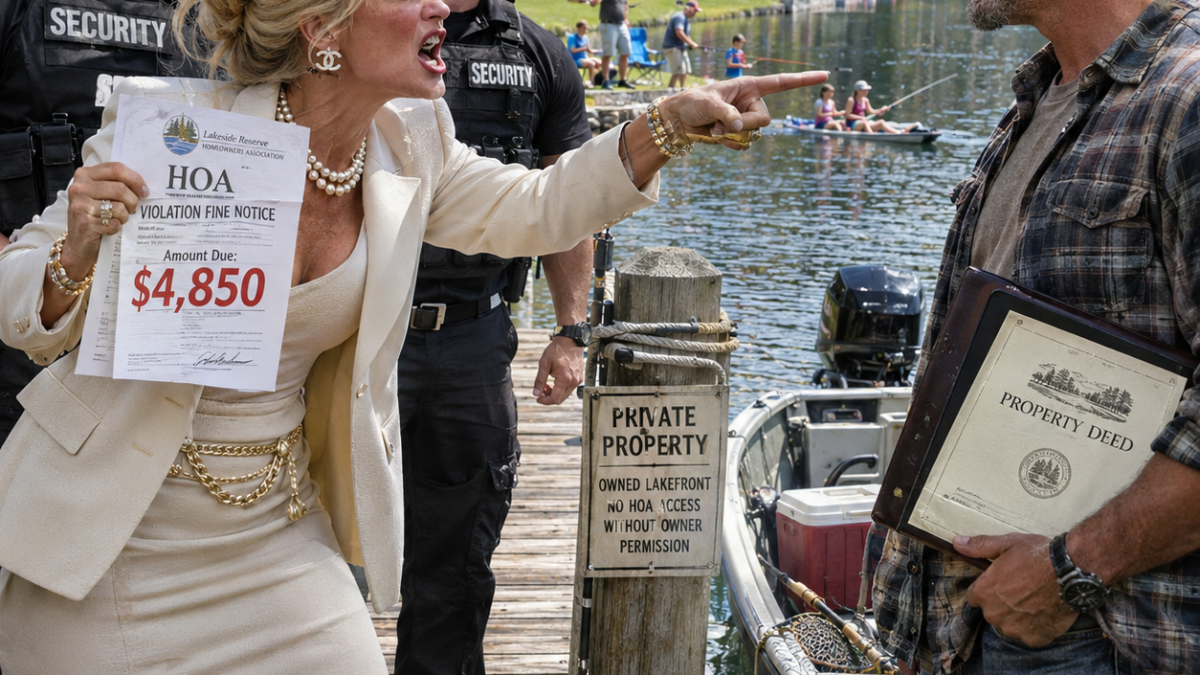
After twelve years, permission had slowly turned into something that looked like ownership.
But appearances didn’t change deeds.
Karen finally answered.
“Our attorney is reviewing the ownership history.”
Hayes nodded.
Then he turned to me.
“And what do you have?”
I opened the folder.
“My deed. My uncle’s deed. The old survey. The recreational license Cedar Ridge’s developer signed with him. And a letter from the developer thanking my uncle for continuing to allow residents to fish here.”
Paul lowered his head.
Karen stared at the documents.
The deputy looked back at her.
“So the association’s access might be based on permission from his family?”
Karen’s voice sharpened.
“That is a gross oversimplification.”
Maybe.
But the truth was actually worse for her.
Because Karen had spent months trying to fine me, tow my boat, ban me from using the lake, put HOA signs on my dock, and finally chain my private boat ramp.
And she had done all of it while Cedar Ridge residents were enjoying Lake Briar because of permission granted by the man who left the property to me.
I didn’t know any of that when I first came back to northern Georgia.
Back then, Lake Briar was simply the place where I remembered my uncle.
PART2
My name is David Mercer.
I was thirty-eight when my uncle William died.
He had never married and never had children, so when his attorney called and told me Uncle William had left me the cabin and surrounding property at Lake Briar, I didn’t know what to feel.
Grief came first.
Then nostalgia.
Then responsibility.
The property sat almost two hours north of Atlanta, where I worked as an electrical contractor.
The cabin wasn’t impressive.
Old wooden floors.
A stone fireplace.
A kitchen that looked like somebody had stopped remodeling sometime around 1985 and decided that was good enough.
The roof leaked near the back porch.
The dock needed boards replaced.
The workshop was packed with forty years of tools, bolts, fishing equipment, tractor parts, coffee cans full of screws, and things Uncle William had apparently saved because he believed every broken object might someday become useful again.
But the lake was exactly as I remembered it.
Pines climbed the hills around the shoreline.
Rocky outcroppings broke the water in a few places.
Bass hid beneath fallen limbs.
Frogs started calling as soon as the evening light disappeared.
When I was eight, Uncle William taught me how to bait a hook there.
When I was ten, he taught me to swim.
When I was twelve, he put me behind the motor of his little aluminum fishing boat and told me not to hit the dock.
I hit the dock.
He laughed until he nearly fell into the water.
Those memories were everywhere.
At first, I thought I would sell.
My work was in Atlanta.
I had a life there.
Keeping an old cabin two hours away didn’t make much financial sense.
Then I spent one weekend alone at Lake Briar.
Saturday evening, I sat on Uncle William’s dock with a cup of coffee while the sunset turned the water orange.
A father and his daughter were fishing farther up the shore.
The girl couldn’t have been more than ten.
She kept casting badly.
Her line landed in bushes twice.
Her father patiently untangled it both times.
I watched them until the light disappeared.
Something about selling suddenly felt wrong.
So I decided to keep the place.
I would fix the cabin slowly.
Use it on weekends.
Maybe spend more time there as I got older.
For several months, everything was peaceful.
Cedar Ridge Estates occupied much of the northern side of the lake.
The development had been built about twelve years earlier on land that had once been woods and pasture.
Eighty or ninety expensive homes sat among the trees.
There was a stone entrance, clubhouse, pool, tennis courts, landscaped sidewalks, and enough decorative streetlights to make the neighborhood look like a resort advertisement.
Many residents fished Lake Briar.
That didn’t bother me.
Uncle William had always allowed neighbors to use the water.
He believed private ownership and generosity could exist together.
“If you have enough room for kindness,” he used to say, “make room.”
People respected him.
He respected them.
If somebody left trash, William said something.
If a kid wanted to learn how to fish, he found another rod.
If somebody asked where bass were biting, he told them.
There were no access cards.
No fines.
No corporate-looking signs.
No security guards.
Just neighbors.
I wanted to preserve that.
One Cedar Ridge resident I got to know well was Paul Sanders.
Paul often fished with his daughter, Madison.
She was ten years old and absolutely terrible at fishing.
Which made her love it even more.
One Saturday, she spent two hours without catching anything.
I finally walked over.
“What bait are you using?”
She showed me.
I suggested something different.
Fifteen minutes later, she pulled out a small bass.
You would have thought she had landed a shark.
“I GOT ONE!”
Her scream echoed across the lake.
Paul laughed.
I laughed.
Madison nearly dropped the fish trying to show us.
Paul offered me twenty dollars for helping her.
I refused.
He shook his head.
“William used to do the same thing.”
That made me smile.
For a while, that was life at Lake Briar.
Then Karen Whitlock drove down my driveway.
She arrived in a black SUV so clean that I wondered whether she had ever driven it anywhere except paved roads.
I was working beside a seventeen-foot fiberglass fishing boat I had bought used a few weeks earlier.
Uncle William’s old aluminum boat was no longer safe.
The hull had deteriorated.
I wanted something simple I could use for fishing and basic maintenance around the lake.
Karen got out carrying a blue folder.
She was in her early fifties.
Blonde hair.
Perfect makeup.
Expensive sunglasses.
The kind of person who could somehow look overdressed beside a fishing dock.
“Mr. Mercer?”
“That’s me.”
“I’m Karen Whitlock. President of the Cedar Ridge Homeowners Association.”
I wiped my hands on a rag.
“Nice to meet you.”
She looked at my hand.
Then at the grease on the rag.
She chose not to shake it.
“I wanted to welcome you properly to the lake community.”
“Thank you.”
“I understand you inherited William Mercer’s property.”
“Yes.”
“He was a very unusual man.”
I couldn’t tell whether she meant that as a compliment.
“He was.”
Her eyes moved toward my boat.
“That’s actually why I’m here.”
I waited.
She opened the folder.
“Cedar Ridge does not allow visible watercraft to remain along the shoreline unless stored in an approved covered slip.”
I looked at the boat.
Then at her.
“My boat?”
“Yes.”
“Beside my cabin?”
“Yes.”
“On my property?”
Her smile tightened.
“The lake-community rules apply differently from ordinary yard regulations.”
I almost laughed.
“What does that mean?”
“It means shoreline appearance affects all homeowners.”
“I’m not a homeowner in Cedar Ridge.”
“You’re a lake property.”
“That wasn’t my question.”
Karen’s expression changed slightly.
I asked again.
“Am I a member of Cedar Ridge HOA?”
“Your property is what we classify as a legacy lake parcel.”
“So no.”
“That doesn’t mean shoreline rules do not apply.”
“Do I pay HOA dues?”
“No.”
“Do you maintain my driveway?”
“No.”
“My cabin?”
“No.”
“My dock?”
“No.”
“My land?”
“That isn’t relevant.”
“It feels extremely relevant.”
She exhaled like a teacher dealing with a difficult student.
“Mr. Mercer, everybody around Lake Briar has a responsibility to protect property values.”
“I agree.”
“Then remove the boat within ten days.”
“Show me the document giving your HOA authority over my property.”
She stared at me.
“I’ll have management send it.”
“Perfect.”
Karen reached into her folder, removed a warning notice, and clipped it to my dock railing.
Then she turned and walked away.
I watched the black SUV disappear.
I almost threw the notice in the trash.
Instead, I remembered something Uncle William used to tell me.
Whenever somebody sends paperwork saying you owe money, keep it.
Even if they’re wrong.
Especially if they’re wrong.
So I placed the notice in my kitchen drawer.
Nobody sent the rules Karen promised.
A week later, another envelope arrived.
CEDAR RIDGE HOA — WATERCRAFT VIOLATION
Fine: $250.
I laughed.
Then I called the management office.
A young woman named Rachel answered.
I gave her the address.
I heard typing.
“Oh.”
“What?”
“Your property is listed as a Legacy Lake Parcel.”
“What does that mean?”
“I’m not totally sure.”
“Am I a Cedar Ridge HOA member?”
Another pause.
“I don’t think so.”
“Then why am I being fined by Cedar Ridge?”
More typing.
“It looks like President Whitlock entered the violation directly.”
“Can you send me the rule she’s using?”
“Yes. I’ll ask somebody to email it.”
“Thank you.”
Nothing arrived.
Another fine did.
Then another.
The balance reached five hundred dollars.
Karen claimed the boat violated both watercraft rules and shoreline-storage rules.
I called her.
“You still haven’t sent me proof.”
“David, everybody around this lake follows the same standards.”
“Then sending the document should be easy.”
“You’re being difficult.”
“Asking why I owe money is difficult?”
“You know exactly what the rules are.”
“No. I know what you say the rules are.”
She hung up.
Over the next several weeks, the violations multiplied.
Seven hundred fifty dollars.
Eleven hundred.
Sixteen fifty.
The boat.
The dock.
An old canoe behind the shed.
Firewood stacked near the cabin.
A trailer visible from what Karen described as a “community recreation corridor.”
The corridor was a dirt fishing path almost two hundred feet away.
I photographed everything.
I saved every envelope.
I wrote down every conversation.
But I refused to let Karen consume my life.
I worked during the week.
I repaired the cabin on weekends.
I still talked to Cedar Ridge residents.
I still helped Madison fish.
Then a summer storm nearly turned everything dangerous.
Paul and Madison had taken their small fishing boat toward the far side of Lake Briar.
The weather looked fine when they left.
An hour later, dark clouds rolled across the hills.
Wind hit first.
Then heavy rain.
I was securing tools when I saw Paul’s boat struggling near the far shoreline.
Their electric motor had failed.
I started my supposedly illegal fiberglass boat and headed toward them.
By the time I reached them, Madison was crying.
Rain ran down her face.
Paul was trying to paddle against the wind.
I pulled alongside.
“Madison, come here.”
I gave her my rain jacket.
Then Paul and I secured his boat behind mine.
We headed back slowly.
The rain was brutal.
Waves slapped against the hull.
But we made it.
When we reached my dock, Karen was standing under a large umbrella beside the Cedar Ridge path.
She watched me help Madison onto land.
Paul climbed out next.
For one second, I thought Karen might finally understand how absurd the fight had become.
My “unauthorized” boat had just brought two Cedar Ridge residents safely home.
Three days later, another fine arrived.
Balance due: $2,300.
Paul found out.
He drove over furious.
“David, why didn’t you tell me?”
“About what?”
“These fines.”
“I didn’t think it was your problem.”
“My daughter was sitting in that boat during a storm.”
“I know.”
“And Karen is fining you for owning it?”
“Apparently.”
Paul looked embarrassed.
“I thought your property belonged to the HOA somehow.”
“It doesn’t.”
“I mean the lake.”
“What about it?”
He hesitated.
“I thought Cedar Ridge owned Lake Briar.”
I stared at him.
“Why?”
“Everybody does.”
“What makes you think that?”
Paul shrugged.
“The newsletters call it Cedar Ridge Lake.”
I frowned.
“It has never been called Cedar Ridge Lake.”
“That’s what the HOA calls it.”
“What else?”
“We pay a lake maintenance fee.”
“How much?”
“One hundred eighty dollars a year.”
“What does that pay for?”
“Paths. Benches. Safety. Shoreline work.”
“Does Cedar Ridge maintain my dock?”
“No.”
“The dam?”
“I don’t know.”
“Stock fish?”
“I’m not sure.”
“Clean my shoreline?”
“No.”
Paul seemed uncomfortable.
“David, I’m not saying they own it. I’m saying that’s what we’ve always been told.”
That night, I opened Uncle William’s old filing cabinet.
For hours, I searched.
Tax documents.
Old surveys.
Photographs.
Letters.
Maps.
Fishing permits.
Repair receipts.
One old map showed Lake Briar long before Cedar Ridge existed.
Several family names surrounded the water.
Mercer.
Dalton.
Hayes.
Wilson.
Then I found a letter from Cedar Ridge’s original developer.
It thanked Uncle William for his continued permission allowing residents to access designated fishing areas.
I read that sentence again.
Permission.
Why would Cedar Ridge need William’s permission if Cedar Ridge owned the lake?
The next morning, I visited Henry Dalton.
Henry was seventy-six and had known Uncle William nearly his entire life.
He lived west of the lake on another old property.
I showed him the developer letter.
“Henry, who owns Lake Briar?”
He looked at me.
Then he laughed.
“What?”
“Cedar Ridge’s been telling people they own it?”
“I don’t know. Their residents seem to think so.”
Henry shook his head.
“William let that go too long.”
“What does that mean?”
“Read his deed.”
“I have some deeds.”
“No, David. Read all of it.”
“Why?”
Henry leaned back.
“Old lakes are complicated. Property under water can be separate from shoreline property. Access rights can be separate from ownership.”
“So who owns it?”
“I’m not giving you an answer you might repeat before a lawyer checks it.”
That irritated me.
But Henry was right.
Before I could investigate further, another certified letter arrived.
$4,850.
Final warning.
Seven days to remove my boat and pay the balance.
Otherwise Cedar Ridge would take “additional enforcement action.”
That was enough.
I called property attorney Laura Mitchell.
We scheduled a meeting.
Before the meeting happened, Karen escalated.
Sunday morning, I heard a truck near the dock.
I walked outside.
A tow company was backing a boat trailer toward the water.
Two men stood beside my boat.
Karen was there.
One worker had already connected a cable.
“STOP!”
The man froze.
I ran down the hill.
“What are you doing?”
He held up a work order.
“Cedar Ridge HOA hired us to remove an unauthorized vessel from community-controlled shoreline.”
“This is private property.”
The man looked toward Karen.
Karen stepped forward.
“You were warned.”
I pulled out my phone and started recording.
“Karen, tell them whose dock this is.”
“This shoreline falls within Cedar Ridge lake-control authority.”
“Show them the deed.”
“I don’t need to show a tow company our legal documents.”
The tow operator looked uncomfortable.
“Ma’am, do you own this dock?”
“The HOA controls the lake.”
“That isn’t what I asked.”
Karen’s face reddened.
Then she said the sentence that changed everything.
“DAVID, YOU DON’T OWN THE WATER. YOU OWN A CABIN BESIDE IT. THAT’S ALL.”
I looked across Lake Briar.
Dozens of Cedar Ridge residents were fishing.
Children cast lines from benches Uncle William had allowed Cedar Ridge to install.
Small boats moved slowly across the water.
I remembered Henry.
I remembered the developer letter.
I remembered the old maps.
I looked at the tow operator.
“Do not move my boat until ownership is verified.”
The man disconnected the cable.
Karen snapped.
“What are you doing?”
“I’m not removing a boat from disputed private property without clearer authorization.”
“I’m paying your company.”
“That doesn’t change property law.”
Karen pointed toward his truck.
“Then leave. I’ll hire somebody competent.”
The tow crew left.
Karen turned toward me.
“This is not over.”
“No,” I said. “I don’t think it is.”
She walked toward her SUV.
Then I noticed a metal sign attached to one of my dock posts.
CEDAR RIDGE RESIDENTS ONLY
NO PRIVATE WATERCRAFT WITHOUT HOA APPROVAL
I pulled it off.
“Karen!”
She turned.
“You put this on my dock?”
“We’re protecting lake access.”
“Get your signs off my property.”
“It’s part of the recreation zone.”
“Whose recreation zone?”
“Ours.”
There it was again.
Ours.
I went inside.
I emptied Uncle William’s filing cabinet onto the kitchen table.
For two hours, I read everything.
Then I found a thick envelope.
Across the front, in William’s handwriting:
LAND & WATER
Inside was an old deed.
The paper was yellow.
The legal description was dense.
I found the cabin acreage.
The shoreline.
Then I found a paragraph describing Lake Briar.
The lake bed.
Water rights.
A dam.
Something called a fee interest.
I read it once.
Then again.
My hands started shaking.
Before I could fully understand it, Paul called.
“David, you need to know something.”
“What?”
“Karen called an emergency HOA meeting.”
“About?”
“Your boat.”
I almost laughed.
“She wants the board to ban it permanently from Lake Briar.”
“Not from my dock?”
“No. The entire lake.”
I looked down at the deed.
Karen was asking a hundred homeowners to decide whether I could use water described in a document sitting in my hands.
But I still didn’t know exactly what that document meant.
So I called Laura.
She told me not to make any ownership claims publicly until she traced the title.
“They’re voting tonight.”
“Let them vote.”
“She’s banning my boat.”
“David, an HOA can vote that the moon belongs to them. A vote doesn’t transfer title.”
That calmed me down.
Paul took me to the meeting.
The clubhouse was packed.
A screen behind Karen displayed:
LAKE SAFETY & WATERCRAFT ENFORCEMENT
Karen opened with a speech about property values.
Uniform rules.
Safety.
Responsible lake management.
Then she described me as an “uncooperative legacy property owner.”
I sat quietly.
She proposed a new rule.
Any boat launched from an unapproved shoreline location could be prohibited from operating on Lake Briar.
HOA security could document violations and prevent launching from my dock.
That caught the attention of board member Thomas Avery.
“Karen, do we own Mr. Mercer’s dock?”
“We have recreational authority.”
“That wasn’t my question.”
“The HOA attorney has confirmed broad rights.”
“Can we see the legal opinion?”
“It’s privileged.”
Thomas looked unconvinced.
Paul stood during resident comments.
He told everyone what had happened during the storm.
“How many people here knew David’s boat brought my daughter home when our motor died?”
People looked at one another.
Paul continued.
“That boat Karen keeps calling dangerous was the reason Madison wasn’t stuck across the lake in lightning and wind.”
Someone in the back said Uncle William had taught her son to fish.
Another homeowner asked whether Cedar Ridge actually owned Lake Briar.
The room changed.
People started whispering.
Karen banged a small wooden gavel.
“This meeting is about watercraft enforcement.”
The homeowner repeated himself.
“Do we own the lake?”
Karen ignored him.
Then she looked at me.
“Mr. Mercer, would you like to speak?”
I stood.
My deed was inside the folder beneath my arm.
Every part of me wanted to pull it out.
Laura’s warning stopped me.
So I kept it simple.
“I’m not a Cedar Ridge member.”
Karen rolled her eyes.
“My property predates this development. I don’t pay HOA dues. Cedar Ridge doesn’t maintain my cabin, dock, driveway, or land. I’ve repeatedly asked for proof that this HOA can fine me.”
Nobody spoke.
“Now I’m asking one more question.”
Karen stared at me.
“Where did Cedar Ridge get the legal right to control Lake Briar?”
Karen leaned forward.
“That was established when Cedar Ridge was developed.”
“By what document?”
“There are agreements.”
“Can residents see them?”
“Your speaking time has expired.”
That answer hurt Karen more than anything I could have said.
Homeowners immediately started asking questions.
What were the lake fees for?
Who owned the shoreline?
Who paid taxes on the lake?
What rights had the developer purchased?
Karen pushed forward with the vote.
Three board members voted yes.
Thomas voted no.
One abstained.
The boat ban passed.
Karen looked directly at me.
“Beginning tomorrow, your watercraft is prohibited from operating on Lake Briar.”
I nodded.
“Understood.”
She seemed disappointed.
Maybe she expected yelling.
I felt something else.
Curiosity.
The next morning, I sat across from Laura Mitchell.
The table between us was covered in seventy years of land records.
Laura pointed toward an old survey.
“Lake Briar was created when one of your family’s predecessors dammed a creek decades ago.”
I nodded.
She traced a line around the basin.
“This is the important part.”
Inside the boundary was the Mercer tract.
“What does that mean?”
“Not enough by itself.”
I sighed.
She smiled.
“I warned you property law was boring.”
“It stopped being boring around five thousand dollars ago.”
Laura showed me the deed from when Cedar Ridge’s developer bought land north of the lake.
The developer’s property ended at the high-water boundary.
The sale did not include the lake bed.
Then Laura found another document.
RECREATIONAL ACCESS LICENSE
I stared at the title.
“License?”
“Yes.”
“Not easement?”
“Not ownership.”
“Who issued it?”
Laura looked at me.
“William Mercer.”
My heart started pounding.
The license allowed Cedar Ridge residents to fish from designated areas.
Small non-motorized boats were permitted under certain conditions.
The developer agreed to several maintenance responsibilities.
Then Laura pointed to a paragraph near the bottom.
The property owner retained the right to revoke recreational permission for misuse, damage, unauthorized commercial activity, or interference with the owner’s enjoyment of the property.
I laughed once.
Laura looked at me.
“What?”
“Karen fined my boat. Tried to tow it. Put a sign on my dock. And banned me from using the lake.”
“Yes.”
“While her entire neighborhood is here because my uncle gave them permission.”
“Potentially. But we’re not finished.”
I groaned.
Laura smiled.
“I need the complete chain of title. I need to know whether later agreements changed anything.”
“Can I shut fishing down?”
“Not yet.”
For the next week, I did nothing dramatic.
That mattered.
I continued repairing the cabin.
I let residents fish.
I helped Madison restring her reel.
I refused to punish people who had done nothing wrong.
Then Janet Miller knocked on my door.
Her husband had served on Cedar Ridge’s original HOA board.
He had died several years earlier.
Janet carried a box of old newsletters.
“I heard people asking about lake ownership.”
We sat at my kitchen table.
She opened a newsletter from eleven years earlier.
One sentence jumped off the page.
We are grateful to Mr. William Mercer for continuing to allow Cedar Ridge residents community fishing access to beautiful Lake Briar.
Allow.
Another newsletter called lake access a privilege extended through private-property agreements.
Then the language slowly changed.
Lake Briar.
Then:
Our Community Lake.
Then:
Cedar Ridge Lake.
Finally:
HOA Recreational Property.
Janet looked horrified.
“I never noticed.”
“Why would you?”
The language had changed slowly enough that nobody questioned it.
Then Karen arrived at my dock with two security guards.
I was checking my boat battery.
She held the new rule.
“You are not permitted to launch.”
“You’re standing on private property.”
“This path is within the lake recreation zone.”
“Show me the easement.”
She didn’t.
One guard raised a camera.
“Document the boat,” Karen ordered.
I stood.
“Neither of you has permission to come farther onto my property.”
The guards stopped.
Karen didn’t.
She stepped onto my dock.
That was when I finally raised my voice.
“KAREN. GET OFF MY DOCK.”
She froze.
I pointed toward the shore.
“You’ve fined me. Threatened me. Tried to tow my boat. Now you’re trespassing.”
“I am enforcing community rules.”
“You are standing on my dock after being told to leave.”
One security guard quietly said, “Ms. Whitlock, we should probably step back.”
Karen spun toward him.
“You work for Cedar Ridge.”
“Yes, ma’am. But he has explicitly told us to leave.”
Karen glared at me.
“This will escalate.”
“It already has.”
She left.
That evening, Laura called.
“David.”
“What?”
“I finished the title search.”
I sat down.
“What does the deed mean?”
Laura paused.
Then she said it plainly.
“You own Lake Briar.”
I didn’t answer.
“The Mercer property includes the lake bed and the dam. Neighboring parcels have limited access arrangements, but the central lake property remained in your family’s chain of title.”
I looked through the window.
The sunset reflected across the water.
“You’re certain?”
“As certain as I can be after reviewing the recorded history.”
“And Cedar Ridge?”
“They hold a recreational license. They do not own the lake.”
“My boat?”
“Not subject to their HOA rules.”
“My dock?”
“Yours.”
“My ramp?”
“Yours.”
“Can Karen ban me from the lake?”
Laura laughed.
“No.”
For a moment, I expected to feel triumphant.
I didn’t.
Children were fishing near the northern shore.
A father was helping his son untangle a line.
Uncle William could have closed Lake Briar years ago.
He never did.
I told Laura I wanted Cedar Ridge to have one final chance.
She drafted a letter.
Every fine had to be canceled.
The boat ban withdrawn.
HOA staff had to stop entering my property.
Unauthorized signs had to be removed.
Cedar Ridge had to acknowledge that it did not own Lake Briar.
And continued interference could result in suspension or revocation of its recreational license.
Certified mail confirmed delivery.
Two days passed.
Karen called.
I didn’t answer.
She left a message.
“Your lawyer’s interpretation is ridiculous. Cedar Ridge has used this lake for more than a decade. You cannot suddenly rewrite history because you found some old paperwork.”
Old paperwork.
A deed.
That told me exactly how Karen thought.
The HOA attorney sent a more careful response.
Cedar Ridge refused our demands and claimed long-term continuous use might have created stronger recreational rights.
Laura said that argument needed proper legal review.
Karen apparently decided legal review was too slow.
Saturday morning, engines woke me.
I looked outside.
Three Cedar Ridge security vehicles sat beside the northern path.
Workers were installing two metal posts across my private boat ramp.
A heavy chain lay between them.
Another crew was putting up a sign.
NO MOTORIZED WATERCRAFT
CEDAR RIDGE HOA AUTHORITY
I ran outside.
“STOP!”
One worker froze.
Karen stood at the bottom of the hill.
“Continue.”
I started recording.
“You received my attorney’s letter.”
Karen smiled.
“And we disagree with it.”
“So you’re putting a chain across my ramp?”
“We are enforcing lake rules.”
“My ramp.”
“Our recreational zone.”
I called the sheriff.
Then Laura.
By the time I reached the dock, the posts were already in the ground.
Karen folded her arms.
“Now you can’t launch that eyesore.”
I looked at the chain.
Then across Lake Briar.
Families were fishing everywhere.
Something inside me became completely calm.
Paul came running down the shore.
“David, what happened?”
I looked at him.
“Tell everybody to pack their fishing gear.”
His eyes widened.
“What?”
“Cedar Ridge’s permission to fish Lake Briar ends today.”
Karen laughed.
Paul didn’t.
He understood.
I called Laura.
“They chained the ramp.”
“You’re recording?”
“Yes.”
“Photograph everything. Names. Vehicles. Workers. Do not touch Karen. Do not touch the guards.”
“What about fishing?”
There was a pause.
“Given the written warning and continued interference, we have a much stronger basis to suspend the recreational license while the dispute is resolved.”
“Good.”
Paul approached the nearest group.
At first, nobody believed him.
One man laughed.
“Karen close the lake again?”
Paul shook his head.
“No. David did.”
The man looked at me.
“Why?”
Paul pointed toward the chain.
“Because David owns Lake Briar and the HOA just chained his private boat ramp after his lawyer told them to stop.”
Silence.
Karen stormed toward Paul.
“You have no authority to tell residents to leave.”
He looked at her.
“No. David does.”
Karen turned toward me.
“You cannot throw a hundred families off a lake they have used for twelve years.”
“I’m not angry with those families.”
“Then stop this childish retaliation.”
I stared at her.
“Karen, I asked for proof. You sent fines. I asked you to stay off my dock. You brought security. My lawyer showed you the ownership records. You chained my ramp.”
“This is community property.”
“No.”
I pointed toward the water.
“This is private property that my uncle chose to share.”
Twenty minutes later, Deputy Robert Hayes arrived.
I gave him the deed.
The license.
Laura’s letter.
The photographs.
Karen immediately launched into her version.
“Cedar Ridge maintains these facilities. We have longstanding lake authority.”
Hayes listened.
Then he asked:
“Does the HOA own Lake Briar?”
“We have longstanding recreational rights.”
“Does the HOA own the lake?”
“Our attorney—”
“Ms. Whitlock. Does Cedar Ridge hold the deed?”
Karen looked toward the security guards.
Then away.
“Our attorney is reviewing title.”
Hayes looked at me.
“Do you want these workers off your property?”
“Yes.”
He turned to Karen.
“I’m not resolving every property-law question on a shoreline today. But the current deed holder is explicitly telling your workers to leave his land. Nobody is installing anything else here.”
The chain came down.
The sign came out.
The posts were removed.
Karen thought that meant everything would return to normal.
It didn’t.
I walked the northern shoreline.
I told every fishing group the same thing.
“Cedar Ridge’s recreational permission has been temporarily suspended because of an unresolved property dispute and repeated interference with my land.”
I gave them time.
Nobody was humiliated.
Nobody’s equipment was seized.
Children finished reeling in their lines.
Parents packed coolers.
One man confronted me.
“Why are you punishing all of us because of Karen?”
“That’s a fair question.”
He looked surprised.
“I tried for months to keep this between me and the HOA. I asked them to cancel invalid fines. I asked for documents. I asked them to stay off my dock. My attorney warned them in writing that continued interference could affect Cedar Ridge’s license.”
Paul stepped beside me.
“David saved my daughter on this lake.”
The man looked at him.
Paul continued.
“He let us keep fishing after Karen fined him. Karen is the reason this happened.”
The homeowner looked down.
Then he helped his son pack the tackle box.
By noon, Lake Briar was almost completely quiet.
For the first time in my memory, there were no Cedar Ridge residents fishing the northern bank.
I sat on the dock.
I should have felt victorious.
Instead, I felt miserable.
Uncle William loved seeing families here.
I could almost hear him asking whether children deserved to lose something because adults couldn’t behave.
Laura visited that afternoon.
“You didn’t act impulsively.”
“It still feels wrong.”
“Then make the suspension temporary while the legal dispute is resolved.”
I agreed.
That was exactly what I wanted.
Not punishment.
Boundaries.
We replaced the signs.
PRIVATE PROPERTY
CEDAR RIDGE RECREATIONAL ACCESS TEMPORARILY SUSPENDED PENDING RESOLUTION OF PROPERTY DISPUTE
No insults.
No accusations.
No Karen.
Just facts.
Madison came with Paul while I installed one.
“When can we fish again?”
“I hope soon.”
She looked at the empty lake.
“Maybe grown-ups should stop arguing about lakes.”
I laughed.
She had summarized six months of legal conflict in eight words.
During the quiet days that followed, I noticed something else.
Fishing line tangled beneath bushes.
Plastic wrappers.
Erosion near walking paths.
Damaged shoreline plants.
Uncle William had cleaned these areas quietly for years.
Nobody saw the work.
That changed my understanding of ownership.
Owning Lake Briar wasn’t simply having the power to close it.
It meant maintaining it.
Protecting it.
Paying attention when everybody else went home.
I contacted a local environmental group.
Samuel Harris came to inspect the shoreline with me.
He showed me where foot traffic was causing erosion.
Where vegetation needed restoration.
Where access could remain open safely.
I began thinking about what fair rules would look like.
No trash.
Respect private docks.
No commercial events.
Protect the shoreline.
Small boats under reasonable safety standards.
Simple.
Then Karen sent another HOA email.
It claimed I had unlawfully closed “community recreational facilities.”
Residents were instructed not to communicate directly with me.
The HOA was exploring legal action.
Paul forwarded it.
Laura contacted Cedar Ridge’s lawyer, Gregory Walsh.
Gregory was more cautious than Karen.
He argued that years of continuous use and HOA investment might support stronger access claims.
Laura said those questions could be discussed.
Then she asked a simpler one.
“How does any of that authorize your president to fine Mr. Mercer’s private boat or chain his private ramp?”
Gregory didn’t have a satisfying answer.
The attorneys scheduled a meeting.
Karen arrived with Gregory, Thomas Avery, and HOA treasurer Denise Cooper.
Before we started, Denise looked at Karen.
“Why didn’t the board ever see the recreational license?”
Karen stiffened.
“I assumed management had it.”
Denise shook her head.
“Management says lake matters were handled through your office.”
Gregory redirected the discussion.
Laura placed the original license on the table.
She showed the access language.
Then the revocation clause.
Then she listed the incidents.
The fines.
Attempted towing.
Unauthorized dock sign.
Boat ban.
Security personnel.
The chain.
Thomas rubbed his forehead.
“Karen, why did you keep pushing after David’s attorney sent the ownership records?”
Karen stared at him.
“Because the HOA cannot allow one person to control an amenity used by an entire community.”
I finally spoke.
“That is exactly what private ownership means when the amenity belongs to one person.”
She glared at me.
Denise opened a spreadsheet.
“I have another question.”
Karen turned.
“How much have we collected in lake-access fees?”
“I don’t have the figure.”
“I do.”
The room became quiet.
“More than one hundred forty thousand dollars during the last five years.”
I stared at her.
Laura asked:
“What did that money pay for?”
Denise read the categories.
Path maintenance.
Landscaping.
Security.
Signs.
Insurance.
Lake management.
“Any payment to William Mercer?”
“No.”
“To David Mercer?”
“No.”
“Dam maintenance?”
Denise hesitated.
“Not that I can find.”
“Property taxes on Lake Briar?”
“No.”
Thomas leaned back.
The entire narrative had changed.
Cedar Ridge had collected money for access to private property without clearly explaining to residents that the access originated from a revocable license.
Gregory asked for time to review everything.
Laura agreed.
The fishing suspension remained.
Karen objected.
Thomas didn’t support her.
Neither did Denise.
A week later, I began inviting individual residents back as personal guests.
Paul and Madison were first.
Madison caught nothing.
She was delighted anyway.
I invited Henry Dalton.
Janet.
Several older people who had known Uncle William.
Those afternoons reminded me that protecting property didn’t require becoming bitter.
Then Laura found another document.
An amendment signed six years earlier.
It expanded Cedar Ridge fishing access.
Added two shoreline areas.
Allowed three more benches.
Gregory initially thought it strengthened the HOA position.
Then Laura found a clause near the bottom.
The license remained revocable.
And Cedar Ridge had another obligation.
Every year, the HOA was required to give Uncle William a written report showing fees collected specifically for lake access.
Laura asked me whether William had saved the reports.
I searched.
Nothing.
Cedar Ridge searched.
Nothing.
Thomas called me personally.
“I’m sorry.”
“You didn’t write the agreement.”
“I was on the board for years and never knew it existed.”
“Then fix that going forward.”
He paused.
“Several board members want Karen removed.”
I said nothing.
“Honestly, David, I thought you’d be happy.”
“I want you to remove her if the facts justify it. Not because everybody is angry.”
“You’re being more fair to her than she’s been to you.”
“Fairness shouldn’t depend on who deserves it.”
The board scheduled a vote.
The evening before it, Karen came to my cabin alone.
No guards.
No folder.
No workers.
She walked toward the dock.
She looked exhausted.
“Cedar Ridge is turning against me because of you.”
I shook my head.
“No. Cedar Ridge is asking questions because of your decisions.”
“I spent years building that neighborhood.”
“You didn’t build Cedar Ridge.”
“I made it valuable.”
“The homes are valuable because people like living there. Not because you fined my boat.”
She looked across Lake Briar.
Then something unexpected happened.
Karen admitted that when she became HOA president, she truly believed Cedar Ridge owned the lake.
“Every document called it Cedar Ridge Lake,” she said.
“Every budget had lake expenses. Every resident paid fees. Nobody ever told me otherwise.”
For the first time, I understood how the original mistake might have happened.
Then I asked:
“What happened after Laura showed you the deed?”
Karen looked away.
That silence separated mistake from choice.
“You knew then.”
She said nothing.
“You could have stopped.”
“If I backed down after months of enforcement, everyone would think I was weak.”
There it was.
The most honest sentence Karen had ever spoken to me.
I looked at her.
“Being wrong isn’t weakness, Karen.”
She turned.
“Refusing to admit you’re wrong because you’re afraid of looking weak—that’s weakness.”
She left.
The following evening, Cedar Ridge removed Karen as president.
Thomas became interim president.
My $4,850 in fines disappeared.
The boat ban was formally withdrawn.
Cedar Ridge agreed to repair damage around my ramp.
Laura and the new board began drafting a new recreational agreement.
We were close to reopening Lake Briar.
Then one Monday morning, I noticed the water was lower.
At first, I thought wind was changing the shoreline.
By afternoon, muddy ground appeared where there had been water.
Tuesday morning, the lake had fallen several more inches.
I called Samuel Harris.
We drove toward the dam.
Before we reached it, we heard machinery.
A maintenance truck stood near the spillway.
Two workers were beside an open control gate.
Water was rushing out of Lake Briar.
I ran toward them.
“CLOSE THAT GATE!”
One worker raised both hands.
“We were ordered to lower the lake for inspection.”
“By who?”
He pointed toward a white pickup.
A man stepped out.
I recognized Richard Coleman from Cedar Ridge’s development company.
He held a folder.
“Mr. Mercer, our company retains historic maintenance rights over the dam.”
I called Laura immediately.
Richard handed me an old easement.
He claimed it gave the developer authority to inspect drainage infrastructure and control lake levels when necessary.
Then Samuel shouted.
“David!”
He was near the control box.
A new metal lock had been installed.
A tag hung from it.
AUTHORIZED BY CEDAR RIDGE HOA
My stomach dropped.
Karen was no longer president.
Thomas knew nothing about dam work.
Denise knew nothing.
I called Thomas.
He answered immediately.
“David?”
“Did your board authorize the developer to lower the lake?”
“What?”
“Did you?”
“No.”
“Are you sure?”
“Absolutely. Nobody approved anything.”
I looked at Richard.
He started walking toward his truck.
“Richard!”
He kept moving.
Then one of the workers shouted.
“The gate’s jammed!”
Water surged through the spillway.
The lake was dropping faster.
Samuel called the county water office.
Thomas called the HOA attorney.
Laura joined by phone and told us not to touch the old mechanism ourselves.
The equipment was under pressure.
Somebody could get hurt.
County engineers arrived within thirty minutes.
Mud was already visible around docks.
Fish crowded shallow areas.
One small boat rested partly on exposed bottom.
Watching the lake drain made me feel physically sick.
This wasn’t an argument anymore.
Someone had altered the lake itself.
Engineers worked on the gate.
Eventually, they slowed the flow.
One told us the mechanism had been opened farther than it was designed to operate routinely.
It had jammed under pressure.
Several more hours could have caused major shoreline and ecological damage.
Laura arrived.
She reviewed Richard’s easement.
Then she found the clause he had ignored.
The developer did have limited inspection rights concerning drainage infrastructure.
But reasonable notice had to be provided to the lake owner unless there was a true emergency.
There had been no emergency.
No dangerous storm.
No dam failure.
No urgent flood threat.
Laura looked at Richard.
“Where is your notice to Mr. Mercer?”
Richard said the company had contacted the HOA.
Thomas arrived.
“No, you didn’t.”
Richard looked at him.
Thomas held up his phone.
“No board email. No management request. No vote. Nothing.”
Denise arrived carrying printouts.
“I found the authorization.”
Everyone turned.
“It was submitted through an old administrator account.”
“Whose?” Laura asked.
Denise looked uncomfortable.
“Karen Whitlock.”
Nobody spoke.
Karen’s access should have been disabled.
The management company discovered that one older maintenance portal had remained active.
That didn’t automatically prove Karen personally used it.
Laura reminded us.
Facts first.
But the timing mattered.
County engineers closed the gate completely before dark.
Lake Briar had lost enough water to expose a wide muddy ring around parts of the shoreline.
Samuel organized people to rescue fish trapped in shallow pools.
Then something happened I will never forget.
Cedar Ridge residents came to help.
Men.
Women.
Teenagers.
Parents.
People who, weeks earlier, had been angry because I suspended fishing.
They walked through mud carrying buckets.
Paul was there.
So was Madison.
Paul tried to keep her clean.
That lasted five minutes.
She carried two small bluegill toward deeper water.
When she released them, she looked at me.
“Can the fish come home too?”
I smiled.
“They never left.”
That night, I sat on the dock alone.
The lake looked wounded.
The waterline was low.
Mud stretched beneath the moonlight.
But Lake Briar was still there.
I finally understood Uncle William’s generosity differently.
Kindness without boundaries can eventually be mistaken for surrender.
The next week, Thomas and Denise opened every Cedar Ridge lake file to Laura.
No hiding behind “confidential.”
No selective documents.
That transparency changed everything.
The dam work authorization led to old emails between Karen and Richard Coleman.
They had been discussing expanded lake programming months before Karen ever fined my boat.
The developer wanted more waterfront features.
A larger launch area.
Rental kayaks.
Paid fishing events.
Possible amenities connected to future development.
One problem stood in their way.
Uncle William’s recreational license prohibited unauthorized commercial use.
Cedar Ridge could fish.
Residents could enjoy designated areas.
But the HOA didn’t own the lake.
The developer didn’t own the lake.
And neither could convert it into a commercial attraction without stronger rights.
Then Laura found an email from Richard.
Mercer cooperation would simplify future waterfront use.
Karen replied:
I’m working on compliance leverage.
I read those words three times.
Compliance leverage.
The boat fines suddenly looked different.
My ugly seventeen-foot fishing boat had never been the real problem.
I was.
As long as a separate Mercer property owner understood what the deed said, Cedar Ridge couldn’t conveniently treat Lake Briar as an HOA-controlled asset.
The fine created pressure.
The tow attempt created pressure.
The boat ban created pressure.
The chain created pressure.
Thomas looked sick.
“I can’t believe this happened under our board.”
“You didn’t know.”
“That doesn’t make me feel much better.”
“Then make sure nobody gets this much unchecked authority again.”
“We will.”
Karen eventually requested a meeting through Laura.
Attorneys attended.
Karen admitted she had continued communicating with Richard after being removed as president.
She said she genuinely believed Thomas and Denise were surrendering Cedar Ridge rights because they were afraid of litigation.
She admitted using the old maintenance portal to help arrange the developer’s inspection.
She insisted she never expected the dam gate to jam.
Laura asked:
“Why didn’t you notify the new board?”
Karen said nothing.
“Why didn’t you notify Mr. Mercer?”
Silence.
“What legal right were you protecting?”
Karen finally answered.
“Our community has used that lake for years.”
Laura leaned forward.
“Use is not ownership.”
Karen looked at me.
I didn’t speak.
There was nothing left to say.
The documents had already said it.
Cedar Ridge settled the remaining disputes.
Every fine was canceled.
The HOA formally acknowledged that my cabin, dock, ramp, land, and Lake Briar were not subject to Cedar Ridge architectural or recreational enforcement.
They paid part of my legal expenses.
They repaired damage around the ramp.
The development company separately funded shoreline restoration and environmental work after the water-level incident.
Most importantly, Cedar Ridge changed its language.
No more:
Cedar Ridge Lake.
No more:
HOA Recreational Property.
Newsletters and maps would state:
Lake Briar — Private Lake, Access Provided by Owner Agreement.
That sentence mattered.
It stopped permission from quietly becoming ownership again.
Then Thomas asked the question everyone had been waiting for.
“David, are you going to reopen fishing?”
I didn’t answer immediately.
Part of me wanted Lake Briar private forever.
After the fines, the tow truck, the trespassing, the chain, the dam, nobody would have blamed me.
Then I thought about Madison.
Paul.
Janet.
Thomas.
Denise.
The residents who waded through mud to save fish.
Those people were not Karen.
I invited several of them to Uncle William’s kitchen.
We sat around the same worn wooden table where he had probably signed the original license.
Together, we wrote a new agreement.
Simple rules.
Cedar Ridge residents could fish designated shoreline areas.
Children were welcome.
Small boats could operate under reasonable safety conditions.
Nobody could enter my private dock or ramp without permission.
No commercial fishing events.
No rental operations.
No HOA signs on Mercer property.
No claiming ownership of Lake Briar.
Trash had to be removed.
Shoreline damage could result in individual access being revoked.
And once a year, Cedar Ridge had to remind every homeowner:
Lake access is a privilege provided by the private owner. It is not an HOA ownership right.
Thomas read the line.
“You really want that sentence?”
I looked at him.
“Absolutely.”
He laughed.
“Fair enough.”
We signed.
The following Saturday, Lake Briar reopened.
Families returned slowly.
Almost cautiously.
Madison was the first child to cast a line.
She caught nothing.
Paul blamed the fish.
Madison blamed Paul.
I laughed harder than I had in months.
Then I launched my boat.
My boat.
From my ramp.
Onto my lake.
No security guard.
No chain.
No Karen.
No $4,850 fine.
I drove slowly across the water.
People waved.
I waved back.
That simple ride felt better than winning any courtroom battle could have.
Karen eventually sold her house.
She moved away.
I never saw her after the final legal meetings.
There was no spectacular confrontation.
No dramatic apology.
No moment when Karen stood crying on my dock and admitted everything.
Real life doesn’t always give you that.
Sometimes accountability is quieter.
Someone loses authority.
Documents get corrected.
Rules change.
Property gets repaired.
People move on.
That was enough for me.
Cedar Ridge’s developer abandoned its commercial waterfront expansion ideas.
Lake Briar remained what Uncle William had always loved.
A fishing lake.
A place where families sat under pine trees.
Where children learned to cast.
Where neighbors talked.
Where people could share something beautiful without pretending they owned it.
Months later, while cleaning Uncle William’s filing cabinet, I found one last letter.
It was handwritten.
Never mailed.
Most of it was ordinary.
The cabin roof.
Fishing.
My work in Atlanta.
Then near the end, William had written:
If this place ever becomes yours, remember the lake is yours to protect, not yours to keep people away from. Let good people enjoy it, but never be afraid to close the gate when somebody forgets whose kindness opened it.
I sat down.
I read it again.
Then again.
Outside, children were fishing.
Parents sat on the old benches.
My boat floated beside the dock.
The water level had almost completely recovered.
I finally understood.
Ownership wasn’t power.
It was responsibility.
Kindness wasn’t weakness.
It was a choice.
And saying no didn’t make generosity disappear.
Sometimes saying no was how you protected generosity from people who wanted to turn it into entitlement.
Karen Whitlock fined me $4,850 because she didn’t like where I kept my fishing boat.
She tried to tow it.
She banned it from Lake Briar.
She sent security guards onto my property.
She chained my private ramp.
All while Cedar Ridge residents were fishing on water they had been allowed to use because my uncle believed neighbors should share good things.
So yes.
For a while, I closed Lake Briar to Cedar Ridge.
The lake became quiet.
And that silence forced an entire neighborhood to ask the question Karen should have asked before writing the first violation notice.
Who actually owns this lake?
The legal answer was me.
But that turned out not to be the most important question.
The important question was what I would do once everybody knew.
I chose to share it again.
Not because Cedar Ridge defeated me.
Not because Karen intimidated me.
Not because an HOA vote gave them ownership.
I reopened it because good people shouldn’t lose something beautiful forever because one arrogant leader confused permission with power.
Today, there is a wooden sign beside the main northern path.
It does not say CEDAR RIDGE LAKE.
It does not say HOA PROPERTY.
It says:
WELCOME TO LAKE BRIAR
PRIVATE PROPERTY
PLEASE RESPECT THE LAND, THE WATER, AND EACH OTHER
Underneath, in smaller letters:
FISHING ACCESS PROVIDED BY PERMISSION OF THE OWNER
Thomas once asked whether that final sentence was really necessary.
I smiled.
Then I looked across the water toward the place where Karen had once stood and told me I had no right to use my own boat.
“Thomas,” I said, “after everything we’ve been through, that sentence is never coming down.”
Then I climbed into my boat.
Started the motor.
And headed across Lake Briar while Madison waved from the shoreline.
My lake.
Still shared.
Still protected.
And finally understood.








