PART2:“GET THOSE DOGS AWAY FROM ME, YOU WORTHLESS MARINE—THIS LAKE BELONGS TO THE HOA!” Karen Cut Through My Private Fence and Never Expected What Her Own Records Would Reveal
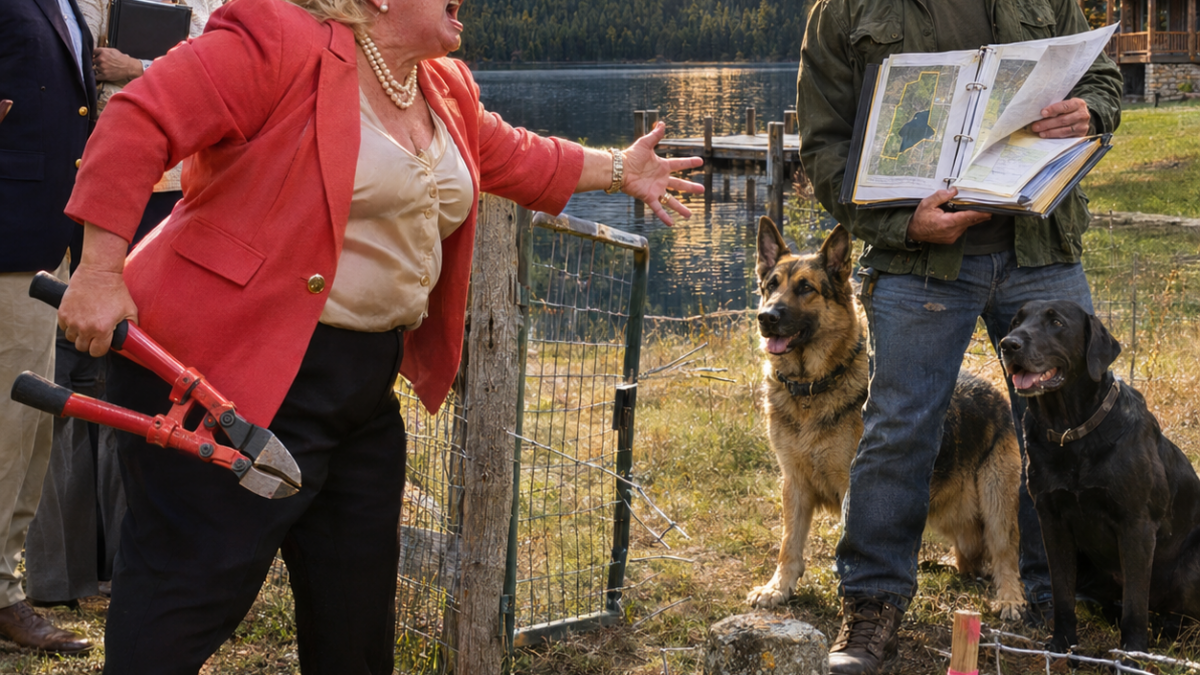
PART2
Deputy Aaron Rains arrived twenty minutes later.
He was a broad-shouldered man in his early fifties with tired eyes and the expression of someone who had already dealt with three completely unnecessary arguments before breakfast.
His cruiser rolled slowly up my gravel driveway.
Brutus and Shadow watched from the porch.
Rains stepped out.
“Morning, Trevor.”
“Deputy.”
He looked toward the backyard.
“I hear somebody’s been doing unauthorized carpentry.”
I almost smiled.
“Something like that.”
We’d met the previous Fourth of July when a neighbor complained about fireworks being set off near the wooded edge of the subdivision.
Rains had handled it professionally.
He was the kind of officer who preferred facts to shouting.
That made him exactly the person I wanted there.
I led him behind the house.
He examined the cut fence.
Then the metal shavings scattered near the post.
Then the white stake.
PROPOSED COMMUNITY LAKE ACCESS.
He read it twice.
“Who put this here?”
“Ellen Everhart.”
“The HOA president?”
“Yes.”
He sighed.
“Of course.”
I almost laughed.
“You know her?”
“I know she’s enthusiastic about reporting things.”
He crouched beside the broken cedar.
“Start from the beginning.”
So I did.
The growling.
The porch.
The bolt cutters.
The argument.
Her claim that the board had authorized public lake access.
The dogs remaining under control.
Her departure through the fence.
Rains listened without interrupting.
Then he asked:
“Any cameras?”
“Three angles.”
“Audio?”
“Clear enough to hear every word.”
He looked up.
“Good.”
I showed him the recordings on my tablet.
Ellen appeared on the screen, approaching the fence from the rear service path.
She looked around.
Removed bolt cutters from her bag.
Cut through the wire reinforcement.
Pulled a cedar board free.
Then entered my yard.
Rains watched without speaking.
When the recording reached Ellen’s announcement that the HOA had authorized lake access, he asked me to pause.
“Does your deed show any public access easement?”
“No.”
“Any recorded right of entry for the association?”
“Not across this area.”
“You have the documents?”
“In the house.”
“Let’s see them.”
I’d learned something during my military career.
When confusion begins, documentation matters.
Not because paperwork is more important than people.
Because people remember conversations differently.
People misstate intentions.
People become frightened.
Some people lie.
A clear record gives everybody something solid to work with.
When I purchased the house, I’d ordered a complete title review and boundary survey.
I kept certified copies in a fire-resistant cabinet beside my office.
I brought them outside.
Rains reviewed the survey.
The shoreline boundary.
The recorded access information.
The deed.
Then he looked at the broken fence again.
“So, as far as the documents you’ve shown me indicate, the HOA doesn’t have a right to enter here.”
“Correct.”
“And she cut the fence anyway.”
“That’s what the footage shows.”
He nodded.
“I’ll document the property damage and the reported trespass. Whether charges are filed, and what kind, will depend on the evidence and the prosecutor’s review.”
I respected that answer.
He wasn’t promising to throw Ellen into jail before lunch.
He was doing his job.
Then he said something I hadn’t expected.
“You might want an attorney.”
“I’ve already got one in mind.”
“Good.”
Rains handed back the survey.
“Keep your original recordings intact. Don’t edit them. I’ll arrange for an evidence copy.”
I nodded.
Then he looked at Brutus.
“Those two always this quiet?”
“Only when they’re deciding whether somebody deserves attention.”
Rains smiled.
“Smart dogs.”
Shadow wagged once.
Brutus remained professionally unimpressed.
After the deputy left, I repaired the fence temporarily.
I didn’t want the dogs wandering through the opening.
I didn’t want children from the subdivision finding their way to the water.
And I didn’t want Ellen claiming that leaving the fence open proved I had accepted public access.
I installed a reinforced temporary section and added a camera facing the service path.
Then I took photographs.
Measurements.
Close-ups.
Wide shots.
The broken boards.
The cut wire.
The stake.
Everything.
By noon, I’d uploaded copies to a secure drive.
Then I sat down at my desk and called David Rourke.
Colonel David Rourke had been a Marine Corps legal officer before retiring and entering private practice.
He was sixty-three, deliberate, and capable of making a short question sound more intimidating than most people’s entire arguments.
We’d known each other for years.
I had helped him with several technical problems at his law office.
He had once joked that if I ever needed legal assistance, he owed me at least one favor.
I intended to collect.
He answered on the third ring.
“Langston.”
“Colonel.”
“What did you break?”
“Nothing.”
“That’s suspicious.”
“Someone broke my fence.”
A pause.
“Explain.”
I told him.
When I finished, he asked:
“Do you have the recorded deed and survey?”
“Yes.”
“Video?”
“Three cameras.”
“HOA governing documents?”
“Most of them.”
“Send everything.”
“Can you help?”
“Trevor, I can tell you whether the matter belongs in a courtroom after I read the documents. I can’t promise you the outcome over the phone.”
There was the David Rourke I remembered.
No dramatic promises.
No magical shortcuts.
Just work.
“Fair enough.”
He paused.
“Are the dogs okay?”
I looked toward the window.
Brutus was lying beneath the pecan tree.
Shadow was investigating a turtle.
“They’re fine.”
“Good.”
Then his voice changed.
“Trevor, don’t let her turn this into a personal war.”
I looked at the broken fence.
“She already has.”
“No.”
Rourke said.
“She’s started a dispute. Don’t help her make it a war.”
I didn’t appreciate that distinction then.
I would later.
The first time Ellen mentioned opening my lake to the neighborhood, I thought she was making polite conversation.
It was at an HOA barbecue six months after I bought the house.
The event was held near the clubhouse.
Residents stood around picnic tables.
Children played on the lawn.
Someone had burned the hamburgers badly enough that smoke drifted across the tennis courts.
Ellen approached carrying a glass of sparkling water.
She wore a wide-brimmed hat and an expensive watch.
“Trevor Langston.”
“Ellen.”
“I understand you’re a retired Marine.”
“That’s right.”
“How wonderful. Thank you for your service.”
I nodded.
Then she gestured toward the trees behind the houses.
“You must enjoy having that lake.”
“I do.”
“It seems such a shame that so few people get to use it.”
I looked at her.
“It’s private property.”
“Of course.”
She smiled.
“But imagine what a lovely amenity it could be for the community.”
“It already is a lovely amenity.”
“For you.”
“For the people who own it.”
Her smile became thinner.
“Some homeowners might consider sharing access.”
“I’ll keep that in mind.”
I didn’t mean it.
She knew.
That was the beginning.
Over the following months, Ellen brought up the lake at nearly every board meeting.
At first, the language sounded innocent.
Community recreation.
Walking access.
Improving neighborhood attractiveness.
Encouraging outdoor activity.
Then she began using more pointed phrases.
Underutilized natural asset.
Obstructed shoreline.
Potential community benefit.
At one meeting, she displayed a photograph of the lake.
My dock was visible.
So was my fence.
I raised my hand.
“Ellen, why is my property in the presentation?”
She smiled.
“We’re discussing ways to improve neighborhood amenities.”
“Does the association own my lake?”
“No one is suggesting that, Trevor.”
“Then why is it on the improvement map?”
“Because the community has an interest in the area.”
“An interest isn’t an easement.”
She gave a strained laugh.
“Let’s not turn a friendly discussion into a legal seminar.”
A few people chuckled.
I didn’t.
“Then stop presenting private land as an HOA project.”
She moved to the next slide.
Two weeks later, I received a written request to consider a pedestrian access agreement.
I declined.
Then another request arrived.
Then a notice claiming my fence interfered with a proposed community trail.
That was when I realized Ellen didn’t regard my refusal as an answer.
She regarded it as a temporary inconvenience.
The lake mattered to me in ways I rarely explained.
After leaving the Marines, I had struggled with the sudden lack of structure.
For eighteen years, someone always knew where I was supposed to be.
When to report.
What needed doing.
Who depended on me.
Then retirement arrived.
Civilian life wasn’t bad.
It was just different.
People expected me to enjoy the freedom.
For a while, I didn’t know what to do with it.
I took an IT job because I understood systems.
Problems had causes.
Equipment could be tested.
Failures could be diagnosed.
You followed a process until something worked again.
Human beings were harder.
I had good friends.
Some former Marines.
Some civilians.
But I wasn’t particularly interested in crowds.
The house in Lakewood Pines offered something I’d wanted for years without knowing how to describe it.
A place where silence wasn’t loneliness.
The first morning after I moved in, I sat at the end of the dock before sunrise.
Mist covered the lake.
Brutus lay beside my feet.
Shadow watched ducks moving through the reeds.
Nothing demanded anything from me.
No alarm.
No schedule.
No one waiting for an answer.
For the first time in months, I felt my shoulders relax.
I bought the house because I wanted that feeling to last.
Ellen looked at the same water and saw an amenity to be monetized.
That was the distance between us.
My neighbor Phil Dawson noticed the trouble before I did.
Phil was sixty-six, retired from the postal service, and lived across the street with his wife, Donna.
He was the kind of man who considered it a personal responsibility to know every vehicle entering the neighborhood.
Not because he was nosy.
At least, that was his explanation.
He liked people.
He liked talking.
And after thirty-eight years delivering mail, he’d never lost the habit of noticing things.
The evening after Ellen cut my fence, Phil caught me bringing in the trash bins.
“Trevor!”
I looked over.
“Phil.”
“Heard Ellen tried to liberate your shoreline.”
I stared.
“How did you hear that already?”
“Donna saw her running along the service path.”
“Of course she did.”
Phil laughed.
“She looked like she’d seen a ghost.”
“Two German Shepherds.”
“That’ll do it.”
His expression became more serious.
“Listen, you’re not the only one she’s pushed around.”
“What happened?”
“The Harrisons got fined for parking their boat trailer in their driveway.”
“Was that prohibited?”
“Not under the version of the rules they were given.”
“Did they appeal?”
“Tried.”
“What happened?”
“Ellen said the appeals process had been streamlined.”
I looked at him.
“Streamlined?”
“Her favorite word.”
Phil sighed.
“She says it whenever somebody asks why a decision was made without the rest of the board.”
I thought about Ellen’s claim that everyone had voted to open my lake.
“Phil, do you know whether the board actually approved a public access trail?”
He shook his head.
“Not that I know of.”
That was the first clue that the cut fence might be part of something larger.
Rourke reviewed the governing documents over the next several days.
He called me on Thursday.
“Trevor, we need to separate three things.”
“Go ahead.”
“First, the association may regulate certain aspects of your home under its recorded covenants.”
“Understood.”
“Second, that doesn’t automatically give it a property interest in your separately described shoreline or a right to create a public path across your backyard.”
“Also understood.”
“Third, some of the amendments Ellen claims to be enforcing don’t appear in the properly approved records.”
I leaned forward.
“What does that mean?”
“It means we need to examine whether the board followed the procedures required by its governing documents.”
“Can you stop her?”
“We can seek an injunction against further trespass or interference. Whether the court grants it depends on the evidence and the applicable standards.”
“And the fence?”
“We’ll pursue the property-damage claim through the appropriate channels.”
I rubbed my forehead.
“Feels like a lot of work to tell someone she can’t cut a fence.”
“That’s why she may have expected you to give up.”
Those words stayed with me.
At Rourke’s direction, I sent a formal demand for the HOA to stop entering my property and preserve relevant records.
The association’s attorney replied within four days.
The letter was almost impressive in its audacity.
It accused me of creating a hostile environment for HOA officials.
It suggested my dogs were aggressive.
It claimed the association was entitled to assess shoreline access for the benefit of residents.
And it warned that additional legal action could be taken if I continued to interfere with official HOA business.
Rourke read the letter aloud over a video call.
Then stopped.
“Interesting.”
“What?”
“They’ve carefully avoided identifying any recorded easement.”
“Because there isn’t one.”
“Likely.”
He tapped the page.
“And this section suggests Ellen may have described the situation very differently to her own attorney.”
I looked at the accusation concerning Brutus and Shadow.
“She said I threatened her with the dogs.”
“Yes.”
“They were under command the entire time.”
“We have the footage.”
I stared at the screen.
“Why lie when she knows I have cameras?”
Rourke leaned back.
“Because the immediate goal may not be winning in court.”
“What is it?”
“Making you stop.”
Ellen’s next move was predictable.
She sent a notice claiming my dogs represented a threat to residents.
Then another alleging that my fence violated community design standards.
Then a third stating that my dock required architectural review.
I read them at the kitchen counter.
Brutus sat beside me.
Shadow had fallen asleep beneath the table.
I looked down at them.
“Congratulations.”
Brutus lifted his head.
“You’ve officially become a neighborhood menace.”
Shadow snored.
I almost laughed.
Then I looked at the legal letter on the counter.
And stopped.
The jokes were getting harder.
Every notice meant more time.
More documentation.
More money.
That was Ellen’s real advantage.
She could make demands as part of her role.
I had to interrupt my work to respond.
A few weeks later, I attended another HOA meeting.
I brought copies of the recorded documents.
I intended to speak briefly.
Stay calm.
Ask for a clear explanation.
Then leave.
Ellen had other plans.
When I stood, she addressed the room before I opened my mouth.
“Before Mr. Langston speaks, the board should be aware that he’s currently the subject of a law-enforcement complaint concerning dangerous animals.”
I froze.
There had been no such finding.
Deputy Rains had documented her entry onto my property.
Not an attack.
I looked at Ellen.
“That’s false.”
She raised one hand.
“I’m simply reporting what I’ve been told.”
“By whom?”
“That information is confidential.”
I turned toward the room.
“My dogs were on my private property. They were under command. I have the video.”
Ellen struck the table with her pen.
“This is not a courtroom, Trevor.”
“Then stop making criminal accusations.”
A woman in the second row spoke.
“Can we see the video?”
Ellen’s face tightened.
“That is not on the agenda.”
The woman looked at her.
“But you’re the one who brought it up.”
For a moment, the room went quiet.
Then Ellen moved to the next item.
I sat down.
My hands were shaking.
Not from fear.
From the effort required to stay seated.
That evening, I received an email from someone named Karen Woo.
Karen had served as HOA treasurer until the previous quarter.
I’d met her briefly at meetings.
Quiet woman.
Early forties.
Worked in accounting.
Always carried organized folders.
Always seemed uncomfortable when Ellen interrupted other board members.
Her email contained only three sentences.
Mr. Langston, I understand you’re challenging the association’s recent enforcement actions.
I have information concerning expenditures and board approvals that may be relevant.
Please call me from a private number.
I stared at it.
Then called Rourke.
“Do you know Karen Woo?”
“Former treasurer?”
“Yes.”
“Why?”
I forwarded the message.
He read it.
Then said:
“Call her. But don’t promise confidentiality you can’t legally guarantee. If she has records, we’ll handle them properly.”
I called.
Karen answered immediately.
“Trevor?”
“Yes.”
She exhaled.
“I’ve been waiting for somebody to ask questions.”
Karen didn’t begin with the lake.
She began with money.
“Ellen has been authorizing expenses that weren’t approved by the full board.”
“What kind?”
“Landscaping projects.”
“Security patrols.”
“Consulting fees.”
“Maintenance contracts.”
I frowned.
“Isn’t that normal HOA spending?”
“It can be.”
Her voice tightened.
“But we have invoices for patrols nobody ever saw, and contracts with companies that don’t appear to have performed any work.”
“How much?”
“Enough that I resigned rather than continue signing reports I couldn’t verify.”
I sat back.
“Do you have proof?”
“I retained copies of records available to me during my work as treasurer. I want your attorney to review what I can lawfully provide.”
“Will you testify?”
A pause.
“If necessary.”
She swallowed.
“But I have children, Trevor. Ellen knows where I live. She’s already told people I was removed for incompetence.”
“Were you?”
“No.”
Her voice broke.
“I resigned because I kept asking where the money was going.”
I understood something then.
Ellen hadn’t only frightened people with fines.
She had frightened people who knew how the association worked.
Karen continued.
“There was a feasibility study.”
“For what?”
“Private development near the lake.”
My stomach tightened.
“Which lake?”
She didn’t answer immediately.
Then:
“Yours.”
I sat motionless for almost a minute after the call ended.
Brutus came over.
Placed his head against my knee.
I looked down at him.
“Apparently we’re not just fighting about a fence.”
He wagged.
I scratched behind his ears.
Then called Rourke.
His reaction was immediate but restrained.
“We need documents.”
“Karen says she has them.”
“Good. We’ll review their origin and relevance.”
“David, she mentioned a development study.”
“I heard.”
“For my lake.”
“I know.”
“What if Ellen’s using association money to make it easier to take private property?”
“Then that’s a serious allegation.”
“How do we prove it?”
“One record at a time.”
That answer was becoming familiar.
I still hated it.
But I was learning.
Karen met Rourke and me in his office the following week.
She arrived carrying a small folder and looked as if she’d barely slept.
“Before I give you anything,” she said, “I need to know whether this is going to become public.”
Rourke answered carefully.
“Some information may become part of legal proceedings or a lawful records review. We won’t make promises about secrecy that we can’t keep.”
Karen nodded.
“I figured.”
She opened the folder.
Inside were copies of vendor summaries, board meeting agendas, expense approvals, and correspondence.
One invoice was from a company called Pine Horizon Services.
The description read:
PROPERTY ENHANCEMENT CONSULTING.
Another concerned neighborhood security patrols.
The amounts were substantial.
But the supporting documents were strangely thin.
No detailed work reports.
No consistent vendor information.
No clear board approval in the records Karen had reviewed.
Then she showed us the feasibility study.
The cover contained a photograph of my lake.
My dock.
My fence.
And a proposed walking trail cutting directly through the corner of my backyard.
The heading read:
LAKEWOOD PINES WATERFRONT COMMUNITY ACCESS CONCEPT.
I stared.
“This is my property.”
Karen nodded.
“I know.”
“Who commissioned it?”
“The invoice was submitted through Ellen’s office.”
“Did the board approve it?”
“I couldn’t find a valid approval.”
She paused.
“That’s why I started asking questions.”
Rourke examined the pages.
Then looked at me.
“Trevor, don’t react to the picture. Look at the financing notes.”
I did.
There was a paragraph concerning potential revenue from future amenities.
Resident access fees.
Improved property values.
Possible partnership opportunities.
Then one line:
PRIVATE SHORELINE CONTROL REQUIRED PRIOR TO IMPLEMENTATION.
I read it twice.
They couldn’t create their project without controlling access to my property.
And I had repeatedly refused.
For the first time, the pattern became clear.
Ellen had presented the lake as an underused community asset.
She had tried to pressure me into voluntary access.
When that failed, she claimed the association could authorize access without my agreement.
Then she cut my fence.
Meanwhile, questionable association spending supported a project designed around the assumption that my private shoreline would become available.
None of that proved every crime we suspected.
But it gave Rourke a concrete reason to investigate further.
And it gave me a reason to believe Ellen’s behavior wasn’t simply personal arrogance.
There was a plan.
A bad one.
But a plan.
The neighborhood began changing around me.
Phil organized a small gathering at his house.
Nothing formal.
Just a few residents who wanted to compare violation notices.
The Harrisons came.
So did a retired teacher named Alice Mercer.
A younger couple whose mailbox had been cited for using the wrong shade of bronze.
And a woman named Vanessa who lived in the townhouse section with her elderly mother.
Vanessa arrived carrying a plastic folder.
“My mother got fined for a planter.”
“A planter?” I asked.
“A ceramic pot.”
“Where?”
“On our front porch.”
“What was the violation?”
She gave a tired laugh.
“Nonconforming decorative object.”
Her mother had planted white flowers in it.
They’d belonged to Vanessa’s grandmother.
When Ellen ordered it removed, Vanessa’s mother cried.
Not because the pot was expensive.
Because it was one of the few things she’d brought from her old house.
“We couldn’t afford the fine,” Vanessa said.
“They threatened additional fees if we appealed.”
She looked around the room.
“I thought we were the only ones.”
That was the sentence I kept hearing.
I thought we were the only ones.
Ellen’s system worked best when every resident believed their problem was isolated.
The moment people began comparing notes, the pattern became visible.
Phil laid the notices across his dining-room table.
Dates.
Amounts.
Signatures.
Appeal deadlines.
Some appeared consistent with properly adopted rules.
Others didn’t.
One notice referenced a rule that nobody could locate in the recorded or approved documents.
Another claimed a late fee that didn’t match the published schedule.
A third contained a warning about a lien for a disputed charge that had never gone through the review procedure required by the association’s governing rules.
Rourke joined us briefly by video.
He warned everyone not to assume every notice was automatically invalid.
“Different assessments and enforcement actions can have different legal requirements,” he explained.
“But if the board failed to follow its own procedures, that may provide grounds to challenge particular actions.”
Phil frowned.
“That’s not as exciting as saying Brenda—sorry, Ellen—is going to prison.”
Rourke smiled.
“Courts are rarely designed to be exciting.”
I looked around the table.
People were listening.
Asking questions.
Comparing records.
That mattered more than a dramatic speech.
For the first time, Ellen’s authority was being examined instead of merely feared.
Then someone tried to enter my garage.
It happened at 11:43 on a Tuesday night.
I was upstairs reading when the motion lights came on.
My phone alerted me.
GARAGE CAMERA — MOVEMENT DETECTED.
I opened the feed.
A person in dark clothing stood beside the side door.
They carried something metallic.
They pulled at the handle.
Then struck the doorframe.
I was already reaching for my phone.
“Stay,” I told Brutus and Shadow.
Both dogs froze near the bedroom doorway.
The figure outside heard a noise.
Looked toward the house.
Then ran.
I called 911.
I did not chase.
I did not send the dogs.
I stayed inside and watched the cameras until deputies arrived.
That was one of the longest waits of my life.
Not because I feared a confrontation.
Because the property had stopped feeling secure.
The lake was supposed to be the place where I could relax.
Now I was checking security alerts after midnight.
Deputy Rains came again.
He inspected the garage door.
A pry mark ran along the frame.
Nearby lay a crowbar.
And beside the hedges, he found a clipboard with the Lakewood Pines HOA logo.
He photographed everything.
Collected what was appropriate for evidence.
Then asked:
“Any idea who that was?”
“No clear face.”
“Could’ve been someone associated with the association.”
“Could’ve been.”
He looked at me.
“But we need more than a clipboard to establish that.”
“I know.”
Rains nodded.
“You’ve been learning.”
I didn’t feel proud.
I felt tired.
He looked toward the house.
“Trevor, make sure you and the dogs are safe tonight.”
I glanced at the lake.
The moon reflected on the water.
For months, Ellen had told me I was the problem.
That I was hostile.
Uncooperative.
Dangerous.
Now someone had tried to force entry into my garage while I slept.
I wanted to believe it had nothing to do with her.
I couldn’t.
Rourke called the next morning.
“Are you okay?”
“I’m fine.”
“That wasn’t a legal question.”
I rubbed my eyes.
“No.”
He waited.
“I’m angry.”
“Reasonable.”
“I’m not sleeping.”
“Also understandable.”
I looked toward the garage.
“What do we do?”
“We document. We pursue appropriate protective relief. And we let the investigation determine who attempted the entry.”
I hated his calmness.
Then realized it was the thing keeping me from doing something stupid.
“David?”
“Yes?”
“If this is Ellen, she has no idea how close she is to making me lose my temper.”
Rourke was quiet.
Then said:
“Trevor, you’ve spent your life learning how to respond under pressure.”
“I know.”
“Don’t let a woman with a clipboard make you forget.”
I closed my eyes.
He was right.
The next afternoon, an anonymous package arrived.
No return address.
Inside was a small USB drive.
The label read:
BOARD MINUTES — PRIVATE.
I stared at it.
After the garage incident, I wasn’t eager to plug an unknown device into my computer.
I photographed the package.
Notified Rourke.
And delivered it to a digital-forensics professional he recommended.
The drive contained an audio recording.
Its source was initially uncertain.
Rourke warned me that admissibility and lawful use would depend on more than whether it sounded authentic.
We needed to establish what it was.
Who recorded it.
Whether recording had been lawful.
Whether it had been altered.
And whether it could be connected to the relevant meeting.
I waited.
Two days later, the forensic examiner confirmed the file showed no obvious signs of editing.
Board calendar records also showed a closed session on the date reflected in the metadata.
That didn’t answer every question.
But it justified further investigation.
Then Rourke played the recording for me.
Ellen’s voice filled his office.
“If Langston won’t cooperate, we make the situation uncomfortable enough that he changes his mind.”
Another voice asked:
“How?”
“Code violations. Noise complaints. Architectural reviews.”
A pause.
Then Ellen again.
“We can bury him in paperwork until he gives us the access we need.”
Somebody objected.
“Isn’t that harassment?”
Ellen laughed.
“It’s enforcement.”
I sat motionless.
I had imagined her saying things like that.
Hearing her say them was different.
Rourke stopped the recording.
I stared at him.
“She admitted it.”
“She made statements relevant to our claims,” he said.
I almost laughed.
“You never stop sounding like a lawyer.”
“That’s why you hired me.”
Then his expression changed.
“Trevor, we’re going to have to establish who recorded this and under what circumstances before relying on it in court.”
I nodded.
“Fine.”
He looked at the file.
“But if it can be authenticated and lawfully used, it’s significant.”
For once, I didn’t need him to say more.
The source of the recording eventually came forward.
Harold Green.
One of the longest-serving members of the HOA board.
Harold was seventy-two, quiet, and rarely spoke during public meetings.
I had seen him sitting near the back of the board table, taking notes.
He was a retired civil engineer who’d lived in Lakewood Pines for twenty-six years.
When he arrived at Rourke’s office, he looked more uncomfortable than frightened.
“I should have spoken sooner,” he said.
Rourke asked him to explain the circumstances of the recording.
Harold did.
It had been made during a meeting he attended, using his own device, under circumstances Rourke then reviewed for legality in the applicable jurisdiction.
Harold also brought emails, draft minutes, and his personal notes.
“I knew the meetings were wrong,” he admitted.
“What do you mean?” I asked.
“Ellen stopped circulating full financial summaries. She treated questions as disloyalty. She called special meetings without giving everyone adequate information.”
“Why stay?”
Harold looked at his hands.
“Because I thought I could keep things from getting worse.”
I stared at him.
He looked up.
“I was wrong.”
There was no excuse in his voice.
Just regret.
“I’ve served on that board sixteen years,” he said.
“I watched it become something I barely recognized.”
He turned toward me.
“I owe you an apology.”
I didn’t know what to say.
He continued.
“I knew she was trying to pressure you about the lake. I didn’t know she’d cut your fence until afterward, but I knew she was crossing lines long before that.”
“Then why didn’t you stop her?”
He accepted the question.
“Because I was afraid of what she’d do if I challenged her publicly.”
The room went quiet.
Then he said:
“I’m done being afraid.”
The preliminary hearing took place several weeks later.
Not the dramatic criminal trial people in the neighborhood had begun imagining.
A hearing concerning protective relief, property interference, and the association’s claimed authority.
Rourke prepared carefully.
He sorted exhibits.
Verified certified records.
Confirmed witnesses.
Reviewed the recording’s provenance.
And reminded me repeatedly that I was not there to give a speech.
“You’re there to answer questions.”
“I know.”
“Briefly.”
“I know.”
“Truthfully.”
“David.”
He looked at me.
“I’m making sure.”
The courtroom was smaller than I expected.
Judge Mallory sat behind the bench with the expression of a woman who had heard every possible excuse people invent to avoid taking responsibility.
Ellen sat across the aisle.
Her hair was pulled tightly back.
She wore a cream jacket.
Her attorney whispered to her.
She didn’t look at me.
That bothered me more than it should have.
For months, she’d stared directly into my eyes while issuing threats.
Now she seemed unable to acknowledge I existed.
The hearing began with documents.
The recorded deed.
The survey.
The shoreline boundaries.
The governing declaration.
Rourke explained why the HOA’s documents did not grant the access Ellen had claimed.
The association’s attorney argued that community planning discussions had been misunderstood.
Then the video played.
Ellen approaching my fence.
Looking around.
Removing bolt cutters.
Cutting through the reinforcement.
Pulling away the cedar board.
Entering my yard.
I watched the judge’s face.
Nothing dramatic.
She made notes.
Then asked:
“Ms. Everhart, did you personally cut this fence?”
Ellen’s attorney spoke first.
There was discussion.
Then Ellen acknowledged that she had cut the opening.
She insisted she believed the board had authorized a necessary inspection.
The judge asked where that authorization appeared in the recorded rights affecting my property.
Her attorney referred to the HOA resolution.
The judge examined it.
Then said:
“An internal board resolution does not, by itself, create a property interest in land owned by somebody else.”
That was the sentence I’d been waiting months to hear.
Simple.
Precise.
Devastating.
The hearing continued.
The court examined the conduct shown on video and the ongoing risk of further interference.
Rourke presented relevant evidence supporting the request for protection.
The anonymous recording became part of a separate evidentiary discussion after its source and circumstances were disclosed.
Harold gave sworn testimony.
Karen Woo testified about financial procedures and the lack of clear approval for certain expenses.
Nobody declared Ellen guilty of every wrongdoing that afternoon.
That wasn’t what the hearing was for.
But by the end, the court had issued orders restricting unauthorized entry and interference with my private property while the underlying dispute proceeded.
The association could no longer plausibly claim that my fence was simply an obstruction it had permission to remove.
Outside the courthouse, Rourke put one hand on my shoulder.
“Good day.”
I exhaled.
“Is it over?”
He looked at me.
“No.”
I almost laughed.
“Of course not.”
“But we accomplished what we came here to accomplish.”
I nodded.
Then looked toward the parking lot.
Brenda—Ellen—was walking toward her vehicle with her attorney.
She didn’t look back.
For the first time, I wasn’t bothered.
The next stage came from the financial records.
Karen Woo’s concerns had triggered a broader demand for transparency within the association.
Residents requested an independent review.
Additional board members began asking questions.
The court proceedings also increased scrutiny of expenditures related to the lake-access project.
The financial examiner identified recurring payments to Pine Horizon Services.
Landscaping consultation.
Security coordination.
Maintenance evaluation.
Property-development planning.
The invoices were professionally formatted.
That was the problem.
They looked more substantial than the work anyone could identify.
The listed business address was a commercial mailbox.
Some vendor descriptions did not match available records.
Further investigation connected the company to an entity associated with Ellen’s earlier business dealings.
A second company had billed the HOA for security patrols that residents could not confirm had occurred.
None of it automatically proved every invoice fraudulent.
But it gave investigators enough reason to examine the payments in detail.
Then another fact emerged.
Ellen had been discussing a potential arrangement with a private developer interested in the lakefront.
The proposed trail wasn’t simply a recreational project.
It was part of a larger concept involving increased property values, premium amenities, and future development opportunities.
My private shoreline sat directly in the center.
I finally understood why Ellen had never accepted no.
She had already begun treating the lake as an asset she could promise to somebody else.
She didn’t possess the legal rights to deliver it.
But she had the HOA presidency.
A budget.
A board that rarely challenged her.
And a neighborhood accustomed to receiving violation notices whenever somebody disagreed.
That combination had convinced her she could create control by acting as though she already had it.
The fence was the physical expression of that belief.
Cut through the boundary.
Plant a sign.
Call it community access.
Then keep repeating the claim until nobody remembered the original deed.
I sat at my kitchen table one evening reading the latest documents.
Brutus rested under the window.
Shadow slept near the door.
I looked outside.
The lake was still.
Peaceful.
Unaffected by any of this.
It struck me how much damage one person’s hunger for control could cause without changing the thing she claimed to care about.
The water hadn’t changed.
The people around it had.
Phil organized another neighborhood gathering.
This time we met at my house.
Folding chairs filled the patio.
Someone brought lemonade.
Vanessa brought pie.
Karen Woo arrived looking nervous but determined.
Harold Green sat beside her.
Rourke attended for the first hour to answer general questions about the process.
I didn’t want the meeting to turn into a trial.
I wanted people to speak.
They did.
One man described a fine for repairing his own driveway.
Another woman described repeated demands to repaint a front door even though the approved color list had never been properly adopted.
Vanessa talked about her mother’s planter.
Phil brought a stack of notices.
Harold explained what the board’s proper approval procedures required.
Karen explained why financial oversight mattered.
For the first time, people were connecting what had happened to them.
Not as isolated inconveniences.
As a pattern.
When Rourke finished speaking, Harold stood.
“I’ve served on the board sixteen years,” he said.
His voice shook.
“And I allowed things to continue because I thought I could manage them quietly.”
He looked around.
“I was wrong.”
Nobody interrupted.
He continued.
“If this association is going to survive, it must belong to the homeowners again—not to one president.”
Vanessa raised her hand.
“What if it shouldn’t survive?”
The room became quiet.
Harold looked at her.
“What do you mean?”
“Maybe we don’t need it.”
Several people nodded.
Others looked uncertain.
That was the first time dissolution became a serious topic.
Not a slogan.
A question.
The criminal investigation developed separately.
Deputy Rains called to tell me that the attempted garage entry had produced a lead.
An identifiable fingerprint had been recovered from the crowbar.
Investigators connected it to Desmond Hale.
Ellen’s nephew.
He had previously worked occasional jobs for a vendor associated with the HOA.
That didn’t automatically prove Ellen sent him.
Rains was careful about that.
But Desmond’s connection to the association led investigators to examine communications and payments surrounding the attempted entry.
Eventually, Desmond was questioned and faced proceedings connected to the attempted unlawful entry.
Evidence suggested he had been asked to retrieve or remove materials related to the HOA dispute.
The exact extent of Ellen’s involvement became part of the broader investigation.
I remember sitting in silence after the call.
Then asking:
“Did she really think breaking into my garage would make this go away?”
Rains answered:
“People under pressure sometimes make decisions that create bigger problems.”
I looked toward the workshop.
For weeks after the attempt, I’d checked every lock twice before bed.
Now I knew the person who’d tried the door had a connection to the same people trying to claim my shoreline.
I didn’t feel triumphant.
I felt sick.
The HOA’s interim leadership changed before the criminal case concluded.
Residents followed the procedures required by the governing documents to replace the board members responsible for the disputed actions.
Harold Green became acting president.
He looked almost unhappy about it.
At the first meeting, he told everyone:
“I don’t want this job.”
Vanessa raised her hand.
“That’s why we’re considering you.”
People laughed.
Harold didn’t.
Then he smiled.
A little.
His first actions were practical.
Pause disputed enforcement matters.
Preserve financial records.
Arrange independent accounting oversight.
Review the association’s contracts.
Notify residents of the ongoing review.
Correct the procedures for hearings and appeals.
No grand speeches.
No promises that every fine ever imposed would automatically vanish.
Instead, each questionable action would be examined and corrected as appropriate.
That sounded boring.
It was beautiful.
Then came the audit results.
The findings were serious.
Payments to entities that could not substantiate the services billed.
Invoices with inconsistent dates.
Association spending connected to projects that had not received proper approval.
Financial relationships that Ellen had not disclosed.
And documentation indicating that some enforcement activity had been used to pressure specific homeowners rather than neutrally enforce valid rules.
My property appeared in several planning documents.
So did other lakefront parcels.
A preliminary map showed properties marked in different colors.
Some identified for potential acquisition.
Others for access.
Others for what the notes called:
PRIORITY ENFORCEMENT.
I stared at that phrase.
Priority enforcement.
As if people’s homes were targets on a sales chart.
Rourke looked at me.
“Trevor, this is why we don’t build a case around one dramatic moment.”
He tapped the audit summary.
“We build it around the record.”
I nodded.
For once, I didn’t argue.
The prosecutor eventually filed charges arising from the financial misconduct and related conduct supported by the investigation.
Ellen’s attorney denied key allegations.
The process continued through motions, discovery, and hearings.
News coverage followed.
Some reports exaggerated the story.
One headline claimed Ellen had stolen an entire lake.
Another said she’d personally ordered every violation in Lakewood Pines.
Neither was accurate.
She had tried to force access to private shoreline.
She had misused authority.
And there was substantial evidence of serious financial misconduct.
That was bad enough.
I didn’t need journalists inventing more.
I declined most interviews.
When one reporter asked why, I said:
“Because I bought this house to avoid attention.”
He laughed.
I didn’t.
Months later, Ellen entered a plea agreement resolving significant charges related to the misuse of association funds and false records.
The court imposed restitution and other penalties.
Desmond’s case was handled separately.
Civil claims continued.
Some of the money recovered went toward restoring HOA accounts and compensating affected parties through lawful processes.
It wasn’t an instant movie ending.
It took time.
Some losses could be documented.
Others couldn’t.
People had spent months afraid in their own homes.
There was no simple number for that.
But Ellen’s authority was gone.
Her financial conduct had been exposed.
And she could no longer threaten residents from behind an HOA seal.
That mattered.
The association still faced a larger question.
What happened next?
Harold invited me to meet him by the lake one afternoon.
The sun was low.
A breeze moved across the water.
Brutus lay beside the porch steps.
Shadow patrolled the edge of the yard, occasionally stopping to investigate a rabbit trail.
Harold carried a clipboard.
Of course.
“Trevor.”
“Harold.”
He stood looking at the lake.
“It’s beautiful.”
“That’s why I bought the place.”
He smiled.
“Ellen really thought she could make it hers.”
“She thought she could make it everybody’s.”
Harold shook his head.
“No.”
He looked at me.
“She thought she could decide.”
I didn’t answer.
Because he was right.
He opened the clipboard.
“We’ve been reviewing the association’s future.”
“New board?”
“That’s one option.”
“New management company?”
“Another.”
He paused.
“Some residents want dissolution.”
I looked at him.
“Can that actually happen?”
“Possibly. But not just because people sign a petition.”
He explained.
The association’s governing documents and applicable state requirements would have to be followed.
Existing obligations needed to be addressed.
Common property couldn’t simply disappear.
Maintenance arrangements would have to be replaced legally.
Contracts and debts needed resolution.
Required owner votes and approvals had to be obtained.
It would take months.
Maybe longer.
“Sounds like work,” I said.
Harold smiled.
“It is.”
“Worth doing?”
He looked toward the subdivision.
“That’s for the homeowners to decide.”
Then he held out a packet.
Not a demand.
An invitation.
“I’d like you to review the shoreline portion of our proposed plan. We want to make certain nobody is claiming rights over your property.”
I took it.
“Now that’s a conversation I can appreciate.”
The dissolution proposal divided the neighborhood.
Some residents wanted to eliminate the HOA immediately.
They were tired of dues.
Tired of fines.
Tired of being told what color to paint their doors.
Others worried about road maintenance, landscaping, drainage, and shared infrastructure.
Those concerns were real.
People argued.
At one meeting, a man shouted:
“Just dissolve the whole thing!”
A woman stood and answered:
“And who’s paying to repair the retention pond when it fails?”
The room went quiet.
Good question.
The old board had treated disagreement as disloyalty.
The new process needed people to disagree and still work together.
Harold insisted on written proposals.
Independent legal review.
Budget estimates.
Clear explanations.
No hidden meetings.
No surprise rules.
No one-person decisions.
It took months.
A cooperative maintenance structure was proposed for shared obligations that could lawfully be transferred.
Other responsibilities were addressed through formal arrangements with the appropriate authorities and property owners.
The necessary approvals were pursued.
Some agreements had to be rewritten.
Some debts settled.
Some owners changed their minds.
I watched it all from the outside.
My shoreline remained mine.
That was my concern.
But I cared what happened to my neighbors.
They’d spent years being told that rules were something handed down to them.
Now they were learning how much responsibility came with making decisions together.
One afternoon, Vanessa came to my door.
She carried a canvas tote.
Her mother was waiting near the sidewalk.
“Trevor, can we talk?”
“Of course.”
She looked nervous.
“Harold wants to form an oversight committee while the transition continues.”
“Sounds sensible.”
“He asked whether you’d consider serving.”
I stared.
“Me?”
She nodded.
“Why?”
“Because you keep asking questions.”
“I’ve spent two years trying not to attend HOA meetings.”
Vanessa laughed.
“I know.”
“That’s not exactly a qualification.”
Her smile softened.
“Maybe it is.”
I looked toward her mother.
The older woman stood beside a walker.
A small white flower was tucked behind one ear.
Vanessa followed my eyes.
“Mom got her planter back.”
I smiled.
“Good.”
“She cried.”
My throat tightened.
Vanessa continued.
“She said she thought she’d spend the rest of her life asking permission to put flowers on her own porch.”
I looked down.
That sentence made the entire fight feel different.
I had been angry about my lake.
My fence.
My right to be left alone.
But for Vanessa’s mother, the fight had been about one ceramic pot.
Something small enough that Ellen could dismiss it.
Important enough to make an elderly woman cry.
Vanessa handed me the committee invitation.
“You don’t have to say yes.”
I took it.
“Let me think.”
She smiled.
“That’s more than I expected.”
I didn’t become committee chairman.
Instead, I agreed to advise on technical recordkeeping and property-boundary issues during the transition.
That was enough.
I helped establish a secure document archive.
Clear access controls.
Backup procedures.
A way for members to review approved records without having to beg one officer for permission.
It was ordinary IT work.
That felt good.
For months, everything had been legal letters and confrontations.
Now I was doing something useful.
Building a system that made it harder for one person to control information.
Maybe that was my contribution.
Not leading the neighborhood.
Helping it stop needing a leader who could hide the facts.
The final vote took place nearly a year after Ellen cut my fence.
The community center was packed.
More residents attended than at any previous meeting.
Families brought chairs.
Children waited outside with parents.
There was no dramatic music.
No television crew directing the moment.
Just neighbors.
Harold stood near the front.
He looked exhausted.
Proud.
Nervous.
He explained the proposal one final time.
The legal obligations.
The transfer arrangements.
The remaining maintenance responsibilities.
The necessary approval threshold.
Then votes were cast and counted according to the required procedures.
When the results were announced, the proposal had passed.
The formal dissolution process could be completed under the approved arrangements.
Some people cheered.
Some cried.
Others looked stunned.
A few had voted against it.
Harold acknowledged them too.
“This neighborhood belongs to all of us,” he said.
“Not just those who agreed tonight.”
I stood near the back.
Phil beside me.
Donna holding his arm.
Vanessa near her mother.
Karen Woo and several former board members watching quietly.
I thought about the first HOA meeting I’d attended.
Ellen sitting behind the table.
Interrupting people.
Calling disagreement a threat.
Now everyone was being allowed to speak.
That mattered more than the applause.
The remaining legal steps took additional time.
The old management contract ended.
The association’s formal dissolution was recorded after required conditions were satisfied.
Common maintenance obligations were transferred or otherwise resolved through the approved arrangements.
The neighborhood moved into a cooperative structure for services residents still needed.
No more Brenda—Ellen—controlling everything from a leather portfolio.
No more closed-door enforcement campaigns.
No more pretending a board vote could override private deeds.
Lakewood Pines was still a neighborhood.
People still argued about parking and lawns.
They still disagreed about expenses.
But they no longer had an HOA president who believed every disagreement was an opportunity to punish someone.
And my lake remained untouched.
The first weekend after the final transition, Phil invited everyone to a block party.
I almost declined.
Crowds still weren’t my favorite thing.
Then Donna appeared at my door carrying a covered dish.
“You’re coming.”
“Am I?”
“Yes.”
“I have work.”
“Remote IT support can wait.”
“That’s not always true.”
She looked at Brutus.
“Brutus agrees with me.”
Brutus stared at her.
Traitor.
I went.
There were folding tables.
Hot dogs.
Lemonade.
Children running across the grass.
A portable speaker playing old music.
Harold stood beside the grill wearing an apron that said:
FORMER HOA PRESIDENT. ASK ME NOTHING.
I laughed so hard I had to lean against a chair.
Vanessa’s mother sat beneath an umbrella beside the ceramic flowerpot she’d fought to keep.
White flowers spilled over the edge.
I stopped beside her.
“Looks good.”
She smiled.
“It’s just a pot.”
I shook my head.
“No.”
She looked at me.
Then nodded.
“No.”
We understood each other.
Later, Phil asked whether I regretted fighting Ellen.
I thought about it.
The legal expenses.
The nights without sleep.
The garage incident.
The broken fence.
The constant feeling that someone was watching.
Then I thought about Karen Woo finally speaking.
Harold admitting he’d waited too long.
Vanessa’s mother placing flowers on her porch.
The neighbors comparing records.
The vote.
And the quiet that had returned to my backyard.
“No,” I said.
Phil nodded.
“Good.”
Then I added:
“I regret how long I let her occupy my thoughts.”
He looked at me.
“That’s different.”
“Yeah.”
We stood together watching the children.
After a while, he said:
“You know, Trevor, people thought you were fighting because you didn’t want to share.”
I looked at him.
“Were they wrong?”
“Not exactly.”
I laughed.
Phil continued.
“But it wasn’t about being selfish.”
“No.”
“You wanted the right to decide what happened on your own property.”
I looked toward the lake beyond the houses.
“Exactly.”
That was the part Ellen never understood.
I wasn’t opposed to neighbors enjoying water.
I wasn’t opposed to walking trails.
I wasn’t opposed to community projects.
If she’d approached me respectfully, asked about possibilities, and accepted that the answer might be no, we could have had a completely different conversation.
I might even have supported another public recreation project elsewhere.
But she didn’t ask.
She announced.
Then demanded.
Then threatened.
Then cut through my fence because she believed my refusal was merely an obstacle to her plans.
The principle wasn’t complicated.
A community doesn’t become stronger by taking away a person’s right to say no.
It becomes stronger when people respect that right even when the answer disappoints them.
Two months later, the last disputed signs were removed from the service path.
The grass where Ellen had planted her proposed access marker was growing back.
The repaired fence had weathered enough that the new cedar no longer looked dramatically different from the old boards.
I walked the property line with Brutus and Shadow.
The dogs moved ahead.
Brutus stopped at the place where Ellen had entered.
Sniffed.
Then continued.
Shadow followed him.
I looked at the fence.
For months, I’d pictured Ellen standing there with bolt cutters.
Now all I saw was cedar.
Wire.
Sunlight.
And the lake beyond.
The place had stopped being a crime scene in my mind.
It was becoming my backyard again.
One evening, Harold came by with a small bottle of cider.
He found me on the porch.
Brutus slept beside the steps.
Shadow stood watching ducks near the reeds.
“Figured you’d be here.”
“Where else?”
He handed me the bottle.
“Thank you.”
I set it beside my coffee.
Harold sat.
We watched the water for a while.
Then he said:
“I should’ve stopped her earlier.”
I looked at him.
“You’ve apologized.”
“I know.”
“Then stop doing it.”
He smiled sadly.
“I was afraid.”
“Most people were.”
“I thought staying quiet would keep the peace.”
I looked toward the lake.
“Did it?”
“No.”
He rubbed his hands together.
“Sometimes I think the whole thing happened because nobody wanted an argument.”
I considered that.
Then said:
“Not wanting an argument isn’t a crime.”
“No.”
“But avoiding every disagreement lets the loudest person decide everything.”
Harold nodded.
We sat quietly.
Then he asked:
“You staying?”
I looked toward the dock.
“Yeah.”
“For good?”
I smiled.
“As long as the dogs can stand me.”
Brutus opened one eye.
Harold laughed.
“Seems uncertain.”
After he left, I carried the cider inside.
Then returned to the porch.
The sun was setting behind the pine trees.
Orange light stretched across the water.
A pair of ducks moved through the reeds.
Shadow settled beside Brutus.
Both dogs were getting older.
Brutus’s muzzle had started turning gray.
Shadow still had enough energy to patrol the yard, but he slept longer after walks.
I looked at them.
Then at the lake.
For two years, that view had been the reason I got up early.
The place where I drank coffee.
Thought through work problems.
Remembered people I’d served with.
And enjoyed the kind of silence that doesn’t ask you to explain yourself.
Ellen had nearly taken that silence from me.
Not by successfully taking the lake.
She never did.
By making every morning feel like preparation for the next confrontation.
That was what I wanted back most.
Not revenge.
Not headlines.
Not seeing her humiliated.
Peace.
I walked down to the dock.
Brutus came with me.
Shadow followed.
The boards creaked beneath our feet.
The water was almost perfectly still.
I sat at the end.
The dogs settled on either side.
For a long time, I didn’t move.
No phone.
No documents.
No camera alerts.
No letters stamped FINAL WARNING.
Just the lake.
I thought about the day Ellen stood in my yard with bolt cutters.
Her confidence.
Her entitlement.
The certainty in her voice when she said the board had voted to open my property to everyone.
I remembered how she’d looked at me when I challenged her.
As though I were a difficult employee refusing a supervisor’s order.
She had mistaken my quietness for weakness.
She had mistaken my willingness to follow a process for an inability to fight.
And she had mistaken the HOA presidency for ownership of every life inside the neighborhood.
But she wasn’t the only person who had learned something.
I had too.
I’d learned that a good neighbor sometimes needs to speak even when speaking is uncomfortable.
That records matter.
That fear grows when people feel alone.
And that standing up for your own rights becomes easier when you realize the same person may be trampling somebody else’s.
I thought about Vanessa’s mother.
The ceramic pot.
The white flowers.
Something so small.
Something so important.
Then I looked at the lake.
My private dock.
My fence.
The quiet I’d worked so hard to build.
Different objects.
Same principle.
People deserve to feel that their homes belong to them.
The breeze moved through the reeds.
Shadow lifted his head.
A duck splashed.
Brutus sighed.
I laughed quietly.
“Relax, boys.”
Neither moved.
“You’ve done enough.”
Brutus rested his chin on his paws.
Shadow closed his eyes.
For the first time in months, I didn’t have to tell them to guard anything.
There was no stranger at the fence.
No bolt cutters.
No unauthorized trail marker.
No woman declaring that a board meeting had given her permission to take what was mine.
There were only two old dogs beside their person.
A lake that looked exactly as it had the morning I first saw it.
And a house behind us with the porch light burning.
I stayed until the sky turned dark.
Then I stood.
Brutus rose slowly.
Shadow stretched.
We walked back toward the house.
At the gate, I paused.
The new cedar boards were solid.
The latch worked.
The boundary was clear.
For a moment, I remembered Ellen running through the opening she’d cut, terrified of the very dogs she’d tried to use against me.
I could have laughed.
Instead, I closed the gate.
Locked it.
And went inside.
Because the fight was over.
And I finally had something better to do than remember her.
I had a life.
I had a home.
I had two loyal dogs who still believed that every evening deserved a walk.
And I had the lake.
Not because I defeated an HOA president.
Not because a judge rewarded me.
Not because the neighborhood eventually recognized my rights.
I had it because I’d bought the property lawfully, protected what belonged to me, and refused to let somebody else’s ambition become my obligation.
The next morning, I woke before sunrise.
Made coffee.
Opened the back door.
Brutus and Shadow trotted onto the porch.
Mist covered the lake.
The first light touched the pine trees.
I breathed in the cool air.
And for the first time in a very long while, there was no anger waiting for me.
Only quiet.
The kind I’d come here to find.
The kind you cannot buy with HOA dues, manufacture with landscaping rules, or claim through a vote about someone else’s property.
I set my coffee on the railing.
Looked toward the water.
And smiled.
Ellen Everhart had wanted to turn my private lake into a monument to her authority. Instead, the neighborhood learned that real community begins where someone else’s rights are respected—and I finally got to enjoy the home I’d worked eighteen years to earn.








