PART2:“GET THIS DANGEROUS OLD MAN OFF HOA PROPERTY!” HOA Karen Called 911 on Me at My Family Ranch—She Had No Idea Why the Sheriff Recognized My Face
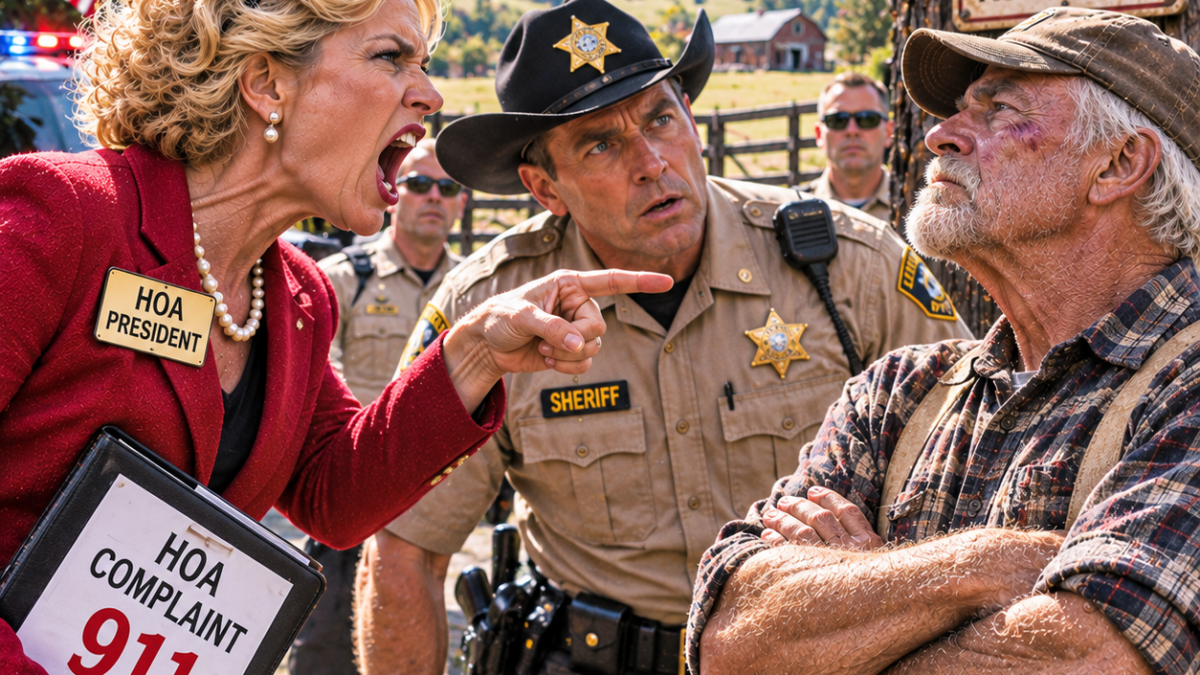
PART2
Four months earlier, I had never heard of Linda Crawford.
I was perfectly happy that way.
Harper Ranch sat just outside a small town in western Tennessee, spread across a little more than three hundred acres of pasture, hardwood woods, creek bottom, and hay fields.
My grandfather purchased the first eighty acres after returning from military service.
He didn’t buy it because he believed land would make him rich.
He bought it because he’d spent enough years being told where to go and what to do.
He wanted a place where a man could work, raise children, and close his own gate at night.
My father added acreage gradually.
He built the eastern dirt road when he needed a way to move hay trailers between the lower pasture and the county highway.
He installed the first steel gate himself.
I helped hold the posts.
I was sixteen, and I complained that the work was unnecessary because there was hardly any traffic in those days.
Dad handed me a wrench.
“Then the gate ought to last a long time.”
Forty years later, it was still standing.
Until Linda found a reason to destroy it.
My wife, Mary, loved the ranch more quietly than I did.
She planted flowers along the porch.
Fed injured birds.
Learned which calves belonged to which cows and corrected me whenever I confused them.
She also possessed the unusual ability to make me reconsider an argument after I was absolutely certain I had won it.
She died five years before Linda arrived.
Cancer.
Eleven months from diagnosis to the day I held her hand and felt it grow still.
People told me time would make the loss smaller.
They were wrong.
Time simply made me better at carrying it without making everyone else uncomfortable.
For years afterward, I left her gardening gloves hanging on the hook beside the back door.
I couldn’t bring myself to move them.
The porch still leaned slightly toward the south because she’d always complained about it, and fixing it after her death somehow felt like erasing one more ordinary conversation we used to have.
Mary was the reason I tried to be patient with people.
Even difficult ones.
She used to say:
“Walter, kindness isn’t weakness. You can be gentle and still close the gate.”
I would remember those words many times during the following months.
Sometimes I managed to follow them.
Sometimes I came close to forgetting.
Oak Valley Estates was built about six years earlier on former Patterson family land bordering my eastern pasture.
The subdivision contained more than a hundred homes.
Neat lawns.
A clubhouse.
A swimming pool.
Walking trails.
Entrance landscaping that required more water than I used on half my garden.
I didn’t resent any of it.
People wanted different things.
Some wanted acreage.
Some wanted a place where someone else maintained the common areas.
That was their business.
Most of the Oak Valley residents were good neighbors.
They waved when I drove past.
Some purchased hay from me.
A few families brought their children over to see newborn calves.
One family became especially close.
Jason and Rachel Baker lived near the eastern boundary.
Jason worked at the county hospital.
Rachel operated a small bookkeeping business.
Their son, Noah, was eleven and had enough questions to exhaust a university professor.
He wanted to understand everything.
Why cows chewed constantly.
Why horses slept standing.
Why my tractors had tires almost as tall as he was.
Why hay smelled different after rain.
And why I still drove an old pickup that knocked whenever I turned left.
I never knew the answer to that last question.
Noah began visiting on Saturdays with his parents’ permission.
He helped feed chickens.
Learned how to approach cattle safely.
Carried tools.
Closed gates.
Usually.
One morning, he forgot to latch the chicken enclosure.
I found three hens wandering through Mary’s flower bed.
“Noah.”
He looked horrified.
“I thought I closed it.”
“You thought.”
“Yes, sir.”
“Thinking is good.”
I pointed at the chickens.
“Checking is better.”
He chased them for twenty minutes.
Afterward, I bought him a doughnut.
He claimed the job was unfairly compensated.
I told him ranching was full of disappointments.
He kept coming back.
That boy made my house feel less empty.
Not because he replaced anyone.
Nobody replaces Mary.
But because laughter has a way of finding rooms where you thought it could never return.
Linda Crawford arrived at my ranch one Tuesday afternoon carrying a leather folder.
She was around fifty.
Perfect hair.
Expensive silver SUV.
Shoes too clean for a working pasture.
Her smile was polished and professional.
“Mr. Harper?”
“That’s me.”
“I’m Linda Crawford, newly elected president of Oak Valley Homeowners Association.”
I shook her hand.
“Welcome.”
“I wanted to introduce myself personally.”
“That’s neighborly.”
She smiled wider.
“We want to establish positive relationships with all surrounding property owners.”
“Sounds sensible.”
Then she opened the folder.
That should have warned me.
Inside was a map showing Oak Valley’s main entrance, the county road, the eastern boundary, and the dirt track across my ranch.
She pointed to the road.
“We have a traffic problem.”
I nodded.
“I’ve seen the cars backing up near your entrance in the mornings.”
“Exactly.”
“School traffic?”
“School traffic. Evening commuters. Sometimes emergency vehicles.”
“That’s unfortunate.”
“We’re considering a secondary route.”
I looked at the map.
Then at her.
“No.”
She blinked.
“Mr. Harper, I haven’t finished explaining.”
“You’re going to ask to run neighborhood traffic through my cattle pasture.”
“It would be a controlled access road.”
“No.”
“An improved road would benefit everyone.”
“Not my cattle.”
She laughed.
A short, practiced sound.
“The association would pay for improvements.”
“Still no.”
She closed the folder slowly.
“I hoped you’d be more open-minded.”
“I am.”
She waited.
I smiled.
“My mind’s open enough to know I don’t want a hundred families driving through a working ranch.”
Her expression changed.
Only slightly.
But I noticed.
For twenty-seven years, I had interviewed people who were angry, frightened, dishonest, or simply determined to get their way.
I’d learned that the first moment someone realizes persuasion isn’t working can tell you a great deal about what comes next.
Linda stood.
“Well, we’ll continue studying the matter.”
“You’re welcome to study whatever you like from your side of the fence.”
She gave me a tight smile.
“Have a nice afternoon, Walter.”
“You too.”
I watched her drive away.
Then went back to repairing a water trough.
I assumed that conversation was finished.
I was wrong.
Two weeks later, a white sign appeared on my eastern gate.
OAK VALLEY EMERGENCY ACCESS ROUTE.
It was secured with plastic ties.
I cut the ties.
Removed the sign.
Put it inside my workshop.
The next morning, another sign stood twenty yards inside my fence.
That made me stop.
Someone had crossed onto the ranch.
Not accidentally.
Not looking for a lost dog.
They had carried a post, dug a hole, and installed an official-looking marker on private land.
I photographed it.
Then called Linda.
“Morning.”
“Mr. Harper.”
“Somebody from Oak Valley put access signs on my property.”
“They’re temporary planning markers.”
“Then remove them.”
“They identify the proposed easement corridor.”
“There isn’t an HOA easement across my ranch.”
“Our board is reviewing historical access rights.”
“Which rights?”
“There may be an old recorded easement.”
I leaned against the workshop bench.
“Linda, my father built that road.”
“That doesn’t mean he retained every possible right over it.”
“No, but his deed and recorded easements tell us what rights exist.”
She sighed.
“Let’s allow the professionals to determine that.”
“Fine.”
I almost ended the call.
Then added:
“But until then, your people stay outside my fence.”
She didn’t answer.
I heard the line disconnect.
I stood there holding the phone.
Then called Sarah Bennett.
Sarah had handled property disputes, agricultural easements, and rural land transactions for more than twenty years.
She wasn’t impressed by impressive letterhead.
That was why I trusted her.
When I explained the situation, she asked one question.
“Have you signed any access agreement with the HOA?”
“No.”
“Did your father?”
“Not with Oak Valley. The subdivision didn’t exist then.”
“Anyone else?”
“Not that I know of.”
She spent the next several days reviewing county records.
Then called me into her office.
“I found an easement.”
My stomach tightened.
“Of course you did.”
“Don’t panic.”
“I don’t panic.”
“You used to be a police chief, Walter. You absolutely panic. You just do it quietly.”
I stared.
She smiled.
Then spread the original document across her desk.
Almost thirty years earlier, my father had granted the volunteer fire department limited access across a narrow section of the ranch during genuine emergencies.
Fire.
Medical rescue.
Disaster response when normal routes were blocked.
Necessary maintenance to keep the emergency route passable.
That was it.
Not neighborhood traffic.
Not a second subdivision entrance.
Not a commercial road.
Not ownership of the underlying land.
Sarah tapped the document.
“This is a limited emergency access easement.”
“I remember Dad talking about it.”
“He was generous.”
“He believed the volunteer fire department might need another way through during brush fires.”
“Then that’s what the document provides.”
She looked at me.
“An easement can create specific use rights. It doesn’t automatically transfer ownership or authorize every improvement somebody dreams up later.”
I exhaled.
“So Linda can’t turn it into a street.”
“Not under the language I’ve reviewed.”
She prepared a formal letter.
Explained the limits of the easement.
Attached supporting records.
Demanded that Oak Valley stop entering the ranch without authorization.
The letter was delivered.
For nearly a month, everything became quiet.
I thought that meant Linda had accepted reality.
Instead, she had simply moved to the next stage.
Orange paint appeared along my eastern fence.
Then survey stakes.
Three inside the pasture.
Each marked:
OV ACCESS.
I photographed them.
Removed none until Sarah advised me how best to document them.
Then I called Linda.
“You sent surveyors.”
“We’re identifying the historical corridor.”
“Your attorney already received the easement.”
“Our counsel interprets it differently.”
“What’s your counsel’s name?”
“That’s confidential.”
I almost laughed.
“A lawyer’s identity isn’t a state secret.”
“Walter, this is becoming tiresome.”
“For you?”
She hung up.
I stood beside the orange stakes, looking across the pasture.
The grass was still wet from morning rain.
A cow watched me from beneath an oak.
I thought about Mary.
You can be gentle and still close the gate.
So I called Sarah.
Then started keeping a dated log.
Every notice.
Every phone call.
Every photograph.
Every vehicle.
I didn’t know yet how important that log would become.
Jason Baker came by several days later.
Noah was already at the barn, brushing my old mare Daisy.
Jason looked uncomfortable.
“Walter, I should tell you something.”
“Sounds serious.”
“Linda’s been talking about you at meetings.”
“I’d be disappointed if she weren’t.”
He didn’t smile.
“She says you’re blocking an emergency evacuation route.”
I stopped tightening the bolt in my hand.
“What?”
“She tells people Oak Valley needs a second exit in case of wildfire.”
“That part may be true.”
“Then why—”
“Because needing an exit doesn’t mean she owns my road.”
Jason nodded.
“I understand.”
“Does everyone else?”
He hesitated.
“No.”
That hurt.
Linda had found the one argument that could turn reasonable neighbors against me.
Safety.
Children.
Emergencies.
She could frame my refusal to allow ordinary traffic as a refusal to help firefighters.
I looked toward Noah.
The boy was holding a brush against Daisy’s neck and explaining something important to her.
Daisy seemed unimpressed.
“Jason, if there were a fire, I’d open that gate myself.”
“I know.”
“The easement already permits emergency vehicles.”
“I know.”
“But Linda’s telling people I care more about cattle than children.”
Jason looked down.
“Some people believe her.”
I felt a familiar anger rise.
Not the hot kind.
The colder kind.
The kind that comes when someone discovers exactly where your values are and uses them against you.
I looked at Noah again.
Then said:
“Tell people the truth.”
Jason nodded.
“I will.”
The first contractors arrived on a Tuesday.
I heard engines near the eastern pasture shortly after nine.
At first, I assumed someone was working on the subdivision side.
Then I saw a utility vehicle inside my fence.
Four men.
Brush cutters.
Measuring equipment.
A small trailer carrying gravel.
I drove over in my tractor.
The supervisor waved.
“Morning.”
“What are you doing?”
“Preparing the emergency access route.”
“On whose instructions?”
“Oak Valley.”
I shut off the tractor.
“This is Harper Ranch.”
He looked at his clipboard.
“We’ve got a work order.”
“Can I see it?”
He handed it over.
SECONDARY EMERGENCY ACCESS PREPARATION.
Below that were instructions to clear shoulders, widen a turning area, and begin preparing the approach for a controlled gate system.
I pointed at the map.
“This road belongs to me.”
The supervisor frowned.
“We were told the HOA has access rights.”
“Limited emergency access rights. Not permission to build a neighborhood entrance.”
He looked uneasy.
“Let me call my office.”
“Please.”
The crew stopped.
Twenty minutes later, they packed their equipment.
No argument.
No threats.
I thanked the supervisor for handling it professionally.
He shrugged.
“I’m not interested in being in the middle of a land dispute.”
Neither was I.
Then Linda arrived.
She stepped from her SUV with her folder already open.
“You stopped an authorized safety project!”
I stood beside the tractor.
“I stopped contractors clearing my land without permission.”
“This is an emergency corridor.”
“For emergency responders.”
“Exactly.”
“Linda, your contractors were preparing a keypad gate for neighborhood vehicles.”
Her face shifted.
“Future improvements are under discussion.”
“Not on my land.”
She pointed toward the road.
“More than four hundred people live in Oak Valley.”
“I know.”
“You’re putting them at risk.”
“No.”
“Do you want a child to die in a wildfire because you’re too stubborn to share a dirt road?”
That was the first time I raised my voice.
“Don’t you dare put a child’s life on me because you refuse to read a deed.”
She stepped back.
I stopped.
Took one breath.
Then another.
Mary’s voice returned.
Kindness isn’t weakness.
I looked at Linda.
“If an ambulance needs this road during an emergency, I’ll help clear it.”
“If firefighters need to cross, the easement allows it.”
“But you are not turning it into a commuter shortcut or access to somebody else’s development.”
She stared.
Then said:
“Communities change, Walter.”
“So?”
“Older landowners sometimes have to adapt.”
I smiled.
“New neighbors sometimes have to learn where the fence is.”
She left without answering.
That evening, I found a violation notice nailed to my gate.
UNAUTHORIZED OBSTRUCTION OF DESIGNATED EMERGENCY ACCESS.
It demanded I remove my chain and padlock within forty-eight hours.
The letterhead belonged to an HOA I wasn’t a member of.
I photographed it.
Sent it to Sarah.
She called.
“Walter.”
“Yes?”
“Don’t remove that lock.”
“Wasn’t planning to.”
“And start checking the gate every morning.”
“Why?”
“Because someone who ignores two attorney letters may not stop at a third.”
She was right.
Three days later, somebody cut the chain.
I found the lock missing on Saturday morning.
Fresh tire tracks crossed the dirt inside the gate.
The chain lay in the grass.
I stood there looking at it for almost a minute.
Then called the sheriff’s office.
Deputy Tyler Brooks arrived.
He was younger than most of the officers I’d trained, but his father had worked in my department.
Tyler knew me.
He treated the situation professionally.
Photographs.
Measurements.
Incident report.
Questions.
“Any idea who did this?”
“No.”
“Cameras?”
“Not at this gate.”
“You should consider installing some.”
“I will.”
Then he noticed the HOA violation notice.
“What’s that?”
“Apparently, I violated neighborhood rules.”
He looked around.
“Did you join Oak Valley?”
“I’d rather wrestle a bull.”
He laughed.
Then read the notice.
His expression changed.
“I’ll include this in the report.”
After he left, Jason helped me install trail cameras.
Noah wanted to assist.
I gave him the box of screws.
He looked offended.
“That’s not real work.”
“Every organization needs management.”
He thought about that.
“Then I should be the boss.”
Jason laughed.
“You’ve got the attitude.”
For a while, I forgot Linda.
We worked in the sun.
The smell of warm grass rose from the pasture.
Daisy watched from the fence.
It was almost a normal Saturday.
Almost.
The cameras caught Linda’s SUV four mornings later.
She stopped at 6:12.
A second vehicle pulled up behind her.
Two men stepped out.
They examined my chain.
Pointed toward the eastern road.
Then left.
Nobody damaged anything that morning.
But the footage mattered.
It showed Linda knew exactly where the gate was.
Exactly how it was secured.
And exactly which road she was trying to control.
I saved the files.
Sent copies to Sarah.
Then continued working.
There is a limit to how many hours a man can spend thinking about a woman who believes his property belongs to her.
I was determined not to let Linda consume all of mine.
That determination lasted until the morning she called 911.
I was repairing the fence near my north field when I heard her SUV.
She had entered through a southern service opening that a delivery driver apparently left unlatched.
She drove right onto the ranch.
Stopped twenty feet from my tractor.
Stepped out.
“Walter.”
I kept working.
“Morning.”
“You need to stop this.”
“Stop repairing my fence?”
“Stop obstructing the Oak Valley emergency route.”
I straightened.
“The same road your attorney has been told doesn’t belong to the HOA?”
“The board has authorized the route.”
“The board can authorize what happens on association property.”
“This corridor is under easement.”
“That does not make it HOA property.”
She took a step closer.
“You’re trespassing.”
I stared.
Then looked around.
The red barn.
The cattle.
My father’s road.
The fields my grandfather bought.
“Where exactly am I supposed to go?”
Her face tightened.
“I’ve had enough.”
“So have I.”
She pulled out her phone.
“I’m calling the police.”
“Go ahead.”
That surprised her.
She dialed.
“911? I need officers at Oak Valley’s emergency access road.”
I listened.
“There is an elderly man refusing to leave.”
A pause.
“He’s becoming aggressive.”
I folded my work gloves.
Placed them on the tractor seat.
Then she said:
“He owns firearms. I believe he may be dangerous.”
I felt something inside me go very still.
I owned legally secured firearms.
They were inside my house.
Far from where we stood.
I was carrying a wrench.
A fence staple.
And a pair of work gloves.
No weapon.
No threats.
No aggressive movement.
I said calmly:
“Linda, tell the dispatcher I haven’t threatened you.”
She covered the phone.
“Stop interfering!”
Then she turned away.
“He’s still being hostile.”
I stopped talking.
If officers were coming, I knew exactly what to do.
Hands visible.
No sudden movements.
Answer questions.
Keep the situation calm.
I’d taught those principles for decades.
Linda interpreted my silence as surrender.
“You should have listened the first time,” she said.
I almost answered.
Then decided she could learn the truth from the people she’d called.
Six minutes later, the first cruiser arrived.
The younger deputy stepped out.
“Sir, stay where you are.”
I nodded.
Linda rushed toward him.
“He’s trespassing on HOA-controlled property!”
I waited.
“He threatened me!”
I waited.
“He may be armed!”
I kept my hands visible.
Then Tyler Brooks arrived in the second cruiser.
He looked at me.
Stopped.
“Walter?”
I nodded.
“Morning, Tyler.”
He glanced toward Linda.
Then toward the ranch sign.
The sheriff’s SUV pulled in behind him.
David Coleman stepped out.
He’d worked under me when he was a rookie.
I remembered the first report he’d written after joining the department.
It contained so many spelling errors that I handed it back with a dictionary.
He never forgave me.
He became an excellent officer.
Then sheriff.
Now he stood in my pasture looking at me with an expression that mixed recognition and disbelief.
“Walter?”
“David.”
Linda practically ran toward him.
“Thank goodness. Perhaps somebody senior will finally handle this.”
David looked from her to me.
“Ma’am, who did you say this man was?”
“Some farmer named Walter Harper.”
He stared at her.
Then at my barn.
Then at the Harper Ranch sign.
“Right.”
Linda folded her arms.
“He refuses to leave HOA property.”
David looked at me.
“Walter?”
“No.”
Then he turned to Linda.
“Where is the HOA property you’re referring to?”
“The emergency corridor.”
“Do you have documentation?”
She thrust her folder at him.
He examined the easement summary.
Then said:
“This describes emergency-service access.”
“It gives the association control.”
“Not necessarily.”
“Our attorney disagrees.”
“Your attorney can present that position in the proper process.”
Linda was becoming angrier.
“He threatened me.”
David looked at me.
“Did you?”
“No.”
He turned back to her.
“What exactly did he say?”
She hesitated.
“He refused to leave.”
“His own ranch?”
She opened her mouth.
Then closed it.
That’s when the radio call arrived.
Construction equipment.
East Gate.
Property damage.
And the sound of metal tearing somewhere beyond the trees.
David drove us toward the east pasture.
I rode beside him in the sheriff’s SUV while another deputy remained with Linda.
The ranch rolled past the windows.
Hay fields.
Fence lines.
A stretch of woodland.
The road my father built.
David glanced at me.
“Never thought I’d see you dragged into an HOA complaint.”
“I was enjoying retirement.”
He smiled.
“Your version of enjoyment looks unusually complicated.”
Another crash sounded ahead.
His smile disappeared.
We reached the eastern gate.
And I felt the anger rise all the way into my throat.
The steel gate hung from one twisted hinge.
One post leaned toward the ditch.
An excavator sat twenty feet inside my ranch.
A skid steer had already cleared brush along the road.
Workers stood beside a flatbed truck carrying gravel and metal posts.
A temporary sign announced:
OAK VALLEY SECONDARY ENTRANCE — PROJECT AREA.
Not emergency access.
Not a fire route.
A secondary entrance.
I stepped from the SUV.
For several seconds, I couldn’t speak.
That gate was forty years old.
Dad had welded it himself.
I still remembered the afternoon we painted it.
Mary had brought lemonade because the heat was miserable.
Dad complained that she was spoiling us.
Then drank two glasses.
Now the gate lay half destroyed because a woman who’d lived nearby for a few years believed a board resolution gave her the right to tear through it.
David approached the site supervisor.
“Who authorized this?”
The man looked uncomfortable.
“Scott Bradley. Bradley Siteworks.”
He handed over a work order.
“Oak Valley HOA.”
David read it.
“Remove existing access barrier, widen roadway, install controlled entrance.”
He looked up.
“Did anyone show you written permission from the landowner?”
Scott hesitated.
“We received an easement package.”
“Signed by Mr. Harper?”
“No, sir.”
“Did you review the actual recorded easement?”
“Our office reviewed what the client provided.”
David waited.
Scott looked away.
I stepped forward.
“You knew the ownership was disputed.”
Scott exhaled.
“I asked for clarification this morning.”
“From whom?”
“Mrs. Crawford.”
“What did she say?”
“That the owner had been notified and the association had authorization.”
I looked at the broken gate.
“Notified isn’t the same as consenting.”
He nodded.
“I understand that now.”
Linda arrived ten minutes later.
The moment she stepped from the patrol car, she pointed at Scott.
“Continue working.”
Nobody moved.
David turned.
“No.”
She stared.
“You cannot stop an authorized emergency project.”
“I can stop further damage while we determine whether the work has lawful authorization.”
“There is no dispute.”
Sarah’s easement copy was in my folder.
I raised it.
“There is now.”
Linda looked toward David.
Then toward me.
Her expression changed.
“Are you really a former police chief?”
“Yes.”
She looked at David.
“And you worked for him?”
“A long time ago.”
Her face flushed.
“So that’s why you’re taking his side.”
David’s expression hardened.
“No, ma’am.”
She crossed her arms.
“Of course you are.”
He continued.
“I’m stopping this work because the landowner disputes your authority, the documents presented do not clearly authorize this construction, and his gate has been damaged.”
“He’s your friend.”
“He is.”
That surprised her.
David continued.
“And that changes nothing.”
I respected him for saying it.
If I’d been the man breaking the law, friendship should not have protected me.
My past badge didn’t grant me extra property rights.
The deed did.
Scott’s crew stopped work.
Deputies photographed the gate.
Statements were taken.
Sarah was notified.
Nobody made an arrest just because I wanted somebody punished.
That was important.
Law enforcement had to investigate.
Not perform revenge.
But standing beside the twisted gate, I wanted revenge more than I cared to admit.
My hands shook.
I looked at the dirt road.
The road Dad built.
The road Grandpa had never wanted opened to subdivision traffic.
The road meant for moving cattle and helping emergency responders when necessary.
Now it was gouged by heavy equipment.
David stood beside me.
“You okay?”
“No.”
He nodded.
“Fair answer.”
I looked at him.
“She called me dangerous.”
“I know.”
“She told dispatch I was armed.”
“We’re reviewing what she reported.”
“Then sent contractors here while I was occupied.”
David didn’t answer immediately.
That silence told me he’d been considering the same possibility.
Finally he said:
“We’ll establish the timeline.”
Then:
“Walter, don’t assume motive until we have evidence.”
I almost laughed.
I’d taught him that sentence twenty years earlier.
Now I hated hearing it.
Jason arrived with Noah shortly after noon.
They saw the gate.
Jason whistled softly.
“Good Lord.”
Noah stared.
“They tore it down?”
“Partly.”
“That seems worse than breaking a rule.”
“It is.”
He walked around the damaged hinge.
“Can we fix it?”
I looked at his serious face.
The boy wanted a problem he could understand.
Metal.
Bolts.
Tools.
Something that could be repaired by working hard.
I understood that feeling.
“We can try.”
For two hours, Jason, Noah, and I built a temporary closure.
Noah tightened one bolt so hard I thought it would snap.
“Easy.”
“You said gates matter.”
“They do.”
“So it should be extra strong.”
Jason laughed.
“He gets logic from his mother.”
For the first time that day, I smiled.
Then Noah looked up.
“Mr. Harper?”
“Yes?”
“Why does she want your road so badly?”
I stared toward Oak Valley.
“I don’t know yet.”
He thought about that.
Then said:
“Maybe she wants something at the other end.”
I looked at him.
Children sometimes ask questions adults have complicated into silence.
“Maybe,” I said.
I would remember that question when the development plans finally came to light.
By evening, the neighborhood message board was full of rumors.
Jason showed me.
Some residents claimed I had threatened Linda with a shotgun.
False.
Others said officers refused to arrest me because I was a retired police chief.
Also false.
Someone wrote that Harper Ranch had been partially annexed into Oak Valley.
Completely false.
A few residents asked for documents.
Those comments were buried beneath arguments.
Jason looked embarrassed.
“I’m sorry.”
“For what?”
“My neighbors.”
“They’re working with bad information.”
“Still.”
I looked toward the temporary gate.
“Give people the truth.”
“Will they believe it?”
“Some will.”
“And the rest?”
I thought of Mary.
“You keep telling the truth anyway.”
The next morning, Sarah called.
“I reviewed the HOA attorney’s easement copy.”
“And?”
“It contains language I don’t remember from the recorded original.”
I sat up.
“What language?”
“Broad rights to improve, widen, maintain, and control the corridor for community safety.”
I stared at the wall.
“That’s not what Dad signed.”
“I agree. But we need to compare the original archive.”
“Could there be an amendment?”
“Possibly.”
I didn’t want to hear that word.
Possibly.
We drove to the county records office that afternoon.
A clerk brought out the original paper file.
Dad’s signature.
The volunteer fire chief’s signature.
Recording stamp.
Legal description.
Emergency-service provisions.
I recognized Dad’s handwriting on the signature page.
For a moment, the room disappeared.
I remembered him sitting at the kitchen table with a ballpoint pen.
Mary serving coffee.
Dad telling me that if a brush fire ever threatened the neighborhood, the fire department shouldn’t have to ask permission before saving lives.
He believed that.
I believed it too.
Sarah placed the two documents side by side.
The difference was unmistakable.
Oak Valley’s copy contained an additional paragraph granting broad access and construction rights.
The original did not.
Someone had modified the document.
And they’d kept the recording information and signature page the same.
Just enough truth to make the added language look legitimate.
I stared.
“Somebody changed my father’s agreement.”
Sarah nodded.
“That’s what it appears to show.”
“Who?”
“We don’t know.”
I looked at her.
“Linda?”
“We don’t know, Walter.”
I hated that answer.
It was the correct one.
The clerk checked the available request history.
Oak Valley’s law firm had requested the easement.
So had a company called Greenway Community Development.
And Linda Crawford herself had obtained a certified copy of the original months earlier.
I stopped.
“Linda had the real version?”
“Yes.”
“When?”
“Before the altered one began appearing in your dispute.”
Sarah wrote down the dates.
That did not prove Linda created the alteration.
But it made it harder to believe she had never known what the original said.
I looked at Dad’s signature one last time.
Then said:
“Let’s find out who wrote that paragraph.”
An emergency HOA meeting was announced for the following evening.
Jason urged me to attend.
Sarah agreed.
Not to start a confrontation.
To hear what Linda told residents while the evidence was still fresh.
The clubhouse was packed.
Linda sat at the front beside the association attorney, Gregory Lane.
Three board members sat nearby.
Frank Dalton.
Susan Clark.
And another man I’d seen but never met.
Jason and Rachel sat in the middle.
I stayed near the back.
Linda opened the meeting with an astonishing sentence.
“Unfortunately, we’ve experienced a misunderstanding with a neighboring landowner.”
I nearly laughed.
A misunderstanding.
My gate was twisted in a ditch.
She’d called 911 accusing me of being armed and dangerous.
Contractors had entered my land.
And somehow the real problem was poor communication.
Gregory explained that the HOA believed it possessed broader rights under the recorded easement.
A resident raised his hand.
“Does that mean we can use the road every day?”
Gregory hesitated.
“We believe the easement supports necessary community access.”
“That wasn’t the question,” the resident replied.
Another person asked:
“Why did the sheriff stop construction?”
Linda answered immediately.
“Because Mr. Harper has personal connections with local law enforcement.”
The room shifted.
Jason stood.
“That’s unfair.”
Linda struck the table.
“Mr. Baker, sit down.”
“No.”
Several people turned.
Jason continued.
“The sheriff stopped the contractors because they didn’t have clear authorization to destroy Walter’s gate.”
Linda looked furious.
Then an older woman named Patricia Moore stood.
“My husband served with the volunteer fire department for twenty years.”
The room quieted.
“I remember that easement. It was for emergency vehicles.”
Gregory replied:
“The recorded language is broader.”
I raised my hand.
Linda ignored me.
Patricia pointed toward me.
“Why don’t we let the property owner speak?”
More hands went up.
Linda stared.
Then sighed.
“Walter. Briefly.”
I stood.
“I am not blocking fire trucks.”
The room became quiet.
“I am not blocking ambulances.”
I looked at Linda.
“I am blocking your president from turning my private cattle road into a neighborhood entrance without permission.”
Several people murmured.
Then I lifted the two easement copies.
“And I want to know why the version your attorney is using contains language that does not appear in the county’s original recorded document.”
Gregory’s face changed.
Not dramatically.
Just enough.
Linda looked at him.
A man near the front asked:
“Are you saying the document was changed?”
I answered carefully.
“I’m saying the two versions don’t match, and the county original does not contain the paragraph Oak Valley is relying on.”
Gregory stood.
“We need to verify that before anyone makes accusations.”
“I agree,” I said.
That surprised him.
“That’s why nobody should’ve driven an excavator through my gate.”
A few people laughed.
Linda did not.
Frank Dalton leaned toward Gregory.
“I want both copies.”
Gregory whispered something.
Linda shook her head.
Frank frowned.
“I’m on the board.”
“These are legal materials,” Linda replied.
“Then why aren’t they available to the board?”
Susan Clark reached for her folder.
“I’d like to see them too.”
Linda struck the table again.
“Order.”
But the room had changed.
People weren’t asking permission to understand anymore.
Then the clubhouse doors opened.
Sheriff Coleman entered with Tyler Brooks.
Nobody expected them.
Linda stood.
“What is this?”
David answered calmly.
“We need to request information about the construction incident and the 911 call.”
Gregory immediately leaned forward.
David raised one hand.
“Nobody is being arrested here. We have questions.”
He asked Linda about the information reported to dispatch.
She repeated that she believed I was dangerous.
David asked what conduct supported that belief.
She talked about refusing instructions.
He asked whether I had threatened her.
She didn’t give a clear example.
Then Tyler provided the incident timeline.
Linda entered my north field shortly after nine.
The construction crew arrived at the east gate minutes later.
She called 911 while the crew was beginning work.
I heard whispers moving through the room.
David asked:
“Did you make the emergency call to keep Mr. Harper occupied while contractors removed his gate?”
Gregory told Linda not to answer.
She didn’t.
That was her right.
But the question had already changed how people viewed the timeline.
Then Frank Dalton checked the shared project folder on his tablet.
His expression changed.
“Wait.”
Linda turned.
“What?”
Frank held up a construction authorization.
“My signature is on this.”
Linda looked relieved.
“Of course. The board approved—”
“I never signed it.”
The room went silent.
Susan took the tablet.
Her eyes widened.
“My signature is here too.”
“Did you sign?” somebody asked.
“No.”
Linda rose.
“This is getting out of control.”
Frank looked directly at her.
“No, Linda. I think we’re finally seeing what was out of control.”
The next development came from the east gate.
A deputy reported that a locked equipment trailer had been left near the construction area.
The contractor said it belonged to Greenway Community Development.
The sheriff’s office arranged to secure the area and determine the legal basis for examining its contents.
What investigators eventually found inside changed the case.
Survey equipment.
Road plans.
Oak Valley signs.
Property documents concerning Harper Ranch.
And a metal box containing copies of police records.
My police records.
I didn’t know that during the meeting.
I learned afterward, when David called.
“Walter, sit down.”
I sat.
“What’s wrong?”
“We found files connected to your old department.”
My stomach tightened.
“What kind?”
“Some public records. Some internal summaries. Personnel material.”
I stared toward the window.
“Whose?”
“Yours.”
For the first time since Linda began her campaign, I felt something colder than anger.
Why would a development company want my police files?
I had retired eleven years earlier.
The easement dispute concerned land.
Not my career.
I knew somebody was looking for leverage.
I just didn’t know how far back they intended to reach.
The next morning, David arrived at my house.
He carried photographs of the recovered documents.
He put them on the kitchen table.
Some were harmless.
Old newspaper clippings.
Retirement announcements.
Public reports.
Then I saw a name I hadn’t thought about in years.
Richard Crawford.
I stared.
David noticed.
“You remember him?”
“Yes.”
“Tell me.”
Richard had been an officer in my department nearly twenty years earlier.
Smart.
Charismatic.
Popular with some people.
He also had a habit of treating rules as obstacles that applied to everyone except him.
First came late reports.
Then unauthorized use of equipment.
Then a serious problem involving evidence handling in a burglary case.
The internal investigation established inconsistencies and misconduct.
I recommended termination.
Richard resigned before the final disciplinary hearing.
No criminal conviction resulted from that investigation.
That distinction mattered.
I had not sent him to prison.
I had done what I believed my responsibilities required.
David listened.
Then asked:
“Any relationship to Linda?”
I looked at the surname again.
“Crawford.”
He nodded.
“We’re checking.”
Later that morning, he confirmed it.
Richard was Linda’s older brother.
I sat silently.
For four months, I’d believed Linda’s obsession began with traffic.
Now I wasn’t so sure.
David showed me another photograph.
An internal summary.
Several lines had been highlighted.
My name appeared repeatedly.
Chief Harper recommends termination.
Chief Harper finds Officer Crawford’s explanation not credible.
Chief Harper orders access to evidence storage revoked.
A handwritten note sat beside the document.
Harper fights when he believes he has control. Use retirement history if necessary.
I read it twice.
“Who wrote this?”
“We’re investigating.”
“Why?”
“Possibly to undermine your credibility.”
I looked toward the old photograph of Mary on the mantel.
She was smiling beside our porch.
I suddenly felt tired.
I’d worked twenty-seven years in law enforcement.
Made mistakes.
Had difficult cases.
Upset people.
But I’d tried to do the work fairly.
Now someone had gone searching through two decades of old conflicts to find something useful against me.
Not because of a crime.
Because I wouldn’t surrender a dirt road.
David watched me.
“Walter.”
“I’m fine.”
He gave me the look I’d once given rookies who lied badly.
“No, you’re not.”
I smiled without humor.
“No.”
Then I said:
“But I’m not giving them a reaction they can photograph.”
The next piece came from Sarah.
Greenway Community Development had signed a consulting agreement with Oak Valley nine months earlier.
Not merely for traffic studies.
The agreement included:
Strategic access expansion.
Connectivity planning.
Property-value enhancement.
And future commercial access evaluation.
“Commercial?” I asked.
Sarah unfolded a map.
The proposed road crossed my ranch.
Then continued north toward a parcel beyond my boundary.
A parcel under option to Greenway.
I stared.
“What are they planning?”
“A small retail development.”
“Grocery store?”
“Possible.”
“Pharmacy?”
“Yes.”
“Gas station?”
“One of the concepts.”
I looked again.
The road was not simply about helping Oak Valley residents avoid school traffic.
It could provide convenient access to future commercial property.
The kind of access that made development more valuable.
Then Sarah showed me another clause.
If the secondary route became operational, Greenway would pay Oak Valley a connectivity contribution.
Five hundred thousand dollars.
I stared.
“Half a million?”
“Yes.”
“For using my road?”
“For completing the connectivity arrangement.”
“On land I never agreed to provide.”
Sarah nodded.
“That’s the problem.”
I sat back.
Then asked:
“Did Linda know?”
“She signed the contract.”
The room went quiet.
I thought about the neighborhood meetings.
Children’s safety.
Emergency access.
Wildfire evacuation.
All legitimate concerns.
Then the concealed development payment.
That was the ugliness.
Linda had wrapped a private financial opportunity inside a public safety argument.
And she was angry because I had refused to supply the land.
I told Jason.
He sat on my porch staring at the documents.
“Five hundred thousand dollars?”
“That’s what the agreement says.”
He shook his head.
“Linda never mentioned a retail project.”
“Then you should ask why.”
Jason looked toward his neighborhood.
“We trusted her.”
I didn’t answer.
He continued.
“Some people really are worried about emergency evacuation.”
“I know.”
“I am too.”
“So am I.”
He looked at me.
“You wouldn’t block firefighters?”
I stared.
“Jason, your son has spent half his Saturdays on this ranch. If his house were burning, do you think I’d stand at the gate arguing over a deed while a fire truck waited?”
He looked ashamed.
“No.”
“Then don’t let Linda turn a legal distinction into a moral accusation.”
He nodded.
“I’m sorry.”
“Don’t be sorry. Ask questions.”
That became the theme of the next neighborhood meeting.
Forty residents gathered in the clubhouse.
Linda wasn’t there.
Neither was Gregory Lane.
Frank Dalton and Susan Clark attended.
Jason and Rachel sat near the middle.
I stayed near the back.
Frank stood.
“We failed to exercise proper oversight.”
Some residents looked surprised.
A man asked:
“How?”
Frank held up the Greenway contract.
“We approved an initial traffic study.”
Susan added:
“We did not approve destroying Walter Harper’s gate.”
Frank continued.
“And we were not told clearly about the five-hundred-thousand-dollar connectivity contribution.”
The room erupted.
Questions.
Anger.
Disbelief.
Then an older woman named Carol Peterson turned toward me.
“Walter, is it true you were a police chief?”
“Yes.”
“How long?”
“Long enough to know I like retirement better.”
A few people laughed.
Then she asked:
“Why didn’t you tell Linda when she called the police?”
I considered the question.
Then answered:
“Because it shouldn’t matter.”
The room quieted.
I stood.
“I was standing on my property.”
“I hadn’t threatened anyone.”
“I hadn’t broken the law.”
“Whether I was a retired police chief, plumber, teacher, or unemployed shouldn’t change how officers treat me.”
I looked toward Frank.
“If the only reason I deserved respect was because I used to wear a badge, then something would be very wrong.”
Nobody spoke.
I continued.
“Linda didn’t make a mistake because she picked the wrong old farmer.”
“She made a mistake because she decided an old farmer didn’t deserve to be heard.”
Carol lowered her eyes.
Then nodded.
That mattered more to me than applause.
The evidence kept accumulating.
Sarah sought court protection against further construction.
Frank pushed for a full review of the Greenway agreement.
The board began preserving records.
Then Greenway entered the legal dispute directly.
Its attorneys claimed financial interests connected to the proposed road.
Sarah called me.
“Walter, there’s a new filing.”
“Of course there is.”
“Greenway claims a purchase option.”
I stopped.
“For what?”
“Thirty-two acres of Harper Ranch.”
I stood so quickly my chair hit the wall.
“What?”
“Near your northeast boundary.”
“The land beside their planned retail project.”
“Yes.”
“I never signed a purchase option.”
“I know.”
“Then what are they claiming?”
Sarah read the document.
It purported to give Greenway the option to purchase thirty-two acres if the Oak Valley access road became operational.
The stated price was $240,000.
Several times below what Sarah believed the parcel might be worth with potential commercial development.
Then she said:
“Your signature appears on it.”
My mouth went dry.
“It’s not mine.”
“There’s also a witness signature.”
“Whose?”
She hesitated.
“Linda Crawford.”
I closed my eyes.
For months, Linda had tried to take my road.
Now someone was producing paperwork claiming I’d agreed to sell part of the ranch itself.
I thought of Dad.
Grandpa.
Mary.
The creek bottom.
The old oak tree.
All reduced to a cheap option price on paper.
I whispered:
“They’re not getting thirty-two acres.”
Sarah’s voice was steady.
“Then we’ll challenge the document and prove what we can.”
That afternoon, David called.
A Greenway employee had contacted investigators with information about records being destroyed.
The employee reported that company president William Crawford had instructed staff to delete old drafts connected to Harper Ranch.
My stomach tightened.
“William Crawford?”
“Yes.”
“Related to Linda?”
“Her nephew.”
I sat down.
“And Richard?”
“William’s father.”
The room seemed to tilt.
The son of the officer I had recommended for termination nearly twenty years earlier now ran the company trying to obtain my land.
Sarah had warned me not to assume motive.
David repeated it.
“Family relationships aren’t proof of conspiracy.”
“I know.”
“But the records requests and property documents are relevant.”
“I know.”
Then David told me something worse.
William had obtained some public records about my career.
Property tax information.
Estate filings.
Land-use records.
Mortgage information.
And copies of internal police documents whose source remained under investigation.
The research began almost a year earlier.
Before Linda formally approached me about the road.
Before the first HOA signs.
Before I knew Greenway existed.
That frightened me more than the forgery.
They had been studying my vulnerabilities before I understood there was a dispute.
A project folder recovered through the investigation bore the title:
HARPER LEVERAGE.
I sat at my kitchen table while David read portions of the information a Greenway employee had reported.
Use retirement history if public pressure fails.
Position owner as hostile to authority.
Escalate access dispute through visible incident.
I felt sick.
I had spent decades teaching officers not to let narratives replace evidence.
Now someone was constructing a narrative around me.
Old.
Dangerous.
Uncooperative.
Former police chief with a disciplinary history involving another officer.
They weren’t planning to defeat my property rights.
They were planning to make the public stop caring whether I had them.
Then David said:
“Walter, lock your doors.”
I looked up.
“What?”
“We’ve received a report of a Greenway vehicle entering your north pasture.”
I stood.
“Where?”
“Near the equipment barn.”
My heart began pounding.
I heard an engine in the distance.
Then another.
Sarah was on the call too.
“Walter, stay inside.”
Old instincts told me to go toward the sound.
Find out.
Confront.
Stop the damage.
Experience told me something else.
A seventy-one-year-old man standing alone in a field against strangers wasn’t going to improve anything by becoming a second emergency.
I locked the door.
Then looked through the north window.
A dark pickup emerged from the trees.
Two men stepped out.
Both wore Greenway jackets.
One carried a camera.
The other carried a long metal object wrapped in a blanket.
I watched from the window.
“What are they doing?”
David’s voice came through the phone.
“We’re minutes away.”
The second man unwrapped the object.
A signpost.
He planted it near my equipment barn.
The sign read:
DANGER — ARMED OWNER — KEEP OUT.
My blood went cold.
The photographer stepped backward.
Raised his camera.
Took pictures with my barn behind the warning sign.
I understood immediately.
They weren’t documenting a danger.
They were creating the appearance of one.
Then Linda’s silver SUV came through the damaged fence opening.
She stopped beside the pickup.
William Crawford stepped out.
Expensive jacket.
Phone in hand.
He looked younger than I’d imagined.
He pointed toward my house.
The photographer adjusted his position.
Linda spoke to him.
Then the first siren sounded in the distance.
William turned.
Saw the approaching patrol car.
Panic crossed his face.
He opened a folder.
Pulled out several pages.
Walked toward an old metal burn barrel beside my barn.
I had used that barrel for feed-bag scraps years earlier.
He dropped the papers inside.
Struck a lighter.
The pages caught.
Flames rose.
I heard David shouting through the phone.
“Walter, stay inside!”
A gust of wind lifted one half-burning page from the barrel.
It drifted across the dirt.
Landed near my porch.
The flames died along one edge.
I could read several words through the glass.
HARPER INCIDENT PLAN.
Below:
911 CALL — OWNER DISTRACTION.
And near the bottom:
PHASE TWO — CREATE ARMED CONFRONTATION IF REQUIRED.
For several seconds, I couldn’t move.
The same emergency call Linda had made while her contractors destroyed my gate was written into a plan.
Not an accident.
Not a moment of anger.
A planned distraction.
And now they were apparently trying to manufacture photographic evidence that I was dangerous.
I heard the sirens stop.
Deputies shouted commands.
The men near the barn raised their hands.
Linda froze beside her SUV.
William stepped away from the barrel.
For the first time in months, I wasn’t angry.
I was afraid.
Because I finally understood how far they had been willing to go.
The sheriff’s deputies secured the scene.
The fire was extinguished.
The surviving documents were collected.
Phones and equipment were handled through appropriate legal procedures.
Nobody rushed into a dramatic arrest merely because the papers looked terrible.
William requested an attorney.
Linda did too.
That was their right.
The two Greenway workers gave statements.
The man who carried the warning sign was Andrew Pearce.
He told investigators he’d been instructed to photograph alleged hazard conditions at the ranch.
He had never met me.
He had never seen me carry a weapon.
He had never heard me threaten anyone.
The photographer, Eric Nolan, said much the same.
They had been told their work supported a safety evaluation.
Neither appeared to understand the larger legal dispute.
I stood on my porch after David said it was safe to come outside.
The half-burned page was already in an evidence bag.
Linda looked toward me.
Her face was pale.
I thought I would enjoy seeing her frightened.
I didn’t.
She looked smaller than she had at the clubhouse.
Older.
Tired.
But none of that changed what she had done.
I looked away.
Because Mary had been right about one thing.
Kindness wasn’t weakness.
It also wasn’t pretending wrongdoing didn’t matter.
The documents recovered from the barrel were chilling.
A timeline corresponded closely to the morning Linda called 911.
9:00 — President contacts owner at North Field.
9:10 — East Gate crew begins removal.
9:12 — Police call if owner resists.
9:20 — Complete gate opening before owner returns.
I read it twice when David later showed me an authorized copy.
Every time matched.
The confrontation.
The call.
The excavator.
They had planned to keep me occupied while the crew removed my gate.
Another section outlined a public messaging campaign describing me as hostile to emergency planning.
Still another suggested using my former police career to portray me as controlling and aggressive.
Then there was the phrase about an armed confrontation.
David insisted investigators determine what it meant before drawing conclusions.
They eventually found additional planning notes.
William had wanted someone to photograph me carrying a legally owned rifle during ordinary ranch activities.
The image could then be used with misleading claims that contractors faced an armed landowner.
There was no evidence in those recovered notes of a plan to shoot me.
That distinction mattered.
What they planned was still dishonest.
Still dangerous.
But truth didn’t become better by making it more dramatic.
I’d taught that lesson to young officers.
Now I had to practice it myself.
Phone records connected Linda directly to the staged 911 incident.
One message from William said:
Keep him talking until gate is open.
Linda replied:
If he refuses to move, I’ll call police.
Another message instructed:
Do not tell board full timeline.
The construction authorization also came under scrutiny.
Frank Dalton and Susan Clark had not signed it.
Investigators determined that their signatures had been copied from earlier board documents and added electronically.
Gregory Lane, the HOA attorney, was questioned about the altered easement.
His records showed Greenway had supplied him with the version containing expanded language.
He claimed he believed it was an authentic recorded copy.
That raised serious questions about his professional diligence.
But it did not automatically prove he personally forged anything.
Investigators traced the added paragraph to a draft file on Greenway’s server.
A planning employee reported that William had instructed the language change because the original emergency easement was too narrow for the commercial project’s financing needs.
That phrase stayed with me.
Too narrow.
They had widened my father’s easement with words.
Then tried widening his road with machines.
And when I refused, they tried widening the conflict until it swallowed my reputation.
The thirty-two-acre purchase option was challenged successfully.
The evidence showed the signature attributed to me was not genuine.
Greenway’s claimed rights were rejected.
The original emergency easement remained intact.
The fabricated version had no power to turn my cattle road into a subdivision entrance.
Greenway lost its option on the commercial parcel when the access plan collapsed.
Oak Valley terminated the company’s contracts.
The half-million-dollar connectivity arrangement was abandoned.
Criminal proceedings followed against William for conduct supported by the investigation, including false property documents and destruction of evidence.
Linda faced separate legal consequences for her part in the false reports, property damage, and staged access operation.
Some matters proceeded as civil claims.
Others as criminal cases.
Not every suspicion became a charge.
Not every accusation ended in conviction.
That was how the system was supposed to work.
Evidence.
Review.
Consequences tied to what could actually be established.
I knew that better than most.
And still, I sometimes wished everything would finish faster.
For months, I had imagined the satisfying moment when Linda finally lost control.
I pictured her being confronted publicly.
Her lies exposed.
Her confidence destroyed.
Then it happened gradually.
Board members asked for records.
Residents demanded answers.
Frank and Susan withdrew support.
Greenway’s documents contradicted her public explanations.
The legal cases advanced.
Linda resigned as HOA president before the board completed its removal process.
And I discovered that watching somebody lose power wasn’t nearly as satisfying as I expected.
What I wanted more was to wake up without wondering which part of my property would be threatened next.
I wanted to repair fences.
Feed cattle.
Drink coffee on the crooked porch.
Watch Noah grow tall enough to stop asking whether tractors were difficult to drive and start asking whether I would teach him.
I wanted the ranch to feel like home again.
One afternoon, Sarah arrived with copies of the latest court orders.
“Good news.”
I looked up from my kitchen table.
“That’s rare.”
“The temporary restrictions are now stronger.”
“Meaning?”
“No unauthorized construction.”
“No project-related entry.”
“No new access markers.”
“No use of the altered easement.”
“And the legitimate emergency route?”
“Still available to authorized responders under the original terms.”
I nodded.
That was exactly what I’d wanted.
Then Sarah looked at me.
“You know this could take another year to resolve completely.”
“I know.”
“You say that very confidently.”
“I used to be a police chief.”
She smiled.
“You used to be an impatient police chief.”
“That’s also true.”
I leaned back.
Then looked through the window.
The eastern gate had been replaced.
Jason and Noah had helped.
The new steel was heavier.
The posts deeper.
Noah had insisted on inspecting every bolt.
He had even asked me whether the gate could withstand another excavator.
I told him no.
He looked disappointed.
“Then why build it?”
I thought about that for a moment.
“Because most people stop when they see a gate.”
“And people who don’t?”
I looked at him.
“That’s why we have laws.”
He nodded.
Then tightened another bolt.
Oak Valley changed after Linda resigned.
Frank Dalton became president.
He was not particularly charismatic.
That was a relief.
He spoke slowly.
Asked questions.
Read documents.
Admitted when he didn’t know something.
Residents began receiving clearer explanations of board decisions.
The actual emergency easement was made available for review.
People could see the words themselves.
Fire trucks.
Ambulances.
Rescue vehicles.
Genuine emergencies.
Nothing about daily traffic.
Nothing about a shopping center.
Nothing about a half-million-dollar payment from Greenway.
Some residents remained angry with me.
They wanted a second entrance.
I understood.
Traffic congestion was real.
Emergency planning mattered.
A wildfire did not care about property lines.
But solving a real problem didn’t justify stealing somebody else’s rights.
Most people eventually understood the distinction.
Some even apologized.
I didn’t demand it.
I preferred their questions.
Frank came to my ranch one afternoon.
He stood beside the new gate.
“I owe you an apology.”
“For what?”
“I voted for the initial access study.”
“That wasn’t illegal.”
“I should’ve asked more questions before approving it.”
I looked at him.
“Then ask them next time.”
He seemed surprised.
“That’s all?”
“What else do you want me to do?”
“I don’t know. Be angry?”
I smiled.
“Frank, I’m seventy-one. Anger uses energy I need for cattle.”
He laughed.
That was the beginning of a better relationship.
Not friendship overnight.
Not forgiveness for everything Linda had done.
Just two neighbors talking honestly.
I had missed that.
The next Saturday, Jason and Noah came over to help repair a section of fence near the creek.
Noah had grown taller.
He was beginning to look less like a boy and more like the teenager he was becoming.
He carried tools without being asked.
Closed gates more reliably.
And still asked questions faster than I could answer them.
At one point, we stopped beside the creek.
Noah threw a small stone into the water.
“Mr. Harper?”
“Yes?”
“Were you scared when you were police chief?”
“Many times.”
He looked surprised.
“I thought cops weren’t supposed to be scared.”
“Everybody gets scared.”
“Then how do you do the job?”
I considered it.
“You decide what to do while you’re scared.”
He stared into the water.
“That sounds hard.”
“It is.”
He nodded.
Then asked:
“Were you scared when Linda called the police?”
“Yes.”
He looked at me.
“Even though you knew the sheriff?”
“Even then.”
“Why?”
“Because I knew how badly a false report can go if people stop asking questions.”
He was quiet.
Then:
“So being brave doesn’t mean you’re not afraid?”
“No.”
“What’s it mean?”
I looked toward the gate.
“Sometimes it just means refusing to let fear choose your next step.”
He nodded slowly.
I hoped he’d remember that.
Years later, I think he would.
Linda contacted me through Sarah several months after resigning.
She wanted to meet.
I almost refused.
Then thought about Mary.
You can be gentle and still close the gate.
I agreed.
We met at a coffee shop in town.
Public place.
No lawyers at the table.
Linda looked tired.
Her hair wasn’t as carefully arranged.
She wore a plain sweater instead of the expensive jackets she’d favored at meetings.
For a moment, she looked like any other middle-aged woman who had made terrible decisions and now had to live with them.
She sat.
“Walter.”
“Linda.”
She folded her hands.
“I’m sorry.”
I waited.
Her eyes moved toward the window.
“For the 911 call.”
I said nothing.
“For the gate.”
Still nothing.
“And for allowing things to go as far as they did.”
I leaned forward.
“Did you know the easement was altered?”
She looked down.
“I knew the original was narrower.”
“That wasn’t my question.”
“I didn’t create the document.”
“Did you know Greenway wanted daily access through my property?”
“Yes.”
“Did you know about the commercial project?”
She hesitated.
“Yes.”
“Then why tell residents this was only about emergency safety?”
Linda swallowed.
“Because traffic really was a problem.”
“I know.”
“People were frightened about wildfire evacuation.”
“I know that too.”
“Greenway offered a solution. Money. Engineering. A way to improve access.”
She looked at me.
“When you refused, I began thinking of you as an obstacle.”
I nodded.
“And an obstacle doesn’t get a vote in what happens to him?”
Her eyes filled.
“I thought if the work started, you would eventually negotiate.”
I almost laughed.
“That’s not negotiation.”
“I know.”
“No, Linda. I don’t think you did.”
She accepted that.
Then said:
“I thought being HOA president meant I could make decisions necessary for the neighborhood.”
“On land the neighborhood owned?”
She shook her head.
“On land we thought we needed.”
I sat back.
There it was.
Not a misunderstanding.
A belief that wanting something badly enough created a right to take it.
For a while, neither of us spoke.
Then Linda asked:
“Why didn’t you tell me you were a police chief?”
I looked at her.
“Why should I have?”
She hesitated.
“Maybe I would’ve handled things differently.”
I let that sit between us.
Then said:
“That’s exactly the problem.”
She looked confused.
“You called 911 on an old farmer because you assumed the officers would believe your version.”
“Walter—”
“You described me as dangerous.”
She lowered her eyes.
“You assumed I had less credibility than you.”
“I was wrong.”
“Yes.”
I leaned forward.
“But suppose I hadn’t been a police chief.”
She looked up.
“Suppose David had never met me.”
“Suppose I was an old man who spent his life driving a truck, teaching school, fixing engines, or cleaning buildings.”
I paused.
“Would I have deserved less respect?”
Her eyes filled.
“No.”
“Then my old badge had nothing to do with why what you did was wrong.”
She nodded.
That was the lesson I wanted her to understand.
Not that she’d chosen the wrong old man.
There shouldn’t be a right old man to falsely accuse.
She had tried to use my age, my appearance, and her position to make other people treat her claims as facts.
She’d been wrong before anybody recognized my face.
I finished my coffee.
Then stood.
Linda looked up.
“Do you forgive me?”
I thought about Mary.
The broken gate.
The false documents.
The months of worry.
The plans to portray me as dangerous.
Then answered:
“I hope you become better than the person who did those things.”
She waited.
“But I don’t owe you access to my life so you can prove it.”
I walked away.
That was the end of our conversation.
It was enough.
After everything settled, Oak Valley still needed a legitimate emergency plan.
The neighborhood still had one busy entrance.
The county road still backed up on school mornings.
Wildfire risk remained real.
None of those facts disappeared because Linda had abused the situation.
One afternoon, Frank arrived at Harper Ranch with fire chief Steven Lewis, Sarah Bennett, and two board members.
No Greenway.
No hidden agreement.
No altered paperwork.
No private developer promising money.
Frank looked uncomfortable.
“Walter, we’d like to discuss the emergency easement.”
I almost smiled.
“Again?”
He sighed.
“I know.”
Sarah placed a proposal on the kitchen table.
It concerned improving a narrow section of the existing emergency route.
A stronger culvert.
Gravel reinforcement.
A safe turning area for larger fire vehicles.
No daily resident traffic.
No commercial access.
No keypad for neighborhood cars.
No connection to the proposed retail development.
Only emergency responders during genuine emergencies.
I read it carefully.
Then asked questions.
Who would pay for the work?
Who would maintain it?
Who could authorize future changes?
Who controlled the gate?
What happens if the property is sold?
Sarah answered each question.
The fire chief explained the equipment requirements.
Frank listened.
Nobody interrupted.
Nobody called me stubborn.
Nobody suggested I was endangering children.
They asked.
I considered it.
Then said:
“Yes.”
Frank stared.
“Really?”
“Yes.”
“After everything?”
I looked at him.
“Frank, I was never against fire trucks.”
He smiled.
“No.”
“I suppose you weren’t.”
We signed a clear agreement.
Specific rights.
Specific limitations.
Written approval required for further changes.
Emergency services only.
No ambiguity.
No tricks.
When the work began, I stood beside the gate.
Contractors arrived.
They showed me the plans.
Confirmed the boundaries.
Asked where to place their equipment.
The job took two days.
No police.
No lawsuits.
No shouting.
Amazing what permission can accomplish.
A year later, wildfire burned several miles west of us.
Smoke drifted over the hills.
The county issued an evacuation warning for areas near the advancing fire.
Oak Valley residents became frightened.
Understandably.
The fire never reached the subdivision.
But crews used Harper Ranch to reach a ridge behind the neighborhood.
They traveled the emergency route exactly as the agreement allowed.
Fire trucks.
Rescue vehicles.
Authorized responders.
I stood beside the gate while they passed.
The road held.
The culvert held.
The turning area worked.
Nobody asked whether I’d been a police chief.
Nobody needed to.
The agreement worked because everyone respected what it actually said.
After the danger passed, Frank came by.
He looked exhausted.
“Walter.”
“Frank.”
“Thank you.”
I nodded.
“You’re welcome.”
He looked down the road.
“Funny, isn’t it?”
“What?”
“All that trouble, and you agreed to improve the access route in the end.”
I shook my head.
“No.”
He looked at me.
“I agreed to this.”
I pointed toward the gravel road.
“They tried to take something completely different.”
Frank thought about that.
Then nodded.
“You’re right.”
That distinction mattered.
Compromise doesn’t mean surrendering after somebody pressures you long enough.
Real compromise begins when people finally respect your right to say no.
Oak Valley held a community picnic to thank the firefighters.
I almost skipped it.
Noah wouldn’t allow that.
He appeared at my front door wearing a baseball cap and carrying a plate of brownies Rachel had baked.
“Mr. Harper, you’re coming.”
“I’ve got work.”
“You always have work.”
“That’s what makes it work.”
He rolled his eyes.
“Dad said you were a first responder.”
“Retired.”
“Still counts.”
“Noah.”
“Old people always make excuses.”
I stared at him.
He stared back.
I laughed.
“Get in the truck.”
At the picnic, people shook my hand.
Some apologized.
Others simply talked about weather.
Cattle.
Football.
School.
The upcoming hay season.
That was better.
I didn’t want to spend the rest of my life being the man an HOA president falsely called police on.
I wanted to go back to being Walter.
The old farmer with the crooked porch.
The cattle.
The stubborn tractor.
And a boy next door who still occasionally forgot to close gates.
After the picnic, Noah asked if he could ride back with me.
Jason agreed.
The boy climbed into the passenger seat.
We drove slowly along the county road.
He looked toward Oak Valley.
“Mr. Harper?”
“Yes?”
“Are you glad Linda’s gone?”
I thought.
“Yes.”
“Do you hate her?”
I kept my eyes on the road.
“No.”
He looked surprised.
“Why?”
“Because I don’t want to spend whatever years I have left thinking about her.”
He considered that.
Then asked:
“Wasn’t she evil?”
I shook my head.
“She made serious choices that hurt people.”
“Isn’t that evil?”
“Some choices are.”
I glanced toward him.
“But it’s dangerous when you decide someone is nothing but a villain. Then you stop paying attention to how they got there, or how other people allowed it.”
Noah frowned.
“You sound like Dad when he talks about hospital administration.”
I laughed.
“Your dad’s probably smarter than I am.”
“No.”
The answer came so quickly that I turned.
“What?”
He shrugged.
“You fixed the gate.”
I smiled.
“Jason helped.”
“So did I.”
“You held the bolts.”
“Management.”
I laughed all the way home.
The new sign arrived the following week.
I’d ordered it from a small woodworking shop in town.
The old sign had said only:
HARPER RANCH.
The new one was larger.
Plain wood.
Dark lettering.
No fancy decorations.
I mounted it beside the gate with Jason and Noah.
It read:
HARPER RANCH
PRIVATE PROPERTY
EMERGENCY SERVICES WELCOME WHEN NEEDED
EVERYONE ELSE, PLEASE ASK.
No mention of my old police career.
No rank.
No badge.
No special title.
Because that had never been the point.
The point was simple.
A person shouldn’t need a powerful history to make his rights matter today.
As autumn settled over western Tennessee, the ranch finally became quiet again.
The cattle moved lazily through the pasture.
The creek ran clear.
The eastern gate stood straight.
No more orange survey stakes.
No more unauthorized construction crews.
No more white HOA notices.
I returned to repairing fences.
Cutting hay.
Complaining about my truck.
And drinking coffee on Mary’s crooked porch.
Sometimes I caught myself looking toward the eastern road.
Not because I expected another confrontation.
Because my body had learned to watch.
Those months had changed me.
I didn’t like admitting that.
Before Linda, I had felt safe in a way I barely noticed.
Afterward, I checked gates twice.
Read every unfamiliar letter carefully.
Looked at vehicles approaching the ranch.
I knew it would take time to stop.
That was all right.
Recovery isn’t always dramatic.
Sometimes it’s simply going one more ordinary day without expecting trouble.
One evening, Noah stayed late after helping feed the cattle.
Jason was working a hospital shift.
Rachel had said he could eat dinner with me.
We sat on the porch with sandwiches.
The sky was orange beyond the eastern pasture.
Noah watched the road.
Then asked:
“Do you ever miss being police chief?”
I thought about it.
“Sometimes.”
“What part?”
“The people.”
“Not the badge?”
“No.”
“The car?”
“Definitely not the paperwork.”
He laughed.
Then became serious.
“Why did you quit?”
“I retired.”
“Why?”
“Because eventually you have to let somebody else do the job.”
He nodded.
Then:
“Were you good at it?”
I looked toward the barn.
“I tried.”
“That isn’t an answer.”
I smiled.
“No.”
I considered the question.
“I made mistakes.”
He looked surprised.
“Big ones?”
“Some.”
“Did people forgive you?”
“Some did.”
“And the others?”
I looked at him.
“You learn to live with that.”
Noah thought for a while.
Then asked:
“Did Linda know your dad built that gate?”
“I told her.”
“Did she care?”
I looked down at my hands.
“I don’t think she understood why it mattered.”
He frowned.
“It’s just a gate, though.”
I nodded.
“That’s true.”
“Then why did it make you so sad?”
I looked toward the eastern pasture.
Because Dad had built it.
Because Mary had stood beside me while I painted it.
Because I could still remember the heat of that afternoon.
Because no one who cut through it understood what memories were attached to the metal.
I didn’t tell Noah all that.
Instead, I said:
“Sometimes something ordinary becomes important because of the people who touched it.”
He looked toward the gate.
Then nodded.
“I get that.”
I hoped he did.
Someday he would.
Later that evening, after Noah went home, I walked down to the eastern gate alone.
The new steel reflected the fading sunlight.
I rested one hand on the post.
Then looked beyond Oak Valley toward the highway.
Cars moved in the distance.
People going to work.
Home.
School.
Dinner.
Their lives continuing.
I thought about how close the whole dispute had come to becoming something worse.
A false emergency call.
Police responding to a report of an armed man.
Contractors destroying property.
A fabricated easement.
A forged purchase option.
A plan to photograph me carrying a rifle and turn it into evidence of a threat.
So many opportunities for somebody to make a terrible decision.
And all because a group of people wanted a road they hadn’t been given permission to use.
I closed my eyes.
Mary’s voice came back.
You can be gentle and still close the gate.
I looked at the latch.
Then closed it.
Not angrily.
Not to punish anyone.
Because the gate belonged to the ranch.
And closing it at night was what I’d always done.
On the fifth anniversary of Mary’s death, I visited the little cemetery outside town.
Her stone sat beneath a maple tree.
I brought fresh flowers.
She would have complained that they were too expensive.
Then arranged them carefully when we got home.
I sat beside the grave.
For a while, I said nothing.
Then:
“You would’ve hated Linda.”
The wind moved through the leaves.
I almost smiled.
“No.”
I shook my head.
“You would’ve told me not to say that.”
I looked down at the flowers.
“She tried to take the road.”
“She had my gate torn down.”
“She called the sheriff on me.”
I paused.
“And the sheriff still remembers how bad his first reports were.”
I laughed quietly.
Then cried.
Not because of Linda.
Because Mary’s absence still surprised me sometimes.
Even after five years.
I wanted to tell her about Noah.
About Jason and Rachel.
About the wildfire.
About the new gate.
About how the neighborhood finally asked instead of demanded.
I wanted her to laugh when I explained that I’d become the subject of a major HOA scandal.
She would have called me stubborn.
I would have said she married me knowing that.
Then we’d have argued over coffee.
I sat there until the afternoon light began to fade.
Before leaving, I touched the edge of the stone.
“You were right.”
I whispered.
“You can be gentle and still close the gate.”
When I returned home, Jason’s truck was in my driveway.
Noah was sitting on the porch.
Rachel had brought a casserole.
I stepped out of my pickup.
Jason looked at me.
“You okay?”
I nodded.
“Yeah.”
He studied me.
Then said:
“We figured you might not want to eat alone tonight.”
I looked toward the porch.
The old boards still leaned slightly.
Mary’s flower pots sat beside the steps.
Noah was arguing with Rachel about whether a casserole counted as dinner if it contained too many vegetables.
I stood there for a moment.
Then smiled.
“Come on inside.”
That was what Linda never understood about Oak Valley.
Most of the people living there had never wanted to take anything from me.
They wanted good roads.
Safe homes.
Room for their children to grow.
They wanted what my grandfather wanted when he bought this ranch.
Somewhere to belong.
Linda had convinced herself that belonging required control.
But real neighbors don’t need to control one another.
They need boundaries they respect.
Doors they can knock on.
And enough trust to believe the person on the other side might be willing to help when asked.
Today, Harper Ranch still sits beside Oak Valley.
The dirt road remains a working ranch road.
The limited emergency route is properly maintained.
Fire and rescue crews can use it when necessary.
Ordinary neighborhood traffic does not pass through my cattle pasture.
The retail development Greenway planned never went forward under that scheme.
The forged purchase option was rejected.
The altered easement was exposed.
Linda no longer runs the HOA.
Frank Dalton does.
He still asks more questions than most people consider necessary.
I consider that an improvement.
Jason still helps me repair equipment.
Rachel still brings food.
Noah is taller now.
He still has a talent for asking uncomfortable questions.
And he still occasionally forgets to latch a gate unless I remind him.
As for me, I’m seventy-one.
My knees hurt in cold weather.
The porch still leans.
The truck still knocks when I turn left.
I have no interest in becoming famous because a woman called the police on me.
I was a police chief once.
I did that job as well as I could.
Now I’m a farmer.
That’s enough.
Sometimes people ask whether Linda’s biggest mistake was failing to recognize me.
I always tell them no.
Her mistake wasn’t calling 911 on a retired police chief.
It was believing an old farmer deserved less respect before she knew who he used to be.
If David Coleman hadn’t recognized my face, he still would have had a responsibility to examine the facts.
If I’d spent my entire life working cattle instead of wearing a badge, my deed would still have mattered.
If I had never trained a sheriff, the emergency easement would still have meant what the recorded document actually said.
Rights should not depend on discovering somebody important enough to defend them.
Last Sunday, I walked out to the eastern gate just after sunrise.
There was a little frost on the grass.
The cattle were moving slowly through the lower field.
A hawk circled over the creek.
I checked the latch.
Solid.
Checked the new hinges.
Still holding.
Then I looked at the sign.
HARPER RANCH.
PRIVATE PROPERTY.
EMERGENCY SERVICES WELCOME WHEN NEEDED.
EVERYONE ELSE, PLEASE ASK.
I thought about Dad building the road.
Grandpa buying the first eighty acres.
Mary planting flowers beside the porch.
Noah learning to hold a wrench.
Fire trucks crossing during the wildfire.
Frank finally bringing a proposal that respected the actual easement.
And Linda standing in my pasture, telling the sheriff I had no right to be there.
The memory no longer made me angry.
Not the way it once had.
I had spent months defending the boundary.
Now the boundary was clear.
I didn’t need to keep fighting a battle that was already over.
I turned toward the farmhouse.
Sunlight touched the windows.
The porch leaned a little.
Just as Mary had left it.
I smiled.
Then walked home.
Because that was the real victory.
Not Linda losing her title.
Not Greenway losing its project.
Not somebody discovering I’d once been police chief.
The victory was an ordinary Tennessee morning in which I could stand on the land my family had cared for across generations, breathe the cold air, and know that nobody else’s ambition had the right to turn my home into their shortcut.
Sometimes a fence is just a fence.
Sometimes a gate is just a gate.
But sometimes the simplest word in the English language is the one powerful people struggle hardest to hear.
No.
And after everything that happened on Harper Ranch, I finally understood something Mary had been trying to teach me all those years.
You don’t need to raise your voice to defend what is yours. You only need the courage to stand beside your gate, tell the truth, and refuse to let somebody else decide where your home begins and ends.








