PART2:“GET THAT UGLY GENERATOR OUT OF SIGHT—OR I’LL FINE YOU UNTIL YOU DO!” HOA Karen Forced Me to Remove My 55-kW Diesel Generator—Then a Hurricane Knocked Out Her Neighborhood
PART2
The first letter was polite.
I will give her that.
Dear Homeowner,
Residents had reported recurring mechanical noise from my property.
Would I please be mindful of community peace?
The complaint referred to my monthly test of the stationary generator.
Once a month, usually Saturday around nine, I ran it under load for roughly half an hour.
Honestly?
Fair enough.
Diesel generators are not wind chimes.
People next door had paid serious money for those homes.
So I wrote back.
Explained I was not in their HOA, but as a courtesy I would move the test to a weekday around eleven when fewer people were home.
I thought that was the end.
Two weeks later:
Second letter.
Different tone.
NOTICE OF COMMUNITY STANDARDS VIOLATION.
Visible commercial equipment.
Excessive mechanical noise.
Potential impact on property values.
I wrote back:
My property is not within your association. Please update your records.
Third letter.
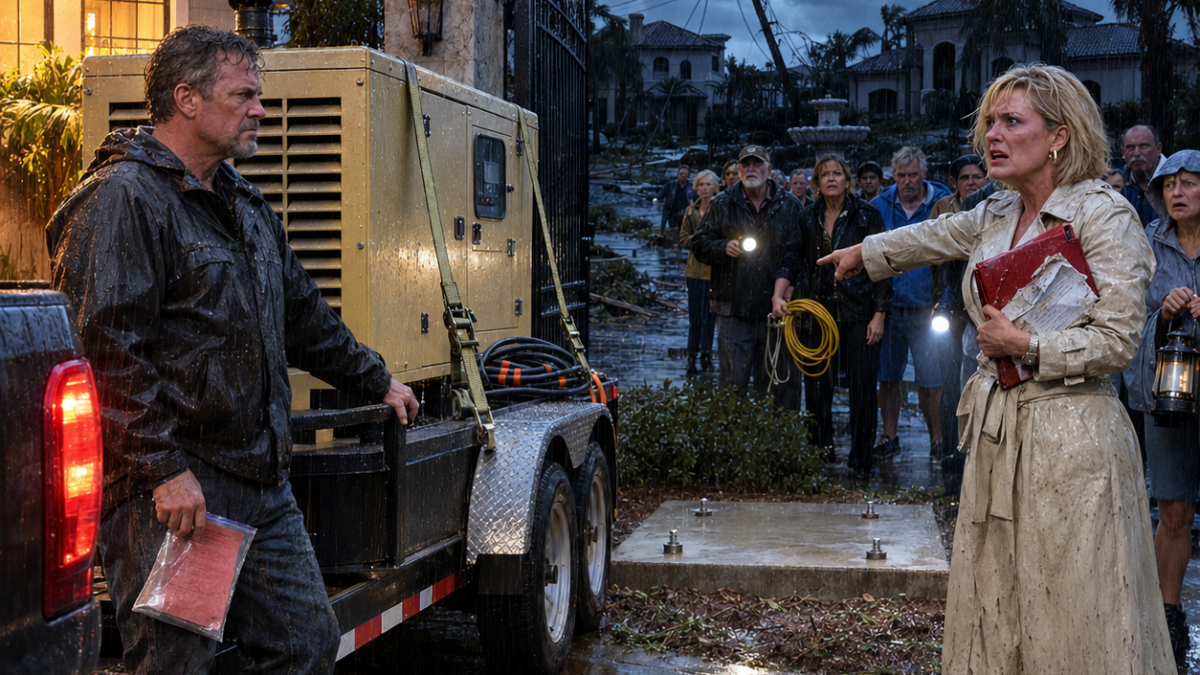
This one specifically named the large yellow towable generator.
Called it industrial equipment inconsistent with residential character.
Also mentioned unsafe fuel storage.
That irritated me.
The diesel tank feeding my stationary unit was double-walled.
Professionally installed.
Permitted.
Inspected.
I photocopied the permit and mailed it.
Fourth letter.
$50 fine.
Noise nuisance.
Fifth:
$100.
Unscreened equipment.
Sixth:
$150.
Exterior property appearance.
The appearance complaint appeared to involve the carport roof above the big generator.
The roof had rust.
So did half the metal within ten miles of the ocean.
Even their stone entrance sign had orange rust stains where decorative bolts met masonry.
Every letter said:
Dear Homeowner.
Every letter was signed:
Karen Whitmore, President.
Every letter used the same official vocabulary.
Standards.
Enjoyment.
Safety.
Values.
Compliance.
It was almost impressive how completely official stationery could conceal the simple fact that she had no jurisdiction over me.
I responded to the first few.
Then stopped.
Made a folder.
By the end of summer, my fake fine balance was around $1,800.
I owed them exactly zero dollars.
At some point, curiosity made me call the property management office.
A man named Marvin Ellis answered.
“Red Harbor Property Management.”
“Marvin?”
“Yes, sir.”
“This is Murray Collins.”
Silence.
Small.
But noticeable.
“I’m guessing you know who I am.”
“I’m aware.”
“I’m the man your HOA keeps fining who doesn’t live in your HOA.”
Longer silence.
Marvin sounded like a decent man who had already rehearsed this conversation internally.
“I understand the concern.”
“Concern?”
“I’ve raised the boundary issue with the board.”
“So you know my property isn’t included.”
“I’m aware of the situation.”
That is a phrase spoken by a man who enjoys receiving a paycheck.
“Then why are letters still coming?”
“Enforcement direction comes from the board.”
“Karen.”
“I didn’t say that.”
“You didn’t need to.”
He sighed.
“Mr. Collins, I’m not trying to make your day harder.”
“I believe you.”
“I’ll raise it again.”
“Please do.”
“Anything else?”
“Tell Karen my generator doesn’t vote in HOA elections.”
Marvin laughed before catching himself.
“I probably won’t include that in the minutes.”
Good man.
The letters continued.
Then Karen upgraded from imaginary authority to county government.
A county pickup came down my driveway one Tuesday morning.
Inspector stepped out.
Mid-forties.
Clipboard.
Neutral expression.
The look of a man who had seen at least seven neighbor disputes before lunch.
“Mr. Collins?”
“That’s me.”
“We received a complaint.”
“Let me guess.”
He did not smile.
“Hazardous fuel storage, unpermitted electrical generation equipment, commercial machinery use, and noise.”
I felt a little nervous.
Not because I thought I had done anything deliberately wrong.
But some of Dad’s equipment was old.
Codes change.
Rules change.
The difference between Grandfathered and legal and Congratulations, remove this immediately can be one paragraph you never knew existed.
I walked him to the stationary generator.
He inspected the pad.
Clearances.
Exhaust.
Transfer equipment.
Then fuel tank.
Labels.
Double wall.
Containment.
I went inside the shop and brought out the original permit file.
Dad kept paperwork.
That saved me more than once.
Inspector read.
Checked numbers.
Then walked to the yellow generator.
“Use this commercially?”
“Not anymore.”
“When was the last job?”
“Before my father died.”
“You run it?”
“Maintenance.”
“How often?”
“Every month or two.”
He checked the trailer.
Tires.
Connection panel.
Data plate.
“Noise complaint?”
“Stationary unit gets a half-hour test once a month.”
“What time?”
“Used to be Saturday nine.”
“Now?”
“Weekday eleven because the neighbors complained.”
He wrote something.
Then looked at me.
“I don’t see a violation.”
I waited.
“That’s it?”
“Permitted equipment is permitted.”
He pointed to the tank.
“That installation is fine.”
Towable unit.
“Stored equipment on private property.”
Then:
“Half-hour daytime generator exercise is not something we’d normally act on.”
“So you’re closing the complaint?”
“Yes.”
He shook my hand.
No joke.
No criticism of Karen.
No wink.
Just:
“Have a good day.”
He drove away.
Most people would hear that an actual county inspector found nothing wrong and decide the issue was finished.
Karen heard:
Challenge accepted.
The next HOA letter complained of diesel odor.
Then:
Potential fire risk.
Then:
Potential impact on insurance.
Then the one that mattered.
FINAL NOTICE.
Thirty days.
Remove the yellow towable generator.
Or relocate it so it was invisible from all portions of the community.
Failure to comply would result in additional enforcement action.
Signed Karen.
Vice President Chester Hall copied.
I read it twice.
Then sat in the workshop.
Dad’s old voltmeter hung over the workbench.
The yellow generator sat outside.
I could have kept fighting.
I knew she had no authority.
The county knew she had no authority.
But I was tired.
That is the part people leave out when they tell stories about standing up for yourself.
Sometimes surrender happens not because somebody has power.
Because they have more energy for conflict than you do.
I had not needed the big generator in years.
The thirty-kilowatt unit handled my house.
The fifty-five sat there because it worked and because Dad had owned it.
A friend named Floyd Bennett ran an equipment yard twenty-five miles inland.
Fenced lot.
Gravel.
Excavators.
Skid steers.
Chippers.
Compressors.
The kind of place where my old generator could disappear into the scenery.
I called.
“Floyd.”
“Murray.”
“You got space?”
“For what?”
“Dad’s old yellow generator.”
“That dinosaur?”
“Yes.”
“Runs?”
“Every time.”
“Then why are you getting rid of it?”
“I’m not.”
“Storage?”
“Yes.”
“How long?”
“No idea.”
He laughed.
“Bring it.”
Saturday morning, I checked tires.
Lights.
Hitched it.
Towed it inland.
Forty minutes.
Floyd walked around it.
“Still ugly.”
“That seems to be the official finding.”
We parked it between a wood chipper and a skid steer.
I disconnected.
Stood there a second.
Floyd noticed.
“You okay?”
“Yeah.”
“Sentimental?”
“No.”
“Liar.”
I went home.
Carport looked empty.
Oil stain.
Leaves.
A rectangular patch of concrete that had not seen sun in years.
I did not tell Karen.
Did not send a letter.
Did not ask permission.
Within a week, neighbor Wilbur Tate shouted over the fence.
“Murray!”
“What?”
“Karen announced the generator issue has been resolved.”
I stared.
“What?”
“Board meeting.”
“She said firm enforcement works.”
Wilbur was in his eighties and had perfected the art of saying outrageous things with a straight face.
“She took credit?”
“Full credit.”
I laughed.
“Good.”
“You’re not mad?”
“I moved it.”
“She wanted it moved.”
“She won.”
Wilbur looked suspicious.
“You okay?”
“Fine.”
The fake fines continued briefly.
Apparently removing the generator did not erase the imaginary balance.
I kept filing letters.
Then hurricane season arrived.
We watch the tropics differently down here.
You learn not to panic when a model shows a storm five days away.
You also learn not to ignore one.
This storm was not historic.
No Category Five monster.
It came up the coast around Category One strength, flirting with Two.
Slow-moving.
Slow storms are miserable.
Wind for hours.
Rain for hours.
Water stacking into marshes.
Trees sitting in saturated ground until roots give up.
I did normal preparations.
Shutters.
Tie-downs.
Filled generator tank.
Chainsaw gas.
Bottled water.
Charged batteries.
Van parked on high side.
The power died around eight that night.
House went dark.
Three seconds later:
My stationary generator fired.
Low diesel rumble.
Transfer switch clicked.
Lights returned.
Refrigerator.
Freezer.
Workshop circuits.
A few air-conditioning zones.
Internet eventually.
I ate hot food while wind pushed rain against the shutters.
By daylight, the road looked terrible.
Trees down.
Utility pole snapped near the bend where Karen nearly hit me.
Power lines across pavement.
Standing water.
Utility company estimated days in some areas.
We were one.
That second night, my house was one of the few lit buildings visible.
Across the fence, most of the gated community was black.
A few portable generators.
Clubhouse had some power.
Gate lights.
Security.
Around 9:30, somebody knocked.
I opened the door.
Karen.
Rain jacket.
Flashlight.
Arms crossed.
Hair damp.
Expression unchanged.
“Your generator is extremely loud.”
I genuinely had to process the sentence.
“Karen?”
“People are trying to sleep.”
Wind gusted hard enough to bend palmetto fronds behind her.
“The power is out.”
“I am aware.”
“My generator is producing electricity.”
“I know what a generator does.”
“Good.”
“We have quiet hours beginning at nine.”
I stared.
“Karen.”
“What?”
“I am still not in your HOA.”
“The fact that your property sits outside the legal boundary doesn’t mean your activities cannot affect our residents.”
“That’s not what your letters say.”
“This noise is unreasonable.”
“It’s a hurricane blackout.”
“Exactly.”
She somehow made exactly sound like I had proved her point.
“People are stressed.”
“Some are elderly.”
“They need rest.”
“So do I.”
“Then shut it off.”
“No.”
Her jaw tightened.
“Excuse me?”
“No.”
“It’s keeping my refrigerator cold.”
“Food can be replaced.”
“My freezer?”
“Murray.”
“My well controls?”
She stopped.
“Some of my shop equipment?”
“You’re being difficult.”
“You drove through a hurricane blackout to tell a man outside your HOA to turn off his legal backup generator because it violates HOA quiet hours.”
Her eyes hardened.
“The rules do not stop applying simply because the power is out.”
“Your rules have never applied to me.”
She stared.
I stared.
Finally:
“I’ll be documenting this.”
“Of course you will.”
She turned.
Walked toward the gate.
Flashlight bouncing.
I closed the door.
Next morning:
Email.
No idea how they got my email address.
CONTINUED GENERATOR OPERATION DURING QUIET HOURS.
Residents had expressed concern.
Please limit mechanical equipment to reasonable hours.
I read it while looking through my window at three downed trees.
Deleted nothing.
Printed it.
Added it to the folder.
Then went outside with a chainsaw.
What I did not know was that the neighborhood next door had a much larger problem than noise.
Their clubhouse had a small standby generator.
That unit worked.
It powered emergency lights.
Management office.
Gate.
Security.
Basics.
It did not run the sewage lift station.
If you live on high ground, you might never think about lift stations.
Our area is low.
Flat.
Near marsh.
Wastewater does not always have enough gravity to travel where it needs to go.
So neighborhoods use buried pumping stations.
Wastewater flows into a wet well.
Electric pumps lift it onward into the municipal sewer.
Power fails?
Pumps stop.
Wastewater does not.
It keeps arriving.
Everybody flushes.
Showers.
Dishwashers.
Sinks.
Tanks rise.
Maintenance man Earl Jenkins had been watching the alarm from the first night.
Earl was one of those men who seemed permanently attached to a ring of keys.
Mid-sixties.
Former industrial mechanic.
He told Marvin.
Marvin called the utility.
Utility was overwhelmed.
Then the lift-station service contractor.
Their emergency plan called for a portable generator if an outage lasted.
The station had a proper connection point.
Good planning.
One problem.
Every generator big enough to run it was already committed.
Hospitals.
Nursing homes.
Municipal pumps.
Water systems.
Emergency shelters.
Rental companies had waiting lists.
Marvin called everywhere.
Nothing.
Tried pump trucks.
Nothing.
Every community along the coast was asking for the same equipment at the same time.
By the end of day two, wastewater began appearing in the lowest houses.
Not Hollywood sewage geysers.
Worse in a quieter way.
Floor drain.
Shower.
Toilet base.
Laundry drain.
Slow dark water returning where water should leave.
Four homes were hit.
One belonged to Karen.
Her house sat low near the back side.
Downstairs laundry room.
Bathroom.
Part of a lower family room.
Wet carpet.
Drywall.
Cabinet bases.
That smell.
Once sewage enters a house, everybody stops caring about decorative standards.
Remediation crews.
Protective suits.
Dehumidifiers.
Disinfection.
Insurance adjusters.
Walls opened.
Flooring removed.
When I learned Karen’s house was one of the four, I want to be honest.
I did not feel sorry for her immediately.
Not proud.
True.
I did feel sorry for the other three homeowners.
They had done nothing to me.
But Karen?
The woman who had stood on my porch during a blackout complaining that my generator violated quiet hours while sewage was apparently rising beneath her own floor?
I took a minute.
Meanwhile, Marvin, Chester, and Earl were standing beside the lift station trying to solve the problem.
Earl looked at the electrical service.
Then said:
“What we need is something around fifty or sixty kilowatts on a trailer.”
Marvin reportedly stared at him.
“That’s exactly what I’ve been trying to rent for two days.”
Earl said:
“Doesn’t Murray have one?”
Silence.
Chester looked toward my property.
“The big yellow one?”
“Yeah.”
Another silence.
“The one Karen made him move?”
Nobody answered.
Months earlier, my generator had been an eyesore.
A threat.
Commercial equipment.
Noise nuisance.
Property-value problem.
Now it was approximately the most beautiful machine within fifty miles.
About an hour later, three men appeared at my door.
Chester.
Marvin.
Earl.
Karen was not with them.
Chester did the talking.
He was in his sixties.
Retired insurance executive.
Spoke carefully.
“Murray.”
“Chester.”
“We have a serious problem.”
“I heard about the lift station.”
His face changed.
“You know?”
“Wilbur.”
“Of course.”
Wilbur knew everything.
Chester explained anyway.
Outage.
Pumps.
Rental shortages.
Houses.
Sewage.
I listened.
Then said:
“That’s bad.”
He waited.
“That needs fixing.”
Some tension left his shoulders.
Then I said:
“One complication.”
He knew.
“The yellow generator.”
“Twenty-five miles inland.”
Chester closed his eyes briefly.
“Because of the notice.”
I walked to the shop.
Came back with my folder.
Pulled the FINAL NOTICE.
Handed it to Marvin.
He read.
Then again.
Looked at Chester.
Then me.
“She actually sent this?”
“Several versions.”
Earl laughed.
Immediately covered his mouth.
“Sorry.”
“Don’t be.”
Chester said:
“Would you be willing to get it?”
“Yes.”
All three looked surprised.
“I’m not letting four houses fill with sewage because I’m mad at Karen.”
Chester nodded.
“Thank you.”
“But I need something first.”
His face tightened slightly.
Probably expected money.
I named no rental rate.
“I want a written agreement.”
“What kind?”
“HOA acknowledges my property is outside the association.”
Marvin nodded immediately.
“HOA acknowledges your rules do not apply.”
Chester:
“Fine.”
“All prior fines and notices void.”
“Fine.”
“Fuel reimbursed.”
“Of course.”
“Reasonable towing costs.”
“Yes.”
“Your licensed electrician makes every connection.”
Earl nodded.
“I’m not touching your sewage equipment.”
“Understood.”
“And the association accepts responsibility for the lift station, pumps, cables, connection, and operation while my generator is attached.”
Chester considered.
“Reasonable.”
“I’m not charging rent.”
Marvin looked at me.
“Seriously?”
“Yes.”
“Why?”
“Because people’s houses are being damaged.”
Silence.
Then:
“I just don’t want your board suing me later because your pump burns up.”
Chester actually smiled.
“Fair.”
He stepped outside.
Made calls.
Enough directors were reachable to approve emergency action.
Fifteen minutes later, Marvin sat at my kitchen table typing on his laptop.
My printer produced the agreement.
Two copies.
Chester signed as vice president under emergency board authorization.
Marvin witnessed.
I photographed every page.
Put the original in my folder.
Then got my truck keys.
Drive inland took nearly twice normal time.
Trees partly blocking roads.
Water.
Utility trucks.
Emergency vehicles.
Floyd met me at the yard.
His property still had no grid power either.
He was running his own generator.
When he saw me:
“Well.”
“What?”
“They want it back.”
“Yes.”
“The same people?”
“Yes.”
“The ugly thing?”
“Yes.”
He shook his head.
“I thought they hated this machine.”
“They did.”
“What changed?”
“Sewage.”
Floyd looked at me.
“Nature has timing.”
We hooked up.
Checked lights.
Tires.
Fuel.
Chains.
I drove back.
When I reached the community gate, the barrier was down.
Guard stepped out.
Young guy.
Tired.
Polite.
Flashlight.
“Sorry, sir.”
I leaned toward the window.
“What?”
“No commercial trailers or equipment without approval.”
I looked over my shoulder at fifty-five kilowatts of HOA-approved irony.
“This is approved.”
“I’m sorry.”
He genuinely looked miserable.
“Standing order.”
“From who?”
He hesitated.
“The president, I think.”
Of course.
I called Marvin.
“Gate.”
“What?”
“They won’t let me in.”
“Stay there.”
Five minutes later, Marvin’s car arrived.
Chester passenger seat.
Behind them came Karen on foot.
Rain jacket.
Flashlight.
She looked at the generator.
Her face tightened.
Marvin told the guard:
“Board emergency approval.”
Karen stepped forward.
“You cannot make this kind of decision without following proper procedure.”
Chester stared.
“There are four houses with sewage coming through the drains.”
“I am aware, Chester.”
“One is yours.”
“I am very aware.”
“Then we need this generator.”
“What we need is to stop making exceptions every time somebody declares an emergency.”
Earl had arrived behind them now.
He looked stunned.
Karen continued.
“There are liability issues.”
“Precedent.”
“Safety.”
“We do not even know whether that machine meets current requirements.”
Marvin said quietly:
“It’s the same machine you made him remove.”
Karen did not look at him.
I stayed in the truck.
Window down.
Arm on the door.
Listened.
Then said:
“No problem.”
Everybody looked at me.
“I can take it back.”
I reached down.
Turn signal.
Left blinker.
Click.
Click.
Click.
I did not put the truck in gear.
Did not threaten.
Did not smile.
Just sat there.
Click.
Click.
Click.
The guard looked at Chester.
Marvin looked at Chester.
Earl looked like he was trying not to laugh and cry simultaneously.
Karen opened her mouth.
Chester turned to the guard.
“Open the gate.”
“Chester—”
He did not look at her.
“Open the gate.”
The guard pressed the control.
Barrier rose.
I turned off the blinker.
Drove through.
No applause.
Did not need any.
The lift station was farther inside near a service road.
Earl waited.
Licensed electrician had come from his own powerless neighborhood.
I backed the trailer where he wanted.
Set brake.
Chocked wheels.
Electrician checked data plate.
Connections.
Voltage configuration.
Transfer equipment.
Cables.
I stayed out of the way.
That was the agreement.
He owned that part.
When everything was ready, he gave me the signal.
I climbed beside the generator.
Battery switch.
Preheat.
Start.
Old yellow machine coughed once.
Always did.
Then caught.
Deep diesel clatter.
Loud.
Ugly.
Beautiful.
Electrician watched meters.
Made transfer.
Pumps came online.
Earl stood at the control panel.
We waited.
Five minutes.
Ten.
Fifteen.
Twenty.
Then Earl looked up.
“It’s dropping.”
That was it.
No music.
No speech.
No triumphant slow clap.
He looked at the wet-well level.
“Thank God.”
Marvin walked away to call residents.
The four homes already damaged remained damaged.
Nothing could reverse what had entered those rooms.
But the rise stopped.
The next morning I checked fuel.
Wilbur Tate stood near the roadside holding coffee.
First time I had really met him face-to-face.
He nodded at the generator.
“So that’s the ugly one.”
“That’s her.”
He looked toward Karen’s house.
Restoration van outside.
Two men in protective suits carrying wet carpet.
Wilbur took a drink.
“Seems prettier now.”
I laughed so hard I nearly spilled diesel on my boots.
Power returned about three days later.
Electrician disconnected.
I towed the yellow generator home.
Not to Floyd’s.
Home.
Right back beneath the carport.
Same spot.
Same oil stain.
Same visibility from the development.
Nobody mailed me anything.
Marvin sent reimbursement for diesel and towing.
Few hundred dollars.
Exactly what we agreed.
No drama.
Then the HOA scheduled an emergency meeting.
I did not attend.
Not a member.
But between Chester, Marvin, Earl, Wilbur, and about half the people along my fence line, I eventually heard enough versions to reconstruct most of it.
Apparently the clubhouse was packed.
People had questions.
Big one:
Why did wastewater back into four houses when a compatible generator had been available right next door?
Marvin answered.
Honestly.
Karen had sent repeated enforcement letters to a non-member.
Fines.
County complaint.
Final removal demand.
I had moved the generator.
Then during the blackout Karen came to my door to complain about the stationary generator violating quiet hours.
Next morning:
Email.
Then when the HOA desperately needed the towable unit, I agreed to retrieve it for free.
Then Karen tried to stop it at the gate.
One homeowner whose downstairs had been contaminated stood.
“Wait.”
Apparently everybody went quiet.
“So we had a generator that could run the lift station sitting next door?”
Marvin said:
“Yes.”
“And the president made him remove it?”
Karen objected.
“I did not make him remove anything.”
Chester said:
“You sent a final notice demanding removal.”
“I requested compliance.”
“With rules that did not apply to him.”
Karen’s voice sharpened.
“The equipment created legitimate visual and noise concerns for homeowners.”
Another resident:
“Did the county find a violation?”
Marvin:
“No.”
Karen:
“That inspection did not address our private community standards.”
Someone from the back:
“He isn’t in the private community!”
Apparently that got applause.
Karen raised her voice.
“This is exactly the kind of emotional reaction that makes responsible governance difficult.”
That sentence was a mistake.
A woman named Patricia Lane stood.
Her home was one of the damaged ones.
Not Karen’s.
Another.
She had spent two days removing contaminated flooring.
“Emotional?”
Karen tried to answer.
Patricia continued.
“My husband and I slept in a hotel because sewage came through our shower.”
“I understand—”
“No.”
“You keep saying property values.”
“What exactly do you think raw sewage does to property values?”
People laughed.
Karen did not.
Another resident asked:
“How much HOA money did we spend mailing fines to somebody we can’t fine?”
Silence.
Marvin had records.
Postage.
Management time.
Consultation.
Not enormous.
Enough to be embarrassing.
Another resident asked:
“Did she really go to his house during a hurricane and complain about generator noise?”
Marvin looked at Chester.
Chester answered:
“Yes.”
A man yelled:
“You cannot be serious.”
Then Wilbur stood.
Apparently he had been sitting in the back with his arms crossed.
Karen said:
“Wilbur, if you have something constructive—”
“I do.”
Room quiet.
He spoke loudly enough for everyone.
“My property value went up the day that ugly generator came back.”
People laughed.
Then applauded.
Karen’s face reportedly turned red.
She tried defending herself.
She said nobody could have predicted the lift station emergency.
True, to a point.
She said community standards existed for a reason.
Also true.
She said generator noise and industrial appearance were legitimate quality-of-life concerns.
Perhaps.
Then Chester asked one question.
“If Murray had ignored your final notice, where would the generator have been during the outage?”
Karen did not answer.
Chester answered for her.
“Next door.”
Silence.
“And how long did Murray spend retrieving it?”
“Several hours.”
“And how much additional damage occurred during that time?”
Nobody could calculate exactly.
The point landed.
Karen said:
“You cannot blame me for a hurricane.”
Chester:
“No one is.”
“You’re acting like this is my fault.”
“No.”
“We’re discussing decisions.”
“I acted within my role.”
“No.”
Chester apparently placed my signed emergency agreement on the table.
“This document exists because Murray required us to acknowledge in writing what you refused to acknowledge for months.”
He read:
Murray Collins’s property is not subject to the Red Harbor Estates Homeowners Association.
Karen interrupted.
“We were in an emergency.”
Chester continued:
The HOA has no enforcement authority over the Collins property.
Applause.
All prior HOA violation notices and monetary penalties issued to Mr. Collins are void.
Someone laughed.
Karen stood.
“This meeting is turning into a personal attack.”
Patricia answered:
“No.”
“You made it personal when you fined a man who wasn’t a member because you didn’t like his equipment.”
Karen stared.
Then came the vote.
Remove Karen as president.
She argued the meeting lacked proper notice.
Association counsel had apparently confirmed emergency procedures were sufficient.
She argued accusations were exaggerated.
Board members disagreed.
She argued removing her in the middle of hurricane recovery would create instability.
Chester said:
“The instability already happened.”
Vote passed.
Karen was removed as president.
She remained on the board briefly.
About a month.
Then resigned.
Chester became president.
One of the first formal letters from the new board came to me.
I opened it in the workshop.
Different tone.
No Dear Homeowner nonsense.
Dear Mr. Collins.
The board acknowledged:
My parcel was outside association jurisdiction.
HOA covenants did not apply.
Prior notices withdrawn.
All fines void.
No future enforcement communication would be sent unless involving a legitimate shared legal matter.
I read it twice.
Then placed it on top of the folder.
Perfect ending to that stack.
I could have thrown away Karen’s letters.
Did not.
Paper tells stories.
The next spring, Red Harbor did what it should have done years earlier.
Special assessment.
Permanent standby generator at the lift station.
Properly sized for pumps.
Automatic transfer equipment.
Weather enclosure.
Maintenance contract.
Load testing.
Fuel plan.
The generator was bigger than mine.
Newer.
Quieter.
And hidden behind a very expensive decorative screen so no resident had to suffer the visual trauma of seeing emergency infrastructure.
Wilbur told me Karen probably loved the fence.
I said:
“Assuming the fence color was approved.”
He nearly choked on his coffee.
Life settled.
My yellow generator remained under the carport.
I kept starting it.
Still loud.
Still ugly.
Still reliable.
A year after the hurricane, another tropical storm came through.
Nothing serious.
Power flickered.
The development’s new lift-station generator started automatically.
I heard it from my shop.
Low hum beyond the fence.
I smiled.
That is what competent planning sounds like.
Not silence.
Preparedness.
Karen still lived in Red Harbor.
Still drove the white Lexus.
Slower around the bend.
At least when I saw her.
We did not speak for months.
Then one afternoon I was picking up marine wire at the hardware store.
Turned into an aisle.
Karen.
She stopped.
I stopped.
Cart between us.
“Hello, Murray.”
“Karen.”
Silence.
Then:
“I suppose you’re happy.”
I genuinely had no idea what she meant.
“About?”
“Everything.”
“Everything is a large category.”
“My resignation.”
I leaned against the cart.
“I didn’t vote.”
“You know what I mean.”
“I’m not in your HOA.”
Her mouth tightened.
Old reflex.
Then she seemed to catch herself.
“No.”
“You’re not.”
That may have been the first time I heard her say it voluntarily.
I nodded.
She looked at a shelf of hurricane flashlights.
“I handled it badly.”
That surprised me.
I waited.
“The generator.”
“Yes.”
“I thought you moved it to make a point.”
“I moved it because you told me to.”
“You knew I couldn’t enforce it.”
“Yes.”
“Then why?”
“I was tired.”
She looked confused.
“Of what?”
“You.”
That was perhaps rude.
True.
Karen looked down.
“I thought you were trying to prove I had no authority.”
“You didn’t have authority.”
“That is not what I mean.”
“I know.”
She sighed.
“I had homeowners complaining.”
“I believe you.”
“They thought the equipment looked commercial.”
“It did.”
“They complained about noise.”
“It was noisy.”
She looked at me.
“You agree?”
“Sure.”
“Then why did you fight every letter?”
“Because none of those facts gave you authority over my property.”
She went quiet.
I continued.
“You could have knocked.”
“I did.”
“After the hurricane.”
“No.”
“Before all that.”
She stared.
“You could have come over and said, ‘Murray, people are complaining. Is there anything you can reasonably do?’”
“That’s what the first letter did.”
“No.”
“A letter on HOA enforcement letterhead addressed to ‘Homeowner’ says you already decided the relationship.”
Her face shifted.
That landed.
“I moved the generator test voluntarily.”
“I know.”
“You could have stopped there.”
She looked away.
“I thought if I let it go, other residents would say I wasn’t protecting standards.”
“From the man who isn’t a resident?”
“Yes.”
She laughed bitterly.
“When you say it like that…”
“There isn’t another way to say it.”
Silence.
Then:
“When Chester brought that generator back through the gate…”
“You mean when I brought it.”
“Yes.”
Her eyes tightened.
“I was terrified.”
“Of the generator?”
“Of the situation.”
She looked toward the parking lot.
“My house already had sewage in it.”
I stayed quiet.
“I knew the board had made a decision without me.”
“Emergency decision.”
“I know.”
“I knew people were angry.”
“Understandable.”
“And then there was that machine.”
“The machine you wanted gone.”
“Yes.”
She looked embarrassed.
“I felt like letting it through meant admitting I had been wrong.”
That was the first honest explanation I ever heard from her.
I said:
“So you almost chose sewage.”
She winced.
“When you say it that way…”
“Karen.”
“I know.”
She rubbed one hand over the cart handle.
“I am not asking you to forgive me.”
“Good.”
Her eyes lifted.
I softened slightly.
“But I don’t hate you.”
“I assumed you did.”
“No.”
“You should.”
“I have work.”
She almost smiled.
Then:
“I am sorry.”
I waited.
“For what?”
She looked irritated.
“Really?”
“Yes.”
Specific apologies matter.
She took a breath.
“For trying to enforce HOA rules on land outside the association.”
“Okay.”
“For continuing after the county found no violations.”
“Okay.”
“For the fines.”
“Okay.”
“For the final removal letter.”
“Okay.”
“And for coming to your house during the blackout about the noise.”
That one almost made me laugh.
She noticed.
“It sounds ridiculous now.”
“It sounded ridiculous then.”
She nodded.
“And the gate.”
“The gate was my favorite.”
Karen closed her eyes.
“I know.”
I imitated the blinker softly.
“Click.”
She looked at me.
“Don’t.”
“Click.”
“Murray.”
I smiled.
For the first time, she did too.
Barely.
That did not make us friends.
It made us two people capable of ending a conversation without another war.
A few months later, Chester invited me to the HOA annual emergency-preparedness meeting.
I declined.
He called.
“You should come.”
“I’m not a member.”
“I know.”
“Then?”
“We want you to talk about generators.”
“That sounds dangerous.”
“Residents asked.”
I agreed eventually.
Not because I wanted to be the hero.
Because coastal power planning matters.
Clubhouse was full.
Karen sat in the back.
I noticed.
Said nothing.
I talked about basics.
Never run portable generators indoors.
Never backfeed a panel without proper transfer equipment.
Fuel storage.
Load.
Testing.
Extension-cord ratings.
Carbon monoxide.
Maintenance.
Then lift stations.
Earl handled that section.
He explained wet wells.
Pump loads.
Automatic transfer.
The new standby system.
At one point somebody asked:
“Would Murray’s generator really have prevented all four sewage backups if it had been available immediately?”
Earl answered carefully.
“Probably would have prevented most or all of that particular overflow event if it had been connected before levels became critical.”
Not absolute.
Accurate.
Then:
“But that’s not the lesson.”
Everybody looked at him.
“The lesson is emergency equipment needs to be planned before the emergency.”
I nodded.
Exactly.
Not:
Karen should have loved my generator.
Not:
Every ugly machine is secretly essential.
The HOA’s actual error was relying on a portable rental market during a regional disaster while operating infrastructure that could damage homes without electricity.
My generator exposed that weakness.
Karen’s campaign made it worse.
The new permanent system fixed it.
That was a real ending.
After the meeting, Patricia Lane approached me.
Her home had been one of the damaged ones.
“Murray.”
“Patricia.”
“We never met properly.”
“No.”
She shook my hand.
“Thank you.”
“You don’t owe me that.”
“Yes.”
“No.”
I shook my head.
“I brought a machine.”
“You brought it for free.”
“I asked for fuel.”
“That is not the same thing.”
“I wasn’t going to let your house keep filling.”
She stared.
“You know what I was angry about?”
“What?”
“That Karen made it sound afterward like you helped because we forced you.”
My eyebrows rose.
“She said that?”
“Not exactly.”
“Careful.”
“She said the board negotiated emergency access to your equipment.”
I laughed.
“That sounds like Karen.”
Patricia smiled.
“Chester corrected the minutes.”
Good.
I liked Chester.
Then Patricia said:
“I’m sorry about the letters.”
“You didn’t write them.”
“I lived there.”
“That’s not guilt.”
She nodded.
“Still.”
Then walked away.
Something shifted after the hurricane.
People along my fence started waving more.
Not because I had changed.
Because now they knew the person behind the property Karen had described.
Before that, I had been:
The commercial equipment guy.
The generator noise guy.
The outsider.
Afterward:
Murray.
That bothered me.
Not personally.
Conceptually.
I had deserved the same basic respect before I became useful.
You should not need to save somebody’s plumbing before they decide you are a neighbor.
Wilbur understood that.
One morning he leaned over the fence.
“You’re famous.”
“Terrible.”
“Karen made you famous.”
“Worse.”
“People say you saved the neighborhood.”
“I ran a generator.”
“Same thing to people who don’t understand electricity.”
He drank coffee.
Then:
“Funny thing.”
“What?”
“Karen always said that machine hurt property values.”
“Yes.”
“My daughter saw houses sell this year.”
“So?”
“Values are up.”
“Market.”
“Don’t ruin my joke.”
Sorry.
The stationary generator continued monthly tests.
Weekday.
Eleven.
Courtesy.
Not obligation.
One new homeowner complained to Chester.
He called me.
“Murray.”
“Yes?”
“Any chance you can test at noon instead?”
“Why?”
“New resident has a baby who sleeps late.”
I thought.
“Sure.”
“Thanks.”
That was how normal people handled shared inconvenience.
Ask.
Explain.
Adjust if reasonable.
No fake fines.
No jurisdiction fantasy.
No county complaint.
No war.
Karen had confused I would prefer with I have authority.
That difference caused almost everything.
I thought about the final notice sometimes.
The one telling me to remove the yellow generator.
Karen believed it was a victory when I complied.
Truthfully, she did win that round.
No trick.
No scheme.
I moved it.
People later called what happened malicious compliance.
I am not sure that is accurate.
Malicious compliance implies I knew removing the generator would hurt them.
I did not.
I had no idea the lift station needed a portable unit.
No idea their emergency contractor would be unavailable.
No idea a hurricane would hit months later.
I simply did exactly what she wanted because I was tired.
Reality wrote the revenge.
That is why the story still makes me laugh.
Had I kept the generator just to spite her, it would have been sitting fifteen minutes from the lift station when the power failed.
Maybe Earl would have asked sooner.
Maybe four homes would have stayed dry.
Karen’s campaign against the machine harmed the people she claimed to protect.
Not because I sabotaged anything.
Because she optimized for appearance without understanding resilience.
That is a dangerous habit.
Especially near the coast.
People love hidden infrastructure until it becomes visible.
Generators.
Pumps.
Drainage.
Fuel tanks.
Utility boxes.
Storm shutters.
None are beautiful.
Neither is water inside your drywall.
The new board learned that.
Their permanent lift-station generator was installed behind decorative screening.
I admit:
It looked good.
Professional.
Quiet.
Automatic.
Better solution than my old towable generator.
When Chester showed it to me, he looked proud.
“What do you think?”
“I hate it.”
His face dropped.
Then I laughed.
“Kidding.”
He punched my shoulder.
“Jerk.”
“Nice installation.”
“Automatic test every Wednesday.”
“What time?”
“Eleven.”
I stared.
He grinned.
“Community standard.”
Good one.
Karen eventually became almost invisible to HOA politics.
She attended some meetings.
Did not run again.
Her house was repaired.
Insurance covered much of it, according to Wilbur.
New flooring.
Drywall.
Cabinets.
The downstairs looked better afterward.
That was another bit of irony.
The sewage event modernized the part of Karen’s house she had been planning to renovate.
I did not tell her that was a property-value improvement.
Growth has limits.
Floyd eventually called.
“You selling the yellow dinosaur?”
“No.”
“You never use it.”
“Used it.”
“One emergency in eight years.”
“Enough.”
He laughed.
“Your dad would approve.”
That stopped me.
“You think?”
“He never sold anything useful.”
True.
Dad had a rule.
If a machine owes you nothing and still works, leave it alone.
Terrible philosophy for clutter.
Excellent for emergency equipment.
I began giving the generator more attention.
New tires.
Battery.
Fuel lines.
Repainted sections of the trailer.
Not full restoration.
Still needed to look ugly enough to maintain character.
One afternoon Karen’s Lexus passed while I had the generator running under load.
She slowed.
I expected trouble.
Instead, she rolled the window down.
“Testing?”
“Yes.”
“How long?”
“Twenty minutes.”
She nodded.
Then:
“Sounds healthy.”
I stared.
“You feeling okay?”
She rolled her eyes.
“Goodbye, Murray.”
Progress.
The hurricane became part of local HOA folklore.
New residents heard distorted versions.
In one, Karen personally ordered police to seize my generator.
False.
In another, I refused to help until the HOA paid me ten thousand dollars.
False.
Another claimed sewage filled half the subdivision.
No.
Four homes.
Four too many.
One guy told Wilbur I intentionally moved the generator because I knew their lift station would fail.
That one irritated me.
I corrected it whenever I heard it.
I did not engineer their emergency.
I did not predict it.
I did not withhold help.
That distinction matters.
Justice does not become more satisfying when you add cruelty that never happened.
What made the story powerful was that I did not have to do anything vindictive.
Karen built her own trap.
She declared my equipment ugly.
Used authority she did not have.
Ignored a county finding.
Sent a removal notice.
Celebrated when I complied.
Then a hurricane exposed the actual value of what she had removed.
That was enough.
Nature does not care about HOA aesthetics.
Wastewater certainly does not.
The next year, Red Harbor revised its emergency plan.
Chester sent me a copy even though I had no reason to receive it.
It listed:
Lift station.
Permanent generator.
Weekly automated test.
Quarterly load inspection.
Fuel contract.
Emergency electrician.
Pump-truck backup.
Vendor priority agreement.
Resident notification.
Good plan.
On page twelve:
Adjacent private properties are not subject to HOA emergency authority absent separate written agreement.
I laughed.
Apparently I had become a footnote.
Marvin eventually left property management.
Not because of Karen.
Better job.
Before he left, he came by.
“Thought I should say goodbye.”
“You could have sent an enforcement notice.”
He laughed.
“I deserved that.”
I offered coffee.
We sat in the shop.
He looked at the folder.
Still there.
Karen’s letters.
New board letter on top.
“I hated those.”
“The letters?”
“Every one.”
“Why didn’t you stop them?”
“I tried.”
“That’s what you said.”
“I know.”
He stared into his coffee.
“Can I tell you what really happened?”
“Sure.”
“Karen believed adjacency gave the HOA some kind of nuisance-enforcement leverage.”
“Based on?”
“Nothing solid.”
“She kept saying counsel had told her communities could protect themselves from external nuisances.”
“Did counsel tell her that?”
“Probably in a general sense.”
“Noise ordinances?”
“Civil nuisance.”
“County enforcement.”
“Exactly.”
“Not HOA fines.”
“No.”
“So why send fines?”
Marvin sighed.
“She said putting a dollar amount on notices made people respond.”
I laughed once.
Not amused.
“She knew I wasn’t a member.”
“She knew it was disputed.”
“Marvin.”
“Yes.”
“She knew.”
He nodded.
“Yes.”
That mattered.
Not because I needed fresh anger.
Because people often hide overreach inside uncertainty.
Maybe we have authority.
Maybe this applies.
Maybe legal said.
Then the letter looks certain.
The recipient has to spend energy disproving something the sender never properly proved.
Karen understood confidence.
The county inspector understood jurisdiction.
The difference showed.
Marvin continued.
“When you moved the generator, she told the board enforcement had succeeded.”
“I heard.”
“She used it to justify getting tougher with two residents inside the community.”
“What happened?”
“One had a boat trailer.”
“Against the rules?”
“Technically.”
“Then that is different.”
Marvin looked surprised.
“You’re defending her?”
“No.”
“If a covenant applies, enforce it correctly.”
“That’s not my issue.”
He smiled.
“You’re annoyingly reasonable.”
“Been called worse.”
He finished coffee.
Then:
“I should have pushed harder.”
“Maybe.”
“Sorry.”
“Accepted.”
Not absolution.
Not condemnation.
People inside bad systems often compromise because every day cannot become a resignation speech.
Still, they should remember those compromises have costs.
Marvin did.
That was enough.
Earl and I became friends.
Old mechanics find each other.
He started coming over to talk generators.
One afternoon he looked at Dad’s yellow machine.
“You know why this thing matched the lift station so well?”
“Luck?”
“Mostly.”
He showed me the station load data.
Pump motors.
Starting current.
Running load.
Voltage.
My unit had enough capacity with margin.
Not enormous.
Enough.
“You could have been ten kilowatts smaller and we’d have had trouble.”
“So Dad saved Red Harbor?”
“Don’t start.”
I smiled.
“Frank Collins, posthumous HOA savior.”
“He’d hate that.”
Correct.
Dad disliked HOAs before it became fashionable.
He once received a complaint from a marina board about his service truck blocking a decorative planter while repairing their shore-power pedestal.
His response:
Move the planter or enjoy decorative darkness.
I miss him.
He would have enjoyed Karen.
Not the conflict.
The irony.
Dad understood machines better than people.
Maybe because machines usually tell you what they need.
Voltage drops.
Pressure rises.
Bearings heat.
People send letters about property values.
Years after the hurricane, my property changed.
I stopped doing much marine electrical work.
Hands not as quick.
Knees complain.
Sold some tools.
Kept generators.
Of course.
A developer once asked to buy my land.
Good offer.
I said no.
He asked why.
I looked toward the shop.
Family.
History.
No dramatic reason.
Home.
He accepted it.
Imagine.
No fake fines.
No campaign.
No county complaint.
Just:
“Understood.”
Humans can learn.
Red Harbor matured too.
Not perfect.
HOA still argued about shutters.
Rental rules.
Pool hours.
Landscaping.
Chester served two terms.
Then refused another.
“Too many emails.”
They elected Patricia Lane.
One of the homeowners whose house had been damaged.
First year she held a meeting about reserve funding.
People complained dues were too high.
She said:
“Emergency systems cost money.”
Nobody argued for long.
The sewage smell had created institutional memory.
Sometimes bad events teach communities what spreadsheets cannot.
They built reserves.
Maintained the lift-station generator.
Documented contractor priorities.
Created a written disaster operations plan.
And, according to Wilbur, added a rule requiring the president to verify jurisdiction before sending enforcement to adjacent properties.
I told him:
“That seems basic.”
“Apparently you were the training module.”
Great.
Karen wrote me one letter years later.
Personal.
No HOA letterhead.
I almost did not open it.
Inside:
Murray,
I have been thinking about the hurricane for a long time.
I was wrong to treat your property as though it fell under our control.
I was wrong to continue after the county inspector closed the complaint.
I was wrong to treat appearance as more important than function.
And I was especially wrong at the gate.
I had become so focused on procedure and authority that I could not admit an emergency required me to reverse a position I had defended publicly.
You helped anyway.
I know you did not have to.
Thank you.
—Karen
I read it twice.
Then placed it in the folder.
Under the new board letter.
Not above.
Order matters.
I never replied.
Not because I rejected the apology.
I simply had nothing to add.
Sometimes forgiveness does not require correspondence.
I stopped feeling angry long before.
Life is too short to maintain a private HOA grievance forever.
My first grandchild was born.
Floyd sold his yard.
Wilbur eventually died at eighty-eight.
His daughter told me one of his favorite stories was the ugly generator.
At his memorial, I repeated his line:
Seems prettier now.
People laughed.
Karen was there.
She laughed too.
That felt appropriate.
The white Lexus disappeared eventually.
Karen bought an SUV.
Much slower.
Maybe age.
Maybe wisdom.
I never asked.
One summer afternoon, a new resident walked along the fence and saw my yellow generator.
He waved.
“Is that the famous one?”
I sighed.
“Unfortunately.”
“My neighbor told me it saved the subdivision.”
“It ran a pump.”
“That’s saving.”
“No.”
“Why not?”
“Because the electrician saved you from me connecting it wrong.”
He laughed.
Then:
“Mind if I take a picture?”
“Yes.”
He lowered his phone.
“Sorry.”
I smiled.
“Thank you.”
Boundaries.
Ask.
Respect.
Simple.
He walked on.
The generator kept aging.
At some point, replacement parts became harder to find.
Earl helped locate an injector pump.
Floyd knew a guy with old industrial equipment.
We kept it running.
Not because I expected Red Harbor to need it again.
Their permanent standby system was better.
Because Dad’s machine still worked.
And because now every time it started, I remembered something useful.
Not revenge.
Perspective.
Objects do not determine their importance by appearance.
People do not either.
The generator was ugly when it sat beside my shop.
Useful when it powered a lift station.
Same machine.
Same rust.
Same noise.
Only the situation changed.
Karen’s judgment had been based almost entirely on context she valued.
Luxury homes nearby.
Visual standards.
Quiet.
Property values.
From that perspective, my machine was undesirable.
During a multi-day blackout?
Different value.
Good leadership recognizes context can change before reality forces the lesson through a sewer pipe.
Karen did not.
At least not then.
I think she eventually did.
That is why I do not tell the story as:
Karen got what she deserved.
Four houses getting sewage damage is not justice.
Three innocent families certainly did not deserve it.
Even Karen’s house did not need sewage for her to learn.
I would have preferred no damage.
The satisfying part came after.
She faced the board.
Residents compared her claims to facts.
She lost authority she had abused.
The HOA acknowledged boundaries.
Installed proper infrastructure.
Improved emergency planning.
That is justice.
Useful consequences.
Not suffering for entertainment.
People online love the phrase:
Karma.
Fine.
But karma did not connect that generator.
A licensed electrician did.
Preparation mattered.
Written agreement mattered.
Board emergency approval mattered.
Fuel mattered.
Maintenance mattered.
Floyd keeping my machine stored safely mattered.
Dad maintaining it years earlier mattered.
Real stories are built from boring competent actions.
That is why I insisted on written terms before retrieving it.
Some people later asked:
“Why make them sign paperwork during an emergency?”
Because emergencies are exactly when people make promises they later remember differently.
I was lending a large piece of privately owned equipment to an organization that had spent months falsely fining me.
I would have been irresponsible not to document the arrangement.
The agreement protected everybody.
HOA knew costs.
I knew liability.
Electrician knew responsibility.
No confusion.
Paper is not hostility.
Sometimes paper is how people cooperate after trust has failed.
That lesson stayed with Chester.
He once told me:
“The fifteen minutes we spent writing that agreement probably prevented fifteen months of arguments afterward.”
Correct.
Karen saw paperwork as authority.
Chester learned paperwork could also be clarity.
Subtle difference.
Years later, a tropical storm knocked power out for six hours.
My stationary generator started.
Across the fence, I heard the Red Harbor lift-station generator start.
Both running.
Nobody knocked on my door.
No email.
No quiet-hours complaint.
Around midnight, utility power returned.
Both units cooled down and stopped.
Silence.
I stood outside.
Salt air.
Wet leaves.
Stars behind retreating clouds.
For the first time, I felt the whole story had actually ended.
Not when Karen lost office.
Not when the board withdrew fines.
When two generators could run through a storm and nobody turned preparedness into a personal conflict.
That was peace.
The next morning Patricia emailed.
Not an enforcement notice.
Hope you came through okay. Our lift station backup performed perfectly. Thanks again for helping us understand what we needed years ago.
I replied:
Glad it worked.
That was enough.
The old fake fine folder eventually moved from my workbench to a cabinet.
I stopped adding things.
Then one day my daughter was helping clean the shop.
She pulled it out.
“What’s this?”
“Ancient history.”
She opened.
$50.
$100.
$150.
$1,800 total.
Final notice.
Emergency agreement.
Formal HOA acknowledgment.
Karen’s apology.
My daughter laughed.
“You kept everything.”
“Your grandfather’s son.”
She read the final removal notice.
Then looked outside at the yellow generator.
“They made you move that?”
“Yes.”
“Then needed it?”
“Yes.”
“During a hurricane?”
“Yes.”
“Because sewage was backing up?”
“Yes.”
She stared.
“Dad.”
“What?”
“You cannot make this stuff up.”
“I know.”
“Did you rub it in?”
“No.”
“Why?”
“I was busy.”
“That’s disappointing.”
She smiled.
Then:
“You did the right thing.”
“I retrieved a generator.”
“You could’ve said no.”
“I could have.”
“Why didn’t you?”
I thought about Patricia’s house.
The other families.
Children.
Old people.
Karen.
The gate.
“Because being right is not the same thing as being useful.”
My daughter stopped smiling.
“That sounded like Grandpa.”
Probably.
He left me more than machinery.
The yellow generator will eventually die.
Everything mechanical does.
One day a repair will cost more than the machine is worth.
Or a part will not exist.
I will have to decide.
Maybe I will sell it.
Maybe scrap.
Maybe keep the data plate.
I do not know.
But I know I will not keep it because Karen once wanted it gone.
That would still give her too much control.
I will keep it while it remains useful.
Same reason Dad did.
That feels right.
The story people tell is:
Karen forced Murray to remove ugly generator.
Hurricane came.
Karen’s sewage pump failed.
HOA begged for generator.
Karen tried stopping it again.
Board removed Karen.
Funny.
True.
But incomplete.
The deeper story is simpler.
Karen kept confusing three different things.
Preference.
Authority.
Responsibility.
She preferred not to see my generator.
Fine.
She believed that preference gave her authority over my land.
Wrong.
Then when an emergency made the generator useful, she still tried protecting the appearance of her authority rather than accepting responsibility for changing course.
That was her worst moment.
Not the fine.
Not the county complaint.
The gate.
Four homes had sewage coming through drains.
Her own included.
Board had approved emergency help.
Written agreement existed.
Licensed electrician waited.
And she was still worried that allowing the machine through might violate procedure.
Not because she loved procedure.
Because reversing herself felt like losing.
Leadership fails when preserving face matters more than solving the problem.
Chester understood.
“Open the gate.”
Three words.
Correct decision.
No speech.
No debate.
Open the gate.
That was leadership.
Then later:
Install permanent equipment.
Pay for it.
Create plan.
Do better.
Also leadership.
Karen lost the presidency because residents finally compared her stated purpose with her behavior.
She said:
Protect values.
Result:
Damaged homes.
She said:
Protect standards.
Result:
Unauthorized fines.
She said:
Protect safety.
Result:
Ignoring county findings and nearly delaying emergency equipment.
Good intentions do not survive every contradiction.
Sometimes outcomes expose the underlying priority.
Control.
That was what she valued most.
Until the cost became visible.
I do not think Karen was evil.
That disappoints people.
She was controlling.
Proud.
Confident beyond evidence.
Too invested in never being seen as wrong.
Those traits can create plenty of damage without evil.
They can also be changed.
Maybe she changed.
Her apology suggested some of it.
I hope so.
Because communities are full of people who become dangerous the moment a small title convinces them they cannot be questioned.
HOA president.
Committee chair.
Supervisor.
Board member.
Manager.
The title itself is not the problem.
The sentence:
I’m in charge, therefore I must be right
is.
The county inspector never said:
“I outrank you.”
He inspected.
Compared rules.
Closed complaint.
Chester never said:
“I’m powerful.”
He checked emergency authority.
Got board votes.
Signed agreement.
Opened gate.
The electrician did not perform authority.
He checked voltage.
Connected correctly.
Started pumps.
Competence often looks quieter than control.
That is probably why Karen did not recognize it at first.
Nowadays, when I test the yellow generator, I still choose weekdays.
Usually eleven.
Sometimes noon.
Not because Red Harbor can fine me.
Because neighbors deserve consideration.
That distinction matters.
Courtesy freely given is not obedience forced.
Karen could have had most of what she wanted through courtesy.
Less weekend noise.
Cleaner view perhaps if she had asked whether I could adjust screening.
Better communication.
Instead she chose enforcement.
When people reach first for power, they often lose cooperation they could have had for free.
I would probably have discussed adding side screening around the carport.
Never got asked.
Could have coordinated test times.
I did that voluntarily.
Could have told her the diesel tank was permitted before the county complaint.
I did.
She kept escalating because compromise did not feel like winning.
That turned a neighbor issue into a governance crisis.
One evening, years later, I was repairing a small battery charger in the shop.
Karen walked along the development path beyond the fence.
She stopped.
“Murray?”
“Yeah?”
“Is the big generator running?”
“No.”
“I thought I heard it.”
“Red Harbor’s new one.”
She listened.
“Oh.”
Then:
“It is quieter.”
“Cost more.”
“I know.”
“Looks better.”
“I know.”
She smiled.
“You’re enjoying this.”
“A little.”
She nodded.
Fair.
Then kept walking.
No hostility.
No friendship.
Neighbor.
That was enough.
Wilbur once told me:
“Best revenge is they spend fifty thousand dollars hiding a generator after making you move yours.”
I corrected him.
“More than fifty.”
He laughed.
“You know the number?”
“Chester told me.”
“Of course.”
Then:
“Still revenge.”
“No.”
“Preparedness.”
“Boring.”
“Good.”
Boring emergency infrastructure is a blessing.
Nobody wants the dramatic alternative.
The lift station became something residents actually understood.
New homeowner packets included an emergency-systems page.
Generator.
Pumps.
Flood procedures.
Contact numbers.
Somebody had learned.
A woman moved in three years later and asked why the HOA spent so much maintaining a machine she never noticed.
Patricia told her:
“Because we notice when it stops.”
Perfect answer.
That applies to many things.
Infrastructure.
Relationships.
Rights.
Trust.
You often understand the value of boring things after they fail.
My property boundary was boring until Karen ignored it.
The county permit was boring until she alleged danger.
The generator was ugly until pumps needed power.
The emergency agreement was paperwork until liability mattered.
The HOA bylaws were tedious until board authority had to be used correctly.
Boring things hold life together.
Maybe that is what Dad understood.
He maintained machines nobody noticed.
Boat owner does not praise the battery charger every morning.
They notice when the engine will not start offshore.
Dad believed good work should disappear into reliability.
Karen believed good governance should be visible through enforcement.
Different philosophies.
I prefer Dad’s.
If everything works, maybe nobody should notice you.
Red Harbor became calmer after Karen.
Not lawless.
Rules remained.
People still got letters.
Inside the HOA.
For actual violations.
Chester once told me a homeowner complained the new board had become too soft.
“What’d you tell him?”
“That he was welcome to run.”
“Did he?”
“No.”
Of course.
Governance is easier from the complaint side.
I never joined.
Could not.
Still outside.
Gladly.
Yet I came to respect the board after reform.
That was another unexpected outcome.
The original problem made me assume HOA meant petty power.
The later board showed an association could handle shared infrastructure sensibly.
They admitted error.
Paid expenses.
Withdrew invalid fines.
Invested in resilience.
Not perfect.
Responsible.
Institutions are not automatically their worst leader.
That is why removal mattered.
Karen’s mistakes did not require destroying the entire HOA.
They required changing who had authority and how it was checked.
People sometimes ask if I sued over the false fines.
No.
What damages?
I paid none.
Lost some time.
Moved equipment voluntarily.
Annoying.
Not worth litigation after the board formally withdrew everything.
I wanted peace more than another folder.
Karen had already lost office.
The HOA had acknowledged jurisdiction.
The generator came home.
Lift station had permanent backup.
Enough.
Justice does not require squeezing every available consequence from a situation.
Sometimes stopping is part of winning.
My daughter called that “old man wisdom.”
I called it:
Lawyers cost money.
Both true.
Floyd sold his equipment yard to a larger company.
Before closing, he drove over.
“Remember when this thing lived at my yard?”
He slapped the yellow generator.
“Yes.”
“I should have charged storage.”
“You got free entertainment.”
“True.”
He looked at the carport.
“Karen okay with it?”
“Not relevant.”
“That’s my Murray.”
We sat outside.
Talked about Dad.
Floyd remembered jobs I had forgotten.
One marina after Hurricane Hugo.
Boat lift failures.
Temporary shore power.
Dad running that same generator nearly forty-eight hours.
“Your old man would’ve loved the sewer story.”
“I know.”
“He’d have charged rent.”
“No.”
Floyd laughed.
“Probably.”
Maybe.
Dad liked invoices.
I think he would have helped first.
Billed later.
I like imagining him at the gate.
Karen:
You cannot bring industrial equipment into the community.
Dad:
Then enjoy your community.
He had less patience than me.
Maybe good he was not there.
The funniest thing about the whole conflict is that Karen was right about one narrow issue.
The yellow generator was ugly.
Still is.
I repainted the trailer.
Not the enclosure.
The faded yellow remains.
Rust patches.
Dent near one door.
Old manufacturer decals.
Every new machine looks better.
Mine looks dependable.
Those are not always the same.
When hurricanes approach, I still prepare.
Shutters.
Fuel.
Water.
Chainsaw.
Test both generators.
And now, across the fence, I sometimes hear Red Harbor staff testing theirs.
One storm season, Earl texted me:
BOTH DINOSAURS READY?
I replied:
MINE IS. YOURS IS TOO NEW TO BE A DINOSAUR.
He answered:
GIVE IT TIME. SALT AIR.
True.
Everything rusts.
Including certainty.
That may be why this story worked out as well as it did.
Karen built her authority on certainty.
My property was a nuisance.
Her rules mattered.
The generator had to go.
County inspection did not change her mind.
Hurricane did.
Reality is very good at corroding certainty.
Sometimes slowly.
Sometimes through a downstairs drain.
I wish the lesson had cost less.
I mean that.
Four damaged homes were expensive lessons.
Karen’s pride was not worth Patricia’s flooring.
No one’s was.
That is why emergency planning matters before somebody needs to learn humility.
The new board understood.
Maybe readers should too.
If you live in a low area with a sewage lift station, ask whether it has backup power.
Seriously.
That is a more useful takeaway than:
Laugh at Karen.
Laugh a little.
Then check the pump.
Years after, Patricia’s husband told me they almost sold because of the sewage event.
Did not.
House remediated.
No lasting issue.
They stayed.
Property values did fine.
Ironically, the permanent generator became a selling point.
Real estate listings sometimes mentioned enhanced community emergency infrastructure.
I sent one to Wilbur before he died.
He replied:
THANK YOUR UGLY GENERATOR FOR RAISING PROPERTY VALUES.
Perfect.
Karen’s original argument came full circle.
Not because old yellow machinery became beautiful.
Because reliability has value too.
Aesthetic standards are not meaningless.
People care what neighborhoods look like.
That is legitimate.
But appearance is one variable.
Safety.
Function.
Ownership.
Jurisdiction.
Resilience.
Those matter.
Good decisions balance them.
Karen reduced everything to one:
What should I see from my community?
That tunnel vision made her powerful until the world presented a problem aesthetics could not solve.
Sewage does not care about curb appeal.
The last time I saw Karen up close was at Wilbur’s funeral reception.
She came to me.
“Murray.”
“Karen.”
She held a paper cup of coffee.
“Wilbur really said that?”
“What?”
“Seems prettier now.”
I laughed.
“Yes.”
She closed her eyes.
“I hated that man for three days.”
“He loved you.”
“He absolutely did not.”
“He loved material.”
She smiled.
Then:
“I deserved it.”
“Probably.”
She looked at me.
“You always were irritating.”
“You nearly killed me with a Lexus.”
“I did not nearly kill you.”
“You were on your phone.”
“I stopped.”
“Thirty feet past me.”
She laughed.
“I was awful.”
“On that day?”
“All of it.”
There was no defensiveness.
Time had done work.
I said:
“You got better.”
She looked surprised.
“You think?”
“Yes.”
“How would you know?”
“You just admitted you were awful.”
She laughed again.
Then looked toward Wilbur’s photograph.
“Losing that presidency was probably good for me.”
“Expensive therapy.”
“Not as expensive as my downstairs renovation.”
We both laughed.
That felt like closure more than any formal apology.
Two older people acknowledging absurdity after enough years had passed.
I went home.
Walked through the shop.
Touched the yellow generator enclosure.
“Still ugly.”
No response.
Machines are excellent at boundaries.
Today, if somebody asked whether I regret moving it when Karen told me to, I would say no.
That surprises people.
If I had refused, maybe less damage.
Maybe.
But I did not know the future.
At the time, moving unused equipment twenty-five miles to stop pointless conflict was reasonable.
Regret assumes we should make yesterday’s choices with tomorrow’s knowledge.
That is unfair.
I did what made sense.
Karen did not.
Difference:
I adjusted when facts changed.
She resisted until the gate arm was rising without her permission.
That is the actual leadership lesson.
Being wrong is not fatal.
Refusing to update can be.
Karen could have saved herself politically at several points.
County inspector says no violation?
Stop.
Generator removed?
Stop sending fines.
Hurricane?
Do not complain about quiet hours.
Board finds emergency use?
Say yes.
Generator arrives?
Open gate.
Afterward?
Admit mistake before residents force the conversation.
She missed every exit.
Pride kept driving.
By the time she stopped, presidency was gone.
People think downfall happens in one dramatic vote.
Usually it is a series of exits not taken.
Same with conflict.
Each new letter was another chance.
Each response.
Each fact.
She kept choosing escalation because backing down felt weaker.
Eventually the weakest-looking choice would have been the strongest:
“I was wrong.”
She learned it later.
Better late.
The folder remains in my shop cabinet.
On top:
New board acknowledgment.
Under it:
Emergency agreement.
Under that:
Karen’s apology.
Then final notice.
Fines.
Complaints.
County inspection copy.
Oldest letter.
Chronological backward.
From resolution to beginning.
Sometimes I think of throwing it away.
Then do not.
Not because I want to preserve resentment.
Because documentation matters.
My father kept permits from decades earlier.
Those permits helped when the county inspector arrived.
Paperwork everyone thinks is junk becomes valuable when somebody confidently insists reality is different.
Keep your permits.
Keep your deeds.
Keep your inspection records.
Keep letters.
Not forever, perhaps.
Long enough.
And if an HOA you do not belong to sends you fines?
Definitely keep those.
They are comedy with letterhead.
If there is a moral beyond that, maybe it is this:
You cannot control everything visible from your neighborhood.
You cannot turn preference into jurisdiction.
You cannot declare somebody’s property subject to your authority because it sits close enough to annoy you.
And before you demand that a neighbor remove something ugly, noisy, old, or inconvenient, it might be worth asking what that thing does.
Because sometimes the rusty machine you cannot stand looking at is exactly what everybody will be begging to see when the lights go out.
Karen spent months trying to make my generator disappear.
She fined it.
Complained about it.
Reported it.
Ordered it moved.
Celebrated when it was gone.
Then a hurricane arrived.
The utility grid failed.
The lift station filled.
Wastewater reversed direction.
Emergency rentals disappeared.
And suddenly three HOA representatives were standing on my porch asking whether I could retrieve the same old yellow machine before more homes were damaged.
I could have said no.
I did not.
I could have charged a fortune.
I did not.
I asked for one thing more valuable than revenge.
Clarity.
In writing.
My land is mine.
Your HOA is yours.
Your rules stop at your boundary.
Your mistake does not become my liability.
Your emergency deserves help.
Those ideas can all coexist.
That was what Karen had never understood before the storm.
Boundaries are not hostility.
Helping someone does not mean surrendering them.
Courtesy does not mean submission.
And authority does not become legitimate simply because it arrives on official stationery.
The HOA signed.
I retrieved the generator.
The electrician connected it.
The pumps started.
The water level dropped.
Then the board eventually did what healthy institutions are supposed to do after failure.
It learned.
Permanent backup.
Written procedures.
Clear jurisdiction.
Better leadership.
Karen lost a title.
The community gained resilience.
That was a fair trade.
These days, when I stand outside the shop during a generator test, I can sometimes hear both machines running.
Mine.
And Red Harbor’s permanent unit beyond the fence.
Two diesel engines carrying load.
Different properties.
Different owners.
No argument.
The sound would have driven old Karen crazy.
The current neighborhood barely notices.
Because now everybody knows what those ugly machines are doing.
And if Karen ever forgets?
Well.
I still have the folder.
And the yellow generator still starts every single time.








