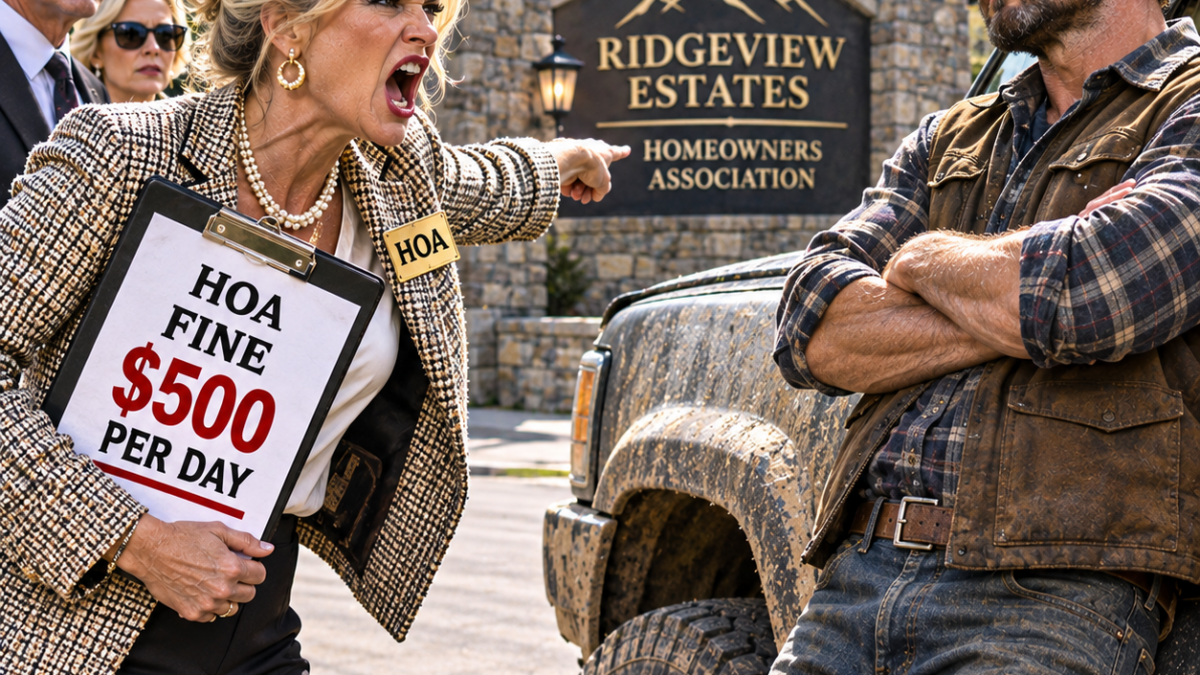
PART2:“GET THAT TRASHY TRUCK OFF MY MOUNTAIN!” HOA Karen Fined Me $500 a Day—She Had No Idea I Owned the Land Beneath All 847 Homes.v
PART2
For almost an hour, I told myself I was misunderstanding the map.
Maybe it was historical.
Maybe Grandpa had sold the land decades ago.
Maybe the subdivision map had simply been layered over old boundaries for reference.
There had to be an explanation more reasonable than:
My broke grandfather died owning the mountain beneath 847 luxury homes.
I pulled another map from the wall.
Then another.
Every one showed the same original tract.
I opened file drawers.
Property taxes.
Lease receipts.
Old correspondence.
Most documents meant nothing to me.
I fix cars.
Give me an engine knock and I can tell you whether you have a worn bearing, detonation, or a loose heat shield before you finish describing the noise.
Give me seventy years of real-estate instruments and I am a man staring at hieroglyphics.
Still, some words require no law degree.
LEASE PAYMENT.
GROUND RENT.
ASSIGNMENT.
DEVELOPMENT RIGHTS.
A ledger contained monthly numbers from different entities.
Then suddenly, around 2005, payments stopped.
Not the records.
The payments.
Grandpa kept writing dates.
Letters mailed.
Calls made.
Notices returned.
Names.
Amounts.
On one page:
Dennis Walsh says assessment proves I no longer control lease. Asked for written basis. None provided.
My stomach tightened.
Dennis.
Brenda’s husband.
I looked toward the window.
The Range Rover was gone.
The mountain remained.
I barely slept.
At six the next morning, red and blue light flashed through the bedroom.
I reached for my jeans and stepped outside.
Two sheriff’s deputies stood on the porch.
Behind them, parked thirty yards down the drive, was Brenda’s Range Rover.
Of course.
The older deputy wore a name tag:
MARTINEZ.
He looked tired.
“Mr. Brennan?”
“Yes.”
“We received a complaint.”
I looked past him toward Brenda.
“She’s quick.”
Martinez followed my gaze.
“Mrs. Walsh states you threatened her yesterday.”
I laughed.
Not because it was funny.
Because sometimes absurdity escapes through the mouth before anger does.
“What threat?”
“She said you became hostile after she issued a violation.”
“I said, ‘Interesting.’”
The younger deputy’s mouth twitched.
Martinez remained professional.
“She’s also questioning your right to occupy this property.”
“I inherited it four days ago.”
“Do you have documentation?”
“Yes.”
“Can we see it?”
I appreciated that.
He did not say:
Leave.
He asked for evidence.
I brought Grandpa’s death certificate.
Probate letter.
Deed for the cabin parcel.
Martinez read.
“This establishes your interest here.”
“Only the cabin?”
His eyes lifted.
“Sir?”
“My grandfather’s maps show 1,300 acres.”
He looked toward the subdivision.
“That is not something I can adjudicate on your porch.”
Fair.
Then he said:
“Mrs. Walsh mentioned delinquent taxes and an old transfer.”
“Did she show you either?”
“No.”
“My husband works for the assessor,” Brenda called from the Range Rover.
I turned.
She had lowered the window.
Martinez looked annoyed.
“Ma’am, please let us handle this.”
She raised both hands theatrically.
“Of course, Deputy.”
Then gave me a smile.
The deputies left fifteen minutes later.
No arrest.
No removal.
No restraining order.
Brenda waited.
As soon as their cruisers disappeared, she drove slowly past the cabin.
Window down.
“Two days left on the truck.”
I said nothing.
She laughed.
That laugh followed me into town.
Pine Ridge Public Library sat near the courthouse.
Red brick.
White columns.
A hand-painted sign advertising a used-book sale.
Inside, the air smelled like dust and old paper.
A silver-haired librarian looked at me over thick glasses.
“You’re Ezra Brennan’s grandson.”
I stopped.
“How?”
“You have his eyes.”
She stood.
“Opal Cartwright.”
The name hit something in my memory.
“Grandpa mentioned you.”
“He owed me forty-seven cents in late fees.”
I smiled for the first time since the funeral.
“I’ll settle the estate.”
“Interest puts you around sixty.”
Then her expression changed.
“I’m sorry.”
“Thank you.”
She looked toward the front window.
“You met Brenda.”
“Does everybody know everything here?”
“Only the important things.”
I handed her the violation notice.
Opal snorted.
“Ezra had a drawer full.”
“Was he actually under their HOA?”
She looked at me sharply.
“That is the question, isn’t it?”
We went downstairs to local records.
Property assessments.
Plats.
Archived county reports.
Grandpa’s land had been valued at roughly $2.8 million in 2004.
In 2005:
$180,000.
I thought I read wrong.
“Can assessments drop that much?”
“Not normally.”
“Maybe a conservation designation?”
“We’ll check.”
The signature approving the valuation belonged to an office supervisor.
Dennis Walsh.
Every year after that showed remarkably low numbers compared with developed property nearby.
Opal whispered:
“Ezra used to complain.”
“What did people say?”
“That he was confused.”
The word burned.
“Was he?”
“He was old.”
“That is not what I asked.”
Opal looked ashamed.
“No.”
“Not about numbers.”
“He remembered every parcel better than people half his age.”
“Then why didn’t anyone believe him?”
She sat.
“Because Brenda told everyone he was obsessed.”
“Dennis said the records proved him wrong.”
“And when official paper says one thing and an eighty-year-old man says another…”
She did not finish.
She didn’t have to.
Official paper wins.
Unless the official paper is false.
We searched payments next.
Pinnacle Ridge Property Management Company had collected fees that included ground-lease components.
But Grandpa’s estate records showed no corresponding legitimate payment stream after 2005.
Not one.
I felt cold.
“How much?”
Opal shook her head.
“You need an accountant.”
Even rough math was ugly.
If the property management entity had collected thousands across hundreds of homes for years, the total could reach millions.
I walked outside.
Made it to the side alley.
Vomited.
Not because I suddenly imagined myself rich.
Because I remembered Grandpa’s coat.
Brown canvas.
Worn elbows.
He had patched the lining with duct tape.
I offered him a new one two Christmases earlier.
He laughed.
“Still got another decade in this one.”
He died wearing it.
If people had been collecting money from land he still legally owned while convincing him he was too confused to understand his own contracts—
I could not think about the money.
I thought about dignity.
That afternoon I called Janet Torres.
Denver property attorney.
Forty-nine.
Sharp voice.
No patience for dramatic storytelling.
She interrupted me three times.
“Do you have the original deed?”
“Some documents.”
“That’s not an answer.”
“I have what looks like the original 1952 deed.”
“Recorded?”
“I don’t know.”
“Lease?”
“Some.”
“Chain of assignments?”
“No idea.”
“Then we do not say you own 847 houses.”
“I didn’t.”
“Good.”
She continued.
“We need a full title search.”
“Forensic accounting.”
“Recorded lease review.”
“Subdivision documentation.”
“Lender interests.”
“HOA declaration.”
“County records.”
Then:
“Do not threaten anyone.”
“I haven’t.”
“Do not close roads.”
“I wasn’t planning to.”
“Do not tell residents you own their homes.”
“Brenda already seems to enjoy making me look crazy.”
“Then don’t help her.”
I liked Janet immediately.
Three days later, she drove to the cabin.
By then I had found more ledgers.
More letters.
More notes.
She spent six hours reading.
Finally she sat back.
“Cole.”
“Yes?”
“There is enough here to investigate seriously.”
My heart raced.
“What does that mean?”
“It means your grandfather may have retained underlying land ownership or other enforceable interests longer than your family understood.”
“And the subdivision?”
“Likely developed through leasehold arrangements and assignments.”
“Meaning?”
“Meaning complicated.”
I groaned.
She smiled faintly.
“Complicated is good.”
“Why?”
“Because it means Brenda’s claim that everything is obvious is probably nonsense.”
She tapped one document.
“If obligations were not properly assigned or paid, there may be defaults.”
“Can we recover money?”
“Potentially.”
“Can we clear title?”
“Potentially.”
“Can I evict Brenda?”
Janet looked at me.
“You are enjoying that question too much.”
“Yes.”
“We are nowhere near it.”
Fair.
While Janet built the legal case, Brenda built a social one.
A Facebook group appeared:
PROTECT PINNACLE RIDGE FROM UNDESIRABLE ELEMENTS.
My photograph was the banner.
Taken from someone’s doorbell camera.
Me carrying a trash bag.
Caption:
UNKNOWN MALE CONDUCTING SUSPICIOUS ACTIVITY NEAR COMMUNITY BOUNDARY.
I stared.
I was taking Grandpa’s garbage to the dumpster.
Another post showed me opening the mailbox.
SUBJECT CONTINUES MONITORING COMMUNITY ACCESS.
One comment:
Is he homeless?
Another:
I heard he has a criminal record.
I did not.
Another:
Brenda says he’s trying to seize houses.
I had not even filed yet.
Margaret Flynn contacted me through Opal.
Seventy-one.
Retired teacher.
Widow.
She invited me to breakfast at the Pine Ridge Café.
“Brenda called an emergency HOA meeting.”
“How many people?”
“Twelve.”
“Out of 847?”
“Yes.”
“What happened?”
“She declared your cabin a nuisance.”
I laughed.
“Then she approved a new security fee.”
“How much?”
“Two hundred a month.”
I stopped.
“Per household?”
Margaret nodded.
I did the math aloud.
“$169,400 every month.”
“She says it pays private patrol.”
“What company?”
“No one asked.”
“Did you vote?”
“No.”
“Why?”
“She called for hands.”
“Six went up.”
“And that passed?”
“According to Brenda.”
Margaret stirred coffee.
“She has run things like this for years.”
“Why do people let her?”
“Because every time someone challenges her, something happens.”
“What?”
“Fines.”
“Inspections.”
“Problems.”
That afternoon, I installed trail cameras near the eastern meadow.
Not because I had become paranoid.
Because Janet said:
Document.
Do not confront.
Around four, diesel echoed through the trees.
A dump truck reversed toward the meadow.
I stayed behind aspens.
Driver:
Dennis Walsh.
Brenda’s husband.
The bed rose.
Broken concrete spilled out.
Then roofing material.
Rusty rebar.
Construction debris.
Across land Grandpa’s records showed as still part of his tract.
My jaw tightened.
Dennis never saw me.
The camera saw him.
I took photographs after he left.
Called Janet.
“Do not move anything.”
“Already learned that lesson.”
“Report it.”
“To Dennis’s county?”
Pause.
“State environmental office too.”
That told me everything about her confidence in local institutions.
The next afternoon, Buck Martinez arrived.
Hardware-store owner.
No relation to Deputy Martinez.
He carried his hat instead of wearing it.
“Your granddad was a good man.”
“Everybody keeps saying that after he’s dead.”
Buck looked away.
I regretted the sharpness immediately.
“Sorry.”
“No.”
He nodded.
“You’re right.”
Then:
“You need to know about Brenda.”
He told me business owners received “voluntary community partnership requests.”
Five hundred.
One thousand.
More.
Buck refused.
Within days, a county inspector found expensive electrical problems.
A restaurant refused.
Health-code scrutiny.
Landscaper refused.
Lost every Pinnacle Ridge contract.
“Can you prove Brenda ordered inspectors?”
“No.”
“Can you prove timing?”
“Yes.”
“Do that.”
Buck studied me.
“You sound like Ezra.”
“People keep saying that.”
“He kept paper.”
“So do I now.”
That night I searched the cabin again.
Grandpa’s bedroom closet had cedar paneling.
One panel sat slightly proud of the others.
I remembered something he told me at eleven.
“The safest place is where the carpenter expects you not to look.”
I pulled.
The panel moved.
Steel safe.
I tried birth dates.
Nothing.
Grandma’s death date.
Nothing.
Nothing.
Then I opened Grandpa’s old journal.
June 14, 1952.
Closing date.
The lock clicked.
Inside were documents wrapped in oiled leather.
The smell hit me first.
Old paper.
Machine oil.
Dust.
History.
I called Janet at 6:12 the next morning.
She answered:
“Someone better be dying.”
“I found a safe.”
Pause.
“I’m awake.”
Three hours later she wore cotton gloves at Grandpa’s table.
Original survey.
Original deed.
Development lease.
Assignments.
Correspondence.
And one document that made her stop breathing.
A long-term ground lease governing substantial portions of the property.
She read.
Then read again.
“Cole.”
“Yes?”
“This lease contains a reversion provision.”
“What is that?”
She did not answer immediately.
Instead she kept reading.
Then:
“If specified lease obligations remain uncured after notice for more than the stated period, certain leasehold interests and improvements may revert to the landowner.”
I stared.
“In English.”
“In English, if this clause remained valid, if the proper parties defaulted, if required notice occurred, if assignments did not alter it, and if no other legal protections override it…”
She pointed toward the ridge.
“You may have an extremely powerful claim.”
“To the land?”
“At minimum, potentially.”
“The houses?”
“Do not say that.”
“Why?”
“Because 847 homeowners, lenders, title companies, statutes, equitable doctrines, and seventy years of transactions are about to enter the room.”
I nodded.
“Understood.”
Then I found Grandpa’s journal.
Pages filled with names.
Amounts.
Dates.
Brenda.
Dennis.
Board members.
Property company employees.
Sheriff calls.
Violation notices.
Returned checks.
One entry made my hands shake.
September 17. Brenda told Margaret I’m senile. Dennis says county records prove lease ended. Asked for original transfer. None shown.
Another:
October 2. They fined truck again. Told me I’m not allowed on road I surveyed.
Another:
November 11. Payment still missing. Sent certified demand. Returned unopened.
Then the final entry.
Two months before his death.
The handwriting was weak.
But readable.
They think they’ve broken me. They think if enough people call an old man crazy, paper becomes less true. I know what I signed. I know what they stopped paying. I know what Dennis changed. I kept everything. Someday someone will make this right.
I sat down.
Janet walked toward the window.
She pretended to read another document.
Giving me privacy.
I cried.
Quietly at first.
Then hard.
Not because I had found treasure.
Because Grandpa had died waiting.
He died knowing the truth and believing nobody would care enough to read it.
My father had dismissed him.
I had.
Everyone.
He was not crazy.
He was alone.
That was worse.
I wiped my face.
“What do we do?”
Janet turned.
“We do this correctly.”
“No Facebook war.”
“No threats.”
“No blocking roads.”
“No revenge eviction fantasy.”
“What do we do?”
“Court.”
We filed.
Quiet-title claims.
Declaratory relief.
Accounting.
Preservation requests.
Injunction-related motions where appropriate.
Challenges concerning lease obligations.
We did not name every resident as a thief.
Most were likely good-faith buyers.
They had mortgages.
Title policies.
Families.
Nobody had told them Grandpa existed.
Janet said:
“If you turn innocent homeowners into enemies, Brenda wins.”
“I know.”
“Do you?”
“Yes.”
I looked at the school bus moving between houses.
“Those kids did not steal from Grandpa.”
“Good.”
The lawsuit became public by lunchtime.
By evening, Denver television stations had reporters on the mountain.
Brenda went live on Facebook.
Red blazer.
American flag behind her.
HOA seal.
“My friends and neighbors, our peaceful community is under attack by an opportunistic outsider attempting to exploit the death of an elderly relative.”
Outsider.
My grandfather’s name was on the land records.
But I was the outsider.
She continued.
“This individual has threatened to seize homes.”
False.
“Close roads.”
False.
“Triple rents.”
False.
“Disrupt essential services.”
False.
I watched from Grandpa’s kitchen.
Then saved the video.
Documentation.
Brenda called Sheriff Martinez.
He visited again.
This time alone.
He removed his hat.
“Cole.”
“Yes?”
“You threatened to close the mountain road?”
“No.”
“Raise ground rent to triple market?”
“No.”
“Evict families?”
“No.”
He sighed.
“That’s what I thought.”
“Why?”
“Because Brenda’s complaint says you told her yesterday.”
“I haven’t spoken to her in six days.”
Martinez looked toward my new porch camera.
“You have footage?”
“Yes.”
“Good.”
He paused.
“Off the record?”
“I know what that means.”
“I’m getting tired of being used as a prop.”
I looked at him.
“Then stop.”
His jaw tightened.
Not at me.
At himself.
“Fair.”
Two days later Brenda arrived with an attorney.
Whitmore.
Expensive.
Professional.
Unlike Brenda, he looked nervous before he opened his mouth.
“Mr. Brennan, we have a document that should resolve your misunderstanding.”
Brenda handed me yellowed paper.
1955 LAND DEVELOPMENT AGREEMENT.
It stated Ezra transferred development rights permanently.
I read.
Signature.
Seal.
Notary.
Official-looking.
Then one line stopped me.
Mailing address:
Pine Ridge, CO 80—
ZIP code.
I looked up.
“When were ZIP codes introduced?”
Whitmore blinked.
“What?”
“This agreement is dated 1955.”
“Yes.”
“It contains a five-digit ZIP code.”
Brenda’s face changed.
Whitmore cleared his throat.
“Historical records can be recopied.”
“It says original.”
Silence.
I looked at Ezra’s signature.
I had stared at hundreds of examples by then.
His 1950s signature was angular.
This one was rounded.
Like his later handwriting.
“Who authenticated this?”
Whitmore said:
“We have experts.”
“Names?”
“Through counsel.”
“Good.”
I held the document.
Brenda reached.
“I’ll take that.”
“No.”
Her eyes widened.
“You cannot keep our property.”
“You delivered it as evidence relevant to active litigation.”
Whitmore intervened.
“We will coordinate custody through attorneys.”
Smart.
Brenda glared.
“You have no idea who you’re dealing with.”
I looked at the paper.
“Starting to.”
Janet received it that afternoon.
She called a forensic document examiner.
Modern ink components.
Paper inconsistent with claimed origin.
Addressing anachronisms.
Potentially copied signature.
Not proof of who made it.
But enough to trigger serious questions.
Then federal investigators arrived.
Special Agent Sarah Kim.
White-collar unit.
Calm.
Precise.
No dramatic promises.
She showed me corporate records tying businesses associated with Brenda to disputes in other Colorado counties.
Not identical convictions.
Not automatic guilt.
Patterns.
Different names.
Brenda Simpson.
Brenda Morrison.
Companies opened.
Closed.
Elderly landowners.
Questioned documents.
Agent Kim said:
“We are investigating.”
Not:
We caught her.
Good investigators do not write the ending before evidence.
I liked her.
“What should I do?”
“Nothing heroic.”
“I’m a mechanic.”
“That has never stopped anyone.”
“Fair.”
“Preserve communication.”
“Do not provoke.”
“Do not create fake deals.”
“Do not entrap anyone.”
“Understood.”
Brenda came to the cabin four days later.
Alone.
No clipboard.
No accent.
Makeup imperfect.
“You look tired.”
She ignored it.
“We should settle.”
“Through lawyers.”
“I’m talking neighbor to neighbor.”
“We’re not neighbors?”
She forced a smile.
“Cole.”
First name now.
Interesting.
“I can get you five hundred thousand dollars.”
“For what?”
“Drop the litigation.”
“Against who?”
“The HOA.”
“County issues?”
“You don’t need those.”
“Missing payments?”
“Historical confusion.”
“Forged document?”
Her face hardened.
“Careful.”
I stared.
“Did you forge it?”
“No.”
“Then you should want it investigated.”
Her nostrils flared.
“Five hundred thousand dollars is more money than you have ever seen.”
True.
“Probably.”
“You can go back to Ohio.”
“I’m not sure I want to.”
Her eyes narrowed.
“I know about your debt.”
That chilled me.
“What debt?”
“Credit cards.”
“Rent.”
“Funeral.”
She smiled.
“People talk.”
Nobody in Pine Ridge knew my Ohio rent situation.
“How do you know?”
“Take the offer.”
“That is not an answer.”
She stepped closer.
“Mountains are dangerous places when people create enemies.”
I felt my recorder in my jacket pocket.
Colorado law and Janet’s advice allowed me to record conversations I was part of under the applicable rule she had explained.
“What does that mean?”
Brenda smiled.
“Exactly what I said.”
Then walked away.
I gave the audio to Janet.
Then Agent Kim.
Two nights later, I woke at 2:07 to vibration from my security monitor.
Three men near the cabin foundation.
Utility vests.
Work lights.
Jackhammer.
Truck parked without plates visible.
I watched from inside.
My hands went cold.
One man took a call.
The camera microphone caught fragments.
“Mrs. Walsh…”
Then:
“…make it look like utility…”
“…gas line…”
“…insurance…”
I grabbed my phone.
No signal.
Landline.
Dead.
I checked the outside box through camera.
Cable cut.
For the first time since arriving, I was genuinely afraid.
Not angry.
Afraid.
I had imagined Brenda as an entitled woman with paperwork.
Now men were damaging Grandpa’s cabin at two in the morning while communication lines were disabled.
I went to the closet.
Grandpa kept an emergency radio.
Storm channel.
Buck had one at his store.
I called.
He answered half asleep.
“Cole?”
“Call sheriff.”
“What?”
“Now.”
“Men at the cabin.”
His voice changed.
“Stay inside.”
“I am.”
Deputies arrived seventeen minutes later.
The crew fled.
They left tools.
Tire tracks.
Foundation damage.
Cameras preserved video.
Nobody could yet prove Brenda sent them.
But the recorded call mattered.
The investigation escalated.
Janet wanted me in a hotel.
I refused.
She swore at me.
I agreed to security upgrades.
Tony Martinez, Buck’s nephew, former Army communications specialist, installed redundant communication.
Remote video storage.
Motion lighting.
Backup power.
No fantasy spy system.
Just reliable evidence.
Then Dennis fell.
County review found years of irregular assessment decisions.
Some had explanations.
Others did not.
He was suspended.
Then terminated.
Criminal investigators opened their own files.
Brenda responded by attacking me publicly.
She posted:
DANGEROUS MAN STOCKPILING SURVEILLANCE EQUIPMENT.
My trail cameras became “sniper infrastructure.”
My mechanic tools became “potential weapons.”
A gasoline can for the lawn mower became “accelerant storage.”
She told residents I planned to burn houses if I lost.
Parents pulled children away when I drove by.
One morning, a boy waiting for the bus saw my truck and stepped behind his mother.
That hurt.
I stopped.
Not the truck.
Myself.
I went home.
Sat on Grandpa’s porch.
And asked:
What would Ezra do?
The answer was in his journals.
Paper.
Not shouting.
So I changed the war.
I knocked on Margaret Flynn’s door.
She opened.
“Cole.”
“I need twenty minutes.”
“I have coffee.”
“I need thirty.”
She laughed.
We sat.
I showed her the real lease.
Not entire legal file.
Enough.
I showed her Brenda’s Facebook claims.
Then my lawyer’s written settlement framework.
Margaret read.
“Is this real?”
“Yes.”
“You’re not evicting us?”
“No.”
“Can you?”
“I don’t know yet.”
“That’s honest.”
“We have claims.”
“Court decides how far they reach.”
“My goal is to protect legitimate homeowners while correcting title and recovering what was diverted.”
She cried.
“Why?”
“What?”
“Why protect us?”
I stared.
“Did you steal from Grandpa?”
“No.”
“Then why should you lose your house?”
That answer spread faster than Brenda’s fear campaign.
Margaret invited six neighbors.
Then twelve.
Then forty.
We held meetings.
Not HOA meetings.
Kitchen tables.
Garages.
Living rooms.
Janet attended some by video.
We explained:
No guarantee.
No instant ownership transfer.
No magic clause.
But if the Brennan claims succeeded, we would negotiate.
Fair lot purchase options.
Long-term financing.
Recognition of legitimate homeowner equities.
Coordination with lenders and title insurers.
Transparent fees.
No revenge.
People began bringing their own papers.
That changed everything.
One homeowner had a closing packet showing ground-lease fees.
Another had letters from Pinnacle Ridge Property Management.
Another had assessment notices signed by Dennis.
Another had a “special security fee.”
One had been fined $2,000 because a wheelchair ramp did not match exterior aesthetics.
That made me furious.
The homeowner’s husband had Parkinson’s.
Brenda denied the first modification request.
They appealed.
Paid legal fees.
Eventually got approval after a county accessibility complaint.
I added the story to the evidence file.
Not because it proved land fraud.
Because it showed how power was used.
Buck brought business owners.
Twelve statements.
Donation requests.
Inspections.
Contract retaliation.
Again:
Pattern.
Not automatic proof.
But investigators had more witnesses.
The newspaper editor, Sarah Sterling, began working independently.
She was relentless.
Her rule:
“If I can’t print the document, I don’t print the accusation.”
I liked her immediately.
She found HOA budgets showing unexplained vendor expenses.
Management companies with shared addresses.
Security contracts.
Consulting fees.
Travel.
Brenda’s personal spending still required tracing, but the questions became impossible to dismiss.
Then the airport call came.
Six in the morning.
Agent Kim.
“Cole.”
“Yes?”
“Brenda was detained at Denver International.”
I sat upright.
“Why?”
“I can tell you public facts once filed.”
“Is she leaving?”
“She was attempting international travel.”
“Where?”
“Costa Rica.”
I stared toward the ridge.
Later filings revealed investigators found a large amount of cash and financial materials in her luggage.
The reported cash total:
Approximately $847,000.
Almost exactly a thousand dollars for every Pinnacle Ridge household.
The symbolism was so outrageous residents assumed it had to be fake.
It was not.
Federal allegations expanded.
Wire fraud.
Money laundering-related conduct.
Tax issues.
Obstruction.
The HOA’s internal accounts were frozen pending review.
Dennis began cooperating.
Board members resigned.
People who had defended Brenda for years suddenly claimed:
“We always suspected something.”
Margaret called me.
“You should see the neighborhood.”
“What happened?”
“People are ripping Brenda’s signs out of their yards.”
“Do not let anyone vandalize her property.”
“You sound like a grandfather.”
“I’m serious.”
“So am I.”
Then she added:
“Someone spray-painted THIEF on the Martins’ garage.”
“Tell them to report it.”
“They were Brenda’s biggest supporters.”
“Still vandalism.”
Silence.
“Cole.”
“What?”
“You really aren’t enjoying this enough.”
I laughed.
Maybe not.
But Grandpa had been humiliated by group cruelty.
I was not rebuilding justice through another mob.
Brenda obtained release on bond while the case proceeded.
Her lawyers attacked.
They called the cash explanation legitimate.
Claimed travel was planned.
Denied criminal intent.
That is what lawyers do.
Everyone deserves process.
Even Brenda.
The property case moved separately.
Preliminary rulings favored substantial parts of our ownership theory.
But the reversion question remained complex.
Mortgage interests.
Assignments.
Notice requirements.
Equitable defenses.
Statutory protections.
Janet warned me every week:
“Do not tell reporters you own 847 houses.”
“I know.”
“Say it.”
“I do not yet own 847 houses.”
“Good.”
Then she smiled.
“Though Brenda’s house is increasingly interesting.”
That was the one property with especially weak defensive documentation.
Brenda acquired it in 2018 through an entity connected to management interests.
Long after alleged defaults.
No innocent-family narrative.
No decades-old homeowner equity.
If the leasehold terminated, her position looked dangerous.
I asked:
“Can we evict her?”
Janet smiled.
“You really need a hobby.”
“I fix cars.”
“A second hobby.”
The town hall happened because residents demanded answers.
Community center.
Three hundred inside.
More outside.
Television cameras.
Sheriff Martinez near the back.
Buck.
Opal.
Margaret.
Sarah.
Janet beside me.
I had spent forty-eight hours rehearsing.
Not a revenge speech.
Evidence.
Slide one:
Ezra Brennan deed.
Slide two:
1952 survey.
Slide three:
development lease.
Slide four:
payment history.
Slide five:
assessment anomalies.
Slide six:
alleged forged agreement and forensic concerns.
Slide seven:
HOA fees.
Slide eight:
our proposed resident-protection framework.
I stepped to the microphone.
The room went quiet.
“My grandfather died thinking nobody believed him.”
That was not in the rehearsed opening.
Janet looked at me.
I continued.
“He spent years saying lease payments stopped.”
“That county records changed.”
“That documents did not match what he signed.”
“People called him confused.”
“My family called him obsessed.”
“I thought he was just an old man who could not let go.”
I held up his journal.
“I was wrong.”
Silence.
Then:
“But being wrong about Grandpa does not give me the right to punish innocent homeowners.”
I heard someone exhale loudly.
“So tonight I’m going to tell you what we can prove.”
“What we cannot yet prove.”
“And what I intend to do if the court recognizes the rights our attorneys believe still exist.”
Slide one.
The survey.
Murmurs.
Slide two.
Lease.
More.
Slide three.
Payment history.
A man yelled:
“My mortgage company told me I owned the land!”
Janet stepped to the microphone.
“That may be exactly what your closing documents represent.”
“This litigation will examine how competing interests fit together.”
Cole:
“You are not the target.”
That became the refrain.
Homeowner:
Not target.
Child:
Not target.
Widow:
Not target.
Brenda’s manipulation:
Target.
Missing money:
Target.
Forged documents:
Target.
Corrupt records:
Target.
Then the rear doors opened.
Brenda walked in.
Red suit.
Two attorneys.
No smile.
The room erupted.
“THIEF!”
“LIAR!”
“Give us our money!”
Sheriff Martinez moved.
I raised my hand.
“Stop.”
Some people ignored me.
“Stop!”
The room quieted.
Brenda stared.
“You enjoying this?”
“No.”
“You should.”
She walked toward the aisle.
“This man is lying.”
I looked at Janet.
She nodded once.
I said:
“Mrs. Walsh, you may stay.”
“I demand to respond.”
“This is not your HOA meeting.”
Applause.
I raised my hand again.
“No.”
“Let evidence speak.”
That irritated people almost as much as Brenda.
Good.
We continued.
The 1955 document appeared on screen.
Brenda shouted:
“Authentic!”
Janet stepped up.
“Forensic examination identified materials inconsistent with the claimed date and anachronistic address formatting.”
Brenda’s lawyer grabbed her arm.
She yanked away.
“Ezra signed it!”
I played nothing.
I simply displayed Grandpa’s authentic 1952 signature beside the disputed one.
People murmured.
Then I displayed accounting.
Then Dennis’s assessment changes.
Then the reversion clause.
The room went dead silent.
I read the language.
Not dramatized.
Just contract.
Then explained:
“Our attorneys contend that prolonged uncured default may permit termination of leasehold interests and reversion of certain improvements.”
A woman screamed:
“You’re stealing our homes!”
“No.”
I said it loudly.
“You’re right to be afraid.”
That surprised everyone.
“If someone walked into my garage in Ohio and told me a seventy-year-old contract might affect my house, I would be terrified.”
The woman stopped.
“That is why we are offering a settlement framework.”
Slide changed.
Lot purchase options.
Ten-year financing where feasible.
Credits.
Lender coordination.
Title work.
Reduced interim charges.
Independent association governance.
“Families who bought in good faith should not pay for Brenda’s corruption.”
Applause.
This time I let it happen.
Then Brenda stood.
“This is extortion!”
Janet answered:
“No.”
“Settlement.”
“Subject to individual review.”
“Court approval where required.”
“Lender participation.”
“Title confirmation.”
Brenda shouted:
“He came here broke!”
I looked at the audience.
“She’s right.”
The room quieted.
“I was three months behind on rent.”
“Funeral went on my credit card.”
“I came here intending to sell Grandpa’s cabin.”
Brenda smiled triumphantly.
Then I continued:
“That means I know what losing a home feels like before it even happens.”
Her smile died.
“And that is exactly why I will not use Grandpa’s contract to punish families who did not steal from him.”
Then I held up his journal.
“He wrote one line before he died.”
I read:
“Someday someone will make this right.”
My voice broke.
I stopped.
Opal cried.
Margaret covered her mouth.
I took a breath.
“I thought that meant I was supposed to destroy the people who hurt him.”
“It doesn’t.”
“It means fix what was wrong.”
“Get the land records right.”
“Return stolen money where possible.”
“Protect residents.”
“Hold guilty people accountable.”
“That is what making it right means.”
The applause began.
Slow.
Then louder.
Brenda shouted over it.
“You self-righteous piece of—”
The rear door opened again.
Federal agents entered.
Agent Kim at the front.
Brenda froze.
Her lawyer went pale.
Kim approached.
“Mrs. Kensington-Walsh.”
Brenda backed up.
“What is this?”
“We have a federal warrant.”
“You arrested me already.”
“This concerns additional allegations developed during the ongoing investigation.”
Her attorney stepped between them.
Kim spoke to him calmly.
Then Brenda screamed:
“He set this up!”
Every camera turned.
“This hillbilly mechanic is stealing your homes!”
No one answered.
“You’re all idiots!”
There it was.
The mask came off.
The residents she had claimed to protect.
Idiots.
She pointed at me.
“You think you won because your senile grandfather kept a box of garbage?”
Something inside me went cold.
Dozens gasped.
I stepped toward the microphone.
“Do not call him senile.”
She laughed.
“Why?”
“He’s dead.”
“What are you going to do?”
Nothing.
That was the old version of conflict.
Brenda wanted me angry.
Threatening.
Dangerous.
I stepped back.
“Agent Kim.”
Kim nodded.
Brenda was taken into custody.
No cinematic struggle.
No dramatic handcuff speech.
She screamed.
Threatened lawsuits.
Said she knew judges.
Politicians.
Reporters.
Then agents led her through the doors.
Residents watched.
Some applauded.
Others simply sat.
Margaret whispered:
“It’s over.”
I shook my head.
“No.”
“Court hasn’t decided half of this.”
Janet smiled.
“Finally, a client who listens.”
The next eleven months were less exciting than the town hall and more important.
Depositions.
Motions.
Title reports.
Accountants.
Mediation.
Lender conferences.
Individual homeowner files.
Government investigations.
Brenda’s criminal defense.
Dennis’s cooperation.
HOA receivership.
Insurance claims.
The boring machinery of justice.
People online wanted:
Who owns the houses?
When does Cole become a billionaire?
Does Brenda lose everything?
Reality moved slower.
The court recognized that the Brennan estate retained significant underlying property interests and that there had been serious defaults and improper payment diversion in the ground-lease structure.
The reversion clause was enforceable in important respects, but innocent homeowner and lender rights required careful treatment.
Exactly as Janet warned.
No sheriff arrived to throw 847 families into the snow.
Thank God.
Instead, negotiations created a court-supervised framework.
Good-faith homeowners could acquire clear lot ownership.
Long-term financing.
Reasonable purchase price.
Credits for qualifying prior payments.
Title corrections.
Lender protections.
No secret management layer.
The old HOA’s enforcement powers were suspended during restructuring.
Residents elected an interim board.
Transparent books.
Public bids.
Real votes.
The first meeting lasted four hours because people were not accustomed to democracy.
Margaret loved every minute.
“I have twelve amendments.”
“Margaret.”
“What?”
“It’s snow-removal policy.”
“Important.”
Buck whispered:
“We created a monster.”
I laughed.
Better monster.
The purchase terms averaged around $50,000 per lot in the central settlement structure, with ten-year payment arrangements around three percent for many participating families, adjusted where legal and financial circumstances required.
Not every homeowner had identical terms.
Not every lot was identical.
But the central promise held.
Stay.
Own.
No Brenda.
The first family to sign was not Margaret.
It was Jennifer Walsh.
No relation.
Single mother.
Two children.
She lived near the subdivision entrance.
Her hands shook while signing.
“Is this really it?”
Janet nodded.
“Once closing completes.”
“No more ground lease?”
“No.”
“No Brenda?”
I smiled.
“Definitely no Brenda.”
Jennifer cried.
Then hugged me.
“You could have asked for more.”
I had heard that repeatedly.
Maybe.
But I remembered my landlord’s voice back in Ohio.
Rent late.
Again.
Fear does something to a person.
I did not need 847 families feeling that because Brenda hurt Grandpa.
Within the first major phase, 673 households entered purchase agreements.
The rest took longer.
Title complications.
Divorces.
Estates.
Bankruptcy.
Mortgage issues.
Eventually nearly all legitimate residents found a path.
A handful of properties connected directly to Brenda’s companies became different.
Her mansion included.
The documentation around it was weak.
Entity structures suspicious.
No good-faith innocent purchaser defense.
The court eventually awarded possession through the property litigation after the relevant interests were resolved.
I remember Janet calling.
“Cole.”
“Yes?”
“Brenda’s house.”
“What?”
“It’s yours.”
I sat down.
“Actually mine?”
“Through the settlement and judgment structure, yes.”
I stared at the wall.
For months I had fantasized about that moment.
Brenda yelling:
Get your trashy truck off my mountain.
Her house.
My land.
Justice.
Then the moment arrived.
I felt nothing.
“What do I do with it?”
Janet laughed.
“You own property now.”
“Helpful.”
Sarah suggested turning it into a community center.
Margaret wanted affordable senior housing.
Buck wanted demolition.
“Bonfire.”
“No.”
“Small bonfire?”
“No.”
Eventually we sold it under the settlement process.
A portion of proceeds went toward restitution-related claims and community infrastructure under the applicable arrangements.
I did not move in.
I did not park my truck on her lawn.
Did not hold a party.
The house was never the point.
Brenda’s federal case ended later.
Plea agreement.
Eighteen months in federal custody.
Supervised release.
Restitution exceeding $2.3 million.
People online called it too little.
Maybe.
But the judge’s words mattered more to me.
He described a systematic betrayal of community trust.
Grandpa was part of that community.
His name appeared in the record.
Not as crazy old Ezra.
As victim.
Dennis received a shorter sentence tied to his conduct and was permanently removed from public employment.
Several associates faced penalties or agreements based on their roles.
Some board members were cleared of criminal conduct.
That surprised residents.
It should not have.
Serving on Brenda’s HOA board did not automatically mean they knew everything.
One elderly board member cried during the investigation.
“She told me the numbers were confidential.”
I believed him.
He resigned anyway.
Justice became more complicated as I learned more.
There were villains.
But also cowards.
Useful idiots.
People who looked away.
People who suspected but needed their property value more than they needed truth.
People who tried to speak and were punished.
One board member had emails showing she questioned security fees.
Brenda removed her committee assignments.
Neighbors mocked her.
She eventually stopped asking.
I understood.
Corrupt systems survive because resistance is expensive.
Grandpa knew that.
Buck knew.
Margaret knew.
Now I did.
The new association reduced dues by roughly sixty percent.
At first residents did not believe it.
“How?”
Transparent vendor bids.
No fake consulting company.
No luxury retreat.
No private patrol connected to Brenda’s associates.
No legal budget dedicated to threatening Grandpa.
Roads still got plowed.
Trash still collected.
Landscaping still happened.
Turns out community services are cheaper when nobody is siphoning money.
Margaret planted purple flowers Brenda had once fined her for.
She sent me a photograph.
Caption:
COME ARREST ME.
I printed it.
Buck built a shed.
Bright red.
I drove by.
“That color legal?”
He grinned.
“Democracy.”
“Ugly democracy.”
“Still democracy.”
The biggest decision remained:
What to do with the undeveloped acreage.
Developers came immediately.
Resort.
Golf course.
Luxury townhomes.
One offer would have changed my life beyond anything I imagined.
I stared at the number.
Sarah, who had become more than the newspaper editor by then, asked:
“You’re thinking about it.”
“Of course.”
“You’d be rich.”
“I’m already okay.”
“Different level.”
She was right.
Then I opened Grandpa’s journal.
Not the fraud sections.
Older pages.
1950s.
Saw six elk near east meadow.
Creek clear after snowmelt.
Aspens turned early this year.
He loved the mountain.
Before HOAs.
Before mansions.
Before fraud.
Grandpa did not buy acreage because he predicted development.
He bought it because he wanted a place where land could remain land.
We placed roughly four hundred acres under permanent conservation restrictions.
Trails.
Habitat.
School programs.
No resort.
My father called.
“You turned down how much?”
“Dad.”
“I’m just asking.”
“You spent forty years saying Grandpa was bad with money.”
“Yes.”
“Maybe it’s genetic.”
He laughed.
Then became quiet.
“You’re doing what he would want.”
“I think so.”
That mattered.
The Ezra Brennan Mountain Preserve opened two years after the case began.
Opal cut the ribbon.
Not me.
She protested.
I insisted.
“She believed Grandpa before anybody.”
That was reason enough.
The first school group arrived in yellow buses.
Children hiked the meadow Dennis once used as a dumping ground.
We cleaned every piece.
Restored native grass.
The elk returned.
One evening I sat on Grandpa’s porch and watched six of them cross.
Exactly six.
Like his old journal entry.
I cried.
Sarah sat beside me.
Did not say anything.
That is one reason I fell in love with her.
She knew when silence was better.
Our first date technically happened because she refused free auto repair.
Her Subaru needed brakes.
I said:
“Bring it over.”
She said:
“I cannot accept gifts from a source.”
“You already published the investigation.”
“Ethics remain.”
“You’re paying?”
“Full price.”
“You’re impossible.”
“Yes.”
Dinner followed.
Then another.
Eventually, she spent more nights at the cabin than her apartment.
But slowly.
No empire.
No secrets.
No fake British accents.
She won a state journalism award for her series.
Her headline:
FIFTEEN YEARS UNDER PINNACLE RIDGE: HOW PAPER, POWER, AND FEAR SILENCED A LANDOWNER
I asked:
“No Mountain Mafia?”
“Editors.”
“Cowards.”
She kissed me.
I opened Brennan’s Honest Auto Repair in town.
Buck rented me an old garage.
At a fair price.
I tried to rename it Brennan Auto.
Buck ordered the sign himself.
BRENNAN’S HONEST AUTO REPAIR
I stared.
“That sounds defensive.”
“It’s marketing.”
“People will think I’m usually dishonest.”
“People already think mechanics are dishonest.”
“Excellent.”
Business exploded.
Apparently being publicly associated with exposing fraud created expectations.
I had to fire one technician for padding a repair estimate.
He complained:
“Everybody does it.”
I heard Brenda’s logic in that sentence.
No.
Not everybody.
I paid off the Ohio cards.
Funeral expenses.
Back rent.
Then sent my old landlord six months extra because he had waited longer than he should have.
He called.
“You don’t owe this.”
“I know.”
“Then why?”
“Because I can.”
That was the first time money felt good.
Not as power.
As freedom.
I bought a new truck.
Still Ford.
Dark blue.
The morning I parked it beside Grandpa’s cabin, Margaret inspected it.
“Brenda would approve.”
I stared at her.
“Take that back.”
She laughed.
I drove straight through mud.
Better.
My father came to visit the preserve.
He had not been to the mountain in fifteen years.
We walked to Grandpa’s survey marker.
Dad was seventy then.
Slower.
He opened Ezra’s journal.
Read.
Then sat on a rock.
“I thought he was crazy.”
I said nothing.
“He called me once.”
“When?”
“About six years ago.”
“What did he say?”
“That Dennis was changing records.”
“What did you say?”
Dad started crying.
“I told him to stop obsessing.”
My throat tightened.
“He asked me to come look.”
“I didn’t.”
Silence.
Wind through pines.
Finally Dad said:
“I owe him an apology.”
I almost said:
He’s dead.
Instead:
“Yes.”
Dad looked at the preserve.
Then at me.
“I owe you one too.”
“For what?”
“For teaching you to laugh at him.”
That hurt.
Because it was true.
Family stories shape children.
Grandpa’s foolish mountain.
Ezra’s mistake.
Crazy old surveyor.
We had all participated.
Not like Brenda.
But enough.
“I laughed too.”
“You were a kid.”
“I grew up.”
“So did I.”
We stood.
Dad touched the survey marker.
“I’m sorry, Dad.”
Not to me.
To Ezra.
It was too late.
Still necessary.
Years passed.
Pinnacle Ridge became boring.
Beautifully boring.
Snow budgets.
Road repairs.
Election debates.
Arguments over dog parks.
No federal agents.
No forged deeds.
No $500-a-day truck fines.
Residents renamed the annual celebration Freedom Day despite my objections.
Music.
Food.
Kids.
The dunk tank returned every year.
Someone always dressed as an HOA president.
One year Sarah wore the wig.
I paid fifty dollars.
Missed every throw.
She mocked me for weeks.
Property values increased once title uncertainty cleared and governance stabilized.
The irony was delicious.
Brenda claimed arbitrary control protected values.
Honest government did better.
The Brennan settlement revenues created the Ezra Brennan Memorial Scholarship.
Community service requirement.
Not grades alone.
First year:
Twenty-three recipients.
One was Jennifer Walsh’s daughter.
Environmental engineering.
She told me:
“I want to design watershed protections for mountain communities.”
Grandpa would have loved that.
Opal retired at ninety.
The library named the local-history room after her.
She protested.
Then gave a three-hour speech at the ceremony.
Nobody dared stop her.
Buck eventually sold the hardware store to his nephew.
Tony kept security work but removed most cameras from the mountain after the cases ended.
“You don’t need a fortress forever.”
He was right.
Trauma loves permanent surveillance.
Healing requires deciding when danger has passed.
I kept cameras at the cabin.
Normal ones.
Not because of Brenda.
Because bears.
Brenda herself disappeared from public life after release.
Last I heard, she moved out of state.
Some residents wanted me to track her.
Why?
I did not care.
Her punishment was not my hobby.
That surprised people.
“After everything?”
Yes.
After everything.
Grandpa’s name was restored.
Residents had security.
Money was accounted for.
The land was protected.
Why spend another decade emotionally renting space to Brenda?
She had already taken enough.
One morning, five years after her first violation notice, I found the original paper in Grandpa’s desk.
Yellow.
Faded slightly.
UNAPPROVED VEHICLE.
$500 DAILY PENALTY.
I laughed.
Sarah said:
“Frame it.”
“Too cheesy.”
“Do it.”
I did.
It hangs in the repair shop.
Customers ask.
I tell them:
“That piece of paper made me read another piece of paper.”
Sometimes life changes because somebody insults you at exactly the wrong moment.
If Brenda had ignored my truck, maybe I would have sold the cabin.
Maybe Grandpa’s safe would have stayed closed.
Maybe years more would pass.
Maybe investigators eventually found the fraud.
Maybe not.
Entitled people often create the enemy they fear by pushing someone who would otherwise leave.
Brenda believed power meant constant enforcement.
Every boundary had to be tested.
Every outsider humiliated.
Every old man silenced.
Every truck controlled.
Her need to dominate the smallest thing exposed the biggest thing.
That lesson stayed with me.
Power reveals itself in how people handle small resistance.
A reasonable HOA president might have said:
“Welcome.”
A corrupt one said:
“Obey.”
That told me where to look.
The famous $381 million figure still appears online.
“Mechanic inherits $381 million HOA subdivision.”
Not exactly.
That was an estimate of combined improved residential value at one point.
I did not receive $381 million.
Nor did I want to seize that amount from innocent homeowners.
What I received through settlements, corrected land interests, long-term purchase contracts, recovered amounts, and eventual property disposition was life-changing.
But lawyers.
Taxes.
Infrastructure.
Conservation.
Credits.
Claims.
Everything mattered.
I became wealthy by my old standard.
Financially secure by any reasonable one.
But my favorite purchase remained a rebuilt 1969 Ford Bronco Grandpa once wanted.
I found one rusting behind Buck’s old store.
Spent two years restoring it.
Sarah asked:
“How much have you sunk into that thing?”
“Don’t ask.”
“Bad financial decision?”
“Family tradition.”
Grandpa would have laughed.
Sometimes I sit at the cabin kitchen table.
His brass surveyor compass beside the coffee mug I never washed.
Yes.
Still there.
The coffee ring inside hardened years ago.
Probably disgusting.
I don’t care.
The journal lies beside it.
Final entry.
Someday someone will make this right.
For a long time I thought that someone was me.
Hero version.
Mechanic grandson arrives.
Destroys Karen.
Saves community.
Gets rich.
People love that version because it is simple.
It is also false.
I did not make it right.
Not alone.
Opal believed an old man.
Janet read the clauses.
Agent Kim followed money.
Buck spoke despite retaliation.
Margaret organized residents.
Sarah published documents.
Martinez stopped letting Brenda use his badge as scenery.
Accountants traced funds.
Judges read contracts.
Homeowners chose settlement over panic.
Even Dennis eventually provided information.
Making it right required hundreds of people to stop choosing convenience over truth.
That is less cinematic.
More important.
Grandpa’s biggest enemy was not Brenda alone.
It was disbelief.
Every institution around him found it easier to assume the elderly man was confused.
His family did.
His neighbors.
Officials.
Once that assumption took hold, every new complaint became evidence of his instability rather than evidence of the fraud.
He says they stole payments?
Obsessed.
He says county records changed?
Paranoid.
He says the HOA has no authority?
Difficult.
He keeps documents?
Fixated.
That is how people get erased while still alive.
You do not need to destroy their records.
You just convince everyone the person holding them cannot be trusted.
Brenda understood that.
Maybe instinctively.
Maybe deliberately.
Either way, she used it.
So the most important thing we did was not win land.
We restored credibility to a dead man.
Court findings referenced his documents.
Investigators relied on his ledgers.
Journal dates matched external records.
Certified mail receipts supported notices.
The papers everyone treated like an old man’s obsession became the skeleton of the case.
Grandpa did not live to hear anyone say:
Ezra was right.
I did.
Every time, I wished he had.
That remains the part money cannot repair.
People ask whether I regret not taking the “nuclear option.”
Assuming courts would have allowed anything close to what early interpretations suggested.
No.
Never.
Imagine 847 families.
Children.
Retirees.
People who spent life savings.
They did not choose Brenda’s fraud.
Some supported her, yes.
Some mocked me.
Some posted ugly things.
Fear makes people foolish.
But losing a home is not proportional punishment for a Facebook comment.
Justice needs scale.
That became my deepest lesson.
Revenge asks:
How much pain can I legally cause?
Justice asks:
What needs to be repaired?
Grandpa needed his ownership recognized.
Residents needed clear title.
Money needed tracing.
Brenda needed accountability.
The county needed reform.
Businesses needed relief.
The mountain needed protection.
That was enough.
One winter evening, a young homeowner named Tyler came to the shop.
He had been seventeen during the case.
Now twenty-two.
He said:
“My parents were on Brenda’s side.”
“I remember.”
“They said you were trying to steal our house.”
“I remember.”
“I believed them.”
“Okay.”
He looked embarrassed.
“I posted stuff.”
“Probably.”
“I called you white trash.”
I laughed.
“You and Brenda.”
“Sorry.”
He looked toward the framed violation notice.
“My parents own the lot now because of the settlement.”
“Good.”
“My dad says he was wrong.”
“Good.”
“I wanted to say we were wrong too.”
I nodded.
“Thank you.”
He hesitated.
“That’s it?”
“What do you want?”
“I don’t know.”
“Punishment?”
He smiled.
“Maybe.”
“Oil change due?”
“Yes.”
“Full price.”
He laughed.
That was enough.
Later, Sarah asked:
“You forgive too easily.”
“No.”
“I just don’t collect apologies as debt.”
She thought.
“Annoyingly wise.”
“Mechanic philosopher.”
“Terrible.”
Our relationship became another unexpected result.
We married at the preserve.
Small ceremony.
No HOA approval required.
Margaret insisted on decorating.
Purple flowers.
Of course.
Buck was best man.
Opal attended in a wheelchair and criticized the food.
Dad cried through the entire ceremony.
Sarah’s vows included:
“I promise never to report your truck.”
Mine:
“I promise to disclose all conflicts of interest.”
Everyone laughed except Janet.
She said:
“Good clause.”
Lawyers.
A year later, Sarah became pregnant.
I panicked.
Not because I did not want a child.
Because suddenly the mountain story became inheritance again.
What do I leave?
Land?
Money?
Expectations?
Family mythology?
I remembered what happened to Grandpa.
How our jokes rewrote him.
I made a rule.
Our daughter would learn the whole story.
Not:
Grandpa Ezra the fool.
Not:
Cole the hero.
Not:
Brenda the cartoon villain.
Truth.
Grandpa made some bad decisions.
Good ones too.
Brenda committed real wrongs.
Residents sometimes enabled her.
Cole sometimes enjoyed revenge fantasies.
Lawyers saved him from stupidity.
Communities can be victims and participants simultaneously.
Paper matters.
People matter more.
Our daughter, Emma, was five when she first asked why Grandpa Ezra’s compass sat on the table.
“That belonged to your great-great-grandfather.”
“Was he a pirate?”
“No.”
“Did he find treasure?”
I looked at Sarah.
She smiled.
“Sort of.”
I told Emma:
“He found land.”
“That’s boring.”
Correct.
At eight, she learned more.
At twelve, she read the journal.
She cried.
Then asked:
“Why didn’t people believe him?”
That question has no comfortable answer.
“Because he was old.”
“That’s stupid.”
“Yes.”
“Because Brenda lied?”
“Yes.”
“Because Dad thought he was bad with money?”
I looked at her.
“How do you know that?”
“Grandpa told me.”
My father.
Apparently confession had become family tradition.
“Yes.”
“That too.”
Emma frowned.
“So if everyone says someone is wrong, they can still be right?”
“Yes.”
She thought for a long time.
“That makes life harder.”
Exactly.
That is adulthood.
Years after the HOA case, another email came.
Texas family.
Ground lease.
Elderly father.
Missing payments.
Forged-looking documents.
The old version of me felt adrenaline.
Go.
Fight.
Save them.
Then I stopped.
I was not a Texas property lawyer.
I did not know their facts.
Heroism can become another form of arrogance.
I wrote:
Preserve every document. Do not confront anyone. Get a complete title search. Hire local counsel experienced in real-property and lease disputes. If you suspect fraud, let the attorney determine the proper reporting path. Do not assume your case matches mine.
I forwarded overlapping company information to Agent Kim.
Then closed the laptop.
Sarah asked:
“You’re not going?”
“No.”
“Growth.”
“Painful.”
We walked outside.
Pine.
Snow.
The preserve quiet.
Pinnacle Ridge lights below.
847 homes.
Not mine.
That distinction made me proud.
I owned some rights once.
Then settlements.
Then homeowners owned their lots.
Exactly how it should be.
I could see Margaret’s purple flowers even from the road in summer.
Buck’s red shed.
Jennifer’s porch.
Families.
Grandpa’s mountain did not become my kingdom.
That would have repeated Brenda’s mistake.
It became a community with rules nobody was supposed to rule above.
That was better.
The original cabin remains mine.
I repaired the roof.
Insulated walls.
Updated plumbing.
But kept the kitchen mostly unchanged.
Coffee mug.
Compass.
Maps.
Journal.
One afternoon, my father sat in Grandpa’s chair.
He said:
“Do you think he forgave me?”
I stared toward the ridge.
“I don’t know.”
Dad nodded.
“Fair.”
Then:
“Do you forgive me?”
“For teaching me he was a fool?”
“Yes.”
I thought.
“Mostly.”
He smiled.
“Honest.”
“I’m trying.”
Dad died two years later.
Heart attack.
In his desk, I found a letter addressed to me.
One paragraph stood out.
Your grandfather taught me that truth does not become false because people are tired of hearing it. You taught me that being right does not give you permission to destroy innocent people. I am proud of both of you, though I understood each lesson too late.
I keep that letter beside Ezra’s journal now.
Three generations.
Mistakes.
Correction.
Evidence.
Sometimes justice is not a judge.
It is a family finally telling the next generation a truer story.
I am fifty-three now.
The case feels both yesterday and another lifetime.
Brenda’s violation notice still hangs in my shop.
The Ford she hated is long gone.
The new one has dents too.
Some things resist improvement.
Pinnacle Ridge Freedom Day still happens.
I still hate the name.
Nobody cares.
Margaret is ninety.
She still submits more motions than everyone else at association meetings.
Buck moved to Arizona and complains about heat.
Opal died at ninety-four.
The library was packed.
Her obituary called her “keeper of the county’s memory.”
Perfect.
Janet still sends invoices.
Sarah says that proves some corruption survives every reform.
Janet threatens to sue her.
Agent Kim retired.
Dennis disappeared from public life.
Brenda never contacted me.
Good.
I do not need the final villain conversation.
No:
You ruined me.
No:
I underestimated you.
No:
I’m sorry.
Those scenes are satisfying in movies.
In real life, silence is better.
Her absence is the ending.
There was one moment, however, that came close.
Years after release, an envelope arrived at the shop.
No return name.
Inside:
A photocopy of Grandpa’s violation file.
Hundreds of notices.
Firewood.
Truck.
Fence.
Mailbox.
Grass.
One handwritten note from Brenda at the bottom of an old violation:
Old man continues claiming ownership beyond cabin parcel. Recommend documentation to establish cognitive incapacity if necessary.
I sat for a long time.
There it was.
Not full proof of a conspiracy.
But proof she had thought about weaponizing his age.
I sent it to Janet.
She said:
“Case closed years ago.”
“I know.”
“What do you want?”
“Nothing.”
“Then why send it?”
“Because paper.”
She sighed.
“Ezra would approve.”
I filed it.
Not revenge.
Archive.
Some truths deserve a place.
That night, Emma asked why I looked sad.
I showed Sarah first.
Then eventually told Emma age-appropriate pieces.
She said:
“They tried to make people think he was sick?”
“Yes.”
“Was he?”
“He was old.”
“Sometimes tired.”
“Sometimes forgetful.”
“But not wrong about the land.”
She frowned.
“Can someone be confused about one thing and right about another?”
“Yes.”
“That makes life even harder.”
She had said that before.
Still true.
I think about that when people simplify Brenda into “Karen.”
The label is easy.
Fun.
Viral.
But entitlement was only the surface.
Underneath was something more dangerous:
A belief that social status could replace legal truth.
That confidence could replace evidence.
That poor people could be intimidated.
Old people discredited.
Small businesses pressured.
Homeowners manipulated.
Officials used.
Paper manufactured.
And if anyone pushed back hard enough, the community could be frightened into protecting the system harming it.
That is not a personality.
That is power.
Grandpa’s answer was not louder power.
Records.
He wrote dates.
Saved envelopes.
Kept signatures.
Stored originals.
Remembered what he signed.
That discipline defeated people richer, younger, louder, and better connected than he was.
I inherited the records.
Not the courage.
That part I had to learn.
The morning Brenda first walked up my driveway, I was embarrassed by my truck.
Not visibly.
But I knew what she saw.
Poor mechanic.
Oil-stained hands.
Cheap boots.
Debt.
No lawyer.
No social status.
She looked at me and made the same mistake she made with Ezra.
She assumed appearance determined leverage.
My grandfather wore duct-taped coats.
Still owned rights she needed.
I drove a dented truck.
Still inherited the documents that could expose her.
Brenda’s Range Rover was real.
So were her pearls.
Her house.
Her power.
But none of those changed what the paper said.
That is why the violation notice remains framed.
It reminds me:
Never confuse presentation with authority.
A person holding a clipboard may have no power.
A person covered in grease may own the ground beneath your shoes.
But the other lesson matters more.
Having power does not make every use of it just.
For several weeks after finding the reversion clause, I fantasized about Brenda watching every resident receive eviction papers.
Imagine.
The queen of Pinnacle Ridge standing on an empty mountain.
Her perfect community gone.
Her house seized.
Everything collapsed.
It felt satisfying.
Then I saw the school bus.
Children.
Backpacks.
A little girl waving at her father.
And I realized revenge would make me another Brenda.
Different paperwork.
Same arrogance.
I could legally threaten people, perhaps.
So had she.
Legal authority is not moral permission.
That was where justice separated from vengeance.
I think Grandpa would have understood.
His journal never said:
Make them homeless.
It said:
Make this right.
Right.
Not even.
Not painful.
Right.
One night, years later, I dreamed about him.
Not supernatural.
Just memory.
He sat at the kitchen table.
Same brown coat.
Same glasses.
I told him:
“We won.”
He shook his head.
“No?”
Then he pointed outside.
Kids were playing near the road.
Residents owned their lots.
Elk crossed the preserve.
He smiled.
That was the dream.
I woke crying.
Sarah asked:
“What happened?”
“Grandpa.”
She held my hand.
“Good dream?”
“Yeah.”
I think so.
If he could see the mountain now, I hope he would not care that his grandson became financially comfortable.
I hope he would care that no old man can be fined for his firewood anymore.
That disabled residents can install ramps without begging.
That business owners do not pay tribute.
That county records receive outside review.
That HOA meetings publish budgets.
That kids hike his meadow.
That every year someone reads his name on a scholarship letter.
That the cabin still stands.
That the coffee mug remains unwashed.
Actually, he would probably tell me to wash it.
He was not sentimental.
That was my thing.
The line everybody remembers from the beginning is Brenda screaming:
Get that trashy truck off my mountain.
Funny.
Her mountain.
That was the lie underneath everything.
She believed leadership meant ownership.
HOA president.
Therefore mountain.
County connections.
Therefore records.
Money.
Therefore truth.
Fear.
Therefore obedience.
Grandpa knew land does not care who speaks loudest.
Survey points remain where they are.
Contracts retain words.
Money leaves trails.
A forged document carries mistakes.
A bank transfer has a destination.
A camera keeps time.
A journal remembers when people do not.
Brenda built her kingdom on everyone deciding it was easier not to ask questions.
One question destroyed it:
Where are the original documents?
Then another:
Where did the money go?
Then another:
Who authorized this assessment?
Then another:
Why does a 1955 document contain a ZIP code?
Corruption hates boring questions.
They are harder to bully than people.
So if anyone asks what I actually inherited from Ezra Brennan, I do not say:
1,300 acres.
A cabin.
Land rights.
Money.
I inherited his insistence that paper mattered.
I wish I had inherited it sooner.
Maybe he would not have died believing we thought he was crazy.
That regret remains.
Justice did not erase it.
Some damage cannot be repaired.
Only acknowledged.
I once told Sarah:
“That is the worst part.”
“What?”
“We won after he died.”
She thought.
“You didn’t win too late.”
“He didn’t see it.”
“No.”
She took my hand.
“But the people who dismissed him now know.”
“That matters.”
“Not enough.”
“No.”
“Enough is not always available.”
That sentence stayed.
Enough is not always available.
Sometimes justice arrives late.
Sometimes restitution covers only part.
Sometimes guilty people get lighter sentences than victims want.
Sometimes reputations cannot be returned to the dead.
Sometimes people die before hearing:
You were right.
You do what you can anyway.
Because late truth is still better than permanent lie.
That is why every morning at the cabin, I still open Grandpa’s journal to the last entry.
Not because I need motivation.
Because memory requires practice.
They think they’ve broken me.
No.
They isolated him.
Mocked him.
Stole from him.
But they did not erase the record.
Someday someone will make this right.
We tried.
Not perfectly.
But we tried.
And Brenda?
She once stood on Grandpa’s driveway and told me my truck did not belong on her mountain.
Today, that driveway leads to the Ezra Brennan Mountain Preserve.
The road belongs to the community through lawful agreements.
The homes belong to the families who paid for them.
The HOA answers to residents instead of ruling them.
The county records tell the truth.
Grandpa’s name sits on the land-history plaque at the trailhead.
And my truck?
Still parked beside the cabin.
Dirty.
Dented.
Completely legal.
Every once in a while, I look at it and laugh.
Five hundred dollars a day.
She really thought that piece of paper was power.
Turns out she was standing on the one thing she never bothered to understand.
The truth beneath her feet.








