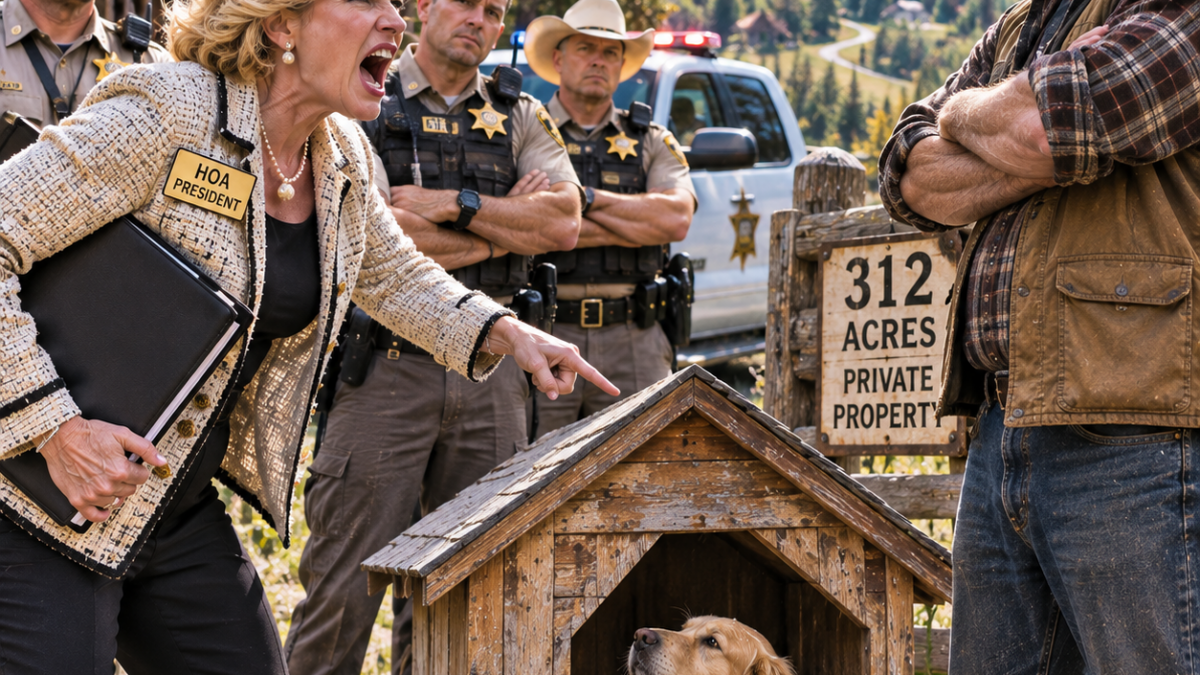
PART2:“GET THAT PLYWOOD DOGHOUSE OFF MY VALLEY OR I’LL HAVE THE SHERIFF TEAR IT DOWN!” HOA Karen Called Three Deputies on My Cabin—She Had No Idea Her Entire Neighborhood’s Only Road Crossed My 312 Acres
PART2
I held the phone away from my ear.
“Excuse me?”
“Forty-two families wake up every Saturday listening to you hammer.”
“Then I suggest they sleep later.”
“You think this is funny?”
“No.”
I walked into my kitchen and poured coffee.
“I think it’s my land.”
Her laugh was cold.
“Your land?”
“Yes.”
“Everything from that ridge to the creek has been under my board for twelve years.”
“That’s not what the county map says.”
“I don’t care what some clerk says.”
“I do.”
“You hammered together a shack and now you think you belong here.”
The words irritated me more than I wanted to admit.
“My family belonged here before your clubhouse had a foundation.”
“You have a permit?”
“County approved.”
“A permit?” she sneered. “Some broke nobody with a bag of nails waves a piece of paper at me and suddenly thinks he’s a homeowner?”
I set my mug down.
“Brenda.”
Her voice grew sharper.
“What?”
“I own the land.”
“You own nothing that gives you the right to drag down my community.”
I almost corrected my community.
Instead, I waited.
She continued.
“I already called the sheriff.”
I stopped.
“What?”
“Monday morning. Three deputies.”
“For what?”
“To remove your illegal structure.”
I laughed once.
Not because it was funny.
Because I couldn’t believe anyone could sound that confident while being that wrong.
“Sheriff’s deputies aren’t your demolition crew.”
“You’ll find out Monday.”
“Brenda—”
“I’ll have that scrap heap torn apart nail by nail.”
Then she added, with almost cheerful contempt:
“And honey, nobody here even knows your name.”
She hung up.
I stood in my kitchen holding the phone.
My coffee tasted bitter.
I wanted to call back.
I wanted to tell her exactly who my grandfather was.
Exactly how long the Tanner name had been attached to that valley.
Exactly how little authority she had.
Instead, I opened the safe in my office.
Inside was my grandfather’s original deed.
Yellowed pages.
Typewritten descriptions.
His signature.
And one paragraph Dad had once made me read aloud:
All land west of Barrel Creek, extending from the northern ridge to the southern tree line, shall remain the sole property of Emmett J. Tanner and his heirs.
I read it twice.
Monday was going to be very different from what Brenda expected.
Saturday morning I drove back to the cabin.
The gravel popped beneath my tires.
Fog hung low over the creek.
I stepped out carrying my tool belt and saw four orange stakes driven into the ground about fifty feet from the cabin.
Survey flags.
Each had been marked:
RIDGELINE ESTATES LOT LINE.
I stared.
Then laughed.
Brenda had apparently decided that if the real boundary would not cooperate, she would invent one.
I pulled the stakes.
Stacked them in my truck.
Went back to work.
Sunday morning, four more appeared.
Same location.
Same orange tape.
I pulled those too.
Monday morning, before the sheriff was due, four more.
This time I stopped.
I photographed every stake.
Date.
Time.
Position.
Then left them in place.
That was the day I began the log.
My father used to say property fights rarely begin with the big thing.
They start with something stupid.
A tree.
A fence.
A driveway.
Then pride gets involved.
Once pride shows up, everybody forgets what they were fighting over.
I decided I would not forget.
At 8:17 Monday morning, three sheriff’s cruisers arrived.
I counted them from the cab of my truck as I rolled down the valley road.
Brenda hadn’t been bluffing about the number.
Three deputies stood beside my unfinished cabin.
Brenda stood near her white Escalade.
Gray slacks.
Black blazer.
Clipboard.
Of course she had a clipboard.
She looked like she had arrived to supervise an execution.
I parked.
Got out.
The lead deputy stepped toward me.
“Mr. Tanner?”
“Yes.”
He held a piece of paper.
“We received a complaint regarding an unauthorized structure.”
I glanced toward Brenda.
She smiled.
The deputy continued.
“This document says the HOA has ordered immediate removal.”
“May I see it?”
He handed it over.
The paper looked official.
HOA letterhead.
Ridgeline seal.
ENFORCEMENT ORDER printed across the top.
Signed:
Brenda Holloway, President.
At the bottom:
Authorized by the Ridgeline Estates Board of Directors.
I handed it back.
“That isn’t a court order.”
Brenda snapped, “It doesn’t need to be.”
The deputy ignored her.
“Do you have a county permit?”
I took it from my truck.
“And an email confirming the parcel isn’t in the HOA.”
He read both.
Handed them to another deputy.
Brenda stepped closer.
“We’ve already spent weeks on this. Just start removing the boards.”
Nobody moved.
She pointed at my cabin.
“I take full responsibility.”
The third deputy had walked toward the porch.
For one horrible second, he pulled yellow tape from his cruiser.
My stomach tightened.
I imagined six weekends of work being torn apart while Brenda watched.
Then the lead deputy raised one hand.
“Hold on.”
He walked aside.
Called dispatch.
Four minutes.
I remember every second.
The creek roaring.
Cold air against my face.
Brenda pacing.
The yellow tape in the third deputy’s hand.
I kept my hands in my jacket pockets because I did not trust them anywhere else.
Finally, the lead deputy returned.
He looked at Brenda.
“Ma’am, county confirms the building permit is valid.”
Her smile disappeared.
“And?”
“And this parcel is not within Ridgeline Estates jurisdiction.”
Brenda stared.
“That’s incorrect.”
“County planning confirmed the parcel.”
“They’re mistaken.”
The deputy remained calm.
“We cannot enforce a private HOA order against property outside the association.”
Brenda pointed toward my cabin.
“You’re going to leave that?”
“Yes, ma’am.”
“That pile of plywood is lowering forty-two property values!”
“We don’t determine architectural standards.”
“I pay taxes in this county.”
“So does he.”
“I want your sergeant.”
“You can call the office.”
Her face flushed.
“You three came here to enforce an order.”
“We came to investigate a complaint.”
“And now?”
“We’re leaving.”
The yellow tape went back into the cruiser.
One by one, the deputies drove away.
Dust rose over the gravel.
Then settled.
Brenda remained.
I leaned against my truck.
She stared at the cabin.
Then at me.
Her voice came out low.
“This isn’t over.”
“No.”
I nodded.
“I don’t think it is.”
She drove away.
Three days later, I returned after work.
Dusk.
Gray light.
The moment I turned into the valley, I knew something was wrong.
The front railing was gone.
Not damaged.
Gone.
Each board had been pried free.
Two support posts were snapped.
Red industrial marking paint covered the front wall.
My cooler had been smashed.
A toolbox dumped.
I stood there with my jaw clenched so tightly it hurt.
Then I saw tire tracks.
Narrow.
Knobby.
Golf-cart type.
Ridgeline used golf carts around the clubhouse.
I photographed them.
Boot prints too.
Two different sets.
I photographed those.
Then I drove home.
I did not call Brenda.
I did not drive to her house.
I ordered a trail camera.
Forty-eight dollars.
Motion activated.
Infrared.
The best forty-eight dollars I ever spent.
The next morning I bolted it to a pine tree overlooking the cabin.
High enough to be missed unless someone knew where to look.
Then I called a licensed surveyor.
His name was Glenn Riddle.
My father had mentioned him years earlier.
“Quiet fellow,” Dad had said. “Doesn’t care who’s angry. Just tells you where the line is.”
That sounded perfect.
Glenn arrived Wednesday morning.
Old pickup.
Sunburned face.
Tripod over one shoulder.
Rolled maps under the other.
“Show me the deed.”
That was his hello.
I gave it to him.
He read the legal description.
Nodded.
Then disappeared into the valley.
He worked two days.
I watched him move across the ridge.
Setting control.
Checking monuments.
Comparing old descriptions.
Running measurements.
Late on the second afternoon he walked back to my truck.
Spread his map over the tailgate.
Used rocks and a socket wrench to hold down the corners.
“You know how much land you own?”
“Roughly.”
“How rough?”
“Three hundred acres.”
“Three hundred twelve.”
I stared at the map.
Glenn tapped the northern line.
“Ridge to creek. Creek to southern timber. Your grandfather kept every bit of it.”
I looked across the valley.
“Okay.”
He did not move.
“What?”
“There’s something else.”
He traced a long strip.
“This.”
“What is it?”
“Ridgeline Road.”
My stomach tightened.
“The subdivision road?”
“Yes.”
“Public road.”
“No.”
I looked at him.
He tapped the map again.
“Not according to the records I found.”
I leaned closer.
“What are you saying?”
“The developer paved approximately sixty feet of road across Tanner land.”
“There has to be an easement.”
“Could be.”
“Did you find one?”
“No.”
“Purchase agreement?”
“No.”
“County right-of-way?”
“No.”
I stared at him.
Glenn folded his arms.
“As far as the title history shows, your grandfather never conveyed this strip.”
I sat on the tailgate.
Below us, forty-two rooftops rose beyond the creek.
Forty-two families.
Forty-two cars.
School buses.
Delivery trucks.
Emergency vehicles.
Every one using Ridgeline Road.
Glenn looked at me.
“You don’t just own the cabin site, Keith.”
He pointed toward the subdivision.
“You may own the ground beneath the only road they use to reach it.”
For several seconds, I heard nothing except water moving through Barrel Creek.
Then Dad’s voice came back to me.
If it isn’t on paper, it isn’t a right. It’s a favor.
I looked at Glenn.
“File the survey.”
“County recorder?”
“Yes.”
“Official?”
“Official.”
He nodded.
“Friday.”
I did not celebrate.
I did not put a gate across the road.
I did not call Brenda and say, Guess what?
Because there were forty-two families living there.
Kids.
Older people.
People who had nothing to do with Brenda’s behavior.
My grandfather would never have punished them.
Neither would Dad.
The road was leverage.
Not a weapon.
I needed someone who understood the difference.
That was how I met Nina Caldwell.
Property attorney.
Fifteen years in practice.
Her office occupied an old farmhouse along Route 9.
Stacks of deeds everywhere.
Coffee strong enough to remove paint.
She read my paperwork in silence.
Grandfather’s deed.
Probate records.
County email.
Glenn’s survey.
Violation notices.
Photos.
Sheriff incident.
Vandalism.
When she finished, she sat back.
“Keith.”
“Yes?”
“You have one of the cleanest ownership claims I’ve seen this year.”
I smiled.
“And?”
“One of the worst neighbors.”
I laughed.
First time in weeks.
Nina made three columns on a legal pad.
“First, Glenn records the survey.”
“Done Friday.”
“Second, I send the HOA a cease-and-desist.”
I nodded.
“Third, if they continue?”
“Civil claims.”
“For what?”
“Trespass. Property damage. Potential abuse of process depending on evidence. We preserve everything.”
I looked at her.
“And the road?”
She tapped her pen.
“You do not close it.”
“I wasn’t planning to.”
“Good.”
“Why?”
“Because forty-two households aren’t Brenda Holloway.”
I nodded.
Nina continued.
“But I will mention the unresolved easement issue.”
“As leverage?”
“As information.”
She smiled.
“People make better decisions when they understand what they stand to lose.”
Allies began appearing before Nina even mailed the letter.
Dale Morrison came first.
Sixty-two.
Retired electrician.
Gray beard.
He drove to my cabin with a six-pack and sat on two stacked lumber boards because my porch was still damaged.
“She fined me five hundred dollars last year.”
“For what?”
“Mailbox.”
I laughed.
“Wrong color?”
“Eggshell.”
“What was it supposed to be?”
“Eggshell.”
I stared.
Dale nodded.
“She said mine was ivory.”
I laughed so hard beer came out my nose.
Dale didn’t.
“She’s been doing this for years.”
My smile faded.
“She told me the same thing Elise did.”
Dale crushed the empty can.
“People are scared.”
“Of fines?”
“Fines. Liens. Letters. Meetings.”
He looked toward Ridgeline.
“She knows most people don’t have time to read bylaws. They see official letterhead and panic.”
“What do you want from me?”
“Nothing.”
He stood.
“If this ends up in court, I’ll testify.”
“Why?”
“Because somebody should’ve done it years ago.”
The county inspector agreed to provide a written statement.
Three complaints.
Three inspections.
Zero violations.
He told me:
“Keith, after the third one I knew your floor plan better than my own house.”
Even Hank Avery came around.
Hank owned the hardware store on Main Street.
Brenda had convinced him not to sell materials to me.
When I first walked into his parking lot, he looked ashamed.
“Keith.”
“Hank.”
“I owe you an apology.”
“Yes.”
He looked surprised.
I shrugged.
“You do.”
He laughed weakly.
Then admitted Brenda had threatened to direct forty-two households away from his store if he supplied my cabin.
“I should have checked.”
“Yes.”
“I didn’t.”
“No.”
He looked at his boots.
“I want to make it right.”
That Saturday, Hank delivered lumber for the porch.
No charge.
Dale and I rebuilt it together.
While he held a board in place, he said:
“You know this isn’t really about your cabin anymore.”
I hammered a nail.
“What is it about?”
“Thirty families who’ve spent ten years paying stupid fines because none of us wanted to be first to say no.”
I didn’t answer.
But I heard him.
Nina’s cease-and-desist arrived Friday morning.
Certified.
Signed:
B. Holloway.
Three days of silence.
Then Brenda hired an attorney.
The counterclaim arrived Monday.
I sat in Nina’s office while she read it.
“Real-estate fraud,” she said.
“Mine?”
“Apparently.”
“That’s creative.”
She continued.
“They claim adverse possession or prescriptive rights over Ridgeline Road.”
I swallowed.
“And?”
“They also claim the 1988 sales contract includes an addendum giving permanent shared access to all roads and pathways.”
My stomach went cold.
“What if that’s true?”
“Then we read the addendum.”
“The original contract is in Dad’s storage unit.”
“Go get it.”
I found the banker’s box beneath old plumbing invoices.
EMMETT LAND, written in Dad’s handwriting.
The contract was thirty-eight pages.
Yellow paper.
Old staples.
I carried it straight to Nina.
She read every word.
Page thirty-one.
She stopped.
“There is an addendum.”
My stomach dropped.
She read aloud.
“Shared access to all connecting driveways and service paths within the developed portion of the eastern parcel.”
I stared.
“Eastern.”
“Yes.”
“Not western.”
“No.”
“Not the whole original valley.”
“No.”
Nina looked up.
“This helps us.”
“How?”
“Your grandfather knew how to grant access when he intended to.”
She tapped the clause.
“He granted shared access inside the land he sold.”
Then tapped Glenn’s map.
“He did not grant it across the western parcel he retained.”
I exhaled.
Nina smiled faintly.
“Brenda’s attorney read half a sentence and hoped you’d panic.”
“I did panic.”
“For one night?”
“Yes.”
“That’s allowed.”
Brenda responded publicly.
Mandatory HOA meeting.
She told residents I planned to barricade the road.
She called Nina’s letter a ransom demand.
Thirty-one residents signed a petition asking the county to condemn my land for access.
The county rejected the petition.
Brenda posted the rejection online.
THE COUNTY IS PROTECTING HIM. WE ARE ON OUR OWN.
Dale sent me a screenshot.
Then another.
Brenda had written:
Attendance at the next meeting is mandatory. Non-attendance will be treated as a compliance issue.
She was now threatening people for skipping meetings.
Nina read the screenshot.
“Interesting.”
“What?”
“Paper trail.”
I laughed.
“That is your answer to everything.”
“Because paper survives bad memories.”
Then Brenda attacked the cabin again.
I was beneath a house replacing a corroded water-heater connection when I returned to my truck and found four missed calls from Dale.
I called.
“Keith.”
“What?”
“She did it again.”
My chest tightened.
“What happened?”
“Cabin.”
I drove forty minutes.
The rebuilt porch was destroyed.
Support posts snapped.
Railing removed.
Front door kicked open.
Inside, the folding table was bent.
Tools scattered.
And on the back wall, in red paint:
NOT YOURS.
I stood there staring at those words.
Something inside me became very quiet.
Not calm.
Focused.
Then I remembered the trail camera.
I climbed the pine.
Pulled the memory card.
That night, Nina and I watched.
11:14 a.m.
Flatbed truck.
Two men.
Then a silver sedan.
Brenda stepped out.
She pointed toward the porch.
The men began tearing it apart.
She never swung a hammer.
She didn’t need to.
She directed everything.
At 11:51, she returned to her car and left.
The men loaded usable lumber into their truck.
Hank’s donated lumber.
My lumber.
My grandfather’s land.
I copied the footage three times.
One copy in my safe.
One to Nina.
One to Dale.
Nina called after watching.
Her voice was flat.
“Keith.”
“Yes?”
“This is no longer just a property dispute.”
The sheriff opened a criminal investigation.
Nina filed an emergency motion in the civil case seeking records relevant to the HOA’s actions and spending.
The court approved production of financial records tied to the dispute.
Two weeks later, boxes arrived at Nina’s office.
She spent hours reviewing them.
I sat across from her.
Finally, she turned her laptop.
“Look.”
HOA dues.
Forty-two households.
Increases.
Expenses.
Pool.
Insurance.
Clubhouse.
Then line items:
ADMINISTRATIVE SERVICES.
LEGAL CONSULTATION.
COMPLIANCE EXPENSES.
Some of the payments led to businesses connected directly to Brenda.
One consulting company was registered to her home address.
Other payments appeared to reimburse her personal expenses related to enforcement.
Nina leaned back.
“We need an accountant to quantify this before anyone makes accusations.”
I nodded.
“What does it look like?”
“It looks like money collected for association purposes may have been used for Brenda’s personal campaign.”
“How much?”
“Preliminary total? Around eighty-six hundred.”
I stared.
“She raised dues.”
“Yes.”
“Told everyone there was no money for improvements.”
“Yes.”
“And spent their dues attacking my cabin?”
“We prove first.”
She closed the laptop.
“Then we talk.”
The forensic review confirmed $8,612 in association funds had been improperly directed into Brenda-related expenses without adequate authorization.
Eight thousand six hundred twelve dollars.
Not millions.
Not some Hollywood fortune.
But that almost made it worse.
This was money from people like Dale.
Retired electrician.
Fixed income.
Families paying annual dues because they believed the money maintained the pool and common areas.
Brenda had used a portion of it to wage a private war against a plumber building a cabin on land she did not own.
Nina looked at me.
“Annual meeting is six weeks away.”
“What are you thinking?”
“That the homeowners deserve to know.”
“Now?”
“No.”
She closed the file.
“At the meeting.”
“Why wait?”
“Because Brenda has spent months controlling the narrative.”
Nina’s eyes hardened.
“This time, everyone hears the evidence at once.”
The annual meeting took place the first Saturday in November.
7:15 p.m.
Ridgeline clubhouse.
Forty-two households required to attend because Brenda had threatened compliance consequences for staying home.
By 7:10, almost every chair was full.
I sat in the back.
Dale sat three rows ahead.
Brenda entered at 7:14.
Blazer.
Reading glasses on a chain.
Clipboard.
Always the clipboard.
She sat at the front.
Tapped the microphone.
“Good evening.”
The room quieted.
“Before regular business, I need to address the ongoing threat on our western boundary.”
She spoke for four minutes.
Called me a transient.
Called my cabin unauthorized.
Called Nina’s cease-and-desist a shakedown.
Claimed I was threatening community access.
Never mentioned the recorded survey.
Never mentioned the county confirmation.
Never mentioned the trail-camera footage.
Never mentioned the sheriff’s investigation.
Then she smiled.
“Any questions?”
I stood.
Silence fell instantly.
Brenda stared.
“This meeting is for Ridgeline residents.”
“No, ma’am.”
I stepped into the aisle.
“But I’m the landowner you’ve been talking about.”
Her jaw tightened.
“You are not recognized.”
“And I brought my attorney.”
The side door opened.
Nina walked in carrying a banker’s box.
Behind her stood a deputy sheriff.
Not to arrest anyone.
To keep the peace and observe.
Nina placed the box on the table.
Six inches from Brenda’s water pitcher.
“My name is Nina Caldwell.”
Brenda stood.
“You’re not authorized to participate.”
Nina ignored her.
“I represent Keith Tanner.”
She opened the box.
“I have four items the residents of Ridgeline Estates deserve to understand.”
First document.
Grandfather’s deed.
“Recorded in 1962. Three hundred twelve acres.”
Second.
Glenn’s survey.
“Confirms the western parcel remains Tanner property.”
She placed a map on the easel.
“And according to the recorded title research, the ground beneath Ridgeline Road crosses Mr. Tanner’s parcel without a presently recorded permanent easement.”
The room erupted.
“What?”
“Are you saying he owns the road?”
“Brenda told us it was HOA property!”
Nina raised her hand.
“Mr. Tanner has never threatened to close the road.”
People quieted.
“He has no intention of punishing forty-two families for this dispute.”
Dale turned toward me.
I gave him a small nod.
Then Nina removed a laptop.
“Third item.”
She pressed play.
The room watched Brenda arrive at my cabin.
Point.
Two men destroy the porch.
Forty seconds.
No narration.
No dramatic music.
Just Brenda.
Her face clear.
When the footage ended, nobody spoke.
Brenda stood.
“This is edited.”
Nina didn’t argue.
She removed the final item.
A large financial summary.
“Fourth.”
She placed it on the easel.
“These figures come from HOA records produced through legal process and reviewed by an independent accounting professional.”
People leaned forward.
“Approximately $8,612 in association funds were directed into expenses connected to Mrs. Holloway’s personal enforcement campaign and related services without proper authorization.”
A woman in the second row whispered:
“Oh my God.”
Dale didn’t move.
He already knew.
Brenda’s chair scraped backward.
“This is a setup.”
Nina looked at her.
“Mrs. Holloway, Mr. Tanner’s family owned the western valley before Ridgeline Estates existed.”
Brenda opened her mouth.
Nina continued.
“You sent sheriff’s deputies to remove a permitted cabin from land outside your jurisdiction.”
The room remained silent.
“You repeatedly filed complaints that produced no violations.”
Brenda’s face reddened.
“You directed men who damaged private property.”
Brenda pointed at me.
“He was trying to steal our road!”
Nina shook her head.
“He was trying to build a cabin.”
Someone laughed.
Not happily.
Bitterly.
Then Dale stood.
He looked around the room.
“I move that Brenda Holloway be removed from the board immediately, subject to the association’s governing procedure.”
A woman near the front raised her hand.
“I second.”
The remaining board members looked at one another.
One man swallowed.
“All in favor?”
Hands rose.
Dozens.
Brenda stared.
Not every hand.
But far more than enough.
The board secretary counted.
Then announced the result.
Brenda had been removed.
For twelve years, that woman had controlled Ridgeline Estates through letters, fines, meetings and fear.
It ended with raised hands.
No screaming.
No cheering.
Just people deciding they had had enough.
Brenda picked up her clipboard.
Reading glasses.
Car keys.
She walked down the center aisle.
Her heels clicked against the tile.
Nobody stopped her.
Nobody said goodnight.
The glass doors closed behind her.
Dale turned around.
Looked at me.
And gave one small nod.
The criminal case took months.
Reality is slow like that.
Brenda ultimately entered a no-contest plea relating to the destruction of my property.
She received supervised probation and was ordered to pay restitution for the cabin damage.
The contractor’s repair estimate came to $6,800.
The HOA financial matter became a separate civil fight.
Twenty-two homeowners joined a claim over the improperly used funds.
A full accounting traced the final amount.
$8,612.
Brenda was ordered to repay it.
Three weeks after judgment, she sold her house.
The white Escalade disappeared on a Tuesday morning.
Nobody stood outside to watch.
That detail mattered to me.
They had spent years watching everything she did.
Now they had lives to get back to.
Dale Morrison became HOA president.
Thirty-four votes.
Two against.
His first meeting lasted forty-two minutes.
Brenda’s meetings sometimes lasted three hours.
Dale stood behind the same microphone and said:
“My first proposal is that we abolish the mailbox color policy.”
His wife began clapping.
Someone laughed.
Dale continued.
“If your mailbox is blue, green, red, cream, ivory, eggshell, polka-dotted or covered in pictures of your grandchildren, I truly do not care.”
The room erupted.
He raised both hands.
“We have actual work.”
Pool maintenance.
Insurance.
Road planning.
Budget review.
Within two months, the board removed most of the old cosmetic restrictions.
No more penalties for wind chimes.
No more fines over decorative planters.
No mandatory attendance enforced by threats.
The HOA didn’t disappear.
It simply stopped pretending to be a government.
The road remained.
My road, technically.
But I never wanted it as leverage forever.
Nina drafted a formal easement.
Permanent.
Recorded.
No annual access fee.
No retaliation.
Ridgeline Estates received irrevocable use of Ridgeline Road provided the association maintained it appropriately.
Susan—the same county clerk who had first told me the HOA had no jurisdiction—handled the filing.
She recognized my name.
“Mr. Tanner.”
“Susan.”
She smiled.
“Quite a few documents since our first phone call.”
“You started this.”
Her eyes widened.
“I did not.”
I laughed.
She stamped the easement.
“Glad it worked out.”
I held the recorded document.
“My grandfather would’ve done the same.”
“Given the road?”
“Yes.”
Susan looked at me.
“Then why didn’t he?”
“Probably thought nobody would ever be foolish enough to start a war over a cabin.”
She laughed.
I used part of the restitution money for something Grandpa would have understood.
A conservation easement.
One hundred acres of the western valley.
Pine forest.
Creek bed.
Wildflower meadow.
Protected.
No subdivision.
No future developer.
No luxury houses.
No shopping center.
No parking lot.
A land trust accepted the easement.
Once recorded, those hundred acres would remain open land long after I was gone.
Nina looked at me when I signed.
“You sure?”
“Yes.”
“You’re giving up development value.”
“I know.”
“Could be substantial one day.”
I looked through her office window toward distant hills.
“That’s exactly why.”
Grandpa kept the valley wild by choice.
Now a piece of it would remain wild by law.
Some inheritances are money.
Some are property.
Some are responsibilities nobody writes down.
By April, the cabin was finished.
New porch.
New railing.
New front door.
I used several pieces of old pine salvaged from Grandpa’s cattle fence.
The boards had darkened to honey.
I sanded them carefully.
Not too much.
I wanted the age to remain visible.
Dale walked out that afternoon with his overweight beagle, Biscuit.
Biscuit ignored the valley entirely and focused on my sandwich.
Dale stood beside the porch.
“Well.”
“Well what?”
“Looks good.”
“Careful. Brenda said it destroyed property values.”
Dale looked around.
“Yeah.”
He pointed toward the pines.
“I can practically hear them collapsing.”
I laughed.
He sat on the steps.
For a while, neither of us spoke.
Then Dale said:
“You know, I hated her for a while.”
“Brenda?”
“Yeah.”
I waited.
“Now I mostly feel stupid.”
“Why?”
“Because it took a plumber in a half-built cabin to make forty-two families realize we could ask questions.”
I looked at him.
“I didn’t do that.”
“Sure you did.”
“No.”
I nodded toward his house.
“You did it when you showed me the letter.”
“Elise did it when she spoke up.”
“The inspector did it when he put his findings in writing.”
“Hank did it when he admitted he’d been wrong.”
“Nina did it when she followed the records.”
“And you people voted.”
Dale smiled.
“So nobody’s the hero?”
“Grandpa would’ve hated a hero.”
“Why?”
“He said the men who came home weren’t the ones who deserved the word.”
Dale looked down.
“Your grandfather sounds like he was something.”
“He was irritating.”
Dale laughed.
“Good men usually are.”
That evening, after Dale left, I sat alone on the porch.
Sun dropping behind the ridge.
Barrel Creek running low.
Pines moving gently.
For the first time in nearly a year, the valley was quiet.
No compliance notice.
No county inspector.
No phone call.
No orange stakes.
No white Escalade.
Just wind.
Water.
Birds.
I realized I had forgotten what silence sounded like.
Then Biscuit barked somewhere down the road.
So much for silence.
I smiled.
A week later, I found an envelope in my mailbox.
No stamp.
Ridgeline letterhead.
I opened it.
One sentence.
Dear Keith,
Your cabin looks great. Also, your mailbox is the wrong shade of brown.
Just kidding.
—Dale
I laughed so loudly I scared myself.
I put the letter on my refrigerator.
It is still there.
People have asked me whether I ever wanted to close the road.
Of course I thought about it.
Not seriously.
But after Brenda destroyed the porch, I imagined a locked gate.
Just once.
Let her drive out in that Escalade and discover the road she thought she controlled belonged to the man she had spent months humiliating.
That fantasy lasted maybe ten minutes.
Then I pictured the rest.
Schoolchildren missing buses.
A nurse trying to reach work.
An ambulance delayed.
Dale unable to leave for a doctor’s appointment.
Elise driving to see her grandkids.
That would not have been justice.
It would have been revenge.
Grandpa never taught me revenge.
He taught me stewardship.
There is a difference.
You can own something and still recognize that other people depend on how you use it.
You can have leverage and choose not to crush someone with it.
You can win without making innocent people pay.
That was the difference between Brenda and the people she tried to control.
She believed possession meant power.
Grandpa believed possession meant responsibility.
I think about Hank Avery sometimes.
The hardware-store owner.
The man who refused to sell me brackets because Brenda threatened his business.
For a few weeks, I was angry every time I drove past his store.
Then he admitted what he had done.
That mattered.
Pride makes apologies expensive.
Hank paid.
Not in money.
In honesty.
He delivered the lumber himself.
Helped unload it.
Stood in the valley with sawdust on his boots.
“I should’ve asked you first.”
“Yes.”
“You ever gonna let me forget that?”
“No.”
He laughed.
Fair enough.
Now I buy almost everything from him.
Not because he was right.
Because he was willing to admit when he wasn’t.
That is rarer than people think.
The county inspector visits too.
Not officially.
He comes fishing.
His name is Tom.
I didn’t know it during the complaints because I was too annoyed to ask.
One afternoon he sat beside Barrel Creek holding a fishing rod.
“You know the funniest part?”
“What?”
“Brenda complained about excessive construction noise.”
I laughed.
“So?”
“County limit during permitted daytime construction was seventy decibels at the receiving property line.”
“Okay.”
“I measured you at forty-eight.”
“What was louder?”
“Her arguing with me.”
I almost dropped my beer.
Tom smiled.
“Seventy-four.”
“You measured her?”
“Professional curiosity.”
We laughed for ten minutes.
There are details about Brenda that people expect me to exaggerate.
I don’t need to.
She was not some movie villain.
She did not own a secret dungeon.
She did not have twenty aliases.
She was a woman who spent twelve years being obeyed often enough that eventually she stopped asking whether obedience was deserved.
That is more believable.
And more dangerous.
At first, her authority had probably been useful.
Someone needed to organize pool repairs.
Someone needed to review landscaping contracts.
Someone needed to collect dues.
Maybe she volunteered when nobody else would.
Maybe she solved real problems.
Then something changed.
Rules became personal.
Disagreement became disrespect.
Questions became attacks.
Residents became subjects.
And somewhere in that transformation, she began believing the HOA existed because of her rather than the other way around.
That is how power usually rots.
Not all at once.
One justified decision.
Then another.
Then one questionable one nobody challenges.
Then another.
Until eventually a woman stands in front of three sheriff’s deputies telling them to tear apart a cabin on land she has never owned.
Dale asked me once whether I thought Brenda knew she was wrong.
“About what?”
“The cabin.”
I considered it.
“At the beginning?”
“Yeah.”
“No.”
“You think she genuinely believed it was HOA land?”
“Probably.”
“And later?”
I looked toward the road.
“Later she had too many chances to learn.”
That distinction mattered.
Being wrong is ordinary.
Everybody is wrong.
Refusing correction is different.
Brenda received county confirmation.
Attorney letters.
Survey evidence.
Sheriff confirmation.
A recorded deed.
Every step gave her a choice.
Adjust.
Or escalate.
She escalated.
That is why I stopped seeing her as confused.
Confusion asks questions.
Entitlement demands reality change.
One spring morning, I drove to the old storage unit.
The one where I found Grandpa’s contract.
I had delayed cleaning it out because Dad’s handwriting was everywhere.
Boxes.
Labels.
Notes.
I found an old photograph in the bottom of the banker’s box.
Grandpa standing beside Barrel Creek.
1964, according to the date.
He was thirty-seven.
Hat pushed back.
Shirt sleeves rolled.
Standing beside a fence post.
On the back, Dad had written:
Dad said land doesn’t care who thinks they’re important. It stays where it is.
I sat on the concrete floor and laughed.
Then cried.
Because that sentence described the entire year better than any court filing.
Brenda believed importance could move a boundary.
It couldn’t.
She believed confidence could erase a deed.
It couldn’t.
She believed fear could turn private land into HOA property.
It couldn’t.
The land stayed where it was.
All we had to do was measure it honestly.
That afternoon, I framed the photograph.
It hangs inside the cabin now.
Near Nina’s recorded easement.
Dale’s joke letter is still on my refrigerator at home.
The first violation notice is framed too.
People ask why.
I tell them:
“Because it cost me four thousand two hundred imaginary dollars.”
They laugh.
But I keep it for another reason.
It reminds me how official nonsense can look when printed on good paper.
Logo.
Stamp.
Signature.
Bold type.
None of those things make a claim true.
That lesson applies far beyond HOAs.
People are intimidated by presentation.
Uniforms.
Letterhead.
Titles.
Confident voices.
I nearly was.
If Dad had not once told me they can’t fine what they don’t own, I might have paid just to make Brenda stop.
Then what?
Another fine.
Another demand.
Another rule.
There is no peace at the end of surrender to someone who keeps moving the line.
The conservation easement became my favorite part of the whole outcome.
One hundred acres.
Permanent.
I walked it with a land-trust representative named Meredith.
She wore mud boots and carried a GPS unit.
At one point we stopped beside a wildflower meadow.
“This is beautiful.”
“My grandfather ran cattle here.”
“Would you ever build?”
“No.”
“You’re sure?”
I looked toward the ridge.
“Yes.”
She nodded.
“Then future Keith can’t change his mind.”
I laughed.
“That is the idea.”
She smiled.
“You don’t trust future Keith?”
“I’ve met current Keith.”
“Fair.”
We marked the protected boundaries.
Not HOA orange stakes.
Real surveyed boundaries.
When the easement was recorded, I drove to the cabin.
Sat on the porch.
And told Grandpa out loud.
“One hundred acres.”
The wind moved through the trees.
No answer.
I smiled.
“You’re welcome.”
Ridgeline changed slowly.
That was healthier than a dramatic overnight transformation.
At first, people argued over which rules to remove.
Some wanted no rules at all.
Others feared chaos.
Dale kept repeating:
“We need rules for common property, not personality.”
That became almost a slogan.
Pool hours stayed.
Insurance requirements stayed.
Budget procedures stayed.
Safety requirements stayed.
Mailbox-color charts disappeared.
Wind-chime permits disappeared.
Garden-gnome restrictions disappeared.
A rule limiting porch flags to three approved seasonal designs disappeared.
I did not know that rule existed until Dale read it aloud.
He stopped halfway.
“Who wrote this?”
Someone shouted:
“Brenda!”
Dale sighed.
“Of course.”
They voted it out.
The funniest moment happened six months later.
Elise painted her mailbox bright purple.
Not tasteful purple.
Electric purple.
Dale called me.
“You need to come see this.”
I drove over.
Elise stood beside it with her hands on her hips.
“What?”
I stared.
“That is terrible.”
She smiled.
“Thank you.”
Dale shook his head.
“I regret changing the rule.”
Elise pointed at him.
“You touch my mailbox and I’m calling Keith.”
I held up my hands.
“I’m not getting involved.”
Dale laughed.
Biscuit peed beside the post.
Elise shouted.
“DALE!”
I walked away before that dispute became another lawsuit.
People sometimes romanticize the cabin now.
They think it was some beautiful handcrafted lodge.
It wasn’t.
The first version really did look a little like a plywood doghouse.
Brenda was cruel.
But visually?
Not completely wrong.
I had framed the walls.
Installed temporary sheathing.
No siding yet.
Porch unfinished.
Roof basic.
If you saw it from Ridgeline, you probably did not think architectural triumph.
But ugly is not illegal.
Unfinished is not unauthorized.
And disliking what another person builds on property outside your jurisdiction does not magically create authority.
That was always the problem.
Not taste.
Power.
The cabin now has cedar siding.
Tin roof.
Small woodstove.
One bedroom.
Kitchenette.
Porch facing west.
Nothing fancy.
I spend weekends there.
Sometimes alone.
Sometimes Dale visits.
Sometimes my daughter comes from Portland.
The first time she visited after everything ended, she stood on the porch and looked across the valley.
“So this is what Grandma kept calling Dad’s ridiculous cabin.”
“Your grandmother had strong opinions.”
“She said it nearly got you arrested.”
“Exaggeration.”
“Nearly got someone else arrested?”
“Closer.”
She laughed.
Then noticed Grandpa’s photograph.
“Is that Emmett?”
“Yes.”
She looked at it for a long time.
“I barely remember him.”
“You were little.”
“What was he like?”
I thought.
“Quiet.”
“Like you?”
“No.”
She raised an eyebrow.
“Dad.”
“Fine.”
I laughed.
“A little.”
She smiled.
Then looked toward the ridge.
“I’m glad you kept this.”
“So am I.”
That was enough.
I no longer think of the valley as something Brenda almost took.
She never had the legal ability to take it.
What she almost took was my willingness to enjoy it.
That is more subtle.
For months, I drove out expecting trouble.
Every unfamiliar tire track made me angry.
Every vehicle near the access road made me tense.
Every phone notification felt like another complaint.
The place I built for peace became a battlefield in my head.
That took time to undo.
Even after Brenda moved away, I would sometimes hear a car and stand automatically.
Look toward the road.
Wait.
That is what intimidation does.
It stays after the person leaves.
Eventually, the valley became quiet again.
Then my mind followed.
One evening, nearly a year after the annual meeting, Nina visited.
I had invited her several times.
She kept saying lawyers are allergic to nature.
Finally, she came.
She stood on the porch holding a glass of iced tea.
“This is what all that fighting was about?”
I looked around.
“You sound disappointed.”
“I expected Versailles.”
“Plumber budget.”
She smiled.
We watched Barrel Creek.
After a while, I said:
“Thank you.”
“For what?”
“Not telling me to block the road.”
Nina looked at me.
“You wouldn’t have.”
“I thought about it.”
“For ten seconds?”
“Ten minutes.”
She laughed.
“Terrifying.”
“I was angry.”
“You were.”
She leaned against the railing.
“But you understood the difference between leverage and cruelty.”
I looked at her.
“Brenda didn’t.”
“No.”
Nina paused.
“That may be the whole story.”
Maybe it was.
Brenda had leverage.
HOA title.
Mailing list.
Neighbors afraid of fines.
Local businesses dependent on their spending.
She used every bit of it against me.
When I discovered leverage, I did something different.
I used it to establish a boundary.
Then I gave permanent access away.
I protected part of the valley from future development.
I preserved the thing instead of weaponizing it.
Grandpa would have understood.
I turned fifty-one last month.
Dale brought beer.
Elise brought cake.
Hank brought a toolbox I absolutely did not need.
Tom the inspector brought a fishing rod.
Nina brought nothing.
“Lawyer gift,” she said.
“What?”
“I did not bill you for the drive.”
I laughed.
We sat around a fire near the cabin.
At some point Dale raised his bottle.
“To Keith.”
I groaned.
“No speeches.”
He ignored me.
“To the broke nobody with a bag of nails.”
Everyone laughed.
I raised my bottle.
“To the HOA president with the purple mailbox.”
Elise bowed.
Dale shook his head.
Then Nina said:
“To property lines.”
Tom added:
“And people who stay on the right side of them.”
I looked around.
For a moment, I thought about Brenda.
Not with satisfaction.
Just distance.
She had once filled this entire valley in my head.
Now she was barely a footnote at my birthday.
That felt right.
After everyone left, I sat alone.
The fire burned low.
Barrel Creek reflected moonlight.
I remembered the first violation notice.
The wet plastic bag.
The bleeding ink.
I remembered Brenda screaming into my phone.
Some broke nobody with a bag of nails.
At the time, the insult bothered me.
Now I liked it.
Because she was right about one thing.
I was nobody special.
Just a plumber.
No law degree.
No political influence.
No fortune.
No secret connections.
I had a deed.
A permit.
A survey.
A trail camera.
An attorney who read everything.
And neighbors who eventually stopped being afraid.
That was enough.
Maybe that is what bullies fear most.
Not powerful people.
Ordinary people who finally check whether the bully is telling the truth.
The valley smelled like pine and woodsmoke.
I went inside.
Before bed, I looked at Grandpa’s framed photograph.
Land doesn’t care who thinks they’re important.
It stays where it is.
I smiled.
“Yeah.”
Then I turned off the light.
A few mornings later, I found Dale standing beside the easement marker along Ridgeline Road.
“What are you doing?”
“Thinking.”
“Dangerous.”
He ignored me.
“Forty-two families use this road.”
“Yes.”
“You could’ve charged us.”
“Yes.”
“A lot.”
“Probably.”
“But you didn’t.”
“No.”
“Why?”
I shrugged.
“Because you’re annoying enough when you get access for free.”
He laughed.
Then became serious.
“Keith.”
“What?”
“Why?”
I looked down the road.
School bus coming.
Children waiting near houses.
Elise walking Biscuit because Dale’s knee was bothering him.
A delivery van turning toward the clubhouse.
“Because my grandfather would’ve given you the road.”
Dale nodded.
“That simple?”
“No.”
I smiled.
“But good answers usually sound simple after you’ve suffered enough to find them.”
Today, the deed is in my safe.
So is Glenn’s survey.
The trail-camera footage exists in three archived copies.
Nina says I am pathologically organized now.
I tell her Brenda cured me.
The cabin stands west of Barrel Creek.
The road easement is recorded.
One hundred acres cannot be developed.
Ridgeline Estates still exists.
Dale still complains about meeting attendance, but unlike Brenda, he complains because nobody wants to volunteer for pool-cleaning duty.
Elise still has the purple mailbox.
Hank still gives me ten percent off lumber even though I keep telling him he paid his debt years ago.
Tom still fishes badly.
Biscuit is still overweight.
And every once in a while, someone new moves into Ridgeline and asks:
“Is it true the HOA tried to tear down your cabin?”
I usually say:
“Sort of.”
Then they ask:
“Is it true you own the road?”
I say:
“Not exactly anymore. They have an easement.”
Then:
“Did you really find financial misconduct?”
“Yes.”
“Did Brenda really plant fake survey stakes?”
“Yes.”
“Did she really call the sheriff?”
“Three deputies.”
They shake their heads.
Then almost always ask the same final question.
“What did you do when you found out the road crossed your land?”
I point toward Ridgeline.
“Gave them permanent access.”
They look disappointed.
People prefer revenge.
A locked gate.
Forty-two houses trapped.
Brenda on her knees.
Something cinematic.
But real justice rarely gives you everything your anger wants.
It gives you something better.
The right boundary restored.
The wrong conduct exposed.
The innocent people protected.
And your own conscience still intact when it is over.
Brenda Holloway called my cabin a plywood doghouse.
She called me a squatter.
A broke nobody.
A threat to property values.
She sent notices.
Fines.
Inspectors.
Three sheriff’s deputies.
She planted false boundary stakes.
She turned businesses against me.
She told forty-two families I wanted to hold their neighborhood hostage.
She directed men who tore apart my porch.
And she spent money that belonged to the people she claimed to protect while trying to force me off property her HOA had never owned.
But the most important thing she did was accidental.
She made us look at the records.
She made Dale speak.
She made Elise stop being afraid.
She made Hank admit he had chosen fear over facts.
She made the board inspect its finances.
She made me commission the survey that finally revealed exactly what Grandpa had preserved.
Without Brenda, I might never have known that Ridgeline Road crossed Tanner land.
I might never have created the conservation easement.
I might never have finished the cabin.
That does not make what she did good.
It means something bad can still force useful truths into daylight.
Grandpa bought the valley because he wanted somewhere to stand.
Dad preserved it because he could not imagine selling what Grandpa had kept.
I built the cabin because I wanted somewhere to sit.
And Brenda tried to convince me that none of those things mattered because forty-two houses and a clipboard had arrived later.
She was wrong.
Not because old ownership is morally superior.
Not because my family deserved more than the families in Ridgeline.
She was wrong because a boundary is a boundary.
Her authority ended where my land began.
That simple truth took nearly a year, thousands of pages, court filings, surveys, witnesses, damaged lumber and one extraordinary amount of bad coffee to enforce.
But it held.
Last Saturday I drove into the valley before sunrise.
Fog lay over Barrel Creek.
Exactly like the morning I first found Brenda’s orange stakes.
I parked beside the cabin.
Walked toward the ridge.
The stakes are long gone.
In their place are proper survey markers.
Small.
Unimpressive.
Accurate.
I stood beside one.
Below me, Ridgeline Estates slowly woke.
Garage doors opening.
Lights turning on.
Dogs barking.
A school athlete running before breakfast.
Somebody burning toast badly enough that I could almost smell it from the ridge.
Normal life.
I looked west.
Pines.
Wild meadow.
Protected land.
Grandpa’s land.
My land.
And someday, somebody else’s responsibility.
I thought about the sentence Brenda screamed into my phone:
Everything from that ridge to that creek has been under my board for twelve years.
Then I looked at the survey marker.
The line had never moved.
Only her belief had.
That is the thing about property lines.
And truth.
They do not become different simply because somebody says the wrong thing loudly enough.
Eventually, someone measures.
Eventually, someone checks.
Eventually, somebody opens the old box, reads page four, paragraph three, and discovers that the woman claiming to own the valley never owned so much as the dirt beneath her own argument.
I walked back to the cabin.
Sat on the porch Grandpa never got to see.
Poured coffee.
The creek moved below.
For a while, I listened.
Then a truck appeared along Ridgeline Road.
Dale.
He stopped beside my driveway.
Rolled down the window.
“Keith!”
“What?”
“HOA emergency!”
My stomach tightened automatically.
He grinned.
“The pool pump died.”
I stared at him.
“That’s your emergency?”
“Eight children are emotionally devastated.”
I laughed.
“Call a plumber.”
“You are a plumber.”
“Double rate for HOA presidents.”
He pointed at me.
“Abuse of power.”
I raised my coffee.
“File a violation.”
Dale drove away laughing.
I sat there smiling long after he disappeared.
That was when I knew the story was finally finished.
Not when Brenda lost the board vote.
Not when the court ordered restitution.
Not when the road easement was recorded.
That morning.
When an HOA president could drive onto Tanner land and make a joke.
When I could hear the letters HOA without feeling my shoulders tighten.
When the valley was just a valley again.
Brenda once told me nobody in Ridgeline even knew my name.
She meant it as an insult.
Now they know it.
But that was never the victory.
The victory was learning theirs.
Dale.
Elise.
Hank.
Tom.
Families I had driven past for years without really seeing.
The people behind those forty-two roofs.
Brenda tried to turn us into enemies.
Property owner versus HOA.
Outsider versus residents.
My road versus their homes.
Instead, her campaign forced us to meet one another.
And once we did, the war she needed became impossible to maintain.
You can frighten strangers much more easily than neighbors.
The cabin door is made of oak now.
Heavy hinges.
Good lock.
Not because I expect Brenda to return.
She will not.
Because I learned to take care of what I build.
Above the door hangs the old photograph of Grandpa.
Inside the frame, beneath the picture, I added one line.
Not his.
Mine.
A boundary protects both sides when both sides respect it.
That is what I learned.
Not that HOAs are evil.
Not that neighbors are enemies.
Not that every disagreement needs a lawyer.
The opposite.
Good communities work because people understand limits.
Boards need limits.
Owners need limits.
Governments need limits.
Even anger needs limits.
Brenda crossed hers.
I nearly crossed mine.
The difference was that I had people around me who kept reminding me what I was actually trying to protect.
Not pride.
Home.
So if you ask me what Granddad really left me, I no longer say 312 acres.
Land can be sold.
Cabins can burn.
Roads can move.
Documents can be lost.
What he left was an example.
He sold what he no longer needed.
Kept what mattered.
Allowed people to cross his land because being neighborly mattered more than squeezing money from every acre.
And when he put an agreement in writing, he made the boundary clear enough that his grandson could still understand it decades later.
That is why Brenda lost.
Not because Grandpa planned for Brenda.
Because he planned carefully.
A clean deed defeated twelve years of entitlement.
A survey defeated orange stakes.
A camera defeated denial.
Transparent accounting defeated secret spending.
And forty-two people raising their hands defeated one woman’s assumption that fear was the same thing as respect.
Sometimes justice looks dramatic.
Most times it looks like paperwork.
But when the papers are right, the line is right, and the people finally stop being afraid, even a woman with twelve years of unchecked power eventually discovers the same thing my grandfather knew in 1962:
You can stand on someone else’s land for years and still never own it.
Brenda Holloway believed she controlled my valley because nobody had forced her to prove otherwise.
The day she finally had to prove it, she lost more than a property dispute.
She lost the fear that had been holding forty-two families together.
And once that fear disappeared, there was nothing left for her to rule.
I still own the western valley.
Ridgeline still uses the road.
The cabin still stands.
The creek still runs cold.
And every time I sit on that porch at sunset, I think about the phone call that started everything.
Get that plywood doghouse off my valley.
I usually laugh.
Because the cabin was never in Brenda’s valley.
Brenda had simply spent twelve years living in a neighborhood whose road crossed mine—and mistaking everyone else’s silence for ownership.
Grandpa left me 312 acres.
But Brenda Holloway accidentally taught all of us what those acres were really worth.
Not money.
Not leverage.
The freedom to stand where you belong without asking permission from somebody who never had the right to move you.
And that, after everything, was worth protecting.








