PART2:“GET THAT DOG OUT OF HERE! I DON’T CARE IF HE’S THE ONLY THING KEEPING YOU ALIVE!” HOA Karen Threatened to Take a Disabled Veteran’s Service Dog at 6 A.M. — But Seven Veterans Were About to Make Her Regret Every Word
PART2
Karen Harrove had been president of our homeowners association for five years.
And if there was one thing she couldn’t stand, it was being told no.
She had built her reputation on a strange combination of expensive clothing, aggressively worded violation notices, and the belief that every homeowner on our street should be grateful for her leadership.
Her favorite phrase was community standards.
You could hear it at almost every meeting.
Lawns had to meet community standards.
Mailboxes had to meet community standards.
Holiday decorations.
Fence colors.
Trash cans.
Driveways.
Everything.
At first, I’d assumed she was simply enthusiastic about maintaining property values.
A little controlling, perhaps.
But harmless.
Then I watched her issue warnings to an elderly widow because a flowerpot extended too far beyond her porch.
I watched her threaten another resident with fines because he parked his work truck in his own driveway.
And I listened to her complain about a neighbor’s wind chimes as though they represented the collapse of civilization.
Eventually, I understood.
Karen didn’t merely like rules.
She liked having the power to decide who was breaking them.
And once she decided somebody was a problem, she could make their life miserable.
But nothing I’d seen before that morning prepared me for what she tried to do to Fish.
I’d lived on the street for nine years.
My house was modest.
Three bedrooms.
A front porch.
A small fenced backyard.
Enough room for Daisy to run and for me to grow tomatoes every summer.
I’m not a veteran myself.
I work in equipment maintenance for a regional transportation company.
My life isn’t glamorous.
I go to work.
Pay my bills.
Walk my dog.
Help my neighbors when I can.
But military service has always meant something personal to my family.
My father served.
My younger brother served.
And when my brother came home struggling with things he rarely knew how to explain, I learned that some wounds aren’t visible.
I learned that a person can be physically sitting at a kitchen table while their nervous system reacts as though danger is happening all around them.
I learned not to grab somebody who is frightened without asking.
Not to shout at them to calm down.
Not to make their distress into entertainment.
And I learned that when a trained service dog is helping someone manage a disability, that dog isn’t simply a companion.
He may be performing tasks that allow the person to function safely and independently.
That’s why the sight of Karen ordering Grizzly away made me so angry.
She wasn’t merely complaining about a pet.
She was trying to remove the support Fish depended on while he was visibly struggling.
I’d seen Fish around the neighborhood before.
I didn’t know him well.
He kept mostly to himself.
He lived in a small house across from mine, with an American flag on the porch and a neatly maintained lawn.
Sometimes I’d see him early in the morning walking Grizzly.
The German Shepherd was beautiful.
Large.
Strong.
Black-and-tan coat.
Alert ears.
Focused eyes.
He walked calmly beside his handler.
Never lunged at other dogs.
Never chased children.
Never barked at passing cars.
Sometimes he wore a service-dog harness.
Sometimes I saw him resting near Fish’s feet while his owner worked in the front yard.
Once, I watched Fish stop halfway down his driveway.
He seemed distracted.
Unsteady.
Grizzly stepped directly in front of him and made contact with his leg.
Fish looked down.
Touched the dog’s head.
Then paused for a moment before continuing.
I hadn’t known the details of Grizzly’s training.
But I knew he and Fish were deeply connected.
Whenever they walked past my house, I smiled.
“Morning.”
Fish usually nodded.
“Morning.”
That was the extent of most of our conversations.
I never imagined that one day I’d be sitting beside him on his driveway while he struggled to recover from a terrifying episode caused by our HOA president.
The morning began like any other.
My alarm rang at five forty-five.
Daisy was already waiting near the bedroom door.
She always seemed to know when I was awake.
I got dressed.
Made coffee.
Then clipped her leash to her collar.
Outside, the air was cool.
The sky was beginning to brighten.
A few birds called from the trees.
Most houses were dark.
I loved that time of day.
Before traffic.
Before lawn mowers.
Before phones started ringing.
Just quiet streets and the soft sound of Daisy’s paws on the sidewalk.
We had walked less than two blocks when I heard raised voices.
At first, I thought someone was arguing over parking.
That wasn’t unusual.
Karen had been known to confront people before sunrise if she believed a vehicle violated the HOA guidelines.
But then I heard a man cry out.
“PLEASE DON’T!”
I stopped.
Daisy looked up at me.
Then I heard another voice.
Sharp.
Female.
Familiar.
Karen.
And I knew something was wrong.
When I rounded the corner, I saw the animal control truck.
It was parked beside Fish’s driveway.
The officers stood near the curb.
Karen stood closer to the house, holding a thick folder.
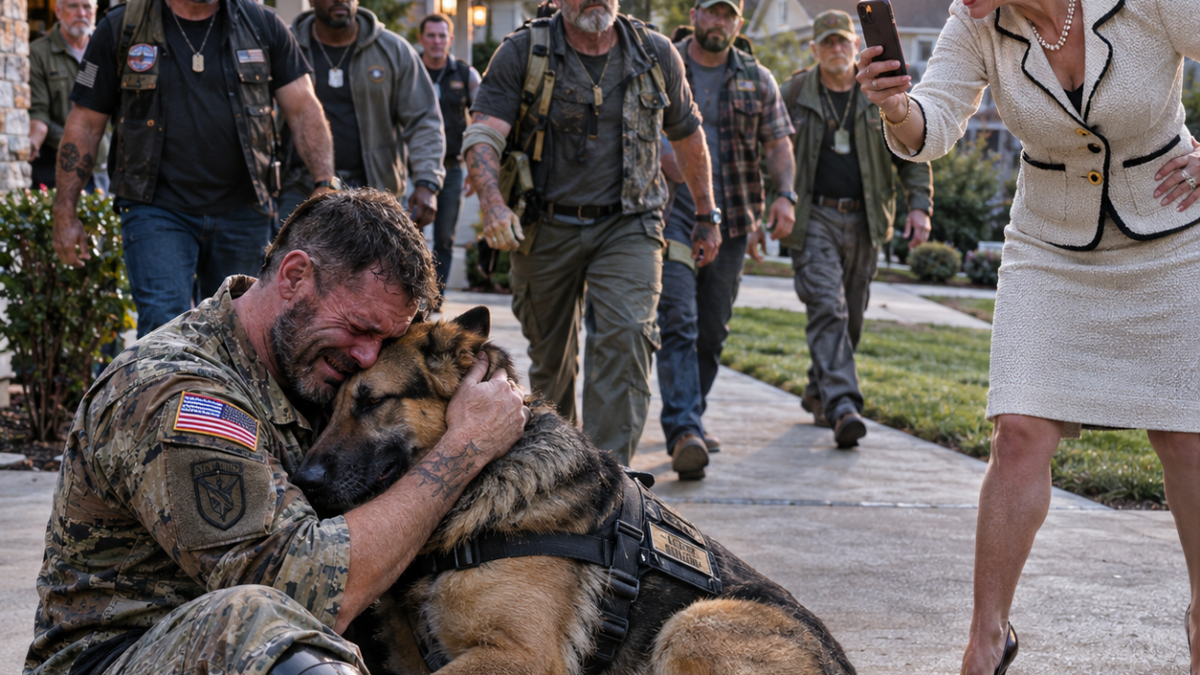
Fish was kneeling on the concrete.
Grizzly pressed against him.
At first, I couldn’t understand why animal control was there.
The dog looked calm.
Focused.
Working.
Then I heard Karen say:
“You’ve had three chances to register that animal properly.”
Fish shook his head.
“I submitted the forms.”
His voice trembled.
“Every time.”
Karen opened the folder.
“And every time, they were incomplete.”
He looked toward her.
“You wouldn’t tell me what was missing!”
She smirked.
“Not my responsibility to do your paperwork for you.”
I felt my stomach tighten.
Fish began breathing faster.
“Ma’am, please.”
Grizzly moved closer.
The veteran pressed one hand against the dog’s shoulder.
Karen pointed toward the officers.
“I’ve had enough. Remove the dog.”
That was the moment Fish dropped fully to his knees.
His hands shook.
His breathing became shallow and rapid.
And Grizzly immediately moved into position beside him.
I watched the dog lean his weight against Fish’s torso.
Nudge his hand.
Maintain contact.
Every movement seemed purposeful.
The kind of trained assistance I’d seen service dogs provide to people experiencing acute distress.
I looked toward Karen.
She wasn’t helping.
She wasn’t giving him space.
She was filming.
I approached carefully.
Daisy remained on a short leash at my side.
“Karen.”
She turned.
Her face tightened.
“What?”
I looked toward Fish.
“Does he need medical help?”
She rolled her eyes.
“He needs to follow the rules.”
I stared.
“That isn’t what I asked.”
Her voice sharpened.
“This is HOA business.”
I looked toward the animal control officers.
“Has anyone asked whether Grizzly is a service animal?”
The younger officer nodded.
“We’re reviewing the complaint.”
Karen interrupted.
“It’s an oversized German Shepherd.”
I looked at her.
“That doesn’t answer the question.”
She folded her arms.
“Dogs over twenty-five pounds require approval.”
I swallowed my anger.
“A service animal isn’t automatically subject to ordinary pet restrictions.”
Her face reddened.
“Don’t lecture me.”
I took a breath.
“Then please stop recording a man who’s clearly in distress.”
She looked offended.
“I’m documenting an enforcement action.”
I glanced toward her phone.
The camera was pointed directly at Fish.
He was crying.
Trying to breathe.
Clutching Grizzly.
I looked back at Karen.
“You don’t need to humiliate him.”
Her expression hardened.
“He’s humiliating himself.”
For a moment, I couldn’t speak.
Because there are certain things people say that reveal more about them than years of polite conversation ever could.
Karen had just shown me exactly how little compassion she possessed for someone who couldn’t defend himself at that moment.
Fish tried to stand.
His legs trembled.
He reached toward the side of his truck.
Grizzly shifted immediately.
The dog stayed against him.
Fish managed to lift himself a little.
Then his knees weakened.
He sank back onto the driveway.
“Please.”
His voice sounded almost childlike.
Not because he was weak.
Because he was terrified.
“Don’t take him.”
Karen sighed dramatically.
“Here we go again.”
The younger officer stepped closer.
“Sir, are you able to tell us what you need right now?”
Fish struggled to answer.
He looked toward Grizzly.
Then buried his face in the dog’s neck.
Karen snapped her fingers.
“Officer, I didn’t call you here to provide therapy.”
I stared.
She continued.
“I called you to enforce the animal regulations.”
The older female officer’s expression changed.
She moved slightly away from Karen.
“Ma’am, we need to assess animal welfare and the situation before taking any action.”
Karen looked furious.
“Fine. I’ll call the police.”
I took a breath.
“If someone needs emergency medical assistance, that should be the priority.”
She glared at me.
Then said the words that would draw half the neighborhood out of their homes.
“I’m tired of veterans thinking the whole world owes them special treatment.”
Fish went still.
Even through his distress, I could see that he’d heard her.
His eyes filled again.
And then he whispered:
“I never asked you for special treatment.”
His voice broke.
“I just asked you not to take my dog.”
The man in the wheelchair was named Griffin.
I’d seen him around the neighborhood many times.
He was broad-shouldered, silver-haired, and usually wore a faded military cap.
He lived three houses down from Fish.
There was an American flag hanging beside his garage.
A Purple Heart banner decorated one of the windows.
I’d occasionally spoken with him at neighborhood gatherings.
He had a dry sense of humor.
A firm handshake.
And the ability to make a person feel as though he was giving them his full attention.
That morning, there was nothing humorous about his expression.
He rolled toward Karen and stopped at a respectful distance.
“Ma’am.”
Karen turned.
“What?”
He looked toward Fish.
Then at Grizzly.
“That’s a working service dog.”
She folded her arms.
“It’s not registered with the association.”
Griffin’s jaw tightened.
“An HOA’s ordinary pet registration policy doesn’t give you the authority to seize someone’s disability-related assistance animal.”
Karen stared.
“I’m president of this HOA.”
Griffin nodded slowly.
“And I’m telling you that title doesn’t give you the power you seem to think it does.”
A few people nearby became very quiet.
Karen’s face reddened.
She raised her phone.
“I’m recording this.”
Griffin looked directly at her.
“Then record the whole thing.”
Her mouth opened.
He continued.
“Record yourself refusing to give a disabled man space during a medical crisis.”
Karen took a step backward.
Then pointed toward the other veterans.
“This is intimidation.”
A woman wearing an Army training shirt stepped forward.
“Kyla.”
That was the name printed on her shirt.
Her voice was calm.
“Ma’am, we’re standing in the public street and sidewalk area. We’re not threatening you.”
Karen shook her head.
“You’re interfering with an official HOA action.”
Kyla glanced toward Fish.
“No.”
She looked back at Karen.
“We’re asking you to stop interfering with a service dog while he’s helping his handler.”
The man with the prosthetic leg stood beside Griffin.
His name was Shawn.
He wore jeans and a faded gray T-shirt.
A metal prosthesis was visible below his right knee.
He looked toward the animal control officers.
Then toward Karen.
For a moment, he didn’t say anything.
Then he asked a simple question.
“Has the dog bitten anyone?”
The younger officer shook his head.
“There’s no report of a bite.”
“Has it attacked another animal?”
“Not in the information we have.”
Shawn looked toward Karen.
“Has Grizzly behaved aggressively toward a neighbor?”
She folded her arms.
“It’s a dangerous breed.”
Shawn stared.
“That’s not what I asked.”
Her face hardened.
“A large German Shepherd can be dangerous.”
He nodded.
“Any dog needs appropriate handling.”
Then he looked toward Grizzly.
“But that dog is doing exactly what he’s been trained to do.”
Karen rolled her eyes.
“I’m not taking advice from somebody who doesn’t understand association regulations.”
Shawn’s expression changed.
He took one slow breath.
Then said:
“I understand enough to know that you don’t get to rewrite disability accommodations because you dislike a dog.”
For a moment, Karen looked ready to scream again.
But the other veterans stood nearby.
Quiet.
Watching.
And for the first time, she seemed to realize that her familiar threats weren’t intimidating everyone into silence.
I looked back toward Fish.
His hands were trembling.
Grizzly leaned against him.
The dog moved his head toward Fish’s face, maintaining contact.
The veteran was trying to regulate his breathing.
But every time Karen raised her voice, he flinched.
I felt anger rise again.
Then I remembered my brother.
The way loud confrontations could make a difficult moment worse.
The way somebody’s attempt to help could become another source of distress if they crowded him.
I looked toward Griffin.
“Can somebody ask Karen to give him more room?”
Griffin nodded.
Then he turned toward the officers.
“Can we move this discussion away from the driveway while he recovers?”
The older female officer looked toward Fish.
Then nodded.
“That would be appropriate.”
Karen snapped.
“Absolutely not.”
Kyla looked at her.
“Why?”
Karen pointed.
“He needs to be present while we decide what happens to the animal.”
Griffin’s voice became firm.
“He’s having a medical episode.”
She stared.
He continued.
“Your paperwork can wait.”
For a moment, nobody moved.
Then the younger officer stepped forward.
“Ma’am, we’re not removing the dog at this time.”
Karen looked stunned.
“What?”
The officer remained professional.
“We need to verify the circumstances and follow the appropriate process.”
She stepped closer.
“I called you here!”
He nodded.
“We understand.”
“THEN DO YOUR JOB!”
His expression remained calm.
“We are.”
Karen’s face became almost purple.
She looked from one officer to the other.
Then at Griffin.
Then at Shawn.
Then toward Fish.
It was obvious she was losing the control she’d expected to have.
She raised her phone again.
“This is outrageous.”
Her voice shook.
“Veterans interfering with HOA enforcement. Animal control refusing to follow instructions. A resident openly defying community safety rules.”
Shawn took out his own phone.
Karen noticed.
“What are you doing?”
He looked at her.
“Documenting the interaction.”
She stared.
“You can’t record me!”
He raised an eyebrow.
“You’ve been recording everyone else.”
A few neighbors murmured.
Karen’s face tightened.
Shawn’s voice remained calm.
“I’m making sure there’s an accurate record of what happens.”
Karen looked away.
For a moment, her phone lowered.
Then she raised it again.
But something had changed.
Now she knew other people were watching her.
Not merely as an audience for her accusations.
As witnesses.
By six thirty, more neighbors had emerged.
Some stood on porches.
Others near their driveways.
A few approached carefully, asking what had happened.
The street had become crowded.
I counted at least a dozen people.
Then more.
A man in a bathrobe.
An older couple.
A woman carrying a travel mug.
Two residents who normally left for work before sunrise.
Their expressions ranged from confusion to concern.
But when they saw Fish sitting on the driveway with Grizzly pressed against him, most stopped talking.
The sight didn’t look like a dangerous animal being restrained.
It looked like a man who needed help.
And a dog working very hard to provide it.
Karen seemed to hate that people were drawing their own conclusions.
She raised her folder.
“EVERYBODY, LISTEN!”
A few people turned.
She continued.
“This resident has received three formal warnings.”
Fish lowered his head.
“He refused to comply with our procedures.”
Karen waved the folder.
“I have the paperwork right here.”
A woman approached from a nearby house.
I recognized her from HOA meetings.
She was known for reading every document carefully and asking questions Karen disliked.
“May I see those?”
Karen went still.
“What?”
“The rejection letters.”
The woman held out her hand.
“May I look at them?”
Karen’s expression tightened.
She glanced toward the crowd.
Then handed over the folder.
And for the first time that morning, somebody began examining the actual documents instead of simply accepting Karen’s description of them.
The woman read slowly.
Page by page.
She compared the rejection notices.
Then turned back to the first.
Her forehead creased.
Karen stood with her arms folded.
“Well?”
The woman didn’t answer immediately.
She read another paragraph.
Then asked:
“Which provision of the bylaws requires this particular document?”
Karen frowned.
“What?”
The woman pointed toward the page.
“You rejected the accommodation request for improper documentation.”
Karen nodded sharply.
“Correct.”
“But the rejection doesn’t identify the provision you relied on.”
Karen’s mouth tightened.
“I don’t have to explain every administrative decision to every resident.”
The woman remained calm.
“An accommodation request involving a service animal is not simply an ordinary pet registration issue.”
Karen looked angry.
She continued.
“The request needs to be considered under the applicable disability and housing requirements.”
Karen waved her hand.
“I know the rules.”
The woman looked toward the papers.
“Then can you explain the reason for rejecting his request three times?”
For a moment, Karen said nothing.
Then she answered:
“Because I didn’t consider the paperwork sufficient.”
The woman nodded.
“Under what written standard?”
Karen’s face reddened.
“I am the HOA president.”
The woman looked directly at her.
“That isn’t a written standard.”
The street became very quiet.
I glanced toward Fish.
He was sitting more upright.
Still pale.
Still exhausted.
But his breathing had slowed.
Grizzly remained pressed against his side.
The German Shepherd’s attention never seemed to drift far from his handler.
I could see Fish’s fingers moving gently through the dog’s fur.
One stroke.
Then another.
Then another.
The same slow movement, repeated.
Griffin rolled toward him.
“Fish?”
The veteran looked up.
“Yeah?”
Griffin’s voice softened.
“Keep breathing. Let the dog work.”
Fish nodded.
His lips trembled.
Griffin looked toward Grizzly.
“Good boy.”
The German Shepherd remained focused.
Fish swallowed.
Then whispered:
“I thought they were going to take him.”
Griffin’s face changed.
“I know.”
The veteran’s eyes filled again.
“I thought I was going to lose him.”
Griffin moved a little closer.
“Right now, he’s here.”
Fish looked down at Grizzly.
The dog pressed against him.
And for the first time since I’d arrived, the veteran’s shoulders began relaxing.
Shawn approached and crouched several feet away.
He moved carefully, maintaining enough space that Fish wouldn’t feel surrounded.
“Hey, brother.”
Fish looked toward him.
Shawn nodded at Grizzly.
“That’s a beautiful dog.”
Fish swallowed.
“Yeah.”
“What’s his name?”
“Grizzly.”
Shawn smiled faintly.
“Fits him.”
For a moment, Fish almost smiled.
Then his face crumpled.
“I’m sorry.”
Shawn shook his head.
“For what?”
Fish looked down.
“For all this.”
Shawn’s expression softened.
“You don’t owe anybody an apology for needing help.”
Fish wiped his face.
Then looked toward Shawn’s prosthetic leg.
Shawn noticed.
He touched his knee.
“Lost it in Kandahar.”
Fish stared.
Shawn continued.
“I had a dog named Ranger who helped me while I was learning to move around again.”
His voice was quiet.
“Ranger knew when I was struggling before I always recognized it myself.”
Fish listened.
Shawn smiled sadly.
“He’d come over, nudge my hand, and remind me to slow down.”
The veteran looked toward Grizzly.
Then whispered:
“That’s what he does.”
Shawn nodded.
“I figured.”
For a moment, neither man spoke.
Then Fish reached toward Grizzly’s head.
The dog leaned into his touch.
And I watched some of the tension leave the veteran’s face.
I looked down at Daisy.
She was sitting beside my leg.
Quiet.
Alert.
Her eyes followed the movement across the street.
For fifteen minutes, I’d been holding her leash so tightly that my hand had begun to ache.
I loosened my grip.
Then looked toward Fish.
Something occurred to me.
While everybody argued about paperwork, he’d been sitting on the concrete in front of a crowd of strangers.
His worst moment of the morning had become a neighborhood spectacle.
He needed privacy.
Support.
Space to recover.
Not another person demanding that he explain himself.
I looked toward Griffin.
Then toward the animal control officers.
The immediate argument seemed to be moving away from the driveway.
I made a decision.
I approached Fish slowly.
Stopped several feet away.
“Hey.”
He looked up.
“My name’s Alex.”
His eyes were red.
I gestured toward Daisy.
“This is Daisy.”
He looked at her.
Then nodded.
I crouched.
“Would it help if somebody stayed nearby while the others sort out the paperwork?”
For a moment, he didn’t answer.
Then he nodded again.
“Yeah.”
His voice sounded rough.
“Okay.”
I sat on the edge of the driveway at a respectful distance.
Daisy settled beside me.
Grizzly remained close to Fish.
For a while, nobody spoke.
The sun rose higher.
Birds called from the trees.
A car passed slowly.
And I sat there with a man who had survived six deployments but had nearly been overwhelmed by the fear of losing the dog who helped him face ordinary mornings.
Five minutes passed.
Maybe ten.
Fish’s breathing gradually became steadier.
He rested one hand against Grizzly’s shoulder.
The other lay on his knee.
His fingers still trembled occasionally.
But he no longer appeared to be struggling for every breath.
I didn’t rush him.
Didn’t ask questions about his military service.
Didn’t demand details about his condition.
I simply sat.
Then Fish spoke.
“I’m sorry you had to see that.”
I turned toward him.
“See what?”
He looked embarrassed.
“Me.”
His voice cracked.
“Like that.”
My heart tightened.
I thought about my brother.
How ashamed he sometimes felt after an episode.
How he apologized for things he couldn’t always control.
I shook my head.
“You don’t have to apologize to me.”
Fish looked down.
“I haven’t had one that bad in months.”
I nodded.
He continued.
“Usually Grizzly catches it earlier.”
The dog shifted slightly.
Fish stroked his fur.
“Today everything happened so fast.”
I looked toward the street.
“I noticed.”
He swallowed.
“She showed up with animal control.”
I waited.
“Before I could even understand what was happening, she told them to take him.”
His voice shook.
I remained quiet.
He looked toward Grizzly.
“I thought…”
He stopped.
Took a breath.
Then whispered:
“I thought I was going to be alone again.”
I felt my throat tighten.
I didn’t know what to say.
So I answered with the only thing I could say honestly.
“You’re not alone right now.”
Fish looked toward me.
For a moment, his eyes filled.
Then he nodded.
And rested his hand on Grizzly’s head.
Fish looked toward the front door of his house.
It stood half open.
A pair of boots rested near the welcome mat.
An American flag moved gently beside the porch.
Everything about the house looked ordinary.
Yet I wondered how much courage it sometimes took him just to step outside.
After a while, I asked whether he needed water or wanted me to contact anyone.
He considered the question.
Then pointed toward the porch.
“My phone’s inside.”
I nodded.
“Would you like me to get it?”
He hesitated.
Then shook his head.
“Not yet.”
I didn’t push.
We sat for another minute.
Then he looked at Daisy.
“She’s beautiful.”
I smiled.
“Don’t tell her that. She’s already impossible.”
For the first time, Fish laughed.
Just once.
A small, shaky sound.
But it was real.
He looked down at Daisy.
She wagged her tail.
I smiled.
“Her name’s Daisy.”
He nodded.
“Good name.”
Then he looked toward Grizzly.
“This big guy came into my life when I wasn’t sure I wanted to keep going.”
My smile faded.
I remained quiet.
Fish stroked the dog’s head.
“He gave me a reason to get out of bed.”
His voice trembled.
“A reason to leave the house.”
I watched Grizzly lean against him.
Fish continued.
“Some mornings, I don’t even notice what he’s doing until I realize I’m breathing normally again.”
He swallowed.
“People see a dog.”
I nodded.
“But he’s the reason I can do things they take for granted.”
I looked toward the street.
The quiet houses.
The passing cars.
The people heading toward work.
Then back at him.
“I believe you.”
Fish lowered his head.
And for a moment, I could see how much those three words mattered.
I’d known my brother during some of his hardest years.
The insomnia.
The sudden anxiety.
The days when ordinary noises seemed to carry him somewhere far away.
People often told him to move on.
To stop thinking about the past.
To remember that he was home now.
They meant well, most of them.
But they didn’t understand.
He knew where he was.
He knew the danger was over.
That didn’t always stop his nervous system from reacting.
Watching Fish that morning brought those memories back.
I remembered one evening when my brother had called me after midnight.
He couldn’t explain what was happening.
He kept apologizing.
I drove to his house.
Sat beside him.
Didn’t ask him to tell me everything.
Just stayed until he felt safe enough to rest.
Years later, he told me that what helped most was knowing he didn’t have to earn somebody’s patience.
I thought about that while sitting beside Fish.
Karen had treated his disability like an inconvenience.
Then a violation.
Then a spectacle.
But what he needed was the one thing she’d refused to give him.
A little dignity.
Down the street, the discussion continued near Griffin’s house.
I could see Karen gesturing angrily.
Her folder opened and closed.
Her phone appeared in her hand again.
But the argument was farther away now.
Fish couldn’t hear every word.
Neither could I.
For that, I was grateful.
After a while, the older animal control officer returned.
She approached slowly.
“Sir?”
Fish looked up.
She stopped at a respectful distance.
“My name is Officer Martinez.”
He nodded.
She continued.
“I want to check whether you’re feeling safe enough to speak.”
Fish looked toward Grizzly.
Then back at her.
“Yes.”
His voice was still rough.
She nodded.
“We aren’t taking your dog today.”
Fish went completely still.
For a moment, I thought he hadn’t understood.
Then his lips trembled.
“What?”
Officer Martinez repeated herself.
“We’re not removing Grizzly.”
The veteran stared.
She continued.
“We’re documenting the complaint and referring the accommodation questions for appropriate review.”
His eyes filled.
“That’s it?”
She spoke gently.
“For now, our immediate priority is making sure you’re okay.”
Fish looked down at Grizzly.
Then covered his face.
His shoulders began shaking.
For one terrible second, I thought another episode was beginning.
Then I realized he was crying with relief.
“Thank you.”
The words came out barely above a whisper.
Officer Martinez nodded.
“Do you need medical assistance?”
Fish took a slow breath.
He looked toward Grizzly.
Then toward me.
We gave him time to consider.
He explained that he had a care plan and wanted to contact his support provider.
Officer Martinez helped him understand what the animal control report would cover and how the complaint would be followed up.
She didn’t promise that every question was settled.
Didn’t pretend the paperwork could be resolved instantly.
But she also didn’t treat him like somebody who’d committed a crime merely by relying on a service dog.
When she finished, Fish looked toward her.
“I’m sorry this got so ugly.”
Her expression softened.
“You don’t need to apologize for seeking help.”
Then she looked toward Grizzly.
“He’s been very attentive to you.”
Fish smiled weakly.
“Always is.”
Officer Martinez nodded.
“Take care of yourself, sir.”
She stood.
Then returned to her vehicle.
Fish watched her go.
For the first time that morning, his hands looked almost steady.
Griffin rolled back toward us a little later.
Shawn walked beside him.
Kyla followed.
The other veterans remained nearby, giving Fish space.
Griffin stopped at the bottom of the driveway.
“How’re you doing, brother?”
Fish looked up.
“Better.”
Griffin nodded.
“Good.”
For a moment, they studied one another.
Then Fish’s face crumpled.
“I’m sorry you all had to come out here.”
Griffin stared.
“Are you kidding me?”
Fish looked down.
Griffin leaned forward.
“You hear somebody down the street needs help, you show up.”
His voice softened.
“That’s how this works.”
Fish wiped his eyes.
Shawn nodded.
“You’d do the same.”
For a moment, Fish didn’t answer.
Then he whispered:
“Yeah.”
Griffin smiled.
“Then we’re even.”
A small laugh moved through the group.
Not at Fish.
With him.
And something in the atmosphere changed.
The fear that had filled the driveway began giving way to the warmth of people who understood they didn’t have to face everything alone.
Kyla approached.
She carried a bottle of water.
“Would this help?”
Fish nodded.
“Thanks.”
She handed it to him.
Then looked toward Grizzly.
“Beautiful dog.”
Fish smiled faintly.
“His name’s Grizzly.”
She crouched at a respectful distance.
“Mind if I ask what work he does?”
Fish took a breath.
Then explained some of the tasks Grizzly performed.
Recognizing changes in his behavior.
Interrupting escalating distress.
Providing trained pressure and physical contact when appropriate.
Helping him remain oriented and recover enough to use his coping strategies.
Kyla listened.
Then nodded.
“Sounds like he’s very good at his job.”
Fish looked toward the dog.
His eyes filled.
“He is.”
She smiled.
Then asked whether he had copies of the accommodation request he’d submitted to the HOA.
Fish nodded.
“Inside.”
Griffin looked toward the house.
“We can help you organize them if you’d like.”
For a moment, Fish seemed uncertain.
Then he looked at each of us.
And said something that made my throat tighten.
“I didn’t think anybody around here cared.”
Nobody answered immediately.
Then Griffin smiled sadly.
“Brother, you live on a street with a whole lot of people who know what it means to need help.”
Fish lowered his head.
And cried.
We helped Fish inside once he felt ready.
His house was neat.
Almost painfully neat.
The shoes aligned beside the door.
A jacket hanging from a hook.
A small stack of mail on the kitchen counter.
A framed photograph of a military unit stood on a shelf.
Beside it was another photograph.
Fish and Grizzly.
The veteran was kneeling beside the German Shepherd in a grassy field.
Both looked happy.
I studied the picture.
Then turned toward Fish.
“That a recent photo?”
He smiled weakly.
“Last spring.”
I nodded.
“Good-looking pair.”
He laughed softly.
“Grizzly’s doing all the work.”
The dog settled beside his legs.
Fish sat on the sofa.
For a moment, he looked exhausted.
Not merely tired.
Completely drained.
As though the morning had taken more from him than he’d expected to have to give.
Griffin remained near the doorway.
Kyla helped gather the documents Fish wanted reviewed.
Shawn made sure he had what he needed.
Nobody searched through his belongings without permission.
Nobody made decisions for him.
He was an adult.
A veteran.
A homeowner.
And a man entitled to direct what happened in his own home.
That mattered.
Because Karen had spent the morning treating him as though he were incapable of knowing what he needed.
The accommodation paperwork was in a blue folder.
Fish had kept everything.
The original submission.
The follow-up correspondence.
The notices.
The three rejections.
I watched Kyla place the documents in order while Fish explained what had happened.
He’d informed the association that Grizzly was a service dog trained to assist with his disability.
He’d submitted supporting information.
Then received a rejection.
He asked what was missing.
Received a second notice.
Submitted additional material.
Then received another rejection.
Each time, the response seemed to shift.
First, Karen claimed Grizzly had not been properly registered.
Then she objected to his size.
Then she questioned whether the paperwork met association standards.
Fish looked toward the folder.
“I kept trying.”
His voice trembled.
“I wasn’t trying to avoid the rules.”
Griffin nodded.
“I know.”
Fish swallowed.
“I just wanted them to stop threatening to take him.”
The room grew quiet.
I looked at Grizzly.
He rested beside the sofa.
His ears moved occasionally.
His eyes remained on Fish.
And I found myself thinking how strange it was that the only being in the room who seemed completely unconcerned with status, titles, and paperwork was the one doing the most important work.
The veteran who had reviewed Karen’s documents earlier arrived with copies of the relevant association provisions.
She sat at the kitchen table.
The others gave her room.
She compared the paperwork again.
Then spoke carefully.
“These rejection letters raise serious concerns.”
Fish looked up.
She continued.
“The association needs to explain the basis for its decisions and consider the applicable disability-accommodation requirements.”
He nodded.
“Does that mean Grizzly can stay?”
She looked toward the dog.
Then back at him.
“I’m not going to promise a legal outcome without reviewing everything properly.”
His face tightened.
“But an HOA cannot simply treat a working service animal as an ordinary pet and ignore the relevant accommodation obligations.”
Fish looked down.
For a moment, he seemed close to tears again.
Then she added:
“You have options for challenging the way this was handled.”
Griffin nodded.
“And you won’t have to figure them out by yourself.”
Fish looked around the room.
Seven veterans.
A neighbor who had been walking his dog.
A woman willing to read the paperwork carefully.
People who’d gotten out of bed because they heard somebody needed help.
He swallowed.
Then whispered:
“I don’t know what to say.”
Griffin smiled.
“Start with a cup of coffee.”
For the first time all morning, Fish laughed without sounding frightened.
Karen didn’t disappear that day.
I wish she had.
Instead, she spent the next several hours trying to regain control.
She called board members.
Sent messages.
Complained that animal control had failed to enforce the rules.
And, according to several neighbors, began drafting a statement about an organized campaign of harassment against her.
But her version of events was becoming harder to maintain.
Too many people had witnessed what happened.
Too many residents had heard her insult Fish.
Too many had seen Grizzly working to help his handler while Karen continued filming.
And the documents were finally being examined.
Shawn preserved his recording.
Other witnesses wrote down what they remembered.
The animal control officers completed their report.
Fish retained copies of the notices and accommodation requests.
Nobody needed to exaggerate.
The facts were disturbing enough.
Two days later, Karen posted a message on the neighborhood Facebook page.
She described the incident as an effort to protect residents from large, potentially dangerous animals.
She claimed Fish had repeatedly failed to comply with established procedures.
She suggested the crowd of veterans had interfered with official enforcement.
Then she accused people of unfairly criticizing her for simply performing her duties.
What she didn’t mention was the medical crisis.
The service-dog tasks.
The way she’d continued recording after Fish asked her to stop.
Or the fact that animal control hadn’t removed Grizzly.
Several neighbors challenged her account.
Some had been present.
Others asked for the written policy.
One resident requested the specific reason Fish’s accommodation had been denied.
Another asked whether the HOA had obtained independent legal advice before contacting animal control.
At first, Karen answered angrily.
Then she stopped replying.
By the following afternoon, her original post was gone.
But the questions remained.
An emergency HOA meeting was called.
The announcement came on Thursday.
The meeting would take place the following Tuesday evening at the neighborhood clubhouse.
Normally, HOA meetings attracted ten or twelve people.
Sometimes fewer.
Most residents had learned that attending meant listening to Karen lecture them about grass, paint, and mailbox numbers.
But this meeting was different.
By seven o’clock, the room was crowded.
People stood along the walls.
Folding chairs filled the floor.
I sat beside Griffin.
Shawn and Kyla were nearby.
Fish arrived with Grizzly.
The dog wore his working harness.
He moved calmly beside his handler.
When they entered, several people turned.
Fish immediately looked uncomfortable.
I stood.
“Hey, Fish.”
He glanced toward me.
I smiled.
“There’s a seat here.”
He hesitated.
Then approached.
Grizzly settled beside his chair.
I noticed Fish breathe a little easier.
And I wondered how different his life might become if he no longer had to fear that every person he passed on the street was judging him.
Karen arrived five minutes late.
She wore a navy blazer.
Her hair was perfectly styled.
She carried the same thick folder she’d waved in the street.
For a moment, she looked almost confident.
Then she saw how many people were waiting.
Her smile tightened.
She took her place at the front.
Tapped the microphone.
And began.
“I want to make something very clear.”
The room fell quiet.
“Our association has always prioritized safety.”
A few residents exchanged glances.
Karen continued.
“Recent events have been deliberately misrepresented.”
I looked toward Fish.
His hand rested against Grizzly’s shoulder.
Karen pointed toward the audience.
“Certain individuals have attempted to intimidate the board into making exceptions.”
Griffin raised his hand.
Karen ignored him.
She continued.
“If we allow one person to ignore the rules, how can we enforce them against anyone else?”
Griffin raised his hand again.
This time, a board member noticed.
“Mr. Griffin?”
Karen looked irritated.
He rolled slightly forward.
“Thank you.”
His voice was calm.
“I have a question.”
Karen folded her arms.
“Go ahead.”
He looked toward the board.
“What specific authority did the association rely on when it attempted to have animal control remove Fish’s service dog?”
The room went completely silent.
Karen stared at him.
Then smiled tightly.
“As president, I am responsible for enforcing our community standards.”
Griffin nodded.
“That wasn’t my question.”
Her smile disappeared.
He continued.
“What written authority allowed you to order the removal of a disability-related assistance animal without completing an appropriate accommodation review?”
Karen looked toward the other board members.
One adjusted his glasses.
Another looked down at her notes.
Karen cleared her throat.
“The dog exceeded the weight limit.”
Kyla raised her hand.
The board recognized her.
She spoke calmly.
“A general pet weight limit doesn’t automatically resolve a service-animal accommodation request.”
Karen’s face reddened.
Kyla continued.
“Was Fish’s request referred for proper review?”
Silence.
“Did the board obtain qualified advice?”
Karen folded her arms.
“We don’t need outside people telling us how to run our neighborhood.”
A murmur moved through the audience.
Kyla looked directly at her.
“An HOA isn’t exempt from applicable law because its president dislikes outside advice.”
Karen opened her mouth.
But another board member interrupted.
“Karen, we need to answer these questions.”
She turned sharply.
“Excuse me?”
The woman held up a copy of the accommodation correspondence.
“I’ve reviewed the file.”
Karen looked furious.
“And?”
The board member took a breath.
“There are significant problems with how these requests were handled.”
For the first time, Karen appeared uncertain.
Fish sat completely still.
I could see his hand trembling against Grizzly’s fur.
The dog shifted closer.
Not dramatically.
Just enough to maintain contact.
I leaned slightly toward Fish.
“You okay?”
He nodded.
Then whispered:
“Trying.”
I didn’t ask anything else.
At the front, the board member continued.
“The rejection letters don’t clearly explain the standards applied.”
Karen stared.
She continued.
“And several of the stated reasons appear inconsistent with the process required for disability accommodations.”
The room became quiet.
Someone near the back asked:
“Why was animal control called before those questions were resolved?”
Karen snapped:
“Because that dog is huge!”
For a moment, nobody spoke.
Then Griffin looked toward her.
“That’s your explanation?”
She looked furious.
He continued.
“You threatened to separate a disabled veteran from his working service dog because the dog was large?”
Karen pointed toward him.
“Don’t twist my words!”
He shook his head.
“I don’t have to.”
The room fell silent.
He looked toward the board.
“Everybody here saw what happened.”
Then he spoke the words I think most of us had been waiting to hear.
“This was never just about the dog’s weight.”
Karen went pale.
Griffin continued.
“It was about one person believing she had the power to decide whose needs mattered.”
Fish slowly raised his hand.
The room quieted.
The board chair recognized him.
For a moment, he didn’t speak.
I could see how difficult it was for him to sit there.
The morning confrontation had frightened him badly.
Now he was surrounded by neighbors, all waiting to hear his voice.
Grizzly rested close to his leg.
Fish looked down at him.
Took a breath.
Then raised his eyes.
“My name is Fish.”
His voice was quiet.
“I served six deployments.”
A few people shifted.
He continued.
“I came home with problems I didn’t know how to explain.”
His voice trembled.
“For a long time, I tried to handle everything alone.”
He looked toward Grizzly.
“Then this dog came into my life.”
The room was silent.
Fish swallowed.
“He helps me recognize when I’m becoming overwhelmed.”
His hand moved gently over Grizzly’s head.
“He helps me use the things I’ve learned in treatment.”
His eyes filled.
“And he makes it possible for me to do ordinary things.”
He looked toward the audience.
“Go to the grocery store.”
A pause.
“Take a walk.”
Another.
“Come outside when the sun is shining.”
His voice broke.
“I know that may not sound like much to some people.”
He looked down.
“But for me, those things matter.”
I felt tears gathering.
Fish continued.
“I submitted the paperwork because I wanted to do everything properly.”
He swallowed.
“When it was rejected, I tried again.”
His eyes filled.
“And again.”
He looked toward Karen.
“I wasn’t asking to ignore the rules.”
His voice cracked.
“I was asking for a reasonable way to live in my home with the dog who helps me.”
For a moment, nobody moved.
Then Fish whispered:
“The morning animal control came, I thought I was losing him.”
He placed his hand on Grizzly’s shoulder.
“And I was terrified.”
Karen opened her mouth.
But the board chair raised a hand.
“Let him finish.”
She stared.
For the first time in years, Karen Harrove was being told to remain quiet while somebody else spoke.
Fish looked down at Grizzly.
Then back toward the board.
“I don’t want anyone punished just because I’m upset.”
His voice trembled.
“I don’t want a fight with my neighbors.”
A tear rolled down his cheek.
“I want to be able to walk outside without being afraid somebody is going to take him away.”
He paused.
“And I don’t want another person to go through what happened to me.”
The room remained silent.
Then he sat back.
Grizzly leaned gently against his leg.
Fish stroked his fur.
And I watched him breathe out slowly.
He’d done it.
Not perfectly.
Not without trembling.
But he’d spoken.
And everybody had listened.
The meeting lasted almost three hours.
The board reviewed the available documents.
Discussed the need for a proper accommodation process.
Heard statements from witnesses.
And addressed Karen’s conduct during the confrontation.
An attorney consulted by the association had advised that the matter required careful handling under applicable fair-housing and disability protections.
The board was not entitled simply to treat a trained service animal as an ordinary pet subject to a blanket weight restriction.
Nor could the president unilaterally order animal control to seize a resident’s dog merely because she had rejected paperwork.
The exact facts still needed to be documented and evaluated.
But it was clear that the earlier process had been seriously flawed.
Eventually, the board announced that Fish’s accommodation request would be reconsidered promptly through the appropriate procedure and that no enforcement action would be taken against Grizzly based solely on the disputed weight restriction while the matter was reviewed.
The board also voted to remove Karen from the role she held in handling accommodation requests, pending further governance review.
Karen stood.
Her chair scraped loudly against the floor.
“This is unbelievable!”
Nobody answered.
She pointed toward Fish.
“He caused all of this!”
I felt my anger rise.
But before I could speak, Griffin turned toward her.
“No.”
His voice was steady.
“You made decisions.”
Karen stared.
He continued.
“Now you’re being asked to answer for them.”
She looked toward the board.
Then the audience.
Then back at Fish.
For a moment, she seemed to search for somebody who would take her side.
Nobody did.
She grabbed her folder.
And walked out.
When the meeting ended, Fish remained seated.
People approached slowly.
Some thanked him for speaking.
Others apologized for not realizing what had been happening.
A few simply introduced themselves.
Grizzly remained calm beside his handler.
I watched Fish look from one person to another.
His expression was complicated.
Relief.
Exhaustion.
And something like disbelief.
Griffin rolled over.
“Good job, brother.”
Fish shook his head.
“I was shaking the whole time.”
Griffin smiled.
“So?”
Fish looked up.
Griffin continued.
“Courage isn’t the absence of fear.”
He touched the armrest of his wheelchair.
“Sometimes it’s doing something important while your hands are shaking.”
Fish’s eyes filled.
Then he smiled.
A small smile.
But genuine.
I looked toward Grizzly.
The dog leaned against Fish’s leg.
And I thought about the morning when that same man had been crying on his driveway, afraid that he would lose the one companion who helped him face the world.
Now he was surrounded by people who knew his name.
And wanted him to stay.
The following weeks brought changes.
Not dramatic changes.
No television crews.
No courtroom speeches.
No mysterious millionaire arriving to save the day.
Just ordinary people doing the work that should have been done before the confrontation ever happened.
The association arranged a proper review of Fish’s accommodation request.
The relevant paperwork was examined.
The training and tasks Grizzly performed were considered as part of the appropriate assessment.
And the association confirmed that Grizzly could remain with Fish under the approved accommodation.
When Fish received that confirmation in writing, he called Griffin first.
Then Shawn.
Then Kyla.
Then, to my surprise, me.
I was sitting at my kitchen table when the phone rang.
“Hello?”
A pause.
Then a familiar voice.
“Alex?”
I smiled.
“Fish?”
“Yeah.”
He sounded nervous.
“I wanted to tell you something.”
My stomach tightened.
“What happened?”
He took a breath.
“Grizzly can stay.”
For a moment, I couldn’t speak.
Then I leaned back in my chair.
“Oh, man.”
My eyes filled.
“That’s wonderful.”
Fish laughed.
A strange, shaky laugh.
Then his voice broke.
“They put it in writing.”
I swallowed.
“Good.”
He continued.
“I read it three times.”
I smiled through tears.
“I probably would’ve, too.”
There was a pause.
Then I heard something in the background.
A soft bark.
Fish laughed.
“That’s Grizzly.”
I smiled.
“Tell him congratulations.”
Another pause.
Then Fish whispered:
“Thank you for staying with me that morning.”
My throat tightened.
I looked toward Daisy sleeping near the kitchen door.
“Of course.”
He swallowed.
“I don’t think I could’ve handled being alone afterward.”
For a moment, I remembered sitting beside him on the driveway.
The sunlight warming the concrete.
The trembling hands.
The dog pressed against his side.
The way he’d apologized for something he couldn’t simply choose to stop experiencing.
I took a breath.
“I’m glad I was there.”
Fish was quiet.
Then he said:
“Me, too.”
Karen’s position within the HOA changed permanently.
After reviewing the incident and the governance concerns it raised, the association selected new leadership through its procedures.
Karen no longer oversaw accommodation requests.
Her authority to issue or direct enforcement notices was removed.
The board adopted clearer requirements for documenting complaints and explaining decisions.
Members were instructed to seek qualified advice when disability-accommodation issues arose.
The association also clarified that enforcement decisions could not be made solely on the president’s personal preference.
Some residents wanted Karen punished more harshly.
Others thought the public embarrassment had already been enough.
But for me, the most important change was practical.
She could no longer wake up one morning, decide she disliked a resident’s service dog, and use her title to demand that somebody take it away.
That was what mattered.
I saw Karen once several weeks later.
She was standing near the community mailbox.
I had Daisy on her leash.
The morning was cool.
The street quiet.
Karen noticed me immediately.
Her expression hardened.
For a moment, I thought she would say something.
Instead, she looked away.
I could have confronted her.
Asked whether she regretted humiliating Fish.
Reminded her how close she came to creating an even more dangerous situation.
Told her that the whole neighborhood knew what she’d done.
But I didn’t.
I continued walking.
Because the point had never been to win a personal argument with Karen.
It had been to stop her from hurting someone who needed protection.
And Grizzly was still with Fish.
That was the outcome I cared about.
The neighborhood began changing in smaller ways, too.
People stopped treating Fish like a mysterious man who kept to himself.
They greeted him.
Invited him to community gatherings.
Asked whether he wanted company on walks.
Nobody demanded that he explain his military experiences.
Nobody treated his disability as a public curiosity.
They simply began including him.
Sometimes he accepted.
Sometimes he declined.
And people respected both answers.
I noticed the difference one Saturday morning.
Fish was walking Grizzly along the sidewalk when Helen, an elderly neighbor, came out to water her flowers.
She smiled.
“Morning, Fish.”
He nodded.
“Morning.”
Then she looked toward Grizzly.
“Morning, handsome.”
The dog remained focused on his handler.
Helen smiled.
“Working hard today?”
Fish laughed.
“He always is.”
She nodded.
“Well, you two have a beautiful morning.”
Then she returned to her flowers.
It was such a small exchange.
But I watched Fish continue walking with his shoulders a little more relaxed.
And I understood how powerful ordinary kindness can become when somebody has spent a long time expecting rejection.
The seven veterans began meeting regularly.
Sometimes at Griffin’s house.
Sometimes at the park.
Sometimes simply on somebody’s porch with coffee.
They weren’t an official organization.
Didn’t have a president.
Didn’t collect dues.
They just checked on one another.
Shawn brought stories about Ranger.
Kyla helped organize community resources.
Griffin seemed to know somebody who could answer almost any practical question.
And Fish began joining them.
At first, he stayed quiet.
He listened.
Smiled occasionally.
Let Grizzly rest beside his chair.
But gradually, he began talking more.
About the military.
About his dog.
About woodworking projects he wanted to finish.
About things he’d enjoyed before the worst years of his struggles.
I watched the change.
Not because his PTSD had disappeared.
It hadn’t.
And nobody expected it to.
But he no longer seemed to believe he had to face every difficult day alone.
One afternoon, Griffin invited me over.
The veterans were sitting in his backyard.
Grizzly lay near Fish.
Daisy settled beside my chair.
The sun was warm.
Someone had brought sandwiches.
Shawn was telling a terrible joke.
Everyone groaned.
Then laughed.
I looked toward Fish.
He was smiling.
Not a forced smile.
A genuine one.
His eyes were bright.
He looked comfortable among the people around him.
For a moment, I remembered the man I’d first seen on his knees in the driveway.
Shaking.
Crying.
Trying desperately to stop someone from taking his dog.
The difference almost made me emotional.
Fish noticed.
“What?”
I shook my head.
“Nothing.”
He smiled.
“Come on.”
I laughed softly.
“It’s just good seeing you happy.”
His expression changed.
He looked down at Grizzly.
Then back toward his friends.
“Yeah.”
He swallowed.
“It’s good being here.”
Griffin raised his coffee cup.
“To that.”
We lifted ours.
And for a moment, everything felt wonderfully ordinary.
Later, Fish and I stood near the backyard fence.
Grizzly remained beside him.
Daisy was lying in the shade.
The others were still talking.
Fish looked toward me.
“Alex?”
“Yeah?”
He hesitated.
“Do you remember what I said on the driveway?”
I looked at him.
“You said a lot that morning.”
He smiled faintly.
Then his expression grew serious.
“I told you Grizzly was all I had.”
My throat tightened.
I nodded.
“I remember.”
He looked toward the house.
The voices.
The laughter.
The people who had come to help him without expecting anything in return.
Then he turned back to me.
“I don’t think that’s true anymore.”
For a moment, I couldn’t speak.
Fish’s eyes filled.
He looked down at Grizzly.
“I still need him.”
He stroked the dog’s head.
“I love him more than I can explain.”
His voice trembled.
“But now…”
He looked toward Griffin’s house.
“Now I know there are people I can call.”
I smiled through tears.
“Yeah.”
He swallowed.
“There are.”
Months later, I was walking Daisy at six in the morning again.
Same street.
Same cool air.
Same quiet neighborhood.
The sun was just beginning to rise.
As I approached Fish’s driveway, I saw him standing near his truck.
Grizzly sat beside him.
The dog wore his working harness.
Fish looked up.
“Morning, Alex.”
I smiled.
“Morning.”
He glanced toward Daisy.
“Morning, girl.”
Daisy wagged her tail.
I stopped a few feet away.
“How’re you doing?”
Fish considered the question.
Then smiled.
“Pretty good.”
I nodded.
“Glad to hear it.”
He looked toward the street.
Then said something that stayed with me.
“You know what I did yesterday?”
I smiled.
“What?”
“Went to the hardware store.”
I raised an eyebrow.
“Big adventure.”
He laughed.
“Yeah.”
Then his voice softened.
“First time in a while I went without spending the whole morning worrying about whether I’d run into somebody who’d make a problem out of Grizzly.”
My smile faded.
Fish looked toward his dog.
“He did great.”
Grizzly looked up at him.
Fish stroked his head.
“And I did pretty good, too.”
I felt tears gathering.
“Sounds like you both did.”
He nodded.
Then smiled.
“Yeah.”
For a moment, we stood together in the early morning light.
Two neighbors.
Two dogs.
A quiet street.
Nothing extraordinary.
And somehow, after everything that had happened, it felt extraordinary to me.
I sometimes think about how close that morning came to becoming something much worse.
Karen had treated a medical crisis like a disciplinary hearing.
She had raised her phone while Fish begged.
She had insulted him in front of strangers.
And she had demanded that the officers remove the dog without giving proper consideration to the animal’s role.
Fish was overwhelmed.
Frightened.
Unable to defend himself in the way he might have on a better day.
Grizzly was doing his job.
Yet the person with the loudest voice kept insisting the dog was the problem.
I wonder what might have happened if Griffin hadn’t come outside.
If Shawn and Kyla hadn’t joined him.
If the officers hadn’t stopped to assess the situation.
If nobody had challenged Karen’s version of events.
I can’t know.
And I don’t want to invent an answer.
But I know what did happen.
People showed up.
They spoke calmly.
They insisted on a fair process.
They protected Fish’s dignity.
And they gave him time to recover with his service dog beside him.
That mattered.
More than any argument.
More than any social-media post.
More than any HOA title.
I’ve never forgotten Karen’s expression when she turned and saw those seven veterans standing nearby.
Not angry enough to become violent.
Not frightened enough to retreat.
Just determined.
Seven people who understood something she didn’t.
That service doesn’t always end when someone takes off a uniform.
Sometimes it continues in ordinary neighborhoods.
In quiet acts of support.
In bringing somebody a bottle of water.
In checking whether a friend is okay.
In standing beside a person who’s being treated unfairly.
In making sure somebody isn’t forced to face a frightening moment alone.
The veterans didn’t save Fish by threatening Karen.
They helped by refusing to let her turn his suffering into a spectacle.
And by insisting that the people responsible for making decisions follow the appropriate process.
I also think about Grizzly.
That enormous German Shepherd.
His thick fur.
His focused eyes.
The way he moved against Fish when the trembling became severe.
The way he remained close even when strangers crowded the driveway.
He never understood the HOA letters.
The weight limit.
The arguments about registration.
He didn’t know who Karen was or what authority she claimed.
He knew his person needed help.
And he did the work he’d been trained to do.
That was enough.
In all the chaos of that morning, the dog understood his responsibility more clearly than the woman who claimed to be responsible for the entire neighborhood.
Last weekend, we held a small barbecue at Griffin’s house.
Fish was there.
Shawn.
Kyla.
The other veterans.
Several neighbors.
Someone brought hamburgers.
Someone else brought potato salad.
Griffin insisted he was in charge of the grill, despite everybody’s concern about his questionable cooking skills.
We laughed.
Daisy slept beneath my chair.
Grizzly rested quietly beside Fish.
At one point, I looked across the yard.
Fish was laughing at something Shawn had said.
His head was tilted back.
His eyes were bright.
And I realized I couldn’t remember the last time I’d seen him look so relaxed.
For a moment, I became emotional.
Then Griffin noticed.
“Alex?”
I looked up.
“Yeah?”
He nodded toward Fish.
“Pretty good sight, isn’t it?”
I swallowed.
“Yeah.”
My voice broke.
“Pretty good.”
Griffin smiled.
Then looked toward the yard.
“For a while, he thought nobody cared.”
I nodded.
Griffin’s expression softened.
“Sometimes people just need somebody to show them otherwise.”
This morning, I was standing on my porch when Fish walked past with Grizzly.
The German Shepherd moved calmly beside him.
His harness was secure.
His eyes alert.
Fish looked toward me.
Raised one hand.
“Morning!”
I smiled.
“Morning, brother.”
He laughed.
Then continued down the sidewalk.
I watched them for a moment.
The man.
The dog.
The quiet morning.
No shouting.
No animal control truck.
No camera pointed at a frightened face.
No HOA president threatening to take away the animal who helped him live independently.
Just a veteran walking his service dog on his own street.
The kind of ordinary freedom most of us rarely stop to appreciate.
I looked toward Daisy.
She was waiting beside the front door.
I picked up her leash.
“Ready, girl?”
She wagged her tail.
I smiled.
Then stepped outside.
I don’t know whether Karen ever truly understood what she’d done.
Maybe she still believes she was simply enforcing the rules.
Maybe she thinks the neighbors turned against her unfairly.
Maybe she remembers the incident as the day seven veterans embarrassed her in front of the community.
But that’s not how I remember it.
I remember a disabled man on his knees.
His hands shaking.
His breathing broken.
His face wet with tears.
I remember a German Shepherd pressing against him while a woman threatened to take him away.
I remember the terrible fear in Fish’s voice when he begged:
“Please. He’s all I have.”
Then I remember the sound of doors opening.
One.
Then another.
Then another.
And seven veterans emerging from their homes because somebody nearby needed help.
I remember Griffin rolling forward.
Shawn standing beside him.
Kyla speaking calmly.
The officers taking the time to assess the situation.
Neighbors beginning to ask questions.
And Fish slowly realizing that the people gathering around him were not there to condemn him.
They were there to help.
There is one thing I know now that I didn’t understand before that morning.
Sometimes people who have survived extraordinary hardship are still frightened of ordinary cruelty.
A harsh voice.
A threat.
A public humiliation.
The possibility of losing someone or something they depend on.
Those things can hurt deeply, even when they happen on a quiet street in broad daylight.
And sometimes the most important thing another person can do is refuse to look away.
Not rush in with threats.
Not turn someone’s pain into a performance.
Not pretend to understand everything they’re experiencing.
Simply recognize that a human being needs help.
Ask what they need.
Respect their dignity.
And stay when staying is welcome.
I began that morning expecting nothing more than a peaceful walk with my dog.
I had no idea I would hear a veteran begging for the one companion who helped him face the world.
No idea I would watch our HOA president threaten him while his service dog worked to keep him grounded.
And no idea that seven veterans living quietly among us would step outside and remind the entire neighborhood what solidarity could look like.
But I will never forget it.
Because when Karen ordered the officers to take Grizzly away, she thought Fish was alone.
She thought his fear made him powerless.
She thought the HOA title beside her name gave her the right to decide what support he deserved.
She was wrong.
And when those seven veterans appeared, she finally discovered that a man can be frightened, overwhelmed, and struggling—and still be surrounded by people willing to stand beside him.
I look down the street now.
Fish and Grizzly are walking beneath the morning sun.
The dog’s tail moves gently.
Fish’s shoulders are relaxed.
Then he stops.
Turns.
And waves.
I wave back.
For a moment, I remember the man who couldn’t lift himself from his own driveway.
Then I see the man standing before me now.
Still living with the difficulties that followed him home.
Still working through them.
Still needing Grizzly.
But no longer believing that nobody will come when he needs help.
I smile.
And watch them continue down the street.
Karen thought she could take away a disabled veteran’s service dog because she controlled the HOA. She never imagined that the moment she tried to separate Fish from Grizzly, seven veterans would come out of their homes and refuse to let his suffering be treated like a violation notice.
And in the end, the greatest victory wasn’t watching Karen lose her authority. It was seeing Fish walk down his own street with Grizzly beside him, knowing that the dog who helped him survive was safe—and that he had finally found a community willing to stand with him, too.








