PART2:“GET OUT OF MY WAY, OLD MAN—300 WEDDING GUESTS ARE PAYING TO USE YOUR BARN!” HOA Karen Secretly Rented My Lakefront Property for $8,400—Until the Fire Marshal Discovered What She Had Hidden Behind My Signature
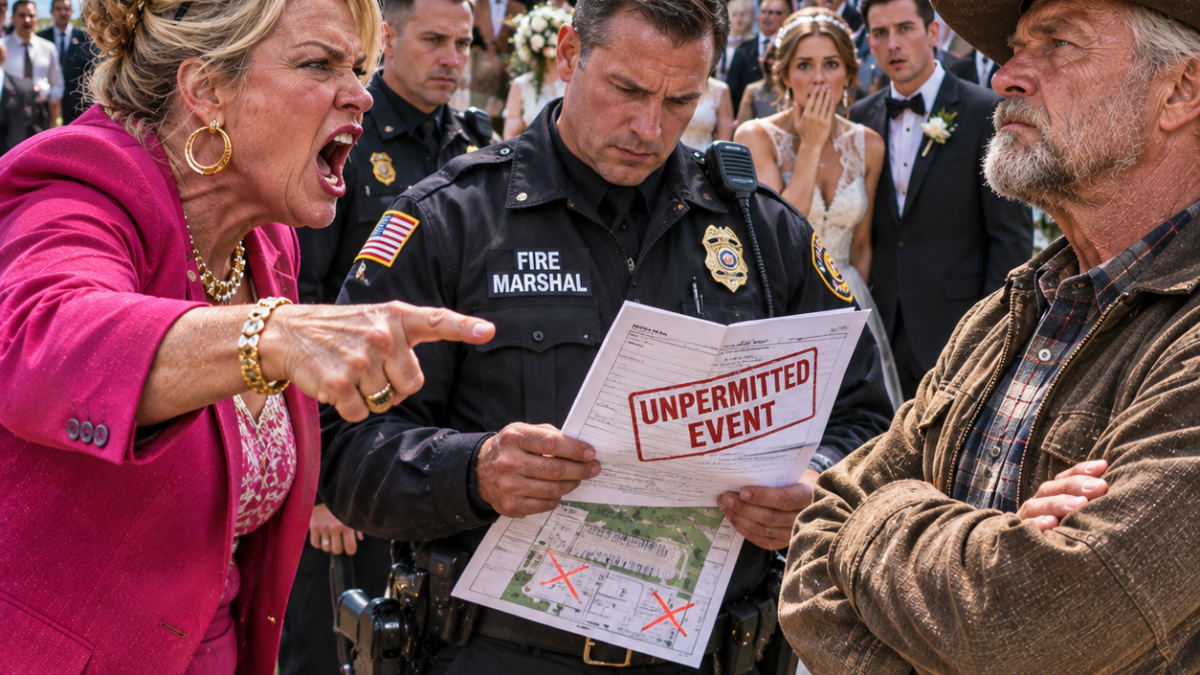
My name is Frank Mercer.
I was sixty-six years old when Patricia Bell decided that being president of a homeowners association gave her the right to rent out a building she didn’t own.
I’d spent most of my adult life repairing heating and cooling systems.
Furnaces in the middle of January.
Air conditioners in August.
Boilers that picked the coldest night of the year to quit.
It wasn’t glamorous work, but it paid the bills, helped raise my daughter, and taught me something important about people.
Whenever somebody told me a difficult problem was “just a little misunderstanding,” I learned to look for the part they were hoping I wouldn’t notice.
Patricia Bell was very good at creating misunderstandings.
She could turn a written rule into a personal favor.
A favor into an obligation.
And an obligation into something she claimed you had already agreed to.
For years, most people in Willow Point had found it easier to say yes than argue with her.
My father had never been one of those people.
Neither was I.
Our lakefront barn stood on a narrow strip of property beside Willow Point, a residential development overlooking a beautiful stretch of water in Texas.
The subdivision had an HOA.
My house belonged to that association.
But the barn and the land beneath it were separate.
My father had kept that piece when he sold the surrounding residential lots decades earlier.
It had its own legal description.
Its own recorded ownership history.
And one very simple rule.
It belonged to the Mercer family.
Not the HOA.
Not Patricia.
Not anybody who happened to think the lake view would make a nice wedding photograph.
Dad had once operated a small boat repair business there.
He called it Mercer Landing.
When I was a boy, I spent weekends watching him repair wooden hulls, sand damaged boards, and coax old outboard motors back to life.
He worked beneath heavy timber beams that he’d reinforced himself.
He installed the broad front doors because some boats were too large to fit through anything smaller.
The stone foundation was older than I was.
And the workbench along the back wall was something he built from oak planks salvaged from a demolished farmhouse.
Dad used to say that a good workbench should outlive the man who made it.
His certainly had.
After he died, I stopped repairing boats for customers.
I converted the front half of the barn into my woodworking shop.
The rear still held his tools, old shelves, and equipment that reminded me of him.
A little wooden ruler sat above the bench.
One edge was worn smooth from years inside his work apron.
On the wall beside it were pencil marks showing how tall Rachel had been each summer as she grew up.
Those marks meant more to me than almost anything else in that building.
I remembered Dad lifting Rachel onto the workbench when she was four.
“Stand straight, peanut.”
“I am straight, Grandpa!”
“Then stop standing on your toes.”
He would laugh, put the ruler against her head, and draw another small line.
Every summer, another mark.
Another date.
Another little piece of our family preserved in pencil.
By the time Patricia started talking about using the barn for community events, Dad had been gone for years.
Rachel was grown.
And I was spending my retirement building cabinets, repairing furniture, and enjoying the rare luxury of choosing my own schedule.
I didn’t mind helping neighbors.
When Willow Point held its annual lake cleanup, I let volunteers use part of my lawn for a refreshment table.
Dad had previously allowed the association to store cleanup gloves and trash bags inside a small cupboard attached to the outside wall of the barn.
He had even permitted them to keep a key for that limited purpose.
That was the kind of man he was.
If people were doing something useful for the neighborhood, he wanted to make it easier.
Unfortunately, he had installed a lock that used the same key for the exterior cupboard and the barn’s main doors.
I should have changed it when he died.
I didn’t.
For years, nobody abused the arrangement.
Then Patricia Bell became HOA president.
And she began treating every neighbor’s generosity as a resource she could control.
The first warning came six days before the wedding.
I was carrying a cabinet door across the yard when a delivery truck stopped at my gate.
Two workers climbed into the back and began loosening the straps holding stacks of white folding chairs.
The driver approached me with a tablet.
“Mr. Mercer?”
“That’s me.”
“Where do you want these unloaded?”
I stared at him.
“What are they?”
“Wedding chairs.”
“Then you’ve got the wrong address.”
He checked his screen.
“Mercer Landing. Lake Road. That’s what I’ve got.”
“That’s my address. But I didn’t order any chairs.”
The driver looked over his shoulder.
“Sir, somebody’s expecting a large delivery.”
“Not here.”
He turned his tablet toward me.
The customer name read Bell Lakeside Events.
Below it was a note.
OWNER WILL PROVIDE ACCESS.
I felt my stomach tighten.
“Who placed this order?”
“Patricia Bell.”
Of course.
I asked the driver to stop his workers from unloading anything.
He called the number on the order.
Five minutes later, Patricia’s white SUV came speeding down the shared lake road.
She climbed out wearing sunglasses and a bright smile.
“Oh, good, Frank. You’re home.”
I pointed toward the truck.
“Why are there wedding chairs at my gate?”
She barely glanced at the delivery.
“They’re early. I told them Friday.”
“That wasn’t my question.”
Her smile faded.
“Frank, please don’t make this difficult.”
I looked at the driver.
“Nothing gets unloaded.”
He nodded and motioned toward his crew.
Patricia waited until they stepped away.
Then she lowered her voice.
“It’s one wedding.”
“Whose wedding?”
“A lovely young couple. They lost their original venue because of a plumbing emergency. We’re helping them.”
“Who is ‘we’?”
“The community.”
“Did the community buy my barn?”
Her mouth tightened.
“You don’t have to be sarcastic.”
“Then don’t tell me the community can rent property it doesn’t own.”
She sighed dramatically.
“We discussed community events last spring.”
“We discussed putting a refreshment table on my lawn for the lake cleanup.”
“Exactly.”
“Outside.”
“Frank—”
“For one afternoon. With volunteers. Not three hundred wedding guests.”
She glanced toward the truck again.
“Nobody said three hundred.”
I stared at her.
“How many people are coming?”
“That’s not important.”
“How many?”
“It’s a decent-sized wedding.”
“Patricia.”
She looked away.
“I don’t have the final count.”
That should have frightened me more than it did.
At that moment, I was mostly angry.
I thought Patricia had made an irresponsible promise and was trying to bully me into covering for her.
I hadn’t yet considered that she’d already collected money.
Or that she had been bringing strangers through my building.
Or that she might have copied my signature.
I told her clearly that she had no permission to use the barn, the porch, or the yard for a wedding.
Then I asked for the couple’s contact information.
“I’ll talk to them myself.”
“No,” Patricia replied sharply. “You’ll only upset them.”
“They’re going to be more upset when they arrive here and discover the barn isn’t available.”
“I’ll handle it.”
“Then handle it somewhere else.”
The driver approached with his tablet.
“Sir, can you sign that you refused delivery?”
I read the note carefully.
It said only that the delivery had been refused by the property owner.
I signed it.
Asked him to email me a copy.
And watched the truck leave with every chair still aboard.
Patricia stood beside her SUV, furious.
“There are people depending on me, Frank.”
“Then you should’ve asked before promising them somebody else’s property.”
She slid on her sunglasses.
“You really have no idea how selfish you sound.”
I looked toward the barn.
“No. I know exactly whose building that is.”
She drove away without another word.
I thought that would be the end of it.
I was wrong.
That afternoon, I sent Patricia an email confirming that I had not authorized any wedding or commercial event on my property.
I copied the HOA office.
I asked for written confirmation that the event had been moved.
Then I went into the barn and photographed everything.
The workbench.
The shelves.
The tools.
The timber posts.
The main doors.
The smaller side door that stuck when the weather changed.
That side door had been bothering me for months.
I could open it, but it caught against the frame when the wood swelled.
I had made a chalk mark beside the latch to remind myself to plane the edge.
For one old man working alone in his shop, it was a maintenance job I needed to finish.
For a room containing hundreds of guests, it was an entirely different problem.
The barn had never been approved as a public wedding venue.
The electrical system had been inspected for workshop use, not entertainment equipment, catering appliances, and dozens of lights.
There weren’t proper facilities for a large gathering.
And I had never asked anyone to assess whether the building could legally or safely accommodate hundreds of people.
I wasn’t going to gamble with somebody else’s wedding guests because Patricia Bell wanted another source of income.
The next morning, Denise from the HOA office called.
Denise managed the association’s paperwork.
She handled complaints, scheduled maintenance, and coordinated community events.
Unlike Patricia, she actually listened when people spoke.
“Frank, I checked the association calendar.”
“And?”
“There’s no wedding scheduled through the HOA.”
I sat down at the kitchen table.
“Then why is Patricia sending chairs to my barn?”
“I don’t know.”
“Have you heard of Bell Lakeside Events?”
There was a pause.
“Yes. That’s Patricia’s private business.”
I closed my eyes.
A private business.
Of course it was.
She wasn’t even pretending that the HOA itself was renting my property.
She was using her position as HOA president to support a commercial venture in her own name.
“Denise, does she have a key to my barn?”
Silence.
Then Denise said, “Let me check the key log.”
I heard a drawer open.
Paper moving.
A keyboard clicking.
Then another pause.
“Frank?”
“Yes?”
“Patricia signed out the old cleanup-storage key last Thursday.”
My hands went cold.
“What reason did she give?”
“Checking community supplies.”
“The key opens my main barn door.”
“I know.”
I stared toward the window.
The barn stood quietly beyond the yard.
All those years, Dad had trusted the association to use that key only for the outdoor cupboard.
And Patricia had signed it out right before arranging a wedding in my building.
“Denise, put it in the file that she has no permission to enter my barn.”
“I will.”
“And tell her to return the key.”
“Of course.”
“Actually, don’t bother waiting.”
I stood.
“I’m changing the lock.”
That afternoon, a locksmith installed a new cylinder.
It cost me $145.
I saved the receipt.
Kept the old lock in a plastic bag.
And photographed the new hardware.
It felt ridiculous.
A sixty-six-year-old man changing the lock on his own building because the president of his homeowners association couldn’t understand the meaning of the word no.
But I knew Dad’s tools were inside.
So were decades of memories.
And I no longer trusted Patricia to respect either.
Rachel came by after work.
She found me standing beside the workbench, moving my father’s smaller tools into a locking cabinet.
“Dad?”
I turned.
“Hey, sweetheart.”
She looked around.
“What’s happening?”
“Apparently, I’m operating a wedding venue.”
She frowned.
“What?”
I explained the chairs, Patricia, and the old key.
Rachel listened with growing disbelief.
“She just decided to rent out Grandpa’s barn?”
“Looks that way.”
“Without asking you?”
“She seems to consider asking optional.”
Rachel picked up Dad’s little wooden ruler.
She turned it over slowly.
“I remember this.”
“Your grandpa used it to measure you.”
She walked toward the back wall.
The pencil marks were still visible.
Small lines.
Dates.
Her name in Dad’s handwriting.
Rachel touched one of the marks.
“This one was the summer before he got sick.”
I nodded.
She looked toward the barn doors.
“Don’t let her cover this wall.”
“I’m trying not to let her through the door.”
Rachel set down the ruler.
“Then we’re documenting everything.”
She helped me photograph the tools, shelves, workbench, and old family markings.
We weren’t cataloging museum treasures.
We were protecting things that belonged to us.
When we finished, Rachel pulled out her phone.
“Let me look up that event company.”
A few seconds later, her expression changed.
“Dad.”
“What?”
“You need to see this.”
She turned the screen toward me.
Bell Lakeside Events.
A polished website.
Expensive-looking photographs.
Descriptions of waterfront celebrations and exclusive private gatherings.
And there, on the homepage, was my barn.
My barn.
Photographed at sunset from the lake.
Decorative lights had been added to the image.
Round tables appeared on the lawn.
The description called the property an exclusive waterfront event venue.
MERCER LANDING.
I stared at those words.
My father’s business name.
The name he’d painted on a wooden sign decades earlier.
Patricia had taken it and turned it into an advertisement for a place she didn’t own.
Rachel opened the photo gallery.
There were images of the barn’s interior.
White fabric hung along the walls.
The lighting made the wood glow.
The photographs had been carefully framed to hide most of the tools and workshop equipment.
But I could see a familiar corner of my lumber rack behind one curtain.
Rachel looked up.
“She’s been inside.”
I remembered the spare key.
The date Denise had found in the log.
And the sick feeling in my stomach grew heavier.
I called the number on the website.
Patricia answered in a cheerful professional voice.
“Bell Lakeside Events. How may I help you?”
“It’s Frank.”
Her tone changed instantly.
“What now?”
“Take my barn off your website.”
“Frank, I’m handling the situation.”
“You’re advertising my property.”
“That’s an old page.”
“It says bookings are available.”
“I can’t redesign an entire website every time you get nervous.”
“You’re selling access to a building I own.”
She sighed.
“You’re making everything much more complicated than necessary.”
“Give me the couple’s telephone number.”
“No.”
“Then tell them yourself that the barn isn’t available.”
“I said I’ll handle it.”
“Patricia—”
She hung up.
I stared at the phone.
Rachel looked at me.
“What now?”
I thought for a moment.
“Now we make sure other people know.”
I posted a straightforward message through the event company’s contact page stating that I owned the barn and had not authorized commercial rentals.
Rachel saved a copy.
Then I called the county building-inspection office.
I didn’t ask anybody to shut down a wedding.
I asked whether my workshop had ever been approved as an event venue.
The clerk checked the address.
“No, sir. I’m not seeing that use.”
I asked who handled fire safety for large gatherings.
She gave me the fire marshal’s office number.
I called.
Left a message.
Then sent an email describing the situation.
I included the advertised location, the expected event date, the photographs, and my concern that the building had not been evaluated for public assembly use.
At that point, I still believed a clear warning would end the matter.
After all, Patricia couldn’t force a couple to hold their wedding inside a building they had no legal right to use.
Could she?
I found out the next afternoon.
And the truth was far worse than a delivery truck full of chairs.
Wednesday afternoon, a dusty blue car pulled into my driveway.
I was outside sanding a cabinet door when a young woman stepped out holding a notebook against her chest.
She looked exhausted.
Not the ordinary kind of tired that comes from a long workday.
She looked like someone who had been carrying too many problems for too long and had just discovered another one waiting for her.
“Mr. Mercer?”
“That’s me.”
“I’m Natalie.”
She hesitated.
“Patricia said you wanted to meet before Saturday.”
I put the cabinet door aside.
“Did she?”
Natalie nodded.
“She said there were some concerns about parking.”
I looked toward the barn.
“Is this about your wedding?”
Her face brightened slightly.
“Yes. I’m getting married Saturday.”
I pulled the bench away from the wall so we could sit beneath the shade.
“Miss, I think there’s something you need to understand.”
Her smile disappeared.
“What’s wrong?”
I could have started with Patricia.
I could have described every unpleasant encounter, every arrogant remark, and every excuse that woman had made since the chair delivery.
But Natalie wasn’t responsible for any of it.
So I told her the one fact that mattered.
“I haven’t rented my barn to anybody.”
She stared at me.
“What?”
“I own that building. I haven’t agreed to host a wedding there.”
“But Patricia said—”
“I know what Patricia said.”
Natalie slowly lowered herself onto the bench.
She opened her notebook with trembling fingers and removed a receipt.
“Adam and I paid her eighty-four hundred dollars.”
I looked at the figure.
$8,400.
For a venue package built around my property.
“Who is Adam?”
“My fiancé.”
She swallowed.
“We were supposed to get married at another venue. A pipe burst in the building, and they couldn’t host us. We were running out of time. Patricia said she had this beautiful waterfront property available.”
I watched her struggle to keep her voice steady.
“She said you were her business partner.”
I shook my head.
“Never have been.”
“She said you preferred not to handle bookings.”
“That’s because I don’t handle bookings. It’s my workshop.”
Natalie’s eyes filled with tears.
I felt terrible for her.
She hadn’t done anything wrong.
She had booked what she believed was a legitimate venue from a business that advertised professional services.
She had seen photographs.
Signed papers.
Paid money.
And trusted the person collecting it.
“How many people are coming?” I asked.
She wiped her eyes.
“Three hundred.”
I looked toward the barn doors.
“Three hundred guests?”
“That’s the final count.”
I thought about the side exit.
The wiring.
The old wood floor.
The lack of proper restrooms.
The workshop equipment.
The small space between Dad’s lumber shelves.
Then I looked back at Natalie.
“Sweetheart, that building isn’t set up for three hundred people.”
She covered her mouth.
“Oh my God.”
I handed her copies of my email refusing permission and the message from Denise confirming that no HOA wedding had been authorized.
She read both.
Then she looked at me.
“What are we supposed to do?”
“I don’t know yet. But you need to call Adam, and you both need to stop relying on anything Patricia tells you without written confirmation.”
Natalie nodded.
She called her fiancé.
While they were speaking, her phone chimed.
She looked at the screen.
Then went completely still.
“Frank?”
“Yes?”
She turned the phone toward me.
It was a message Patricia had sent to the event crew.
The subject concerned access to the barn.
The message said the owner would be unavailable Friday morning and that the crew should arrive at eight with a replacement lock.
Below it was a photograph.
My brand-new lock.
The one I’d paid $145 to install the previous afternoon.
I took the phone carefully.
Enlarged the image.
There was the pale scratch beside the metal plate that the locksmith had accidentally made while fitting the cylinder.
There was no possibility that this was an older photograph.
Somebody had stood at my barn that very morning and photographed the new lock.
And Patricia had apparently instructed workers to replace it.
I looked up at Natalie.
“Would you send me that?”
She nodded immediately.
I walked toward the doors.
The new lock was still intact.
The old storage cupboard remained closed.
But the photograph told me something important.
Patricia wasn’t preparing to apologize.
She was preparing to get inside.
Whether I agreed or not.
Adam arrived twenty minutes later.
He was a tall young man with tired eyes and a calm manner that I immediately liked.
He went straight to Natalie.
“Are you okay?”
She nodded without much conviction.
Then he introduced himself.
“Mr. Mercer, I’m Adam.”
We shook hands.
“I’m sorry you got caught in this.”
He looked toward the barn.
“I think we’re all caught in it now.”
We sat beneath the porch while I showed him the documents.
He asked straightforward questions.
Had I agreed to rent the property?
No.
Had Patricia paid me?
No.
Was there another legal owner who could authorize the wedding?
No.
Had I ever signed a contract with Bell Lakeside Events?
Absolutely not.
Adam pulled out his own copy of the venue agreement.
I examined it.
The contract named Mercer Landing as the venue.
Bell Lakeside Events was identified as the booking company.
It represented that Patricia had obtained the owner’s permission.
But the copy Adam had did not include a signed authorization from me.
“Where’s the owner’s signature?” I asked.
Adam frowned.
“Patricia said that would be included in the final packet.”
“Did she send it?”
He searched his email.
“No.”
“Ask her for it in writing.”
He typed the request while we sat there.
Then Natalie called Patricia.
She put the call on speaker.
“Patricia, we’re at the barn.”
“Oh, wonderful,” Patricia replied brightly. “I hope Frank has explained the parking arrangements.”
Natalie closed her eyes.
“He says you don’t have permission to use it.”
Silence.
Then Patricia said, “Put Frank on.”
“You’re already on speaker,” Natalie answered.
I leaned forward.
“Patricia, I saw the message telling workers to replace my lock.”
“That concerns the storage cupboard.”
“The photograph is of my main barn door.”
“The crew needs access, Frank.”
“They won’t be given access.”
“We cannot keep discussing this.”
“Then stop scheduling people to enter my property.”
Patricia drew a sharp breath.
Then her voice changed.
“Natalie, darling, I’m terribly sorry you’re being dragged into this private business disagreement.”
Adam spoke.
“Send us the owner’s authorization.”
“I will.”
“And don’t send anybody to cut my lock,” I added.
The call ended.
No goodbye.
No explanation.
Just silence.
Adam stared at his phone.
“She hung up.”
“She’s good at that,” I said.
Natalie began crying again.
Not loudly.
She simply sat there with her hands over her face.
Adam moved beside her and put his arm around her shoulders.
I looked away to give them a little privacy.
They were supposed to be worrying about flowers and music and who would sit beside Aunt Susan at dinner.
Instead, they were sitting on an old man’s porch discovering that the woman who took their money might not have been entitled to sell them anything.
I offered to contact their vendors and explain what had happened.
I told them I would provide copies of my correspondence if they needed proof.
But I refused to promise another venue.
I didn’t know one that could take three hundred people on short notice.
And I was finished making promises I couldn’t personally keep.
That evening, I called the sheriff’s office.
Deputy Luis Ramirez returned my call.
He listened while I explained the spare key, the chair delivery, the refusal, and the message concerning replacement of the new lock.
“Is anyone inside the building right now?” he asked.
“No.”
“Has the lock been damaged?”
“Not yet.”
“Have you communicated that entry is forbidden?”
“Several times. In writing.”
He gave me a report number and instructions for sending the messages and photographs.
“If workers show up and refuse to leave, call us. Don’t physically confront them.”
“I understand.”
“Keep the original messages and photographs.”
“I will.”
After we hung up, I looked toward the barn.
It was getting dark.
The lake beyond it reflected the last orange light of sunset.
Dad used to sit on the rear porch after a long day repairing boats, drinking iced tea and watching the water.
I could almost picture him there.
Sleeves rolled up.
Work boots dusty.
That battered ruler sticking out of his apron pocket.
He had trusted people.
Maybe more than he should have.
But he had also taught me that kindness didn’t mean surrendering everything somebody demanded.
I checked the lock one more time.
Then went inside.
The next morning, the fire marshal’s office called.
A woman named Joan asked me several questions.
What was the building normally used for?
A private woodworking shop and storage.
Had it been approved for public assembly?
Not to my knowledge.
How many guests were expected?
Three hundred.
There was a pause.
“Three hundred inside the barn?”
“That’s what the couple paid for.”
Joan asked for photographs of the doors, interior, and advertised event setup.
I sent everything.
I explained the sticking side exit.
The workshop equipment.
And the fact that I hadn’t authorized any event.
She told me Fire Marshal David Harland would review the information and that I should report any change immediately.
I saved the email confirming receipt.
Then I made a sign.
PRIVATE PROPERTY.
NO EVENT AUTHORIZED.
NO ENTRY WITHOUT OWNER’S PERMISSION.
I dated and signed it.
Attached it to the main doors.
And photographed it.
I didn’t stretch chains across the entrance or block the walkway.
I didn’t put anything where someone could trip.
I simply locked my property and made the warning unmistakable.
By Thursday afternoon, something hopeful happened.
Natalie called.
“Frank, Patricia says she’s moving the wedding.”
“Where?”
“The Willow Point clubhouse lawn.”
I sat straighter.
“Not my barn?”
“No. The ceremony will be outside and the dinner under tents.”
I breathed out.
“That’s good news.”
“She says the HOA will provide access.”
“Get the exact location and plan in writing.”
Natalie gave a weary laugh.
“Adam already asked.”
I smiled.
“Smart man.”
Denise confirmed that Patricia had requested permission to use the clubhouse lawn.
The board was considering the outdoor event, subject to normal conditions and whatever vendor or safety requirements applied.
Denise stressed that the clubhouse building itself couldn’t accommodate three hundred guests.
But the lawn and rented tents were a different proposal.
“Does everybody understand my barn isn’t included?” I asked.
“I’ll make sure the board receives your written notice.”
A little later, I called Natalie again.
I told her I was willing to explain the venue dispute to the chair company or any other vendor.
The original delivery driver remembered me.
He agreed that his company could redirect the chairs after receiving a valid destination.
He even agreed not to charge the couple for the wasted Monday trip.
That small act of kindness made Natalie cry.
Again.
I began to understand how desperately she needed someone to simply tell the truth and help without asking what was in it for them.
Friday morning, though, brought another test.
At exactly eight o’clock, a pickup stopped outside my gate.
Two men climbed out.
One carried a tool bag.
The other held a cardboard box displaying a new door lock.
I was already standing beside the barn.
“Morning, gentlemen.”
The older man nodded.
“Morning. We’re here about the lock.”
“Who sent you?”
“Patricia Bell.”
I pointed to the notice on the door.
“Then you need to read that before you touch anything.”
The older man approached.
His name was Rick.
He ran a small repair business.
He studied the sign.
Then looked at me.
“Mrs. Bell said the owner lost the keys.”
I held up my key ring.
“Owner hasn’t lost anything.”
Rick looked at the new cylinder.
Then at the replacement hardware in his partner’s hands.
He slowly shook his head.
“Well, that changes things.”
He called Patricia.
I couldn’t hear everything she said, but I heard enough to recognize the familiar pattern.
A misunderstanding.
An urgent event.
Somebody being difficult.
A promise that everything was authorized.
Rick listened.
Then said, “Ma’am, the property owner is standing right here telling me not to touch his lock.”
He paused.
“No, ma’am. I’m not doing that.”
He ended the call.
Turned toward his partner.
“Put the lock back in the truck.”
I could have hugged him.
Instead, I asked if he would send me a copy of the work request.
He hesitated.
“Look, I don’t want to get dragged into a dispute.”
“I understand. But somebody sent you to remove a lock from a building they don’t own. I need a record of why you were here.”
Rick glanced toward the barn.
Then nodded.
Ten minutes after he left, the work request arrived by email.
It claimed the owner’s keys were missing and access was needed for a scheduled event.
I saved it.
Sent it to Deputy Ramirez.
Sent it to the fire marshal’s office.
And sent it to Adam.
He called immediately.
“She told us the wedding was moved!”
“That’s what she told me too.”
“Why would she send a locksmith?”
“I think you already know the answer.”
Adam was silent.
In the background, I heard Natalie asking what was happening.
He sighed.
“We’re going to her office.”
“Get everything in writing,” I told him.
“We will.”
I spent Friday afternoon at the HOA office.
Rachel stayed at the barn while I went.
Denise showed me the old key envelope.
Patricia had returned it that morning.
Inside was the original key.
And attached to the envelope was a copy of the permission Dad had given years earlier.
I read it carefully.
The association could store cleanup supplies in the outside cupboard.
Volunteers could use a short path beside the barn during scheduled lake-cleanup activities.
That was all.
Nothing about entering the workshop.
Nothing about weddings.
Nothing about charging money.
Nothing granting the association authority over the property.
I asked Denise for a copy.
She made one.
Then she brought out the permission form I had signed for the spring lake cleanup.
It authorized a refreshment table on part of my lawn for a particular afternoon.
My signature appeared at the bottom.
I remembered signing it.
The pen had skipped.
I had tapped the tip against the paper to get the ink flowing.
A tiny black mark remained near my name.
I looked at the form, thinking only about how limited the permission was.
Not yet realizing how important that mark would become.
“Who has access to these forms?” I asked.
“Board members can request copies for association business.”
“Has Patricia requested them?”
Denise checked her email.
Then frowned.
“Yes.”
“When?”
“Last week.”
I looked up.
“What did she ask for?”
“Every agreement involving Mercer Landing.”
Something cold moved through me.
I asked for a copy of that request as well, if it could be properly provided.
Denise arranged to preserve the relevant records.
I left the office with more paper in my folder.
More dates.
More signatures.
More evidence of a woman who seemed determined to manufacture permission after I’d expressly refused it.
By Friday evening, Adam sent me a revised venue sheet.
The ceremony would take place on the clubhouse lawn.
Dinner would be under rented tents.
My barn was specifically excluded.
Patricia had signed it.
Denise confirmed that the board had accepted the outdoor arrangement subject to the applicable conditions.
I forwarded the revised sheet to the fire marshal’s office so the officials would know the plan had apparently changed.
Then I sat at my kitchen table and ate a sandwich.
I barely tasted it.
Rachel stayed until dark.
As she was leaving, she stopped at the door.
“Dad, want me back tomorrow?”
“I’ll be fine.”
She raised an eyebrow.
“That wasn’t the question.”
I smiled.
“Yes. I’d like that.”
She hugged me.
“I’ll be here before lunch.”
After she drove away, I walked to the barn.
Checked the lock.
Looked at the sign.
Then stood on the rear porch watching the moonlight move across the lake.
For the first time all week, I allowed myself to believe the danger had passed.
Patricia had signed a revised plan.
The couple had been informed.
The HOA knew.
The fire marshal’s office knew.
The sheriff’s office had a report.
Surely that was enough.
I went to bed relieved.
Saturday morning was beautiful.
Blue sky.
A light breeze across the lake.
Warm sunshine reflecting off the water.
The kind of day people dream about when they plan an outdoor wedding.
From my kitchen window, I could see white tents rising on the clubhouse lawn through the trees.
Delivery trucks used the association entrance.
Workers carried decorations toward the outdoor setup.
Nobody came down my driveway.
Rachel arrived before noon with coffee.
We walked to the barn and checked the doors.
Everything was secure.
Dad’s tools were where they belonged.
The height marks were uncovered.
The workbench held a half-finished cabinet.
I ran my hand over the smooth oak surface.
“Looks like we’re safe.”
Rachel glanced toward the clubhouse.
“I hope they have a good wedding.”
“Me too.”
And I meant it.
Natalie and Adam deserved a beautiful day.
They had already endured enough.
Around two o’clock, shuttle buses began arriving along the shared road.
Guests stepped out in suits, summer dresses, and polished shoes.
The ceremony started later that afternoon.
We heard music drifting across the water.
For a while, everything seemed peaceful.
Rachel and I sat in the kitchen.
I made sandwiches.
We talked about her son, my grandson, and a small table I was building for his bedroom.
Then a van turned off the shared road.
Toward my barn.
I saw it through the window.
My hand stopped halfway to my coffee cup.
“Dad?”
I stood.
Another pickup followed the van.
A man in a black event shirt climbed out.
Then someone unloaded a tool chest.
I knew what was happening before I reached the porch.
And when I saw the battery-powered cutting tool in the man’s hands, I started running.
“STOP!”
He turned.
“Sir?”
“Put that tool down!”
Patricia stepped from behind the van.
She was smiling.
Not the polite smile she’d used in the driveway six days earlier.
This one was hard.
Triumphant.
“We have an agreement, Frank.”
“No, we don’t.”
She lifted several stapled pages.
“You signed the venue authorization.”
I stopped.
“What?”
“You heard me.”
The man raised his cutting tool toward the lock.
“Tell him to stop,” I said.
Patricia didn’t move.
I took out my phone.
Dialed the sheriff’s office.
The cutting tool started.
Metal screamed.
Rachel came running from the house.
She saw what was happening and immediately began recording.
“Patricia!” she shouted. “That’s my father’s property!”
Patricia ignored her.
The lock broke.
A piece of hardware fell against the wooden door.
I told the dispatcher that workers were cutting their way into my barn after repeated written refusals.
Patricia turned toward me.
“You can argue about paperwork on Monday.”
Then she pointed toward the doors.
“Open it.”
The workers pulled them wide.
I heard music from the clubhouse stop.
A few moments later, guests began coming down the path.
Dozens of them.
Then more.
A woman carrying a reception sign walked at the front.
Behind her came people in wedding clothes.
Laughing.
Talking.
Expecting dinner.
Expecting champagne.
Expecting the reception they’d been promised.
Patricia spread her arms.
“Welcome, everyone! Right this way!”
I moved toward the entrance.
“Please stop.”
A man carrying a folded jacket looked at me.
“Is something wrong?”
“This building isn’t available for your reception.”
Patricia appeared beside him.
“Please ignore that. It’s a private business disagreement.”
I looked directly at the man.
“I own this barn. I haven’t given anybody permission to hold a wedding inside.”
His smile faded.
Several guests stopped.
But others kept coming along the path.
Some couldn’t hear us over the portable music.
Others had already been told the barn was the reception venue.
Rachel began asking people to wait on the lawn.
Patricia turned on her.
“Stop upsetting the guests!”
Rachel looked her straight in the eye.
“They’re already being lied to.”
I continued speaking to the dispatcher.
“I’m not going to fight anybody. But they’re entering my building without permission.”
She told me a deputy was on the way.
As guests gathered near the entrance, I called the fire marshal’s emergency contact number.
I explained that the three-hundred-person wedding event I’d reported earlier was now being moved into my barn.
The man asked if there was a fire.
“No. But the building hasn’t been approved for this crowd, and the side exit has problems.”
He told me Fire Marshal Harland was being contacted.
I stepped away from the doorway.
I wasn’t about to physically trap people in a crowded entrance just to prove I owned the building.
Inside, the event crew moved quickly.
Tables were carried through the wide doors.
Chairs scraped across the floor.
Somebody rolled a rack of glasses toward the back wall.
Workers pulled white fabric across my lumber shelves.
Another crew member began moving the stools I’d built myself.
A floral arrangement was placed near the side door.
I stared at the scene.
My workshop was disappearing beneath somebody else’s wedding decorations.
And Patricia was directing the transformation as though the building belonged to her.
I approached the woman carrying the reception sign.
“Miss?”
She turned.
“I’m Kelly.”
“Who told you to bring the guests here?”
She showed me her phone.
Patricia had sent a message instructing the event staff to direct everyone to the barn after the ceremony.
The outdoor tents, according to the message, would be used only for the cocktail hour.
I looked at the timestamp.
This wasn’t a panicked last-minute decision.
It had been arranged.
Patricia had signed one plan for the couple and the HOA.
Then told the workers to carry out another.
Kelly looked frightened.
“I didn’t know there was a problem.”
“I believe you.”
She swallowed.
“What do I do?”
“Help keep the entrance clear. Tell guests to wait outside until the officials arrive.”
She nodded and hurried toward the door.
A few minutes later, Natalie and Adam appeared.
Still dressed for their wedding.
Natalie stopped when she saw the barn standing open.
Her smile disappeared.
“No.”
Adam followed her gaze.
Then looked at Patricia.
“We agreed on the tents.”
Patricia reached for Natalie’s elbow.
“Darling, the caterer needed more shelter. Everything is under control.”
Adam stepped between them.
“Don’t touch her.”
Patricia blinked.
“Excuse me?”
“Why did you move the reception here?”
“I made an executive decision.”
“You signed a written plan saying the barn wasn’t part of the event.”
Patricia lifted her chin.
“And now I’m solving a problem.”
I looked at Adam.
“She had somebody cut my lock.”
Natalie covered her mouth.
“Oh my God.”
Then Deputy Ramirez pulled into the driveway.
For a moment, everything felt like it might finally stop.
He got out and approached calmly.
I handed him the report number and my folder.
Pointed to the broken lock lying in the dirt.
Explained the written refusals.
The revised event plan.
The tool crew.
The unauthorized entry.
Patricia pushed forward.
“This man is trying to sabotage a wedding!”
Ramirez held up one hand.
“Ma’am, I’m going to hear everyone.”
She handed him a packet.
“We have the owner’s signed agreement.”
He examined it.
Then looked at me.
“Mr. Mercer, are you saying you didn’t sign this?”
“I haven’t even seen that document.”
He turned the last page toward me.
And that’s when I saw my name.
Frank Mercer.
Written in a style that looked exactly like my signature.
Before I could examine it closely, somebody shouted from inside the barn.
“Hey! This door won’t open!”
I turned.
A guest stood beside the small side exit, pulling at the handle.
The door moved a few inches.
Then stopped.
Outside, somebody had leaned a folded table against the wall beside the opening.
Inside, a tall flower stand narrowed the space in front of it.
I felt a surge of fear.
Not anger.
Fear.
“Move that table!” I called.
I went around the outside corner and pulled it away.
Kelly asked the florist to move the flower stand.
But the door still caught against its frame.
The same sticking door I’d photographed.
The same door I’d reported.
The one I’d never claimed was suitable as an emergency exit for hundreds of people.
I looked around.
The barn was filling rapidly.
Guests stood between the tables.
Workers moved catering equipment through the aisles.
Electrical cords ran toward food warmers.
My lumber racks were covered in fabric.
Decorations hung from beams.
And people were moving farther into a building that had never been approved for this use.
I looked toward Ramirez.
“We need to get these people out.”
Before he could answer, Fire Marshal David Harland arrived.
He was a broad-shouldered man with graying hair and the kind of expression that made people stop explaining and start listening.
He walked directly into the barn.
Looked at the doors.
The crowd.
The seating plan.
The cords.
The food equipment.
Then he approached Kelly.
“How many people?”
“Three hundred invited guests.”
“How many checked in?”
“All three hundred.”
“How many staff members?”
She gave him the approximate crew count.
Harland looked around again.
Then spoke in a voice that carried across the entire room.
“Turn off the music.”
A worker hurried toward the speakers.
The music stopped.
The sudden silence was startling.
Harland raised his voice.
“Everyone, I need your attention. This building is being cleared. Please proceed calmly through the main doors.”
A murmur spread through the guests.
Some looked confused.
Others began asking questions.
A few laughed nervously, assuming it was a temporary interruption.
Harland continued.
“Leave the tables and personal items for now. Do not stop in the aisles. Follow the staff toward the main exit.”
Then he turned to Kelly.
“Help direct them out.”
She nodded.
Rachel joined the workers in guiding people toward the doors.
I stood to one side, watching the guests move.
A woman in a wheelchair was assisted through the main entrance.
An elderly man reached for his cane.
Children held their parents’ hands.
Catering staff stepped aside so people could pass.
There was no smoke.
No fire.
No dramatic disaster.
But a building full of strangers was suddenly confronting the possibility that something dangerous could have happened.
And I knew exactly who had brought them there.
Patricia marched toward me.
Her face was red.
“Frank, tell him this is unnecessary.”
I stared at her.
“What?”
“Tell the marshal you approved the event.”
“No.”
She grabbed my sleeve.
“Do you realize what you’re doing to this wedding?”
I pulled away.
“You’re the one who brought them here.”
“You signed the paperwork!”
“I never approved this.”
“Stop lying!”
Then Natalie stepped toward us.
Still holding her bouquet.
Her eyes were filled with tears.
“Patricia?”
Patricia turned.
“Natalie, sweetheart, don’t worry. We’re working it out.”
The young bride looked at me.
“Mr. Mercer, did you really never give permission?”
“No.”
Natalie opened her purse.
Took out the contract.
And held it toward me.
At the bottom was my name.
My signature.
Attached to a statement that I had authorized a reception for three hundred people and confirmed the suitability of the barn.
I stared at it.
The handwriting looked frighteningly familiar.
Then I noticed the tiny black mark beneath the final letter.
I remembered the spring cleanup permission form.
The skipping pen.
The little mark I’d made while trying to get the ink flowing.
I looked at Patricia.
She stared back.
For the first time, she didn’t look angry.
She looked cornered.
“Where did you get this signature?” I asked.
Patricia stepped forward.
“From your authorization.”
“I never signed a wedding authorization.”
“You gave the HOA permission to use the property.”
“For a refreshment table outside.”
“Permission is permission!”
“No, Patricia.”
I held the document carefully.
“Permission to serve lemonade on my lawn during a lake cleanup isn’t permission to rent out my father’s workshop to three hundred people.”
She opened her mouth.
I kept talking.
“And it certainly isn’t permission to tell somebody the building is safe when you know the side door barely opens.”
Harland approached us.
He looked at the document.
Then at Patricia.
“The property owner contacted our office before this event. He specifically reported concerns about the building and denied authorizing its use.”
Patricia pointed toward the side door.
“Then why didn’t he fix it?”
Harland answered before I could.
“Because he didn’t authorize you to operate an assembly venue here.”
For once, Patricia had no immediate response.
Harland made it clear that the reception would not continue inside the barn.
The building hadn’t been shown to meet the requirements for the proposed gathering, and the exit problems made the immediate safety concern obvious.
Patricia tried to argue.
Then tried to blame me.
Then complained about the inconvenience to the couple.
Nothing changed the order.
The barn had to remain empty of wedding guests.
Natalie stood beside Adam, holding flowers she barely seemed to notice.
Guests gathered outside in confused groups.
Older relatives searched for places to sit.
Catering workers stood beside equipment they couldn’t use.
A woman in a pale green dress was crying because she didn’t understand where the dinner would be served.
I looked at the scene.
My anger hadn’t disappeared.
But these people hadn’t done anything to deserve this.
They had come to celebrate a wedding.
Not participate in a property dispute.
I approached Kelly.
“Ask the marshal whether you can bring out some folding chairs once the doorway is clear.”
She nodded.
“There’s level grass beside the driveway,” I continued. “Put chairs there for the older guests. Keep the access road open.”
“Thank you, Mr. Mercer.”
Rachel brought bottled water from the house.
Several neighbors helped carry chairs.
We weren’t reopening the reception.
We weren’t pretending the barn was available.
We were simply helping people wait safely while the wedding party figured out what to do.
I found Natalie sitting beside an older woman beneath a tree.
Her bouquet rested across her knees.
Adam stood nearby, talking quietly on his phone.
I approached.
“Natalie?”
She looked up.
“I’m sorry this happened.”
Her eyes filled again.
“You warned us.”
“I tried.”
“We should’ve canceled when she sent the man with the lock.”
I sat on an empty chair.
“She signed a revised plan. You had every reason to think she’d follow it.”
Natalie shook her head.
“She kept telling us how much money we’d lose if we changed anything.”
I looked toward Patricia.
She was arguing with Ramirez near her SUV.
Suddenly I understood something I hadn’t fully appreciated before.
Patricia hadn’t merely lied to obtain money.
She had used the couple’s desperation to keep them under her control.
Their original venue had failed.
Relatives were traveling.
Food had been ordered.
The wedding date was days away.
Every time they questioned her, she reminded them how much they stood to lose.
She made the cost of escaping her lies feel greater than the danger of trusting them.
I had seen people do that in business disputes before.
But I’d never watched someone do it to a bride on her wedding day.
Adam returned.
He crouched beside Natalie.
“My family found somewhere we can take the food.”
She looked at him.
“Where?”
“A small hall. It won’t be perfect.”
She gave a tired laugh.
“Nothing about today has been perfect.”
He took her hand.
“We’re still married.”
She looked at him.
For the first time since the fire marshal arrived, she smiled.
“Yeah.”
He kissed her forehead.
“We’re still married.”
I stood and stepped away.
They deserved that moment.
By evening, the shuttles were leaving.
Some guests went home.
Others followed Adam’s family to the alternate gathering place.
The caterer arranged to move what food could still be served.
I didn’t know whether they recovered every part of the dinner.
I only knew that the wedding day hadn’t ended the way Natalie and Adam had paid for.
Deputy Ramirez photographed the cut lock.
He requested Rachel’s original video recording.
He also asked for copies of the messages concerning the replacement lock and the revised venue plan.
He told me the disputed signature would need to be examined as part of the investigation.
I wanted him to look at Patricia and announce that she’d be arrested immediately.
I wanted a clean ending.
An answer.
A consequence.
Instead, he gave me another report number and instructions for preserving the evidence.
The process wasn’t going to move at the speed of my anger.
After the guests left, Harland allowed the workers to remove their equipment in small groups under controlled conditions.
I stayed near the doors.
Kelly checked every item before taking it out.
She asked permission before moving anything that belonged to me.
At one point, she pulled down a white sheet covering the rear wall.
Dad’s pencil marks appeared.
Rachel’s name.
The dates.
The little lines reaching higher each summer.
I stared at them.
Kelly noticed.
“Your kids?”
“My daughter.”
She studied the marks.
“Every summer?”
“Every summer.”
She looked genuinely ashamed.
“I’m sorry we covered them.”
I shook my head.
“You didn’t know.”
“Patricia said everything had been cleared.”
I looked around at the workshop.
“She didn’t ask.”
Kelly hesitated.
Then said, “I have the crew instructions.”
I looked at her.
“What instructions?”
“Messages telling us what to set up and when. She specifically said the barn setup should stay out of the couple’s way until after the ceremony.”
I felt my stomach drop.
“Could you send me those?”
She nodded.
“I think you should have them.”
A few minutes later, the messages arrived.
They showed that the crew had been instructed to prepare the barn reception while Natalie and Adam were occupied with the outdoor ceremony.
Patricia hadn’t simply changed plans without telling me.
She had concealed the change from the very couple paying her.
It was deliberate.
Or at least so carefully organized that the claim of an innocent misunderstanding was becoming impossible to believe.
When the final table came out, I walked through the barn.
My floor was scratched.
The edge of Dad’s workbench had been chipped.
Someone had driven screws into two timber posts to hang decorations.
A few stools had been moved roughly against the wall.
None of the damage was catastrophic.
That somehow made it worse.
The barn was still standing.
My tools were mostly intact.
But strangers had handled everything as though it belonged to nobody.
They had moved through my father’s building without ever asking whether they had the right.
I rested my hand on the chipped corner of the workbench.
I remembered Dad cutting those oak planks.
Remembered the smell of fresh wood shavings.
Remembered standing beside him while he explained why a work surface had to be level.
Now a careless worker had knocked a piece off the edge because Patricia had promised a champagne display would look beautiful there.
Rachel came to stand beside me.
“Dad?”
I nodded toward the bench.
“Look what they did.”
She ran her fingers over the damaged corner.
Her face tightened.
“I know.”
For a long time, neither of us said anything.
Then she put her arm around me.
“We’ll fix it.”
I looked at the marks on the wall.
“Some things aren’t that easy.”
She leaned against my shoulder.
“I know.”
We locked the barn with spare hardware after the last worker left.
Then we went into the house.
Rachel opened her laptop.
And together, we began organizing every record.
Photographs.
Videos.
Emails.
Texts.
Delivery receipts.
Locksmith invoices.
The old permission forms.
The revised venue plan.
The rental agreement bearing my name.
The messages Patricia had sent to the event crew.
We preserved the original electronic files and made separate copies.
It was after midnight when Rachel finally closed the laptop.
She looked exhausted.
“Get some sleep, Dad.”
I stared toward the kitchen window.
“I don’t think I can.”
She sat beside me.
“Then at least stop trying to solve everything tonight.”
I looked at her.
“When did you get so sensible?”
She smiled faintly.
“Somebody had to.”
We laughed.
Just a little.
And after she went home, I sat alone at the kitchen table until nearly two in the morning.
For the first time that day, I let myself think about what might have happened if Harland hadn’t arrived.
Three hundred guests.
Food equipment.
Electrical cords.
A narrow interior.
A side exit that wouldn’t open properly.
I imagined somebody shouting that there was smoke.
People rushing for a door.
Tables tipping.
Chairs falling.
An elderly guest stumbling.
A child losing sight of a parent.
I closed my eyes.
Then opened them again.
There had been no fire.
Nobody had been hurt.
And I was grateful for that.
But the absence of a disaster didn’t make Patricia’s decision harmless.
She had created a risk and expected other people to carry it.
That was what frightened me most.
Not the money.
Not even the lock.
The certainty with which she had risked other people’s safety because she believed her own plans mattered more.
The next morning, I almost made a mistake.
I wrote a long message for the Willow Point neighborhood page.
I named Patricia.
Described the wedding.
Accused her of forging my signature.
And demanded that the HOA remove her immediately.
My finger hovered over the button to publish it.
Then Rachel called.
I read her the message.
She listened.
When I finished, she asked one question.
“Dad, do you know exactly how she made that signature page?”
I frowned.
“What do you mean?”
“Do you know whether she copied it, scanned it, had someone else assemble the document, or did something different?”
“No.”
“Then don’t claim details you can’t prove yet.”
I stared at the screen.
“She used my name.”
“I know.”
“I never signed that wedding agreement.”
“I know that too.”
“So what are you saying?”
“I’m saying the truth is strong enough without you guessing about how she did it.”
I sat silently.
Then deleted the draft.
Instead, I sent Denise a short factual account.
My lock had been cut.
People had entered without permission.
The fire marshal had cleared the building.
A document purported to contain my authorization for a wedding I had never approved.
I attached the photographs and requested that the board preserve its records.
Denise called within an hour.
“Frank, we’re holding a special board meeting Monday evening.”
“Good.”
“Patricia has already told the board you canceled the venue at the last minute.”
I stared at the phone.
“What?”
“She says you gave permission and then withdrew it because you were angry.”
I let out a slow breath.
“She has my written refusal from Monday.”
“I know.”
“She has the revised plan excluding my barn.”
“I know that too.”
Denise lowered her voice.
“Bring your documents.”
“I will.”
Then she said something that made me stop.
“I’ll bring the original cleanup permission form.”
The moment she said it, I remembered the little black mark beside my signature.
The skipping pen.
The old agreement I’d signed beside my truck.
I went straight to the folder.
Pulled out the copy Denise had given me.
Then found the photograph I’d taken of the wedding agreement.
I placed the pages side by side.
My heart began pounding.
The signatures weren’t merely similar.
They were identical in size and shape.
The little black dot beneath the final letter was in precisely the same position.
So was a faint shadow near the edge of the scanned image.
Rachel arrived thirty minutes later.
I showed her.
She didn’t speak for several seconds.
Then she looked at me.
“Dad, that’s the same signature image.”
I nodded.
On the original form, the permission concerned a refreshment table on the lawn during the spring cleanup.
On the wedding agreement, the words above that identical signature said I had approved a paid reception for three hundred people inside the barn.
The difference was unmistakable.
I didn’t alter either document.
Didn’t mark them.
Didn’t try to make the resemblance more obvious.
We placed them in separate protective sleeves.
Then sent copies to Deputy Ramirez.
I sat at the kitchen table looking at the two pages.
And finally understood why Patricia had insisted that the permission “carried over.”
She had taken a small favor I once gave the neighborhood and turned it into something she could sell.
The papers hadn’t changed ownership.
They hadn’t made the barn safe.
They hadn’t given her authority.
But they had been convincing enough to deceive a young couple who desperately needed a wedding venue.
Monday evening, Rachel drove me to the clubhouse.
The building was quiet when we arrived.
Denise met us near the entrance.
She held a folder against her chest.
“Frank.”
“Evening.”
“Are you ready?”
I looked toward the boardroom.
“About as ready as I’ll ever be.”
She gave me a tired smile.
Then opened the door.
Patricia sat at the head of the table.
A thick stack of documents lay in front of her.
She wore a dark blazer.
Her hair was perfect.
Her expression was smug.
Natalie and Adam sat against the far wall.
They had asked permission to attend.
Harris, one of the newer board members, gave me a respectful nod.
The acting chairman, Walter, sat beside the association’s records.
I’d known Walter for years as the neighbor who complained about leaves clogging the clubhouse gutters.
That evening, he looked much more serious.
Patricia spoke before I had taken my seat.
“Let’s get this over with.”
I looked at her.
“Fine by me.”
She pushed a paper toward the middle of the table.
“Frank’s signature is right there. He agreed to the event and then changed his mind.”
I sat down.
Didn’t argue.
Didn’t shout.
Just opened my folder.
Denise placed the original cleanup form beside Patricia’s wedding authorization.
Then she placed the email showing Patricia had requested that form from the HOA office shortly before the event.
Walter leaned forward.
He studied the pages.
Then he looked at Patricia.
“Explain this.”
She frowned.
“Explain what?”
“These signatures.”
Patricia glanced down.
I watched her eyes find the little black mark.
The moment was almost invisible.
A slight tightening around her mouth.
A quick breath.
Then her expression hardened.
“They’re Frank’s signatures.”
Walter nodded.
“That’s exactly the problem.”
He pointed to the first form.
“This authorizes a refreshment table on the lawn during the spring cleanup.”
Then the second.
“This supposedly authorizes a commercial wedding inside his barn.”
He looked back at her.
“Why are the signature images identical?”
Patricia shifted in her chair.
“The office prepared the documents.”
Denise spoke.
“No.”
Patricia turned sharply.
“Excuse me?”
Denise sat straighter.
“I sent you a copy of the original cleanup permission. I did not prepare a wedding authorization. I did not receive a new signed agreement from Frank.”
The room went silent.
Denise continued.
“You requested every document involving Mercer Landing. I sent the records that existed.”
Patricia stared at her.
“Be careful what you’re implying.”
“I’m explaining what I did.”
Walter raised his hand.
“Patricia, did Frank sign a separate agreement authorizing this wedding?”
She looked toward me.
“He signed permission for events.”
I opened my mouth.
But Walter spoke first.
“Read the original.”
Patricia stared at him.
“What?”
“Read the actual permission he signed.”
She hesitated.
Then pulled the document closer.
Her voice was steady at first.
It grew quieter as she read the sentence permitting volunteers to use part of my lawn for refreshments during the scheduled cleanup.
When she finished, nobody spoke.
Walter folded his hands.
“And did you use that signature on the wedding document?”
Patricia glanced around the table.
“I used the permission we already had.”
I felt the air leave my lungs.
There it was.
No shouting.
No dramatic confession.
Just one sentence.
I used the permission we already had.
A permission that had nothing to do with weddings.
Nothing to do with indoor gatherings.
Nothing to do with charging $8,400.
Nothing to do with certifying that my barn could safely hold three hundred people.
Walter leaned back.
“That wasn’t permission for this event.”
Patricia lifted her chin.
“You were all pleased when I found ways to bring income into the community.”
Denise looked up.
“Income for whom?”
Patricia turned toward her.
“What is that supposed to mean?”
“Bell Lakeside Events collected the payment. The HOA didn’t.”
Natalie stood.
Her face was pale.
“Patricia, why did you charge us eighty-four hundred dollars?”
Patricia softened her voice.
“Natalie, darling, you know we had substantial expenses.”
Natalie shook her head.
“You told us Frank was your partner.”
“I said we had an arrangement.”
“You said he approved the venue.”
“He had signed permission.”
Natalie’s voice cracked.
“Permission for a refreshment table?”
Patricia looked away.
Adam stood beside his wife.
He didn’t pull her down.
Didn’t tell her to calm herself.
He simply rested one hand on the back of her chair.
“Patricia,” he said, “why did you send us a written plan saying dinner would be under the tents?”
“The circumstances changed.”
“Then why did you tell the event crew to prepare the barn before the ceremony ended?”
She said nothing.
“And why did the chair company tell us they’re still waiting for payment?”
That was news to me.
Patricia’s face turned red.
“Vendors always complain.”
Adam nodded slowly.
“Then show us the invoices.”
She looked at Walter.
“This is becoming a personal attack.”
Walter shook his head.
“No, Patricia. This is a board reviewing the use of private property, association records, and a business operated by its president.”
She pushed back her chair.
“After everything I’ve done for this neighborhood?”
Nobody answered.
She looked around.
“I organized the cleanup events. I handled complaints. I found vendors. I increased participation.”
Walter said, “None of that gives you the right to rent Frank’s barn.”
Patricia pointed at me.
“He could have let the reception finish!”
I stared at her.
“After the fire marshal ordered everyone out?”
“If he hadn’t made such a scene, there wouldn’t have been a problem.”
I felt my anger rise.
But I kept my voice steady.
“Patricia, I didn’t invite three hundred people into an unapproved workshop. I didn’t cut the lock. I didn’t block a side exit with decorations. And I didn’t put somebody else’s signature beneath promises they never made.”
She looked away.
I leaned forward.
“You did.”
For a moment, I thought she might apologize.
Instead, she whispered, “You’re going to ruin me over a misunderstanding.”
I looked at her.
“No, Patricia.”
My voice was quiet enough that everyone leaned in to hear.
“You turned a favor into a business, my property into your venue, and my name into your permission.”
I paused.
“Now you’re angry because the records show what happened.”
Walter called the board to order.
The remaining members reviewed the evidence and voted to remove Patricia from the president’s role under the association’s procedures.
A membership meeting would determine whether she remained on the board at all.
Denise was instructed to secure the records.
Patricia’s ability to order work through the association was suspended.
And the board committed to reviewing how private property permissions and keys were handled.
Patricia sat rigidly in her chair.
Her hands were clenched.
Her mouth formed a thin line.
For years, she had controlled meetings by intimidating anyone who challenged her.
Now the people around the table were quietly making decisions without asking her permission.
Walter turned toward me.
“Frank, what do you want this board to do?”
I’d thought about that question all afternoon.
I could have demanded a public humiliation.
An elaborate apology.
A neighborhood meeting where Patricia had to stand in front of everyone and admit what she’d done.
But none of those things would repair my bench.
Restore the wedding.
Or erase the fear I’d felt watching three hundred people crowd into an unsafe building.
So I asked for something simpler.
“Correct the record.”
Walter nodded.
“In what way?”
“Put it in writing that I never approved the wedding.”
He made a note.
“That I didn’t accept money for renting the barn.”
Another note.
“That I didn’t cancel a reception I’d agreed to host.”
Walter nodded.
“And that the fire marshal cleared the building because it wasn’t suitable for the gathering Patricia brought inside.”
He wrote again.
“Anything else?”
“Return every key connected to my property.”
Denise placed the old key envelope on the table.
I took it.
The key no longer opened my new lock.
But I wanted it back anyway.
Because it had belonged to an arrangement based on trust.
And that arrangement was over.
Natalie raised her hand.
Walter looked toward her.
“Yes?”
“Will the HOA return our eighty-four hundred dollars?”
The question changed the mood in the room.
Walter looked uncomfortable.
“The association didn’t receive the payment. We’ll need to establish what happened to the money.”
Natalie lowered her head.
Adam squeezed her hand.
I’d been so focused on my barn that I almost forgot the couple’s financial nightmare was still unfolding.
The board could remove Patricia.
It could correct the neighborhood record.
It could change its procedures.
But it couldn’t magically return money that had been paid to Patricia’s private business.
Natalie folded the receipt and put it carefully into her purse.
As though keeping that piece of paper safe might somehow preserve what she and Adam had lost.
The meeting ended.
I gathered my documents.
Patricia approached me near the door.
For the first time that evening, she wasn’t shouting.
“Frank, we could have settled this privately.”
I looked at her.
“I tried when the chairs arrived.”
She folded her arms.
“You made everything public.”
“You brought three hundred people into my barn.”
Her lips tightened.
“You’re impossible.”
I thought about the broken lock.
The copied signature.
The fire marshal.
The frightened bride.
Then I stepped past her.
“Good night, Patricia.”
She didn’t follow.
Outside, the night air smelled of lake water and freshly cut grass.
Rachel stood beside my truck.
“You okay, Dad?”
I looked back toward the clubhouse.
Through the window, I could see Walter talking to Denise.
Patricia sat alone at the board table.
For the first time in years, nobody seemed interested in what she had to say.
I turned toward Rachel.
“I’m getting there.”
But the board meeting was only the beginning.
Patricia had lost her position.
She hadn’t yet paid for the damage.
Natalie and Adam were still fighting for their money.
And somewhere inside the sheriff’s investigation was a document bearing my signature beneath a promise I had never made.
That paper would matter far beyond the HOA clubhouse.
The next morning, every homeowner in Willow Point received a written correction from the HOA.
The board confirmed that I had never authorized the wedding reception inside my barn, had not rented the property to Bell Lakeside Events, and had not accepted any venue payment.
It also explained that the fire marshal had cleared the building after identifying safety concerns with the unauthorized gathering.
I read the notice three times.
Not because I doubted what it said.
Because after spending a week watching Patricia twist every conversation, seeing the truth stated plainly on official association letterhead felt almost unreal.
Around noon, Ruth, a neighbor two doors down, called.
“Frank, I owe you an apology.”
“What for?”
“I thought you’d taken the couple’s money and changed your mind at the last minute.”
I closed my eyes.
“Ruth, I never received a dime.”
“I know that now.”
She sounded embarrassed.
“Patricia told several of us you were being difficult because you wanted more money.”
I looked toward the barn.
“She said that?”
“Yes.”
I shook my head.
“Well, now you know.”
“I’m sorry, Frank.”
I thanked her.
Over the next few days, other neighbors contacted me.
Some had believed I’d canceled a wedding.
Others thought Patricia was renting an HOA-owned building.
A few hadn’t even known the barn stood on separately owned property.
I didn’t lecture them.
I answered their questions, showed them the board’s written correction when necessary, and let the documents speak.
Meanwhile, Deputy Ramirez continued investigating.
He asked me to come to the station.
Denise brought the original cleanup permission form herself, preserving the record of where it had been kept.
Ramirez examined it alongside the wedding authorization.
He also collected Rachel’s complete video recording, Kelly’s crew instructions, Rick’s locksmith work request, and the photographs of the cut lock.
I gave a formal statement.
Then I went home.
No dramatic announcement.
No instant arrest.
Just another step in a process that moved more slowly than I wanted.
The barn needed repairs.
A carpenter inspected the posts where decorations had been screwed into the timber.
Fortunately, the damage was minor enough to repair.
The locksmith replaced the damaged door hardware.
The floor scratches were repaired.
I saved every invoice.
The first lock replacement had cost $145.
The second lock and damaged hardware cost $390.
Repairing the floor and damaged wood cost another $610.
My documented property expenses totaled $1,145.
I didn’t assign a dollar value to the nights I hadn’t slept.
Or to the anger I felt whenever I walked past the barn door.
I listed the costs I could prove.
The corner of Dad’s workbench bothered me most.
I could have paid somebody to repair it.
Instead, I decided to do that part myself.
I found a small piece of oak.
Cut it carefully.
Shaped it to fit the damaged corner.
Then spent an afternoon sanding it until the edges matched.
The repair showed.
The new wood was lighter than the old.
For a while, I considered staining the entire workbench to hide the patch.
Then I stopped.
Dad had never believed every repair needed to disappear.
He used to say a properly repaired object had earned the right to show its history.
So I left the patch visible.
A reminder that somebody had damaged something important.
And that I had repaired it with my own hands.
A week after the wedding, Natalie and Adam came to visit.
They arrived carrying a photograph.
In it, they stood beneath a simple arch on the clubhouse lawn.
The lake shimmered behind them.
Natalie wore her beautiful white dress.
Adam held both her hands.
And for one brief moment, before Patricia brought everybody toward my barn, they looked completely happy.
Natalie handed me the picture.
“We wanted you to know the entire day wasn’t ruined.”
I studied it.
“I’m glad.”
Adam told me his family had found enough room for most of the guests at a nearby hall that evening.
Not everyone made it.
Some relatives had already gone home.
The music came from a phone.
Natalie’s aunt had cut the cake with a serving knife borrowed from the kitchen.
But they ate together.
Talked.
Shared what was left of the celebration.
And somehow found a way to finish their wedding day as husband and wife.
They weren’t pretending everything had been fine.
They were telling me what they had managed to save.
I placed the photograph on the kitchen table.
“Your family sounds like good people.”
Natalie smiled.
“They are.”
I gave them copies of the HOA correction and the police report information.
Their credit-card company had asked for supporting evidence concerning their disputed venue payment.
Before leaving, Natalie asked a question.
“Could I see the height marks Rachel told me about?”
I took them into the barn.
The afternoon light fell across the old back wall.
I showed her the faded lines.
Rachel’s name.
The dates.
Dad’s handwriting.
Natalie ran one finger along the wood without touching the pencil marks.
“Patricia told us this building wasn’t being used anymore.”
I looked around.
My tools rested on the shelves.
A half-finished cabinet stood near the workbench.
Fresh sawdust lay beneath the table saw.
“She didn’t ask.”
Natalie looked down.
Then back at me.
“I’m glad you kept it.”
I nodded.
“Me too.”
The financial consequences took longer.
Patricia initially offered to pay half my repair expenses.
But there was a condition.
She wanted me to sign a statement describing the unauthorized entry as a misunderstanding.
I read the proposed statement twice.
Then put it down.
I was willing to settle a repair bill.
I was not willing to replace the truth with words designed to protect Patricia.
I paid a local attorney $250 for a consultation.
He reviewed the documents and helped prepare a straightforward demand.
I requested reimbursement for the $1,145 in documented expenses, plus the $250 consultation cost.
Total: $1,395.
Patricia refused.
So I filed a small-claims case.
By the time the hearing arrived, the homeowners had voted Patricia off the HOA board entirely.
Bell Lakeside Events had stopped advertising Mercer Landing as a wedding venue.
And Natalie and Adam had successfully disputed the $8,400 venue charge through their card issuer.
They showed me the credit on their statement.
I was relieved.
But I also knew they had lost additional money because of the disrupted reception.
The refund didn’t erase that.
Those other expenses were something they were handling separately.
At my hearing, Patricia tried the same argument she’d used at the clubhouse.
She said I should have allowed the reception to continue.
She suggested that everyone would have been fine if I’d stopped making a scene.
The judge looked up.
“Even after the fire marshal ordered the building cleared?”
Patricia hesitated.
Then began explaining that the situation had been exaggerated.
I didn’t interrupt.
When my turn came, I placed the documents on the table in order.
My refusal before the wedding.
The photograph of the new lock.
The message directing workers to bring replacement hardware.
The revised venue plan.
Rachel’s video showing the lock being cut.
The repair invoices.
Then I explained what each expense covered.
I didn’t ask the judge to decide whether Patricia was a pleasant neighbor.
I didn’t ask for a punishment based on how angry she’d made me.
I asked her to pay for the physical damage resulting from the entry she had arranged.
The court awarded me the $1,145 in documented expenses and the filing fee.
It did not award the $250 I’d spent consulting the attorney.
That was less than I’d requested.
I accepted it.
Patricia paid within the required period.
When the money cleared, I put the receipts away.
For the first time in weeks, my kitchen table was free of legal documents.
But the investigation into the disputed signature continued.
Several months later, I received notice that Patricia had pleaded guilty to charges connected with the false document and the damage to my lock.
At sentencing, she received probation and community service.
She was also ordered to stay off my property unless I gave her written permission.
I attended the hearing.
Not because I wanted to watch her suffer.
Because I wanted to hear the final decision myself.
When Patricia was given an opportunity to speak, she said she’d been trying to keep a struggling business alive.
I believed that might have been part of her motivation.
Perhaps Bell Lakeside Events had been losing money.
Perhaps the wedding booking had seemed like the opportunity she desperately needed.
But I kept thinking about what she’d chosen to do.
She had tried to keep her business standing by placing it beneath my father’s roof.
She had used my name beneath promises I never made.
She had collected money from a young couple who trusted her.
She had ignored written refusals.
She had sent workers to cut a lock.
And she had brought hundreds of unsuspecting guests into a building that wasn’t suitable for their gathering.
That wasn’t helping a bride.
It wasn’t community service.
And it wasn’t a misunderstanding.
It was a series of decisions she made because she believed other people’s rights were less important than her own plans.
After the hearing, I saw Natalie and Adam in the courthouse hallway.
Adam shook my hand.
Natalie smiled.
Then she said something I understood immediately.
“Maybe now I can stop checking my email every time my phone makes a noise.”
I nodded.
“I know exactly what you mean.”
Willow Point changed its procedures after Patricia’s removal.
Private-property keys could no longer be signed out solely on one board member’s authority.
Written permissions had to identify the property, the purpose, and the specific dates involved.
Transactions involving businesses connected to board members required disclosure and proper review.
Those changes weren’t dramatic.
They didn’t make headlines.
But they mattered.
They made it harder for another person to do what Patricia had done.
I ended the old storage-cupboard arrangement.
The trash bags, gloves, and cleanup equipment were moved to the clubhouse.
I replaced the old shared-key arrangement completely.
My barn stayed locked.
But that didn’t mean I stopped helping people.
When the next spring lake cleanup came around, I carried a folding table to the public landing.
Rachel helped distribute water.
I spent the morning walking the shoreline with volunteers, picking bottles and discarded plastic out of the reeds.
Some were neighbors I’d known for years.
Others had moved in recently.
Nobody demanded access to my workshop.
Nobody claimed that a favor from last year entitled them to something this year.
We cleaned the shoreline.
Shared sandwiches.
And went home.
That was all community service needed to be.
Later that afternoon, Rachel brought her son to the barn.
My grandson had grown several inches since his last visit.
He stood against the old wooden wall where Dad had marked Rachel’s height every summer.
“Stand straight,” she told him.
“I am!”
“You’re on your toes.”
“No, I’m not!”
I laughed.
For a moment, it sounded exactly like the arguments Rachel used to have with her grandfather.
I picked up Dad’s little wooden ruler.
Placed it flat against my grandson’s head.
And drew a new pencil line.
Then wrote the date.
Rachel stood beside me.
We stepped back together.
There were Dad’s old marks.
Rachel’s childhood heights.
The passing years.
And now a new line above the others.
Three generations of memories sharing the same piece of wood.
My grandson pointed at one of the older marks.
“Mom, were you really that little?”
Rachel laughed.
“Once upon a time.”
He looked at me.
“Grandpa, are you gonna keep making these?”
I rested my hand on his shoulder.
“As long as you’ll let me.”
Outside, the lake moved gently against the shore.
Sunlight reached through the open barn doors.
The repaired workbench stood beside the back wall.
Its small oak patch remained visible.
And I thought about something I hadn’t fully understood until that moment.
Patricia had seen my barn as an opportunity.
Eight thousand four hundred dollars.
A beautiful lake view.
A business transaction.
A place she could decorate, advertise, and rent without bothering to ask the man who owned it.
But that building had never been empty.
Even when nobody stood inside, it held decades of work, love, and memory.
My father’s hands were in the bench he built.
Rachel’s childhood was in the pencil marks.
My own life was in the tools hanging above the shelves.
And now my grandson’s height was recorded beside the others.
Those things had no meaningful rental price.
They were not for sale.
They were not community assets.
They were ours.
As evening settled, Rachel and her son walked back toward the house.
I stayed behind for a moment.
I looked at the broad barn doors.
The new lock.
The repaired floor.
The old beams.
Then I switched off the lights.
For months, Patricia Bell had behaved as though a title on an HOA board gave her the right to decide what happened on my property.
She had treated my refusal as an obstacle to work around.
My signature as something she could reuse.
And the safety of three hundred people as somebody else’s problem.
But in the end, the records mattered.
The truth mattered.
And the people she had deceived finally heard it.
I stepped outside.
Pulled the heavy doors together.
And turned the key.
This time, no one was telling me to move aside.
No one was waiting with a replacement lock.
No one was collecting money for access to my family’s property.
I stood there for a moment, listening to the lake.
Then slipped the key into my pocket.
Patricia Bell had spent $8,400 worth of lies trying to decide who could enter my father’s barn—but after everything she did, the one thing she could never take from me was the right to decide when those doors opened, and when they stayed closed.








