PART2:“GET OFF THIS LAKE OR I’LL HAVE YOU ARRESTED!” HOA Karen Called the Sheriff on Me at 2 A.M.—She Had No Idea My Aunt Left Behind the One Document That Could Destroy Her Entire Empire
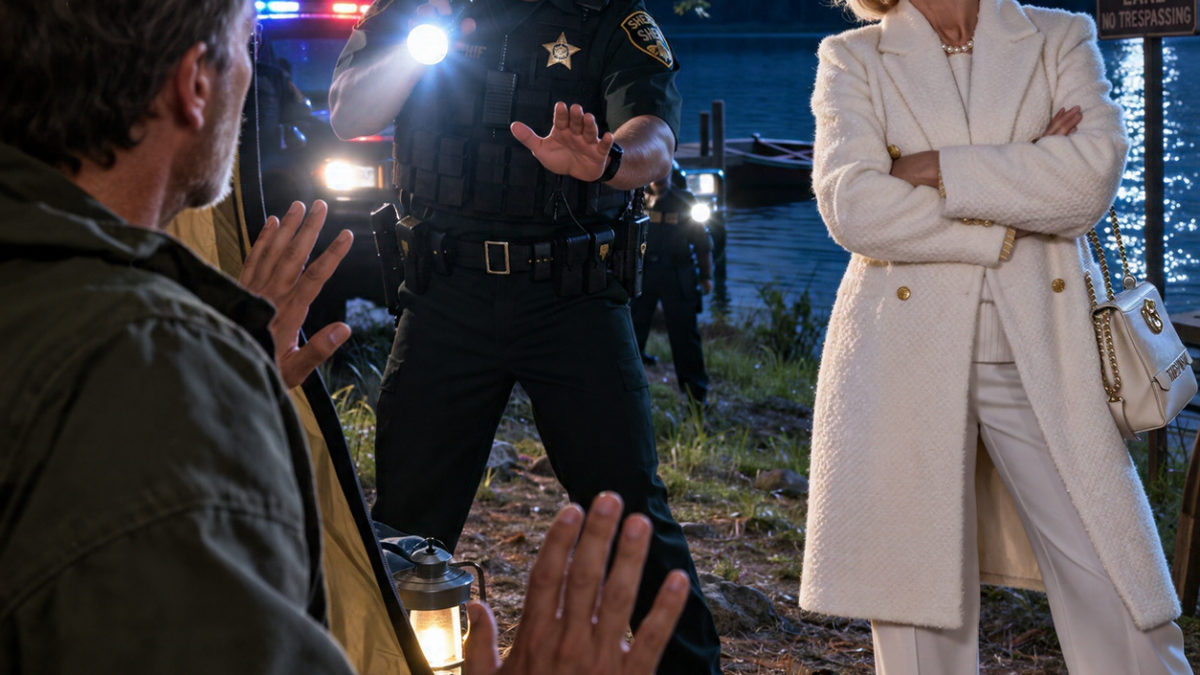
PART2
By the time I reached the cabin, my hands were still shaking.
The drive from the lake took less than ten minutes.
I’d made it hundreds of times as a boy.
The gravel road curved through a stand of pines before climbing to a small ridge overlooking Cedar Hollow Lake.
Aunt June’s cabin stood beneath two enormous cedar trees.
It wasn’t impressive by wealthy Twin Cedars standards.
The roof needed repair.
The porch boards were weathered.
The kitchen was small enough that two people cooking together would inevitably bump shoulders.
But I loved that place.
I loved the smell of cedar inside the walls.
The stone fireplace.
The shelves overflowing with old books.
The little copper kettle June kept on the stove.
And the silence.
Especially the silence.
After she died, I’d left most of her belongings exactly where they were.
Her gardening gloves still hung from a rusty nail near the door.
Her favorite wool sweater remained folded over the living-room chair.
There were photographs of us fishing when I was a kid.
And on the kitchen windowsill sat the blue ceramic mug she used every morning.
Sometimes I’d walk into the cabin and forget she was gone.
For one wonderful second, I’d expect to hear her voice from the back room.
“Noah, take those muddy boots off before you ruin my floor!”
Then I’d remember.
And the silence would become unbearable.
That night, I dropped my camping equipment beside the door.
I didn’t turn on the television.
Didn’t make coffee.
Didn’t even remove my boots.
I went straight to the back room.
June called it her library.
In reality, it was a converted pantry filled with maps, filing cabinets, books, and an enormous antique rolltop desk.
She had kept that room locked for most of my childhood.
Not because she was hiding money.
Because she was guarding records.
“People can lie, Noah,” she once told me. “Paperwork gets harder to argue with when you keep the originals.”
I used to tease her.
“Aunt June, you keep receipts for lightbulbs.”
She’d point a finger at me.
“And one day somebody will accuse me of stealing a lightbulb, and I’ll be ready.”
I smiled at the memory.
Then opened the desk.
The drawers smelled of old paper.
I began searching.
Tax records.
Property maintenance receipts.
Letters from the county.
Insurance documents.
Then I found a folder labeled:
TWIN CEDARS HOA — LAKE ACCESS REQUESTS DENIED
My pulse quickened.
I opened it.
The first letter was dated six years earlier.
It came from the Twin Cedars Lakeside HOA.
The association requested that June grant limited shoreline access for neighborhood events, recreational activities, and community improvement initiatives.
The wording was polite.
Almost flattering.
It described the lake as a beautiful natural resource that could strengthen neighborhood unity.
I turned the page.
There was June’s response.
Short.
Direct.
Unmistakably hers.
Respectfully declined. Cedar Hollow Lake is privately owned and will remain so. No additional community access is authorized. Please refrain from further requests regarding this matter.
I stared at her signature.
June Granger.
Written in thick black ink.
I could almost hear her reading the letter aloud.
Then I found the survey.
County-certified.
Dated 1993.
It showed the entire twenty-acre property.
The cabin.
The ridge.
The surrounding forest.
And the lake.
Every part of the lake lay inside the Granger parcel.
I spread the map across the desk.
Then I noticed a handwritten note in the margin.
June’s sharp, angular cursive.
Keep this for when the snakes come sniffing again.
Despite everything, I laughed.
That was my aunt.
Even from beyond the grave, she knew exactly how to describe people like Veronica.
I ran my fingers along the boundary lines.
The survey confirmed what I’d known since childhood.
The lake belonged to June.
And after her death, it belonged to me.
Veronica’s folder might contain association declarations.
It might contain some strange claim about community access.
But a homeowners association couldn’t simply declare someone else’s private lake communal property by passing a resolution.
At least, not legally.
I looked toward the window.
The first hint of dawn was beginning to brighten the sky.
I folded the survey.
Grabbed my flashlight.
And headed back down toward the lake.
The mist was still thick when I reached the southern shoreline.
Cedar Hollow Lake looked almost silver in the early light.
The surface was calm.
Pine trees reflected in the water.
Somewhere beyond the reeds, a heron called.
It should have been peaceful.
Instead, I felt my anger returning with every step.
I walked toward the wooden boundary post near the southern end of the property.
It was a marker I remembered from childhood.
June had once used it to teach me how to read a survey.
But when my flashlight reached the post, I stopped.
There was a new sign.
Fresh white paint.
Black lettering.
TWIN CEDARS HOA PROPERTY
NO TRESPASSING
VIOLATORS WILL BE PROSECUTED
I stared at it.
Then at the ground beneath the post.
The soil was disturbed.
Fresh.
The marker looked as though it had been moved recently.
I took out June’s survey map.
Compared the shoreline.
Checked the position of the nearby trees.
Then looked toward the rocky ridge she used as a reference point.
Something was wrong.
The HOA’s sign appeared to stand at least fifteen feet inside the property boundary shown on June’s map.
I checked again.
Then again.
The more I studied it, the angrier I became.
Someone had apparently shifted the boundary.
Not legally.
Physically.
They’d moved a post and put up a sign that made private land look like HOA property.
And anyone who didn’t know the original boundary might believe it.
I took out my phone.
Photographed the sign.
The post.
The soil.
The surrounding landmarks.
Then recorded a slow video showing its position relative to the shoreline.
I remembered Veronica’s words.
According to the association’s records…
I looked toward the lake.
Someone was trying to change not just who could use the land.
They were trying to change what people believed the land was.
And that frightened me more than the confrontation with the deputy.
Because if Veronica could convince enough people that the lake belonged to the community, she might eventually use those claims to pressure me into selling.
Or accepting access.
Or surrendering some portion of the property.
June had refused for decades.
Now that she was gone, Veronica apparently believed I would be easier.
I stood beside the new sign as the sun rose.
Then whispered, “You picked the wrong nephew.”
The first legal demand arrived two days later.
The envelope was thick.
Ivory-colored.
Printed with the letterhead of Cardwell and Trent, a law firm I’d never heard of.
Inside was a formal notice claiming I owed the Twin Cedars Lakeside HOA retroactive fees for unauthorized use of association-governed recreational property.
I read the amount.
Then read it again.
$43,860.
Forty-three thousand, eight hundred and sixty dollars.
For using my own lake.
I sat at June’s kitchen table and stared at the number.
The letter demanded payment within fourteen business days.
Failure to comply, it warned, could result in civil litigation.
I almost laughed again.
But the laughter didn’t come.
Because I understood what the amount meant.
They weren’t expecting me to pay.
They were expecting me to panic.
Forty-three thousand dollars was enough to frighten an ordinary working person.
Enough to make someone seek a quick settlement.
Enough to convince a person unfamiliar with property law that fighting would be more expensive than surrendering.
I looked toward the old survey lying on the table.
June had known this kind of pressure could come.
I took photographs of the letter.
Saved a scanned copy.
Then placed the original inside a new folder.
I wrote the date across the top.
The next morning, my work phone began ringing.
Blocked numbers.
Silence.
Occasional heavy breathing.
Then hang-ups.
At first, I dismissed the calls as harassment.
But on Thursday, my supervisor asked me to come into his office.
He looked uncomfortable.
“Noah, is there something going on with a property dispute?”
My stomach tightened.
“Why?”
He folded his hands.
“We’ve received a few calls claiming you’re under investigation for serious legal violations.”
I stared at him.
“What?”
He looked apologetic.
“I don’t know what to make of it. I just wanted to ask whether there’s anything that might affect your work.”
My cheeks burned.
“There’s a dispute involving inherited property. I’m not aware of any criminal investigation against me.”
He nodded.
“All right.”
But the damage was already done.
Someone had reached into my professional life.
Someone had wanted my employer to question whether I was trustworthy.
I left the meeting feeling sick.
Veronica wasn’t simply trying to win a property argument.
She was trying to make my entire life uncomfortable enough that I’d surrender.
The newsletters began arriving that weekend.
Twin Cedars HOA publications.
I wasn’t even a member.
Yet someone made sure copies appeared on my porch.
They discussed community compliance.
Respect for shared resources.
The importance of cooperating during property transitions.
One article described “individual resistance to community improvement” as a threat to neighborhood harmony.
Nobody mentioned me by name.
They didn’t have to.
Everyone knew about the confrontation at the lake.
People who used to wave when I drove past started avoiding eye contact.
The woman at the café where I sometimes bought coffee became strangely formal.
A neighbor I’d known for years asked whether I was planning to “make trouble” over the lake.
I looked at him.
“Make trouble?”
He shrugged.
“Veronica says you’re blocking community access.”
“It’s private property.”
He looked uncomfortable.
“Well, that’s what she says is disputed.”
I stared at him.
He had never seen the survey.
Never seen June’s deed.
Never asked me what the records showed.
But he’d heard Veronica’s version enough times that he was already treating it as plausible.
That was when I understood the real danger.
A lie doesn’t need everyone to believe it.
Sometimes it only needs enough repetition to make honest people uncertain.
And Veronica was using that uncertainty to isolate me.
I met Bri at a gas station.
Of all places.
I was standing beside my truck, filling the tank, when a beat-up white Jeep pulled into the next bay.
A young woman stepped out wearing jeans, sneakers, and a dark hoodie with an anti-HOA slogan across the chest.
She noticed me looking.
Then smiled.
“You’re the lake guy, right?”
I hesitated.
“Depends who’s asking.”
She laughed.
“Someone who got fined for planting lavender.”
I stared.
“Lavender?”
“In my own front yard.”
She rolled her eyes.
“Apparently, purple flowers are an offense against civilized society.”
I laughed despite myself.
It felt strange.
I hadn’t laughed genuinely in days.
She held out her hand.
“Bri.”
“Noah.”
“I know.”
She smiled.
“Everyone in Twin Cedars knows your name right now.”
I sighed.
“Wonderful.”
She leaned against her Jeep.
“Listen, I don’t believe Veronica’s story.”
I looked at her.
“Why not?”
“Because she’s been pulling the same garbage with everybody.”
She explained that she was twenty-seven, worked as a software engineer, and had moved into Twin Cedars less than a year earlier.
She’d expected a quiet neighborhood.
Instead, she’d received fines for landscaping, fence colors, and minor changes to her property.
At first, she paid them.
Then she began asking questions.
The answers didn’t make sense.
So she started documenting meetings and notices.
“Turns out,” she said, “when you compare enough of their decisions, the patterns get interesting.”
I studied her.
“What patterns?”
She smiled without humor.
“People who push back get targeted. People who cooperate get left alone. And somehow, everything Veronica wants eventually becomes a community necessity.”
I felt my stomach tighten.
“That sounds familiar.”
She looked toward my truck.
“Got time for coffee?”
I considered refusing.
I barely knew her.
But something about the directness of her voice reminded me of June.
And I needed someone who wasn’t afraid to question Veronica.
“Yeah,” I said.
“I’ve got time.”
We sat in a small café near the highway.
Bri placed her phone on the table.
I told her about the deputy.
The camping incident.
The survey.
The moved boundary post.
The forty-three-thousand-dollar demand.
The calls to my workplace.
She listened without interrupting.
Then she leaned forward.
“Okay.”
I looked at her.
“Okay?”
“You’re going to want to see something.”
She unlocked her phone.
Opened a video file.
And turned the screen toward me.
The footage showed a private HOA meeting inside the clubhouse.
The image was grainy.
The angle was partially obstructed by a flower arrangement.
But the people were recognizable.
Veronica stood at the head of the conference table.
Her leather folder lay open.
Several board members sat around her.
I leaned closer.
Bri adjusted the volume.
Veronica’s voice came through the speaker.
“If Granger pushes back, escalate.”
My stomach tightened.
She continued.
“Legal channels. Rumors. Compliance inspections. Whatever makes him uncomfortable.”
A man asked something I couldn’t hear clearly.
Then Veronica spoke again.
“Once we’ve established community usage through precedent, he’ll have a much harder time keeping the lake private.”
I felt my hands go cold.
Another board member asked about the ownership documents.
Veronica dismissed them.
“Outdated. Emotional. We’ll bury him in paperwork until he begs to sell.”
Someone laughed.
The video ended.
I stared at the phone.
Then looked at Bri.
“Where did you get that?”
She explained how she’d obtained and preserved HOA meeting footage while documenting board conduct, and that an attorney would need to review what portions could lawfully be used.
I nodded.
The recording was serious.
But I didn’t want to build my case around evidence that might later be challenged because of how it was obtained.
Bri seemed to understand.
“I’ve kept the original file. Metadata and everything.”
I looked at her.
“She’s been planning this.”
Bri nodded.
“And you’re not the only one.”
She pulled up several notes.
Different homeowners.
Different disputes.
Similar pressure.
Fines.
Threats.
Selective enforcement.
Aggressive legal letters.
Attempts to force people into agreements they didn’t understand.
I stared at the screen.
“So this is what she does.”
Bri leaned back.
“Veronica turns people into problems, then sells herself as the solution.”
I looked toward the café window.
Outside, cars passed beneath the afternoon sun.
Ordinary people going about ordinary lives.
And I wondered how many of them had already been pressured into giving up something valuable.
Bri watched me.
“You’re thinking about June, aren’t you?”
I turned.
“How did you know?”
She smiled faintly.
“Because you look like somebody just realized this has been going on longer than you thought.”
I nodded.
“My aunt fought them for years.”
“Then she probably left you more than a deed.”
I stared at her.
“Funny you should say that.”
She leaned forward.
“What else did she leave?”
I thought about the locked cabinets.
The old desk.
The folders.
And the parts of June’s life I’d barely begun to explore.
“Apparently,” I said, “an entire filing system designed to ruin somebody’s day.”
Bri laughed.
“Good.”
Then her expression hardened.
“Let’s find out whose.”
Three days later, Frank Delaney arrived at the cabin.
He drove an old pickup that looked as though it had survived several wars.
When he stepped out, I saw a tall, thin man in his seventies wearing faded jeans, a flannel shirt, and a brown cap embroidered with a U.S. Army veteran emblem.
He carried a weathered leather briefcase.
I opened the door before he reached the porch.
“Can I help you?”
He studied me.
Then smiled faintly.
“You look like June.”
I stared.
“Excuse me?”
“Not the face. The expression.”
He held out his hand.
“Frank Delaney.”
I shook it.
“Noah Granger.”
“I know.”
He glanced toward the lake.
“I was a friend of your aunt’s.”
I looked at the briefcase.
“And?”
“And I represented her when the association tried to pull something similar years ago.”
My chest tightened.
He lifted the briefcase.
“June told me that if they ever came after the lake again, I should find you and open the file.”
I stood motionless.
For a moment, I almost heard June laughing.
That woman.
Even dead, she was two steps ahead.
I stepped aside.
“Come in.”
Frank entered the cabin slowly.
He looked around.
His expression softened when he saw June’s gardening gloves hanging near the door.
“She really did leave everything where it was.”
I nodded.
“Couldn’t bring myself to change it.”
He touched the old kitchen table.
“Good woman, your aunt.”
My throat tightened.
“The best.”
He sat.
Placed the briefcase on the table.
Then opened it.
Inside were folders secured with old rubber bands.
The documents had been carefully preserved.
He removed the first.
“County-certified survey from 1985.”
He placed it in front of me.
Then another.
“Updated survey from 1993.”
I recognized the boundary.
The lake was completely enclosed inside the Granger parcel.
Frank continued.
“1998 court correspondence. The association tried to challenge June’s southern property line.”
I looked up.
“They took her to court?”
“They tried.”
He smiled grimly.
“Didn’t go well for them.”
I opened the folder.
There were pleadings.
Survey evidence.
A court decision confirming the boundary.
And correspondence rejecting the HOA’s claims.
Frank watched me.
“Your aunt won.”
I stared at the papers.
“She never told me.”
“She didn’t want you worrying about it when you were a kid.”
I looked down.
June had protected that lake for decades.
And she’d done it quietly.
Without asking anyone to admire her.
Without using the fight as an excuse to hurt people.
She simply refused to let strangers take what belonged to her.
Frank removed another document.
A hand-drawn boundary sketch.
June’s writing filled the margins.
One note caught my eye.
If they move the stakes, measure from the split rock at the eastern ridge.
I stared.
Then began laughing.
Frank raised an eyebrow.
“What’s funny?”
I shook my head.
“She knew they’d move the posts.”
He nodded.
“June knew Veronica’s type.”
I looked toward the lake.
The woman who’d taught me to fish had apparently anticipated a scheme that would unfold years after her death.
Frank folded his hands.
“Now, Noah, I want you to understand something.”
I looked at him.
“Veronica’s claims are weak. But weak claims can still cause damage if you ignore them.”
I nodded.
“So we don’t ignore them.”
He smiled.
“Exactly.”
The next morning, we hired Mark Holland.
Frank recommended him.
Mark was a professional land surveyor with a gray beard, a weathered face, and enough equipment in his SUV to make it look like a mobile engineering laboratory.
When he arrived, he studied June’s records carefully.
Then looked toward the lake.
“Let’s see what we’ve got.”
He spent five hours working.
Boundary measurements.
Survey markers.
Coordinates.
Photographs.
Drone imagery.
Comparison with the county records.
Bri joined us around noon.
She carried a notebook and photographed the work as it progressed.
I watched Mark move along the shoreline.
Sometimes he stopped.
Checked the equipment.
Made another measurement.
Then shook his head.
By late afternoon, he returned to the cabin.
His expression was serious.
I stood.
“Well?”
He placed his notes on the table.
“The boundary markers have been moved.”
My stomach tightened.
“How far?”
“At least twenty-two feet into your property at the points we’ve examined.”
Bri stared.
“Twenty-two?”
Mark nodded.
“The original survey and fixed reference points are consistent. The newer posts are not.”
I looked at him.
“Can you prove it?”
He smiled faintly.
“That’s what you hired me for.”
He showed us the measurements.
The coordinates.
The overlays.
The disturbed soil.
The differences between the original boundary and the altered markers.
The report would be formalized and supported by his professional certification and sworn statement.
I studied the map.
Then looked toward the lake.
Someone had moved the apparent boundary far enough to make part of my shoreline seem like HOA land.
And they’d placed signs there threatening prosecution.
I thought of Deputy Ramirez ordering me to leave.
Veronica standing behind him.
The folder.
The certainty in her voice.
She hadn’t merely made an incorrect interpretation of a boundary.
Evidence suggested someone had physically altered the markers to support her claim.
I looked at Frank.
“Now what?”
He closed the survey folder.
“Now we stop treating this like a neighborly disagreement.”
That evening, Bri discovered something else.
She was sitting at June’s kitchen table with her laptop open.
I’d been making coffee when she suddenly said, “Noah.”
I looked over.
“Yeah?”
She turned the screen.
“Have you ever authorized events at the lake?”
I frowned.
“What kind of events?”
“Sunset yoga.”
I stared.
“What?”
“Wine tastings. Lakeside brunches. Moonlight canoe mixers.”
She scrolled.
The screen displayed photographs of people gathering along my shoreline.
White folding chairs.
Decorations.
Bottles of wine.
Catering trays.
Event invitations.
A smiling group posing beside the dock.
My dock.
I leaned closer.
“When were these?”
“Over the last few months.”
I felt my pulse quicken.
Bri opened another page.
“Some of them charged admission.”
She pointed to an event listing.
Twenty-five dollars per person.
A paid lakeside gathering advertised as a Twin Cedars community experience.
I stared at the image.
Veronica had been charging people to attend events on land she didn’t own.
Bri continued.
“And according to the financial records I’ve been able to review, the revenue isn’t clearly reflected where you’d expect it to be.”
Frank leaned closer.
“That needs proper accounting review before we conclude anything.”
Bri nodded.
“Absolutely. But it’s another reason to investigate.”
I looked at the photographs.
The beautiful shoreline.
The old dock.
The pines.
The lake June had spent decades protecting.
Veronica had turned it into a marketing asset.
All while telling people I was the trespasser.
My hands tightened around the back of the chair.
“She was making money off June’s land.”
Bri looked at me.
“That’s what the advertisements suggest.”
I stared at the screen.
Then thought of the sheriff’s deputy standing outside my tent.
Hands near his holster.
Ordering me to pack up.
Because Veronica claimed I was using communal property without authorization.
I laughed.
A short, bitter sound.
“She charged people to use my lake and then sent me a forty-three-thousand-dollar bill for camping there.”
Frank shook his head.
“That’s the kind of detail a judge may find very interesting.”
We spent the evening organizing evidence.
Mark’s survey report.
June’s original surveys.
The 1998 court records.
The HOA access requests.
The denial letters.
The retroactive fee demand.
The workplace harassment timeline.
The event advertisements.
The video footage Bri had preserved.
And a list of other residents who believed they’d been targeted through similar tactics.
I created a digital archive.
Bri helped organize the files.
Frank advised us on preserving originals and maintaining a clear record of where each item came from.
By midnight, we had a substantial case file.
I looked across the table.
Bri was still typing.
Frank was reading one of June’s old letters.
I felt something strange.
For weeks, Veronica had worked to make me feel alone.
Now I had two people sitting in my kitchen, helping me protect something they didn’t personally own.
I looked at Frank.
“Why are you doing all this?”
He raised his eyes.
“Because June was my friend.”
I nodded.
He continued.
“And because people like Veronica become dangerous when everybody assumes someone else will stop them.”
I turned toward Bri.
“What about you?”
She smiled.
“Because somebody fined me for lavender.”
I laughed.
She laughed, too.
Then her expression became serious.
“And because I don’t want another homeowner to go through what your aunt did.”
I looked down at the papers.
The surveys.
The court records.
The map with June’s handwriting.
For the first time since the night Deputy Ramirez ordered me out of my campsite, I felt hope.
Not because the fight was over.
It wasn’t.
But because we finally had a way to expose the truth.
And this time, Veronica wasn’t the only one preparing.
We installed the trail cameras the following morning.
One near the dock.
One along the southern boundary where the HOA’s sign had been placed.
And one overlooking the narrow dirt path that event workers had apparently been using to reach the shoreline.
I didn’t hide them to spy on private conversations.
I installed them to document activity on land I owned, with placement reviewed for lawful use.
After what Mark found, I wanted a reliable record of anyone entering the property.
Bri helped configure the cameras.
She was precise about everything.
Dates.
Times.
Battery levels.
Recording angles.
She tested each device twice.
Then she stood beside the dock and looked across the water.
“Now, if somebody moves another post, we’ll have a better chance of seeing who.”
I nodded.
“That’s the idea.”
Frank watched from the path.
“June would’ve approved.”
I smiled.
“She probably would’ve installed them years ago.”
He laughed.
“She would’ve complained about the technology the whole time.”
I imagined my aunt standing beside a camera, muttering that nothing worked properly anymore.
Then I imagined her reviewing the footage.
And smiling when it proved somebody had been lying.
I missed her.
More than I could say.
But standing beside the lake with people helping me defend it, I felt closer to her than I had since the funeral.
The first sign that Veronica was preparing something new came on a Thursday morning.
I woke to the sound of distant music.
Low bass.
Faint voices.
The clatter of equipment.
At first, I thought there was construction happening on the road.
Then I stepped onto the porch.
Across the lake, near the southern shoreline, large white tents were being erected.
My stomach tightened.
I grabbed my binoculars.
There were caterers.
Decorators.
Workers carrying chairs.
A truck unloading tables.
And a large banner stretched between two posts.
TWIN CEDARS LAKESIDE PRESERVATION GALA
HOSTED BY HOA PRESIDENT VERONICA SPADE
I stared.
She was hosting a preservation gala.
On my property.
While disputing my ownership.
After sending me a bill for using the lake.
I lowered the binoculars.
For a moment, I couldn’t believe anyone could be that arrogant.
Then my phone rang.
Bri.
“You’re seeing this, right?”
“Yeah.”
“She’s really doing it.”
I looked toward the white tents.
“Apparently.”
Bri was already near the ridge with her camera.
She explained that she’d documented workers entering the property and the event setup.
Frank had also been notified.
Our attorney was preparing an appropriate response.
I wanted to march down there and order everyone out.
But we had already learned how Veronica operated.
She thrived on confrontation.
She wanted footage of me shouting.
Threatening.
Losing control.
So I stayed where I was.
And let the cameras record.
By late afternoon, the gala looked like something out of a luxury wedding magazine.
White tents.
Decorative lights.
Chandeliers hanging from temporary frames.
Caterers carrying polished trays.
A small stage overlooking the water.
Veronica had transformed June’s peaceful shoreline into a private event venue.
And she was calling it preservation.
I stood on the porch with Frank.
He lowered his binoculars.
“That woman has no shame.”
I stared toward the tents.
“She has confidence.”
Frank snorted.
“Confidence without honesty is just arrogance wearing expensive clothes.”
I almost smiled.
Then we saw something strange.
Two workers were moving large gray drums along the dirt path behind the main tent.
They weren’t carrying decorations.
Or catering supplies.
The containers were industrial-looking.
Sealed.
Heavy enough that the men needed equipment to move them.
I frowned.
“What are those?”
Frank raised the binoculars.
“Don’t know.”
Bri called a moment later.
“I’ve got the barrels on video.”
My stomach tightened.
“Any labels?”
“Not from this angle.”
“Can you get closer safely?”
“I’m staying on the public side of the marked path. I’ll document what I can.”
I looked across the water.
The workers moved the drums behind a screen of temporary event equipment.
Then disappeared from view.
Something felt wrong.
But I had no proof of what they contained.
So I recorded what I could see and passed the information along.
I didn’t know then how important those barrels would become.
At six the following morning, shouting woke me.
I sat upright.
For a moment, I thought someone was arguing outside the cabin.
Then I heard vehicles.
Doors slamming.
Voices calling.
I pulled on jeans and hurried to the porch.
News vans stood along the access road.
Reporters were gathering near the shoreline.
A group of residents had formed beside the temporary stage.
And Veronica Spade was speaking into a microphone.
I couldn’t hear every word from the porch.
But I could see her holding something in a clear bag.
I grabbed my phone.
Then walked toward the lake.
As I approached, I heard her voice.
“…a devastating environmental incident.”
My stomach tightened.
She continued.
“Our beautiful lake has been contaminated.”
I stopped.
What?
Veronica lifted the sample bag.
Inside was dark, discolored water.
She turned toward the cameras.
“We believe an irresponsible individual may have introduced harmful substances into this treasured community resource.”
A reporter asked whether she had evidence.
Veronica’s expression became solemn.
“We are cooperating with investigators.”
Then she looked across the crowd.
Her eyes found me.
And I understood.
The barrels.
The event.
The cameras.
The sudden press conference.
This wasn’t merely a celebration that had gone wrong.
It looked like another attempt to rewrite the story of the lake.
I moved toward the dock.
And saw the water.
A rainbow-colored sheen spread across part of the surface near the reeds.
It wasn’t the normal shimmer of sunlight.
It looked oily.
Unnatural.
My stomach dropped.
Someone had introduced something into Cedar Hollow Lake.
The lake where I learned to fish.
The lake June had spent decades protecting.
The lake where wildlife lived and drank.
I felt sick.
Bri appeared beside me.
Her face was pale.
“You’re seeing it?”
I nodded.
“Yeah.”
She raised her camera.
“I’ve been photographing everything.”
I stared at the sheen.
Then whispered, “She wouldn’t.”
Bri didn’t answer.
Because we both knew how far Veronica had already gone.
A reporter approached.
“Mr. Granger?”
I turned.
She held a microphone.
“Do you have any comment on the contamination allegations?”
I stared at her.
“What allegations?”
She hesitated.
“HOA representatives have suggested that a disgruntled property claimant may be responsible.”
I felt my face burn.
“Property claimant?”
“Yes.”
“This is my lake.”
The reporter looked toward the water.
“Have you had any involvement with the apparent contamination?”
I couldn’t believe she was asking.
“No.”
I took a breath.
“Absolutely not. I’m the person trying to protect this property.”
She continued.
“Veronica Spade says there has been a pattern of hostility between you and the association.”
I looked toward the stage.
Veronica was watching.
Her expression was composed.
Almost mournful.
As though she were devastated by damage to the environment.
I turned back toward the reporter.
“There’s a documented boundary dispute. There’s a history of the HOA attempting to claim private property. And now we have an environmental incident that needs independent investigation.”
The reporter nodded.
“Are you suggesting the HOA is involved?”
“I’m saying nobody should make accusations before the evidence is examined.”
I looked toward Veronica.
“And that includes the HOA president.”
I stepped away.
My hands were shaking.
But I knew I’d done the right thing.
Veronica wanted me furious on camera.
She wanted a clip she could use to portray me as unstable.
I wasn’t going to give her one.
By noon, the headlines had begun spreading.
Some described the contamination as a suspected act of retaliation.
Others mentioned the property dispute.
A few repeated Veronica’s allegations without clearly distinguishing them from established facts.
I sat at June’s kitchen table watching the coverage.
The same lake appeared on every screen.
The same oily sheen.
The same footage of Veronica holding a water sample.
Then a photograph of me from an HOA meeting.
I turned off the television.
I felt physically ill.
Bri arrived a few minutes later.
She didn’t bother knocking.
She stepped inside carrying her camera and laptop.
“Noah.”
I looked up.
“What?”
“I found something.”
She opened the laptop.
Displayed a photograph.
Two gray drums near the water.
I recognized them immediately.
The same containers we’d seen behind the gala tent.
Bri zoomed in.
At the top of one drum was a faint blue marking.
Partially scraped away.
But still visible.
CLEAR PATH ENVIRONMENTAL SERVICES
I stared.
“What’s that?”
Bri opened another page.
“An environmental services company.”
She scrolled.
“Veronica was its CEO until 2019.”
My stomach tightened.
“You’re kidding.”
She shook her head.
“No.”
Bri showed me public records connecting Veronica to the company.
Then photographs of similar containers used in its waste-handling operations.
The match wasn’t enough to identify the contents of the barrels.
But it was enough to raise serious questions.
I looked at Bri.
“Those drums need to be examined.”
She nodded.
“Agreed.”
I contacted the environmental authorities and provided everything we had.
The photographs.
The video.
The reported barrel locations.
The association with Clear Path.
I made it clear that I wanted the lake tested and any potential contamination handled safely.
I wasn’t interested in staging my own investigation by opening suspicious containers.
If chemicals had entered the water, the priority was protecting people, animals, and the ecosystem.
But as I looked at the evidence, my anger became something colder.
Veronica wasn’t simply trying to take the lake.
She might have been willing to damage it to make me look guilty.
And if that was true, then she had crossed a line far beyond HOA harassment.
That evening, Frank arrived carrying another folder.
He looked more serious than I’d ever seen him.
“Noah, sit down.”
I stared.
“What’s wrong?”
He placed the folder on the table.
“I’ve been reviewing the old conservation records.”
I looked toward the door.
Bri was still in the living room working on her laptop.
I sat.
Frank opened the folder.
Inside was a yellowed legal document dated March 1993.
It carried June’s signature.
A notarial acknowledgment.
And a federal recording reference connected to the property’s conservation status.
I leaned forward.
“What is this?”
Frank looked at me.
“A conservation deed.”
I stared.
He continued.
“Your aunt formally placed the property under permanent conservation restrictions.”
I looked down at the page.
The language described the preservation of the land and lake as a non-commercial natural area.
It imposed restrictions on development, changes to the ecological condition, and certain commercial uses.
The details were extensive.
And the legal effect would depend on the relevant jurisdiction, the document’s recording, and the governing conservation framework.
But the central purpose was unmistakable.
June had protected the lake from development.
Long before Veronica tried to claim it.
I looked up.
“She did this in 1993?”
Frank nodded.
“She was already concerned about outside interests.”
I stared at the signature.
June Granger.
My aunt had been fighting this battle for decades.
And she had left behind a document intended to protect the land even after her death.
Frank leaned closer.
“This is important, Noah.”
I nodded.
“How important?”
“Potentially decisive for the development claims. The association can’t simply override recorded property restrictions with a bylaw.”
I looked toward the lake.
The white gala tents were still visible through the trees.
The contamination investigation had begun.
And Veronica was still telling reporters she was trying to preserve the environment.
I almost laughed.
June had placed the lake under conservation protection thirty years earlier.
Veronica was trying to commercialize it while presenting herself as its guardian.
I looked at Frank.
“She knew.”
He nodded.
“Your aunt knew people would come looking for ways around her refusal.”
I stared at the document.
Then whispered, “She left me everything I needed.”
Frank’s expression softened.
“She left you the tools. You still have to use them.”
That night, I sat alone at the kitchen table.
The conservation deed lay beside the survey.
June’s handwritten notes were spread across the desk.
I stared at the documents until the words blurred.
Then I looked toward the photograph of my aunt hanging beside the fireplace.
She was standing on the dock.
Holding a fishing rod.
Smiling at the camera.
She looked happy.
Not wealthy.
Not powerful.
Just happy.
The kind of happiness that comes from being somewhere you love.
I remembered how fiercely she’d guarded her independence.
She never married.
Never had children.
But she’d loved me like a son.
My parents worked long hours when I was young, and I spent nearly every summer with her.
She taught me to fish.
To repair a boat motor.
To recognize bird calls.
To build a campfire safely.
To respect wildlife.
And to leave the land better than I found it.
She didn’t lecture constantly.
She preferred stories.
Sometimes, when we sat on the dock, she’d tell me about people who had tried to buy the lake.
Developers.
Vacation-home investors.
People who wanted to divide the shoreline into expensive lots.
I’d ask why she refused.
She would smile.
“Because money isn’t the only thing land is worth.”
At twelve, I didn’t understand.
At thirty-eight, I did.
The lake was home to fish.
Birds.
Animals.
Trees.
Plants.
Memories.
Silence.
And a way of life June believed deserved protection.
Veronica saw an opportunity to profit.
June saw something entrusted to her care.
I looked at the conservation deed.
Then whispered toward the photograph, “I get it now.”
My throat tightened.
“I’m sorry it took me so long.”
Bri’s phone rang just before midnight.
She looked at the screen.
Then frowned.
“Another article.”
I turned.
“What now?”
She read aloud.
A local blog had published an opinion piece claiming I was suspected of dumping pesticides into the lake in retaliation against the HOA.
I stared at her.
“Pesticides?”
She nodded.
“Anonymous sources.”
I felt my hands tighten.
“Of course.”
The article painted me as angry, unstable, and dangerous.
It cited the earlier property dispute.
The confrontation with Deputy Ramirez.
My objections to the HOA’s events.
Then suggested that the contamination might be an act of revenge.
I looked toward the lake.
It was dark outside.
The water lay beyond the trees, invisible except for the faint reflection of moonlight.
I thought of the wildlife.
The fish.
The birds.
The animals that depended on that ecosystem.
Then I thought of June.
She would have been devastated by the contamination.
But she would have been even angrier that someone was using environmental damage as a tool for political manipulation.
I closed my eyes.
For a moment, I wanted to throw the phone across the room.
Instead, I took a breath.
“Save a copy.”
Bri nodded.
“Already done.”
“Date and time.”
“Got it.”
“Source.”
“Got that, too.”
I looked at Frank.
“We need to be ready for the meeting.”
He closed the conservation folder.
“Then let’s make sure every document speaks for itself.”
The emergency community meeting was scheduled for Thursday evening.
Twin Cedars Civic Hall.
The same place where Veronica had spent years imposing rules and collecting applause from board members who rarely questioned her.
But this time, the atmosphere was different.
When I arrived with Frank and Bri, the parking lot was already full.
News vans lined the street.
Residents crowded near the entrance.
A few people held signs demanding transparency.
Others wanted the lake contamination investigated.
Some simply wanted to know who owned the land.
I looked around.
The dispute had become bigger than the twenty acres June left me.
People were finally asking whether the HOA had been operating honestly.
That mattered.
Because Veronica’s strategy had depended on people remaining isolated.
Each homeowner receiving a fine.
Each family dealing with a threat.
Each property owner wondering whether it was worth fighting.
Now they were talking to one another.
Comparing documents.
Sharing experiences.
And realizing they weren’t alone.
Bri nudged my arm.
“Look.”
I turned.
Near the entrance stood a woman in her sixties.
She held a folder against her chest.
Beside her was a younger man carrying a stack of papers.
The woman approached.
“Are you Noah Granger?”
I nodded.
“Yes.”
She introduced herself.
Then explained that the HOA had pressured her to remove a garden shed, claiming it violated neighborhood standards.
She’d paid thousands of dollars in fees before discovering that similar structures were allowed on other properties.
Her voice shook.
“I thought I was the only one.”
I looked at her.
“You’re not.”
Her eyes filled.
She nodded.
“That’s why I’m here.”
As she walked away, Bri looked at me.
“See?”
I nodded.
She continued.
“This stopped being just about your lake a while ago.”
I looked toward the hall.
Through the open doors, I could see Veronica seated at the elevated board table.
White suit.
Perfect hair.
Leather folder.
The same practiced expression of authority.
Only now, the room was full of people who had stopped accepting that expression as proof she was right.
I tightened my grip on June’s documents.
Then walked inside.
Deputy Cole Ramirez stood near the exit.
His arms were folded.
His expression was tense.
When he saw me, his eyes shifted toward the folders I was carrying.
For a moment, neither of us spoke.
Then he nodded.
“Mr. Granger.”
“Deputy.”
He looked uncomfortable.
I remembered the night at the lake.
His flashlight.
His hand near his holster.
The instruction to leave my own land.
I wanted to ask whether he knew he’d been used.
Whether he had understood how weak Veronica’s claim was.
Whether he’d suspected that the HOA folder was more theater than evidence.
But the meeting was beginning.
And something in his expression told me he was carrying his own concerns.
So I continued toward the front row.
Frank sat on one side of me.
Bri sat on the other.
She opened her laptop.
Checked the presentation.
Then leaned closer.
“Ready?”
I looked toward Veronica.
She was smiling at a reporter.
Acting as though the entire meeting had been arranged to honor her.
I took a breath.
“Yeah.”
Bri nodded.
“Let’s show them what June left behind.”
Veronica called the meeting to order.
Her voice was smooth.
Confident.
Carefully controlled.
“Thank you all for coming.”
She paused.
“As your HOA president, I have always placed the health, safety, and harmony of Twin Cedars above personal interests.”
A few people murmured.
Veronica continued.
“Unfortunately, recent events have demonstrated how dangerous it can be when one individual refuses to cooperate with community standards.”
She looked directly at me.
I remained seated.
She displayed a photograph of the contaminated lake.
The rainbow-colored sheen was visible near the reeds.
Gasps moved through the room.
“This is what happens when private hostility threatens a shared natural resource.”
I felt my hands tighten.
Bri touched my arm.
I took a breath.
Veronica lifted a document.
“An affidavit from a concerned resident suggests that Mr. Noah Granger may have introduced harmful substances into the water.”
I stared.
A concerned resident.
Anonymous.
Of course.
She continued.
“Mr. Granger has repeatedly challenged community authority, ignored established lake-use rules, and made threatening statements.”
I looked toward Frank.
He remained calm.
Veronica turned another page.
“This association has documented community usage of Cedar Hollow Lake for years.”
She held up a printed log.
Dates.
Events.
Supposed approvals.
A history designed to make the lake appear communal.
Then she looked at me.
“Mr. Granger has no legitimate basis for excluding Twin Cedars residents from this natural resource.”
For a moment, the room was silent.
Then someone near the back asked, “What about the deed?”
Veronica smiled.
“We will address outdated private records at the appropriate time.”
I felt something cold settle inside me.
Outdated private records.
That was how she described June’s legally recorded property rights.
I looked at the survey folder.
Then at Frank.
He gave me a small nod.
I stood.
“Madam President.”
Veronica’s smile tightened.
“Mr. Granger, you’ll have your chance to speak.”
I held up the folder.
“Good.”
She looked irritated.
“Please keep your remarks relevant.”
I smiled faintly.
“Oh, I intend to.”
Bri activated the projector.
The first image appeared.
Mark Holland’s professional survey overlay.
Two boundary lines.
One showing the original county-certified property boundary.
The other showing the position of the HOA’s newer markers.
A twenty-two-foot discrepancy was highlighted in red.
The room grew quiet.
I stepped toward the screen.
“This is the documented boundary of my aunt’s property.”
I pointed to the first line.
“She purchased the twenty-acre parcel in 1985.”
Then I indicated the second survey.
“The county-certified update from 1993 confirmed the same boundary.”
I turned toward Veronica.
“Yet newer HOA markers were placed at least twenty-two feet inside that property.”
A murmur moved through the audience.
Veronica shifted in her chair.
I continued.
“The soil around those markers showed evidence of recent disturbance. A licensed surveyor documented the discrepancy.”
I placed Mark’s report on the table.
Then looked toward the residents.
“The association posted no-trespassing signs inside private land and subsequently had a deputy order me out of a campsite near the lake.”
Someone called out.
“That’s outrageous!”
I raised a hand.
“Please. There’s more.”
Bri changed the slide.
The 1998 court documents appeared.
I explained that June had previously defended the same boundary against an HOA challenge.
The records showed the property line had already been examined in legal proceedings.
The association knew—or had reason to know—that the lake was privately owned.
Veronica interrupted.
“Those documents are irrelevant to current community arrangements!”
I looked at her.
“Then you should be able to explain what legally transferred the property.”
She opened her mouth.
Nothing came out.
I continued.
“Because as far as the recorded deed and certified surveys show, no such transfer occurred.”
The room became silent.
Then Bri advanced the presentation.
The conservation deed appeared.
I held up the original document.
“This was executed in March 1993.”
I paused.
“My aunt June Granger placed the property under permanent conservation restrictions designed to protect Cedar Hollow Lake from commercial development and unauthorized alteration.”
The audience began murmuring.
I continued.
“The exact legal effect of those restrictions is a matter for the court and appropriate conservation authorities. But they are recorded restrictions with a clear purpose.”
I looked toward Veronica.
“They are not something an HOA president can erase by declaring the lake communal.”
Her jaw tightened.
I continued.
“For years, my aunt refused requests to open this shoreline for commercial or association events.”
I displayed her denial letter.
“She made her position clear.”
Then Bri changed slides.
Event advertisements filled the screen.
Sunset yoga.
Wine tastings.
Lakeside brunches.
Paid canoe gatherings.
Every one advertised using my lake.
I looked toward the audience.
“These events were promoted without my authorization.”
A woman near the back gasped.
I continued.
“Some involved admission fees. We have requested a full accounting of revenue and expenses associated with them.”
Veronica leaned toward her attorney.
He whispered something.
She shook her head sharply.
I watched her.
For the first time, she looked genuinely uncomfortable.
But I hadn’t reached the most serious evidence.
Not yet.
Bri displayed a photograph of the gray barrels.
Clear Path Environmental Services.
The faint blue logo was visible.
I turned toward the audience.
“These containers were documented near the shoreline shortly before the contamination was discovered.”
The room became still.
I continued.
“Public corporate records connect Veronica Spade to Clear Path Environmental Services, where she previously served as CEO.”
A few people gasped.
Veronica stood.
“This is outrageous!”
I looked at her.
“Then you should welcome an independent investigation.”
She pointed toward me.
“You’re implying I poisoned the lake!”
“I’m presenting evidence that warrants examination.”
The room murmured.
I continued.
“Environmental authorities have been provided with the photographs and the information concerning the containers.”
Then Bri displayed another image.
A frame from the recorded event setup.
Veronica stood near the tents speaking with two men wearing work gloves.
Bri played the portion of footage whose authenticity and lawful use had been reviewed.
Veronica’s voice filled the hall.
“Put the drums near the dock. It needs to look bad, but not fatal.”
The room went silent.
A man’s voice followed.
“This stuff’s strong. What if someone gets hurt?”
Veronica answered.
“Then they’ll sue him, not us.”
For several seconds, nobody moved.
I stared at the screen.
Even though I’d reviewed the evidence before the meeting, hearing the words in that room made my stomach turn.
The same woman who’d held up a water sample and called for environmental protection had apparently discussed placing suspicious substances near the lake.
And she’d anticipated blaming me if someone was harmed.
I looked toward Veronica.
Her face had gone pale.
She shook her head.
“That’s fabricated.”
Her attorney rose.
“We dispute the authenticity and admissibility of this material.”
Frank nodded.
“Those questions can be examined through the proper investigation. The original files have been preserved.”
I looked toward the residents.
“That’s exactly what we’re asking for.”
Then I took a breath.
“The lake deserves to be protected. No matter who owns it.”
The room remained silent.
And for the first time that evening, Veronica seemed unable to control what people were thinking.
But the most disturbing revelation came next.
Bri looked toward Deputy Ramirez.
Then at me.
I knew what was coming.
An audio recording had surfaced that raised questions about why the deputy had treated me the way he did that night.
Before the meeting, Frank had insisted the material be preserved and reviewed carefully.
The allegation was serious.
It concerned an officer’s conduct.
And a possible attempt to blackmail him.
Bri started the recording.
Veronica’s voice filled the room.
“If Cole doesn’t keep Noah in check, I’ll remind the department about that DUI cover-up.”
A pause.
Then she continued.
“His custody hearings are next month. He’ll fold.”
I heard someone gasp.
Then another.
All eyes turned toward Deputy Ramirez.
He stood near the exit.
His face was pale.
For a moment, he seemed unable to move.
Then he stepped forward.
Slowly.
Removed his hat.
And looked toward the room.
“I was threatened,” he said.
His voice was quiet.
But in that silence, everyone heard him.
Veronica’s expression changed.
“Cole—”
He shook his head.
“No.”
He looked toward me.
“Mr. Granger, I need to apologize.”
I stood motionless.
He swallowed.
“Veronica pressured me. She threatened to interfere with my custody situation and expose misconduct from my past if I didn’t cooperate.”
The room erupted.
Someone shouted.
Another person demanded to know whether he’d been using his badge to enforce private HOA demands.
Cole raised his hand.
“I should have reported the threats.”
His voice broke.
“I should not have allowed myself to be used that way.”
He looked directly at me.
“I’m sorry.”
For a moment, I couldn’t speak.
I remembered kneeling outside my tent.
The flashlight in my eyes.
The fear.
The humiliation.
The feeling that even law enforcement had already decided Veronica was right.
Now the deputy who’d ordered me off my own property was acknowledging that he’d been pressured.
I felt anger.
Of course I did.
But I also saw a man finally telling the truth in front of everyone.
I nodded slowly.
“Thank you for saying it.”
He lowered his head.
I continued.
“But what happened that night needs to be investigated, too.”
He nodded.
“I understand.”
Veronica slammed her folder shut.
“This is a circus!”
Her voice echoed through the hall.
People turned toward her.
She stood at the elevated table, her white suit immaculate, her expression furious.
“You have no right to turn this meeting into a public attack on me!”
Bri stepped forward.
“Then answer the evidence.”
Veronica pointed at her.
“You’ve been harassing this board for months!”
Bri folded her arms.
“I’ve been documenting its decisions.”
Veronica looked toward the other board members.
“Somebody say something!”
For several seconds, nobody moved.
Then Carl Jennings, one of her longtime supporters, slowly pushed his chair back.
He looked shaken.
“Veronica, I didn’t know about any of this.”
She stared at him.
“What?”
“The barrels. The deputy. The recordings.”
His voice trembled.
“I thought we were dealing with a property dispute.”
Veronica’s face reddened.
“You don’t understand!”
Carl shook his head.
“No.”
He looked toward the audience.
“I don’t think any of us understood how far this had gone.”
A woman near the back stood.
“I want the board investigated!”
Another voice joined.
“And I want every fine reviewed!”
Then someone called out.
“We should dissolve the HOA!”
The room erupted.
People began talking over one another.
Residents who had spent years quietly accepting Veronica’s decisions were suddenly demanding accountability.
Frank stepped toward the front.
He placed a folder on the table.
“Formal legal action is being initiated concerning the boundary encroachment, harassment, and other alleged misconduct.”
He paused.
“Relevant evidence is also being referred to the state attorney general and appropriate environmental and law-enforcement authorities.”
Veronica stared at him.
Her face seemed to lose all color.
I looked toward the crowd.
The anger was understandable.
But I wanted the process to remain legitimate.
I didn’t want the board dissolved through a chaotic show of hands that could later be challenged.
I wanted proper legal consequences.
A valid proceeding.
An enforceable outcome.
And an investigation that could withstand scrutiny.
I stepped toward the microphone.
“Everybody, please.”
The room quieted slightly.
I continued.
“This needs to be handled properly.”
People turned toward me.
“The evidence should be investigated. The board’s conduct should be reviewed. And any decision about dissolving the association needs to follow the law and its governing documents.”
I paused.
“That’s what my aunt spent years fighting for.”
I looked toward Veronica.
“Not revenge.”
My voice hardened.
“Accountability.”
Deputy Ramirez approached Veronica after the meeting was interrupted.
The evidence had already been referred to investigators, and officers involved in the matter were coordinating with the appropriate authorities.
Veronica looked around.
For the first time, she seemed to understand that her position could no longer shield her from scrutiny.
Cole addressed her formally.
The allegations concerning environmental tampering, fraudulent records, harassment, and interference with the investigation required immediate action.
She began protesting.
Her attorney stepped forward.
But the process continued.
As Veronica was taken into custody pending further proceedings, the room fell silent.
There was no sudden triumph in the sound of handcuffs.
No moment that erased the damage to the lake.
No magical restoration of the months of harassment.
I watched her.
She turned toward me.
Her face was pale.
Her eyes were furious.
“You don’t know what you’ve started.”
I looked at her for a long moment.
Then thought about June.
Her old cabin.
The fishing rod.
The maps.
The conservation deed.
The letters she’d written refusing to surrender the shoreline.
I took a breath.
“No, Veronica.”
My voice was quiet.
“You don’t know what June finished.”
She stared.
Then turned away.
And for the first time since the night she stood beside Deputy Ramirez, Veronica Spade left the lake dispute without getting the final word.
I thought I would feel victorious when Veronica disappeared through the civic hall doors.
For weeks, I’d imagined that moment.
The woman who sent a deputy to remove me from my own land.
The woman who tried to charge me forty-three thousand dollars for camping beside my own lake.
The woman whose association had moved boundary posts, advertised events on private property, and apparently tried to make me look responsible for environmental contamination.
Finally facing consequences.
But as the room emptied, I felt something much more complicated.
Relief.
Exhaustion.
Anger.
And grief.
Because I kept thinking about June.
She should have been there.
She should have seen the surveys projected onto the wall.
Heard the crowd questioning Veronica.
Watched people finally understand why she refused to give up the lake.
I looked toward the empty board table.
The leather folder Veronica had carried into the meeting was still lying there.
For months, she’d used that folder as a symbol of authority.
Something designed to make people assume she knew the law.
Now the actual documents had spoken.
And her confidence had collapsed.
Bri approached.
“You okay?”
I nodded.
Then shook my head.
“I don’t know.”
She studied my face.
“That’s fair.”
I looked toward the doors.
“I thought I’d feel happier.”
Frank joined us.
He placed a hand on my shoulder.
“Your aunt would’ve been pleased.”
I swallowed.
“You think so?”
He nodded.
“But she would’ve told you not to confuse exposing the truth with finishing the work.”
I looked at him.
He smiled faintly.
“She always said the hard part came afterward.”
I stared toward the empty hall.
And I knew he was right.
The confrontation had ended.
But the lake still needed protection.
The contamination still needed remediation.
The legal proceedings still needed to run their course.
And the people Veronica had frightened still needed a way to reclaim their rights.
We had won the right to be heard.
Now we had to make sure it meant something.
The following two weeks were a blur.
Investigators examined the environmental evidence.
Officials reviewed the altered boundary markers and disputed property records.
The recordings and witness statements were evaluated.
Financial records connected to the HOA’s lakeside events came under scrutiny.
And allegations concerning Veronica’s conduct toward Deputy Ramirez became part of a separate investigation.
I spent more time with lawyers and officials than I’d ever imagined possible.
There were interviews.
Statements.
Requests for documents.
Questions about dates and conversations.
I answered carefully.
I tried never to exaggerate.
Because by then I’d learned something important.
The truth was powerful enough without embellishment.
We didn’t need to make Veronica sound worse than the evidence supported.
We needed the evidence examined properly.
Bri helped preserve and organize the digital records.
Frank handled legal correspondence.
Mark remained available to explain his survey findings.
And I provided the historical files June had spent decades protecting.
Every piece had a role.
The 1985 survey showed the original boundaries.
The 1993 survey confirmed them.
The 1998 court records established the history of June’s successful defense.
The conservation deed imposed enduring protections on the lake.
The photographs and recordings supported the investigation into the HOA’s conduct.
Together, the materials showed a story far different from the one Veronica had been telling.
Cedar Hollow Lake was not a communal resource she’d generously offered to residents.
It was private land that my aunt had protected for decades.
And the HOA had tried to make that protection disappear.
When the court eventually issued its ruling concerning the association, I sat beside Frank and Bri.
My stomach was tight.
My hands were cold.
I knew we had compelling evidence.
But I’d spent enough time dealing with Veronica to understand that a good case didn’t eliminate every uncertainty.
The judge reviewed the property history.
The boundary evidence.
The conservation restrictions.
The association’s conduct.
And the legal consequences.
The ruling confirmed the relevant Granger ownership and conservation protections.
The association’s attempted encroachment had no lawful basis.
The disputed claims about communal lake ownership could not stand against the property records.
The court also ordered dissolution of the Twin Cedars Lakeside HOA through the appropriate legal process.
Its assets were frozen pending investigation and resolution of liabilities.
I sat completely still.
For several seconds, I couldn’t absorb the words.
Then I looked at Frank.
He smiled.
“It’s done.”
My throat tightened.
“The lake?”
He nodded.
“Protected.”
I looked toward Bri.
Her eyes were shining.
She reached across the table.
“We did it.”
I stared down at the judgment.
The lake was still mine.
But more importantly, its recorded conservation protections had been recognized.
No developer could simply pretend those restrictions didn’t exist.
No HOA president could redraw the boundaries with a new sign.
No threatening letter could change what June had legally established.
I covered my mouth.
And for the first time since that night at two in the morning, I cried.
The proceedings against Veronica continued.
Environmental tampering.
Fraud.
Falsification of legal records.
Obstruction-related allegations.
The full legal process would determine the final consequences of each charge.
But the woman who had once controlled every HOA meeting was no longer controlling the narrative.
Her arrest and the subsequent charges became local news.
Her carefully maintained image of flawless leadership had collapsed.
The evidence of the staged contamination and the association’s broader conduct remained under scrutiny.
I saw her photograph on the evening news.
The platinum-blonde hair.
The stern expression.
The face I remembered smiling behind Deputy Ramirez’s flashlight.
For a moment, I felt that old anger.
Then I turned off the television.
I didn’t want her occupying another evening in June’s cabin.
I’d given Veronica enough of my life.
There were things I wanted to do that had nothing to do with punishing her.
I wanted to repair the dock.
Restore the damaged shoreline.
Walk through the forest.
Sleep beside the lake without being awakened by flashlights.
And learn to enjoy the place June had loved without constantly expecting another confrontation.
I wanted my inheritance to feel like a gift again.
Not a battlefield.
Environmental specialists continued assessing the contaminated area.
The visible sheen had been frightening.
But the precise ecological consequences required testing and professional evaluation.
We followed the recommendations for restricting access where necessary and supporting the appropriate cleanup work.
I worried about the fish.
The birds.
The amphibians.
Everything living in and around the water.
June had always taught me that protecting land meant paying attention to the creatures that couldn’t speak for themselves.
One afternoon, I stood beside the dock while a remediation crew worked farther along the shoreline.
Bri joined me.
She looked toward the water.
“Hard to believe somebody would damage a lake just to win an argument.”
I shook my head.
“It wasn’t really an argument to Veronica.”
She glanced at me.
“What do you mean?”
I looked toward the distant trees.
“It was ownership. Control. Money.”
Bri nodded.
“Yeah.”
I watched the crew work.
“June used to say that some people look at a forest and see lumber. Some look at a lake and see waterfront lots.”
Bri smiled faintly.
“And June?”
I looked toward the water.
“She saw home.”
For a moment, we stood quietly.
Then Bri said, “I think I understand why you fought so hard.”
I swallowed.
“Honestly?”
She looked at me.
“Yeah?”
“At first, I fought because I was angry.”
She smiled.
“Understandable.”
“But somewhere along the way, I realized I was defending something June wanted to outlive her.”
Bri turned toward the lake.
“And now it will.”
I nodded.
“That’s the plan.”
The idea for the legal defense fund began on the cabin porch.
It was a cool morning.
Bri sat at the outdoor table with her laptop.
Frank was reading the newspaper.
I was repairing a loose board near the steps.
For the first time in months, nobody was shouting at me about a violation.
Nobody was threatening a lawsuit.
Nobody had placed another HOA notice on the property.
The quiet felt strange.
Then Bri spoke.
“Noah.”
I looked up.
“Yeah?”
“I’ve been getting messages.”
I straightened.
“What kind?”
“Homeowners.”
She turned her laptop.
The screen displayed an inbox full of emails.
I stared.
“All these?”
She nodded.
“People who heard about the case.”
She opened one message.
A retired couple dealing with a dispute over their property boundary.
Another from a single mother facing escalating HOA fines.
Another from a veteran whose association had threatened him over modifications to his home.
Different places.
Different problems.
But a familiar pattern of fear.
People unsure what their rights were.
People overwhelmed by legal language.
People afraid that standing up would cost more than surrendering.
Bri looked at me.
“Some of them just want advice about finding a lawyer.”
I sat down.
Frank lowered the newspaper.
Bri continued.
“Others want to know how we organized our evidence.”
I looked at the messages.
Then at June’s old cabin.
The shelves full of records.
The filing cabinets.
The surveys.
The notebooks.
She had spent decades preparing because she didn’t trust powerful organizations to protect her interests automatically.
And now other people were facing their own versions of the same problem.
I looked at Bri.
“What are you thinking?”
She smiled.
“A nonprofit.”
Frank raised an eyebrow.
“That’s a serious undertaking.”
“I know.”
She looked toward me.
“Something that helps homeowners understand how to document disputes and find qualified legal support.”
I considered it.
We weren’t going to become attorneys overnight.
We couldn’t promise to win everyone’s case.
But we could help people avoid feeling as isolated as I had during those first weeks.
We could connect them with professionals.
Share educational resources.
Explain the value of preserving evidence.
And encourage people to verify claims rather than surrendering simply because a threatening letter carried an official-looking logo.
I looked toward June’s photograph visible through the open cabin door.
Then back at Bri.
“What would we call it?”
She thought for a moment.
Then smiled.
“The June Granger Legal Defense Fund.”
My throat tightened.
Frank looked down.
For several seconds, none of us spoke.
Then I nodded.
“Yeah.”
I smiled through tears.
“She’d like that.”
We established the organization with proper legal and financial guidance.
Its purpose was straightforward.
Help homeowners facing predatory or unlawful association practices understand their options and connect with qualified assistance.
We couldn’t solve every case.
We couldn’t fund every lawsuit.
And we weren’t going to encourage people to ignore legitimate community rules.
But we could help individuals recognize when a situation deserved closer examination.
Within the first month, the inbox filled with hundreds of messages.
Some contained stories of unfair fines.
Others described harassment.
Boundary disputes.
Threatening correspondence.
Confusing claims of authority.
People thanked us for making them feel less alone.
That mattered more than the attention our case received.
Because I remembered what isolation felt like.
The blocked telephone calls.
The meeting with my supervisor.
The neighbors avoiding my eyes.
The forty-three-thousand-dollar demand.
The deputy ordering me to leave my own campsite.
Veronica had tried to make me believe resistance was pointless.
Now people were reaching out because they wanted to resist unfair treatment lawfully and effectively.
I thought of June’s favorite saying.
Land doesn’t talk, so you’ve got to speak for it.
I smiled.
Maybe we’d found a way to help other people speak for theirs.
The first time I camped beside Cedar Hollow Lake again, I almost didn’t bring the tent.
I stood in the cabin doorway holding it.
The same tent.
The same worn sleeping bag.
The same folding chair.
I remembered the flashlight cutting through the nylon walls.
The deputy’s shouted instructions.
Veronica’s smile.
The shame of packing up under the eyes of people who acted as though I didn’t belong.
For a moment, I felt my hands tighten.
Then I looked toward the lake.
The evening light was beautiful.
The shoreline was quiet.
The birds were calling.
I took a breath.
And walked down the path.
I set up the tent near the same spot.
Made sure everything was safe.
Prepared a small campfire where permitted.
Then sat beside the water.
No police vehicles arrived.
No flashlights swept across the trees.
No HOA president stood nearby with a leather folder.
Just the lake.
The frogs.
The breeze.
And the quiet.
I watched the sunset until the sky turned deep blue.
Then I leaned back in my chair.
For the first time in months, I wasn’t thinking about legal deadlines.
Or evidence.
Or Veronica.
I was thinking about June.
I remembered the summer I was ten.
She had taken me fishing before sunrise.
I’d complained that it was too early.
She’d laughed and handed me a cup of hot chocolate.
“The fish don’t care what time you want to wake up.”
I’d asked whether we’d catch anything.
She shrugged.
“Maybe.”
“Then why are we out here?”
She looked across the water.
“Because the point isn’t always catching something, Noah.”
At ten, I thought she was being ridiculous.
At thirty-eight, I finally understood.
Sometimes the point was simply being there.
The next morning, Bri arrived carrying a small solar-powered camera.
I looked at it.
“What’s that?”
She grinned.
“A live camera.”
I raised an eyebrow.
“Why?”
“People keep asking to see the lake.”
I stared.
“Seriously?”
She nodded.
“Some of them followed the whole case. They want to know what happened afterward.”
I glanced toward the water.
“And you want to livestream it?”
“Only the scenery. No private conversations. No showing anyone who doesn’t want to be recorded.”
I considered that.
Then smiled.
“June would’ve hated the idea.”
Bri laughed.
“Probably.”
“She’d say nobody needs to watch a lake through a screen.”
“Maybe.”
Bri looked toward the dock.
“But people who’ve never been here might appreciate seeing why it mattered so much to her.”
I thought about that.
Then nodded.
“All right.”
We installed the camera in an appropriate location with a clear view of the water.
It showed the lake.
The reeds.
The trees.
The sky.
Nothing dramatic.
No confrontations.
No accusations.
No HOA meetings.
Just a quiet landscape.
And to my surprise, people watched.
Sometimes dozens.
Sometimes hundreds.
They left comments about the scenery.
The birds.
The light.
Some said it reminded them of lakes they visited as children.
Others thanked us for preserving the property.
I smiled when I read those messages.
For so long, Veronica had tried to turn Cedar Hollow into a symbol of conflict.
Now strangers were watching it simply because it was peaceful.
I thought June would have appreciated that more than she’d ever admit.
Months passed.
The property boundary records were corrected and protected against further encroachment.
The conservation restrictions remained in effect.
The unlawful HOA claims were no longer hanging over my head.
The environmental response continued through the proper channels.
And the legal proceedings involving Veronica followed their course.
I repaired the cabin.
Replaced the damaged porch boards.
Cleaned out the gutters.
Repainted the kitchen.
But I left June’s library almost exactly as it had been.
The old desk remained.
The maps.
The files.
Her handwritten notes.
I added a few labeled archival boxes to protect the most important documents.
And on the wall beside her photograph, I framed a copy of the court ruling confirming the lake’s protected status.
It wasn’t a trophy.
Not to me.
It was a promise fulfilled.
Proof that the work she’d done decades earlier had mattered.
That her refusal to surrender had mattered.
That keeping records had mattered.
That a woman who lived quietly beside a lake had been able to protect something valuable from people with more money, more influence, and much louder voices.
I sometimes stood in that room and wondered whether she’d known how much she was teaching me.
Probably not.
She’d simply lived according to her principles.
And expected me to pay attention.
I wish I’d done it sooner.
One evening, Frank visited.
He brought an old photograph of June standing beside the dock in 1998.
She wore a faded fishing vest.
Her hair was pulled back.
And she was smiling with unmistakable satisfaction.
I laughed when I saw it.
“What happened that day?”
Frank smiled.
“That was after the first boundary case.”
I looked at the picture.
June held a folder beneath one arm.
In her other hand was a fishing rod.
“She went fishing after court?”
Frank nodded.
“Immediately.”
I laughed.
“Of course she did.”
He sat beside me.
“She said she’d wasted enough time arguing with people who couldn’t read a survey.”
I laughed harder.
Then the laughter faded.
I looked at the photograph.
“She would’ve liked seeing Veronica lose.”
Frank considered the question.
“Maybe.”
I looked at him.
“Maybe?”
He nodded toward the water.
“I think she’d have liked seeing the lake protected more.”
I stared at the photograph.
Then nodded slowly.
“Yeah.”
He smiled.
“That’s the difference.”
I looked toward the trees.
Frank continued.
“Veronica wanted to win because she wanted power over something.”
He paused.
“June wanted to win because she wanted to keep something safe.”
I studied the picture.
And suddenly, the entire fight seemed clearer.
That was what had separated them from the beginning.
One woman saw a lake as an asset to control.
The other saw it as a responsibility to protect.
And every decision they made had followed from that difference.
The following spring, I sat on the dock early one morning.
The air was cool.
The water was still.
Mist floated over the surface.
I held a fishing rod in my hands.
A small red bobber drifted near the reeds.
Beside me sat June’s old tackle box.
I’d cleaned it carefully but hadn’t replaced the faded stickers or the scratches.
Those marks were part of its history.
A bird called from the trees.
I looked toward the eastern ridge.
The split rock still marked the same boundary June had noted on her survey decades earlier.
The moved HOA posts were gone.
The threatening signs were gone.
The white gala tents were gone.
Veronica’s association no longer controlled the neighborhood.
And Cedar Hollow Lake remained protected.
I sat quietly.
Then took out my phone.
There was a message from Bri.
A photograph of a new homeowner who had received help finding legal representation through the defense fund.
The accompanying note said the family had successfully challenged an improper property claim.
I smiled.
Then looked at June’s tackle box.
“Looks like we’re still helping people, Aunt June.”
The water moved softly.
Of course, she didn’t answer.
But I imagined her sitting beside me.
Her fishing rod resting against her knee.
Her old cap pulled low over her eyes.
Then I imagined her smiling.
Not because I’d become famous.
Not because Veronica had been arrested.
Not because the HOA had been dissolved.
Because the lake was safe.
And because the work she’d begun was helping people beyond its shores.
Sometimes I think about that first night.
Two in the morning.
A flashlight shining through my tent.
A deputy shouting for me to show my hands.
Veronica standing behind him in her ridiculous white coat, smiling as though she’d finally proven I didn’t belong.
I remember the humiliation.
The anger.
The fear.
The way I packed up and drove away from land I legally owned.
At the time, I thought the worst thing Veronica could do was take the lake.
I hadn’t yet discovered the moved boundary markers.
The forty-three-thousand-dollar demand.
The harassment.
The unauthorized events.
The staged contamination.
The recordings.
Or the threats made against Deputy Ramirez.
I hadn’t met Bri.
I hadn’t called Mark.
I hadn’t opened Frank’s files.
And I hadn’t found the full meaning of June’s conservation deed.
I was simply a man standing in the dark, being told to leave the place his aunt loved most.
But that night changed me.
Because when I returned to the cabin, I stopped assuming the truth would protect itself.
It wouldn’t.
Truth needed records.
People willing to speak.
People willing to question authority.
People willing to document what happened instead of surrendering to intimidation.
And sometimes, it needed someone stubborn enough to spend years preparing for a fight she might never personally see.
June had been that person.
She was gone.
But her work remained.
I still fish at Cedar Hollow Lake.
Sometimes I catch something.
Often I don’t.
It doesn’t matter much.
I sit on the dock.
Listen to the frogs.
Watch the morning light spread across the water.
And remember the woman who taught me that land could be worth more than anything someone was willing to pay for it.
The lake isn’t valuable to me because a developer might want to build luxury homes beside it.
It isn’t valuable because an HOA tried to claim it.
It isn’t even valuable because I won a legal dispute.
It’s valuable because it’s alive.
Because of the trees.
The birds.
The fish.
The animals.
The quiet.
The memories.
The summers I spent with June.
And the generations who might enjoy it after me.
Veronica believed that if she could control the paperwork, intimidate the owner, and manipulate public opinion, she could eventually control the land.
She underestimated how carefully my aunt had prepared.
But she also underestimated something else.
People who have been frightened into silence don’t necessarily remain silent forever.
Sometimes all it takes is one person standing up with the truth.
Then another person comes forward.
And another.
Soon, what looked like a private dispute becomes a public demand for accountability.
That’s what happened in Twin Cedars.
The lake was protected.
The association was dissolved.
Its misconduct was exposed.
And people who had once believed they were powerless began learning how to defend their own rights.
But none of that would have happened if June hadn’t kept her records.
I look toward the cabin sometimes and imagine her at the old rolltop desk.
Writing letters.
Filing maps.
Making notes in the margins.
Refusing another request to give up the shoreline.
She probably had no idea how much those papers would matter after she was gone.
Or maybe she did.
Maybe that’s why she kept them.
Maybe she knew that one day somebody would stand on her land and claim it belonged to someone else.
And maybe she trusted that the nephew she’d raised would eventually remember where to look.
I reel in my fishing line.
The red bobber skips across the water.
A breeze moves through the pines.
I smile toward the place where June used to sit.
“Don’t worry, Aunt June.”
My voice is quiet.
“The lake’s still ours.”
Then I cast again.
And as the line settles onto the calm surface, I understand the thing Veronica Spade never did.
You can move a boundary post. You can invent a fee. You can threaten someone with lawyers, police, and public humiliation. But when the truth has been preserved—and people finally find the courage to defend it—even the most powerful bully can discover that some things were never hers to take.








