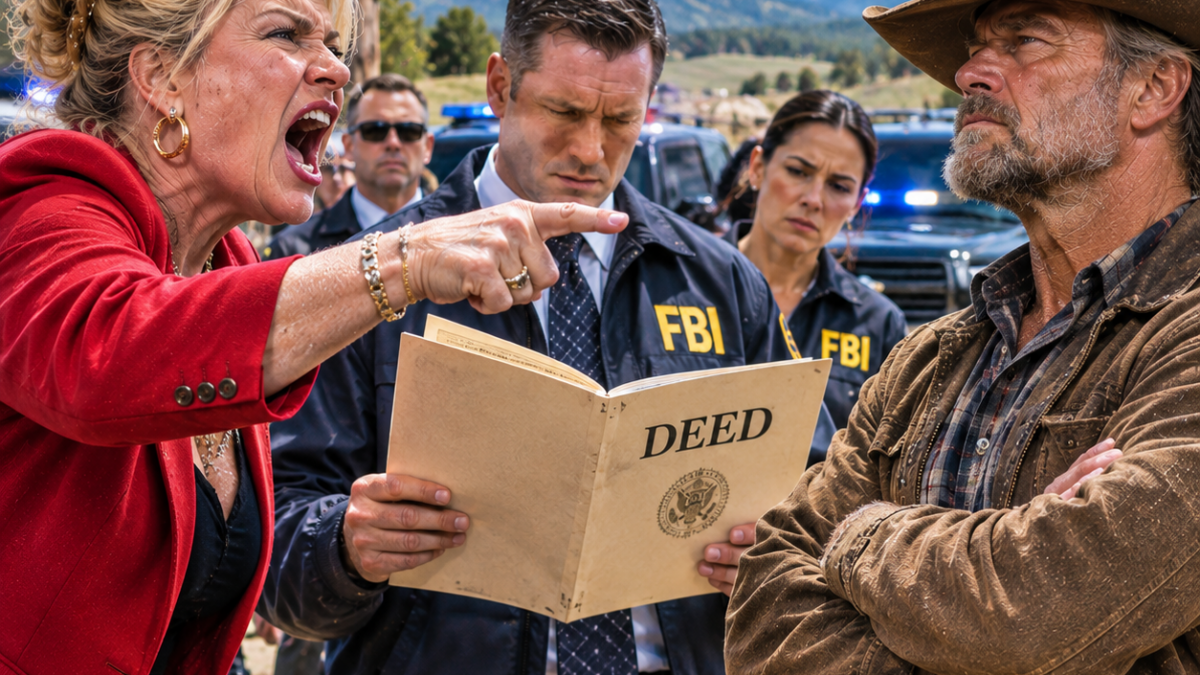
PART2:“GET OFF MY HOA LAND, COWBOY—YOUR FAMILY DOESN’T OWN A DAMN THING HERE!” HOA Karen Sold 12 Luxury Lots on My 427-Acre Ranch—Then the FBI Opened the Deed
PART2
The number had not changed.
The voice answering had.
“Federal land fraud coordination desk.”
“This is Ryan Hail.”
Pause.
“Former investigator?”
“Unfortunately.”
Another pause.
“What do you need?”
I looked through my windshield toward the distant ranch.
“A favor.”
That night, I rented a motel room outside Pinerest.
Cheap carpet.
Bad coffee.
Air conditioner that sounded like a helicopter trying to die.
Perfect.
I opened my laptop.
Started with Eleanor Harrington.
Within two hours, I stopped thinking about Whispering Oaks as an isolated theft.
Eleanor’s name appeared across property records in Texas, Oklahoma, and New Mexico.
Not always as owner.
Sometimes HOA officer.
Sometimes trustee.
Sometimes consultant.
Sometimes signatory on neighborhood land transfers.
Forty-seven properties formed a pattern.
Elderly owners.
Widows.
People with no nearby children.
Individuals entering assisted living.
Owners diagnosed with dementia.
Land transferred shortly before hospitalization.
Sometimes weeks before death.
Always through clean-looking paperwork.
Always followed by development, resale, or “community improvement.”
And over and over again, one notary name appeared.
Colton Murray.
I searched the state notary database.
My hand stopped on the mouse.
Murray’s seal had been reported stolen in 2017.
Yet documents bearing that seal continued appearing for years.
I sat back.
One forged deed can be greed.
Forty-seven is a business model.
The next morning I drove to Magnolia Pines Assisted Living.
Opal Whitfield was eighty-four.
Tiny woman.
White hair.
Sharp eyes.
She held an old photograph of a red barn.
“That’s my grandfather,” she told me.
The photograph showed a young man beside horses.
“Farm still in the family?”
Her expression changed.
“No.”
“What happened?”
“That woman happened.”
“Eleanor?”
Opal laughed bitterly.
“She came with cookies.”
I waited.
“Sat right there.”
Opal pointed toward a small visitor table.
“Said the HOA was updating neighborhood safety records.”
“What did you sign?”
“I don’t know.”
Her voice dropped.
“I thought it was contact information.”
“How much land?”
“One hundred twenty acres.”
“And afterward?”
“They told me I had donated it.”
“Did you?”
“No.”
Her hand closed around my wrist.
Stronger than I expected.
“My husband worked that place forty-seven years.”
I said nothing.
“Do you know what they told me?”
“What?”
“That old people forget things.”
Her eyes filled.
“They said maybe I’d forgotten giving it away.”
That sentence stayed with me.
Fraud takes money.
But fraud aimed at elderly people takes something else too.
It takes credibility.
It teaches victims to doubt their own memory.
Opal reached into a drawer.
Handed me a folded sheet of paper.
Twelve names.
“Families like mine.”
I stared.
“How did you get this?”
“People talk in places like this.”
One name had a star beside it.
Margaret Beckley.
“Who’s Margaret?”
“Alzheimer’s.”
“Family?”
“Son used to be HOA treasurer.”
That became my next road.
I had barely returned to the motel when my phone buzzed.
Unknown number.
10:47 PM. Roadhouse on Route 9. Blue Camry. Come alone.
I should have ignored it.
Instead, at 10:46, I parked beneath a dying neon beer sign.
A blue Toyota Camry sat near the back.
The man inside looked sixty even though he was probably fifty.
Warren Beckley.
Former Pinerest HOA treasurer.
He stared through the windshield for nearly a minute before opening the passenger door.
“Get in.”
I did.
He immediately handed me a USB drive.
“What’s this?”
“Two sets of books.”
My pulse changed.
“One for residents.”
“And?”
“One real.”
He swallowed.
“Shell companies. Kickbacks. Fake contractors. Transfers.”
“How long?”
“Fifteen years.”
“You were treasurer.”
“I know.”
“Then why now?”
His face twisted.
“Because she went after my mother.”
There it was.
Margaret Beckley.
“Three months ago Eleanor told me we needed to review Mom’s property for estate planning.”
“How much?”
“Seventy-eight acres.”
“Your mother has Alzheimer’s.”
“Yes.”
“Can she sign legal documents knowingly?”
“No.”
He looked at me.
“That’s when I understood.”
“You understood fifteen years too late.”
He flinched.
Good.
I did not want him comfortable yet.
“How much did you help hide?”
“A lot.”
“Money?”
“Yes.”
“Properties?”
His eyes lowered.
“Yes.”
“Officials?”
He nodded.
“Names.”
“Judge Morrison.”
My stomach tightened.
“Related to Sheriff Morrison?”
“Brothers.”
“Anyone else?”
“County clerk staff. Bank managers. Zoning people.”
He rubbed both hands over his face.
“Eleanor always said no one would believe old people.”
My jaw tightened.
“She said documents beat memories.”
There it was again.
Warren looked toward me.
“I was a coward.”
“Yes.”
“I can fix some of it.”
“No.”
He looked surprised.
“You can help expose it.”
I held up the USB.
“You cannot fix dead people losing family land.”
His eyes filled.
“I know.”
“Then tell the truth.”
He nodded.
I took the drive.
Left.
At 7:12 the next morning, Sheriff Earl Morrison knocked on my motel door.
No courtesy call.
No small talk.
Just a restraining order in one hand.
Big man.
Gray mustache.
Confidence built from a lifetime of people moving when he walked toward them.
“You Ryan Hail?”
“Yes.”
He held out the paper.
“You’re ordered to stay five hundred feet from Pinerest HOA property.”
“My ranch is not HOA property.”
He smiled.
“Court says otherwise.”
I looked at the judge’s signature.
Morrison.
“Your brother?”
His smile widened.
“Small county.”
“Apparently.”
He leaned closer.
“My cousin works the clerk’s office.”
That was not the flex he thought it was.
“Good to know.”
“Here’s better advice.”
His voice lowered.
“Leave town.”
“Why?”
“Accidents happen.”
I stared at him.
He did not blink.
Then he added:
“Cowboys disappear every day.”
I smiled.
“Sheriff?”
“What?”
“Thanks for the road map.”
His expression shifted.
I closed the door.
Then called the federal contact.
“Move this from favor to formal referral.”
The reply came quickly.
“Evidence?”
“I’m sending it.”
The USB opened an empire.
Payments to Delaware LLCs.
Consulting invoices for nonexistent work.
Property proceeds entering HOA-linked accounts and leaving through private companies.
Transfers linked to Judge Morrison’s brother-in-law.
Payments routed to associates of Sheriff Morrison.
Not every transfer proved a crime.
But enough looked suspicious that the matter stopped belonging to me.
That afternoon, Greer Ashworth called.
Title examiner.
Small office between a dry cleaner and a flooring shop.
She had reviewed Whispering Oaks.
When I arrived, documents covered her desk.
“You need to see this.”
She pointed at the 2019 donation deed.
“Colton Murray’s seal.”
“Stolen in 2017.”
“You know?”
“Yes.”
She pulled another file.
“Same seal.”
Another.
“Same.”
Another.
“Same.”
“How many?”
“Every suspect donation I checked.”
Then she tapped Ezra’s signature.
“I pulled his medical records with authorization from the estate.”
I looked at her.
“August 2019?”
“He was inpatient for six days.”
She handed me the page.
Neurological deficit.
Right-hand paralysis.
Unable to sign routine consent independently.
Yet Eleanor’s deed had Ezra executing a complex property transfer that same week.
Greer removed her glasses.
“I contacted the FBI.”
I stared.
“You?”
“My sister lost her house through one of these transfers six years ago.”
Her voice went flat.
“She died in a shelter.”
I said nothing.
“She had nowhere else.”
I looked down at the deed.
For the first time, the case stopped being professionally interesting.
It became personal in a larger way.
Opal.
Greer’s sister.
Warren’s mother.
Ezra.
Families erased one signature at a time.
Two nights later, Eleanor called an emergency HOA meeting.
I attended.
The community center was county-owned.
The restraining order covered HOA property.
Not county property.
Old habits die hard.
Loopholes too.
Eleanor stood at the podium in that same light-blue suit.
Behind her:
A projection of my photograph.
DISRUPTIVE NEW RESIDENT
I almost laughed.
I did not live there.
She began:
“Ladies and gentlemen, over the past several weeks, one individual has engaged in a campaign of harassment against our community.”
Whispers.
“That man claims ownership of land legally donated to Pinerest years ago.”
She pointed toward my image.
“He is attempting to destabilize property values.”
That phrase got attention.
Property values.
The holy scripture of wealthy HOAs.
Then she spotted me.
Her voice sharpened.
“You.”
Heads turned.
“Mr. Hail, you are violating a court order.”
“No.”
“This is HOA business.”
“This is county property.”
A few people laughed nervously.
Her face reddened.
“Security.”
The side door opened.
But security did not enter.
Three people in dark jackets did.
The woman in front raised credentials.
“Special Agent Miranda Thorne. Federal Bureau of Investigation.”
The room stopped breathing.
Eleanor’s smile froze.
Agent Thorne continued.
“Mrs. Harrington, this meeting is not being shut down.”
Eleanor recovered slightly.
“Good.”
“But you are formally advised that a federal investigation involving real estate transactions connected to this organization is underway.”
Whispers became voices.
Eleanor gripped the podium.
“This is ridiculous.”
“You are not under arrest tonight.”
Eleanor exhaled.
Thorne added:
“But I strongly advise against leaving the jurisdiction.”
That was when Eleanor looked afraid.
Not much.
A flicker.
But I saw it.
So did Warren, standing near the back.
The next forty-eight hours moved fast.
Faster than stories make federal investigations sound.
Not cinematic explosions.
Paperwork.
Warrants.
Teams.
Digital preservation.
Bank subpoenas.
Searches.
Servers imaged.
Records seized.
Agents entered Eleanor’s house early in the morning.
She stood on the porch in a silk robe screaming about lawsuits.
Twenty-three evidence boxes came out.
The county clerk’s office received warrants.
Several banking offices were examined.
Judge Morrison was removed from active judicial duties while allegations were reviewed.
Sheriff Morrison was placed under investigation by outside authorities rather than his own department.
That distinction mattered.
By then, news vans had arrived.
Eleanor gave interviews.
“I built Pinerest.”
“I protected homeowners.”
“This is retaliation.”
Then the financial evidence started talking.
Warren gave six hours of testimony the first day.
He admitted maintaining duplicate financial records.
He identified shell entities.
Explained how questionable “donations” were processed.
Named people.
Named accounts.
Named properties.
When he reached his mother, his voice broke.
“Three months ago Eleanor asked me to prepare Margaret’s land.”
The prosecutor asked:
“What did that mean?”
Warren stared at the table.
“It meant forge the transfer.”
Silence.
“And your mother?”
“Has Alzheimer’s.”
“Could she knowingly consent?”
“No.”
“Did that affect your decision?”
Warren began crying.
“It finally made me understand what I’d done to everybody else.”
That is the terrible thing about conscience.
Sometimes it arrives only when the knife turns toward your own house.
Still, late conscience is better than none.
The investigation ultimately connected forty-seven property matters requiring review.
The financial exposure ran into tens of millions of dollars.
The source records later used a figure of approximately $68.4 million connected to the alleged scheme.
But the number mattered less to me than the names.
Families.
Forty-seven properties meant forty-seven histories.
Barns.
Grandfathers.
Kitchen tables.
Graves.
Fence lines.
Eleanor called them assets.
Opal called hers home.
The agents found material supporting a broad fraud investigation involving forged deeds, wire transactions, money laundering theories, and coordinated conduct across jurisdictions.
RICO was discussed because of the alleged pattern and network structure.
But investigations are not convictions.
Agent Thorne reminded everyone constantly.
“Evidence first.”
I respected her for that.
One evening, after the search teams left, I drove to Whispering Oaks.
The luxury sales signs were gone.
The HOA common-area marker had been removed pending litigation.
My granite pillar stood exposed again.
HAIL — 1891
Greer met me there.
We stood under a Texas sunset.
She touched the stone.
“My sister would’ve loved seeing this.”
I looked at her.
“What was her name?”
“Rebecca.”
“Rebecca would’ve liked you fighting.”
Greer smiled sadly.
“She would’ve asked why I waited six years.”
“People survive first.”
She nodded.
“Then fight?”
“Sometimes.”
The formal arrest came later.
By then, Eleanor had spent weeks telling anyone who would listen that the investigation would collapse.
It did not.
The morning agents arrived, Pinerest woke early.
Residents stood outside.
Phones up.
News cameras along the curb.
I hated that part.
Not because Eleanor deserved privacy.
Because justice easily becomes spectacle.
Agent Thorne let me observe from a lawful distance because I was a victim and cooperating witness.
Six dark federal vehicles entered the cul-de-sac.
Eleanor’s white-columned house looked strangely small behind them.
The front door opened.
She stepped outside wearing a nightgown and cardigan.
Hair loose.
No pearls.
No sunglasses.
Just a frightened woman.
“This is harassment!”
Agent Thorne read the warrant.
Eleanor’s hands shook.
“You cannot arrest me.”
The charges included serious federal fraud and financial allegations tied to the property scheme.
Forgery-related counts.
Money laundering allegations.
Wire fraud.
Conspiracy.
RICO-related conduct as charged by prosecutors.
Eleanor looked toward the cameras.
“I built this neighborhood.”
Nobody answered.
“Without me there is no Pinerest Estates.”
Then she saw me.
Her face changed.
“You.”
I did not move.
“This is your fault.”
“No.”
“You came here looking for revenge.”
“I came here because you sold my land.”
“Your land?”
She laughed wildly.
“That ranch should have been mine.”
Agent Thorne glanced at her.
Eleanor kept going.
“Ezra promised me.”
My chest tightened.
“No, he didn’t.”
“He did!”
“When?”
“Years ago.”
“Then why forge the deed?”
Silence.
Her face changed.
She realized what she had said.
Too late.
Every camera was running.
Every body camera.
Every news microphone.
Eleanor tried to recover.
“I didn’t say—”
Agent Thorne stepped forward.
“Mrs. Harrington, stop speaking.”
But Eleanor was furious now.
Anger beat judgment.
“I built everything out there!”
She pointed toward the development.
“The stables. The roads. The courts. The luxury lots. I made that land worth something.”
I stared.
“It was worth something before you touched it.”
Her eyes burned.
“It was dirt.”
“No.”
I stepped closer but stayed outside the agents’ space.
“It was my family.”
For once, she had no answer.
The cuffs closed.
Metal around her wrists.
The sound was small.
Nothing like movies.
No thunder.
No music.
Just a click.
Eleanor looked toward the residents.
“Do something!”
Nobody moved.
People who had spent years afraid of HOA letters stood silently.
She shouted:
“I protected your property values!”
One woman called back:
“You stole people’s property.”
Eleanor’s mouth opened.
Nothing came.
As agents led her toward the vehicle, she twisted toward me.
“You’re still just cowboy trash.”
I almost smiled.
That insult had become familiar.
I opened my jacket enough for her to see the old federal investigator credential I still carried as retired identification.
“I was never just a cowboy.”
Her face went blank.
Then the vehicle door shut.
That should have felt like victory.
It didn’t.
Not completely.
Justice after nineteen years still means nineteen years happened.
Sheriff Morrison faced outside investigation and charges tied to conduct prosecutors believed they could prove.
Judge Morrison left the bench amid the expanding scandal and legal proceedings.
Bank officials connected to suspicious transactions became subjects of the financial investigation.
County employees were interviewed.
Some cooperated.
Some retained counsel.
Some were cleared of criminal wrongdoing but exposed for negligence.
The network was not one villain.
That became important.
Eleanor could not have operated for years if everybody around her had asked basic questions.
Who signed?
Was the owner competent?
Was the notary valid?
Why are HOA funds moving to private companies?
Why are elderly owners suddenly donating valuable acreage?
Why are the same names appearing repeatedly?
Greed created the scheme.
Silence made it durable.
Warren negotiated cooperation.
He did not receive a magical consequence-free ending.
His involvement was reviewed.
His cooperation mattered, but so did what he had helped conceal.
He spent months giving testimony and turning over records.
His mother’s property transfer was stopped before final loss.
When Margaret’s ownership was secured, Warren called me.
“I got it back.”
“No.”
“What?”
“She got it back.”
Silence.
Then:
“You’re right.”
Opal’s case took longer.
Court filings.
Title review.
Challenges.
No instant miracle.
But three months later, I visited her again.
She sat in the same sunroom.
This time, a lawyer sat beside her.
On the table:
A corrected deed confirming her restored title after the fraudulent transfer was invalidated.
Opal touched the paper like it might disappear.
“I want to go home.”
The lawyer smiled.
“Soon.”
Her eyes filled.
“My grandfather is buried there.”
I nodded.
“First thing I’m doing is taking flowers.”
I sat across from her.
“What are you going to tell him?”
She smiled.
“That I didn’t give it away.”
That broke me more than Eleanor’s arrest.
Because for years Opal had lived with people implying she had forgotten her own decision.
The deed was not just property.
It was proof she had remembered correctly.
“I didn’t give it away.”
Four words.
More powerful than handcuffs.
Greer’s sister’s property could not be returned to Rebecca.
Rebecca was gone.
But heirs received legal relief connected to the recovered estate value after review.
That mattered financially.
It did not undo dying in a shelter.
Greer never pretended otherwise.
“Money isn’t restitution for that.”
“No.”
“But the record matters.”
“Yes.”
“Her name is back on the history.”
“Yes.”
That mattered to Greer.
The federal court process froze and recovered substantial assets where possible.
Restitution claims followed.
Some victims received land back.
Some received money because developments had permanently altered parcels.
Some cases remained tangled.
Roads had been built.
Homes sold to buyers who claimed no knowledge of fraud.
Lenders held interests.
Property law does not become simple because the villain is obvious.
Whispering Oaks was complicated too.
Twelve buyers had deposited money.
Several believed honestly they were purchasing legal lots.
I was angry.
But not at them.
They had title-company paperwork.
HOA representations.
Sales contracts.
They were victims too.
We worked through cancellation and repayment claims from frozen/recovered funds.
Some buyers threatened me initially.
Then saw the documents.
One man named Steven came to the ranch.
“I sold my house for this lot.”
I looked at him.
“I’m sorry.”
“That’s all?”
“What do you want me to say?”
“That you’ll honor the sale.”
“I can’t.”
“You own four hundred acres.”
“My family owns four hundred acres because Eleanor forged a deed.”
His jaw tightened.
“My wife planned our retirement here.”
“And my uncle planned to die here.”
That ended the argument.
Not because I had won.
Because both things were true.
Steven eventually received most of his deposit through the legal recovery process.
He bought elsewhere.
Sent me a Christmas card the following year.
No hard feelings.
Good man.
The pickleball court was removed.
Not because pickleball offended my ancestors.
Because it had been built in the middle of an old grazing route and violated restoration plans.
The luxury stable was newer.
Useful.
For a while, I considered tearing it down.
Then Warren said:
“Why destroy something good because she built it for a bad reason?”
I hated that he had a point.
So the stable stayed.
But not as an HOA amenity.
That decision became part of what Whispering Oaks would become.
I had spent years saying retirement meant horses.
Quiet.
No investigations.
No fraud.
No agencies.
Then Eleanor handed me a second career.
Not federal.
Personal.
I created the Whispering Oaks Property Recovery Foundation.
Not a sanctuary in the fantasy sense.
A real nonprofit partnership with legal-aid groups, title professionals, and victim advocates.
Its purpose was narrow:
Help elderly and vulnerable property owners understand suspicious deed transfers before they lost everything.
Free title reviews.
Notary verification.
Referral assistance.
Estate-planning education.
Fraud reporting support.
We used part of the ranch.
The stable became therapy and community space.
Not because horses cure fraud.
Because victims needed someplace that did not feel like another courthouse.
Opal came to the opening.
So did Greer.
So did Warren’s mother in a wheelchair.
Margaret Beckley had advanced Alzheimer’s.
She did not understand speeches.
She liked the horses.
That was enough.
Warren stood beside her crying.
“I helped people do this.”
I looked at him.
“Yes.”
“I don’t deserve to be here.”
“Probably not.”
He almost smiled.
“Still blunt.”
“You wanted forgiveness?”
“No.”
“Good.”
I looked at Margaret touching a horse’s nose.
“Do useful things anyway.”
That became Warren’s life.
He volunteered.
Not as hero.
As restitution in motion.
He sat with families whose parents had dementia.
Explained financial tricks he once helped hide.
Told them:
“Do not trust paperwork because it looks official.”
He carried shame.
I did not remove it.
Maybe nobody should.
But he used it.
That counted.
Pinerest changed too.
The homeowners removed the old board.
Independent audit.
New counsel.
New officers.
Public financial reports.
Meeting minutes.
Conflict-of-interest rules.
The HOA survived.
Some residents wanted to dissolve it entirely.
Others wanted normal governance.
I stayed out.
My ranch was not in their HOA.
That was the entire original point.
One afternoon, the new president came to Whispering Oaks.
Her name was Claire Benton.
Sixty-two.
Retired school principal.
No pearls.
No clipboard.
She stood beside the repaired entrance marker.
“Mr. Hail.”
“Ryan.”
“I owe you an apology.”
“You didn’t do anything.”
“I lived here twelve years.”
I waited.
“I saw things.”
“What things?”
“Eleanor threatening people.”
“Did you know about deeds?”
“No.”
“Then don’t claim guilt you didn’t earn.”
She looked surprised.
“But I knew she was cruel.”
“That’s different.”
“I stayed quiet.”
I nodded.
“That’s something to think about.”
She handed me an envelope.
“What’s this?”
“Formal acknowledgment from the new board that Whispering Oaks has never been HOA property.”
I read it.
Clear.
Simple.
No legal tricks.
“Thank you.”
“We’re also removing every Pinerest sign from your boundaries.”
“Already removed most.”
“We found seven.”
I stared.
“Seven?”
She smiled awkwardly.
“Eleanor was enthusiastic.”
That was one word.
Claire looked toward the old stone marker.
“We’d like to repair the road damage our contractors caused.”
“Get estimates.”
“You’ll let us pay?”
“You caused it.”
She nodded.
“Fair.”
That conversation was more satisfying than watching Eleanor arrested.
Because power used properly is boring.
It asks permission.
Fixes damage.
Keeps records.
Then leaves.
Eleanor’s criminal case took time.
People online wanted immediate sentencing.
Real cases move slowly.
Motions.
Evidence disputes.
Witness preparation.
Financial tracing.
Property schedules.
Plea discussions.
Some charges changed.
Some counts consolidated.
Some allegations were easier to prove than others.
The final outcome still buried the empire she built.
She was convicted on serious federal fraud-related charges and received a lengthy prison sentence.
Not because she was an HOA Karen.
Because of evidence.
Forged deeds.
Money movement.
Victim testimony.
Records.
Her own statements.
The financial recovery order reached tens of millions.
But nobody pretended every victim received everything instantly.
Assets had been spent.
Properties transformed.
Legal costs existed.
Recovery became a process.
That was less cinematic.
More honest.
Sheriff Morrison lost his office and faced consequences tied to proven misconduct.
Judge Morrison’s career ended.
Other participants faced penalties according to their individual roles.
Not all fourteen people in the original network received identical outcomes.
They shouldn’t.
Justice is not a group punishment.
Each case requires proof.
I had spent my professional career telling angry landowners that.
Funny how much harder it becomes when the land is yours.
One evening, a reporter asked me:
“Did you ever want Eleanor to lose everything?”
I thought.
“At first?”
“Yes.”
“Then?”
“I wanted everyone else to get back what they could.”
“That’s different.”
“Yes.”
Revenge focuses on the offender.
Justice eventually has to focus on victims.
Opal did not care whether Eleanor’s prison mattress was uncomfortable.
She cared whether she could take flowers to her grandfather.
Greer cared about Rebecca’s name.
Steven cared about his retirement deposit.
Warren cared about stopping his mother from becoming another forged transfer.
I cared about Ezra.
Uncle Ezra had been difficult.
People turned dead relatives into saints.
I won’t.
He hated cell phones.
Argued about everything.
Once refused to replace a broken water heater for six months because, according to him:
“Cold water builds character.”
But he loved that ranch.
At his funeral, I was the only family member there.
That haunted me.
Not because nobody loved him.
Because time had scattered us.
I had spent twelve years traveling for investigations.
I visited less than I should have.
Every time I called, Ezra said:
“Land’ll still be here.”
Then one day he wasn’t.
The land was.
That became the emotional center of everything for me.
Eleanor had looked at Whispering Oaks and seen unused acreage.
Development potential.
Twelve lots.
Four-point-eight million in deposits.
I saw the porch where Ezra taught me how to sharpen a knife.
The creek where my father broke his wrist at twelve.
The cemetery hill with seven Hail family graves.
The scar on an oak tree where lightning hit in 1967.
Land is not sacred because dirt has magic.
It becomes sacred because memory has geography.
Eleanor had tried to erase geography with paperwork.
That was why I fought.
Not because 427 acres made me wealthy.
Because somewhere beneath her pickleball court was the path my great-grandmother walked to bring lunch to men digging fence posts.
You cannot put that on a balance sheet.
The foundation’s first major case involved a seventy-nine-year-old veteran named Harold James.
His daughter brought us a letter claiming he had transferred twenty acres to a neighborhood association.
He had not.
This time, we caught it before recording.
Fake witness.
Invalid notary.
No FBI raid.
No national scandal.
Just one stopped document.
Harold looked at me.
“That’s it?”
“That’s it.”
“Nobody gets arrested?”
“Maybe later.”
He laughed.
“Feels anticlimactic.”
“Best kind.”
Fraud prevented is boring.
I learned to love boring.
Within three years, the foundation had reviewed hundreds of suspicious documents.
Most were legitimate.
That mattered too.
Not every confusing deed is criminal.
Not every HOA is Eleanor.
Not every family dispute is theft.
We told people when they were wrong.
Sometimes that made them angry.
A woman once insisted her brother had stolen their mother’s farm.
Records showed their mother had sold it voluntarily ten years earlier.
She slammed my office door.
Warren looked at me.
“You okay?”
“Delighted.”
“Why?”
“Truth doesn’t belong to whoever cries hardest.”
He nodded.
“That should be on the wall.”
“No.”
Too much like an HOA sign.
Opal died five years after getting her farm back.
Her family invited me to the funeral.
At the cemetery, they buried her beside her husband.
Her grandfather’s old barn still stood in the distance.
Before the service, her granddaughter found me.
“Are you Ryan?”
“Yes.”
She handed me something.
The handwritten list Opal had given me years earlier.
Twelve names.
Folded.
Worn.
“Grandma kept this.”
I opened it.
Next to several names, someone had added checkmarks.
Returned.
Resolved.
Recovered.
One still had nothing beside it.
The family had died without identifiable heirs.
That stayed with me.
You do not win every case.
Opal’s granddaughter said:
“Grandma used to say you believed her.”
I swallowed.
“That was easy.”
“No.”
She shook her head.
“It wasn’t easy for her.”
That was the wound Eleanor had created deepest.
Not the stolen farm.
The years of being told:
Maybe you forgot.
Maybe you signed.
Maybe you are confused.
Believing victims is not the same as blindly accepting every claim.
It means taking them seriously enough to investigate.
Opal deserved that from the beginning.
I placed flowers on her grave.
Then drove home.
Whispering Oaks had changed.
Some pastures restored.
The stable remained.
The luxury sales pavilion became foundation offices.
The pickleball court area became a gravel gathering space.
People joked I could have kept the court.
I hate pickleball.
No regrets.
The HAIL 1891 pillar was repaired professionally.
I refused to replace it.
The stone was chipped.
Letters imperfect.
History should look its age.
One afternoon, a young couple stopped outside the gate.
I walked over.
“Can I help?”
The man pointed at the marker.
“Is this the ranch from the Eleanor Harrington case?”
“Yes.”
“Can we take a picture?”
“Of the marker?”
“Yes.”
“Why?”
The woman smiled.
“My grandmother got her property back through one of the later reviews.”
“What was her name?”
“Dorothy Lane.”
I remembered.
Small property.
Oklahoma.
“Go ahead.”
They took the picture.
Then the woman touched the stone.
“She always said land remembers who cared for it.”
I smiled.
“Sounds like something my uncle would say.”
Later that evening, I sat on Ezra’s porch.
Same porch Eleanor once used as background for a luxury-lot sign.
I had removed the sign long ago.
Sun setting.
Horses moving beyond the fence.
Quiet.
Warren came up the steps carrying two coffees.
“You ever miss investigating full-time?”
“No.”
“Liar.”
“Occasionally.”
He sat.
We watched the pasture.
After a while:
“Do you forgive me?”
First time he had asked.
I considered.
“No.”
He nodded.
Then I added:
“But I trust what you’re doing now.”
He looked over.
“That’s something.”
“Yes.”
He stared toward the stable.
“I used to think forgiveness was the goal.”
“What is?”
“Not doing it again.”
I smiled.
“Finally learning.”
He laughed.
People want clean endings.
Bad person punished.
Good person rewarded.
Victims restored.
Credits roll.
Whispering Oaks taught me endings are messier.
Eleanor went to prison.
That was justice.
Some land came back.
Some could not.
Money was recovered.
Not all of it.
Officials lost careers.
Victims still carried years they could not recover.
Warren helped expose the scheme.
He still had participated.
I regained my ranch.
I still could not bring Ezra back to sit on the porch.
Justice does not rewind.
It draws a line.
Before.
After.
Then asks what you build next.
I built something Ezra might have laughed at first.
A property-fraud resource center on ranch land.
He would have called it:
“A government meeting without government.”
Then he would have donated coffee.
I know him.
Pinerest eventually became a normal neighborhood.
Children rode bikes.
People complained about weeds.
Boards argued about pool repairs.
Good.
Normal is underrated after corruption.
The new HOA sent me exactly one letter in five years.
Request:
Would Whispering Oaks allow an emergency access route across a ten-foot strip during wildfire evacuation?
I read it twice.
Called Claire.
“You’re asking?”
“Yes.”
“Not demanding?”
She laughed.
“Ryan.”
“Just checking.”
We negotiated a legal easement.
Payment:
One dollar.
Plus maintenance responsibility.
Written.
Recorded.
Clear.
That is how land agreements should work.
No stolen seal.
No mystery signatures.
No dying owner.
One dollar.
Two informed parties.
Somewhere Eleanor would have hated it.
That amused me.
The most powerful moment in the story was not the handcuffs.
People expect me to say it was.
Six black SUVs.
Morning sun.
Cameras.
Eleanor screaming.
Sure.
It was satisfying.
But the moment that returns when I cannot sleep happened months later.
Opal sat in Magnolia Pines holding the corrected deed.
Her hands shook.
She kept touching her own name.
Then she whispered:
“I knew I didn’t sign it.”
I sat across from her.
She began crying.
Not loudly.
“I knew.”
That was it.
A woman in her eighties finally receiving written proof she had not imagined her own life.
That is what fraud had taken.
And that is what evidence gave back.
Years later, when people ask how Eleanor got away with it for nineteen years, they expect some sophisticated answer.
Corrupt networks.
Shell companies.
Officials.
Legal complexity.
All true.
But the simplest answer is:
She chose people she thought nobody would believe.
Old.
Ill.
Alone.
Confused.
Poorly connected.
Then she wrapped theft in paperwork.
A seal.
A signature.
Letterhead.
An HOA logo.
A judge’s order.
Professional-looking lies.
People trust formatting.
That is frightening.
She also understood property values.
As long as houses appreciated, many Pinerest residents did not ask where the new amenities came from.
Luxury stable?
Nice.
New trail?
Great.
More common land?
Wonderful.
Nobody asked:
Whose grandfather used to own this?
Where did the deed come from?
Why did an eighty-four-year-old widow donate a farm?
Comfort can make people incurious.
That is how systems rot.
Not always through active evil.
Often through people enjoying benefits enough not to ask questions.
Claire eventually said that publicly at an HOA meeting.
“We did not know the whole crime.”
Then:
“But we enjoyed results without asking how they were purchased.”
That was brave.
Accountability does not require falsely confessing to crimes you did not commit.
It requires admitting where you stopped looking.
I did my own version too.
Ezra had called me six months before the supposed 2019 deed.
I remembered later.
He complained about:
“That blond woman from the fancy houses.”
I laughed.
Told him to stop arguing with neighbors.
If I had asked more—
No.
That path leads nowhere.
Maybe I could have found Eleanor earlier.
Maybe not.
Alternate histories are seductive.
They let survivors punish themselves for crimes committed by someone else.
I refused.
Ezra was responsible for Ezra’s choices.
I was responsible for mine.
Eleanor was responsible for fraud.
That line mattered.
The old deed now hangs inside the ranch office.
Not the forged one.
The family deed.
Beside it is a copy of Eleanor’s fake transfer, marked clearly:
FRAUDULENT — VOIDED
Visitors sometimes ask why I display it.
Because both documents teach something.
One says ownership can survive generations.
The other says paper can lie.
Never confuse official appearance with truth.
Check.
Verify.
Ask.
The foundation eventually created a simple checklist:
Who benefits?
Was the signer competent?
Was the signature witnessed properly?
Is the notary active?
Did the owner understand the transfer?
Did money move?
Do dates align with medical and travel records?
Does the recipient have a pattern?
Basic questions.
Eleanor’s empire depended on people not asking them.
One winter morning, I found a young volunteer staring at the fake deed.
“Hard to believe one signature caused all this.”
“It didn’t.”
She looked at me.
“What did?”
“Thousands of people assuming somebody else checked.”
She nodded slowly.
That was closer.
Eleanor appealed parts of her conviction.
Lawyers do that.
Some issues changed.
The core fraud findings survived.
I stopped following every filing.
Her life no longer deserved that much space inside mine.
Someone once emailed asking whether I hated her.
I deleted the message.
Not because I had forgiven her.
Because hatred is another form of occupancy.
She already occupied too much land.
She did not get my head too.
The ranch belongs legally to me now.
But I rarely say:
“My land.”
I say:
“Whispering Oaks.”
Or:
“The ranch.”
Ownership matters.
So does stewardship.
Ezra inherited it.
Then me.
Eventually someone else.
Land outlives arguments.
People who try to own history permanently usually misunderstand history.
My job became simpler.
Keep the deed clean.
Keep the fences honest.
Do not sell memories without knowing what they are.
The last time I saw the old Eleanor-era Pinerest sign, it was lying behind the foundation workshop.
White metal.
Bent.
COMMON AREA — AUTHORIZED PERSONNEL ONLY
Warren asked:
“Want to throw it away?”
I looked at it.
“Cut it.”
“What?”
We took the metal to a local fabricator.
He cut it into twelve small plaques.
One for each luxury lot Eleanor tried to sell.
On the front we engraved:
VERIFY THE DEED.
We gave them to twelve legal-aid offices.
Petty?
Maybe.
Useful?
Definitely.
One hangs in Greer’s title office.
She says clients ask about it constantly.
Good.
Every question is one less comfortable assumption.
I am older now.
My knees dislike horses more than they used to.
I still wear boots.
Still drive the F-250, though Sadie—my cousin’s daughter, who helps with the foundation now—says it belongs in a museum.
I refuse.
The ranch road is quieter.
Pinerest’s luxury houses sit beyond the trees.
Some of those residents became friends.
Not HOA friends.
Real ones.
Claire brings peach pie every July.
Her husband fixes fence motors better than I do.
Life is strange.
The community Eleanor used as camouflage eventually became part of the network protecting elderly owners.
Every year, Pinerest hosts a title-fraud seminar.
Attendance is boring.
Perfect.
At the most recent one, an eighty-year-old man raised his hand.
“What if my daughter says I should sign something?”
I answered:
“Read it.”
“What if I trust her?”
“Read it.”
“What if she’s offended?”
“Read it.”
People laughed.
I didn’t.
Trust is not a substitute for understanding.
Ezra trusted community institutions enough to ignore Eleanor until it was nearly too late.
Opal trusted cookies and forms.
Margaret Beckley trusted her son.
Rebecca trusted paperwork.
Trust is human.
Verification protects humans.
After the seminar, I walked outside.
Late afternoon.
Sun low.
HAIL 1891 glowing gold on the stone.
A boy from Pinerest was riding a bike along the road.
He stopped.
“Mr. Hail?”
“Yes?”
“My mom says you beat the HOA.”
I laughed.
“No.”
“She said you did.”
“I proved the ranch wasn’t theirs.”
“Same thing.”
Kids.
He pointed toward the old house.
“Did your great-great-grandpa build that?”
“Part of it.”
“Cool.”
Then he rode away.
That was history to him.
Cool.
Maybe that is enough.
Not every generation needs to carry the anger.
They need the record.
The truth.
The boundary line.
The lesson.
The rest can become story.
When Eleanor first stood in front of me in that blue suit, she called me lazy cowboy trash.
She thought the deed in my hand was nostalgia.
She thought her deed was power.
She believed nineteen years of winning made her untouchable.
But nineteen years did not make the forgery more real.
Millions of dollars did not move a boundary line.
A judge’s friendship did not cure a stolen notary seal.
An HOA letter did not transform fraud into community standards.
And a platinum-blond woman with a clipboard did not become owner simply because enough frightened people stopped arguing with her.
In the end, I did not beat Eleanor with influence.
I did not threaten her.
Did not forge anything back.
Did not bulldoze her house.
Did not shoot out the gate.
I did something less dramatic.
I looked.
Then kept looking.
At dates.
Names.
Medical records.
Notary seals.
Bank transfers.
Old victims.
Two sets of books.
One frightened treasurer.
One dead sister.
One eighty-four-year-old woman who knew damn well she had never donated her grandfather’s farm.
Eleanor’s entire empire depended on people believing paper more than people.
So we found better paper.
Real deeds.
Real records.
Real signatures.
Real money trails.
And finally, the truth became louder than her letterhead.
The ranch is quiet tonight.
The stable lights are on.
Two horses moving behind the fence.
Wind through the live oaks.
No HOA signs.
No luxury-lot banners.
No patrol SUVs.
Just the granite pillar.
HAIL — 1891.
Sometimes I stop there before driving inside.
I put my hand on the stone.
Think about Ezra.
Think about Opal.
Rebecca.
Margaret.
All those families whose histories were almost reduced to line items in Eleanor’s books.
And I remember something my uncle once told me when I was twelve.
We were repairing fence after a storm.
I complained that the posts were crooked.
Ezra said:
“Boy, a fence doesn’t need to be pretty.”
I asked:
“What does it need to be?”
He drove the post deeper.
“True.”
I did not understand then.
I do now.
That was the whole fight.
Not pretty paperwork.
Not impressive titles.
Not HOA authority.
Not federal badges.
Not luxury development.
True boundaries.
True signatures.
True ownership.
True memory.
Eleanor Harrington spent nineteen years believing she could change the truth by filing enough paper over it.
She could not.
Because underneath every false deed was still a real piece of land.
And underneath every fake signature was still a family that remembered who it belonged to.
She called me nobody.
Maybe I was.
One retired investigator.
One nephew.
One man standing beside an old stone gate.
But sometimes nobody is enough—
if nobody finally looks at the deed.








