PART2:“GET DOWNSTAIRS AND SERVE MY MOTHER—NOW!” My Husband Hurt Me at 4:40 A.M. and Locked Me in My Own House—He Didn’t Know the Three Documents I Took Would Destroy the Deal He’d Built on My Inheritance
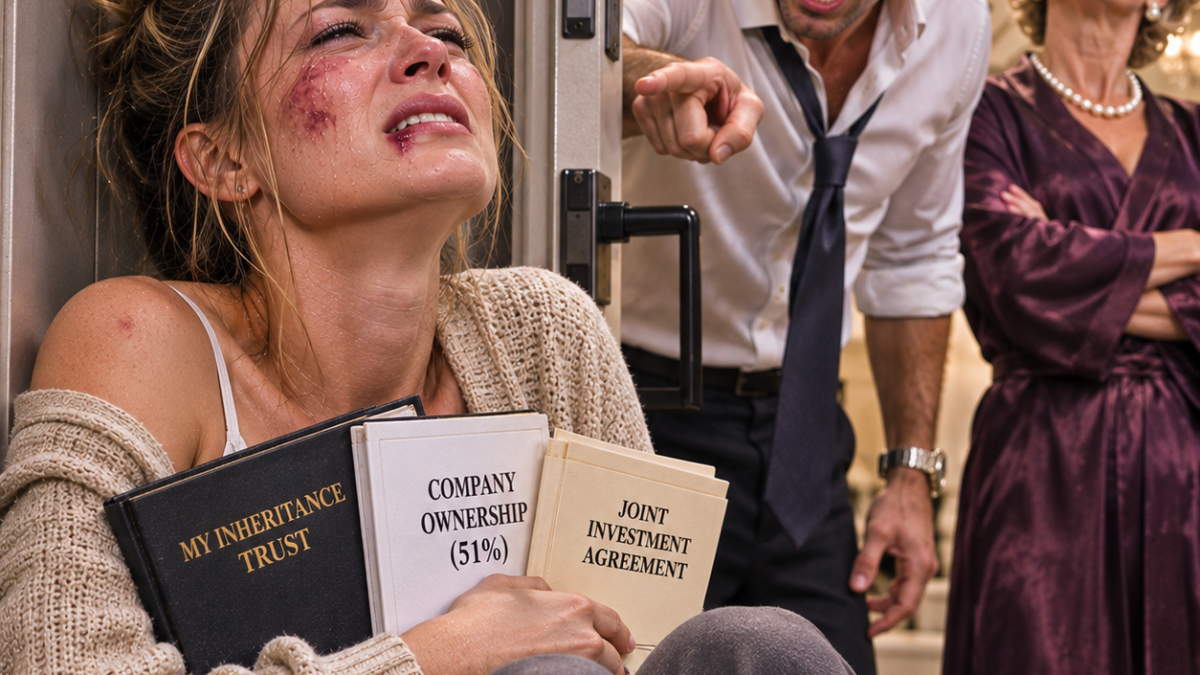
PART2
I reached into my pocket and pulled out my phone.
Daniel laughed.
“What are you going to do?”
I said nothing.
“Call the cops?”
“No.”
That made him pause.
I opened the smart-security application.
The account was registered only to me.
The house had been mine before Daniel.
The deed was mine.
The insurance account was mine.
And after a burglary eighteen months earlier, I had upgraded the entire security system without allowing Daniel administrator access because he had complained the app was “too complicated.”
For once, his arrogance had been useful.
I opened:
Emergency Protocols.
Daniel stepped closer.
“What are you doing?”
I selected:
Medical / Duress / Forced Confinement.
The system asked:
Silent response?
Yes.
Unlock interior smart deadbolts?
Yes.
Preserve last 60 minutes of interior security video?
Yes.
Notify monitoring center?
Yes.
My thumb pressed the screen.
Daniel heard the office deadbolt release.
He looked at it.
Then at me.
“What did you do?”
I picked up my suitcase.
“Remember whose house this is?”
He blocked the doorway.
I stared.
The app displayed:
Emergency monitoring active. Response initiated.
“Move.”
“No.”
His voice was quieter now.
That frightened me less than it once had.
“Daniel.”
“You think you can just destroy everything?”
I looked at the red folder.
“I think you already did.”
Lorraine shouted from the hallway:
“Don’t let her leave with company documents!”
I almost laughed.
Company documents.
Interesting.
For years Lorraine told everyone the company belonged to Daniel.
Now suddenly documents mattered enough to trap me.
I pulled out the three pages I had already copied the night before.
Daniel saw them.
His face drained.
They were not random.
The first was a consulting agreement between Bennett Strategic Partners and a company called North Crest Advisory.
North Crest had been paid $486,000 over eighteen months.
The listed managing member?
A holding company.
The holding company’s registered mailing address?
Lorraine’s townhouse.
The second document was an internal reimbursement ledger.
Travel.
Vendor retainers.
“Client development.”
Hundreds of charges approved by Daniel.
Several payments to North Crest.
Others to a second entity I did not recognize.
The third was the most dangerous.
A draft asset-sale consent.
It proposed selling seventy percent of Bennett Strategic Partners to Graymark Capital for a fraction of the valuation our outside accountant had given us six months earlier.
The signature blocks showed:
Daniel Bennett — Managing Partner
and beneath it:
Claire Bennett — Shareholder Consent
My signature line was blank.
For now.
Attached to the draft was an email.
Need Claire consent before close unless we use the estate authorization. Confirm.
Daniel had printed it.
Probably accidentally.
I found it in the office printer tray.
That was why I packed the suitcase three weeks earlier.
Not because I understood the entire plan.
Because I finally knew there was one.
Daniel said:
“Those are drafts.”
“Then why are you afraid I have them?”
“You don’t understand corporate transactions.”
“I founded the company.”
“You inherited money.”
“And used it to keep twelve employees paid when our biggest client collapsed.”
“That doesn’t make you operational.”
“No.”
I looked at him.
“It makes me the majority owner.”
His eyes flashed.
“You think because your aunt gave you money—”
“My aunt gave me the house.”
I held up one page.
“She also gave me the capital that saved the company.”
Lorraine stepped inside.
“This obsession with Evelyn is pathetic.”
I looked at her.
“My aunt paid the mortgage when Daniel’s consulting income disappeared.”
Lorraine’s face hardened.
“Daniel rebuilt that business.”
“Yes.”
I nodded.
“He also appears to have been paying you through North Crest.”
She went still.
Daniel said:
“Mom, go downstairs.”
She stared at him.
“Why?”
“Go.”
That was when I knew North Crest was real.
Not accounting noise.
Not misunderstanding.
Real.
My phone vibrated.
Monitoring center: law enforcement dispatched. Remain in safe area.
Daniel did not see.
He reached toward the folder.
“Give it to me.”
“No.”
“Claire.”
“No.”
His hand moved.
I stepped back.
He stopped.
Maybe because he saw my wrist.
Maybe because the camera above the bookshelf had a blue recording light.
His eyes followed mine.
Then:
“You recorded this?”
“The house did.”
He looked up.
Lorraine did too.
For the first time, she looked afraid.
“You record bedrooms?”
“No.”
I pointed toward the office.
“I record my office.”
Daniel lunged for the camera.
I said:
“Cloud backup.”
He froze.
That was not entirely true.
The footage was locally mirrored and cloud-preserved only during emergency activation.
But now it was.
He stared at me.
“You planned this.”
“No.”
I picked up the suitcase.
“I prepared for it.”
Sirens arrived three minutes later.
Daniel moved away from the doorway.
Not because I asked.
Because consequences had become audible.
I walked downstairs.
Lorraine followed.
“Claire, don’t you dare tell police some ridiculous story.”
I turned.
“What story?”
“You know Daniel didn’t mean to hurt you.”
I looked at my bleeding wrist.
She followed my eyes.
Then said:
“You bruise easily.”
There are sentences that tell you exactly who someone is.
That was hers.
The doorbell rang.
I opened it.
Two officers.
One woman.
One man.
“Claire Bennett?”
“Yes.”
“Security company reported a duress alarm and forced confinement.”
“Yes.”
The female officer noticed my wrist.
“What happened?”
Daniel appeared behind me.
“This is a marital disagreement.”
The male officer looked at him.
“Sir, stay where you are.”
Lorraine said:
“She’s being dramatic.”
The officer looked at her.
“Ma’am, nobody asked you.”
For some reason that nearly made me cry.
The female officer asked:
“Did your husband cause that injury?”
I looked at Daniel.
Then answered:
“Yes.”
His face changed.
Six years.
Six years of:
He didn’t mean it.
He was stressed.
It wasn’t that bad.
He only grabbed me.
He only blocked the door.
He only threw the glass beside me.
He only punched the wall.
He never really hit me.
That morning I used one word.
Yes.
The officers separated us.
Daniel tried to explain.
Lorraine explained more.
I heard pieces.
“She’s unstable.”
“Family pressure.”
“Company problems.”
“Misunderstanding.”
Then the officer asked if I wanted medical care.
“I’m going to urgent care.”
“Do you have somewhere safe to stay?”
“Yes.”
That was another lie.
But one I intended to fix immediately.
I left with my suitcase and copies of the three documents.
The originals stayed in the house.
I wanted that clearly documented.
I did not steal company records.
I had copied documents I believed related to my ownership interests.
My attorney could decide what came next.
At 6:03 a.m., sitting in my car three blocks away, I called Rachel Stein.
Rachel had been Aunt Evelyn’s estate lawyer.
She answered on the fourth ring.
“Claire?”
“I need help.”
She went instantly awake.
“What happened?”
“My husband hurt me.”
Silence.
“Are you safe?”
“Yes.”
“For the next hour?”
“Yes.”
“Good.”
“What else?”
“I found documents.”
“What documents?”
“A proposed sale of Bennett Strategic.”
That woke her completely.
“To whom?”
“Graymark Capital.”
“How much?”
I told her.
She became quiet.
“That’s less than half the last internal valuation.”
“I know.”
“What else?”
“Payments to North Crest.”
“What is North Crest?”
“Apparently connected to Lorraine.”
Another silence.
Then:
“Claire.”
“Yes?”
“Do you remember the protective provision in Evelyn’s estate agreement?”
I frowned.
“No.”
“You were twenty-eight when she died.”
“I remember the house.”
“The house passed outright.”
“Yes.”
“The business rescue capital was different.”
I closed my eyes.
I remembered documents.
Too many documents.
Aunt Evelyn had died eight years earlier after a stroke.
She had owned a small private investment portfolio and no children.
She loved me like one.
“What provision?”
“When the estate advanced the $1.2 million that recapitalized Bennett Strategic, it wasn’t documented as a simple personal gift.”
“What was it?”
“A secured estate note that converted into a restricted preferred interest.”
I stared through the windshield.
“English.”
Rachel almost laughed.
“Evelyn wanted you protected if you married someone who later tried to strip the company.”
My heart stopped.
“She knew Daniel?”
“No.”
“You weren’t even dating him.”
“Then why?”
“Because Evelyn had been married to your uncle.”
That explained enough.
Uncle Martin had almost bankrupted her before their divorce.
Rachel continued.
“The estate retained certain protective rights until specific conditions were satisfied.”
“I thought all of that terminated years ago.”
“Most did.”
“Most?”
“One survives.”
“What?”
“If a controlling interest in Bennett Strategic is transferred below a defined valuation threshold, or if related-party distributions exceed limits without independent approval, the estate’s successor trust can demand an audit before consent.”
I sat frozen.
“Who is successor trustee?”
“Evelyn Hart Foundation.”
The charitable foundation my aunt had created.
“Rachel.”
“Yes?”
“Daniel is trying to sell seventy percent.”
“I heard.”
“And he’s been paying his mother’s company.”
“I heard.”
“What happens now?”
“I contact the foundation trustee.”
“Can they stop the sale?”
“Possibly.”
“Do it.”
“You’re sure?”
I looked at my wrist.
“Yes.”
Rachel’s voice softened.
“Claire.”
“What?”
“I’m sorry.”
“Me too.”
“No.”
She paused.
“You called before the money moved.”
That mattered more than she knew.
By 7:00 a.m., I was in urgent care.
By 8:30, photographs existed.
Medical documentation.
My wrist was sprained.
The cut was superficial.
No fracture.
The doctor asked:
“Is this the first time?”
I stared.
“No.”
That answer opened another door.
I described the wall punching.
The blocking.
The time Daniel grabbed my upper arm.
The time he took my phone during an argument.
The doctor listened.
Then asked whether I wanted an advocate.
I said yes.
Another new word.
Yes.
At 10:17, Rachel called.
“The foundation’s counsel is issuing a preservation notice.”
“To Daniel?”
“To Bennett Strategic, Graymark, North Crest, your company accountant, and the bank handling the proposed transaction.”
My stomach tightened.
“Will Daniel know I did it?”
“He’ll know someone did.”
“Good.”
“Also.”
“What?”
“The trust has retained a forensic auditor.”
“When?”
“Immediately.”
“How immediately?”
“She’s already reviewing remote records.”
I laughed.
“Of course Aunt Evelyn built a dead-person alarm system.”
Rachel laughed too.
“That is one way to describe corporate governance.”
The auditor’s name was Natalie Price.
CPA.
Certified fraud examiner.
Former Big Four forensic-accounting director.
By noon, she had found enough irregularities to recommend suspending the Graymark transaction.
The sale required majority shareholder consent.
Mine.
Daniel had no lawful authority to sign for me.
That should have ended it.
It did not.
Because he had apparently been preparing another route.
“Estate authorization.”
Those words from the printed email.
Rachel explained later.
Daniel had discovered the old recapitalization documents.
He believed certain outdated management powers gave him authority to approve a sale if I was “unavailable.”
They did not.
But he had drafted a board resolution suggesting I had delegated authority to him.
Signed?
Not yet.
Someone had created a PDF containing a signature block that looked remarkably like mine.
I started to understand why Daniel wanted the red folder so badly.
The folder was not only proof of money leaving.
It showed he knew consent was required.
That afternoon I checked into a hotel under my maiden name.
Claire Hart.
Not because I planned to keep it.
Because I needed privacy.
I turned off location sharing.
Reset banking passwords.
Changed email passwords.
Called my business bank.
Called my personal bank.
Froze new credit.
Removed Daniel from emergency contacts where appropriate.
Then sat on the bed.
And finally cried.
Not elegant tears.
Not quiet.
My body shook.
I kept looking at the red mark around my wrist.
Six years of marriage.
I remembered Daniel proposing at Lake Geneva.
His hands shaking.
His eyes full of tears.
I remembered him carrying me through the front door after our wedding even though I told him it was cheesy.
I remembered him bringing soup when I had pneumonia.
People ask why women stay with controlling men.
As if cruelty arrives with a résumé.
It doesn’t.
Daniel was not cruel every day.
That was why I stayed.
Good months.
Bad weeks.
Apologies.
Vacations.
Flowers.
Then rules.
Gradually.
“Don’t wear that to dinner with clients.”
“Why do you need to see Amanda again?”
“Let me handle the finances.”
“Mom is only trying to help.”
“You’re too emotional to discuss business.”
“You should be grateful I’m running the firm.”
Every rule arrived wrapped in concern.
By Year Four, I had stopped asking why.
By Year Six, Lorraine had a key to my house.
Not because I gave it.
Daniel did.
He said:
“She’s family.”
She arrived without notice.
Reorganized my kitchen.
Criticized housekeeping.
Once she removed a framed photograph of Aunt Evelyn from the dining room because she said:
“Dead relatives make a room gloomy.”
I put it back.
Daniel told me:
“Don’t start.”
Those words became a cage long before he turned the office deadbolt.
My phone buzzed at 6:48 p.m.
Unknown local number.
I hesitated.
Then answered.
“Hello?”
“Am I speaking with Ms. Claire Bennett?”
“Yes.”
“My name is Officer Miguel Ramirez.”
I sat up.
“Is Daniel okay?”
“Your husband is not injured.”
“What happened?”
“I’m standing outside your residence.”
My stomach tightened.
“Why?”
“There’s a woman here identifying herself as a forensic auditor representing counsel for the Evelyn Hart estate foundation.”
Natalie.
“What is she doing there?”
“She states she had scheduled access to retrieve corporate records stored in your home office after counsel served notice this afternoon.”
I frowned.
“At this hour?”
“It’s 6:48.”
I looked at the hotel clock.
I had fallen asleep and somehow thought it was middle of the night.
The room was dark because the blackout curtains were closed.
“Sorry.”
I rubbed my face.
“Go on.”
“Your husband is threatening her with trespassing.”
“Of course.”
“He claims he owns the property.”
I became very still.
“What?”
“He says it is his residence and he has authority to exclude her.”
“He lives there.”
“Yes.”
“He does not own it.”
“That is what she says.”
Ramirez continued.
“She has a copy of the deed showing you as sole legal owner.”
I exhaled.
“Did she enter?”
“No.”
“Good.”
“Ms. Bennett, are you authorizing her to enter?”
I hesitated.
The house contained my property.
Daniel’s property.
Company records.
I did not want evidence accusations later.
“Not without proper process.”
Ramirez paused.
“That’s wise.”
“Tell her to coordinate with counsel for formal access.”
“I will.”
“What about Daniel?”
“He asked what authority police have to stop him from destroying his own papers.”
My blood went cold.
“What did you say?”
“That he should speak with his attorney.”
“Officer.”
“Yes?”
“Did he say destroy?”
Pause.
“Yes.”
“Exactly?”
“Approximately. Body camera is recording.”
I smiled into the darkness.
Not because anything was funny.
Because Daniel had just done what controlling men do when control begins slipping.
He talked.
Too much.
“What do you want us to do with him?” Ramirez asked.
That question felt strange.
I answered carefully.
“Whatever the law allows.”
“No special request?”
“No.”
I looked at my wrist.
“I don’t want revenge.”
Then:
“I want records preserved.”
The next morning Natalie obtained access through counsel.
Not secretly.
Not at 2:00 a.m.
Daniel’s attorney attended.
So did mine.
An independent IT specialist imaged the office computer.
Documents were catalogued.
No theatrical box carrying.
No possibility that Daniel could later say I planted records.
That mattered.
The audit found the first major problem within forty-eight hours.
North Crest Advisory had received $486,000.
Its stated services:
Executive strategy.
Client sourcing.
Vendor relations.
No work product existed.
No reports.
No time records.
No contracts beyond one vague two-page agreement.
North Crest’s beneficial owner?
Lorraine Hayes.
My mother-in-law.
Daniel had approved every payment.
Lorraine had reported some revenue on taxes.
Enough to make the company look legitimate.
Not enough to explain the funds.
The second entity was called Harbor Lane Services.
It received another $312,000.
Owner?
Daniel.
Through a Delaware LLC he had never disclosed to me.
I sat in Rachel’s conference room.
Natalie laid out the payments.
“My husband paid himself through a shell company.”
“Potentially.”
“Don’t say potentially.”
“I have to.”
She was right.
“Could there be legitimate services?”
“Yes.”
“Are there?”
“So far we have found none.”
She continued.
“More concerning is the timing.”
“What timing?”
“Payments increase whenever Bennett Strategic receives distributions from large client engagements.”
I stared.
“So he skimmed profitable quarters.”
“That is a hypothesis.”
I almost smiled.
“You’re going to make me hate auditors.”
“Occupational hazard.”
Then came Graymark.
The proposed deal valued Bennett Strategic at $4.8 million.
Our independent valuation six months earlier:
$11.6 million.
Daniel wanted to sell seventy percent for $3.36 million.
Why?
Natalie found the side agreement.
Not inside Bennett Strategic.
Inside Daniel’s personal email archive recovered from the office laptop.
Graymark would pay Daniel a separate $900,000 “transition consulting fee” over three years.
He would become president of the acquired company.
I would receive sale proceeds as majority shareholder.
But lose control.
Daniel would gain salary, fee, title, and operational authority.
Then another document appeared.
A post-closing employment plan.
My role:
Non-executive founder / brand ambassador.
Compensation:
$60,000.
I stared.
I currently drew $220,000 plus distributions.
“He planned to turn me into a mascot.”
Natalie did not answer.
She did not need to.
Rachel said:
“Was there any discussion with you?”
“No.”
“Any approval?”
“No.”
“Any board meeting?”
“No.”
“Then there is no sale.”
That was the first good news.
The transaction died.
Graymark’s attorneys withdrew the offer pending investigation.
They claimed they had believed Daniel possessed proper authority.
Evidence later supported that some of their executives genuinely did.
One internal email read:
Need founder signature. Daniel keeps saying estate mechanism covers it. Legal uncomfortable.
Good.
Not everyone was conspiring.
That mattered.
Daniel called me forty-three times in five days.
I answered none.
Then his attorney requested communication through counsel.
Better.
Lorraine called from three different numbers.
I blocked them.
Then she emailed.
Subject:
YOU ARE DESTROYING YOUR HUSBAND
I read one paragraph.
Daniel gave you everything. He built your company while you played owner because your aunt handed you money. A wife who loves her husband does not call auditors and police when he is under pressure.
I forwarded it to Rachel.
She replied:
Preserved. Do not answer.
I did not.
The domestic-violence case moved separately.
Police reports.
Security footage.
Medical photographs.
Daniel was not charged with some dramatic attempted-murder offense.
That would have been absurd.
The conduct supported more ordinary but serious domestic-assault and unlawful-restraint allegations under state law.
The office video showed him grabbing my wrist.
Blocking the door.
Locking it.
Refusing to let me leave.
Lorraine appeared in frame.
Smiling.
Then saying:
Maybe now she’ll remember who runs this house.
She did not touch me.
That distinction mattered legally.
But her conduct mattered in the protection-order hearing.
The judge watched the clip.
Then looked at Daniel.
He looked smaller than I remembered.
My temporary protective order was granted.
Daniel could retrieve personal belongings through an arranged process.
He could not return freely.
The house was mine.
Sole title.
Inherited before marriage.
Daniel’s attorney argued it had become marital residence.
True.
Residence rights and ownership questions could still matter during divorce.
But that did not make Lorraine owner.
Did not make Daniel sole owner.
And certainly did not give him permission to imprison me in a room.
Lorraine learned that the hard way when she arrived at the house two days after the order.
She tried her key.
The locks had been changed.
Officer Ramirez happened to be present while a security technician finished upgrades.
Lorraine shouted:
“My son lives here!”
Ramirez answered:
“Not currently.”
She pointed at me.
“She has manipulated the police.”
I was standing on the porch.
I said nothing.
She continued.
“That house belongs to my son too.”
I still said nothing.
Ramirez looked at the deed documentation.
Then at her.
“Ma’am, you need to leave.”
Lorraine looked at me.
“You smug little—”
“Mom.”
Daniel’s attorney had arrived for property retrieval and cut her off.
That was the first time I saw anyone shut Lorraine down and survive.
She looked stunned.
Then got into her car.
I almost laughed.
Inside the house, Daniel had left an astonishing amount of evidence.
Not because criminals are always stupid.
Because controlling people become careless when they assume the person closest to them will never resist.
Receipts.
Printed emails.
Personal ledgers.
Password hints.
A handwritten notebook.
One page listed:
L — 28 monthly
HL — variable
G closing — 900
“L” was Lorraine.
Twenty-eight thousand per month averaged close to North Crest payments.
“HL” likely Harbor Lane.
“G closing” looked like Graymark.
Natalie photographed the page.
“Not proof alone.”
“I know.”
“You’re learning.”
“I hate learning this.”
“Fair.”
Then the auditor found something I had never suspected.
Daniel had been moving money out of the company for almost four years.
Not enough at once to trigger obvious crisis.
Small percentages.
Inflated vendor payments.
Fake consulting.
Personal reimbursements.
Credit-card charges.
The total suspected improper benefit exceeded $1.3 million.
Some had gone to Lorraine.
Some to Daniel.
Some funded a lake property.
I had never heard of a lake property.
The title was held through Harbor Lane.
Photographs showed Daniel there.
With Lorraine.
And another woman.
That last part should have devastated me.
Instead I stared at the photograph.
Daniel on a dock.
Arm around a brunette woman.
Date stamp fourteen months earlier.
I felt almost nothing.
Rachel asked:
“You okay?”
“I think so.”
“You don’t have to be.”
“I know.”
I looked again.
“Who is she?”
Natalie said:
“We don’t know.”
She turned out to be a regional client-relations manager named Elise Parker.
Affair?
Yes.
Sixteen months.
Before the final year of my marriage.
Trips categorized as client-development expenses.
The company paid portions.
Daniel had not only controlled me.
He had built an alternate life with money from a company he told me I was incapable of understanding.
That realization hurt.
But it also freed me.
Any lingering fantasy that this was one terrible morning disappeared.
There had been a system.
I was simply the last person allowed to see it.
Elise retained a lawyer when contacted.
Then cooperated.
She had believed Daniel and I were separated.
He told her I remained in the house because of “estate complications.”
He told her I was emotionally unstable.
That I refused divorce.
That he was waiting until he could “untangle ownership.”
Classic.
Elise showed messages.
Daniel:
Claire doesn’t really run Bennett. She inherited control. I built everything.
Another:
Graymark fixes all of this. Once the sale closes, she takes her money and I finally control what I created.
Then:
Mom says Claire will fold if we force the issue. She always does.
That sentence again.
She always does.
I had spent six years teaching them that if they pushed hard enough, I would surrender for peace.
Not intentionally.
But patterns teach people.
I was done teaching that lesson.
The divorce filing went in during Week Three.
Daniel responded aggressively.
Requested temporary support.
Claimed marital contribution to the home.
Claimed an ownership interest in Bennett Strategic.
Claimed my inheritance had been commingled.
Some claims were not ridiculous.
Marriage creates complicated property questions.
Rachel brought in a divorce specialist named Julia Ross.
Julia reviewed everything.
Then looked at me.
“You’re not going to enjoy this.”
“What?”
“Daniel can be a terrible husband and still have legitimate property arguments.”
I almost smiled.
“Tessa Warren told me something similar in another life.”
Julia frowned.
“Who?”
“Never mind.”
She continued.
“We separate emotion from accounting.”
I hated that.
Also needed it.
The house had been inherited solely by me.
I had maintained title solely in my name.
Daniel had contributed to some renovations from joint income.
That could create reimbursement issues.
It did not transform him automatically into owner.
Bennett Strategic was more complicated.
I founded it before marriage.
Aunt Evelyn’s rescue capital arrived before Daniel.
But Daniel worked in the firm for most of the marriage.
Some growth occurred while married.
His legitimate labor mattered.
His misconduct mattered too.
Forensic accountants traced both.
No magical result.
No judge saying:
“You were bad, therefore Claire gets everything.”
Instead:
Valuations.
Dates.
Contributions.
Contracts.
Misappropriated amounts.
Offsets.
That made the eventual outcome stronger.
Daniel could never claim revenge replaced law.
Then the criminal financial investigation began.
Bennett Strategic’s board—not me alone—referred audit findings to authorities.
Our outside accountant documented suspicious transactions.
Bank records followed.
Subpoenas.
Emails.
Lorraine’s North Crest books.
Harbor Lane.
Graymark communications.
The district attorney investigated state offenses.
Federal authorities became interested only where interstate wires, banking, and tax issues supported jurisdiction.
Again, no dramatic secret-agency raid.
Just paper.
Lots of paper.
Daniel was removed from management pending investigation.
The board vote was unanimous except for Daniel, who was prohibited from voting on certain conflict matters under company governance rules.
I returned as interim CEO.
The first Monday back, twelve employees waited in the conference room.
Some looked terrified.
I understood why.
Daniel had told them for years he was the company.
I stood.
“I’m not firing everyone.”
Somebody actually exhaled audibly.
I almost laughed.
“Bennett Strategic is not shutting down.”
I continued.
“Payroll is funded.”
“Client contracts remain.”
“We are conducting an independent review.”
“No employee will be punished for providing truthful information.”
A project manager named Sophie raised her hand.
“What about Daniel?”
“Daniel is no longer managing operations.”
Silence.
“Is he coming back?”
“I don’t know.”
That was honest.
“He is entitled to process too.”
Sophie nodded.
Then another employee asked:
“Are you staying?”
That question hit me harder.
“Yes.”
For the first time in years:
“Yes.”
I spent the next six months learning my own company again.
Daniel had slowly pushed me toward client-facing work.
Strategy lunches.
Brand events.
Speaking engagements.
Anything visible but not powerful.
He controlled operations.
Banking.
Vendor approvals.
I had allowed it because he told me:
“You’re good with people. Let me handle the boring stuff.”
The boring stuff contained the theft.
So I relearned it.
Cash flow.
Vendor onboarding.
Dual-approval limits.
Expense audits.
Conflict disclosures.
I hired a controller.
Changed banking permissions.
Required two signatures above thresholds.
No related-party vendor without board review.
People joked I became obsessed with controls.
Correct.
Trust is not a control system.
That lesson cost me $1.3 million.
Lorraine refused to cooperate with auditors voluntarily.
Her attorney eventually provided records under subpoena.
North Crest had almost no legitimate operations.
No real employees.
Minimal client work.
Invoices to Bennett Strategic were generic.
Strategic relationship services.
Market positioning.
Executive advisory.
Twenty-eight thousand dollars.
Again.
Again.
Again.
Lorraine used the money to pay her mortgage.
Car lease.
Travel.
Credit cards.
And contribute to the lake property.
She insisted Daniel had hired her legitimately.
Maybe she even believed it.
But no evidence of actual services justified the amounts.
One email from Lorraine to Daniel read:
Need extra 10 this month. Claire is still using that ridiculous company card for charity stuff, so there’s room.
My charity stuff.
A five-thousand-dollar annual sponsorship for a domestic-violence shelter.
I stared at that email for a long time.
The irony was unbearable.
I increased the sponsorship the next year.
Not for symbolism.
Because the shelter advocate who helped me at urgent care had changed my life.
Daniel was eventually charged with several financial offenses.
Not every dollar became a criminal count.
Some transactions were civil breaches.
Some questionable expenses were difficult to prove intentionally fraudulent.
Prosecutors focused on the clearest conduct.
False invoices.
Related-party concealment.
Unauthorized transfers.
Certain interstate wire transactions.
Attempted use of false corporate authorization in connection with the Graymark sale.
Lorraine faced charges connected to false invoices and receipt of proceeds where prosecutors believed knowledge could be established.
Both pleaded not guilty initially.
Of course.
Daniel’s public story was that I had weaponized domestic-violence allegations to seize the company.
His lawyer did not say that in court.
A public-relations consultant said something adjacent to it.
Anonymous “sources” told a business blog:
The Bennetts’ contentious divorce has spilled into a corporate governance dispute.
I read it.
Almost responded.
Julia stopped me.
“Do not litigate in comments.”
“I know.”
“Then put down the phone.”
I did.
Bennett Strategic issued one factual statement.
Daniel Bennett is no longer serving in an executive capacity pending ongoing legal and financial review. Company operations remain unchanged.
Nothing more.
No accusations.
No spectacle.
Daniel hated silence because he could not argue with it.
Three months later, the criminal case strengthened.
Elise provided messages.
North Crest accountant provided spreadsheets.
Graymark produced internal communications.
Bank records showed Daniel transferring money from Harbor Lane to personal accounts.
Then investigators found a draft power-of-attorney document.
My name.
Signature.
Not mine.
Not filed.
Not used successfully.
But created.
Metadata traced it to Daniel’s work laptop.
The file was named:
Claire_POA_FINAL.docx
Sometimes sophisticated people do unsophisticated things.
Daniel’s defense argued it was only a planning draft.
Maybe.
But combined with emails discussing how to close without my direct signature, it mattered.
He had been trying to construct a path around me.
Not negotiate with me.
Around me.
That distinction ended any remaining emotional confusion.
My marriage had become an obstacle in his business plan.
The domestic case resolved first.
Daniel entered a plea to a misdemeanor-level domestic assault-related charge and unlawful restraint-related conduct under an agreement that included probation, counseling requirements, no-contact conditions except through attorneys during divorce, and compliance with the protective order.
Some people asked why he did not go to prison.
Because not every abusive act leads to prison.
Because charges depend on statutes and facts.
Because plea agreements happen.
Because my wrist was injured but not broken.
Because the confinement was brief.
Because real justice is often less cinematic than Facebook wants.
I was satisfied.
There was a record.
He had to admit conduct.
No more:
She bruises easily.
Lorraine was not charged in the assault.
She had not physically participated.
Her statement and presence were documented.
Morally ugly did not automatically equal criminal.
I had learned to tolerate that distinction.
The financial case took longer.
Daniel eventually entered a plea involving fraud and misuse of company funds after extensive negotiations.
Lorraine pleaded to lesser financial offenses associated with false invoicing and tax/reporting consequences.
Restitution followed.
Asset recovery followed.
The lake property was sold.
Some funds returned.
Not all.
Insurance covered a portion.
Bennett Strategic absorbed a portion.
Daniel lost his executive career.
Not forever.
But the résumé would always carry questions.
Lorraine sold her townhouse.
Moved into a smaller property.
The woman who once stood in my bedroom wearing my robe and asking who controlled the house eventually had to explain her shell company to a probation officer.
I took no joy in that.
At least not as much as I expected.
The satisfying part came elsewhere.
Payroll Friday.
All employees paid.
A client renewal.
A clean audit.
A quarter with no unexplained vendor expenses.
My first board meeting where nobody asked Daniel what he thought.
Those felt like justice.
The divorce finalized seventeen months after that 4:40 morning.
Daniel received a fair accounting of legitimate marital interests.
His misappropriations were credited where legally appropriate.
I retained the house as separate inherited property subject to any agreed reimbursement adjustments.
I retained control of Bennett Strategic.
He received no executive role.
No ownership power beyond whatever economic interest the final settlement recognized and then resolved through buyout terms.
The exact numbers mattered to lawyers.
The outcome mattered to me:
No shared control.
No shared keys.
No shared bank accounts.
No shared passwords.
No shared life.
The day the decree arrived, Julia called.
“You’re divorced.”
I sat at my desk.
“That’s it?”
“That’s it.”
I looked around.
No champagne.
No dramatic music.
Just email.
I laughed.
Then cried.
Then went back to work.
I stayed in Aunt Evelyn’s house for another year.
People thought I should sell.
“Too many memories.”
Maybe.
But I wanted to choose the timing.
That mattered.
I reclaimed rooms.
The office where Daniel locked me became a library.
I removed the deadbolt entirely.
Not because interior locks are evil.
Because I wanted that particular door to close without ever trapping me again.
The bedroom changed.
New paint.
New mattress.
Lorraine’s guest room became an exercise room.
I found my silk robe in the laundry closet.
The one she had worn that morning.
I considered throwing it away.
Then washed it.
Wore it.
Made coffee.
Sat on the porch.
That felt better.
Objects do not belong to the people who used them badly.
The first anniversary of leaving came quietly.
4:40 a.m.
I woke automatically.
For months my body had remembered the time.
I looked at the clock.
4:41.
No Daniel.
No Lorraine.
No voice.
I went back to sleep.
That was healing.
Not forgetting.
Sleeping.
Rachel Stein eventually gave me a box from Aunt Evelyn’s estate archives.
“We’re closing the last residual trust administration.”
I opened it.
Letters.
Investment documents.
Photographs.
Then one envelope:
For Claire, if she ever doubts herself.
I stared.
“Aunt Evelyn wrote this?”
“Years before she died.”
I opened it at home.
Her handwriting:
Claire, you have a habit of giving people one more chance after they have already shown you who they are. Compassion is a gift, but do not confuse it with surrender.
I started crying.
Then laughed.
“Really, Evelyn?”
Dead eight years and still lecturing.
The letter continued:
Money is only useful if it creates choices. Never let an inheritance become a cage built from guilt. Use what I leave you to remain free enough to say no when no is necessary.
I stopped.
No.
The word that started everything.
I framed one sentence.
Not the money part.
Remain free enough to say no.
It hangs in my office now.
Bennett Strategic eventually grew past its pre-Daniel valuation.
Not because I was secretly a genius.
Because good employees stayed.
Because controls improved.
Because clients did not care about family drama as long as we delivered work.
I promoted Sophie to COO.
The first time she sat in Daniel’s old office, she said:
“This feels weird.”
“Why?”
“You sure you trust me?”
I laughed.
“Wrong question.”
She frowned.
“What’s the right one?”
“Do we have systems that don’t require blind trust?”
She smiled.
“Now you sound like Natalie.”
“That woman ruined me.”
We laughed.
Natalie remained our external auditor for three years.
Then told me:
“You don’t need me hovering anymore.”
“Are you firing us?”
“Yes.”
“Rude.”
“Healthy.”
She was right.
The best control system should eventually feel boring.
I started dating two years after the divorce.
Terribly.
One man told me I was “intimidatingly independent.”
I thanked him.
He did not mean it as a compliment.
Another wanted to know my net worth on Date Four.
There was no Date Five.
Then I met Andrew Collins.
Emergency-room physician.
Divorced.
No children.
We met at a fundraiser for the domestic-violence shelter.
He asked what I did.
“Consulting.”
“What kind?”
“Corporate strategy.”
He nodded.
No follow-up about revenue.
Good start.
Months later, I told him the Daniel story.
Not all at once.
He listened.
Then asked:
“What happens if I accidentally eat oatmeal at your house before sunrise?”
I stared.
Then laughed until I cried.
It was the first time I had laughed about 4:40.
Andrew never moved in quickly.
Never asked for ownership.
When he eventually stayed overnight regularly, he brought his own robe.
I appreciated that more than he understood.
One morning at 5:10, he woke first.
I opened my eyes.
He whispered:
“Go back to sleep.”
“Why?”
“I’m making oatmeal.”
I stared.
He froze.
“Oh, God.”
I burst out laughing.
He covered his face.
“I forgot.”
“No.”
I sat up.
“Make the oatmeal.”
“You sure?”
“Yes.”
He returned with two bowls.
We ate in bed.
That is how memories change.
Not erased.
Overwritten gently.
Andrew and I married eventually.
Small ceremony.
Prenup.
Separate attorneys.
Full financial disclosure.
He reviewed his documents.
I reviewed mine.
Rachel reviewed estate issues.
Julia reviewed marital-property provisions.
Andrew joked:
“I think the paperwork is longer than the relationship.”
“Good.”
“Good?”
“Clarity is romantic.”
He smiled.
“Your standards are strange.”
“Run while you can.”
He stayed.
Lorraine contacted me once more years after everything.
A letter.
Handwritten.
I recognized the dramatic script.
I almost threw it away.
Then read.
Claire, I have spent a long time believing you destroyed my son’s life.
Great opening.
Then:
I now understand Daniel made choices I encouraged because I taught him that keeping control mattered more than respecting another person.
I sat down.
That was different.
I thought a wife should serve her husband’s family. I thought because my own marriage worked that way, yours should too. I mistook fear for respect.
I kept reading.
I watched him hurt you. I smiled. There is no explanation that makes that acceptable.
My throat tightened.
At least she named it.
You do not owe me forgiveness. I wanted you to know I finally stopped telling myself you overreacted.
I folded the letter.
No response.
Not every apology earns access.
But I believed it.
That was enough.
Daniel wrote once.
Shorter.
I’m sorry for what I did. I spent years calling control responsibility because admitting I was controlling would have required me to change. You were right to leave.
That sentence took six years, one criminal case, one divorce, mandatory counseling, and the loss of a company.
Still.
True.
I did not answer.
I also did not hate him anymore.
That surprised me.
Hatred requires attention.
My life had become too full.
Years after the divorce, I sold Aunt Evelyn’s house.
Voluntarily.
No Daniel.
No threat.
No emergency.
I had married Andrew and we wanted a different neighborhood.
At closing, the title officer asked:
“Are you signing freely and voluntarily?”
I smiled.
“Yes.”
“Any pressure?”
“No.”
“Anyone forcing the transaction?”
“No.”
I looked at Andrew.
He was waiting across the room.
Not hovering.
Not answering for me.
I signed.
The house sold for considerably more than it had been worth when Evelyn left it to me.
I donated part of the gain to the foundation she created.
Part went into retirement.
Part bought our new home.
Both names.
By choice.
That detail mattered.
The red folder stayed with me.
Not because I enjoyed remembering Daniel.
Because it represented the morning I finally trusted evidence more than excuses.
Inside were copies of the original three documents.
North Crest agreement.
Reimbursement ledger.
Graymark sale draft.
I later added:
Protection order.
Final audit summary.
Divorce decree.
Then, eventually:
Aunt Evelyn’s letter.
One day Andrew asked:
“Why keep all that?”
I thought.
“Proof.”
“Of what?”
I almost said:
What they did.
Then realized that was no longer true.
“Proof that I left.”
He nodded.
That answer felt right.
When people hear the story now, they focus on 4:40 a.m.
The blanket.
The oatmeal.
Lorraine smiling.
Daniel gripping my wrist.
The locked office.
The security system.
The auditor.
The shell companies.
The million dollars.
Those details are dramatic.
But they are not why I stayed six years.
And they are not why I finally left.
I stayed because nothing terrible happened every day.
That is important.
Some mornings Daniel kissed me goodbye.
Some weekends Lorraine was pleasant.
Some months the company did well.
Some holidays were genuinely happy.
Control grows best in ordinary soil.
One concession.
Then another.
You stop seeing a friend.
Give up one password.
Let someone else “handle” finances.
Allow a mother-in-law to enter without knocking.
Accept a joke that hurts.
Apologize for objecting.
Eventually you wake at 4:40 in the morning with a grown man ordering you to cook for his mother and discover the extraordinary thing is not his demand.
It is how normal he expects it to feel.
That was what terrified me most.
Daniel was shocked when I said no.
Not because no was unreasonable.
Because he had forgotten I could.
So had I.
The first no did not fix my life.
It made fixing possible.
I still needed police.
Doctors.
Attorneys.
Auditors.
Accountants.
Friends.
A board.
Therapy.
Documentation.
Time.
There was no single phone call that destroyed Daniel.
That is not how life works.
The call to Rachel did not magically punish him.
It started a process.
The security alarm did not end my marriage.
It got me out of a locked room safely.
The audit did not prove every suspicion.
It separated suspicion from evidence.
The court did not give me revenge.
It gave enforceable boundaries.
That was enough.
More than enough.
I once believed power meant never needing help.
Daniel believed power meant making other people comply.
Lorraine believed power meant family hierarchy.
Aunt Evelyn understood it better.
Money creates choices.
Documentation creates leverage.
Law creates boundaries.
But the deepest power I found was much smaller.
One word.
No.
No, I will not get downstairs.
No, you may not grab me.
No, your mother does not run my house.
No, you cannot sell my company behind my back.
No, I will not call control love simply because we have been married six years.
No, I do not owe you one more chance because you are finally afraid to lose me.
Years later, I sometimes wake before sunrise.
Andrew asleep beside me.
House quiet.
No commands.
No footsteps in the hallway.
No woman wearing my robe.
I look at the clock.
Sometimes 4:38.
4:39.
4:40.
Then I close my eyes again.
Because the most satisfying ending was never seeing Daniel lose the lake house.
Never Lorraine facing an auditor.
Never watching Graymark walk away.
Never even keeping Bennett Strategic.
The ending I wanted was this:
At 4:40 in the morning, nobody in my house gets to order me out of my own bed.
And if somebody ever forgets that again?
I remember exactly where the word no is.








