PART2:For Three Months My Dog Waited at the Airport for the Soldier Who Never Came Home—Then He Heard My Footstep Through the Crowd
PART2
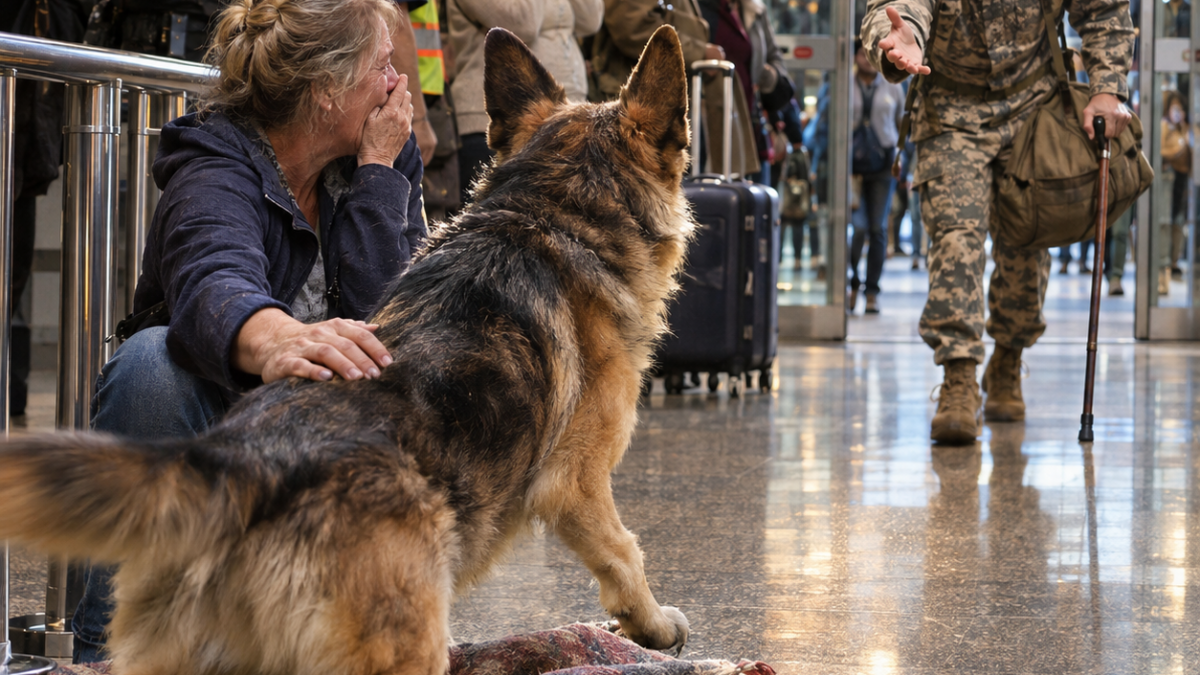
The woman holding him looked at my face.
Then at Rex.
I saw the moment she understood.
Her grip opened.
The leash dropped.
Rex ran.
People stepped back.
A suitcase tipped over.
Someone shouted.
I did not hear much of it.
I dropped my second crutch.
There are sensible ways for a man with a reconstructed leg to lower himself to the floor.
I used none of them.
I went down on one knee.
Pain flashed white through my thigh.
I barely noticed.
Rex reached me.
He could have knocked me flat.
He had done it before when excited.
He didn’t.
At the last second, he lowered his body and slammed his shoulder gently against my side instead.
Then he started shaking.
Not tail-wagging.
Not bouncing.
Shaking.
His whole body trembled as though ninety-one days of holding himself together had broken loose at once.
“Rex.”
He pushed his head underneath my chin.
“Rex.”
I wrapped both arms around him.
His fur smelled like shampoo, cold air, and dog.
The most familiar smell in the world.
He licked my hands.
My jaw.
The scar near my neck.
Then backed away.
Looked directly into my face.
Checked me.
That was exactly what he used to do overseas after an explosion.
Eyes.
Hands.
Breathing.
Then he came forward again.
His nose buried against my throat.
I started crying.
Not quietly.
There are moments when pride becomes too heavy to carry.
I had not cried when they told me Ortega was dead.
I had not cried during the first surgery.
I had not cried when physical therapy put me between parallel bars and my leg folded beneath me.
I had not cried when a doctor explained that my military career, at least the one I understood, was probably over.
I had swallowed every one of those things because I believed that was what getting through meant.
Then one dog found me in an airport and everything came out.
“I’m sorry.”
Rex licked my face.
“I’m sorry, buddy.”
His paw landed on my good thigh.
“I didn’t know where you were.”
He whined.
“I tried.”
People had stopped around us.
Some filmed.
Most simply watched.
An older woman wiped her eyes.
A teenager in Army fatigues stood beside the security line with his mouth pressed into a tight smile.
I did not care.
The young woman approached slowly.
She had short brown hair and the calm posture of someone accustomed to nervous animals.
“Sergeant Callahan?”
I looked up.
“James.”
“I’m Anna Brooks.”
She pointed toward Rex.
“I’ve been looking after him.”
I tightened my arms around the dog.
“Thank you.”
Her eyes filled.
“You should know something.”
“What?”
She looked toward the glass doors at the arrivals area.
“He’s been coming here every day.”
I stared.
“What?”
“For three months.”
“That doesn’t make sense.”
“It didn’t to us either.”
She knelt.
“When he arrived stateside, he wouldn’t settle at the kennel.”
Rex pressed closer against me.
Anna continued.
“He barely ate the first week.”
My throat tightened.
“We moved him into our veteran-dog transition facility near the airport.”
“Why the airport?”
“Our vans pass here when we pick up incoming teams and volunteers.”
She smiled through tears.
“The first morning he saw the terminal, he lost his mind.”
I looked at Rex.
Anna said:
“He dragged me to almost this exact spot.”
“What spot?”
“The arrivals barrier.”
My stomach dropped.
“He sat down.”
“For how long?”
“Four hours.”
I stared at her.
“We eventually got him back to the facility.”
“What happened the next day?”
“He refused breakfast.”
She paused.
“Until I put on my jacket.”
“What?”
“He thought we were coming back.”
I covered my face.
“No.”
Anna nodded.
“So we came.”
I looked down at Rex.
The dog leaned against my chest.
“Every day?”
“Every day we could safely manage.”
“Ninety-one days?”
“I counted after the first month.”
“Why?”
“Because I kept thinking eventually he’d stop.”
Her voice broke.
“He never did.”
I could not speak.
Anna looked toward the arrivals doors.
“He’d sit there watching soldiers come out.”
I shut my eyes.
“If someone wore your uniform pattern, he’d stand.”
My hand froze on Rex’s neck.
“If he heard crutches, he’d look.”
I started crying again.
“If a man had your build…”
“Stop.”
Anna stopped immediately.
I whispered:
“Please.”
She nodded.
“I’m sorry.”
“No.”
I rubbed my face.
“It’s not you.”
Rex pushed his nose under my hand.
The last thing I had imagined while lying awake in hospital rooms was that someone missed me.
Not politely.
Not because family obligation required it.
Missed me enough to wait in the same place every morning because giving up made less sense than believing.
I had convinced myself Rex was better off.
He had apparently built his entire life around the opposite conclusion.
Anna said:
“We tried to place him with two experienced handlers.”
“What happened?”
“He worked.”
That surprised me.
“Worked?”
“He followed commands. Passed assessments.”
“So?”
“He wouldn’t bond.”
Rex looked up at me.
Anna smiled sadly.
“He did everything asked of him and then went to the door.”
“Waiting?”
“Yes.”
“At night?”
“Yes.”
“Why didn’t anyone tell me?”
“We tried.”
I looked at her.
“Your medical team limited nonessential contact during the worst part of your recovery.”
I remembered.
There had been weeks when calls exhausted me.
Weeks when doctors were afraid depression was interfering with rehabilitation.
I had told everyone:
No visitors.
No military people.
No calls from the old unit.
Nothing.
Anna continued gently.
“And later, when we finally reached your case coordinator…”
She hesitated.
“What?”
“You told them you didn’t want to complicate his transition.”
I remembered.
The sentence.
If Rex is adapting, leave him alone.
I had said it.
Because I thought letting go was kindness.
My hand tightened around his vest.
“I abandoned him.”
“No.”
Anna’s answer came fast.
“You were hospitalized.”
“I stopped asking.”
“You were trying to survive.”
“He didn’t know that.”
“No.”
That was the truth.
Rex did not understand military paperwork.
Trauma wards.
Surgeries.
Depression.
He understood one thing.
James left.
James did not return.
And every morning he went to the place where men in uniform appeared because maybe one of them would be me.
I buried my face in his neck.
“I’m here.”
Rex’s tail moved.
“I’m here.”
Again.
“I’m sorry.”
Anna placed one hand against my shoulder.
“He knows.”
“How?”
“Because he stopped looking at the doors.”
I lifted my head.
Rex was staring only at me.
That nearly broke me worse than anything else.
Airport security eventually asked us to move.
Very politely.
Understandable.
Rex and I had become an obstacle in the middle of arrivals.
I reached for the crutches.
Anna picked them up.
“You okay?”
“No.”
She smiled.
“Fair.”
I tried to stand.
My injured leg buckled.
Rex moved instantly.
He stepped beneath my left side.
Not trained to brace weight.
Just positioning himself where he had always positioned himself.
My hand landed on his shoulder.
Muscle memory.
“Easy.”
He stayed.
Anna handed me one crutch.
Then the other.
I stood.
Rex looked up.
The old working position.
Left side.
Head even with my thigh.
Exactly where he had walked through dust, snow, barracks corridors, and places I still did not like thinking about.
I took one step.
Rex matched it.
Another.
Matched.
A third.
My leg hurt.
But something had changed.
Not physically.
Pain remained pain.
The brace remained locked.
The damage remained real.
But for the first time since the blast, movement had a destination beyond another hospital room.
At the exit, Anna held out Rex’s leash.
I looked at it.
Then at him.
I smiled.
“He doesn’t need it.”
Anna raised an eyebrow.
“Airport regulations disagree.”
I laughed.
First real laugh in months.
“Fair.”
I clipped it on.
Outside, November light stretched orange across the parking structures.
Cold air hit my face.
Rex sat beside my left boot.
His head rested against my knee.
I put one hand between his ears.
“We’re going home.”
His tail struck the pavement.
Hard.
Again.
Again.
The next problem arrived twenty minutes later.
I did not technically have legal custody of him yet.
Military working-dog transitions involve paperwork.
Ownership.
Veterinary evaluations.
Retirement status.
Adoption approval.
Rex had not been officially assigned to me.
Anna explained all of that in the parking garage.
I stared at her.
“You’re taking him away?”
Rex immediately stood.
“No.”
Anna lifted both hands.
“No.”
“Then what?”
“I’m saying we need to finish paperwork.”
“He comes with me.”
“I expected you to say that.”
“He comes with me tonight.”
She smiled.
“I already have temporary foster authorization in my bag.”
I looked at her.
“You planned this?”
“James.”
“What?”
“I have watched this dog wait for you ninety-one mornings.”
She opened the van.
“Do you really think I was going to make him watch you leave again?”
I had to look away.
“Thank you.”
“Stop making me cry in parking structures.”
Rex rode home pressed against my good leg in the back seat.
I kept my hand on his neck the entire drive.
Every time I moved, his eyes opened.
Every time the vehicle slowed, he looked toward me.
At the rehabilitation apartment, he jumped out.
Then froze.
New building.
New smells.
Elevator.
Automatic doors.
He looked at me.
I understood.
“Together.”
We entered.
The apartment was small.
Temporary housing provided while I completed outpatient rehabilitation.
One bedroom.
Brown couch.
Tiny kitchen.
A stack of medical equipment in the corner.
Rex walked every room.
Bedroom.
Bathroom.
Closet.
Returned to me.
Then circled twice and lay directly in front of the apartment door.
I stared.
Anna had warned me.
He guarded exits.
He had been doing it since I disappeared.
I sat on the floor beside him.
My leg screamed.
Worth it.
“You don’t have to do that.”
Rex put one paw over my boot.
“I’m not leaving.”
He closed his eyes.
But every time I shifted, one ear moved.
That first night I woke at 1:13 a.m.
Nightmare.
Not unusual.
Vehicle.
Heat.
Ortega shouting.
Metal.
I sat upright gasping.
Before I fully understood where I was, Rex was beside the bed.
He had climbed halfway onto the mattress.
His nose pressed against my hand.
I stared.
“Hey.”
His tail moved once.
“I’m okay.”
Lie.
He rested his chin on my chest.
My breathing slowed.
For months, nurses had taught me grounding exercises.
Five things you see.
Four you feel.
Three you hear.
Two you smell.
One you taste.
That night my grounding exercise was simpler.
Warm fur.
Dog breath.
Weight against my ribs.
Present.
Not then.
Here.
I slept.
The next morning, Rex followed me to physical therapy.
Technically, the clinic had not approved him yet.
Anna handled that.
A therapist named Dana looked at him.
“Is he trained as a mobility dog?”
“No.”
“Then he cannot physically support you.”
“I know.”
“You cannot lean on him.”
“I know.”
She looked at my hand resting on his head.
“You’re going to lean emotionally.”
“Probably.”
“Fine.”
Dana had spent eighteen years rehabilitating stubborn military patients.
She recognized her species.
That first session, I had to walk between rails.
Twenty-five feet.
I hated those rails.
They represented everything that used to happen automatically.
Step.
Shift.
Brace.
Pain.
Step.
At fifteen feet, I stopped.
“I’m done.”
Dana said:
“No.”
“I said I’m done.”
“You said that yesterday too.”
“Yesterday sucked.”
“So does today.”
I glared.
Rex sat at the far end.
Anna had brought him around so I could see him without violating the therapy space.
He stared.
I took another step.
Rex stood.
Another.
His tail moved.
Another.
I reached the end.
Dana said:
“Interesting.”
“What?”
“You walked six feet farther.”
“I hate you.”
“Everybody does.”
Rex pushed his nose into my hand.
Dana smiled.
“Keep the dog.”
That afternoon, I slept four hours.
Recovery is humiliatingly exhausting.
One hallway can feel like a mountain.
Rex stayed beside the couch.
When I woke, he had not moved.
Over the next weeks, my therapists incorporated him cautiously.
Never as a substitute for clinical treatment.
Never bearing weight he was not trained to carry.
He became motivation.
Target.
Routine.
Walk to Rex.
Walk with Rex beside the outdoor path.
Stand long enough to brush him.
Bend carefully to fill his bowl.
Things that resembled life instead of tests.
That mattered.
My medical team had been worried about me before he returned.
I found that out later.
Not because I was suicidal in some dramatic way.
I had simply stopped caring enough.
There is a dangerous kind of despair that does not announce itself with speeches.
You attend therapy.
Take pills.
Eat because somebody places food in front of you.
Answer questions.
But nothing pulls you toward tomorrow.
That was where I had been.
Not trying to die.
Not particularly interested in living.
Rex changed that.
Not magically.
I still had nightmares.
Still hated crowds.
Still lost my temper.
Still stared at the wall some mornings because putting on pants felt impossible.
But Rex had needs.
Six-thirty breakfast.
Seven-thirty bathroom.
Walk.
Medication for an old joint injury.
Water.
Grooming.
He did not care whether I believed in my future.
He believed in breakfast.
That was enough to get me out of bed.
One morning in December, snow fell overnight.
Rex woke me before sunrise.
I looked outside.
White.
“Absolutely not.”
His ears lifted.
“No.”
He walked toward the door.
“Traitor.”
Tail wag.
I put on the brace.
Coat.
Boot.
Used one crutch now instead of two.
We went outside.
Snow made everything quiet.
Rex walked slowly.
For me.
I knew he could move faster.
He matched my limp.
Step.
Step.
Pause.
At the corner, I stopped.
Pain.
He stopped.
I looked at him.
He looked forward.
Not back.
Waiting.
I moved.
We made it around the block.
My longest outdoor walk since hospitalization.
When we returned, I sat on the apartment floor laughing and crying.
Rex licked snow from my jacket.
I called my sister.
She answered half asleep.
“James?”
“I walked around the block.”
Silence.
Then I heard her crying.
“You did?”
“Yeah.”
“All the way?”
“Yeah.”
“Rex?”
“Rex.”
She laughed.
“I hate that dog.”
“No you don’t.”
“I’ve been trying to motivate you for two months.”
“He has better ears.”
“Jerk.”
That was the first normal conversation we’d had since the blast.
Rex did not repair only my body.
He made people less afraid to talk to me.
Before him, everyone treated me like glass.
How’s your pain?
How are you coping?
Need anything?
Then Rex stole a hamburger from my sister’s five-year-old during Christmas dinner.
The child screamed.
My sister yelled.
I laughed until my ribs hurt.
Normal chaos.
Life returned through small things.
The paperwork making Rex officially mine was completed in January.
Medically retired.
Transferred.
Adoption approved.
Anna brought the final document.
I signed.
She handed me the folder.
“Congratulations.”
I looked at Rex.
“You hear that?”
He yawned.
Anna sat at my kitchen table.
For a long moment, she said nothing.
Then:
“I’m going to miss him.”
I looked at her.
Of course.
She had spent three months caring for the animal everyone kept describing as mine.
“Anna.”
She smiled quickly.
“No guilt.”
“You brought him every day.”
“He brought me.”
“What?”
“After about two weeks, I tried skipping the airport.”
I waited.
“He refused to get in the facility van for anything else.”
I laughed.
“Seriously?”
“Yes.”
“I took him to the park.”
“He sat by the gate.”
“Training yard?”
“Gate.”
“Vet?”
“Afterward, gate.”
She shook her head.
“So I gave up.”
I looked down.
Rex slept beside my chair.
“Why did you keep doing it?”
Anna’s eyes filled.
“Because on day twenty-three, a flight came in with a group of soldiers.”
I looked at her.
“Rex stood.”
She paused.
“There was one man about your height, walking with a duffel bag.”
My chest tightened.
“Rex ran three steps.”
Anna swallowed.
“Then the man turned.”
“Not me.”
“No.”
“What did Rex do?”
She looked away.
“He sat back down.”
That image hurt more than I expected.
“How many times?”
“Several.”
I covered my mouth.
Anna continued:
“After that I stopped asking why we were going.”
“Why?”
“Because hope was the only thing he was doing voluntarily.”
I looked at Rex.
“He never gave up?”
“No.”
Anna smiled.
“I did.”
“What?”
“By month two, I thought maybe you weren’t coming.”
“Why?”
“Your status updates were vague.”
I nodded.
“Rehab.”
“I know.”
“I started wondering if bringing him was cruel.”
My throat tightened.
“What changed your mind?”
“Rex.”
“How?”
“He would sit facing the doors.”
She looked directly at me.
“Never the exit.”
I did not understand.
“He never watched where people left.”
“He watched where they arrived.”
I cried.
Again.
Apparently becoming emotionally unstable around this dog was permanent.
Spring came.
By March, I used a cane.
By April, short distances without it.
My gait would never be exactly what it was.
Doctors stopped promising “full recovery.”
They started saying “best functional outcome.”
At first I hated that phrase.
Then I learned to live inside it.
Best did not mean before.
Best meant what could still exist.
Rex helped with that too.
He had scars.
Old injuries.
He favored one hind leg after long walks.
None of it made him less Rex.
Why did I believe damage made me less James?
That question took therapy—not dog loyalty—to answer.
Important distinction.
Rex opened the door.
Professionals helped me walk through.
I started seeing a trauma therapist named Dr. Elena Morris.
First session:
“I don’t want to talk about the blast.”
“Fine.”
“Really?”
“Yes.”
“What are we going to talk about?”
“Why you believe needing a dog is evidence of weakness.”
I stared.
“I don’t.”
“You apologized to me three times for bringing him.”
“That’s courtesy.”
“That’s shame.”
I hated her immediately.
Good sign, apparently.
Therapy was harder than physical rehab in different ways.
The body screams when you push too far.
The mind negotiates.
I told Elena about Ortega.
About the convoy.
About the pieces I remembered.
About the pieces I didn’t.
About waking in Germany.
Then:
Rex.
Waiting.
The airport.
“I abandoned him.”
She asked:
“What choice did you make?”
“I stopped asking.”
“Why?”
“Because I thought he was better without me.”
“Evidence?”
“I was broken.”
“Is broken a medical term?”
I glared.
“No.”
“What did Rex do when he saw you?”
I knew where she was going.
“He came.”
“Then maybe he gets a vote.”
That sentence stayed with me.
Maybe people who love us get a vote before we decide they would be better off without us.
Rex voted every morning.
He woke beside my bed.
Followed me to breakfast.
Sat by the shower.
Waited through therapy.
Slept against the door.
If I left for an appointment without him, Anna sometimes stayed.
He tolerated it.
But when I returned, he acted like I had been gone three years.
Eventually that changed.
One afternoon I returned from therapy.
Opened the door.
Rex remained on the couch.
I froze.
“Rex?”
He opened one eye.
Tail thump.
That was all.
I laughed.
Anna, sitting at the kitchen table, looked confused.
“What?”
“He didn’t panic.”
She smiled.
Rex yawned.
I walked over.
Knelt slowly.
“You knew I was coming back.”
His tail moved.
I pressed my forehead against his.
“Good.”
That mattered more than people might understand.
At the airport, he had spent ninety-one days uncertain.
At home, slowly, he learned:
James leaves.
James returns.
For groceries.
Therapy.
Appointments.
Coffee.
James returns.
Trust does not grow from one reunion.
It grows from repetition after reunion.
I needed the same lesson.
I began believing I could leave home without something exploding.
Could sleep without waking overseas.
Could plan next month.
Could say “next year” without feeling like I was tempting fate.
Rex and I learned permanence together.
One year after the airport reunion, Anna invited us back.
I almost refused.
Airports triggered me.
Noise.
Crowds.
Uniforms.
Memory.
She said:
“No pressure.”
Then explained the veterans’ organization was holding a small event to raise money for transitional care of retired working dogs.
Rex’s story had become known after airport videos circulated.
I hated the videos initially.
Strangers had filmed me crying on the floor.
Great.
The organization asked permission before using anything officially.
I agreed on one condition:
No “dog cures wounded veteran” nonsense.
Anna laughed.
“Very specific.”
“I mean it.”
“He helped.”
“Yes.”
“Therapy helped.”
“Yes.”
“Medicine.”
“Yes.”
“Family.”
“Yes.”
“Time.”
“Yes.”
“So we say that.”
Good.
We returned to the airport.
Rex recognized it before we entered.
His body stiffened in the parking garage.
I stopped.
“You okay?”
He looked at me.
Then toward the terminal.
We entered slowly.
The arrivals hall looked smaller.
That surprised me.
Memories enlarge rooms.
Anna pointed.
“There.”
Same barrier.
The place he waited.
Rex approached.
Sat.
My throat tightened.
People passed.
He watched the doors for maybe five seconds.
Then looked up at me.
Stood.
Walked back to my side.
I smiled through tears.
“You’re done?”
Tail wag.
He had no reason to wait anymore.
The person he wanted was standing beside him.
We left before the event even started.
Anna caught up.
“Where are you going?”
“Outside.”
“You’re supposed to speak.”
“I will.”
“Why leave?”
I looked at Rex.
“He already finished.”
She understood.
At the event, I said something simple.
“Do not tell this story as a miracle.”
The room went quiet.
“Rex did not rebuild my leg.”
“He did not replace surgeons.”
“He did not treat trauma.”
“He did not erase the men we lost.”
I looked at him.
“But when I stopped believing there was anything on the other side of recovery worth reaching, he reminded me that somebody had been reaching back the whole time.”
That was the truth.
The video of that speech went farther than the airport clip.
I never understood why.
Maybe because people are tired of miracles that make suffering disappear.
Real recovery is uglier.
Slower.
You can be grateful and angry.
Loved and still depressed.
Alive and not yet sure what to do with survival.
Rex never required me to be inspirational.
He just required me to fill his water bowl.
That was enough.
Years passed.
I did not return to active deployment.
Eventually I accepted a medical retirement.
That was harder than the surgeries.
The Army had been my structure.
Identity.
Language.
Then one morning I put my uniform into a garment bag.
Rex sat in the doorway watching.
I touched the sleeve.
“Guess that’s it.”
He yawned.
“Could pretend to care.”
No response.
I laughed.
Maybe dogs are good at reminding us titles are for humans.
To Rex I had never been Sergeant Callahan.
I was the person who smelled right and came back.
We moved into a small house outside Colorado Springs.
Fenced yard.
One level because stairs and my leg remained enemies.
Rex claimed the window beside the front door.
I volunteered with the same veterans’ organization that had cared for him.
At first I repaired kennels.
Then helped transport dogs.
Eventually I began talking to veterans entering the transition program.
One young Marine named Caleb sat across from me and said:
“My family would be better off if I didn’t go home.”
I knew that sentence.
“What evidence?”
He looked at me.
“What?”
“Evidence.”
“I’m messed up.”
“That isn’t evidence.”
He frowned.
I pointed toward Rex asleep under the table.
“I thought he was better off without me.”
“What happened?”
“He waited ninety-one days at an airport.”
Caleb stared.
“That’s insane.”
“Correct.”
Rex opened one eye.
Caleb smiled for the first time.
Sometimes stories help.
Not because they solve people.
Because they interrupt the certainty of despair.
Caleb went home.
It was not magically perfect.
He still struggled.
So did I.
But he went.
Rex aged.
Dogs are cruel that way.
They save you, then their bodies move through time faster than yours.
The first gray appeared around his muzzle when he was nine.
Then more.
His hips stiffened.
The dog who once sprinted across an airport began needing a ramp into my truck.
I built one.
Badly.
Anna inspected it.
“This is terrible.”
“It works.”
“It violates several laws of carpentry.”
“I was infantry.”
“Exactly.”
We bought a better one.
Rex developed arthritis.
Medication helped.
Shorter walks.
More sleep.
Still beside me.
Always.
When I left the house, he no longer waited at the front door.
He knew.
I would come back.
That trust became the greatest gift I ever received from him.
Then one September morning, he did not eat.
Rex had refused food only twice in all the years I knew him.
Once after the convoy separation.
Once after a stomach infection.
I sat beside the bowl.
“Come on.”
He sniffed.
Turned away.
My stomach dropped.
Vet.
Bloodwork.
Ultrasound.
Mass.
Spleen.
Likely cancer.
We had options.
Surgery.
Risky at his age.
Possible temporary benefit.
No guarantees.
I asked every question.
Because I had learned not to let fear make decisions before facts.
The veterinarian was kind.
“If he were two years younger…”
I understood.
“How much time?”
“Could be weeks.”
“Months?”
“Possibly.”
“With comfort?”
“That’s our goal.”
I drove home with Rex in the back.
At a red light, I looked in the mirror.
He was watching me.
I laughed bitterly.
“Of course.”
His ears moved.
“You waited ninety-one days.”
I swallowed.
“And now I’m supposed to learn how to let you go.”
He rested his head on the seat.
I hated him for that.
Not really.
Grief searches for targets.
We had six good weeks.
Then four mixed ones.
Rex still walked to the mailbox.
Still barked at squirrels.
Still stole half a steak from Anna when she visited.
She said:
“If he can commit crimes, he’s fine.”
Good medical standard.
Then bad days started outnumbering good.
He struggled to stand.
Panted at night.
One evening he collapsed in the yard.
I carried him inside.
Seventy pounds used to feel light when adrenaline took over.
At fifty-two, with a damaged leg, he felt enormous.
We ended up on the living-room floor.
His head in my lap.
He looked tired.
Not frightened.
Tired.
I knew.
Humans spend a lot of time pretending we do not know.
I knew.
I called Anna.
Then my sister.
Then the veterinarian.
The vet came to the house the next afternoon.
Anna sat on the floor beside us.
Rex wore no service vest.
No collar except his old leather one.
The red vest from the airport lay folded on the table.
I had kept it all those years.
The veterinarian explained the medication.
I nodded.
Could barely hear.
My right hand stayed on Rex’s chest.
Heart.
Slow.
Steady.
Anna said:
“Do you want a minute?”
I laughed once.
“Ninety-one days wasn’t enough.”
She cried.
So did I.
Rex lifted his head.
Barely.
I leaned closer.
“Hey.”
His eyes met mine.
Cloudy with age.
Same dog.
Same eyes.
“I need to tell you something.”
His tail moved once against the blanket.
“I thought nobody was waiting.”
I swallowed.
“I was wrong.”
Another tiny tail movement.
“You waited.”
My voice broke.
“Every damn day.”
I put my forehead against his.
“You don’t have to anymore.”
Anna covered her face.
“I’m here.”
Rex breathed.
“I’m not going anywhere.”
His nose touched my wrist.
The exact place he used to nudge when waking me from nightmares.
I whispered:
“You found me.”
His eyes closed.
“No.”
I shook my head.
“Look at me one more time.”
His eyes opened.
I hated myself for asking.
Then:
“Good boy.”
His breathing slowed.
“You can go.”
Those three words almost killed me.
Because for years, the entire lesson between us had been:
Come back.
Come back.
Come back.
Now love required the opposite.
“You can go.”
The veterinarian administered the final medication.
Rex relaxed.
No struggle.
His head became heavier in my lap.
I kept talking.
“Remember the airport?”
Ridiculous.
“Remember how you scared half of Denver?”
Anna laughed through tears.
“You ruined my knee.”
Rex breathed once.
Then again.
Then stopped.
I did not.
I kept my hand on his chest long after there was nothing left to feel.
Anna eventually put both arms around me.
I whispered:
“He waited for me.”
“I know.”
“I should’ve had more time.”
“I know.”
“I wasted three months.”
“No.”
“I did.”
“James.”
She grabbed my face and made me look at her.
“He got you back.”
I could not answer.
She continued.
“And after that, he spent years knowing exactly where you were.”
That helped.
Not immediately.
But later.
I had Rex cremated.
Part of his ashes went beneath a tree in my yard.
Part I kept.
His red service vest hung beside my old uniform.
Two identities.
Soldier.
Dog.
Both retired.
Both carried more history than fabric should hold.
The house became unbearable for a while.
No nails on hardwood.
No breathing beside the bed.
No body blocking the bathroom doorway.
I still stepped around the place where his water bowl had been.
Grief creates ghosts out of routine.
Three months after Rex died, I found myself at Denver International Airport.
I had not planned to go.
Anna called.
A young Army medic was coming home after a long rehabilitation.
His family had asked the veterans’ organization to help with arrival because he was anxious about crowds.
I said no.
Then yes.
I stood near the arrivals barrier.
The same place.
People came through.
Families cheered.
Children ran.
I looked at the floor where Rex’s paws had once slipped while trying to reach me.
Anna stood beside me.
“You okay?”
“No.”
“Want to leave?”
“No.”
A soldier appeared.
Young.
Cane.
His mother began crying.
He froze.
Then slowly walked toward her.
I watched.
And for a moment, I could almost hear barking.
Not literally.
Memory.
I smiled.
Anna said:
“What?”
“Nothing.”
We helped the soldier leave through a quieter exit.
Outside, I looked at the sunset.
Orange.
Pink.
Almost exactly like the day Rex and I walked out together.
I finally understood something.
I had spent years believing Rex waited because he was unable to move on.
Maybe that was part of it.
But waiting is not always weakness.
Sometimes waiting is an act of faith.
He had no orders.
No flight number.
No calendar.
No guarantee.
He only knew I had left.
And that sometimes people return.
So he showed up.
Day one.
Day twelve.
Day thirty.
Day sixty.
Day ninety-one.
Then I did.
For the rest of his life, Rex taught me a lesson I had failed to learn from any medal, therapist, doctor, or military manual:
Being wounded does not make you unworthy of being waited for.
Needing help does not make you a burden.
And sometimes the people—or animals—you are trying to protect by disappearing would rather have the damaged version of you than the memory of you.
That is what I tell veterans now.
Not that a dog will save them.
Not that love fixes trauma.
Not that coming home ends the war inside your head.
I tell them:
Do not make the decision for everyone else that they would be better without you.
Let them vote.
Let them wait.
Let them show up.
Rex voted ninety-one times before I listened.
Years later, I still go to the airport sometimes with Anna.
Not every day.
God, no.
Rex was the obsessive one.
We meet wounded veterans.
Retiring handlers.
Dogs moving into civilian homes.
Families trying to understand people who are returning with invisible pieces missing.
There is one bench near arrivals where I sometimes sit.
A small plaque was installed there by the veterans’ organization.
I refused anything grand.
No statue.
No heroic language.
It says:
FOR REX — WHO KEPT COMING BACK TO WAIT.
Underneath:
AND FOR EVERYONE STILL ON THEIR WAY HOME.
Sometimes travelers ask who Rex was.
I usually say:
“My dog.”
That is enough.
If they ask more, I tell them the airport story.
But I always correct one part.
People say:
“He waited three months because he knew you’d return.”
I don’t know that.
Maybe he didn’t know.
Maybe every morning he was terrified I never would.
That makes what he did more meaningful.
Hope is not knowing the ending.
Hope is showing up anyway.
That is what Rex did.
And on the day I finally walked through those doors, I had arrived believing nobody was waiting for a broken soldier.
Then I heard him bark.
One sound.
That was all it took to destroy the lie I had been telling myself for months.
I turned.
He saw me.
And for the rest of his life, I never again had to wonder whether coming home mattered.
The answer had crossed an airport terminal at full speed and buried its face against my neck.








